1. Introduction
In this work, we will use terminologies and traditional notations from [
1]. Let
be a finite, simple, and undirected connected graph with vertex set
and edge set
. The order of
G is the number
of its vertices and its size is the number
of its edges. The adjacency matrix of
G, denoted by
, is a
matrix whose
-entry is equal to 1 if
and
are adjacent in
G and 0 otherwise. The degree of
in
G is denoted by
.
The Laplacian matrix of
G is the matrix
, where
is the diagonal matrix of
G whose diagonal entries are the degrees of the vertices of
G. The characteristic polynomial of
is defined as
where
is the identity matrix of order
n. Note that
is positive semi-definite. The Laplacian spectrum of
G is denoted by
, and we assume that the eigenvalues are labeled such that
.
The distance between vertices
and
in
G, denoted by
, is the length of the shortest path between them in
G. The Wiener index, a distance-based topological index, was first presented by Wiener in chemistry back in 1947 [
2] and in mathematics about 40 years later [
3]. The famous Wiener index
is defined as
where the sum is taken over all distances between pairs of vertices of
G.
At present, the Wiener index has been widely studied, and many research results have been obtained [
4,
5,
6,
7,
8,
9].
The topological index in a graph distance function can explain the structure and properties of a graph well. In 1993, Klein and Randić [
10] introduced a distance function named resistance distance on the basis of electrical network theory. The resistance distance between vertices
and
, denoted by
, is defined to be the effective electrical resistance between them if each edge of
G is replaced by a unit resistor. One famous resistance distance-based parameter called the Kirchhoff index,
[
10], was given by
Moreover, Klein and Randić [
10] proved that
and
with equality if and only if
G is a tree.
Similar to the Wiener index, the Kirchhoff index is also intrinsic to the graph, not only with some fine, purely mathematical properties, but also with a substantial potential for chemical applications. Unfortunately, it is difficult to compute the resistant distance and Kirchhoff index in a graph due to their computational complexity. Thus, it is necessary to find closed-form formulas for the Kirchhoff index.
It is worth noting that the resistance distance between any two vertices can be obtained in terms of the eigenvalues and eigenvectors of the Laplacian matrix in an electronic network. Therefore, for any connected graph
G of order
, it is shown, independently, by Gutman and Mohar [
11] and Zhu et al. [
12] that
For some graphs with a good structure, such as graphs with good periodicity and good symmetry, researchers can calculate the closed-form formulas of the Kirchhoff index of those graphs. Readers are referred to the references [
13,
14,
15,
16,
17,
18] and the references therein.
A linear pentagonal chain of length
n, denoted by
, is a pentagonal chain with
pentagons in which two pentagons with two edges in common can be regarded as adding one vertex and two edges to a hexagon. Wang and Zhang [
19] obtained the explicit closed-form formulas of the Kirchhoff index of linear pentagonal chains. Wei et al. [
20] made comparisons between the expected values of the Wiener index and the Kirchhoff index in random pentachains and presented the average values of the Wiener and Kirchhoff indices with respect to the set of all random pentachains with
n pentagons. Recently, Sahir and Nayeem [
21] derived closed-form formulas for the Kirchhoff index and the Wiener index of the linear pentagonal cylinder graph and the linear pentagonal Möbius chain graph. The study of hexagonal systems have attracted interest because they are natural graph representations of benzenoid hydrocarbon [
22], and they have been of great interest and extensively studied; see [
5,
17,
23].
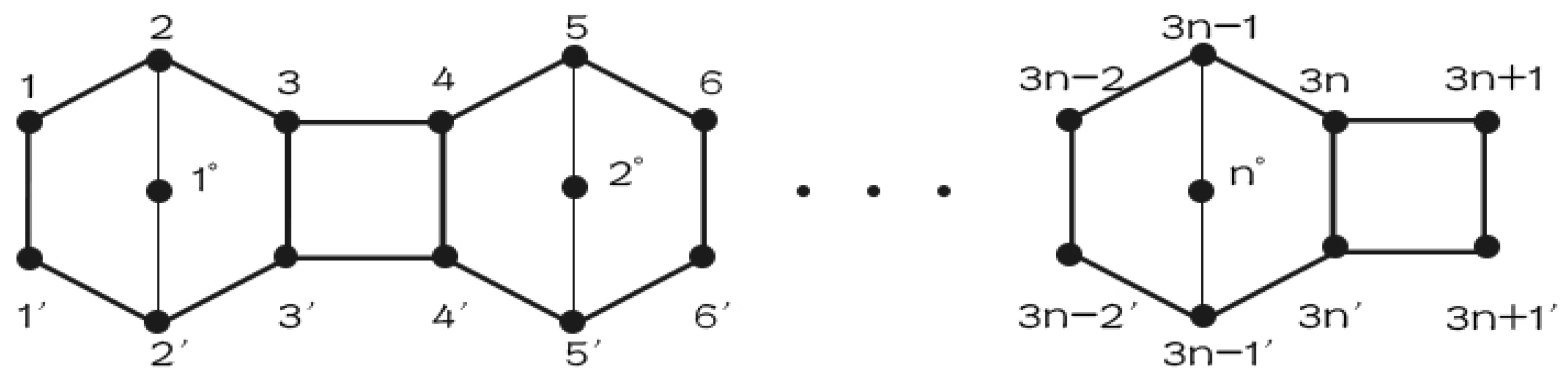
Consider a linear pentagonal chain
consisting of
pentagons. The linear pentagonal derivation chain, denoted by
, is thus the graph obtained by attaching four-membered rings to every two pentagons of
, as depicted in
Figure 1. It is easy to check that
,
. Obviously, the linear pentagonal derivation chain
is different from random pentachains, a linear pentagonal cylinder graph, and a linear pentagonal Möbius chain graph.
In this paper, we focus on the linear pentagonal derivation chain . Firstly, the Laplacian spectrum of consisting of the eigenvalues of two symmetric matrices, is determined. Next, using the decomposition theorem for the Laplacian characteristic polynomial, the explicit closed-form formulas for the Kirchhoff index and the number of spanning trees of can be represented. Interestingly, the Kirchhoff index is about half of the Wiener index of a linear pentagonal derivation chain .
3. The Kirchhoff Index and the Number of Spanning Trees of the Linear Pentagonal Derivation Chain
In this section, on the basis of Lemma 1, we derive the Laplacian eigenvalues of linear pentagonal derivation chains . Next, we present a complete description of the sum of the Laplacian eigenvalues’ reciprocals and the product of the Laplacian eigenvalues, which will be used in obtaining the Kirchhoff index and the number of spanning trees of , respectively. Finally, we prove that the Kirchhoff index of is approximately one half of its Wiener index.
Let
M be an
square matrix. We will then use
to denote the sub-matrix obtained by deleting the
i-th,
j-th,
k-th rows and the corresponding columns of
M. According to
Figure 1,
,
,
, and
are given as follows:
Since
and
we have
and
By Lemma 1, the Laplacian spectrum of consists of eigenvalues of and . Hence, assume that the eigenvalues of and are, respectively, denoted by and . Therefore, it is easy to verify that , and .
Considering
, we can assume that
Theorem 2. Let , , , and be defined as above. Suppose is a linear pentagonal derivation chain with length n. We then have Proof. Since
with
,
are the roots of the above equation. By Vieta’s formulas, we obtain
For
with
, we know
are the roots of the above equation. Applying Vieta’s Formulas to Equation (5) yields
Note that
. By (
1), we obtain
In the following, it suffices to determine
,
,
, and
in Equation (
7).
Claim 1. Proof. It is well known that the number
is the sum of the determinants obtained by deleting the
i-th row and the corresponding column of
for
(see also in [
28]), that is
Case 1.. Based on the structure of
(see also in (
2)), deleting the
i-th row and the corresponding column of
is equivalent deleting the
i-th row and the corresponding column of
, the
i-th row in
, and the
i-th column in
. We denote the resulting blocks as
,
,
, and
, respectively. If we then apply Lemma 3 to the resulting matrix, we have
where
and there is only one 3 in the
-th row of
for
.
Applying elementary operations of the determinant, we have
Therefore, for
, we obtain
Case 2. In this case, according to the structure of
, deleting the
i-th row and the corresponding column of
is equal to deleting the
-th row and the corresponding column of
, the
-th column in
, and the
-th row in
. We denote the resulting matrices as
,
,
, and
, respectively. Thus, by Lemma 3, we obtain
where
and the
are as follows:
By a direct calculation, one can see that
, so
. Hence, for
, we obtain
Together with (
8)–(
10), we have
This completes the proof. □
Claim 2. Proof. Note that
is the sum of the determinants of the resulting matrix by deleting the
i-th row and
i-th column as well as the
j-th row and
j-th column for some
in
. That is,
According to the range of i and j, there are three cases in which the number can be calculated as follows.
Case 1.. In this case, to delete the
i-th and
j-th rows and the corresponding columns of
is to delete the
i-th and
j-th rows and the corresponding columns of
, the
i-th and
j-th rows of
, and the
i-th and
j-th columns of
. If we denote the resulting matrices, respectively, as
,
,
, and
and apply Lemma 3 to the resulting matrix, we have
where
and there is one 3 in the
-th and
-th rows of
for
, respectively.
By straightforward computing, we have
Therefore, when
, we obtain
Case 2.. In this case, to delete the
i-th and
j-th rows and the corresponding columns of
is to delete the
-th and
-th rows and the corresponding columns of
, the
-th and
-th columns of
, and the
-th and
-th rows of
. If we denote the resulting blocks, respectively, as
,
,
, and
and apply Lemma 3 to the resulting matrix, we have
where
and the
are as follows:
By direct calculation, one can get
Hence, for
, we obtain
Case 3.,
. Similarly, to delete the
i-th and
j-th rows and the corresponding columns of
is to delete the
i-th row and the
i-th column of
, the
-th row and
-th column of
, the
i-th row and
-th column of
, and the
-th row and
i-th column of
. If we denote the resulting matrices, respectively, as
,
,
, and
and apply Lemma 3 to the resulting matrix, we have
Subcase 3.1. If
,
, then the matrix
is
and there is only one 3 in the
-th row of
for
.
Subcase 3.2. If
,
, then the matrix is
where
Subcase 3.3. If
,
or
,
, then the matrix is
where
and there is only one 3 in the
-th row of
E, or
and there is only one 3 in the
-th row of
F.
By the basic calculation of the determinant, we have .
Hence, for
,
, we obtain
Combining this with (
11)–(
14), we obtain
This completes the proof. □
In order to determine
and
in (
7), we consider the
k order principal submatrix,
, formed by the first
k rows and the first
k columns of
,
. Put
. We proceed by proving the following fact.
Fact 1. For
, the integers
satisfy the recurrence
with the initial conditions
and
Proof. It is easy to verify that
and
For
, expanding
with regard to its last row, we have
For
, let
; for
, let
; for
, let
. Therefore,
Hence,
,
and
. Therefore, for
,
satisfies the recurrence
where
and
. □
Claim 3. .
Proof. By Fact 1, the characteristic equation of
is
, whose roots are
and
. Assume that
. Considering the initial conditions
and
, we obtain the systems of the following equations:
A direct computation shows that
, so
In the same way, we can obtain
and
as follows:
Since
and
, we obtain
By an expansion formula, we can obtain
with respect to its last row as
This completes the proof. □
Proof. Since
is the sum of all those principal minors of
, each of which is of size
, we have
Note that
H is a
matrix obtained from
by deleting the first
i rows and the corresponding columns. Let
. Whence, we get
, where
Thus,
Combining (
15) with (
17), we know that
and
Hence, if (
19)–(
21) is placed into (
18), Claim 4 follows directly. □
Finally, substituting Claims 1–4 into (
1), Theorem 2 follows immediately. □
Theorem 3. Let be a linear pentagonal derivation chain with length n. Therefore, Proof. According to Lemma 2, we know that
, where
represents the Laplacian eigenvalues of
G for
. Note that the eigenvalues of
and
are
and
, respectively. Therefore, by Claims 2 and 3,
This completes the proof. □
Based on Theorem 2, we can easily obtain the Kirchhoff indices of linear pentagonal derivation chains from
to
, which are listed in
Table 1.
By Theorem 3, it is not difficult to obtain the numbers of spanning trees of linear pentagonal derivation chains from
to
, which are shown in
Table 2.
At the end of this section, we characterize the relation between the Kirchhoff index and the Wiener index of .
Theorem 4. Let be a linear pentagonal derivation chain with length n. Therefore, Proof. Firstly, we determine
, we evaluate
for all vertices (fixed
i and for all
j), and we then add them all together and divide them by two in the end. The expression of each type of vertex is
Together with Theorem 2, our result follows immediately. □