


Abstract
The paper deals with two general families of cumulative distribution functions based on arctangent function. We provide analysis of the error of the best one-sided Hausdorff approximation for some special cases of these families. We obtain precious estimates for the value of the Hausdorff distance that can be used as an additional criterion in practice. Further, the family of recurrence generated adaptive functions is constructed and investigated. All new results are illustrated with suitable numerical experiments. Simple dynamic software modules show applicability of Hausdorff approximation.
Keywords:
generated family; trigonometric distribution; Hausdorff distance; Heaviside step function; upper and lower bounds; recurrent family MSC:
41A46
1. Introduction
Over the last few years, the general classes of trigonometric distributions have been seriously studied by many researchers. The main goal of these new distributions is to create models with a small number of parameters but a high degree of flexibility using trigonometric functions and their inverses. Some of these new families are based on Cauchy distribution and involve the arctangent function. For example, one can see generalized odd half-Cauchy-G (GOHC-G) family [1], the odd power Cauchy-G family (OPC-G) [2], truncated Cauchy power-G family (TCP-G) and its extensions [3], extended odd Half-Cauchy-G family (EOHC-G) [4], Arctan-X family [5] and many others.
Recently Altun, Alizadeh, Ramires and Ortega [6] proposed a new family of distributions named generalized odd power Cauchy-G (GOPC-G). The cumulative distribution function of GOPC-G family is given by
where is the cumulative distribution function of the baseline distribution and represents the parameter vector of the baseline distribution, and are the shape parameters.
In [7] Shrahili and Elbatal construct a new family called Truncated Cauchy Power Odd Fréchet-G (TCPOF-G) family of distributions with cumulative distribution function defined by
where and .
The main purpose of this paper is to investigate some properties of cumulative function for some of the special cases of GOPC-G family and TCPOF-G family. We need an approximation error between sigmoidal (cumulative) function and a step function if we want to substitute the one for the other. Hausdorff metric between the graphs of these functions is a native metric that can be used in this case. We look for an expression for the error of the best one-sided approximation from cumulative function to the horizontal asymptote (at the median level) in the Hausdorff sense. This characteristic can help researchers in the choice of a suitable model for approximating specific cumulative data.
Definition 1.
The interval Heaviside step function is defined by
Definition 2
([8,9]). The one-sided Hausdorff distance between two interval functions on , is the one-sided Hausdorff distance between their completed graphs and considered as closed subsets of . More precisely,
wherein is any norm in , e.g., the maximum norm ; hence, the distance between points , in is .
According to authors’ knowledge, only Kyurkchiev and Iliev [10,11] have made an investigation on Hausdorff approximation of the Heaviside step function and distribution functions containing arctangent function. Similar investigation on some generalized trigonometric distributions (Sin-G, Cos-G and Tan-G families) can be found in [12,13,14,15,16,17,18]. The investigations on the Hausdorff approximation can be useful when researchers make a choice for an approximation model of cumulative data in various modeling problems—from growth theory, population dynamics, biostatistics, computer viruses propagation, debugging and test theory, financial and insurance mathematics and many others. One can see some modeling and approximation problems in related articles [19,20,21,22] and references therein.
The rest of the paper is organized as follows: Section 2 is devoted to distance d to the horizontal asymptote in the Hausdorff sense. We obtain precise estimates for this one-sided Hausdorff approximation for four special cases of proposed families. Some numerical examples show the feasibility of obtained results. We propose two simple dynamic software modules, implemented within the programming environment CAS Wolfram Mathematica. First one present new results using real cumulative data. Second one shows Hausdorff approximation of two submodels from proposed families with the same baseline distribution. In Section 3, we construct a new family of recurrence generated adaptive functions based on the GOPC-G family. Further, we explore asymptotic behavior of the one-sided Hausdorff distance of the shifted Heaviside function by means of the corresponding family. Finally, some concluding remarks are included in Section 4.
2. Approximation Results
This section is devoted to investigation of error of the best one-sided approximation to the horizontal asymptote (at the median level) in the Hausdorff sense. We present a detailed study of two special cases of GOPC-G family and TCPOF-G family considered from [6,7], respectively. The reader can formulate other special cases of proposed families using different baseline distributions with corresponding approximation problems.
2.1. Generalized Odd Power Cauchy-G Family
Here we shall prove that cumulative function tends to Heaviside step function. The one-sided Hausdorff distance is a square (box) unit ball in the case of maximum norm. From Definition 2 we have that distance d is the side of the smallest unit square, centered at the point touching the graph of the cumulative function. First the following equality holds true
where is defined by (1).
Hence, for this “median” level for the one-sided Hausdorff approximation d between cumulative distribution function and the Heaviside step function we have
Next theorem gives upper and lower estimates for the one-sided Hausdorff distance d. Note that one can use them as an additional criteria in investigation of one-sided Hausdorff approximation.
Theorem 1.
Let
Then the one-sided Hausdorff distance d between interval Heaviside step function and the cumulative distribution function defined by (1) satisfies the following inequalities for :
Proof.
Let us define a function as follows
Function is increasing since . We consider the approximation of as we use the function
where A is defined by (4). From Taylor series we have
where . Then using that we obtain
So we obtain that . Note that function is increasing too. Hence, approximates with as . Let . It is easy to check that the following inequalities hold true
that completes the proof. □
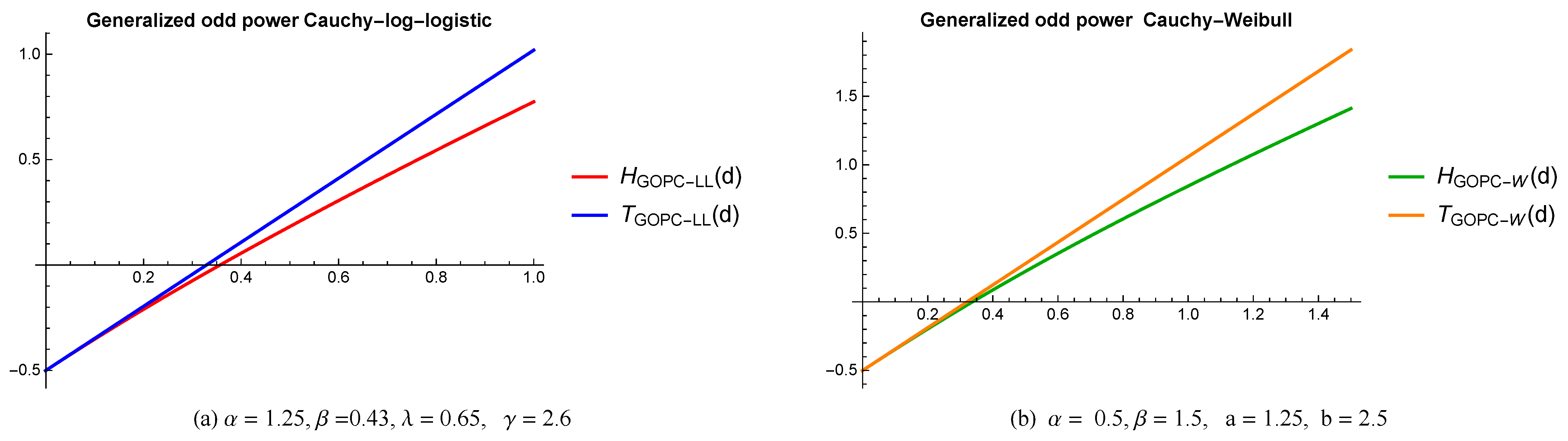
We consider two special cases of GOPC-G family with baseline distributions: Log-logistic and Weibull called GOPC-LL and GOPC-W, respectively. Figure 1 presents graphs of approximation functions H and T for fixed parameters in the cases of GOPC-LL and GOPC-W distributions.
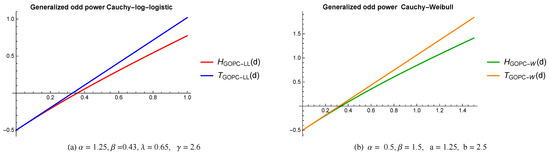
Figure 1.
Graph of functions and in the cases of GOPC-LL and GOPC-W distributions.
The cumulative distribution function of log-logistic distribution is given by
where , and .
Definition 3.
Generalized odd power Cauchy-log-logistic (GOPC-LL) distribution is associated with the cumulative distribution function given as
Then for the one-sided Hausdorff approximation (using square unit ball with a side d) we have
where
Now we are ready to state our first corollary of Theorem 1. It shows how one-sided Hausdorff distance is related with parameters of cumulative distribution function.
Theorem 2.
Let
Then the one-sided Hausdorff distance d between interval Heaviside step function and the cumulative distribution function defined by (5) satisfies the following inequalities for :
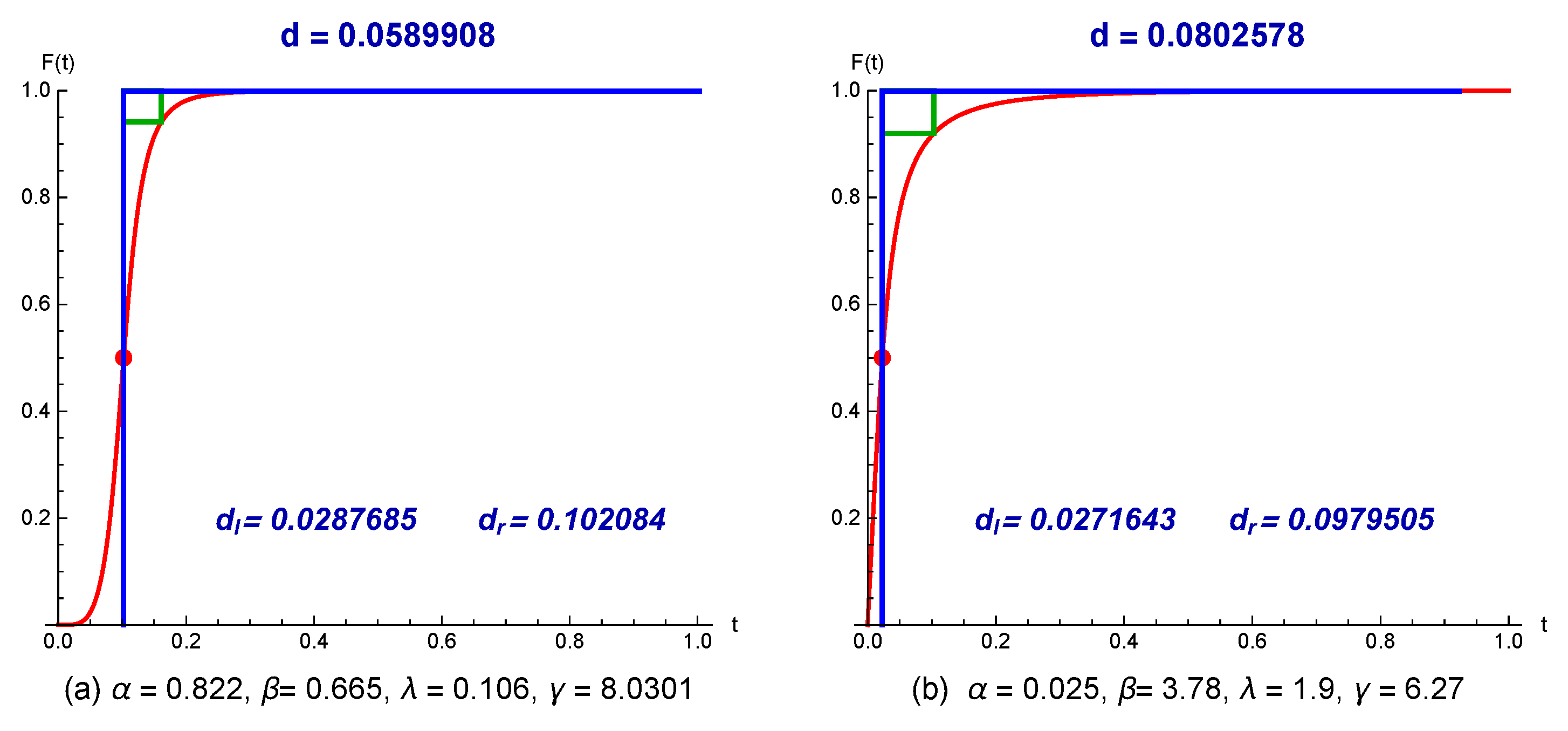
Table 1 gives several numerical experiments for different values of parameters , , and . The values of estimates and are computed according to Theorem 2. Figure 2 shows some graphical representations.

Table 1.
Bounds for Hausdorff distance d according to Theorem 2.
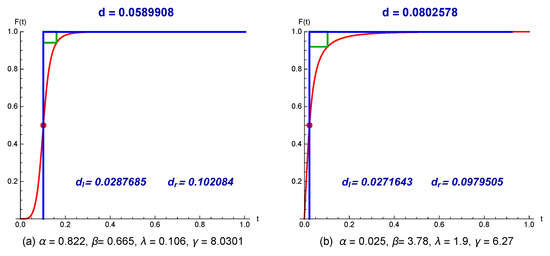
Figure 2.
Approximation of CDF function of GOPC-LL distribution.
Let us recall that the cumulative distribution function of Weibull distribution is
where , is a shape parameter and is a scale parameter.
Definition 4.
Generalized odd power Cauchy–Weibull (GOPC-W) distribution is associated with the cumulative distribution function given as
Here we examine the one-sided Hausdorff distance of the Heaviside step function and cumulative distribution function defined by (8). For the “median level” we have
Then the one-sided Hausdorff distance d satisfies the following nonlinear equation
Next corollary of Theorem 1 gives useful estimates for the one-sided Hausdorff approximation d.
Theorem 3.
Let
Then the one-sided Hausdorff distance d between interval Heaviside step function and the cumulative distribution function defined by (8) satisfies the following inequalities for :
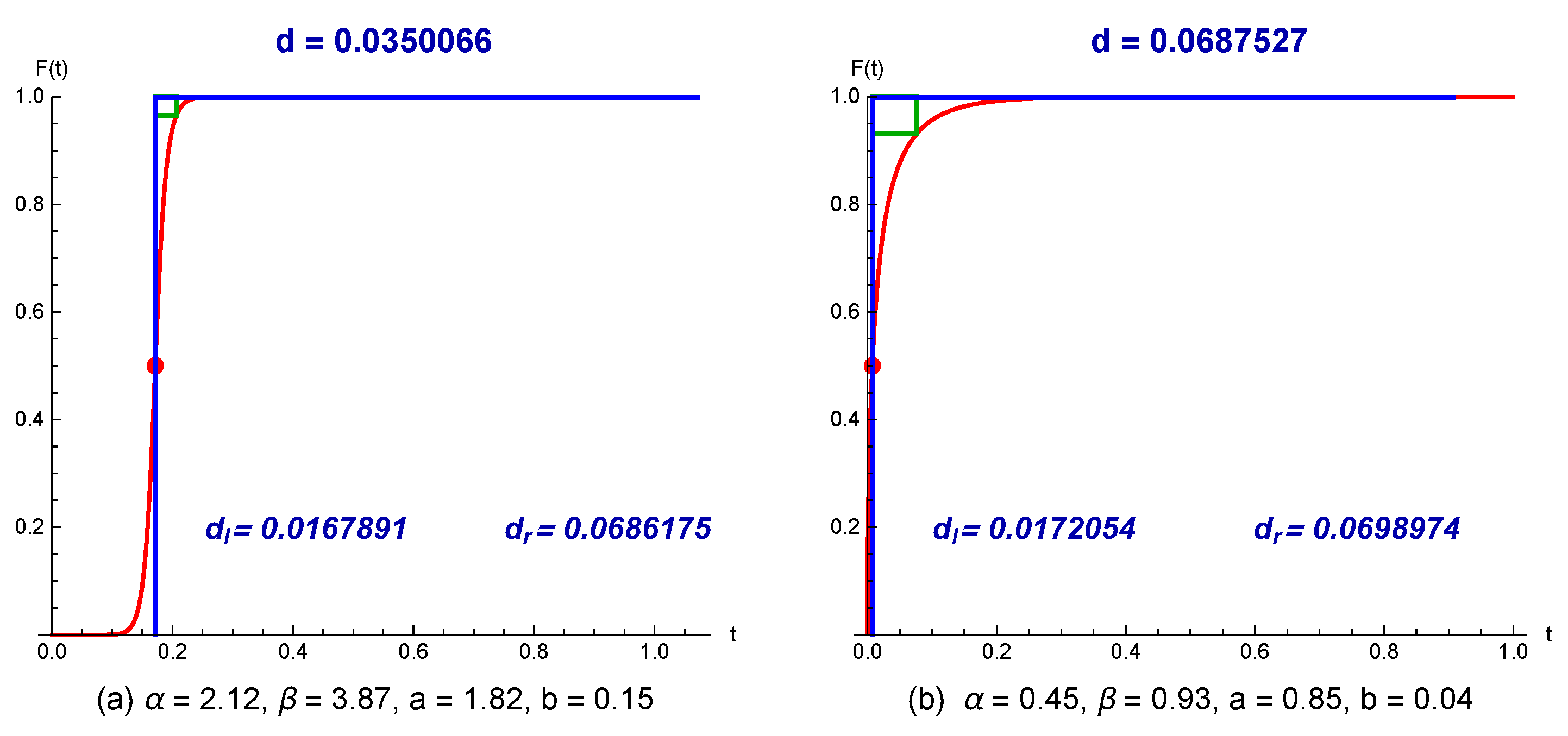
Table 2 presents some computational examples for different values of parameters , , a and b. We exhibit the values of and as we use Theorem 3. Some graphical visualizations are given in Figure 3.
Table 2.
Bounds for the one-sided Hausdorff distance d computed by Theorem 3.
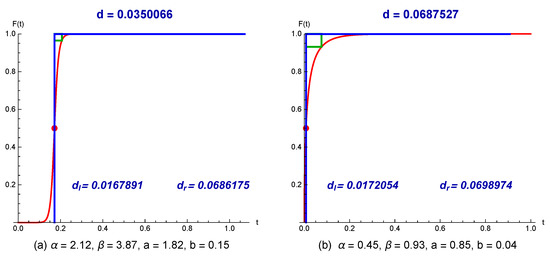
Figure 3.
Approximation of CDF function of GOPC-W distribution.
2.2. Some Special Models from Truncated Cauchy Power Odd Frechet-G Family of Distributions
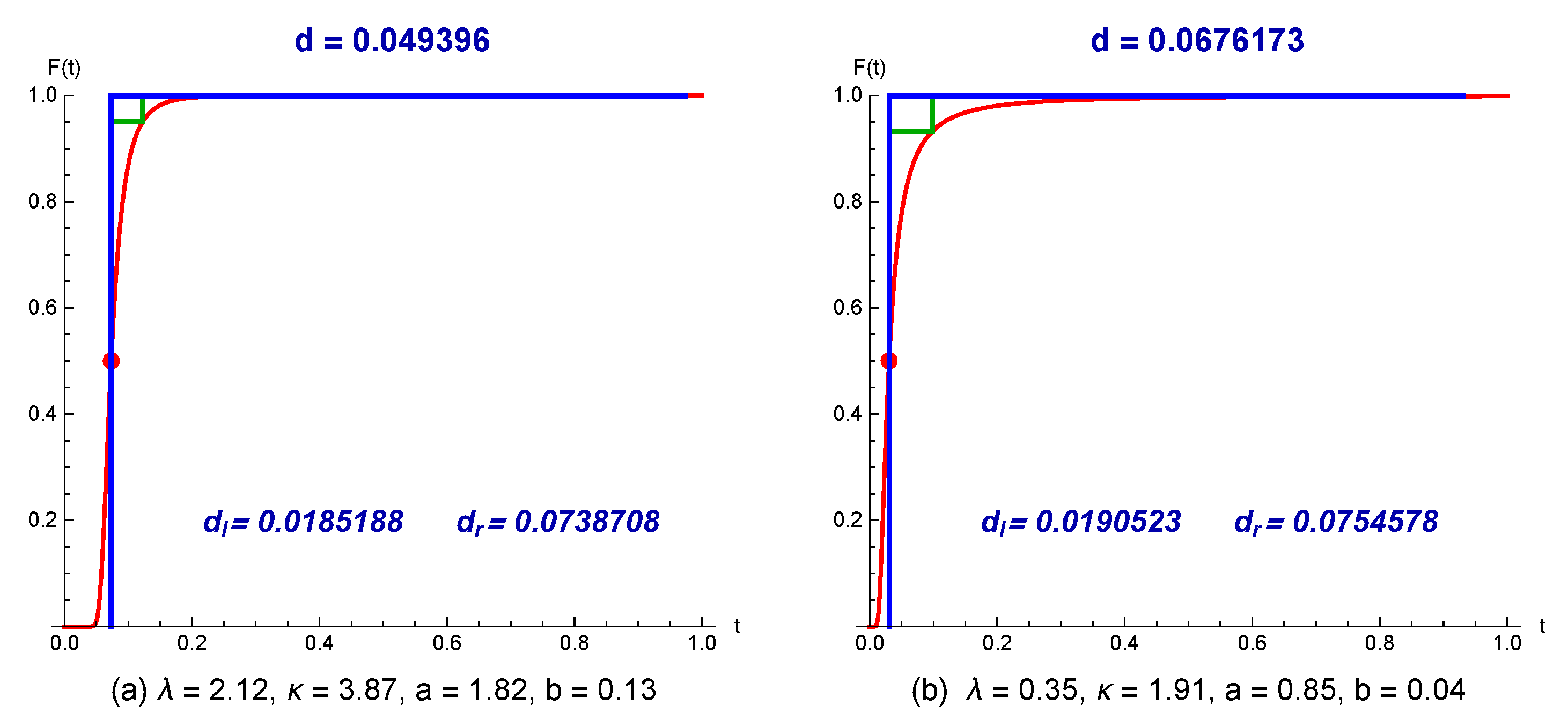
In this section we consider two submodels of TCPOF-G family based on the baseline distributions: Weibull and Lomax named TCPOFW and TCPOFL. For these two special cases, we obtain upper and lower estimates for the one-sided Hausdorff distance d. Since the proof of Theorems 4 and 5 follows the ideas given in Theorem 1, then they will be omitted. Some computational examples and graphical representations are presented in Table 3 with Figure 4 for TCPOFW distribution and Table 4 with Figure 5 for TCPOFL distribution, respectively.
Table 3.
Bounds for one-sided Hausdorff distance d computed by Theorem 4.
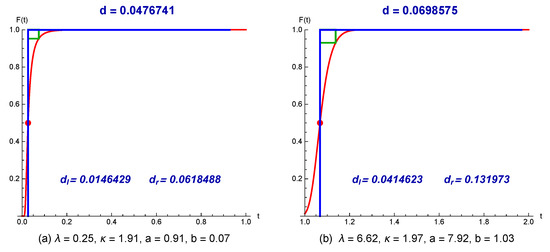
Figure 4.
Approximation of CDF function of TCPOFW distribution.
Table 4.
Bounds for the one-sided Hausdorff distance d computed by Theorem 5.
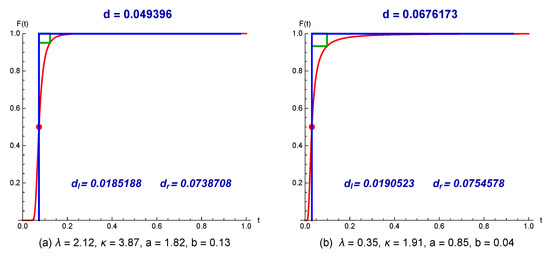
Figure 5.
Approximation of CDF function of TCPOFL distribution.
Definition 5.
Truncated Cauchy Power Odd Fréchet–Weibull (TCPOFW) distribution is associated with the cumulative distribution function given as
Hence, the one-sided Hausdorff distance d between defined by (11) and the Heaviside function satisfy the relation
where
Theorem 4.
Let
Then the one-sided Hausdorff distance d between interval Heaviside step function and the cumulative distribution function defined by (11) satisfies the following inequalities for :
Definition 6.
Truncated Cauchy Power Odd Fréchet–Lomax (TCPOFL) distribution is associated with the cumulative distribution function given as
The one-sided Hausdorff distance d between defined by (13) and the Heaviside function satisfies the relation
where
Theorem 5.
Let
Then the one-sided Hausdorff distance d between interval Heaviside step function and the cumulative distribution function defined by (13) satisfies the following inequalities for :
2.3. Some Applications
In this section we present one particular application of obtained results. We consider data that represent runoff amounts of Jug Bridge, Maryland (see Chhikara and Folks [23]):
Here we present a simple dynamic programming module, implemented within the programming environment CAS Wolfram Mathematica, for the analysis of cumulative distribution function of GOPC-W (see Figure 6). We consider that the considered data set can be approximated with cumulative distribution function GOPC-W with parameters , , and . We compute Hausdorff distance with its upper and lower estimates as we use Theorem 3. The obtained values are with estimates and , respectively. Our module provides graphical visualization of the results. Similar modules can be obtained for other cases of proposed families.
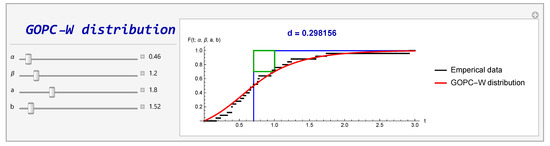
Figure 6.
The model (8) for runoff amounts data (normalized) of Jug Bridge, Maryland.
2.4. Simple Comparison of GOPC-G and TCPOF-G Families
Some special cases of GOPC-G family and TCPOF-G family are proposed from [6] and [7], respectively. Reader can obtain many others using different base cumulative distribution functions. For example in the literature there are many modifications of classical Weibull distribution. In 2014, Almalki and Nadarajah [24] present a review of some of them.
In this section we propose a simple comparison of GOPC-G and TCPOF-G families with the same Weibull-type correction. Let us consider an example with Inverse Weibull distribution with cumulative distribution function defined by
Hence we obtain the following submodels of GOPC-G and TCPOF-G named GOPC-IW and TCPOFIW, respectively.
Cumulative distribution function of Generalized odd power Cauchy-Inverse Weibull (GOPC-IW) distribution is defined by
Cumulative distribution of Truncated Cauchy Power Odd Fréchet-Inverse Weibull (TCPOFIW) distribution is given by
In Figure 7, we present simple comparatively investigation of asymptotic behavior of one-sided Hausdorff distance between Heaviside step function and cumulative distribution functions of GOPC-IW and TCPOFIW. Both models are based on arctangent function but they have different construction. In our simple dynamic programming module we choose corresponding distribution parameters which yield similar type of cumulative shapes. The corresponding Hausdorff distances that we obtain are and .
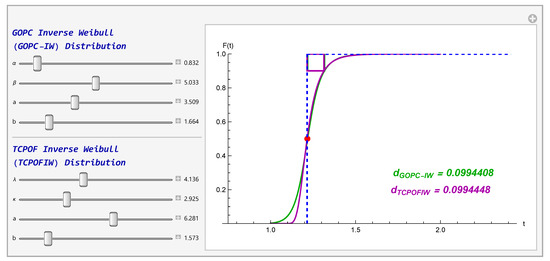
Figure 7.
Hausdorff approximation of GOPC-IW and TCPOFIW distributions.
3. Recurrent Generation of New Families of “Adaptive Functions”
We construct a family of recurrence generated activation functions based on GOPC-G family in the following way
with
The reader may formulate some special cases of a family of recurrence generated activation functions with the corresponding approximation problems based on GOPC-G family or TCPOF-G family. In this section we consider a special case based on GOPC-G family with Weibull as baseline distribution. Here we investigate the one-sided Hausdorff approximation of the shifted Heaviside function by means of the corresponding family at “median level”. For other results about families of recurrence generated parametric activation functions with various approximation and modeling aspects see [12,14,17,18,22].
Let us consider one special case. The recurrent family based on GOPC-W is defined by
with
The recurrence generated functions , , , and from family (18) for fixed , , and are visualized on Figure 8.
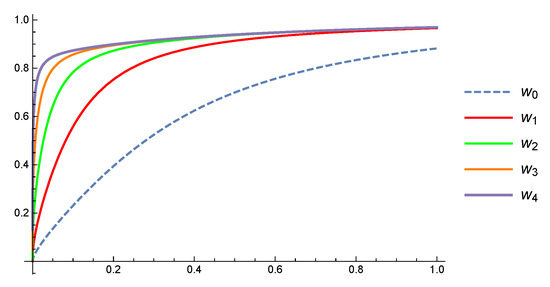
Figure 8.
The graphics of recurrence generated adaptive functions from family (18).
The one-sided Hausdorff distance d between cumulative distribution function and the Heaviside function satisfies the following nonlinear equation
where is a positive solution of the equation . We present some computational examples in Table 5. We show the asymptotic behavior of the one-sided Hausdorff distance for cumulative distribution functions , for different values of parameters , , a and b. From these results, one can observe that how deeper we go into the recursion, the one-sided Hausdorff distance comes smaller.
4. Conclusions
The aim of this research is to study the asymptotic behavior of the one-sided Hausdorff distance between Heaviside step function and some cumulative distribution functions based on arctangent function and some baseline distribution. Estimates for the searching Hausdorff approximation are given. In practice, they can be used as one more possible criterion in examination of the one-sided Hausdorff approximation. Simple comparatively investigation of asymptotic behavior of one-sided Hausdorff distance between Heaviside step function and cumulative distribution functions of GOPC-G and TCPOF-G families with the same Weibull-type correction is presented. Moreover, we construct families of recurrence generated adaptive functions. One can formulate corresponding tasks with approximation problems using proposed methods for other families containing arctangent function and their extensions. In this way the researcher receive a lot of opportunities when choosing the appropriate model for approximation of cumulative specific data. We propose a simple dynamic software module that demonstrate how new results can be using with real cumulative data.
Funding
This research received no external funding.
Institutional Review Board Statement
Not applicable.
Informed Consent Statement
Not applicable.
Data Availability Statement
Not applicable.
Conflicts of Interest
The author declare no conflict of interest.
References
- Cordeiro, G.M.; Alizadeh, M.; Ramires, T.G.; Ortega, E.M. The generalized odd half-Cauchy family of distributions properties and applications. Commun. Stat. Theory Methods 2017, 46, 5685–5705. [Google Scholar]
- Alizadeh, M.; Altun, E.; Cordeiro, G.M.; Rasekhi, M. The odd power Cauchy family of distributions: Properties, regression models and applications. J. Stat. Comput. Simul. 2018, 88, 785–807. [Google Scholar]
- Aldahlan, M.A.; Jamal, F.; Chesneau, C.; Elgarhy, M.; Elbatal, I. The truncated Cauchy power family of distributions with inference and applications. Entropy 2020, 22, 346. [Google Scholar]
- Chakraburty, S.; Alizadeh, M.; Handique, L.; Altun, E.; Hamedani, G.G. A new extension of Odd Half-Cauchy family of distributions: Properties and applications with regression modeling. Stat. Transit. New Ser. 2021, 22, 77–100. [Google Scholar]
- Alkhairy, I.; Nagy, M.; Muse, A.H.; Hussam, E. The Arctan-X family of distributions: Properties, simulation, and applications to actuarial sciences. Complexity 2021, 14, 4689010. [Google Scholar]
- Altun, E.; Alizadeh, M.; Ramires, T.; Ortega, E. Generalized odd power Cauchy family and its associated heteroscedastic regression model. Stat. Optim. Inf. Comput. 2021, 3, 516–528. [Google Scholar]
- Shrahili, M.; Elbatal, I. Truncated Cauchy power odd Fréchet-G family of distributions: Theory and applications. Complexity 2021, 9, 4256945. [Google Scholar]
- Hausdorff, F. Set Theory, 2nd ed.; Chelsea Publication: New York, NY, USA, 1962. [Google Scholar]
- Sendov, B.L. Hausdorff approximations. In Mathematics and Its Applications; Springer Science & Business Media: Berlin/Heidelberg, Germany, 1990; Volume 50, pp. 1–367. [Google Scholar]
- Kyurkchiev, N. On the approximation of the step function by some cumulative distribution functions. Comp. Rend. Acad. Bulg. Sci. 2015, 68, 1475–1482. [Google Scholar]
- Kyurkchiev, N.; Iliev, A. On the Hausdorff distance between the Heaviside function and some Transmuted activation functions. Math. Model. Anal. 2016, 1, 8–12. [Google Scholar]
- Kyurkchiev, N.; Rahneva, O.; Iliev, A.; Malinova, A.; Rahnev, A. Investigations on Some Generalized Trigonometric Distributions. Properties and Applications; Plovdiv University Press: Plovdiv, Bulgaria, 2021; ISBN 978-619-7663-01-3. [Google Scholar]
- Kyurkchiev, N.; Iliev, A.; Rahnev, A. A new Cos-G family with baseline cumulative function of Volmer–type. Applications. Int. J. Pure Appl. Math. 2021, 15, 55–65. [Google Scholar]
- Kyurkchiev, N.; Pavlov, N.; Iliev, A.; Rahneva, O. Some classes of “Transmuted adaptive functions”. Applications. Commun. Appl. Anal. 2021, 25, 53–65. [Google Scholar]
- Kyurkchiev, N.; Iliev, A.; Arnaudova, V.; Rahnev, A. Investigation on some new cumulative distributions via Cosine and Sine functions. Int. J. Differ. Equ. Appl. 2021, 20, 75–88. [Google Scholar]
- Kyurkchiev, N.; Rahneva, O.; Malinova, A.; Iliev, A. On some adaptive G-families. Applications. Int. J. Differ. Equ. Appl. 2021, 20, 89–101. [Google Scholar]
- Kyurkchiev, N.; Iliev, A.; Rahneva, O.; Kyurkchiev, V. A look at some Trigonometric-G families baseline inverted exponential (cdf). Applications. Int. J. Differ. Equ. Appl. 2021, 20, 103–119. [Google Scholar]
- Kyurkchiev, N.; Iliev, A.; Rahnev, A. Properties and applications of a Tan–G family of “Adaptive functions”. Int. J. Circuits Syst. Signal Process. 2021, 15, 1292–1296. [Google Scholar]
- Kyurkchiev, N. Some intrinsic properties of Tadmor–Tanner functions: Related problems and possible applications. Mathematics 2020, 8, 1963. [Google Scholar]
- Vasileva, M. Some notes on the Omega distribution and the Pliant probability distribution family. Algorithms 2020, 13, 324. [Google Scholar]
- Vasileva, M.; Iliev, A.; Rahnev, A.; Kyurkchiev, K. On the approximation of the Haar scaling function by sigmoidal scaling functions. Int. J. Differ. Equ. Appl. 2021, 20, 1–13. [Google Scholar]
- Vasileva, M.; Rahneva, O.; Malinova, A.; Arnaudova, V. The odd Weibull-Topp-Leone-G power series family of distributions. Int. J. Differ. Equ. Appl. 2021, 20, 43–58. [Google Scholar]
- Chhikara, R.S.; Folks, J.L. The inverse Gaussian distribution as a lifetime model. Technometrics 1977, 19, 461–468. [Google Scholar]
- Almalki, S.J.; Nadarajah, S. Modifications of the Weibull distribution: A review. Reliab. Eng. Syst. Saf. 2014, 124, 32–55. [Google Scholar]



Publisher’s Note: MDPI stays neutral with regard to jurisdictional claims in published maps and institutional affiliations. |
© 2022 by the author. Licensee MDPI, Basel, Switzerland. This article is an open access article distributed under the terms and conditions of the Creative Commons Attribution (CC BY) license (https://creativecommons.org/licenses/by/4.0/).