Abstract
This paper discusses the Crank–Nicolson compact difference method for the time-fractional damped plate vibration problems. For the time-fractional damped plate vibration equations, we introduce the second-order space derivative and the first-order time derivative to convert fourth-order differential equations into second-order differential equation systems. We discretize the space derivative via compact difference and approximate the time-integer-order derivative and fraction-order derivative via central difference and L1 interpolation, respectively, to obtain the compact difference formats with fourth-order space precision and ()-order time precision. We apply the energy method to analyze the stability and convergence of this difference format. We provide numerical cases, which not only validate the convergence order and feasibility of the given difference format, but also simulate the influence of the damping coefficient on the amplitude of plate vibration.
1. Introduction
Viscoelastic materials possess both the mechanical properties of an elastic solid and a Newtonian fluid and are effective for mitigating vibration by energy dissipation [1,2]. The memory of viscoelastic damping materials and the fractional power frequency dependence of the viscoelastic damping factor can be described by time-fractional derivatives with good accuracy [3,4,5]. The fourth-order differential equations with time-fractional derivative can better describe and solve damped vibration problems in a viscoelastic medium, such as problems dealing with vibration reduction in bridges, aircrafts and spacecrafts, noise reduction, etc. The time-fractional damped plate vibration equations are difficult to solve analytically because they are fourth-order differential equations with time-fractional derivatives. Thus, the vibration models with fraction-order derivatives as the damping factor and their numerical solutions have gained increasing attention from researchers around the world [6,7,8], similar to various other types of studies of fractional problems [9,10,11].
The compact difference method, which can further accelerate the convergence of the general difference methods following a similar idea as the efficient numerical methods developed in [12] accelerate most existing approaches, is a high-accuracy numerical method that uses relatively fewer nodes arranged in a compact way. It handles boundary conditions efficiently and is often employed to solve second-order differential equations. Refs. [13,14] studied the compact difference method for the wave equations. Refs. [15,16,17,18,19] constructed the compact difference formats for the time fractional sub-diffusion equation, the fraction sub-diffusion equations and the time fractional convection-diffusion equation of groundwater pollution problems. For the fourth-order nonlinear elliptic boundary value problems, ref. [20] converted fourth-order differential equations into second-order differential equation systems by introducing intermediate variables and constructed the compact difference format with fourth-order space precision. For the type differential equations such as two-dimensional fourth-order hyperbolic equations, the fourt- order fractional diffusion-wave system and fourth-order temporal multi-term fractional wave equations, refs. [21,22,23,24,25,26,27] established the compact difference formats by introducing second-order derivatives as intermediate variables.
To date, the authors have found no studies that use the compact difference method to numerically simulate time-fractional damped plate vibration equations. Therefore, this paper seeks to solve time-fractional damped plate vibration equations by introducing the second-order space derivative and the first-order time derivative to convert fourth-order differential equations into second-order differential equation systems. The space derivative is discretized by fourth-order compact difference, the time-integer-order derivative is discretized by the Crank–Nicolson (C-N) difference format, and the time-fractional derivative is approximated by L1 interpolation in the same way as [28]. The compact difference method for solving time-fractional damped plate vibration equations is established. The energy method is applied to analyze the stability and convergence of this difference format. Numerical cases are provided to validate the convergence order and feasibility of the given difference format. This paper not only discusses the compact difference method for the damped plate vibration equations with time-fractional derivatives but also simulates the influence of damping coefficients on the amplitude of vibration. This paper provides a novel effective numerical method for solving damped plate vibration problems, which enlarges the toolkit for simulating damped plate vibration problems and contributes to a more thorough and complete system of theories for numerically solving time-fractional fourth-order differential equations.
This paper is structured as follows: Section 2 establishes the C-N compact difference format for time-fractional damped plate vibration equations. Section 3 and Section 4 analyze the stability and convergence of the given difference format using the energy method. Section 5 provides the numerical cases to verify the convergence order and feasibility of the given difference format and simulates the influence of damping coefficient on the amplitude of vibration.
2. Compact Difference Scheme
In this section, the following fractional damped plate vibration equations are considered.
where , , T is the total amount of time, , , is the damping coefficient, and , D, and l are the bending stiffness, sheet density and sheet thickness, respectively. For simplicity, we assume that a and are both constants. The right-hand term is a known smooth function, and , , , and , are all known functions.
By introducing two intermediate functions, , , (1) becomes
For establishing the C-N compact difference scheme of Problem (1), region is divided along the x and y directions, respectively. Let , be the spatial step, and let be the time step; then , , . , , is the grid function on and is the grid function on .
Introduce the following notations:
Let and denote compact difference operators in the x and y directions, respectively, and [29]
Let , .
Let . For any two functions , we introduce the following inner product and norms:
Next, we shall give three Lemmas. One is the L1 discrete format of the fractional derivative, and the other two are error estimates and symmetry for compact operators.
Lemma 1
([29]). If , , let , there is
where
Lemma 2
([30]). If , there is
where .
Now, we discretize the system of Equation (2).
Firstly, at node , , , , Equation (2a) can be written as
According to Lemma 1, for , the fractional derivative is approximated by L1 interpolation
where
For the integer derivative terms, by Taylor’s expansion, there are
Applying the compact operators on both sides of Formula (5), we obtain
According to Lemma 2, using the commutativity of operator , we obtain
where
Assuming that w and v are sufficiently smooth, there exists a constant such that
By omitting in (7) and replacing and with approximate solutions and , the differential discretization scheme of Equation (2a) can be obtained
Secondly, at node , , , , Equation (2b) can be written as
Applying the compact operators on both sides of Formula (9), we obtain
Assuming that w and v are sufficiently smooth, there exists a constant such that
By omitting in (11) and replacing and with approximate solutions and , the differential discretization scheme of Equation (2b) can be obtained:
The initial value condition (2c) can be directly discretized as
By combining Equations (8), (12), (13) and (14), the C-N compact difference scheme of the system of Equation (2) can be obtained as follows:
Discrete the equation ; similarly to (12), we get
3. Stability Analysis
In this part, the energy method is used to analyze the stability of the C-N compact difference scheme (15).
Theorem 1.
Set , where are the solutions of the following difference scheme,
then
Proof of Theorem 1.
Let . Taking the inner product of Equation (17) with , we obtain
Taking the inner product of the Equation (18) with , we obtain
Multiplying both sides of (20) by a, adding them to (21) and using the commutativity of operator , we obtain
Applying the Cauchy–Schwarz inequality, we obtain
Multiplying both sides of the above equation by , we obtain
Recursively, we obtain
Applying the Cauchy–Schwarz inequality, we obtain
It can be obtained from the nature and definition of that
It can be obtained by the discrete Gronwall inequality that
□
From Theorem 1, we know that the difference scheme (15) is unconditionally stable.
4. Convergence Analysis
In this section, the energy method is used to analyze the convergence of the C-N compact difference scheme (15). For , let , , where are the solutions of the system of Equation (2), and and are the solutions of the C-N compact difference format (15). Subtracting (7) and (11) from (8) and (12) respectively, we obtain the error equations system from (13) and (14)
Theorem 2.
Proof of Theorem 2.
Similar to the stability proof, according to Theorem 1 and the system of error Equation (28), we obtain
□
5. Numerical Examples
In this part, three numerical examples are given to verify the convergence order and validity of the C-N compact difference schemes (15) and (16) for Problem (1). The first and second examples verify the time and space convergence of the error estimates when is different; the third example verifies the influence of the damping coefficient on the vibration amplitude of the damping plate.
Example 1.
Now solve this problem using the C-N compact difference schemes (15) and (16) proposed in Section. Set as the spatial step and as the time step. Let and take different values to verify the time-direction convergence order of the C-N compact difference schemes. Let and h take different values to verify the spatial-direction convergence order of the C-N compact difference schemes.
When , the computational errors and convergence orders are shown in Table 1, Table 2, Table 3, Table 4, Table 5 and Table 6, respectively.
Table 1.
The computational errors and spatial convergence orders of U.
Table 2.
The computational errors and time convergence orders of U.
Table 3.
The computational errors and spatial convergence orders of U.
Table 4.
The computational errors and time convergence orders of U.
Table 5.
The computational errors and spatial convergence orders of U.
Table 6.
The computational errors and time convergence orders of U.
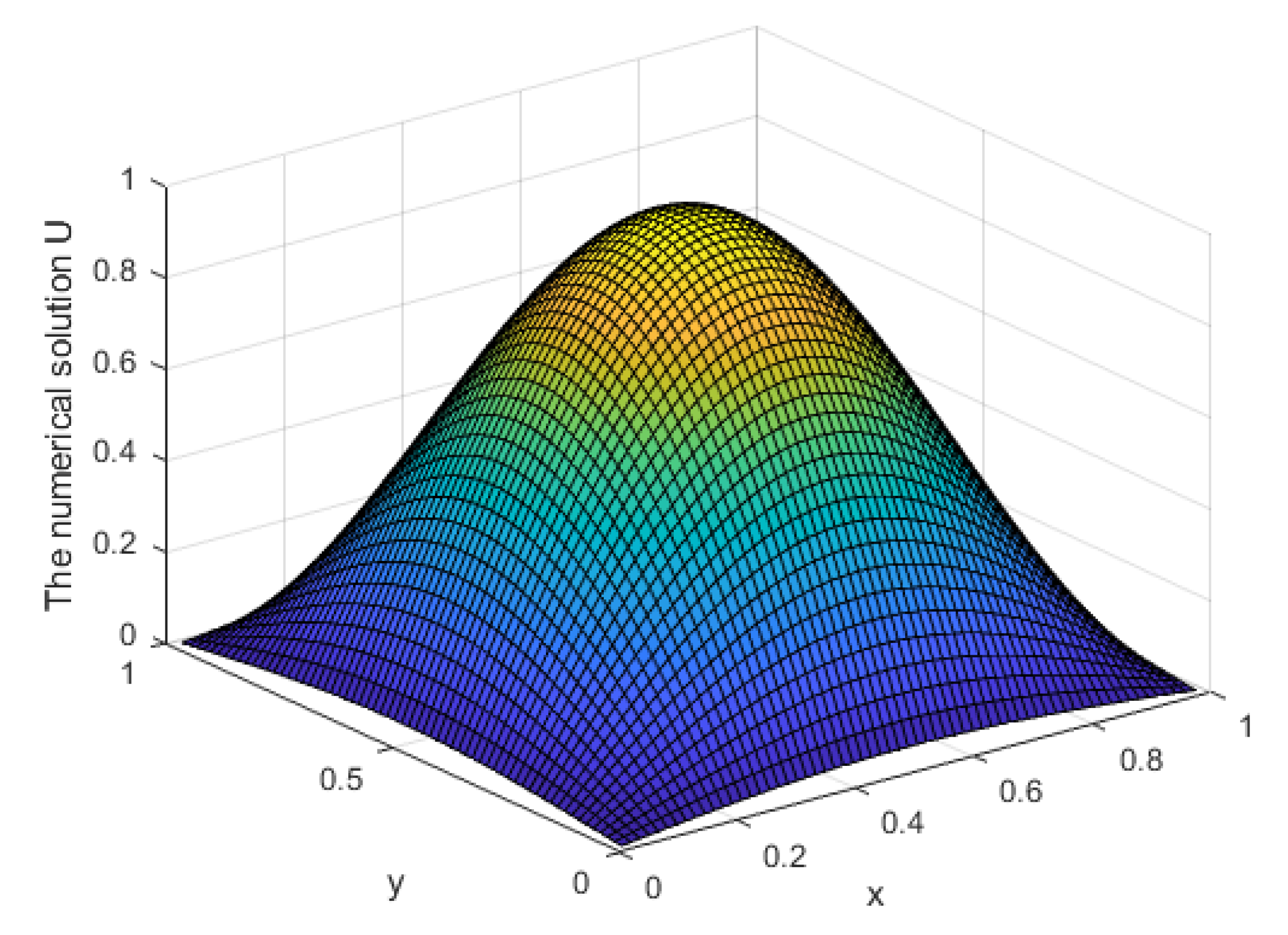
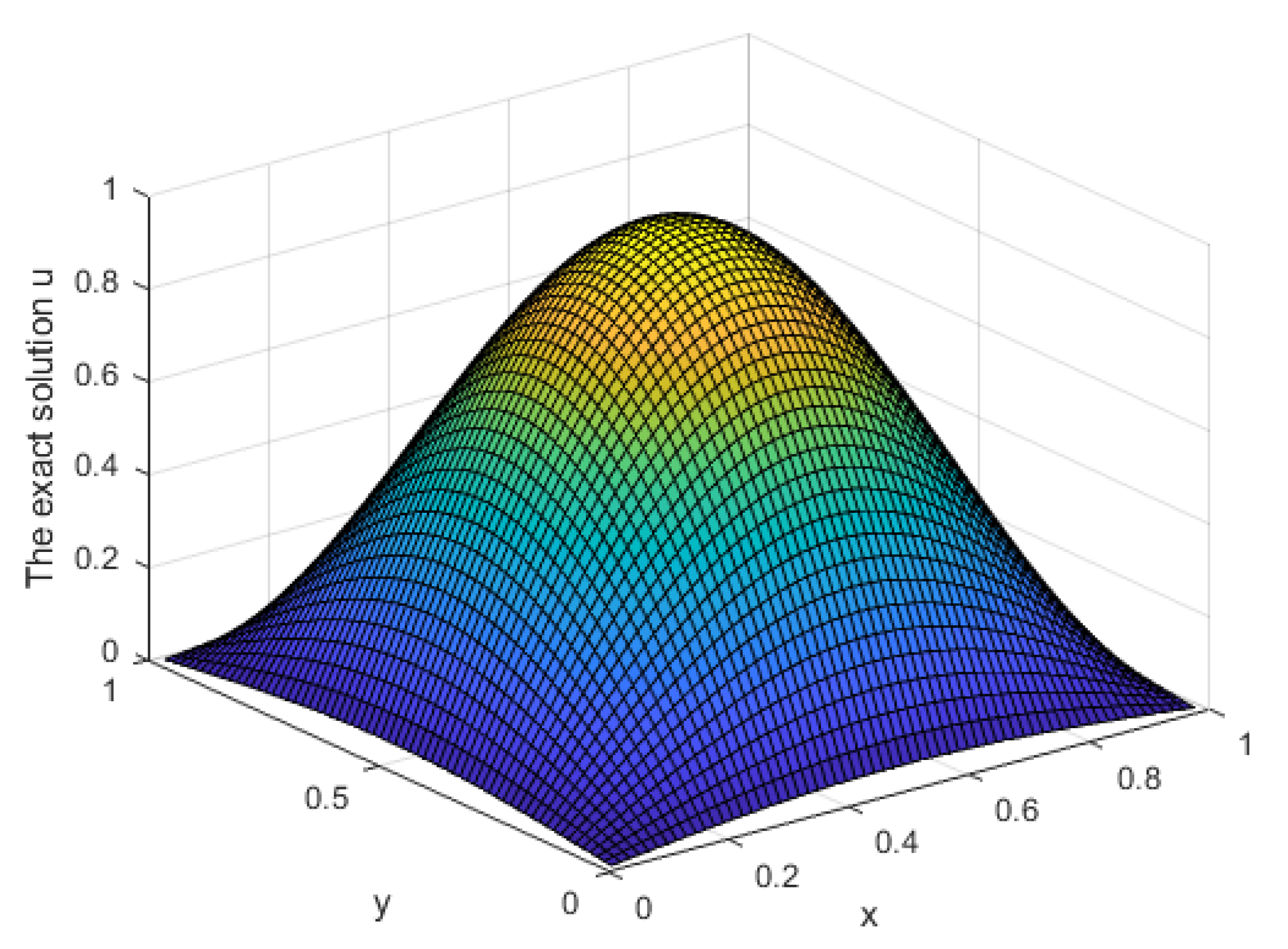
When , the images of the numerical solution U and the exact solution u at with the mesh h = 1/64, are shown in the Figure 1 and Figure 2.
Figure 1.
The numerical solution U when , .
Figure 2.
The exact solution u when , .
Table 1, Table 2, Table 3, Table 4, Table 5 and Table 6 show the computational errors and convergence orders of the numerical solution U when takes different values. It can be seen that in the sense of the maximum norm and the norm, the order of time convergence is , and the order of space convergence is 4, which demonstrates the effectiveness of the C-N compact difference schemes established in Section 2. Figure 1 and Figure 2 show the graphs of the numerical solution U and the exact solution u, which show good fitting results.
Example 2.
Similar to Example 1, let and take different values to verify the time-direction convergence order of the schemes. Let and h take different values to verify the spatial-direction convergence order of the schemes.
When , the computational errors and convergence orders are shown in Table 7, Table 8, Table 9, Table 10, Table 11 and Table 12, respectively.
Table 7.
The computational errors and spatial convergence orders of U.
Table 8.
The computational errors and time convergence orders of U.
Table 9.
The computational errors and spatial convergence orders of U.
Table 10.
The computational errors and time convergence orders of U.
Table 11.
The computational errors and spatial convergence orders of U.
Table 12.
The computational errors and time convergence orders of U.
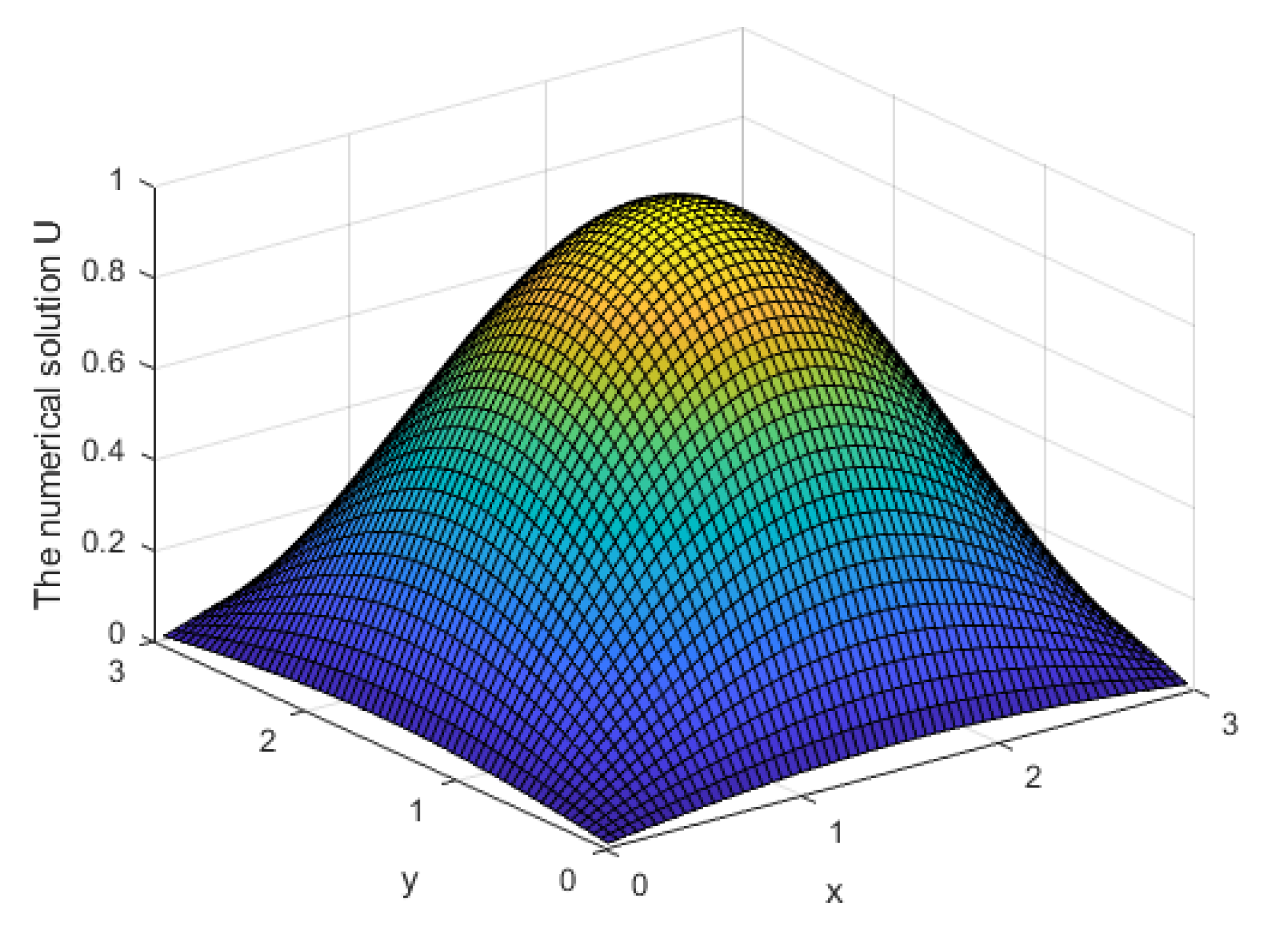
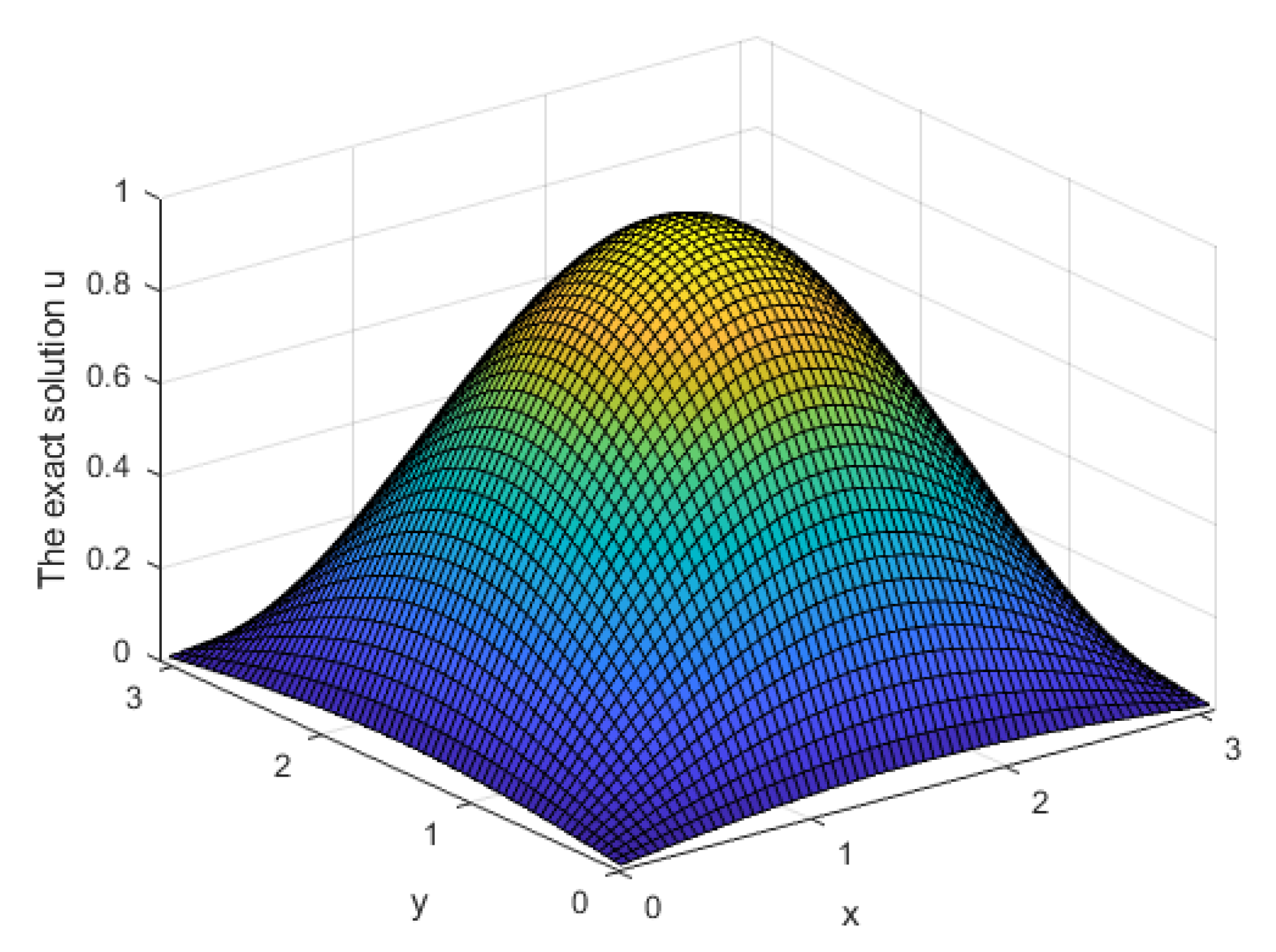
When , the images of the numerical solution U and the exact solution u at with the mesh are shown in Figure 3 and Figure 4.
Figure 3.
The numerical solution U when , .
Figure 4.
The exact solution u when , .
Table 7, Table 8, Table 9, Table 10, Table 11 and Table 12 show the computational errors and convergence orders of the numerical solution U when takes different values. It can be seen that in the sense of the maximum norm and the norm, the order of time convergence is , and the order of space convergence is 4, which demonstrates the effectiveness of the C-N compact difference schemes established in Section 2. Figure 3 and Figure 4 show the graphs of the numerical solution U and the exact solution u, which show good fitting results.
Example 3.
In the problem (1), let , , , , .
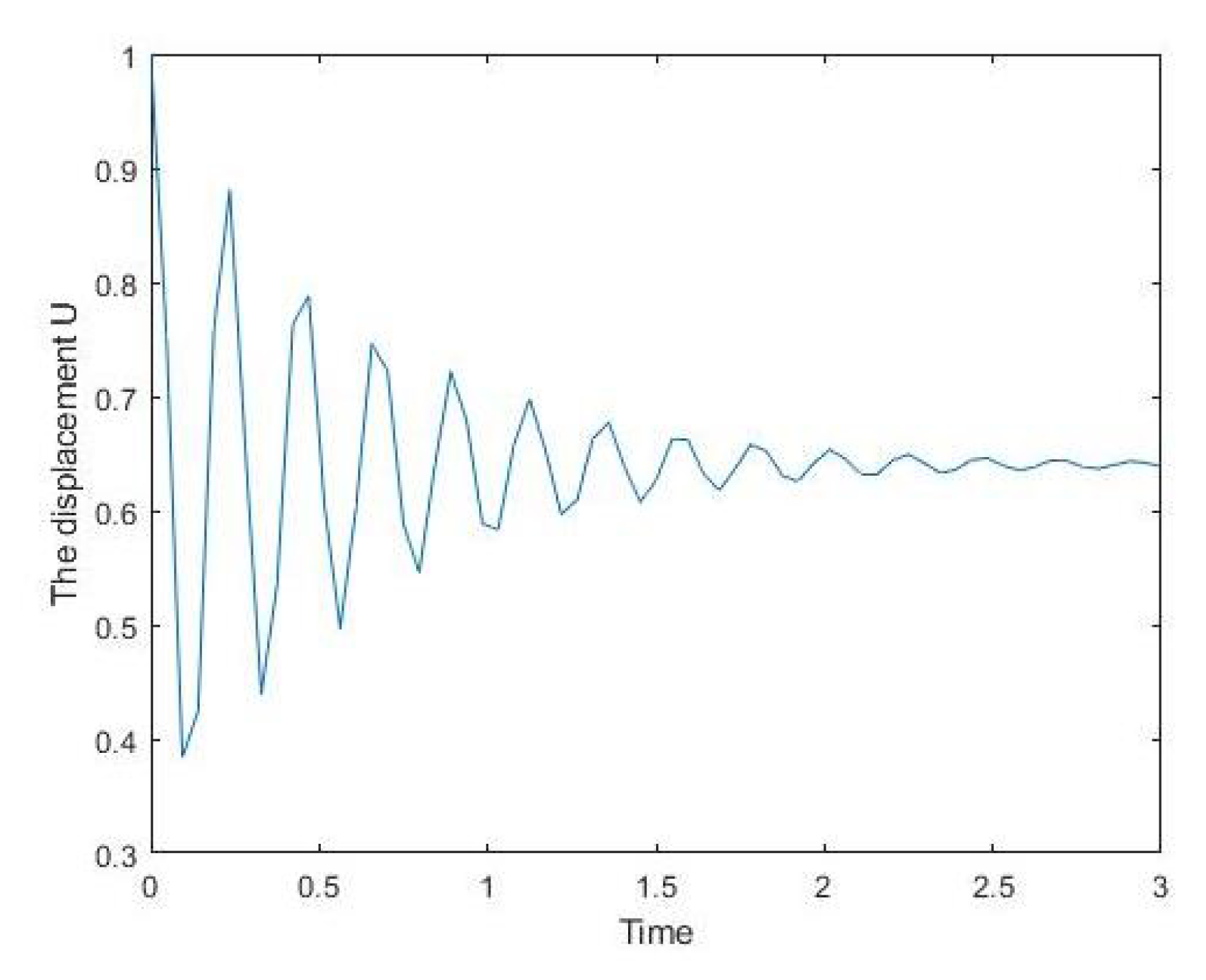
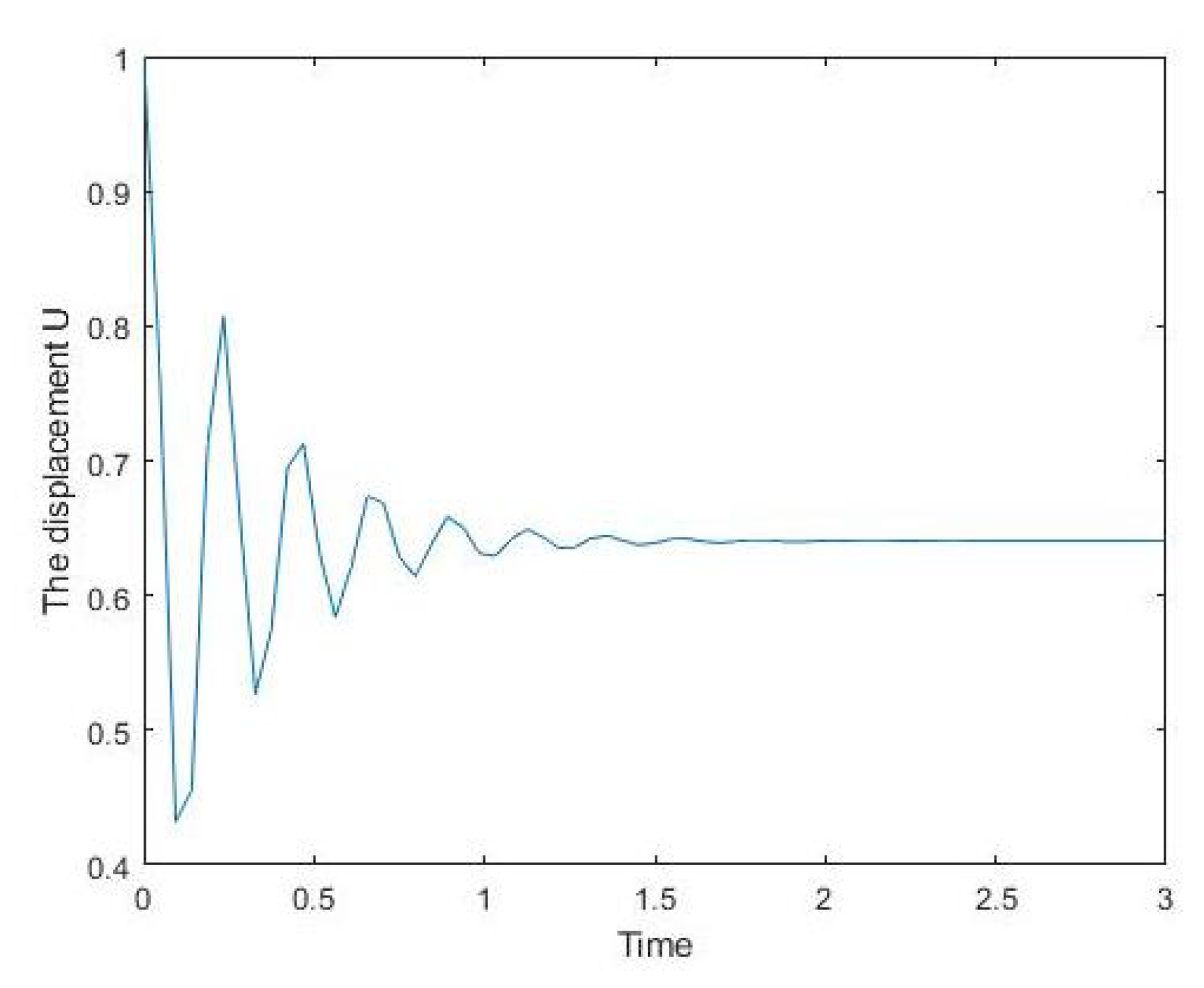
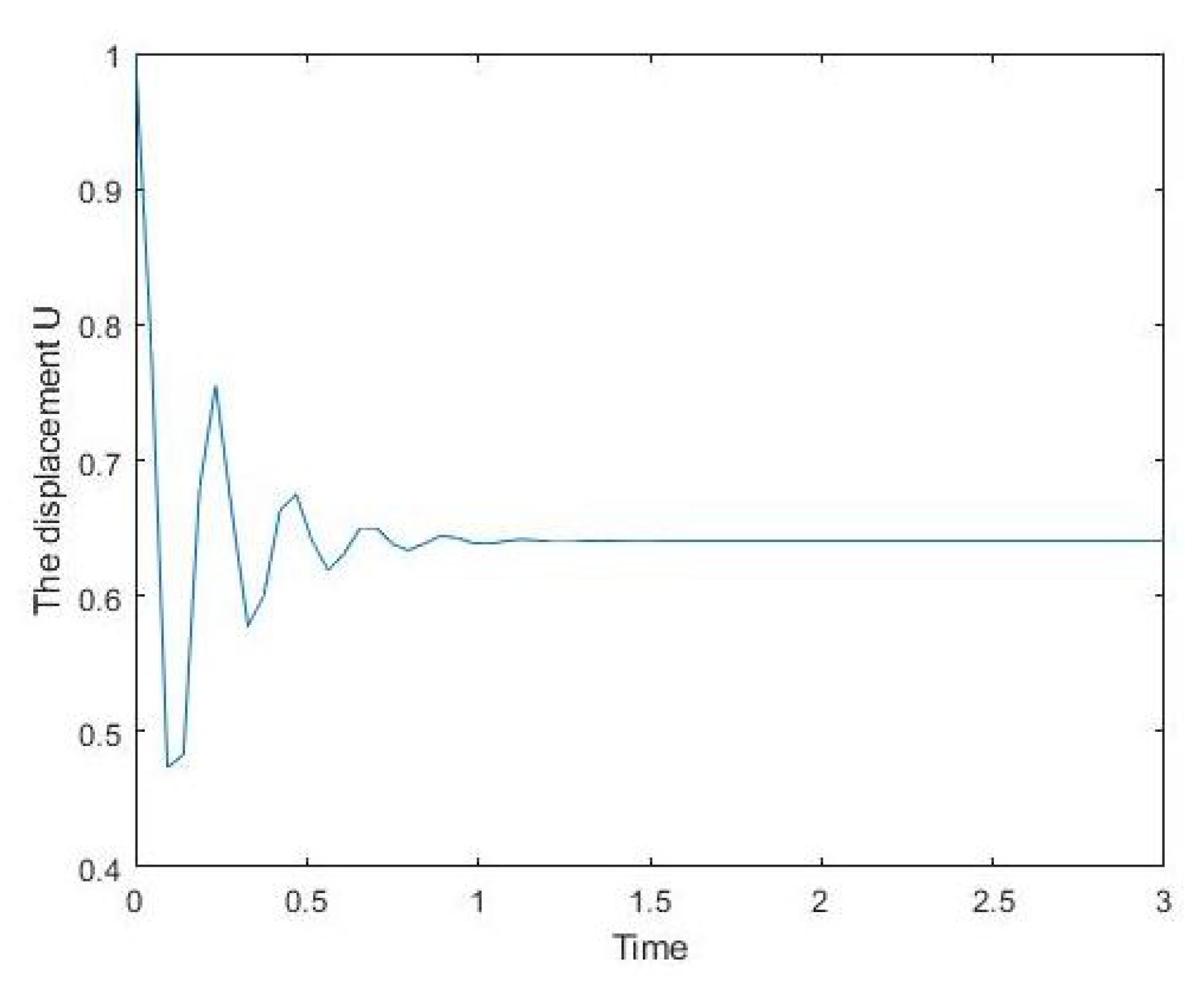
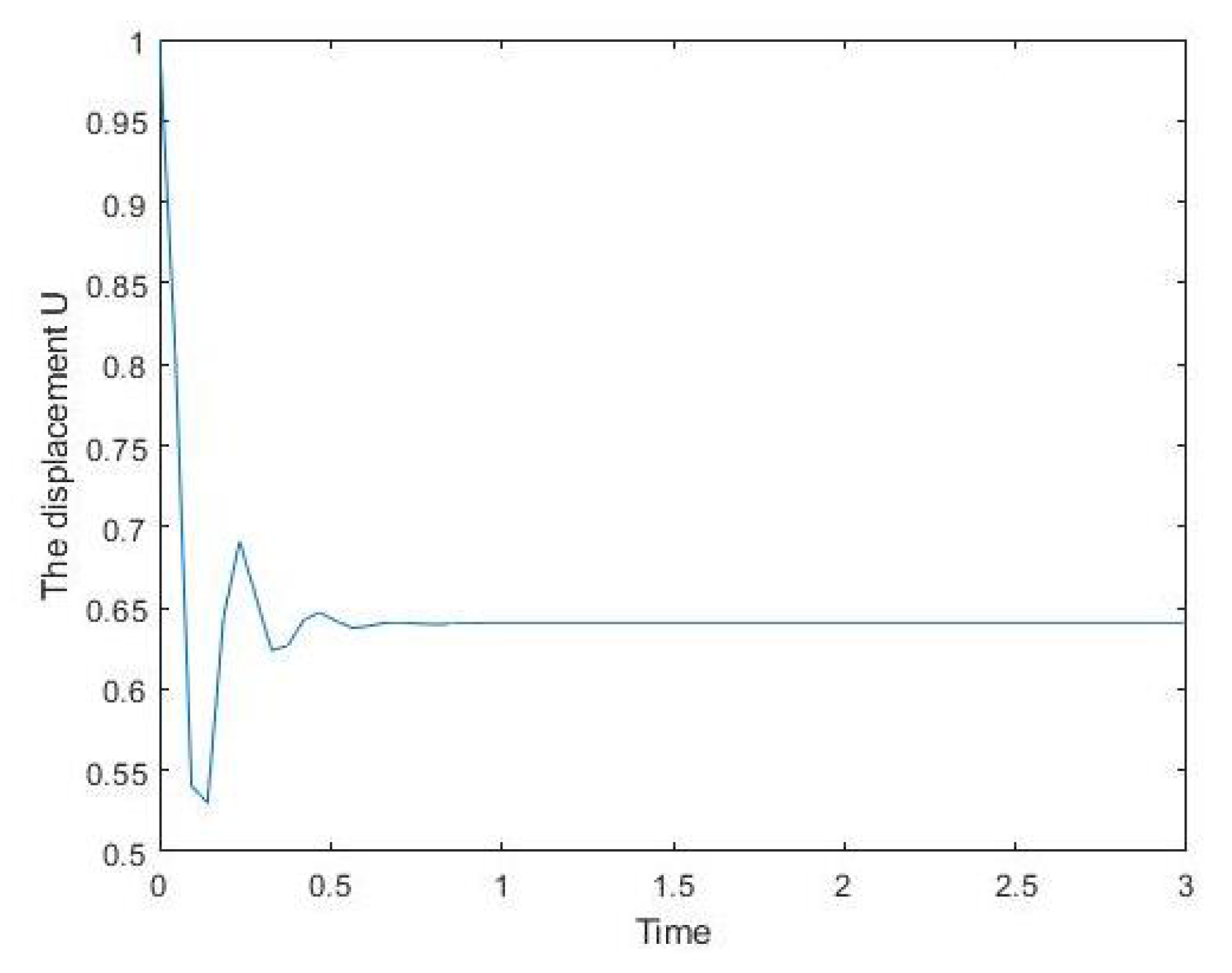
We simulate the influence of the damping coefficient on the vibration amplitude of the damped plate using the C-N compact difference schemes (15) and (16) proposed in Section 2. Let = 1.5; when is 1, 2, 3 and 5, the images of the center point of the thin plate are shown in the Figure 5, Figure 6, Figure 7 and Figure 8, respectively, with the spatial step and the time step .
Figure 5.
The displacement U when .
Figure 6.
The displacement U when .
Figure 7.
The displacement U when .
Figure 8.
The displacement U when .
From Figure 5, Figure 6, Figure 7 and Figure 8, it is shown that using the fractional derivative equation to simulate the vibration of the damped plate and using the C-N compact difference method to solve this model can well characterize the way the amplitude decreases more quickly with the increase in the damping coefficient.

6. Conclusions
This paper seeks to solve time-fractional damped plate vibration equations. By introducing the second-order space derivative and the first-order time derivative as intermediate variables, the fourth-order differential equations are converted into second-order differential equation systems, and the C-N compact difference formats for solving time-fractional damped plate vibration problems are established. Numerical cases are given to validate the convergence order and feasibility of the given difference formats, as well as to simulate the influence of the damping coefficient on the vibration amplitude. This research topic will be further pursued by investigating algorithms that are more effective for solving time-fractional damped plate vibration equations and further discussing the simulation performance with different values of , which is the order of the fraction-order derivative, for solving time-fractional damped plate vibration equations.
Author Contributions
Writing—original draft, C.W. (Cailian Wu); Writing—review & editing, C.W. (Congcong Wei), Z.Y. and A.Z. All authors have read and agreed to the published version of the manuscript.
Funding
The work is supported by the National Natural Science Foundation of China (contract grant number: 12171287) and the Natural Science Foundation of Shandong Province (contract grant number: ZR2021MA063).
Data Availability Statement
The authors store data supporting the reported results and are available upon request.
Acknowledgments
The authors would like to express their sincere thanks to the referees for the valuable comments and suggestions that helped to improve the original paper.
Conflicts of Interest
The authors declare no conflict of interest.
References
- Wang, Y.H.; Zhou, Y.; Ding, K. Recent advances in research and applications of viscoelastically damped structure. J. Disaster Prev. Mitig. Eng. 2006, 26, 109–121. [Google Scholar]
- Zhu, K.Q. Some advances in non-Newtonian fluid mechanics. Mech. Eng. 2006, 28, 1–8. [Google Scholar]
- Cai, E. Fundamentals of Viscoelastic Mechanics; Beihang University Press: Beijing, China, 1989. [Google Scholar]
- Li, Z.; Xu, B.Y. Equiv alent v isco us damping system for viscoelastic fractional derivative model. J. Tsinghua Univ. (Sci. Technol.) 2000, 40, 27–29. [Google Scholar]
- Xu, M.Y.; Tan, W.C. Intermediate process, critical phenomena-theory, methodology and evolution of the fractional operator and its applications to the modern mechanics. Sci. China Ser. G Phys. Mech. Astron. 2006, 36, 225–238. [Google Scholar]
- Ingman, D.; Suzdalnitsky, J. Control of damping oscillations by fractional differential operator with time-dependent order. Comput. Methods Appl. Mech. Eng. 2004, 193, 5585–5595. [Google Scholar] [CrossRef]
- Sakakibara, S. Relaxation properties of fractional derivative viscoelasticity models. Nonlinear Anal. 2001, 47, 5449–5454. [Google Scholar] [CrossRef]
- Adolfsson, K.; Enelund, M.; Olsson, P. On the fractional order model of viscoelasticity. Mech. Time-Depend. Mater. 2005, 9, 15–34. [Google Scholar] [CrossRef]
- Srivastava, H.M.; Saad, K.M.; Hamanah, W.M. Certain new models of the multi-space fractal-fractional Kuramoto-Sivashinsky and Korteweg-de Vries equations. Mathematics 2022, 10, 1089. [Google Scholar] [CrossRef]
- Wang, F.Y.; Zhang, Z.Q.; Zhou, Z.J. A spectral Galerkin approximation of optimal control problem governed by fractional advection–diffusion–reaction equations. J. Comput. Appl. Math. 2021, 386, 113233. [Google Scholar] [CrossRef]
- Zhu, A.L.; Wang, Y.X.; Xu, Q. A weak Galerkin finite element approximation of two-dimensional sub-diffusion equation with time-fractional derivative. AIMS Math. 2020, 5, 4297–4310. [Google Scholar] [CrossRef]
- Jiang, K.; Si, W.; Chen, C.; Bao, C.L. Efficient numerical methods for computing the stationary states of phase field crystal models. SIAM J. Sci. Comput. 2020, 42, B1350–B1377. [Google Scholar] [CrossRef]
- Ciment, M.; Leventhal, S.H. Higher compact implicit schemes for the wave equation. Math. Comput. 1975, 29, 985–994. [Google Scholar] [CrossRef]
- Jiang, Y.Z.; Ge, Y.B. An explicit fourth-order compact difference scheme for solving the 2D wave equation. Adv. Differ. Equ. 2020, 2020, 834–841. [Google Scholar] [CrossRef]
- Ran, M.; Zhang, C.J. New compact difference scheme for solving the fourth-order time fractional sub-diffusion equation of the distributed order. Appl. Numer. Math. 2018, 129, 58–70. [Google Scholar] [CrossRef]
- Vong, S.; Lyu, O.; Wang, Z.B. A compact difference scheme for fractional sub-diffusion equations with the spatially variable coefficient under Neumann boundary conditions. J. Sci. Comput. 2016, 66, 725–739. [Google Scholar] [CrossRef]
- Ji, C.C.; Sun, Z.Z. A high-order compact finite difference scheme for the fractional sub-diffusion equation. J. Sci. Comput. 2015, 64, 954–985. [Google Scholar] [CrossRef]
- Su, B.J.; Jiang, Z.W. High-order compact finite volume scheme for the 2D multi-term time fractional sub-diffusion equation. Adv. Differ. Equ. 2020, 2020, 689. [Google Scholar] [CrossRef]
- Li, L.Y.; Jiang, Z.W.; Yin, Z. Compact finite-difference method for 2D time-fractional convection-diffusion equation of groundwater pollution problems. Comput. Appl. Math. 2020, 39, 142. [Google Scholar] [CrossRef]
- Wang, Y.M.; Guo, B.Y. Fourth-order compact finite difference method for fourth-order nonlinear elliptic boundary value problems. J. Comput. Appl. Math. 2007, 221, 76–97. [Google Scholar] [CrossRef][Green Version]
- Deng, D.W.; Zhang, C.J. A new fourth-order numerical algorithm for a class of three-dimensional nonlinear evolution equations. Numer. Methods Partial. Differ. Equ. 2013, 29, 102–130. [Google Scholar] [CrossRef]
- Li, Q.; Yang, Q. Compact difference scheme for two-dimensional fourth-order hyperbolic equation. Adv. Differ. Equ. 2019, 2019, 328. [Google Scholar] [CrossRef]
- Li, Q.; Yang, Q.; Chen, H.Z. Compact difference scheme for two-dimensional fourth-order nonlinear hyperbolic equation. Numer. Methods Partial Differ. Equ. 2020, 36, 1938–1961. [Google Scholar] [CrossRef]
- Hu, X.L.; Zhang, L.M. A compact finite difference scheme for the fourth-order fractional diffusion-wave system. Comput. Phys. Commun. 2011, 182, 1645–1650. [Google Scholar] [CrossRef]
- Gao, G.H.; Liu, R. A compact difference scheme for fourth-order temporal multi-term fractional wave equations and maximum error estimates. East Asian J. Appl. Math. 2019, 9, 703–722. [Google Scholar]
- Pu, Z.; Ran, M.H.; Luo, H. Fast and high-order difference schemes for the fourth-order fractional sub-diffusion equations with spatially variable coefficient under the first Dirichlet boundary conditions. Math. Comput. Simul. 2021, 187, 110–133. [Google Scholar] [CrossRef]
- Zhang, P.; Pu, H. A second-order compact difference scheme for the fourth-order fractional sub-diffusion equation. Numer. Algorithms 2017, 76, 573–598. [Google Scholar] [CrossRef]
- Shen, X.; Zhu, A.L. A Crank–Nicolson linear difference scheme for a BBM equation with a time fractional nonlocal viscous term. Adv. Differ. Equ. 2018, 2018, 351. [Google Scholar] [CrossRef]
- Sun, Z.Z.; Gao, G.H. Finite Difference Method for Fractional Differential Equations; Science Press: Beijing, China, 2015. [Google Scholar]
- Sun, Z.Z. Numerical Solution of Partial Differential Equations; Science Press: Beijing, China, 2012. [Google Scholar]
Publisher’s Note: MDPI stays neutral with regard to jurisdictional claims in published maps and institutional affiliations. |
© 2022 by the authors. Licensee MDPI, Basel, Switzerland. This article is an open access article distributed under the terms and conditions of the Creative Commons Attribution (CC BY) license (https://creativecommons.org/licenses/by/4.0/).