


Abstract
In this paper, we consider a class of quasilinear third-order differential equations with a delay argument. We establish some conditions of such certain third-order quasi-linear neutral differential equation as oscillatory or almost oscillatory. Those criteria improve, complement and simplify a number of existing results in the literature. Some examples are given to illustrate the importance of our results.
1. Introduction
Consider the third-order neutral delay differential equation of the form
where and we assume that the following hypotheses are satisfied:
- (I1)
- is positive and where
- (I2)
- q is non-negative and does not eventually vanish (i.e., is not eventually zero on any half line for );
- (I3)
- and
- (I4)
- and satisfieswhere is the quotient of odd positive integers.
By a solution of (1), we mean a nontrivial function with , which satisfies the property , moreover, satisfies (1) on We only consider those solutions of (1) satisfying, on some half-line, and satisfying the condition for any . A solution of (1) is oscillatory if it has arbitrarily large zeros on ; otherwise, it is said to be nonoscillatory. The equation itself is termed oscillatory if all its solutions oscillate, and is said to be almost oscillatory if all its solutions are oscillatory or asymptotically convergent to zero.
The neutral differential equations have numerous applications in electrical engineering, chemical reactions analysis, and economics.
Such equations are essential tools to model and study the dynamics and stability properties of electrical power systems, as in the works of Milano et al. [1,2]. The asymptotic behavior of solutions of associated delay differential equations have been used to describe the behavior of solutions to third-order partial differential equations. Additionally, they are employed for the study of distributed networks containing lossless transmission lines; see [3,4] for more details.
Recently, there has been much research activity concerning the oscillation of second-order differential equations with delay. See, for example, [5,6] and the references cited therein. Compared to the development of the oscillation for the second-order equations, the oscillation for third-order equations has received considerably less attention from researchers; see [7,8,9,10,11,12,13,14,15,16,17,18,19,20,21,22,23,24].
Baculikova and Dzurina [25,26] and Grace et al. [27] considered the third-order nonlinear delay differential equation
in the case where or
Saker and Dzurina [28] studied the third-order nonlinear delay differential equation
and obtained several oscillation criteria, which guarantee that all non-oscillatory solutions of such Equation (2) tend towards zero.
Ravi et al. [29] investigated a third-order delay differential equation
and established some oscillation results that supplemented and improved the results in [27]. Sidorov and Trufanov [30] considered nonlinear operator equations with a functional perturbation of the argument of neutral type and reduced the problem to quasilinear operator equations with a functional perturbation of the argument.
Moaaz, in [11], studied a third-order nonlinear delay differential (2) under the condition ; he developed some results of previous references and established several sufficient conditions, which ensure that all solutions of (2) are oscillatory.
In previous papers, the authors used an integral averaging technique and a Riccati transformation to establish some sufficient conditions which ensure that any solution of (1) oscillates or converges to zero. The purpose of this paper is to improve and generalize these results and present some new sufficient conditions, which ensure that any solution of (1) oscillates or, for all its nonoscillatory solutions, tend towards zero as
2. Auxiliary Results
In this section, we state and prove the following lemmas, which will be useful in the proofs of the main results.
Lemma 1
Lemma 2
([31]). Let where , A and C are constants, α bea ratio of two odd positive numbers. Then, h attains its maximum value on at such that
Lemma 3
([32]). Assume that and . Then
where
Lemma 4.
Proof.
Since , we find
That is
This completes the proof. □
Lemma 5.
Proof.
Let be a positive solution of (1). Then, there exists such that and for all . From Lemma 3 and , we obtain
In view of (I), (4) implies
Thus,
This completes the proof. □
Lemma 6.
Assume that is a positive solution of (1) and . Then
Proof.
Since is nondecreasing, this implies that
Integrating from to , we get
Hence, for any and we see that
The proof is complete. □
Lemma 7.
Proof.
Lemma 8.
- (a)
- and is decreasing, and ,
- (b)
- and is increasing.
Proof.
Assume that is a positive solution of (1) on . Then, there exists such that and for all . Since y is increasing, y satisfies either case or . In view of and (11), we see that (9) hold. By Lemma 7, satisfies case .
On the other hand, it follows from is decreasing, such that there exists a constant such that . We claim that As the proof of Lemma 7 we have (10). Take into account and , we have
It follows that
Integrating from to t, we obtain
In view of (11), this contradicts the positivity of . Thus . By “Hospital’s rule”, we see that
Thus,
Therefore,
for Hence, by the monotonicity of one can obtain that
By (12), we have
Now, it is easy to see that
Thus,
The proof is complete. □
3. Main Results
Theorem 1.
Proof.
Assume that is a positive solution of (1) on . Then, there exists such that and for all . Suppose that satisfies case or Since y is increasing, then it follows that
Set
In (6), we obtain
Since by (15), we have
First, let satisfies case . We note that . Using the fact together with (13) yields that contradicts the positivity of .
Integrating from to t, we have
we obtain a cotradiction with the positivity of . The proof of the theorem is complete. □
Theorem 2.
Proof.
Assume that is a positive solution of (1) on . Then, there exists such that and for all . Suppose that y satisfies case or . In view of (19), (11) holds. Hence, by Lemma 8, satisfies case and properties (a) and (b) in Lemma 8. This implies that
Combining the above inequality along with (6), we get
Using the fact that we see that
Now, set we obtain
In view of ([13], Theorem 1), however, the associated delay Equation (21) has a positive solution, which is a contradiction. The proof is complete. □
Remark 1.
Theorem 2 does not require the existence of auxiliary functions such as ([27], Theorem 3), which uses the same principles (compared with first-order delay equations).
Proof.
Suppose that y satisfies case or . We see that (9) holds due to (this mean that ) and condition (22). Hence, by Lemma 8, satisfies case in addition to properties (a) and (b) in Lemma 8. As in the proof of Theorem 2 with the fact is nonincreasing, and from (20), we obtain
That is,
This contradicts (22). The proof is complete. □
Theorem 4.
Proof.
Assume that is a positive solution of (1) on . Then, there exists such that and for all . Suppose that y satisfies case or . By Lemma 8, satisfies case and the properties (a) and (b). Define the function by
Then , and
Using the fact that is decreasing, we have
By (24), we obtain
Since there exists such that
Combining the above inequality in (27) implies
Hence,
Integrating from to t, we have
which is a contradiction. The proof is complete. □
By choosing , we conclude the following corollary.
Corollary 1.
Theorem 5.
Proof.
Assume that is a positive solution of (1) on ; then, there exists such that and for all . Suppose that y satisfies case or . By Lemma 8, satisfies case and the properties (a) and (b).
Define the function by
From Lemma 8, it is easy to see that
That is, and
Using (16) and the fact is decreasing, we have.
In view of (b) in Lemma 8, we find
Set
Using Lemma 2, we obtain
It is clear that
In (33), we obtain
Integrating the above inequality from to t yields
From (30), we are led to
The proof is complete. □
Lemma 9.
Proof.
Assume that is a positive solution of (1) on , there exists such that and for all . Since and there is , such that Assume that Integrating (6) from to t, we have
This contradicts (35). Hence The proof is complete. □
Theorem 6.
4. Applications
4.1. Asymptotic Properties
By combining Theorems 2–5 with Lemma 9, one can easily provide new criteria for the asymptotic properties of (1) as follows
Theorem 10.
4.2. Oscillation
In the following Theorem, we combine Theorems 2–5 with Theorem (37) to obtain new criteria for oscillation of (1)
Theorem 12.
Remark 2.
Compared to the existing results of [25,26], oscillation of (1) is attained by easier conditions.
Example 1.
Consider the third-order neutral delay differential equation
where and We note that , , . It can easily be verified that By choosing Condition (19), (29), (28) and (37) become
and
respectively. Using Theorems 8, 10 and 11, Equation (39) is almost oscillatory if (40) or (41) or (42) holds. Moreover, by Theorem 12, we see that (39) is oscillatory if
Remark 3.
It is easy to verify that condition (13) fails; therefore, Theorem 1 does not apply.
Remark 4.
If then our results are reduced to the results of Chatzarakis in [14].
Example 2.
Remark 5.
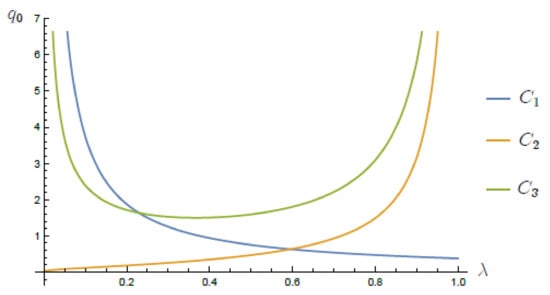
Consider a particular case of (43), namely,
Conditions (44) and (45) reduce to
and
respectively; see Figure 1. Thus, by Theorem 12, Equation (46) is oscillatory if (47) or (48) satisfies. So, For a given Condition (47) is sharp for oscillation, but in Condition (48) is sharp for oscillation.
Figure 1.
Test of the strength of criteria for (46).
Remark 6.
It is easy to notice that the effect of the delay argument on the oscillation parameters varies from one example to another, and no consistent pattern can be found to determine this effect. Additionally, the oscillation test depends on two different conditions, so we notice the change in the effect of the delay argument on oscillation (from inverse to direct relationship). This also applies to the effect of α.
5. Conclusions
In this paper, we introduced a simplified theorem for near oscillation; furthermore, we established oscillation criteria for (1). Using comparison theorems and the Riccati technique, we established criteria to check the oscillation under fewer restrictions, and compared this with some results published in the literature. Our results are an extension of and complement to existing results in some previous studies, such as [15,27,29].
The establishment of criteria for the oscillation of Equation (1) without the need for a condition and remains an open problem.
Author Contributions
Conceptualization, B.Q., O.M., S.S.S., S.N., D.S. and E.M.E.; methodology, B.Q., O.M., S.S.S., S.N., D.S. and E.M.E.; validation, B.Q., O.M., S.S.S., S.N., D.S. and E.M.E.; formal analysis, B.Q., O.M., S.S.S., S.N., D.S. and E.M.E.; investigation, B.Q., O.M., S.S.S., S.N., D.S. and E.M.E.; writing—review and editing, B.Q., O.M., S.S.S., S.N., D.S. and E.M.E.; supervision, B.Q., O.M., S.S.S., S.N., D.S. and E.M.E.; funding acquisition, D.S.; All authors have read and agreed to the published version of the manuscript.
Funding
D.S. was funded out under State Assignment Projects (No. FWEU-2021-0006, FWEU-2021-0001) of the Fundamental Research Program of Russian Federation 2021–2030 using the resources of the High-Temperature Circuit Multi-Access Research Center (Ministry of Science and Higher Education of the Russian Federation, project no 13.CKP.21.0038).
Conflicts of Interest
There are no competing interests.
References
- Liu, M.; Dassios, I.; Tzounas, G.; Milano, F. Stability Analysis of Power Systems with Inclusion of Realistic-Modeling of WAMS Delays. IEEE Trans. Power Syst. 2019, 34, 627–636. [Google Scholar] [CrossRef]
- Milano, F.; Dassios, I. Small-Signal Stability Analysis for Non-Index 1 Hessenberg Form Systems of Delay Differential-Algebraic Equations. IEEE Trans. Circuits Syst. Regul. Pap. 2016, 63, 1521–1530. [Google Scholar] [CrossRef]
- Agarwal, R.P.; Berezansky, L.; Braverman, E.; Domoshnitsky, A. Nonoscillation Theory of Functional Differential Equations with Applications; Springer: Berlin/Heidelberg, Germany, 2012; 520p, ISBN 978-1-4614-3454-2. [Google Scholar]
- Hale, J.K. Theory of Functional Differential Equations; Springer: Berlin/Heidelberg, Germany, 1977. [Google Scholar]
- Moaaz, O.; Elabbasy, E.M.; Qaraad, B. An improved approach for studying oscillation of generalized Emden–Fowler neutral differential equation. J. Inequal. Appl. 2020, 2020, 69. [Google Scholar] [CrossRef]
- Chatzarakis, G.E.; Moaaz, O.; Li, T.; Qaraad, B. Some oscillation theorems for nonlinear second-order differential equations with an advanced argument. Adv. Differ. Equ. 2020, 160. [Google Scholar] [CrossRef]
- Bohner, M.; Grace, S.R.; Sager, I.; Tunc, E. Oscillation of third-order nonlinear damped delay differential equations. Appl. Math. Comput. 2016, 278, 21–32. [Google Scholar] [CrossRef]
- Chatzarakis, G.E.; Grace, S.R.; Jadlovska, I.; Li, T.; Tunc, E. Oscillation criteria for third-order Emden–Fowler differential equations with unbounded neutral coefficients. Complexity 2019, 2019, 5691758. [Google Scholar] [CrossRef]
- Grace, S.R.; Graef, J.R.; Tunc, E. Oscillatory behaviour of third order nonlinear differential equations with a nonlinear nonpositive neutral term. J. Taibah Univ. Sci. 2019, 13, 704–710. [Google Scholar] [CrossRef]
- Grace, S.R.; Jadlovska, I.; Tunc, E. Oscillatory and asymptotic behavior of third-order nonlinear differential equations with a superlinear neutral term. Turk. J. Math. 2020, 44, 1317–1329. [Google Scholar] [CrossRef]
- Moaaz, O.; Qaraad, B.; El-Nabulsi, R.; Bazighifan, O. New Results for Kneser Solutions of Third-Order Nonlinear Neutral Differential Equations. Mathematics 2020, 8, 686. [Google Scholar] [CrossRef]
- Elabbasy, E.M.; Qaraad, B.; Abdeljawad, T.; Moaaz, O. Oscillation Criteria for a Class of Third-Order Damped Neutral Differential Equations. Symmetry 2020, 12, 1988. [Google Scholar] [CrossRef]
- Philos, C. On the existence of nonoscillatory solutions tending to zero at ∞ for differential equations with positive delays. Arch. Math. 1981, 36, 168–178. [Google Scholar] [CrossRef]
- Chatzarakis, G.E.; Dzurina, J.; Jadlovsk, I. Oscillatory and asymptotic properties of third-order quasilinear delay differential equations. J. Inequal. Appl. 2019, 23. [Google Scholar] [CrossRef]
- Li, T.; Zhang, C.; Baculikova, B.; Dzurina, J. On the oscillation of third-order quasi-linear delay differential equations. Tatra Mt. Math. Publ. 2011, 48, 117–123. [Google Scholar] [CrossRef]
- Dzurina, J.; Thapani, E.; Tamilvanan, S. Oscillation of solutions to third-order half-linear neutral differential equations. Electron. J. Differ. Equ. 2012, 29, 1–9. [Google Scholar]
- Graef, J.; Tunc, E.; Grace, S. Oscillatory and asymptotic behavior of a third-order nonlinear neutral differential equation. Opuscula Math. 2017, 37, 839–852. [Google Scholar] [CrossRef]
- Santra, S.S.; Ghosh, A.; Bazighifan, O.; Khedher, K.M.; Nofal, T.A. Second-order impulsive differential systems with mixed and several delays. Adv. Differ. Equ. 2021, 1, 1–12. [Google Scholar] [CrossRef]
- Santra, S.S.; Baleanu, D.; Khedher, K.M.; Moaaz, O. First-order impulsive differential systems: Sufficient and necessary conditions for oscillatory or asymptotic behavior. Adv. Differ. Equ. 2021, 1, 1–20. [Google Scholar] [CrossRef]
- Santra, S.S.; Tripathy, A.K. On oscillatory first order nonlinear neutral differential equations with nonlinear impulses. J. Appl. Math. Comput. 2019, 59, 257–270. [Google Scholar] [CrossRef]
- Ruggieri, M.; Santra, S.S.; Scapellato, A. On nonlinear impulsive differential systems with canonical and non-canonical operators. Appl. Anal. 2021. [Google Scholar] [CrossRef]
- Moaaz, O. Oscillation Theorems for Cartain Second-Order Differential Equations; Lambert Academic Publishing: Saarbrücken, Germany, 2014. [Google Scholar]
- Tunc, E. Oscillatory and asymptotic behavior of third-order neutral differential equations with distributed deviating arguments. Electron. J. Differ. Equ. 2017. [Google Scholar] [CrossRef][Green Version]
- Tiryaki, A.; Aktas, M.F. Oscillation criteria of a certain class of third-order nonlinear delay differential equations with damping. J. Math. Anal. Appl. 2007, 325, 54–68. [Google Scholar] [CrossRef]
- Baculikova, B.; Dzurina, J. Oscillation of third-order functional differential equations. Electron. J. Qual. Theory of Diff. Equ. 2010, 43, 1–10. [Google Scholar] [CrossRef]
- Baculikova, B.; Dzurina, J. Oscillation of third-order nonlinear differential equations. Appl. Math. Lett. 2011, 24, 466–470. [Google Scholar] [CrossRef]
- Grace, S.R.; Agarwal, R.P.; Pavani, R.; Thapani, E. On the oscillation of certain third order nonlinear functional differential equations. Appl. Math. Comput. 2008, 202, 102–112. [Google Scholar] [CrossRef]
- Saker, S.H.; Dzurina, J. On the oscillation of certain class of third-order nonlinear delay differential equations. Math. Bohem. 2010, 135, 225–237. [Google Scholar] [CrossRef]
- Ravi, P.; Agarwal, R.P.; Bohner, M.; Li, T.; Zhang, C. Oscillation of Third-Order Nonlinear Delay Differential Equations. Taiwan. J. Math. 2013, 17, 545–558. [Google Scholar]
- Sidorov, N.A.; Trufanov, A.N. Nonlinear operator equations with a functional perturbation of the argument of neutral type. Differ. Equ. 2009, 45, 1840–1844. [Google Scholar] [CrossRef]
- Zhang, S.Y.; Wang, Q. Oscillation of Second-Order Nonlinear Neutral Dynamic Equations on Time Scales. Appl. Math. Comput. 2010, 216, 2837–2848. [Google Scholar] [CrossRef]
- Thapani, E.; Li, T. On the oscillation of third-order quasi-linear neutral functional differential equations. Arch. Math. 2011, 47, 181–199. [Google Scholar]
Publisher’s Note: MDPI stays neutral with regard to jurisdictional claims in published maps and institutional affiliations. |
© 2021 by the authors. Licensee MDPI, Basel, Switzerland. This article is an open access article distributed under the terms and conditions of the Creative Commons Attribution (CC BY) license (https://creativecommons.org/licenses/by/4.0/).