Numerical Simulation Study on the Influence of Physical Heterogeneity on the Dissolution Rate of Carbonate Rock

Abstract
1. Introduction
2. Methods
2.1. Generation of Fractures with Heterogeneous Aperture Distribution
2.2. Generation of Fractures with Heterogeneous Mineral Distribution
2.3. Reaction Transport Simulation
2.4. Reaction Rate Formulations
2.5. Dimensionless Parameters
3. Results
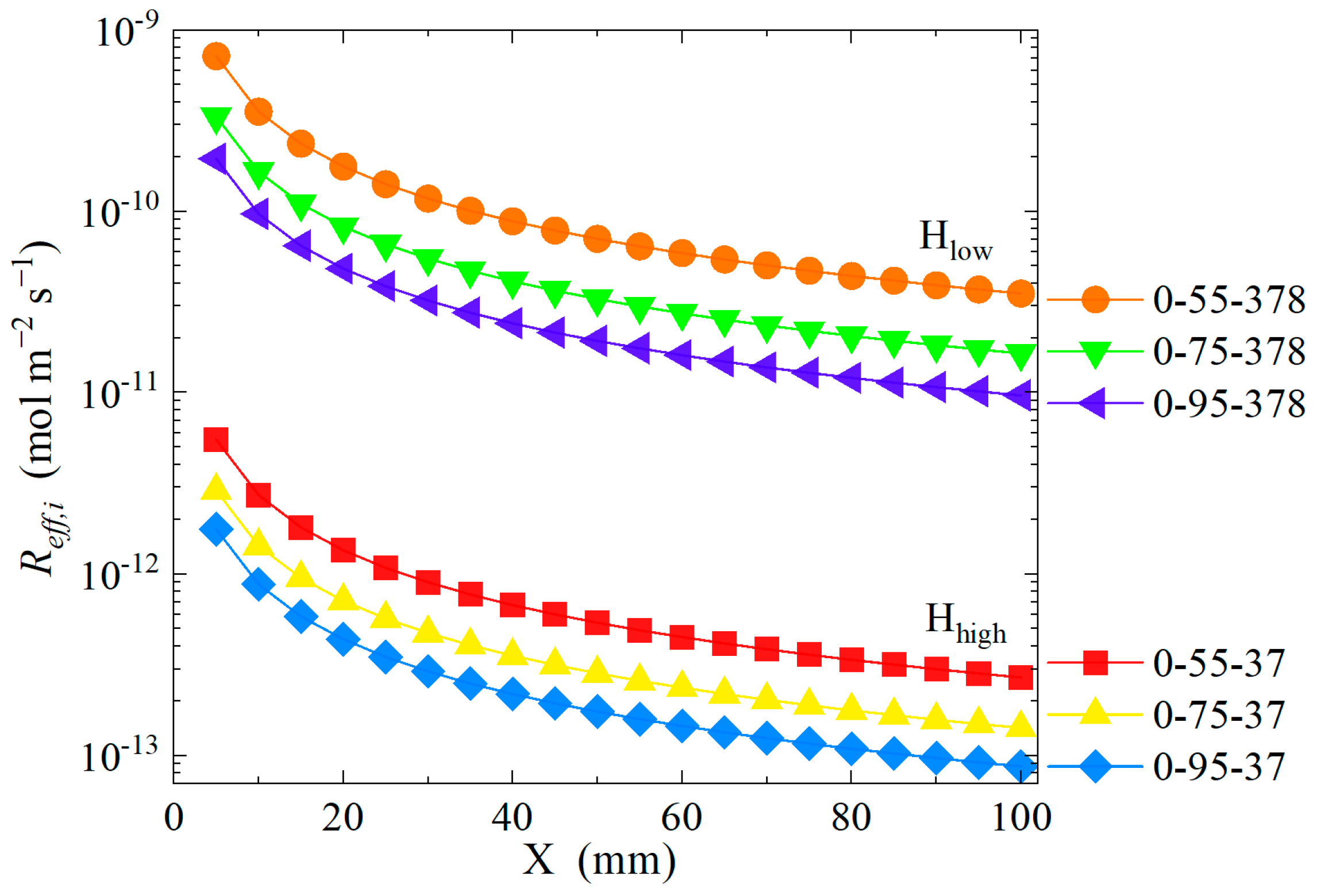
3.1. Effective Dissolution Rate (Reff,i) Controlled by Mineral Content in Homogeneous Fractures
3.2. Local Darcy Flow Rate (u) Under Heterogeneous Aperture Distribution
3.2.1. Characteristics of Local Flow Velocity (u) Under Heterogeneous Aperture
3.2.2. Correlation Between Fracture Roughness (λb) and Local Flow Velocity (u)
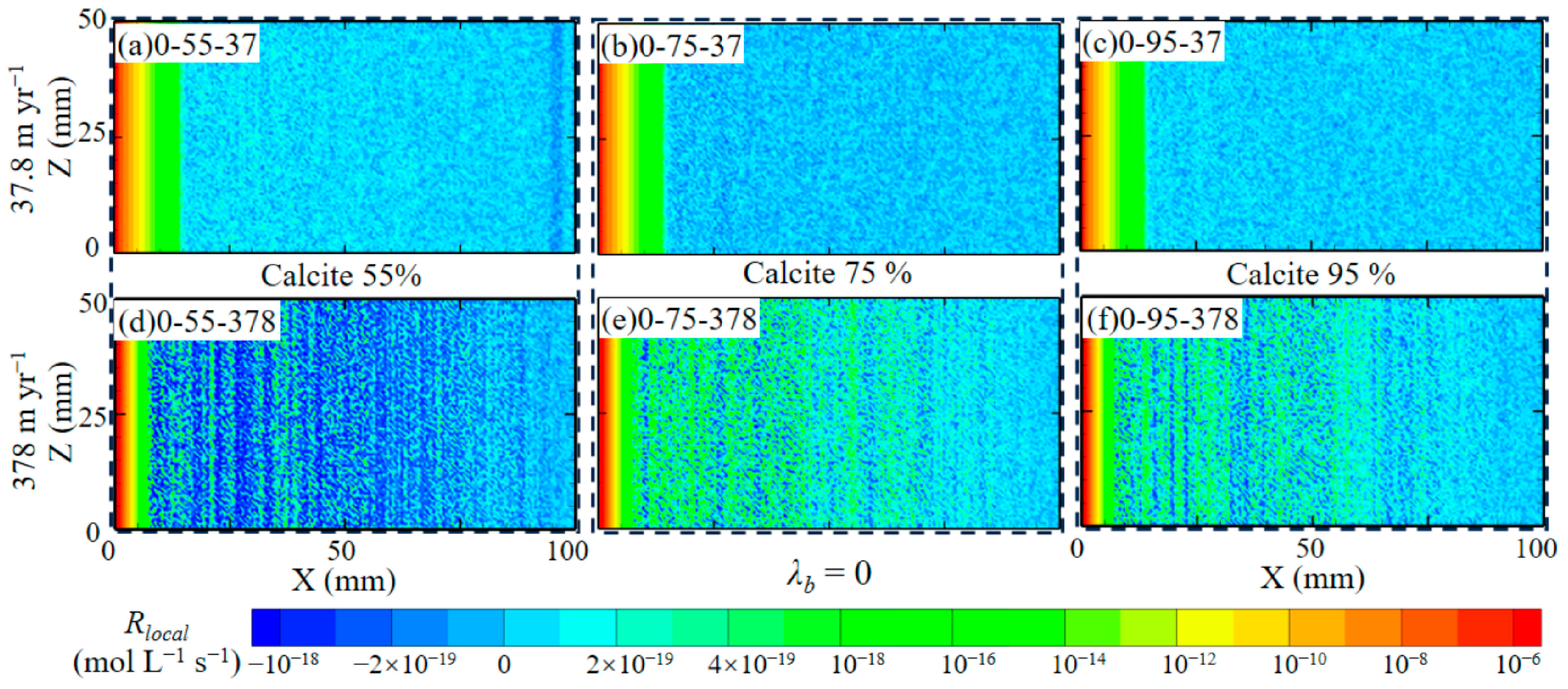
3.3. Characteristics of Local Mineral Dissolution Rate (Rlocal) Under Different Calcite Contents
3.3.1. Characteristics of Rlocal at 37.8 m·yr−1 (Hlow)
3.3.2. Characteristics of Rlocal at 378 m·yr−1 (Hhigh)
3.4. Characteristics of Effective Dissolution Rates Under Heterogeneous Mineral Distribution
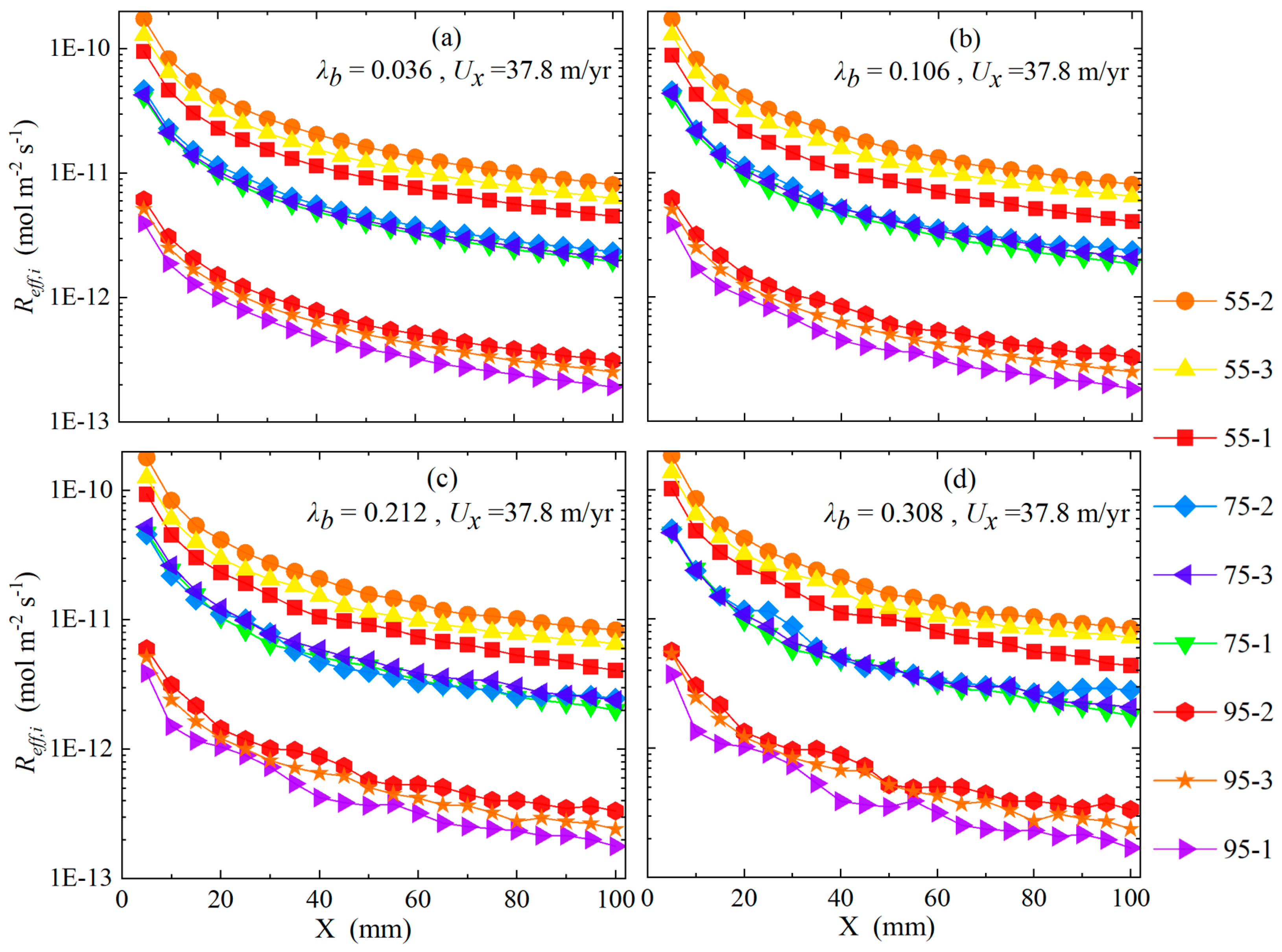
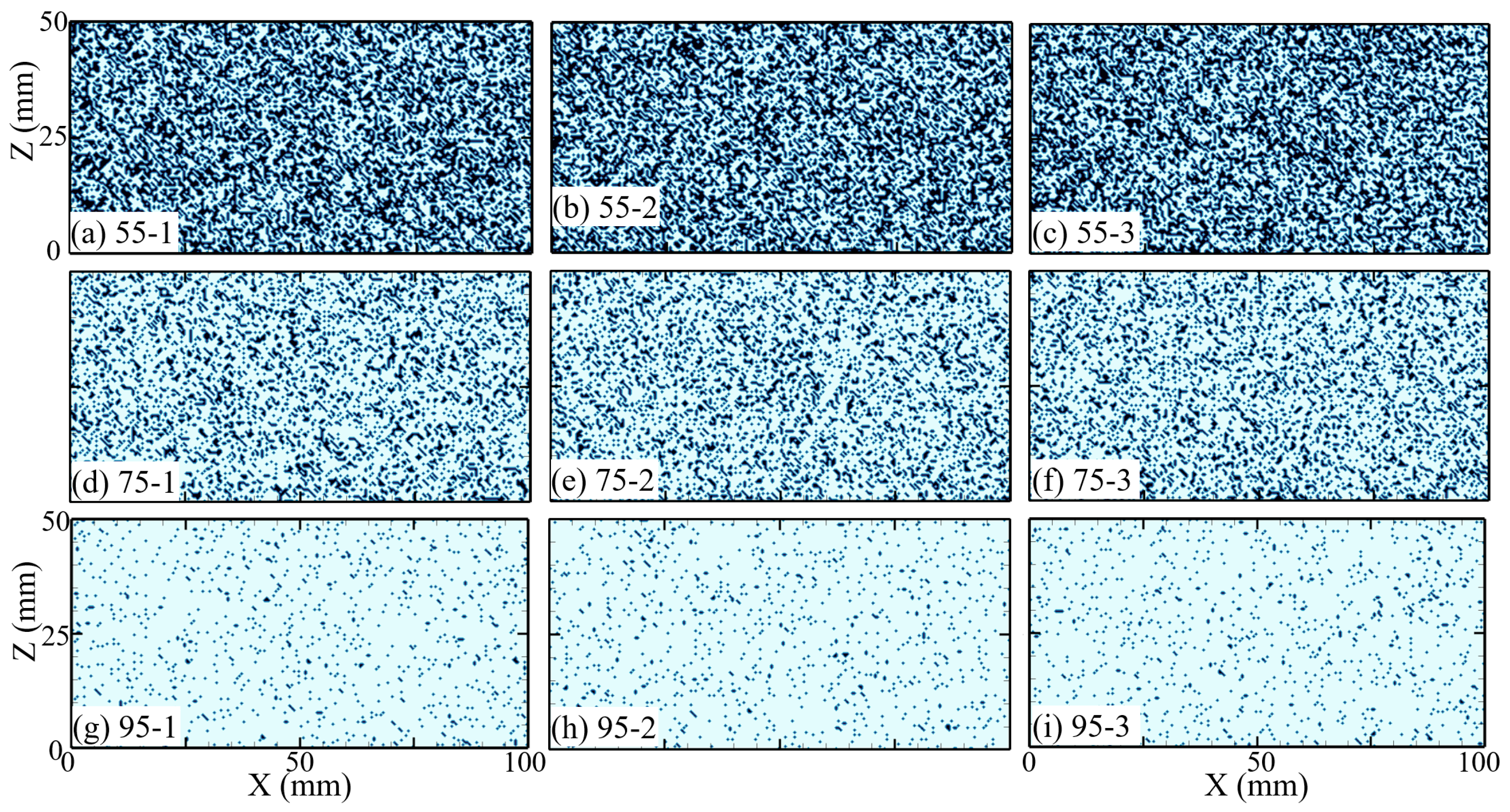
- Consistent with observations in homogeneous systems, dissolution rates decrease with increasing calcite content. Among all distributions, “55-2” yields the highest dissolution rate across fractures of all roughnesses, while “95-1” exhibits the lowest. According to Table S1, among the three random distributions for 55% calcite content, “55-2” has the fewest clusters and the largest average number of mineral units; in contrast, “95-1” has the most clusters and the smallest average number of mineral units, with both featuring the smallest XY standard deviation.
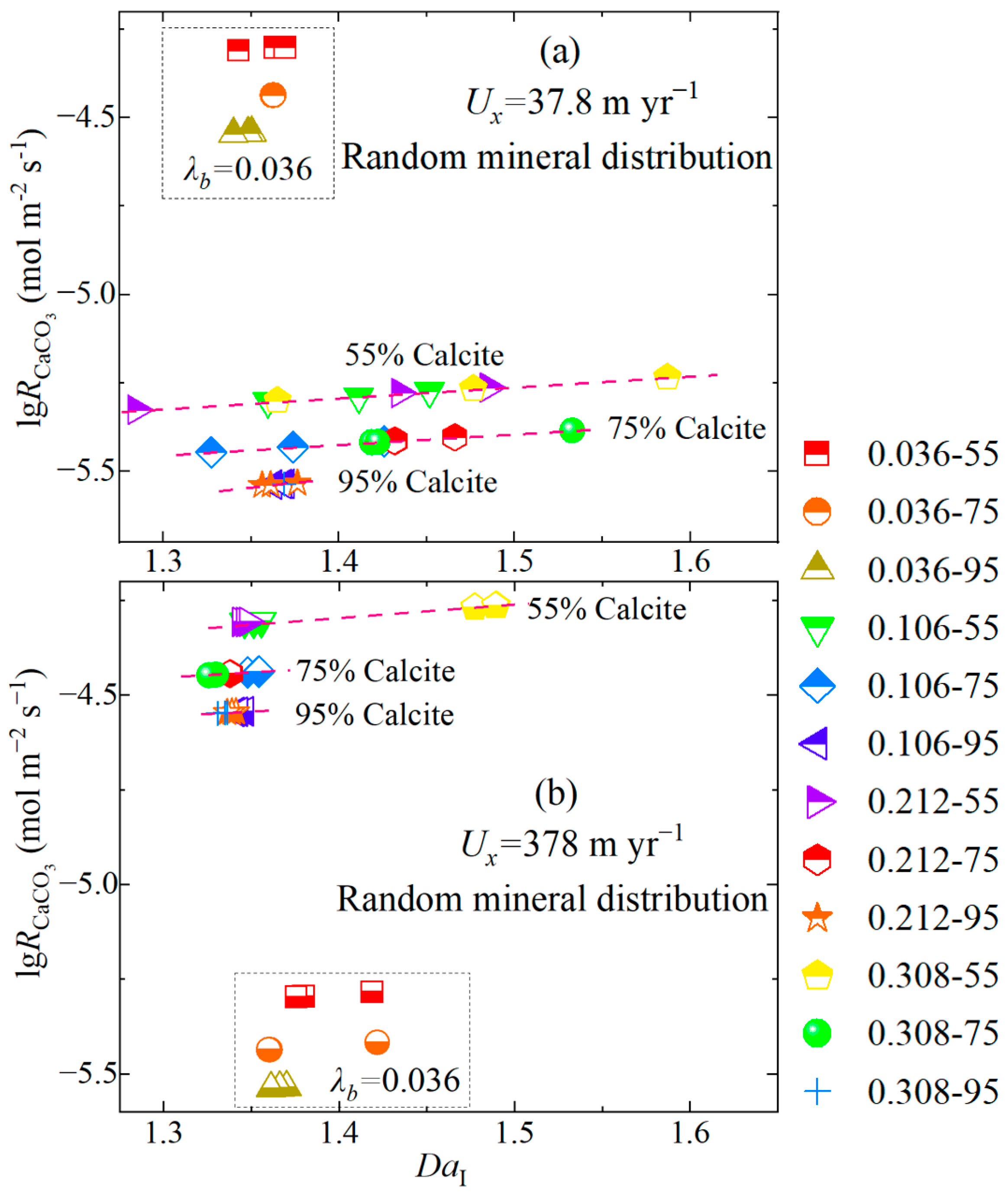
- In contrast to the distinct differences in effective dissolution rates among the three random distributions for 55% and 95% calcite contents, the dissolution rate curves for 75% calcite content exhibit consistent profiles. Furthermore, despite identical calcite content differences between adjacent groups, the average incremental differences in dissolution rates vary: the average rate for 55% calcite content is 0.47 orders of magnitude greater than that for 75%, while the average rate for 75% calcite content is 0.94 orders of magnitude greater than that for 95% (Figure S2). These results indicate that the dissolution rate curve for 75% calcite content exhibits the highest stability, followed by 55% calcite content. The fitting goodness (R2) for random calcite distributions at 75% content reaches 0.990, significantly higher than those for the other two contents. Combined with the relative stability of the distribution curves, it can be inferred that there exists an optimal reactive mineral content for fractures, at which the dissolution rate is relatively high and stable.
- Relative to previous findings, rate curve instability is more pronounced under Hlow conditions. The effect of aperture-heterogeneous fractures on dissolution is amplified under mineral-heterogeneous conditions, with more pronounced oscillatory trends observed in Fractures C and D.
4. Discussion
4.1. Correlation Between Dimensionless Parameters and Dissolution Rate of Heterogeneous Mineral Distribution
4.2. Synergistic Control Mechanism of Dissolution Rate by Heterogeneity
- Synergistic enhancement mode: For the combination of a high-roughness fracture (Fracture D) and low calcite content (55%), preferential flow paths highly overlap with inert quartz regions. Preferential flow paths enable efficient fluid discharge, while inert regions mitigate solute accumulation—this further increases the contact area between acidic fluid and reactive minerals per unit volume. Preferential flow paths enable efficient fluid discharge, while inert regions mitigate solute accumulation. The effective dissolution rate (Reff) reaches 2.1 × 10⁻¹¹ mol·m−2·s−1, the maximum among all combinations, which is twice that of the low-roughness (Fracture A) + high-content (95%) combination.
- Synergistic inhibition mode: For the combination of a high-roughness fracture (Fracture D) and high calcite content (95%), the calcium ions produced by the high-concentration calcite in preferential flow paths far exceed the transport capacity of the fracture system. Calcium ions accumulate at the minimum aperture regions along the flow paths (where the flow velocity is relatively low), leading to an increase in local mineral saturation. This induces the precipitation of calcite, which clogs fluid pathways and ultimately further reduces the local dissolution rate. The superposition of stagnant zones and dense calcite regions intensifies solute retention, reducing Reff to 7.3 × 10⁻¹² mol·m−2·s−1, only 1/3 of that in the synergistic enhancement mode.
- At 55% content: 45% inert quartz provides sufficient solute transport space, preventing calcium ion accumulation. Reff reaches 1.87 × 10⁻¹¹ mol·m−2·s−1, 0.94 orders of magnitude greater than that at 95% content;
- At 75% content (critical stability value): The average size of calcite clusters (37.69 units) achieves the optimal matching with transport space. The Reff difference among different random distributions is only 5%, with a coefficient of determination R2 = 0.990;
- At 95% high content: Calcite is densely distributed (maximum cluster size up to 5427 units), resulting in calcium ion production exceeding transport capacity. The IAP/Keq values are generally higher than 0.8, Reff decreases to 8.2 × 10⁻¹² mol·m−2·s−1, and local deposition zones appear in 15% of the fracture area.
4.3. Model Merits/Limitations and Academic/Engineering Implications
5. Conclusions
- A novel coupling method—integrating "self-affine fractal fracture aperture modeling, Monte Carlo-based random mineral distribution construction, and multi-component reactive transport simulation"—is proposed. For the first time, this method quantifies the regulatory intensity of mineral cluster distribution on dissolution front morphology, while clarifying that the spatial differentiation of fracture dissolution rate arises from the synergy between "flow field differentiation dominated by aperture heterogeneity" and "reaction site differentiation dominated by mineral heterogeneity". This thereby bridges the gap in insufficient quantitative research on the role of mineral spatial distribution in fracture dissolution.
- Critical thresholds of calcite content governing fracture dissolution are identified: ① 55% calcite content is the “optimal reaction content”, where 45% inert quartz provides sufficient solute transport channels to inhibit Ca2+ accumulation, resulting in the highest effective dissolution rate; ② 75% calcite content is the “critical stability content”, where the matching efficiency between calcite cluster size and transport space is maximized, leading to a coefficient of variation in dissolution rate of only 5% under random distributions; these thresholds provide direct quantitative criteria for optimizing carbonate reservoir acidification stimulation and evaluating karst dissolution potential.
- Two synergistic regulation modes of dual heterogeneities (aperture roughness λb and mineral distribution) on dissolution rate are revealed: Synergistic enhancement mode: High roughness (λb = 0.308) coupled with 55% calcite content forms “preferential flow-inert mineral spatial overlap”, achieving a peak dissolution rate of 2.1 × 10⁻¹¹ mol·m−2·s−1; Synergistic inhibition mode: High roughness coupled with 95% calcite content leads to “stagnant zone-dense calcite superposition”, reducing the dissolution rate to 1/3 of the enhancement mode; High flow velocity can alleviate this inhibition by enhancing advective transport, providing a practical strategy for mitigating solute retention in high-mineral-content fractures.
- A dynamic linear correlation model between the dimensionless parameter DaI and dissolution rate is established (R2 > 0.98 under the same mineral content). The correlation law varies with flow rate: low-roughness fractures are reaction-dominated (small DaI) under low flow velocity, and advection-dominated (large DaI) under high flow velocity. This model offers a simple tool for the rapid evaluation of dissolution mechanisms in engineering practice.
Supplementary Materials
Author Contributions
Funding
Institutional Review Board Statement
Informed Consent Statement
Data Availability Statement
Acknowledgments
Conflicts of Interest
References
- Hartmann, J.; West, A.J.; Renforth, P.; Köhler, P.; De La Rocha, C.L.; Wolf-Gladrow, D.A.; Dürr, H.H.; Scheffran, J. Enhanced chemical weathering as a geoengineering strategy to reduce atmospheric carbon dioxide, supply nutrients, and mitigate ocean acidification. Rev. Geophys. 2013, 51, 113–149. [Google Scholar] [CrossRef]
- Ulloa-Cedamanos, F.; Probst, A.; Moussa, I.; Probst, J.-L. Chemical weathering and CO2 consumption in a multi-lithological karstic critical zone: Long term hydrochemical trends and isotopic survey. Chem. Geol. 2021, 585, 120567. [Google Scholar] [CrossRef]
- Zachara, J.; Brantley, S.; Chorover, J.; Ewing, R.; Kerisit, S.; Liu, C.; Perfect, E.; Rother, G.; Stack, A.G. Internal domains of natural porous media revealed: Critical locations for transport, storage, and chemical reaction. Environ. Sci. Technol. 2016, 50, 2811–2829. [Google Scholar] [CrossRef]
- Raabe, D. The materials science behind sustainable metals and alloys. Chem. Rev. 2023, 123, 2436–2608. [Google Scholar] [CrossRef]
- Zhao, G.; Huang, Q.; Zhu, Y.; Xu, Y.; Pu, Z. Simulation of the buffering process of karst soil on sulfuric acid rain and the characteristic of δ13CDIC and the carbon sink flux in Guilin City, southwest China. Environ. Earth Sci. 2023, 82, 296. [Google Scholar] [CrossRef]
- Kump, L.R.; Brantley, S.L.; Arthur, M.A. Chemical weathering, atmospheric CO2, and climate. Annu. Rev. Earth Planet. Sci. 2000, 28, 611–667. [Google Scholar] [CrossRef]
- Brantley, S.; Lebedeva, M.; Bazilevskaya, E. Relating Weathering Fronts for Acid Neutralization and Oxidation to pCO2 and pO2. In The Atmosphere-History; Elsevier Inc.: Amsterdam, The Netherlands, 2013; pp. 327–352. [Google Scholar]
- Meng, L.; Yang, Y.; Zhou, S.; Wang, S.; Wang, W.; Tan, R.; Wang, L.; Wang, Q.; Wu, X.; Du, A.; et al. Hydro-chemical performance of copper mine waste-based capillary barriers for acid mine drainage control in humid climates. J. Rock Mech. Geotech. Eng. 2025; in press. [Google Scholar] [CrossRef]
- Stoffel, M.; Trappmann, D.G.; Coullie, M.I.; Ballesteros Cánovas, J.A.; Corona, C. Rockfall from an increasingly unstable mountain slope driven by climate warming. Nat. Geosci. 2024, 17, 249–254. [Google Scholar] [CrossRef]
- Bufe, A.; Rugenstein, J.K.C.; Hovius, N. CO2 drawdown from weathering is maximized at moderate erosion rates. Science 2024, 383, 1075–1080. [Google Scholar] [CrossRef]
- Zhao, Y.J. Study on Dissolution Characteristics of Karst Key Development Area in Wulong Tunnel; Jilin University: Chongqing, China, 2018. (In Chinese) [Google Scholar]
- Yang, B.; Shi, W.; Yang, X. Nonlinear seepage erosion model of water inrush considering particle size distribution of karst collapse column and its engineering applications. Sci. Rep. 2022, 12, 17078. [Google Scholar] [CrossRef] [PubMed]
- Yu, J.H. Quantitative Characterization of Karst Fracture Dissolution Law and Its Application; Henan Polytechnic University: Jiaozuo, China, 2023. (In Chinese) [Google Scholar]
- Zhang, S.; Liu, X.; Wang, E. Quantitative evaluation of the onset and evolution for the non-Darcy behavior of the partially filled rough fracture. Water Resour. Res. 2024, 60, e2023WR036494. [Google Scholar] [CrossRef]
- Huang, D.; Gu, D.M. Influence of filling-drawdown cycles of the Three Gorges reservoir on deformation and failure behaviors of anaclinal rock slopes in the Wu Gorge. Geomorphology 2017, 295, 489–506. [Google Scholar] [CrossRef]
- Chen, Y.; Zhang, Y.; Wang, L.; Wang, S.; Tian, D.; Zhang, L. Influencing factors, deformation mechanism and failure process prediction for reservoir rock landslides: Tanjiahe landslide, three gorges reservoir area. Front. Earth Sci. 2022, 10, 974301. [Google Scholar] [CrossRef]
- White, A.F.; Brantley, S.L. The effect of time on the weathering of silicate minerals: Why do weathering rates differ in the laboratory and field? Chem. Geol. 2003, 202, 479–506. [Google Scholar] [CrossRef]
- Zhu, C. In situ feldspar dissolution rates in an aquifer. Geochim. Cosmochim. Acta 2005, 69, 1435–1453. [Google Scholar] [CrossRef]
- Bain, J.; Mayer, K.; Blowes, D.; Frind, E.; Molson, J.; Kahnt, R.; Jenk, U. Modelling the closure-related geochemical evolution of groundwater at a former uranium mine. J. Contam. Hydrol. 2001, 52, 109–135. [Google Scholar] [CrossRef] [PubMed]
- Steefel, C.I.; Depaolo, D.J.; Lichtner, P.C. Reactive transport modeling: An essential tool and a new research approach for the Earth sciences. Earth Planet. Sci. Lett. 2005, 240, 539–558. [Google Scholar] [CrossRef]
- Navarre-Sitchler, A.; Brantley, S. Basalt weathering across scales. Earth Planet. Sci. Lett. 2007, 261, 321–334. [Google Scholar] [CrossRef]
- Maher, K.; Steefel, C.I.; DePaolo, D.J.; Viani, B.E. The mineral dissolution rate conundrum: Insights from reactive transport modeling of U isotopes and pore fluid chemistry in marine sediments. Geochim. Cosmochim. Acta 2006, 70, 337–363. [Google Scholar] [CrossRef]
- Reeves, D.; Rothman, D.H. Age dependence of mineral dissolution and precipitation rates. Glob. Biogeochem. Cycles 2013, 27, 906–919. [Google Scholar] [CrossRef]
- Mei, C.C.; Auriault, J.-L. Mechanics of heterogeneous porous media with several spatial scales. Proc. R. Soc. Lond. A Math. Phys. Sci. 1989, 426, 391–423. [Google Scholar] [CrossRef]
- Murphy, E.M.; Ginn, T.R.; Chilakapati, A.; Resch, C.T.; Phillips, J.L.; Wietsma, T.W.; Spadoni, C.M. The influence of physical heterogeneity on microbial degradation and distribution in porous media. Water Resour. Res. 1997, 33, 1087–1103. [Google Scholar] [CrossRef]
- Pyrak-Nolte, L.J.; DePaolo, D.J.; Pietraß, T. Controlling Subsurface Fractures and Fluid Flow: A Basic Research Agenda; USDOE Office of Science (SC): Washington, DC, USA, 2015; p. 692.
- Laubach, S.E.; Lander, R.; Criscenti, L.J.; Anovitz, L.M.; Urai, J.L.; Pollyea, R.M.; Hooker, J.N.; Narr, W.; Evans, M.A.; Kerisit, S.N.; et al. The role of chemistry in fracture pattern development and opportunities to advance interpretations of geological materials. Rev. Geophys. 2019, 57, 1065–1111. [Google Scholar] [CrossRef]
- Chen, R.; Xu, W.; Chen, Y.; Nagel, T.; Chen, C.; Hu, Y.; Li, J.; Zhuang, D. Influence of heterogeneity on dissolved CO2 migration in a fractured reservoir. Environ. Earth Sci. 2024, 83, 463. [Google Scholar] [CrossRef]
- Jiang, C.; Wang, X.; Lei, Q.; Liu, L.; Song, G.; Jourde, H. Evidence of stress control on dissolution cavity growth along heterogeneous field-scale fractures from coupled hydro-mechanical-chemical modeling. J. Geophys. Res. Solid Earth 2025, 130, e2024JB029901. [Google Scholar] [CrossRef]
- Du, X.; Liu, E.; Shan, R.; Yang, F.; Ling, B. Pore-scale flow and solute transport heterogeneity induced by mineral dissolution. Phys. Fluids 2025, 37, 066602. [Google Scholar] [CrossRef]
- Garcia-Rios, M.; Luquot, L.; Soler, J.M.; Cama, J. The role of mineral heterogeneity on the hydrogeochemical response of two fractured reservoir rocks in contact with dissolved CO2. Appl. Geochem. 2017, 84, 202–217. [Google Scholar] [CrossRef]
- Wang, L.; Cardenas, M.B. Linear permeability evolution of expanding conduits due to feedback between flow and fast phase change. Geophys. Res. Lett. 2017, 44, 4116–4123. [Google Scholar] [CrossRef]
- Hu, R.; Zhou, C.X.; Wu, D.S.; Yang, Z.; Chen, Y.F. Roughness control on multiphase flow in rock fractures. Geophys. Res. Lett. 2019, 46, 12002–12011. [Google Scholar] [CrossRef]
- Andrews, E.; Navarre-Sitchler, A. Temporal and spatial heterogeneity of mineral dissolution rates in fractured media. Geochim. Cosmochim. Acta 2021, 312, 124–138. [Google Scholar] [CrossRef]
- MacQuarrie, K.T.; Mayer, K.U. Reactive transport modeling in fractured rock: A state-of-the-science review. Earth-Sci. Rev. 2005, 72, 189–227. [Google Scholar] [CrossRef]
- Li, L.; Steefel, C.I.; Yang, L. Scale dependence of mineral dissolution rates within single pores and fractures. Geochim. Cosmochim. Acta 2008, 72, 360–377. [Google Scholar] [CrossRef]
- Brown, S.R. Simple mathematical model of a rough fracture. J. Geophys. Res. Solid Earth 1995, 100, 5941–5952. [Google Scholar] [CrossRef]
- Ogilvie, S.R.; Isakov, E.; Glover, P.W. Fluid flow through rough fractures in rocks. II: A new matching model for rough rock fractures. Earth Planet. Sci. Lett. 2006, 241, 454–465. [Google Scholar] [CrossRef]
- Phillips, T.; Bultreys, T.; Bisdom, K.; Kampman, N.; Van Offenwert, S.; Mascini, A.; Cnudde, V.; Busch, A. A systematic investigation into the control of roughness on the flow properties of 3D-printed fractures. Water Resour. Res. 2021, 57, ewrcr.25233. [Google Scholar] [CrossRef]
- Glass, R.J.; Rajaram, H.; Detwiler, R.L. Immiscible displacements in rough-walled fractures: Competition between roughening by random aperture variations and smoothing by in-plane curvature. Phys. Rev. E 2003, 68, 061110. [Google Scholar] [CrossRef]
- Wang, L.; Cardenas, M.B. Non-Fickian transport through two-dimensional rough fractures: Assessment and prediction. Water Resour. Res. 2014, 50, 871–884. [Google Scholar] [CrossRef]
- Wang, L.; Cardenas, M.B. Connecting pressure-saturation and relative permeability models to fracture properties: The case of capillary-dominated flow of supercritical CO2 and brine. Water Resour. Res. 2018, 54, 6965–6982. [Google Scholar] [CrossRef]
- Steefel, C.I.; Appelo, C.A.J.; Arora, B.; Jacques, D.; Kalbacher, T.; Kolditz, O.; Lagneau, V.; Lichtner, P.C.; Mayer, K.U.; Meeussen, J.C.L.; et al. Reactive transport codes for subsurface environmental simulation. Comput. Geosci. 2015, 19, 445–478. [Google Scholar] [CrossRef]
- Jung, H.; Navarre-Sitchler, A. Physical heterogeneity control on effective mineral dissolution rates. Geochim. Cosmochim. Acta 2018, 227, 246–263. [Google Scholar] [CrossRef]
- Jiang, J.; Feng, J.; Zhang, Q.; Li, W.; Zhang, N. Water Cycle Pattern and Hydrochemical Characteristics in Wulong-Guangyang Area. Sci. Technol. Eng. 2022, 22, 2626–2633. (In Chinese) [Google Scholar]
- Haynes, W.M. CRC Handbook of Chemistry and Physics, 97th ed.; CRC Press: Boca Raton, FL, USA, 2016. [Google Scholar]
- Chou, L.; Garrels, R.M.; Wollast, R. Comparative study of the kinetics and mechanisms of dissolution of carbonate minerals. Chem. Geol. 1989, 78, 269–282. [Google Scholar] [CrossRef]
- Salehikhoo, F.; Li, L.; Brantley, S.L. Magnesite dissolution rates at different spatial scales: The role of mineral spatial distribution and flow velocity. Geochim. Cosmochim. Acta 2013, 108, 91–106. [Google Scholar] [CrossRef]
- Salehikhoo, F.; Li, L. The role of magnesite spatial distribution patterns in determining dissolution rates: When do they matter? Geochim. Cosmochim. Acta 2015, 155, 107–121. [Google Scholar] [CrossRef]
- Plummer, L.N. Defining reactions and mass transfer in part of the Floridan aquifer. Water Resour. Res. 1977, 13, 801–812. [Google Scholar] [CrossRef]
- Pačes, T. Rate constants of dissolution derived from the measurements of mass balance in hydrological catchments. Geochim. Cosmochim. Acta 1983, 47, 1855–1863. [Google Scholar] [CrossRef]
- Lei, Y.C.; Wang, D.P.; Lü, Y.X.; Yue, R. Study on the Influence of Aperture Heterogeneity on Fracture Dissolution Mechanism. Earth Sci. Front. 2024; in press. (In Chinese) [Google Scholar]






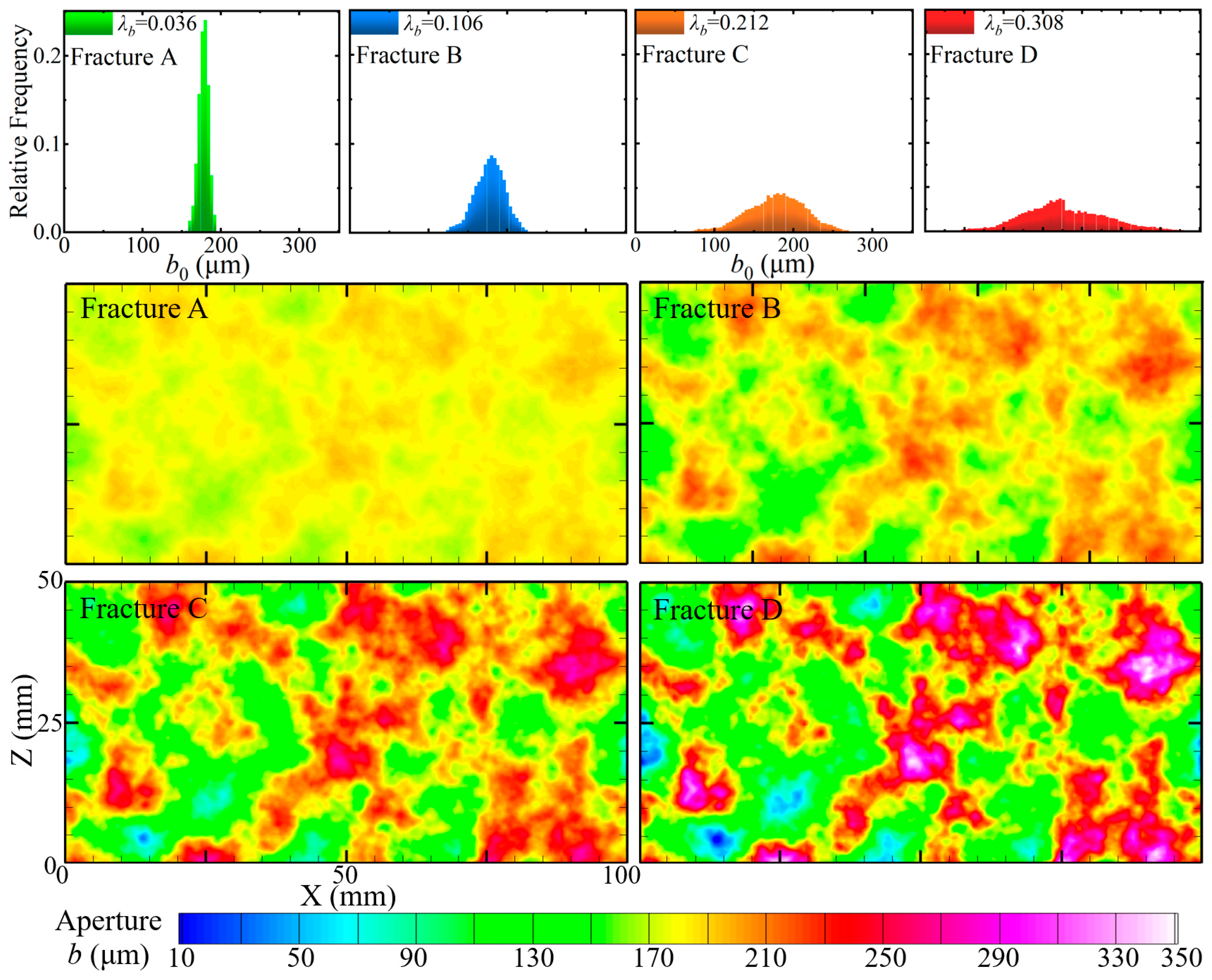
| Case Name | Roughness Coefficient λb | Aperture Standard Deviation σb | Mean Aperture 〈b〉 | Aperture Range |
|---|---|---|---|---|
| H | / | / | 179.56 | / |
| A | 0.036 | 6.4 | 179.56 | 155~197 µm |
| B | 0.106 | 19.1 | 179.56 | 107~232 µm |
| C | 0.212 | 38.1 | 179.56 | 34~285 µm |
| D | 0.308 | 55.3 | 179.56 | 0.44~360 µm |
| Porosity (%) | Geometric Mean of Permeability (m2) | Effective Diffusion Coefficient (m2 s−1) | Mineral Contents (%) | Fracture Initial Fluid Parameters/Inlet Fluid Parameters (mol L−1) | ||||||
|---|---|---|---|---|---|---|---|---|---|---|
| Calcite | Quartz | pH | HCO3− | Ca2+ | Mg2+ | Na+ | SiO2 (aq) | |||
| 20 | 5.37 × 10⁻¹⁰ | 1.15 × 10⁻⁹ | 55/75/95 | 45/25/5 | 7.85/5 | 4.89 × 10⁻³/10−5 | 1.68 × 10⁻³/0 | 4.72 × 10⁻⁴/0 | 5.79 × 10⁻⁴/0 | 10−6/0 |
Disclaimer/Publisher’s Note: The statements, opinions and data contained in all publications are solely those of the individual author(s) and contributor(s) and not of MDPI and/or the editor(s). MDPI and/or the editor(s) disclaim responsibility for any injury to people or property resulting from any ideas, methods, instructions or products referred to in the content. |
© 2026 by the authors. Licensee MDPI, Basel, Switzerland. This article is an open access article distributed under the terms and conditions of the Creative Commons Attribution (CC BY) license.
Share and Cite
Lei, Y.; Li, Z.; Lv, Y. Numerical Simulation Study on the Influence of Physical Heterogeneity on the Dissolution Rate of Carbonate Rock. Minerals 2026, 16, 110. https://doi.org/10.3390/min16010110
Lei Y, Li Z, Lv Y. Numerical Simulation Study on the Influence of Physical Heterogeneity on the Dissolution Rate of Carbonate Rock. Minerals. 2026; 16(1):110. https://doi.org/10.3390/min16010110
Chicago/Turabian StyleLei, Yunchao, Zihao Li, and Yuxiang Lv. 2026. "Numerical Simulation Study on the Influence of Physical Heterogeneity on the Dissolution Rate of Carbonate Rock" Minerals 16, no. 1: 110. https://doi.org/10.3390/min16010110
APA StyleLei, Y., Li, Z., & Lv, Y. (2026). Numerical Simulation Study on the Influence of Physical Heterogeneity on the Dissolution Rate of Carbonate Rock. Minerals, 16(1), 110. https://doi.org/10.3390/min16010110