Review

Overview of Platinum Group Minerals (PGM): A Statistical Perspective and Their Genetic Significance

by
Federica Zaccarini
1,*,
Giorgio Garuti
1,
Maria Economou-Eliopoulos
2,
John F. W. Bowles
3,
Hannah S. R. Hughes
4,
Jens C. Andersen
4 and
Saioa Suárez
5
1
Geosciences Programme, Faculty of Science, University Brunei Darussalam, Jalan Tungku Link, Gadong, Bandar Seri Begawan BE1410, Brunei
2
Department of Geology and Geoenvironment, University of Athens, 15784 Athens, Greece
3
School of Earth and Environmental Sciences, University of Manchester, Manchester M13 9PL, UK
4
Camborne School of Mines, University of Exeter, Penryn Campus, Penryn, Tremough, Cornwall TR10 9FE, UK
5
Department of Geology, University of the Basque Country (UPV/EHU), 48940 Leioa, Spain
*
Author to whom correspondence should be addressed.
Minerals 2026, 16(1), 108; https://doi.org/10.3390/min16010108
Submission received: 16 December 2025 / Revised: 10 January 2026 / Accepted: 19 January 2026 / Published: 21 January 2026

Abstract

The six platinum group elements (PGE) are among the rarest elements in the upper continental crust of the earth. Higher values of PGE have been detected in the upper mantle and in chondrite meteorites. The PGE are siderophile and chalcophile elements and are divided into the following: (1) the Ir subgroup (IPGE) = Os, Ir, and Ru and (2) the Pd subgroup (PPGE) = Rh, Pt, and Pd. The IPGE are more refractory and less chalcophile than the PPGE. High concentrations of PGE led, in rare cases, to the formation of mineral deposits. The PGE are carried in discrete phases, the platinum group minerals (PGM), and are included as trace elements into the structure of base metal sulphides (BM), such as pentlandite, chalcopyrite, pyrite, and pyrrhotite. Similarly to PGE, the PGM are also divided into two main groups, i.e., IPGM composed of Os, Ir, and Ru and PPGM containing Rh, Pt, and Pd. The PGM occur both in mafic and ultramafic rocks and are mainly hosted in stratiform reefs, sulphide-rich lenses, and placer deposits. Presently, there are only 169 valid PGM that represent about 2.7% of all 6176 minerals discovered so far. However, 496 PGM are listed among the valid species that have not yet been officially accepted, while a further 641 are considered as invalid or discredited species. The main reason for the incomplete characterization of PGM resides in their mode of occurrence, i.e., as grains in composite aggregates of a few microns in size, which makes it difficult to determine their crystallography. Among the PGM officially accepted by the IMA, only 13 (8%) were discovered before 1958, the year when the IMA was established. The highest number of PGM was discovered between 1970 and 1979, and 99 PGM have been accepted from 1980 until now. Of the 169 PGM accepted by the IMA, 44% are named in honour of a person, typically a scientist or geologist, and 31% are named after their discovery localities. The nomenclature of 25% of the PGM is based on their chemical composition and/or their physical properties. PGM have been discovered in 25 countries throughout the world, with 64 from Russia, 17 from Canada and South Africa (each), 15 from China, 12 from the USA, 8 from Brazil, 6 from Japan, 5 from Congo, 3 from Finland and Germany (each), 2 from the Dominican Republic, Greenland, Malaysia, and Papua New Guinea each, and only 1 from Argentine, Australia, Bulgaria, Colombia, Czech Republic, England, Ethiopia, Guyana, Mexico, Serbia, and Tanzania each. Most PGM phases contain Pd (82 phases, 48% of all accepted PGM), followed, in decreasing order of abundances, by those of Pt 35 phases (21%), Rh 23 phases (14%), Ir 18 phases (11%), Ru 7 phases (4%), and Os 4 phases (2%). The six PGE forming the PGM are bonded to other elements such as Fe, Ni, Cu, S, As, Te, Bi, Sb, Se, Sn, Hg, Ag, Zn, Si, Pb, Ge, In, Mo, and O. Thirty-two percent of the 169 valid PGM crystallize in the cubic system, 17% are orthorhombic, 16% hexagonal, 14% tetragonal, 11% trigonal, 3% monoclinic, and only 1% triclinic. Some PGM are members of a solid-solution series, which may be complete or contain a miscibility gap, providing information concerning the chemical and physical environment in which the mineral was formed. The refractory IPGM precipitate principally in primitive, high-temperature, mantle-hosted rocks such as podiform and layered chromitites. Being more chalcophile, PPGE are preferentially collected and concentrated in an immiscible sulphide liquid, and, under appropriate conditions, the PPGM can precipitate in a thermal range of about 900–300 °C in the presence of fluids and a progressive increase of oxygen fugacity (fO2). Thus, a great number of Pt and Pd minerals have been described in Ni-Cu sulphide deposits. Two main genetic models have been proposed for the formation of PGM nuggets: (1) Detrital PGM represent magmatic grains that were mechanically liberated from their primary source by weathering and erosion with or without minor alteration processes, and (2) PGM reprecipitated in the supergene environment through a complex process that comprises solubility, the leaching of PGE from the primary PGM, and variation in Eh-pH and microbial activity. These two models do not exclude each other, and alluvial deposits may contain contributions from both processes.

1. Introduction

The acronym PGE embraces the six platinum group elements, osmium (Os), iridium (Ir), ruthenium (Ru), rhodium (Rh), platinum (Pt), and palladium (Pd). With concentrations of about 0.05 to 0.4 ppb, the PGE are among the rarest elements in the upper continental crust of the earth [1]. Higher values of PGE have been detected in the upper mantle (Os = 4.2, Ir = 4.4, Ru = 5.6, Rh = 1.6, Pt = 8.3, and Pd = 4.4 ppb) [2] and in chondrite meteorites (Os = 514, Ir = 540, Ru = 690, Rh = 200, Pt = 1020, and Pd = 545 ppb) [3]. During the last few decades, owing to their use in many industries such as electronics, automotive, medical, manufacturing, and green technologies, their scarcity, and the high risk of their supply shortage, PGE are considered as strategic and critical metals [4]. Owing to their resistance to corrosion and oxidation, PGE are considered noble metals.
The PGE are siderophile and chalcophile elements and divided into (1) the Ir subgroup (IPGE) comprising Os, Ir, and Ru, and (2) the Pd subgroup (PPGE) consisting of Rh, Pt, and Pd. IPGE are more refractory and less chalcophile than the PPGE [2]. The concentration of PGE in the earth’s crust (or upper crust) involves complex geological factors that can lead, in rare cases, to the formation of mineral deposits. The most economically important PGE deposits occur in chromitite and sulphide-bearing layers of the Bushveld Complex [5], and in Cu-Ni magmatic sulphide associated with subvolcanic mafic intrusions in Norilsk, Russia [6]. Smaller occurrences of PGE are also recovered from the Cu-Ni sulphide deposits associated with the Sudbury Igneous Complex (formed by a meteorite impact about 1.85 billion years ago), the Lac-des-Iles mine in Canada, and the Stillwater Complex in the USA [7], as well as locally from small placer deposits of Russia derived from the erosion of chromitites and dunites that belong to the Alaskan-type zoned intrusions [8].
PGE are carried in discrete phases, called platinum group minerals (PGM), and are also included as trace elements in the structure of base metal sulphides (BMS), such as pentlandite, chalcopyrite, pyrite, and pyrrhotite. Similarly to PGE, PGM are divided into two main groups, i.e., IPGM composed of Os, Ir, and Ru and PPGM containing Rh, Pt, and Pd. PGM occur as alloys, native elements, or combined with other elements such as Fe, Ni, Cu, S, As, Te, Bi, Sb, Se, Sn, Hg, Ag, Zn, Si, Pb, Ge, In, Mo, and O [9].
PGM occur in both primary and placer deposits. The primary deposits are typically related to mafic and ultramafic rocks and hosted in chromite-rich lenses, stratiform reefs, sulphide-rich lenses, or, in rare cases, lodes [5,7]. The secondary deposits are typically eluvial and alluvial placers [9]. In primary deposits, PGM are generally associated with chromitites or Ni-Cu sulphides. Most of the PGM in primary deposits are less than 100 μm in size. PGM in placers are often bigger than those found in primary deposits [9]. According to the list of recognized minerals updated in September 2025 and released by the Commission on New Minerals Nomenclature and Classification (CNMNC) of the International Mineralogical Association (IMA), there are 169 valid PGM, including only one insufficiently characterized (see Supplementary Material, updated after Bowles 2021 [9,10,11,12,13,14,15,16,17,18,19,20,21,22,23,24,25,26,27,28,29,30,31,32,33,34,35,36,37,38,39,40,41,42,43,44,45,46,47,48,49,50,51,52,53,54,55,56,57,58,59,60,61,62,63,64,65,66,67,68,69,70,71,72,73,74,75,76,77,78,79,80,81,82,83,84,85,86,87,88,89,90,91,92,93,94,95,96,97,98,99,100,101,102,103,104,105,106,107,108,109,110,111,112,113,114,115,116,117,118,119,120,121,122,123,124,125,126,127,128,129,130,131,132,133,134,135,136,137,138,139,140,141,142,143,144,145,146,147,148,149,150,151,152,153,154,155,156,157,158,159,160,161,162,163,164]). These PGM represent about 2.7% of all 6176 minerals discovered so far (Figure 1).
In 1997, only 96 PGM had been approved as recognized minerals by the IMA, with more than 500 PGM occurrences of phases awaiting sufficient characterization for their acceptance [165]. Ten years later, in the compilations provided by Smith and Nickel [166] and updated in 2023 by Jeffrey de Fourestier, Marco Ciriotti, and Yang Zhuming of the IMA subcommittee on unnamed minerals, 496 phases were listed as not yet officially accepted, with 641 considered as invalid or discredited species (Figure 1).
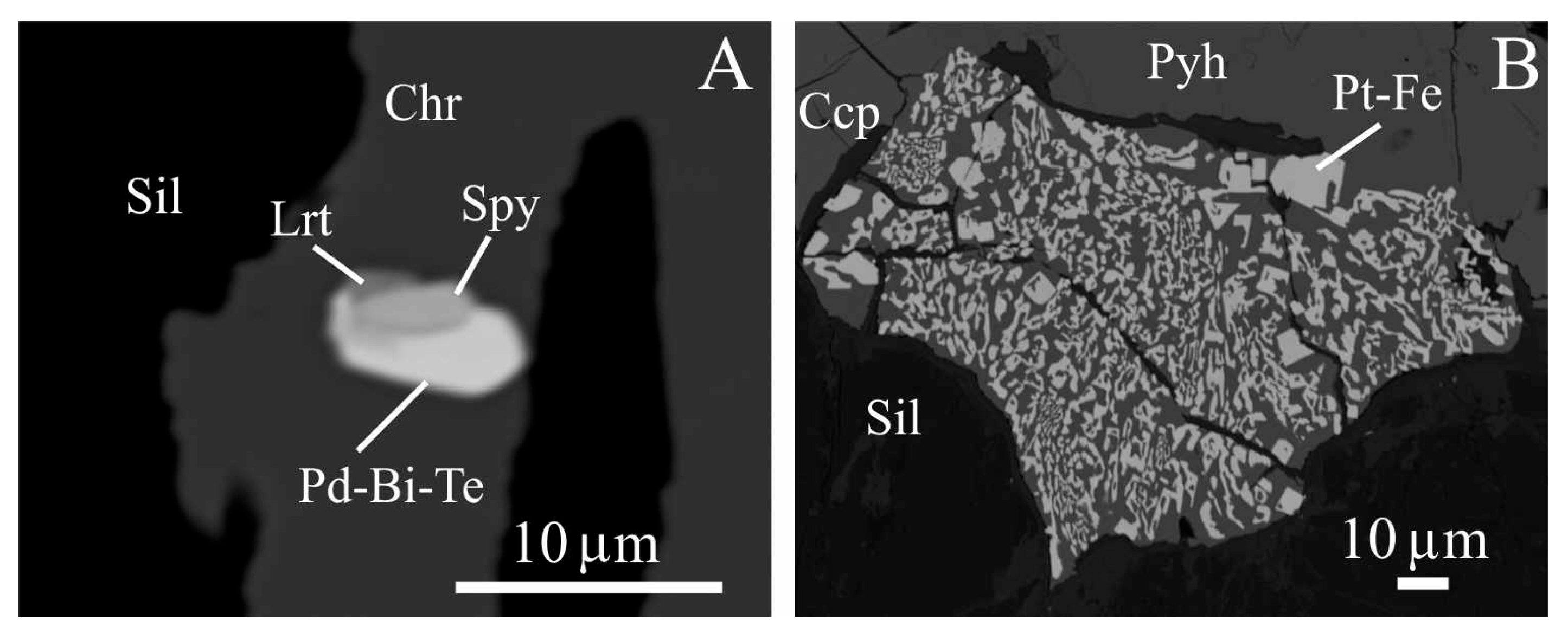
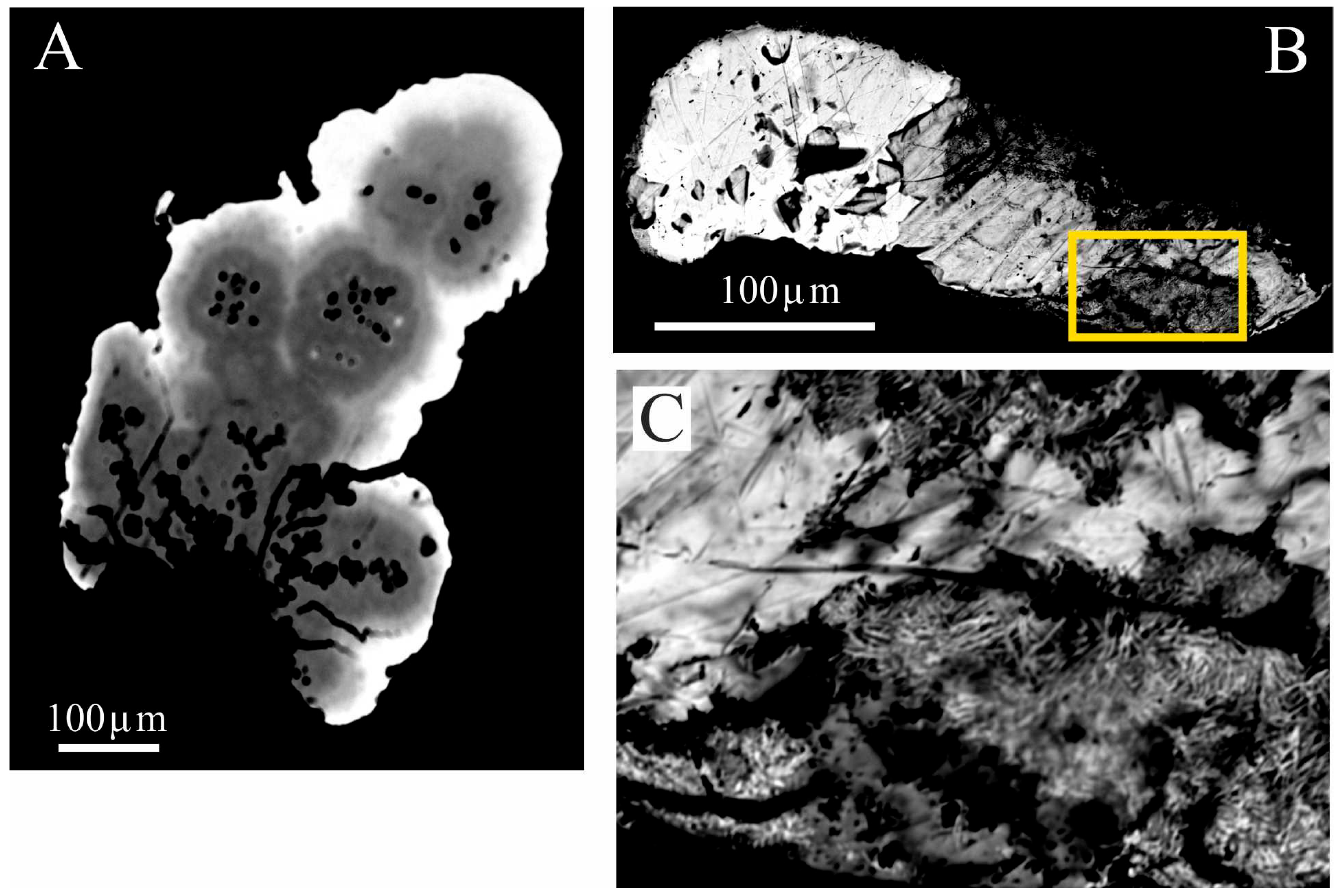
The main reason for the incomplete characterization of PGM resides in their mode of occurrence, i.e., as grains in the composite aggregates of a few microns in size (Figure 2A,B), which makes it difficult for diffraction data to determine their crystallography. However, owing to the improvement in techniques able to provide reliable crystallographic data, it is very likely that more PGM will be completely characterized and accepted in the future.
This contribution provides an overview of the PGM discovered so far, showing, from a statistical point of view, their historical background, the location in which they were first discovered, modes of occurrence, composition, crystallography, and their main solid-solution series. The most common techniques used to characterize the PGM are also described. Finally, the main genetic aspects that control the formation of PGM are also briefly discussed.

2. Techniques Used to Characterize PGM

With rare exceptions, PGM are tiny, cannot be recognized by the naked eye, and they are difficult to identify during petrographic investigation. Therefore, the first step to identifying a PGM is to locate them in polished sections by reflected light and/or scanning electron microscopy. This requires polished sections that represent a selected portion of the host rocks or heavy mineral concentrate mounted as a monolayer in epoxy blocks. The chemical composition of the PGM is generally determined by electron microprobe analysis, a technique that can be successfully applied to grains less than 10 μm in size. The optical properties of the PGM, such as colour, bireflectance, pleochroism, and anisotropy, are obtained using reflected light microscopy, whereas the reflectance values can be measured with a spectrophotometer [10,11,12,13,14,15,16,17,18,19,20,21,22,23,24,25,26,27,28,29,30,31,32,33,34,35,36,37,38,39,40,41,42,43,44,45,46,47,48,49,50,51,52,53,54,55,56,57,58,59,60,61,62,63,64,65,66,67,68,69,70,71,72,73,74,75,76,77,78,79,80,81,82,83,84,85,86,87,88,89,90,91,92,93,94,95,96,97,98,99,100,101,102,103,104,105,106,107,108,109,110,111,112,113,114,115,116,117,118,119,120,121,122,123,124,125,126,127,128,129,130,131,132,133,134,135,136,137,138,139,140,141,142,143,144,145,146,147,148,149,150,151,152,153,154,155,156,157,158,159,160,161,162,163,164].
In the rare cases that PGM are big enough, they can be hand-picked from their host polished section and analyzed by single-crystal X-ray diffraction to obtain crystallographic data [58]. When the small size of the available PGM grains has prevented their extraction and isolation in an amount sufficient for classical crystallographic and structural studies, these data are collected using a synthetic analogue, if available [21,34,37,38,49,51,59,61,71,81,86,91,98,106,118,138]. The structural identity of PGM and their synthetic analogues can be proved using modern techniques, such as electron back-scatter diffraction (EBSD) and Rietveld refinement, which can be applied to small grains [167]. Although not requested by the IMA, in order to accept a new mineral, other complementary methodologies that are able to provide mineralogical information on PGM include Raman spectroscopy [168,169,170,171] and focused ion beam and high-resolution transmission electron microscopy (FIB/HRTEM) [172]. The three-dimensional distribution of PGM within a sample can be investigated using X-ray computed tomography (CT) [173].

3. The PGM and Their Year of Discovery

Platinum was found by Spanish explorers in Colombia; they named it “platina”, meaning “little silver” [109]. A high proportion of ancient Egyptian gold artefacts contain minute inclusions of PGM, mainly those containing Os and Ir. These inclusions are much harder than gold, and they are evident as blemishes on the worked gold surface. Their source is likely to be from alluvial workings for gold that included other heavy metal particles. That source may have been in southern Egypt, Sudan, or Ethiopia [174]. The Yubdo deposit in Ethiopia is the most well-known, and it is drained by the Birbir River which, by a circuitous route, feeds into the White Nile, although transport to Egypt may have been as trade from local workings rather than in the alluvium.
In Europe, Pt was described in 1557 by the Italian intellectual Julius Caesar Scaliger as a metal that could not be melted [175]. He was working on materials brought back from Central America. Later, in 1735, Antonio de Ulloa, a Spanish scientist, sailor, and soldier, was the first to provide a detailed description along with a rigorous analysis of platinum collected in a placer deposit in Colombia [109]. According to the IMA rules, platinum is listed among the “Grandfathered” minerals, i.e., those accepted by the mineralogical community before the establishment of the IMA in 1958. Palladium was discovered in 1803 in a sample from Itabira, Minas Gerais, Brazil [44], and, consequently, it also belongs to the IMA list of “Grandfathered” minerals. The elements Os and Ir were discovered in 1803 by two English chemists, Smithson Tennant and William Hyde Wollaston, in London, England (Tennant, 1804 [176,177]). Subsequently, the minerals osmium and iridium were redefined by the IMA as more detailed information became available [148]. The definition of iridium includes the now obsolete terms osmiridium and ruthenosmiridium, making Ir the dominant element, and the mineral can contain minor amounts of Os and Ru. According to Cabri and Laflamme [135] and Urashima et al. [160], ruthenium and rhodium were officially recognized as minerals in 1974 in Japan and the USA, respectively.
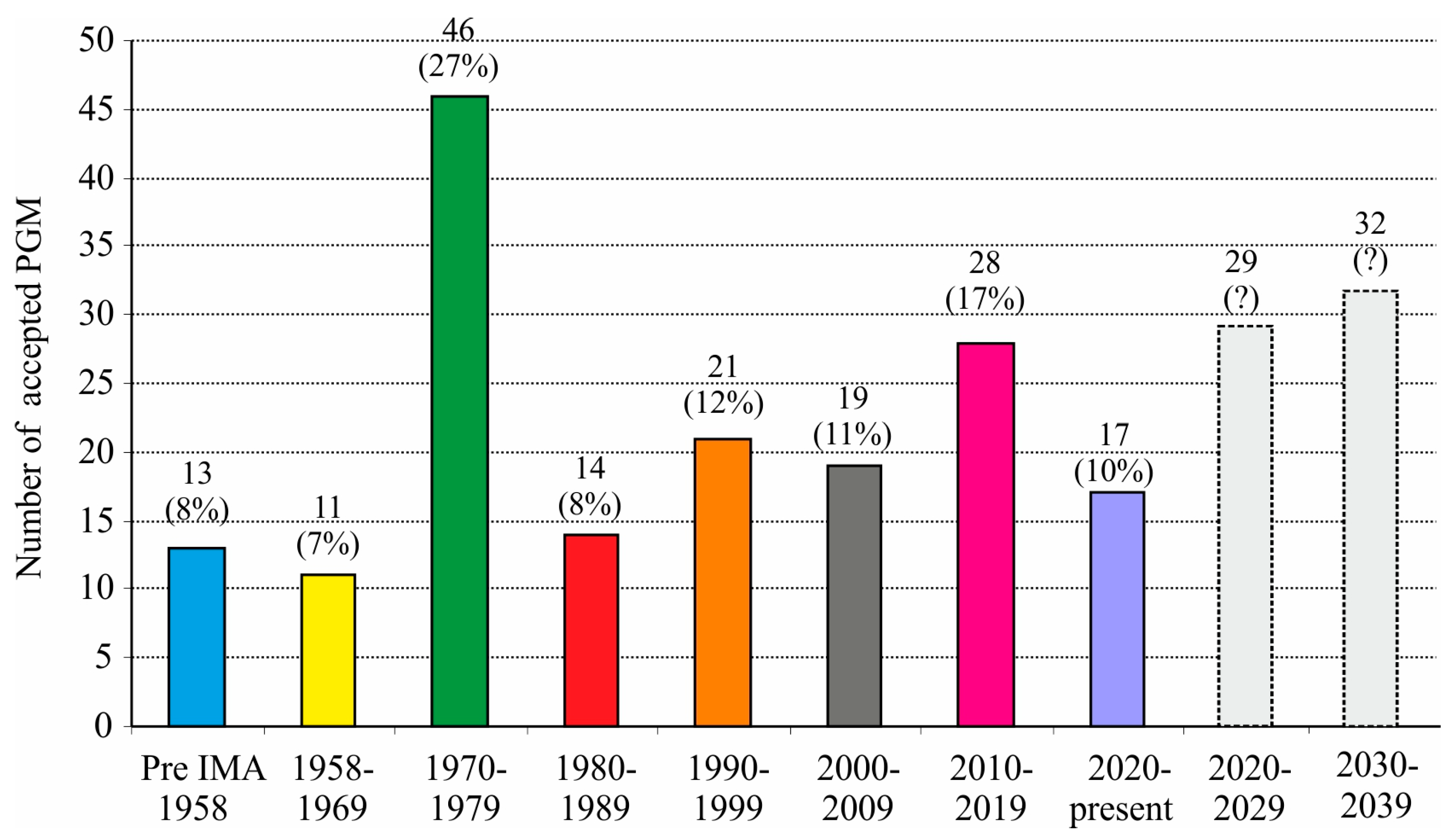
Among the 169 PGM officially accepted by the IMA, only 13, corresponding to 8%, were discovered before 1958, the year when the IMA was formed (Figure 3). Although the time intervals indicated in Figure 3 vary, the highest number of PGM was discovered between 1970 and 1979 (Figure 3), and 99 PGM have been accepted from 1980 until now (Supplementary Materials).
With extrapolation based on regression lines and considering that 1970–1979 was exceptional, we suggest that the number of new PGM that might be accepted for 2020–2029 and 2030–2039 are 29 and 32, respectively (Figure 3). However, with the development of improved techniques, these figures are likely to be higher.

4. The PGM and Their Nomenclature

When scientists discover a new mineral, they can freely select its name but following IMA rules. The IMA recommendations concerning the nomenclature of the new minerals suggest taking into consideration (i) the chemical composition and physical properties, (ii) honouring persons who significantly contributed to the field of mineralogy or related sciences, and (iii) the geographical location of the discovery place.
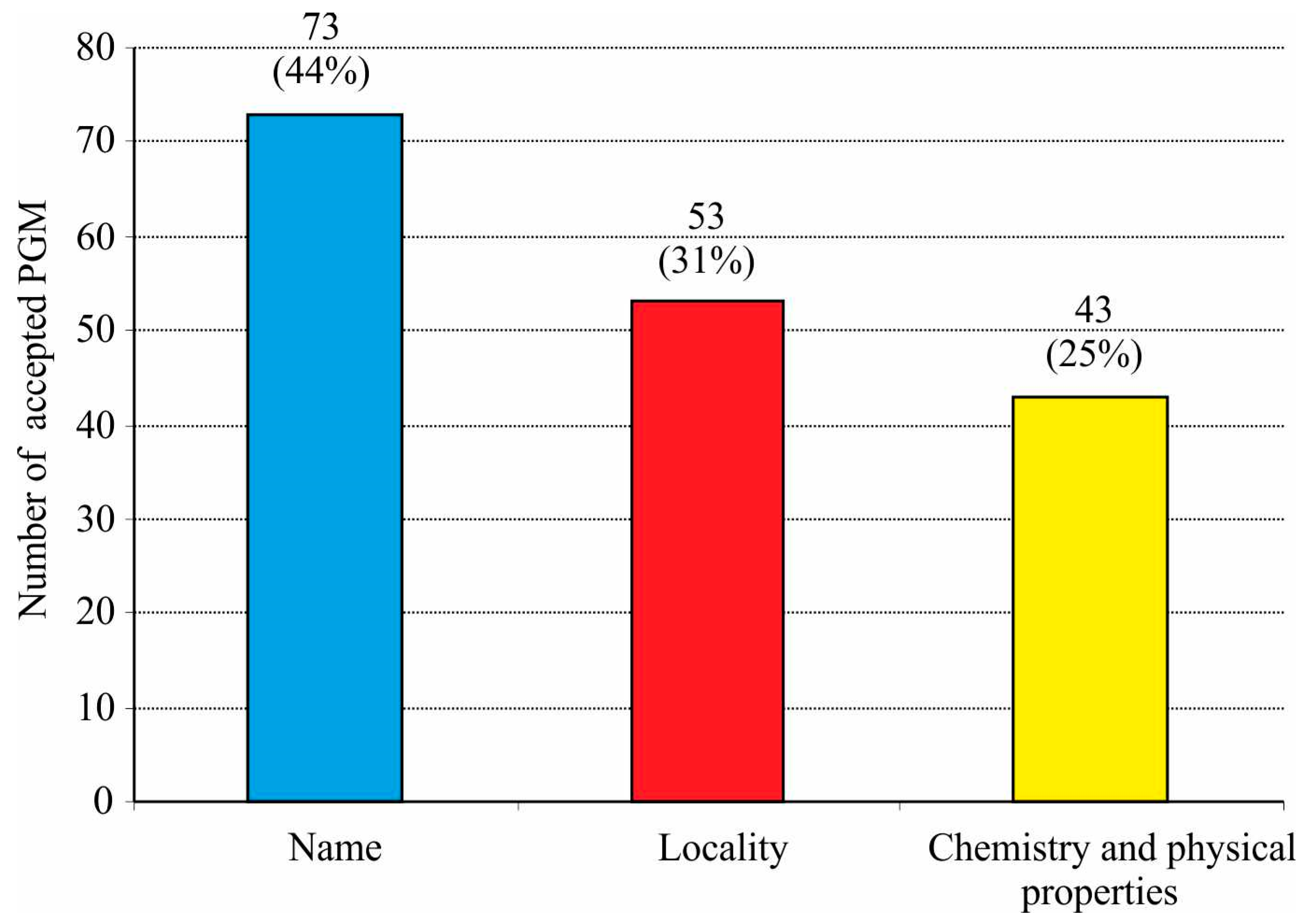
Of the 169 PGM accepted by the IMA (Supplementary Material), 44% are named in honour of a person, typically a scientist or geologist (Figure 4). The PGM kalungaite honours the Kalunga people, who are the descendants of African slaves currently living around Cavalcante, a town located in the northern state of Goiás, Brazil [19].
Braggite, the first mineral that was discovered using an X-ray method, is named in honour of the father and son physicists William Henry Bragg and William Lawrence Bragg. Owing to the fact that they developed the X-ray techniques that enabled scientists to resolve the atomic structure of crystalline materials, including natural minerals, they received the Nobel Prize for Physics in 1915.
The PGM atheneite and laurite have names that do not conform to the naming categories recommended by the IMA. Atheneite is named after the Greek goddess Athena (or Pallas) [10], whereas laurite is named for Laura, the wife of the American chemist Charles Arad Joy, a friend of Wöhler, who discovered the mineral in 1866 [158].
Laurite, together with marialite (Na4Al3Si9O24Cl), are the only two minerals to be named after women who were not scientists themselves but were the wives of scientists.
Thirty-one percent of the PGM accepted by the IMA are named for their discovery localities, including mining sites, villages, rivers, geographical locations, and the name of the host deposit (Figure 4). The mineral changchengite is the only PGM dedicated to a monument located in China—the Great Wall [140].
The nomenclature of 25% of PGM is based on their chemical composition and/or their physical properties (Figure 4). This results in a series of invented words that consist of a combination of the symbol of some chemical elements such as irarsite (IrAsS) [146], among others, or a name suffixed with the chemical symbol of the dominant element, such as, for example, selenolaurite (RuSe2) [161], or because of the crystal structure, as is the case for proxitwelvefoldite [57]. The names created for some minerals comprise a combination of the mineral chemistry and crystallography such as hexaferum [144], hexamolybdenum [157], isoferroplatinum [97], orthocuproplatinum [108], and tetraferroplatinum [97].

5. The PGM: Their Type Locality and Geological Association

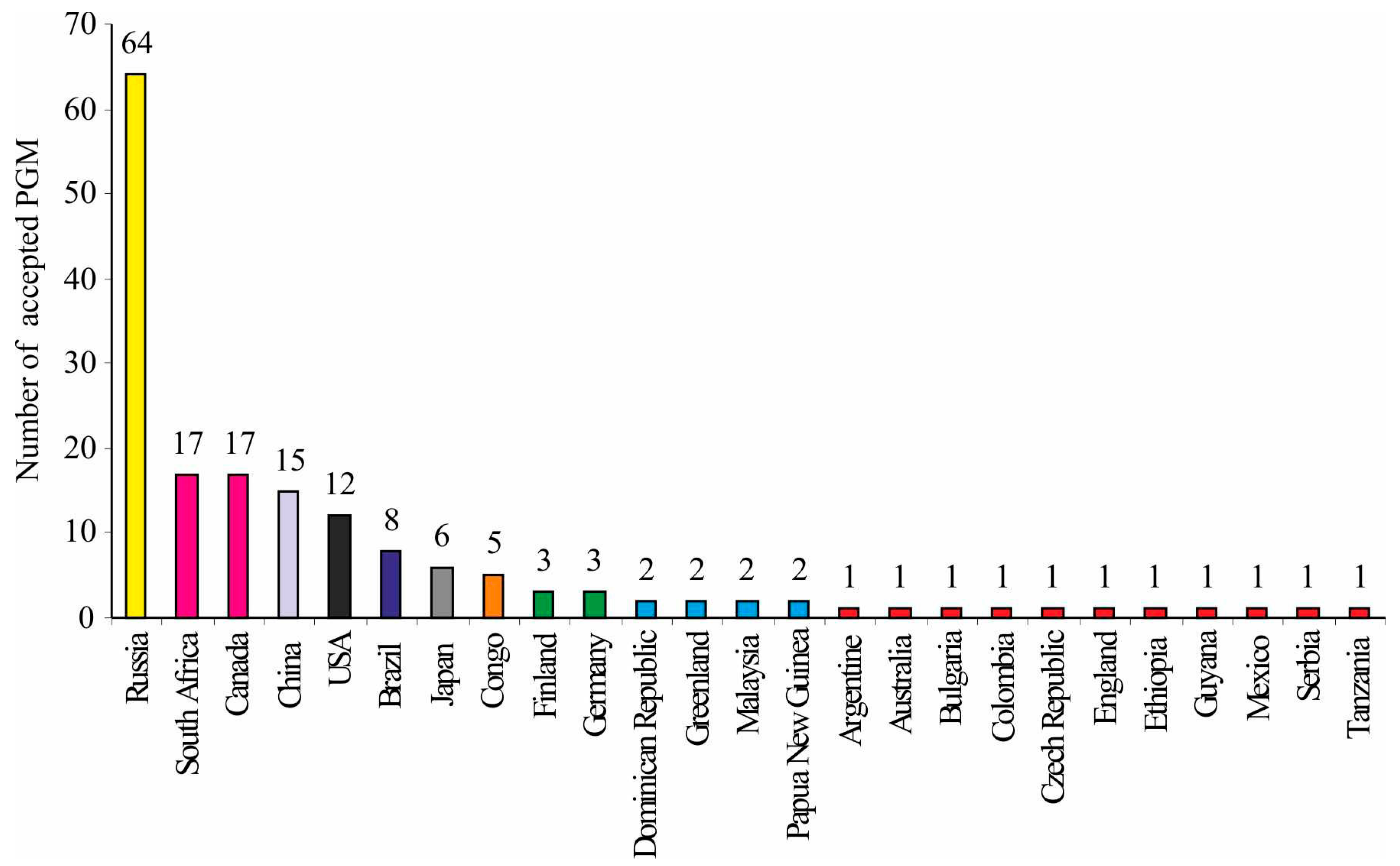
Although after its initial discovery a mineral might be found in several other localities, according to the IMA rules, only the original location in which the mineral was discovered and described for the first time remains the designated locality. PGM have been discovered in 25 countries throughout world, in particular, 64 in Russia, 17 in Canada and South Africa (each), 15 in China, 12 in the USA, 8 in Brazil, 6 in Japan, 5 in Congo, 3 in Finland and Germany (each), 2 in the Dominican Republic, Greenland, Malaysia, and Papua New Guinea (each), and only 1 in Argentine, Australia, Bulgaria, Colombia, Czech Republic, England, Ethiopia, Guyana, Mexico, Serbia, and Tanzania (Supplementary Material, Figure 5).
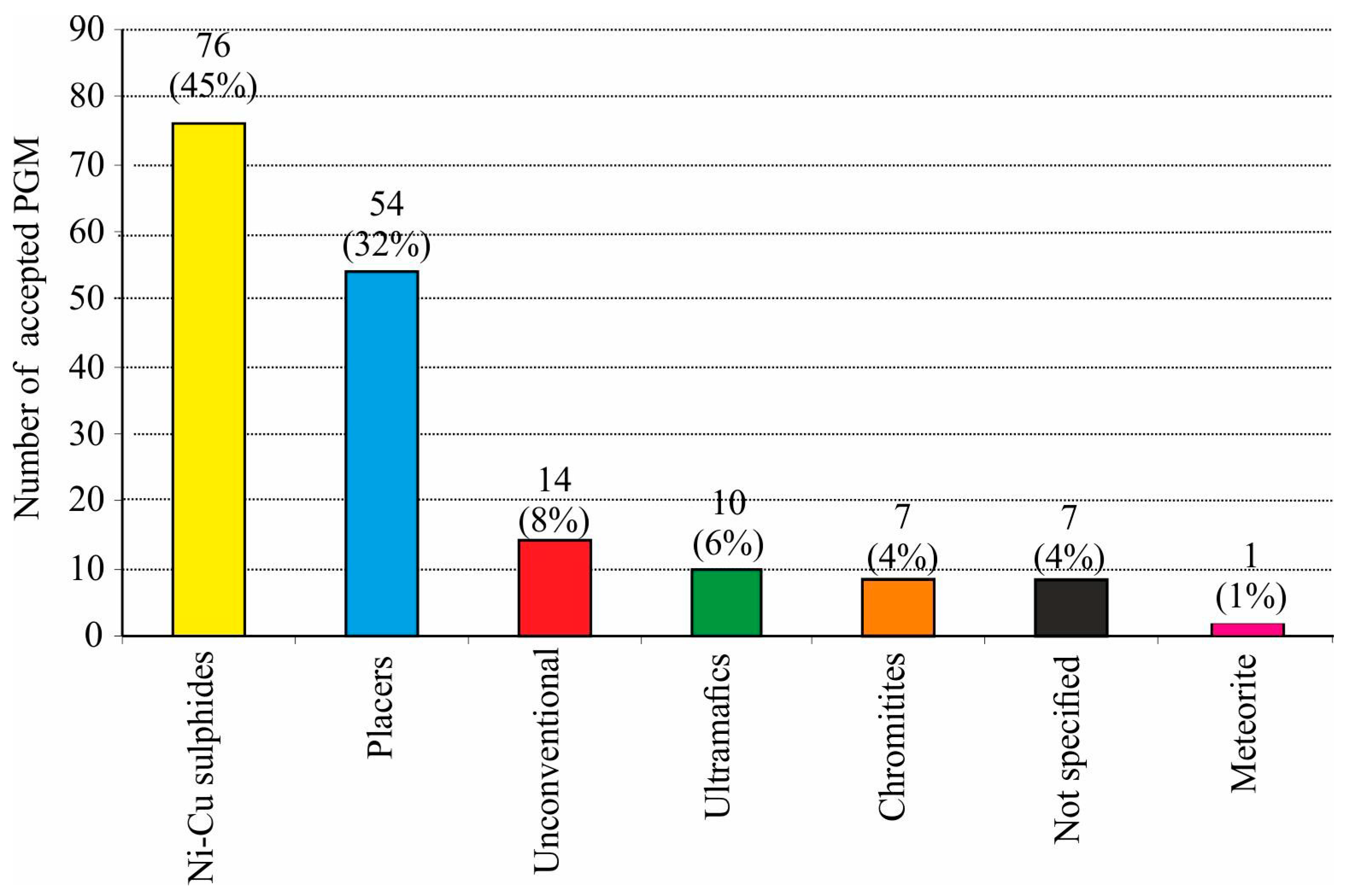
Taking into consideration the geological environment in which they have been described for the first time, most of the PGM, specifically 76 (45% of all valid PGM) occur in primary Ni-Cu sulphide deposits associated with mafic–ultramafic intrusions, 54 PGM (32%) in placers, 14 PGM (8%) in unconventional deposits, 10 PGM (6%) in ultramafic rocks, 7 PGM (4%) in magmatic chromitites, and only 1 (1%) in carbonaceous chondrites. For seven PGM (4%), only the name of the locality has been recorded without precise information about their host rocks (Figure 6).
PGM discovered for the first time in magmatic Ni-Cu sulphide deposits comprise 52 minerals in which Pd is the principal PGE component, 18 for Pt, 4 for Rh, and only 1 for Ir and Os, whereas Ru minerals are absent in this environment (Supplementary Material).
The majority of the PGM nuggets first described from placers derived by the erosion of mafic–ultramafic rocks consist of specific phases of all six of the PGE. Only six Pd-bearing minerals were found, for the first time, associated with alluvial gold deposits from Brazil.
Most of the PGM containing Ru as one of the major components were first characterized from samples associated with chromitites, in which one Rh and one Pt PGM have also been described. In the locality types associated with ultramafic rocks, only four PGM of Pt have been reported. Although the occurrence of PGM is frequently related to the presence of mafic–ultramafic rocks, a few of them have been discovered in less common and unconventional geological environments.
With the exception of the Ru mineral hexamolybdenum that was described in a meteorite collected in Mexico [157], all PGM first discovered in unconventional occurrences contain Pd as the major PGE. In particular, chrisstanleyite, padmaite, and vasilite occur in sedimentary rocks, such as limestones, metamorphosed shales, and clastic sediments, respectively [15,41,78]. Other Pd-bearing PGM have been discovered for the first time in the following unconventional deposits: (1) malyshevite and milotaite in uranium mineralizations in Czech Republic and Russia [27,33], (2) tilkerodeite and tischendorfite in the same low-sulphur hydrothermal deposit in Germany [72,73], (3) kalungaite and jacutingaite in iron and gold mines, respectively [19,98], (4) oosterboschite from the oxidation zone of a Cu-Co mine in Congo, (5) roterbärite in polymetallic mineralization in Germany, and (6) jagueite in a vein enriched in Se from Argentina [18].
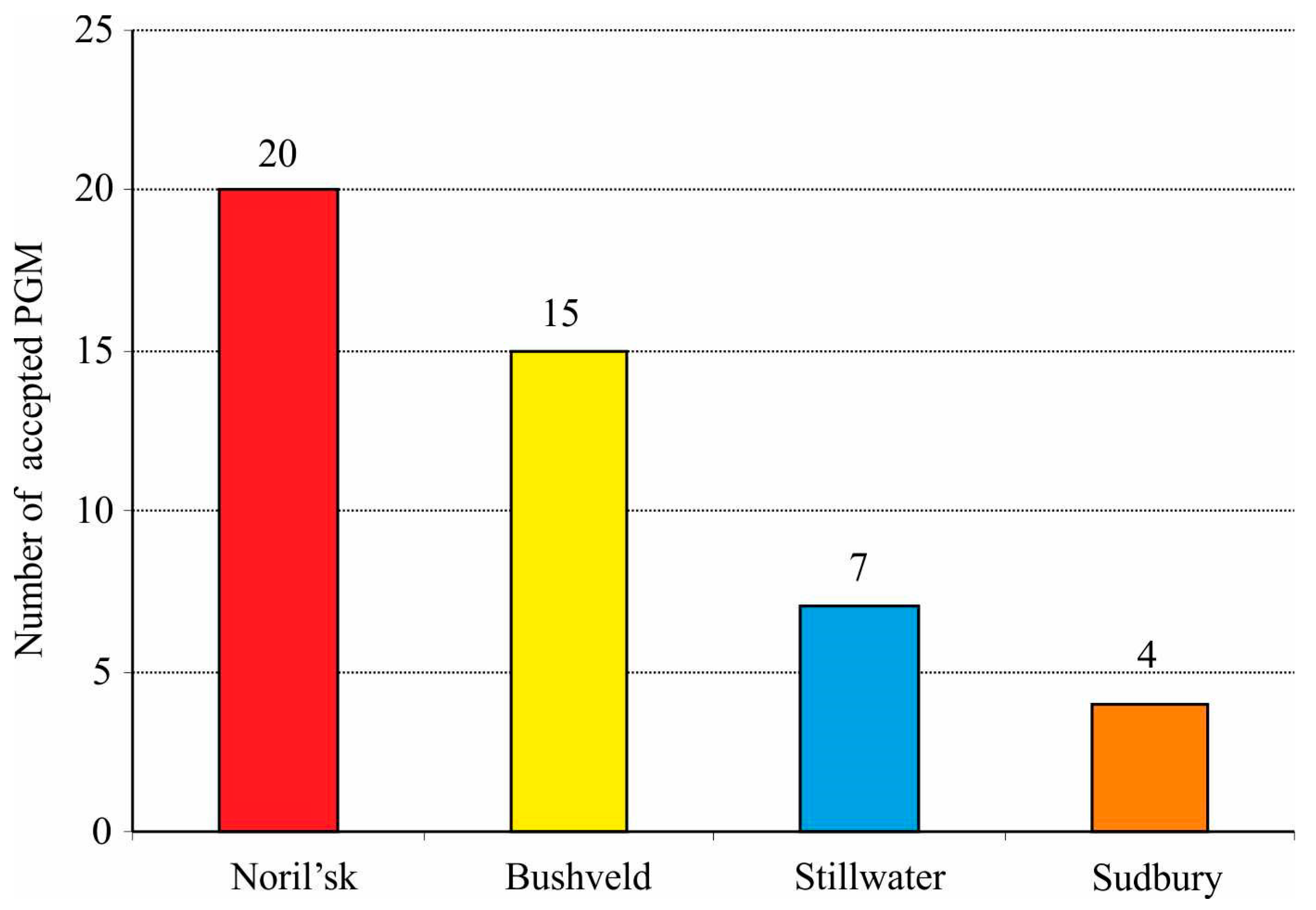
Taking into consideration the four major Ni-Cu sulphide PGE deposits in the world, 20 new PGM have been discovered in the Norilsk mining district in Russia, 15 in the Bushveld Complex in South Africa, 7 in the Stillwater Complex in the USA, and 4 in the Sudbury Igneous Complex in Canada (Figure 7). The PGM from these four PGE deposits represent approximately 27% of all PGM discovered so far.

6. The PGM and Their Mineral Chemistry

To be accepted by the IMA, the chemical composition of the potential new mineral, including the PGE, must be provided. Generally, these compositional data are obtained by EPMA, and, based on these results, a precise stoichiometry of the new mineral can be calculated.
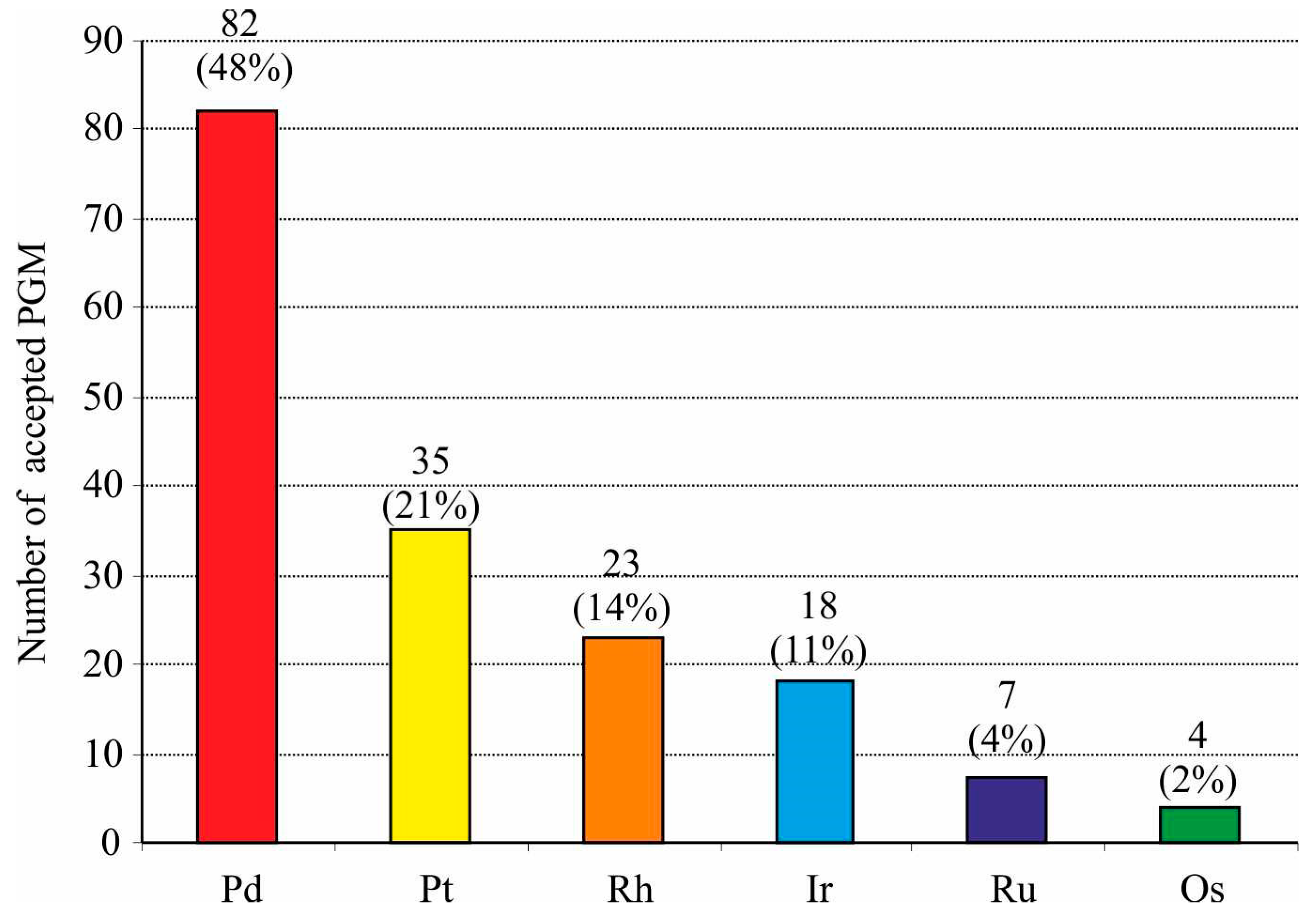
Of the 169 accepted PGM, 82 phases (48%) contain Pd, followed by PGM that contain Pt (35 phases, 21%), Rh (23 phases, 14%), Ir (18 phases, 11%), Ru (7 phases, 4%), and Os (4 phases, 2%). Thus, Pd-PGM represent the most abundant phases accepted by the IMA (Supplementary Material, Figure 8). The six PGE to form a PGM are often bonded to other elements, listed in Table 1.
Pd minerals are characterized by complex chemical compositions in which palladium is bonded with several elements, mainly Ni, Cu, As, Se, Ag, Sn, Sb, Te, Hg, Sb, and Bi, and rarely with Si, Zn, Ge, In, and Tl (Table 1).
Among the Pd minerals, the only PGE oxide, silicide, and Tl-bearing accepted phases are palladinite (PdO) [43], palladosilicide (Pd2Si) [48], and palladothallite (Pd3Tl) [49]. Bortnikovite (Pd4Cu3Zn) is the only PGM discovered so far that contains Zn [13].
The two PGM, marathonite and palladogermanite [28], in which Pd is bonded with Ge, were both discovered in the Coldwell Complex in Canada (Supplementary Material). Despite its chalcophile nature, only seven Pd-bearing phases, representing 8.4% of all Pd minerals accepted, contain S as an essential element.
Eleven of the 35 accepted Pt minerals are alloyed with base metals (BM), specifically Fe, Ni, Cu, and Pb, and 20% of the Pt phases are bonded with S. Sperrylite, PtAs2, is the only arsenide of Pt accepted by the IMA [111]. Other Pt minerals contain Se, In, Sn, Sb, Te, Hg, Sb, and Bi (Table 1).
Although Rh is less chalcophile than Pd and Pt, 14 minerals, constituting more than 60% of all the Rh phases accepted by the IMA, contain S. To a lesser extent, Rh is also bonded with Ni, Fe, Cu, Ge, As, Se, Sb, and Pb. Michitoshiite-(Cu) (Rh(Cu1−x Gex)) [130] is the third Ge-bearing PGM accepted by the IMA. It is important to note that, according to Cabri and McDonald [178], ezochiite and shiranuiite, two PGM recently discovered in Japan, with the ideal formulae of Cu+(Rh3+Pt4+)S4 and Cu+(Rh3+Rh4+)S4, respectively [122,137], are not new minerals. These PGM were accepted as new PGM only on the basis of the assumed calculated valence of certain elements and that is not a criterion accepted by the IMA to define a new mineral. Therefore, having identical crystal structures and similar chemical compositions, it is very likely that both ezochiite and shiranuiite represent varieties of cuprorhodsite [178].
Similarly to Rh, 50% of all 19 Ir phases accepted by the IMA are linked with S. The Ir-bearing minerals also contain the following elements: Fe, Ni, Cu, Bi, Sb, Te, As, and Pb (Table 1).
The Ru and Os PGM accepted by the IMA are only seven and four in number, respectively, and they are characterized by relatively simple compositions. The minerals of Ru are bonded with S, Fe, Ni, As, Se, and Mo, forming alloys, sulphides, arsenides, selenides, and sulfarsenides (Table 1). In particular, the alloy hexamolybdenum is the only PGM that contains Mo [157].
The mineral chemistry of the Os-bearing minerals is much simpler, consisting of only sulphides, arsenides, sulfarsenides, and alloys (Supplementary Material).
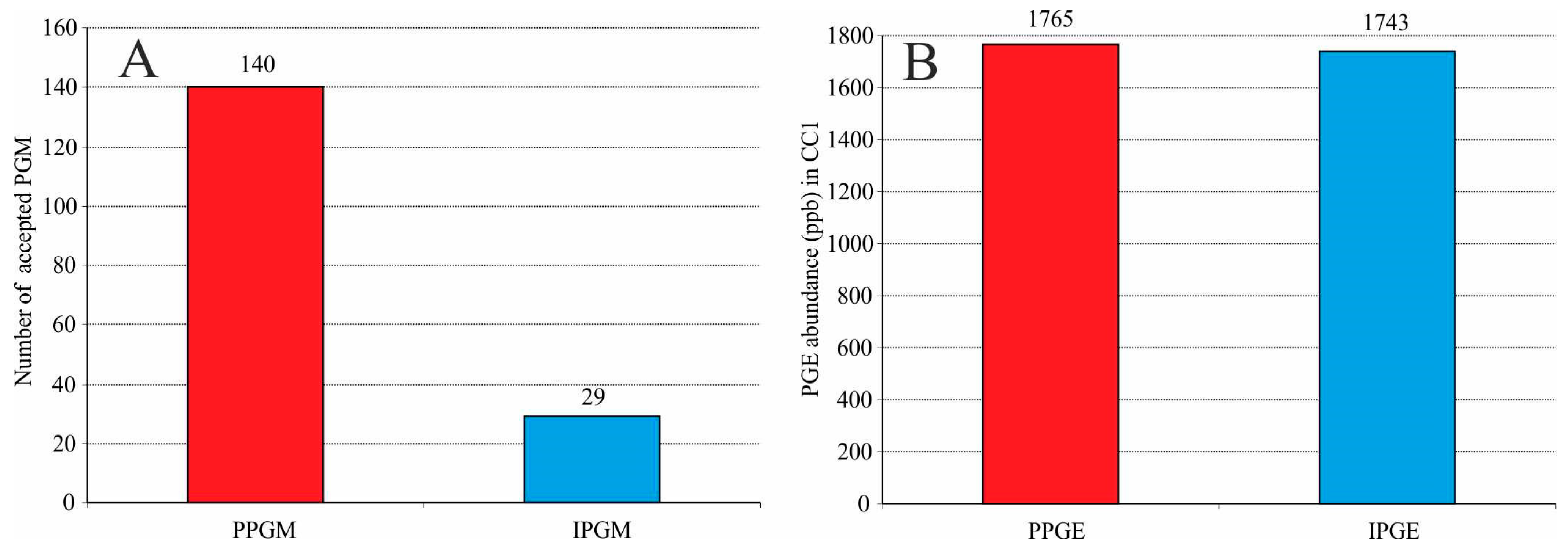
Taking into consideration the geochemical subdivision of PPGE and IPGE, the PPGM (the minerals of Rh, Pt, and Pd, with 140 accepted phases) are much more abundant than the 29 IPGM (those of Os, Ir, and Ru)—Figure 9A. Despite the great difference in the number of accepted PPGM (73%) and IPGM (17%), the abundances of the PPGE and IPGE in chondrite are very similar: PPGE (1765 ppb), IPGE (1743 ppm) [3] (Figure 9B).

7. The PGM and Their Crystallography

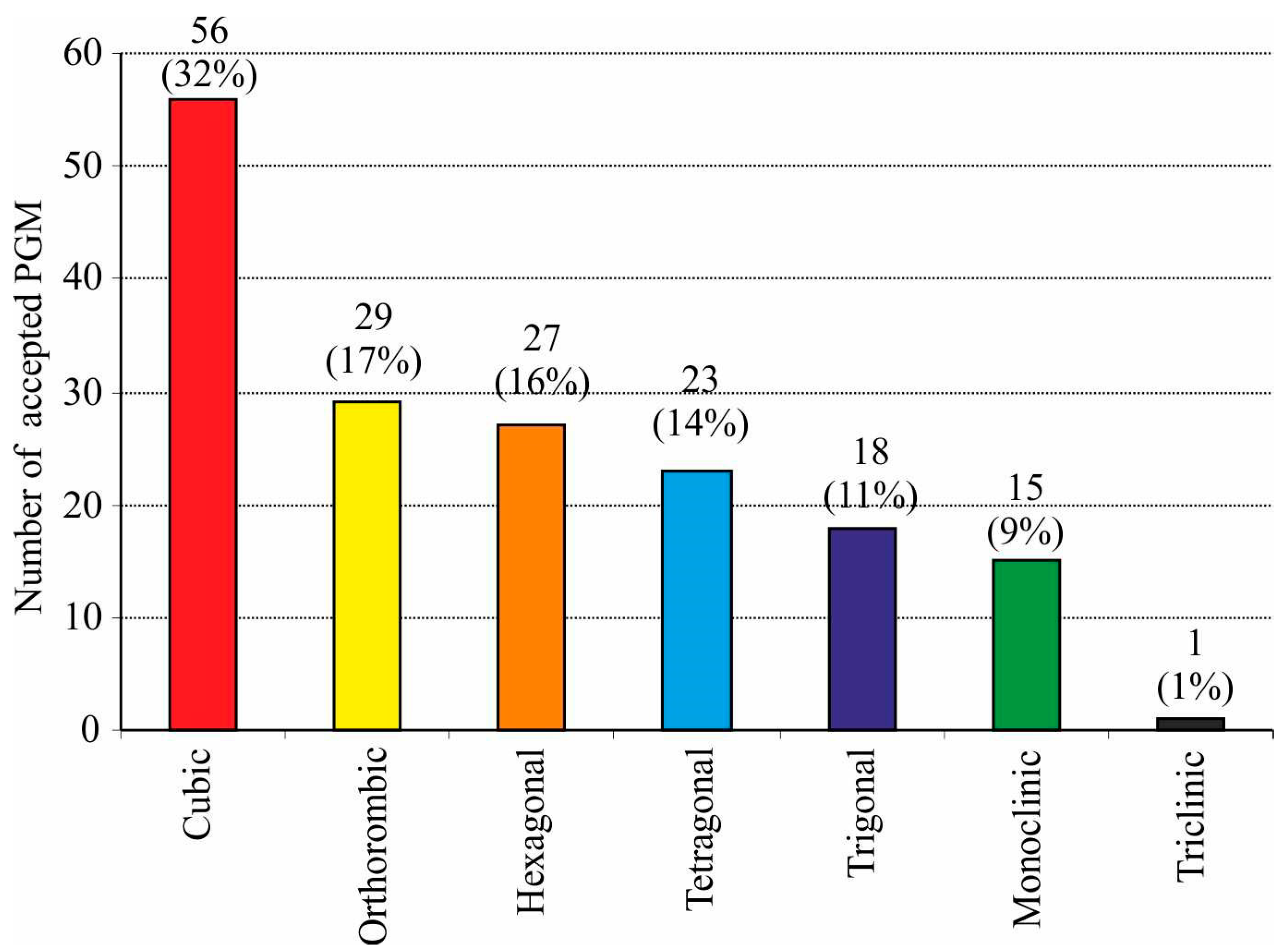
One essential parameter for acceptance as a new mineral by the IMA is to provide the appropriate crystallographic data, in particular, to establish the dimension of its unit cell and in which of the seven crystal systems the mineral crystallizes, i.e., cubic, tetragonal, orthorhombic, monoclinic, triclinic, rhombohedral, and hexagonal. Native palladium, platinum, rhodium, and iridium crystallize in the cubic system, whereas native ruthenium and osmium are hexagonal. Figure 10 shows that 32% of PGM crystallize in the cubic system, 17% are orthorhombic, 16% hexagonal, 14% tetragonal, 11% trigonal, 3% monoclinic, and only 1% are triclinic.
The tetragonal proxitwelvefoldite, Pd3Ni4Te8, is the first terrestrial approximant to a dodecagonal quasicrystal [57]. In mineralogy, polymorphs describe minerals with the same chemical composition but with a distinct crystal structure. Few examples of polymorphism have been described for PGM. Hexaferrum and garutiite are the hexagonal polymorphs of cubic iron and nickel, respectively. Both these minerals contain high amounts of PGE, especially up to 31.11 wt% Ir in hexaferrum and 43.78 wt% Ir in garutiite [143,144].
Specifically, at the P-T conditions of magmatic deposit existence, the cubic phase is one of the most stable structures (low free energy) for heavy transition metals [179]; while under high P-T conditions, some cubic structures could transfer to the hexagonal phase, and the orientation relation of this path is (111)c//(001)h+[11(_)0]c//[100]h [179], with c and h representing cubic and hexagonal phases, respectively [179]. In addition, a high amount of Ir is probably responsible for the change from cubic to hexagonal PGM symmetry and for their transformation into two new PGM.

8. The PGM Solid Solutions and Their Genetic Implication

The structure of a mineral determines the extent to which the main elements that constitute the mineral can be replaced by others. Whilst some structures permit very little substitution, others allow some limited replacement by minor amounts of other “impurity elements”. In some cases, complete substitution is possible.
Olivine, a mineral often found associated with PGM-bearing rocks, allows for complete substitution of Fe by Mg so that all compositions are possible between Fe2SiO4 (fayalite) and Mg2SiO4 (forsterite). In this case, it is said that there is a complete solid solution between the two end members.
Other examples exist in which there are more than two end members and where the solid solution is incomplete with gaps in the permitted compositions; these are known as miscibility gaps. These details provide important information concerning the chemical and physical environment in which the mineral was formed.
Some PGM are members of a solid-solution series which may be complete or contain a miscibility gap. The existence of six PGE and the large number of elements with which they can combine (Table 1) means that there are many possibilities for solid-solution series among the PGM, and this presents exciting avenues for research.

8.1. The Solid Solutions of Pt and Pd-Bearing PGM

Among the hexagonal PGM sobolovskite PdBi, kotulskite PdTe, and Sudburyite PdSb, there is a complete solid solution [62,180,181,182]. This is the only documented case in which the substitutions occur among Bi, Te, and Sb and not among the PGE. A clear and continuous substitution between Te-Bi and Bi-Sb has been documented, whereas the substitution between the Te-Sb side is limited [182]. The experimentally established solid-solution series suggests that soboloveskite, kotulskite, and sudburyite are stable at temperatures in the range of 400 °C to 500 °C.
The tetragonal PGM braggite (Pt,Pd,Ni)S, vysotskite (Pd,Ni)S, and cooperite (Pt,Pd,Ni)S form an almost complete solid-solution series [183,184]. The data obtained from samples from the Stillwater Complex, USA, suggest that this solid-solution series may be subdivided by restricting the name vysotskite to those members that contain less than about 10 mole % of PtS [183].
On the basis of natural occurrences, cooperite and braggite crystallized at magmatic temperatures of 1000 °C or above, whereas vysotskite formed at lower temperatures, possibly by precipitation from a residual immiscible sulphide-rich melt or by solid-state reaction [183]. These natural observations were partially supported by the experiments performed by Verryn and Merkle [184], which demonstrated that synthetic cooperite, braggite, and vysotskite are stable at temperatures above 1200 °C, below 1100 °C, and below 1000 °C, respectively. At temperatures between 1200 ° C and 900 °C and in a Ni-saturated environment, the Ni content of braggite and vysotskite is a function of temperature. A higher Ni content indicates a lower temperature of equilibration [184]. The experiments in the system PtS-PdS-NiS indicate the existence of a well-defined miscibility gap between cooperite and braggite, but it was not observed between braggite and vysotskite [184].
The solid solution of the alloys in the system Pt-Fe-Ni-Cu, which consists of the three tetragonal minerals tetraferroplatinum PtFe, ferronickelplatinum Pt2FeNi, and tulameenite Pt2FeCu, and the cubic mineral isoferroplatinum (Pt,Pd)3(Fe,Cu), is the most complicated among those of the PGM.
In addition to the continuous solid-solution series described above, there are series that contain minerals with discrete compositions and differing structures. The series from Pt to Fe is an important and commonly occurring example. Both Pt and Fe have a cubic structure, and they are known to occur, although their natural occurrence is limited. Occurrences described as Pt in the older literature have often been shown to be one of the Pt-Fe phases, usually Pt3Fe. In between Pt and Fe, there are Pt3Fe, PtFe, and PtFe3. Isoferroplatinum (Pt3Fe) is also cubic, whereas tetraferroplatinum (PtFe) is tetragonal and sidorovite (PtFe3) has a cubic structure. For each of these minerals, there is a range of composition within which the structure remains ordered, but the structure becomes disordered with greater variation in the composition. The variations in composition are more evident in the examples of these minerals that have been exposed to weathering; in which case, Cu is found to have replaced some Fe [185,186,187].
According to Bowles [185], tetraferroplatinum and tulameenite are both tetragonal, and they have a similar cell size. Therefore, a solid solution between them may be postulated. This inferred solid solution is corroborated by experimental studies [186] and by the continuous substitution of Cu-Fe at a constant content of Pt, observed in the composition of several natural minerals [8,185,187,188].
Also, tulameenite and ferronickelplatinum form a solid-solution series, with the substitution between Cu and Ni. Isoferroplatinum, being cubic, does not form a solid-solution series with the other tetragonal alloys in the system Pt-Fe-Ni-Cu, although compositions covering the complete Pt-Fe ratio from tetraferroplatinum to isoferroplatinum have been reported, showing a progressive increase in Cu from the freshest rocks to the most highly weathered lithologies (saprolite) [188]. The Pt-Fe-Ni-Cu alloys mainly occur in placers but are also abundant in chromitites and Ni-Cu sulphide lode deposits [5,7,9]. They crystallized over a wide temperature range, from >1000 °C to possibly as low as ~100 °C [185,187]. There is a general agreement that tulameenite and ferronickelplatinum can be hydrothermal in origin, with Cu and Ni having been introduced by low-temperature fluids after the precipitation of Pt-Fe alloys [8,189,190].
Another commonly encountered PGM solid-solution series is between the trigonal minerals moncheite (Pt,Pd)(Te,Bi)2, merenskyite (Pd,Pt)(Te,Bi)2, and melonite NiTe2 [191,192,193]. A complete solid solution exists between melonite and merenskyite, characterized by a continuous substitution between Ni and Pd.
Conversely, a limited solid solution has been observed in merenskyite and moncheite, as well as in melonite and moncheite, probably owing to the partial lack of chemical affinities. The PGM of the moncheite, merenskyite, and melonite series occur in various Ni-Cu sulphide deposits hosted in mafic–ultramafic intrusions generally associated with sulphides such as pyrrhotite, pentlandite, and chalcopyrite. In most cases, they crystallized from an immiscible sulphide liquid [7,9] in which the PGE, together with Te, were initially dissolved and later exsolved to form the discrete PGM of the series [191,192,193]. Their common association with hydrous silicates suggests a precipitation from later-stage or post-magmatic hydrothermal fluids [191,192,193].
The investigation of two nuggets collected in Corrego Bom Sucesso, Minas Gerais, Brazil, the locality of palladium, revealed the presence of a complete solid solution between Pt and Pd in nature [194], as previously reported on the basis of experimental work [195]. Although investigation into thermocouples has shown that a homogeneous platinum–palladium solid solution can be achieved at temperatures above 770 °C [196], there is not a specific temperature limit below their respective melting points in which the two metals can be alloyed together. Therefore, based on their morphology, the origin of the Pd-Pt nuggets studied by Bindi et al. [194] can be attributed to low-temperature processes in hydrothermal or weathering environments, as suggested for other PGE and Au nuggets collected from the same deposit [197].

8.2. The Solid Solutions Among Ir, Rh, and Pt

Despite the limited data available on a solid solution among Pt, Rh, and Ir, the cubic PGM malanite Cu(Pt,Ir)2S4, cuprorhodsite CuRh2S4, and cuproiridsite CuIr2S4 have been observed on the basis of their chemical composition [8,198,199,200]. Although experiments on the stability of PGM in the malanite, cuprorhodsite, and cuproiridsite solid-solution series are not available, their natural occurrences, i.e., enclosed in magmatic chromite, suggest that they crystallized at high temperatures under high sulphur fugacity (fS2) [8,198,201]. However, their occurrence has also been documented in placer deposits, generally included in Pt-Fe alloys [187,202].
Substitution between Ir and Rh has been described in the following solid-solution series: (1) cubic hollingworthite (Rh,Pt,Pd)AsS and irarsite IrAsS [203], (2) orthorhombic bowieite (Rh,Ir,Pt)2S3 and kashinite (Ir,Rh)2S3 [204], and (3) hexagonal konderite PbCu3(Rh,Pt,Ir)8S16 and inaglyite PbCu3(Ir,Pt)8S16 [199]. Hollingworthite (Rh,Pt,Pd)AsS and irarsite IrAsS form a complete solid-solution series, and examples corresponding to compositions throughout the series have been found as inclusions in chromitites or located in the silicate matrix interstitial to chromite. Thus, they can crystallize at the magmatic stage from a melt enriched in As, or they can also be altered at low temperatures or precipitate from hydrothermal fluids [201,205].
The existence of a possible solid-solution series between the rare PGM bowieite and kashinite was postulated by Parthe et al. [206] on the basis of their synthetic counterparts. The composition and worldwide distribution of bowieite and kashinite, as compiled by Zaccarini et al. [204], confirm that a complete solid solution between them exists in nature. Bowieite and kashinite occur in deposits, such as chromitites, and also as inclusions in Pt-Fe alloys found in placers [204].
The hexagonal konderite PbCu3(Rh,Pt,Ir)8S16 and inaglyite PbCu3(Ir,Pt)8S16 are very rare PGM, being reported, so far, only in a few localities in Russia and Finland [199,206,207]. Nevertheless, Nekrasov et al. [199] proposed the existence of a possible solid solution among konderite, inaglyite, and a potential new PGM with the composition PbCu3(Pt)8S16.

8.3. The Solid Solutions Between Os and Ru

Laurite, ideally RuS2, is probably the most common PGM that occurs, predominantly enclosed in chromite grains of both podiform and stratiform chromitites [208]. Laurite forms a complete and well-documented solid solution with erlichmanite, ideally OsS2, in which both Ru and Os can be substituted by appreciable amounts of Ir, although the endmember IrS2 has never been found.
It is widely accepted that the precipitation in the magmatic stage of the members of the laurite–erlichmanite solid-solution series is strongly influenced by fS2 and the temperature. In particular, laurite starts to crystallize at around 1300 °C at relatively low fS2. Later, laurite becomes progressively enriched in Os, with a decreasing temperature and increasing fS2, to reach the stability field of erlichmanite, which can precipitate at temperatures well below 1000 °C. Therefore, the Ru-Os ratio of these sulphides can be used to model the physical–chemical conditions prevailing during their precipitation and those of their host rock in the magmatic stage [209]. Laurite and erlichmanite have also been documented in placer deposits, in which they can occur as euhedral nuggets [9,158] or as inclusions in Pt-Fe alloys [162,210,211,212].
Despite the few available analyses, a solid solution has been observed between the rare orthorhombic arsenides anduoite (Ru,Os)As2 and omeiite (Os,Ru)As2. These PGM have been found in very few localities, but they occur in a wide variety of ore deposits, including chromitites, magmatic Ni-Cu sulphides, and placers [213,214,215].

8.4. Other Possible Solid Solutions of the PGM

Owing to the scarcity of PGM and the few available data about their chemical compositions, several possible solid solutions have been postulated but not yet verified [214]. These substitutions may involve elements that are not PGE, as in the examples described next.
The recently discovered palladosilicide Pd2Si is considered to be the Si analogue of palladogermanite Pd2Ge, both being hexagonal [28,48]. In the tetragonal panskite Pd9Ag2Pb2S4, Pb is substituted by Bi to form the tetragonal mineral thalhammerite Pd9Ag2Bi2S4 [51,71]. The orthorhombic roterbarite PdCuBiSe3 is the Se analogue of malyshevite PdCuBiS3, which is also orthorhombic [27,59].
The substitution between Se and S has also been observed in the monoclinic zaykovite, Rh3Se4 and kingstonite (Rh,Ir,Pt)3S4 [127,139], as well as in the cubic seleniolaurite RuSe2 and laurite RuS2 [158,161]. The trigonal ferrotorryweiserite Rh5Fe10S16 is the Fe analogue of torryweiserite Rh5Ni10S16 [124,132].
Palladium can be substituted by Pt in the trigonal tilkerodite Pd2HgSe3 and jacuntigaite Pt2HgSe3 [72,98], as well as in the tetragonal ungavaite Pd4Sb3 and genkinite (Pt,Pd)4Sb3 [75,93]. In the example of the cubic tomamaeite Cu3Pt and auricupride Cu3Au, Pt is substituted by Au [115].
Other PGM are possibly characterized by more complex solid solutions: In the hexagonal driekopite PtBi, Pt is probably substituted by Pd in the hexagonal sobolovskite PdBi [62,91] and is also considered the Bi analogue of stumpflite Pt(Sb,Bi) [112]. The trigonal kuvaevite, Ir5Ni10S16, shows two substitutions that involve Rh for Ir in torryweiserite, Rh5Ni10S16 [132,150], and Ni for Fe in tamuraite, Ir5Fe10S16 [153]. In the cubic andrieslombadiite, RhSbS, is considered the Rh analogue of tolovkite, IrSbS, ullmannite, NiSbS, and willyamite, CoSbS [118,154], as well as the Sb analogue of hollingworthite (Rh,Pt,Pd)AsS [126].
Owing to its complex chemical composition, hexamolybdenum (Mo,Ru,Fe,Ir,Os) probably forms solid solutions with other hexagonal PGM such as ruthenium (Ru,Ir,Os), osmium (Os,Ir), hexaferrum (Ni,Fe,Ru,Ir), and garutiite (Ni,Fe,Ir,Ru) [143,148,157,160].

9. Summary of the PGM Genetic Aspects

9.1. Origin of PGM in Primary Deposits

The precipitation of PGM in the magmatic environment is mainly controlled by the different geochemical behaviour of the PGE in mafic and ultramafic melts, which leads to the subdivision in IPGE and PPGE. IPGE have high melting points and, being compatible, are retained in the mantle during partial melting. In order to extract all of the PGE from the mantle, including the most refractory IPGE, about 30% of degree of partial melting is required [2]. Therefore, the PGM of the refractory Os, Ir, and Ru precipitate principally in primitive, high-temperature, mantle-hosted rocks such as podiform chromitites as well as in layered chromitites, which represent one of the first rocks to precipitate from a mantle-derived mafic melt during fractional crystallization [2,7].
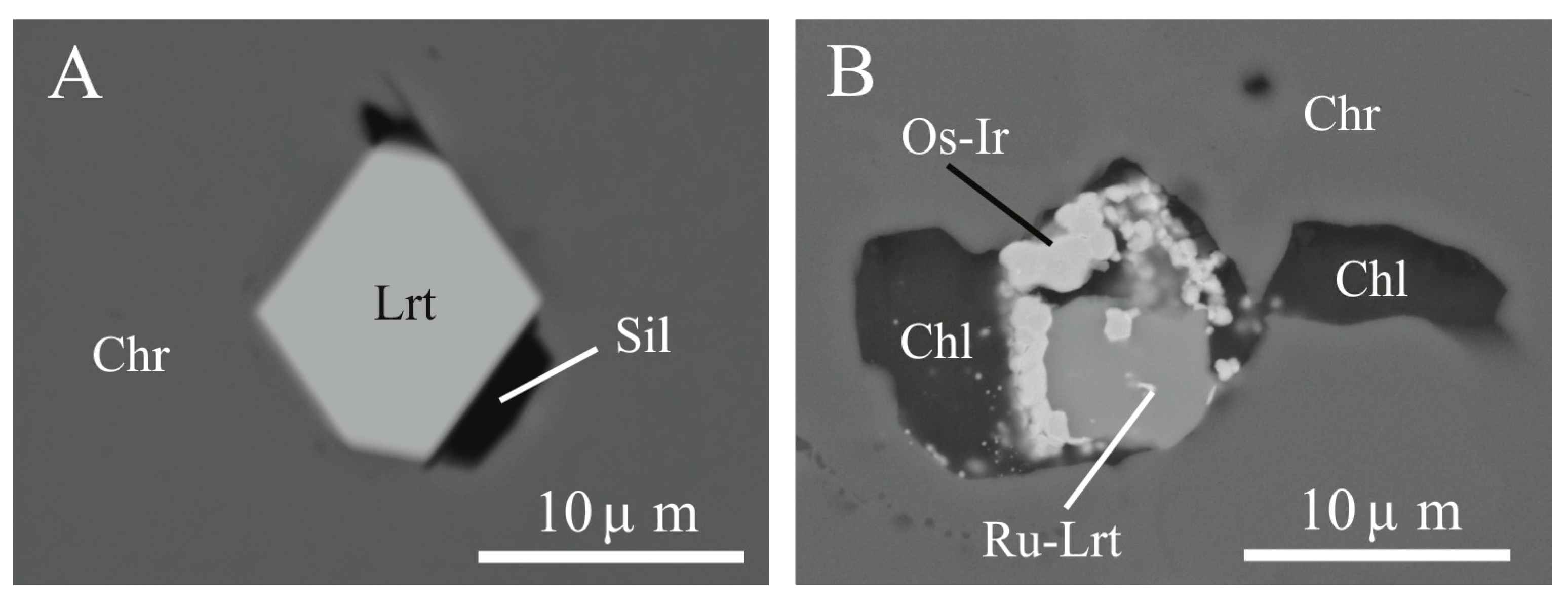
Most of the primary PGM occur as small polygonal grains, less than 10 μm, enclosed in fresh chromite crystals (Figure 11A). Based on mineralogical observations and experimental work [209,216], an order of crystallization can be proposed for magmatic IPGM in the range of temperatures from 1300 °C to 800 °C. Alloys in the Os-Ir-Ru system are the first PGM to crystallize at temperatures around 1300 °C, followed by laurite and Os-Ir alloys, and finally, at lower temperatures around 800 °C, erlichmanite is the last PGM to crystallize together with Ir-bearing sulphides [209,216].
Experimental results also confirmed that the Os solubility in laurite increases with a decreasing temperature and increasing fS2 [216]. Alloys of Pt-Fe-Cu-Ni are most abundant in the Alaskan-type chromitites, accompanied by minor PGE sulphides and osmium. These PGM crystallized at the magmatic stage at temperatures between 1300 °C and 1050 °C. Anomalous situations have been noted where PPGE, such as Pt in mantle-derived ultramafic rocks, have been attributed to SiO2-undersaturation in the parent melt and elevated oxygen fugacity (fO2) during the fractional crystallization of dunite and massive chromitite [8].
The occurrence of abundant IPGM located exclusively along shear zones of the Veria ophiolite (Greece), coupled with their large size (over 1.3 mm) and the cataclastic textural characteristics of both chromite and these IPGM, may indicate a link with the ductile and brittle deformation stage of the Veria ophiolite [217]. According to these authors, the temperature (average 870 °C), obtained by applying geobarometers and geothermometers for silicate inclusions in the host chromitites, is consistent with that estimated for extremely large IPGM (obtained by applying the Arrhenius equation) [218]. In addition, the presence of Os-Ir-Ru-alloys and oxides surrounding remnants of laurite suggests that the stability of IPGM may be governed by thermodynamic principles, indicating the spontaneous formation of minerals and their stability under specific temperature and pressure conditions and fO2, fS2, and fluid composition [219,220]. Thus, after their precipitation in the magmatic stage, the primary PGM, including those of Os-Ir-Ru, can be subject to hydrothermal alteration, reworking, and recrystallization, forming the secondary PGM.
A common alteration process is the progressive in situ desulfurization of magmatic PGE sulphides, especially laurite, with the subsequent formation of Ru-Os-Ir alloys [221,222,223,224,225]. Most of these secondary alloys occur in the low-temperature alteration assemblage of the host chromitites, composed of ferrian chromite, chlorite, and serpentine (Figure 11B). The newly formed alloys display a rugged surface and high porosity. The final stage of the alteration process results in the precipitation of magnetite derived from oxidizing fluids enriched in Fe that fill the pores of the secondary Ru-Os-Ir alloys [225]. In some cases, S, Os, and Ir are also partially removed from magmatic laurite at low temperatures, resulting in the formation of a Ru-rich laurite associated with irregularly shaped Os-Ir alloys (Figure 11B).
Although it is difficult to determine the extent of PGE mobilization based only on mineralogical observations, it has been proposed that secondary processes modified the primary PGM assemblage without changing the whole-rock distribution of the IPGE [223,225].
Figure 11. BSE images of IPGM. (A) Polygonal grain of laurite in contact with silicate, enclosed in chromite (present work); (B) Ru-rich laurite rimmed by irregularly shaped Os–Ir alloy, and associated with chlorite. Abbreviations: Lrt = laurite, Sil = silicate, Chr = chromite, Ru-Lrt = Ru-rich laurite, Os-Ir = Os–Ir alloy, and Chl = chlorite. (Modified after Zaccarini et al. [224]).
Minerals 16 00108 g011
Grains of zoned laurite found in the Merensky Reef of the Bushveld Complex revealed that they precipitated at 400–200 °C, which are typical temperatures in the hydrothermal systems. Therefore, the zoned laurite of the Merensky Reef probably crystallized in the presence of a late-stage hydrous solution at temperatures much lower than those of the precipitation of magmatic laurite [226].
PPGE are the more chalcophile and less refractory PGE, typically hosted in or associated with base metal sulphides. Therefore, lower melting degrees between 20 and 25% of the mantle will dissolve all the PPGE into the melts [2]. Subsequently, during crystallization of a magma, when S reaches saturation leading to the formation of an immiscible sulphide liquid, the PPGE are collected and concentrated in the sulphide melt where, given the appropriate conditions, the PPGE minerals can precipitate [2,7]. During the cooling and solidification of this sulphide melt, Pt and Pd can be incorporated as trace elements into the structure of BM and then exsolved from the host minerals with the subsequent formation of discrete PGM.
Post-magmatic sulphur loss coupled with an oxidation process in migrating deuteric or hydrothermal fluids may have caused, in some cases, the dissolution and reprecipitation of Pd and Au in different redox barriers [227].
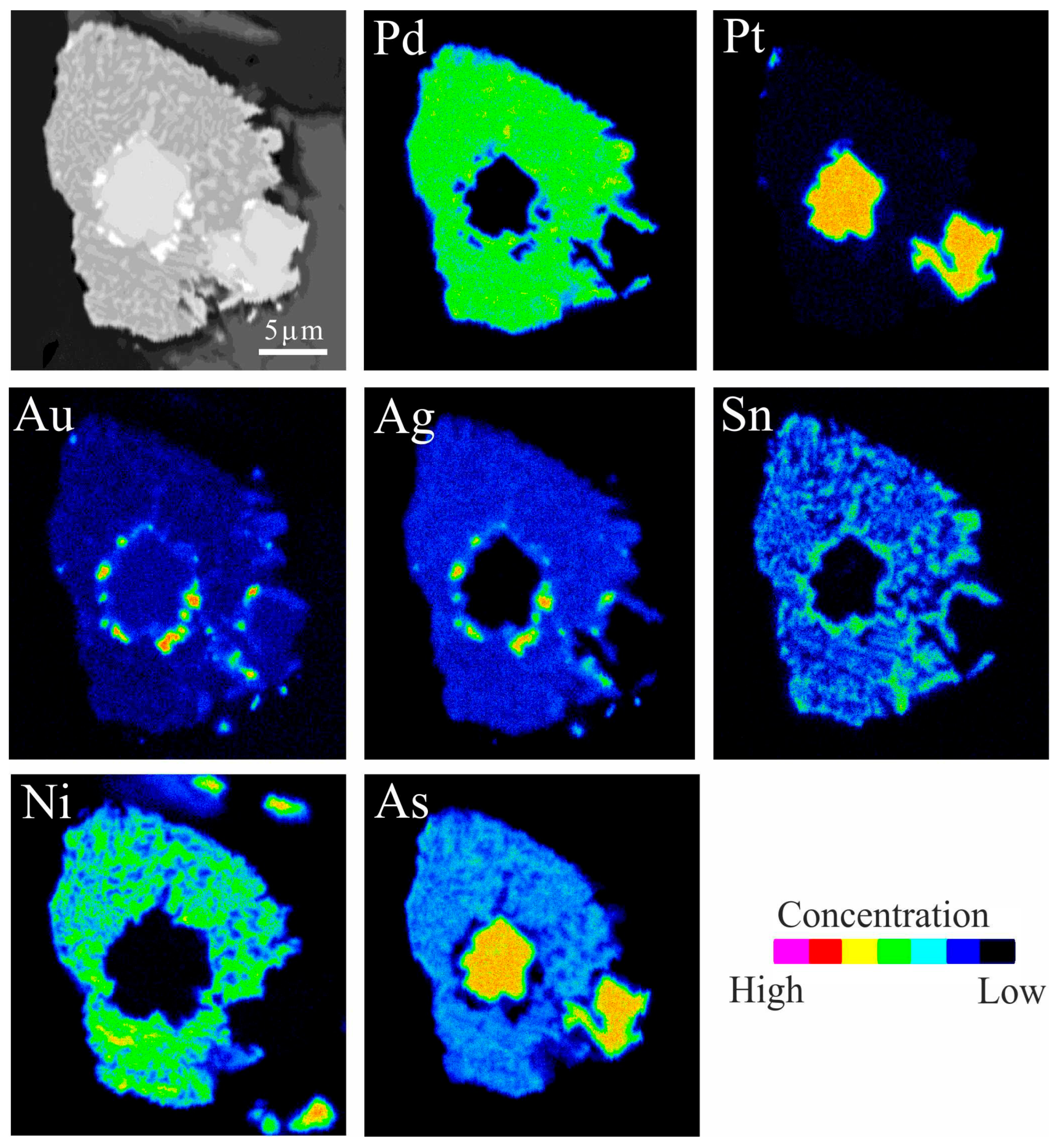
In contrast to the immobile IPGE, PPGE, especially Pd, tend to be weakly mobile in magmatic and hydrothermal systems [228], where they can migrate as soluble complexes, together with ligands and other incompatible elements, showing a behaviour comparable to that of gold and silver [212,214,229]. Under those conditions, the PPGE minerals can be bonded with several elements and not only with S (Table 1) and they may occur in close association with Au minerals, as illustrated in Figure 12 and reported by several authors [95,212,214,227,230,231,232].
A great number of Pt and Pd minerals have been described in Ni-Cu sulphide deposits in which they precipitate, with few exceptions, in a thermal range of about 900–300 °C in the presence of metasomatic and hydrothermal fluids and a progressive increase of oxygen fugacity (fO2). These observations are also supported by the close association of PPGE minerals with hydrous silicates [214,229,233]. PPGE may also be redistributed and locally transported by circulating late aqueous, hydrothermal fluids causing the precipitation of PPGE minerals below 300 °C [214,229]. These crystallization temperatures have also been experimentally confirmed for several Pt and Pd minerals [181,234,235,236,237,238,239,240,241,242]. A rare Pt mineralization occurring in quartz veins was described in the hydrothermal deposit of Waterberg (South Africa) [243,244].

9.2. Origin of PGM in Placer Deposits

According to Cabri et al. [243,244,245], PGM in placer deposits are dominated by alloys in the Pt-Fe and Ru-Os-Ir systems, accompanied by less abundant laurite–erlichmanite and sperrylite. However, a great number of PGM containing all six PGE, characterized by a great mineralogical variety and complex textures, have been reported in several placer deposits [170,190,194,197,210,211,212,246,247,248,249] and references therein.
The formation of PGM nuggets involves several processes that have been summarized in two main genetic models: (1) The detrital PGM represent grains that, after their crystallization in the magmatic stage, were mechanically liberated from their primary source by weathering and erosion, with or without minor alteration processes [246], and (2) the PGM nuggets precipitated in the supergene environment through a complex process that involves solubility, the leaching of PGE from the primary PGM, and variation in Eh-pH and microbial activity [194,197,204,210,212,215,247,248,249,250,251].
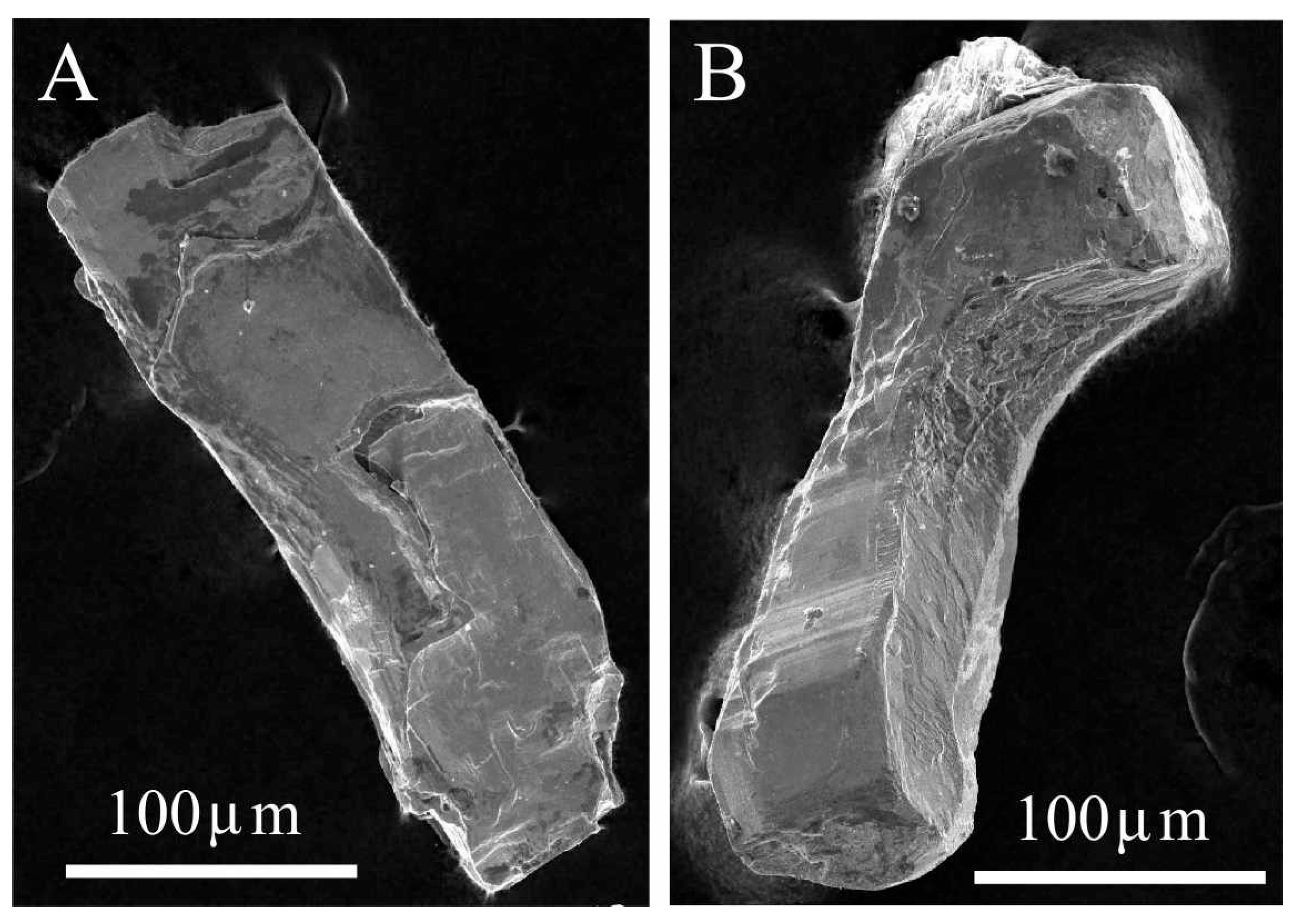
These two models do not exclude each other; an alluvial deposit may contain contributions from both processes. The detrital PGM simply liberated from their host rocks and mechanically concentrated in placer deposits mainly consist of stable phases, such as Pt-Fe and Ru-Os-Ir alloys, laurite–erlichmanite, and sperrylite [245]. The final PGM assemblage, which survived the alteration processes from the primary deposits to the placers, is due to the continuous elimination of unstable PGM and the dispersion of soluble PGE in the environment [247]. Therefore, the alluvial PGM assemblage represents a spectrum of residual, detrital grains. Often, these nuggets preserve faceted and polygonal morphologies (Figure 13A,B), suggesting relatively short transport distances from their source [210,215].
However, this model can be applied to a limited number of PGM nuggets for the reasons listed below and summarized by Bowles and Suárez [212]. Although exceptionally large PGM, up to 2 cm in size, have been described in magmatic deposits [210,247], there is often three orders of magnitude difference in size between the primary PGM, typically less than 10 μm [212], compared with the larger PGM alluvial nuggets, which can be up to several cm in size. The morphology, shape, composition, and micro texture of the PGM differ from those typically reported in magmatic PGM.
In particular, the presence of delicate textures [212] such as rosette-like, skeletal, and secondary colloform zonation (Figure 14A,B) observed in several PGM nuggets [170,190,194,197,204,210,212,246,247,251,252] and, to a lesser extent, in primary deposits indicates that they are secondary in origin.
Secondary PGM revealed that the magmatic PGM have become unstable during serpentinization and weathering of the host rock as well as in the supergene environment. As a result, these PGM precipitated directly from aqueous solutions enriched in PGE that, very likely, were previously leached from precursor PGM.
The precipitation of authigenic PGM nuggets is also supported by their close association with minerals such as quartz, gold, and PGE-bearing oxides and hydroxides [210,247,250] that rarely, if ever, occur as primary phases in the ultramafic rocks that host the magmatic PGM crystallized at high temperatures.
The presence of organic material is one of the factors that may play an important role during the precipitation of PGM nuggets in the supergene environment [252,253,254,255,256]. The involvement of organic material during the precipitation and growth of the authigenic PGM nuggets has been postulated on the basis of the presence of bacterial biofilms also found in the PGM of lateritic soils [257] and comparable to those produced in the laboratory [254,255].

10. Summary and Concluding Remarks

This review demonstrates that PGM are rare: 169 in total, representing only 2.7% of all the 6176 minerals discovered so far. They comprise 82 phases of Pd, 35 of Pt, 23 of the PPGM Rh, 18 of Ir, 7 of Ru, and 4 of the IPGM Os.
The PGM are bonded to several elements such as Fe, Ni, Cu, S, As, Te, Bi, Sb, Se, Sn, Hg, Ag, Zn, Si, Pb, Ge, In, Mo, and O, and they crystallized in all the seven structure systems. Some PGM form solid-solution series which may be complete or contain a miscibility gap, and the substitution among the elements may provide information about the chemical and physical conditions in which the mineral was formed.
However, 496 PGM are listed among the valid species that have not yet been officially accepted, owing to their size and mode of occurrence, i.e., polyphasic aggregates of few μm that prevent any XRD structural study. With the improvement of more efficient techniques and the availability of synthetic analogues, it is very likely that more PGM will be completely characterized and accepted in the near future.
PGM have been described in both magmatic and placer deposits and formed in a wide range of temperatures, from more than 1000 °C to as low as 100 °C. All PGM, and especially IPGM, initially crystallized from mafic–ultramafic magma at high temperatures (1300 °C to 900 °C) and occur with associated chromitites. The PPGM formed at lower temperatures, generally after the formation of an immiscible sulphide liquid. The modification, equilibration, and alteration of the primary PGM assemblages can occur at temperatures of 300 °C or less, caused by the presence of metasomatic and hydrothermal fluids.
The alteration of PGM may occur during serpentinization and weathering of the host rock as well as in the supergene environment, such as in laterites and in eluvial and alluvial deposits. These secondary PGM can be altered in situ, or they can precipitate from aqueous solutions enriched in PGE previously leached from the precursor PGM. The PGM nuggets formed through different processes, i.e., they represent grains that, after their magmatic crystallization, were mechanically liberated from their primary source by weathering and erosion, with or without minor alteration processes, or they are authigenic in origin and precipitated directly in the supergene environment through a complex process that comprises solubility, the leaching of PGE, and variation in Eh-pH and microbial activity.

Supplementary Materials

The following supporting information can be downloaded at: https://www.mdpi.com/article/10.3390/min16010108/s1, Table S1: Accepted PGM.

Author Contributions

Conceptualization, F.Z., G.G., M.E.-E., J.F.W.B., H.S.R.H., J.C.A. and S.S.; Writing—original draft preparation, F.Z.; Writing—review and editing, F.Z., G.G., M.E.-E., J.F.W.B., H.S.R.H., J.C.A. and S.S. All authors have read and agreed to the published version of the manuscript.

Funding

This research received no external funding.

Data Availability Statement

Not applicable.

Acknowledgments

We would like to thank all referees for their comments that greatly improved the quality of the manuscript. The help provided by the editprial staff of Minerals is highly appreciated.

Conflicts of Interest

The authors declare no conflicts of interest.

References

  1. Wedepohl, K.H. The composition of the continental crust. Geochim. Cosmochim. Acta 1995, 59, 1217–1232. [Google Scholar] [CrossRef]
  2. Barnes, S.-J.; Naldrett, A.J.; Gorton, M.P. The origin of the fractionation of platinum-group elements in terrestrial magmas. Chem. Geol. 1985, 5, 303–323. [Google Scholar] [CrossRef]
  3. Naldrett, A.J.; Duke, J.M. Platinum metals in magmatic sulfide ores. Science 1980, 208, 1417–1424. [Google Scholar] [CrossRef] [PubMed]
  4. Balaram, V.; Santosh, M. Critical metal deposits in terrestrial and oceanic environments and the Global Energy Transition. Habit. Planet 2025, 1, 86–107. [Google Scholar] [CrossRef]
  5. Cawthorn, R.G. The platinum group element deposits of the Bushveld Complex in South Africa. Platin. Met. Rev. 2010, 54, 205–215. [Google Scholar] [CrossRef]
  6. Krivolutskaya, N.A.; Latyshev, A.V.; Dolgal, A.S.; Gongalsky, B.I.; Makarieva, E.M.; Makariev, A.A.; Svirskaya, N.M.; Bychkova, Y.V.; Yakushev, A.I.; Asavin, A.M. Unique PGE–Cu–Ni Noril’sk Deposits, Siberian Trap Province: Magmatic and tectonic factors in their origin. Minerals 2019, 9, 66. [Google Scholar] [CrossRef]
  7. Naldrett, A.J. Magmatic Sulfide Deposits: Geology, Geochemistry and Exploration; Springer: Berlin/Heidelberg, Germany, 2004; 727p. [Google Scholar]
  8. Garuti, G.; Pushkarev, E.; Zaccarini, F. Composition and paragenesis of Pt alloys from chromitites of the Uralian–Alaskan-type Kytlym and Uktus complexes, northern and central Urals, Russia. Can. Mineral. 2002, 40, 1127–1146. [Google Scholar] [CrossRef]
  9. Bowles, J.F.W. Platinum-Group Minerals. In Encyclopedia of Geology, 2nd ed.; Elsevier: Amsterdam, The Netherlands, 2021; Volume 1, pp. 473–483. [Google Scholar]
  10. Clark, A.M.; Criddle, A.J.; Fejer, E.E. Palladium arsenide-antimonides from Itabira, Minas Gerais, Brazil. Mineral. Mag. 1974, 39, 528–543. [Google Scholar] [CrossRef][Green Version]
  11. Mihalik, P.; Hiemstra, S.A.; de Villiers, J.P.R. Rustenburgite and atokite, two new platinum-group minerals from the Merensky Reef, Bushveld igneous complex. Can. Mineral. 1975, 13, 146–150. [Google Scholar]
  12. Yalovoi, A.A.; Sidorov, A.F.; Rudashevskii, N.S.; Bud´ko, I.A. Borovskite, Pd3SbTe4, a new mineral. Zapiski Vsesoyu. Mineral. Obsh. 1973, 102, 427–431. [Google Scholar]
  13. Mochalov, A.G.; Tolkachev, M.D.; Polekhovsky, Y.S.; Goryacheva, E.M. Bortnikovite, Pd4Cu3Zn, a new mineral species from the unique Konder placer deposit, Khabarovsk krai, Russia. Geol. Ore Depos. 2007, 49, 318–327. [Google Scholar] [CrossRef]
  14. Estigneeva, T.L.; Genkin, A.D. Cabriite, Pd2SnCu, a new mineral species in the mineral group of palladium, tin and copper compounds. Can. Mineral. 1983, 21, 481–487. [Google Scholar]
  15. Paar, W.H.; Roberts, A.C.; Criddle, A.J.; Topa, D. A new mineral, chrisstanleyite, Ag2Pd3Se4, from Hope’s Nose, Torquay, Devon, England. Mineral. Mag. 1998, 62, 257–264. [Google Scholar] [CrossRef]
  16. McDonald, A.M.; Cabri, L.J.; Stanley, C.J.; Good, D.J.; Redpath, J.; Lane, G.; Spratt, J.; Ames, D.E. Coldwellite, Pd3Ag2S, A New Mineral Species from the Marathon Deposit, Coldwell Complex, Ontario, Canada. Can. Mineral. 2015, 53, 845–857. [Google Scholar] [CrossRef]
  17. Hawley, J.E.; Berry, L.G. Michenerite and froodite, palladium bismuth minerals. Can. Mineral. 1958, 6, 200–209. [Google Scholar]
  18. Paar, W.H.; Topa, D.; Makovicky, E.; Sureda, R.J.; de Brodtkorb, M.K.; Nickel, E.H.; Putz, H. Jaguéite, Cu2Pd3Se4, a new mineral species from El Chire, La Rioja, Argentina. Can. Mineral. 2004, 42, 1745–1755. [Google Scholar] [CrossRef]
  19. Botelho, N.F.; Moura, M.A.; Peterson, R.C.; Stanley, C.J.; Silva, D.V.G. Kalungaite, PdAsSe, a new platinum-group mineral from the Buraco do Ouro gold mine, Cavalcante, Goiás State, Brazil. Mineral. Mag. 2006, 70, 123–130. [Google Scholar] [CrossRef]
  20. Cabri, L.J.; Rowland, J.F.; Laflamme, J.H.G.; Stewart, J.M. Keithconnite, telluropalladinite and other palladium-platinum tellurides from the Stillwater Complex, Montana. Can. Mineral. 1979, 17, 589–594. [Google Scholar]
  21. Stanley, C.J.; Vymazalová, A. Kojonenite, a new palladium tin telluride mineral from the Stillwater Layered Igneous Intrusion, Montana, U.S.A. Am. Mineral. 2015, 100, 447–450. [Google Scholar] [CrossRef]
  22. Genkin, A.D.; Zhuravlev, N.N.; Smirnova, E.M. Moncheite and kotulskite—New minerals—And the composition of michenerite. Zap. Vserossi. Mineral. Obshch. 1963, 92, 33–50. [Google Scholar]
  23. Vymazalová, A.; Laufek, F.; Sluzhenikin, S.F.; Stanley, C.J.; Kozlov, V.V.; Chareev, D.A.; Lukashova, M.L. Kravtsovite, PdAg2S, a new mineral from the Noril’sk-Talnakh deposit, Krasnoyarskiykray, Russia. Eur. J. Mineral. 2017, 29, 597–602. [Google Scholar] [CrossRef]
  24. Barkov, A.Y.; Martin, R.F.; Halkoaho, T.A.A.; Criddle, A.J. Laflammeite, Pd3Pb2S2, a new platinum-group mineral species from the Penikat layered complex, Finland. Can. Mineral. 2002, 40, 671–678. [Google Scholar] [CrossRef]
  25. Vymazalová, A.; Grokhovskaya, T.L.; Laufek, F.; Rassulov, V.A. Lukkulaisvaaraite, Pd14Ag2Te9, a new mineral from Lukkulaisvaara intrusion, northern Russian Karelia, Russia. Mineral. Mag. 2014, 78, 1743–1754. [Google Scholar] [CrossRef]
  26. Genkin, A.D.; Evstigneeva, T.L.; Troneva, N.V.; Vyal´sov, L.N. Majakite, PdNiAs, a new mineral from copper-nickel sulfide ores. Zap. Vserossi. Mineral. Obshch. 1976, 105, 698–703. [Google Scholar] [CrossRef]
  27. Chernikov, A.A.; Chistyakova, N.I.; Uvarkina, O.M.; Dubinchuk, V.T.; Rassulov, V.A.; Polekhovsky, Y.S. Malyshevite PdBiCuS3—A new mineral from Srednyaya Padma deposit in southern Karelia. New Data Mineral. 2006, 41, 14–17. [Google Scholar]
  28. McDonald, A.M.; Ames, D.E.; Kjarsgaard, I.M.; Cabri, L.J.; Zhe, W.; Ross, K.C.; Good, D.J. Marathonite, Pd25Ge9, and palladogermanide, Pd2Ge, two new platinum-group minerals from the Marathon deposit, Coldwell Complex, Ontario, Canada: Descriptions, crystal-chemical considerations, and genetic implications. Can. Mineral. 2021, 59, 1865–1886. [Google Scholar] [CrossRef]
  29. Barkov, A.Y.; Martin, R.F.; Pakhomovsky, Y.A.; Tolstykh, N.D.; Krivenko, A.P. Menshikovite, Pd3Ni2As3, a new platinum-group mineral species from two layered complexes, Russia. Can. Mineral. 2002, 40, 679–692. [Google Scholar] [CrossRef]
  30. Kingston, G.A. The occurrence of platinoid bismuthotellurides in the Merensky Reef at Rustenburg platinum mine in the western Bushveld. Mineral. Mag. J. Mineral. Soc. 1966, 35, 815–834. [Google Scholar] [CrossRef]
  31. Desborough, G.A.; Finney, J.J.; Leonard, B.F. Mertieite, a new palladium mineral from Goodnews Bay, Alaska. Am. Mineral. 1973, 58, 1–10. [Google Scholar]
  32. Kojonen, K.K.; Tarkian, M.; Roberts, A.C.; Törnroos, R.; Heidrich, S. Miessiite, Pd11Te2Se2, a new mineral species from Miessijoki, Finnish Lapland, Finland. Can. Mineral. 2007, 45, 1221–1227. [Google Scholar] [CrossRef]
  33. Paar, W.H.; Topa, D.; Makovicky, E.; Culetto, F.J. Milotaite, PdSbSe, a new palladium mineral species from Predborice, Czech Republic. Can. Mineral. 2005, 43, 689–694. [Google Scholar] [CrossRef]
  34. Vymazalová, A.; Laufek, F.; Grokhovskaya, T.L.; Stanley, C.J. Monchetundraite, Pd2NiTe2, a new mineral from the Monchetundra layered intrusion, Kola Peninsula, Russia. Mineral. Petrol. 2020, 114, 263–271. [Google Scholar] [CrossRef]
  35. Cabri, L.J.; McDonald, A.M.; Stanley, C.J.; Rudashevsky, N.S.; Poirier, G.; Durham, B.R.; Mungall, J.E.; Rudashevsky, V.N. Naldrettite, Pd2Sb, a new intermetallic mineral from the Mesamax Northwest deposit, Ungava region, Québec, Canada. Mineral. Mag. 2005, 69, 89–97. [Google Scholar] [CrossRef]
  36. McDonald, A.M.; Cabri, L.J.; Rudashevsky, N.S.; Stanley, C.J.; Rudashevsky, V.N.; Ross, K.C. Nielsenite, PdCu3, a new platinum-group intermetallic mineral species from the Skaergaard intrusion, Greenland. Can. Mineral. 2008, 46, 709–716. [Google Scholar] [CrossRef]
  37. Grokhovskaya, T.L.; Karimova, O.V.; Vymazalová, A.; Laufek, F.; Chareev, D.A.; Kovalchuk, E.V.; Magazina, L.O.; Rassulov, V.A. Nipalarsite, Ni8Pd3As4, a new platinum-group mineral from the Monchetundra Intrusion, Kola Peninsula, Russia. Mineral. Mag. 2019, 83, 837–845. [Google Scholar] [CrossRef]
  38. Vymazalová, A.; Laufek, F.; Sluzhenikin, S.F.; Stanley, C.J. Norilskite, (Pd,Ag)7Pb4, a new mineral from Noril’sk-Talnakh deposit, Russia. Mineral. Mag. 2017, 81, 531–541. [Google Scholar] [CrossRef]
  39. Johan, Z.; Picot, P.; Pierrot, R.; Verbeek, T. L’oosterboschite (Pd,Cu)7Se5, une nouvelle espèce minérale et la trogtalite cupro-palladifère de Musonoï (Katanga). Bull. Minéral. 1970, 93, 476–481. [Google Scholar]
  40. Barkov, A.Y.; Men’Shikov, Y.P.; Begizov, V.D.; Lednev, A.I. Oulankaite, a new platinum-group mineral from the Lukkulaisvaara layered intrusion, northern Karelia, Russia. Eur. J. Mineral. 1996, 8, 311–316. [Google Scholar] [CrossRef]
  41. Polekhovskij, Y.S.; Voloshin, A.V.; Tarasova, I.P.; Nikitin, S.A.; Pakhomovskij, Y.A.; Men´shikov, Y.P.; Kretzer, Y.L.; Kolytscheva, T.I. Padmaite PdBiSe—A new selenide of palladium and bismuth from metasomatites of the southern Karelia. Zapiski Vsesoyu. Mineral. Obsh. 1991, 120, 85–88. [Google Scholar]
  42. Begizov, V.D.; Zav´yalov, E.M.; Pavlov, E.G. Palarstanide, Pd8(Sn,As)3, a new mineral. Zapiski Vsesoyu. Mineral. Obsh. 1981, 110, 487–492. [Google Scholar]
  43. Johnson, P.N.; Lampadius, W.A. Mittheilungen über das brasilianische Palladgold. J. Prakt. Chem. 1837, 11, 11–315. [Google Scholar]
  44. Wollaston, W.H. On a New Metal, Found in Crude Platina. Philosoph. Transac. R. Soc. Lond. 1804, 94, 419–430. [Google Scholar]
  45. Begizov, V.D.; Meshichankina, V.I.; Dubakina, L.S. Palladoarsenide, Pd2As, a new natural palladium arsenide from the copper-nickel deposits of the Oktyabr deposits. Zapiski Vsesoyu. Mineral. Obsh. 1974, 103, 104–107. [Google Scholar] [CrossRef]
  46. Cabri, L.J.; Chen, T.T.; Stewart, J.M.; Laflamme, J.H.G. Two new palladium-arsenic-bismuth minerals from the Stillwater Complex, Montana. Can. Mineral. 1976, 14, 410–413. [Google Scholar]
  47. Britivin, S.N.; Rudashevsky, N.S.; Bogdanova, A.N.; Shcherbachov, D.K. Palladodymite (Pd,Rh)2As, a new mineral from a placier of the Miass River, the Urals. Zap. Vserossi. Mineral. Obshch. 1999, 128, 39–42. [Google Scholar]
  48. Cabri, L.J.; McDonald, A.M.; Stanley, C.J.; Rudashevsky, N.S.; Poirier, G.; Wilhelmij, H.R.; Zhe, W.; Rudashevsky, V.N. Palladosilicide, Pd2Si, a new mineral from the Kapalagulu Intrusion, Western Tanzania and the Bushveld Complex, South Africa. Mineral. Mag. 2015, 79, 295–307. [Google Scholar] [CrossRef][Green Version]
  49. Grokhovskaya, T.L.; Vymazalová, A.; Laufek, F.; Stanley, C.J.; Borisovskiy, S.Y. Palladothallite, Pd3Tl, a new mineral from the Monchetundra layered intrusion, Kola Peninsula, Russia. Can. Mineral. 2021, 59, 1821–1832. [Google Scholar] [CrossRef]
  50. Davis, R.J.; Clark, A.M.; Criddle, A.J. Palladseïte, a new mineral from Itabira, Minas Gerais, Brazil. Mineral. Mag. 1977, 41, 123. [Google Scholar] [CrossRef]
  51. Vymazalová, A.; Subbotin, V.V.; Laufek, F.; Savchenko, Y.E.; Stanley, C.J.; Gabov, D.A.; Plášil, J. Panskyite, Pd9Ag2Pb2S4, a new platinum group mineral from the Southern Kievey ore occurrence of the Fedorova–Pana layered intrusion, Kola Peninsula, Russia. Mineral. Mag. 2021, 85, 161–171. [Google Scholar] [CrossRef]
  52. Genkin, A.D.; Evstigneeva, T.L.; Vyalsov, L.N.; Laputina, I.P.; Groneva, N.V. Paolovite—Pd2Sn—A new mineral from copper-nickel sulfide ores. Geol. Rud. Mestoroz. 1974, 16, 98–103. [Google Scholar] [CrossRef]
  53. Vymazalová, A.; Laufek, F.; Drabek, M.; Haloda, J.; Sidorinova, T.; Plasil, J. Pašavaite, Pd3Pb2Te2, a new platinum-group mineral species from the Noril’sk-Talnakh Ni-Cu Camp, Russia. Can. Mineral. 2009, 47, 53–62. [Google Scholar] [CrossRef]
  54. Genkin, A.D.; Evstigneeva, T.L.; Vyal’sov, L.N.; Laputina, I.P.; Troneva, N.V. Plumbopalladinite—Pd3Pb2—A new mineral from copper-nickel ores. Geol. Rud. Mestoroz. 1970, 5, 63–68. [Google Scholar]
  55. Genkin, A.D.; Evstigneeva, T.L.; Troneva, N.V.; Vyal’sov, L.N. Polarite, Pd(Pb,Bi) a new mineral from copper-nickel sulfide ores. Zap. Vserossi. Mineral. Obshch. 1969, 98, 708–715. [Google Scholar]
  56. Spencer, L.J. Potarite, a new mineral discovered by the late Sir John Harrison in British Guiana. Mineral. Mag. J. Mineral. Soc. 1928, 21, 397–406. [Google Scholar] [CrossRef]
  57. Bindi, L.; Cabri, L.J.; Mihalkovič, M.; Laufek, F.; Krivovichev, S. Proxitwelvefoldite, CNMNC Newsletter 81. Eur. J. Mineral. 2024, 36, 917–923. [Google Scholar] [CrossRef]
  58. Cabri, L.J.; Laflamme, J.H.G.; Stewart, J.M.; Rowland, J.F.; Chen, T.T. New data on some palladium arsenides and antimonides. Can. Mineral. 1975, 13, 321–335. [Google Scholar]
  59. Vymazalová, A.; Cabral, A.R.; Laufek, F.; Ließmann, W.; Stanley, C.J.; Lehmann, B. Roterbärite, PdCuBiSe3, a new mineral species from the Roter Bär mine, Harz Mountains, Germany. Mineral. Petrol. 2020, 114, 443–451. [Google Scholar] [CrossRef]
  60. Rudashevsky, N.S.; McDonald, A.M.; Cabri, L.J.; Nielsen, T.F.D.; Stanley, C.J.; Kretzer, Y.L.; Rudashevsky, V.N. Skaergaardite, PdCu, a new platinum-group intermetallic mineral from the Skaergaard intrusion, Greenland. Mineral. Mag. 2004, 68, 615–632. [Google Scholar] [CrossRef]
  61. Vymazalová, A.; Welch, M.D.; Laufek, F.; Kozlov, V.V.; Stanley, C.J.; Plášil, J. Sluzhenikinite, Pd15(Sb7−xSnx) 3 ≤ x ≤ 4, a new platinum group mineral (PGM) from the Oktyabrsk deposit, the Noril`sk deposits, Russia. Mineral. Mag. 2022, 86, 577–585. [Google Scholar] [CrossRef]
  62. Evstigneeva, T.L.; Genkin, A.D.; Kovalenker, V.A. A new bismuthide of palladium, sobolevskite, and the nomenclature of minerals of the system PdBi-PdTe-PdSb. Zap. Vsesoyu. Mineral. Obsh. 1975, 104, 568–579. [Google Scholar] [CrossRef]
  63. Orsoev, D.A.; Rezhenova, S.A.; Bodanova, A.N. Sopcheite, Ag4Pd3Te4, a new mineral from copper-nickel ores of the Monchegorsk pluton. Zap. Vsesoyu. Mineral. Obsh. 1982, 111, 114–117. [Google Scholar] [CrossRef]
  64. Maslenitzky, I.N.; Faleev, P.V.; Iskyul, E.V. Tin-bearing minerals of the platinum group in sulfide copper-nickel ores. Dokl. Akad. Nauk 1947, 58, 1137–1140. [Google Scholar]
  65. Adam, H.R. A note on a new palladium mineral from the Potgietersrust platinum fields. J. Chem. Metall. Min. Soc. S. Afr. 1927, 27, 249–250. [Google Scholar]
  66. Cabri, L.J.; Laflamme, J.H.G. Sudburyite, a new palladium-antimony mineral from Sudbury, Ontario. Can. Mineral. 1974, 12, 275–279. [Google Scholar]
  67. Begizov, V.D.; Sluzhenikin, S.F. On the compositions of some platinum minerals from the northwest and extreme north of the Talnakh ore junction. Tsentral. Nauch. Geol. Inst. Tsvet. Blagor. Metal. 1976, 122, 107–116. [Google Scholar]
  68. Kovalenker, V.A.; Genkin, A.D.; Evstigneeva, T.L.; Laputina, I.P. Telargpalite, a new mineral of palladium, silver and tellurium, from the copper-nickel ores of the Oktyabr deposit. Zap. Vsesoyu. Mineral. Obsh. 1974, 103, 595–600. [Google Scholar] [CrossRef]
  69. Cabri, L.J.; Laflamme, J.H.G.; Stewart, J.M. Temagamite, a new palladium-mercury telluride from the Temagami copper deposit, Ontario, Canada. Can. Mineral. 1973, 12, 193–198. [Google Scholar]
  70. Cabri, L.J.; Liang, Q.L. Testibiopalladite, PdSbTe: A Valid Mineral and Sb-Analogue of Michenerite. Can. J. Mineral. Petrol. 2024, 62, 307–316. [Google Scholar] [CrossRef]
  71. Vymazalová, A.; Laufek, F.; Sluzhenikin, S.; Kozlov, V.; Stanley, C.J.; Plášil, J.; Zaccarini, F.; Garuti, G.; Bakker, R. Thalhammerite, Pd9Ag2Bi2S4, a new mineral from the Talnakh and Oktyabrsk Deposits, Noril’sk Region, Russia. Minerals 2018, 8, 339. [Google Scholar] [CrossRef]
  72. Ma, C.; Förster, H.J.; Grundmann, G. Tilkerodeite, Pd2HgSe3, a new platinum-group mineral from Tilkerode, Harz Mountains, Germany. Crystals 2020, 10, 687. [Google Scholar] [CrossRef]
  73. Stanley, C.J.; Criddle, A.J.; Forster, H.J.; Roberts, A.C. Tischendorfite, Pd8Hg3Se9, a new mineral species from Tilkerode, Harz Mountains, Germany. Can. Mineral. 2002, 40, 739–745. [Google Scholar] [CrossRef]
  74. Kojonen, K.K.; McDonald, M.; Stanley, C.J.; Johanson, B. Törnroosite, Pd11As2Te2, a new mineral species related to isomertieite from Miessijoki, Finnish Lapland, Finland. Can. Mineral. 2011, 49, 1643–1651. [Google Scholar] [CrossRef]
  75. McDonald, A.M.; Cabri, L.J.; Stanley, C.J.; Rudashevsky, N.S.; Poirier, G.; Mungall, J.E.; Ross, K.C.; Durham, B.R.; Rudashevsky, V.N. Ungavaite, Pd4Sb3, a new intermetallic mineral species from the Mesamax Northwest deposit, Ungava region, Québec, Canada: Description and genetic implications. Can. Mineral. 2005, 43, 1735–1744. [Google Scholar] [CrossRef]
  76. Rudashevsky, N.S.; Makarov, V.N.; Mededeva, E.M.; Ballakh, V.V.; Permyakov, Y.I.; Mitenkov, G.A.; Karpenkov, A.M.; Budk´ko, I.A.; Shishkin, N.N. Urvantsevite, Pd(Bi,Pb)2, a new mineral in the system Pd-Bi-Pb. Zap. Vsesoyu. Mineral. Obsh. 1976, 105, 704–709. [Google Scholar]
  77. Kasatkin, A.V.; Biagioni, C.; Nestola, F.; Agakhanov, A.A.; Stepanov, S.Y.; Gurzhiy, V.V.; Petrov, S.V.; Pilugin, G. Vadlazarenkovite, Pd8Bi1.5Te1.25As0.25, a new mineral isotypic with mertieite from the Konder massif, Far East, Russia. Mineral. Mag. 2025, 89, 92–101. [Google Scholar] [CrossRef]
  78. Atanasov, A.V. Vasilite, (Pd,Cu)16(S,Te)7, a new mineral species from Novoseltsi, Bulgaria. Can. Mineral. 1990, 28, 687–689. [Google Scholar]
  79. Roberts, A.C.; Paar, W.H.; Cooper, M.A.; Topa, D.; Criddle, A.J.; Jedwab, J. Verbeekite, monoclinic PdSe2, a new mineral from the Musonoi Cu-Co-Mn-U mine, near Kolwezi, Shaba Province, Democratic Republic of Congo. Mineral. Mag. 2002, 66, 173–179. [Google Scholar] [CrossRef]
  80. Stumpfl, E.F.; Tarkian, M. Vincentite, a new palladium mineral from south-east Borneo. Mineral. Mag. 1974, 39, 525–527. [Google Scholar] [CrossRef]
  81. Vymazalová, A.; Laufek, F.; Grokhovskaya, T.L.; Stanley, C.J. Viteite, Pd5InAs, a new mineral from the Monchetundra layered intrusion, Kola Peninsula, Russia. Can. Mineral. 2020, 58, 395–402. [Google Scholar] [CrossRef]
  82. Sluzhenikin, S.F.; Kozlov, V.V.; Stanley, C.J.; Lukashova, M.L.; Dicks, K. Vymazalováite, Pd3Bi2S2, a new mineral from the Noril’sk-Talnakh deposit, Krasnoyarskiy region, Russia. Mineral. Mag. 2018, 82, 367–373. [Google Scholar] [CrossRef]
  83. Genkin, A.D.; Zvyagintsev, O.E. Vysotskite, a new sulfide of palladium and nickel. Zap. Vserossi. Mineral. Obshch. 1962, 91, 718–725. [Google Scholar]
  84. Chen, C.; Xian, H.; Jenkins, C.; Yao, Z.; Yang, Y.; Lin, X.; Li, S.; Xi, J.; Yuan, Y.; Zhu, J.; et al. Wangyanite, PdNi8S8, a new Pd end-member mineral of the pentlandite group from the J-M reef, Stillwater Complex, Montana, USA. Am. Mineral. 2025, 110, 1844–1853. [Google Scholar] [CrossRef]
  85. Genkin, A.D.; Murav’eve, I.V.; Troneva, N.V. Zvyagintsevite, a natural intermetallic compound of palladium, platinum, lead and tin. Geol. Rud. Mestoroz. 1966, 8, 94–100. [Google Scholar]
  86. Vymazalová, A.; Zaccarini, F.; Garuti, G.; Laufek, F.; Mauro, D.; Stanley, C.J.; Biagioni, C. Bowlesite, PtSnS, a new platinum group mineral (PGM) from the Merensky Reef of the Bushveld Complex, South Africa. Mineral. Mag. 2020, 84, 468–476. [Google Scholar] [CrossRef]
  87. Bannister, F.A. Determination of minerals in platinum concentrates from the Transvaal by X-ray methods. Mineral. Mag. 1932, 23, 188–206. [Google Scholar] [CrossRef]
  88. Wartenweiler, F. Discussion on a new platinum mineral in the Rustenburg norites. J. Chem. Metallur. Min. Soc. S. Afr. 1928, 28, 281–283. [Google Scholar]
  89. Cook, N.J.; Wood, S.A.; Gebert, W.; Bernhardt, H.J.; Medenbach, O. Crerarite, a new Pt-Bi-Pb-S mineral from the Cu-Bi-Ni-PGE deposit at Lac Sheen, Abitibi-Témiscamingue, Québec, Canada. Neues Jahr. Mineral. Monat. 1994, 12, 567–575. [Google Scholar] [CrossRef]
  90. Yu, Z. Damiaoite a new native indium and platinum alloy. Acta Geol. Sin. 1997, 71, 329–331. [Google Scholar]
  91. McDonald, A.M.; Cabri, L.J.; Tamura, N.; Melcher, F.; Vymazalová, A. Driekopite, ideally PtBi, a new mineral species from the Driekop platinum pipe, Republic of South Africa. Can. J. Mineral. Petrol. 2023, 61, 537–547. [Google Scholar] [CrossRef]
  92. Rudashevsky, N.S.; Mochalov, A.G.; Men’shikov, Y.P.; Shumskaya, N.I. Ferronickelplatinum Pt2FeNi—A new mineral species. Zap. Vsesoyu. Mineral. Obsh. 1983, 112, 487–494. [Google Scholar]
  93. Cabri, L.J.; Stewart, J.M.; Laflamme, J.H.G.; Szymanski, J.T. Platinum-group minerals from Onverwacht. III. Genkinite, (Pt,Pd)4Sb3, a new mineral. Can. Mineral. 1977, 15, 389–392. [Google Scholar]
  94. Stumpfl, E.F. Some new platinoid-rich minerals, identified with the electron microanalyser. Mineral. Mag. 1961, 32, 833–847. [Google Scholar] [CrossRef]
  95. Kwitko, R.; Cabral, A.R.; Lehmann, B.; Laflamme, J.H.G.; Cabri, L.J.; Criddle, A.J.; Galbiatti, H.F. Hongshiite, PtCu, from itabirite-hosted Au-Pd-Pt min eralization (Jacutinga), Itabira district, Minas Gerais, Brazil. Can. Mineral. 2002, 40, 711–723. [Google Scholar] [CrossRef]
  96. Cabri, L.J.; Harris, D.C. The new mineral insizwaite (PtBi2) and new data on niggliite (PtSn). Mineral. Mag. 1972, 38, 794–800. [Google Scholar] [CrossRef][Green Version]
  97. Cabri, L.J.; Feather, C.E. Platinum-Iron Alloys: A nomenclature based on a study of natural and synthetic alloys. Can. Mineral. 1975, 13, 117–126. [Google Scholar]
  98. Vymazalová, A.; Laufek, F.; Drábek, M.; Cabral, A.R.; Haloda, J.; Sidorinova, T.; Lehmann, B.; Galbiatti, H.F.; Drahokoupil, J. Jacutingaite, Pt2HgSe3, a new platinum-group mineral species from the Caue iron-ore deposit, Itabira district, Minas Gerais, Brazil. Can. Mineral. 2012, 50, 431–440. [Google Scholar] [CrossRef]
  99. Genkin, A.D.; Evstigneeva, T.L.; Byelsov, L.N.; Laputina, I.P. Kharaelakhite (Pt,Cu,Pb,Fe,Ni)9S8—A new sulphide of platinum, copper and lead. Mineral. Zhur. 1985, 7, 78–83. [Google Scholar]
  100. Cabral, A.R.; Skála, R.; Vymazalová, A.; Kallistová, A.; Lehmann, B.; Jedwab, J.; Sidorinová, T. Kitagohaite, Pt7Cu, a new mineral from the Lubero region, North Kivu, Democratic Republic of the Congo. Mineral. Mag. 2014, 78, 739–745. [Google Scholar] [CrossRef]
  101. Sidorov, E.G.; Kutyrev, A.V.; Zhitova, E.S.; Agakhanov, A.A.; Sandimirova, E.I.; Vymazalová, A.; Chubarov, V.M.; Zolotarev, A.A. Kufahrite, PtPb, a new mineral from Ledyanoy Creek placer, Galmoenan ultramafic complex, Koryak Highlands, Russia. Mineral. Mag. 2021, 85, 254–261. [Google Scholar] [CrossRef]
  102. Yu, Z.; Cheng, F.; Ma, H. Lisiguangite, CuPtBiS3, a new platinum-group mineral from the Yanshan Mountains, Hebei, China. Acta Geol. Sin. 2009, 83, 238–244. [Google Scholar] [CrossRef]
  103. Jedwab, J.; Cervelle, B.; Gouet, G.; Hubaut, X.; Piret, P. The new platinum selenide luberoite Pt5Se4 from the Lubero region (Kivu Province, Zaire). Eur. J. Mineral. 1992, 4, 683–692. [Google Scholar] [CrossRef]
  104. Yu, Z. Malanite a new cupric platinum (Pt3+) and iridium (Ir3+) sulfide. Acta Geol. Sin. 1996, 70, 309–314. [Google Scholar]
  105. Kovalenker, V.A.; Begizov, V.D.; Evstigneeva, T.L.; Troneva, N.V.; Ryabikin, V.A. Maslovite, PtBiTe: A new mineral from the Oktyabr copper-nickel deposit. Geol. Rud. Mestoroz. 1979, 21, 94–104. [Google Scholar]
  106. Subbotin, V.V.; Vymazalová, A.; Laufek, F.; Savchenko, Y.E.; Stanley, C.J.; Gabov, D.A.; Plášil, J. Mitrofanovite, Pt3Te4, a new mineral from the East Chuarvy deposit, Fedorovo–Pana intrusion, Kola Peninsula, Russia. Mineral. Mag. 2019, 83, 523–530. [Google Scholar] [CrossRef]
  107. Scholtz, D.L. The magmatic nickelferous ore deposits of East Griqualand and Pondoland. Transac. Geol. Soc. S. Afr. 1936, 39, 184–186. [Google Scholar]
  108. Cabral, A.R.; Skála, R.; Vymazalová, A.; Maixner, J.; Stanley, C.J.; Lehmann, B.; Jedwab, J. Orthocuproplatinum, Pt3Cu, a new mineral from the Lubero region, North Kivu, Democratic Republic of the Congo. Mineral. Petrol. 2019, 113, 527–532. [Google Scholar] [CrossRef]
  109. Juan, J.; Ulloa, A. Relación histórica del viage a la América Meridional. A. Marín, Madrid 1748, 4, 606. [Google Scholar] [CrossRef][Green Version]
  110. Kutyrev, A.; McDonald, A.M.; Tamura, N.; Cabri, L.J.; Tolstykh, N.; Pekov, I.V. Sidorovite, PtFe3, a new mineral from the Snegovaya River placer, Koryak Highlands, Russia. Can. J. Mineral, Petrol. 2023, 61, 1021–1030. [Google Scholar] [CrossRef] [PubMed]
  111. Wells, H.L. Sperrylite, a new mineral. Am. J. Sci. 1889, 137, 67–70. [Google Scholar] [CrossRef]
  112. Johan, Z.; Picot, P. La stumpflite, Pt (Sb, Bi), un nouveau minéral. Bull. Minéral. 1972, 95, 610–613. [Google Scholar] [CrossRef]
  113. Polekhovskij, Y.S.; Tarasova, I.P.; Nesterov, A.P.; Pakhomovskiy, Y.A.; Bakhchisaraitsev, A.Y. Sudovikovite PtSe2—A new platinum selenide from Karelia metasomite. Dokl. Akad. Nauk 1997, 354, 82–85. [Google Scholar]
  114. Barkov, A.Y.; Martin, R.F.; Poirier, G.; Tarkian, M.; Pakhomovskii, Y.A.; Men’shikov, Y.P. Tatyanaite, a new platinum-group mineral, the Pt analogue of taimyrite, from the Noril’sk complex (northern Siberia, Russia). Eur. J. Mineral. 2000, 12, 391–396. [Google Scholar] [CrossRef]
  115. Nishio–Hamane, D.; Saito, K. Platinum–group minerals in the placer deposit in northwestern Hokkaido, Japan: Description of a new mineral, tomamaeite. J. Mineral. Petrol. Sci. 2022, 117, 220309. [Google Scholar] [CrossRef]
  116. Cabri, L.J.; Owens, D.R.; Laflamme, J.H.G. Tulameenite, a new platinum—Iron—Copper mineral from placers in the Tulameen River area, British Columbia. Can. Mineral. 1973, 12, 21–25. [Google Scholar]
  117. Yu, Z. Yixunite—An ordered new native indium and platinum alloy. Acta Geol. Sin. 1997, 71, 332–335. [Google Scholar]
  118. Cabri, L.J.; McDonald, A.M.; Oberthür, T.; Tamura, N.; Vymazalová, A.; Ross, K.C.; Melcher, F. Andrieslombaardite, RhSbS, a new platinum-group mineral from the platiniferous Onverwacht Pipe, Republic of South Africa. S. Afr. J. Geol. 2023, 126, 151–160. [Google Scholar] [CrossRef]
  119. Desborough, G.A.; Criddle, A.J. Bowieite: A new rhodium-iridium-platinum sulfide in platinum-alloy nuggets, Goodnews Bay, Alaska. Can. Mineral. 1984, 22, 543–552. [Google Scholar]
  120. Rudashevsky, N.S.; Motshalov, A.G.; Trubkin, N.V.; Shumskaya, N.M.; Shkursky, V.I.; Evstigneeva, T.L. Cherepanovite RhAs—A new mineral. Zapiski Vsesoyu. Mineral. Obsh. 1985, 114, 464–469. [Google Scholar]
  121. Rudashevsky, N.S.; Men’shikov, Y.P.; Mochalov, A.G.; Trubkin, N.V.; Shumskaya, N.I.; Zhdanov, V.V. Cuprorhodsite CuRh2S4 and cuproiridsite CuIr2S4—New natural thiospinels of platinum-group elements. Zap. Vsesoyu. Mineral. Obsh. 1985, 114, 187–195. [Google Scholar]
  122. Nishio–Hamane, D.; Saito, K. Ezochiite, Cu+(Rh3+Pt4+)S4, a new mineral in the thiospinel group from Hokkaido, Japan. J. Mineral. Petrol. Sci 2024, 119, 240304. [Google Scholar]
  123. Begizov, V.D.; Zavjalov, E.N. Ferhodsite (Fe,Rh,Ir,Ni,Cu,Co,Pt)9–xS8—New mineral from Nizhny Tagil ultramafic complex. New Data Mineral. 2016, 51, 8–11. [Google Scholar]
  124. Barkov, A.Y.; Tolstykh, N.D.; Tamura, N.; Martin, R.F.; McDonald, A.M.; Cabri, L.J. Ferrotorryweiserite, Rh5Fe10S16, a New Mineral Species from the Sisim Placer Zone, Eastern Sayans, Russia, and the Torryweiserite–Ferrotorryweiserite Series. Minerals 2021, 11, 1420. [Google Scholar] [CrossRef]
  125. Barkov, A.Y.; Bindi, L.; Tamura, N.; Martin, R.F.; Ma, C.; Winkler, B.; Shvedov, G.I.; Morgenroth, W. Fleetite, Cu2RhIrSb2, a New Species of Platinum-Group Mineral from the Miass Placer Zone, Southern Urals, Russia. Can. Mineral. 2021, 59, 423–430. [Google Scholar] [CrossRef]
  126. Stumpfl, E.H.; Clark, A.M. Hollingworthite, a new rhodium mineral, identified by electron probe microanalysis. Am. Mineral. 1965, 50, 1068–1074. [Google Scholar]
  127. Stanley, C.J.; Criddle, A.J.; Spratt, J.; Roberts, A.C.; Szymański, J.T.; Welch, M.D. Kingstonite, (Rh,Ir,Pt)3S4, a new mineral species from Yubdo, Ethiopia. Mineral. Mag. 2005, 69, 447–453. [Google Scholar] [CrossRef]
  128. Rudashevsky, N.S.; Mochalov, A.G.; Trubkin, N.V.; Gorshkov, A.I.; Men’shikov, Y.P.; Shumskaya, N.I. Konderite Cu3Pb(Rh,Pt,Ir)8S16—A new mineral. Zap. Vsesoyu. Mineral. Obsh. 1984, 113, 703–712. [Google Scholar]
  129. Britvin, S.N.; Rudashevsky, N.S.; Bogdanova, A.N.; Shcherbachev, D.K. Miassite Rh17S15, a new mineral from a placier of Miass River, Urals. Zap. Vserossi. Mineral. Obshch. 2001, 130, 41–45. [Google Scholar]
  130. Tanaka, T.; Shinmachi, T.; Kataoka, K.; Nishio-Hamane, D. Michitoshiite-(Cu), a new Ge-containing platinum-group mineral from Kumamoto Prefecture, Japan. Bull. Nation. Museum Nat. Sci. Series C (Geol. Paleontol.) 2024, 50, 1–6. [Google Scholar]
  131. Nishio–Hamane, D.; Tanaka, T.; Shinmachi, T. Minakawaite and platinum–group minerals in the placer from the clinopyroxenite area in serpentinite mélange of Kurosegawa belt, Kumamoto Prefecture, Japan. J. Mineral. Petrol. Sci. 2019, 114, 252–262. [Google Scholar] [CrossRef]
  132. McDonald, A.M.; Kjarsgaard, I.M.; Cabri, L.J.; Ross, K.C.; Ames, D.E.; Bindi, L.; Good, D.J. Oberthürite, Rh3(Ni,Fe)32S32 and torryweiserite, Rh5Ni10S16, two new platinum-group minerals from the Marathon deposit, Coldwell Complex, Ontario, Canada: Descriptions, crystal-chemical considerations, and comments on the geochemistry of rhodium. Can. Mineral. 2021, 59, 1833–1863. [Google Scholar] [CrossRef]
  133. Britvin, S.N.; Rudashevsky, N.S.; Bogdanova, A.N.; Shcherbachov, D.K. Polkanovite Rh12As7—The new mineral from a placer at the Miass River (the South Urals). Zap. Vserossi. Mineral. Obshch. 1998, 127, 60–62. [Google Scholar]
  134. Tarkian, M.; Krstic, S.; Klaska, K.H.; Ließmann, W. Rhodarsenide, (Rh,Pd)2As, a new mineral. Eur. J. Mineral. 1997, 9, 1321–1325. [Google Scholar] [CrossRef]
  135. Cabri, L.J.; Laflamme, J.H.G. Rhodium, platinum, and gold alloys from the Stillwater Complex. Can. Mineral. 1974, 12, 399–403. [Google Scholar]
  136. Genkin, A.D.; Vyal’sov, L.N.; Evstigneeva, T.L.; Laputina, I.P.; Basova, G.V. Rhodplumsite Rh3Pb2S2—A new sulfide of rhodium and lead. Mineral. Zhur. 1983, 5, 87–91. [Google Scholar]
  137. Nishio-Hamane, D.; Tanaka, T.; Shinmachi, T. Shiranuiite, IMA 2023-072a, in: CNMNC Newsletter 78. Eur. J. Mineral. 2024, 36, 361–367. [Google Scholar] [CrossRef]
  138. Vymazalová, A.; Laufek, F.; Drábek, M.; Stanley, C.J.; Baker, R.J.; Bermejo, R.; Garuti, G.; Thalhammer, O.; Proenza, J.A.; Longo, F. Zaccariniite, RhNiAs, a new platinum-group mineral from Loma Peguera, Dominican Republic. Can. Mineral. 2012, 50, 1321–1329. [Google Scholar] [CrossRef]
  139. Belogub, E.V.; Britvin, S.N.; Shilovskikh, V.V.; Pautov, L./A.; Kotlyarov, V.A.; Zaykova, E.V. Zaykovite, Rh3Se4, a new mineral from the Kazan placer, South Urals, Russia. Mineral. Mag. 2023, 87, 118–129. [Google Scholar] [CrossRef]
  140. Yu, Z. Changchengite-A new iridium bismuthide-sulphide from the Yanshan Mountains. Acta Geolog. Sin. 1997, 71, 486–490. [Google Scholar]
  141. Yu, Z. Chengdeite—Ordered natural iron-iridium alloy. Acta Geol. Sin. 1995, 69, 215–220. [Google Scholar]
  142. Yu, Z. Gaotaiite a new iridium telluride. Acta Mineral. Sin. 1995, 15, 1–4. [Google Scholar]
  143. McDonald, A.M.; Proenza, J.A.; Zaccarini, F.; Rudashevsky, N.S.; Cabri, L.J.; Stanley, C.J.; Rudashevsky, V.N.; Melgarejo, J.C.; Lewis, J.F.; Longo, F.; et al. Garutiite, (Ni,Fe,Ir), a new hexagonal polymorph of native Ni from Loma Peguera, Dominican Republic. Eur. J. Mineral. 2010, 22, 293–304. [Google Scholar] [CrossRef]
  144. Mochalov, A.G.; Dmitrenko, G.G.; Rudashevsky, N.S.; Zhernovsky, I.V.; Boldyreva, M.M. Hexaferrum (Fe,Ru),(Fe,Os),(Fe,Ir)—A new mineral. Zap. Vsesoyu. Mineral. Obsh. 1998, 127, 41–51. [Google Scholar]
  145. Rudashevskii, N.S.; Mochalov, A.G.; Begizov, V.D.; Men’sikov, Y.P.; Shumakaya, N.I. Inaglyite, PbCu3(Ir,Pt)8S16, a new mineral. Zap. Vsesoyu. Mineral. Obsh. 1984, 113, 712–717. [Google Scholar]
  146. Genkin, A.D.; Zhuravlev, N.N.; Troneva, N.V.; Murav’eva, T. Irarsite, a new sulfoarsenide of iridium, ruthenium, and plantinum. Zap. Vserossi. Mineral. Obshch. 1966, 95, 700–712. [Google Scholar]
  147. Harris, D.C. Ruthenarsenite and iridarsenite, two new minerals from the territory of Papua and New Guinea and associated irarsite, laurite and cubic iron-bearing platinum. Can. Mineral. 1974, 12, 280–284. [Google Scholar]
  148. Harris, D.C.; Cabri, L.J. Nomenclature of platinum-group-element alloys: Review and revision. Can. Mineral. 1991, 29, 231–237. [Google Scholar]
  149. Begizov, V.D.; Zabyalov, E.N.; Rudashevskij, N.S.; Vyalsov, L.N. Kashinite (Ir,Rh)2S3—A new iridium rhodium sulphide. Zap. Vsesoyu. Mineral. Obsh. 1985, 114, 617–622. [Google Scholar]
  150. Barkov, A.Y.; Tolstykh, N.D.; Martin, R.F.; Tamura, N.; Ma, C.; Nikiforov, A.A. Kuvaevite, Ir5Ni10S16, a new mineral species, its associations and genetic features, from the Sisim River Placer Zone, Eastern Sayans. Russ. Geol. Geophys. 2022, 63, 1373–1387. [Google Scholar] [CrossRef]
  151. Yu, Z. Mayingite—A new iridium bismuthide-tehuride. Acta Mineral. Sin. 1995, 15, 5–8. [Google Scholar]
  152. Yu, Z. Shuangfengite—A new iridium bitelluride. Acta Mineral. Sin. 1994, 14, 322–326. [Google Scholar]
  153. Barkov, A.Y.; Tolstykh, N.D.; Martin, R.F.; McDonald, A.M. Tamuraite, Ir5Fe10S16, a new species of platinum-group mineral from the Sisim Placer Zone, Eastern Sayans, Russia. Minerals 2021, 11, 545. [Google Scholar] [CrossRef]
  154. Razin, L.V.; Rudashevskii, N.S.; Sidorenko, G.A. Tolovkite, IrSbS, a new sulfoantimonide of iridium from northeastern USSR. Zap. Vsesoyu. Mineral. Obsh. 1981, 110, 474–480. [Google Scholar] [CrossRef]
  155. Yu, T.H.; Lin, S.J.; Chao, P.; Fang, C.S.; Huang, C.S. A preliminary study of some new minerals of the platinum group and another associated new one in platinum-bearing intrusion in a region in China. Acta Geol. Sin. 1974, 2, 202–218. [Google Scholar]
  156. Tsu-hsiang, Y.; Hsueh-tsi, C. Anduoite, a new ruthenium arsenide. Kexue Tongbao. Chin. Sci. Bull. 1979, 24, 704–708. [Google Scholar]
  157. Ma, C.; Beckett, J.R.; Rossman, G.R. Allendeite (Sc4Zr3O12) and hexamolybdenum (Mo,Ru,Fe), two new minerals from an ultrarefractory inclusion from the Allende meteorite. Am. Mineral. 2014, 99, 654–666. [Google Scholar] [CrossRef]
  158. Wöhler, F. Ueber ein neues mineral von Bornéo. Nach. Königl. Gesell. Wissen. Georg Augusts Univ. 1866, 1866, 155–160. [Google Scholar]
  159. Yu, T.; Chou, H. Ruarsite, a new mineral. Sci. Bull. 1979, 24, 310–316. [Google Scholar]
  160. Urashima, Y.; Wakabayashi, T.; Masaki, T.; Terasaki, Y. Ruthenium, a new mineral from Horakanai, Hokkaido, Japan. Mineral. J. 1974, 7, 438–444. [Google Scholar] [CrossRef]
  161. Belogub, E.V.; Britvin, S.N.; Shilovskikh, V.V.; Pautov, L.A.; Kotlyarov, V.A.; Krzhizhanovskaya, M.G.; Novoselov, K.A.; Zaykova, E.V.; Blinov, I.A. Selenolaurite, RuSe2, a new mineral from the Ingul gold placer, South Urals, Russia. Mineral. Mag. 2025, 89, 380–392. [Google Scholar] [CrossRef]
  162. Snetsinger, K.G. Erlichmanite, OsS2, a new mineral. Am. Mineral. 1971, 56, 1501–1506. [Google Scholar]
  163. Ren, Y.; Hu, Q.; Xu, J. A preliminary study of the new mineral of platinum group—Omeiite OsAs2. Acta Geol. Sin. 1978, 52, 163–167. [Google Scholar]
  164. Snetsinger, K.G. Osarsite, a new osmium-ruthenium sulfarsenide from California. Am. Mineral. 1972, 57, 1029–1036. [Google Scholar]
  165. Daltry, V.D.; Wilson, A.H. Review of platinum-group mineralogy: Compositions and elemental associations of the PG-minerals and unidentified PGE-phases. Mineral. Petrol. 1977, 60, 185–229. [Google Scholar] [CrossRef]
  166. Smith, D.G.W.; Nickel, E.H. A system of codification for unnamed minerals: Report of the SubCommittee for Unnamed Minerals of the IMA Commission on New Minerals, Nomenclature and Classification. Can. Mineral. 2007, 45, 983–1055. [Google Scholar] [CrossRef]
  167. Laufek, F.; Plášil, J. Crystallographic Study of Pyrite Related Phases PtSnS, PtSnSe and PtSnTe. In Materials Structure in Chemistry, Biology, Physics and Techology; Kužel, R., Ed.; Czech and Slovak Crystallographic Association: Prague, Czech Republic, 2008; ISBN 1211 5894. [Google Scholar]
  168. Mernagh, T.P.; Trudu, A.G. A laser Raman microprobe study of some geologically important sulphide minerals. Chem. Geol. 1993, 103, 113–127. [Google Scholar] [CrossRef]
  169. Zaccarini, F.; Bakker, R.J.; Garuti, G.; Aiglsperger, T.; Thalhammer, O.A.R.; Campos, L.; Proenza, J.A.; Lewis, J.F. Platinum group minerals in chromitite bodies of the Santa Elena Nappe, Costa Rica: Mineralogical characterization by electron microprobe and Raman-spectroscopy. Bol. Soc. Geol. Mex. 2010, 62, 161–171. [Google Scholar] [CrossRef]
  170. Zaccarini, F.; Garuti, G.; Bakker, R.J.; Pushkarev, E.V. Electron micro probe and Raman Spectroscopy investigation of an oxygen-bearing Pt–Fe–Pd–Ni–Cu compound from the Nurali Chromitite (southern Urals, Russia). Microsc. Microanal. 2015, 21, 1070–1079. [Google Scholar] [CrossRef] [PubMed]
  171. Vymazalová, A.; Zaccarini, F.; Bakker, R.J. Raman spectroscopy characterisation of synthetic platinum-group minerals (PGM) in the Pd–Sn–Te and Pd–Pb–Te ternary systems. Eur. J. Mineral. 2014, 26, 711–716. [Google Scholar] [CrossRef]
  172. Wirth, R.; Reid, D.; Schreiber, A. Nanometer-sized Platinum-Group Minerals (PGM) in base metal sulfides: New evidence for an orthomagmatic origin of the Merensky Reef PGE ore deposit, Bushveld Complex, South Africa. Can. Mineral. 2013, 51, 143–155. [Google Scholar] [CrossRef]
  173. Godel, B.; Barnes, S.J.; Barnes, S.J.; Maier, W.D. Platinum ore in three dimensions: Insights from high-resolution X-ray computed tomography. Geology 2010, 38, 1127–1130. [Google Scholar] [CrossRef]
  174. Ogden, J.M. The So-Called ‘Platinum’ Inclusions in Egyptian Goldwork. J. Egypt. Archaeol. 1976, 62, 138–144. [Google Scholar] [PubMed]
  175. McDonald, D.; Hunt, L.B. A History of Platinum and Its Allied Metals; Johnson Matthey Plc: London, UK, 1982; ISBN 10: 0950837504. [Google Scholar]
  176. Tennant, S. On Two Metals, Found in the Black Powder Remaining after the Solution of Platina. Philosoph. Transac. Royal Soc. Lond. 1804, 94, 411–418. [Google Scholar] [CrossRef][Green Version]
  177. Venetskii, S.I. Osmium. Metallurgist 1974, 18, 155–157. [Google Scholar] [CrossRef]
  178. Cabri, L.J.; Mcdonald, A. Ezochiite and shiranuiite = cuprorhodsite and are not new mineral species. Am. Mineral. 2025, 110, 941–944. [Google Scholar] [CrossRef]
  179. Liu, Y.G.; Cai, C.; Zhu, S.C.; Zheng, Z.; Li, G.W.; Chen, H.Y.; Li, C.; Sun, H.Y.; Chou, I.-M.; Yu, Y.N.; et al. Enhanced hydrogen evolution catalysis of pentlandite due to the increases in coordination number and sulfur vacancy during cubic-hexagonal phase transition. Small 2024, 20, 2311161. [Google Scholar] [CrossRef]
  180. Grammatikopoulos, T.A.; Barr, S.M.; Hiebert, R.S.; Stanley, C.R.; Valeyev, O. Platinum-group minerals from the Mechanic Settlement pluton, southern New Brunswick, Canada. Can. Mineral. 2007, 45, 775–792. [Google Scholar] [CrossRef]
  181. Vymazalová, A.; Drábek, M.; Zaccarini, F.; Garuti, G.; Evstigneeva, T. Kotulskite-Sobolevskite Solid Solution, Natural Occurrence and an Experimental Investigation. In Mineral Deposit Research for a High-Tech World; Springer: Berlin/Heidelberg, Germany, 2013; pp. 383–386. [Google Scholar]
  182. Vymazalová, A.; Laufek, F.; Kamenský, J.; Tuhý, M. The synthetic analogue of kotulskite and its solid solution series with selected elements. Mineral. Mag. 2025, 89, 566–574. [Google Scholar] [CrossRef]
  183. Cabri, L.J.; Laflamme, J.H.G.; Stewart, J.M.; Turner, K.; Skinner, B.J. On cooperite, braggite, and vysotskite. Am. Mineral. 1978, 63, 832–839. [Google Scholar]
  184. Verryn, S.M.C.; Merkle, R.K.W. The system PtS PdS–NiS between 1200° and 700°C. Can. Mineral. 2002, 40, 571–584. [Google Scholar] [CrossRef][Green Version]
  185. Bowles, J.F.W. Platinum-iron alloys, their structural and magnetic characteristics in relation to hydrothermal and low temperature genesis. Mineral. Petrol. 1990, 43, 37–47. [Google Scholar] [CrossRef]
  186. Shahmiri, M.; Murphy, S.; Vaughan, D.J. Structural and phase equilibria studies in the system Pt-Fe-Cu and the occurrence of tulameenite (Pt2FeCu). Mineral. Mag. 1985, 49, 547–554. [Google Scholar] [CrossRef]
  187. Bowles, J.F.W.; Suárez, S.; Prichard, H.M.; Fisher, P.C. Weathering of PGE-sulfides and Pt–Fe alloys, in the Freetown Layered Complex, Sierra Leone. Mineral. Deposita 2017, 52, 1127–1144. [Google Scholar] [CrossRef]
  188. Mogessie, A.; Zaccarini, F.; Garuti, G.; Mali, H. Mineral chemistry of platinum alloys from the historical placer deposits of Yubdo complex, Ethiopia. Mitt. Osterr. Mineral. Ges. 2009, 155, 108. [Google Scholar]
  189. Tolstykh, N.; Sidorov, E.G.; Laajoki, K.V.O.; Krivenko, A.P.; Podlipskiy, M. The association of platinum-group minerals in placers of the Pustaya river, Kamchatka, Russia. Can. Mineral. 2000, 38, 1251–1264. [Google Scholar] [CrossRef]
  190. Barkov, A.Y.; Fleet, M.E.; Nixon, G.T.; Levson, V.M. Platinum-group minerals from five placer deposits in British Columbia, Canada. Can. Mineral. 2005, 43, 1687–1710. [Google Scholar] [CrossRef]
  191. Helmy, H.M. Melonite group minerals and other tellurides from three Cu–Ni–PGE prospects, Eastern Desert, Egypt. Ore Geol. Rev. 2005, 26, 305–324. [Google Scholar] [CrossRef]
  192. Zaccarini, F.; Garuti, G.; Fiorentini, M.L.; Locmelis, M.; Kollegger, P.; Thalhammer, O. Mineralogical hosts of platinum group elements (PGE) and rhenium in the magmatic Ni-Fe-Cu sulfide deposits of the Ivrea Verbano Zone (Italy): An electron microprobe study. Neues Jahr. Mineral. Abhand. 2014, 191, 169–187. [Google Scholar] [CrossRef]
  193. Vishnevskiy, A.V.; Cherdantseva, M.V. Merenskyite and other precious metal minerals in sulfide blebs from the Rudniy Ultramafic-mafic intrusion, Northwest Mongolia. Can. Mineral. 2016, 54, 519–535. [Google Scholar] [CrossRef]
  194. Bindi, L.; Zaccarini, F.; Garuti, G.; Angeli, N. The solid solution between platinum and palladium in nature. Mineral. Mag. 2013, 77, 269–274. [Google Scholar] [CrossRef]
  195. Bhardwaj, S.R.; Kerkar, A.S.; Tripathi, S.N.; Dharwadkar, S.R. The palladium platinum phase diagram. J. Less Comm. Met. 1991, 169, 167–172. [Google Scholar] [CrossRef]
  196. Edler, F.; Lehmann, H. Mechanical Stability of Pt/Pd Thermocouples. Working Document, The Bureau International des Poids et Mesures (BIPM). 2003. Available online: https://www.bipm.org/documents/20126/28439271/working-document-ID-920/0cfcc8f5-991-c4fc-aa7c-00263ad83181 (accessed on 15 November 2025).
  197. Cabral, A.R.; Lehmann, B. A two-stage process of native palladium formation at low temperatures: Evidence from a palladian gold nugget (Gongo Soco iron ore mine, Minas Gerais, Brazil). Mineral. Mag. 2003, 67, 453–463. [Google Scholar] [CrossRef]
  198. Garuti, G.; Gazzotti, M.; Torres Ruiz, J. Iridium, rhodium, and platinum sulfides in chromitites from the ultramafic massifs of Finero. Italv and Ojen, Spain. Can. Mineral. 1995, 33, 509–520. [Google Scholar]
  199. Nekrasov, I.Y.; Lennikov, A.H.; Zalishchak, B.L.; Oktyabrsky, R.A.; Ivanov, V.V.; Sapin, V.I.; Taskaev, V.I. Compositional variations in platinum-group minerals and gold, Konder alkaline-ultrabasic massif, Aldan Shield, Russia. Can. Mineral. 2005, 43, 637–654. [Google Scholar] [CrossRef]
  200. Cabri, L.J.; Mcdonald, A.M.; Oberthür, T.; Vymazalová, A. An Examination of Platinum-Group Element Thiospinels. Can. J. Mineral. Petrol. 2023, 61, 1109–1121. [Google Scholar] [CrossRef]
  201. Zaccarini, F.; Economou-Eliopoulos, M.; Kiseleva, O.; Garuti, G.; Tsikouras, B.; Pushkarev, E.; Idrus, A. Platinum Group Elements (PGE) Geochemistry and Mineralogy of Low Economic Potential (Rh-Pt-Pd)-Rich Chromitites from Ophiolite Complexes. Minerals 2022, 12, 1565. [Google Scholar] [CrossRef]
  202. Johan, Z.; Slansky, E.; Ohnenstetter, M. Isoferroplatinum nuggets from Milverton (Fifield, N.S.W., Australia): A contribution to the origin of PGE mineralization in Alaskan-type complexes. C. R. Acad. Sci. Paris Ser. II 1991, 312, 55–60. [Google Scholar]
  203. Tarkian, M.; Prichard, H.M. Irarsite-hollingworthite solid-solution series and other associated Ru-, Os-, Ir-, and Rh-bearing PGM’s from the Shetland ophiolite complex. Mineral. Depos. 1987, 22, 178–184. [Google Scholar] [CrossRef]
  204. Zaccarini, F.; Bindi, L.; Pushkarev, E.; Garuti, G.; Bakker, R.J. Multi-Analytical characterization of minerals of the bowieite–kashinite series from the Svetly Bor Complex, Urals, Russia, and comparison with worldwide occurrences. Can. Mineral. 2016, 461, 461–473. [Google Scholar] [CrossRef]
  205. Kapsiotis, A.; Grammatikopoulos, T.A.; Tsikouras, B.; Hatzipanagiotou, K.; Zaccarini, F.; Garuti, G. Mineralogy, composition and PGM of chromitites from Pefki, Pindos ophiolite complex (NW Greece): Evidence for progressively elevated fAs conditions in the upper mantle sequence. Mineral. Petrol. 2011, 101, 129–150. [Google Scholar] [CrossRef]
  206. Parthe, E.; Hohnke, D.; Hulliger, F. A new structure type with octahedron pairs for Rh2S3,Rh2Se3 and Ir2S3. Acta Crystall. 1967, 23, 832–840. [Google Scholar] [CrossRef]
  207. Barkov, A.Y.; Halkoaho, T.A.A.; Roberts, A.C.; Criddle, A.J.; Martin, R.F.; Papunen, H. New Pd-Pb and Pb-V oxides from a bonanza-type PGE-rich, nearly BMS-free deposit in the Penkat layered complex, Finland. Can. Mineral. 1999, 37, 1507–1524. [Google Scholar]
  208. Prichard, H.M.; Barnes, S.J.; Fisher, P.C.; Page, P.; Zientek, M.L. Laurite and associated PGM in the Stillwater chromitites: Implications for processes of formation, and comparisons with laurite in the Bushveld and ophiolitic chromitites. Can. Mineral. 2017, 55, 121–144. [Google Scholar] [CrossRef]
  209. Garuti, G.; Zaccarini, F.; Moloshag, V.; Alimov, V. Platinum-Group minerals as indicator of sulfur fugacity in ophiolitic upper mantle: An example from chromitites of the Ray-Iz ultramafic complex (Polar Urals, Russia). Can. Mineral. 1999, 37, 1099–1115. [Google Scholar]
  210. Zaccarini, F.; Pushkarev, E.; Garuti, G.; Krause, J.; Dvornik, J.P.; Stanley, C.J.; Bindi, L. Platinum-group minerals (PGM) nuggets from alluvial-eluvial placer deposits in the concentrically zoned mafic-ultramafic Uktus complex (Central Urals, Russia). Eur. J. Mineral. 2013, 25, 519–531. [Google Scholar] [CrossRef]
  211. Stepanov, S.Y.; Palamarchuk, R.S.; Kozlov, A.V.; Khanin, D.A.; Varlamov, D.A.; Kiseleva, D.V. Platinum-Group Minerals of Pt-Placer Deposits Associated with the Svetloborsky Ural-Alaskan Type Massif, Middle Urals, Russia. Minerals 2019, 9, 77. [Google Scholar] [CrossRef]
  212. Bowles, J.F.W.; Suárez, S. The formation of alluvial platinum-group minerals: Present knowledge and the way ahead. Mineral. Mag. 2021, 85, 12–21. [Google Scholar] [CrossRef]
  213. Gornostayev, S.S.; Ohnenstetter, M.; Neziraj, A.; Ohnenstetter, D.; Laajoki, K.V.O.; Popovchenko, S.E.; Kornienko, P.K. New occurrences of anduoite, (Ru,Os)As2, from chromite deposits of Ukraine and Albania. Can. Mineral. 2001, 39, 591–606. [Google Scholar] [CrossRef]
  214. Ames, D.E.; Kjarsgaard, I.M.; McDonald, A.M.; Good, D.J. Insights into the extreme PGE enrichment of the W Horizon, Marathon Cu-Pd deposit, Coldwell Alkaline Complex, Canada: Platinum-group mineralogy, compositions and genetic implications. Ore Geol. Rev. 2017, 90, 723–747. [Google Scholar] [CrossRef]
  215. Barkov, A.Y.; Tolstykh, N.D.; Nikiforov, A.A.; Martin, R.F. The platinum-group minerals of the River Ko Watershed, Sisim Placer Zone, Eastern Sayans, Russia, and the differentiation of multicomponent Melts. Can. J. Mineral. Petrol. 2023, 61, 805–824. [Google Scholar] [CrossRef]
  216. Brenan, J.M.; Andrews, D.R.A. High-temperature stability of laurite and Ru-Os-Ir alloys and their role in PGE fractionation in mafic magmas. Can. Mineral. 2001, 39, 341–360. [Google Scholar] [CrossRef]
  217. Tsoupas, G.; Economou-Eliopoulos, M. Transformation of PGM in supra subduction zones: Geochemical and mineralogical constraints from the Veria (Greece) podiform chromitites. Geosci. Front. 2021, 12, 827–842. [Google Scholar] [CrossRef]
  218. Petrou, A.L.; Economou-Eliopoulos, M. The activation energy values estimated by the Arrhenius equation as a controlling factor of platinum-group mineral formation. Geochim. Cosmochim. Acta 2009, 73, 1625–1636. [Google Scholar] [CrossRef]
  219. Liang, Q.L.; Song, X.Y.; Wirth, R.; Chen, L.M.; Yu, S.Y.; Krivolutskaya, N.A.; Dai, Z.H. Thermodynamic conditions control the valences state of semimetals thus affecting the behavior of PGE in magmatic sulfide liquids. Geochim. Cosmochim. Acta 2022, 321, 1–15. [Google Scholar] [CrossRef]
  220. Olivotos, S.; Economou-Eliopoulos, M. Gibbs Free Energy of Formation for Selected Platinum Group Minerals (PGM). Geosciences 2016, 6, 2. [Google Scholar] [CrossRef]
  221. Stockman, H.W.; Hlava, P.F. Platinum-group minerals in Alpine chromitites from south-western Oregon. Econ. Geol. 1984, 79, 491–508. [Google Scholar] [CrossRef]
  222. Garuti, G.; Zaccarini, F. In-situ alteration of platinum-group minerals at low temperature: Evidence from chromitites of the Vourinos complex (Greece). Can. Mineral. 1997, 35, 611–626. [Google Scholar]
  223. Zaccarini, F.; Proenza, J.A.; Ortega-Gutierrez, F.; Garuti, G. Platinum group minerals in ophiolitic chromitites from Tehuitzngo (Acatlan Complex, Southern Mexico): Implications for postmagmatic modification. Mineral. Petrol. 2005, 84, 147–168. [Google Scholar] [CrossRef]
  224. Zaccarini, F.; Pushkarev, E.; Garuti, G. Platinum-group element mineralogy and geochemistry of chromitite of the Kluchevskoy ophiolite complex, central Urals (Russia). Ore Geol. Rev. 2008, 33, 20–30. [Google Scholar] [CrossRef]
  225. Zaccarini, F.; Bindi, L.; Garuti, G.; Proenza, J.A. Ruthenium and magnetite intergrowths from the Loma Peguera chromitite, Dominican Republic, and relevance to the debate over the existence of platinum-group element oxides and hydroxides. Can. Mineral. 2014, 52, 617–624. [Google Scholar] [CrossRef]
  226. Zaccarini, F.; Garuti, G. Zoned laurite from the Merensky Reef, Bushveld Complex, South Africa: “Hydrothermal” in origin? Minerals 2020, 10, 373. [Google Scholar] [CrossRef]
  227. Wernette, B.; Li, P.; Boudreau, A. Sulfides, native metals, and associated trace minerals of the Skaergaard intrusion, Greenland: Evidence for late hydrothermal fluids. Mineral. Deposita 2020, 55, 1197–1214. [Google Scholar] [CrossRef]
  228. Barnes, S.J.; Liu, W. Pt and Pd mobility in hydrothermal fluids: Evidence from komatiites and from thermodynamic modelling. Ore Geol. Rev. 2012, 44, 49–58. [Google Scholar] [CrossRef]
  229. Barkov, A.Y.; Nikiforov, A.A.; Barkova, L.P.; Martin, R.F. Occurrences of Pd–Pt bismuthotellurides and a phosphohedyphane-like phase in sulfide veins of the Monchepluton Layered Complex, Kola Peninsula, Russia. Minerals 2022, 12, 624. [Google Scholar] [CrossRef]
  230. Spiridonov, E.M.; Kulagov, E.A.; Kulikova, I.M. Palladium, platinum and gold mineral assemblages in ores of the Norilsk deposit. Geol. Ore Dep. 2004, 46, 150–166. [Google Scholar]
  231. Zaccarini, F.; Anikina, E.; Pushkarev, E.; Rusin, I.; Garuti, G. Palladium and gold minerals from the Baronskoe-Kluevsky ore deposit (Volkovsky complex, Central Urals, Russia). Mineral. Petrol. 2004, 82, 137–156. [Google Scholar] [CrossRef]
  232. Okrugin, A.; Gerasimov, B. Formation of intergrowths of platinum-group minerals and Gold from Magmatogenic Ores in Relation to Phase Changes in Pt-Pd-Fe-Cu-Au System. Minerals 2024, 14, 326. [Google Scholar] [CrossRef]
  233. Cabri, L.J.; Laflamme, J.H.G. The Mineralogy of the Platinum-group elements from some copper-nickel deposits of the Sudbury Area, Ontario. Econ. Geol. 1976, 71, 1159–1195. [Google Scholar] [CrossRef]
  234. Vymazalová, A.; Drábek, M. The system Pd-Sn-Te at 400°C and mineralogical implications. I. the binary phases. Can. Mineral. 2010, 48, 1051–1058. [Google Scholar] [CrossRef]
  235. Vymazalová, A.; Drábek, M. The system Pd-Sn-Te at 400°C and mineralogical implications. II. the binary phases. Can. Mineral. 2010, 48, 1041–1050. [Google Scholar] [CrossRef]
  236. Vymazalová, A.; Drábek, M. The system Pd-Pb-Te at 400°c: Phase relations involving pǎsavaite and potential minerals. Can. Mineral. 2012, 49, 1679–1686. [Google Scholar] [CrossRef]
  237. Drábek, M.; Vymazalová, A.; Cabral, A.R. The system Hg-Pt-Se at 400°C: Phase relations involving jacutingaite. Can. Mineral. 2012, 50, 441–446. [Google Scholar] [CrossRef]
  238. Laufek, F.; Vymazalová, A. Structural ordering in the pyrite-related phases PtSnS, PtSnSe and PtSnTe. Acta Cryst. A Found. Adv. 2019, 75, e230. [Google Scholar] [CrossRef]
  239. Drábek, M.; Vymazalová, A.; Laufek, F.; Tuhý, M. The Hg–Pd–Te system: Phase relations involving temagamite and a new ternary phase. J. Geosci. 2021, 66, 197–204. [Google Scholar] [CrossRef]
  240. Laufek, F.; Vymazalová, A.; Tuhý, M. Ag, Cu, Hg, Pt, Sb and Te substitutions in the synthetic analogue of palladseite, Pd17 Se15: An experimental mineralogical study. J. Geosci. 2021, 66, 205–213. [Google Scholar] [CrossRef]
  241. Vymazalová, A.; Laufek, F.; Kristavchuk, A.V.; Chareev, D.A.; Drábek, M. The system Ag–Pd–Te: Phase relations and mineral assemblages. Mineral. Mag. 2018, 79, 1813–1832. [Google Scholar] [CrossRef]
  242. Vymazalová, A.; Laufek, F.; Kristavchuk, A.V.; Chareev, D.A. The system Pd-Ag-S: Phase relations and mineral assemblages. Mineral. Mag. 2020, 84, 125–130. [Google Scholar] [CrossRef]
  243. McDonald, I.; Vaughan, D.J.; Tredoux, M. Platinum mineralization in quartz veins near Naboomspruit, central Transvaal. S. Afr. J. Geol. 1995, 98, 168–175. [Google Scholar]
  244. McDonald, I.; Ohnenstetter, D.; Rowe, J.P.; Tredoux, M.; Pattrick, R.A.D.; Vaughan, D.J. Platinum precipitation in the Waterberg deposit, Naboomspruit, South Africa. S. Afr. J. Geol. 1999, 102, 184–191. [Google Scholar]
  245. Cabri, L.J.; Oberthür, T.; Keays, R.R. Origin and depositional history of platinum-group minerals in placers—A critical review of facts and fiction. Ore Geol. Rev. 2020, 144, 104733. [Google Scholar] [CrossRef]
  246. Cabri, L.J.; Harris, D.C.; Weiser, T.W. Mineralogy and distribution of platinum-group mineral (PGM) placer deposits of the world. Expl. Min. Geol. 1996, 5, 73–167. [Google Scholar]
  247. Bowles, J.F.W.; Suárez, S.; Prichard, H.M.; Fisher, P.C. The mineralogy, geochemistry and genesis of the alluvial platinum-group minerals of the Freetown Layered Complex, Sierra Leone. Mineral. Mag. 2018, 82, 223–246. [Google Scholar] [CrossRef]
  248. Bowles, J.F.W.; Suárez, S.; Prichard, H.M.; Fisher, P.C. Inclusions in an isoferroplatinum nugget from the Freetown Layered Complex, Sierra Leone. Mineral. Mag. 2018, 82, 577–592. [Google Scholar] [CrossRef]
  249. Oberthür, T. The fate of platinum-group minerals in the exogenic envir onment–from sulfide ores via oxidised ores into placers: Case studies Bushveld Complex, South Africa, and Great Dyke, Zimbabwe. Minerals 2018, 8, 581. [Google Scholar] [CrossRef]
  250. Cabral, A.R.; Kwitko-Ribeiro, R. On the rosettes of “native palladium” from Minas Gerais, Brazil: Evidence from Gongo Soco. Can. Mineral. 2004, 42, 683–687. [Google Scholar] [CrossRef][Green Version]
  251. Cabral, A.R.; Reith, F.; Lehmann, B.; Brugger, J.; Meinhold, G.; Tupinambá, M.; Kwitko-Ribeiro, R. Anatase nanoparticles on supergene platinum-palladium aggregates from Brazil: Titanium mobility in natural waters. Chem. Geol. 2012, 334, 182–188. [Google Scholar] [CrossRef]
  252. Campbell, S.G.; Reith, F.; Etschmann, B.; Brugger, J.; MartinezCriado, G.; Gordon, R.A.; Southam, G. Surface transformations of platinum grains from Fifield, New South Wales, Australia. Am. Mineral. 2015, 100, 1236–1243. [Google Scholar] [CrossRef]
  253. Bowles, J.F.W.; Giże, A.P.; Vaughan, D.J.; Norris, S.J. The development of platinum-group minerals in laterites; initial comparison of the organic and inorganic controls. Trans. Inst. Min. Metall. (Sect. B Appl. Earth Sci.) 1994, 103, B53–B56. [Google Scholar]
  254. Bowles, J.F.W.; Giże, A.P.; Vaughan, D.J.; Norris, S.J. Organic controls on platinum- group element (PGE) solubility in soils: Initial data. Chron. Rech. Min. 1995, 520, 65–73. [Google Scholar]
  255. Reith, F.; Campbell, S.G.; Ball, A.S.; Pring, A.; Southam, G. Platinum in Earth surface environments. Earth Sci. Rev. 2014, 131, 1–21. [Google Scholar] [CrossRef]
  256. Reith, F.; Zammit, C.M.; Shar, S.S.; Etschmann, B.; Bottrill, R.; Southam, G.; Ta, C.; Kilburn, M.; Oberthür, T.; Bail, A.S.; et al. Biological role in the transformation of platinum-group mineral grains. Nature Geosci. 2016, 9, 294–298. [Google Scholar] [CrossRef]
  257. Aiglsperger, T.; Proenza, J.A.; Font-Bardia, M.; Baurier-Aymat, S.; Galí, S.; Lewis, J.F.; Longo, F. Supergene neoformation of Pt-Ir-Fe-Ni alloys: Multistage grains explain nugget formation in Ni-laterites. Mineral. Depos. 2017, 52, 1069–1083. [Google Scholar] [CrossRef]
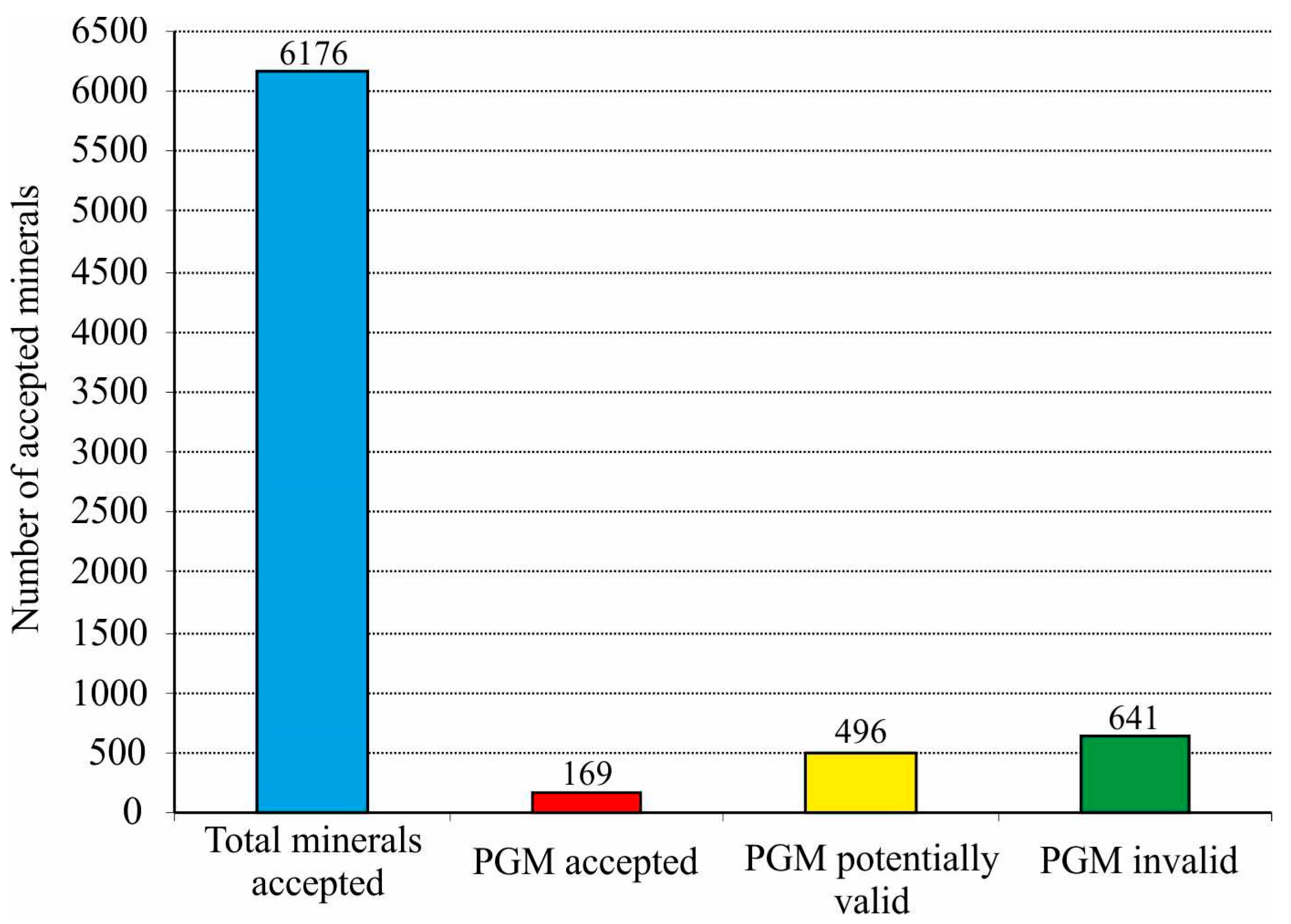
Figure 1. Statistical distribution of all accepted minerals; PGM accepted and potentially valid and invalid PGM. Based on the list of recognized minerals updated in September 2025 and released by CNMNC of the IMA.
Minerals 16 00108 g001
Figure 2. Back-scattered electron (BSE) images of PGM from the Bushveld Complex (present work). (A) Composite inclusion in chromite; (B) composed of pyrrhotite and Pt-Fe alloy. Abbreviations: Lrt = laurite, Spy = sperrylite, Pd-Bi-Te = PGM containing Pd, Bi, and Te, Sil = silicate, Chr = chromite, Pt-Fe = Pt–Fe alloy, Ccp = chalcopyrite, and Pyh = pyrrhotite.
Minerals 16 00108 g002
Figure 3. Statistical distribution of accepted PGM based on the year of their discovery [10,11,12,13,14,15,16,17,18,19,20,21,22,23,24,25,26,27,28,29,30,31,32,33,34,35,36,37,38,39,40,41,42,43,44,45,46,47,48,49,50,51,52,53,54,55,56,57,58,59,60,61,62,63,64,65,66,67,68,69,70,71,72,73,74,75,76,77,78,79,80,81,82,83,84,85,86,87,88,89,90,91,92,93,94,95,96,97,98,99,100,101,102,103,104,105,106,107,108,109,110,111,112,113,114,115,116,117,118,119,120,121,122,123,124,125,126,127,128,129,130,131,132,133,134,135,136,137,138,139,140,141,142,143,144,145,146,147,148,149,150,151,152,153,154,155,156,157,158,159,160,161,162,163,164]. The calculated number of new PGM that might be accepted for 2020–2029 and 2030–2039 is also reported.
Minerals 16 00108 g003
Figure 5. Statistical distribution of the countries in which the PGM have been discovered for the first time [10,11,12,13,14,15,16,17,18,19,20,21,22,23,24,25,26,27,28,29,30,31,32,33,34,35,36,37,38,39,40,41,42,43,44,45,46,47,48,49,50,51,52,53,54,55,56,57,58,59,60,61,62,63,64,65,66,67,68,69,70,71,72,73,74,75,76,77,78,79,80,81,82,83,84,85,86,87,88,89,90,91,92,93,94,95,96,97,98,99,100,101,102,103,104,105,106,107,108,109,110,111,112,113,114,115,116,117,118,119,120,121,122,123,124,125,126,127,128,129,130,131,132,133,134,135,136,137,138,139,140,141,142,143,144,145,146,147,148,149,150,151,152,153,154,155,156,157,158,159,160,161,162,163,164].
Minerals 16 00108 g005
Figure 6. Statistical distribution of the ore deposits and host rocks in which the PGM have been described for the first time [10,11,12,13,14,15,16,17,18,19,20,21,22,23,24,25,26,27,28,29,30,31,32,33,34,35,36,37,38,39,40,41,42,43,44,45,46,47,48,49,50,51,52,53,54,55,56,57,58,59,60,61,62,63,64,65,66,67,68,69,70,71,72,73,74,75,76,77,78,79,80,81,82,83,84,85,86,87,88,89,90,91,92,93,94,95,96,97,98,99,100,101,102,103,104,105,106,107,108,109,110,111,112,113,114,115,116,117,118,119,120,121,122,123,124,125,126,127,128,129,130,131,132,133,134,135,136,137,138,139,140,141,142,143,144,145,146,147,148,149,150,151,152,153,154,155,156,157,158,159,160,161,162,163,164].
Minerals 16 00108 g006
Figure 7. Statistical distribution of the major PGE magmatic ore deposits in which the PGM have been described for the first time (see Supplementary Material).
Minerals 16 00108 g007
Figure 9. Statistical distribution of PPGM and IPGM (A); and abundances of PPGE and IPGE in the CC1 chondrite [3] (B).
Minerals 16 00108 g009
Figure 12. BSE image and X-ray elemental distribution maps of Pd, Pt, Au, Ag, Sn, Ni, and As in a PGM from the Norilsk deposit (present work).
Minerals 16 00108 g012
Figure 13. BSE images of PGM nuggets showing their polygonal shape. (Modified after Zaccarini et al. [210]).
Minerals 16 00108 g013
Figure 14. BSE images of PGM nuggets. (A) Zoned Pt-Pd alloy showing colloform texture, with the bright area enriched in Pt (modified after Bindi et al. [194], (B) Pt-Fe alloy showing skeletal texture, and (C) enlargement of the area marked in yellow in Figure (B).
Minerals 16 00108 g014
Table 1. List of elements forming valid PGM.
PGEBonded Elements
PdO, S, Si, Ni, Cu, As, Se, Ag, Sn, Sb, Te, Hg, Bi, Tl
PtS, Fe, Ni, Cu, Zn, Ge, As, Se, In, Sn, Sb,Te, Hg, Pb, Bi
RhS, Fe, Ni, Cu, Ge, As, Se, Sb, Pb
IrS, Fe, Ni, Cu, As, Sb, Te, Pb, Bi
RuS, Fe, Ni, As, Se, Mo
OsS, As
Disclaimer/Publisher’s Note: The statements, opinions and data contained in all publications are solely those of the individual author(s) and contributor(s) and not of MDPI and/or the editor(s). MDPI and/or the editor(s) disclaim responsibility for any injury to people or property resulting from any ideas, methods, instructions or products referred to in the content.