Chronology and Geochemistry of Intrusive Magmatic Rocks in the Shiquanhe Ophiolitic Mélange, Tibet: Constraints on the Tectonic Evolution of the Meso-Tethys Ocean

 , , ,
, , ,
Abstract
1. Introduction
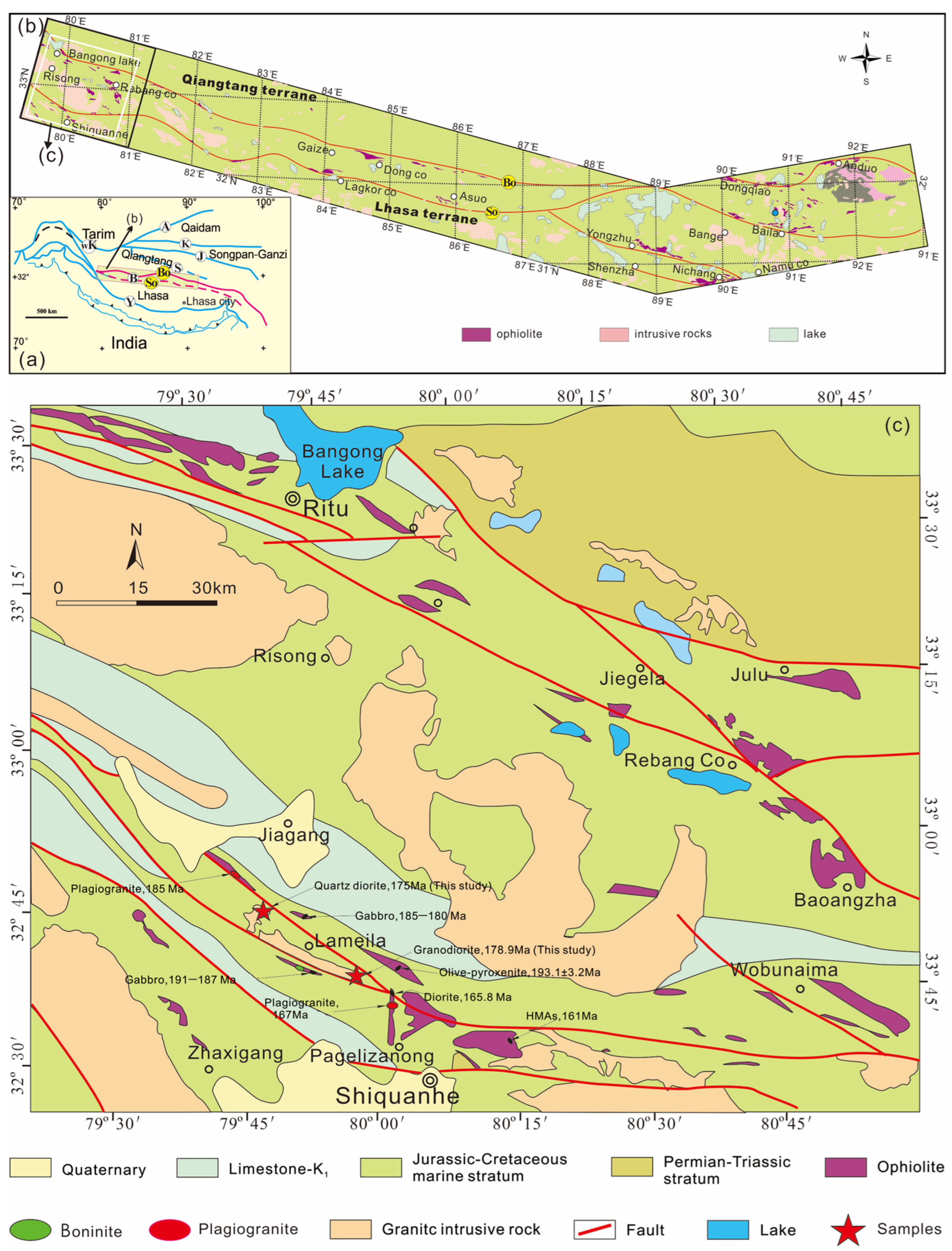
2. Geological Background and Sample Locations
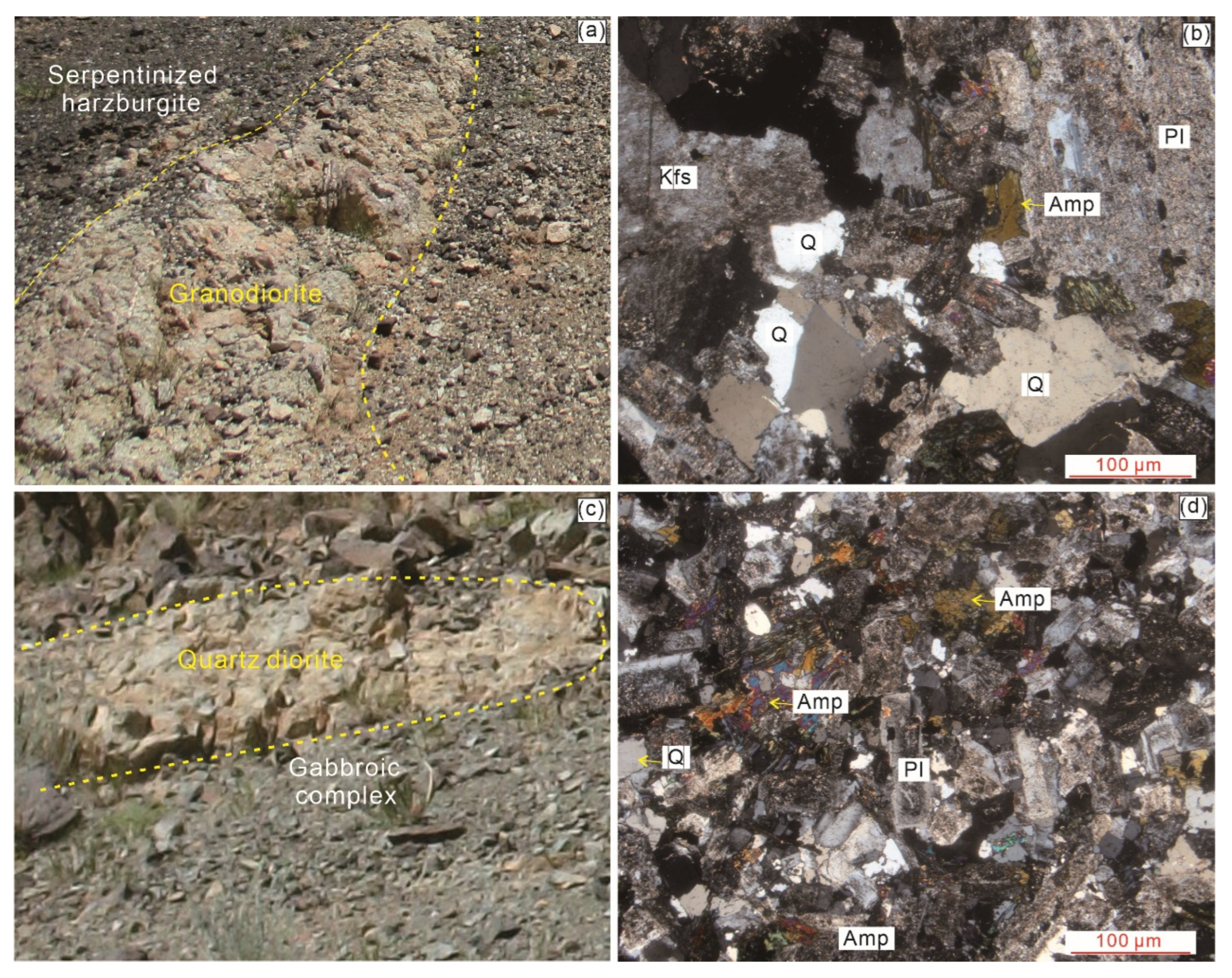
3. Field Relations and Petrography
4. Analytical Methods
4.1. Zircon U-Pb Geochronological Analysis
4.2. Major and Trace Element Analyses
5. Results
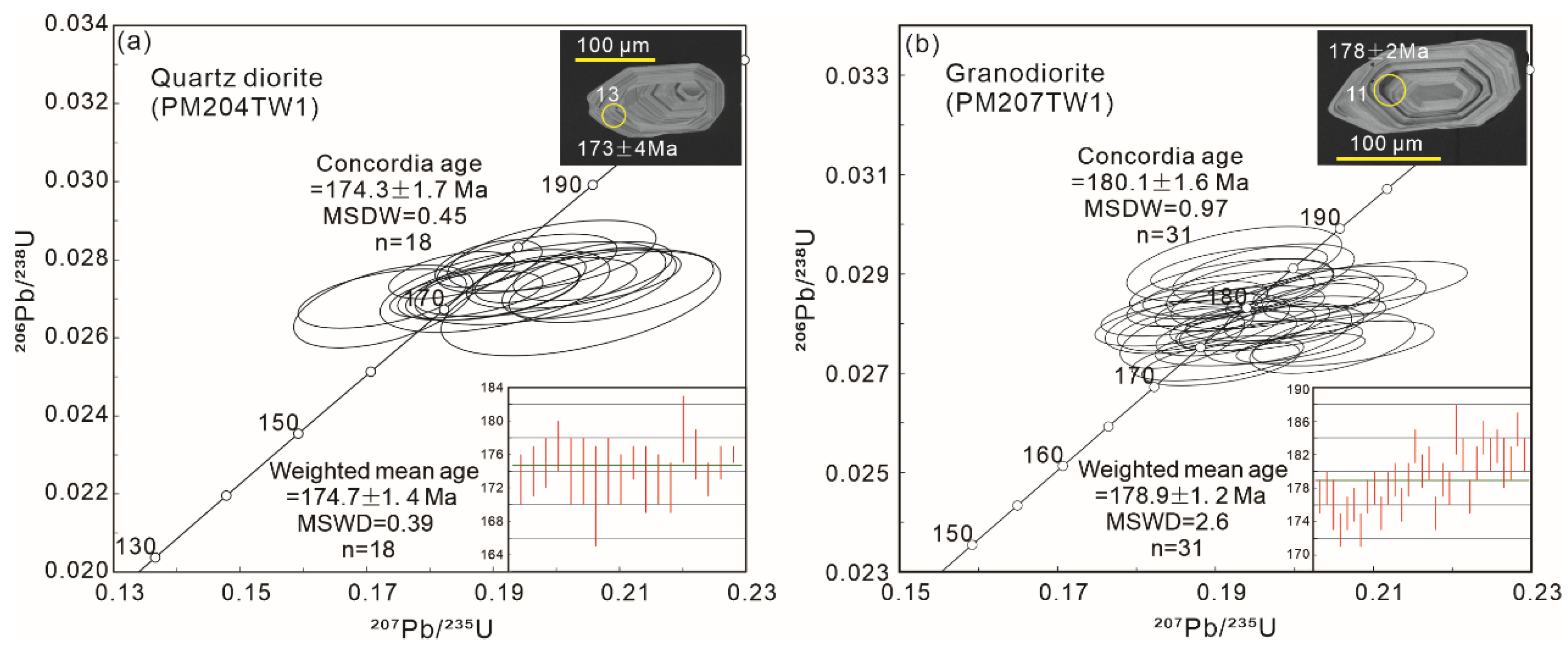
5.1. Zircon U-Pb Geochronology
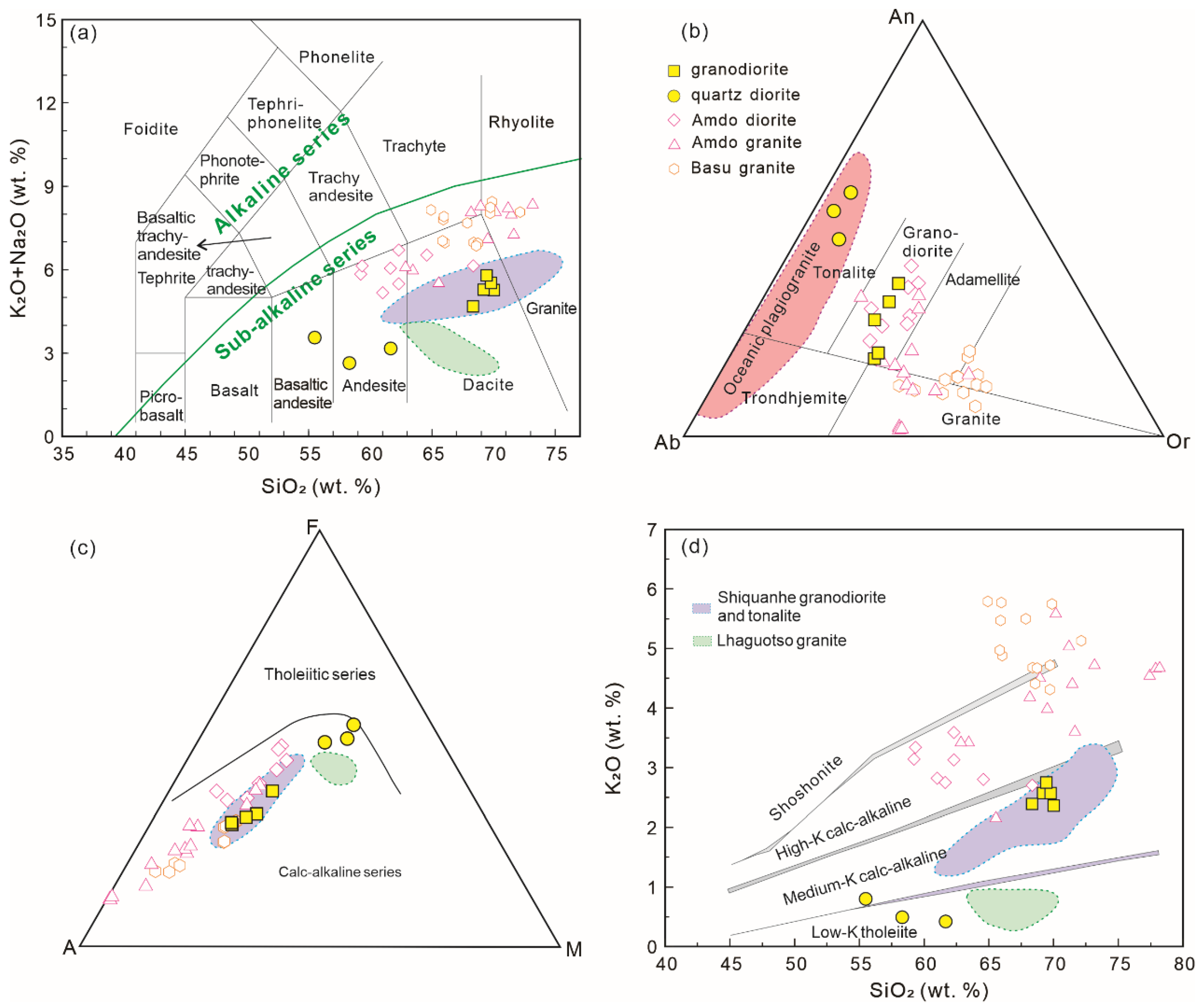
5.2. Whole-Rock Major and Trace Elements
5.2.1. Quartz Diorite
5.2.2. Granodiorite
6. Discussion
6.1. Formation Ages of the Quartz Diorite and Granodiorite
6.2. Petrogenesis
6.2.1. Influence of Alteration
6.2.2. Petrogenesis of Quartz Diorite
6.2.3. Petrogenesis of Granodiorite
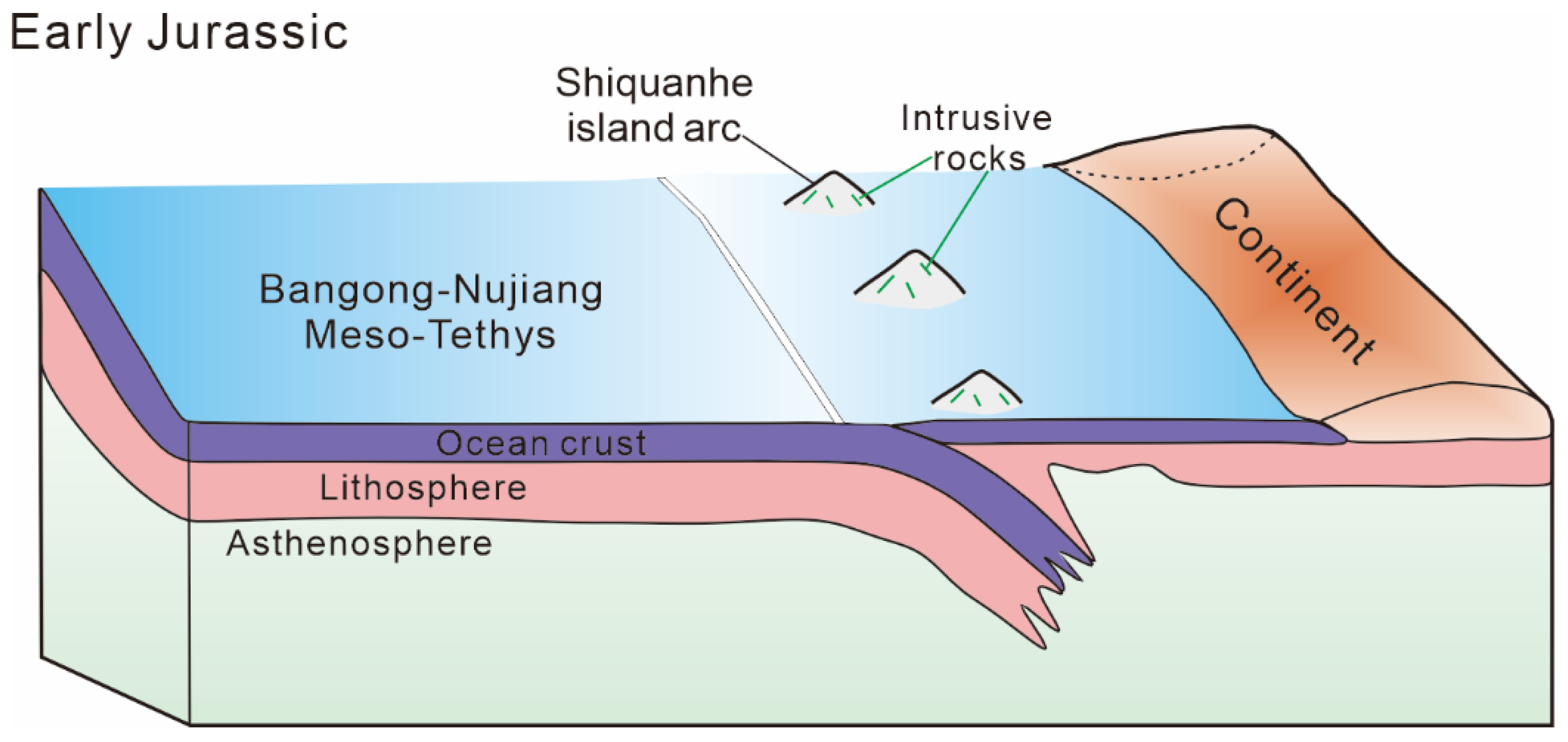
6.3. Tectonic Setting and Its Implications
7. Conclusions
Supplementary Materials
Author Contributions
Funding
Institutional Review Board Statement
Informed Consent Statement
Data Availability Statement
Acknowledgments
Conflicts of Interest
References
- Metcalfe, I. Multiple Tethyan ocean basins and orogenic belts in Asia. Gondwana Res. 2021, 100, 87–130. [Google Scholar] [CrossRef] [Scilit]
- Scotese, C.R. An atlas of Phanerozoic paleogeographic maps: The seas come in and the seas go out. Annu. Rev. Earth Planet. Sci. 2021, 49, 679–728. [Google Scholar] [CrossRef] [Scilit]
- Fan, J.J.; Zhang, B.C.; Zhou, J.B.; Niu, Y.L.; Sun, S.L.; Lv, J.P.; Wang, P.; Hao, Y.J. The Meso-Tethys Ocean: The nature, extension and spatial-temporal evolution. Earth-Sci. Rev. 2024, 255, 104839. [Google Scholar] [CrossRef] [Scilit]
- Hu, W.L.; Wang, Q.; Yang, J.H.; Hao, L.L.; Wang, J.; Qi, Y.; Yang, Z.Y.; Sun, P. Growth of the continental crust induced by slab rollback in subduction zones: Evidence from Middle Jurassic arc andesites in central Tibet. Gondwana Res. 2023, 117, 8–22. [Google Scholar] [CrossRef] [Scilit]
- Fan, J.J.; Zhang, B.C.; Niu, Y.L.; Luo, A.B.; Hao, Y.J. Resolving the nature and evolution of the Bangong–Nujiang Tethyan Ocean: New perspectives from the intraplate oceanic-island fragments preserved in Northern Tibet. GSA. Bull. 2024, 136, 1379–1394. [Google Scholar] [CrossRef] [Scilit]
- Zheng, Y.; Pan, J.W.; Li, H.B.; Tian, Z.L.; Liu, D.L.; Bai, M.K.; Han, S.; Ge, C.G.; Lu, H.H.; Zhong, N. Far-field response to the closure of the Meso-Tethys Ocean: New geochronological evidence from the Chem Co graben in the westernmost part of Central Tibet. Palaeogeogr. Palaeoclimatol. Palaeoecol. 2025, 658, 112628. [Google Scholar] [CrossRef] [Scilit]
- Pan, G.T.; Wang, L.Q.; Yin, F.G.; Geng, Q.R.; Li, G.M.; Zhu, D.C. Researches on geological-tectonic evolution of Xizang Plateau: A review, recent advances, and directions in the future. Sediment. Geol. Tethyan Geol. 2022, 42, 151–175, (In Chinese with English abstract). [Google Scholar]
- Hu, X.M.; Ma, A.L.; Xue, W.W.; Garzanti, E.; Cao, Y.; Li, S.M.; Sun, G.Y.; Lai, W. Exploring a lost ocean in the Tibetan Plateau: Birth, growth, and demise of the Bangong-Nujiang Ocean. Earth-Sci. Rev. 2022, 229, 104031. [Google Scholar] [CrossRef] [Scilit]
- Wu, F.Y.; Wan, B.; Zhao, L.; Xiao, W.J.; Zhu, R.X. Tethyan geodynamics. Acta Petrol. Sin. 2020, 36, 1627–1674, (In Chinese with English abstract). [Google Scholar]
- Zhang, B.C.; Fan, J.J.; Luo, A.B.; Zeng, X.W.; Duan, M.L.; Sun, S.L. Tectonic evolution of the Meso-Tethys Ocean in the Jurassic: Birth, growth, and demise of a missing intra-oceanic arc. Gondwana Res. 2023, 122, 41–59. [Google Scholar] [CrossRef] [Scilit]
- Coulon, C.; Maluski, H.; Bollinger, C.; Wang, S. Mesozoic and Cenozoic volcanic rocks from central and southern Tibet: 39Ar-40Ar dating, petrological characteristics and geodynamical significance. Earth Planet. Sci. Lett. 1986, 79, 281–302. [Google Scholar] [CrossRef] [Scilit]
- Kapp, P.; Murphy, M.A.; Yin, A.; Harrison, T.M.; Ding, L.; Guo, J.H. Mesozoic and Cenozoic tectonic evolution of the Shiquanhe area of western Tibet. Tectonics 2003, 22. [Google Scholar] [CrossRef] [Scilit]
- Luo, A.B.; Fan, J.J.; Zhang, B.C.; Zhang, J.Z.; Li, H.; Duan, M.L. From arc-continent collision to ocean closure: Lower Cretaceous Shamuluo Formation in the western segment of the Bangong–Nujiang suture zone, central Tibet. Geosci. Front. 2021, 12, 101207. [Google Scholar] [CrossRef] [Scilit]
- Liu, D.L.; Shi, R.D.; Ding, L.; Huang, Q.S.; Zhang, X.R.; Yue, Y.H.; Zhang, L.Y. Zircon U–Pb age and Hf isotopic compositions of Mesozoic granitoids in southern Qiangtang, Tibet: Implications for the subduction of the Bangong-Nujiang Tethyan Ocean. Gondwana Res. 2017, 41, 157–172. [Google Scholar] [CrossRef] [Scilit]
- Zhai, Q.G.; Tang, Y.; Hu, P.Y.; Liu, Y.M.; Wang, W. Induced subduction initiation near an ultra-slow spreading ridge: A case study from the Beila ophiolite in the north-central Tibetan Plateau. Gondwana Res. 2024, 135, 1–16. [Google Scholar] [CrossRef] [Scilit]
- Liu, Y.M.; Li, S.Z.; Zhai, Q.G.; Tang, Y.; Hu, P.Y.; Guo, R.H.; Liu, Y.J.; Wang, Y.H.; Yu, S.Y.; Cao, H.H.; et al. Jurassic tectonic evolution of Tibetan Plateau: A review of Bangong-Nujiang Meso-Tethys Ocean. Earth Sci. Rev. 2022, 227, 103973. [Google Scholar] [CrossRef] [Scilit]
- Kapp, P.G.; DeCelles, P. Mesozoic-Cenozoic geological evolution of the Himalayan-Tibetan orogen and working tectonic hypotheses. Am. J. Sci. 2019, 319, 159–254. [Google Scholar] [CrossRef] [Scilit]
- Tang, Y.; Zhai, Q.G.; Hu, P.Y.; Wang, W.; Yan, Z.; Wang, H.T.; Zhu, Z.C. Forearc lava stratigraphy of the Beila Ophiolite, north-central Tibetan Plateau: Magmatic response to initiation of subduction of the Bangong-Nujiang Meso-Tethys Ocean. Palaeogeogr. Palaeoclimatol. Palaeoecol. 2021, 582, 110663. [Google Scholar] [CrossRef] [Scilit]
- Zhu, D.C.; Zhao, Z.D.; Niu, Y.L.; Mo, X.X.; Chung, S.L.; Hou, Z.Q.; Wang, L.Q.; Wu, F.Y. The Lhasa Terrane: Record of a microcontinent and its histories of drift and growth. Earth Planet. Sci. Lett. 2011, 301, 241–255. [Google Scholar] [CrossRef] [Scilit]
- Liu, W.L.; Huang, Q.T.; Gu, M.; Zhong, Y.; Zhou, R.J.; Gu, X.D.; Zheng, H.; Liu, J.N.; Lu, X.X.; Xia, B. Origin and tectonic implications of the Shiquanhe high-Mg andesite, western Bangong suture. Tibet. Gondwana Res. 2018, 60, 1–14. [Google Scholar] [CrossRef] [Scilit]
- Zhang, Y.C.; Zhai, Q.G.; Fan, J.J.; Song, P.P.; Qie, W.K. Editorial preface to special issue: From prototethys to neotethys: Deep time paleobiogeographic and paleogeographic evolution of blocks in the Qinghai-Tibet Plateau. Palaeogeogr. Palaeoclimatol. Palaeoecol. 2022, 599, 111046. [Google Scholar] [CrossRef] [Scilit]
- Li, S.M.; Wang, Q.; Zhu, D.C.; Cawood, P.A.; Stern, R.J.; Weinberg, R.; Zhao, Z.D.; Mo, X.X. Reconciling orogenic drivers for the evolution of the Bangong-Nujiang Tethys during Middle-Late Jurassic. Tectonics 2020, 39, e2019TC005951. [Google Scholar] [CrossRef] [Scilit]
- Liu, W.L.; Liang, H.; Furnes, H.; Zhang, X.; Zeng, Q.G.; Ma, Y.L.; Yan, C.; Ding, R.X.; Zhong, Y.; Gu, R.X. A snapshot of subduction initiation within a back-arc basin: Insights from Shiquanhe ophiolite, western Tibet. Geosci. Front. 2025, 16, 102088. [Google Scholar] [CrossRef] [Scilit]
- Zeng, Y.C.; Xu, J.F.; Chen, J.L.; Wang, B.D.; Huang, F.; Xia, X.P.; Li, M.J. Early cretaceous (~138–134 Ma) forearc ophiolite and tectonomagmatic patterns in Central Tibet: Subduction termination and re-initiation of Meso-Tethys ocean caused by collision of an oceanic plateau at the continental margin? Tectonics 2021, 40, e2020TC006423. [Google Scholar] [CrossRef] [Scilit]
- Wang, B.D.; Wang, L.Q.; Zhou, D.Q.; Wang, D.B.; Yu, Y.P.; Yan, G.C.; Wu, Z. Longmu Co-shuanghu-changning-menglian suture zone: The boundary between Gondwanaland and pan-cathaysia mainland in the Qinghai-Tibet Plateau. Geol. Bull. China 2021, 40, 1783–1798, (In Chinese with English abstract). [Google Scholar]
- Li, C.W.; Zeng, M.; Qian, Y.J.; Deng, L.T.; Li, Z.J.; Stern, R.J. Late Mesozoic ridge subduction and subduction initiation in the Bangong-Nujiang Tethyan Ocean (Tibet): Evidence from two distinct arc magmatic systems. GSA Bull. 2025, 137, 3069–3092. [Google Scholar] [CrossRef] [Scilit]
- Li, W.; Liu, N.N.; Nayak, R.; Ma, Y.L.; Wang, J.J.; Hu, X.C.; Pang, J.H.; Huang, W.L.; Zhong, Y.; Liu, W.L. An island arc origin of Jurassic plagiogranite in the Shiquanhe ophiolite, western Bangong Suture, Tibet: Zircon U–Pb chronology, geochemistry, and tectonic implications of Bangong Meso-Tethys. Geol. J. 2021, 56, 3941–3958. [Google Scholar] [CrossRef] [Scilit]
- Zeng, X.W.; Wang, M.; Li, H.; Chi, P.; Shen, D. Early Jurassic intra-oceanic subduction initiation along the Bangong Meso-Tethys: Geochemical and geochronological evidence from the Shiquanhe ophiolitic complex, western Tibet. Lithos 2022, 416–417, 106657. [Google Scholar] [CrossRef] [Scilit]
- Li, H.; Wang, M.; Zeng, X.W.; Luo, A.B.; Feng, S.B. Zircon U-Pb and Lu-Hf isotopes and geochemistry of granitoids in Central Tibet: Bringing the missing Early Jurassic subduction events to light. Gondwana Res. 2021, 98, 125–146. [Google Scholar] [CrossRef] [Scilit]
- Zhang, K.J.; Zhang, Y.X.; Tang, X.C.; Xia, B. Late Mesozoic tectonic evolution and growth of the Tibetan plateau prior to the Indo-Asian collision. Earth-Sci. Rev. 2012, 114, 236–249. [Google Scholar] [CrossRef] [Scilit]
- Zhang, K.J.; Xia, B.; Zhang, Y.X.; Liu, W.L.; Zeng, L.; Li, J.F.; Xu, L.F. Central Tibetan Meso-Tethyan oceanic plateau. Lithos 2014, 210, 278–288. [Google Scholar] [CrossRef] [Scilit]
- Jin, X.; Zhang, Y.X.; Whitney, D.L.; Zhang, K.J.; Raia, N.H.; Hamelin, C.; Hu, J.C.; Lu, L.; Zhou, X.Y.; Khalid, S.B. Crustal material recycling induced by subduction erosion and subduction-channel exhumation: A case study of central Tibet (western China) based on P-T-t paths of the eclogite-bearing Baqing metamorphic complex. GSA Bull. 2021, 133, 1575–1599. [Google Scholar] [CrossRef] [Scilit]
- Zheng, Y.Y.; Xu, R.K.; Ma, G.T.; Gao, S.B.; Zhang, G.Y.; Ma, X.M.; Ci, Q. Ages of generation and subduction of Shiquan river ophiolite: Restriction from SHRIMP zircon dating. Acta Geol. Sin. 2006, 22, 895–904, (In Chinese with English abstract). [Google Scholar]
- Zhang, X.; Cai, D.Z.; Furnes, H.; Liu, W.L.; Wang, R.; Li, W.; Liao, X.; Yan, C.; Ding, R.X.; Zhong, Y. Neoproterozoic back-arc and arc-type magmatisms in the Rutong and Shiquanhe region, west of Tibet: Tectonic implications for the early-stage evolution of the Bangong-Nujiang suture zone and North Lhasa terrane. Precamb. Res. 2024, 405, 107374. [Google Scholar] [CrossRef] [Scilit]
- Pan, G.T.; Wang, L.Q.; Li, R.S.; Yuan, S.R.; Ji, W.H.; Yin, F.G.; Zhang, W.P.; Wang, B.D. Tectonic evolution of the Qinghai-Tibet plateau. J. Asian Earth Sci. 2012, 53, 3–14. [Google Scholar] [CrossRef] [Scilit]
- Ma, Y.L.; Zhong, Y.; Furnes, H.; Qiangba, Z.X.; Pang, J.H.; Liu, W.L.; Xia, B. Origin and tectonic implications of boninite dikes in the Shiquanhe ophiolite, western Bangong Suture, Tibet. J. Asian Earth Sci. 2021, 205, 104594. [Google Scholar] [CrossRef] [Scilit]
- Wang, X.M.; Ji, C.; Zhang, K.J.; Tian, R.Y.; Li, K.Y. An embryonic intra-oceanic subduction in the Bangong−Nujiang Meso-Tethys: Insights from Late Jurassic NdHf isotopic decoupling adakitic granodiorites in the Dongco ophiolite of central Tibet. Lithos 2024, 484, 107750. [Google Scholar] [CrossRef] [Scilit]
- Zhang, Y.Y.; Liu, K.; Wang, Y.; Zhang, D.; Mo, X.X.; Deng, Y.F.; Yu, T.X.; Zhao, Z.N. Geological significance of Late Permian magmatic rocks in the middle section of the Ailaoshan orogenic belt, SW China: Constraints from petrology, geochemistry and geochronology. Minerals 2022, 12, 652. [Google Scholar] [CrossRef] [Scilit]
- Liu, Y.S.; Hu, Z.C.; Zong, K.Q.; Gao, C.G.; Gao, S.; Xu, J.; Chen, H.H. Reappraisement and refinement of zircon U-Pb isotope and trace element analyses by LA-ICP-MS. Chin. Sci. Bull. 2010, 55, 1535–1546. [Google Scholar] [CrossRef] [Scilit]
- Ludwig, K.R. Isoplot 3.0, A Geochronological Toolkit for Excel. Berkeley Geochronol; Center Special Publication: Berkeley, CA, USA, 2003; Volume 4, pp. 1–70. [Google Scholar]
- Corfu, F.; Hanchar, J.M.; Hoskin, P.; Kinny, P. Atlas of zircon textures. Rev. Mineral. Geochem. 2003, 16, 469–500. [Google Scholar] [CrossRef] [Scilit]
- Hoskin, P.W.O.; Schaltegger, U. The Composition of Zircon and Igneous and Metamorphic Petrogenesis. Rev. Mineral. Geochem. 2003, 53, 27–62. [Google Scholar] [CrossRef] [Scilit]
- Thornton, C.P.; Tuttle, O.F. Chemistry of igneous rocks–[Part] 1, Differentiation index. Am. J. Sci. 1960, 258, 664–684. [Google Scholar] [CrossRef] [Scilit]
- Kuno, H. Origin of Cenozoic petrographic provinces of Japan and surrounding areas. Bull. Volcanol. 1959, 20, 37–76. [Google Scholar] [CrossRef] [Scilit]
- Rittmann, A. On the serial character of igneous rocks. Egypt. J. Geol. 1957, 1, 23–48. [Google Scholar]
- Maniar, P.D.; Piccoli, P.M. Tectonic discrimination of granitoids. Bull. Geol. Soc. Am. 1989, 101, 635–643. [Google Scholar] [CrossRef] [Scilit]
- Middlemost, E.A.K. Naming materials in the magma igneous rock system. Earth Sci. Rev. 1994, 37, 215–224. [Google Scholar] [CrossRef] [Scilit]
- O’Connor, J.T.; Colo, D. A classification of quartz-rich igneous rocks based on feldspar ratio. US Geol. Surv. 1965, 525, 79–84. [Google Scholar]
- Irvine, T.N.; Baragar, W.R.A. A guide to the chemical classification of the common volcanic rocks. Can. J. Earth Sci. 1971, 8, 523–548. [Google Scholar] [CrossRef] [Scilit]
- Rickwood, P.C. Boundary lines within petrologic diagrams which use oxides of major and minor elements. Lithos 1989, 22, 247–263. [Google Scholar] [CrossRef] [Scilit]
- Li, H.Q.; Xu, Z.Q.; Webb, A.A.G.; Li, T.F.; Ma, S.W.; Huang, X.M. Early Jurassic tectonism occurred within the Basu metamorphic complex, eastern central Tibet: Implications for an archipelago-accretion orogenic model. Tectonophysics 2017, 702, 29–41. [Google Scholar] [CrossRef] [Scilit]
- Sun, S.S.; McDonough, W.F. Chemical and isotopic systematics of oceanic basalts: Implications for mantle composition and processes. In Magmatism in the Ocean Basins; Saunders, A.D., Norry, M.J., Eds.; Geological Society Special Publications: London, UK, 1989; pp. 313–345. [Google Scholar]
- Whalen, J.B.; Currie, K.L.; Chappell, B.W. A-type granites: Geochemical characteristics, discrimination and petrogenesis. Contrib. Mineral. Petrol. 1987, 95, 407–419. [Google Scholar] [CrossRef] [Scilit]
- Shi, Q.; Ma, L.; Chen, X.; Zhao, G.; Chen, K.; Xu, Z.Y.; Dong, X.J. Late Neoarchean charnockite in Daqingshan terrane, North China Craton: Petrogenesis and implications for continental crustal evolution. Int. Geol. Rev. 2024, 66, 1718–1742. [Google Scholar] [CrossRef] [Scilit]
- Zeng, Y.C.; Xu, J.F.; Chen, J.; Li, J.; Huang, F. Tracing crustal recycling mechanisms using Mo isotopes in high-Mg andesites. Geology 2025, 53, 343–348. [Google Scholar] [CrossRef] [Scilit]
- Tatsumi, Y. High-Mg andesites in the Setouchi volcanic belt, southwestern Japan: Analogy to Archean magmatism and continental crust formation? Annu. Rev. Earth Planet. Sci. 2006, 34, 467–499. [Google Scholar] [CrossRef] [Scilit]
- Jiang, W.C.; Adam, J.; Firth, C.; Martel, C.; Turner, S.; Rushmer, T.; Rushmer, T.; Cronin, S. Experimental constraints on shallow differentiation of high-Mg andesite at Whakaari, New Zealand. Contrib. Mineral. Petrol. 2025, 180, 48. [Google Scholar] [CrossRef] [Scilit]
- Altherr, R.; Holl, A.; Hegner, E.; Langer, C.; KrEuzer, H. High-potassium, calc-alkaline I-type plutonism in the European Variscides: Northern Vosges (France) and northern Schwarzwald (Germany). Lithos 2000, 50, 51–73. [Google Scholar] [CrossRef] [Scilit]
- Douce, P.; Alberto, E. What Do Experiments Tell Us About the Relative Contributions of Crust and Mantle to the Origin of Granitic Magmas? Special Publications; Geological Society: London, UK, 1999; Volume 168, pp. 55–75. [Google Scholar]
- Sylvester, P.J. Post-collisional strongly peraluminous granites. Lithos 1998, 45, 29–44. [Google Scholar] [CrossRef] [Scilit]
- Plank, T.; Langmuir, C.H. The chemical composition of subducting sediment and its consequences for the crust and mantle. Chem. Geol. 1998, 145, 325–394. [Google Scholar] [CrossRef] [Scilit]
- Zeng, Y.C.; Chen, J.L.; Xu, J.F.; Wang, B.D.; Huang, F. Sediment melting during subduction initiation: Geochronological and geochemical evidence from the Darutso high-Mg andesites within ophiolite mélange, central Tibet. Geochem. Geophys. Geosyst. 2016, 17, 4859–4877. [Google Scholar] [CrossRef] [Scilit]
- Wu, H.; Liu, H.; Wang, Y.; Liu, X.; Zeng, Q.; Wang, P. Late Jurassic oceanic plateau subduction in the Bangong-Nujiang Tethyan Ocean of northern Tibet. Geosci. Front. 2024, 15, 101813. [Google Scholar] [CrossRef] [Scilit]
- Li, J.Y.; Zhai, Q.G.; Wang, W.; Tang, Y.; Hu, P.Y.; Liu, Y.M.; Wu, L.F.; Yang, N.; Chang, S. Subduction to closure of the Bangong−Nujiang Meso-Tethyan Ocean: Constraints from Mesozoic magmatic rocks in the Jiang Co area, north-central Tibetan Plateau. Geol. Soc. Am. Bull. 2025, 138, 215–231. [Google Scholar] [CrossRef] [Scilit]
- Pearce, J.A.; Harris, N.B.; Tindle, A.G. Trace element discrimination diagrams for the tectonic interpretation of granitic rocks. J. Petrol. 1984, 25, 956–983. [Google Scholar] [CrossRef] [Scilit]
- Batchelor, R.A.; Bowden, P. Petrogenetic interpretation of granitoid rock series using multicationic parameters. Chem. Geol. 1985, 48, 43–55. [Google Scholar] [CrossRef] [Scilit]
- Harris, N.B.; Pearce, J.A.; Tindle, A.G. Geochemical Characteristics of Collision-Zone Magmatism; Special Publications; Geological Society: London, UK, 1986; Volume 19, pp. 67–81. [Google Scholar]
- Chen, N.; Meng, X.Y.; Mao, J.W.; Xie, G.Q. Genetic relationship between subduction of slab topographic anomalies and porphyry deposit formation: Insight from the source and evolution of Rio Blanco magmas. J. Petrol. 2022, 63, egac045. [Google Scholar] [CrossRef] [Scilit]
- Drummond, M.S.; Defant, M.J.; Kepezhinskas, P.K. Petrosenesis of slab-derived trondhjemite-tonalite-dacite/adakite magmas. Trans. R. Soc. Edinb. Earth Sci. 1996, 87, 205–215. [Google Scholar]
- Huang, Q.T.; Zhang, C.L.; Zhang, K.J.; Hua, Y.J.; Chen, W.C.; Cao, Y.D.; Cheng, P. Interaction of upwelling asthenosphere with oceanic lithospheric mantle in Bangong-Nujiang subduction zone: A new mechanism for the petrogenesis of Nb-enriched basalts. Lithos 2023, 448, 107172. [Google Scholar] [CrossRef] [Scilit]
- Chen, H.Y.; Wu, C. Metallogenesis and major challenges of porphyry copper systems above subduction zones. Sci. China Earth Sci. 2020, 63, 899–918. [Google Scholar] [CrossRef] [Scilit]
- Groves, D.I.; Santosh, M.; Zhang, L.; Deng, J.; Yang, L.Q.; Wang, Q.F. Subduction: The recycling engine room for global metallogeny. Ore Geol. Rev. 2021, 134, 104130. [Google Scholar] [CrossRef] [Scilit]
- Wang, X.H.; Lang, X.H.; Turlin, F.; Deng, Y.L.; Xie, F.W.; He, Q.; Moritz, R. Copper behavior in arc-back-arc systems: Insights into the porphyry Cu metallogeny of the Gangdese belt, southern Tibet. Mineral. Depos. 2024, 59, 133–154. [Google Scholar] [CrossRef] [Scilit]
- Zhang, X.; Sun, Z.L.; Cai, Y.C.; Xu, Y.; Wu, N.Y.; Cao, H. Pulsed injections of metal-rich magmatic fluids: Key drivers of mineralization in a back-arc basin hydrothermal system. Geochem. Geophys. Geosyst. 2025, 26, e2025GC012318. [Google Scholar] [CrossRef] [Scilit]
- Ishizuka, O.; Umino, S.; Taylor, R.N.; Kanayama, K. Evidence for hydrothermal activity in the earliest stages of intraoceanic arc formation: Implications for ophiolite-hosted hydrothermal activity. Econ. Geol. 2014, 109, 2159–2178. [Google Scholar] [CrossRef] [Scilit]
- DeWolfe, Y.M.; Kolb, J.; Sorensen, E.V.; Rosa, D.; Guarnieri, P. Nature and origin of a massive sulfide occurrence in the Karrat Group: Evidence for Paleoproterozoic VMS mineralization in central West Greenland. Econ. Geol. 2024, 119, 45–57. [Google Scholar] [CrossRef] [Scilit]
- Ray, D.; Sreenivas, B.; Prakash, L.S.; Mazumdar, A.; Peketi, A.; Paropkari, A.L.; Balu, G. Fe and S-isotope compositions of hydrothermal deposits from Kings Triple Junction, Lau Basin, southwest Pacific Ocean. Mar. Chem. 2021, 230, 103929. [Google Scholar] [CrossRef] [Scilit]
- Faisal, M.; Yang, X.Y.; Khalifa, I.H.; Amuda, A.K.; Sun, C. Geochronology and geochemistry of Neoproterozoic Hamamid metavolcanics hosting largest volcanogenic massive sulfide deposits in Eastern Desert of Egypt: Implications for petrogenesis and tectonic evolution. Precamb. Res. 2020, 344, 105751. [Google Scholar] [CrossRef] [Scilit]
- Denisová, N.; Piercey, S.J. Evolution of the hydrothermal system associated with the ABM replacement-style volcanogenic massive sulfide deposit, Finlayson Lake district, Yukon, Canada. Econ. Geol. 2023, 118, 1055–1083. [Google Scholar] [CrossRef] [Scilit]
- Tang, J.X.; Zhang, L.; Huang, Y.; Wang, C.H.; Li, Z.J.; Deng, Q.; Lang, X.H.; Wang, Y. 40Ar/39Ar isotope ages of main geological bodies in Xiongcun copper-gold deposit Xietongmen County Tibet and their geological significance. Miner. Depos. 2009, 28, 759–769, (In Chinese with English abstract). [Google Scholar]
- Tang, J.X.; Lin, B.; Yang, H.H.; Tang, B.; Xie, F.W.; Wang, Y.; Zhou, A.R.G.L.; Gu, F.H.; Zou, B.; Zhang, X.X.; et al. Geological characteristics and prospecting direction of porphyry-skarn-epithermal deposits in Xizang. Miner. Depos. 2024, 43, 1223–1265, (In Chinese with English abstract). [Google Scholar]


Disclaimer/Publisher’s Note: The statements, opinions and data contained in all publications are solely those of the individual author(s) and contributor(s) and not of MDPI and/or the editor(s). MDPI and/or the editor(s) disclaim responsibility for any injury to people or property resulting from any ideas, methods, instructions or products referred to in the content. |
© 2026 by the authors. Licensee MDPI, Basel, Switzerland. This article is an open access article distributed under the terms and conditions of the Creative Commons Attribution (CC BY) license.
Share and Cite
Dai, K.; Zhang, X.; Ding, R.-X.; Furnes, H.; Liu, W.-L.; Kang, X.; Zhao, H.; Li, J.; Wang, Q.; Bai, Y.; et al. Chronology and Geochemistry of Intrusive Magmatic Rocks in the Shiquanhe Ophiolitic Mélange, Tibet: Constraints on the Tectonic Evolution of the Meso-Tethys Ocean. Minerals 2026, 16, 123. https://doi.org/10.3390/min16020123
Dai K, Zhang X, Ding R-X, Furnes H, Liu W-L, Kang X, Zhao H, Li J, Wang Q, Bai Y, et al. Chronology and Geochemistry of Intrusive Magmatic Rocks in the Shiquanhe Ophiolitic Mélange, Tibet: Constraints on the Tectonic Evolution of the Meso-Tethys Ocean. Minerals. 2026; 16(2):123. https://doi.org/10.3390/min16020123
Chicago/Turabian StyleDai, Kegang, Xu Zhang, Ru-Xin Ding, Harald Furnes, Wei-Liang Liu, Xiaobo Kang, Hongfei Zhao, Jing Li, Qin Wang, Yun Bai, and et al. 2026. "Chronology and Geochemistry of Intrusive Magmatic Rocks in the Shiquanhe Ophiolitic Mélange, Tibet: Constraints on the Tectonic Evolution of the Meso-Tethys Ocean" Minerals 16, no. 2: 123. https://doi.org/10.3390/min16020123
APA StyleDai, K., Zhang, X., Ding, R.-X., Furnes, H., Liu, W.-L., Kang, X., Zhao, H., Li, J., Wang, Q., Bai, Y., Yan, C., & Shi, Y. (2026). Chronology and Geochemistry of Intrusive Magmatic Rocks in the Shiquanhe Ophiolitic Mélange, Tibet: Constraints on the Tectonic Evolution of the Meso-Tethys Ocean. Minerals, 16(2), 123. https://doi.org/10.3390/min16020123