

Radionuclide Removal in Rare Earth Mineral Processing: A Review of Existing Methods and Emerging Biochemical Approaches Using Siderophores



Abstract
1. Introduction
2. Radionuclides: Occurrence and Classification in Rare Earth Minerals
3. Separation and Remediation Techniques
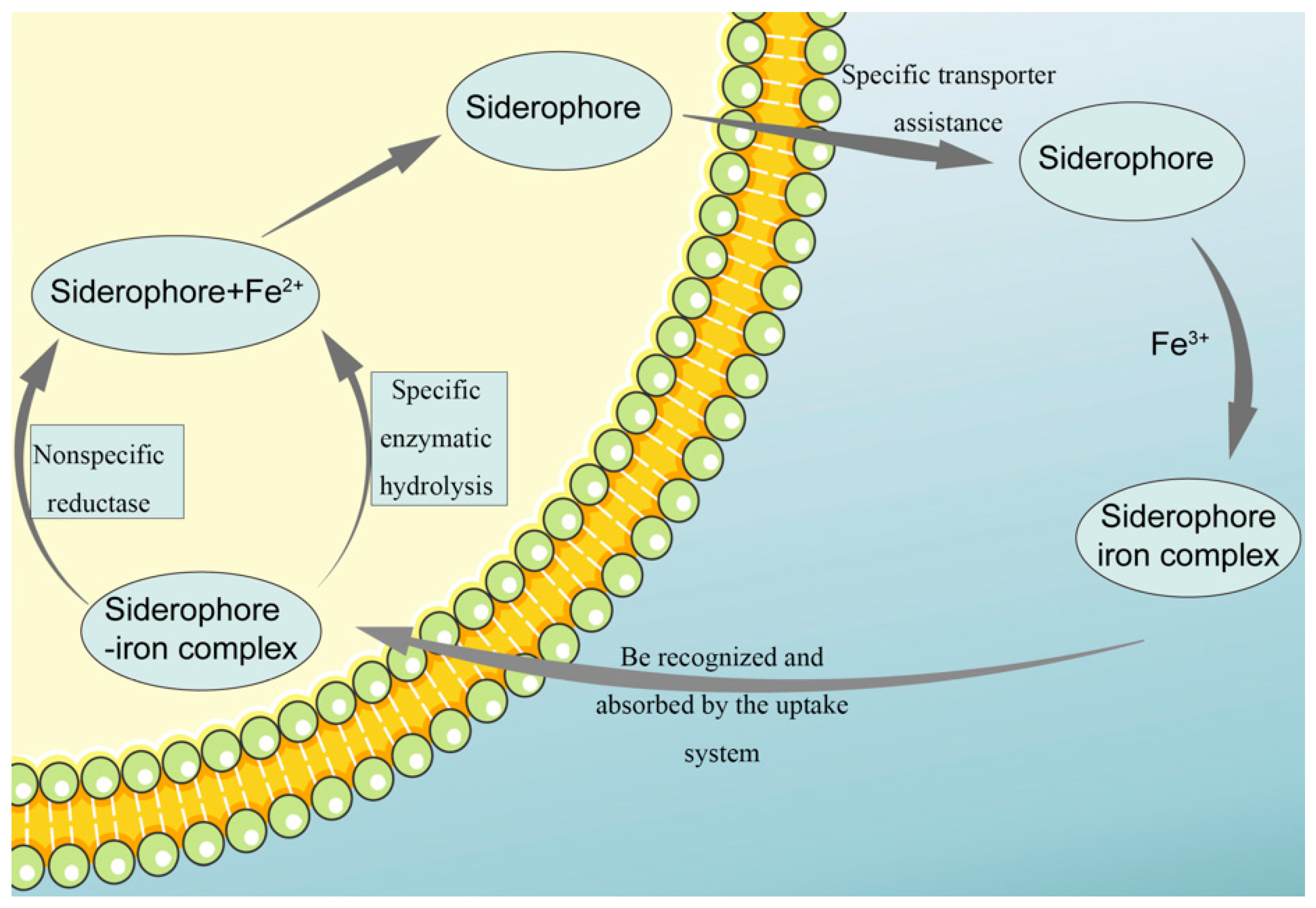
4. Prospects in Microbial Technology: Utilization of Siderophores
5. Conclusions
Funding
Data Availability Statement
Acknowledgments
Conflicts of Interest
References
- Owusu-Fordjour, E.Y.; Yang, X. Bioleaching of rare earth elements challenges and opportunities: A critical review. J. Environ. Chem. Eng. 2023, 11, 110413. [Google Scholar] [CrossRef]
- Penaloza, I.; Tita, A.; McNew, E.; Chu, P. Barite resources, production and recovery using froth flotation: A review. Miner. Eng. 2023, 203, 108327. [Google Scholar] [CrossRef]
- Findeiß, M.; Schäffer, A. Fate and environmental impact of thorium residues during rare earth processing. J. Sustain. Metall. 2017, 3, 179–189. [Google Scholar] [CrossRef]
- Yin, X.; Martineau, C.; Demers, I.; Basiliko, N.; Fenton, N.J. The potential environmental risks associated with the development of rare earth element production in Canada. Environ. Rev. 2021, 29, 354–377. [Google Scholar] [CrossRef]
- Patel, K.S.; Sharma, S.; Maity, J.P.; Martín-Ramos, P.; Fiket, Ž.; Bhattacharya, P.; Zhu, Y. Occurrence of uranium, thorium and rare earth elements in the environment: A review. Front. Environ. Sci. 2023, 10, 1058053. [Google Scholar] [CrossRef]
- Degueldre, C.; Joyce, M.J. Evidence and uncertainty for uranium and thorium abundance: A review. Prog. Nucl. Energy 2020, 124, 103299. [Google Scholar] [CrossRef]
- Talan, D.; Huang, Q.; Liang, L.; Song, X. Conceptual process development for the separation of thorium, uranium, and rare earths from coarse coal refuse. Miner. Process. Extr. Metall. Rev. 2023, 44, 330–345. [Google Scholar] [CrossRef]
- Keith-Roach, M.; Grundfelt, B.; Kousa, A.; Pohjolainen, E.; Magistrati, P.; Aggelatou, V.; Olivieri, N.; Ferrari, A. Past Experience of Environmental, Health and Safety Issues in REE Mining and Processing Industries and an Evaluation of Related EU and International Standards and Regulations; EURARE: Keyworth, UK, 2015. [Google Scholar]
- García, A.C.; Latifi, M.; Amini, A.; Chaouki, J. Separation of radioactive elements from rare earth element-bearing minerals. Metals 2020, 10, 1524. [Google Scholar] [CrossRef]
- Zhu, Z.; Pranolo, Y.; Cheng, C.Y. Separation of uranium and thorium from rare earths for rare earth production—A review. Miner. Eng. 2015, 77, 185–196. [Google Scholar] [CrossRef]
- Singh, H.; Gupta, C. Solvent extraction in production and processing of uranium and thorium. Miner. Process. Extr. Metullargy Rev. 2000, 21, 307–349. [Google Scholar] [CrossRef]
- Amaral, J.C.; Sá, M.L.; Morais, C.A. Recovery of uranium, thorium and rare earth from industrial residues. Hydrometallurgy 2018, 181, 148–155. [Google Scholar] [CrossRef]
- Kaphle, K.P. Rare earth elements, their occurrences and industrial uses. Nepal Geol. Soc. 2013, 30, 49–56. [Google Scholar]
- Sastri, V.S.; Bünzli, J.-C.; Rao, V.R.; Rayudu, G.V.S.; Perumareddi, J.R. Modern Aspects of Rare Earths and Their Complexes; Elsevier: Amsterdam, The Netherlands, 2003. [Google Scholar]
- Höppe, H. Rare-Earth Elements: Solid State Materials: Chemical, Optical and Magnetic Properties; Walter de Gruyter GmbH & Co KG: Berlin, Germany, 2024. [Google Scholar]
- Balaram, V. Sources and Applications of Rare Earth Elements. Environmental Technologies to Treat Rare Earth Elements Pollution: Principles and Engineering; IWA Publishing: London, UK, 2022; Volume 113, pp. 75–113. [Google Scholar]
- Shannon, R.T.; Prewitt, C.T. Effective ionic radii in oxides and fluorides. Struct. Sci. 1969, 25, 925–946. [Google Scholar] [CrossRef]
- Kanazawa, Y.; Kamitani, M. Rare earth minerals and resources in the world. J. Alloys Compd. 2006, 408, 1339–1343. [Google Scholar] [CrossRef]
- Smołka-Danielowska, D.; Walencik-Łata, A. The occurrence of selected radionuclides and rare earth elements in waste at the mine heap from the Polish Mining Group. Minerals 2021, 11, 504. [Google Scholar] [CrossRef]
- Sheppard, M.I. The Environmental Behaviour of Radium; Atomic Energy of Canada Ltd.; Whiteshell Nuclear Research: Pinawa, MB, Canada, 1980. [Google Scholar]
- Cowart, J.; Burnett, W. The distribution of uranium and thorium decay-series radionuclides in the environment—A review. J. Environ. Qual. 1994, 23, 651–662. [Google Scholar] [CrossRef]
- Carvalho, F.; Chambers, D.; Fernandes, S.; Fesenko, S.; Goulet, R.; Howard, B.; Kim, C.-K.; Martin, P.; Moore, W.S.; Phaneuf, M.; et al. The Environmental Behaviour of Radium, revised ed.; International Atomic Energy Agency: Wien, Austria, 2014. [Google Scholar]
- Ragheb, M.; Tsoukalas, L. Global and USA thorium and rare earth elements resources. In Proceedings of the 2nd Thorium Energy Alliance Conference, the Future Thorium Economy, Google Campus, Mountain View, CA, USA, 29–30 March 2010. [Google Scholar]
- Park, B. Management of thorium and uranium in mining and processing of rare earth minerals. In Proceedings of the 51st Annual Conference of Metallurgists, Niagara, ON, Canada, 30 September–3 October 2012; 2012. [Google Scholar]
- Araujo, I.P. Flotation of Barite from Mountain Pass Carbonatite Ore; University of Nevada: Reno, NV, USA, 2023. [Google Scholar]
- Nili, S.; Thella, J.S.; Sharifian, S.; Chu, P.; Vasquez, V.R.; Vahidi, E. Economic viability and environmental impact: A dual approach to sustainable REE production from bastnasite using a density-based sorting machine. Sci. Total Environ. 2025, 983, 179696. [Google Scholar] [CrossRef]
- Thella, J.; McNew, E.; Emmanuel, M.; Thella, C.; Chu, P. A Laboratory Study to Simulate Ore Sorting for a Rare Earth Ore. Min. Metall. Explor. 2024, 41, 1909–1918. [Google Scholar] [CrossRef]
- Wang, G.; Tang, J. Pollution and suggestions for controlling measurement of the three types of waste in rare earth production. In Proceedings of the Conference for Chinese Rare Earth Comprehensive Exploitation and Environment Protection; ResearchGate: Berlin, Germany, 2007. [Google Scholar]
- Jordens, A.; Cheng, Y.P.; Waters, K.E. A review of the beneficiation of rare earth element bearing minerals. Miner. Eng. 2013, 41, 97–114. [Google Scholar] [CrossRef]
- Gupta, C.K.; Krishnamurthy, N. Extractive metallurgy of rare earths. Int. Mater. Rev. 1992, 37, 197–248. [Google Scholar] [CrossRef]
- Keekan, K.K.; Jalondhara, J.C.; Abhilash. Extraction of Ce and Th from monazite using REE tolerant Aspergillus niger. Miner. Process. Extr. Metall. Rev. 2017, 38, 312–320. [Google Scholar] [CrossRef]
- Osman, Y.; Gebreil, A.; Mowafy, A.M.; Anan, T.I.; Hamed, S.M. Characterization of Aspergillus niger siderophore that mediates bioleaching of rare earth elements from phosphorites. World J. Microbiol. Biotechnol. 2019, 35, 93. [Google Scholar] [CrossRef] [PubMed]
- Chambers, D.; Lowe, L.; Feasby, D. Radiological aspects of naturally occuring radioactive materials (NORM) in the ore processing and production of rare earth element concentrates. In Proceedings of the 51st Annual Conference of Metallurgists, COM, Niagara Falls, ON, Canada, 30 September–3 October 2012; 2012. [Google Scholar]
- Lagae Capelle, E.; Coudert, L.; Hermassi, M.; Neculita, C.M.; Demers, I. Mine Water Treatment Methods for Rare Earth Elements and Associated Radionuclides. Mine Water Environ. 2025, 144, 722–746. [Google Scholar] [CrossRef]
- Kim, J.; Choi, J.; Lee, S. A Review of Rare Earth Elements Recovery from Bastnaesite Ore: From Beneficiation to Metallurgical Processing. J. Sustain. Metall. 2025, 11, 773–798. [Google Scholar] [CrossRef]
- Talan, D.; Huang, Q. Separation of thorium, uranium, and rare earths from a strip solution generated from coarse coal refuse. Hydrometallurgy 2020, 197, 105446. [Google Scholar] [CrossRef]
- Kanojia, A.; Nyembwe, J.K.; Petranikova, M.; Vollmer, T.R.; Ekberg, C. Solvent Extraction and Isolation Strategies for Uranium, Thorium, and Radium in Rare Earth Element Recovery from Ores: A Review. Solvent Extr. Ion Exch. 2025, 43, 671–707. [Google Scholar] [CrossRef]
- Basque, J.; Lavoie, J.; Reynier, N.; Larivière, D. Quantitative separation of thorium from rare earth elements and uranium in a rare earth element sulfuric acid leachate using cloud point extraction. Microchem. J. 2023, 190, 108724. [Google Scholar] [CrossRef]
- Huang, M.; Liu, D.; Xiu, T.; Liu, Z.; Liu, Z. Aluminum-assisted acid leaching for Uranium/Thorium from High-Fluorine niobium Slag: Occurrence states and Behaviors in mineralogy. Sep. Purif. Technol. 2025, 372, 133503. [Google Scholar] [CrossRef]
- Baghaliannejad, R.; Aghahoseini, M.; Amini, M.K. Determination of rare earth elements in uranium materials by ICP-MS and ICP-OES after matrix separation by solvent extraction with TEHP. Talanta 2021, 222, 121509. [Google Scholar] [CrossRef]
- Zhou, H.; Huang, Z.; Zhang, X.; Bu, X.; Du, Y.; Shi, W.; Yuan, L. Enabling the extraction of high-purity thorium from rare earth ores by simple one-step crystallization. Chem. Eng. J. 2025, 519, 165158. [Google Scholar] [CrossRef]
- Özkan, B.; Altaş, Y.; İnan, S. Extraction and purification of thorium and rare earth elements from bastnaesite mineral: A comprehensive leaching and precipitation study. J. Radioanal. Nucl. Chem. 2025, 334, 541–550. [Google Scholar] [CrossRef]
- Thakur, N. Separation of rare earths by solvent extraction. Miner. Process. Extr. Metullargy Rev. 2000, 21, 277–306. [Google Scholar] [CrossRef]
- Traore, M.; Gong, A.; Wang, Y.; Qiu, L.; Bai, Y.; Zhao, W.; Liu, Y.; Chen, Y.; Liu, Y.; Wu, H.; et al. Research progress of rare earth separation methods and technologies. J. Rare Earths 2023, 41, 182–189. [Google Scholar] [CrossRef]
- Dmitrieva, E.; Anokhina, T.; Tsebrikova, G.S.; He, T.; Baulin, V.E.; Volkov, A.V.; Tsivadze, A.Y. Membrane Methods of Isolation and Separation of Rare Earth Elements (A Review). Pet. Chem. 2025, 65, 113–156. [Google Scholar] [CrossRef]
- Mohammadi, M.; Forsberg, K.; Kloo, L.; De La Cruz, J.M.; Rasmuson, Å. Separation of Nd (III), Dy (III) and Y (III) by solvent extraction using D2EHPA and EHEHPA. Hydrometallurgy 2015, 156, 215–224. [Google Scholar] [CrossRef]
- Li, Z.; Zhang, Z.; Qi, S.; Zhao, L.; Pan, J.; Feng, Z.; Huang, X. Stripping and recovery of U and Th from EHEHPA in rare earth separation plant. Sep. Purif. Technol. 2024, 331, 125423. [Google Scholar] [CrossRef]
- Mishra, B.B.; Devi, N. Study on the extraction and separation of samarium from chloride medium using D2EHPA and [P66614][D2EHP] and their application to monazite ore. Trans. Indian Inst. Met. 2020, 73, 2247–2257. [Google Scholar] [CrossRef]
- Rodríguez Varela, R.; Chagnes, A.; Forsberg, K. Third-Phase Formation in Rare Earth Element Extraction with D2EHPA: Key Factors and Impact on Liquid Membrane Extraction Performance. Membranes 2025, 15, 188. [Google Scholar] [CrossRef]
- Jiang, F.; Yin, S.; Srinivasakannan, C.; Li, S.; Peng, J. Separation of lanthanum and cerium from chloride medium in presence of complexing agent along with EHEHPA (P507) in a serpentine microreactor. Chem. Eng. J. 2018, 334, 2208–2214. [Google Scholar] [CrossRef]
- El-Hefny, N.; El-Nadi, Y.; Daoud, J. Equilibrium and mechanism of samarium extraction from chloride medium using sodium salt of CYANEX 272. Sep. Purif. Technol. 2010, 75, 310–315. [Google Scholar] [CrossRef]
- Belova, V.; Voshkin, A.A.; Egorova, N.S.; Khol’kin, A.I. Extraction of rare earth metals from nitrate solutions with a binary extractant based on Cyanex 272. Russ. J. Inorg. Chem. 2010, 55, 629–633. [Google Scholar] [CrossRef]
- Menzies, I.; Rigby, F. Separation of thorium from uranium and rare-earth elements by solvent extraction with tri-n-butyl phosphate-xylene. J. Appl. Chem. 1961, 11, 104–113. [Google Scholar] [CrossRef]
- Gupta, B.; Malik, P.; Deep, A. Extraction of uranium, thorium and lanthanides using Cyanex-923: Their separations and recovery from monazite. J. Radioanal. Nucl. Chem. 2002, 251, 451–456. [Google Scholar] [CrossRef]
- Lu, J.; Wei, Z.; Li, D.; Ma, G.; Jiang, Z. Recovery of Ce (IV) and Th (IV) from rare earths (III) with Cyanex 923. Hydrometallurgy 1998, 50, 77–87. [Google Scholar] [CrossRef]
- Sato, T. Extraction of uranium (VI) from hydrochloric acid solutions by long-chain aliphatic amines. J. Appl. Chem. 1966, 16, 143–148. [Google Scholar] [CrossRef]
- Li, Y.; Lu, Y.; Bai, Y.; Liao, W. Extraction and separation of thorium and rare earths with 5, 11, 17, 23-tetra (diethoxyphosphoryl)-25, 26, 27, 28-tetraacetoxycalix [4] arene. J. Rare Earths 2012, 30, 1142–1145. [Google Scholar] [CrossRef]
- Zhu, Z.; Cheng, C.Y. A Review of Uranium Solvent Extraction: Its Present Status and Future Trends; Alta Metallurgical Services: Castlemaine, VIC, Australia, 2011. [Google Scholar]
- El-Yamani, I.; Shabana, E. Studies on extraction of thorium (IV) from sulfate media with mixtures of long-chain primary amines and tributyl phosphate. J. Radioanal. Nucl. Chem. 1985, 88, 273–280. [Google Scholar] [CrossRef]
- Crouse, D.J.; Brown, K.B. The amex process for extracting thorium ores with alkyl amines. Ind. Eng. Chem. 1959, 51, 1461–1464. [Google Scholar] [CrossRef]
- Amaral, J.C.; Morais, C.A. Thorium and uranium extraction from rare earth elements in monazite sulfuric acid liquor through solvent extraction. Miner. Eng. 2010, 23, 498–503. [Google Scholar] [CrossRef]
- Xu, G. Rare Earths; Metallurgical Industry: Beijing, China, 1995. [Google Scholar]
- Vijayalakshmi, R.; Mishra, S.L.; Singh, H.; Gupta, C.K. Processing of xenotime concentrate by sulphuric acid digestion and selective thorium precipitation for separation of rare earths. Hydrometallurgy 2001, 61, 75–80. [Google Scholar] [CrossRef]
- Kogel, J.E. Industrial Minerals & Rocks: Commodities, Markets, and Uses; SME: Bratislava, Slovakia, 2006. [Google Scholar]
- Fourest, B.; Lagarde, G.; Perrone, J.; Brandel, V.; Dacheux, N.; Genet, M. Solubility of thorium phosphate-diphosphate. New J. Chem. 1999, 23, 645–649. [Google Scholar] [CrossRef]
- Sanding, A.; Bruno, J. The solubility of (UO2)3(PO4)2·4H2O(s) and the formation of U (VI) phosphate complexes: Their influence in uranium speciation in natural waters. Geochim. Cosmochim. Acta 1992, 56, 4135–4145. [Google Scholar] [CrossRef]
- Zepf, V. Rare Earth Elements: What and Where They Are, in Rare Earth Elements: A New Approach to the Nexus of Supply, Demand and Use: Exemplified Along the Use of Neodymium in Permanent Magnets; Springer: Berlin/Heidelberg, Germany, 2013; pp. 11–39. [Google Scholar]
- Han, K.N. Characteristics of precipitation of rare earth elements with various precipitants. Minerals 2020, 10, 178. [Google Scholar] [CrossRef]
- Wylie, A. Coprecipitation of uranous sulphate with rare-earth double sulphates. Nature 1947, 160, 830. [Google Scholar] [CrossRef]
- Amer, T.; Abdella, W.M.; Wahab, G.M.A.; El-Sheikh, E.M. A suggested alternative procedure for processing of monazite mineral concentrate. Int. J. Miner. Process. 2013, 125, 106–111. [Google Scholar] [CrossRef]
- Santos, E.A.; Ladeira, A.C. Recovery of uranium from mine waste by leaching with carbonate-based reagents. Environ. Sci. Technol. 2011, 45, 3591–3597. [Google Scholar] [CrossRef]
- Kang, M.J.; Han, B.E.; Hahn, P.S. Precipitation and adsorption of uranium (VI) under various aqueous conditions. Environ. Eng. Res. 2002, 7, 149–157. [Google Scholar]
- Yu, B.; Verbaan, N.; Pearse, G.; Britt, S. Beneficiation and extraction of REE from GEOMEGA resources’ Montviel project. In Proceedings of the Rare Earth Elements (COM 2013), West Westmount, QC, Canada, 27–31 October 2013; p. 30. [Google Scholar]
- Walawalkar, M.; Nichol, C.K.; Azimi, G. Process investigation of the acid leaching of rare earth elements from phosphogypsum using HCl, HNO3, and H2SO4. Hydrometallurgy 2016, 166, 195–204. [Google Scholar] [CrossRef]
- Kumar, M.; Kumar, M.; Kim, M.-S.; Jeong, J.; Yoo, K. Leaching of Metals from Waste Printed Circuit Boards (WPCBs) Using Sulfuric and Nitric Acids. Environ. Eng. Manag. J. (EEMJ) 2014, 13, 2601–2607. [Google Scholar]
- Lazo, D.E. Selective Complexation Leaching of Rare Earth Minerals: A New Hydrometallurgical Route Inspired by Geochemical Process; Curtin University: Perth, Australia, 2019. [Google Scholar]
- Balomenos, E. Recovering of REEs from unconventional resources—Bauxite Residue. Authorea Prepr. 2023, 75–98. [Google Scholar]
- Liu, P.; Wang, X.; Zhang, W. Impact of organic acids on extraction of rare earth elements: Mechanisms and optimization. J. Rare Earths 2025, in press. [Google Scholar] [CrossRef]
- Banerjee, R.; Chakladar, S.; Mohanty, A.; Chakravarty, S.; Chattopadhyay, S.K.; Jha, M. Review on the environment friendly leaching of rare earth elements from the secondary resources using organic acids. Geosyst. Eng. 2022, 25, 95–115. [Google Scholar] [CrossRef]
- Yudaev, P.; Chistyakov, E. Chelating extractants for metals. Metals 2022, 12, 1275. [Google Scholar] [CrossRef]
- Lapidus, G.; Doyle, F. Selective thorium and uranium extraction from monazite: I. Single-stage oxalate leaching. Hydrometallurgy 2015, 154, 102–110. [Google Scholar] [CrossRef]
- Lapidus, G.; Doyle, F. Selective thorium and uranium extraction from monazite: II. Approaches to enhance the removal of radioactive contaminants. Hydrometallurgy 2015, 155, 161–167. [Google Scholar] [CrossRef]
- Whitty-Léveillé, L.; Reynier, N.; Larivière, D. Rapid and selective leaching of actinides and rare earth elements from rare earth-bearing minerals and ores. Hydrometallurgy 2018, 177, 187–196. [Google Scholar] [CrossRef]
- Tan, J.P.; Clyde, C.W.; Ng, C.C.; Yeap, S.K.; Yong, C.Y. Advancements in microbial-mediated radioactive waste bioremediation: A review. J. Environ. Radioact. 2024, 280, 107530. [Google Scholar] [CrossRef]
- Kaksonen, A.H.; Lakaniemi, A.-M.; Tuovinen, O.H. Acid and ferric sulfate bioleaching of uranium ores: A review. J. Clean. Prod. 2020, 264, 121586. [Google Scholar] [CrossRef]
- Bhatti, T.M.; Tuovinen, O.H. Bioleaching of uranium from ores and rocks using filamentous fungi. Front. Microbiol. 2025, 16, 1523962. [Google Scholar] [CrossRef]
- Wang, Y.; Wang, J.; Ding, D.; Li, G.; Sun, J.; Hu, N.; Li, F.; Ma, J.; Zhang, H.; Ding, Y.; et al. Hyphae and organic acids of Aspergillus Niger promote uranium recovery by destroying the ore surface and increasing the porosity and permeability of ores. Nucl. Eng. Technol. 2024, 56, 1880–1886. [Google Scholar] [CrossRef]
- Agbo, P.; Rees, J.A.; Abergel, R.J. Actinide biological inorganic chemistry: The overlap of 5f orbitals with biology. Exp. Theor. Approaches Actin. Chem. 2018, 445–489. [Google Scholar]
- Torapava, N.; Persson, I.; Eriksson, L.; Lundberg, D. Hydration and hydrolysis of thorium (IV) in aqueous solution and the structures of two crystalline thorium (IV) hydrates. Inorg. Chem. 2009, 48, 11712–11723. [Google Scholar] [CrossRef] [PubMed]
- Teksöz, S.; Acar, C.i.d.; Ünak, P. Hydrolytic behavior of Th4+, UO22+, and Ce3+ ions at various temperatures. J. Chem. Eng. Data 2009, 54, 1183–1188. [Google Scholar] [CrossRef]
- Kamal, H.M.; Mahdy, H.M.A.; Hassanein, R.A.; Mahmoud, K.F.; Abouzeid, M.A. Microbial leaching of some valuable elements from Egyptian phosphate rock. Nucl. Sci. Sci. J. 2012, 1, 155–165. [Google Scholar] [CrossRef]
- Amin, M.M.; Elaassy, I.E.; El-Feky, M.G.; Kawady, N.A.; Talaat, M.S.; Sallam, A.S.M. Recovery of uranium from low-grade ore using microorganism isolated from uraniferous rock sample. Sep. Sci. Technol. 2018, 53, 2232–2237. [Google Scholar] [CrossRef]
- Hassanien, W.A.G.; Desouky, O.A.N.; Hussien, S.S.E. Bioleaching of some rare earth elements from Egyptian monazite using Aspergillus ficuum and Pseudomonas aeruginosa. Walailak J. Sci. Technol. (WJST) 2014, 11, 809–823. [Google Scholar]
- Ruijter, G.; Kubicek, C.; Visser, J. Production of Organic Acids by Fungi. In Industrial Applications; Springer: Berlin/Heidelberg, Germany, 2002; pp. 213–230. [Google Scholar]
- Hussien, S.S. Advances in Microbial Leaching as a Non-conventional Technique for Metal Recovery from Ores: A Review. Geomicrobiol. J. 2025, 42, 255–267. [Google Scholar] [CrossRef]
- Jalali, J.; Lebeau, T. The role of microorganisms in mobilization and phytoextraction of rare earth elements: A review. Front. Environ. Sci. 2021, 9, 688430. [Google Scholar] [CrossRef]
- Xie, B.; Wei, X.; Wan, C.; Zhao, W.; Song, R.; Xin, S.; Song, K. Exploring the biological pathways of siderophores and their multidisciplinary applications: A comprehensive review. Molecules 2024, 29, 2318. [Google Scholar] [CrossRef]
- Khairnar, A.; Goyal, A.K. Iron Harvesters: Exploring Microbial Siderophores and Their Diverse Applications in Biomedicine. Biomed. Mater. Devices 2025, 3, 277–287. [Google Scholar] [CrossRef]
- Mayegowda, S.B.; Gadilingappa, M.N. Microbial Siderophores: A New Insight on Healthcare Applications. BME Front. 2025, 6, 0112. [Google Scholar] [CrossRef]
- Kalinowski, B.E.; Oskarsson, A.; Albinsson, Y.; Arlinger, J.; Ödegaard-Jensen, A.; Andlid, T.; Pedersen, K. Microbial leaching of uranium and other trace elements from shale mine tailings at Ranstad. Geoderma 2004, 122, 177–194. [Google Scholar] [CrossRef]
- Desouky, O.A.; El-Mougith, A.A.; Hassanien, W.A.; Awadalla, G.S.; Hussien, S.S. Extraction of some strategic elements from thorium–uranium concentrate using bioproducts of Aspergillus ficuum and Pseudomonas aeruginosa. Arab. J. Chem. 2016, 9, S795–S805. [Google Scholar] [CrossRef]
- Hussien, S. Biological Control of Plant Diseases by Fungi or Bacteria. Master’s Thesis, Botany Department, Faculty of Science, Zagazig University, Zagazig, Egypt, 2007. [Google Scholar]
- Hussien, S.S.; Desouky, O.A.; Abdel-Haliem, M.E.; El-Mougith, A.A. Uranium (VI) complexation with siderophores-pyoverdine produced by Pseudomonas fluorescens SHA 281. Int. J. Nucl. Energ. Sci. Eng. (IJNESE) 2013, 3, 95–102. [Google Scholar] [CrossRef]
- Schalk, I.J. Bacterial siderophores: Diversity, uptake pathways and applications. Nat. Rev. Microbiol. 2025, 23, 24–40. [Google Scholar] [CrossRef]
- Linget, C.; Collinson, S.; Azadi, P.; Dell, A.; Page, W.; Abdallah, M.A. Structure of azoverdin, a pyoverdin-like siderophore of Azomonas macrocytogenes ATCC 12334. Tetrahedron Lett. 1992, 33, 1889–1892. [Google Scholar] [CrossRef]





| Ore Types | Mineral | Chemical Formula | Composition (Weight Percent) | Reference | ||
|---|---|---|---|---|---|---|
| REO | UO2 | ThO2 | ||||
| Carbonate | ancylites | Sr(REE,Ce,La)(CO3)2OH.H2O | 46 | 0.1 | <0.4 | [29] |
| parisite | Ca(Ce,La)2(CO3)3F2 | 59 | 0.0–0.3 | 0.0–0.5 | ||
| bastnasite | (Ce,La)CO3F | 74 | 0.0–0.9 | 0.0–0.3 | ||
| Oxide | perovskite | (Ca,REE)TiO3 | <37 | <0.05 | 0–2 | [29] |
| euxenite | (Y,Ca,Ce,U,Th)(Nb,Ta,Ti)2O6 | 15–35 | 0.0–0.5 | 0.0–0.5 | ||
| brannerite | (U,REE,Ca)(Ti,Fe)2O6 | 6 | <0.002 | - | ||
| fergusonite | (Y,REE)NbO4 | 30–50 | 0.0–0.5 | 0.0–0.5 | ||
| Silicate | allanite | (Ca,Ce,La,Y)2(Al,Fe)3(SiO4)3(OH) | 30 | - | 0.3 | [30] |
| cheralite | (REE,Th,Ca)(P,Si)O4 | 5 | - | <30 | ||
| Ion-adsorption clays | - | 0.05–0.5 | < 0.002 | <0.002 | [28] | |
| Phosphate | monazite | (Ce,La,Nd,Th)PO4 | 35–72 | 0–16 | 0–20 | [29,31,32] |
| xenotime | YPO4 | ~60 | 0–5 | - | ||
| britholite | (REE,Ca)5(SiO4,PO4)3(F, OH) | 56 | - | <1.5 | ||
| Elements | pH Range | Reference | |
|---|---|---|---|
| Sulfate Leachates | Chloride Leachates | ||
| Th | 1.0–2.0 | 4.8–5.8 | [9] |
| U | ~6.0 | 5.5–7.0 | |
| REE | 3.0–5.5 | 6.8–8.0 | |
Disclaimer/Publisher’s Note: The statements, opinions and data contained in all publications are solely those of the individual author(s) and contributor(s) and not of MDPI and/or the editor(s). MDPI and/or the editor(s) disclaim responsibility for any injury to people or property resulting from any ideas, methods, instructions or products referred to in the content. |
© 2025 by the authors. Licensee MDPI, Basel, Switzerland. This article is an open access article distributed under the terms and conditions of the Creative Commons Attribution (CC BY) license (https://creativecommons.org/licenses/by/4.0/).
Share and Cite
Mends, E.A.; Chu, P. Radionuclide Removal in Rare Earth Mineral Processing: A Review of Existing Methods and Emerging Biochemical Approaches Using Siderophores. Minerals 2025, 15, 1308. https://doi.org/10.3390/min15121308
Mends EA, Chu P. Radionuclide Removal in Rare Earth Mineral Processing: A Review of Existing Methods and Emerging Biochemical Approaches Using Siderophores. Minerals. 2025; 15(12):1308. https://doi.org/10.3390/min15121308
Chicago/Turabian StyleMends, Emmanuel Atta, and Pengbo Chu. 2025. "Radionuclide Removal in Rare Earth Mineral Processing: A Review of Existing Methods and Emerging Biochemical Approaches Using Siderophores" Minerals 15, no. 12: 1308. https://doi.org/10.3390/min15121308
APA StyleMends, E. A., & Chu, P. (2025). Radionuclide Removal in Rare Earth Mineral Processing: A Review of Existing Methods and Emerging Biochemical Approaches Using Siderophores. Minerals, 15(12), 1308. https://doi.org/10.3390/min15121308