


Abstract
Topological indices and polynomials are predicting properties like boiling points, fracture toughness, heat of formation, etc., of different materials, and thus save us from extra experimental burden. In this article we compute many topological indices for the family of circulant graphs. At first, we give a general closed form of M-polynomial of this family and recover many degree-based topological indices out of it. We also compute Zagreb indices and Zagreb polynomials of this family. Our results extend many existing results.
1. Introduction
A number, polynomial or a matrix can uniquely identify a graph. A topological index is a numeric number associated to a graph which completely describes the topology of the graph, and this quantity is invariant under the isomorphism of graphs. The degree-based topological indices are derived from degrees of vertices in the graph. These indices have many correlations to chemical properties. In other words, a topological index remains invariant under graph isomorphism.
The study of topological indices, based on distance in a graph, was effectively employed in 1947 in chemistry by Weiner [1]. He introduced a distance-based topological index called the “Wiener index” to correlate properties of alkenes and the structures of their molecular graphs. Recent progress in nano-technology is attracting attention to the topological indices of molecular graphs, such as nanotubes, nanocones, and fullerenes to cut short experimental labor. Since their introduction, more than 140 topological indices have been developed, and experiments reveal that these indices, in combination, determine the material properties such as melting point, boiling point, heat of formation, toxicity, toughness, and stability [2]. These indices play a vital role in computational and theoretical aspects of chemistry in predicting material properties [3,4,5,6,7,8].
Several algebraic polynomials have useful applications in chemistry, such as the Hosoya Polynomial (also called the Wiener polynomial) [9]. It plays a vital role in determining distance-based topological indices. Among other algebraic polynomials, the M-polynomial—introduced recently in 2015 [10]—plays the same role in determining the closed form of many degree-based topological indices. Other famous polynomials are the first Zagreb polynomial and the second Zagreb polynomial.
A graph G is an ordered pair , where V is the set of vertices and E is the set of edges. A path from a vertex v to a vertex w is a sequence of vertices and edges that starts from v and stops at w. The number of edges in a path is called the length of that path. A graph is said to be connected if there is a path between any two of its vertices. The distance between two vertices of a connected graph G is the length of a shortest path between them. Graph theory is contributing a lion’s share in many areas such as chemistry, physics, pharmacy, as well as in industry [11]. We will start with some preliminary facts.
Let G be a simple connected graph and let represent the edge between the vertices u and The number of vertices of adjacent to a given vertex v, is the “degree” of this vertex, and will be denoted by . We define , and as the number of edges of G such that The M-polynomial of G is defined as:
Active research is in progress, and many authors computed M-polynomials for different types of nonmaterial, for example see [12,13,14,15,16] and the references therein.
The Wiener index of G is defined as:
where is any ordered pair of vertices in Gutman and Trinajstić [11] introduces important topological index called first Zagreb index, denoted by , and is defined as:
The second Zagreb index and the second modified Zagreb index are defined as:
and:
Results obtained in the theory of Zagreb indices are summarized in the review [17].
In 1998, working independently, Bollobas and Erdos [18] and Amic et al. [19] proposed general Randić index. It has been extensively studied by both mathematicians and theoretical chemists (see, for example, [20,21]). The Randić index denoted by is the sum of ; i.e.:
where is any constant.
The symmetric division index is defined by:
These indices can help to characterize the chemical and physical properties of molecules (see [9]).
Table 1 enlists some standard degree-based topological indices and their derivation from M-polynomial [10].

Table 1.
Derivation of topological indices from M-polynomial.
Where
For a simple connected graph, the first Zagreb polynomial is defined as:
and the second Zagreb polynomial is defined as:
In 2013, Shirdel et al. in [22] proposed the hyper-Zagreb index, which is also degree-based, given as:
In 2012, Ghorbani and Azimi [23] proposed two new variants of Zagreb indices; namely, the first multiple Zagreb index and the second multiple Zagreb index which are defined as:
In this paper, we address the family of circulant graphs. We give closed forms of M-polynomial and Zagreb Polynomials for this family. We also compute many degree-based topological indices.
Definition 1.
Let n, m, and be positive integers, where and for all . An undirected graph with the set of vertices and the set of edges , where the indices being taken modulo n, is called the circulant graph, and is denoted by .
The graph of is shown in Figure 1.
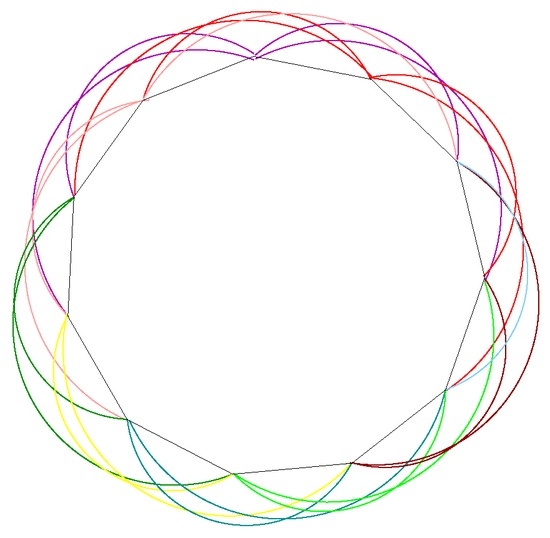
Figure 1.
.
This is one of the most comprehensive families, as its specializations give some important families. Classes of graphs that are circulant include the Andrásfai graphs, antiprism graphs, cocktail party graphs, complete graphs, complete bipartite graphs, crown graphs, empty graphs, rook graphs, Möbius ladders, Paley graphs of prime order, prism graphs, and torus grid graphs. Special cases are summarized in the Table 2.
Table 2.
Special cases of circulant graphs.
Because of this somewhat universality, circulant graphs have been the subject of much investigation; for example, the chromatic index for circulant graphs is computed in [24]. Connectivity is discussed in [25], and the Weiner index is computed in [26]. Exact values of the domination number of some families of circulant graphs are given in [27]. Habibi et. al. computed the revised Szeged spectrum of circulant graphs [28]. Multi-level and antipodal labelings for circulant graphs is discussed in [29,30].
2. Main Theorem
We divided our main results into two parts.
2.1. Polynomials
In this section, we computed the closed forms of some polynomials.
Theorem 1.
Let be a circulant graph. Then, the M-Polynomial is:
Proof.
Let , where and and when even and when and when odd be the circulant graph. From the structure of , we can see that there is one partition We see that the edge set of partitions as follows:
Thus, the M-Polynomial of is:
⃞
In the following theorem, we computed first and second Zagreb polynomials.
Theorem 2.
Let be a circulant graph. Then:
- (1)
- (2)
Proof.
Let be a complete circulant graph. The edge set of has one partition based on degree of vertices. The edge partition has n edges , where . It is easy to see that . Now we have:
- (1)
- (2)
2.2. Topological Indices
In this section, we will recover some topological indices from polynomials computed in the above section.
Theorem 3.
For the circulant graph we have:
- (1)
- (2)
- (3)
- (4)
- (5)
- (6)
Proof.
Let Then:
- (1)
- :
- (2)
- :
- (3)
- :
- (4)
- :
- (5)
- :
- (6)
- :
Theorem 4.
Let be a circulant graph. Then:
- (1)
- (2)
- (3)
Proof.
Let be a complete circulant graph. The edge set of has one partition based on degree of vertices.The edge partition has n edges , where . It is easy to see that . Now, we have:
- (1)
- (2)
- (3)
3. Conclusions
In this article, we computed many topological indices for the family of circulant graphs. At first we give a general closed form of M-polynomial of this family and recover many degree-based topological indices out of it. We also compute Zagreb indices and Zagreb polynomials of this family. Our results actually extend many existing results about crown graphs, Paley graphs, complete bipartite, Möbius Ladders, any many other families; see Table 2.
Acknowledgments
This research is supported by Gyeongsang National University, Jinju 52828, Korea. We are thankful to the reviewers for suggestions that really improve this paper.
Author Contributions
All authors contributed equally to the writing of this paper. All authors read and approved the final manuscript.
Conflicts of Interest
The authors declare no conflict of interest.
References
- Wiener, H. Structural determination of paraffin boiling points. J. Am. Chem. Soc. 1947, 69, 17–20. [Google Scholar] [CrossRef] [PubMed]
- Katritzky, A.R.; Jain, R.; Lomaka, A.; Petrukhin, R.; Maran, U.; Karelson, M. Perspective on the Relationship between Melting Points and Chemical Structure. Cryst. Growth Design 2001, 1, 261–265. [Google Scholar] [CrossRef]
- Rucker, G.; Rucker, C. On topological indices, boiling points, and cycloalkanes. J. Chem. Inf. Comput. Sci. 1991, 39, 788. [Google Scholar] [CrossRef]
- Dobrynin, A.A.; Entringer, R.; Gutman, I. Wiener index of trees: Theory and applications. Acta Appl. Math. 2001, 66, 211–249. [Google Scholar] [CrossRef]
- Du, W.; Li, X.; Shi, Y. Algorithms and extremal problem on Wiener polarity index. MATCH Commun. Math. Comput. Chem. 2009, 62, 235–244. [Google Scholar]
- Gutman, I.; Polansky, O.E. Mathematical Concepts in Organic Chemistry; Springer: New York, NY, USA, 1986. [Google Scholar]
- Ma, J.; Shi, Y.; Yue, J. The wiener polarity index of graph products. Ars Combin. 2014, 116, 235–244. [Google Scholar]
- Ma, J.; Shi, Y.; Wang, Z.; Yue, J. On wiener polarity index of bicyclic networks. Sci. Rep. 2016, 6, 19066. [Google Scholar] [CrossRef] [PubMed]
- Gutman, I. Some Properties of the Wiener Polynomial; Graph Theory Notes: New York, NY, USA, 1993; Volume 125, pp. 13–18. [Google Scholar]
- Klavzar, S.; Deutsch, E. M-Polynomial and Degree-Based Topological Indices. Iran. J. Math. Chem. 2015, 6, 93–102. [Google Scholar]
- Gutman, I.; Trinajstic, N. Graph theory and molecular orbitals total ϕ-electron energy of alternant hydrocarbons. Chem. Phys. Lett. 1972, 17, 535–538. [Google Scholar] [CrossRef]
- Munir, M.; Nazeer, W.; Rafique, S.; Kang, S.M. M-polynomial and degree-based topological indices of Nano star dendrimers. Symmetry 2016, 8, 97. [Google Scholar]
- Munir, M.; Nazeer, W.; Rafique, S.; Nizami, A.R.; Kang, S.M. M-polynomial and degree-based topological indices of Titania Nanotubes. Symmetry 2016, 8, 117. [Google Scholar] [CrossRef]
- Munir, M.; Nazeer, W.; Rafique, S.; Kang, S.M. M-polynomial and degree-based topological indices of Buckytubes. Symmetry 2016. submitted. [Google Scholar]
- Kang, S.; Munir, M.; Nizami, A.; Shahzadi, Z.; Nazeer, W. Some Topological Invariants of the Möbius Ladder. Preprints 2016, 2016110040. [Google Scholar] [CrossRef]
- Munir, M.; Nazeer, W.; Rafique, S.; Nizami, A.; Kang, S.M. Some Computational Aspects of Triangular Boron Nanotubes. Symmetry 2016. [Google Scholar] [CrossRef]
- Gutman, I.; Das, K.C. The first Zagreb indices 30 years after. MATCH Commun. Math. Comput. Chem. 2004, 50, 83–92. [Google Scholar]
- Bollobas, B.; Erdös, P. Graphs of extremal weights. Ars Combin. 1998, 50, 225–233. [Google Scholar] [CrossRef]
- Amic, D.; Beslo, D.; Lucic, B.; Nikolic, S.; Trinajstić, N. The Vertex-Connectivity Index Revisited. J. Chem. Inf Comput. Sci. 1998, 38, 819–822. [Google Scholar] [CrossRef]
- Kier, L.B.; Hall, L.H. Molecular Connectivity in Structure-Activity Analysis; John Wiley & Sons: New York, NY, USA, 1986. [Google Scholar]
- Li, X.; Gutman, I. Mathematical Aspects of Randic-Type Molecular Structure Descriptors; Mathematical Chemistry Monographs, No. 1; University of Kragujevac: Kragujevac, Serbia, 2006. [Google Scholar]
- Shirdel, G.H.; Pour, H.R.; Sayadi, A.M. The hyper-Zagreb index of graph operations. Iran. J. Math. Chem. 2013, 4, 213–220. [Google Scholar]
- Ghorbani, M.; Azimi, N. Note on multiple Zagreb indices. Iran. J. Math. Chem. 2012, 3, 137–143. [Google Scholar]
- Voigt, M.; Walther, H. On the chromatic number of special distance graphs. Discrete Math. 1991, 97, 395–397. [Google Scholar] [CrossRef]
- Boesch, F.; Tindell, R. Circulants and their connectivity. J. Graph Theory 1984, 8, 487–499. [Google Scholar] [CrossRef]
- Zhou, H. The Wiener Index of Circulant Graphs. J. Chem. 2014. [Google Scholar] [CrossRef]
- Fu, X.L.; Yang, Y.S.; Jiang, B.Q. On the domination number of the circulant graphs C(n; 1, 2), C(n; 1, 3) and C(n; 1, 4). Ars Comb. 2011, 102, 173–182. [Google Scholar]
- Habibi, N.; Ashrafi, A.R. On revised szeged spectrum of a graph. TAMKANG J. Math. 2014, 45, 375–387. [Google Scholar] [CrossRef]
- Kang, S.M.; Nazeer, S.; Kousar, I.; Nazeer, W.; Kwun, Y.C. Multi-level and antipodal labelings for certain classes of circulant graphs. J. Nonlinear Sci. Appl. 2016, 9, 2832–2845. [Google Scholar]
- Nazeer, S.; Kousar, I.; Nazeer, W. Radio and radio antipodal labelings for circulant graphs G(4k + 2; 1; 2). J. Appl. Math. Inf. 2015, 33, 173–183. [Google Scholar]
© 2016 by the authors; licensee MDPI, Basel, Switzerland. This article is an open access article distributed under the terms and conditions of the Creative Commons Attribution (CC-BY) license (http://creativecommons.org/licenses/by/4.0/).