Abstract
The regular autonomous asynchronous systems are the non-deterministic Boolean dynamical systems and universality means the greatest in the sense of the inclusion. The paper gives four definitions of symmetry of these systems in a slightly more general framework, called semi-regularity, and also many examples.
MSC Classification:
94C10
1. Introduction
Switching theory has developed in the 1950s and the 1960s as a common effort of the mathematicians and the engineers of studying the switching circuits (a.k.a. asynchronous circuits) from digital electrical engineering. We are unaware of any existent mathematical work published after 1970 on what we call switching theory. The published works are written by engineers and their approach is always descriptive and unacceptable for the mathematicians. The label of switching theory has changed to asynchronous systems (or circuits) theory. One of the possible motivations of the situation consists in the fact that the important producers of digital equipments have stopped the dissemination of such researches.
Our interest in asynchronous systems had bibliography coming from the 1950s and the 1960s, as well as engineering works giving intuition, as well as mathematical works giving analogies. An interesting rendez-vous has happened when the asynchronous systems theory has met the dynamical systems theory, resulting in the so-called regular autonomous systems (a.k.a Boolean dynamical systems) where the vector field is and time is discrete or real, and we obtain the unbounded delay model of computation of suggested by the engineers. The synchronous iterations of of the dynamical systems are replaced by asynchronous iterations in which each coordinate is iterated independently on the others, in arbitrary finite time.
We denote with the binary Boolean algebra, together with the discrete topology and with the usual algebraic laws:
We use the same notations for the laws that are induced from on other sets, for example , ,
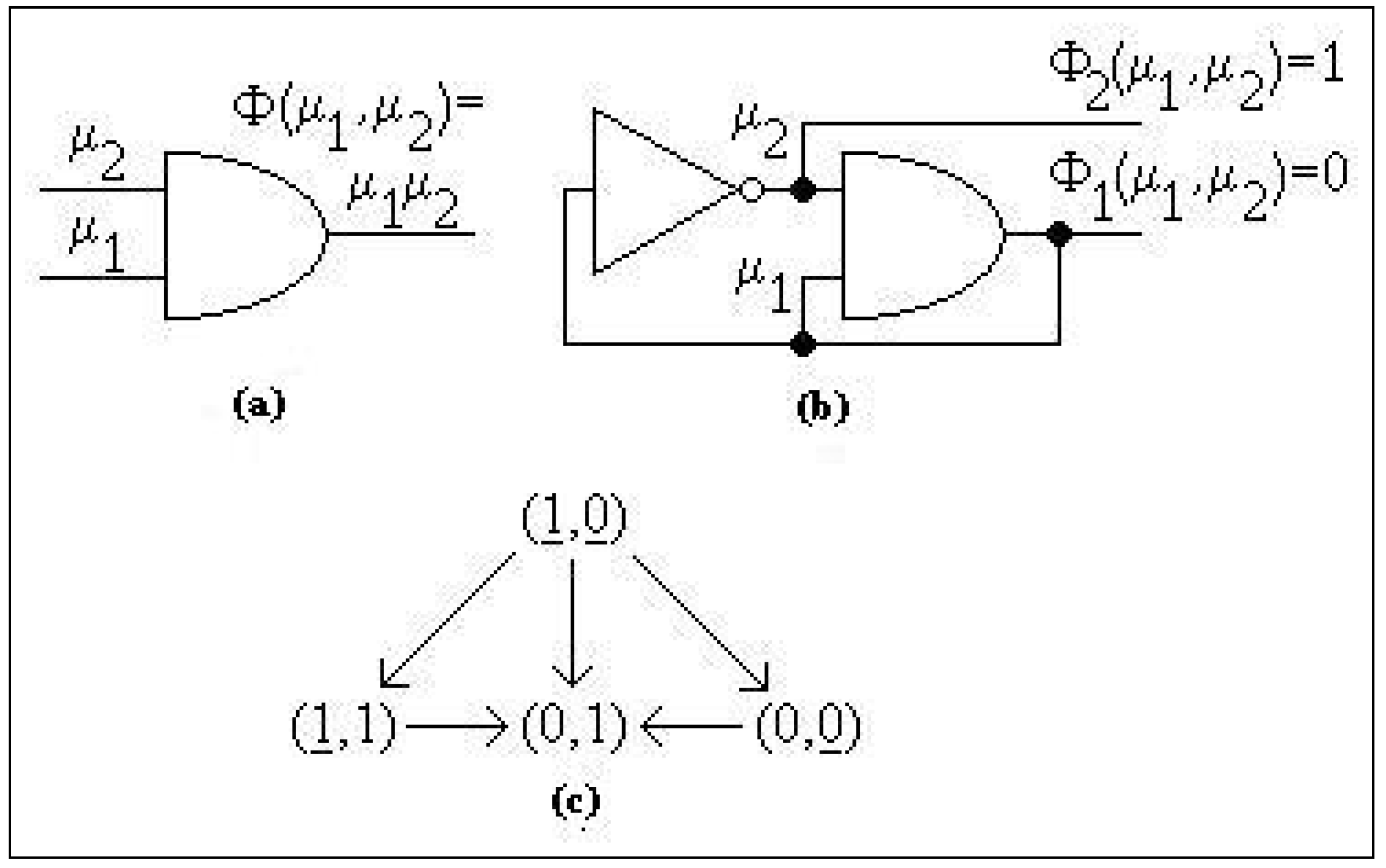
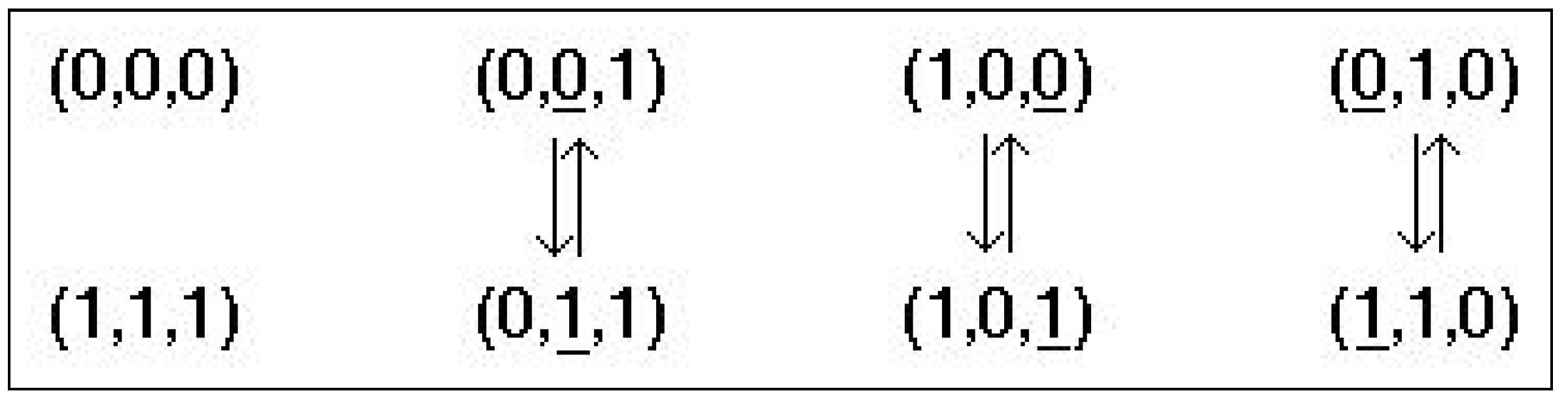
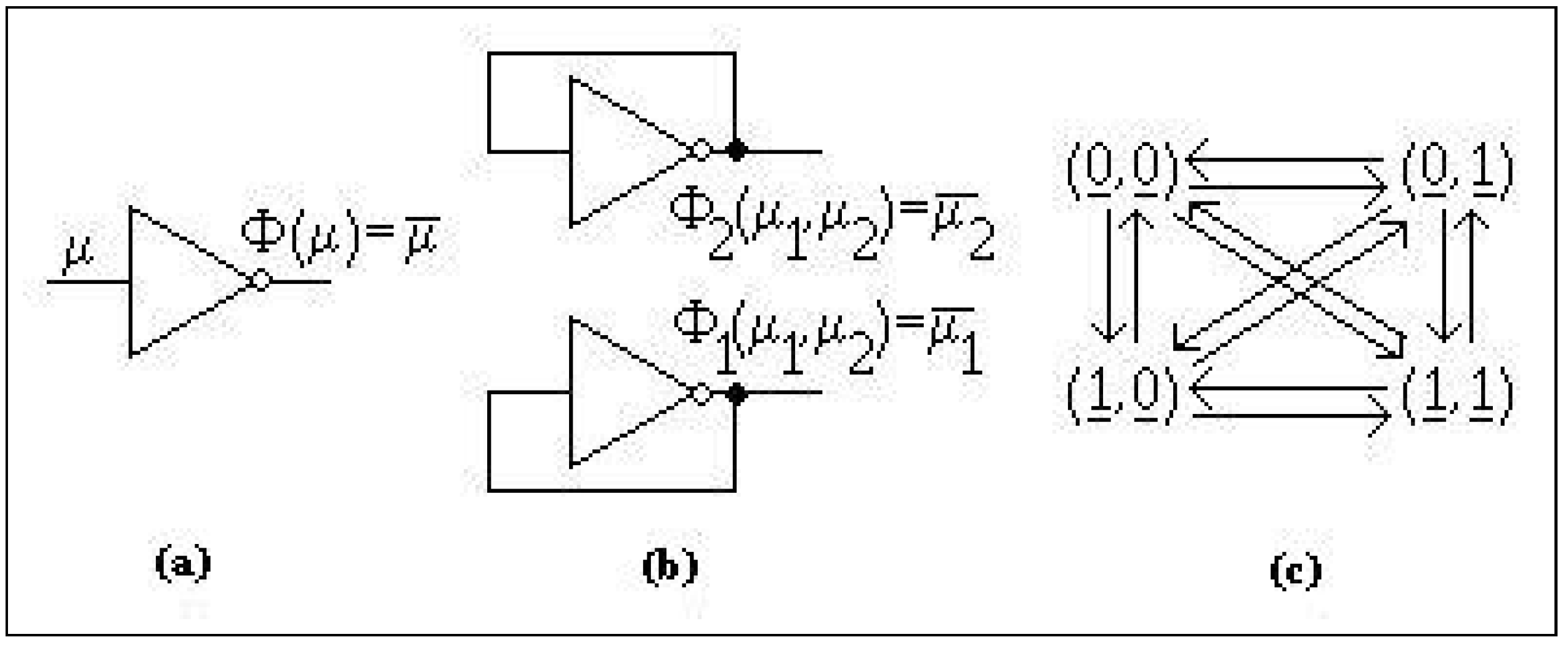
etc. In Figure 1, we have drawn at (a) the logical gate NOT, i.e., the circuit that computes the logical complement and at (b) a circuit that makes use of logical gates NOT. The asynchronous system that models the circuit from (b) has the state portrait drawn at (c). In the state portraits, the arrows show the increase of (the discrete or continuous) time. The underlined coordinates are these coordinates for which and they are called excited, or enabled, or unstable. The coordinates that are not underlined fulfill by definition and they are called not excited, or not enabled, or stable. The existence of two underlined coordinates in shows that may be computed first, may be computed first, or , may be computed simultaneously, thus when the system is in , it may run in three different directions, which results in non-determinism.
Figure 1.
(a) the logical gate NOT; (b) circuit with logical gates NOT; (c) state portrait.
Our present purpose is to define the symmetry of these systems.
2. Semi-Regular Systems
Notation 1
We denote .
Notation 2
is the notation of the characteristic function of the set :
Notation 3
We denote with the set of the sequences
Notation 4
The set of the real sequences that are unbounded from above is denoted with .
Notation 5
We use the notation for the set of the functions having the property that and exist with
Definition 6
Let be a function. For we define the function by
Remark 7
For any and if then i.e., is not computed and if then i.e., is computed. This is the meaning of asynchronicity.
Definition 8
Let The function defined by
is called discrete time semi-orbit of We consider also the sequence and the function from Equation (2), for which the function is defined by:
is called continuous time semi-orbit of
Definition 9
The discrete time and the continuous time universal semi-regular autonomous asynchronous systems associated to Φ are defined by
Remark 10
and Φ are usually identified.
Example 11
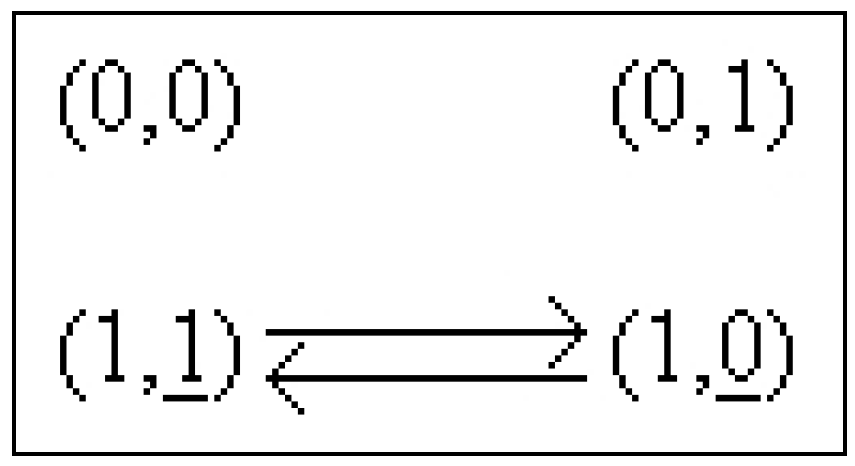
In Figure 2 we have drawn at (a) the AND gate that computes the logical intersection, at (b) a circuit with two gates and at (c) the state portrait of We conclude that
since the first coordinate might finally decrease its value and the second coordinate might finally increase its value, but the order and the time instant when these things happen are arbitrary.
Figure 2.
The semi-regular system from Example 11.
3. Anti-Semi-Regular Systems
Definition 12
Let and from Equation (2). The function that satisfies
is called discrete time anti-semi-orbit of μ and the function that satisfies
is called continuous time anti-semi-orbit of
Remark 13
We compare the semi-orbits and the anti-semi-orbits now and see that they run both from the past to the future, but the cause-effect relation is different: in the cause is in the past and the effect is in the future, while in the cause is in the future and the effect is in the past.
Definition 14
The discrete time and the continuous time universal anti-semi-regular autonomous asynchronous systems associated to Φ are defined by
4. Isomorphisms and Anti-Isomorphisms
Definition 16
Let It defines the functions
and
Theorem 17
Let The following statements are equivalent:
- (a)
- the diagramis commutative;
- (b)
- (c)
and
Proof.
(a)⟹(b): We fix arbitrarily and we use the induction on . For , (b) becomes , thus we suppose that it is true for k and we prove it for :
(b)⟹(c): The first statement results from (b) if we take and In order to prove the second statement, let and be arbitrary, thus Equation (2) holds with If the statement to prove takes the form so that we can suppose now that a finite or an infinite number of are In the case that does not restrict the generality of the proof, we have that
is an element of and
(c)⟹(a): Let be arbitrary and fixed and we consider given by Equation (2), with fixed, and . We have
Case (i) , the commutativity of the diagram is equivalent with the first statement of (c).
Definition 18
We consider the functions If bijective exist such that one of the equivalent properties (a), (b) or (c) from Theorem 17 is satisfied, then we say that the couple defines an isomorphism from to or from to or from Φ to We use the notation for the set of these couples and we also denote with the set of the automorphisms of or
Theorem 19
For , the following statements are equivalent:
(a) the diagram is commutative;
(b)
(c)
and
Proof.
(a)⟹(b): We fix arbitrarily and we use the induction on In the case the equality to be proved is satisfied
thus we presume that the statement is true for k and we prove it for We have:
The proof is similar with the proof of Theorem 17.
Definition 20
Let If bijective exist such that one of the equivalent properties (a), (b) or (c) from Theorem 19 is fulfilled, we say that the couple defines an anti-isomorphism from to or from to or from Φ to We use the notation for these couples and we also denote with the set of the anti-automorphisms of or Φ.
5. Symmetry and Anti-Symmetry
Remark 21
The fact that implies but all of and may be empty.
Definition 22
Let If , then are called symmetrical, or conjugated; if , then are called anti-symmetrical, or anti-conjugated.
If then and Φ are called symmetrical and if then and Φ are called anti-symmetrical.
Remark 23
The symmetry of means that maps the transfers in transfers the situation when Φ is symmetrical and is similar. Anti-symmetry may be understood as mirroring: maps the transfers (or arrows) in transfers and similarly for
Theorem 24
Let
(a) If , then
(b) If , then
Proof.
(a): The hypothesis states that the diagram
commutes, with bijective. We fix arbitrarily We denote and we note that
As were chosen arbitrarily and on the other hand, when runs in runs in and when runs in runs in , we infer that Equation (9) is equivalent with the commutativity of the diagram
for any We have proved that
(b): By hypothesis , the diagram
is commutative, bijective and we prove that , the diagram
is commutative.
Theorem 25
is a group relative to the law:
Proof.
The fact that is proved like this:
the fact that was mentioned before; and the fact that was shown at Theorem 24(a).
Definition 26
Any subgroup with is called a group of symmetry of of or of
6. Examples
Example 27
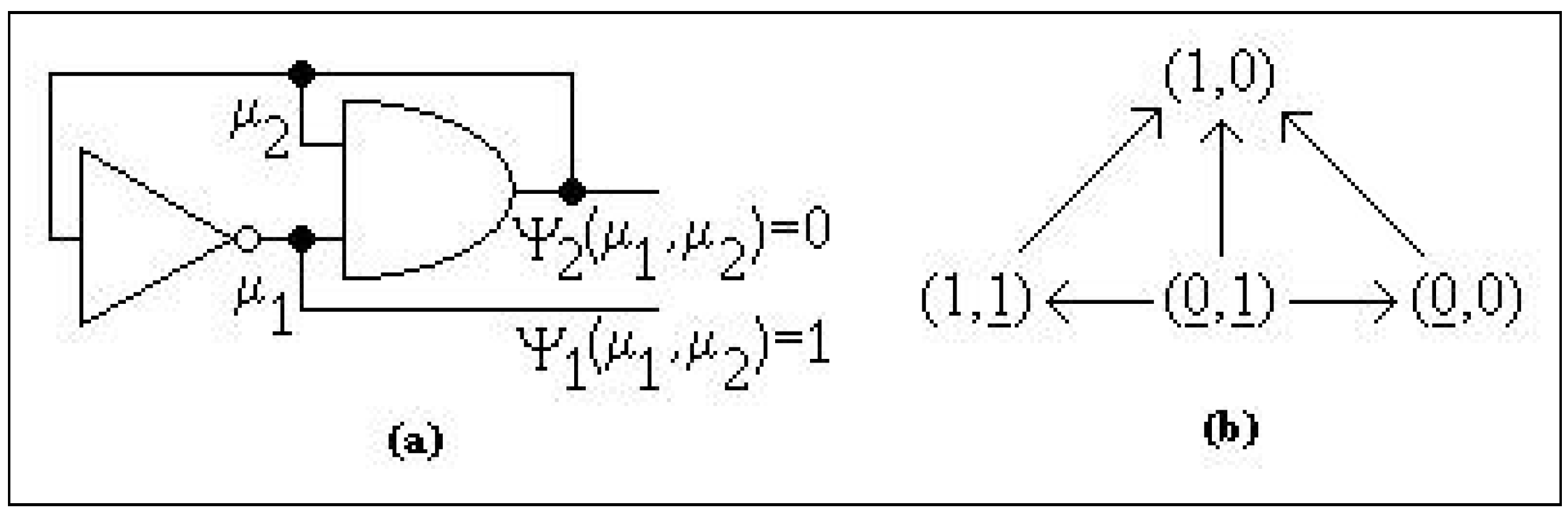
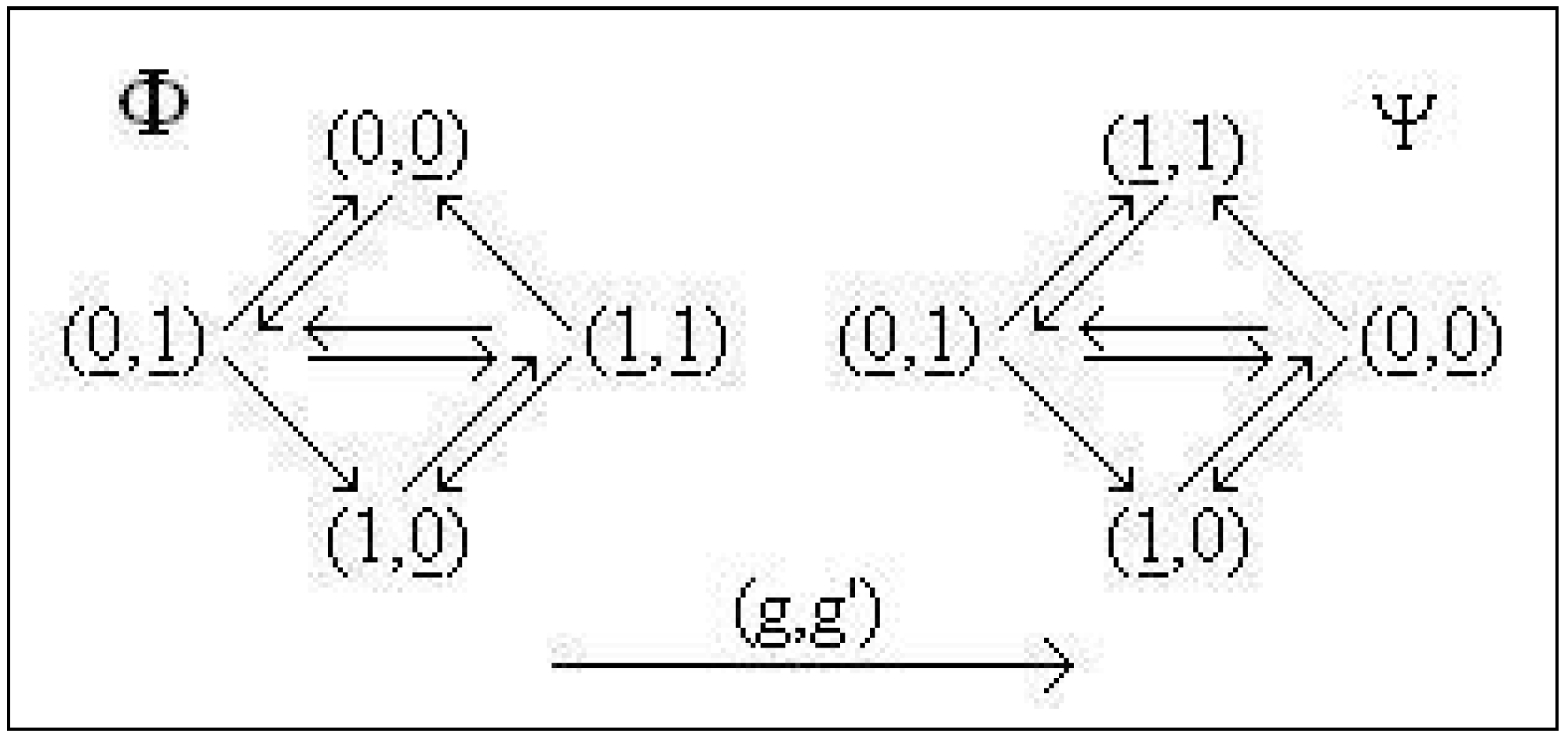
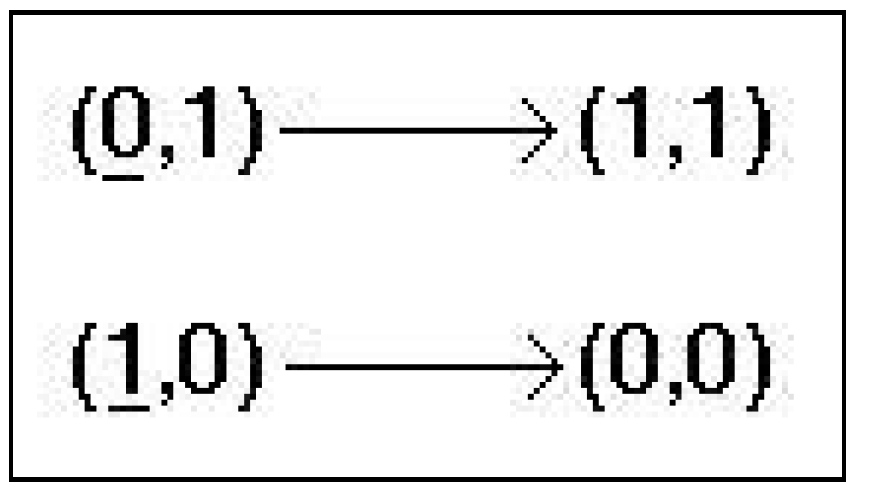
are given by, see Figure 4
and the bijections are
(in order to understand the choice of to be remarked in Figure 4 the positions of the underlined coordinates for Φ and Ψ). Φ and Ψ are conjugated.
Figure 4.
Symmetrical systems, Example 27.
Example 28
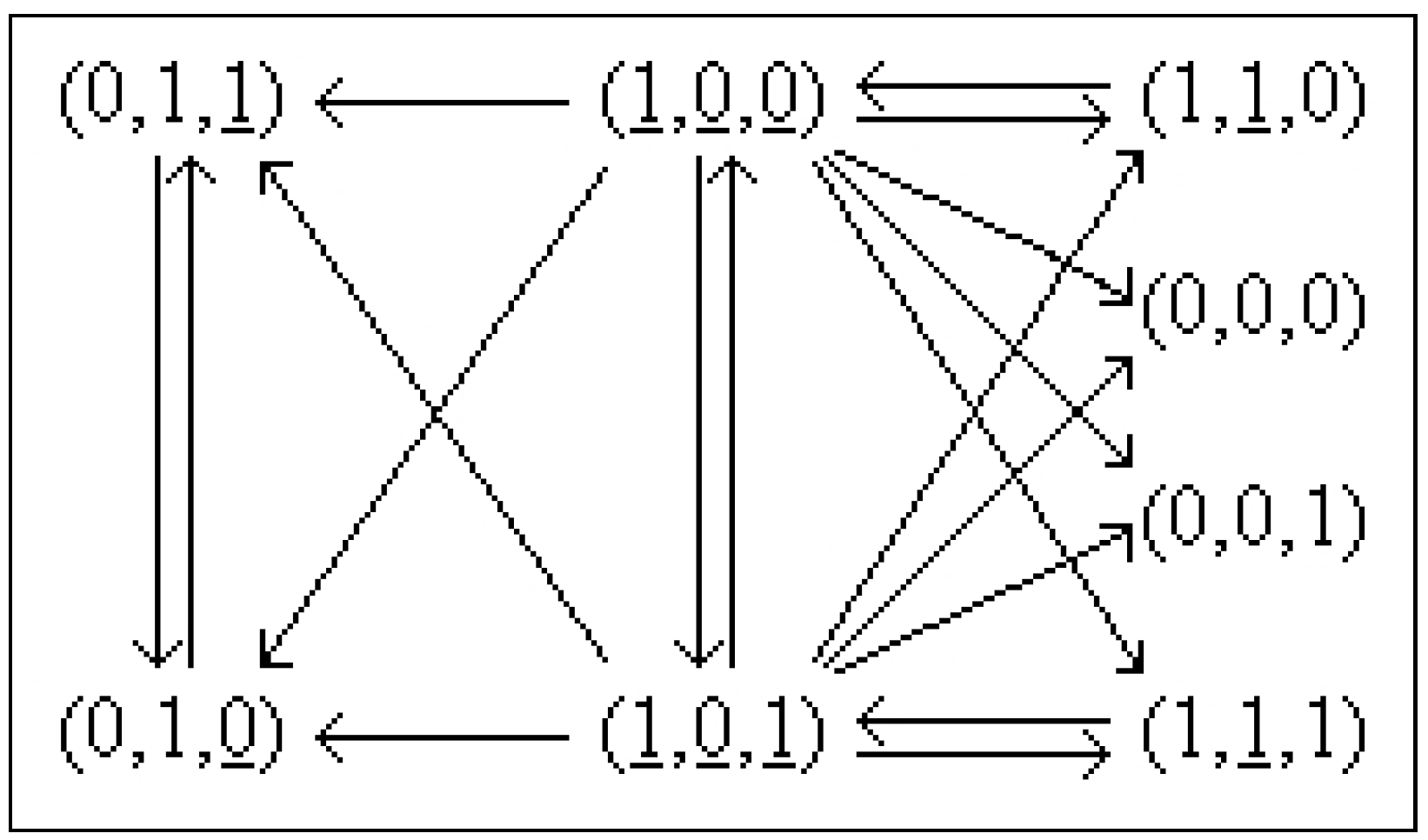
The system from Figure 5 is symmetrical and a group of symmetry is generated by the couples see Equation (10); are transpositions that permute the isolated fixed points
Figure 5.
Symmetrical system, Example 28.
Example 29
The function defined by fulfills for
thus and Φ is anti-symmetrical. The state portrait of Φ was drawn in Figure 1(c).
Notation 30
Let be a bijection. We use the notation for the bijection given by
Definition 31
Any of and is called symmetrical relative to the coordinates if the bijection σ exists, such that
Example 32
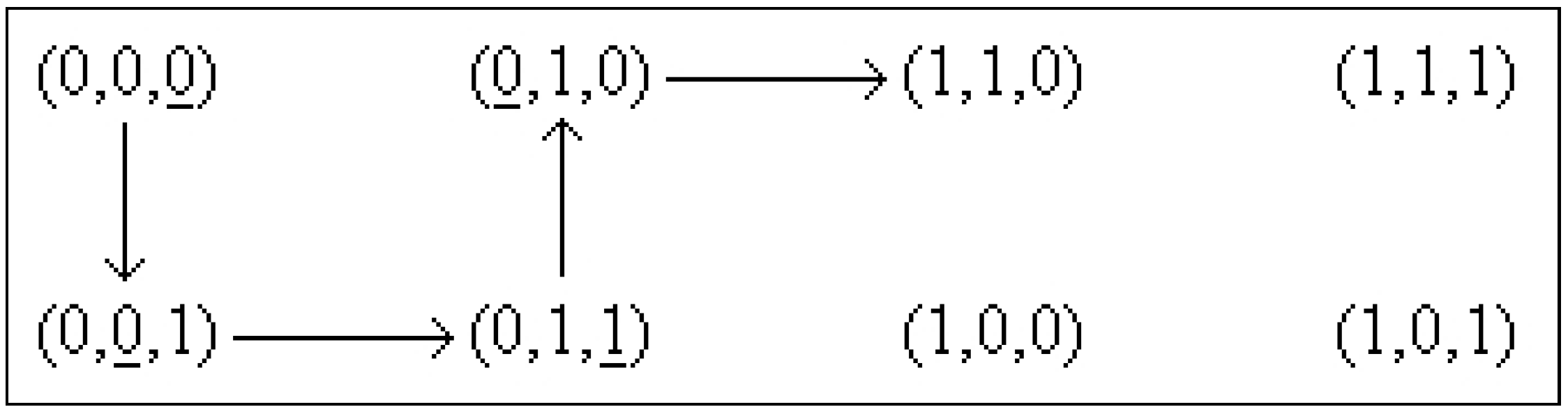
We consider the function defined by and the permutation A group of symmetry of is represented by We have given in Figure 6 the state portrait of
Figure 6.
System that is symmetrical relative to the coordinates, Example 32.
Notation 33
For we denote by the translation of vector
Definition 34
If holds for some , we say that any of and Φ is symmetrical relative to translations.
Example 35
In Figure 7
Figure 7.
Φ has the automorphism Example 35.
Example 36
In Equation (12) we have a function for which four functions exist:
such that The state portrait of Φ is drawn Figure 8.
Figure 8.
Φ is symmetrical relative to translations with , Example 36.
Example 37
The system from Figure 9 is symmetrical relative to translations, since it has the group of symmetry Φ is self-dual where the dual of Φ is defined by
Figure 9.
Function Φ that is self dual, , Example 37.
Example 38
Functions exist, see Figure 10, that are symmetrical relative to the translations with any thus their group of symmetry is The fact that shows that all these functions: are self-dual,
Figure 10.
Functions Φ that are self dual, , Example 38.
7. Conclusions
The paper defines the universal semi-regular autonomous asynchronous systems and the universal anti-semi-regular autonomous asynchronous systems. It also defines and characterizes the isomorphisms (automorphisms) and the anti-isomorphisms (anti-automorphisms) of these systems. Symmetry is defined as the existence of such isomorphisms (automorphisms), while anti-symmetry is defined as the existence of such anti-isomorphisms (anti-automorphisms). Many examples are given. A by-pass product in this study is anti-symmetry, which is related with systems having the cause in the future and the effect in the past. Another by-pass product consists in semi-regularity, since important examples of isomorphisms (automorphisms) are of semi-regular systems only and do not keep progressiveness and regularity [2,3].
References
- Kuznetsov, Y.A. Elements of Applied Bifurcation Theory, 2nd ed.; Springer: Berlin, Germany, 1997. [Google Scholar]
- Vlad, S.E. Boolean dynamical systems. ROMAI J. 2007, 3, 277–324. [Google Scholar]
- Vlad, S.E. Universal regular autonomous asynchronous systems: Fixed points, equivalencies and dynamical bifurcations. ROMAI J. 2009, 5, 131–154. [Google Scholar]
© 2012 by the authors; licensee MDPI, Basel, Switzerland. This article is an open access article distributed under the terms and conditions of the Creative Commons Attribution license (http://creativecommons.org/licenses/by/3.0/).