Article

Delay Differential Equations with a Damping Term: Enhanced Criteria for Testing the Oscillatory Performance of Solutions


1
Department of Mathematical Sciences, College of Science, Princess Nourah bint Abdulrahman University, P.O. Box 84428, Riyadh 11671, Saudi Arabia
2
Department of Mathematics, College of Science, Qassim University, Buraydah 52571, Saudi Arabia
3
Department of Mathematics, Faculty of Science, Mansoura University, Mansoura 35516, Egypt
4
Department of Mathematics and Computer Science, Faculty of Science, Port Said University, Port Said 42526, Egypt
*
Author to whom correspondence should be addressed.
Symmetry 2026, 18(2), 217; https://doi.org/10.3390/sym18020217
Submission received: 26 October 2025 / Revised: 6 December 2025 / Accepted: 22 December 2025 / Published: 23 January 2026
(This article belongs to the Section Mathematics)

Abstract

The oscillatory characteristics of solutions to damped differential equations are examined in this study. Enhanced properties are obtained for positive solutions of the equation under examination. These properties are then utilized to derive criteria ensuring the oscillation of all solutions of the equation, based on the symmetry principle between positive and negative solutions. Several techniques are employed to establish oscillation criteria that encompass a broader range of cases of the equation under investigation. Through the new approach adopted in this study, criteria are obtained that refine and complement the related previous results. The findings are applied to Euler-type equations and are juxtaposed with prior results to illustrate their significance.

1. Introduction

Qualitative theory is highly significant because of its wide-ranging applications across various scientific disciplines. It elucidates many enquiries concerning non-linear mathematical models and provides insights into the stability of solutions, their oscillation, periodicity, synchrony, symmetry, and other related aspects; [1,2,3]. Oscillation theory constitutes an essential domain of qualitative theory and a fundamental component of the qualitative analysis of differential equations (DE), for more information see [4,5,6]. It investigates the oscillatory behavior of solutions to nonlinear differential equations, along with their asymptotic and monotonic properties; see [7,8,9,10,11].
The term “damping” appears when modelling systems in which the amplitude of the solution gradually decreases over time due to the presence of dissipative or vanishing forces. This occurs because the presence of energy dissipation in the systems necessarily leads to a gradually weakening oscillatory behavior. Analyzing this behavior—particularly the oscillation of solutions in the presence of instantaneous damping—is a fundamental aspect of the qualitative theory of differential equations; see [12,13,14,15].
In this work, we consider the delay DEs with a damping term
α u y u + β u y u + γ u ϝ y δ u = 0 ,
where u u 0 . During this study, we assume the following:
(L1)
α , β , γ C u 0 , , 0 , , and α u > 0 ;
(L2)
δ C 1 u 0 , , R , δ u u , δ u 0 , and lim u δ u = ;
(L3)
ϝ C R , R , and ϝ y / y k > 0 for y 0 .
A solution of Equation (1) is defined as a function y C u 0 , , R which has the property α y C 1 u 0 , , R and satisfies Equation (1) on u 0 , . Our interest is directed to the solutions of Equation (1) that satisfy the condition sup y u : u u > 0 for all u u 0 . A nontrivial solution of (1) is said to be oscillatory if it has arbitrarily large zeros; otherwise, it is called nonoscillatory. Equation (1) is said to be oscillatory if all its solutions are oscillatory.
The assumption of positive coefficients serves to highlight a particular structure of Equation (1), thereby allowing a detailed investigation of its oscillatory behavior. Our approach is based on refining the monotonic properties of (1), which in turn requires deriving multiple relations between the delayed and non-delayed solutions, as well as between different orders of the solution’s derivatives. To establish these relations, it is necessary to assume that the delay function is non-decreasing and divergent. Within this framework, we consider the nonlinear function ϝ , which satisfies Condition (L3), in accordance with the adopted methodology, so as to generalize the linear results to selected nonlinear scenarios.
For the second-order DEs
y u + γ u y u = 0 ,
it is well known that its oscillatory behavior is guaranteed under the sufficient condition that γ u as u . Subsequently, further generalizations of the equation were developed, with researchers expanding its scope to include a broader range of variables and conditions. In 1984, Grace et al. [16] studied the DEs with a damping term
α u ψ y u y u + β u ϝ ^ u , y u , y u y u + γ u ϝ y u = 0 ,
where ψ y c > 0 and ϝ ^ y , x , y y α , for some positive real constants c and α .
In [17], the authors studied the ordinary form of the damped second-order DE
α u ψ y u y u + β u y u + γ u ϝ y u = 0 ,
by employing the integral averaging technique. Li et al. [18] extended these results by considering the half-linear ordinary DE
α u y u r + β u y u r + γ u ϝ y u = 0 ,
where r 1 and ϝ y / y r k > 0 .
Numerous studies investigated Equation (1) in its ordinary form, that is, without the inclusion of delays. For further details, the reader was referred to [19,20,21,22,23].
In 1991, Grace [24] was the first to investigate the oscillatory behavior of equations involving delayed damping in this form
α u y u + β u y h u + γ u ϝ y δ u = 0 ,
where h u u and h u > 0 . He ensured that Equation (3) oscillates or converges to zero if there exists a function ρ C 1 u 0 , , 0 , such that ρ 0 , β ρ / h 0 , ρ γ as u ,
u 0 1 α ς ρ ς u 0 ς ρ ξ γ ξ d ξ d ς = ,
and
lim inf u h u u β ς α h ς d ς > 1 e .
Saker et al. [25] completed the results in [24] and proved that every solution of (3) oscillates or converges to zero if there exists a function ρ C 1 u 0 , , 0 , such that
lim sup u u 0 u ρ ς γ ς ρ ς 2 α δ ς 4 k ρ ς δ ς d ς = .
As an extension of the results in [18], Fu et al. [12] presented oscillation criteria for the solutions of the DE
α u y u + β u y u + γ u ϝ y δ u = 0 .
Grace and Jadlovska [13] examined the oscillation of the canonical neutral DE
α u z u r + β u z u r + γ u ϝ y δ u = 0 ,
where z u = y u + σ u y h u , r and a are quotient of two odd positive integer, ϝ y > k y a , and
u 0 exp u 0 ξ α ς d ς d ξ = .
Moaaz et al. [15] extended the results in [13] to the noncanonical case of Equation (6).
Wu et al. [26] and Tunc and Grace [27] studied the DE
α u z u r + β u z u r + γ u ϝ y δ u = 0 ,
where z u = y u ± σ u y h u .
In the very recent literature, a research trend has sought to enhance oscillation criteria across diverse forms of delay equations. Alsharidi and Muhib [28] verified the oscillatory nature of solutions to DE with multiple delays, Alarfaj and Muhib [29] formulated criteria governing the oscillation of all solutions to DEs with mixed neutral terms, whereas Arab et al. [30] proposed oscillation criteria for equations characterized by a sublinear neutral term.
The primary objective of this paper is to further develop the oscillatory behavior analysis of (1), aiming to establish more refined theorems compared to previous works. These theorems are designed to cover a broader range of scenarios and ensure applicability to less general equations, such as Euler’s equation, which provides sharper results in such cases. Additionally, the goal is to derive theorems that impose fewer and simpler conditions on the coefficients, making them easier to apply in practice. In pursuit of this objective, we focus on enhancing the monotonic characteristics of the positive solutions of Equation (1), which stands as a principal analytical difficulty in the study of oscillatory behavior.
Building on the foundation of analyzing oscillatory behavior, this paper aims to advance the understanding and refinement of oscillation criteria for Equation (1). To achieve this, the study is structured into two main sections, Section 2 and Section 3, each addressing critical aspects of solution behavior and oscillatory analysis. In the first section, Section 2, we delve into the essential properties of solutions to (1) by systematically exploring these properties. In Section 2.1, we derive relations between the solution and its derivatives and then establish criteria that exclude the existence of positive solutions across all classes. In Section 2.2, we aim to refine these relations and criteria. Section 3 builds on these results by applying the derived relationships and leveraging multiple approaches to examine the oscillatory behavior of (1) for both canonical and noncanonical cases.

2. Asymptotic Behavior

For convenience, Class U is defined as the class of all eventually positive solutions to Equation (1). Also, we use the symbols ↓ and ↑ to indicate that functions are increasing or decreasing, respectively. Moreover, we mean by y U ( y U ) the class of all solutions y U that are decreasing (increasing). Now, we assume that
η u : = u 1 u 1 α ς d ς
and
μ u : = exp u 0 u β ς α ς d ς ,
for u u 1 , where u is large enough.
The following lemma is presented for the classification of positive solutions to Equation (1).
Lemma 1.
If y U , then either y u or y u .
Proof. 
Let y U . Thence, there is u 1 u 0 such that y δ u > 0 for u u 1 .
Suppose the contrary that y is oscillatory. If y u = 0 , then
α u y u u = u = γ u 1 ϝ y δ u 1 0 .
But, this means that y cannot have another zero after it vanishes the first time. So, y is nonoscillatory.
This completes the proof. □

2.1. New Criteria

Lemma 2.
Assume that y U . Then,
μ α y k μ γ y δ
and
μ α y k μ γ η δ α δ y δ .
Proof. 
Assume that y U . It follows from (1) that
α y β y k γ y δ 0 .
So, for u u 1 ,
y u > u 1 u 1 α ς α ς y ς d ς α u y u η u ,
which implies that
y η .
Using (10), we obtain
μ α y k μ γ y δ k μ γ η δ α δ y δ .
This completes the proof. □
Theorem 1.
Assume that one of the following conditions is satisfied:
lim inf u δ u u μ ς η δ ς μ δ ς γ ς d ς > 1 k e , δ u < u ,
or, there is ρ C 1 u 0 , , 0 , such that
lim sup u u 0 u k ρ ς γ ς η δ ς η ς ρ ς α ς 4 ρ ς ρ ς β ς α ς 2 d ς = ,
or
lim sup u u 1 u k ρ ς μ ς γ ς η δ ς η ς μ ς α ς 4 ρ ς 2 ρ ς d ς = .
Then, U = .
Proof. 
Assume the contrary that y U . From Lemma 2, we obtain that (8) and (9) hold.
Setting w 1 : = μ α y , (9) becomes
w 1 u + k μ η δ μ δ γ w 1 δ 0 .
However, the existence of a positive solution w 1 to inequality (15) contradicts the condition (12) in accordance with Theorem 2.1.1 in [8].
For condition (13), we define
ν 1 : = ρ α y y > 0 .
Then,
ν 1 = ρ ρ ν 1 + ρ α y y ρ α y y 2 ρ ρ ν 1 ρ β y y k ρ γ y δ y 1 ρ α ν 1 2 = ρ ρ β α ν 1 k ρ γ y δ y 1 ρ α ν 1 2 ,
with (11) yields
ν 1 k ρ γ η δ η + ρ ρ β α ν 1 1 ρ α ν 1 2 k ρ γ η δ η + ρ α 4 ρ ρ β α 2 .
An integration of (16) over u 1 , u gives
ν 1 u 1 u 1 u k ρ ς γ ς η δ ς η ς ρ ς α ς 4 ρ ς ρ ς β ς α ς 2 d ς ,
which contradicts condition (13).
For condition (14), we define
ν 2 : = ρ μ α y y > 0 .
Hence, from (8), we get
ν 2 = ρ ρ ν 2 + ρ μ α y y ρ μ α y y 2
ρ ρ ν 2 k ρ μ γ y δ y 1 ρ μ α ν 2 2 k ρ μ γ η δ η + ρ ρ ν 2 1 ρ μ α ν 2 2
k ρ μ γ η δ η + μ α 4 ρ 2 ρ .
An integration of (16) over u 1 , u leads to
ν 2 u 1 u 1 u k ρ ς μ ς γ ς η δ ς η ς μ ς α ς 4 ρ ς 2 ρ ς d ς ,
which contradicts condition (14).
This completes the proof. □
Theorem 2.
Assume that
u 0 1 μ υ α υ u 0 υ μ ς γ ς d ς d υ =
and one of conditions (12), (13), or (14) are satisfied. Then, every nonoscillatory solution of (1) converges to zero.
Proof. 
Assume that y U . Then, we have the following two possible cases:
Case 1: y U . This situation contradicts the assumption that one of conditions (12), (13), or (14) is met.
Case 2: y U . Since y is positive and decreasing, we have that lim u y u = y 0 0 . Suppose that y 0 > 0 . Then, there is a u 1 u 0 such that y u y 0 for u u 1 . It is easy to see that (1) can be reduced to (8). An integration of (8) over u 1 , u gives
μ u α u y u μ u 1 α u 1 y u 1 k u 1 u μ ς γ ς y δ ς d ς k y δ u u 1 u μ ς γ ς d ς ,
and so
y u y 0 k μ u α u u 1 u μ ς γ ς d ς .
By integrating again over u 1 , , we conclude that
y u 1 y 0 + k y 0 u 1 1 μ υ α υ u 1 υ μ ς γ ς d ς d υ .
which contradicts condition (20).
This completes the proof. □
Theorem 1 provided a set of conditions, any one of which was sufficient to exclude positive increasing solutions. Meanwhile, Theorem 2 derived a criterion ensuring that the nonoscillatory solutions of Equation (1) converge to zero, relying on the results of Theorem 1.
Example 1.
Consider the Euler DE
y u + β 0 u y u + γ 0 u 2 y κ u = 0 ,
where β 0 0 , γ 0 > 0 , and κ 0 , 1 (see Example 3.1 in [12,25]). Then, we find that condition (12) is satisfied if
γ 0 > κ β 0 1 e ln 1 / κ , κ < 1 .
By choosing ρ u = u for (13) and ρ u = u 1 β 0 for (14), we obtain
γ 0 > 1 4 κ 1 β 0 2 .
Next, it is easy to verify that (20) is met. Thereby, it follows from Theorem 2 that every nonoscillatory solution of (22) converges to zero if (23) or (24) holds.
Remark 1.
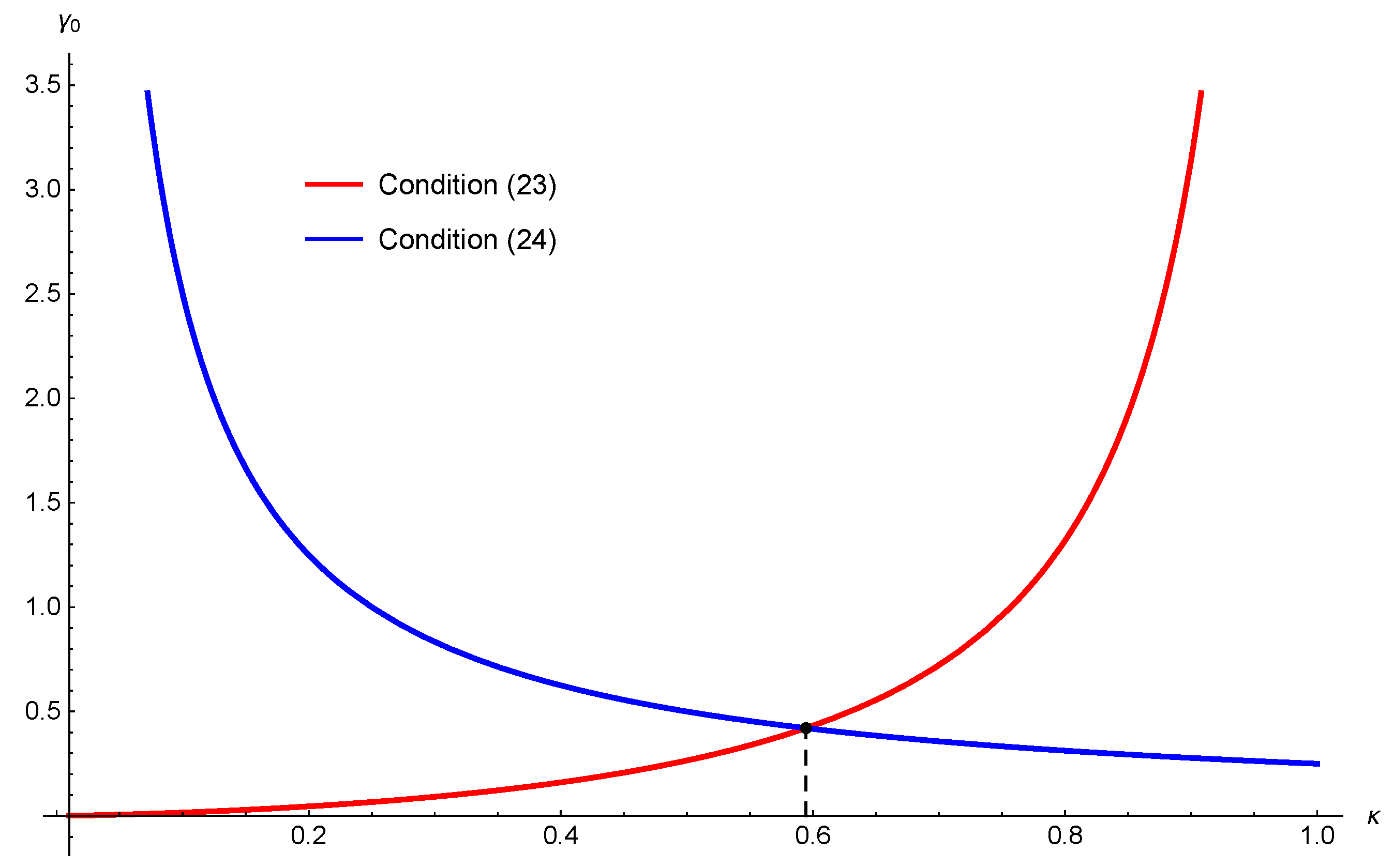
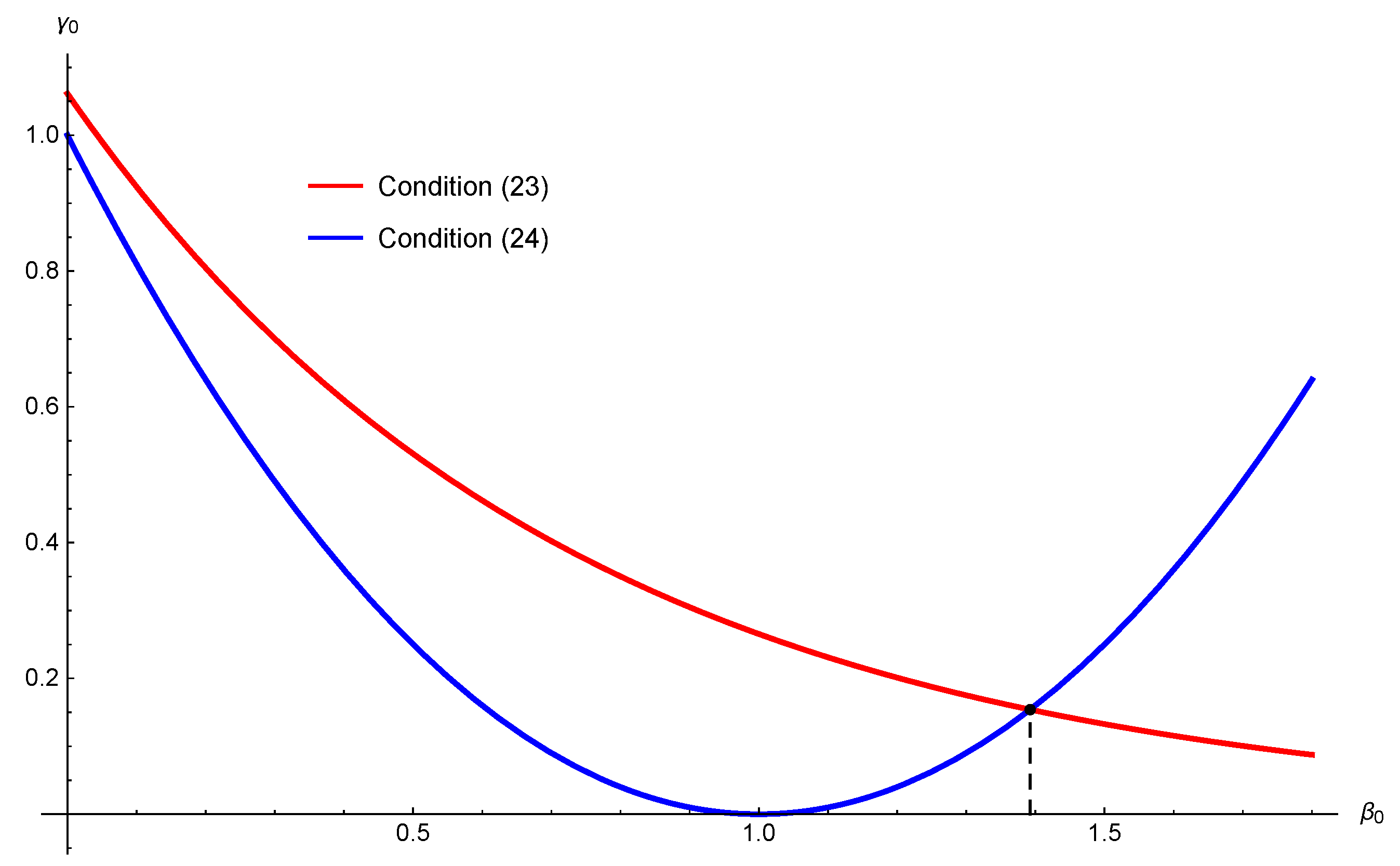
Figure 1 and Figure 2 show the lower bounds of the values of γ 0 corresponding to values of β 0 1 , and κ 0 , 1 . Notice that condition (23) provides a better criterion for checking the oscillation of Equation (22) for κ 0 , 0.594487 and β 0 1.39245 , , while condition (24) provides a better criterion for κ 0.594487 , 1 and β 0 0 , 1.39245 .

2.2. Improved Criteria

For convenience, we define
ϕ u : = u 1 u 1 μ ς α ς d ς ,
ϕ ^ u : = ϕ u + k u 1 u μ ς γ ς ϕ ς ϕ δ ς d ς ,
and
ϕ ˜ u : = exp δ u u 1 μ ς α ς ϕ ^ ς d ς ,
for u u 1 , where u 1 is large enough.
Lemma 3.
Assume that y U . Then,
y u μ u α u y u ϕ ^ u
and
y δ u y u ϕ ˜ u .
Proof. 
Let y U . It follows from (1) that μ α y k μ γ y δ < 0 . So, for u u 1 ,
y u > u 1 u 1 μ ς α ς μ ς α ς y ς d ς μ u α u y u ϕ u .
Then,
y μ α y ϕ = μ α y ϕ k μ γ ϕ y δ k μ γ ϕ μ δ α δ y δ ϕ δ .
An integration of (27) over u 1 , u gives
y u μ u α u y u ϕ u + k u 1 u μ ς γ ς ϕ ς ϕ δ ς μ δ ς α δ ς y δ ς d ς μ u α u y u ϕ ^ u .
Moreover, we obtain
y u y u 1 μ u α u ϕ ^ u ,
By integrating over δ u , u gives
y δ u y u exp δ u u 1 μ ς α ς ϕ ^ ς d ς = ϕ ˜ u .
This completes the proof. □
Theorem 3.
Assume that (20) holds, and one of the following conditions:
lim inf u δ u u μ ς γ ς ϕ ^ δ ς d ς > 1 k e
or there is ρ C 1 u 0 , , 0 , such that
lim sup u u 1 u k ρ ς μ ς γ ς ϕ ˜ u μ ς α ς 4 ρ ς 2 ρ ς d ς = .
Then, every nonoscillatory solution of (1) converges to zero.
Proof. 
Assume that y U . Then, we have the following two possible cases:
Case 1: y U . From Lemma 3, we have that (25) and (26) hold. Using Lemma 2, we have that (8) and (9) hold. Setting z 1 : = μ α y and using (25), we get
z 1 + k μ γ ϕ ^ δ z 1 δ 0 .
However, the existence of a positive solution z 1 to inequality (30) contradicts the condition (28) in accordance with Theorem 2.1.1 in [8].
On the other hand, we assume ν 2 is defined as in (17). Proceeding as in the proof of Theorem 1, we arrive at (19). Using (26) in (19) yields
ν 2 k ρ μ γ ϕ ˜ + ρ ρ ν 2 1 ρ μ α ν 2 2 k ρ μ γ ϕ ˜ + μ α 4 ρ 2 ρ .
An integration of (31) over u 1 , u leads to
ν 2 u 1 u 1 u k ρ ς μ ς γ ς ϕ ˜ u μ ς α ς 4 ρ ς 2 ρ ς d ς ,
which contradicts condition (29).
Case 2: y U . This case with condition (20) confirms that lim u y u = 0 .
This completes the proof. □
By employing the refined monotonicity properties in Lemma 3, Theorem 3 improved upon Theorem 2.
Example 2.
Consider Equation (22) when β 0 0 , β 0 1 , γ 0 > 0 , and κ 0 , 1 . It is easy to verify that (20) holds,
ϕ u = u 1 β 0 1 β 0 , ϕ ^ u = 1 p u 1 β 0 , and ϕ ˜ u = k p ,
where
p = 1 β 0 3 1 β 0 2 + κ 1 β 0 γ 0 .
Conditions (28) and (29) reduce to
1 p κ 1 β 0 γ 0 ln 1 / κ > 1 e
and
κ p γ 0 > 1 4 1 β 0 2 ,
respectively. Using Theorem 3, every nonoscillatory solution of (22) converges to zero if (32) or (33) holds.
Remark 2.
By substituting the parameter values β 0 and κ in the conditions (24)–(33) with their counterparts in the following equations:
y u + 2 u y u + γ 0 u 2 y u e = 0
and
y u + 1 2 u y u + γ 0 u 2 y u 2 = 0 .
Table 1 illustrated the lower bounds of γ 0 that resulted under the application of those conditions. From the results in this table, we note that the use of improved monotonic relations (25) and (26) led to a significant improvement in the criteria for testing the asymptotic behavior of the solutions of Equation (22).

3. Oscillation Behavior

In this section, we present the criteria that confirm the oscillation of all solutions of Equation (1). We also consider both the canonical and noncanonical cases of (1).

3.1. Canonical Case

Note that if
u 0 1 μ ς α ς d ς = ,
then we get a contradiction with the case of y u (see Lemma 4 in [31]). So, in this case, there are no decreasing positive solutions ( U = ) , and hence, we get the following result.
Theorem 4.
Assume that (36) holds. Then, all solutions to Equation (1) are oscillatory if one of the conditions (12)–(14), (28), or (29) is satisfied.
Example 3.
Consider Equation (22) when β 0 1 . Thus, we see that
ϕ u = 1 / 1 β 0 u 1 β 0 β 0 < 1 ; ln u β 0 = 1 ,
which leads to
ϕ u as u .
Therefore, when β 0 1 , all solutions of Equation (22) are oscillatory if one of the conditions (23), (24), (32), or (33) is satisfied.
Remark 3.
Condition (33) provides the well-known sharp criterion for the oscillatory solutions of Euler’s ordinary differential Equation (22), namely γ 0 > 1 4 .
Remark 4.
Applying the results of [13] to Equation (22) yields the following criterion:
γ 0 1 4 κ 1 1 + 1 1 β 0 .
In the particular case (35), this criterion reduces to γ 0 0.16667 . Nevertheless, our criterion (33) provides a sharper result for this case, namely γ 0 0.08276 .
Remark 5.
It is observed that the results in [12,18] fail when applied to (22).

3.2. Noncanonical Case

Here, we restrict the following integral to be bounded, which corresponds to the so-called noncanonical case:
φ u 0 : = u 0 1 μ ς α ς d ς < .
Theorem 5.
Assume that (37) and one of conditions (12), (13), or (14) is satisfied. If
lim inf u δ u u μ ς γ ^ ς ψ ^ δ ς d ς > 1 k e
or there is ρ C 1 u 0 , , 0 , such that
lim sup u u 1 u k ρ ς μ ς γ ^ ς ψ ˜ u μ ς α ^ ς 4 ρ ς 2 ρ ς d ς = ,
then all solutions to Equation (1) are oscillatory, where α ^ u : = α u φ 2 u , γ ^ u : = γ u φ u φ δ u ,
ψ u : = u 1 u 1 μ ς α ^ ς d ς ,
ψ ^ u : = ψ u + k u 1 u μ ς γ ^ ς ψ ς ψ δ ς d ς ,
and
ψ ˜ u : = exp δ u u 1 μ ς α ^ ς ψ ^ ς d ς .
Proof. 
Assume the contrary that y U . Then, we have the following two possible cases:
Case 1: y U . This situation contradicts the assumption that one of conditions (12), (13), or (14) is met.
Case 2: y U . It follows from (1) that
μ α y k μ γ y δ < 0 .
Then, y u μ u α u y u φ u , and so
y φ .
Combining (40) with the fact
μ α φ 2 y φ = φ μ α y + y = φ μ α y
yields
μ α φ 2 y φ + k μ γ φ y δ 0 .
Using the transformation z 2 = y / φ , we obtain
μ α ^ z 2 + k μ γ ^ z 2 δ 0 .
Using the fact y U and (41), we note that z 2 is a solution of (42) with the properties
z 2 u > 0 , z 2 u , and μ α ^ z 2 .
Proceeding exactly as in Lemma 3, we obtain the following properties:
z 2 u μ u α ^ u z 2 u ψ ^ u
and
z 2 δ u z 2 u ψ ˜ u .
Then continuing as in Theorem 3, we get a conflict with conditions (38) or (39).
This completes the proof. □
Theorems 4 and 5 established criteria guaranteeing that all solutions of the studied equation oscillated in the canonical and noncanonical cases, respectively.
Example 4.
Consider Equation (22). This equation satisfies (37) if β 0 > 1 with φ u = 1 / β 0 1 u 1 β 0 . Also, we obtain that
α ^ u = u 1 β 0 β 0 1 2 , γ ^ u = γ 0 κ 1 β 0 β 0 1 2 u 2 β 0 , ψ u = β 0 1 u β 0 1 , ψ ^ u = A u β 0 1
and
ψ ˜ u = κ β 0 1 2 / A ,
where
A : = β 0 1 + γ 0 β 0 1 .
Then, conditions (38) and (39), in Theorem 5, become
A γ 0 > β 0 1 2 e ln 1 / κ
and
γ 0 κ 1 β 0 + β 0 1 2 / A > β 0 1 2 4 ,
respectively.
We obtain oscillation criteria for all solutions by combining one of the conditions (43) or (44) with one of the conditions (23), (24), (32) or (33).
Remark 6.
For the particular case (34) of (22), the oscillation criterion reduces to γ 0 > 0.21015 .
Remark 7.
Applying the results of [26] to Equation (22) yields the following criterion:
γ 0 > 1 β 0 2 4 .
This condition ensures the oscillation of solutions to (34) when γ 0 > 0.25 . In contrast, our results confirm the oscillatory property of all solutions to (34) when γ 0 > 0.21015 , which is sharper.
Remark 8.
Consider the DE
y u + 1 2 u y u + γ 0 u 2 y u c = 0 ,
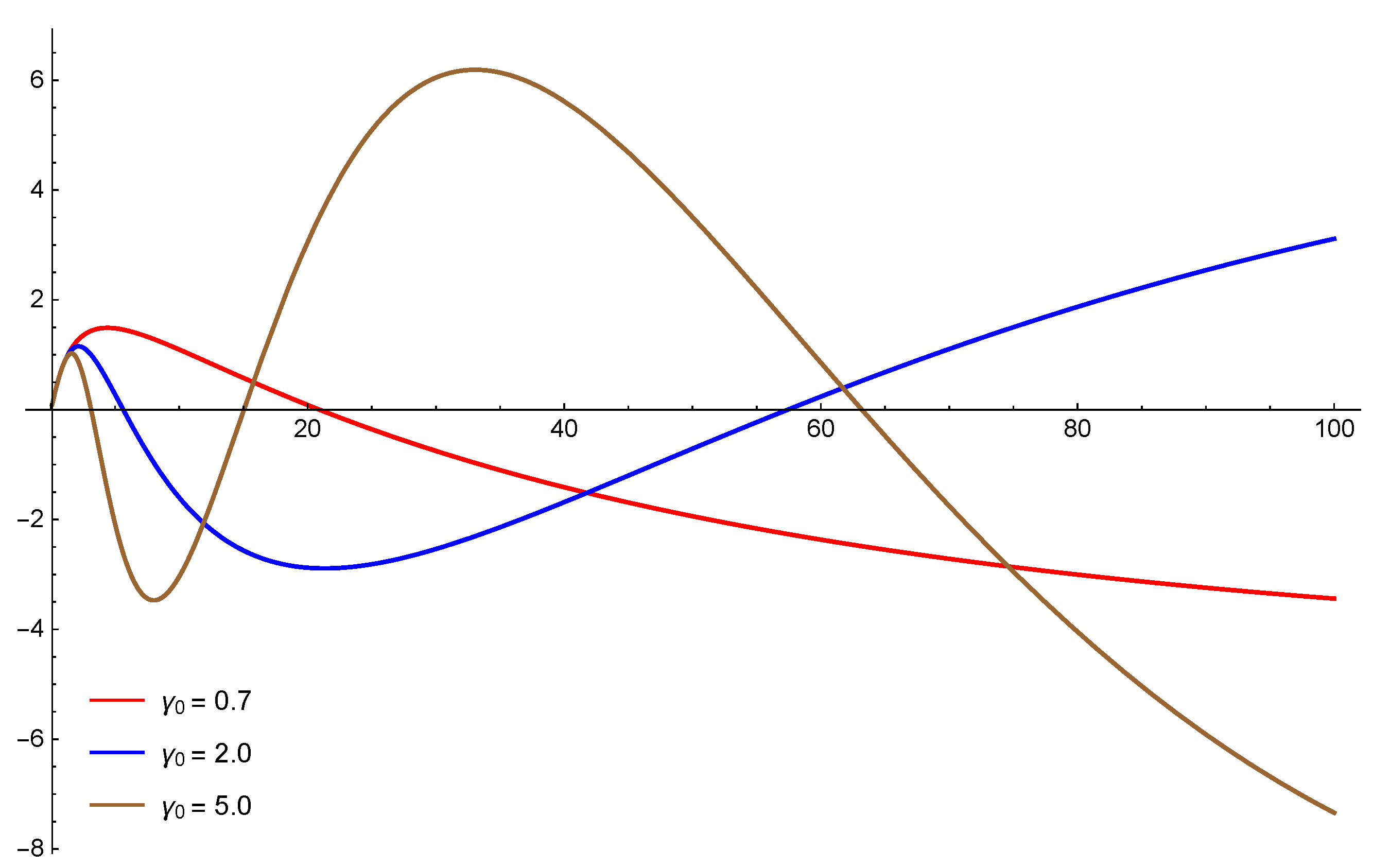
where u > c and c > 0 . Using Theorem 4, every solution of (45) is oscillatory if γ 0 > 1 / 16 . Figure 3 illustrates some numerical solutions to Equation (45).

4. Conclusions

In this paper, relationships between solutions and their derivatives for (1) were derived, as established in Theorem 1, and subsequently refined in Lemma 3. By means of these enhanced relations, the order of the equation was reduced to the first, and the resulting criteria were compared with existing oscillation criteria for such equations. Through this effort, Criterion (12) in Theorem 1 was developed, which excludes the existence of positive increasing solutions. Furthermore, various substitutions within the well-known Riccati technique were employed to derive alternative criteria, such as Criteria (13) and (14) in Theorem 1, which were subsequently improved to yield Criteria (28) and (29) in Theorem 3.
The study was then progressed to the establishment of oscillation criteria that ensure all solutions oscillate. This objective was achieved in Theorem 4 for the canonical case of (1), while Theorem 5 was devoted to the noncanonical case, representing a significant advancement. Unlike most studies that are confined to the simpler canonical case, a dual approach to both cases was undertaken, marking a notable contribution. The findings were finally applied to special cases, as demonstrated in Remark 2, where the criteria were compared to determine their relative efficacy. These criteria were also tested on the renowned Euler equation in Remark 3 to verify their sharpness. In addition, in Remarks 4–7, comparisons with previous works were carried out, underscoring the originality and effectiveness of the approach.
In recent years, a comprehensive research movement has emerged to study the behavior of solutions of fractional differential equations, owing to their importance and diverse applications (see [32,33,34]). It is of particular interest to extend the results of this study to fractional equations, based on works such as [35,36]. Moreover, it would be of interest to obtain criteria that ensure the oscillation of all solutions of the studied equation without the need for the restriction δ u 0 . It is also observed that the obtained conditions are merely sufficient, i.e., they are ineffective when not satisfied. For instance, consider (22) when κ = β 0 = 0.25 and γ 0 = 0.1 , conditions (24)–(33) fail. Consequently, the refinement of these criteria will constitute an interesting direction for future work.

Author Contributions

Conceptualization, O.M.; Methodology, A.A.-J., O.M. and A.E.; Investigation, A.A.-J. and A.E.; Writing—original draft, A.A.-J., O.M. and A.E.; Writing—review; editing, A.A.-J., O.M. and A.E. All authors have read and agreed to the published version of the manuscript.

Funding

Princess Nourah bint Abdulrahman University Researchers Supporting Project number (PNURSP2026R406), Princess Nourah bint Abdulrahman University, Riyadh, Saudi Arabia.

Data Availability Statement

The original contributions presented in this study are included in the article. Further inquiries can be directed to the corresponding author.

Acknowledgments

The author present their sincere thanks to the editors. The authors would like to thank Princess Nourah bint Abdulrahman University Researchers Supporting Project number (PNURSP2026R406), Princess Nourah bint Abdulrahman University, Riyadh, Saudi Arabia.

Conflicts of Interest

The authors declare there is no conflict of interest.

References

  1. Jiao, Z.; Jadlovská, I.; Li, T. Global Behavior in a Two-Species Chemotaxis-Competition System with Signal-Dependent Sensitivities and Nonlinear Productions. Appl. Math. Optim. 2024, 90, 11. [Google Scholar] [CrossRef]
  2. Chiu, K.-S.; Jeng, J.-C.; Li, T.; Córdova-Lepe, F. Global Exponential Stability of Periodic Solutions for Cohen-Grossberg Neural Networks Involving Generalized Piecewise Constant Delay. Cogn. Neurodyn. 2025, 19, 129. [Google Scholar] [CrossRef]
  3. Aljurbua, S.F.; Beniani, A. Numerical and Physics-Informed Neural Network Analysis for the Boussinesq-Type Equation. J. Nonlinear Math. Phys. 2025, 33, 3. [Google Scholar] [CrossRef]
  4. Agarwal, R.P.; Grace, S.R.; O’Regan, D. Oscillation Theory for Second Order Linear, Half-Linear, Superlinear and Sublinear Dynamic Equations; Kluwer Academic Publishers: Dordrecht, The Netherlands, 2002; ISBN 9781402007340. [Google Scholar]
  5. Dosly, O.; Rehak, P. Half-Linear Differential Equations. In Handbook of Differential Equations: Ordinary Differential Equations; Elsevier: Amsterdam, The Netherlands, 2004; Volume 1, pp. 161–357. ISBN 9780444520395. [Google Scholar]
  6. Hale, J.K. Functional Differential Equations. In Analytic Theory of Differential Equations; Springer: Berlin/Heidelberg, Germany, 2006. [Google Scholar] [CrossRef]
  7. Gyori, I.; Ladas, G. Oscillation Theory of Delay Differential Equations with Applications; Clarendon Press: Oxford, UK, 1991; ISBN 9780198535829. [Google Scholar]
  8. Erbe, L.H.; Kong, Q.; Zhang, B.G. Oscillation Theory for Functional Differential Equations; Marcel Dekker: New York, NY, USA, 1995. [Google Scholar] [CrossRef]
  9. Agarwal, R.P.; Grace, S.R.; O’Regan, D. Oscillation Theory for Second Order Dynamic Equations; CRC Press: Boca Raton, FL, USA, 2002. [Google Scholar] [CrossRef]
  10. Saker, S.H. Oscillation Theory of Delay Differential and Difference Equations: Second and Third Orders; VDM Verlag Dr. Müller: Saarbrücken, Germany, 2010; ISBN 9783639238693. [Google Scholar]
  11. Kusano, T.; Naito, M. Comparison Theorems for Functional-Differential Equations with Deviating Arguments. J. Math. Soc. Jpn. 1981, 33, 509–532. [Google Scholar] [CrossRef]
  12. Fu, X.; Li, T.; Zhang, C. Oscillation of Second-Order Damped Differential Equations. Adv. Differ. Equ. 2013, 2013, 326. [Google Scholar] [CrossRef][Green Version]
  13. Grace, S.R.; Jadlovska, I. Oscillation Criteria for Second-Order Neutral Damped Differential Equations with Delay Argument. In Dynamical Systems—Analytical and Computational Techniques; INTECH: Rijeka, Croatia, 2017; pp. 31–53. [Google Scholar] [CrossRef]
  14. Tunc, E.; Kaymaz, A. On Oscillation of Second-Order Linear Neutral Differential Equations with Damping Term. Dyn. Syst. Appl. 2019, 28, 289–301. [Google Scholar] [CrossRef]
  15. Moaaz, O.; Chatzarakis, G.E.; Abdeljawad, T.; Cesarano, C.; Nabih, A. Amended Oscillation Criteria for Second-Order Neutral Differential Equations with Damping Term. Adv. Differ. Equ. 2020, 2020, 553. [Google Scholar] [CrossRef]
  16. Grace, S.R.; Lalli, B.S.; Yeh, C.C. Oscillation Theorems for Nonlinear Second Order Differential Equations with a Nonlinear Damping Term. SIAM J. Math. Anal. 1984, 15, 1082–1093. [Google Scholar] [CrossRef]
  17. Grace, S.R. Oscillation Theorems for Second Order Nonlinear Differential Equations with Damping. Math. Nachr. 1989, 141, 117–127. [Google Scholar] [CrossRef]
  18. Li, T.; Rogovchenko, Y.; Tang, S. Oscillation of Second-Order Nonlinear Differential Equations with Damping. Math. Slovaca 2014, 64, 1227–1236. [Google Scholar] [CrossRef]
  19. Yan, J.R. Oscillation Theorems for Second Order Linear Differential Equations with Damping. Proc. Am. Math. Soc. 1986, 98, 276–282. [Google Scholar] [CrossRef][Green Version]
  20. Grace, S.R.; Lalli, B.S. Oscillation Theorems for Second Order Superlinear Differential Equations with Damping. J. Aust. Math. Soc. 1992, 53, 156–165. [Google Scholar] [CrossRef][Green Version]
  21. Tiryaki, A.; Zafer, A. Oscillation Criteria for Second Order Nonlinear Differential Equations with Damping. Turk. J. Math. 2000, 24, 185–196. [Google Scholar]
  22. Elabbasy, E.M.; Elhaddad, W.W. Oscillation of Second-Order Nonlinear Differential Equations with Damping Term. Electron. J. Qual. Theory Differ. Equ. 2007, 25, 1–19. [Google Scholar] [CrossRef]
  23. Mi, X.; Huang, Y.; Li, D. Oscillation of Second Order Nonlinear Differential Equations with a Damping Term. Appl. Comput. Math. 2016, 9, 46–50. [Google Scholar] [CrossRef][Green Version]
  24. Grace, S.R. Oscillatory and asymptotic behavior of certain functional differential equations. J. Math. Anal. Appl. 1991, 162, 177–188. [Google Scholar] [CrossRef]
  25. Saker, S.H.; Pang, P.Y.; Agarwal, R.P. Oscillation Theorems for Second Order Nonlinear Functional Differential Equations with Damping. Dyn. Syst. Appl. 2003, 12, 307–322. [Google Scholar]
  26. Wu, Y.; Yu, Y.; Xiao, J. Oscillation of Second Order Nonlinear Neutral Differential Equations. Mathematics 2022, 10, 2739. [Google Scholar] [CrossRef]
  27. Tunç, E.; Grace, S.R. On Oscillatory and Asymptotic Behavior of a Second-Order Nonlinear Damped Neutral Differential Equation. Int. J. Differ. Equ. 2016, 2016, 3746368. [Google Scholar] [CrossRef]
  28. Alsharidi, A.K.; Muhib, A. Some New Oscillation Results for Second-Order Differential Equations with Several Delays. Bound. Value Probl. 2025. [Google Scholar] [CrossRef]
  29. Alarfaj, F.K.; Muhib, A. Second-Order Differential Equations with Mixed Neutral Terms: New Oscillation Theorems. AIMS Math. 2025, 10, 3381–3391. [Google Scholar] [CrossRef]
  30. Arab, M.; Zaway, H.; Muhib, A.; Elagan, S.K. Second-Order Neutral Differential Equations with Sublinear Neutral Terms: New Criteria for the Oscillation. Mathematics 2025, 13, 903. [Google Scholar] [CrossRef]
  31. Liu, S.; Zhang, Q.; Yu, Y. Oscillation of Even-Order Half-Linear Functional Differential Equations with Damping. Comput. Math. Appl. 2010, 61, 2191–2196. [Google Scholar] [CrossRef]
  32. Alrebdi, R.; Bchatnia, A.; Aljurbua, S.F. Optimal Polynomial Stability of the Timoshenko System with Single Fractional Boundary Dissipation. AIMS Math. 2025, 10, 14515–14538. [Google Scholar] [CrossRef]
  33. Hammad, H.A.; Aljurbua, S.F. Solving Fractional Random Differential Equations by Using Fixed Point Methodologies under Mild Boundary Conditions. Fractal Fract. 2024, 8, 384. [Google Scholar] [CrossRef]
  34. Aljurbua, S.F. Generalized Existence Results for Solutions of Nonlinear Fractional Differential Equations with Nonlocal Boundary Conditions. Ain Shams Eng. J. 2024, 15, 103035. [Google Scholar] [CrossRef]
  35. Grace, S.R.; Chhatria, G.N. Oscillatory Behavior of Solutions of Fractional Differential Equations with Two Different Derivatives. J. Comput. Appl. Math. 2025, 476, 117098. [Google Scholar] [CrossRef]
  36. Alzabut, J.; Grace, S.R.; Jonnalagadda, J.M.; Thandapani, E. Bounded Non-Oscillatory Solutions of Nabla Forced Fractional Difference Equations with Positive and Negative Terms. Qual. Theory Dyn. Syst. 2023, 22, 28. [Google Scholar] [CrossRef]
Figure 1. Comparison of oscillation criteria for Equation (22) when β 0 = 2 .
Symmetry 18 00217 g001
Figure 2. Comparison of oscillation criteria for Equation (22) when κ = 1 / 4 .
Symmetry 18 00217 g002
Figure 3. Some numerical solutions of Equation (45).
Symmetry 18 00217 g003
Table 1. Criteria for testing the asymptotic behavior of non-oscillatory solutions of (34) and (35).
Equations/Conditions(23)(24)(32)(33)
Equation (34) q 0 > 0.13534 q 0 > 0.67957 Not applicable q 0 > 0.11708
Equation (35) q 0 > 0.75058 q 0 > 0.12500 q 0 > 0.22811 q 0 > 0.08276
Disclaimer/Publisher’s Note: The statements, opinions and data contained in all publications are solely those of the individual author(s) and contributor(s) and not of MDPI and/or the editor(s). MDPI and/or the editor(s) disclaim responsibility for any injury to people or property resulting from any ideas, methods, instructions or products referred to in the content.