1. Introduction
Embeddings of product spaces were first defined by Kuiper between Euclidean spaces, as in the following:
where
is an embedding defined from an
m-dimensional manifold
M into
and
is the standard embedding from an
n-sphere into
. The product
results in a higher-dimensional embedding, which can be interpreted as a surface in a higher-dimensional Euclidean space, following the work of Kuiper [
1].
A special case of these types of embeddings was given for two Euclidean plane curves
,
in [
2]. They defined the spherical product
of two planar curves as follows:
which is a surface in
. In another study [
3], taking
,
, they give the parametrization
in Euclidean 4-space.
Hsu derived both implicit and parametric representations for asymmetric and symmetric spherical product surfaces and applied these results to geometric modeling [
4]. The most well-known special instances of spherical product surfaces are superquadrics and rotational surfaces, concepts that encompass a wide range of geometries—including helicoidal and ruled surfaces—with accompanying illustrations [
5,
6,
7,
8,
9]. In particular, superquadrics and hyperquadrics can be obtained as spherical products of superhyperbolas and superellipses, whose simple forms are familiar from analytic geometry; accordingly, shapes such as the superhyperboloid with one leaf, the superhyperboloid with two leaves, the superellipsoid, and the toroid can be generated [
5,
10]. Such superquadrics have applications in computer vision and computer graphics [
11,
12,
13].
Furthermore, surfaces are also known as a subcategory of hypersurfaces in the field of geometry. In
dimensional spaces, hypersurfaces are considered as
-dimensional surfaces and can be locally represented as level sets of smooth functions. For instance, let
be a smooth real-valued function defined on an open subset
D of the Minkowski space. Then the hypersurface
M can be expressed as
where
is a constant. A number of related studies can be found in [
14,
15,
16,
17].
A 2-surface is created in
using the spherical product [
3]. A hypersurface is obtained in the same space [
18]. Furthermore, a hypersurface can be constructed in Minkowski space
by the spherical product of three planar curves, and various investigations can be performed. The construction of hypersurfaces via spherical products inherently involves combining geometrical objects with structured behavior, often resulting in parametrizations that exhibit various types of symmetry, such as rotational or reflective patterns. In particular, superquadrics derived from such constructions are well-known for their symmetrical forms.
In this paper, the spherical product is considered on hypersurfaces for the first time in Minkowski 4-space. Initially, spherical product hypersurfaces are defined and it is shown under which conditions they are timelike in
. The Gaussian curvature and the mean curvature are obtained. A necessary and sufficient condition for a hypersurface to be flat is established, which asserts that at least one curve constituting the hypersurface must be a straight line. Moreover, the condition for minimality is examined. The subsequent part focuses on defining superquadrics in hypersurface form in
, providing illustrative examples, and plotting their projections onto
. Finally,
Section 5 generalizes spherical product hypersurfaces and presents their related parameterization in
n-dimensional Minkowski space, denoted as
. Throughout, the rotational and reflection symmetries inherited from the generating curves persist and inform the curvature-based criteria across dimensions.
2. Basic Notations
The four-dimensional Minkowski space
is a real vector space
equipped with the metric tensor
, where
are the pseudo-Euclidean coordinates of type
[
19].
Let
,
, and
be three vectors in
. The scalar product
, the vector product
, and the norm of the vector
x are given by
and
A vector
x in
is spacelike if
or
, timelike if
, and lightlike (null) if
and
[
20].
If
is a hypersurface in
, then
M is represented as
and principle normal of
M is given by
Note that a hypersurface in
is spacelike (timelike) if the normal vector is timelike (spacelike).
The matrices corresponding to the first fundamental form
I and the second fundamental form
are, respectively, given by
where
are the coefficients of the first fundamental form and
are the coefficients of the second fundamental form.
For a hypersurface
M in
, the shape operator matrix is obtained as
. Also, the Gaussian curvature
K and the mean curvature
H are given by
respectively. From Equations (
4) and (
7), we have
and
Note that a hypersurface
M is flat (minimal) if
(
). [
16].
3. Spherical Product Hypersurfaces in Minkowski 4-Space
In this section, the concept of rotational embedding is considered. Upon closer examination, the spherical product refers to the multiplication of the last component of the first parameterization by each component of the other parameterization, resulting in the generation of new components. Consequently, the resulting surface is defined in a higher-dimensional space. This spherical product can then be applied twice to construct a hypersurface that incorporates three curves. The following formal definition is given.
Definition 1. Suppose the functions are differentiable and the curves are given by Then, a spherical product hypersurface in is defined by () asHence, is represented by As seen from (
10), the spherical product
corresponds to the spherical product surface
in 3-dimensional Minkowski space.
Example 1. Let the three curves , and γ be chosen as , and . Then, the spherical product of is congruent to a rotational hypersurface and represented by Assume that a spherical product hypersurface is denoted by (
11). The first partial derivatives are
Using (
3) and (
13), we get the unit normal vector of the hypersurface
M as
where
.
It is known that if the unit normal vector is spacelike (that is, ), then the hypersurface is timelike; if the unit normal vector is timelike, then the hypersurface is spacelike. If , the hypersurface is called lightlike. Therefore, we obtain the following corollary.
Corollary 1. Let M be a spherical product hypersurface in given by the parameterization (11). - (i)
In casethe hypersurface M is timelike. - (ii)
In casewe have the following subcases: - (a)
Ifthen the hypersurface M is spacelike. - (b)
Ifthen the hypersurface M is timelike. - (c)
Ifthen the hypersurface M is lightlike.
- (iii)
In casethe hypersurface M is lightlike ifotherwise timelike.
The coefficients of the first fundamental form are obtained as
By using (
4) and (
15), one can find that
.
Now, we get the second partial derivatives as
Taking
and with the help of (
6), (
14), and (
17), we write the coefficients of the second fundamental form as
Theorem 1. Let a spherical product hypersurface be parameterized by (11) in Then, the Gaussian curvature is yielded asHere, and are given in (17). Proof. By using (
8), (
15), and (
18), we obtain the result. □
Theorem 2. Suppose that a spherical product hypersurface M in Minkowski 4-space is parameterized by (11). Then, the necessary and sufficient condition for M to be flat is that one of the generating curves of the hypersurface is a straight line. Proof. Assume a hypersurface obtained by spherical product is given by (
11). If its Gaussian curvature vanishes (flatness), then by the use of (
19), we yield that any of the following equations hold:
which means that at least one of the curves
,
, or
is a straight line. The converse implication is straightforward. □
Theorem 3. Suppose that a spherical product hypersurface M in Minkowski 4-space is parameterized by (11). Then, the mean curvature function is Here,
is spherical product surface in
parameterized by (
12).
Proof. Assume that a spherical product hypersurface is given by (
11) in
Using (
5), (
6), and (
9), we obtain the result. □
Corollary 2. Suppose that a spherical product hypersurface is parameterized by (11) in . By using (20), the following statements are satisfied: - (a)
If γ passes through the origin and is congruent to a straight line, then the spherical product hypersurface is minimal.
- (b)
If all three curves α, β, and γ are straight lines, then the spherical product hypersurface is minimal.
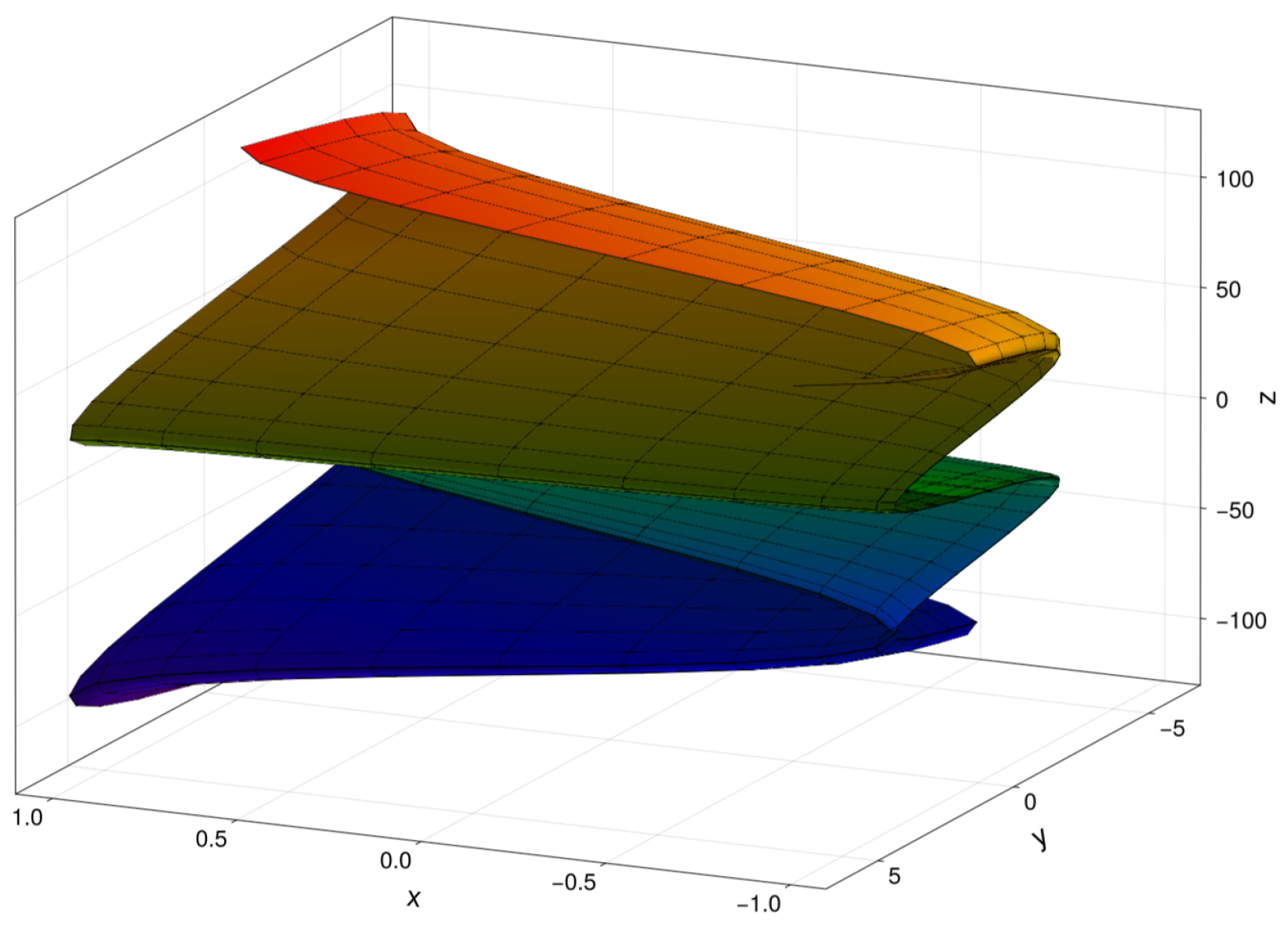
Example 2. Let M be a spherical product hypersurface given with the parametrization (10) in . For the functions , , and , we get the parametrization of M asThe unit normal vector field of M is given byfrom which it follows that the spherical product hypersurface is timelike. Moreover, since all coefficients of the second fundamental form vanish, the spherical product hypersurface is both flat and minimal. Choosing , the corresponding projection can be plotted by using Julia (v1.12.1) with the GLMakie library (v0.13.6) (see Figure 1). 4. Hyperquadrics in Minkowski 4-Space
In this section, the relationship between hyperquadrics and the concept of the spherical product will be presented.
Superellipses are special cases of Lame curves, named after Gabriel Lame, and they have the equation
where
is a positive real constant and
,
are nonzero real constants. Thus, the parametric equation can be given by
In (
22), when
, obviously it corresponds to an ellipse, which is a subject of analytic geometry [
11].
By analogy, the equation of a superhyperbola in Minkowski plane can be given as
which has the following parametrization:
Definition 2. Suppose three curves denoted by α, β, and γ are chosen in the form of superellipses or superhyperbola in the Minkowski plane. The spherical product of α, β, and γ is congruent to a hypersurface, called a hyperquadric in .
With the help of the spherical product of three superellipses or superhyperbola, we obtain some different types of superellipsoids, superhyperboloids, or supertoroids in hypersurface form.
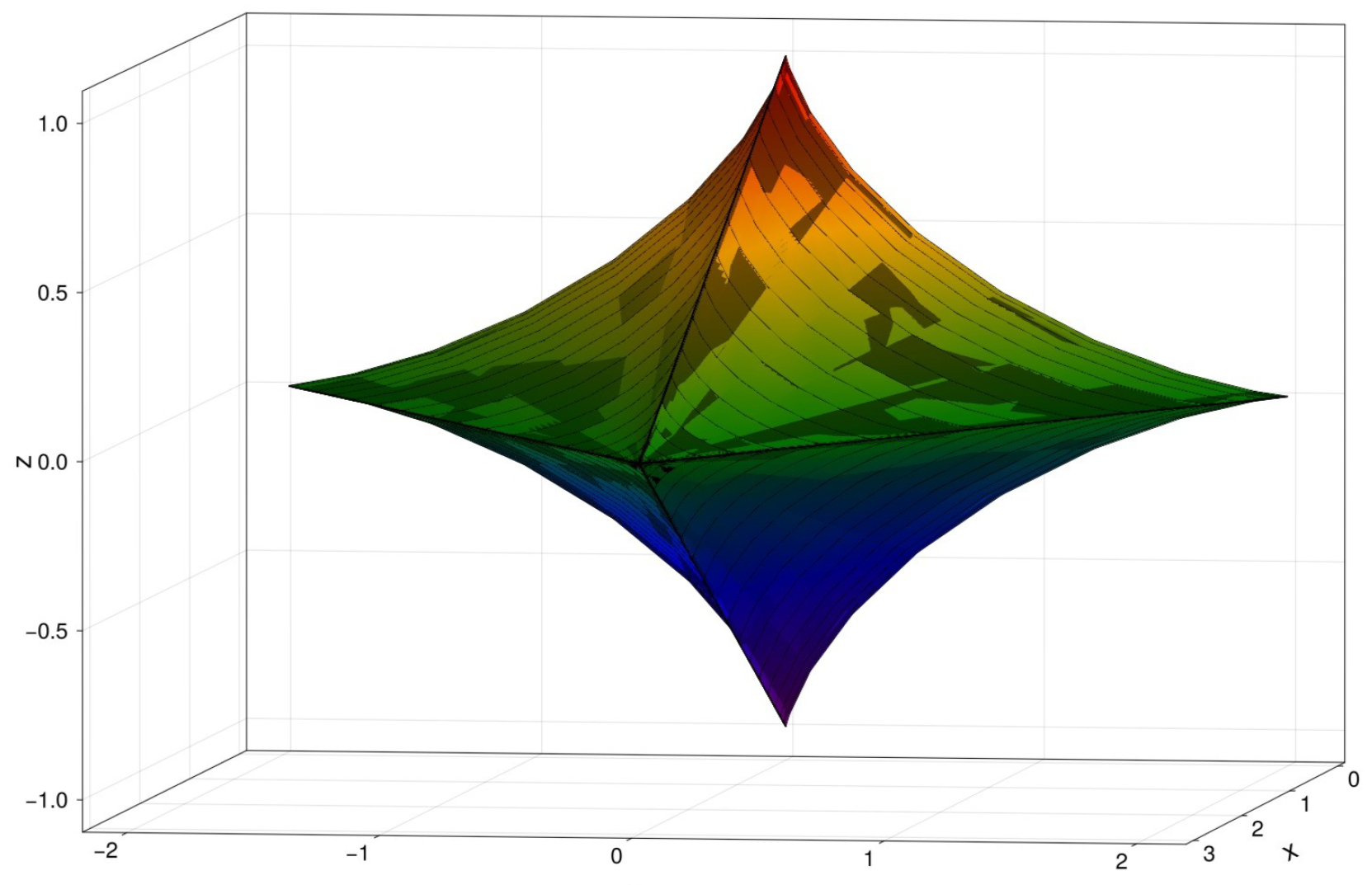
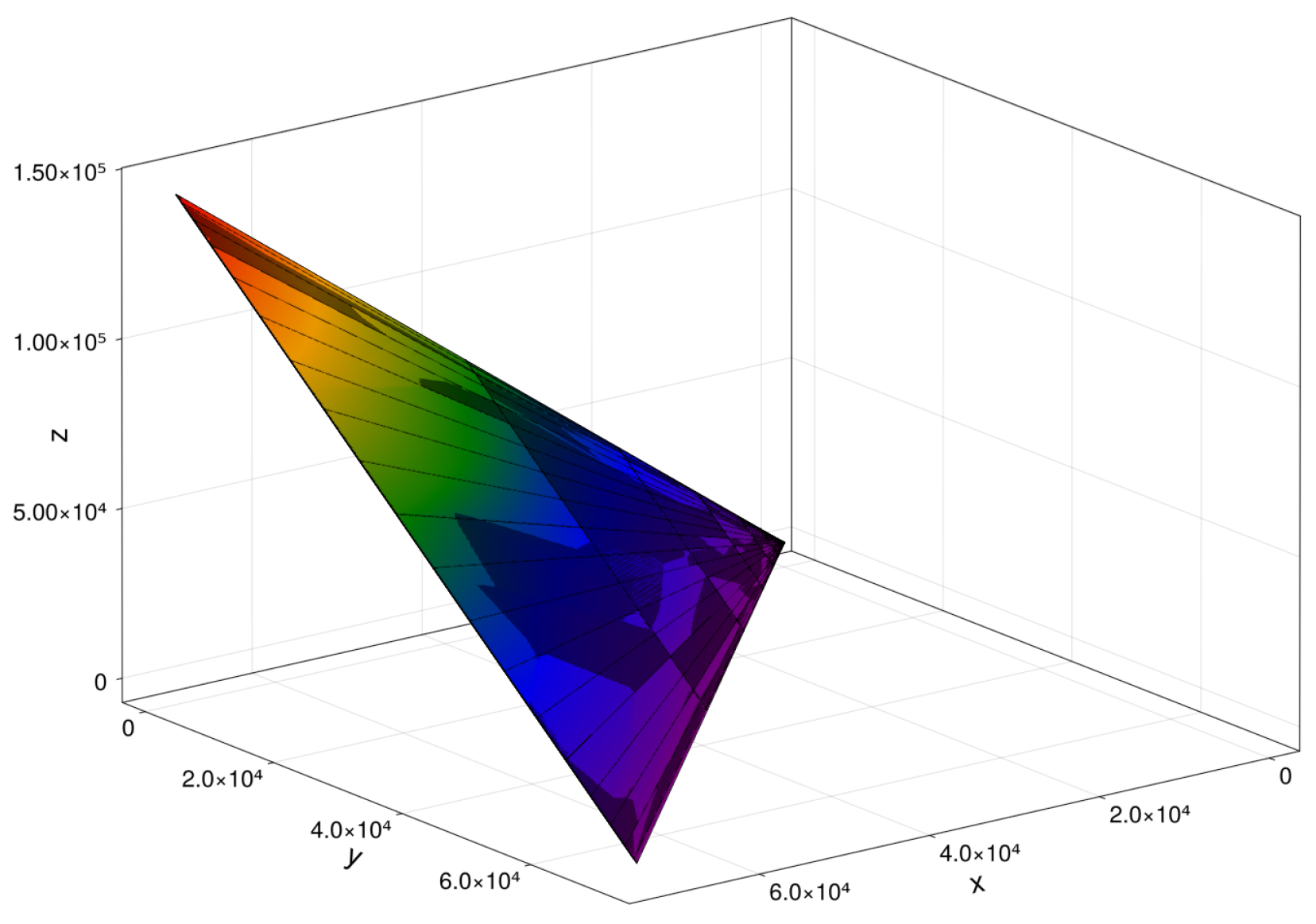
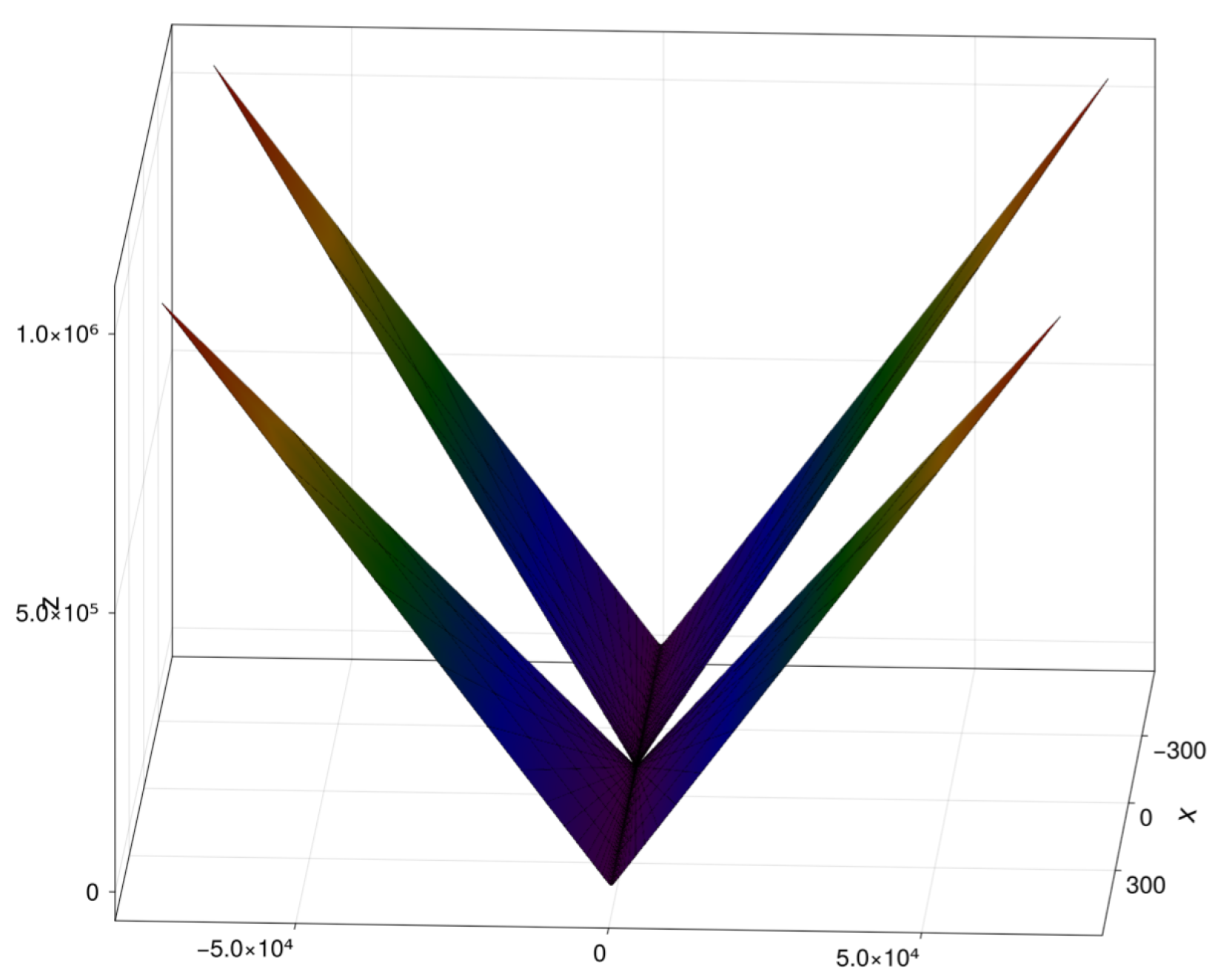
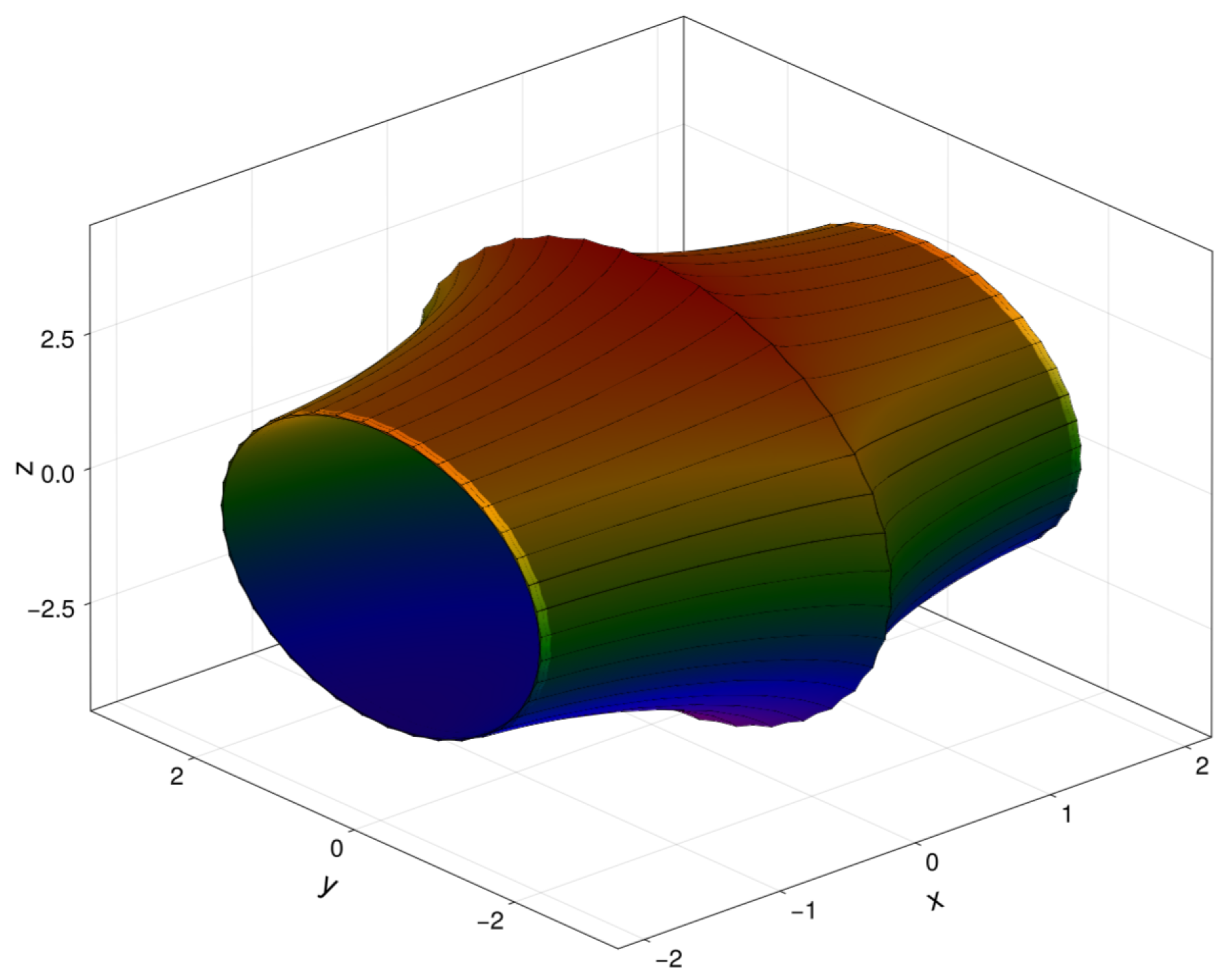
Proposition 1. Let the three superellipses α, β, and γ be given byThe spherical product of them is obtained as This corresponds to a hyperellipsoid, which has the equation in Cartesian coordinates Example 3. Let M be a superellipsoid given with the parametrization (23) in . Choosing , , , , , , and , the corresponding projection can be plotted by using Julia (v1.12.1) with the GLMakie library (v0.13.6), (see Figure 2). Proposition 2. Let the three curves (one superhyperbola and two superellipses) α, β, and γ be given byThe spherical product of them is obtained asThis parametric indication corresponds to an hyperboloid with one leaf in , and the following Cartesian equation is satisfied: Example 4. Let M be a hyperboloid given with the parametrization (24) in . Choosing , , , , , and , the related hypersurfaces’ projection in 3-dimensional space can be plotted by using Julia (see Figure 3). Proposition 3. Let the three superhyperbolas α, β, and γ be given byThe spherical product corresponds to a hyper-hyperboloid with two leaves in and has the parametrizationMoreover, this satisfies the following equation: Example 5. Let M be a superhyperboloid given with the parametrization (25) in . Taking and , the Gaussian curvature K and the mean curvature H are obtained byandrespectively. In particular, choosing , , , and , the corresponding hypersurface’s projection in 3-dimensional space can be plotted by using Julia (see Figure 4). Proposition 4. Let the curves α, β, and γ be defined aswhere are real constants. The spherical product of these three curves leads to the parametrizationThis parametrization corresponds to a toroidal hypersurface in and satisfies the Cartesian equation Example 6. Consider the toroidal hypersurface described by the parametrization introduced above in . Let us choose the constants as , , , and fix the parameter . Under these selections, a 3-dimensional projection of the corresponding hypersurface can be visualized using Julia (see Figure 5). 5. Generalized Spherical Product Hypersurfaces in Minkowski -Space
In this part, the representation of spherical product hypersurfaces are generalized to the n-dimension.
The spherical product of two curves in :
Firstly, let us consider the plane curves
and
with the parametrizations
and
. The spherical product of these two curves is
Thus, the spherical product hypersurface generated by these curves is parametrized by
The spherical product of three curves in :
Secondly, suppose that
,
, and
are plane curves with the parametrizations
,
, and
. The spherical product of these curves is
Thus, the spherical product hypersurface generated by these curves has the following parametrization:
The spherical product of four curves in :
Let
,
,
, and
be plane curves with the parametrizations
,
,
, and
. The spherical product of these curves is
Thus, the spherical product hypersurface generated by these curves has the following parametrization:
By following the steps outlined above, we get the equation of a spherical product hypersurface in Minkowski n-space.
The spherical product of curves in :
Now, let us consider the curves
in the Minkowski plane, which are given by
,
, …
. Then, a spherical product hypersurface in
is defined as
and represented as
where
,
are coordinate functions in
6. Conclusions
The concept of embeddings of product spaces was first defined by Kuiper between Euclidean spaces. Then spherical product immersion, a special case of embeddings of product spaces, has been studied by many authors so far.
In this work, we have considered the concept of the spherical product to construct hypersurfaces in Minkowski space and aimed to generalize such hypersurfaces to higher dimensions. Particularly, some classifications of spherical product hypersurfaces in have been provided, focusing on flat and minimal cases. In addition, some hyperquadric examples have been presented, as well as their projections to 3-dimensional space. We have seen that there is a close relationship between hyperquadrics and the concept of the spherical product.
These results place spherical product hypersurfaces as a flexible and analyzable class within Minkowski geometry, suggesting applications in geometric modeling and mathematical physics where symmetry, causal character, and curvature constraints are paramount. Promising directions include classification by causal type, rigidity under prescribed curvature, and variational problems for spherical product data in higher dimensions. In addition, the spherical product contributes rotational or Lorentzian symmetries, while hyperquadrics obtained through spherical products inherit all symmetries of the associated quadratic form. Consequently, the curvature conditions derived in this paper—such as flatness, minimality, and causal character—are compatible with and, in some cases, dictated by these underlying symmetry groups.
From the viewpoint of general relativity, our timelike spherical product hypersurfaces in may be interpreted as spacelike slices whose mean curvature H encodes the extrinsic geometry. In this setting, the minimal () and constant mean curvature cases are related to vacuum and constant mean curvature hypersurfaces used in spacetime models, while the flat condition (vanishing intrinsic curvature) corresponds to spatial slices with locally Euclidean geometry, compatible with embeddings inspired by Minkowski, Schwarzschild, or de Sitter spacetimes.
Author Contributions
Conceptualization, G.Ö.; Validation, S.B., I.K., G.Ö. and E.K.; Investigation, S.B., I.K. and G.Ö.; Writing—original draft, S.B. and I.K.; Writing—review & editing, S.B., I.K., G.Ö. and E.K.; Visualization, S.B., I.K. and E.K. All authors have read and agreed to the published version of the manuscript.
Funding
This research received no external funding.
Data Availability Statement
The original contributions presented in this study are included in the article. Further inquiries can be directed to the corresponding author.
Conflicts of Interest
The authors declare no conflicts of interest.
References
- Kuiper, N.H. Minimal total absolute curvature for immersions. Invent. Math. 1970, 10, 209–238. [Google Scholar] [CrossRef] [Scilit]
- Bulca, B.; Arslan, K.; Bayram (Kilic), B.; Öztürk, G.; Ugail, H. On spherical product surfaces in . In Proceedings of the Conference on Cyberworlds, Bradford, UK, 7–11 September 2009. [Google Scholar]
- Bulca, B.; Arslan, K.; Bayram (Kilic), B.; Öztürk, G. Spherical product surfaces in . An. St. Univ. Ovidius Constanta 2012, 20, 41–54. [Google Scholar] [CrossRef] [Scilit]
- Hsu, P.C. Asymmetric and symmetric spherical product surfaces with both implicit and parametric representations. Int. Jr. Math. Olymp. 2013, 3, 504. [Google Scholar] [CrossRef] [Scilit]
- Barr, A.H. Superquadrics and Angle-Preserving Transformations. IEEE Comput. Graph. Appl. 1981, 1, 11–23. [Google Scholar] [CrossRef] [Scilit]
- Yıldız, Ö.G.; Hızal, S.; Akyiğit, M. Type I Helicoidal Surfaces with Prescribed Weighted Mean or Gaussian Curvature in Minkowski Space with Density. Ananlele Stiintifice Ale Universtatii Ovidius Constanta-Ser. Math. 2018, 26, 99–108. [Google Scholar] [CrossRef] [Scilit]
- Eren, K.; Kosal, H.H. Evolution of space curves and the special ruled surfaces with modified orthogonal frame. AIMS Math. 2020, 5, 2027–2039. [Google Scholar] [CrossRef] [Scilit]
- Yıldız, Ö.G.; Akyiğit, M. Constructions of Type III Helicoidal Surfaces in Minkowski Space with Density. Int. Electron. J. Geom. 2019, 12, 20–25. [Google Scholar]
- Li, Y.; Eren, K.; Ersoy, S. On simultaneous characterizations of partner-ruled surfaces in Minkowski 3-space. AIMS Math. 2023, 8, 22256–22273. [Google Scholar] [CrossRef] [Scilit]
- Ma, H.; Ohnita, Y. On Lagrangian submanifolds in complex hyperquadrics and isoparametric hypersurfaces in spheres. Math. Z. 2009, 261, 749–785. [Google Scholar] [CrossRef] [Scilit]
- Jaklic, A.; Leonardis, A.; Solina, F. Superquadrics and their geometric properties. In Segmentation and Recovery of Superquadrics; Computational Imaging and Vision; Springer: Dordrecht, The Netherlands, 2000. [Google Scholar]
- Gielis, J.; Beirinckx, B.; Bastiaens, E. Superquadrics with rational and irrational symmetry. In Proceedings of the Eighth ACM Symposium on Solid Modeling and Applications (SM ’03), Seattle, WA, USA, 16–20 June 2003. [Google Scholar]
- Solina, F.; Bajcsy, R. Recovery of parametric models from range images: The case for superquadrics with global deformations. IEEE PAMI 2002, 12, 131–147. [Google Scholar] [CrossRef] [Scilit]
- Tosun, M.; Güngör, M.A.; Samancı, C.; Ersoy, S. Yarı-Öklidiyen uzayında yarı-hiperregle yüzeyler. Fırat Univ. J. Sci. Eng. 2004, 16, 597–606. [Google Scholar]
- Altın, M.; Kazan, A. Rotational hypersurfaces in Lorentz-Minkowski 4-space. Hacet. J. Math. Stat. 2021, 50, 1409–1433. [Google Scholar] [CrossRef] [Scilit]
- Güler, E. Helical hypersurfaces in Minkowski geometry . Symmetry 2020, 12, 1206. [Google Scholar] [CrossRef] [Scilit]
- Güler, E. Timelike Rotational Hypersurfaces with Timelike Axis in Minkowski Four Space. Commun. Fac. Sci. Univ. Ank. Ser. A1 Math. Stat. 2023, 72, 331–339. [Google Scholar] [CrossRef] [Scilit]
- Büyükkütük, S.; Öztürk, G. Spherical product hypersurfaces in Euclidean spaces. Turk. J. Math. 2024, 48, 903–913. [Google Scholar] [CrossRef] [Scilit]
- Neill, B.O. Semi-Riemannian Geometry with Applications to Relativity; Academic Press Inc.: New York, NY, USA, 1983; Volume 103. [Google Scholar]
- Lopez, R. Differential geometry of curves and surfaces in Lorentz-Minkowski space. Int. Electron. J. Geom. 2014, 7, 44–107. [Google Scholar] [CrossRef] [Scilit]
| Disclaimer/Publisher’s Note: The statements, opinions and data contained in all publications are solely those of the individual author(s) and contributor(s) and not of MDPI and/or the editor(s). MDPI and/or the editor(s) disclaim responsibility for any injury to people or property resulting from any ideas, methods, instructions or products referred to in the content. |