


Abstract
This study is motivated by the need to investigate the largest possible collection of classical separation axioms within a newly introduced triple structure of generalized primal topological spaces, and to understand how primal collections influence these familiar notions. The purpose of the paper is to extend several classical concepts by introducing new classes of separation axioms, including -, -, and - for . Within the same framework, we also define - sets and - sets, which naturally lead to new symmetric variants of separation axioms such as -, -weakly regular, -, and -. The main contribution of this work lies in establishing the relationships among these newly introduced axioms and demonstrating how primal collections affect their behavior. Several illustrative examples based on simple graphs are provided to highlight the structure and significance of the results. Overall, the findings offer a broader perspective on separation phenomena in generalized primal settings and deepen the understanding of symmetry within these spaces.
Keywords:
primal collection; generalized topology; generalized primal topology; separation axioms; GP-homeomorphism MSC:
54A05; 54C10; 54A10
1. Introduction
Separation axioms in the theory of topology are mostly formulated to recognize non-homeomorphic topologies. If there are two topological spaces such that one satisfies a separation axiom but not the other, these two topologies are not homeomorphic. These axioms have received great interest from topologists for a long time. A topological space that satisfies is called a -space for short.
Recently, in [1], the author offered a special kind of structure called generalized primal topological spaces. This structure possesses all the properties of a generalized topology in the sense of a new topological structure called “primal collection.” Then, Al-Saadi and Al-Malki [2] studied some types of weak open sets based on an operator employing primal, which satisfied Kuraski’s closure axioms. The concept of “continuity” has gained a lot of attention for its importance in topology. Several types of generalized primal continuous functions are described in [3].
In this study, we continue our work to clarify the notion of “separation axioms” in this new structure. This paper contains five sections, presented as follows.
Section 1 contains two sub-sections. The first deals with previous studies on which this scientific paper was based. The second includes a recall of the basic concepts and results. Section 2 presents several types of separation axioms, which are based on the concept of -set. Next, we study the relationship between them and the axioms for We also introduce for the axioms, which are based on the concept of closure. In Section 3, we present the definition of --set and --set, which leads us to new and multiple types of axioms. In Section 4, we present the fundamental theorem and propositions that are connected between the -continuous function and the -homeomorphism function and the separation axioms. Finally, we discuss the conclusions of this research.
1.1. Literature Review
Over the years, various classical mathematical structures have appeared. The mathematical construction “grill” [4] was introduced as a useful tool for investigating topological concepts with significant applications in the field of topology. Building on this, Acharjee [5] introduced the dual structure, called a “primal”, in 2022. A collection of is named a primal over X when the following requirements hold for all : (i) X never belongs to ; (ii) if and , then ; (iii) if , then either A or B belongs to . A primal topological space ( space) is defined as the triple .
In 1997, Császár [6] established the notion of generalized topological spaces, ( spaces), where a family of subsets of X satisfies the following: (i) ∅ (the empty set) always belongs to ; (ii) any union of members of is also a member of . is considered a generalized topological space. According to [7], each element in X is called a -open set, and -closed refers to its complement. Respectively, and denote the closure and interior of A.
Various studies have investigated the topological properties of generalized spaces. In particular, separation axioms have been explored extensively. For example, ref. [8] introduced early forms of generalized separation axioms, ref. [9] examined their extensions in different contexts, ref. [10] focused on applications of these axioms in specific topological structures, and ref. [11] analyzed neighborhood structures under these axioms. Separation axioms have also been extended by substituting the concept of open sets with more generalized expressions [12,13]. Several forms of generalized continuity have been studied: contra generalized continuity [14], almost generalized continuity [15], and strong generalized continuity [16].
Although both and have been studied extensively, their integration has not been systematically explored. Generalized primal topological spaces ( spaces), introduced by [1], combine the structural constraints of with the flexibility of , resulting in a unified framework where classical concepts such as separation axioms and continuity can be independently developed and analyzed. This integration allows us to investigate how primal collections influence generalized notions, filling a gap in the literature. In particular, three previous studies [1,2,3] addressed foundational aspects of spaces: ref. [2] studied a collection of new generalized structures, and ref. [3] focused on continuous functions and their generalizations in spaces.
While these studies have significantly advanced the understanding of classical and generalized structures, they do not fully integrate the effects of primal collections. Therefore, spaces offer a novel framework where separation axioms can be independently developed and analyzed. This work aims to fill this gap and highlight the influence of primal collections on classical topological notions.
1.2. Preliminaries
First, let us recall some basics about spaces.
Definition 1
([1]). A generalized primal topological space, or ( space), is a generalized topology and a primal defined on The indication symbolizes the space.
Definition 2
([1]). Let be a space with and we have the following:
- (i)
- This structure’s members are called -open sets. The complement of -open sets is called -closed sets.
- (ii)
- symbolize the family of -closed sets.
- (iii)
- symbolize the closure of Hence, is given as the intersection of all -closed sets which contain A.
- (iv)
- A space is named strong if where
- (v)
- An operator is called a generalized primal neighborhood of x, if for each
- (vi)
- An operator is defined by
Definition 3
([3]). Let X and be spaces. A function is known as -continuous if for each -open set is -open.
Also, when f is -continuous, we get
Moreover, -continuity of f leads to then
Definition 4
([3]). A function is known as -closed if for each -closed set U in the image is -closed in
It follows from the above definition that f is -closed iff
for all
2. Separation Axioms
Sarsak [17] studied the separation axioms: -, -, -, -, -, -, -, and - in generalized topological spaces. In this section, we study the alternative definitions of these kinds of separation axioms in a generalized primal topological space. Also, we investigate the main features of them.
Definition 5.
Let be a space with A is known as a -set when we have -open sets U and V satisfies with .
Note that every -open set is -open. Moreover, a space X is known as - if for each with there exists a -set U of X that satisfies or vice versa. However, since a -set is always contained in a space in which contains more than one point trivially does not have the property -.
Example 1.
Consider
We have that is a space. Then, the family of -open sets coincides with , and hence
Consequently,
which is an infinite set. Since every -set is of the form , where U is a -open set with , it follows that every -set is contained in .
Hence, no -set can separate any two distinct points of . Therefore, the space does not satisfy the - property.
Hence, we present the notion of - for as follows:
Definition 6.
Let be a space; X is known as
- (i)
- - if for each there exist -sets U and V satisfying and
- (ii)
- - if for each there exist disjoint -sets satisfying and
Definition 7.
Let be a space. Then, X is known as
- (i)
- - if for each there exists -open set containing precisely one element of x and y;
- (ii)
- - if each there are -open sets U and V satisfying and and and ;
- (iii)
- - if each there are disjoint -open sets U and V satisfying and ;
- (iv)
- -regular if for each -closed set F and there are disjoint -open sets U and V satisfying and ;
- (v)
- -normal if for all -closed sets A and B satisfying there are disjoint -open sets U and V satisfying and
Remark 1.
Let be a space. When
- (i)
- X is - it is -;
- (ii)
- X is - it is -;
- (iii)
- X is - it is -
Theorem 1.
Let be a space.
- (i)
- X is - iff X has the - property;
- (ii)
- X is - iff X has the - property.
Proof.
where and are -sets. Now, implies or and Now, if , from we get the next two cases:
(i) Consider X as - and Thus, there is a -set G satisfying Thus, there are -open sets and satisfying Thus, and If then is the required set. If , then and satisfies the matter.
- The opposite direction follows from Remark 1.
- (ii) Consider X as - and with . Then, there exist -sets and satisfies and Consider
- (1)
- From we get From we get Also,
- (2)
- and We get and and
Moreover, if and , we get and and
The opposite direction follows from Remark 1. □
Corollary 1.
Let be a space. When is - then it is -
Theorem 2.
Let be a space. Then, X is - iff for every with we have
Proof.
Let space be - Hence, for every with -open set U satisfies Thus, is -closed, with , which implies Hence,
Note that Therefore, □
Theorem 3.
Let be a space. X is - iff for every is a -closed set.
Proof.
Consider as -closed. Also, for each consider Thus, the complements of and are -open sets with and Therefore, the space is - □
Definition 8.
Let be a space. A point is called -neat point if leads to
Remark 2.
Let be a space. If X is - and has -neat point, then it is unique.
Theorem 4.
Let be a space. If X is - and has no -neat point, then it is -
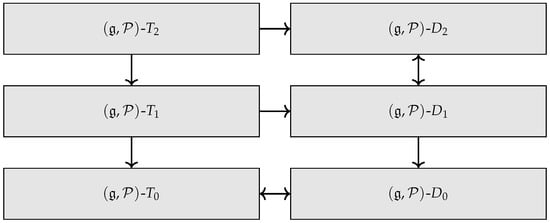
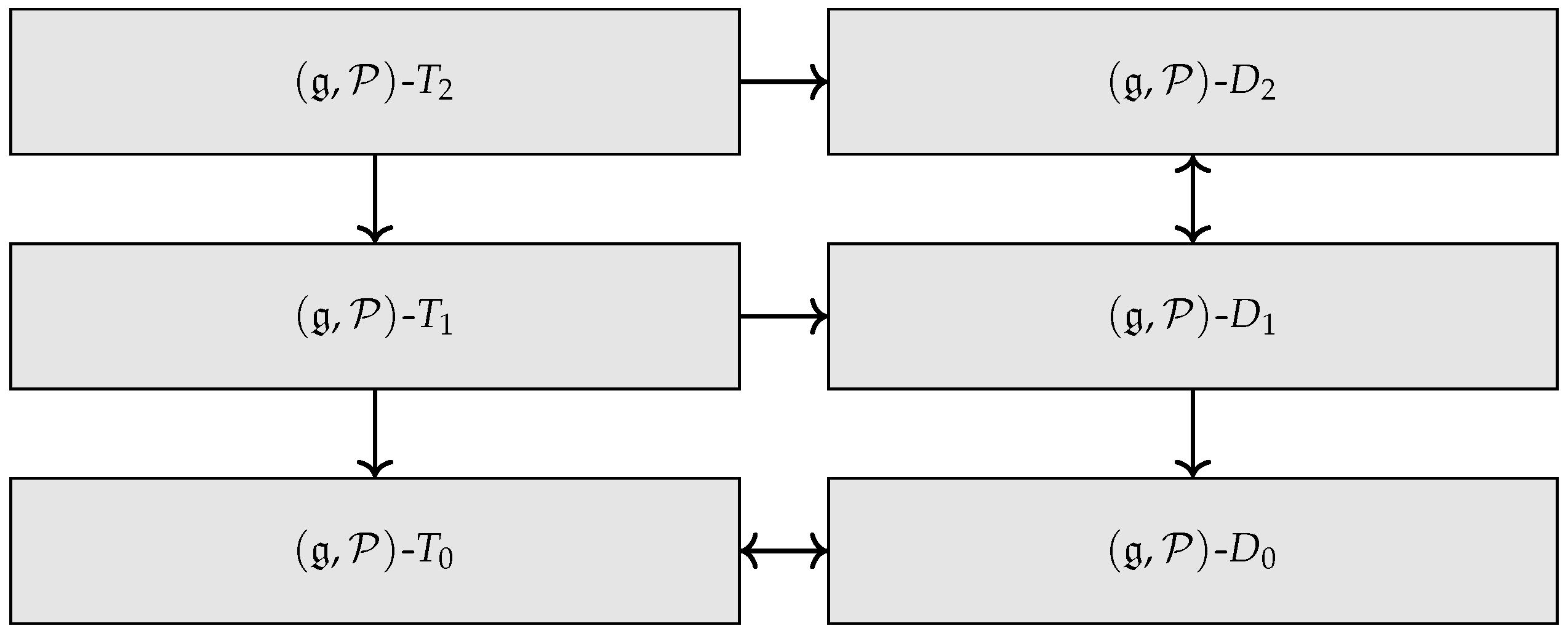
In Figure 1, we present the relationship among the above notions in a simple way.
Figure 1.
The relationship among the separation axioms in spaces.
Example 2.
Consider the infinite space defined as follows:
- (i)
- We show that for each pair of distinct elements in , there exists a -open set that contains exactly one of them. This proves that the space satisfies the - separation axiom.Consider any two distinct points .Case 1: One of the points is 1. Assume without loss of generality that and . Since any subset of containing 1 is -open and satisfiesThus, 1 is distinguished from any other point in X.Case 2: Both points are greater than 1. Suppose and with . The set is -open because it contains the element 1. Moreover,Hence, n is distinguished from m by a -open set.Since in both cases we can find a -open set containing exactly one of x and y, the space satisfies the - property.
- (ii)
- The space is not -. Since every nonempty -open set must contain the element 1, no -open set can isolate any from 1. Thus, the - requirement fails for pairs . Consequently, the space cannot satisfy the stronger - property.
- (iii)
- Since the space represents -, it also represents the --property, Theorem 1.However, no pair of disjoint -open sets can separate all distinct elements of the space. Therefore, the space does not satisfy the - property, and consequently, it also does not satisfy the - property.
Definition 9.
Let be a space. Then, X is known as
- (i)
- - when implies
- (ii)
- - when for every satisfiesthere exist disjoint -open sets U and V satisfying
In a space that is not strong, it is impossible for the closure of any set to be contained in -open set, as is required in definitions of - and - Then, a that is not strong is not a - unless = ∅. Similarly, it is not a -
Theorem 5.
Let be a space. Then,
- (i)
- X is - iff it is - and -;
- (ii)
- When X is - then it is -
Proof.
The result is obtained as a direct consequence of Definition 7 together with Theorems 2 and 3. □
Definition 10.
Let be a space. Then, X is called -symmetric if for each satisfying we get
Theorem 6.
Let be a space. Then, X is - iff it is -symmetric.
Theorem 7.
Let be a space. Then, X is - iff for every with there exist disjoint -open sets satisfying
Corollary 2.
Let be a space. Then, X is - iff for every satisfying there exist disjoint -open sets U and V satisfying
and
Corollary 3.
In a - space X, the following are identical:
- (i)
- X is -.
- (ii)
- X is -.
- (iii)
- X is -.
Corollary 4.
In a space X, the following are identical:
- (i)
- X is -.
- (ii)
- X is - and -
- (iii)
- X is - and -
Corollary 5.
In a - space X, the following are identical:
- (i)
- X is -.
- (ii)
- X is -.
- (iii)
- X is -.
Definition 11.
Let be a space with The -kernel of denoted by - is given by
Lemma 1.
Let be a space with Thus,
Lemma 2.
Let be a space with Thus,
Lemma 3.
Let be a space with Then,
Corollary 6.
Let be a space. Then, X is - iff for every satisfying
there are disjoint -open sets satisfying
Theorem 8.
Let be a space. Then, X is - iff every satisfying
leads to
The following counterexamples demonstrate -spaces where the - and - properties fail, highlighting the role of the -kernel in understanding closure and separability.
Example 3.
this space does not represent the - property.
Consider the infinite -space defined by
The closures of singletons are
The -kernels are
Therefore, this space does not represent the - property.
- Also, since
Theorem 9.
Let be a space. Then, X is - iff for each we get
leads to
Theorem 10.
In a space X, the following are identical:
- (i)
- X is -
- (ii)
- For every satisfying there is a -closed set F satisfying
- (iii)
- Every has the property
- (iv)
- Every -closed set F has the property
- (v)
- Every has the property
Theorem 11.
In a space, the following are identical:
- (i)
- X is -;
- (ii)
- When F is -closed, we get -
- (iii)
- When thus -
Theorem 12.
Let be a space. Then, X is - iff for each we get
3. More Types of Separation Axioms
Following the same approach, some researchers present different types of separation axioms in generalized topology, for example, , weakly regular, and in [18,19]. Here, we will study them on spaces.
Definition 12.
Let be a space. A subset is known as a --set when A represents a countable intersection of -open sets. Moreover, its complement is known as a - set.
Definition 13.
Let be a space. A subset is known as a regular --set if
where each in the sequence is a -closed set.Moreover, its complement known as a regular --set, which means that A is a regular --set if
where each is -open.
Definition 14.
where is a regular --set.
Let be a space. A subset is called a --open set if
where each is a regular - set.
- Moreover, its complement is called --closed, which means that A is --closed when
Definition 15.
Let be a space. A subset A is known as -d-closed if
Lemma 4.
Let be a space with The following are true:
- (i)
- When A is a regular --set, thus , consider as --closed;
- (ii)
- Each regular --set consider as a --set;
- (iii)
- When A is a regular --set, thus , consider as -closed;
- (iv)
- Each -closed set F satisfying , consider as a --set;
- (v)
- Each -d-closed set consider as -closed;
- (vi)
- Each --closed set consider as -d-closed.
Proof.
The proof comes immediately from the definitions. □
Definition 16.
For a space X with
- (i)
- A collection contained in is called a -open complementary system if for every there exists a sequence in satisfying
- (ii)
- A subset A is known as strongly open --set when we have a countable -open complementary system satisfying . Moreover, its complement is known as a strongly closed --set.
- (iii)
- Any intersection of a strongly closed --set is a --closed set. Then, each strongly closed --set is considered as --closed.
- (iv)
- Each --closed set is considered as -d-closed.
The following examples illustrate infinite -spaces where certain new separation axioms hold, highlighting the role of -closed sets, - sets, and -kernels.
Definition 17.
A space is called weakly - if
Theorem 13.
A space X is weakly - iff X has no -neat points.
Proof.
Then, any -open set containing y must be Thus, y is -neat point of is a contradiction. □
Consider X as a space that is weakly - and X has a -neat point Thus, for every is a contradiction.
- Conversely, let the space have no -neat points and not be weakly - Then, there exists a
Theorem 14.
When a space X is - and weakly - then it is -
Theorem 15.
A space is weakly - iff for each
Proof.
is a contradiction. □
Consider X as weakly -. Consider as satisfying
According to Lemma 2, is a contradiction.
- Conversely, let for every x that belongs to If X is not weakly -, then according to Theorem 13, it has a -neat point Therefore,
Definition 18.
A space is called
- (i)
- - if for every -open set there exists -closed set F satisfying
- (ii)
- -weakly regular if it has a base is regular --set
- (iii)
- - if for every -open V and for every there exists a regular --set F satisfying
- (iv)
- - if for all -open V and for all there exists a --closed set F satisfying
- (v)
- - if for all there exists a -closed set F satisfying is a --set with
- (vi)
- - if for all there exists a -d-closed set F satisfying
- (vii)
- - if for all -open set V and for all there exists a strongly closed --set F satisfying
- (viii)
- - if for all -open set V and for all there exists a --closed set F satisfying
Theorem 16.
When a space X is - then it is -
Proof.
Consider that satisfies Thus,
As the space is - thus --closed set
satisfies
Thus, and for some Now
where is a sequence of -closed sets. Then, there exists such that and Then, and are required -open sets. □
Example 4.
Consider the space defined as
For each , define a descending sequence of -open sets:
The corresponding -closures:
Define the --closed set associated with x:
So, for any -open set U with , there exists --closed satisfying
Hence, this space represents - and, by Theorem 16, is also -.
Theorem 17.
A -weakly regular space is -
Proof.
Consider and Thus, Hence, there exists a regular --set F satisfying
Let
where and for some Then,
Hence, Therefore, □
Theorem 18.
When a space X is -regular, hence it is -
Proof.
Consider X is as -regular with Hence, -open set satisfies
Again -regularity yields a -open set with
By induction we get a sequence of -open sets satisfying
Then, the set
is a regular --set satisfying □
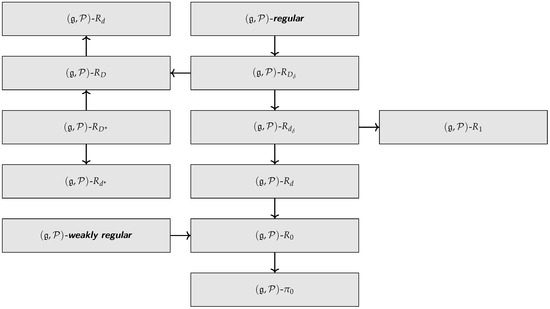
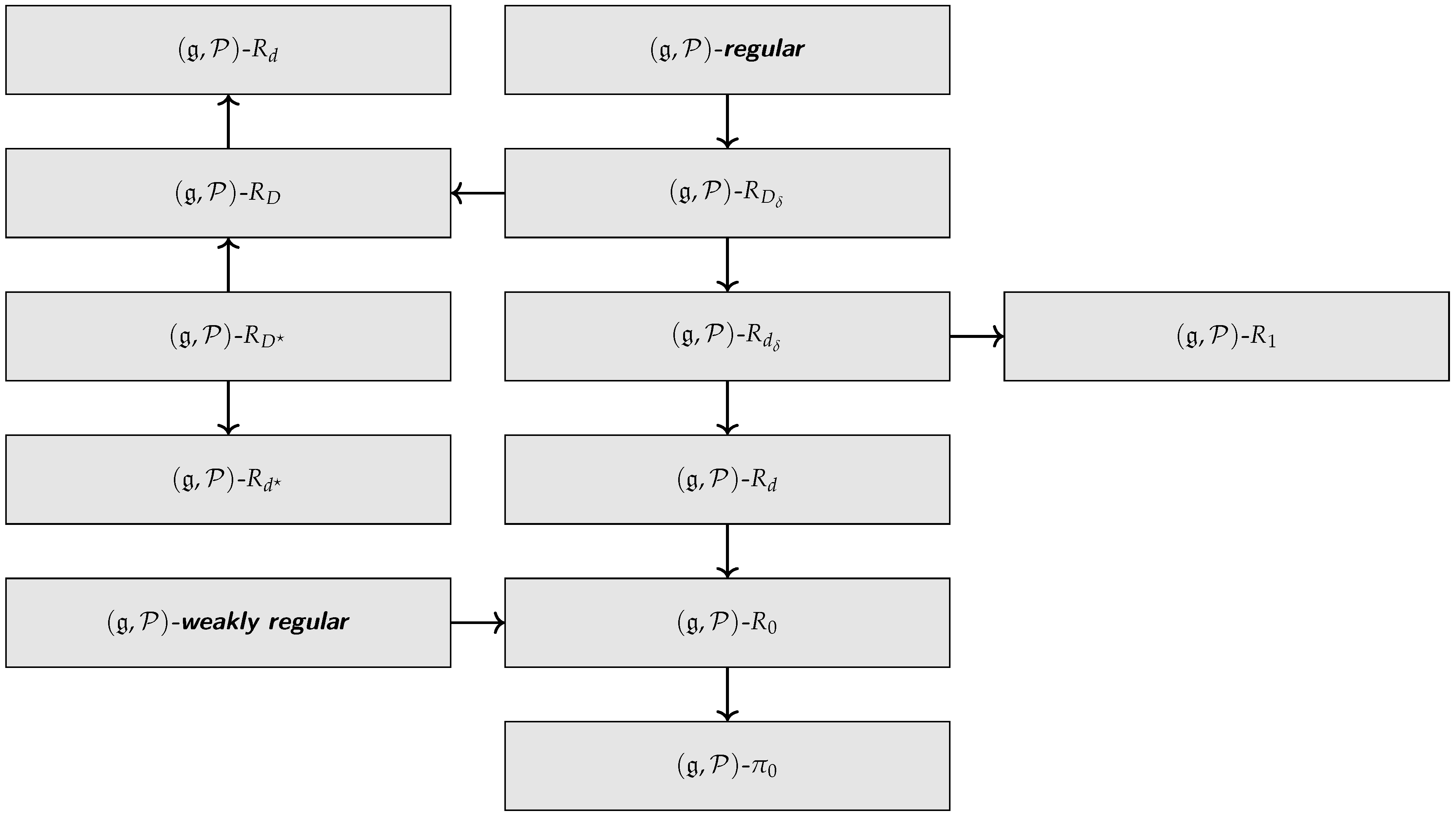
We can summarize the previous results in the following diagram (Figure 2).
Figure 2.
The relationship among new kinds of separation axioms in a space.
Example 5.
Consider the space:
- (i)
- Let the base of -weakly regular sets beEach F is a regular --set (countable union of -closed sets). Every -open set U contains a set from the base . Thus, this space represents -weakly regular and, by Theorem 17, is also -, hence -
- (ii)
- Define the closures of singletons asThe corresponding -kernels are- does not hold for , since no - closed set satisfies for arbitrary U containing n, showing that -weakly regular ⇏- in this space.
- (iii)
- Similarly, - fails for , showing that -weakly regular ⇏ in this space.
It is worth mentioning that focusing the study on special classes of sets whose definitions rely on the primal collection often leads to results that are particularly interesting. This is exactly the approach we shall adopt next. To begin, we first define the notion of a -open set within a GPT-space.
4. -Homeomorphism Mapping
As we said previously, separation axioms in the theory of topology are very important for the rule that plays to recognize non-homeomorphic topologies. In this section, we present the fundamental theorem and propositions about the -continuous functions and the -homeomorphism functions.
Definition 19.
Assuming X and are two spaces and h is a function from X into Then, h is called -homeomorphism if it is bijective, -continuous, and its inverse is -continuous too.
Theorem 19.
Let X and be two spaces. When a -continuous function satisfies
the following are true:
- (i)
- The inverse image or (for short ) of --sets is --set;
- (ii)
- of a strongly closed --set is a strongly closed --set;
- (iii)
- of a --closed set is --closed;
- (iv)
- of a regular --set is regular --set;
- (v)
- of a --closed set is --closed;
- (vi)
- of s -d-closed is -d-closed.
Proof.
(iv) Consider a regular --set H given by
Then,
Now,
Since
the result follows.
where is regular --set, be --closed. Now, apply (iv). Then,
(vi) Comes directly from (i). □
(i) and (iii) are clear.
- (ii) Is true since
- (v) Let
Theorem 20.
Let X and be two spaces. When X is finer than and X is - (resp. -, -, -, -, -), then is - (resp. -, -, -, -, -).
Theorem 21.
Let X and be two spaces. When a -continuous function satisfies
then is -set for each -set
Theorem 22.
Let X and be two spaces. When is - and is -continuous such that h is injective on and satisfies
then X is -
Theorem 23.
A space X is - iff for all with there exists a space and -continuous mapping , where is - with
Theorem 24.
Let X and be two spaces. Assuming as a -continuous and -closed function satisfying
When X is -, then is -.
Proof.
Consider Thus, there exists satisfying Then, Since X is -
As h is -closed,
as Therefore,
Thus, is -. □
Theorem 25.
Let X and be two spaces. When , consider as -homeomorphism and X as -, thus is -
Proof.
Consider and Then,
Since
Therefore,
where As X is --open sets satisfying and Then, are disjoint -open with Thus, is - □
Theorem 26.
Let X and be two spaces. When is -closed injection function satisfying
implies
X is weakly - thus is weakly -
Proof.
Since X is weakly - then
Since h is an injection,
As h is a -closed function,
Therefore, is weakly - □
5. Discussion
In this section, we provide a brief discussion highlighting that certain classical axioms in spaces may differ when restricted to a primal collection. Based on this observation, we introduce relevant definitions and preliminary concepts to clarify the structural differences. This framework will allow us to systematically analyze the consequences of these restrictions.
Definition 20.
In a space X, a subset is called -open if
Definition 21.
A space X is said to be -Hausdorff if for any two distinct points , there exist two disjoint -open sets U and V such that and .
It is important to note that the relationships between separation axioms may differ when we restrict attention to -open sets. In particular, one property does not necessarily imply the other without specific assumptions on the primal collection.
Remark 3.
A -Hausdorff space does not necessarily imply that it is -Hausdorff, and vice versa.
To illustrate, consider a subset . If , then (see Theorem 3.1 [1]), meaning that no set other than the empty set is -open. Consequently, it is impossible to find two disjoint -open sets containing two distinct points.
Furthermore, consider with and primal collection . This example demonstrates that a -Hausdorff space may fail to be -Hausdorff.
Within the framework developed in this paper, however, every -Hausdorff space is indeed a -Hausdorff space, while the converse does not always hold. To avoid ambiguity, we shall adopt the term -Hausdorff to refer to the new notion.
Definition 22.
A space X is called -Hausdorff if for each pair of distinct points , there exist two -open sets and such that , , and .
From Definition 22, it follows that every -Hausdorff space is -Hausdorff, regardless of the specific primal collection.
Consider the infinite space
Observe that without considering the primal collection, the space fails to be Hausdorff because it is impossible to find disjoint -open sets separating points . However, with the primal collection included, we can define -open sets that separate each point of X, ensuring that the space is -Hausdorff. This example clearly shows that the primal collection has a direct effect on separation properties, even in infinite spaces.
6. Conclusions
In this paper, we introduced new classes of separation axioms within the framework of generalized primal topological () spaces and analyzed their interrelations. These axioms extend classical concepts and provide a deeper understanding of the structural properties of spaces. Our results demonstrate how primal collections influence generalized notions of separation and continuity, thereby enriching the theoretical foundation of spaces.
For future research, several specific directions are suggested:
- 1.
- Extension to higher-order spaces: Investigate how the newly introduced separation axioms behave in more complex or higher-dimensional spaces, possibly with additional algebraic or combinatorial structures.
- 2.
- Applications in functional analysis and continuity: Study how generalized continuous functions and other types of function mappings behave under these new axioms, and whether new classes of continuous functions emerge.
- 3.
- Connections with other generalized topologies: Explore relationships between spaces and other generalized or hybrid topological structures, such as soft topologies, fuzzy topologies, or closure spaces, to identify common properties and potential unifying frameworks.
- 4.
- Algorithmic and computational aspects: Develop algorithms to construct spaces satisfying certain separation axioms, and investigate computational complexity of checking these properties in finite or discrete settings.
- 5.
- Topological invariants and classification: Examine whether these new axioms lead to new invariants or classifications within spaces, aiding in the systematic categorization of different types of generalized primal topologies.
These directions aim to deepen the understanding of spaces and extend their theoretical and practical applications in mathematics.
In summary, this work provides a deeper insight into the structure and properties of spaces through the introduction of new separation axioms. The results not only extend classical topological concepts but also offer a foundation for further theoretical and practical developments. Future studies may build on these findings to explore more complex structures, applications, and connections with other generalized topologies.
Author Contributions
Conceptualization, H.A.-S. and H.A.-M.; methodology, H.A.-S. and H.A.-M.; formal analysis, H.A.-S. and H.A.-M.; writing—original draft, H.A.-S. and H.A.-M.; writing—review and editing, H.A.-S. and H.A.-M.; funding acquisition, H.A.-S. All authors have read and agreed to the published version of the manuscript.
Funding
This research received no external funding.
Data Availability Statement
Data are contained within the article.
Conflicts of Interest
The authors declare no conflicts of interest.
References
- Al-Saadi, H.; Al-Malki, H. Generalized primal topological spaces. AIMS Math. 2023, 8, 24162–24175. [Google Scholar] [CrossRef] [Scilit]
- Al-Saadi, H.; Al-Malki, H. Categories of open sets in generalized primal topological spaces. Mathematics 2024, 12, 207. [Google Scholar] [CrossRef] [Scilit]
- Al-Saadi, H.; Al-Malki, H. Strong GP-continuty and weakly GP-closed functions on GPT. J. King Saud Univ.-Sci. 2024. [Google Scholar] [CrossRef] [Scilit]
- Choquet, G. Sur les notions de filtre et de grille. Comptes Rendus Acad. Sci. Paris 1947, 224, 171–173. [Google Scholar]
- Acharjee, S.; Özkoc, M.; Issaka, F.Y. Primal topological spaces. Bol. Soc. Para. Mat. 2025, 43, 1–9. [Google Scholar] [CrossRef] [Scilit]
- Császár, Á. Generalized open sets. Acta Math. Hung. 1997, 75, 65–87. [Google Scholar] [CrossRef] [Scilit]
- Császár, Á. Generalized topology, generalized continuity. Acta Math. Hung. 2002, 96, 351–357. [Google Scholar] [CrossRef] [Scilit]
- Császár, Á. Extremally disconnected generalized topologies. Ann. Univ. Sci. Bp. 2004, 47, 91–96. [Google Scholar]
- Császár, Á. δ- and θ-modifications of generalized topologies. Acta Math. Hung. 2008, 120, 275–279. [Google Scholar] [CrossRef] [Scilit]
- Császár, Á. Remarks on quasi topologyies. Acta Math. Hung. 2008, 119, 197–200. [Google Scholar] [CrossRef] [Scilit]
- Császár, Á. Generalized open sets in generalized topologies. Acta Math. Hung. 2005, 106, 53–66. [Google Scholar] [CrossRef] [Scilit]
- Császár, Á. Separation axioms for generalized topologies. Acta Math. Hung. 2004, 104, 63–69. [Google Scholar] [CrossRef] [Scilit]
- Xun, G.E.; Ying, G.E. μ-Separations in generalized topological spaces. Appl. Math. J. Chin. Univ. 2010, 25, 243–252. [Google Scholar] [CrossRef] [Scilit]
- Jayanthi, D. Contra continuity on generalized topological spaces. Acta Math. Hung. 2012, 137, 263–271. [Google Scholar] [CrossRef] [Scilit]
- Min, W. Almost continuity on generalized topological spaces. Acta Math. Hung. 2009, 125, 121–125. [Google Scholar] [CrossRef] [Scilit]
- Min, W.; Kim, Y. Some strong forms of (g,g‵)-continuity on generalized topological spaces. Honam Math. J. 2011, 33, 85–91. [Google Scholar] [CrossRef] [Scilit]
- Sarsak, M.S. Weak separation axioms in generalized closed. Acta Math. Hung. 2011, 131, 110–121. [Google Scholar] [CrossRef] [Scilit]
- Kohli, J.K.; Singh, D. Dδ-supercontinuous functions. Indian J. Pure Appl. Math. 2003, 34, 1089–1100. [Google Scholar]
- Kohli, J.K.; Tyagi, B.K.; Singh, D.; Aggarwal, J. Rδ super-continuous functions. Demonstratio Math. 2014, 47, 433–448. [Google Scholar] [CrossRef] [Scilit]
Disclaimer/Publisher’s Note: The statements, opinions and data contained in all publications are solely those of the individual author(s) and contributor(s) and not of MDPI and/or the editor(s). MDPI and/or the editor(s) disclaim responsibility for any injury to people or property resulting from any ideas, methods, instructions or products referred to in the content. |
© 2026 by the authors. Licensee MDPI, Basel, Switzerland. This article is an open access article distributed under the terms and conditions of the Creative Commons Attribution (CC BY) license.