Abstract
This paper introduces new formulas for non-symmetric Jacobi polynomials of specific parameters, focusing specifically on the subclasses where the difference between the two parameters of Jacobi polynomials is two or three. First, several key expressions of these polynomials are established, such as the power form expression and its inverse expression. After that, further essential formulas such as the derivatives of moments, linearization and connection formulas, and a formula for the repeated integrals are developed. Symbolic algebra is pivotal for summing some sums in closed forms. An application of some of the introduced formulas is included. The FitzHugh–Nagumo equation—a nonlinear differential equation arising in neuroscience—is solved using the collocation method. The presented numerical examples demonstrate the accuracy and efficiency of the proposed algorithm.
Keywords:
Jacobi polynomials; special functions; symmetric and non-symmetric polynomials; connection and linearization formulas; symbolic algebra; collocation method MSC:
33C45; 33F10; 65M70
1. Introduction
Due to their unique properties and diverse applications, orthogonal polynomials are essential in pure and applied mathematics. These polynomials have imperative properties, including generating functions, recurrence relations, and differential equations (DEs). The Jacobi, Hermite, and Laguerre polynomials are examples of classical families of orthogonal polynomials. These polynomials are important in approximation theory because they are the building blocks of Fourier-like expansions of functions. These expansions make it possible to use fast numerical methods for function interpolation and spectral approximations. Some uses of orthogonal polynomials may be found in [1,2,3,4].
Investigating the sequences of polynomials is an important topic that has caught the attention of many authors due to their wide applications in several disciplines. We can categorize the sequences of polynomials into orthogonal polynomials and nonorthogonal ones. Each of the two categories has been investigated from both theoretical and practical points of view. Regarding the nonorthogonal polynomials, for example, the authors of [5] developed novel formulas regarding some Jacobsthal-type polynomials. In [6], some formulas of generalized Apostol-type polynomials were developed. Vieta Fibonacci polynomials were utilized in [7] to solve generalized Caputo fractal-fractional DEs. In [8], some explicit formulas for certain multi-poly-Bernoulli polynomials were developed. Vieta–Lucas polynomials were used in [9] to solve systems of some fractional DEs. Convolved Fermat polynomials were used in [10] to treat other fractional differential equations (FDEs). The authors of [11,12,13] investigated many polynomial sequences and introduced some applications. Some other contributions can be found in [14,15].
Many generalizations of classical orthogonal polynomials have been employed to solve differential equations. For example, some orthogonal combinations of Chebyshev polynomials were introduced in [16] and utilized for numerically treating the fractional Rayleigh–Stokes problem. The orthogonal Gegenbauer polynomials were employed in [17] to treat the time-fractional Black–Scholes model. New kinds of Chebyshev polynomials were introduced and used to solve some FDEs in [18,19].
The Jacobi polynomials (JPs) family is one of the most important families of classical orthogonal polynomials. These polynomials involve two parameters, so they generalize many well-known orthogonal sequences, such as Chebyshev and Legendre polynomials. A Sturm–Liouville-type second-order linear differential equation is satisfied by the JPs. The symmetric Jcobi polynomials are the Jacobi polynomials with identical parameters, while the non-symmetric Jacobi polynomials are polynomials with non-equal parameters. Of the most essential non-symmetric polynomials, the airfoil polynomials, also called Chebyshev polynomials of the third and fourth kinds, are the most important. These polynomials are useful when singularities occur at one endpoint, not at the other [20]. Due to the non-similarity of the parameters in the case of non-symmetric polynomials, the derivations of their formulas are more difficult than those of symmetric polynomials. The authors of [21] developed new formulas of certain non-symmetric Jacobi polynomials that generalize the third kind of Chebyshev polynomials and employed them to solve some even-order BVPs that arise in many applied sciences. In addition, both symmetric and non-symmetric polynomials are helpful for several Gaussian quadrature rules, such as Jacobi–Gauss and Jacobi–Lobatto, which are commonly employed for high-accuracy numerical integration; see [22]. Many contributions employ the JPs and their particular sequences to treat several DEs. For instance, the authors of [23] used the JPs for numerically solving some stochastic FDEs. In addition, the authors of [24] treated the Bloch equation based on the Jacobi operational matrix method. In [25], a review was performed regarding the employment of JPs to solve some partial DEs. Specific operational matrices of integrals of the shifted JPs were introduced and utilized in [26] to treat some fractional DEs. Some other integral equations were treated in [27] using specific operational matrices of the shifted JPs. A non-polynomial B-spline method introduced in [28] to handle the time-fractional nonlinear coupled Burgers’ equations using the shifted Jacobi spectral collocation method.
Regarding mathematical analysis and its practical applications, hypergeometric functions and their generalized versions are indispensable. One can express nearly all significant functions and celebrated polynomials in terms of them. These functions appear in many crucial problems related to special functions. For example, the explicit formulas for the integer derivatives of certain JPs were developed and used in [21].
Connection and linearization formulas are fundamental in the scope of special functions and their applications. Connection formulas allow the expression of a given family of polynomials as combinations of other polynomials. Thus, these formulas enable the transformation between different bases. On the other hand, the linearization formulas involve expanding the product of two or more special functions as a linear combination of other functions. These formulas are especially valuable in solving nonlinear problems and developing numerical schemes. There were many contributions devoted to investigating these formulas. For linearization formulas of some orthogonal polynomials, one can refer to [29,30,31]. Other contributions can be found in [32,33,34,35].
Spectral methods are numerical methods using orthogonal polynomials and special functions to treat several types of DEs. They have many advantages compared to some other numerical techniques; see, for example, [36,37,38]. Spectral methods involve three main versions that were used extensively to solve many DEs. The collocation method is the most commonly used method among these methods. It was used in many contributions. The authors of [39] proposed collocation methods to deal with some important models that appear in different scientific and engineering models. The authors of [40] followed a comprehensive survey focusing on polynomial matrix collocation methods. The Haar wavelet-based collocation method was employed in [41] to obtain accurate numerical solutions to Fisher’s reaction–diffusion equation. A collocation procedure was followed in [42] to treat multi-dimensional nonlinear time-fractional Schrödinger equations. In [43], the quintic B-spline collocation method was used to treat KdV-type equations. In [44], the authors proposed a fast spectral collocation method and utilized Legendre and Romanovski polynomials to handle some fractional DEs with Riesz derivatives. In [45], the authors showed how fractional B-spline collocation can solve fractional pantograph-type problems. The authors of [46] used a meshless collocation method to treat third-kind Volterra integro-DEs. The authors of [47] followed a collocation approach to deal with specific nonlinear parabolic PDEs. Lastly, the authors of [48] used the Bernstein polynomial-based collocation method to find numerical solutions to systems of Emden–Fowler-type equations.
The main aim of the current article is to establish some new formulas concerned with certain JPs that can be applied in numerical analysis. More precisely, we will deal with normalized JPs that correspond to the following two choices of the parameters:
- (i)
- .
- (ii)
- .
Many new formulas for the polynomials will be established, while we will give an account of the derivation of formulas of the polynomials .
The main aims of the current paper can be summarized in the following points:
- Introducing some new fundamental formulas of the polynomials that will be pivotal to developing further formulas of these polynomials.
- Developing new derivatives of the moments of the polynomials .
- Introducing some linearization formulas involving the polynomials .
- Presenting a repeated integral formula for .
- Introducing some other derivative expressions for different polynomials as combinations of the polynomials .
- Presenting some fundamental formulas of the polynomials .
- Presenting an application to solve the FitzHugh–Nagumo equation using the collocation method.
The remainder of the paper is organized as follows. The next section displays an overview of the JPs and some of their particular classes. Some new essential formulas of the polynomials are given in Section 3. Section 4 is devoted to developing the derivatives of the moments of these classes of polynomials and introducing some basic expressions as special cases. Some new linearization formulas are found in Section 5. A new expression for the repeated integrals is presented in Section 6. Some other derivative expressions are presented in Section 7. Some essential formulas for another class of JPs are given in Section 8. Section 9 presents an application in numerical analysis. Finally, some conclusions are reported in Section 10.

2. Fundamentals and Key Formulas
This section presents an account of the JPs and some essential formulas. It also provides an overview of Zeilberger’s algorithm.
2.1. An Overview of JPs
The set of orthogonal polynomials , defined on , with and , (see, [49,50,51]), can be generated using the next Rodrigues formula:
may also be represented using the following hypergeometric form:
where represents the Pochhammer symbol defined by
It is beneficial to employ the following normalized JPs that were first introduced in [52].
The expression in (1) implies that
It is straightforward to derive analogues for from any relations or formulas for . The orthogonality property of can be written as
where
It is remarkable that the following six specific families of the normalized JPs are presented.
where and are the first, second, third, and fourth kinds of Chebyshev polynomials (CPs), respectively, while and stand for the ultraspherical and Legendre polynomials, respectively.
It is to be noted here that the four kinds of CPs have a unified recurrence relation. That is, if is any one of the four kinds of CPs, then the following recursive formula is satisfied:
but with different initials.
Among the important formulas regarding the normalized JPs are the analytic form of these polynomials and their inverse expression. The following two lemmas present these formulas.
Lemma 1.
For any non-negative integer m, has the following representation [53]:
Lemma 2.
Remark 1.
Remark 2.
In [21], the authors developed new formulas for the power form representation and its inversion formula for the polynomials . Thus, many important formulas regarding these polynomials were developed.
Remark 3.
This paper concentrates on developing new formulas for the JPs . The key to such formulas is the development of the analytic formula and its inversion formula in reduced forms that do not involve any hypergeometric functions. From now on, we will denote by .
2.2. An Account on Zeilberger’s Algorithm
This part is confined to giving an account of Zeilberger’s algorithm. This algorithm is highly effective in obtaining closed forms for complicated summations; specifically, this algorithm aims to find a recurrence relation that is satisfied by the summation . The Maple software can be used via the “sumrecursion command” for this purpose.
It is worth mentioning that after determining the recurrence relation that satisfies the sum, it can be solved exactly using a suitable symbolic algebra algorithm in some cases. The algorithm of Petkovsek [54], or the improved one of van Hoeij [55], may be used. In addition, the package in Maple software called “LREtools[hypergeomsols]” may be used for this purpose.
Remark 4.
Most essential problems in special functions, such as connection, linearization, moments formulas, derivatives, and repeated integral expressions, involve terminating hypergeometric functions of specific arguments. In many cases, these hypergeometric functions can be summed using Zeilberger’s algorithm, which is very important in special functions.
3. New Essential Formulas of the Polynomials
This section is confined to presenting some new essential formulas of the polynomials that will be the fundamental basis of these polynomials. We will derive the following three important essential formulas:
- The power form representation of these polynomials.
- The inversion formula of these polynomials.
- A new connection formula for the symmetric JPs with the polynomials .
3.1. The Analytic Form of and Its Inverse Formula
In this part, we will develop two new fundamental formulas of . More precisely, we will state and prove two lemmas regarding the series expression of the polynomials and their inverse formula. These two formulas will be the key to developing further important formulas for these polynomials.
Lemma 3.
Let k be a non-negative integer. The polynomials have the following power form representation:
and represents the floor function.
Proof.
Setting in Formula (4), yields
For summing the hypergeometric function in (7), let
In virtue of Zeilberger’s algorithm (see, Koepf [54]), it can be deduced that obeys the following second-order recursive formula:
whose solution can be explicitly given as
and, therefore, Formula (6) can be obtained. □
The following lemma presents the inversion formula for the analytic formula in (6).
Lemma 4.
For every non-negative integer k, the following inversion formula holds:
Proof.
If we set in (5), then we get
We will simplify the last formula using symbolic algebra. To this end, set
Again, Zeilberger’s algorithm enables one to show that obeys the following recursive formula:
governed by the following initial values:
whose solution can be explicitly given as
and, accordingly, relation (8) can be obtained. □
3.2. Some Connection Formulas Between Some Classes of JPs
In this part, we will develop a new connection formula between the symmetric JPs and the polynomials . First, we give the general connection formulas between two classes of normalized JPs.
Theorem 1
([50]). The following connection formula holds for every positive integer n:
Remark 5.
The that appears in (11) may be reduced for particular parameters of the four parameters that appear , and δ. The following corollary exhibits the connection formula between the two JPs and .
Corollary 1.
The following connection formula holds:
Proof.
The substitution by and in (11) yields
Based on the identity
the following connection formula holds:
The proof is complete. □
4. Derivatives of the Moments of
Based on the basic formula that was developed in the previous section, this section is devoted to deriving the derivatives of the moments of the JPs . Two essential formulas can be obtained from this formula as particular cases.
Theorem 2.
Consider the three positive integers , and m with The following formula holds:
Proof.
The analytic form in (6) allows expressing in the following form:
where
Formula (8) converts the preceding expression to the following one:
where and are given, respectively, by the following forms:
Some lengthy manipulation converts (18) to the more convenient one:
which can be written in the form
where the coefficients and are respectively given by
Now, Formula (22) can be expressed as in (16). This proves Theorem 2. □
Remark 6.
We comment here that two important formulas can be deduced from Formula (16) as special cases. More precisely, we can deduce the following two expressions:
- The high-order derivatives of in terms of their original ones.
- The moment formula of .
The following two corollaries exhibit these results.
Corollary 2.
The derivatives of can be expressed as
where
Proof.
Setting in (16) yields the follwoing formula:
In order to reduce the last formula, we make use of symbolic computation, and in particular, Zeilberger’s algorithm [54]. For this purpose, set
The utilization of Zelibereger’s algorithm [54] leads to the following recursive formula for :
with the initial condition
Equation (31) can be exactly solved to give
In addition, the following recursive formula is satisfied by :
with the following initial condition:
Equation (33) can be exactly solved to give
and therefore we can write
where the coefficients and are given, respectively, by (26) and (27). □
Remark 7.
We comment here that the derivatives of the non-symmetric polynomials are expressed as a combination of two sums of their original polynomials. This is due to the non-symmetry in their parameters, while the derivative formula of the symmetric Jacobi polynomials is expressed only in one sum [56]. This means that the derivations of the derivative formula and other formulas are more difficult in the non-symmetric case.
Corollary 3.
For all positive integers k and n, the following moment formula holds:
Some specific moment formulas can be deduced in reduced forms from (36). The following corollary gives a simplified moment formula for the polynomials .
Corollary 4.
The following moment formula holds:
5. Some Linearization Formulas
In this section, we give some linearization formulas involving the polynomials .
Theorem 3.
For any two non-negative integers r and s, the following linearization formula holds:
where
Proof.
Now, we recall the two generalized classes of Fibonacci and Lucas polynomials that are respectively generated by the following two recursive formulas [5]:
The following two theorems present the linearization formulas of the polynomials with the two classes of the generalized Fibonacci and Lucas polynomials.
Theorem 4.
Consider r and s to be two non-negative integers. The following linearization formula holds:
where
Proof.
The power form representation in (6) leads to the following linearization formula:
Based on the moment formula of given by [58]
then, after some manipulations, we get the following formula:
Some manipulations enable us to obtain the following linearization formula:
where and are respectively given by (49) and (50). This proves Theorem 4. □
Theorem 5.
Consider r and s to be two non-negative integers. The following linearization formula holds:
where
Proof.
Similar to the proof of Theorem 4, noting that the moment formula of is given by
□
Theorem 6.
Let be any one of the four kinds of CPs. The following linearization formula holds for all positive integers r and s:
Proof.
Similar to the proof of Theorem 4. □
6. Expression for the Repeated Integral Formula
This section is interested in deriving a formula for the repeated integrals of the polynomials . The following theorem exhibits this result.
Theorem 7.
Let the m-times repeated integration of be written as
the following repeated integral formula holds:
where is a polynomial of degree at most , and the coefficients and are given by
Proof.
Integrating the analytic formula in (6) yields
where
Formula (62) can be written as
where
The inversion formula (8) leads to
Some lengthy algebraic computations convert (64) into
where
Now, we can write (65) into the form
where the coefficients , and are given by
Symbolic algebra aids in simplifying the coefficients . Zeilberger’s algorithm leads to the two reduction formulas:
Therefore, the coefficients and can be computed to give their forms in (60) and (61). □
7. Derivatives of Some Polynomials in Terms of
This section derives the derivative formulas for different polynomials in terms of .
Theorem 8.
Let be the standard Hermite polynomials. The following derivative formula for is valid for :
Proof.
Theorem 9.
Let be the generalized Fibonacci polynomials that are constructed by (46). The following derivative formula for is valid for :
Proof.
This proof is similar to that of Theorem 8. □
Theorem 10.
The derivatives of can be expressed in terms of the ultraspherical polynomials as
Proof.
This proof is similar to that of Theorem 8. □
8. Another Class of JPs
This section explains how to derive other formulas concerned with the class of JPs . From the preceding sections, many formulas were developed for the class of JPs . The derivation of such formulas was based on developing a new analytic formula for these polynomials and their inversion formula. Some other new formulas can be developed for the JPs by following similar approaches in the previous sections. Here, we will present these polynomials’ power form representation and inversion formula. Here, we derive new expressions for their representations.
Lemma 5.
The polynomials can be represented explicitly in the following form:
Proof.
Lemma 6.
Let m be any non-negative integer. can be expanded in terms of as in the following form:
Proof.
The proof is similar to the proof of Lemma 4. □
Remark 8.
Following similar approaches to those followed for deriving the formula of , we can develop some formulas for the polynomials .
Remark 9.
Table 1 lists the new formulas derived in this paper with a brief description for each one.
Table 1.
Reference table for the new formulas in the paper.
9. An Application of JPs in Numerical Analysis
In this section, we will solve the following FitzHugh–Nagumo equation [59]:
which is constrained by the following initial and boundary conditions:
where and are given functions.
9.1. The Derivation of the Proposed Numerical Method
This part analyzes how to treat the FitzHugh–Nagumo equation using the collocation method.
Define the following space:
where Any function may be expressed as
The following corollary, which presents the first- and second-order derivatives of the polynomials , is needed for the design of our proposed collocation algorithm.
Corollary 5.
The first and second derivatives of may be represented in the following form:
where and are defined in (26) and (27), respectively.
Proof.
Now, by using Equation (81) and Corollary 5, the residual of Equation (78) can be expressed as
By virtue of the typical collocation method and letting the residual vanish at specific nodes , we get
Moreover, the conditions in (79) lead to
where denote the first different zeros of and , respectively. Therefore, Newton’s iterative method may be employed to solve the nonlinear system presented in (85) and (86).
Remark 10.
The first distinct real zeros of the orthogonal polynomials for every choice of ρ can be evaluated numerically using the Mathematica program.
9.2. Two Illustrative Examples
In this section, we present two numerical examples to validate and demonstrate the applicability and accuracy of our proposed numerical algorithm. We also present comparisons with some other methods. Now, if we consider the successive errors and , then the order of convergence for the given method can be calculated as
Example 1.
The authors of [60] considered the following equation:
governed by the following constraints:
For , the exact solution is
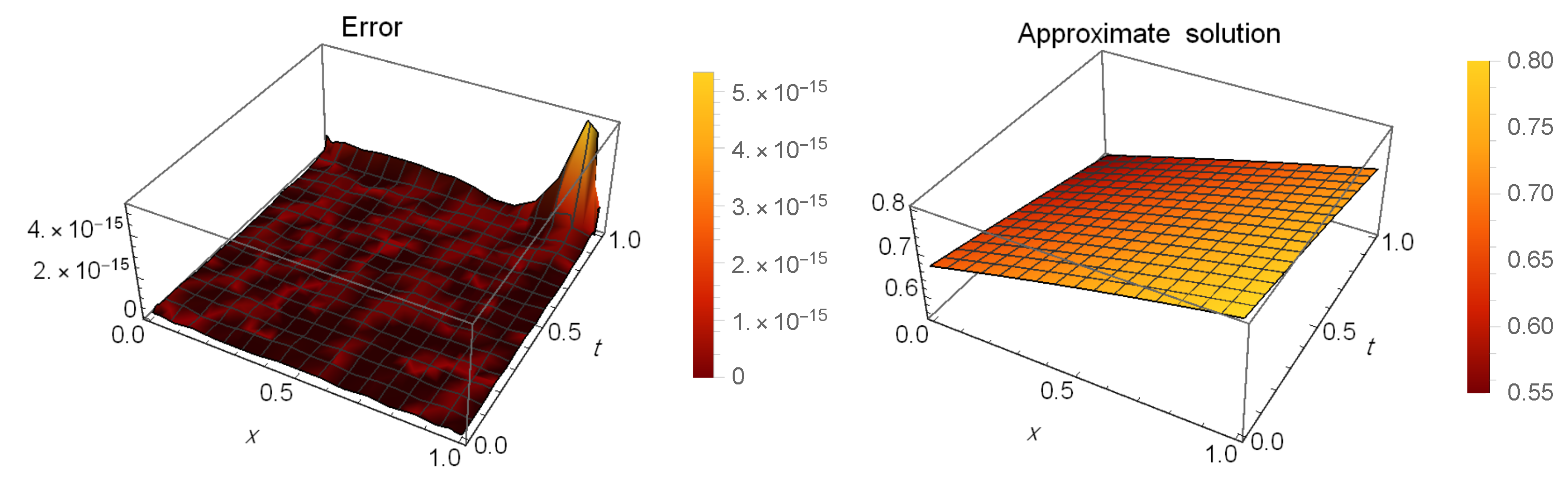
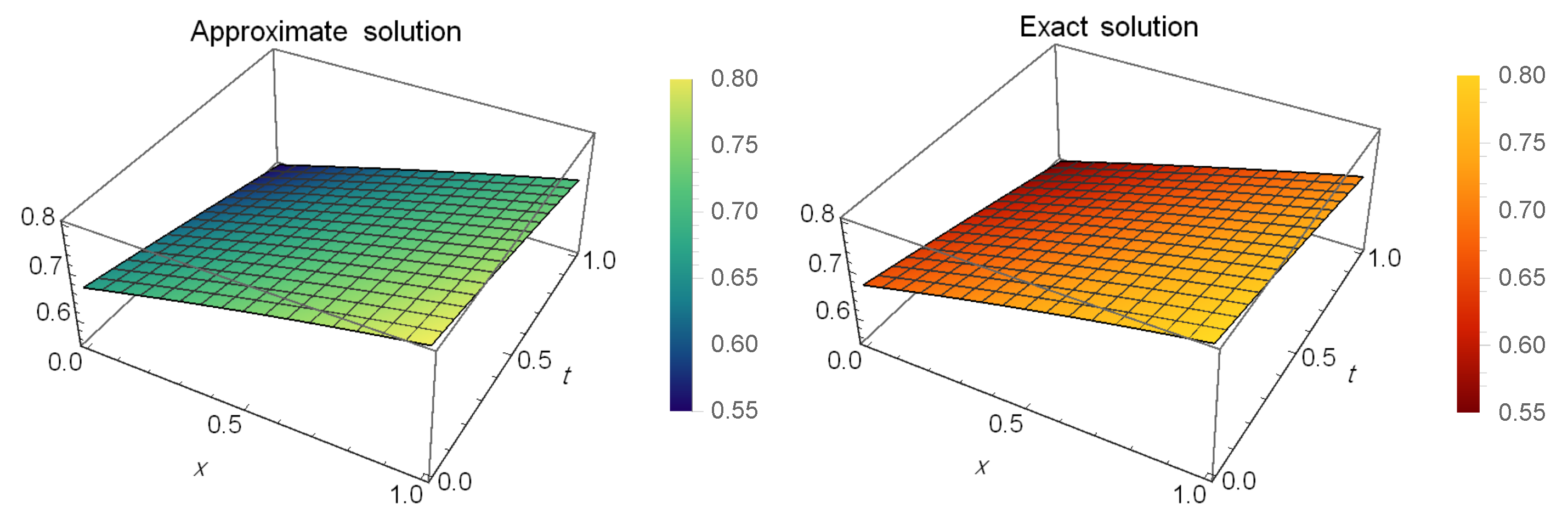
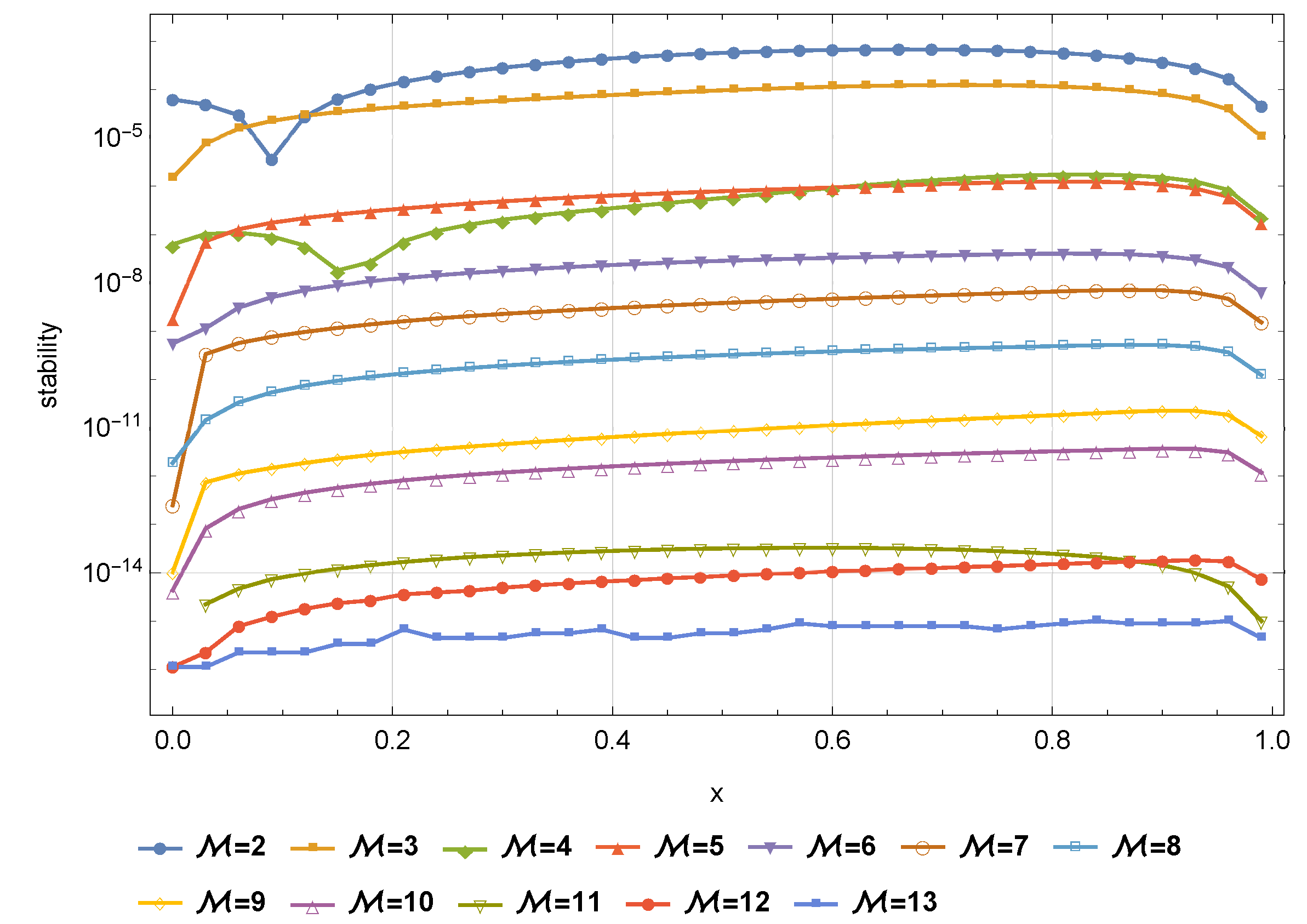
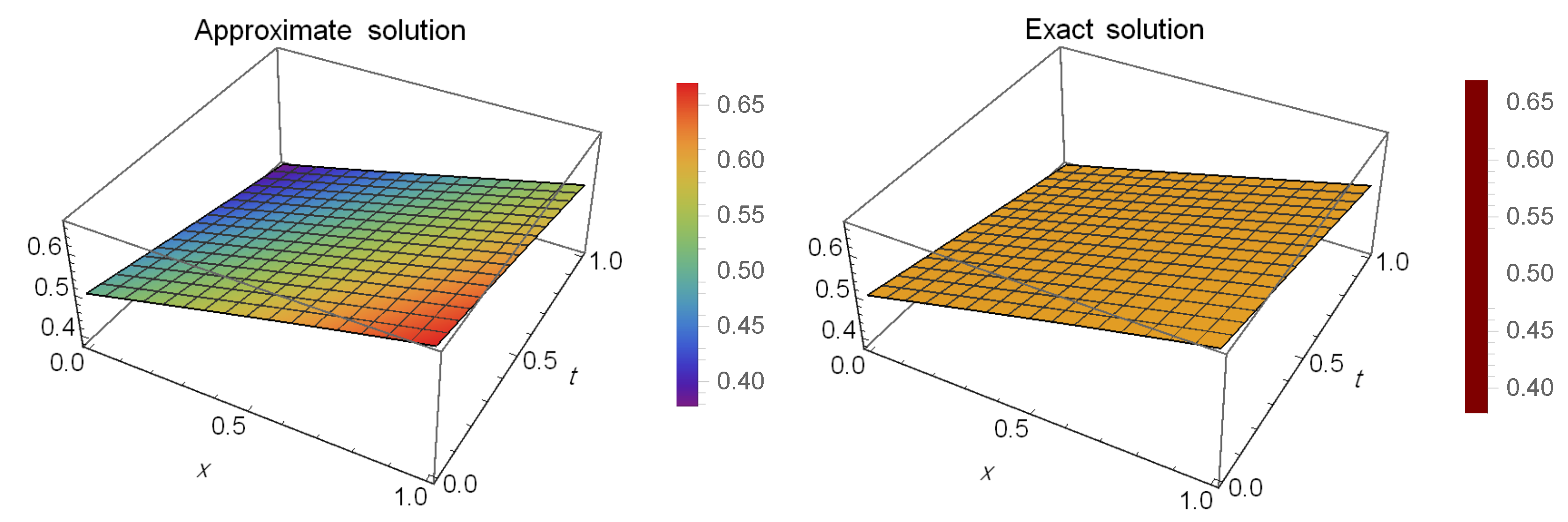
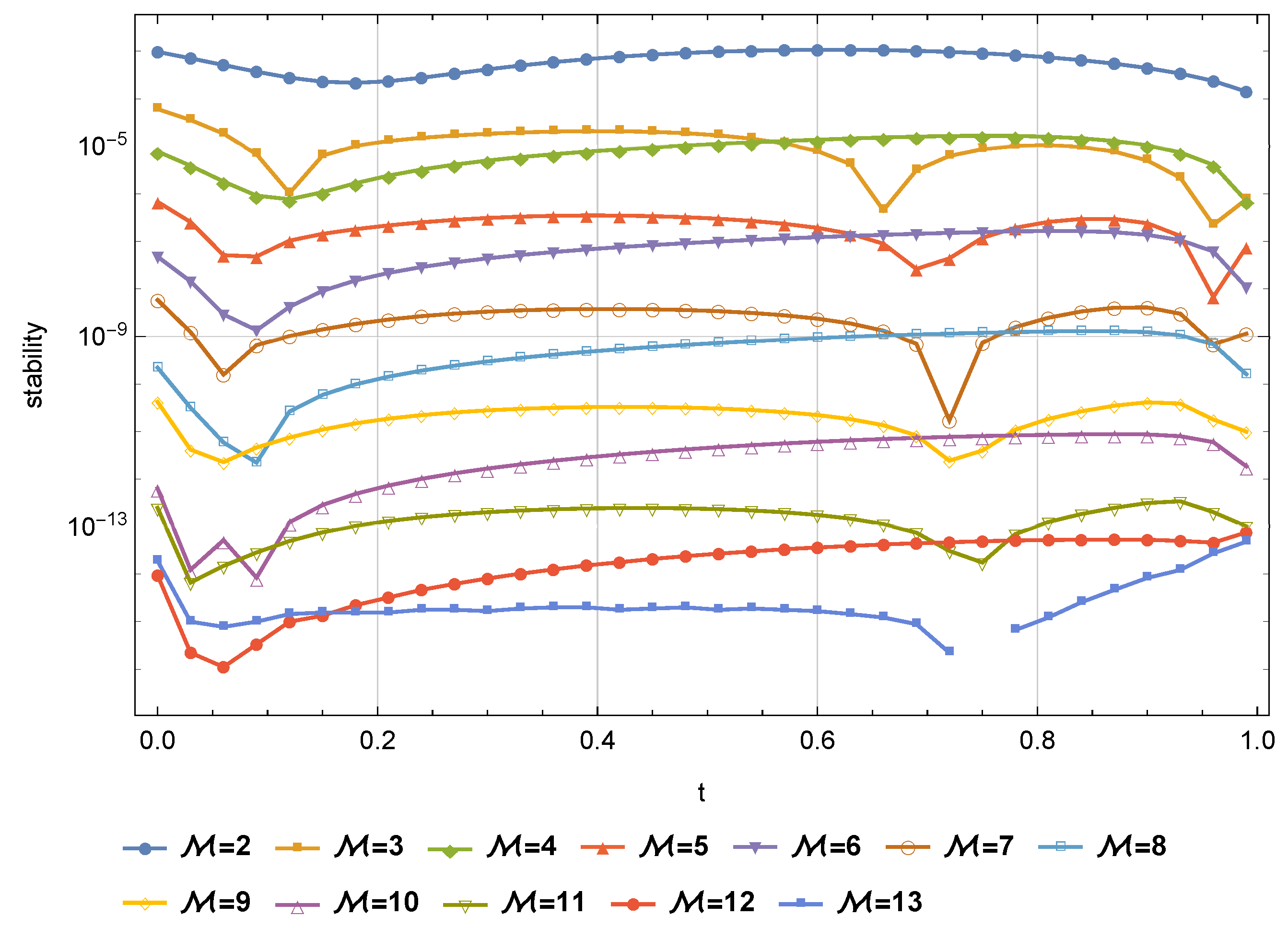
Table 2 compares AE at between our method and the method in [60]. Table 3 presents the errors at different values of and ρ when Figure 1 shows the absolute errors (left) and the approximate solution (right) at , and . Also, Figure 2 illustrates the exact and the approximate solutions at and . Figure 3 illustrates the stability at and different values of when . Table 4 shows the errors and the order of convergence, which is calculated by (87) at different values of . Finally, Table 5 shows the AE at and . These findings show that this method’s results are close to the exact solution.
Table 2.
Comparison of the AE of Example 1 at .
Table 3.
The errors of Example 1.
Figure 1.
The absolute errors (left) and the approximate solution (right) for Example 1 at and .
Figure 2.
The exact and the approximate solutions for Example 1 at and .
Figure 3.
Stability at for Example 1.
Table 4.
The errors and order of convergence for Example 1.
Table 5.
The AE of Example 1 at and .
Example 2.
The authors of [61] considered the following equation:
governed by the following constraints:
For , the exact solution is
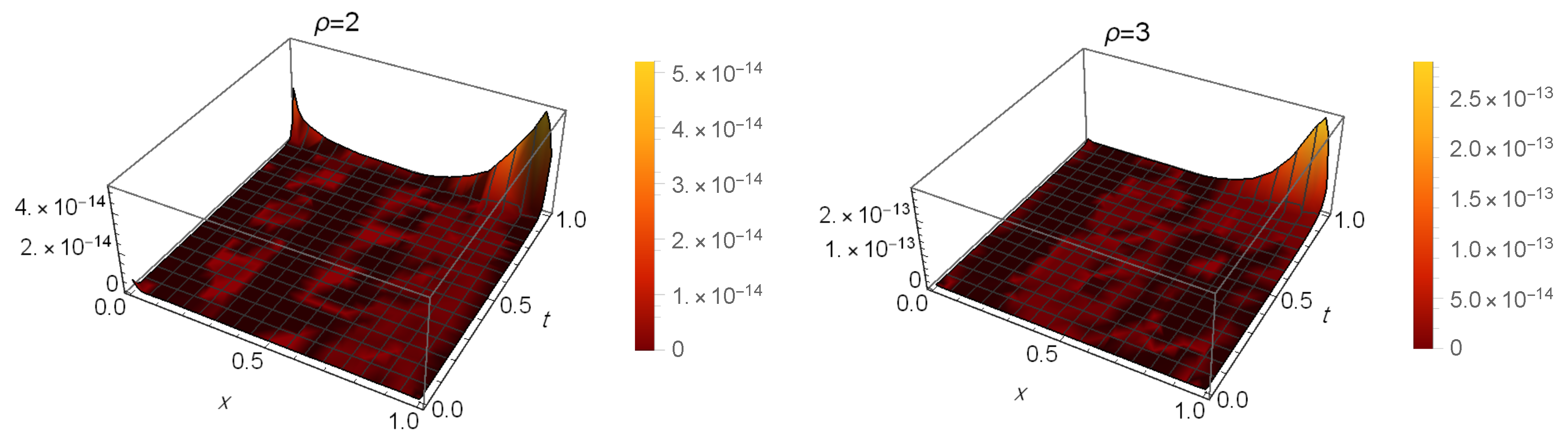
Table 6 shows the AE at and . In Table 7, we compare the errors of our technique at and with those in [61]. Figure 4 illustrates the AE at different values of ρ when . Figure 5 illustrates the exact and the approximate solutions at and . Figure 6 illustrates the stability at and different values of when . These findings show that this method’s results are close to the exact solution.
Table 6.
The AE of Example 2 at and .
Table 7.
Comparison of errors for Example 2.
Figure 4.
The AE of Example 2 at .
Figure 5.
The exact and the approximate solutions for Example 2 at and .
Figure 6.
Stability at for Example 2.
10. Conclusions
The paper has presented new, explicit, and simplified expressions for certain classes of the classical Jacobi polynomials. The core of the derivation of the new formulas is based on introducing some fundamental formulas of such polynomials along with the utilization of symbolic algebra and, in particular, Zeilberger’s algorithm. Many derivative expressions are expressed in terms of their original ones. Some linearization and connection formulas were also developed. To our knowledge, most of the developed formulas in this article are new. They may be helpful, particularly in spectral methods, where orthogonal polynomials are the basis of function approximation. A suggested spectral solution of the FitzHugh–Nagumo equation was explored using a collocation scheme based on the proposed polynomials and some of their developed formulas. We expect to use the introduced polynomials and their new formulas to solve other DEs that arise in the applied sciences. In addition, our proposed algorithm may be extended to solve fractional differential equations and multidimensional problems. All codes were written and debugged by Mathematica 11 on an HP Z420 Workstation, (Hewlett-Packard, Palo Alto, CA, USA) equipped with an Intel(R) Xeon(R) CPU E5-1620 v2—3.70 GHz, 16 GB DDR3 RAM, and 512 GB storage.
Author Contributions
Conceptualization, W.M.A.-E.; Methodology, M.A.A., N.M.A.A. and A.G.A.; Software, W.M.A.-E. and A.G.A.; Validation, W.M.A.-E., N.M.A.A. and A.G.A.; Formal analysis, W.M.A.-E., N.M.A.A. and A.G.A.; Investigation, W.M.A.-E., M.A.A., N.M.A.A. and A.G.A.; Writing—original draft, W.M.A.-E. and M.A.A.; Writing—review & editing, W.M.A.-E.; Funding acquisition, M.A.A. All authors have read and agreed to the published version of the manuscript.
Funding
This work was supported and funded by the Deanship of Scientific Research at Imam Mohammad Ibn Saud Islamic University (IMSIU) (grant number IMSIU-DDRSP2502).
Data Availability Statement
Data are contained within the article.
Acknowledgments
This work was supported and funded by the Deanship of Scientific Research at Imam Mohammad Ibn Saud Islamic University (IMSIU) (grant number IMSIU-DDRSP2502).
Conflicts of Interest
The authors declare no conflicts of interest.
References
- Boyd, J.P. Chebyshev and Fourier Spectral Methods, 2 ed.; Dover Publications: Mineola, NY, USA, 2001. [Google Scholar]
- Shen, J.; Tang, T.; Wang, L.L. Spectral Methods: Algorithms, Analysis and Applications; Springer Series in Computational Mathematics; Springer: Berlin/Heidelberg, Germany, 2011; Volume 41. [Google Scholar]
- Sadiq, S.; ur Rehman, M. Numerical technique based on generalized Laguerre and shifted Chebyshev polynomials. J. Appl. Anal. Comput. 2024, 14, 1977–2001. [Google Scholar] [CrossRef] [PubMed]
- Bouda, H.; Allouch, C.; Boujraf, A.; Tahrichi, M. Projection and modified projection methods for nonlinear Hammerstein integral equations on the real line using Hermite polynomials. Int. J. Comput. Math. 2024, 101, 1270–1299. [Google Scholar] [CrossRef]
- Abd-Elhameed, W.M.; Alqubori, O.M.; Amin, A.K. New results for certain Jacobsthal-type polynomials. Mathematics 2025, 13, 715. [Google Scholar] [CrossRef]
- Alatawi, M.S.; Khan, W.A.; Kızılateş, C.; Ryoo, C.S. Some properties of generalized Apostol-type Frobenius–Euler–Fibonacci polynomials. Mathematics 2024, 12, 800. [Google Scholar] [CrossRef]
- Sivalingam, S.M.; Kumar, P.; Govindaraj, V.; Qahiti, R.A.; Hamali, W.; Mutum, Z.M. An operational matrix approach with Vieta-Fibonacci polynomial for solving generalized Caputo fractal-fractional differential equations. Ain Shams Eng. J. 2024, 15, 102678. [Google Scholar]
- Kim, T.; Kim, D.S. Explicit formulas for probabilistic multi-poly-Bernoulli polynomials and numbers. Russ. J. Math. Phys. 2024, 31, 450–460. [Google Scholar] [CrossRef]
- Chaudhary, R.; Aeri, S.; Bala, A.; Kumar, R.; Baleanu, D. Solving system of fractional differential equations via Vieta–Lucas operational matrix method. Int. J. Appl. Comput. Math. 2024, 10, 14. [Google Scholar] [CrossRef]
- Abd-Elhameed, W.M.; Alqubori, O.M.; Alsafri, N.M.A.; Amin, A.K.; Atta, A.G. A matrix approach by convolved Fermat polynomials for solving the fractional Burgers’ equation. Mathematics 2025, 13, 1135. [Google Scholar] [CrossRef]
- Costabile, F.A.; Gualtieri, M.I.; Napoli, A. Polynomial sequences: Elementary basic methods and application hints. A survey. Rev. Real Acad. Cienc. Exactas Fís. Nat. Ser. A Mat. 2019, 113, 3829–3862. [Google Scholar] [CrossRef]
- Costabile, F.A.; Gualtieri, M.I.; Napoli, A. Polynomial sequences and their applications. Mathematics 2022, 10, 4804. [Google Scholar] [CrossRef]
- Costabile, F.A.; Gualtieri, M.I.; Napoli, A. Matrix calculus-based approach to orthogonal polynomial sequences. Mediterr. J. Math. 2020, 17, 118. [Google Scholar] [CrossRef]
- Singh, P.K.; Ray, S.S. A numerical approach based on Pell polynomial for solving stochastic fractional differential equations. Numer. Algorithms 2024, 97, 1513–1534. [Google Scholar] [CrossRef]
- Yıldırım, G.; Yüzbaşı, Ş. Numerical solutions and simulations of the fractional COVID-19 model via Pell–Lucas collocation algorithm. Math. Methods Appl. Sci. 2024, 47, 14457–14475. [Google Scholar] [CrossRef]
- Abd-Elhameed, W.M.; Al-Sady, A.M.; Alqubori, O.M.; Atta, A.G. Numerical treatment of the fractional Rayleigh-Stokes problem using some orthogonal combinations of Chebyshev polynomials. AIMS Math. 2024, 9, 25457–25481. [Google Scholar] [CrossRef]
- Aghdam, Y.E.; Mesgarani, H.; Amin, A.; Gómez-Aguilar, J.F. An efficient numerical scheme to approach the time fractional Black–Scholes model using orthogonal Gegenbauer polynomials. Comput. Econ. 2024, 64, 211–224. [Google Scholar] [CrossRef]
- Abd-Elhameed, W.M.; Ahmed, H.M.; Zaky, M.A.; Hafez, R.M. A new shifted generalized Chebyshev approach for multi-dimensional Sinh–Gordon equation. Phys. Scr. 2024, 99, 095269. [Google Scholar] [CrossRef]
- Abd-Elhameed, W.M.; Alsuyuti, M.M. Numerical treatment of multi-term fractional differential equations via new kind of generalized Chebyshev polynomials. Fractals Fract. 2023, 7, 74. [Google Scholar] [CrossRef]
- Mason, J.C.; Handscomb, D.C. Chebyshev Polynomials; CRC Press: Boca Raton, FL, USA, 2002. [Google Scholar]
- Abd-Elhameed, W.M.; Alkenedri, A.M. Spectral solutions of linear and nonlinear BVPs using certain Jacobi polynomials generalizing third-and fourth-kinds of Chebyshev polynomials. CMES Comput. Model. Eng. Sci. 2021, 126, 955–989. [Google Scholar] [CrossRef]
- Ralston, A.; Rabinowitz, P. A First Course in Numerical Analysis; Courier Corporation: North Chelmsford, MA, USA, 2001. [Google Scholar]
- Heydari, M.H.; Zhagharian, S.; Razzaghi, M. Jacobi polynomials for the numerical solution of multi-dimensional stochastic multi-order time fractional diffusion-wave equations. Comput. Math. Appl. 2023, 152, 91–101. [Google Scholar] [CrossRef]
- Singh, J.; Kumar, J.; Baleanu, D. Numerical computation of fractional Bloch equation by using Jacobi operational matrix. J. King Saud Univ. Sci. 2024, 36, 103263. [Google Scholar] [CrossRef]
- Hafez, R.M.; Youssri, Y.H. Review on Jacobi-Galerkin spectral method for linear PDEs in applied mathematics. Contemp. Math. 2024, 5, 2051–2088. [Google Scholar] [CrossRef]
- Ahmed, H.M. Enhanced shifted Jacobi operational matrices of integrals: Spectral algorithm for solving some types of ordinary and fractional differential equations. Bound. Value Probl. 2024, 2024, 75. [Google Scholar] [CrossRef]
- Rashidinia, J.; Eftekhari, T.; Maleknejad, K. Numerical solutions of two-dimensional nonlinear fractional Volterra and Fredholm integral equations using shifted Jacobi operational matrices via collocation method. J. King Saud Univ. Sci. 2021, 33, 101244. [Google Scholar] [CrossRef]
- Hadhoud, A.R.; Srivastava, H.M.; Rageh, A.A.M. Non-polynomial B-spline and shifted Jacobi spectral collocation techniques to solve time-fractional nonlinear coupled Burgers’ equations numerically. Adv. Differ. Equ. 2021, 2021, 439. [Google Scholar] [CrossRef]
- Chaggara, H.; Koepf, W. On linearization coefficients of Jacobi polynomials. Appl. Math. Lett. 2010, 23, 609–614. [Google Scholar] [CrossRef][Green Version]
- Sánchez-Ruiz, J. Linearization and connection formulae involving squares of Gegenbauer polynomials. Appl. Math. Lett. 2001, 14, 261–267. [Google Scholar] [CrossRef][Green Version]
- Ahmed, H.M. Computing expansions coefficients for Laguerre polynomials. Integral Transforms Spec. Funct. 2021, 32, 271–289. [Google Scholar] [CrossRef]
- Dolgy, D.V.; Kim, D.S.; Kim, T.; Kwon, J. Connection problem for sums of finite products of Chebyshev polynomials of the third and fourth kinds. Symmetry 2018, 10, 617. [Google Scholar] [CrossRef]
- Kim, T.; Kim, D.S.; Dolgy, D.V.; Park, J.W. Sums of finite products of Legendre and Laguerre polynomials. Adv. Differ. Equ. 2018, 2018, 277. [Google Scholar] [CrossRef]
- Sánchez-Ruiz, J.; Dehesa, J.S. Some connection and linearization problems for polynomials in and beyond the Askey scheme. J. Comput. Appl. Math. 2001, 133, 579–591. [Google Scholar] [CrossRef]
- Srivastava, H.M. A unified theory of polynomial expansions and their applications involving Clebsch-Gordan type linearization relations and Neumann series. Astrophys. Space Sci. 1988, 150, 251–266. [Google Scholar] [CrossRef]
- Trefethen, L.N. Spectral Methods in MATLAB; SIAM: Philadelphia, PA, USA, 2000; Volume 10. [Google Scholar]
- Canuto, C.; Hussaini, M.Y.; Quarteroni, A.; Zang, T.A. Spectral Methods in Fluid Dynamics; Springer: Berlin/Heidelberg, Germany, 1988. [Google Scholar]
- Shizgal, B. Spectral Methods in Chemistry and Physics; Springer: Berlin/Heidelberg, Germany, 2014. [Google Scholar]
- Jiang, W.; Gao, X. Review of Collocation Methods and Applications in Solving Science and Engineering Problems. CMES Comput. Model. Eng. Sci. 2024, 140, 41–76. [Google Scholar] [CrossRef]
- Çevik, M.; Savaşaneril, N.B.; Sezer, M. A review of polynomial matrix collocation methods in engineering and scientific applications. Arch. Comput. Methods Eng. 2025, 32, 3355–3373. [Google Scholar] [CrossRef]
- Zaman, S.S.; Amin, R.; Haider, N.; Akgül, A. Numerical solution of Fisher’s equation through the application of Haar wavelet collocation method. Numer. Heat Transfer Part B 2025, 86, 2746–2757. [Google Scholar] [CrossRef]
- Huang, R.; Weng, Z.; Yuan, J. Collocation-based numerical simulation of multi-dimensional nonlinear time-fractional Schrödinger equations. Comput. Math. Appl. 2025, 183, 214–233. [Google Scholar] [CrossRef]
- Haq, S.; Noreen, A.; Akbar, T.; Arifeen, S.U.; Ghafoor, A.; Khan, Z.A. Numerical solution of seventh order KdV equations via quintic B-splines collocation method. Alex. Eng. J. 2025, 114, 497–506. [Google Scholar] [CrossRef]
- Lachin, A.; Abdelkawy, M.A.; Sathasivam, S. An efficient collocation method based on Legendre and Romanovski polynomials for solving Riesz distributed fractional differential equations. Alex. Eng. J. 2025, 129, 312–328. [Google Scholar] [CrossRef]
- Bivani, S.; Ghasemi, M.; Goligerdian, A. Fractional B-spline collocation method for the numerical solution of the fractional pantograph differential equations. Bound. Value Probl. 2025, 2025, 17. [Google Scholar] [CrossRef]
- Aourir, E.; Dastjerdi, H.L. Numerical computational technique for solving Volterra integro-differential equations of the third kind using meshless collocation method. J. Comput. Appl. Math. 2025, 457, 116294. [Google Scholar] [CrossRef]
- Izadi, M.; Roul, P. Spectral semi-discretization algorithm for a class of nonlinear parabolic PDEs with applications. Appl. Math. Comput. 2022, 429, 127226. [Google Scholar] [CrossRef]
- Shahni, J.; Singh, R. Numerical solution of system of Emden-Fowler type equations by Bernstein collocation method. J. Math. Chem. 2021, 59, 1117–1138. [Google Scholar] [CrossRef]
- Olver, F.W.J.; Lozier, D.W.; Boisvert, R.F.; Clark, C.W. NIST Handbook of Mathematical Functions; Cambridge University Press: Cambridge, UK, 2010. [Google Scholar]
- Andrews, G.E.; Askey, R.; Roy, R. Special Functions; Cambridge University Press: Cambridge, UK, 1999. [Google Scholar]
- Rainville, E.D. Special Functions; The Macmillan Co.: New York, NY, USA, 1960. [Google Scholar]
- Rahman, M. A non-negative representation of the linearization coefficients of the product of Jacobi polynomials. Canad. J. Math. 1981, 33, 915–928. [Google Scholar] [CrossRef]
- Luke, Y.L. Mathematical Functions and Their Approximations; Academic Press: Cambridge, MA, USA, 1975. [Google Scholar]
- Koepf, W. Hypergeometric Summation, 2nd ed.; Springer: Berlin/Heidelberg, Germany, 2014. [Google Scholar]
- Van Hoeij, M. Finite singularities and hypergeometric solutions of linear recurrence equations. J. Pure Appl. Algebra 1999, 139, 109–131. [Google Scholar] [CrossRef]
- Doha, E.H. The coefficients of differentiated expansions and derivatives of ultraspherical polynomials. Comput. Math. Appl. 1991, 21, 115–122. [Google Scholar] [CrossRef]
- Bassetti, B.; Montaldi, E.; Raciti, M. On the linearization problem for ultraspherical polynomials. J. Math. Phys. 1986, 27, 696–698. [Google Scholar] [CrossRef]
- Abd-Elhameed, W.M.; Amin, A.K. Novel formulas of Schröder polynomials and their related numbers. Mathematics 2023, 11, 468. [Google Scholar] [CrossRef]
- Shekarabi, H.S.; Aqamohamadi, M.; Rashidinia, J. Tension spline method for solution of FitzHugh–Nagumo equation. Trans. A. Razmadze Math. Inst. 2018, 172, 571–581. [Google Scholar] [CrossRef]
- Yokus, A. On the exact and numerical solutions to the FitzHugh–Nagumo equation. Int. J. Mod. Phys. B 2020, 34, 2050149. [Google Scholar] [CrossRef]
- Alam, M.; Haq, S.; Ali, I.; Ebadi, M.; Salahshour, S. Radial basis functions approximation method for time-fractional Fitzhugh–Nagumo equation. Fractal Frac. 2023, 7, 882. [Google Scholar] [CrossRef]
Disclaimer/Publisher’s Note: The statements, opinions and data contained in all publications are solely those of the individual author(s) and contributor(s) and not of MDPI and/or the editor(s). MDPI and/or the editor(s) disclaim responsibility for any injury to people or property resulting from any ideas, methods, instructions or products referred to in the content. |
© 2025 by the authors. Licensee MDPI, Basel, Switzerland. This article is an open access article distributed under the terms and conditions of the Creative Commons Attribution (CC BY) license (https://creativecommons.org/licenses/by/4.0/).