1. Introduction
Quantum chemical dynamics seeks to describe chemical reactions in terms of quantum mechanics. Such an endeavor requires the solution of the time-dependent Schrödinger equation [
1]: a partial linear differential equation, second-order in the particles’ positions
and first-order in time
, whose unknown is the time-dependent wavefunction
, where
represents the spin variables. Once
is found, all the chemical properties of a reactive system can be calculated from it. Unfortunately, the solution of the time-dependent Schrödinger equation becomes computationally expensive even for relatively small molecular systems. Therefore, some approximations should be introduced for feasibility’s sake. One fruitful approach is to adopt the time-dependent variational principle (TDVP) [
2]. Therein, a trial wavefunction
=
depending on a set of time-dependent parameters
is optimized for dynamical evolution by subjecting it to the stationary condition of the quantum action:
,
[
2]. This procedure generates a system of classical-like equations of motion for the parameters
that takes the place of and is easier to integrate than the time-dependent Schrödinger equation. Furthermore, guided by chemical insight, one can propose relatively simple trial wavefunctions
that deliver accurate predictions at low computational cost. A successful employment of the TDVP for quantum chemical dynamics has been provided by the electron nuclear dynamics (END) method [
3,
4]. END adopts a total trial wavefunction that contains frozen Gaussian wave packets to describe nuclei and a single-determinantal wavefunction in the Thouless representation [
5] to describe electrons. END has proven to be both accurate and feasible for the simulation of a vast array of time-dependent chemical processes, e.g., Diels–Alder, S
N2, and ion cancer therapy reactions, inter alia [
3,
4,
6,
7,
8,
9].
While END/TDVP simulations run relatively fast, they become inevitably slower when applied to extremely large chemical systems, e.g., to the sizable biomolecules involved in ion cancer therapy reactions [
4,
6,
7,
8,
9]. Therefore, we have devoted considerable efforts to accelerate the END/TDVP method for those simulations [
4,
6,
7,
8,
9]. Broadly speaking, an END/TDVP simulation involves three essential computational tasks [
3,
4]:
(I) the calculation of atomic and molecular basis functions integrals corresponding to the trial wavefunction,
(II) the calculation of all the components of the END/TDVP equations of motion, and
(III) the time integration of those equations. While tasks equivalent to I and III are present in other quantum chemistry methods, task II is specific to the END/TDVP approach and will be the main focus of this investigation. To accelerate the aforesaid tasks in our END/TDVP code PACE [
4], we have employed various state-of-the-art techniques for classical (i.e., standard) computers, e.g., a mixed programming language (Python for logic flow and Fortran and C
++ for numerical calculations), intra- and internode parallelization, and the fast OED/ERD atomic integrals package [
10] from the ACES [
11] program, inter alia. Equipped with these capabilities, we were able to perform the first END/TDVP simulations of ion cancer therapy reactions involving large molecules, e.g., ion-induced water radiolysis in water clusters, and ion-induced DNA damage in nucleobases and the cytosine nucleotide [
4,
6,
7,
8,
9]. Nevertheless, additional acceleration of END/TDVP simulations will be necessary to treat even larger systems.
In recent years, the burgeoning field of quantum computing (QC) [
12,
13,
14] has shown immense potential to revolutionize quantum chemistry through the provision of efficient
quantum computers and
quantum algorithms to simulate chemical systems. Thus, various research groups have reformulated established quantum chemistry methods [
1] into the QC framework (cf. Refs. [
15,
16] and citations therein). In this context, Li and Benjamin have recently developed a variational quantum simulator (VQS) to calculate TDVP dynamics [
17]. VQS is a
hybrid quantum/classical approach wherein each computational task is entrusted to the type of computer, either
classical or
quantum, that provides the fastest algorithms with current technology. Specifically, the calculation of the trial wavefunction and its related components for the TDVP equations of motion are assigned to a quantum computer at each time step; those tasks are executed with quantum circuits that are modifications of one devised by Ekert et al. [
18]. On the other hand, the time integration of the TDVP equations is assigned to a classical computer operating standard software. Li and Benjamin successfully applied their VQS to simulate the TDVP dynamics of an Ising-like model system, thus demonstrating the viability and potential of their innovative approach [
17].
The VQS provides a paradigm for a hybrid quantum/classical implementation of TDVP dynamics, but it will remain scarcely relevant for quantum chemical dynamics if it is only applied to Ising-like models. While those models can simulate spin dynamics, they fail to reproduce most of the basic features of molecules and are, therefore, unsuitable for realistic simulations of chemical reactions. Therefore, the extension of the VQS approach for the accurate description of chemical reactions is a crucial endeavor in both quantum chemistry and QC fields. In this manuscript, we will embark on such an enterprise by reformulating the END method for QC (END/QC) within the VQS scheme (END/QC/VQS; henceforth, we will name END/QC the general QC formulation of END and END/QC/VQS as its VQS realization).
In terms of the previously discussed tasks I-III, END/QC/VQS involves the following sequence of processes (cf.
Figure 1 for a flowchart). At a given time step, task I, the calculation of atomic and molecular basis functions integrals, is executed for the current nuclear and electronic configurations on a classical computer with the OED/ERD atomic integrals package [
10]. With those integrals at hand, task II, the calculation of the components of the END/QC equations of motion, is executed on a quantum computer with quantum circuits that are END/QC versions of the general VQS circuit [
17]. Specifically, our quantum circuits evaluate the END/QC trial wavefunction
, and the metric matrix
and energy gradient vector
of the END/QC equations of motion (cf.
Section 2,
Section 5 and
Section 6). Then, task III, the time integration of the latter equations, is executed from the current to the next time step on a classical computer with standard differential equation solvers. The last task provides the new nuclear and electronic configurations for the next time step so that a new cycle of tasks I through III ensues; this loop runs from the initial to the final time of a dynamical simulation.
While transparent in outline, END/QC/VQS poses various theoretical and computational challenges during its development. As previously mentioned, the electronic part of the END trial wavefunction is a single-determinantal wavefunction in the Thouless representation [
5]. In this approach, a
non-unitary operator
in terms of time-dependent parameters
generates the evolving electronic trial wavefunction
by acting on a single-determinantal reference state
:
[
3,
4,
5]. It is well known that QC is strictly formulated in terms of unitary operators and gates [
14]; therefore, the original END formulation in terms of a non-unitary operator
does not directly fit into the unitary QC framework. To circumvent this difficulty (and also for pure theoretical reasons), we decided to reformulate END in terms of the
Fukutome unitary representation [
19] of a single-determinantal state. In this case, a
unitary operator
in terms of time-dependent parameters
substitutes the previous non-unitary operator
and generates the evolving electronic trial wavefunction as
. In this way,
all its related terms fit directly into the unitary operators and gates of the quantum circuits. The aforesaid substitution of operators may seem simple in outline, but, in fact, it substantially changes the whole structure of the END formalism, as will be shown in
Section 3 and
Section 5. While we will adhere to a unitary representation in this manuscript, we should note that a non-unitary END/QC formalism with the Thouless representation [
5] is indeed possible if the involved non-unitary operators are expressed as linear combinations of unitaries (LCUs) [
20]. We will present that alternative formulation in a sequel.
The formulation of END/QC/VQS for all type of chemical systems is a challenging enterprise to be accomplished in stages. Therefore, in this first attempt, we will adopt some approximations and tackle particular systems. First, we will formulate END/QC for pure electronic dynamics, i.e., for the time evolution of electrons in the presence of fixed nuclei. In this scheme, the END/QC equations of motion will explicitly involve electronic TVDP variables—nuclear variables will act implicitly in those equations as time-independent parameters. Second, for pure electronic dynamics, we will formulate END/QC for multielectron model systems described with effective Hamiltonians and minimal basis sets; similar types of systems are usually employed to develop and test QC methodologies for quantum chemistry [
15,
16]. During these formulations, we will emphasize the
continuous symmetry aspects of the END/QC formalism within the Fukutome unitary representation [
19]; i.e., the END/QC connection with the unitary Lie group and its associated Lie algebra. Third, we will apply these END/QC developments to evaluate
M and
V in one-electron diatomic molecules and to simulate the pure electronic dynamics of a H
2+ molecule. In the latter case, we will also consider the effect of the
point group spatial symmetry in the END/QC equations of motions and dynamics. In these endeavors, we will execute our new QC circuits (algorithms) for task II on the QC software development kit QISKIT version 1.0 [
21], which acts as a simulator of a real quantum computer. In this way, we can corroborate the step-by-step functioning of our QC circuits and gauge their numerical accuracy. We will utilize a real quantum computer for task II in a sequel.
As delineated in the previous paragraph, this manuscript presents the
proof of concept of END/QC/VQS: a firm stepping stone from which we can continue developing this method to its full maturity. Thus, in upcoming publications, we will generalize the current END/QC/VQS for full electronic and nuclear dynamics, for general molecules described with ab initio Hamiltonians and large basis sets, and for executions on state-of-the-art quantum computers. Our group has presented a first glimpse into END/QC/VQS in Ref. [
22]; however, herein, we present a more elaborated version of END/QC/VQS, both in terms of its formalism development and computer applications.
This manuscript is organized as follows. In
Section 2, we will review the TDVP in terms of real variational parameters [
2] because this form of the TDVP provides the most appropriate parameterization for the current version of END/QC/VQS. In
Section 3, we will discuss the Fukutome unitary representation [
19] of single-determinantal wavefunctions in the context of the Hartree–Fock (HF) and the END methods. In
Section 4, we will define a family of model chemical systems for END/QC/VQS treatments in the spirit of the semi-empirical methods [
23] in quantum chemistry. In
Section 5, we will formulate the END/QC formalism to simulate pure electronic dynamics in those systems. In
Section 6, we will apply END/QC/VQS to evaluate
M and
V in one-electron diatomic molecules and to simulate the pure electronic dynamics of a H
2+ molecule. We will perform all the corresponding QC calculations on the QC software development kit QISKIT [
21]. Finally, in
Section 7, we will analyze the main results of this investigation and discuss future work.
2. Background: Time-Dependent Variational Principle (TDVP)
There are different versions of the time-dependent variational principle such as the Dirac-Frenkel variational principle [
24,
25], the McLachlan variational principle [
26], and the simply named TDVP (for their definitions and equivalence conditions, cf. Refs. [
27,
28,
29]). Since END is based on the TDVP [
3,
4], we will employ this variational principle to formulate END/QC. The TDVP starts with a trial wavefunction
that depends on
time-dependent variational parameters
,
, arranged in a column vector
; these parameters can be real or complex [
2,
3,
4], but, in this investigation, we will take them as real without any loss of generality:
(for the relationship between real and complex TDVP parameterizations, cf. Ref. [
2]). The selection of a trial wavefunction for a chemical problem is a matter of chemical insight; thus, following quantum chemistry experience, single-determinantal [
3,
4,
30], multi-configuration [
31], and coupled-cluster wavefunctions [
32,
33,
34] have been employed/proposed to simulate chemical reactions in the TDVP framework. For a chosen
, the TDVP involves the quantum Lagrangian
and quantum action
functionals:
where
is the system Hamiltonian,
and
are the initial and final times of the dynamics, and
and
are time derivative operators acting to the right and to the left, respectively; these operators produce a real Lagrangian with a symmetric distribution of the derivatives
over the bra
and ket
states [
2]. The denominator of
in Equation (1) enforces normalization if the trial wavefunction is unnormalized [
2]. However, we will parameterize
with a unitary operator
acting on a reference state
:
, so that
=
= 1 at all times. Therefore, we will omit the aforesaid denominator in
and in all the subsequent TDVP equations (for the TDVP equations with an unnormalized trial wavefunction, cf. Refs. [
2,
3,
4]). Under this condition, the Lagrangian
is [
2]
where
is the expectation value of the total energy, and
is the canonical variable conjugate to
. To obtain the TDVP equations of motion, one should impose the stationary condition into the quantum action functional,
, with respect to all the variational parameters
and subjected to the end-point conditions
. That procedure leads to a set of Euler-Lagrange equations for the parameters
:
that in terms of the expressions in Equation (2) are [
2]:
Above, the metric matrix
is real and antisymmetric, and the energy gradient vector
is real;
and
contain the kinematic and dynamic features of the system, respectively. It is clear from Equations (1)–(4) that the TDVP and its equations of motion are the quantum analogs of the classical Hamilton principle and of the classical Hamilton equations in
symplectic form [
35], respectively. In that scheme, the parameters
and
span a generalized quantum phase space [
2,
3,
4,
36]. Solving Equation (4) for the time-dependent parameters
provides the evolution of the trial wavefunction
in time [
2,
3,
4,
36].
3. Fukutome Unitary Representation of Single-Determinantal Wavefunctions
As discussed in
Section 1, we will develop the END/QC formalism employing Fukutome unitary representation [
19] of single-determinantal states. Therefore, to understand our formalism, we should review such a unitary approach in the context of the HF theory [
37] (for its extension to the Kohn-Sham density functional theory, cf. Ref. [
30]). As anticipated in
Section 1, we will consider a system containing
evolving electrons and
fixed nuclei. The electronic description of that system involves a set of
orthonormal HF spin-orbitals
=
,
= 1, 2, …
:
=
=
, where
and
are spatial orbitals and spin eigenfunctions with position and spin variables
and
, respectively, and
. Associated with the
, we have a set of second-quantization creation
and annihilation
operators that satisfy the anti-commutation relationships [
37]:
Having the vacuum state
,
, we can define a reference Slater determinant state
with occupied spin-orbitals
,
…
as:
In this investigation, we will follow Fukutome’s notation [
19] and denote the
occupied (hole) spin-orbitals in
with the indices
, the
unoccupied (particle) spin-orbitals with the indices
, and the whole
spin-orbitals irrespective of their with occupancy with the indices
… From
, we can generate all the remaining single-, double-, etc., -excitation Slater determinants as
,
=
, etc. All these single-determinantal states are orthonormal among themselves. While
is arbitrary, we will take it as the HF ground state as is usually the case in END simulations [
3,
4]. The electronic Hamiltonian
of the system in second-quantization form is
where
and
are the one- and two-electron integrals from the spin-orbitals
[
37].
To formulate the HF theory in unitary form, Fukutome considered the set of
pair operators
that span (generate) the
Lie algebra (group) with commutation relationships [
38,
39,
40]:
from them, one can construct operator
and matrix
realizations of the unitary Lie group
[
38,
39,
40] as:
where
is an anti-Hermitian matrix containing the parameters
. The unitary matrix
acts on the orthonormal spin-orbitals
as:
where
is a new set of
transformed spin-orbitals; since
is unitary, the
are orthonormal as well. Then, all the possible single-determinantal states
that are non-orthogonal to
,
, can be generated from
by the unitary transformation [
19]:
where
contains
occupied (hole) transformed spin-orbitals
.
Equation (11) provides a unitary representation of the single-determinantal states
but its application is inconvenient due to redundancies in the parameters
as shown shortly. Fortunately, Fukutome [
19] solved this problem via an exact factorization of both
and
into two unitary components containing the non-redundant and redundant parameters
and
, respectively:
where the new operators and complex parameters are
Notice that
only contains hole-hole and particle-particle pair operators, and
only contains particle-hole and hole-particle ones. The matrix
is
where
and
. The matrix
is
where
The functions
and
are matrix generalizations of the standard sine and cosine functions, respectively. From a QC standpoint,
in Equation (14) can be interpreted as a multi-qubit generalization of the one-qubit matrices
in terms of the rotational matrices
,
= 1, 2, 3, [
14]; suggestively,
resembles
, cf.
Section 5. The unitary matrices
and
act on the spin-orbitals
as
and
, i.e.,
combines occupied spin-orbitals
among themselves, and
combines unoccupied spin-orbitals
among themselves. The matrix
acts on the spin-orbitals
as:
i.e.,
combines occupied and unoccupied spin-orbitals
among themselves. From a QC standpoint, the
transformed orthonormal spin-orbitals
in Equation (16) can be interpreted as multiple-qubit generalization of the one-qubit Bloch sphere states [
14], cf.
Section 5. The action of the operator
on
is
i.e.,
combines the occupied spin-orbitals
in
among themselves and transforms
into the
equivalent states
. The action of the operator
on
is
i.e.,
combines occupied and unoccupied spin-orbitals
into
and transforms the latter into the
non-equivalent states
. Thus, Equations (17) and (18) demonstrate that
and
are the non-redundant and redundant parameters in the unitary representation of all the single-determinantal states from
. Then, we can omit
in
=
=
, Equation (11), and take
=
, Equation (18), as the non-redundant Fukutome unitary representation of the all the non-equivalent single-determinantal states
from
and non-orthogonal to it [
19].
Fukutome unitary representation, Equation (18), establishes a bijective mapping between the single-determinantal states
and the parameters
[
3,
4,
19]. In a time-independent context, this representation provides a suitable parameterization of stationary states
for HF energy optimizations, instabilities analyses, and symmetry breaking classifications [
19]. In a time-dependent context, Fukutome unitary representation provides a suitable parameterization of time-evolving states
for END/QC optimizations and for time-dependent symmetry breakings, as the Thouless non-unitary representation [
5] does in the standard END [
3,
4,
41,
42]. We will employ Fukutome unitary representation to formulate END/QC in
Section 5 and
Section 6. In this and the following section, we keep Fukutome’s original parameters
but we will turn to real parameters in
Section 5.
5. Formulation of END/QC for the Model Systems. Natural QC Encoding
Application of approximations 1–4 in conjunction with the
commutation relationships, Equation (8), to the operator
and matrix
, Equations (12) and (14), leads to their factorization into
particle-hole-pair components:
where
and
denote ordinary and tensor products, respectively, and
is a compound index,
=
.
and
SU(2) depend on a single parameter
as:
and
In Equations (21)–(23), the multi-qubit matrix
, Equation (14), simplifies into a tensor product of one-qubit unitary matrices
[
14], the matrix
, Equation (14), into a set of numbers
, and the matrix functions
,
, and
, Equation (15), into the numerical functions
and
in terms of sine, cosine, and exponential functions. Furthermore, through
, we can switch from a complex
to a real
parameterization, i.e.,
in Equation (23); the latter scheme fits into the TDVP with real variational parameters discussed in
Section 2.
The factorizations in Equation (21) into particle-hole-pair components
suggests a
natural QC encoding for the current model systems. In this scheme, each electron of a
particle-hole-excitation pair can be assigned to a single qubit with compound index
. We will employ this QC encoding during the rest of this manuscript and present alternative formulations in terms of standard QC encodings (e.g., Jordan-Wigner, Kitaev, etc., [
16]) in a sequel. In the natural QC encoding, the occupied and unoccupied spin-orbitals
and
correspond to the computational basis states (vectors)
and
of the qubit with index
:
where the equivalences between operator-wavefunction and matrix-vector representations are indicated with the symbol
. In addition, we can define pseudo spin angular momentum operators
,
, and
, and an electron number operator
as
where their equivalences with the identity and Pauli matrices
,
,
, and
of the qubit
are shown. By inverting the relationships in Equation (25), one can encode the operators
and
, and the electronic Hamiltonian
, Equation (7), in terms of the matrices
,
,
and
of all the qubits (cf.
Section 6). The first three operators in Equation (25) span (generates) the SU(2) Lie algebra (group), and
and
are the Casimir operators of U(2)
SU(2). The mutually commuting
,
and
act on the spin-orbital
and
as
with equivalent expressions in terms of the states (vectors)
and
and matrices
,
,
, and
.
From this point to the end of this section, we will concentrate on the END/QC expressions for QC programming. Therefore, we will prioritize the matrix-vector representation of END/QC [in terms of the matrices , , , and acting on the computational basis states (vectors) and ] over its equivalent operator-wavefunction representation (in terms of the operators , , and acting on the spin-orbitals and ]. Nevertheless, the equivalences between both representations can be obtained straightforwardly [cf. Equation (25)].
U(2) can be factorized in terms of a global phase angle
and three extrinsic Euler angles
,
and
in the
z-y-z axis convention:
=
[
14], where
is the 2 × 2 rotation matrix around the axis
by an angle
. Then, from Equation (23), one obtains
,
,
, and
so that
This additional factorization per qubit is useful in subsequent QC implementations. Alternatively,
can be expressed as a general (1-norm quaternion) rotation by an angle
about an axis with unit vector
=
,
= 1, [
14]:
from which
,
, and
; then,
is a rotation by an angle
about an axis on the
x-y plane and tilted by an angle
from the
y-axis. For constant angles
, the matrices
form a one-real-parameter continuous subgroup
SU(2). Since the SU(2) matrices are identical to the matrices of the SU(2) irreducible representation
, the tensor product in Equation (21) goes along with the products of the SU(2) irreducible representations
, which, in general, produce reducible representations, e.g.,
[
43].
To obtain the components of the END/QC equations of motion for the model systems in QC form, we should first express the corresponding wavefunction and Hamiltonian in that form. The reference Slater determinant state
for
electrons is now [cf. Equation (6)]
Then, through Equations (21)–(27), the END/QC trial wavefunction
, Equation (18), corresponds to the QC state
with real parameters
and
.
where the original multiple-qubit states
in Equation (16) simplifies into standard single-qubit Bloch sphere states
in Equation (30). In addition, by mapping the operators
and
into the identity and Pauli matrices via Equation (25) [e.g.,
, etc.], we can encode the electronic Hamiltonian
, Equation (7), as
where the coefficients
are combinations of the original one-electron
and two-electron
integrals in Equation (7), and the unitary matrices
are combinations of the identity and Pauli matrices. The explicit expressions of the
and
depend on the chemical features of the model system under consideration. We will present examples of these expressions for one-electron diatomic molecules in the following section and for additional molecules in a sequel. From Equation (30), we can obtain the derivatives of the END/QC trial wavefunction
with respect to its variational parameters
and
as
and
where
= 1, 2 …
,
,
,
, and
are defined, and their associated factors are
Our Equations (32) and (33) are equivalent but not identical to their VQS counterparts in Ref. [
17]; the main differences between those and our expressions lie in the occurrence of two derivative terms per each angle
, and in the content of some terms. Differences aside, our equations admit a QC implementation similar to that in Ref. [
17], cf. next section. From Equations (31)–(34), we can obtain the metric matrix
and the energy gradient vector
with respect to the variational parameters
and
=
[cf. Equation (4)]:
and
where
and
=
, and
and
=
, cf. Equations (32)–(34). Each summand between parentheses in Equations (35) and (36) contains one, two, or four terms of the form (cf. Ref. [
17]):
where the QC parameters
and
, and the unitary matrix
are
where now
and
, and
and
, cf. Equations (32)–(34). The terms
in Equation (37) can be evaluated with our END/QC versions of the VQS circuit in Ref. [
17]. We will illustrate such QC evaluations in the following section.
6. Application of END/QC/VQS to One-Electron Diatomic Molecules
As a
proof of concept and for illustration’s sake, we will now apply END/QC/VQS to simulate the pure electronic dynamics of one-electron diatomic molecules. We will consider the general case of hetero-nuclear diatomic molecules that contains the homo-nuclear ones as a simple subcase. In the framework of the model systems defined in
Section 4, each of these molecules forms a single one-electron unit furnished with a minimal basis set of two Slater-type atomic orbitals [
37]
, where
and
are the labels of the nuclei. With this basis set, we can construct one occupied
and one unoccupied
spin-orbital:
where
and
are the highest occupied and lowest unoccupied molecular orbitals (HOMO and LUMO), respectively,
is a one-electron spin eigenfunction, and
,
,
and
are the molecular orbital coefficients from a self-consistent-field HF calculation [
37]. The transformed occupied
and unoccupied
spin-orbitals and the END/QC total trial wavefunction
from the reference state
are [cf. Equations (29) and (30)]
The electronic Hamiltonian
of the considered molecules is [cf. Equation (7)]
where the one-electron
integrals
so that
. Notice that within the present atomic basis set, the Hamiltonian
is exact.
and
are the orbital energies of the HOMO
and LUMO
, respectively, and
is the HOMO–LUMO energy gap. From Equations (40) and (41), we can obtain the energy of the considered systems as:
To derive and implement the END/QC equations motion, we switch to the matrix-vector representation of END/QC delineated in Equations (29)–(38). Then, in the present case, the transformed occupied
and unoccupied
computational basis states, and the END/QC total trial wavefunction
from the reference state
are
In some of the above expressions, we have adopted a simpler notation, more amenable for QC coding, where
=
,
=
,
=
,
=
,
=
, and
=
, and
, cf. Equation (27). From Equation (43), the derivatives of
with respect to the variational parameters
,
, and
are
where
,
and
are equivalent to
,
and
in Equation (34), respectively,
Through Equation (25), we can encode the electronic Hamiltonian
of Equation (41) into the QC form of Equation (31) as
From Equations (44)–(46), we obtain the components of the END/QC equations of motion as
and
For non-null values in Equations (47) and (48), we write first the QC expressions of the elements of
and
obtained from Equations (44)–(46), and second their equivalent analytical expressions obtained from Equations (40)–(42). In terms of the latter, the END/QC equations of motion are
To obtain
and
for the END/QC/VQS simulations, we need to evaluate their basic elements
and
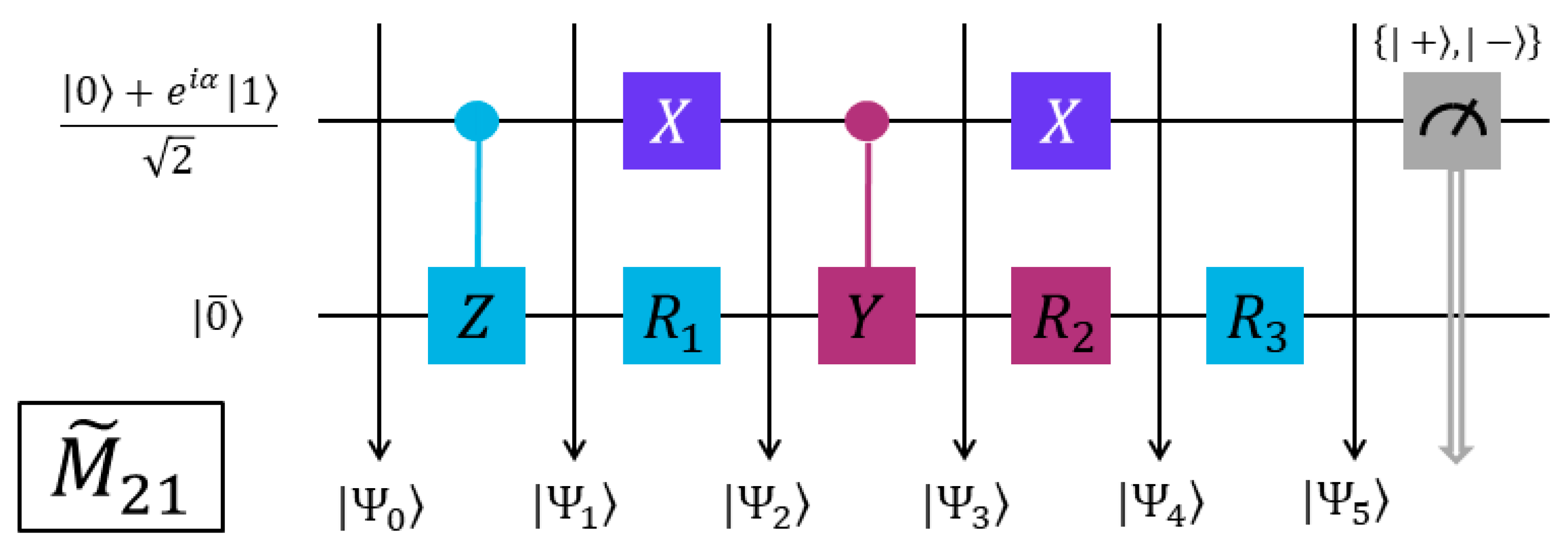
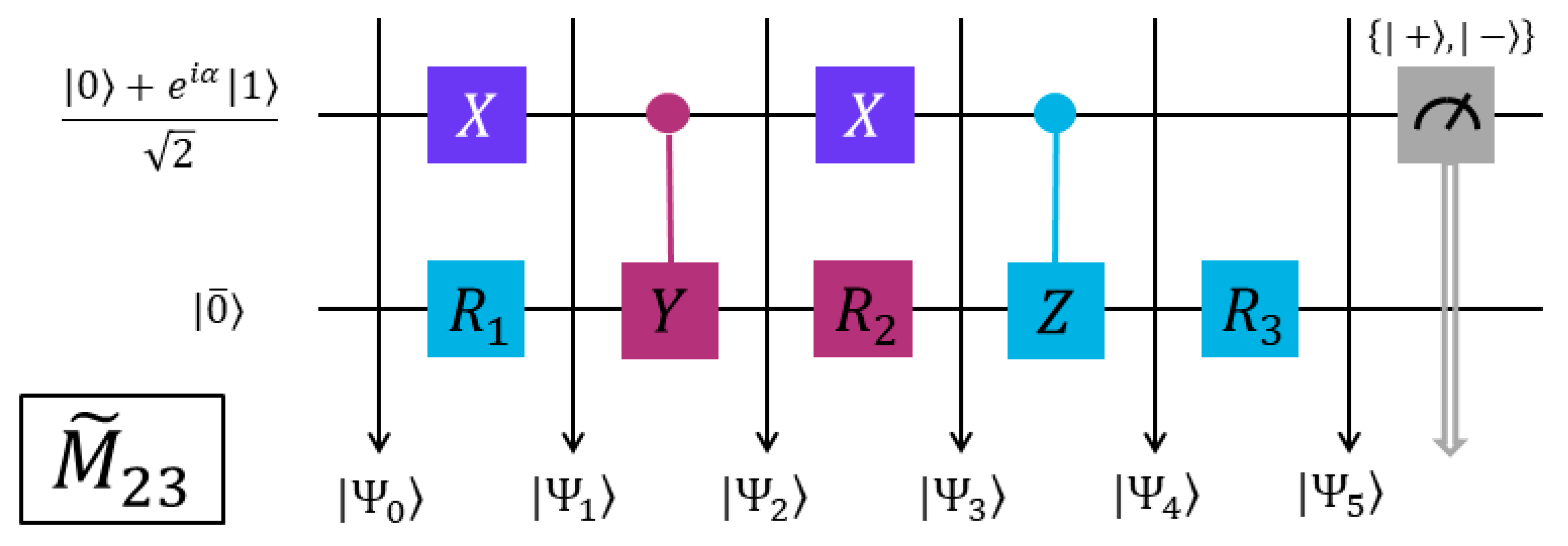
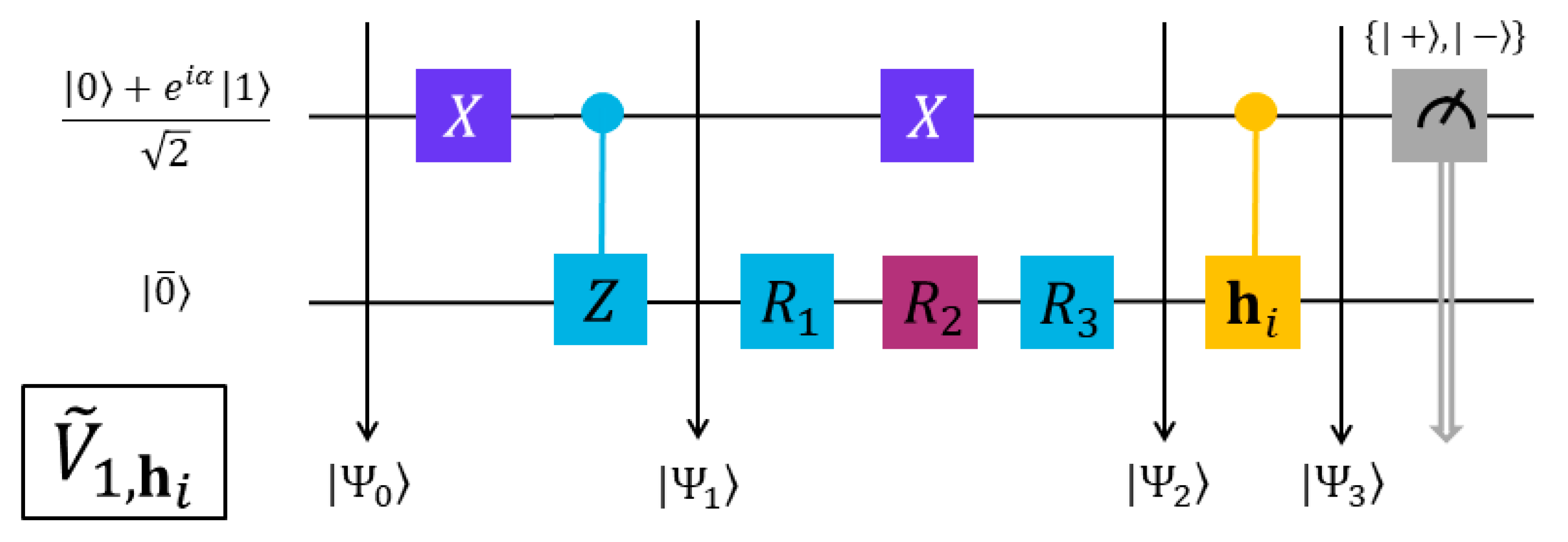
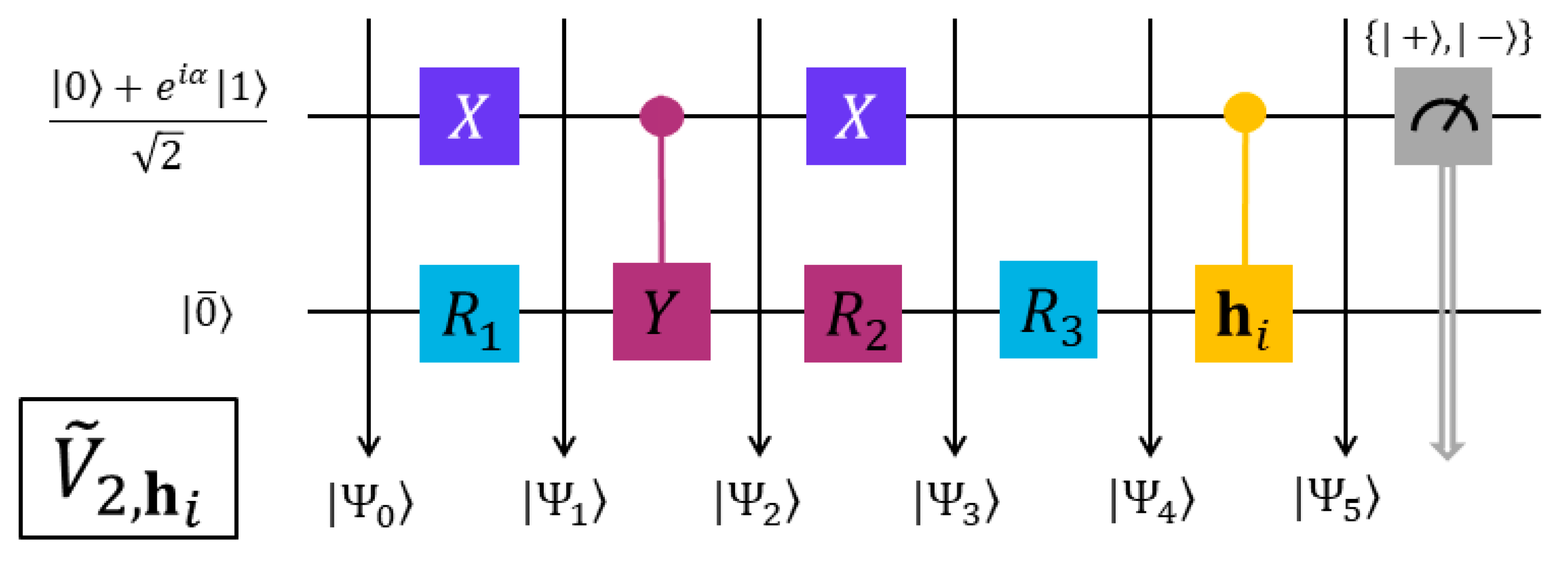
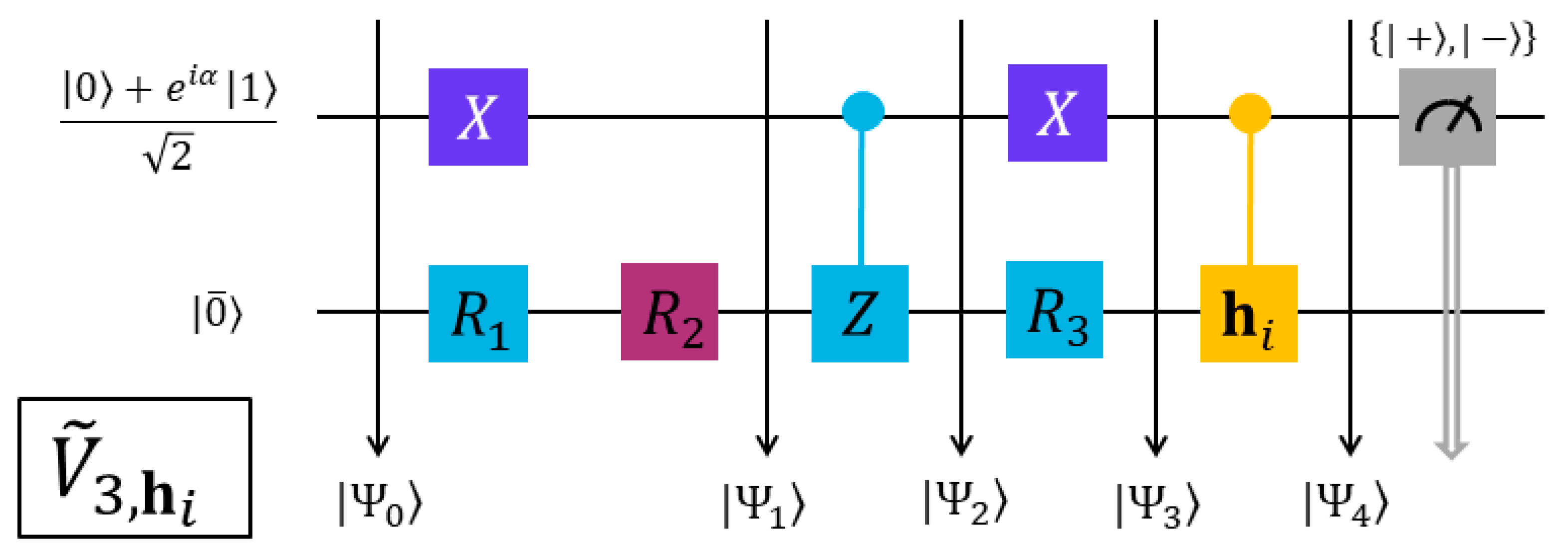
in Equations (47) and (48) in a QC fashion. After recasting these elements in the form of Equation (37), we can evaluate them with the five quantum circuits shown in
Figure 2,
Figure 3,
Figure 4,
Figure 5 and
Figure 6; these circuits are the END/QC versions of the VQS circuit in
Figure 2 of Ref. [
17]. Each of the present circuits has one ancillary qubit prepared in the state
, where the values of the circuit parameter
and
, Equation (37), are obtained with Equation (38). The values of
and
employed in the present QC evaluations are listed in
Table 1. All the ancillary qubits have the same operators: two
gates and two control gates, but in different orders and with varying targets. Each of the present circuits has also one register qubit initially prepared in the END/QC reference state
. The operators in the register qubits correspond to those involved in each evaluated element
and
, cf. Equations (47) and (48). All these circuits end with a measurement of the ancillary qubit in the
basis [
14], where
=
are the eigenvectors of the Pauli matrix
with eigenvalues +1 and −1, respectively [
14]. The average measurement provides the expectation value
=
, cf. Equations (37) and (38), as explained in the following paragraph.
All the present quantum circuits operate similarly and we will elucidate their execution by analyzing the sequential operations in the circuit for
shown in
Figure 3. At each of the steps drawn in
Figure 3, the circuit total state
successively is
By changing from the
basis to the
one in
, we obtain
where the unitary matrices
and
are defined in Equation (44). Then, from Equation (51), the probability
to find the ancillary qubit in the state
is
where
is another unitary matrix. Then, the average measurement of the ancillary qubit in the
basis is the expectation value
which is the final result from the quantum circuit. From that,
is (cf.
Table 1)
The remaining circuits operate in a similar way.
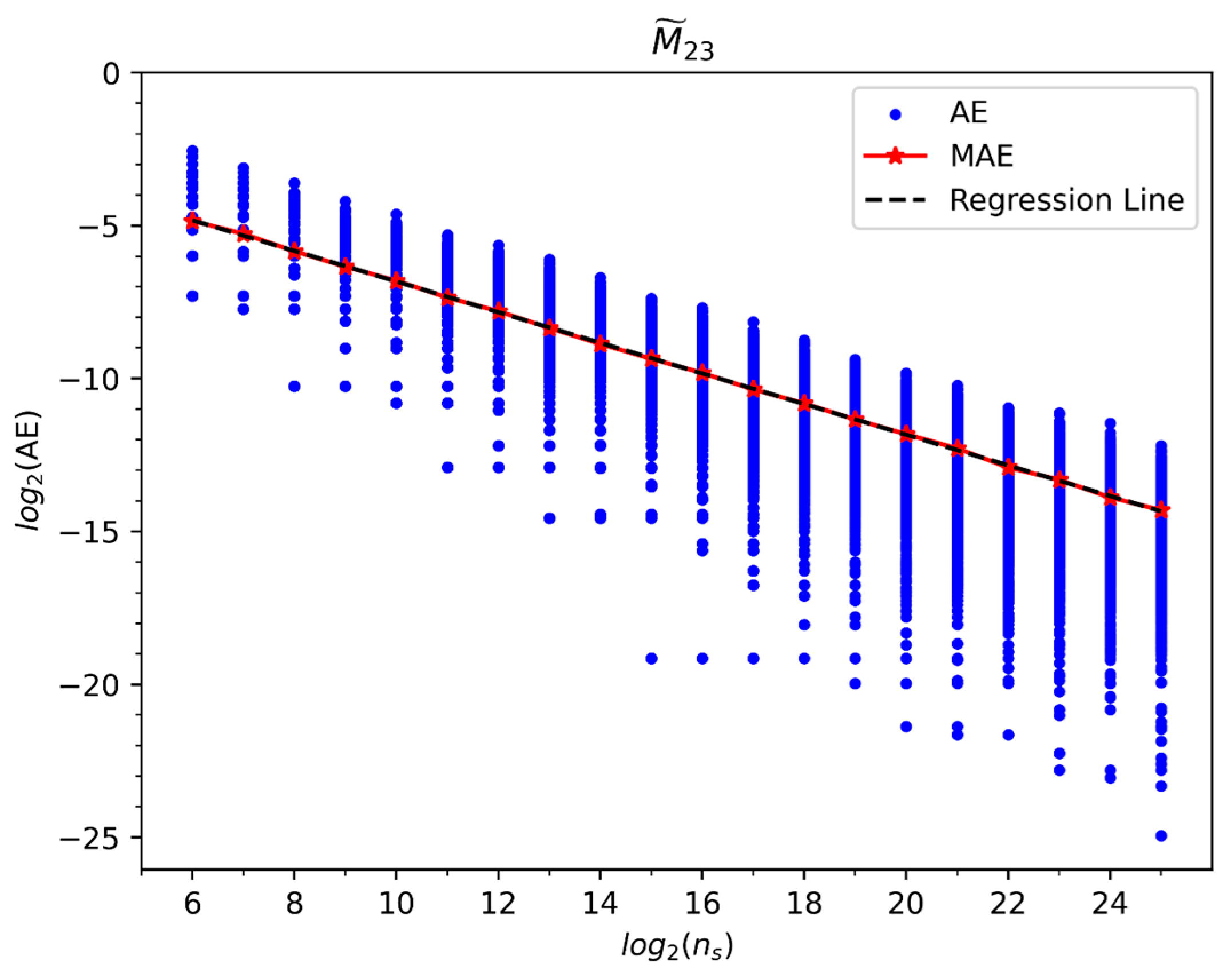
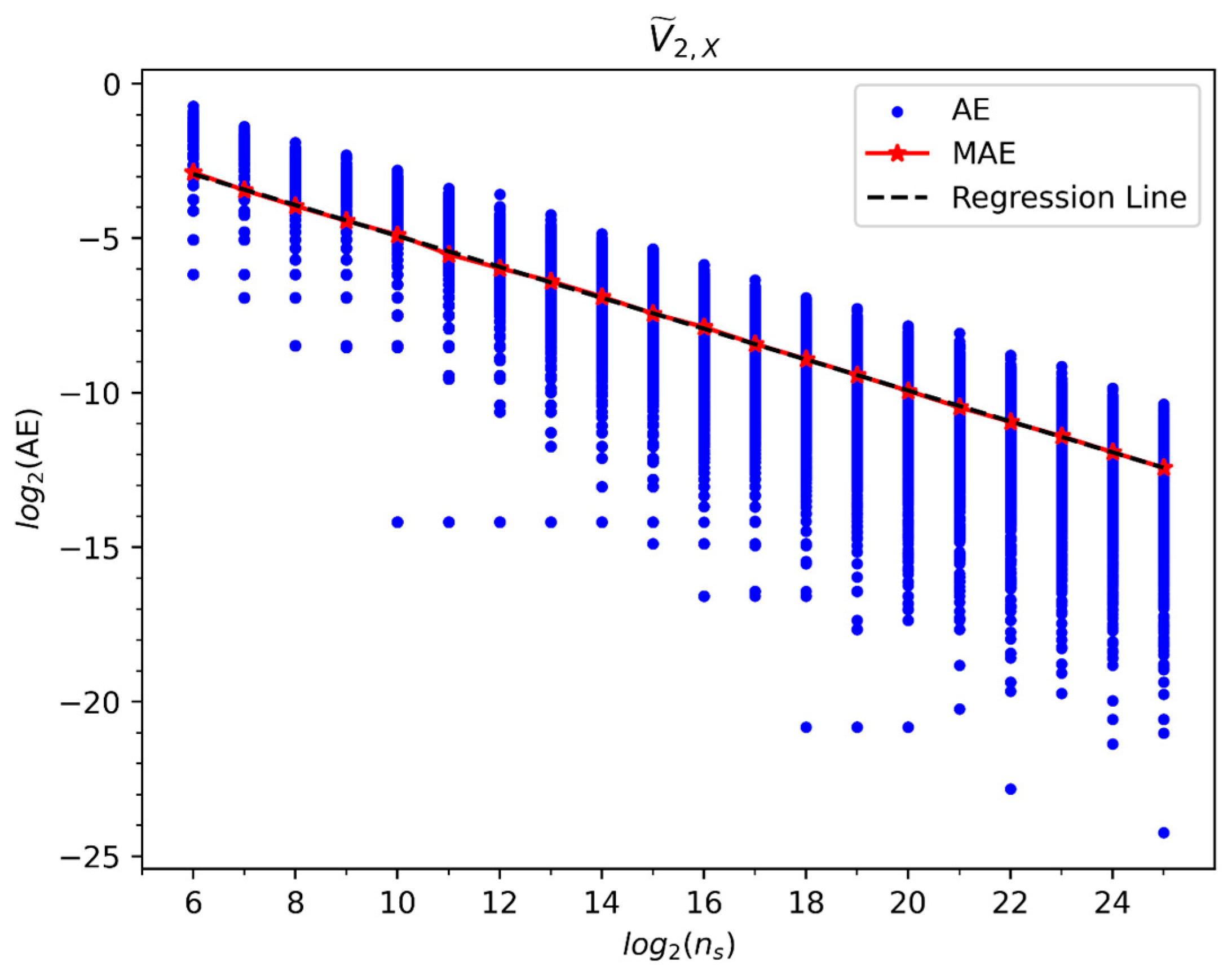
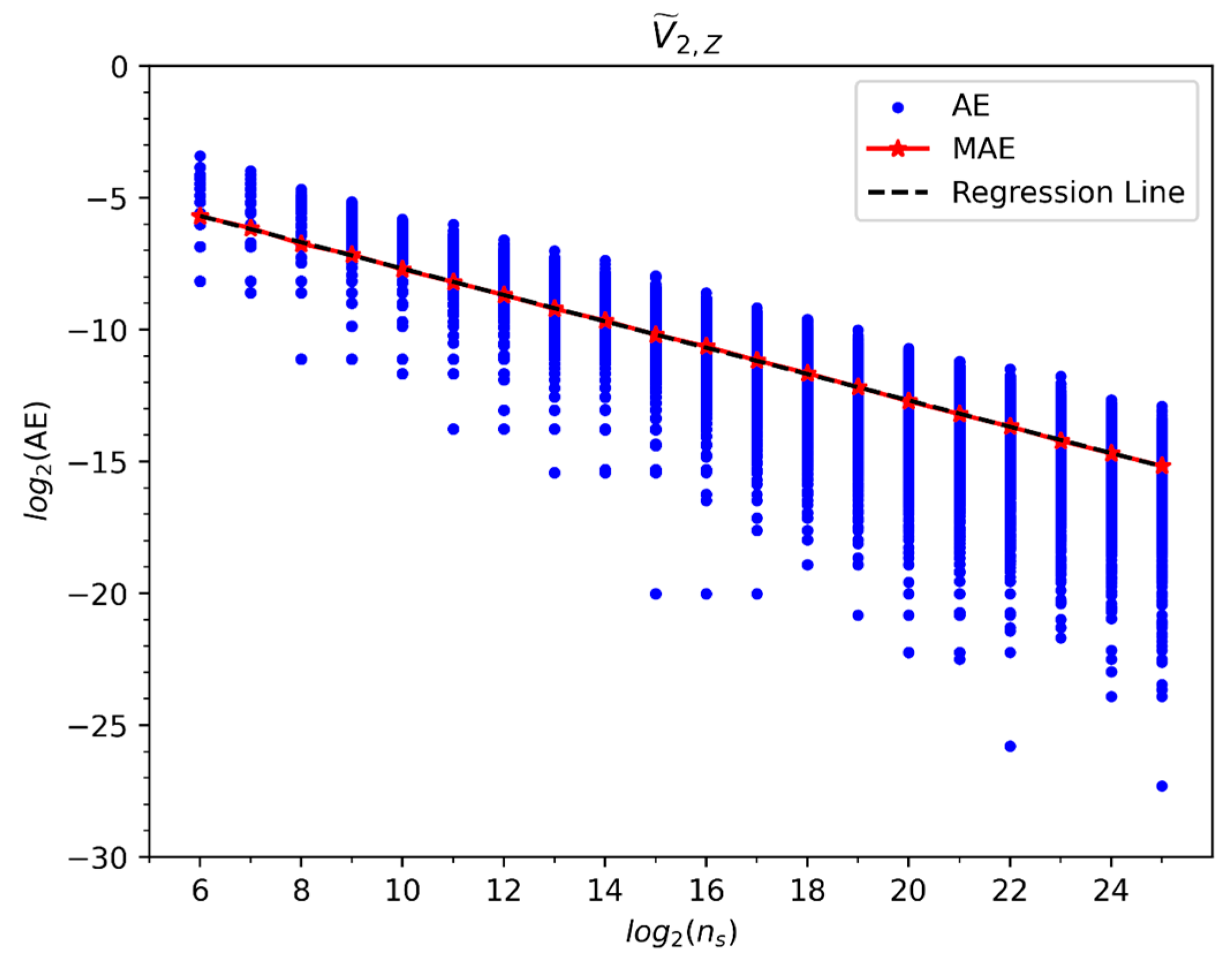
To appraise the accuracy and precision of these circuits, we will examine their results for the elements
,
,
, and
corresponding to the values of the END/QC variational parameters
and
listed in
Table 1. These are the only elements having circuit-evaluated components
not identical to zero
and
. We performed all these circuit calculations on the QC software development kit QISKIT [
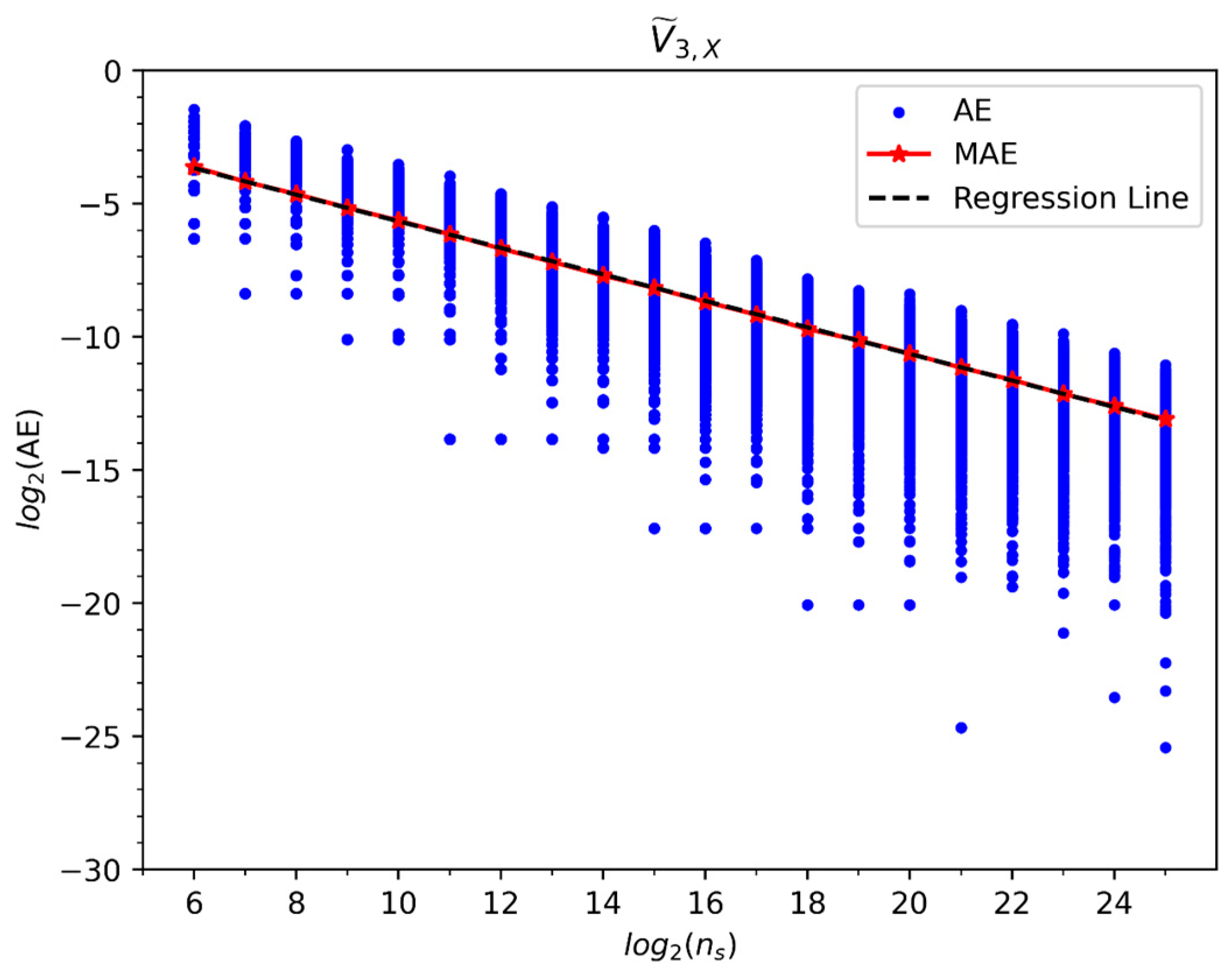
21]. To appraise the accuracy of these QC calculations, we will consider the absolute error (AE),
, and mean AE (MAE),
:
where
is the value of
,
,
, or
from the
repetition of a QC calculation with
shots, and
is the value of the same element from its analytical expression, Equations (47) and (48). The
is the average of the
over the total number of repetitions
. In
Figure 7,
Figure 8,
Figure 9 and
Figure 10, we plot the
for
= 1 to
= 1000 repetitions, and the
vs.
. In each figure, for a given number of shots
, the individual values of
appear as vertically scattered blue points, and the values of
appear as red start points/lines. In addition, in each figure, we plot the regression line corresponding to
vs.
in black and report its slope
, intercept
, and coefficient of determination
in each figure caption. Remarkably, all the regression lines exhibit the same slope
with a perfect correlation with
:
i.e., the asymptotic behavior of these errors with respect to
is of the order
. To appraise the precision of these QC evaluations, we will now consider the standard deviation (SD),
, of the individual
with respect to its
:
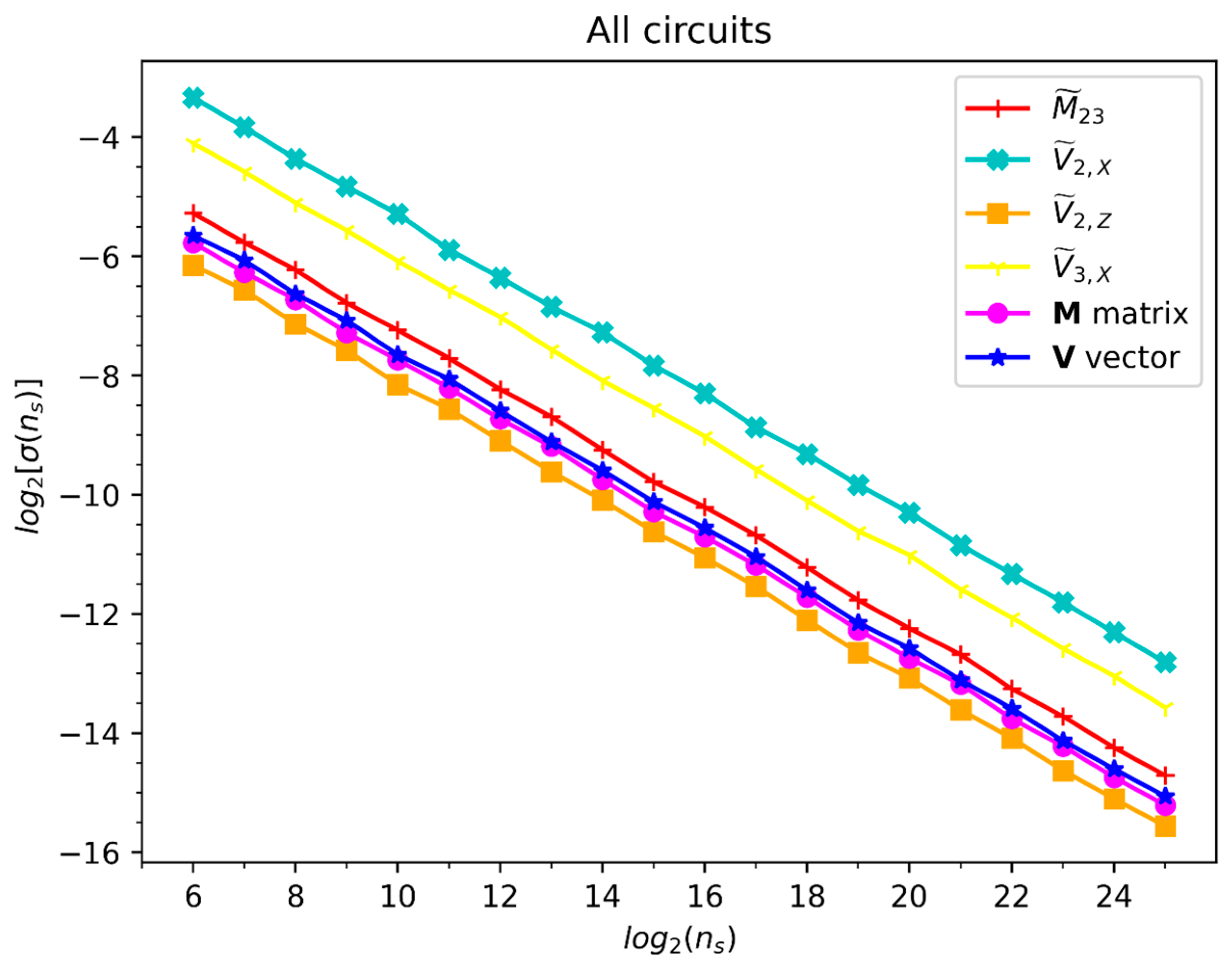
where all the terms have been defined in/after Equation (55). In
Figure 11, we plot the
vs.
of the QC calculations of
,
,
, and
and their corresponding regression lines. Like in the MAEs’ case, all the regression lines of the SDs show the same slope
, with a perfect correlation with
. This demonstrates that the asymptotic behavior of the error spread with respect to
is of the order
. The QC evaluations of the remaining elements
and
having circuit-evaluated components
identical to zero
and
exhibit same behaviors and trends in their accuracy and precision.
Finally, to elucidate a full END/QC/VQS simulation, we will examine its operations for the pure electronic dynamics of a H
2+ molecule, an homonuclear diatomic system. Before examining computational aspects, we will briefly discuss the spatial symmetry of H
2+ and its effect on the END/QC dynamics. H
2+ has a
spatial symmetry, and its HOMO and LUMO,
and
, belong to the one-dimensional
irreducible representations of gerade (
) and ungerade (
) functions, respectively [
37,
44]. This discrepancy between representations dictates that
exactly [
37,
44], cf. Equation (46). Due to this condition, the END/QC equations of motion for H
2+, Equation (49), can be solved
analytically as
where
and
are two initial conditions. Notice that the time-dependent exponential term of
involves the angular frequency
=
, i.e., the HOMO–LUMO gap.
remains stationary as an spin-orbital
or
if
=
or =
,
=
, respectively. For values of
different from the previous ones,
superimposes both spin-orbitals
and
, undergoes a real dynamics, and leads to molecular properties evolving with angular frequency
=
=
(cf. the last paragraph of this section).
To perform an END/QC/VQS simulation according to the flowchart in
Figure 1, we will consider a H
2+ molecule described with a minimal STO-3G basis set [
37] (cf. Approximation 1,
Section 4), and with a bond distance
= 1.4 a.u. The END/QC/VQS simulation of this system starts with task I that calculates the spin-orbital integrals
= −1.2528 a.u. and
= −0.4756 a.u., cf. Equation (46), for the initial nuclear positions of H
2+. This task is performed on a classical computer with the OED/ERD atomic integrals package [
10] incorporated in our END code PACE [
4]. In the present example, task I need not be repeated at each successive time step because the nuclear positions of H
2+ do not change during pure electronic dynamics. Next, task II calculates the matrix
and vector
for the values of the END/QC variational parameters
=
and
at each time step. Task II is performed on the QC software development kit QISKIT [
21] with the QC circuits in
Figure 2,
Figure 3,
Figure 4,
Figure 5 and
Figure 6, which calculate the basic elements
and
as discussed previously; these elements are subsequently combined to construct
and
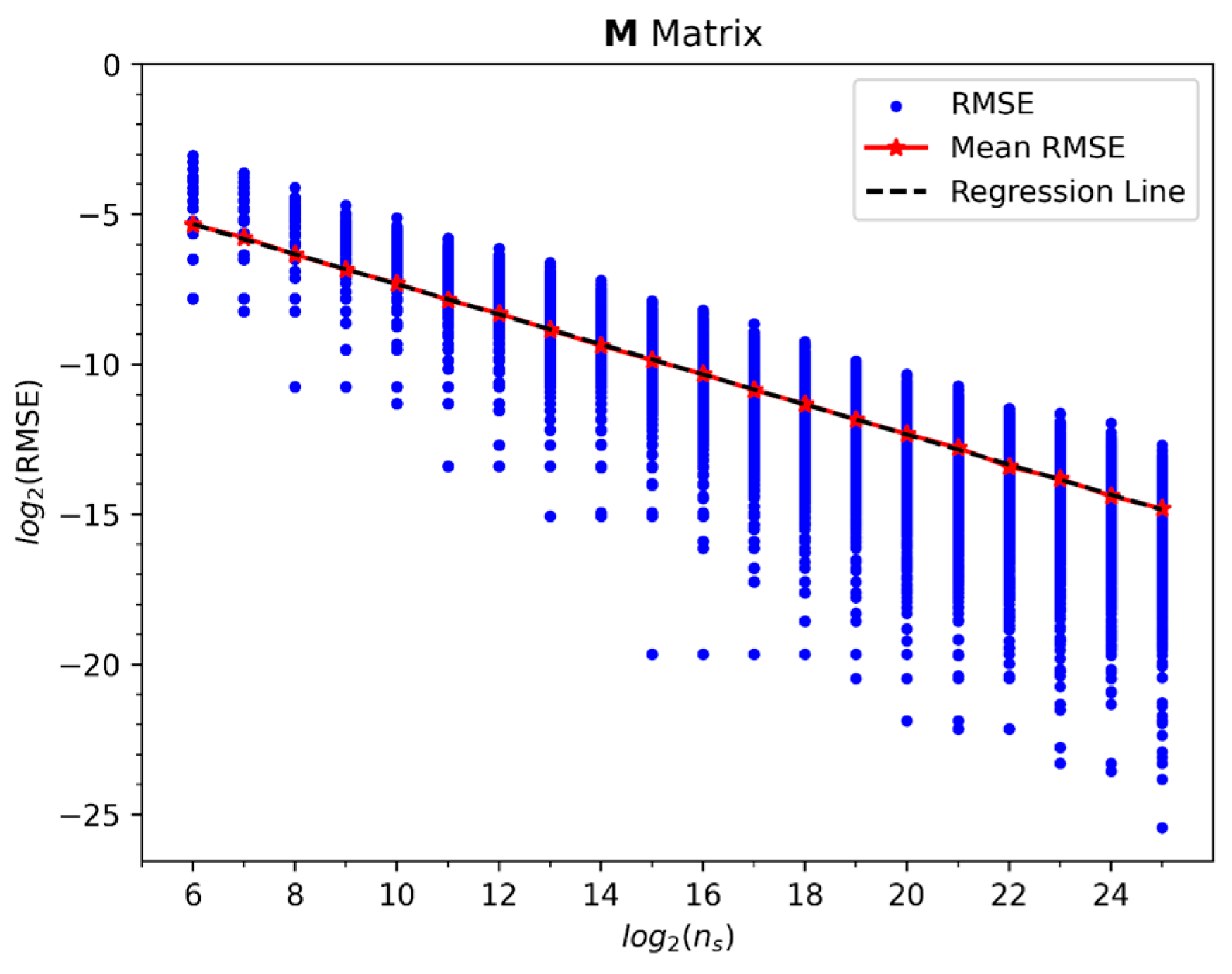
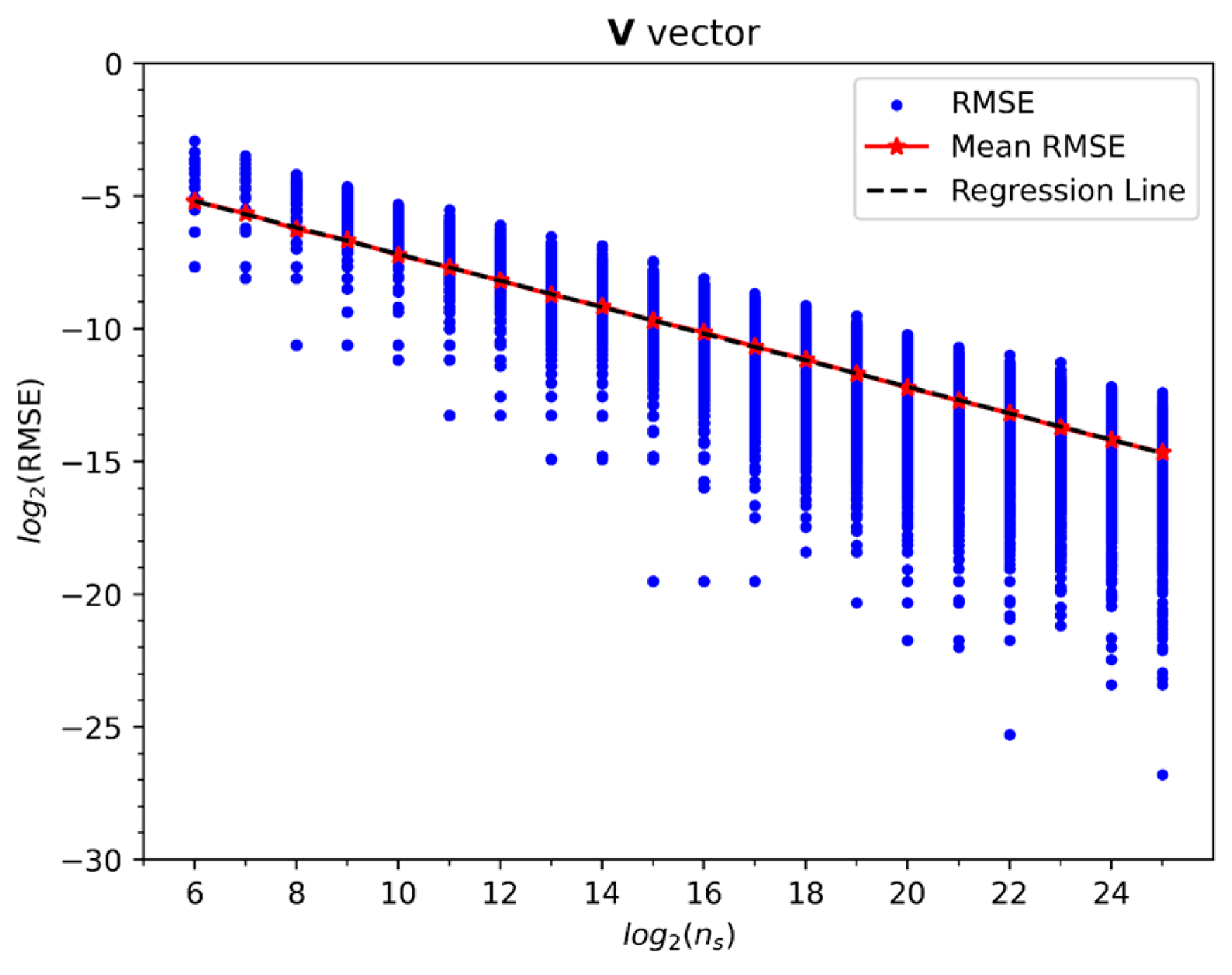
via Equations (47) and (48). To appraise the accuracy and precision of the
and
calculations, we consider the root mean squared error (RMSE),
and the mean RMSE,
, for
=
or
as
where
is the value of an element/component of
from the
repetition of a QC calculation with
shots,
is the value of the same element/component from an analytical expression, Equations (47) and (48),
is the number of elements/components of
, and
is the total number of repetitions = 1000; the RMSE is proportional to the Frobenius norm
. Like in
Figure 7,
Figure 8,
Figure 9 and
Figure 10, we plot in
Figure 12 and
Figure 13 the
,
, and the regression line of the latter vs.
of
=
and
, respectively, for the values of the END/QC variational parameters
and
listed in
Table 1. In addition, we plot in
Figure 11 the log
2 of the SD of the
’s with respect to its
and its regression line vs.
. Like in all previous QC calculations, the log
2-log
2 plots of the MRSMEs and SDs vs.
show the same slopes
with perfect linear correlations; furthermore, both metrics again scale asymptotically with an order
.
Finally, task III integrates the END/QC equations of motion with the current
and
over one time step
to obtain the new END/QC variational parameters
and
for the subsequent time step. This task is performed with the differential equations solvers of PACE [
4] on a classical computer. Alternatively, in the present example, the dynamics can be computed analytically with the expressions in Equation (58).
To illustrate the dynamics of H
2+ and gain chemical insight, we will present the time evolution of some molecular properties of H
2+ from the time-dependent END/QC wavefunction
. A first property to consider is the one-electron density
[
37]:
where
is the one-electron density matrix in the atomic orbitals’ basis
.
provides the probability density to find the electron of H
2+ in position
at time
. The other properties are the electron Mulliken populations [
37] on the nuclei
and
,
and
, respectively:
where
is the overlap matrix of the atomic orbitals
.
and
provide estimates of the total number of electrons around nuclei
and
, respectively. In
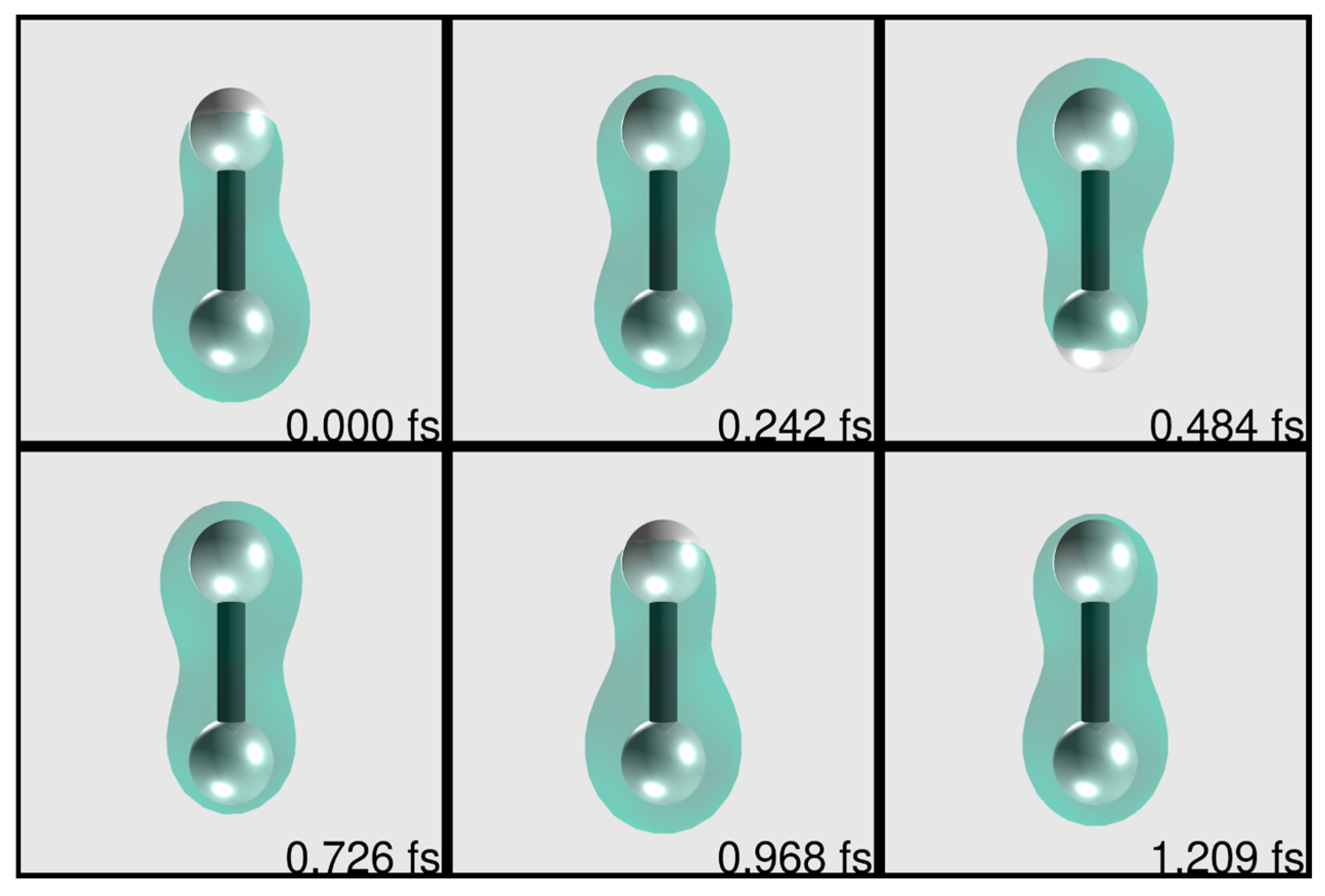
Figure 14, we show six sequential snapshots of an END/QC/VQS/STO-3G computer animation of the pure electronic dynamics of H
2+ at bond distance
= 1.4 a.u. and from the initial conditions
= 5° and
= 0°. The distortion on the electronic density introduced by the initial variational parameters reproduces a perturbation on that density caused by an incoming ion or by an external electric field. The selected values of these parameters lead to a dynamics appropriate for validation and visualization. In each frame of
Figure 14, white spheres represent the fixed H nuclei, and the green cloud depicts an electron density
iso-value = 0.1 a.u. In the first frame at evolution time
= 0 fs, we notice that the initial condition
= 5° distorts the ground-state density
conforming to the
molecular symmetry into an upright pear shape density
not conforming to
symmetry but to the lower
one. This reveals a spatial symmetry breaking [
19,
41,
42] in
and
, which results from the combination of the spin-orbitals
and
from different
irreducible representation in
when
= 5°, cf. Equation (58). In a sense, this superposition (“mixing”) of the spin-orbitals and its resulting symmetry breaking propel the subsequent dynamics. In the following frames,
evolves to a
-conforming shape at
= 0.242 fs, to a
-conforming downright pear shape at
= 0.484 fs, again to a
-conforming shape at
= 0.726 fs, and finally to the initial upright pear shape at
= 0.968 fs. This transformation of shapes repeats periodically in time. In chemical terms, these snapshots reveal that H
2+ undergoes periodical intramolecular electron transfers between the two nuclei.
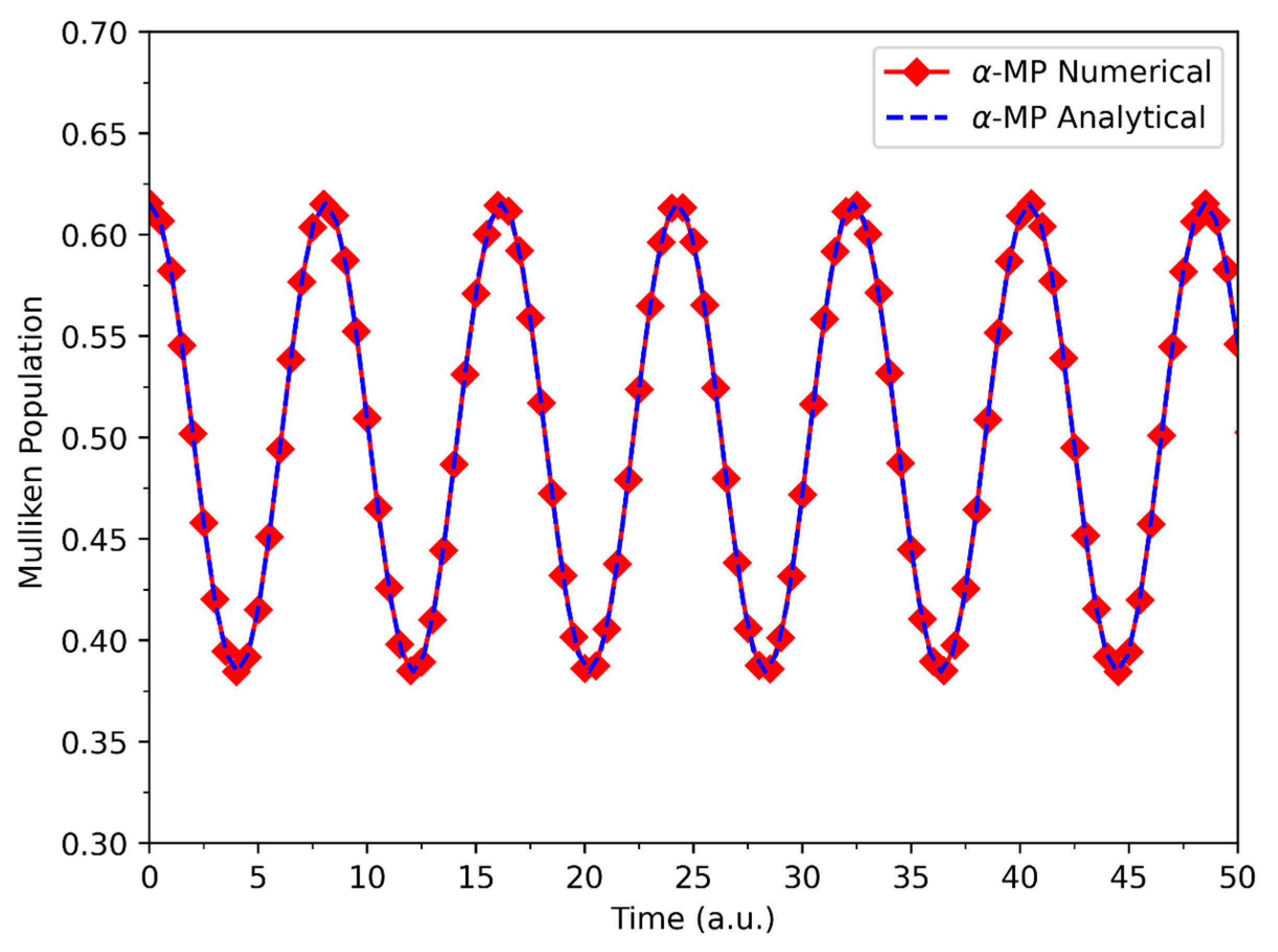
Finally, in
Figure 15, we plot the electron Mulliken population on one of the nuclei of H
2+ vs. time obtained by numerical integration of the END/QC equations, Equation (49), with the Shampine-Gordon predict-evaluate-correct-evaluate method [
45] in PACE [
4], and obtained from the analytical solution in Equation (58). Numerical and analytical results are identical as expected. Both types of Mulliken populations oscillate sinusoidally with the theoretical period
=
=
= 8.0844 a.u., cf. Equation (58), where
= −1.2528 a.u. and
= −0.4756 a.u. in H
2+ with
= 1.4 a.u..
Figure 15 also reveals the aforesaid intramolecular electron transfers.
7. Conclusions and Future Work
In this manuscript, we present the first step toward the QC formulation of the END method [
3,
4] within the VQS scheme [
17], i.e., END/QC/VQS. END [
3,
4] is a time-dependent, variational, direct, and non-adiabatic method to simulate various types of chemical reactions and scattering processes. As implemented in our code PACE [
4] on
classical computers, END adopts a total trial wavefunction that represents nuclei with frozen Gaussian wave packets and electrons with a single-determinantal state in the Thouless
non-unitary representation [
5]. The END equations of motions are obtained through the application of the TDVP [
2] to the END trial wavefunction; this procedure renders a set of symplectic equations for the nuclear and electronic variational parameters
,
, where
is the phase-space metric matrix and
the energy gradient vector [
2,
3,
4]. To implement END on
quantum computers, we adopt the VQS scheme [
17]: a
hybrid quantum/classical approach to simulate symplectic equations of motion from the TDVP [
2] and analogous variational principles [
24,
25,
26]. In our case, an END/QC simulation in the VQS scheme involves three main tasks:
(I) the calculation of atomic and molecular basis functions integrals on a
classical computer,
(II) the calculation of all the components of the END/QC equations of motion,
and
, on a
quantum computer, and
(III) the time integration of those equations,
, on a
classical computer. The philosophy of the VQS scheme [
17] is to perform each numerical task on the type of computer, either
classical or
quantum, that delivers the most efficient result with current technology.
To derive the general END/QC formalism, we substitute Thouless
non-unitary representation of the END single-determinantal electronic state [
3,
4] with Fukutome
unitary representation [
19] of the same state. Through this innovation, the new END/QC formalism fits directly into the unitary framework of QC [
14]. Fukutome representation is based on the
Lie unitary group [
19]; therefore, to understand the END/QC structure, we present a review of Fukutome representation that underlines its relationship with the
group and associated algebra via second quantization. In this context, we are the first to identify Fukutome unitary transformation matrices and transformed spin-orbitals as multi-qubit generalizations of one-qubit unitary matrices
and of one-qubit Bloch sphere states [
14], respectively. In this investigation, we adopt a Fukutome unitary representation in terms of real parameters because it fits directly into the chemical systems under consideration. Accordingly, we also present a review of the particular form of the TDVP in terms of real variational parameters [
2]. Nevertheless, it is possible to derive alternative formulations of END/QC in terms of the Fukutome unitary representation with complex parameters, or in terms of the Thouless non-unitary representation with complex parameters via LCU [
20]; we will present these alternative approaches in a following study soon.
The formulation and code implementation of END/QC for any type of dynamics and chemical systems are challenging endeavors. Therefore, in this investigation, we develop END/QC for pure electronic dynamics, i.e., for the time evolution of the electrons in the presence of fixed nuclei. Furthermore, within this dynamics, we derive END/QC for a family of model chemical systems defined by a set of four approximations; the latter are akin to semi-empirical approximations [
23] employed in quantum chemistry [
23]. In essence, these model systems consist of various chemical units (atoms, molecules, monomers, etc.), each of them containing two effective electrons with opposite spins and represented with a minimal basis set. For these systems, Fukutome unitary transformation matrices factorize into one-qubit
matrices; in turn, each of these
matrices factorizes into three one-qubit rotational matrices
,
, and
in terms of two real angle parameters
and
. Concomitantly, Fukutome transformed spin-orbitals become one-qubit Bloch sphere states in terms of
and
. This decomposition leads to a natural QC encoding of END/QC for the chosen systems wherein each individual electron can be assigned to a single qubit. We adopt this natural encoding in this investigation and will present alternative formulations in terms of standard QC encodings [
16] in a following study soon.
Within the described framework, we derive all the END/QC expressions for one-electron heteronuclear diatomic molecules. We present various formulas to evaluate the END/QC spin-orbitals, wavefunction, total energy, matrix
and vector
in both analytical and QC programming forms. In addition, we present the encoded Hamiltonian and full END/QC equations of motion. To evaluate
and
, we design and code five QC circuits (cf.
Figure 2,
Figure 3,
Figure 4,
Figure 5 and
Figure 6) on the QC software development kit QISKIT [
21], which acts as a simulator of a real quantum computer; these circuits are the END/QC versions of the VQS circuit [
17]. For illustration’s sake, we analyze the step-by-step functioning of the END/QC circuit depicted in
Figure 3. With these circuits, we evaluate the elements/components of
and
, and the whole
and
constructs, and calculate various metrics to gauge the accuracy (as MAE or mean RMSE) and precision (as SDs) of the QC results with respect to their analytical counterparts. Remarkably, in log
2-log
2 plots, we find that the error and deviation of all the QC results exhibit a perfect decreasing linear correlation with the number of shots
and with a same slope equal to −1/2 (cf.
Figure 7,
Figure 8,
Figure 9,
Figure 10,
Figure 11,
Figure 12 and
Figure 13). In other words, we find that the error and deviation of these QC calculations scale asymptotically with order
.
We illustrate a full END/QC/VQS simulation with the pure electronic dynamics of a H
2+ molecule, a homonuclear diatomic subcase. In this endeavor, we execute all the QC circuits for task II on the QC software development kit QISKIT [
21]. We first demonstrate that this H
2+ two-parameter END/QC dynamics has the analytic solution
= constant and
, where the angular frequency
is the HOMO–LUMO energy gap. We exemplify the three main tasks of the END/QC/VQS algorithm with this H
2+ case. Finally, we plot the time evolutions of the one-electron density and of the electron Mulliken populations corresponding to the END/QC/VQS dynamics of H
2+. Both properties evolutions reveal a periodic intramolecular electron transfer between the two nuclei. The analytical solution of the END/QC equations indicates that the “trigger” of this dynamics is the breaking of the
spatial symmetry in the initial END/QC wavefunction; such breaking is generated by the superposition of the HOMO and LUMO that correspond to the
gerade and
ungerade 1D irreducible representation of
, respectively [
19,
41,
42]. The plot of the electron Mulliken population vs. time from the numerically integrated END/QC/VQS equations agrees with its counterpart from analytical formulas. Those electron Mulliken populations oscillate in time with an angular frequency equal to the HOMO–LUMO energy gap
.
This manuscript presents a successful
proof of concept of END/QC/VQS, a solid foundation from which we can continue developing this method to its full maturity. However, we would like to emphasize that we are not claiming that this investigation has completely solved the arduous problem of simulating chemical reactions on quantum computers, nor that this investigation will revolutionize the fields of QC and quantum chemical dynamics. On the contrary, this investigation is just the
first step toward a fully developed END/QC/VQS, a method currently in its infancy. The objective merits of this investigation lie on the introduction of the Fukutome unitary representation [
19] as a key tool to develop END/QC/VQS, the first derivation of the END/QC/VQS formalism for model systems with any number of electrons, the first END/QC/VQS calculations of the metric matrix
and the gradient vector
in one-electron diatomic molecules, and the first END/QC/VQS simulation of the pure electronic dynamics with fixed nuclei of the H
2+ molecule (all those one-electron prototypes provide analytical solutions for comparison). We emphasize that in those efforts, we executed all the reported QC algorithms on the QC software development kit QISKIT [
21] and
not on real quantum computers. Thus, this investigation is the first and necessary step in the long road leading to the chemical reactions’ simulations on quantum machines. Toward this goal, in a series of forthcoming publications, we will first apply the current END/QC/VQS to larger model systems in order to further appraise this novel approach. Then, and more importantly, we will generalize the current END/QC/VQS for full electronic and nuclear dynamics, and for any type of molecules described with ab initio Hamiltonians and large basis sets. In this regard, we are currently implementing full nuclear and electronic END/QC/VQS dynamics of various multielectron molecules, such as H
2, LiH, BeH
2, H
2O, etc. Finally, we will extend our QC formulation to the currently classical tasks, tasks I and III, of END/QC/VQS and execute the QC algorithms on real quantum computers.