1. Introduction
The Weibull distribution is widely used in reliability and survival analysis, renowned for its flexibility in modeling various hazard rate shapes. Its capacity to represent increasing, decreasing, and constant failure rates has made it one of the fundamental tools for analyzing lifetime data across diverse fields including engineering, medicine, and economics [
1]. However, the Weibull distribution’s inability to adequately capture non-monotonic hazard rates, such as the bathtub-shaped curves frequently observed in human mortality, mechanical wear, and electronic component failures, has motivated statisticians to develop numerous extensions and generalizations [
2,
3].
Among the various methodologies for extending classical distributions, the Marshall–Olkin transformation has emerged as a flexible and computationally efficient approach [
4]. This method introduces an additional shape parameter to an existing baseline distribution, thereby enhancing its flexibility without fundamentally altering its structural form. The Marshall–Olkin family has been successfully applied to numerous well-known distributions, including the exponential [
5], Pareto [
6], gamma [
7], Lomax [
8], and linear failure-rate distributions [
9]. Each of these extensions has demonstrated superior performance in modeling complex data patterns that the original distributions could not adequately capture.
The Marshall–Olkin transformation has proven especially valuable for extending Weibull-related distributions. Ref. [
6] introduced the Marshall–Olkin extended Weibull (MOEW) distribution and investigated its properties, while [
10] explored its characterization based on Weibull probability plots. Ref. [
11] conducted a comprehensive study of the MOEW distribution, demonstrating that its density function can be expressed as an infinite linear combination of Weibull density functions, which facilitated the derivation of various mathematical properties including moments, generating functions, mean deviations, and entropy measures. Their work provided explicit expressions for the moment generating function and established several representations for reliability measures and order statistics, significantly advancing the theoretical foundation of Marshall–Olkin extended distributions.
The Marshall–Olkin framework has also been applied to other Weibull extensions, such as the exponentiated Weibull [
12], Kumaraswamy Weibull [
13], and beta modified Weibull distributions [
14], each demonstrating enhanced capability in modeling bathtub-shaped failure rates.
A significant development in unit interval distributions came with the introduction of the omega distribution by [
15], which offers considerable flexibility in modeling hazard rates while maintaining computational simplicity. When the boundary parameter
, the omega distribution reduces to the unit-exponentiated-half-logistic (UEHL) distribution, which has shown promising applications in reliability theory [
16]. The UEHL distribution belongs to the class of proportional hazard rate models and exhibits several advantageous properties, including the absence of exponential terms and special functions in its density expression, which simplifies computational procedures in parameter estimation.
In this paper, we introduce the Marshall–Olkin unit-exponentiated-half-logistic (MO-UEHL) distribution, which combines the flexibility of the UEHL distribution with the extensibility of the Marshall–Olkin transformation. The proposed distribution builds upon the foundational work of [
11] on Marshall–Olkin extended distributions and extends the univariate framework of [
16] by incorporating the tilt parameter from the Marshall–Olkin transformation into the UEHL distribution. This synthesis creates a more flexible three-parameter distribution defined on the unit interval
that can capture a wider range of distributional shapes while maintaining computational tractability.
The MO-UEHL distribution offers several advantages: it is defined on the unit interval , making it ideal for modeling proportional data; it contains neither exponential terms nor special functions, simplifying computational aspects; and it exhibits increased flexibility in capturing various data patterns, including positively skewed, reverse J-shaped, and unimodal configurations. The inclusion of the Marshall–Olkin tilt parameter provides additional shape flexibility beyond the original UEHL distribution, enabling better fit to diverse datasets.
We undertake a comprehensive study of the mathematical properties of the MO-UEHL distribution, deriving explicit expressions for its probability density function, cumulative distribution function, survival function, hazard rate function, and quantile function. Also, we investigate its moment properties and examine various reliability measures, including stress-strength reliability, inverse hazard rate, mean residual life, and information-theoretic measures such as the Shannon entropy and residual entropy.
For parameter estimation, we consider multiple classical methods, including maximum likelihood estimation, maximum product spacing, ordinary and weighted least-squares, and Cramér–von Mises estimation. We conduct extensive simulation studies to evaluate the performance of these estimators under various parameter configurations and sample sizes. The practical utility of the MO-UEHL distribution is demonstrated through applications in four real datasets from environmental and engineering contexts, where it is compared against several competing distributions using various goodness-of-fit criteria.
The remainder of the paper is organized as follows:
Section 2 introduces the MO-UEHL distribution and derives its fundamental properties.
Section 3 explores various reliability measures and information-theoretic properties.
Section 4 discusses parameter estimation methods, while
Section 5 presents the simulation results.
Section 6 demonstrates real data applications, and finally,
Section 7 provides the concluding remarks.
2. Description of the Model
Recently, Ref. [
16] developed the UEHL distribution, grounded in the omega distribution and categorized within the proportional hazard rate model framework. The cumulative distribution function (CDF) of the UEHL distribution is defined as
with corresponding probability density function (PDF):
where
and
are the shape parameters. The UEHL distribution demonstrates multiple applications in reliability theory, leveraging the exponentiated half-logistic distribution [
17,
18].
In this section, the MO-UEHL distribution is introduced by integrating the CDF of the UEHL distribution into the Marshall–Olkin transformation framework. The survival function (SF) of the Marshall–Olkin family of distributions is defined as
where
is the baseline CDF of a continuous distribution and
denotes the SF of the baseline distribution. This approach can be used to leverage the transformation to enhance the adaptability of the baseline UEHL model. Applying the transformation to the CDF (
1), the CDF of the MO-UEHL distribution can be expressed as follows:
where
and
are the shape parameters, and
is the tilt parameter. A distinguishing feature of the MO-UEHL distribution is the explicit control exerted by the Marshall–Olkin tilt parameter
over the symmetry properties of the density on the unit interval. When
, the model coincides with the baseline UEHL distribution, which is generally right-skewed. As
decreases towards 0, the density shifts progressively towards left-concentrated forms, while intermediate values of
with proper
and
values yield nearly symmetric unimodal shapes. This smooth transition from pronounced asymmetry to near-symmetry arises directly from the Marshall–Olkin transformation, which introduces a tilt mechanism that systematically breaks or restores symmetry while preserving the bounded support. Consequently, the MO-UEHL family offers a flexible parametric framework for studying symmetry and symmetry-breaking phenomena in proportional data, rendering it especially suitable for research focused on asymmetry in statistical modeling.
The corresponding PDF of the MO-UEHL, derived from the Marshall–Olkin transformation, is given by
The SF and hazard rate function (HRF) of the MO-UEHL distribution are derived as
and
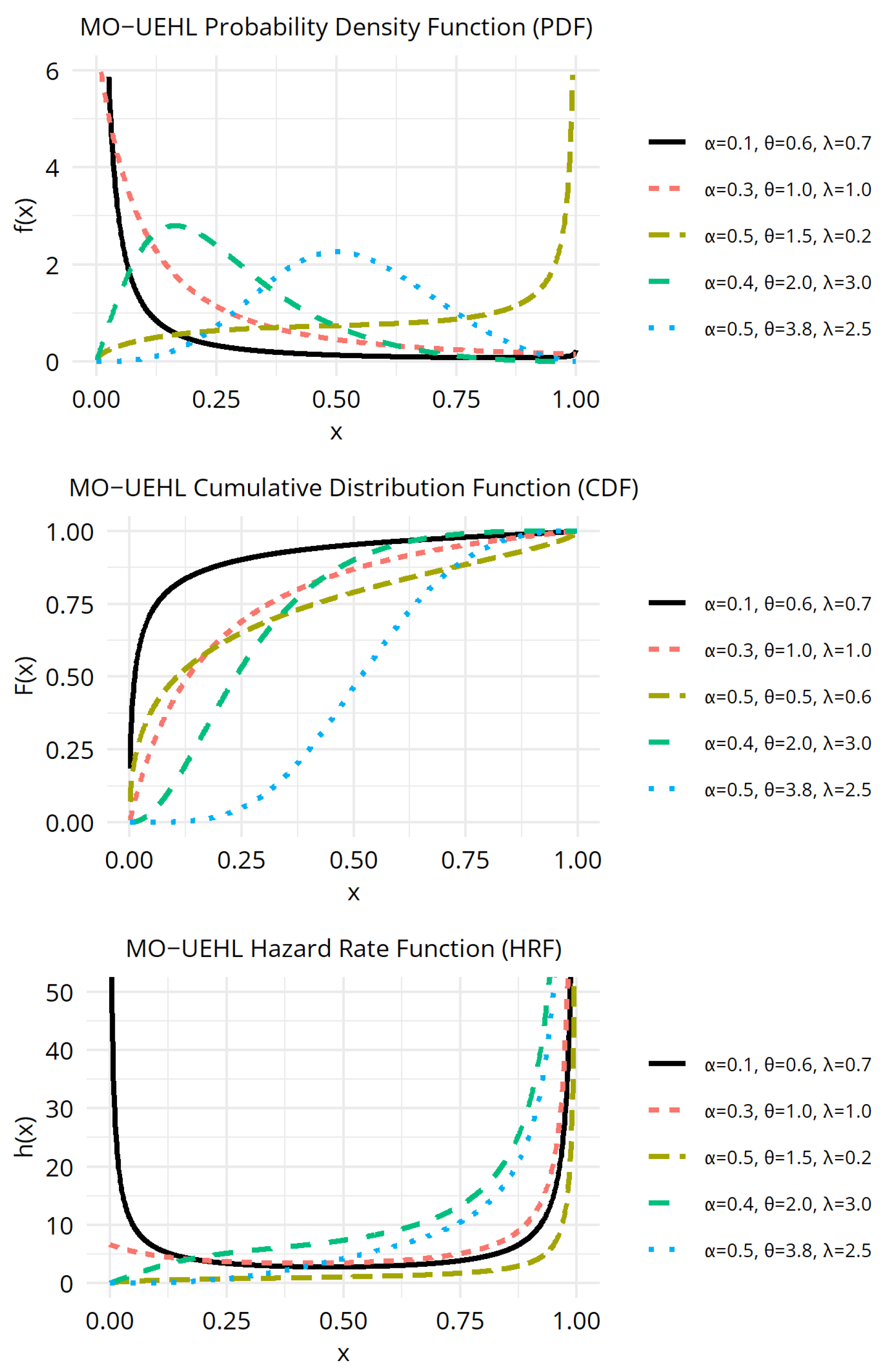
Figure 1 illustrates the PDF plots, CDF plots and HRF plots for various values of the distribution parameters. Specifically, the PDF of the MO-UEHL distribution represent positively skewed, reverse J-shaped, U-shaped, and unimodal configurations, making it a flexible model for fitting diverse data types.
2.1. Quantile Function
The quantile function is a critical tool for generating random samples, computing critical values, and analyzing distributional properties in statistical modeling. For the MO-UEHL distribution, the quantile function is
Equation (
6) facilitates the generation of random samples from the MO-UEHL distribution. It also enables the computation of key statistical measures, such as the median (when
) and other percentiles, which are essential for applications in reliability analysis and data modeling. The flexibility of the parameters
,
, and
allows the quantile function of the MO-UEHL distribution to capture a wide range of distributional shapes within the unit interval
.
To illustrate the behavior of the quantile function across different parameter settings,
Table 1 presents numerical values for the quantiles
,
,
,
,
,
, and
for the combinations of
,
, and
.
2.2. Moments
The moments of a distribution provide essential insights into its central tendency, dispersion, skewness, and kurtosis, which are crucial for statistical inference. For the MO-UEHL distribution, the
r-th raw moment is defined as
where
is the PDF given in (
4). Based on Equation (
2) the MO-UEHL PDF can be expressed using the PDF of the baseline UEHL distribution
and SF
as
By the binomial series, Equation (
7) becomes
and the
r-th moment of MO-UEHL
is then
where
with
UEHL
. The
r-th moment of
Y is given by
Applying the binomial series expansion, Equation (
9) becomes
where
is the beta function with
, the gamma function. Finally, substituting the result from (
10) back into the moment expression (
8), the moments of the MO-UEHL
distribution are obtained as
5. Numerical Simulation
This part evaluates the efficiency of different estimation approaches for determining the parameters of the MO-UEHL distribution. For the simulation study, random samples were produced using the MO-UEHL quantile function from Equation (
6), with sample sizes of
. The focus here is on examining the behavior of the estimators through five traditional methods: MLE, MPS, OLS, WLS, and CVM, as outlined in
Section 4. The evaluation relies on key indicators such as average absolute bias (
), mean squared error (MSE =
), standard deviation (SD), and mean absolute deviation (MAD =
), where
denotes the parameter set, and
represents the simulation repetitions. Three distinct parameter sets were selected for the MO-UEHL:
,
, and
. These combinations allow for assessing estimator performance under varying shape and scale scenarios. For every set and sample size, 1000 samples were created via the quantile function in (
6), followed by parameter estimation using the five techniques. The outcomes are compiled in
Table 2 for
,
Table 3 for
, and
Table 4 for
.
In summary, MLE tends to deliver strong results across various scenarios, especially with larger samples (), showing reduced bias, MSE, MAD, and SD for most parameters. On the other hand, CVM estimators generally exhibited higher bias and MSE compared to MLE and MPS, particularly for larger values of . As the number of observations grows, accuracy measures improve markedly for all approaches, leading to more dependable outcomes, particularly where initial small-sample inaccuracies are pronounced. For bigger datasets, MLE aligns closely with WLS, providing solid performance alongside ease of computation. In practice, MLE and MPS are advisable for modest samples, where MLE shines in minimizing bias and MPS in achieving balanced error reduction (MSE). For large data, MLE achieves the lowest AIC. These observations emphasize how data volume and parameter scale critically affect estimator selection, positioning MLE and MPS as dependable options in diverse conditions.
Ordering the techniques by MSE sheds more light on their efficacy. For the combination
in
Table 2, MLE and MPS frequently lead for
and
, with MPS performing well in small samples (
) and MLE taking precedence in large ones (
). OLS and CVM typically fall behind, especially regarding
. In the case of
in
Table 3, MLE, MPS, and WLS dominate, with MPS excelling in small data and MLE prevailing in large data; OLS tends to rank at the bottom. For
in
Table 4, MLE and MPS yield optimal results in bigger samples, while MPS holds its ground in smaller ones, and OLS exhibits the least favorable outcomes, particularly for
. In general, MLE and MPS prove most consistent across configurations, with MPS advantageous for restricted data and OLS regularly lagging.
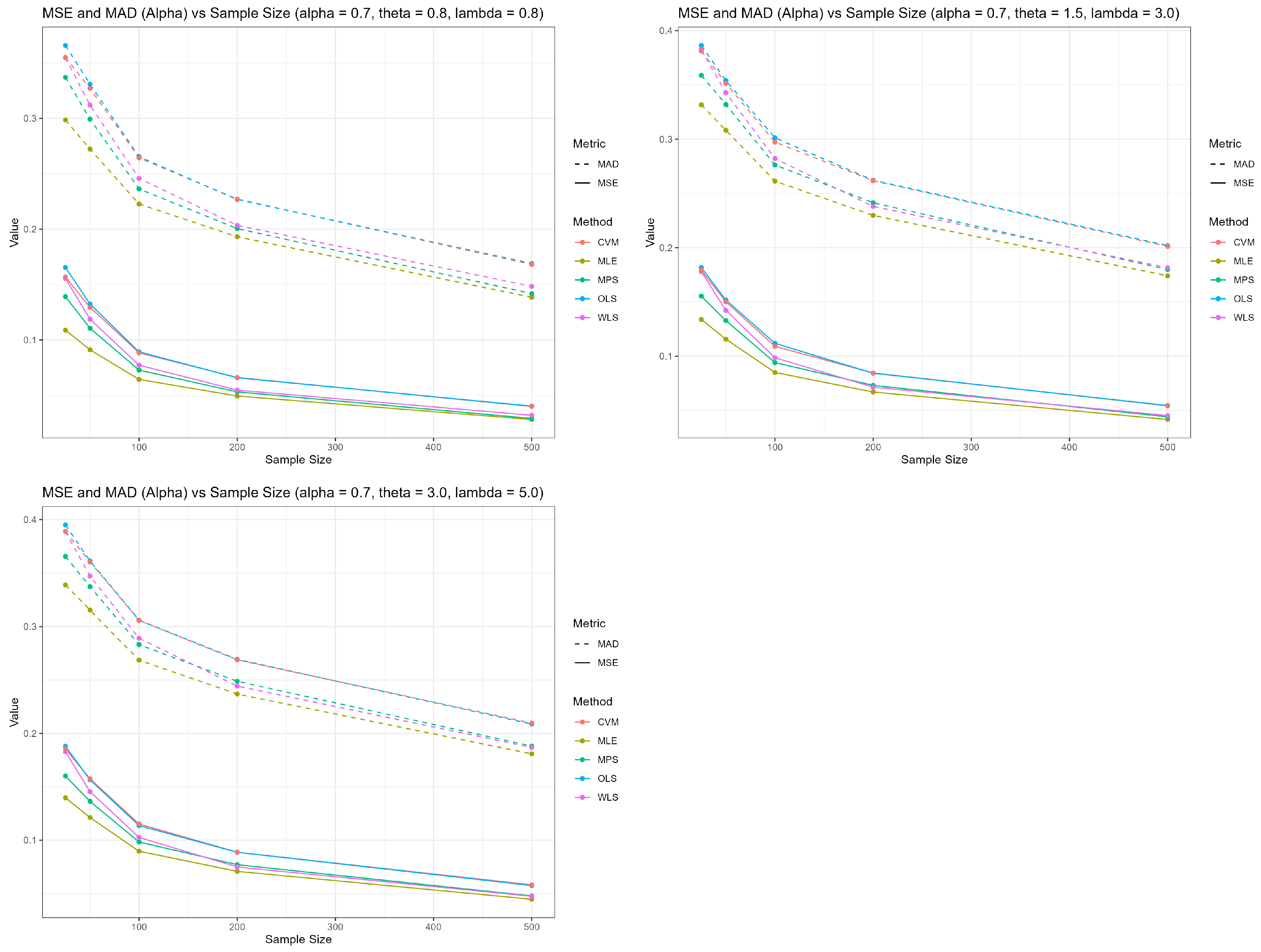
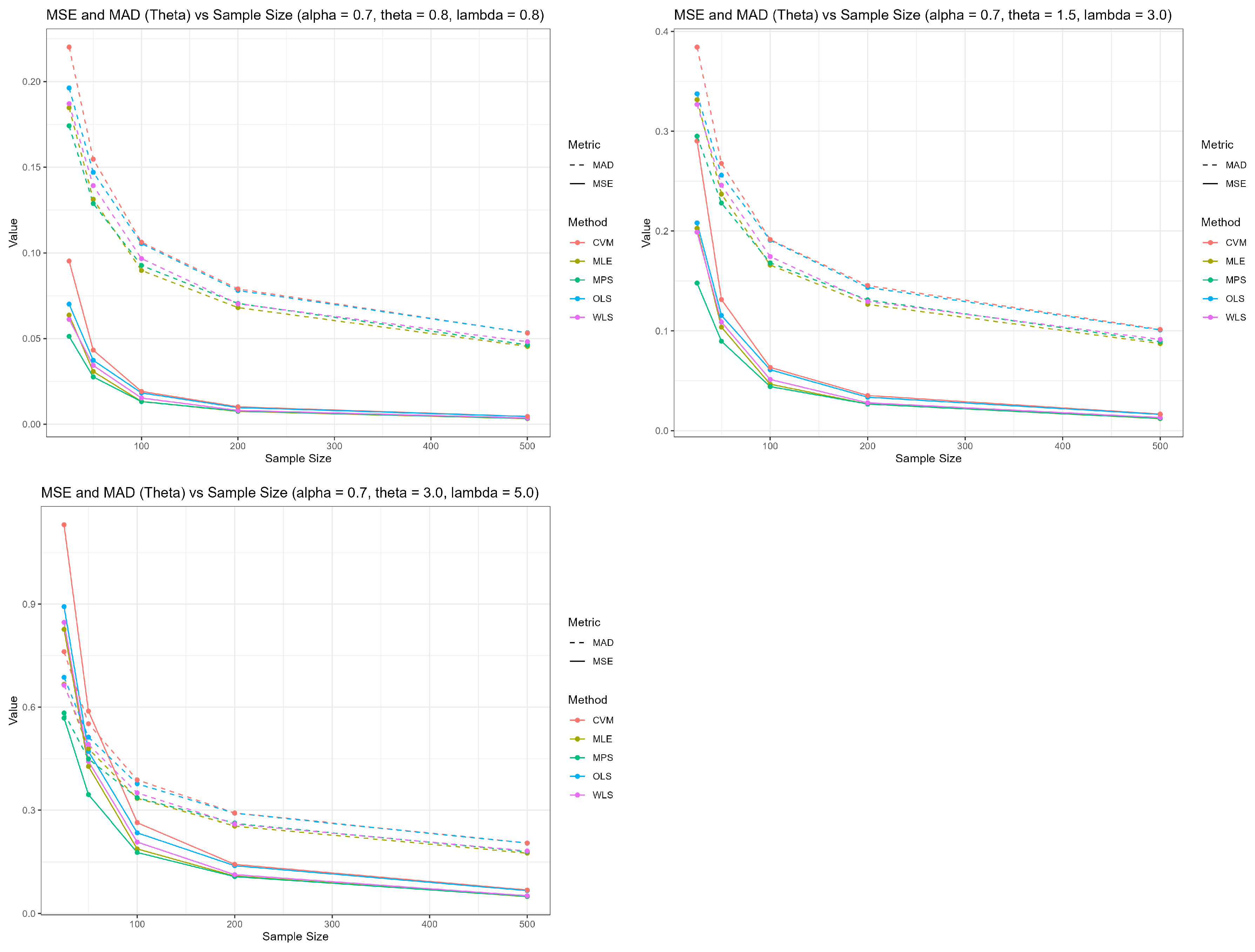
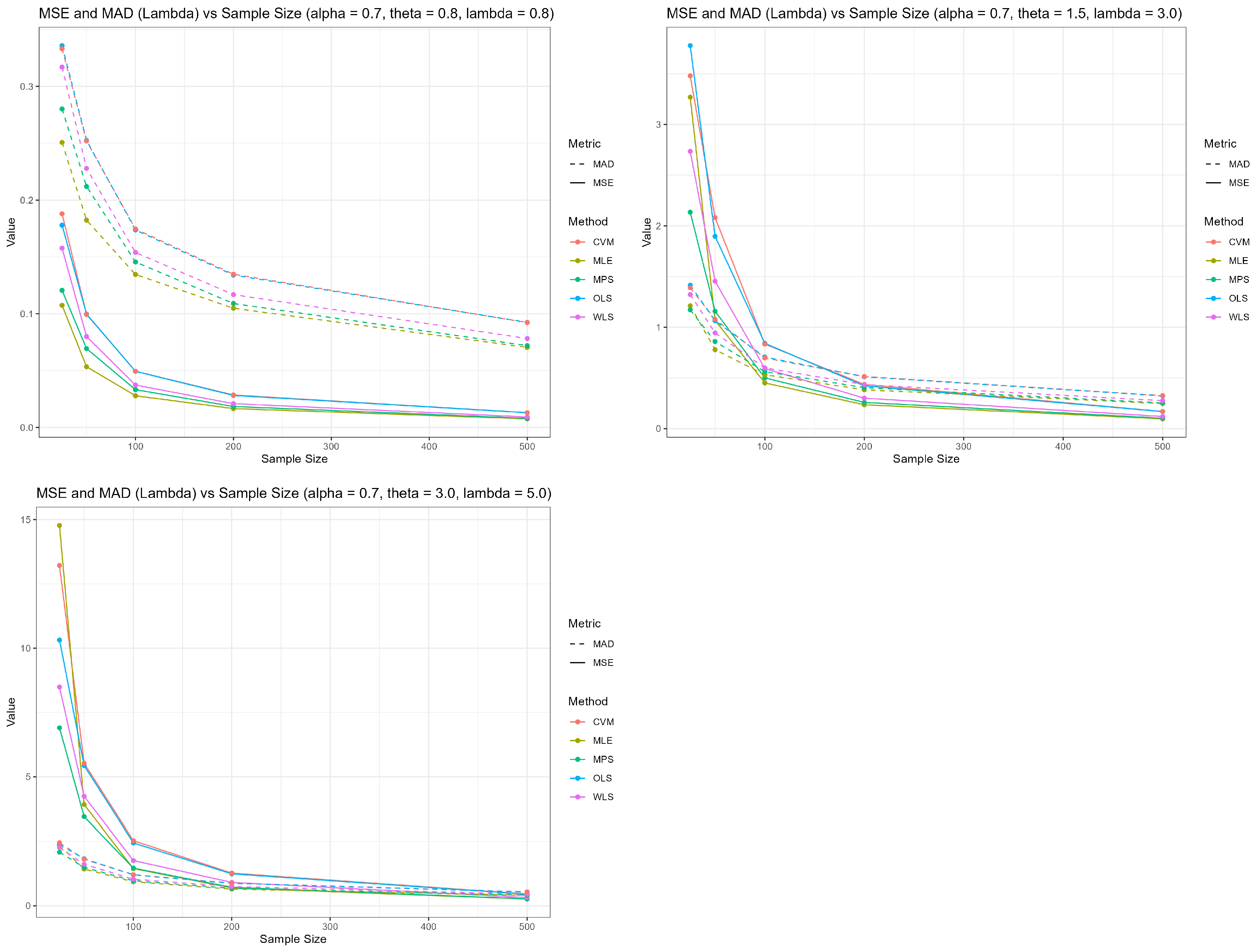
Furthermore, the visual depictions of the simulation data in
Figure 2,
Figure 3 and
Figure 4 effectively back the tabulated insights for the parameter groups
,
, and
, respectively. These visuals effectively reinforce the findings presented in the tables, illustrating the trends of estimators for
,
, and
across varying sample sizes.
6. Real Data Applications
To demonstrate the empirical applicability of the MO-UEHL distribution, we apply it to two real datasets from health and education contexts. These datasets consist of naturally bounded proportions in the unit interval (0, 1), aligning with the model’s design for modeling rates and proportions. The MO-UEHL is compared with several competing distributions, including the MO-Exponential, MO-Kumaraswamy, MO-Weibull, MO-Frechet, Kumaraswamy, and Weibull distributions, using goodness-of-fit measures such as AIC, AICc, BIC, HQIC, Anderson–Darling statistic ( with p-value ), and Kolmogorov–Smirnov statistic (KS with p-value KS).
6.1. COVID-19 Mortality Rate Dataset
The first dataset represents daily mortality rates (proportion of deaths relative to cumulative cases) for COVID-19 in the United Kingdom over 82 days, from 1 May to 16 July 2021 [
21]. The data are: 0.0023, 0.0023, 0.0023, 0.0046, 0.0065, 0.0067, 0.0069, 0.0069, 0.0091, 0.0093, 0.0093, 0.0093, 0.0111, 0.0115, 0.0116, 0.0116, 0.0119, 0.0133, 0.0136, 0.0138, 0.0138, 0.0159, 0.0161, 0.0162, 0.0162, 0.0162, 0.0163, 0.0180, 0.0187, 0.0202, 0.0207, 0.0208, 0.0225, 0.0230, 0.0230, 0.0239, 0.0245, 0.0251, 0.0255, 0.0255, 0.0271, 0.0275, 0.0295, 0.0297, 0.0300, 0.0302, 0.0312, 0.0314, 0.0326, 0.0346, 0.0349, 0.0350, 0.0355, 0.0379, 0.0384, 0.0394, 0.0394, 0.0412, 0.0419, 0.0425, 0.0461, 0.0464, 0.0468, 0.0471, 0.0495, 0.0501, 0.0521, 0.0571, 0.0588, 0.0597, 0.0628, 0.0679, 0.0685, 0.0715, 0.0766, 0.0780, 0.0942, 0.0960, 0.0988, 0.1223, 0.1343, 0.1781.
Table 5 summarizes the descriptive statistics for this dataset, indicating a positively skewed distribution with a mean of 0.0357 and kurtosis of 4.9781.
Table 6 presents the goodness-of-fit results. The MLE estimates are
,
, and
.
Table 6 shows that the MO-UEHL distribution outperforms with the lowest AIC of −387.15, supported by the highest
p-values for
(0.9998) and KS
(0.9976), demonstrating a superior fit to the data. In contrast,
Table 6 indicates that MO-Weibull has a high
value of 14.50 and very low
p-values (
, KS
), pointing to a poor fit. Kumaraswamy, with an AIC of −384.67 and lower
p-values (0.7828 for
, 0.9321 for KS
), also falls short compared to MO-UEHL.
6.2. Reading Accuracy Scores Dataset
The second dataset consists of reading accuracy scores for 44 elementary school students, representing the proportion of words read correctly in a short story [
22,
23]. The data are naturally bounded in (0, 1) as they measure accuracy proportions.
Table 7 summarizes the descriptive statistics for this dataset, indicating a nearly symmetric distribution with a mean of 0.7728 and negative kurtosis of −1.6278.
Table 8 presents the goodness-of-fit results. The MLE estimates are
,
, and
.
Table 8 shows that the MO-UEHL distribution achieves a competitive fit with an AIC of −53.35, supported by
p-values for
(0.0672) and KS
(0.0492). While MO-Kumaraswamy has a slightly higher AIC of −50.61, MO-UEHL outperforms models like MO-Exponential (AIC 69.31, low
p-values) and Weibull (AIC −23.94, low
p-values), indicating better alignment with the data for this proportion-based dataset.
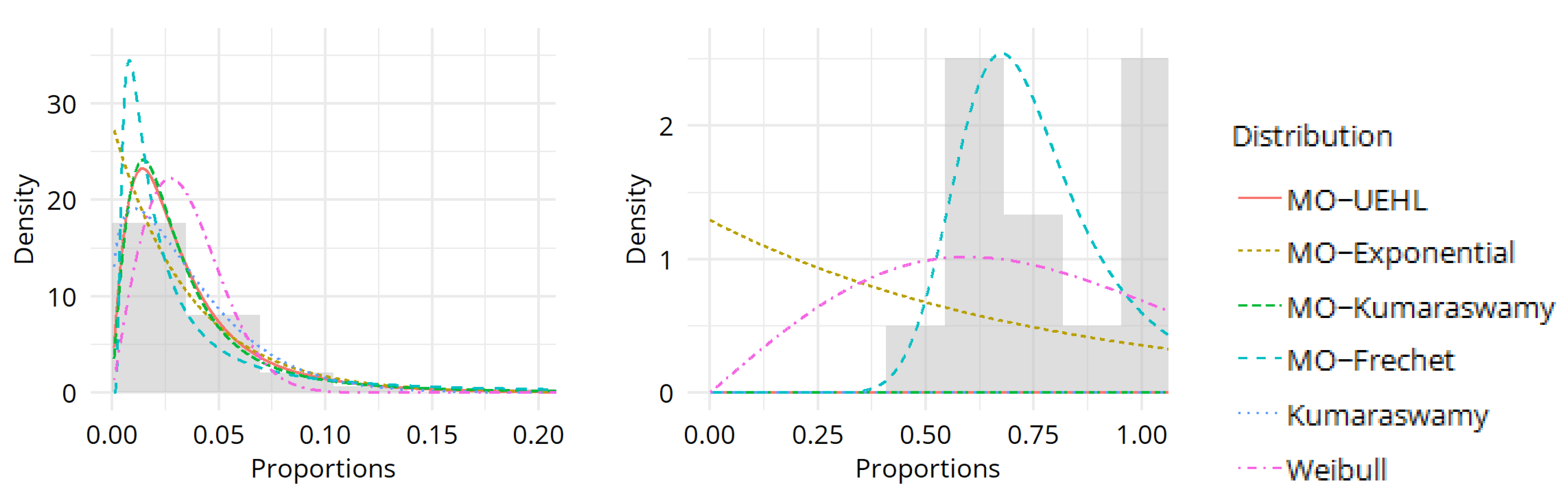
Figure 5 presents density plots with histograms comparing the performance of the proposed MO-UEHL distribution against several competing models. The findings depicted in
Figure 5 effectively support the results from the real data analysis, confirming the superior fit of the MO-UEHL distribution across the analyzed datasets.
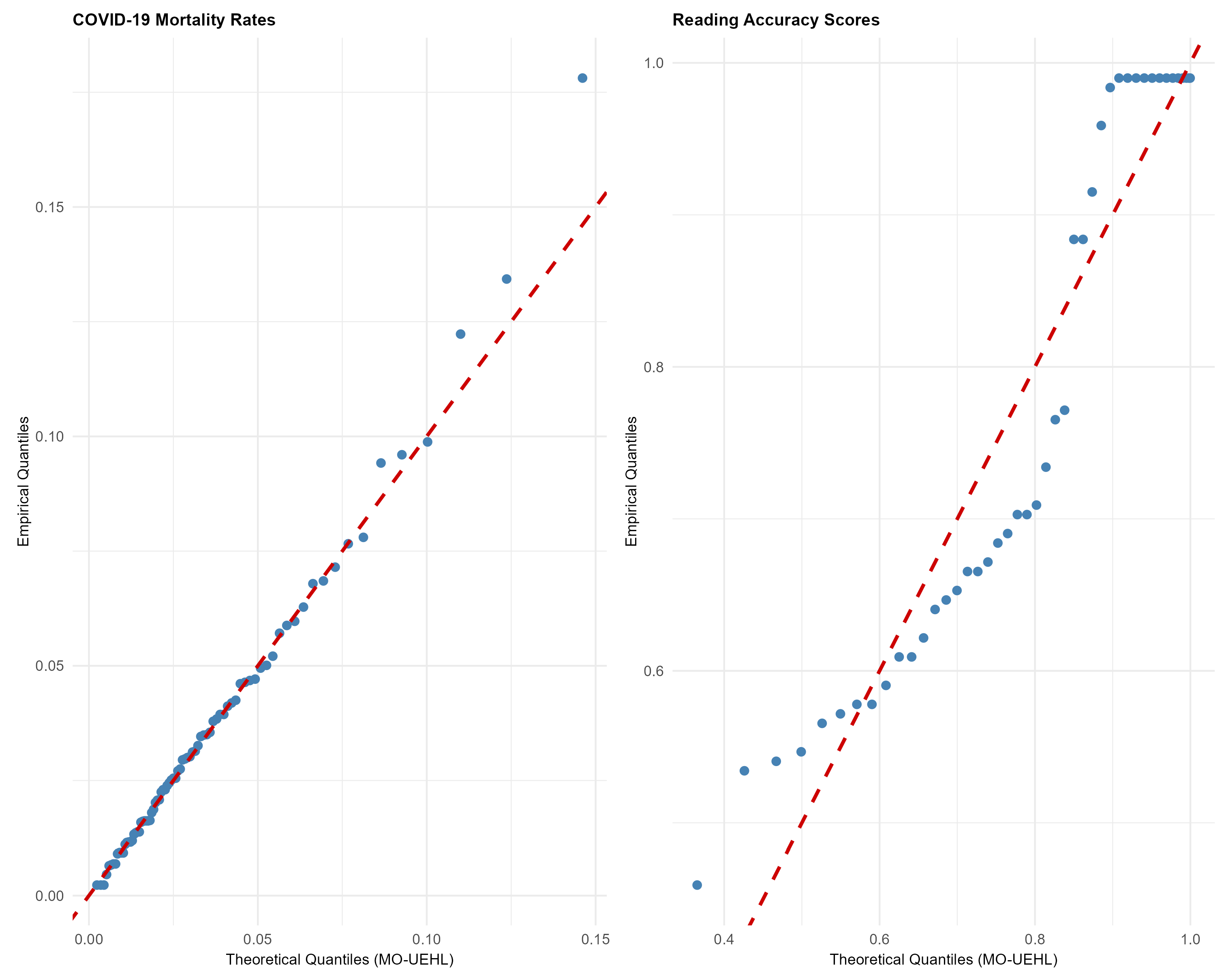
To visually assess the goodness-of-fit of the MO-UEHL distribution,
Figure 6 presents QQ plots for the two real datasets. In each panel, empirical quantiles are plotted against theoretical quantiles computed from the fitted MO-UEHL model using MLE estimates. The plots indicate a good fit for both datasets, with only minor deviations in the tails, which validates the MO-UEHL model’s alignment with the data.
Across both datasets, the MO-UEHL distribution consistently achieves the best or a highly competitive fit, as evidenced by the lowest AIC, AICc, BIC, and HQIC values, alongside high and KS values, confirming its strong alignment with proportion-based data distributions. The adaptability of the MO-UEHL’s three parameters (, , ) enables it to model a wide range of distributional shapes effectively, making it a valuable tool for health modeling, educational analysis, and other fields requiring precise unit interval data modeling.
7. Conclusions
This study has introduced the MO-UEHL distribution, a novel extension of the UEHL distribution through the application of the Marshall–Olkin transformation. The proposed three-parameter model, defined on the unit interval (0, 1), offers enhanced flexibility in capturing a wide range of distributional shapes, including positively skewed, reverse J-shaped, and unimodal patterns, making it an effective tool for modeling proportional data in reliability and survival analysis. The comprehensive derivation of its mathematical properties—such as the PDF, CDF, SF, HRF, quantile function, moments, and information-theoretic measures like the Shannon and residual entropy—provides a solid theoretical foundation. Parameter estimation methods, including MLE and MPS, were evaluated through extensive simulation studies, revealing that MLE and MPS outperform other techniques, particularly for larger sample sizes, while offering computational efficiency.
The practical applicability of the MO-UEHL distribution was validated through its superior performance across four real datasets from environmental and engineering domains, as evidenced by lower AIC, BIC, and HQIC values, alongside high Anderson–Darling and Kolmogorov–Smirnov p-values compared to competing models. These results underscore the model’s ability to handle datasets with significant skewness, establishing it as a useful contribution in fields requiring precise unit interval data modeling.
The findings of this research demonstrate the MO-UEHL distribution’s utility for contributing to statistical modeling, providing a reliable framework for future applications in reliability engineering and related disciplines.