


Abstract
An algebraic graph is defined in terms of graph theory as a graph with related algebraic structures or characteristics. If the vertex set of a graph is a group, a ring, or a field, then is called an algebraic structure graph. This work uses an algebraic structure graph based on the modular ring , known as a hyper-chordal ring network. The lower and upper bounds of the local fractional metric dimension are computed for certain families of hyper-chordal ring networks. Utilizing the cardinalities of local fractional resolving sets, local fractional resolving (LFR)M-polynomials are computed for hyper-chordal ring networks. Further, new topological indices based on (LFR)M-polynomials are established for the proposed networks. The local fraction entropies are developed by modifying the first three kinds of Zagreb entropies, which are calculated for the chosen hyper-chordal ring networks. Furthermore, numerical and graphical comparisons are discussed to observe the order between newly computed topological indices.
Keywords:
local fractional metric dimension; local fractional topological indices; local fractional M-polynomials; hyper-chordal ring network MSC:
05C35; 05C72; 90C35
1. Introduction
An algebraic graph theory and topological indices focus on graph research and its applications in physical science, information technology, and media platforms. A mutual return in graphical research and presentation links topological indices and algebraic graph theory. Topological indices have a specific set of mathematical computations generated from graph topology, algebraic graph theory, and graph features studied using mathematics tools and symbols, which may be used to analyze and identify them. A polynomial, matrix, numerical sequence, or numeric number representing the whole graph may be used to identify it.
The metric dimension has various applications in the field of cryptography and network theory. To find the family of networks that has a particular number of metric dimensions is a hard problem. Further, computing the local fractional metric dimension is an NP-hard problem. The applications of metric dimensions in fields such as network theory, graph theory, and optimization have been discussed in [1,2,3]. Initially, the concept of metric dimension in graph theory was given by Melter and Harary [4]. The resolving set was the minimum number of vertices which was uniquely determined by the distances from all other vertices described in [5]. The initial idea about fractional metric dimension (FMD) given by Arumugam and Mathew contributed to an enhanced comprehension of the FMD. They computed the FMD for complicated structures of lexicographic, classified, Cartesian, corona, and corona-comb networks. Concerning LMD, especially product operations, these networks have been studied in [6].
The FMD of improved Jahangir networks and conversion systems has been studied earliest in the research conducted by Wang and Feng [7,8] and Liu et al. [9]. When accomplishing the estimation, these methodologies were used when considering the landscapes of FMDs and other calculation measures in multiple network topologies. In their study, Aisyah planned the FMD limits in metal-organic graphs [10,11]. However, as Raza pointed out, the FMD can be known with other types of graphs belonging to other categories as well. They proposed to use the Local Fractional Metric Dimension (LFMD), which is a localized version of the metric dimension, in the corona product of systems. In the area of LFMD exploration, remarkable incursions have been achieved by Liu et al. [12]. Ali and Falcn, with other researchers, recently conducted a study on the LFMD of circular symmetric planar networks [13]. More related information can be found in [14]. A similar approach was used by Aisyah [11] as one of the innovators of using the LFMD to characterize the corona product of systems.
A molecular graph displays a molecule’s formation and relationships. The physical and chemical characteristics of molecules are determined by molecular graphs. Research on QSAR and QSPR relies on several applications, including digital screens [15,16]. Molecular graphs are characterized using several topological indices, including effective graph descriptors [17,18]. Various topological indices are used to describe molecular graphs, and several have been shown to interact with natural, chemical, or physical features of molecules [19,20,21,22,23,24,25,26]. Topological indices play a crucial role in understanding and predicting molecular activity and characteristics in diverse chemical and medical settings.
Mathematics is used to study chemical structures in mathematical chemistry. In mathematical chemistry, chemical graph theory models chemical processes mathematically using chemical diagrams. In principle, a molecular network is straightforward: a graph with many edges and no loops that represents atoms and their chemical bonding by their vertices and edges. In mathematics, atoms are graph vertices while chemical bonds are edges. A molecular graph shows a molecule’s formation and connections in a topological representation. Molecular graphs are analyzed using several topological indices, including degree, distance, and derived ones. Distance-based topological indices are important in chemical graph theory, especially chemistry. Each topological index provides unique statistics of molecular graphs and offers many representations for studying chemical compound properties [27,28]. Degree-based topological indices have been investigated extensively and shown to correlate with molecular compound characteristics. Those indexes are strongly linked. In a prior study [29], degree-based topological indices were the most often used variations. Numerical values relate molecular structures to physical properties, chemical compound reactions, and biological reactivities. Topological indices and mathematical values link molecular structure with physical properties, synthetic operations, and biological processes [30,31].
Some topological indices are difficult to calculate. To solve this problem, several academics have developed algebraic polynomials to effectively calculate topological indices. These polynomials are intended to differentiate, integrate, or both, at a point to provide the correct topological index. These algebraic polynomials may considerably minimize the processing effort needed to construct topological indices. The generating function M-polynomial gives the number of graph walks of varying lengths. It helps research molecular graphs and other complicated network topologies. An NM-polynomial is a modified M-polynomial that accounts for non-adjacent vertices in a graph [32,33]. Shannon introduced the entropy theory in 1948 in his landmark paper [34]. While entropies use a probability distribution, they only measure information certainty. Entropy, initially presented in thermodynamics, is now used in information theory, computer theory, physics, and chemistry. Entropy is used to evaluate steam engines and optical fiber data transport capacity. Entropy is usually connected with information theory, but it may also be used to investigate networks, composite systems, graph patterns, and algebraic construction. A broad study of entropy’s applications in algebraic structures and other domains. The degree of each atom is crucial, leading to basic analysis in graph and network theory, revealing constants for scientific studies [35,36,37,38,39,40]. Several researchers have used graph entropy estimates to analyze biological and chemical networks sequentially [41,42,43]. Das and colleagues investigated topological indices and entropies in their study. Graphs based on algebraic structures such as group and number theory are crucial in this study [44,45,46,47,48].
Finding the local fractional metric dimension of a graph, especially an algebraic structure graph, is not an easy task. The upper bound of the local fractional metric dimension is important because in various cases where we cannot compute the exact values of the local fractional metric dimension in the cases, upper bounds give the information that we cannot use objects above the upper bounds. If we cannot have an upper bound for a certain structure, then it is difficult to use the minimum number of objects to cover the whole network uniquely. In this paper, we consider hyper-chordal ring networks, which are based on algebraic structure modular groups. Using a local fractional metric resolving the mapping of cardinalities, we establish a novel local resolving M polynomial and then define some new topological indices based on that polynomial. Further, some new entropies that are based on local fraction metric dimensions are established.
The rest of the article is arranged as follows: In Section 2, the hyper-chordal ring networks and their upper bounds for LFMD are established. In Section 3, local fractional topological indices are computed by using LFRM polynomials. The local fractional entropies are developed for the proposed hyper-chordal ring networks in Section 4. In Section 5, concluding remarks about the proposed work are given.
2. Hyper-Chordal Ring Networks and Their Upper Bounds for LFMD
In this section, hyper-chordal networks and lower- and upper-bound sequences are computed for the local fractional metric dimension.
Definition 1.
Let be the vertex set of the graph and be the set of parameters which is the subset of . The hyper-chordal network is denoted by , and their edge set is defined as
where and
Some hyper-chordal networks are given in Figure 1.
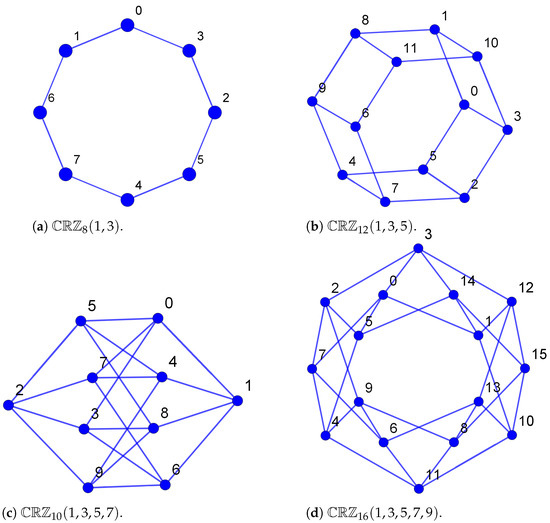
Figure 1.
Four hyper-chordal networks with different parameters.
The mapping r from the set of vertex to the closed interval is known as a resolving mapping [49] if
The FMD of a graph is
The LFMD of a graph is defined as;
Further, . Lemma 1 and Theorem 1 are very useful in this manuscript.
Lemma 1
([11,50]). Let be a finite graph whose order is greater than two; then, we have
where
Theorem 1.
Let be a simple graph; then, we have Where [51].
Theorem 2.
Let be a chordal ring network; the lower and upper limits of the local fractional metric dimension are
Proof.
Let be a chordal ring network; there are three cases of sequences for resolving sets for adjacent vertices. The numerical computing of these cases is given in Table 1, Table 2 and Table 3 respectively.
- Case (a):
- When :
 Table 1. The LFRMs and their cardinalities when .Table 1. The LFRMs and their cardinalities when .
0 1 0 3 0 5 0 0 2 0 2 4 Otherwise Otherwise ∅ - Case (b):
- When :
Table 2. The LFRMs and their cardinalities when .Table 2. The LFRMs and their cardinalities when .
0 1 0 3 0 5 0 0 2 0 2 4 Otherwise Otherwise ∅ - Case (c):
- When :
Table 3. The LFRMs and their cardinalities when .Table 3. The LFRMs and their cardinalities when .
0 1 0 5 0 2 0 4 Otherwise Otherwise ∅
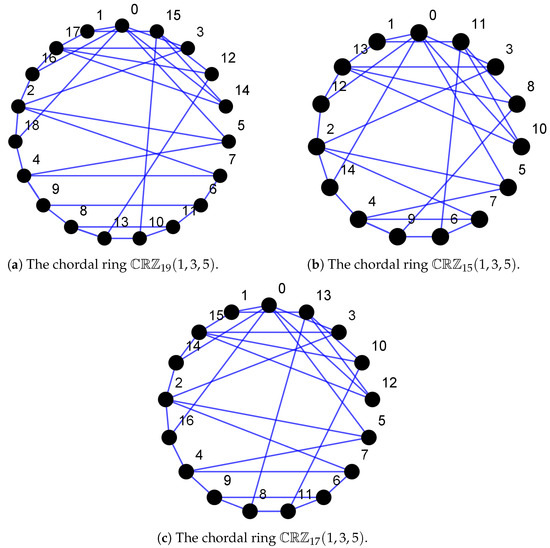
To better understand the proof of Theorem 2, the following networks and their LFRMs are given. Three hyper-chordal networks with parameters for are shown in Figure 2.
Figure 2.
Three hyper-chordal networks with parameters for .
For case (a), , the chordal network is shown in Figure 2a. The local fractional resolving sets for chordal ring are calculated as follows:
for all other edges. Since , the minimum and maximum cardinalities are 17 and 19, respectively. Thus, by using Lemma 1 and Theorem 1, we have
For case (b), , the chordal network is shown in Figure 2b. The local fractional resolving sets for chordal ring are calculated as follows:
for all other edges. Since , the minimum and maximum cardinalities are 17 and 19, respectively. Thus, by using Lemma 1 and Theorem 1, we have
For case (c), , the chordal network is shown in Figure 2c. The local fractional resolving sets for chordal ring are calculated as follows:
for all other edges. Since , the minimum and maximum cardinalities are 17 and 19, respectively. Thus, by using Lemma 1 and Theorem 1, we have
□
Theorem 3.
Let be a chordal ring network; the lower and upper bounds of the local fractional metric dimension are
where ⋎ is an odd number but
Proof.
Let be a chordal ring network; there are two cases of sequences for resolving sets for adjacent vertices. The numerical computing of these cases is given in Table 4 and Table 5 respectively.
- Case (a):
- When :
Table 4. The LFRMs and their cardinalities when .Table 4. The LFRMs and their cardinalities when .
0 1 0 3 0 5 0 7 0 0 2 0 2 4 0 2 4 6 Otherwise Otherwise ∅ ⋎ - Case (b):
- When , then
Table 5. The LFRMs and their cardinalities when .Table 5. The LFRMs and their cardinalities when .
0 1 0 3 0 5 0 7 0 0 2 0 2 4 0 2 4 6 Otherwise Otherwise ∅ ⋎
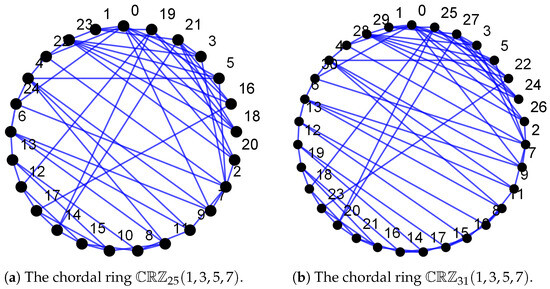
To better understand the proof of Theorem 3, the following networks and their LFRMs are given. Two hyper-chordal networks with parameters for are shown in Figure 3.
Figure 3.
Two hyper-chordal networks with parameters for .
For case (a), , the chordal network is shown in Figure 3a. The local fractional resolving sets for chordal ring are calculated as follows:
for all other edges. Since , the minimum and maximum cardinalities are 22 and 25, respectively. Thus, by using Lemma 1 and Theorem 1, we have
For case (b), , the chordal network is shown in Figure 3b. The local fractional resolving sets for chordal ring are calculated as follows:
for all other edges. Since , the minimum and maximum cardinalities are 28, and 31, respectively. Thus, by using Lemma 1 and Theorem 1, we have
□
Theorem 4.
Let be a chordal ring network; the lower and upper bounds of local fractional metric dimension are
where ⋎ is an odd number and divisible by 3.
Proof.
Let be a chordal ring network; there are two cases of sequences for resolving sets for adjacent vertices. The numerical computing of these cases is given in Table 6 and Table 7 respectively.
- Case (a):
- When :
Table 6. The LFRMs and their cardinalities when .Table 6. The LFRMs and their cardinalities when .
0 1 0 3 0 5 0 7 0 0 2 0 2 4 0 2 4 6 Otherwise Otherwise ∅ ⋎ - Case (b):
- When :
Table 7. The LFRMs and their cardinalities when .Table 7. The LFRMs and their cardinalities when .
0 1 0 3 0 5 0 7 0 0 2 0 2 4 0 2 4 6 Otherwise Otherwise ∅ ⋎
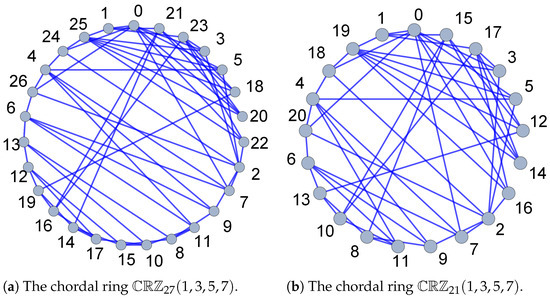
To better understand the proof of Theorem 4, the following networks and their LFRMs are given. Two hyper-chordal networks with parameters for are shown in Figure 4.
Figure 4.
Two hyper-chordal networks with parameters for .
For case (a), , the chordal network is shown in Figure 4a. The local fractional resolving sets for chordal ring are calculated as follows:
for all other edges. Since , the minimum and maximum cardinalities are 24 and 27, respectively. Thus, by using Lemma 1 and Theorem 1, we have
For case (b), , the chordal network is shown in Figure 4b. The local fractional resolving sets for chordal ring are calculated as follows:
for all other edges. Since , the minimum and maximum cardinalities are 19 and 21, respectively. Thus, by using Lemma 1 and Theorem 1, we have
□
3. Local Fractional Resolving M-Polynomials and Topological Indices
In this section, we define new local fractional resolving M-polynomials and then some new topological indices that are based on local fractional resolving set cardinalities. These M-polynomials are defined as follows:
where is the cardinality mapping on . The relationship between the LFR-M polynomial and certain topological indices is given by
where .
Lemma 2.
Let be a chordal ring network; the local fractional resolving M-polynomial is
where ⋎ is an odd number but .
Proof.
Let be a chordal ring network; the edge partition mapping concerning the cardinalities of local resolving sets are computed in Table 4 and Table 5.
By using relation (2), we have
□
Theorem 5.
Let be a chordal ring network; the topological indices are
Proof.
Let be a chordal ring network, the local fractional resolving M-polynomial is
where ⋎ is an odd number but . Taking the partial derivative concerning u and v of Equation (3), we have
By adding and , we have
□
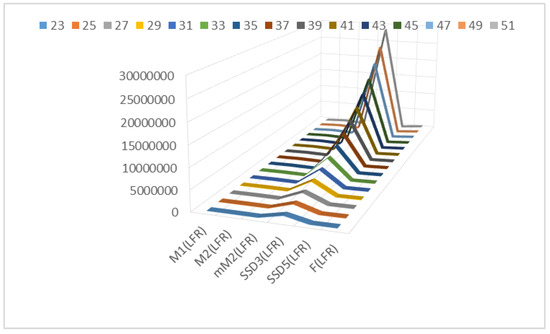
Figure 5.
The graphical comparison of Table 8.
Table 8.
Numerical comparison between topological indices.
Table 8.
Numerical comparison between topological indices.
| ⋎ | ||||||
|---|---|---|---|---|---|---|
| 23 | 2428 | 27,348 | 0.107577 | 1,234,432 | 108 | 54,696 |
| 25 | 2844 | 34,920 | 0.0970156 | 1,717,608 | 116 | 69,840 |
| 27 | 3292 | 43,756 | 0.0883514 | 2,329,168 | 124 | 87,512 |
| 29 | 3772 | 53,952 | 0.0811148 | 3,089,848 | 132 | 107,904 |
| 31 | 4284 | 65,604 | 0.074979 | 4,021,920 | 140 | 131,208 |
| 33 | 4828 | 78,808 | 0.0697101 | 5,149,192 | 148 | 157,616 |
| 35 | 5404 | 93,660 | 0.0651362 | 6,497,008 | 156 | 187,320 |
| 37 | 6012 | 110,256 | 0.0611279 | 8,092,248 | 164 | 220,512 |
| 39 | 6652 | 128,692 | 0.0575862 | 9,963,328 | 172 | 257,384 |
| 41 | 7324 | 149,064 | 0.0544338 | 12,140,200 | 180 | 298,128 |
| 43 | 8028 | 171,468 | 0.0516099 | 14,654,352 | 188 | 342,936 |
| 45 | 8764 | 196,000 | 0.0490654 | 17,538,808 | 196 | 392,000 |
| 47 | 9532 | 222,756 | 0.0467609 | 20,828,128 | 204 | 445,512 |
| 49 | 10,332 | 251,832 | 0.0446637 | 24,558,408 | 212 | 503,664 |
| 51 | 11,164 | 283,324 | 0.0427471 | 28,767,280 | 220 | 566,648 |
Lemma 3.
Let be a chordal ring network; the local fractional resolving M-polynomial is
Theorem 6.
Let be a chordal ring network; the topological indices are
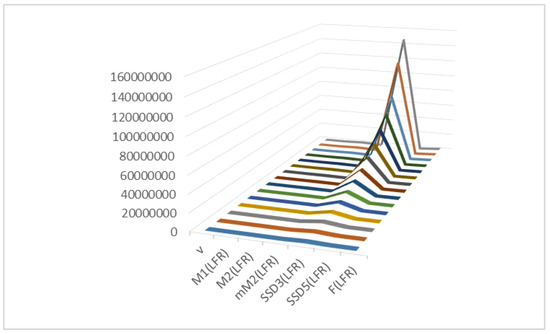
Figure 6.
The graphical comparison of Table 9.
Table 9.
Numerical comparison between topological indices.
Table 9.
Numerical comparison between topological indices.
| ⋎ | ||||||
|---|---|---|---|---|---|---|
| 11 | 1758 | 19,839 | 0.0771189 | 896,754 | 78 | 39,678 |
| 13 | 2394 | 31,869 | 0.0637827 | 1,698,462 | 90 | 63,738 |
| 15 | 3126 | 47,931 | 0.054406 | 2,941,482 | 102 | 95,862 |
| 17 | 3954 | 68,601 | 0.0474481 | 4,762,902 | 114 | 137,202 |
| 19 | 4878 | 94,455 | 0.0420771 | 7,318,242 | 126 | 188,910 |
| 21 | 5898 | 126,069 | 0.0378039 | 10,781,454 | 138 | 252,138 |
| 23 | 7014 | 164,019 | 0.0343222 | 15,344,922 | 150 | 328,038 |
| 25 | 8226 | 208,881 | 0.0314301 | 21,219,462 | 162 | 417,762 |
| 27 | 9534 | 261,231 | 0.0289891 | 28,634,322 | 174 | 522,462 |
| 29 | 10,938 | 321,645 | 0.0269011 | 37,837,182 | 186 | 643,290 |
| 31 | 12,438 | 390,699 | 0.0250944 | 49,094,154 | 198 | 781,398 |
| 33 | 14,034 | 468,969 | 0.0235158 | 62,689,782 | 210 | 937,938 |
| 35 | 15,726 | 557,031 | 0.0221244 | 78,927,042 | 222 | 1,114,062 |
| 39 | 19,398 | 764,835 | 0.0197843 | 120,630,522 | 246 | 1,529,670 |
| 41 | 21,378 | 885,729 | 0.0187908 | 146,794,854 | 258 | 1,771,458 |
Lemma 4.
Let be a chordal ring network; the local fractional resolving M-polynomial is
where ⋎ is a multiple of 3.
Theorem 7.
Let be a chordal ring network; the topological indices are

Figure 7.
The graphical comparison of Table 10.
Table 10.
Numerical comparison between topological indices.
Table 10.
Numerical comparison between topological indices.
| ⋎ | ||||||
|---|---|---|---|---|---|---|
| 23 | 2400 | 26,760 | 0.110614 | 1,197,360 | 108 | 53,520 |
| 25 | 2816 | 34,276 | 0.0993256 | 1,673,144 | 116 | 68,552 |
| 27 | 3264 | 43,056 | 0.0901492 | 2,276,640 | 124 | 86,112 |
| 29 | 3744 | 53,196 | 0.0825412 | 3,028,584 | 132 | 106,392 |
| 31 | 4256 | 64,792 | 0.0761298 | 3,951,248 | 140 | 129,584 |
| 33 | 4800 | 77,940 | 0.070652 | 5,068,440 | 148 | 155,880 |
| 35 | 5376 | 92,736 | 0.0659168 | 6,405,504 | 156 | 185,472 |
| 37 | 5984 | 109,276 | 0.061782 | 7,989,320 | 164 | 218,552 |
| 39 | 6624 | 127,656 | 0.0581397 | 9,848,304 | 172 | 255,312 |
| 41 | 7296 | 147,972 | 0.0549065 | 12,012,408 | 180 | 295,944 |
| 43 | 8000 | 170,320 | 0.0520166 | 14,513,120 | 188 | 340,640 |
| 45 | 8736 | 194,796 | 0.049418 | 17,383,464 | 196 | 389,592 |
| 47 | 9504 | 221,496 | 0.0470684 | 20,658,000 | 204 | 442,992 |
| 49 | 10,304 | 250,516 | 0.0449336 | 24,372,824 | 212 | 501,032 |
| 51 | 11,136 | 281,952 | 0.0429853 | 28,565,568 | 220 | 563,904 |
4. Local Fractional Entropies for Hyper-Chordal Networks
The historical background of entropies was first introduced by a German physicist named Rudolf Clausius in the mid-19th century within the branch of thermodynamics, delivered as a measuring instrument of disorder or randomness within a system. Entropies show what quantity of energy is not accessible to producing work. The more disorganized a structure is and the higher the entropies, the less is the amount of energy of a structure accessible for work. In the branch of chemistry, entropy is connected to the distribution of matter and energy in a system. Entropy is used in biological systems, statistical interpretation, information theory, and thermodynamic perspective. Some newly defined local fractional entropies are
For more detail, see the Appendix A.
Lemma 5.
Let be a chordal ring network; then,
Proof.
Let be a chordal ring network; the edge partition mapping concerning the cardinalities of local resolving sets computed in Table 4 and Table 5 is given in relation (2). By using relation (2), we have
□
Theorem 8.
Let be a chordal ring network; then,
5. Conclusions
It is difficult to determine the local fractional metric dimension of a graph, particularly one with an algebraic structure. The local fractional metric dimension’s upper bound is crucial because in several situations when we are unable to determine the precise values of the local fractional metric dimension, upper bounds indicate that we are not permitted to employ objects larger than the upper bounds. It is challenging to employ the smallest number of objects to cover the whole network uniquely if we are unable to establish an upper bound for a certain structure. In this work, the hyper-chordal network was studied, and then the lower and upper bounds of the local fractional metric dimension were computed. These bounds were
- •
- •
Further, we defined a new LFR-M-polynomial based on the cardinalities of LFR sets. Using LFR-M-polynomial, various new topological indices were computed. The local fraction entropies were developed by modifying the first three kinds of Zagreb entropies; then, those were calculated for chosen hyper-chordal ring networks. Furthermore, numerical and graphical comparisons were given to observe the order between newly computed topological indices. The order between computed topological indices were
For future work, the lower and upper bound for the general hyper-chordal ring is still an open problem.
Author Contributions
Conceptualization, S.A. (Shahzad Ali); methodology, S.A. (Shahzad Ali) and A.S.A.; software, S.A. (Shahzad Ali) and S.A. (Shahzaib Ashraf); validation, S.A. (Shahbaz Ali) and A.S.A.; formal analysis, S.A. (Shahzad Ali) and A.S.A.; investigation, S.A. (Shahzad Ali) and S.A. (Shahzaib Ashraf); resources, A.A.; writing—original draft preparation, S.A. (Shahzad Ali); writing—review and editing, S.A. (Shahzaib Ashraf); and A.S.A.; visualization, A.S.A. and A.A.; supervision, S.A. (Shahzaib Ashraf); project administration, S.A. (Shahzaib Ashraf); funding acquisition, S.A. (Shahzaib Ashraf) and A.S.A. All authors have read and agreed to the published version of the manuscript.
Funding
This research was funded by Project number (PNURSP2024R231), Princess Nourah bint Abdulrahman University, Riyadh, Saudi Arabia.
Data Availability Statement
No new data were created or analyzed in this study.
Acknowledgments
The authors extend their appreciation to Princess Nourah bint Abdulrahman University for funding this research under Researchers Supporting Project number (PNURSP2024R231), Princess Nourah bint Abdulrahman University, Riyadh, Saudi Arabia.
Conflicts of Interest
The authors decacknowledgments.lare no conflicts of interest.
Appendix A
Well-known Zagreb entropies (A1)–(A3) based on vertex degree are given in [52]:
Further, there are some well-known redefined entropies (A5)–(A10) established in [53,54]:
- First redefined Zagreb entropy:Then,
- Second redefined Zagreb entropy:Then,
- Third redefined Zagreb entropy:Then,
In this article, we considered the cardinality of the local resolving set for defining the novel local resolving M-polynomial. Since the cardinality of each local resolving set is a number, each endpoint of the edge has the same cardinality number. Therefore,
If we replace by and use the above relation in Equations (A1)–(A10), then the newly defined entropies are established.
References
- Arulperumjothi, M.; Klavar, S.; Prabhu, S. Redefining fractal cubic networks and determining their metric dimension and fault-tolerant metric dimension. Appl. Math. Comput. 2023, 452, 128037. [Google Scholar] [CrossRef]
- Ghalavand, A.; Klavar, S.; Tavakoli, M. Graphs whose mixed metric dimension is equal to their order. Comput. Appl. Math. 2023, 42, 210. [Google Scholar] [CrossRef]
- DasGupta, B.; Mobasheri, N. On optimal approximability results for computing the strong metric dimension. Discrete Appl. Math. 2017, 221, 18–24. [Google Scholar] [CrossRef]
- Harary, F.; Melter, R.A. On the metric dimension of a graph. Ars. Combin. 1976, 2, 191–195. [Google Scholar]
- Khuller, S.; Raghavachari, B.; Rosenfeld, A. Landmarks in graphs. Discret. Appl. Math. 1996, 70, 217–229. [Google Scholar] [CrossRef]
- Arumugam, S.; Mathew, V.; Shen, J. On fractional metric dimension of graphs. Discret. Math. Algorithms Appl. 2013, 5, 1350037. [Google Scholar] [CrossRef]
- Feng, M.; Wang, K. On the metric dimension and fractional metric dimension of the hierarchical product of graphs. Appl. Anal. Discret. Math. 2013, 7, 302–313. [Google Scholar] [CrossRef]
- Feng, M.; Wang, K. On the fractional metric dimension of corona product graphs and lexicographic product graphs. arXiv 2012, arXiv:1206.1906. [Google Scholar]
- Liu, J.B.; Kashif, A.; Rashid, T.; Javaid, M. Fractional metric dimension of generalized Jahangir graph. Mathematics 2019, 7, 100. [Google Scholar] [CrossRef]
- Raza, M.; Alrowaili, D.A.; Javaid, M.; Shabbir, K. Computing bounds of fractional metric dimension of metal organic graphs. J. Chem. 2021, 2021, 5539569. [Google Scholar] [CrossRef]
- Aisyah, S.; Utoyo, M.I.; Susilowati, L. On the local fractional metric dimension of corona product graphs. IOP Conf. Ser. Earth Environ. Sci. 2019, 243, 012043. [Google Scholar] [CrossRef]
- Liu, J.B.; Aslam, M.K.; Javaid, M. Local fractional metric dimensions of rotationally symmetric and planar networks. IEEE Access 2020, 8, 82404–82420. [Google Scholar] [CrossRef]
- Ali, S.; Falcn, R.M.; Mahmood, M.K. Local fractional metric dimension of rotationally symmetric planar graphs arisen from planar chorded cycles. Rend. Mat. Appl. 2023, 44, 159–179. [Google Scholar]
- Ali, S.; Mahmood, M.K.; Tchier, F.; Tawfiq, F.M.O. Classification of upper bound sequences of local fractional metric dimension of rotationally symmetric hexagonal planar networks. J. Math. 2021, 2021, 6613033. [Google Scholar] [CrossRef]
- Zahid, M.A.; Naeem, M.; Baig, A.Q.; Ggao, W. General fifth M-Zagreb indices and fifth M-Zagreb polynomials of crystal cubic carbon. Util. Math. 2018, 109, 218–229. [Google Scholar]
- Allcock, H.R. Introduction to Materials Chemistry; John Wiley & Sons: Hoboken, NJ, USA, 2019. [Google Scholar]
- Deng, H.; Yang, J.; Xia, F. A general modeling of some vertex-degree based topological indices in benzenoid systems and phenylenes. Comput. Math. Appl. 2011, 61, 3017–3023. [Google Scholar] [CrossRef]
- Gao, W.; Wang, Y.; Basavanagoud, B.; Jamil, M.K. Characteristics studies of molecular structures in drugs. Saudi Pharm. J. 2017, 25, 580–586. [Google Scholar] [CrossRef]
- Gayathri, P.; Priyanka, U.; Priyanka, U. Degree based topological indices of zig zag chain. J. Math. Informatics 2017, 11, 83–93. [Google Scholar] [CrossRef]
- Gutman, I. Some properties of the Wiener polynomial. Graph Theory Notes N. Y. 1993, 125, 13–18. [Google Scholar]
- Unger, S.H. Molecular Connectivity in Structure Activity analysis; Kier, L.B., Hall, L.H., Eds.; Wiley: New York, NY, USA, 1987; pp. 1–262. [Google Scholar]
- Li, X.; Shi, Y. A survey on the Randic index. MATCH Commun. Math. Comput. Chem. 2008, 59, 127–156. [Google Scholar]
- Alali, A.S.; Ali, S.; Hassan, N.; Mahnashi, A.M.; Shang, Y.; Assiry, A. Algebraic structure graphs over the commutative ring Z m: Exploring topological indices and entropies using M-polynomials. Mathematics 2023, 11, 3833. [Google Scholar] [CrossRef]
- Khalaf, A.J.M.; Hussain, S.; Afzal, D.; Afzal, F.; Maqbool, A. M-polynomial and topological indices of book graph. J. Discret. Math. Sci. Cryptogr. 2020, 23, 1217–1237. [Google Scholar] [CrossRef]
- Cancan, M.; Ediz, S.; Farahani, M.R. On ve-degree atom-bond connectivity, sum-connectivity, geometric-arithmetic and harmonic indices of copper oxide. Eurasian Chem. Commun. 2020, 2, 641–645. [Google Scholar] [CrossRef]
- Imran, M.; Bokhary, S.A.U.H.; Manzoor, S.; Siddiqui, M.K. On molecular topological descriptors of certain families of nanostar dendrimers. Eurasian Chem. Commun. 2020, 22, 680–687. [Google Scholar] [CrossRef]
- Babujee, J.B.; Ramakrishnan, S. Topological indices and new graph structures. Appl. Math. Sci. 2012, 6, 5383–5401. [Google Scholar]
- Deutsch, E.; Klavzar, S. M-polynomial and degree-based topological indices. arXiv 2014, arXiv:1407.1592. [Google Scholar]
- Dobrynin, A.A.; Entringer, R.; Gutman, I. Wiener index of trees: Theory and applications. Acta Appl. Math. 2001, 66, 211–249. [Google Scholar] [CrossRef]
- Dimitrov, D. On structural properties of trees with minimal atom-bond connectivity index. Discret. Appl. Math. 2014, 172, 28–44. [Google Scholar] [CrossRef]
- Chaudhry, F.; Shoukat, I.; Afzal, D.; Park, C.; Cancan, M.; Farahani, M.R. M-Polynomials and Degree-Based Topological Indices of the Molecule Copper (I) Oxide. J. Chem. 2021, 2021, 6679819. [Google Scholar] [CrossRef]
- Kwun, Y.C.; Munir, M.; Nazeer, W.; Rafique, S.; Min Kang, S. M-Polynomials and topological indices of V-Phenylenic Nanotubes and Nanotori. Sci. Rep. 2017, 7, 8756. [Google Scholar] [CrossRef]
- Mondal, S.; De, N.; Pal, A. The M-polynomial of line graph of subdivision graphs. Commun. Fac. Sci. Univ. Ank. Ser. Math. Stat. 2019, 68, 2104–2116. [Google Scholar] [CrossRef]
- Shannon, C.E. A mathematical theory of communication. Bell Syst. Tech. J. 1948, 27, 379–423. [Google Scholar] [CrossRef]
- Goldsmith, B.; Salce, L. Algebraic entropies for Abelian groups with applications to the structure of their endomorphism rings: A survey. In Groups, Modules, and Model Theory-Surveys and Recent Developments: In Memory of Rudiger Gobel; Springer: Cham, Switzerland, 2017; pp. 135–174. [Google Scholar]
- Jaynes, E.T. Information theory and statistical mechanics. Phys. Rev. 1957, 106, 620. [Google Scholar] [CrossRef]
- Aczel, J.; Forte, B.; Ng, C.T. Why the Shannon and Hartley entropies are natural. Adv. Appl. Probab. 1974, 6, 131–146. [Google Scholar] [CrossRef]
- Ochs, W. A new axiomatic characterization of the von Neumann entropy. Rep. Math. Phys. 1975, 8, 109–120. [Google Scholar] [CrossRef]
- Lieb, E.H.; Yngvason, J. A guide to entropy and the second law of thermodynamics. Not. AMS 1998, 45, 571. [Google Scholar]
- Lieb, E.H.; Yngvason, J. A fresh look at entropy and the second law of thermodynamics. Phys. Today 2000, 53, 32–37. [Google Scholar] [CrossRef]
- Julietraja, K.; Venugopal, P.; Prabhu, S.; Arulmozhi, A.K.; Siddiqui, M.K. Structural analysis of three types of PAHs using entropy measures. Polycycl. Aromat. Compd. 2022, 42, 4101–4131. [Google Scholar] [CrossRef]
- Nie, C.X.; Song, F.T. Entropy of graphs in financial markets. Comput. Econ. 2021, 57, 1149–1166. [Google Scholar] [CrossRef]
- Das, K.C.; Ali, A. On a conjecture about the second Zagreb index. Discret. Math. Lett. 2019, 2, 38–43. [Google Scholar]
- Das, K.C.; Shang, Y. Some extremal graphs with respect to Sombor index. Mathematics 2021, 9, 1202. [Google Scholar] [CrossRef]
- Das, K.C.; Dehmer, M. A conjecture regarding the extremal values of graph entropy based on degree powers. Entropy 2016, 18, 183. [Google Scholar] [CrossRef]
- Das, K.C.; Ghalavand, A.; Ashrafi, A.R. On a conjecture about the Sombor index of graphs. Symmetry 2021, 13, 1830. [Google Scholar] [CrossRef]
- Mondal, S.; Das, K.C. Degree-Based Graph Entropy in Structure Property Modeling. Entropy 2023, 25, 1092. [Google Scholar] [CrossRef]
- Ali, S.; Shang, Y.; Hassan, N.; Alali, A.S. On topological indices and entropy dynamics over zero divisors graphs under cartesian product of commutative rings. Res. Math. 2024, 11, 2427339. [Google Scholar] [CrossRef]
- Arumugam, S.; Mathew, V. The fractional metric dimension of graphs. Discret. Math. 2012, 312, 1584–1590. [Google Scholar] [CrossRef]
- Okamoto, F.; Phinezy, B.; Zhang, P. The local metric dimension of a graph. Math. Bohem. 2010, 135, 239–255. [Google Scholar] [CrossRef]
- Javaid, M.; Zafar, H.; Zhu, Q.; Alanazi, A.M. Improved lower bound of LFMD with applications of prism-related networks. Math. Probl. Eng. 2021, 2021, 9950310. [Google Scholar] [CrossRef]
- Ranjini, P.S.; Lokesha, V.; Usha, A. Relation between phenylene and hexagonal squeeze using harmonic index. Int. J. Graph Theory 2013, 1, 116–121. [Google Scholar]
- Chen, Z.; Dehmer, M.; Shi, Y. A note on distance-based graph entropies. Entropy 2014, 16, 5416–5427. [Google Scholar] [CrossRef]
- Manzoor, S.; Siddiqui, M.K.; Ahmad, S. On entropy measures of molecular graphs using topological indices. Arab. J. Chem. 2020, 13, 6285–6298. [Google Scholar] [CrossRef]
Disclaimer/Publisher’s Note: The statements, opinions and data contained in all publications are solely those of the individual author(s) and contributor(s) and not of MDPI and/or the editor(s). MDPI and/or the editor(s) disclaim responsibility for any injury to people or property resulting from any ideas, methods, instructions or products referred to in the content. |
© 2024 by the authors. Licensee MDPI, Basel, Switzerland. This article is an open access article distributed under the terms and conditions of the Creative Commons Attribution (CC BY) license (https://creativecommons.org/licenses/by/4.0/).