


Abstract
We present a novel proof, using group theory, for a Meijer transform formula. This proof reveals the formula as a specific case of a broader generalized result. The generalization is achieved through a linear operator that intertwines two representations of the connected component of the identity of the group . Using this same approach, we derive a formula for the sum of three double integral transforms, where the kernels are represented by Bessel functions. It is particularly noteworthy that the group is connected to symmetry in several significant ways, especially in mathematical physics and geometry.
Keywords:
Meijer integral transform; Hankel integral transform; Neumann integral transform; Bessel functions; Whittaker function MSC:
33C10; 33C80; 33B15; 33C05
1. Introduction
One approach to studying special functions in mathematical physics involves using integral transforms. For instance, the commonly utilized Euler gamma function, (see, for example, [1], Entries 8.31–8.33), can be interpreted as the value of the Laplace transform for and elementary functions . The generalized hypergeometric function, , is defined by (see [2], p. 73; see, also, [3]):
where denotes the Pochhammer symbol or the shifted factorial, which is defined (for ) in terms of the gamma function by the following:
It is understood conventionally that . The generalized hypergeometric function plays a crucial role in the class of special functions in mathematical physics. Here and throughout, , , , and represent the sets of positive integers, integers, real numbers, and complex numbers, respectively. Also, let . This function can be seen as an extension of the elementary function , which is represented by through the composition of Laplace transforms and their inverses. Integral transforms emerge in the context of infinite-dimensional representation spaces of Lie groups, particularly when composing transformations of bases, decomposing matrix elements of a representation into those of the same representation in a different basis, and similar processes. Through group-theoretic constructions, not only do well-known integral transformations emerge, but also new ones, including those involving multiple integrals. Multiple integral transforms are primarily discussed in works focused on solving partial differential equations [4,5,6,7].
Shilin and Choi [8] explored the quasi-regular representation of the group SO(2, 2), applying it to specific diagonal and cell-diagonal matrices. Through this approach, they derived elegant double integral representations for various special functions. Notably, they provided double integral formulas for the products of two Whittaker functions of the second kind. In [9], they obtained explicit formulas involving Bessel functions, which describe the kernels of integral operators of the representation in a space of functions defined in a -matrix cone.
In this work, we will explore the group-theoretic aspect of double integral transformations for the first time; specifically, the connection between the group and double integral transformations whose kernels are Bessel functions of order and argument z, the first and second kind, denoted, respectively, by the following:
(see, for example, [1], Entries 8.4–8.5; see, also, [10], Section 3.1) and
which are also called Neumann functions (see, for instance, [1], Entry 8.403; see, also, [10], p. 64, Equation (1)), as well as the Macdonald function (more commonly known as the modified Bessel function of the second kind), (see, for instance, [10], p. 78; see, also, [11], pp. 373–374). The function is defined by the following (see, for instance, [1], pp. 900–901):
Here, and are Bessel functions of the third kind (also called Hankel’s functions), defined by the following:
and
Here and throughout, . The double integral transform with the Macdonald function as the kernel (Meijer transform) was previously studied in [12]. Additionally, we will provide a new (group-theoretic) proof of a well-known formula for the ordinary Meijer transform and a generalization of this formula where the Macdonald function is replaced by the Whittaker function of the second kind, (see, for example, [1], Entries 9.22–9.23; see, also, [11], Chapter XVI). One of various integral representations of the function is recalled (see, for example, [1], Entry 9.222-1):
2. The Group G and Some of Its Subgroups
Let us represent each matrix g belonging to the following group (see [13]):
in the following form:
where A is a matrix of size . Considering as a topological group, we obtain the connected component G of the identity matrix, which is a subgroup defined by the condition that the determinants of the submatrices A and D are both greater than zero (see [14]):
Clearly, the cone and hyperboloids are invariant under the action of the group G.
To construct a tangent (at the point ) space of the group G, we utilize six one-parameter subgroups. Two of these subgroups involve rotations and , rotating through an angle in the planes and , respectively. The remaining four subgroups consist of hyperbolic rotations in the planes , where . The corresponding tangent vectors satisfy the following commutation relations:
These vectors form the basis E of the tangent space.
The linear space forms a subalgebra within the tangent algebra generated by vectors in E. We require the subgroup , which is the exponential image of . Given that the real rank of G is 2 [15], any maximal commutative subalgebra in can be generated by two linearly independent vectors and not in . Choosing and , we find the eigenvalues of the adjoint operators and to be 0, 1, and .
The subspace in , consisting of the zero vector and the eigenvectors corresponding to the eigenvalue 1, forms a maximal nilpotent subalgebra generated by the vectors and . We need the subgroup , which is the exponential image of this nilpotent subalgebra. Another choice of and results in a subgroup isomorphic to .
The subgroup consists of matrices , where
and consists of matrices , where
It is evident that and act transitively on the subsets and within the cone .
Lemma 1.
The group G acts transitively on the punctured cone .
Proof.
For any point , where , we can express it as:
Since the matrix
where (by (2)), we conclude . Therefore, for any , there exists a transformation such that . Consequently, and . □
3. Some Linear Spaces and Their Bases
Fix . A function f is called -homogeneous if . We denote by the linear space of -homogeneous, infinitely differentiable functions on . Similarly, we denote by the space of -homogeneous functions on that belong to the kernel of the operator . For any , we consider the linear operators defined by the formula . If is the zero function, then for any x, at the point , we have . Therefore, are non-degenerate operators. For any , we have ; thus, is a representation of the group G in .
Consider the infinitesimal operators , which correspond to vectors from E. In spherical coordinates , , , , where , on , we have and . In view of relations (3), we have
and . This implies that and are Casimir operators corresponding to the reduction , where the subgroup consists of rotations . By separating the variables in the restriction of their joint eigenfunction to , we find that this restriction coincides with , where . These restrictions form a basis of the space of restrictions of functions from to . For any , we have . Therefore, for any , we obtain the following:
where is the restriction of f to . This implies that the following extensions:
of joint eigenfunctions form the basis in .
Let us introduce the orispherical coordinates on : , , , , where .
Note that the principle of constructing a horospherical coordinate system (in which the Laplace operator admits separation of variables) is described in detail in ref. [16], subsection 10.5.3.
At these coordinates, we have and . Referring to (3), we obtain the following:
and . Thus, and are Casimir operators corresponding to the reduction , where denotes the subgroup consisting of matrices .
Let f be their joint eigenfunction defined on . Representing this function as , we obtain , where . For any such that , we have
where is the restriction of f to . Thus, the extensions
form the basis in . By analogy, we obtain the basis consisting of functions
where . Further, we will need the subset of the punctured cone , which is a homogeneous space of the subgroup of G consisting of matrices
In orispherical coordinates , , , , where , on , the restriction of the to coincides with .
4. The Intertwining Operator Q
Let us assume that the linear space differs from by replacing with . For each function and basis , we denote their analogues in by and , respectively. We define the bilinear functionals by the formula , where denotes the -invariant measure on . Clearly, for any i.
The following lemma states that the bilinear functionals (for ) are identical.
Lemma 2.
.
Proof.
For the orispherical coordinates on , we define . Supposing , we obtain ; therefore, . Given this, we can express as follows:
Introducing new variables and such that and , we note that . This implies a bijective mapping between the integration domain and . Therefore, we can conclude that .
The equality can be proven in the same way. □
Let be the set of functions defined on . Given a fixed , we define the mapping by , where .
The following lemma asserts that the space contains .
Lemma 3.
.
Proof.
It is evident that represents a -homogeneous function. Additionally, can be simplified as follows:
since . □
In applications of representation theory to the physics of the atomic nucleus, the concept of equivalence of representations, as well as the weaker concept of intertwining representations, play a crucial role. Let us demonstrate that Q functions as an intertwining operator for the representations and (see [17], Chapter 2).
Lemma 4.
For every , .
Proof.
It is straightforward to determine that the stabilizer S of the point is isomorphic to the connected component of the identity in the group . Using Lemma 1 from [18] and the definitions of the current paper, for any , we can write . Since , by considering an arbitrary point of , we find that a generating element of the coset can be represented as . Using the obtained expressions for and and Lemma 2, for any and any i, we derive . Then,
On the other hand, considering , we have
Since for an arbitrary from (1), we have
therefore,
Since , from (4) to (6), we derive
□
Lemma 4 can be used to derive integral relations between special functions. By understanding the connection between two functions in , one can deduce the corresponding relation between their Q-images in . Below, we will apply this to the simplest case, where .
5. A New Derivation for a Formula of the Meijer Transform: A Generalization of This Formula
Theorem 1.
Let . For odd n values, . For even n values,
where are Gegenbauer polynomials, which are essentially equivalent to ultraspherical polynomials, defined by the generating relation:
(see, for instance, [2], Chapter 17; see, also, [3], Entry 7.3.1.203). One of the numerous properties and identities for these polynomials is recalled (see [2], pp. 277, 279):
Here and throughout, represents the integer part of a real number ν.
Proof.
Indeed,
Using formulae [19], Entry 2.1.2.76
and [19], Appl. I.1.1
we have
Referring to [19], 2.5.12.26, we obtain
where is the classical Beta function, defined by
(see, for example, [20], p. 8, Equation (43)). Since
we obtain
Here, ; ; ; and Using the Gegenbauer polynomial (see, for instance, [3], Entry 7.3.1.203), we complete the proof. □
Let us demonstrate that at point , the Q-image of the function belonging to the basis is a generalized function.
Theorem 2.
For ,
where δ is the Dirac delta function.
Proof.
We have
Using the known formula ([19], Entry 2.5.3.10) for the Fourier cosine transform and the integral representation of the delta function, we complete the proof. □
Remark 1.
In 1926, Dirac introduced the delta function, denoted as , characterized by the following properties:
The Dirac delta function, is defined such that for any well-behaved function , the integral
Notably, there is no conventional function that directly corresponds to the delta function. For a detailed exploration of the various properties and applications of the Dirac delta function, one can refer to the source cited on pages 27–35 and 80–81 in [21].
Theorem 3.
Let and . Then,
where is the Whittaker function of the second kind (see, for example, [11], Chapter XVI).
Proof.
Let us consider the integral operator
Since
where is the Dirac delta function, we have
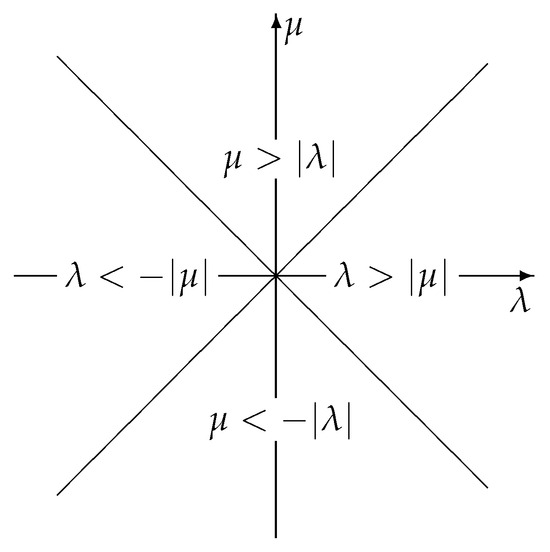
Let us divide the plane into the following five equivalence classes: , , , , and (Figure 1).
Figure 1.
Equivalence classes in the plane.
According to formula [1], Entry 3.384.9, we obtain the following for the different classes:
For the class ,
For the class ,
For the class ,
For the class ,
Remark 2.
Letting in Theorem 3 and using the known formula = , where is the Macdonald function, we obtain the following identity:
This formula coincides with the particular case
of the known formula [22], Entry 2.16.33.2, since
and, therefore,
This means that Theorem 3 is a generalization of Formula (11) (and (12)) for the Meijer integral transform.
6. A Sum of Double Integral Transforms Whose Kernels Are Bessel Functions
In this section, we assume .
Theorem 4.
Let . For ,
For ,
Proof.
Indeed,
According to formulae [19], Entry 2.5.6.1–2,
where
Therefore,
According to formulae [22], 2.12.22.7 and [22], 2.13.8.14, we have the following, respectively:
and
where
Taking the identity ([23], 7.4.26a)
we obtain
for the case , and
for the case . □
Theorem 5.
For ,
Proof.
Indeed, according to [19], Entry 2.2.3.1 and [19], Entry 2.2.3.4,
This integral can be evaluated using formula ([19], Entry 2.2.3.5). □
Theorem 6.
For ,
Proof.
Considering the linear operator
we obtain the following:
According to formulae ([19], Entry 2.5.6.1–2),
where
we find
According to formulae [22], Entry 2.12.15.5–6 and [22], Entry 2.13.8.2, respectively, we have the following:
and
where
Thus,
Using the identity (14) and Theorems 4 and 5, we complete the proof. □
7. Concluding Remarks
We presented a novel proof using group theory for a Meijer transform formula. This proof unveils the formula as a special case of a broader, generalized result. The generalization is achieved through a linear operator that connects two representations of the connected component of the identity of the group . Using this innovative approach, we derived a formula for the sum of three double integral transforms, with kernels represented by Bessel functions.
We can interpret (13) as a formula representing the sum of three double integral transforms: Meijer–Clifford, Hankel–Clifford, and Neumann–Clifford [24,25,26,27]. By introducing new variables in the left side, this formula achieves a more symmetric form, resulting in a combination of Meijer, Hankel, and Neumann integral transforms [28]. For instance, by letting and , we have the following:
Reference [29] established connections among various well-known functions, including exponential, trigonometric, hyperbolic, and Bessel functions, by expressing them as generalized Meijer G-functions and solving an integral involving modified Bessel functions. Reference [30] extended various fractional Laplace transform results to matrix-valued functions, using them to derive valuable theorems on piecewise continuous functions with conformable exponential order and the conditions for obtaining the fractional Laplace transform of matrix-valued functions. Reference [31] introduced a novel cryptosystem called Deoxyribose Nucleic Acid (DNA) secret writing, which utilizes the Laplace transform of the Mittag–Leffler function.
Author Contributions
Writing—original draft, I.A.S. and J.C.; writing—review and editing, I.A.S. and J.C. All authors have read and agreed to the published version of the manuscript.
Funding
This research received no funding.
Data Availability Statement
Data are contained within the article.
Acknowledgments
The authors sincerely thank the anonymous reviewers for their invaluable feedback. Their constructive and encouraging comments have significantly improved the quality of this paper.
Conflicts of Interest
The authors declare no conflicts of interest.
References
- Gradshteyn, I.S.; Ryzhik, I.M. Table of Integrals, Series, and Products, 6th ed.; Academic Press: Cambridge, MA, USA, 2000. [Google Scholar]
- Rainville, E.D. Special Functions; The Macmillan Company: New York, NY, USA, 1960. [Google Scholar]
- Prudnikov, A.P.; Brychkov, Y.A.; Marichev, O.I. More Special Functions. In Integrals and Series; OPA (Overseas Publishers Association): Amsterdam, The Netherlands, 1990; Volume 3. [Google Scholar]
- Saadeh, R.; Sedeeg, A.K.; Ghazal, B.; Gharib, G. Double formable integral transform for solving heat equations. Symmetry 2023, 15, 218. [Google Scholar] [CrossRef]
- Sitnik, S.M.; Skoromnik, O.V.; Shlapakov, S.A. Multi-dimensional generalized integral transform in the weighted spaces of summable functions. Lobachevskii J. Math. 2022, 43, 1408–1416. [Google Scholar] [CrossRef]
- Srivastava, H.M.; Gupta, K.C.; Handa, S. A certain double integral transformation. Indag. Math. (N. S.) 1975, 78, 402–406. [Google Scholar] [CrossRef]
- Sedeeg, A.K.; Mahamoud, Z.I.; Saadeh, R. Using double integral transform (Laplace-ARA transform) in solving partial differential equations. Symmetry 2022, 14, 2418. [Google Scholar] [CrossRef]
- Shilin, I.A.; Choi, J. Integral and series representations of special functions related to the group SO(2, 2). Ramanujan J. 2017, 44, 133–153. [Google Scholar] [CrossRef]
- Shilin, I.A.; Choi, J. On matrix elements of the SO(2, 2)-representation in a space of functions on 2 × 4-matrices. Integral Transform. Spec. Funct. 2018, 29, 761–770. [Google Scholar] [CrossRef]
- Watson, G.N. A Treatise on the Theory of Bessel Functions, 2nd ed.; Cambridge University Press: Cambridge, UK, 1944. [Google Scholar]
- Whittaker, E.T.; Watson, G.N. A Course of Modern Analysis, 4th ed.; Cambridge University Press: Cambridge, UK, 1927. [Google Scholar]
- Srivastava, H.M.; Singhgal, J.P. Double Meijer transformations of certain hypergeometric functions. Math. Proc. Camb. Phil. Soc. 1968, 64, 425–430. [Google Scholar] [CrossRef]
- Choi, J.; Shilin, I.A. On changing between bases of the space of representations of group SO(2, 2). Comput. Math. Math. Phys. 2021, 61, 1219–1228. [Google Scholar] [CrossRef]
- Nikolov, A.V. Structure and parametrization of groups O(p, q) and U(p, q). Bulg. J. Phys. 1975, 2, 537–545. (In Russian) [Google Scholar]
- Onishchik, A.L.; Vinberg, E.B. Lie Groups and Algebraic Groups; Springer: Berlin/Heidelberg, Germany, 1990. [Google Scholar]
- Vilenkin, N.Y. Special Functions and the Theory of Group Representations; American Mathematical Society: Providence, RI, USA, 1968. [Google Scholar]
- Naimark, M.A.; Stern, A.I. Theory of Group Representations; Springer: New York, NY, USA, 1982. [Google Scholar]
- Shilin, I.A.; Choi, J. Concerning transformations of bases associated with unimodular diag(1, −1, −1)-matrices. Axioms 2024, 13, 452. [Google Scholar] [CrossRef]
- Prudnikov, A.P.; Brychkov, Y.A.; Marichev, O.I. Elementary Functions. In Integrals and Series; OPA (Overseas Publishers Association): Amsterdam, The Netherlands, 1990; Volume 1. [Google Scholar]
- Srivastava, H.M.; Choi, J. Zeta and q-Zeta Functions and Associated Series and Integrals; Elsevier Science Publishers: Amsterdam, The Netherland; London, UK; New York, NY, USA, 2012. [Google Scholar]
- Debnath, L.; Bhatta, D. Integral Transforms and Their Applications, 3rd ed.; CRC Press, Taylor & Francis Group: Boca Raton, FL, USA; London, UK; New York, NY, USA, 2015. [Google Scholar]
- Prudnikov, A.P.; Brychkov, Y.A.; Marichev, O.I. Special Functions. In Integrals and Series; OPA (Overseas Publishers Association): Amsterdam, The Netherlands, 1990; Volume 2. [Google Scholar]
- Kratzer, A.; Franz, W. Transzendente Funktionen; Akademische Verlagsgesellchaft: Leipzig, Germany, 1960. [Google Scholar]
- Hayek, C.N. Sobre la transformaci’on de Hankel. In Proceedings of the Actas de la VIII Reuni’on Anual de Matematicos Epanoles, Madrid, Spain, 25–28 October 1967; pp. 47–60. [Google Scholar]
- Perez, J.M.R.M.; Robayna, M.M.S. A pair of generalized Hankel–Clifford transformations and their applications. J. Math. Anal. Appl. 1991, 154, 543–557. [Google Scholar] [CrossRef]
- Choi, J.; Nizhnikov, A.I.; Shilin, I.A. On one sum of Hankel–Clifford integral transforms of Whittaker functions. Chebyshevskii Sb. 2019, 20, 349–360. [Google Scholar]
- Shilin, I.A.; Choi, J. On some relations between hyper Bessel–Clifford, Macdonald and Meijer functions and hyper Hankel–Clifford integral transforms. Integral Transform. Spec. Funct. 2023, 34, 788–798. [Google Scholar] [CrossRef]
- Samko, S.G.; Kilbas, A.A.; Marichev, O.I. Fractional Integrals and Derivatives; Gordon and Breach Science Publishers: Philadelphia, PA, USA, 1993. [Google Scholar]
- Shah, S.A.H.; Mubeen, S.; Rahman, G.; Younis, J. Relation of some known functions in terms of generalized Meijer G-functions. J. Math. 2021, 2021, 7032459. [Google Scholar] [CrossRef]
- Bouchenak, A.; Al Horani, M.; Younis, J.; Khalil, R.; Abd El Salam, M.A. Fractional Laplace transform for matrix valued functions with applications. Arab J. Basic. Appl. Sci. 2022, 29, 330–336. [Google Scholar] [CrossRef]
- Yılmazer, M.Ç.; Yılmaz, E.; Gulsen, T.; Et, M. DNA secret writing with Laplace transform of Mittag-Leffler function. J. Math. Sci. Model. 2023, 6, 120–132. [Google Scholar] [CrossRef]
Disclaimer/Publisher’s Note: The statements, opinions and data contained in all publications are solely those of the individual author(s) and contributor(s) and not of MDPI and/or the editor(s). MDPI and/or the editor(s) disclaim responsibility for any injury to people or property resulting from any ideas, methods, instructions or products referred to in the content. |
© 2024 by the authors. Licensee MDPI, Basel, Switzerland. This article is an open access article distributed under the terms and conditions of the Creative Commons Attribution (CC BY) license (https://creativecommons.org/licenses/by/4.0/).