1. Introduction and Preliminaries
An important field of mathematics called graph theory uses graph representations to study the interactions between pairs of objects. Recent developments in mathematics led to new studies into the relationship between algebraic objects and graphs. In the past, scholars have developed links between graphs and other algebraic structures, enhancing mathematical analysis [
1,
2,
3]. The Cayley graph, zero divisor graph, and nilpotent graphs are important ideas in this field [
4,
5,
6]. Numerous features of a graph related to numerical semigroups and their ideals were studied by Binyamin et al. [
7,
8].
A graph H is said to be an induced subgraph of G if and . A graph is said to be complete if each pair of distinct vertices is connected by an edge. A clique in a graph G is a complete subgraph, and the largest possible clique in G is referred to as the maximal clique. The size of the maximal clique in G is termed the clique number, denoted by .
The most significant clique problem involves determining the largest clique or maximum complete subgraph. Numerous disciplines, including electrical engineering, chemistry, biology, medicine, image processing, and network analysis, have used this problem in the past. For instance, Ref. [
9] proposed a bottom-up clustering technique based on incrementally collapsing small cliques within a system for VLSI architecture. Szabó [
10] reformulated the graph coloring problem as a k-clique problem and also introduced symmetry-breaking techniques. In [
11], Seda proposed modifications in integer models that improve time complexity for solving the maximum clique problem by using GAMS. In [
12], the relevance to the gas sector is discussed, while [
13] proposed a clique-based strategy for recognizing protein clusters (see
Figure 1), Ref. [
14] offers a method using graph theory for finding cliques for the comparative modeling of protein structures.
Cliques inside an image are used in [
15] to compute clique potentials with the objective of segmenting the entire image. A brain tumor picture receives treatment as a graph segment in [
16], which uses a clique-based strategy to perform multi-modal segmentation of brain tumors. Additionally, Ref. [
17] analyzes the brain’s synaptic networks and finds a large number of neuron cliques within gaps that facilitate correlated activity (see
Figure 2).
Cliques are another way that social networks identify groups of people who are acquainted with each other. Group members (or cliques) may have asymmetric relationships with anyone outside the group, while symmetric ties with one another belong to all by members. This is due to the fact that some individuals outside the clique are not connected at all, while others may be connected by an edge, implying exclusive relationships. The maximum clique constrained to visibility graphs of a simple polygon, computed using dynamic programming, is described in [
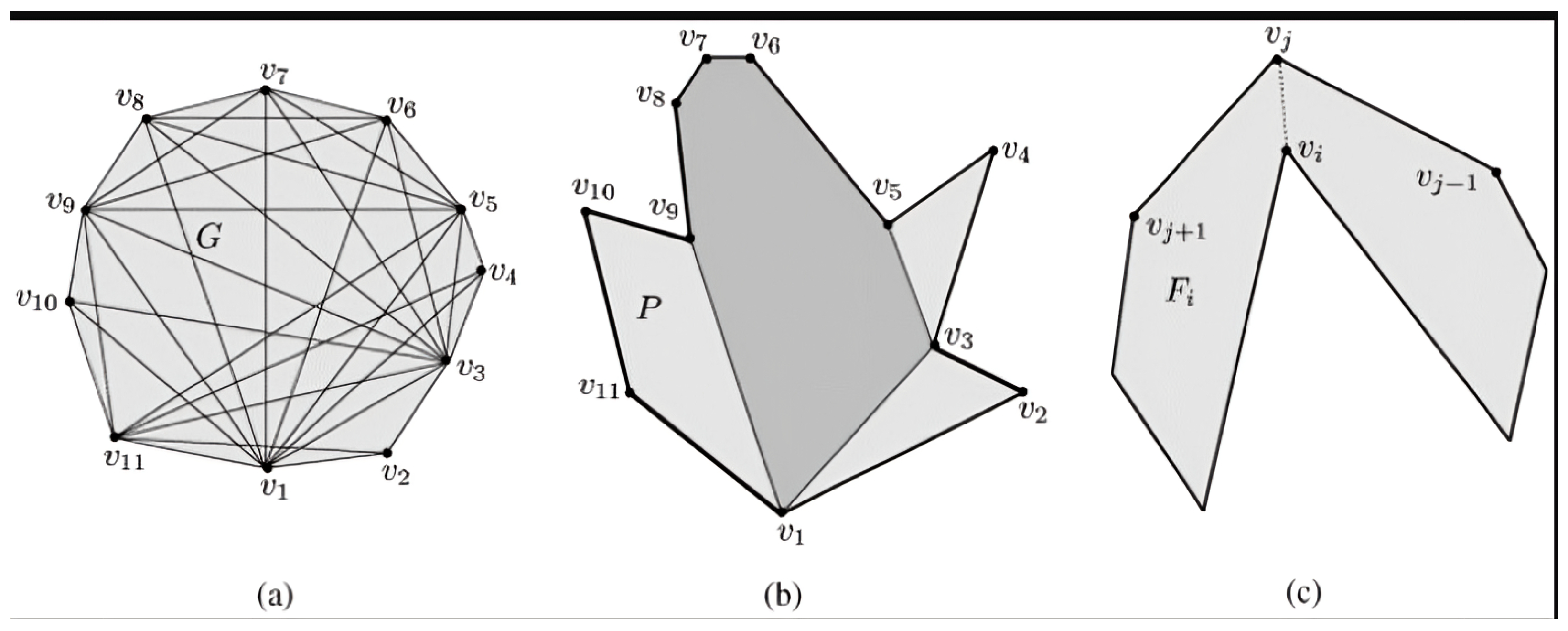
18] (see
Figure 3).
In [
19], it is restricted to one-planar graphs, in [
20] to dense graphs, and in [
21] to graphs without long cycles. To generate different partitions on graphs, Tomescu et al. [
22] employed counting, sequence, and layer matrices, along with proposed modifications and extensions. These partitions were then used to produce visual representations of the graphs.
A numerical semigroup
is a cofinite subset of non-negative integers
having additive binary operation and identity element. If
, we can view the submonoid of
, generated by
X as
where
. If
is a numerical semigroup, then gcd
. If no proper subset of
X generates the numerical semigroup
, then
X is called the minimal set of generators and its cardinality is called embedding dimension
e. The multiplicity
m is the smallest non-zero element that belongs to the
and the largest integer
is called the Frobenius number
. Rosales and Branco introduced that a numerical semigroup
is irreducible if it is not expressible as the intersection of two numerical semigroups properly containing
. Additionally, if a numerical semigroup has an odd Frobenius number and is irreducible, then it is symmetric. The main objective of this article is to propose a conjecture for the clique number of graphs associated with symmetric numerical semigroups of arbitrary multiplicity and embedding dimension and prove it for the case of
2. Clique Number of Graphs Associated with Symmetric Numerical Semigroups
In this section, we compute the clique number of
, where
is a symmetric numerical semigroup of arbitrary multiplicity and embedding dimension discussed in [
23]. Let
, then a graph associated with
is said to be an induced subgraph of
, represented by
Lemma 1 ([
24]).
Let be a numerical semigroup with Then if and only if with and Let
, where
and
. We define the following sets as:
If
is an odd integer, then we consider
or
and if
or
is an even integer, then
Proposition 1. Let be a graph associated with numerical semigroup . Then , for every .
Proof. Since
, therefore
. Furthermore, for
, we have
. Note that for every
and
,
and for every
Above discussion implies
for given conditions. Since
is symmetric and
is the Frobenius number of
, therefore
.
Now, we need to show that , are positive integers for given conditions. To show this, we consider the following cases:
Since the maximum value of
p is
q, then
This implies
, for
.
As the maximum value of
t is
, therefore
This gives
, for
.
Note that for each
a, the maximum of
b is
. Then,
since
, therefore
. This implies
for
and
.
If
and
, then
Now, if
and
, where
, then
If
q is odd,
and
, then
These imply that
is a positive integer for all possibilities of
a and
b. Consequently, we obtain
for every
. □
Proposition 2. Let be an induced subgraph of such that where . Then, .
Proof. To prove to be a complete graph, we have to show that
- Case 1:
If and then
Since
and
, therefore
This implies
- Case 2:
If and then
We can write
This gives
Consider
Since
therefore
. This implies
Hence,
- Case 3:
Let and Let where and Consider
If
m is even, then
Since
and
therefore
and if
m is odd, then
Since
and
therefore
- Case 4:
Assume that , , then
- (1)
and :
We can write
If
q is even, then
, and if
q is odd, then
and also,
. This implies
and
and therefore
By Lemma 1,
This gives
- (2)
and :
It is easy to see that for every
q and for each
l,
. This implies
If
, then consider
where
This implies
By Lemma 1,
Now, if
, then consider
We can write
Note that
as
By Lemma 1,
. Furthermore,
, from the above case. Consequently, we obtain
.
- (3)
q is odd, and :
Since
and
, therefore
If
, then consider
This implies
By using Lemma 1, we obtain
Now, if
, then consider
We can write
Note that
By using Lemma 1,
. Furthermore,
, from the above case. Consequently, we obtain
. □
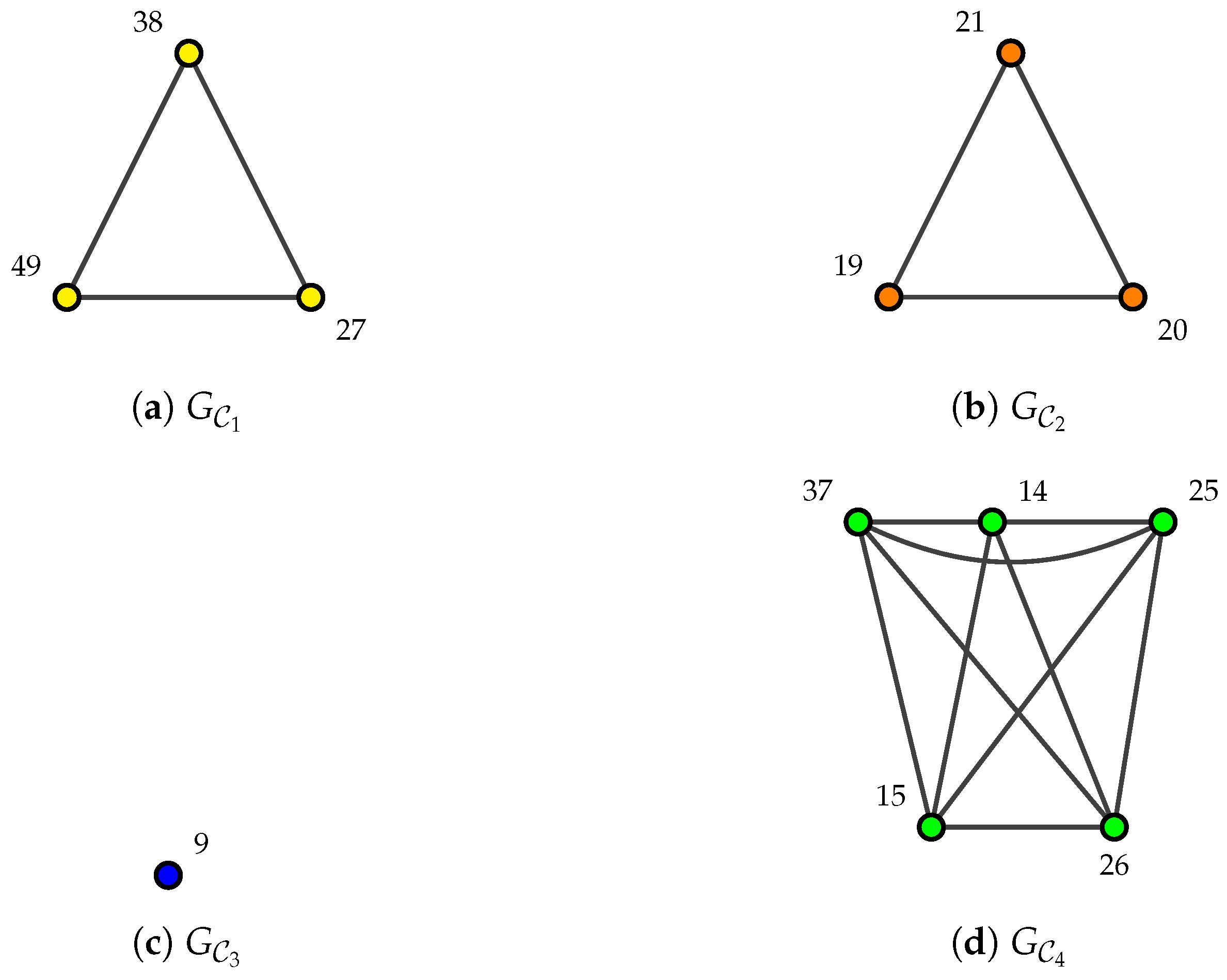
Example 1. Let be a graph associated with then By Proposition 2, , , and The corresponding graphs are shown in Figure 4. Proposition 3. Let be an induced subgraph of such that , where . Then Proof. To prove is a complete graph where , we have to show that for and
- Case 1:
If and , where and , where then
If
, then consider
This implies
Now, if
, then consider
We can write
Note that
By Lemma 1,
. Furthermore,
. Consequently, we obtain
.
- Case 2:
If and , where and then
Since
where
then
If
then consider
This implies
So, we obtain
Now, if
, then consider
We can write
Note that
because
This implies
. Furthermore,
. Consequently, we obtain
.
- Case 3:
If and , where and then
- (1)
and :
We can see that therefore Hence
- (2)
, and or :
If
then
If
then consider
We can write
Note that
By Lemma 1,
. Furthermore,
. Consequently, we obtain
.
- Case 4:
If and , where and , then
If
then consider
This implies
So, we obtain
Now, if
, then consider
We can write
Note that
as
This implies
. Furthermore,
. Consequently, we obtain
.
- Case 5:
If and , where and then
If
, then consider
This implies
Now, if
, then consider
We can write
Note that
By Lemma 1,
. Furthermore,
. Consequently, we obtain
.
- Case 6:
If and , where and then
If
then consider
This implies
So, we obtain
Now, if
, then consider
We can write
Note that
This implies
. Furthermore,
. Consequently, we obtain
.
□
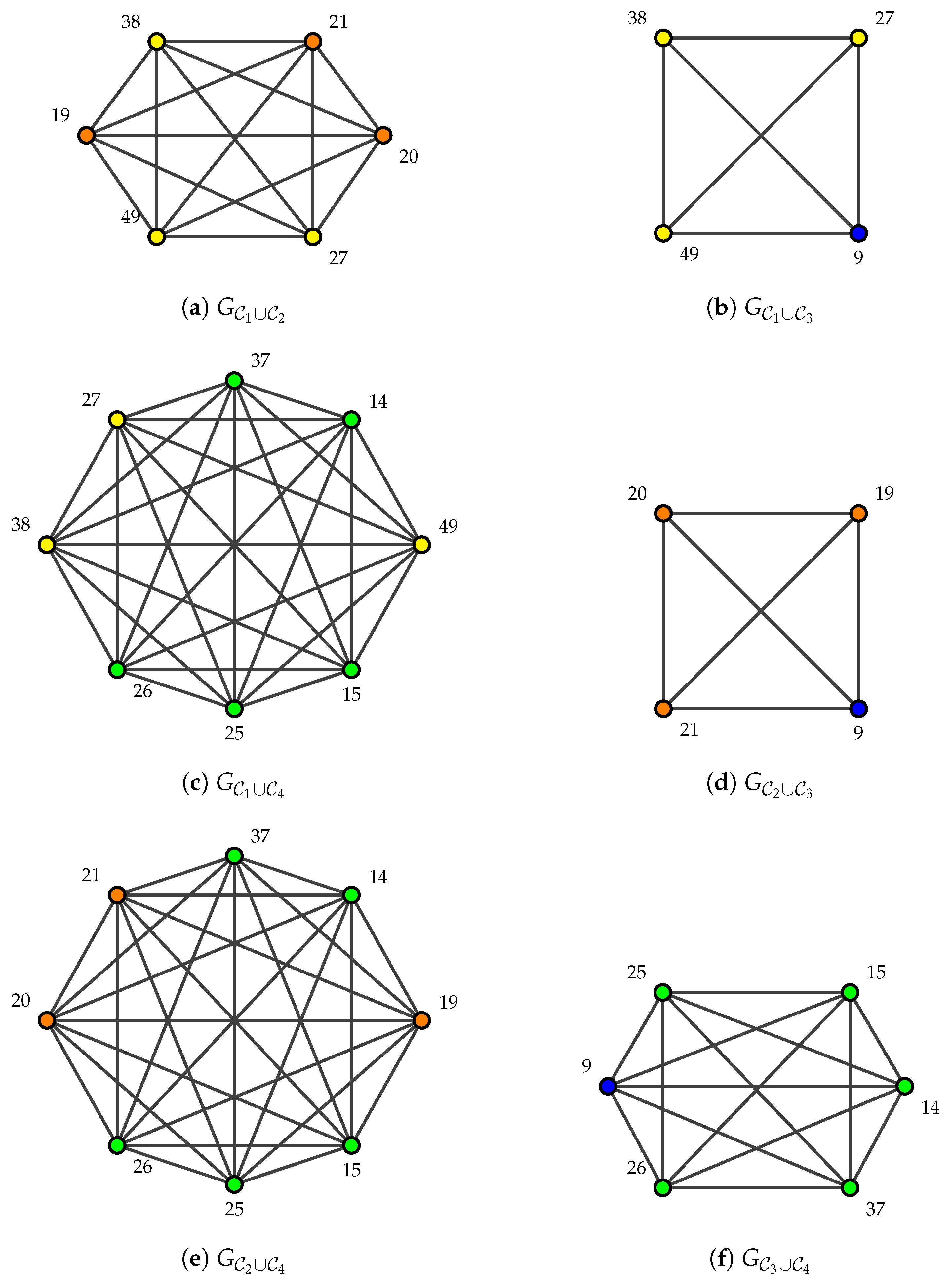
Example 2. Let be a graph associated with , thenBy Proposition 3, , , and The corresponding graphs are shown in Figure 5, respectively. Theorem 1. Let be an induced subgraph of such that . Then, Moreover,
- 1.
, if is odd.
- 2.
if or is even.
Proof. This follows from Proposition 3 that so we need to show for . For this, we have to discuss the following cases:
- Case 1:
If , then t is not a minimal generator, which is a contradiction. Therefore and must be disjoint sets. Similar reasons imply and
- Case 2:
If , then . Since therefore . As we know that and , therefore and are disjoint.
- Case 3:
If , then and therefore . If then this gives and , which is a contradiction. If then , and gcd, therefore This gives , which is a contradiction as . This implies and are disjoint.
- Case 4:
If , then . If , then , which is a contradiction, as j is a generator. If then . Since therefore and we also know that . Therefore,
This implies
, and therefore
It is easy to see that if
is odd then
if
or
is even then
□
Conjucture: Let
be a graph associated with numerical semigroup
. If
is odd then
and if
or
is even then
We prove this conjucture for the case, when
. For this, we only need to show that
is a maximal clique of
.
Theorem 2. Let , then is a maximal clique of .
Proof. Let , where
- Case-1:
If then for
Since
(by Lemma 1), therefore
- Case-2:
If then
Since
therefore
- Case-3:
If then for
Since
(by Lemma 1), therefore
- Case-4:
If and , then
Since
, therefore
- Case-5:
If , , and , then
Since
(by Lemma 1), therefore
- Case-6:
If , and , then
Since
(by Lemma 1), therefore
□
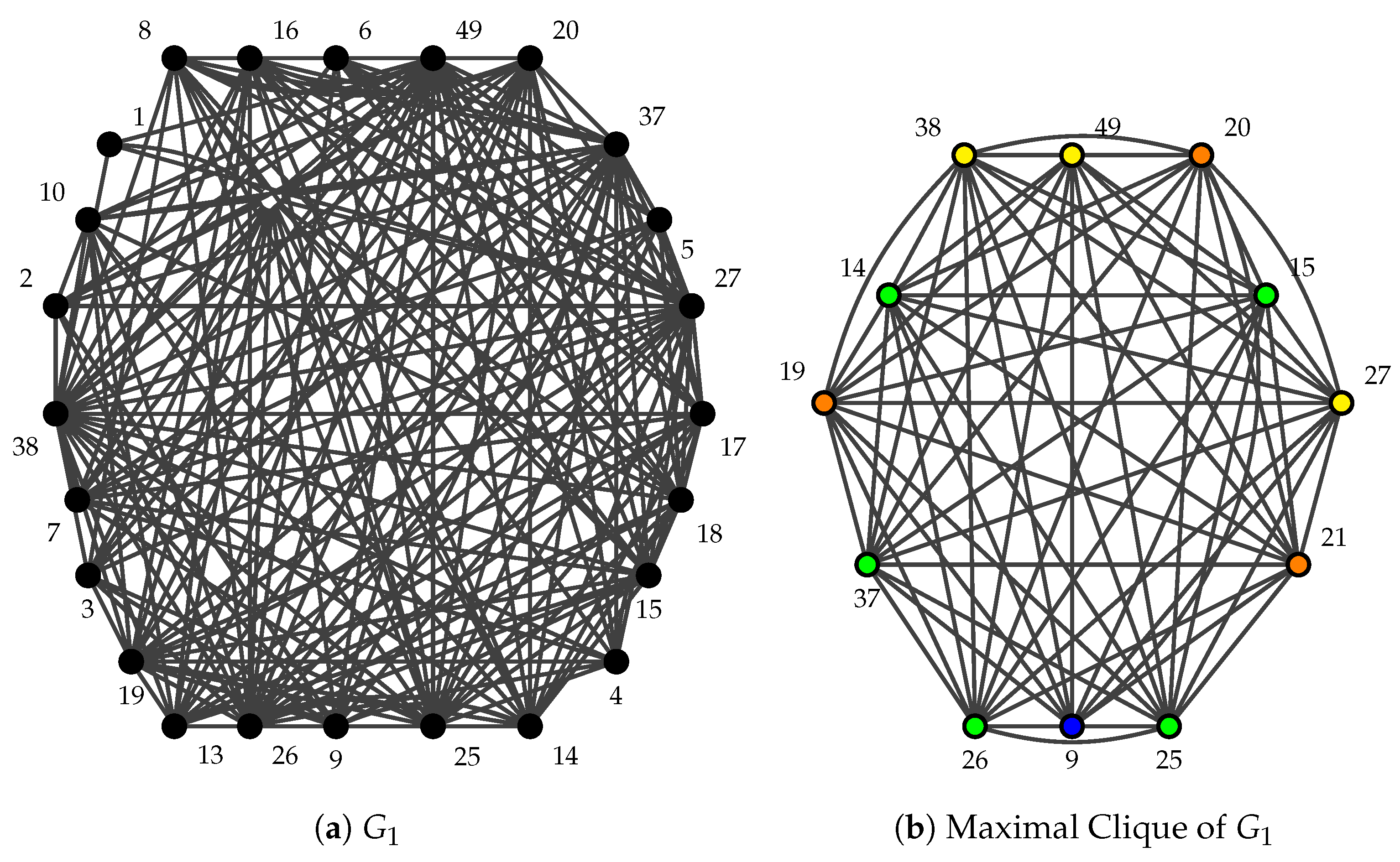
Example 3. Let be a graph associated with , thenProposition 1 and Theorem 1 implyand so,The graph and a maximal clique of are given in Figure 6a and Figure 6b, respectively.