Exploring Symmetry in Industrial Decision-Making: A New Framework Based on Cubic Type-2 Fuzzy Soft Sets
Abstract
1. Introduction
2. Related Work
3. Preliminaries
- Modeling complex relationships: CT2FSSs can capture the intricate relationships between various factors that influence supply chain performance, such as demand, supply, and logistics.
- Handling uncertainty and imprecision: CT2FSSs can effectively handle the uncertainty and imprecision inherent in Industry 4.0 data, such as sensor readings, forecasts, and market trends.
- Supporting decision-making under uncertainty: CT2FSSs can provide a framework for making informed decisions in the face of uncertainty, such as selecting suppliers, allocating resources, and managing risks.
- 1.
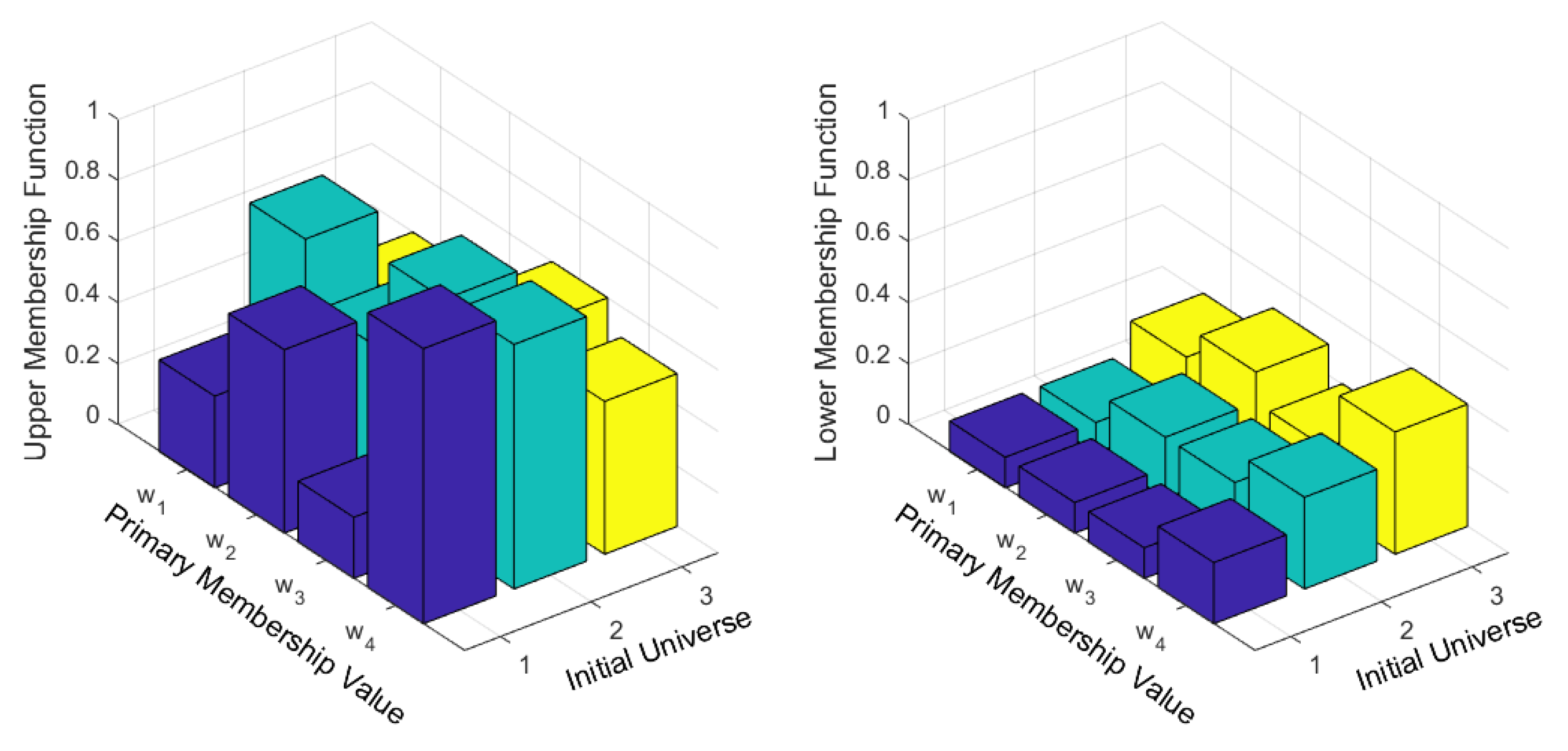
- is the secondary membership function, which satisfies .
- 2.
- is the primary membership function domain for each , representing the range of the secondary membership function.
- 1.
- is the upper membership function,
- 2.
- is the lower membership function,
- 3.
- is a type-2 fuzzy set in w.
- (i)
- ;
- (ii)
- for the upper bound of the membership interval;
- (iii)
- for the lower bound of the membership interval;
- (v)
- for a type-2 fuzzy set.
3.1. Operations of Cubic Type-2 Fuzzy Sets
- 1.
- Let and be Cubic Type-2 Fuzzy Sets (CT2FSs) defined over . The union of and in is represented aswhere . The functions and can be defined as follows:
- 2.
- Let and be CT2FSs defined over . The intersection of and in is represented aswhere . The functions and can be defined as follows:
- 3.
- The complement of , denoted as , is a CT2FS defined as
3.2. Properties of Cubic Type-2 Multifuzzy Sets
- 1.
- 2.
- 3.
- 4.
- 5.
- 6.
- 7.
- 8.
- 9.
- 10.
4. Cubic Type-2 Fuzzy Soft Set
4.1. Operations of Cubic Type-2 Fuzzy Soft Set
- Union Let . The union of and is , defined for all
- ComplementThe complement of a CT2FSS is defined as
- IntersectionLet . The intersection of and is , defined for all as
- 1.
- 2.
4.2. Comparison of CT2FSSs with Existing Tools for Industrial Decision Making
- Fuzzy Multi-Criteria Decision Making (FMCDM): A popular approach that uses fuzzy logic to handle uncertainty in decision-making problems.
- Rough Set Theory (RST): A mathematical tool for dealing with uncertainty and imprecision in data.
- Analytic Hierarchy Process (AHP): A structured technique for making complex decisions by breaking them down into smaller, more manageable parts.
- Accuracy: The ability of the tool to make correct decisions.
- Efficiency: The computational time required to solve decision-making problems.
- Interpretability: The ease with which the decision-making process can be understood and explained.
- Flexibility: The ability of the tool to handle different types of data and decision-making scenarios.
4.3. Comparison of the Proposed Framework with Existing Methods
- Enhanced Uncertainty Handling:
- Traditional fuzzy set theory: While fuzzy set theory has been widely used in decision-making, it often struggles to capture the complex uncertainties inherent in Industry 4.0 supply chains.
- CT2FSS: By incorporating type-2 fuzzy sets and cubic sets, CT2FSSs provide a more flexible and expressive framework for representing uncertainty. This allows for the proposed framework to better handle the dynamic and unpredictable nature of Industry 4.0 environments.
- Improved Flexibility:
- Existing models: Many existing models may be limited in their ability to adapt to changing conditions and unforeseen events.
- CT2FSS: The flexibility of CT2FSSs enables the proposed framework to accommodate a wider range of scenarios and uncertainties, making it more adaptable to the dynamic nature of Industry 4.0 supply chains.
- Enhanced Decision-Making Capabilities:
- Traditional models: Some traditional models may struggle to provide accurate and timely decision-making support in complex and uncertain environments.
- Proposed framework: By leveraging the capabilities of CT2FSSs, the proposed framework offers a more robust and reliable approach to decision-making, enabling decision-makers to navigate complexities and optimize supply chain processes.
- Integration of Theory and Practice:
- Existing models: While some models may focus primarily on theoretical aspects, the proposed framework integrates rigorous theoretical analysis with practical applications, demonstrating its real-world applicability.
- Proposed framework: This integration ensures that the framework is not only theoretically sound but also effective in addressing the challenges faced by Industry 4.0 supply chains. Table 5 summarizes a comparison of the proposed framework with existing methods.
5. Applications of Cubic Type-2 Fuzzy Soft Set in Industry 4.0 Supply Chains
| Algorithm 1: Example Algorithm. |
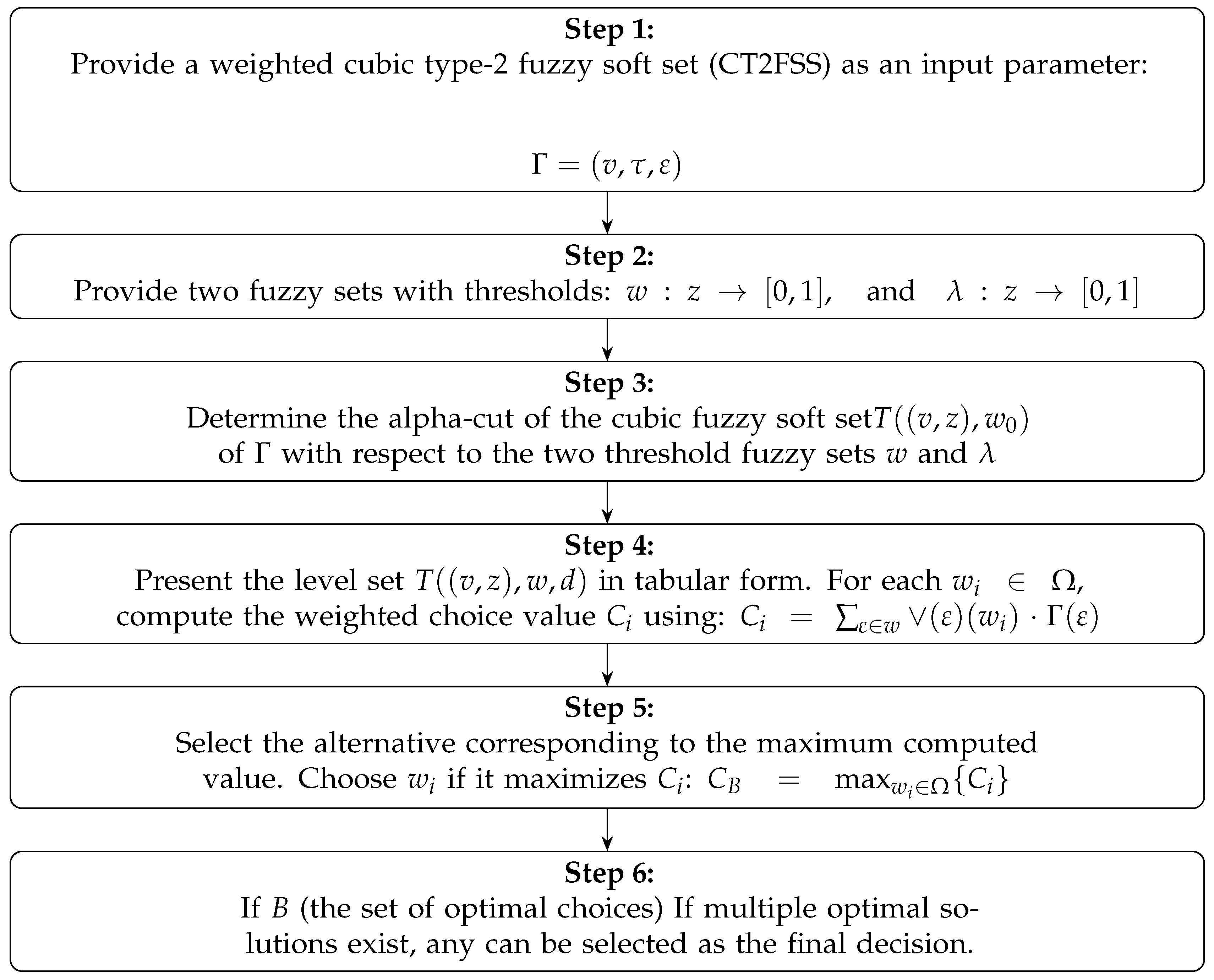
Algorithm Description: Consider the following: Step 1: Provide a weighted Cubic Type-2 Fuzzy Soft Set (CT2FSS) as an input parameter: Step 2: Provide two fuzzy sets with thresholds: These sets are used for decision-making. Step 3: Determine the alpha-cut of the cubic fuzzy soft set of with respect to the two threshold fuzzy sets w and . Step 4: Present the level set in tabular form. For each , compute the weighted choice value using
Step 5: Select the alternative corresponding to the maximum computed value. Choose if it maximizes : Step 6: If B multiple optimal solutions exist, any can be selected as the final decision. |
- : A weighted Cubic Type-2 Fuzzy Soft Set.
- : A threshold fuzzy set used for decision-making.
- : Another threshold fuzzy set used for decision-making.
- CB: The optimal decision based on the CT2FSS and thresholds.
- We start with a CT2FSS named , represented by . Here, v is the universe of discourse, defines fuzzy membership functions, and represents weight information.
- We also provide two threshold fuzzy sets, w and . These sets define what level of membership is considered acceptable for decision-making.
- Compute Level Set Fuzzy Soft Set:
- This step involves calculating a new fuzzy soft set based on the original CT2FSS and the thresholds. We denote this new set as .
- Essentially, we are identifying elements in the CT2FSS that meet the membership criteria defined by w and .
- Present Level Set in Tabular Form:
- Organize the computed level set in a table for better understanding.
- Each row in the table will represent a possible element from the universe of discourse.
- Calculate Weighted Choice Value:
- For each element in the table, we calculate a weighted choice value . This value signifies the suitability of choosing that element based on the CT2FSS and thresholds.
- The formula for is
- Here, represents the membership degree of in the threshold set w for a specific weight . represents the weight of in the CT2FSS.
- In simpler terms, we are considering both the membership level in the thresholds and the weight associated with each element in the CT2FSS to compute a score.
- Determine Optimal Decision:
- Analyze the calculated values for all elements .
- The element with the highest value is considered the optimal decision . This means it has the strongest membership according to the CT2FSS and satisfies the thresholds.
- Handle Multiple Optimal Decisions (Optional):
- In some cases, there might be multiple elements with the same maximum value. This indicates that several options are equally suitable based on the CT2FSS and thresholds.
- If this occurs, B represents the set of elements with the maximum . Any element from set B can be chosen as the final decision. The choice can be based on additional criteria or user preference.
- Illustrative Example:
- (a)
- Imagine you are selecting a candidate for a job position. The CT2FSS represents the evaluation of each candidate with factors like experience and skills weighted according to their importance.
- The thresholds and define the minimum acceptable level of qualification for each factor.
- By following this algorithm, you can systematically evaluate candidates, identify those who meet the criteria, and choose the one with the strongest overall suitability . The flowchart for the given algorithm is shown in Figure 2.
- (b)
- Imagine you are managing a manufacturing facility and want to implement a predictive maintenance strategy to minimize downtime and optimize equipment performance. You can use the CT2FSS algorithm to evaluate the condition of different machines and prioritize maintenance tasks.CT2FSS Parameters:
- Evaluation Factors (F): Vibration levels, temperature, energy consumption, and other relevant machine parameters.
- Weights (c): Assign weights to each factor based on its importance in predicting equipment failure.
- Thresholds (w and ): Define acceptable thresholds for each factor to determine when maintenance is necessary.
Algorithm Steps:- Collect data: Gather data on the machine’s parameters over time. Construct CT2FSS: Create a CT2FSS to represent the machine’s condition,
- considering uncertainty and imprecision in the data. Apply algorithm: Use the CT2FSS algorithm to evaluate the machine’s condition based on the weights and thresholds.
- Prioritize maintenance: Identify machines with the highest risk of failure and prioritize maintenance tasks accordingly.
Benefits:- Early detection of anomalies: CT2FSS can help identify potential equipment failures before they occur, preventing costly downtime.
- Optimized maintenance scheduling: By prioritizing tasks based on risk, you can allocate resources effectively and minimize disruptions to production.
- Improved equipment reliability: Predictive maintenance can extend the lifespan of your equipment and improve overall reliability.
- CT2FSSs offer a refined representation of uncertainty, surpassing traditional fuzzy sets in decision-making accuracy.
- Flexibility in choosing a threshold: Using threshold fuzzy sets lets you change the way decisions are made to fit people with different levels of risk tolerance.
- Engineering, business, and medical diagnostics are just a few of the many fields that can benefit from the algorithm’s adaptability.
- Sensitivity to threshold values: The choice of threshold values significantly impacts the algorithm’s output. Sensitivity analysis is necessary to determine the robustness of the results.
- The algorithm operates under the assumption of attribute independence, which might not always hold true in real-world scenarios, potentially compromising result accuracy.
- The algorithm’s computational complexity increases significantly with problem size, potentially limiting its applicability to large-scale datasets.
- The complexity of the underlying mathematical framework can hinder the interpretability of results derived from CT2FSS-based decision-making processes.
6. Conclusions
Author Contributions
Funding
Data Availability Statement
Conflicts of Interest
References
- Yang, Y.; Fu, Y.; Han, B. Neutrosophic cubic Maclaurin symmetric mean aggregation operators with applications in multi-criteria decision-making. Int. Trans. Oper. Res. 2023, 30, 4107–4169. [Google Scholar] [CrossRef]
- Zadeh, L.A. Fuzzy sets. Inf. Control. 1965, 8, 338–353. [Google Scholar] [CrossRef]
- Molodtsov, D. Soft set theory—First results. Comput. Math. Appl. 1999, 37, 19–31. [Google Scholar] [CrossRef]
- Jun, Y.B.; Smarandache, F.; Kim, C.S. Cubic soft set theory. Notes Intuitionistic Fuzzy Sets 2012, 18, 5–16. [Google Scholar]
- Azar, A.T. Overview of type-2 fuzzy logic systems. Int. J. Fuzzy Syst. Appl. (IJFSA) 2012, 2, 1–28. [Google Scholar] [CrossRef]
- Liang, Q.; Mendel, J.M. Equalization of nonlinear time-varying channels using type-2 fuzzy adaptive filters. IEEE Trans. Fuzzy Syst. 2000, 8, 551–563. [Google Scholar] [CrossRef]
- Mendel, J.M. Uncertainty, fuzzy logic, and signal processing. Signal Process. 2000, 80, 913–933. [Google Scholar] [CrossRef]
- Karnik, N.N.; Mendel, J.M. Introduction to type-2 fuzzy logic systems. In 1998 IEEE International Conference on Fuzzy Systems Proceedings. IEEE World Congress on Computational Intelligence (Cat. No. 98CH36228); IEEE: New York, NY, USA, 1998; Volume 2, pp. 915–920. [Google Scholar]
- Karnik, N.N.; Mendel, J.M. Applications of type-2 fuzzy logic systems to forecasting of time-series. Inf. Sci. 1999, 120, 89–111. [Google Scholar] [CrossRef]
- Liang, Q.; Mendel, J.M. Interval type-2 fuzzy logic systems: Theory and design. IEEE Trans. Fuzzy Syst. 2000, 8, 535–550. [Google Scholar] [CrossRef]
- John, R.I.; Czarnecki, C. An adaptive type-2 fuzzy system for learning linguistic membership grades. In FUZZ-IEEE’99. 1999 IEEE International Fuzzy Systems. Conference Proceedings (Cat. No. 99CH36315); IEEE: New York, NY, USA, 1999; Volume 3, pp. 1552–1556. [Google Scholar]
- John, R.I.; Innocent, P.R.; Barnes, M.R. Type 2 fuzzy sets and neuro-fuzzy clustering of radiographic tibia images. In Proceedings of the 6th International Fuzzy Systems Conference, Barcelona, Spain, 5 July 1997; Volume 3, pp. 1375–1380. [Google Scholar]
- Mendel, J.M.; John, R.B. Type-2 fuzzy sets made simple. IEEE Trans. Fuzzy Syst. 2002, 10, 117–127. [Google Scholar] [CrossRef]
- Garg, H.; Kaur, G. Cubic Intuitionistic Fuzzy Sets and its Fundamental Properties. J. -Mult.-Valued Log. Soft Comput. 2019, 33, 507–537. [Google Scholar]
- Jun, Y.B.; Kim, C.S.; Yang, K. Cubic sets. Ann. Fuzzy Math. Inform. 2012, 4, 83–98. [Google Scholar]
- Kar, M.B.; Roy, B.; Kar, S.; Majumder, S.; Pamucar, D. Type-2 multi-fuzzy sets and their applications in decision making. Symmetry 2019, 11, 170. [Google Scholar] [CrossRef]
- Alsager, K.M.; Alfahhad, S.A. A New Optimization Approach Based on Bipolar Type-2 Fuzzy Soft Sets. J. Funct. Spaces 2022, 2022, 8472982. [Google Scholar] [CrossRef]
- Muneeza; Abdullah, S. Multicriteria group decision-making for supplier selection based on intuitionistic cubic fuzzy aggregation operators. Int. J. Fuzzy Syst. 2020, 22, 810–823. [Google Scholar] [CrossRef]
- Zhang, Z.; Zhang, S. Type-2 Fuzzy Soft Sets and Their Applications in Decision Making. J. Appl. Math. 2012, 2012, 608681. [Google Scholar] [CrossRef]
- Maji, P.K.; Biswas, A.R.; Roy, A.R. Soft set theory in medical diagnosis. Ann. Fuzzy Math. Inform. 2013, 6, 1–9. [Google Scholar]
- Garg, H.; Kumar, K. An improved similarity measure for cubic fuzzy sets and its application in pattern recognition. Measurement 2017, 106, 105–114. [Google Scholar]
- Wang, L.; Li, N.; Zhang, Q.; Liu, X. Cubic fuzzy information aggregation operators and their application to decision making. J. Intell. Fuzzy Syst. 2018, 34, 1–15. [Google Scholar]
- Saqlain, M.; Imran, R.; Hassan, S. Cubic intuitionistic fuzzy soft set and its distance measures. Sci. Inq. Rev. 2022, 6, 59–75. [Google Scholar]
- Jan, N.; Gwak, J.; Pei, J.; Maqsood, R.; Nasir, A. Analysis of networks and digital systems by using the novel technique based on complex fuzzy soft information. IEEE Trans. Consum. Electron. 2022, 69, 183–193. [Google Scholar] [CrossRef]
- Al-shami, T.M.; Alcantud, J.C.R.; Mhemdi, A. New generalization of fuzzy soft sets: (a, b)-Fuzzy soft sets. Aims Math. 2023, 8, 2995–3025. [Google Scholar] [CrossRef]
- Saeed, M.; Saeed, M.H.; Shafaqat, R.; Sessa, S.; Ishtiaq, U.; Di Martino, F. A theoretical development of cubic pythagorean fuzzy soft set with its application in multi-attribute decision making. Symmetry 2022, 14, 2639. [Google Scholar] [CrossRef]
- Subha, V.S.; Dhanalakshmi, P. Some similarity measures of rough interval Pythagorean fuzzy sets. J. Fuzzy Ext. Appl. 2020, 1, 304–313. [Google Scholar]
- Khalil, S.; Hassan, A.; Alaskar, H.; Khan, W.; Hussain, A. Fuzzy logical algebra and study of the effectiveness of medications for COVID-19. Mathematics 2021, 9, 2838. [Google Scholar] [CrossRef]
- Dang, T.T.; Nguyen, N.A.T.; Nguyen, V.T.T.; Dang, L.T.H. A two-stage multi-criteria supplier selection model for sustainable automotive supply chain under uncertainty. Axioms 2022, 11, 228. [Google Scholar] [CrossRef]
- Pasupuleti, V.; Thuraka, B.; Kodete, C.S.; Malisetty, S. Enhancing supply chain agility and sustainability through machine learning: Optimization techniques for logistics and inventory management. Logistics 2024, 8, 73. [Google Scholar] [CrossRef]


| Year | Paper Ref | Methodology | Contribution | Objectives | Potential Drawbacks |
|---|---|---|---|---|---|
| 2023 | [1] | 1. Recognizing the limitations of existing models in handling vagueness, inconsistency, and uncertainty, Cubic Intuitionistic Fuzzy Soft Sets (CIFS-sets) were proposed as an enhanced framework building upon cubic intuitionistic fuzzy sets. 2. Proposed distance measures (Hamming distance, Euclidean distance, and separation measures) to compare CIFS-sets. 3. Developed aggregate operators (P-union and R-intersection) for combining CIFS-sets. | 1. Introduced CIFS-sets as a new approach to representing and handling imprecise information. 2. Proposed distance measures and aggregate operators for CIFS-sets. 3. Claimed that CIFS-sets offer improved reliability, efficiency, and accuracy compared to traditional methods. | 1. Address challenges related to vagueness, inconsistency, and uncertainties in data representation. 2. Develop a more nuanced and effective approach for handling imprecise information. 3. Lay the foundation for potential applications of CIFS-sets in MCDM and MCGDM techniques. | 1. The complexity of CIFS-sets may require more computational resources compared to simpler approaches. 2. The study primarily focuses on the theoretical aspects and may require further research to demonstrate the practical effectiveness of CIFS-sets in real-world applications. 3. The potential limitations of CIFS-sets in handling extreme levels of uncertainty or conflicting information need to be further investigated. |
| 2012 | [4] | 1.Introduced Complex Fuzzy Soft Relations (CFSRs) as a novel construct derived from the Cartesian product of complex fuzzy soft sets. 2. Developed a theoretical framework and associated operations for CFSRs. 3. Demonstrated the application of CFSRs in a decision-making scenario involving network selection. | 1. Proposed a novel approach, CFSR, for managing 2. complex and unreliable information in real-world problems. 3. Integrated the advantages of fuzzy set and soft set theories to develop a versatile and comprehensive approach. 4. Illustrated the practical effectiveness of CFSRs in tackling real-world decision problems. | 1. Develop a new and effective method for handling uncertainties and complexities in real-world data. 2. Provide a robust framework for managing unreliable information in decision-making scenarios. 3. Explore potential applications of CFSRs in various domains. | 1. The complexity of CFSRs may require more computational resources compared to simpler approaches. 2. The study primarily focuses on the theoretical aspects and may require further research to demonstrate the practical effectiveness of CFSRs in a wider range of applications. 3. The potential limitations of CFSRs in handling extreme levels of uncertainty or conflicting information need to be further investigated. |
| 2019 | [14] | 1. To address the limitations of traditional fuzzy soft sets, which impose equal importance on membership and non-membership degrees, (a, b)-fuzzy soft sets were introduced. 2. Established fundamental arithmetic operations and explored the characteristics of (a, b)-FSSs. 3.Constructed aggregation operators for (a, b)-FSSs and analyzed their properties and relationships. 4. Contributed to the field of multi-criteria decision-making by proposing a new method based on (a, b)-FSSs and their associated scoring functions. 5. Validated the applicability of (a, b)-FSSs through a real-world decision-making problem. | 1. Developed a novel framework, (a, b)-FSSs, for managing uncertainties with varying degrees of importance. 2.Enhanced the flexibility and robustness of fuzzy soft set theory for tackling diverse decision-making challenges. 3. Provided a practical approach to handling situations where membership and non-membership evaluations have different weights. | 1. Address the limitations of existing fuzzy soft set models that restrict the importance of membership and non-membership evaluations to be equal. 2. Develop a more versatile and adaptable tool for managing uncertainties with varying degrees of importance. 3. Extend the domain of application for fuzzy soft set theory to encompass a broader array of decision-making challenges. | 1. The introduction of additional parameters (a and b) may increase the complexity of the model compared to simpler fuzzy soft set approaches. 2. The study primarily focuses on the theoretical aspects and may require further research to demonstrate the practical effectiveness of (a, b)-FSSs in a broader range of applications. 3. The potential limitations of (a, b)-FSSs in handling extreme levels of uncertainty or conflicting information need to be further investigated. |
| 2022 | [17] | 1. To address the limitations of existing fuzzy set models, Cubic Pythagorean Fuzzy Soft Sets (CPFSs) were introduced as a novel framework. 2. Defined the internal and external components of CPFSs.Established set operators and aggregation operators for CPFSs. 3. Developed a distance-based algorithm for disease diagnosis using CPFSs. 4. Applied the proposed approach to a real-world disease diagnostic decision-making problem. | 1. Proposed a novel hybrid framework, CPFSs, for handling uncertainties in data analysis. 2.By merging the strengths of interval-valued Pythagorean fuzzy sets and Pythagorean fuzzy sets, Cubic Pythagorean Fuzzy Soft Sets (CPFSs) offer a refined framework for capturing uncertainty and imprecision. 3. Developed an algorithm for disease diagnosis using CPFSs, demonstrating its practical application. | 1. Develop a more precise and targeted approach to dealing with uncertainties in data analysis, particularly in decision-making scenarios. 2. Address the limitations of existing fuzzy set methods by incorporating their strengths into a unified framework. 3. Provide a novel tool for disease diagnosis and other applications involving uncertain data. | 1. The inclusion of membership, non-membership, and indeterminacy values may increase the complexity of the model compared to simpler fuzzy set approaches. 2. The study primarily focuses on the theoretical aspects and may require further research to demonstrate the practical effectiveness of CPFSs in a broader range of applications. 3. The potential limitations of CPFSs in handling extreme levels of uncertainty or conflicting information need to be further investigated. |
| 2020 | [18] | 1. Decision Matrix Formulation: Construct an Agri4SC decision matrix intersecting alternatives and evaluation criteria. 2. Novel FPHFSs: Introduce FPHFSs with operational laws, score function, accuracy function, and aggregation operators. 3. Weight Assignment: Assign weights to evaluation criteria using Fermatean probabilistic hesitant fuzzy weighted zero inconsistency. 4. FPH-FDOSM: Use FPH-FDOSM to score alternatives evaluated subjectively based on SCV criteria. 5. MAIRCA Scoring (Equal Probabilities): Apply MAIRCA scoring method to score alternatives evaluated subjectively based on weighted economic, environmental, and social factors. 6. MAIRCA Ranking (Unequal Probabilities): Use MAIRCA ranking method to benchmark Agri4SC alternatives evaluated objectively based on weighted subcriteria of SP and trade-offs among criteria. | 1. Developed a comprehensive Agri4SC benchmarking framework based on FPHFSs and MCDM methods. 2. Addressed challenges of multiple criteria evaluation and uncertainty in expert judgments. 3. Provided a robust and reliable tool for evaluating and comparing Agri4SC initiatives. | 1. Develop a benchmarking framework for Agri4SC addressing multiple criteria evaluation and uncertainty. 2. Propose novel FPHFSs and MCDM methods for Agri4SC evaluation. 3. Evaluate and rank Agri4SC alternatives based on SCV, SCRI, and SP criteria. 4. Provide a robust and reliable tool for benchmarking Agri4SC initiatives. | 1. Complexity of the FPHFS-based approach. 2. Subjectivity in expert judgments. 3. Data availability challenges. |
| 2022 | [23] | 1. Develop LDFSTAOs based on operational laws of LDFNs and STFs. 2. Construct MCDM framework using LDFSTAOs for HSC performance evaluation. 3. Select relevant criteria and assign weights. Evaluate HSC suppliers using LDFSTAOs. 4. Rank suppliers and select the most suitable one. | 1. Introduced novel LDFSTAOs. 2. Developed MCDM framework for Industry 4.0 healthcare supplier selection. 3. Provided a flexible and an expressive approach to handling uncertainty and vagueness. 4. Demonstrated effectiveness through credibility testing, sensitivity analysis, and comparative analysis. | 1. Develop MCDM framework for supplier selection in Industry 4.0 healthcare. 2. Utilize LDFSTAOs for information aggregation and decision-making. 3. Evaluate HSC supplier performance based on multiple criteria. 4. Identify the most suitable supplier for Industry 4.0 healthcare. | 1. Computational complexity of LDFSTAOs. 2. Subjectivity in weight assignment and supplier evaluation. 3. Data availability challenges. 4. Sensitivity to parameter values. |
| 2022 | [24] | 1. Define Hamacher operational laws for PCFNs. 2. Develop PCFHWA, PCFHOWA, PCFHHA, PCFHWG, PCFHOWG, and PCFHHA operators. 3. Construct decision-making algorithm using aggregation operators and score function. 4. Apply method to green supplier selection. 5. Compare with other group decision techniques. | 1. Introduced Hamacher operational laws for PCFNs and developed aggregation operators. 2. Provided novel decision-making framework for green chain supplier selection. 3. Enhanced flexibility and effectiveness of group decision-making. 4. Demonstrated superiority through comparative analysis and sensitivity analysis. | 1. Develop decision-making mechanism for green chain supplier selection. 2. Introduce Hamacher operational laws for PCFNs and develop aggregation operators. 3. Provide flexible and effective group decision-making framework. 4. Identify the best green supplier for green supply chain management. | 1. Computational complexity. 2. Subjectivity in weight assignment and evaluation. 3. Data availability challenges. 4. Sensitivity to parameters. |
| 2023 | [25] | 1. Two-Phase Group Decision-Making Approach: Combine PF-AHP and MARCOS-G models for supplier selection in CSCM. 2. PF-AHP: Use PF-AHP to determine weights of criteria based on individual DMs’ opinions. 3. MARCOS-G: Employ MARCOS-G to rank suppliers and select the most appropriate one. 4. Sensitivity Analysis: Conduct a comprehensive sensitivity analysis with 50 scenarios to validate the results. 5. Comparative Analysis: Compare the proposed method with other gray COPRAS, TOPSIS, ARAS, and WASPAS methods. | 1. Proposed a novel two-phase group decision-making approach to supplier selection in CSCM. 2. Leveraged PF-AHP and MARCOS-G for effective decision-making. 3. Provided a more robust and reliable supplier selection process. 4. Conducted a comprehensive sensitivity analysis and comparative analysis to validate the proposed method. | 1. Develop a novel group decision-making approach to supplier selection in CSCM. 2. Combine PF-AHP and MARCOS-G for effective decision-making. 3. Evaluate and rank railway material suppliers within a circular economy perspective. 4. Provide a robust and reliable supplier selection process. | 1. Computational Complexity: The PF-AHP and MARCOS-G methods may be computationally intensive for large-scale decision problems. 2. Subjectivity: The assignment of weights and the evaluation of criteria may involve subjective judgments. 3. Data Availability: The availability of accurate and comprehensive data on railway material suppliers and their performance may be a challenge. 4. Sensitivity to Parameters: The results of the method may be sensitive to the choice of parameters used in the PF-AHP and MARCOS-G models. |
| Our study | 1. Dedicated to the investigation of Cubic Type-2 Fuzzy Sets (CT2FS) and their extension to Cubic Type-2 Fuzzy Soft Sets (CT2FSSs). 2. Introduced the fundamental concepts, definitions, and operations related to CT2FS. 3. Examined the operations and characteristics of CT2FSSs. | Provided a comprehensive exploration of CT2FS and CT2FSSs, including their theoretical underpinnings. | Enhanced understanding of CT2FS and CT2FSSs, both theoretically and practically.Established CT2FSSs as a potential solution for complex decision problems involving uncertainty, recognizing the associated. | Increase in computational complexity compared to traditional fuzzy set approaches. |
| Attribute | ||||
|---|---|---|---|---|
| Attribute | ||||
|---|---|---|---|---|
| Attribute | ||||
|---|---|---|---|---|
| Feature | Proposed Framework (CT2FSS-Based) | Existing Models |
|---|---|---|
| Uncertainty Handling | Superior ability to handle complex uncertainties | Limited ability to handle complex uncertainties |
| Flexibility | Highly adaptable to changing conditions | Less adaptable to changing conditions |
| Decision-Making Capabilities | Robust and reliable decision-making | May struggle to provide accurate and timely decisions |
| Theory and Practice | Integrates rigorous theory with practical applications | May focus primarily on theoretical aspects |
Disclaimer/Publisher’s Note: The statements, opinions and data contained in all publications are solely those of the individual author(s) and contributor(s) and not of MDPI and/or the editor(s). MDPI and/or the editor(s) disclaim responsibility for any injury to people or property resulting from any ideas, methods, instructions or products referred to in the content. |
© 2024 by the authors. Licensee MDPI, Basel, Switzerland. This article is an open access article distributed under the terms and conditions of the Creative Commons Attribution (CC BY) license (https://creativecommons.org/licenses/by/4.0/).
Share and Cite
Alsager, K.M.; Alharbi, H.A. Exploring Symmetry in Industrial Decision-Making: A New Framework Based on Cubic Type-2 Fuzzy Soft Sets. Symmetry 2024, 16, 1491. https://doi.org/10.3390/sym16111491
Alsager KM, Alharbi HA. Exploring Symmetry in Industrial Decision-Making: A New Framework Based on Cubic Type-2 Fuzzy Soft Sets. Symmetry. 2024; 16(11):1491. https://doi.org/10.3390/sym16111491
Chicago/Turabian StyleAlsager, Kholood Mohammad, and Hajar Abdullah Alharbi. 2024. "Exploring Symmetry in Industrial Decision-Making: A New Framework Based on Cubic Type-2 Fuzzy Soft Sets" Symmetry 16, no. 11: 1491. https://doi.org/10.3390/sym16111491
APA StyleAlsager, K. M., & Alharbi, H. A. (2024). Exploring Symmetry in Industrial Decision-Making: A New Framework Based on Cubic Type-2 Fuzzy Soft Sets. Symmetry, 16(11), 1491. https://doi.org/10.3390/sym16111491