1. Introduction
Recall that a plane partition
of the positive integer
n is a two-dimensional array
of non-negative integers
such that
which is weakly decreasing in rows and columns:
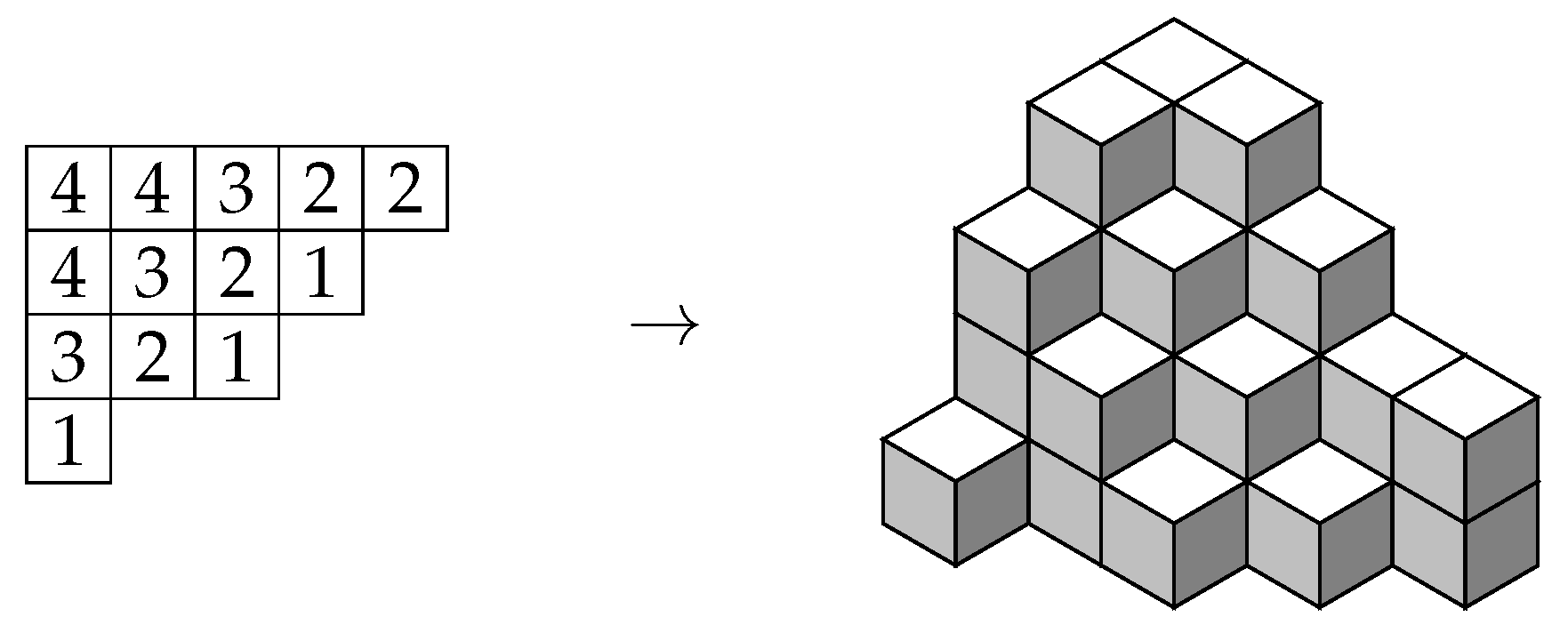
If we ignore the entries equal to zero in a plane partition, it can be considered as the filling of a Young diagram with positive integers with entries weakly decreasing in rows and columns and such that the sum of all entries is equal to
n. On the other hand, there is a desirable way to represent a plane partition as a three-dimensional object: this is achieved by replacing each part of size
k of the plane partition by a stack of
k unit cubes (
Figure 1). This is a natural generalization of the concept of classical partitions [
1]. Different configurations are counted as different plane partitions. As usual, we denote by
the number of plane partitions of
n. For convenience, we define
.
Plane partitions were introduced by MacMahon [
2] who proved the following highly non-trivial result:
An
n-color partition of a positive integer
m is a partition in which a part of size
n can come in
n different colors denoted by subscripts:
. The parts satisfy the following order:
They were introduced by A. K. Agarwal and G. E. Andrews [
3] nearly a century after MacMahon introduced pane partitions. For example, there are thirteen
n-color partitions of 4:
It was pointed out in [
3] that the right-hand side of (
1) is also a generating function for the number of
n-color partitions. Thus, the following statement holds.
Theorem 1. The number of plane partitions of m equals the number of n-color partitions of m.
We also note that the set of plane partitions with strict decrease along columns (of the Young diagram) is in one-to-one correspondence with the set of symmetric matrices with non-negative integer entries ([
1], Corollary 11.6). Moreover, by the Knuth–Schensted correspondence ([
1], Theorem 11.4), in the set of pairs of plane partitions
in which there is strict decrease along columns, each entry is at most
k, and the corresponding rows of
and
are of the same length are in bijection with the set of
matrices with non-negative integer entries.
There is a well-known connection between plane partitions and divisors. In [
4], it is shown that
where
is the sum of squares of divisors of
n, i.e.,
In this article, we consider a restricted sum of divisors function and find connections with the sequence .
For a positive integer
n, we denote by
the sum of divisors
d of
n such that
is a power of 2. For example, the divisors of 12 are
We remark that the sequence
is known and can be found in the On-Line Encyclopedia of Integer Sequence ([
5], A129527). The generating function for
is given on the page for A129527. It can be derived as follows:
where we have used the identity
with
q replaced by
. On the other hand, it is not difficult to prove that
Logarithmic differentiation of the generating Function (
1) gives the following identity:
In
Section 3, we show that
Then, logarithmic differentiation of the generating function (
5) gives
Equating the coefficients of
in the Equations (
4) and (
6), we obtain the following identity:
On the other hand, by (
4) and (
6), we see that
Therefore, we deduce the relation
which implies identity (
3).
From (
3), we see that Theorem 2 is trivial when
n is odd. However, for
n even, this theorem provides an interesting decomposition of
. For example,
The case
of Theorem 2 reads as follows:
For any positive integer
m, we denote by
the number of
m-tuples of plane partitions of non-negative integers
where
. Clearly,
and
For
, we define the numbers
as follows:
Recently, Merca and Radu [
6] considered specializations of complete homogeneous symmetric functions and provided the following formula for
.
Theorem 3. For , and , This formula provides a decomposition of as a sum over all the partitions of n in terms of binomial coefficients involving the multiplicities of the parts.
In this paper, we provide a new decomposition of as a sum over partitions of n in terms of binomial coefficients. This time, in addition to the multiplicities of part sizes, we also need the sequence .
Theorem 4. For , and ,where The case and of Theorem 4 reads as follows.
While the sum above is over all partitions of
n, not all terms are non-zero. Due to the fact that
when
, in this sum it suffices to consider the partitions of
n in which, for each
, part
j occurs at most
times. For example, the partitions of four with this restriction can be rewritten as
Therefore, the case
of Corollary 1 reads as follows:
The case and of Theorem 4 gives the following identity:
Considering the partitions of four with
, the case
of Corollary 1 reads as follows:
On the other hand, according to (
2) we can write
By Corollary 2, we easily deduce the following congruence identity.
Corollary 3. For ,where if x is not a non-negative integer. As a consequence of Theorems 3 and 4, we remark the following identity.
Corollary 4. For , and , The remainder of this paper is organized as follows. In
Section 2, we provide an analytic proof of Theorem 4. In
Section 3, we introduce a new combinatorial interpretation for
. In
Section 4, we make a connection to the Josephus problem. In
Section 5, we give some concluding remarks.
3. A New Combinatorial Interpretation
In this section, we introduce a notion related to n-color partitions and use it to give a new combinatorial interpretation for plane partitions.
Definition 1. An -color partition of a positive integer m is a partition in which a part of size n can come in different colors denoted by subscripts: . The parts satisfy the following order: We denote by
the number of
-color partitions of
m into distinct parts. We set
. For example, there are thirteen
-color partitions into distinct parts of 4:
Using elementary techniques [
1], we obtain the following generating function for
:
On the other hand, by (
12) with
and
, we obtain a new expression of the generating function of
:
Thus, we deduce the following result for which we give a combinatorial proof.
Theorem 5. The number of n-color partitions of m equals the number of -color partitions of m into distinct parts.
Proof. Given an integer
n, we denote by
the largest odd divisor of
n. Then,
for some non-negative integer
k and
Since
, it follows that
. Note that, for odd
n, we have
.
Denote by the set of n-color partitions of m. We define a bijection .
Start with . For each part (size k, color j with ) that occurs more than once, we replace two parts equal to by a single part (part of size , color ). Since , we have . Since and , the obtained partition is an -partition. We repeat the process until parts are distinct and obtain a partition . We define .
To determine the inverse , start with . Note that if is a part of , and k is odd then . For each part with , it follows that k is even and we replace by two parts . Note that if is odd, then and . Then, and . We continue the process until there are no parts with to obtain a partition . Then, . □
Example 1. ConsiderHere, we used the frequency notation: means that there are four parts of size 3 in color 2. We replace two parts by a part , etc. After replacing pairs of equal parts (with equal colors), we obtain Since the parts are not distinct, we continue to replace pairs. We obtain To see that , notice that Conversely, starting withwe replace parts with with two parts . For example, is replaced by . After replacing each such part with a pair, we obtainSince there are still parts with , we continue the process to obtain We remark the following consequence of Theorems 1 and 5.
Corollary 5. The number of plane partitions of m equals the number of -color partitions of m into distinct parts.
4. A Connection with Josephus Problem
The Josephus problem is a math puzzle with a grim description for which we refer the reader to [
7]. Here, we give a friendlier adaptation of the problem:
n rocks, labeled 1 to
n, are placed in a circle. An person walks along the circle and, starting from the rock labeled 1, removes every
k-th rock. As the process goes on, the circle becomes smaller and smaller, until only one rock remains.
We are interested in the case
of the Josephus problem. For
, we denote by
the order in which the first rock is removed. For example, if there are
rocks to begin with, they are removed in the following order:
Therefore, the rock labeled 1 is eliminated at the fourth removal. Therefore,
.
The sequence
is known and can be seen in the On-Line Encyclopedia of Integer Sequence ([
5], A225381). The sequence
can be defined as follows:
By (
3) and (
15), we easily deduce that
for any positive integer
n.
It is clear that our results can be expressed in terms of . For example, we remark the following version of Corollary 1:
In this context, we denote by
the set of partitions of
n with
, for each
, and define
. We set
We also consider the set
defined as
Conjecture 1. Let m, n be positive integers. If , then .
Note that, if n is odd, then , a triangular number. Thus, if are both odd and , then .
For , we define:
to be the number of partitions of n into an even number of distinct parts from ;
to be the number of partitions of n into an odd number of distinct parts from ;
In certain conditions, satisfies Euler’s pentagonal number recurrence.
Theorem 6. Assuming Conjecture 1, for , Analytic Proof. The generating function for
is given by:
Assuming Conjecture 1, elementary techniques in the theory of partitions [
1] give the following generating function:
This concludes the analytic proof. □
We also provide a combinatorial proof of Theorem 6. First, we introduce some notation. We denote by the set of all partitions of n and set . Given , we denote by the number of parts in and by the sum of parts of (also referred to as the size of . For a pair of partitions , we write to mean (and similarly for a triple of partitions). In general, given a set of partitions of n (or pairs of partitions with sizes adding up to n), we set . We also write (respectively, ) for the subset of with even (respectively, odd).
Combinatorial Proof of Theorem 6. Let
be the set of distinct partitions of
n. As explained for example in [
1], Franklin defined a sign-reversing involution
on a subset of the set of distinct partitions of
n to prove combinatorially that the generating function for
equals
Hence, the left-hand side of (
16) is the generating function for
We set
and define
and prove combinatorially that
To do this, we define an involution on the subset of pairs such that has at least one part in or . Let a be the largest part from in and the largest part in . If , remove part a from and insert a part of size a into . If , remove part from and insert a part of size into . The obtained partition has . Hence, . Moreover, consists of pairs such that has no parts from .
Next, we define a Glaisher-type bijection between and . Let . For each part j is with , replace parts of size j by a part of size . We repeat the process until we obtain a partition , i.e., each part j of satisfies . Set .
If the mapping is injective (i.e., if Conjecture 1 holds), the transformation is invertible. Starting with a partition if has a part equal to for some j, we replace part into parts equal to j. We repeat the process until we obtain a partition with no parts in .
Finally, in a manner similar to
, we define an involution
on the set
If , move part from to . Otherwise, move part form to . Clearly, changes the parity of .
The transformation that maps
satisfying
,
and
has parts in
to
shows that that (
17) equals
Halving the parts of completes the proof. □
5. Concluding Remarks and Open Problems
In this section, we introduce some conjectures on the non-negativity of certain truncated theta series involving sequences studied in this article.
In [
8], Andrews and Merca considered the truncation of the theta series arising from Euler’s pentagonal number theorem. They considered the number
of partitions of
n in which
k is the smallest integer that does not occur as a part and there are more parts
than there are
. For example, we have
because the three partitions in question are
As shown in [
8], for every
,
is the coefficient of
in the series
There is a substantial amount of numerical evidence to state the following conjecture.
Conjecture 2. For , all the coefficients of the seriesare non-negative. The coefficient of is positive if and only if . Considering the generating functions of and , Conjecture 2 can be reformulated in its combinatorial form:
Conjecture 3. For ,
- 1.
For n odd, we havewith strict inequality if and only if . - 2.
For n even, we havewith strict inequality if and only if .
The work of Andrews and Merca was the impetus of much work on truncations of different theta series. See, for example, [
9,
10,
11,
12,
13,
14,
15,
16,
17,
18,
19,
20,
21,
22,
23,
24]. Recently, Xia and Zhao [
25] introduced a new truncated version of Euler’s pentagonal number theorem. They considered the number,
, of partitions of
n in which every positive integer
occurs as a part at least once and the first part larger that
k occurs at least
times. For example,
, and the partitions in question are as follows:
As shown in [
25], for every
,
is the coefficient of
in the series
Based on numerical evidence, we make the following conjecture which is analogous to Conjecture 2.
Conjecture 4. For , all the coefficients of the seriesare non-negative. The coefficient of is positive if and only if . The combinatorial interpretation of this conjecture reads as follows.
Conjecture 5. For ,
- 1.
For n odd, we havewith strict inequality if and only if . - 2.
For n even, we havewith strict inequality if and only if .