


Abstract
Consider G to be a simple graph with n vertices and m edges, and to be a Laplacian matrix with Laplacian eigenvalues of . Write as the sum of the k-largest Laplacian eigenvalues of G, where . The motivation of this study is to solve a conjecture in algebraic graph theory for a special type of graph called a wheel graph. Brouwer’s conjecture states that , where . This paper proves Brouwer’s conjecture for wheel graphs. It also provides an upper bound for the sum of the largest Laplacian eigenvalues for the wheel graph which provides a better approximation for this upper bound using Brouwer’s conjecture and the Grone–Merris–Bai inequality. We study the symmetry of wheel graphs and recall an example of the symmetry group of , . We obtain our results using majorization methods and illustrate our findings in tables, diagrams, and curves.
1. Introduction
Denote as G a simple graph with a vertex set and an edge set . The Laplacian matrix of G can be written as , where is the degree matrix. Here, the degree matrix of G is defined by
where is the degree of the vertex i. is the adjacency matrix of G, where G is a graph with , , and without parallel edges. The adjacency matrix is the symmetric binary matrix , which is defined over the ring of integers such that
as in [1]. The characteristic polynomial of the Laplacian matrix is called the Laplacian polynomial. The second smallest root of the Laplacian polynomial of the graph G (counting multiple values separately) is known as the algebraic connectivity of G. The largest is known as the Laplacian spectral. Let be the Laplacian eigenvalues of G, where
Definition 1
([2]). For a graph G with n vertices, , is the sum of the k largest Laplacian eigenvalues of G and , where . is the degree of a vertex v in G.
Obviously, . For the graph G with n vertices, the Grone–Merris–Bai conjecture [3] states that
where . This conjecture was proven by Bai [3].
Let for the graph G. Then, we have the following conjecture [4].
Conjecture 1.
Let G be a graph with n vertices. Then,
for all .
The inequality 3 above holds for split graphs. In particular, it holds for threshold graphs [5]. The conjecture holds for regular graphs [6]. For the case where , Conjecture 1 is derived from the inequality (see [4]). In [7], the authors found that for any tree and when k is equal to 2 for all graphs, Conjecture 1 is true.
Definition 2
([8]). The wheel graph is created by joining a single vertex , to each vertex on the cycle . In other words, .
Remark 1.
We thank the reviewer for providing the Laplacian eigenvalues for the wheel graph in an easy way by referring us to [9,10], which contain the following results:
The Laplacian eigenvalues for the cycle graph are {}, and the Laplacian eigenvalue for the isolated vertex is {0}. Then, the Laplacian eigenvalues for (using the results in [4,8]) are
The sum of the spectrum of the wheel graph is the sum of the degrees of the vertices of the graphs, which is
hence, for all
This paper is organized as follows. This section contains five subsections, including a literature review of studies on wheel graphs and overviews of molecular science and graph theory, the symmetry of wheel graphs, the automorphism group of graphs, and the determining set. We have tried to represent information in wheel graphs that are related to our work. Section 2 contains our approach to tackling this problem. In particular, we explain the notion of majorization. Section 3 contains our main results, including Brouwer’s conjecture, which is valid for wheel graphs, and we provide a better approximation for this upper bound using Brouwer’s conjecture and the Grone–Merris–Bai inequality. Then, we describe an application to international airports that gives us the wheel graph and apply Brouwer’s conjecture. We conclude this work with a discussion and conclusions in Section 4 and Section 5.
1.1. Literature Review of Studies of Wheel Graphs
In 1995, Balasubramanian [11] found the Laplacian of fullerenes (see Section 1.2) using high-precision computational algorithms. In [12], the same author computed the Laplacians of fullerenes as the generators of the number of spanning trees, which find applications in the computation of the magnetic properties of fullerenes. In 2001, the authors of [13] investigated cyclicity in four types of polycyclic graphs, including five-vertex graphs with a five-cycle, Schlegel graphs depicting platonic solids, buckminsterfullerene isomers, and isomers, using the distance-related and resistance distance-related indices. In 2013, Wang et al. [14] determined whether is the graph obtained from G by adding a new vertex corresponding to each edge of G and by joining each new vertex to the end vertices of the corresponding edge. is the graph created from G by joining a new vertex to every edge of G and by joining the edges of those pairs of new vertices that lie on adjacent edges of G. The Laplacian polynomials of and of a regular graph G were derived, along with a formula and the lower bounds of the Kirchhoff index of these graphs. In 2023, Balasubramanian [15] obtained the characteristic polynomials and a number of spectral-based indices such as the Riemann–Zeta functional indices and spectral entropies of n-dimensional hypercubes using recursive Hadamard transforms. In [16], the same author used the Hadamard symmetry and recursive dynamic computational techniques to obtain a large number of degree- and distance-based topological indices, graph and Laplacian spectra and the corresponding polynomials, and entropies and the matching polynomials of n-dimensional hypercubes.
Regarding wheel graphs, in 2009, Zhang et al. [17] proved that, except for , can be determined by its Laplacian spectrum. They provided a graph that is cospectral with the wheel graph . In 2015, Wen et al. [18] proved that all wind-wheel graphs are determined using both their Laplacian and signless Laplacian spectra. In 2020, Chu et al. [19] computed energies of multi-step wheel networks and closed forms of signless Laplacian and Laplacian spectra. These wheel networks are useful in networking and communication, as every node is one hoop neighbor to another. In 2021, Daoqiang et al. [20] studied the subtree number index of wheel graphs and other types of graphs. In 2022, Kuswardi et al. [21] investigated the chromatic number of the amalgamation of wheel graphs. In June 2023, Wei et al. [22] studied the complexity of wheel graphs with multiple edges and vertices. In July 2023, Greeni et al. [23] explained the embedding of a complete bipartite graph into a wheel-related graph. In May 2023, Selig et al. [24] showed us some combinatorial aspects of sandpile models of wheel and fan graphs.
1.2. Molecular Science and Graph Theory
Let us discuss some applications of graph theory to molecular science.
Fullerenes are molecules of carbon atoms that form large hollow shapes. Fullerenes are made of carbon atoms that join together to form hollow hexagonal rings. Fullerenes can be seen as graphs, where vertices represent atoms and edges represent the bonds between atoms. In fact, a fullerene graph is 3-connected and 3-regular with only pentagonal and hexagonal faces. One can observe that the number of pentagonal faces is always 12. This is because of Euler’s formula. We highlight that this application will be studied in future work.
Another application that we can mention here in this regard is nanomaterial structures. One can develop models of nanomaterials using graph theory. This is a modern approach and a new strategy compared to traditional methods. Graph theory can be used as a unifying approach for the structural description of many materials and nanomaterials. This application is important in the study of networks and nanostructures. In fact, the structural analysis of nanoscale network materials using graph theory is now a very active area of research. One of our plans is to study and investigate this approach in the future (see [25,26,27]).
1.3. Symmetry of Wheel Graphs
In this section, we discuss the symmetry of wheel graphs. In particular, we study the results in the paper written by Tully in October 2021 [28].
There is a type of stochastic process with a property of discrete time called a random walk. In this process, a particle starts from one vertex, called the origin, and at each successive epoch, it moves from its current position to an adjacent vertex. Assume that and the transit time from i to j is the random time (number of steps) to get from to . Let represent the transit time from i to j.
Using the structural symmetry of the graph, we have:
- (Hub to periphery): .
- (Periphery to hub): .
- (Periphery to periphery): for all k integers and for all and , where the addition of node labels is interpreted as a modulo n operation (however, is the counter-clockwise neighbor of on the periphery and is the hub).
Hence, the time taken to loop back to the starting vertex can be defined as ; and for , [28] it can be defined as
The authors studied the transition time from to and discussed the mean and the standard deviations of .
1.4. Automorphism Group of Graphs
Definition 3
([29]). The symmetry group of a graph G or its automorphism group consists of permutations of the vertices of G that preserve the adjacency matrix of the graph, which is defined in (1).
Remark 2.
Definition 3 is equivalent to saying that the symmetry group of G consists of permutations whose permutation matrices P satisfy
Theorem 1
([30]). The collection of symmetries of a graph G form a group with composition. This group is denoted as .
Example 1
([31]). The wheel graph with has a symmetry group that is isomorphic to the symmetry of the cycle graph i.e., , where is the dihedral group of order .
1.5. Determining Set
Definition 4
([32]). For a simple graph G, the determining set is a non-empty subset, say T, in which for any two elements r and s in the symmetry group of G, if they are the same in the vertices of T, they are the same on the vertices of G. In other words, T is the determining set for the case where r and s are two automorphisms with for all t in T and
The minimum size of such a set of vertices is the determining number of the graph.
Theorem 2
([31]). The determining number of the wheel graph , is 2.
For recent results of the automorphism group of a graph, the reader is referred to [33,34,35].
2. Methodology
Research on graph theory is a very active area of research. In fact, it is an applied science that has a concrete relationship with pure and discrete mathematics.
Our methodology and strategies in this work are standard. Our approach is to use the previous literature in this field to build and investigate new problems. We focus on a specific type of graph, which is known as a wheel graph.
Linear algebra and matrix theory are very important tools for this work. Spectrum theory has proven to be a powerful tool for visualizing and understanding graph theory.
Another method that we have already used is order and majorization. The concept of majorization can be seen in [8]. It has many applications in graph theory. For two non-increasing real sequences x and y of length n, we say that x is majorized by y (denote as x⪯y) if
3. Main Results
This section investigates whether Brouwer’s conjecture holds for the wheel graph and determines an upper bound for the sum of the k-largest Laplacian eigenvalues of a wheel graph.
We denote the collection of all Laplacian spectra for a graph G by
Our main aim is to show that Brouwer’s conjecture holds for the wheel graph, where , i.e.,
for all , and
To achieve this, we present the cases where .
- Case I: At , observe that in Figure 1 is a regular graph. Therefore, according to [6], the Brouwer’s conjecture holds for .
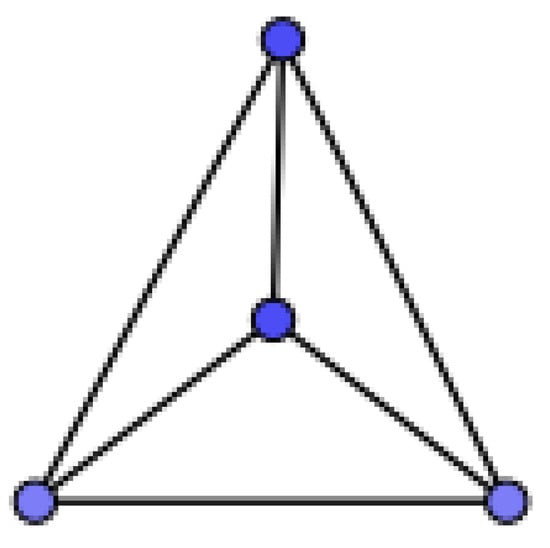 Figure 1. The wheel graph .
 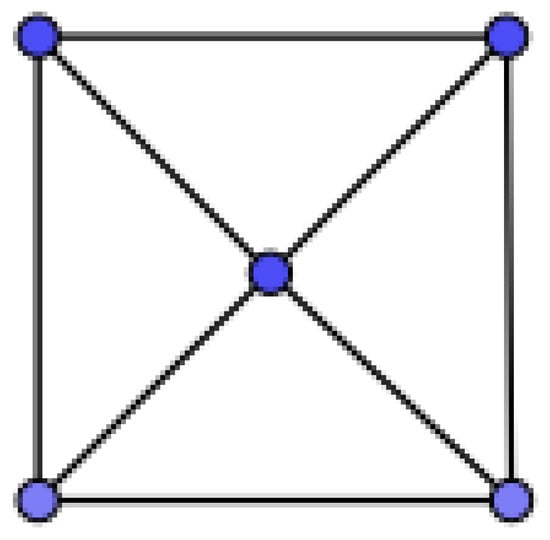 Figure 2. The wheel graph .
 Table 1. and .Therefore, Brouwer’s conjecture holds for for all
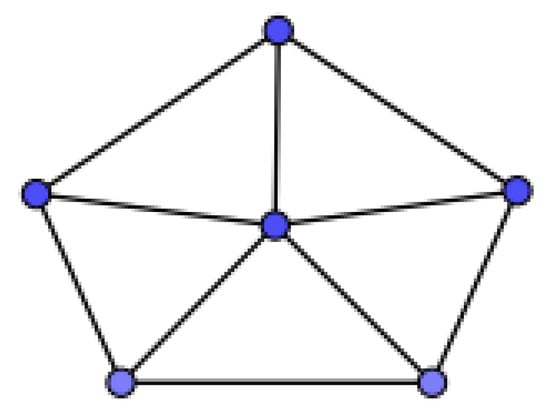 Figure 3. .
Table 2. and .
Figure 3. .
Table 2. and .
Therefore, Brouwer’s conjecture holds for for all
Now, we are ready to present the main theorem.
Theorem 3.
Brouwer’s conjecture holds for the wheel graph , where , i.e.,
where for .
Proof of Theorem 3.
We have to show that
for all
Now, for we have
Then, if To achieve this inequality, consider the polynomial The discriminant for f is which implies that for all when Now, , which implies that , which is Therefore, when , which implies that , Brouwer’s conjecture is satisfied. □
We compare the upper bound obtained for using the Grone–Merris–Bai theorem and that obtained using Brouwer’s conjecture. Here, we review the Grone–Merris–Bai theorem. We present the conjugate of a degree as
Theorem 4.
The Grone–Merris–Bai theorem states that for a graph G and
Clearly, for , , , and .
Therefore,
Now, we present some examples for a comparison between the upper bound obtained for using the Grone–Merris–Bai theorem and that obtained using Brouwer’s conjecture.
Consider the wheel graph . The Laplacian eigenvalues for are
As shown in Table 3, the Grone–Merris–Bai theorem resulted in a better approximation for the upper bound compared to that obtained using Brouwer’s conjecture when , , and . However, this does not apply when and as Brouwer’s conjecture provides a better upper bound.
Table 3.
The Brouwer and Grone–Merris–Bai upper bounds for ).
Consider the wheel graph . The Laplacian eigenvalues for are
From Table 4, it can be observed that at , , and , the Grone–Merris–Bai theorem provides a more accurate upper bound than Brouwer’s conjecture. But at and , the upper bound obtained using Brouwer’s conjecture is better than that obtained using the Grone–Merris–Bai theorem.
Table 4.
The Brouwer and Grone–Merris–Bai upper bounds for ).
Now, we will look at some cases where the upper bound for using the Grone–Merris–Bai theorem is more accurate than that using Brouwer’s conjecture.
Theorem 5.
Let be a wheel graph. Then, the upper bound for using the Grone–Merris–Bai theorem is better than that using Brouwer’s conjecture at , , and .
Proof of Theorem 4.
At ,
At
At , ,
if
that is,
Consider , where the roots of f are
where for all . Therefore, the upper bound obtained for using the Grone–Merris-Bai theorem is better than that obtained using Brouwer’s conjecture if . □
From Theorems 4 and 5, we find the following:
Corollary 1.
Let be a wheel graph. Then, , , , provides an upper bound for that is closer to its actual value compared to the values obtained using the Grone–Merris–Bai theorem and Brouwer’s conjecture.
Example 2.
For :
Therefore,
For :
Therefore,
From Table 5 and Table 6, we can observe that the difference between and is increasing. This means that when n is large, the upper bound obtained using the Grone–Merris–Bai theorem is more accurate than that obtained using Brouwer’s conjecture when n is very large. Also, the equality in the Grone–Merris–Bai theorem holds at . To verify this equality, we can see that
Table 5.
The Brouwer and Grone–Merris–Bai upper bounds for .
Table 6.
The Brouwer and Grone–Merris–Bai upper bounds for .
- .
- . As
The above result directly follows from the previous results [11,12], which show that the sum of the Laplacian spectra equals the sum of the degrees of all the vertices of the graph, which can be readily seen to be for .
4. Application
In this section, we provide an application of our study.
Example 3.
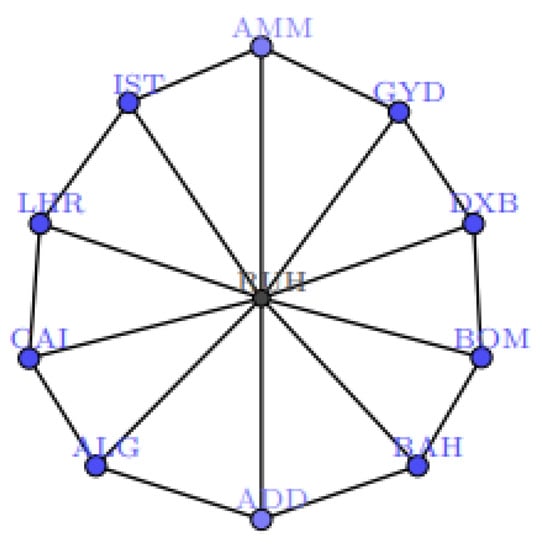
Consider the airports RUH (Riyadh), ALG (Algeria), CAI (Cairo), LHR (London), AMM (Amman), IST (Istanbul), ADD (Addis Ababa), BOM (Mumbai), GYD (Baku), DXB (Dubai), BAH (Manama) as vertices and the flight paths as edges. Then, we have the graph , Figure 4, with Table 7.
Figure 4.
.
Table 7.
Upper bounds for ).
The Laplacian eigenvalues for are
5. Discussion
In this section, a discussion related to our work is presented, including an essential interpretation of a problem and conjecture in algebraic graph theory. Some invariants of wheel graphs are calculated. New results and findings for Brouwer’s conjecture are calculated and presented in majorization tables and figures.
The literature review in Section 1.1 can be compared to our findings and results. This work can be extended to further research and future studies.
There are many open questions and problems in algebraic graph theory that are related to wheel graphs and their invariants. There are unanswered questions and computations that could lead to potential future research in this regard.
6. Conclusions
In this paper, we study a problem in algebraic graph theory. We provide a sufficient background and a review of the relevant literature. The design of this paper is standard. Brouwer’s conjecture holds for the wheel graph , where . The Grone–Merris–Bai theorem results in a better approximation of the upper bound than Brouwer’s conjecture for when and . On the other hand, if , then the upper bound obtained using Brouwer’s conjecture is better than that obtained using the Grone–Merris–Bai theorem. Also, if n is increasing, the difference between and is increasing, as shown in Figure 5, Figure 6 and Figure 7. However, the upper bound obtained using the Grone–Merris–Bai theorem is more accurate than that obtained using Brouwer’s conjecture when n is large enough. The equality in the Grone–Merris–Bai theorem holds for at Therefore, results in a more accurate upper bound compared to the Grone–Merris–Bai and Brouwer upper bounds. We provide an application of this work using the subject of international airports, resulting in the wheel graph . Then, we apply Brouwer’s conjecture. We visualize our results using some curves that depict the relationship between the Grone–Merris–Bai inequality, Brouwer’s conjecture, and as in Figure 8, Figure 9, Figure 10 and Figure 11.
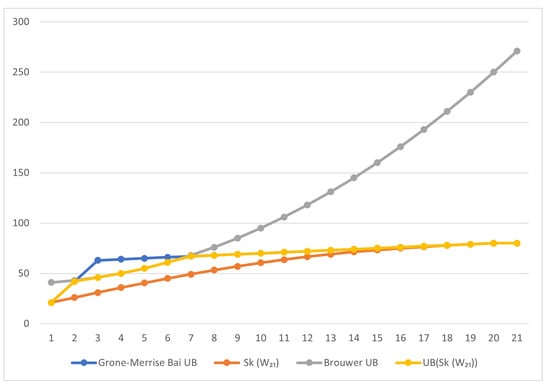
Figure 5.
Comparison of the upper bounds obtained using the Grone–Merris–Bai theorem, Brouwer’s conjecture, and for .
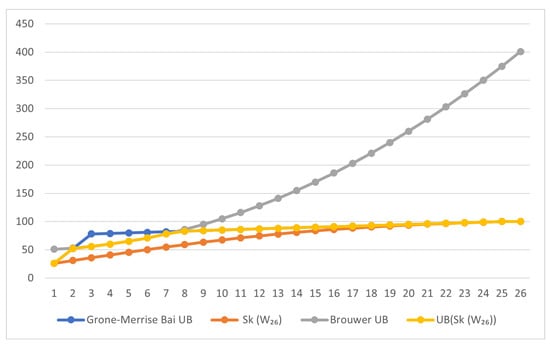
Figure 6.
Comparison of the upper bounds obtained using the Grone–Merris–Bai theorem, Brouwer’s conjecture, and for .
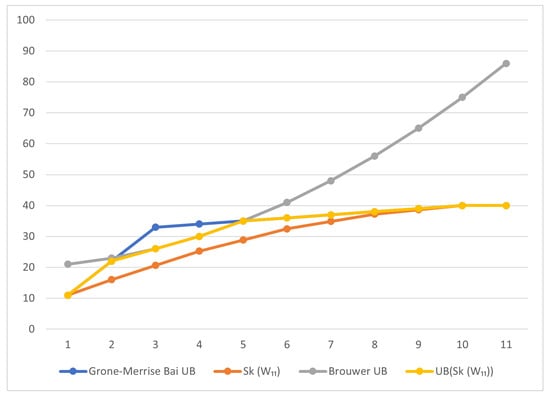
Figure 7.
Comparison of the Grone–Merris–Bai inequality, Brouwer’s conjecture, and for .
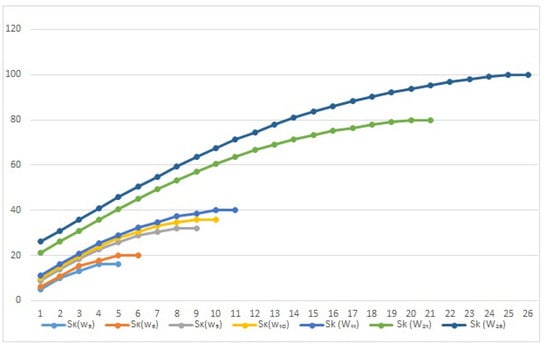
Figure 8.
for specific wheel graphs.
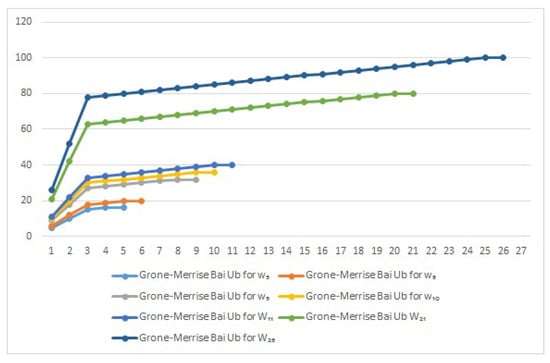
Figure 9.
Grone –Merris–Bai upper bound for specific wheel graphs.
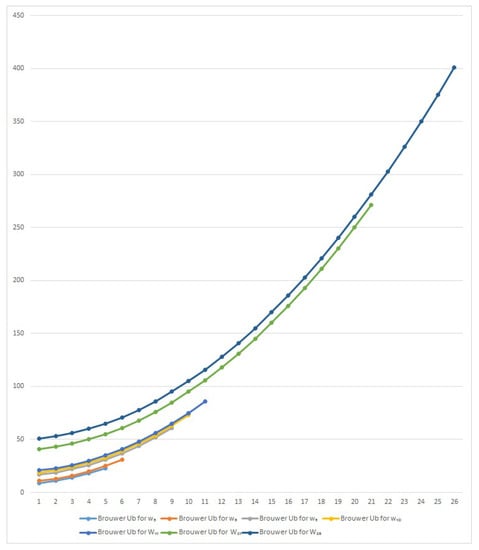
Figure 10.
Brouwer’s conjecture upper bound for specific wheel graphs.
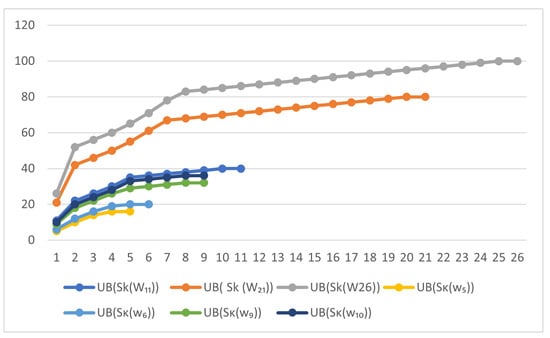
Figure 11.
for specific wheel graphs.
As we indicated in the Discussion section, there is work that can be extended to further research and future studies in the field of algebraic graph theory.
Author Contributions
Formal analysis and writing—original draft, M.A.; Project administration and supervision, H.A.; Validation and visualization, A.A.; Resources and writing—review and editing, H.A. and A.A. All authors have read and agreed to the published version of the manuscript.
Funding
This research received no external funding.
Institutional Review Board Statement
Not applicable.
Informed Consent Statement
Not applicable.
Data Availability Statement
All data are included in the paper.
Acknowledgments
This project was supported by the Researchers Supporting Project Number (RSP2023R317) King Saud University, Riyadh, Saudi Arabia. The authors would like to thank the two reviewers for their valuable comments and suggestions, which led to a great improvement in the original manuscript.
Conflicts of Interest
The authors declare no conflict of interest.
References
- Dharwadker, A.; Pirzada, S. Graph Theory, 3rd ed.; Institute of Mathematics: Hyderabad, India, 2011; pp. 1–190. [Google Scholar]
- Ganie, H.A.; Alghamdi, A.m.; Pirzada, S. On the sum of the Laplacian eigenvalues of a graph and Brouwer’s conjecture. Linear Algebra Appl. 2016, 501, 376–389. [Google Scholar] [CrossRef]
- Bai, H. The grone-merris conjecture. Trans. Am. Math. Soc. 2011, 363, 4463–4474. [Google Scholar] [CrossRef]
- Brouwer, A.; Haemers, W. Spectra of Graph. Personal. Individ. Differ. 2012, xiv+250. [Google Scholar] [CrossRef]
- Trevisan, V.; Helmberg, C. Spectral threshold dominance, Brouwer’s conjecture and maximality of Laplacian energy. Linear Algebra Appl. 2017, 512, 0024–3795. [Google Scholar]
- On Variants of the Grone-Merris Conjecture. Master’s Thesis, Endhoven University of Tichnology, Einhoven, The Netherlands, 2010.
- Haemers, W.H.; Mohammadian, A.; Tayfeh-Rezaie, B. On the sum of Laplacian eigenvalues of graphs. Linear Algebra Appl. 2010, 432, 2214–2221. [Google Scholar] [CrossRef]
- Molitierno, J.J. Applications of Combinatorial Matrix Theory to Laplacian Matrices of Graphs, 3rd ed.; CRC Press: Boca Raton, FL, USA, 2016; pp. 1–171. [Google Scholar]
- Cvetkovic, D.M.; Doob, M.; Sachs, H. Spectra of Graphs. Theory and Application; Academic Press: London, UK; New York, NY, USA; San Francisco, CA, USA, 1980. [Google Scholar]
- Coulson, C.A.; Mallion, R.B. Huckel Theory for Organic Chemists; Academic Press: London, UK; New York, NY, USA; San Francisco, CA, USA, 1978. [Google Scholar]
- Balasubramanian, K. Laplacians of Fullerenes (C42–C90). J. Phys. Chem. 1995, 99, 6509–6518. [Google Scholar] [CrossRef]
- Balasubramanian, K. Computation of spanning tree generators of fullerenes. Mol. Phys. 1995, 85, 335–348. [Google Scholar] [CrossRef]
- Babic’, D.; Klien, D.J.; Lukovits, I.; Nikolic’, S.; Trinajstic, N. Resistance-Distance Matrix: A Computational Algorithm and Its Application. Int. J. Quantum Chem. 2001, 90, 166–176. [Google Scholar] [CrossRef]
- Wang, W.; Yang, D.; Luo, Y. The Laplacian polynomial and Kirchhoff index of graphs derived from regular graphs. Discret. Appl. Math. 2013, 161, 3063–3071. [Google Scholar] [CrossRef]
- Balasubramanian, K. Characteristic polynomials, spectral-based Riemann-Zeta functions and entropy indices of n-dimensional hypercubes. J. Math. Chem. 2023, 61, 1570–1591. [Google Scholar] [CrossRef]
- Balasubramanian, K. Topological indices, graph spectra, entropies, laplacians, and matching polynomials of n-dimensional hypercubes. Symmetry 2023, 15, 557. [Google Scholar] [CrossRef]
- Zhang, Y.; Liub, X.; Yong, X. Which wheel graphs are determined by their Laplacian spectra? Comput. Math. Appl. 2009, 85, 1887–1890. [Google Scholar] [CrossRef]
- Wen, F.; Huang, Q.; Huang, X.; Liu, F. The spectral characterization of wind-wheel graphs. Indian J. Pure Appl. Math. 2015, 46, 613–631. [Google Scholar] [CrossRef]
- Chu, Z.Q.; Munir, M.; Yousaf, A.; Qureshi, M.I.; Liu, J.B. Laplacian and signless laplacian spectra and energies of multi-step wheels. Math. Biosci. Eng. 2020, 17, 3649–3659. [Google Scholar] [CrossRef] [PubMed]
- Sun, D.; Zhao, Z.; Li, X.; Cao, J.; Yang, Y. On subtree number index of generalized book graphs, fan Graphs, and wheel graphs. J. Math. 2021, 2021, 5511214. [Google Scholar] [CrossRef]
- Kuswardi, Y.; Almira, L.; Nurussakbana, N.; Pinilih, A.C. Chromatic Number of Amalgamation of Wheel Graph-Star Graph and Amalgamation of Wheel Graph-Sikel Graphs. J. Math. Math. Educ. 2022, 12, 1–100. [Google Scholar] [CrossRef]
- Wei, Y.; Gao, Z.; Lu, X. The Complexity of Wheel Graphs with Multiple Edges and Vertice. Asian Res. J. Math. 2023, 19, 1–12. [Google Scholar] [CrossRef]
- Greeni, A.B.; Joshwa, P.L. Embedding complete bipartite graphs into wheel related graphs. J. Adv. Comput. Intell. Intell. Inform. 2023, 27, 645–648. [Google Scholar] [CrossRef]
- Selig, T. Combinatorial aspects of sandpile models on wheel and fan graphs. Eur. J. Comb. 2023, 110, 103663. [Google Scholar] [CrossRef]
- Buseck, P.R.; Tsipursky, S.J.; Hettich, R. Fullerenes from the geological environment. Science 1992, 257, 215–217. [Google Scholar] [CrossRef]
- Cox, D.M.; Behal, S.; Disko, M.; Gorun, S.M.; Greaney, M.; Hsu, C.S.; Kollin, E.B.; Millar, J.; Robbins, J. Characterization of C60 and C70 clusters. J. Am. Chem. Soc. 1991, 113, 2940–2944. [Google Scholar] [CrossRef]
- Dance, I.G.; Fisher, K.J.; Willett, G.D.; Wilson, M.A. C60 and liquid-crystal mesophase. J. Phys. Chem. 1991, 95, 8425–8428. [Google Scholar] [CrossRef]
- Tully, C. Symmetric random walks on wheel-and-spokes graphs. SIAM Undergrad. Res. Online 2021, 14, 604–620. [Google Scholar] [CrossRef]
- Balasubramanian, K. Symmetry Groups of Chemical Graphs. Int. J. Quantum Chem. 1982, 21, 411–418. [Google Scholar] [CrossRef]
- Potanka, K.S. Groups, Graphs, and Symmetry-Breaking. Ph.D. Dissertation, Virginia Tech, Blacksburg, VA, USA, 1998; pp. 1–100. [Google Scholar]
- Kavi, L.C. Symmetry breaking in graphs and matroids. AIMS 2015. [Google Scholar] [CrossRef]
- Boutin, D.L. Identifying graph automorphisms using determining sets. Electron. J. Comb. 2006, 13, R78. [Google Scholar] [CrossRef]
- Deligeorgaki, D. Smallest graphs with given automorphism groups. J. Algebr. Comb. 2022, 56, 609–633. [Google Scholar] [CrossRef]
- Mirafzal, S.M. On the automorphism groups of connected bipartite irreducible graphs. Proc.-Math. Sci. 2020, 130, 1–15. [Google Scholar] [CrossRef]
- Ibarra, S.; Rivera, L.M. The automorphism groups of some token graphs. arXiv 2019, arXiv:1907.06008. [Google Scholar]
Disclaimer/Publisher’s Note: The statements, opinions and data contained in all publications are solely those of the individual author(s) and contributor(s) and not of MDPI and/or the editor(s). MDPI and/or the editor(s) disclaim responsibility for any injury to people or property resulting from any ideas, methods, instructions or products referred to in the content. |
© 2023 by the authors. Licensee MDPI, Basel, Switzerland. This article is an open access article distributed under the terms and conditions of the Creative Commons Attribution (CC BY) license (https://creativecommons.org/licenses/by/4.0/).