Abstract
The full discrete approximation of solutions of nonhomogeneous fractional equations is considered in this paper. The methods of iteration, finite differences and projection are applied to obtain desired formulas of explicit- and implicit-difference schemes for discretization schemes. The stability of two difference schemes is also discussed using the Trotter–Kato theorem.
Keywords:
fractional cauchy problem; fulldiscrete approximation; Trotter–Kato theorem; discretization scheme; iteration method; stability MSC:
45L05; 45M10; 65J10
1. Introduction
Many results of the approximation theory to abstract differential equations in Banach spaces simplify the design of concrete numerical approaches. Thus, an approximation theory of differential equations has attracted much attention due to its wide application in recent years.
In [1], Guidetti, Karasözen and Piskarev investigated the general approximation theory for differential equations with first-order derivatives in Banach spaces. Using the approximation theory, they analyzed the numerical problems of homogeneous differential equations and semilinear differential equations, respectively. In [2,3], Li, Morozov and Piskarev considered the approximation theory for derivatives of integrated semigroups. For other papers on the approximation of first-order differential equations, we suggest that readers consult [4,5,6,7,8,9].
Recently, fractional Cauchy problems and their approximation have become an important topic due to their broad application in engineering, physics and biology. A large number of findings on this topic have been reported in the literature [10,11,12,13,14,15,16,17,18,19,20,21,22,23,24,25,26,27,28,29,30,31,32,33]. Among these, in [22], Liu, Li and Piskarev considered the fulldiscretization approximation for solutions of the following equation with fractional time derivative
in abstract space E, by virtue of finite differences and projection methods. In the same year, by discussing the relations of compact convergence of resolvents and semidiscrete approximation, the authors [23] studied the semidiscretization approximation of semilinear fractional problems
where . They demonstrated that the semidiscrete approximation to the solution is convergent if the corresponding resolvents are compactly convergent. However, in [23], the authors did not consider the fulldiscretization of the nonlinear term . In [20], the authors discussed the well-posedness and maximal regularity of fractional semilinear differential equations in Hölder space, and derived the existence and stability of an implicit difference scheme for the fractional systems. We refer to [11,15,20,21,24,25,27,32] and the references therein for the approximation of various differential equations in Banach spaces.
Motivated by above papers, we investigate the fulldiscrete approximation of nonhomogeneous fractional equation
in abstract space E, where operator A is the generator of -semigroup , , f is a smooth enough function, the Caputo fractional-order derivative with order is defined by
and the Riemann–Liouville fractional order integral with order is defined by
if the above two integrals exist.
The general discretization scheme for problem (3) in Banach space is
with a series of smooth enough functions .
In this paper, we find new iteration formulas of solutions to the implicit scheme and explicit scheme for the nonhomogeneous Cauchy problem (3) using the methods of iteration, finite differences and projection. At the same time, we discuss the stability for the two schemes using the Trotter–Kato theorem.
Define and E as Banach spaces, , and with , where denotes the space of all continuous linear operators from E to , denotes . Now, we introduce some notations and definitions of approximation theory, as follows.
By [9], we always assume that , , satisfies that goes to when n tends to infinity for each .
Definition 1
([8]). The family , , is -converging to x belonging to E if . This can also be written as .
Definition 2
([8]). The family , , is -converging to B belonging to if implies for any and . It is also denoted as .
Use to denote the space of all densely defined closed linear operators on E. One version of the Trotter–Kato theorem [1], which is essential in the investigation of the approximation theory for differential equations, is shown as follows.
Theorem 1.
Assume that and are generators of -semigroups, respectively. Then, the hypotheses and are equivalent to .
. Coordination. There is one number that satisfies .
. Stability. There are two real numbers, ω and , satisfying for each and , where ω and are independent of n.
. Convergence. For every , the relation
holds if , and .
2. Explicit and Implicit Schemes for the Approximation
The main purpose of the paper is to investigate the fulldiscrete approximation of the Equation (4). Therefore, the difference schemes for the general approximation to the problem (3) are needed.
Let , ; we approximate the fractional derivative of functions by the finite difference scheme , where
and
In view of [24], the solution of the homogeneous equation of problem (4) can be expressed by for any smooth initial value with the smallest integer l, such that . In this situation, they proved the following relation regarding the order of convergence
On the other hand, we approximate by , where
and
Now, we can approximate problem (3) using the implicit difference scheme
and the explicit scheme
respectively.
3. Existence and Stability
Now, we present the proofs of the iteration formulas that solve the two difference schemes through the method of induction, and discuss the stability of the solutions under the condition (B) with in the Trotter–Kato theorem.
Let in the sequel. The two iteration formulas of solutions for implicit and explicit difference schemes are presented as follows.
Theorem 2.
Proof.
For the implicit difference scheme (5), i.e., for the scheme
it follows that
We prove (7) by induction as follows.
For , , , .
For ,
where , , , , and .
Next, we verify and by induction, respectively.
In fact,
where , , , and
Thus, .
On the other hand,
By assumption, It follows that
Hence, . □
Theorem 3.
,
, ,
, ,
,
, , , ,
and .
Proof.
For ,
where , , and .
For ,
where , , , ,
, , , .
Assume the relation (8) holds for . Then,
where
Now, our aim is to deduce and by induction, respectively. As a matter of fact,
where
,
, ,
, .
Meanwhile, we can obtain
Furthermore,
where , , , and
Consequently,
□
On account of the above two relations, we now can establish the proof of stability to the solutions, under the following conditions.
Theorem 4.
Suppose condition (B) holds, with . Then, the implicit difference scheme (5) is stable, i.e.,
where , .
Proof.
By condition , we have for any . Thus,
Next, we prove the inequality
by induction.
For , .
For , .
Suppose the relation (10) holds for every . Then, for , we obtain
From the above proof, one can also obtain that
Consequently, using Theorem 2, we obtain
□
Theorem 5.
Let . Suppose condition (B) holds with and , where c is a constant. Then, the explicit scheme (6) is stable, i.e.,
where , c is independent of n and .
Proof.
By condition , we have for any . Then, we have . Thus,
Next, we prove
by induction.
For , .
For ,
Suppose the relation (12) holds for every . Then, for , we obtain
Consequently, we have the following estimate
□
Remark 1.
Our results generalize Proposition 1, Proposition 2, Theorem 2 and Theorem 7 in [22], where the authors consider the existence and stability of homogeneous fractional equations. Our contribution in the present paper is that we find the new iteration formulas of solutions for the implicit scheme and explicit scheme of the nonhomogeneous Cauchy problem (3) and obtain the stability results for these two schemes.
4. Numerical Example
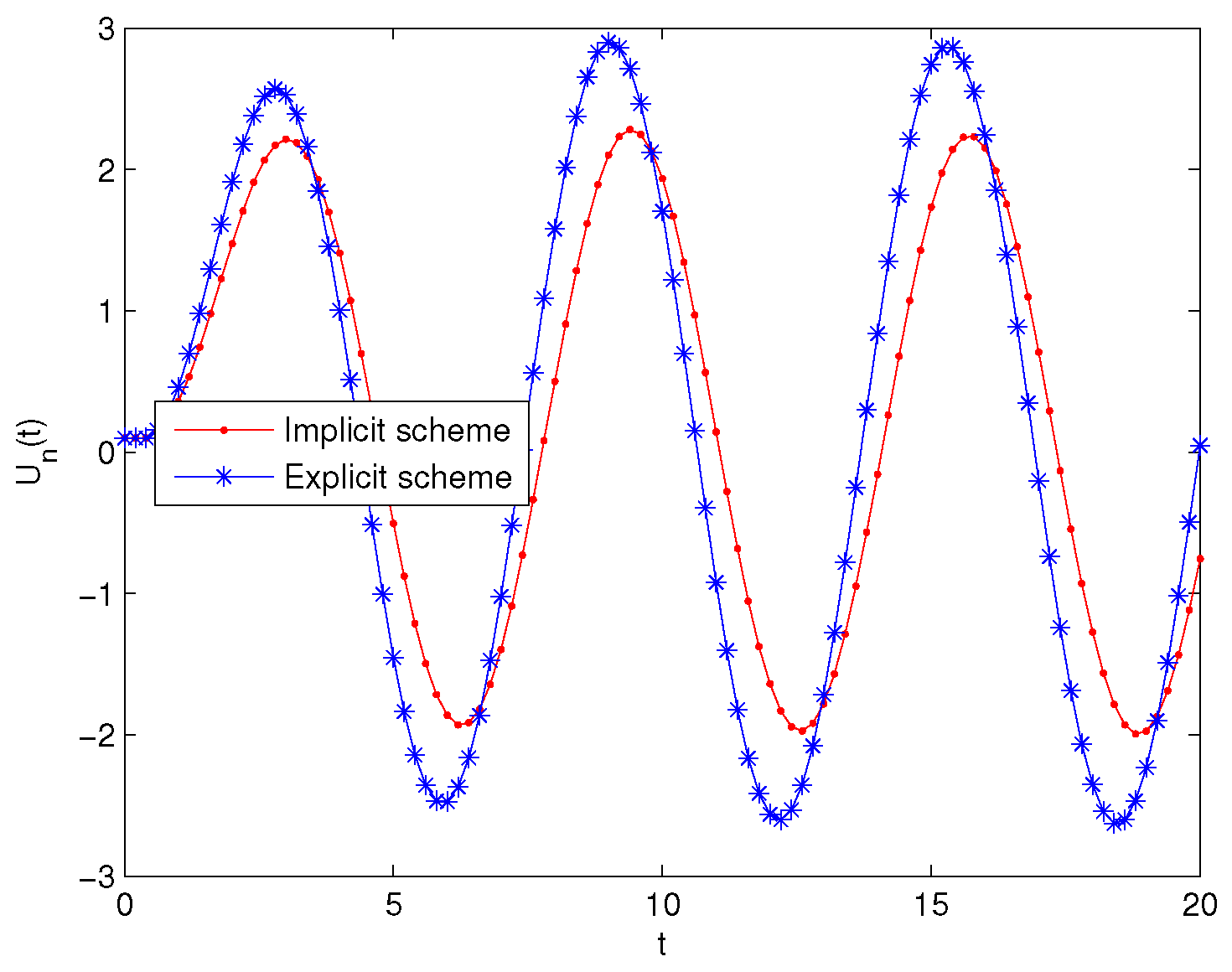
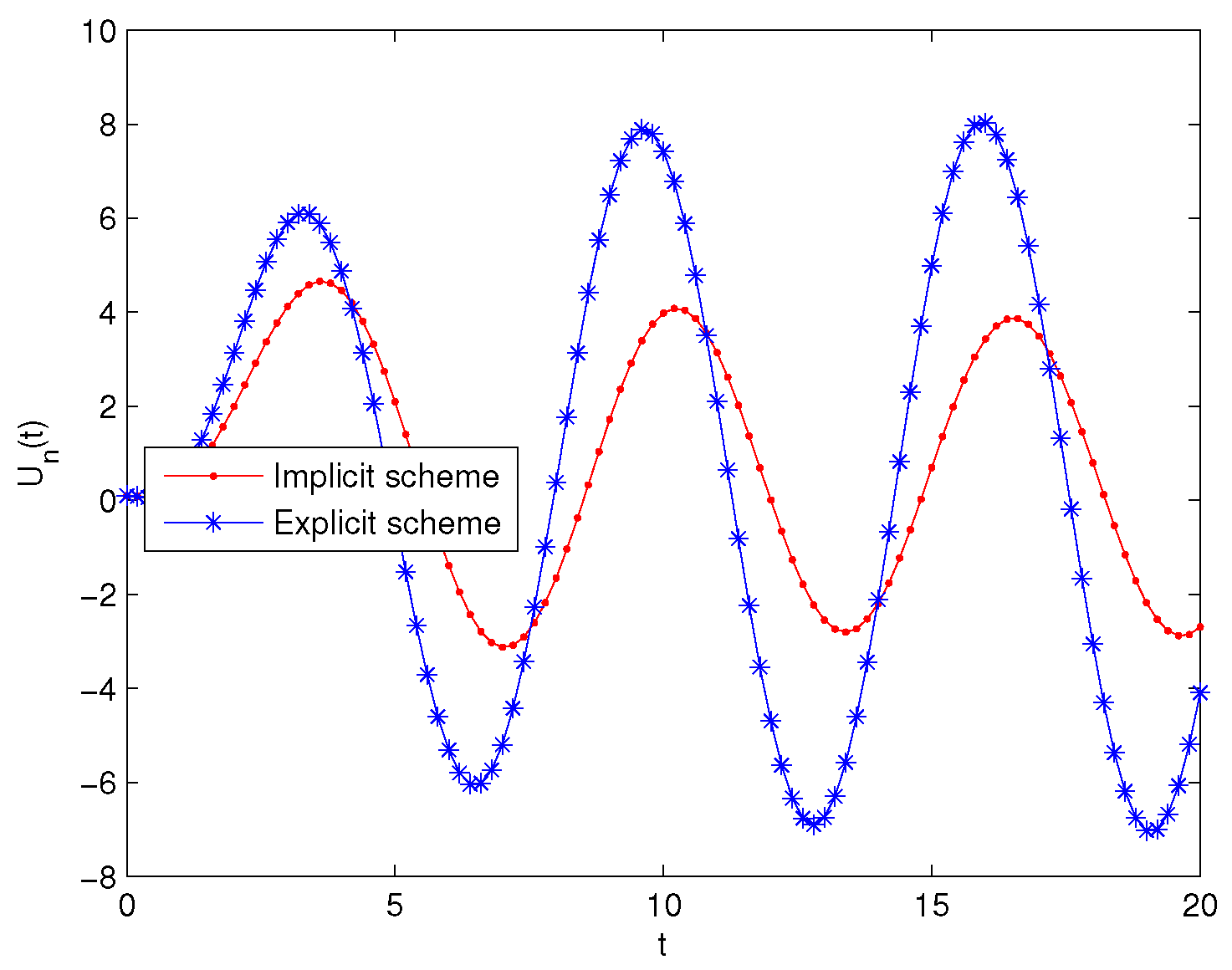
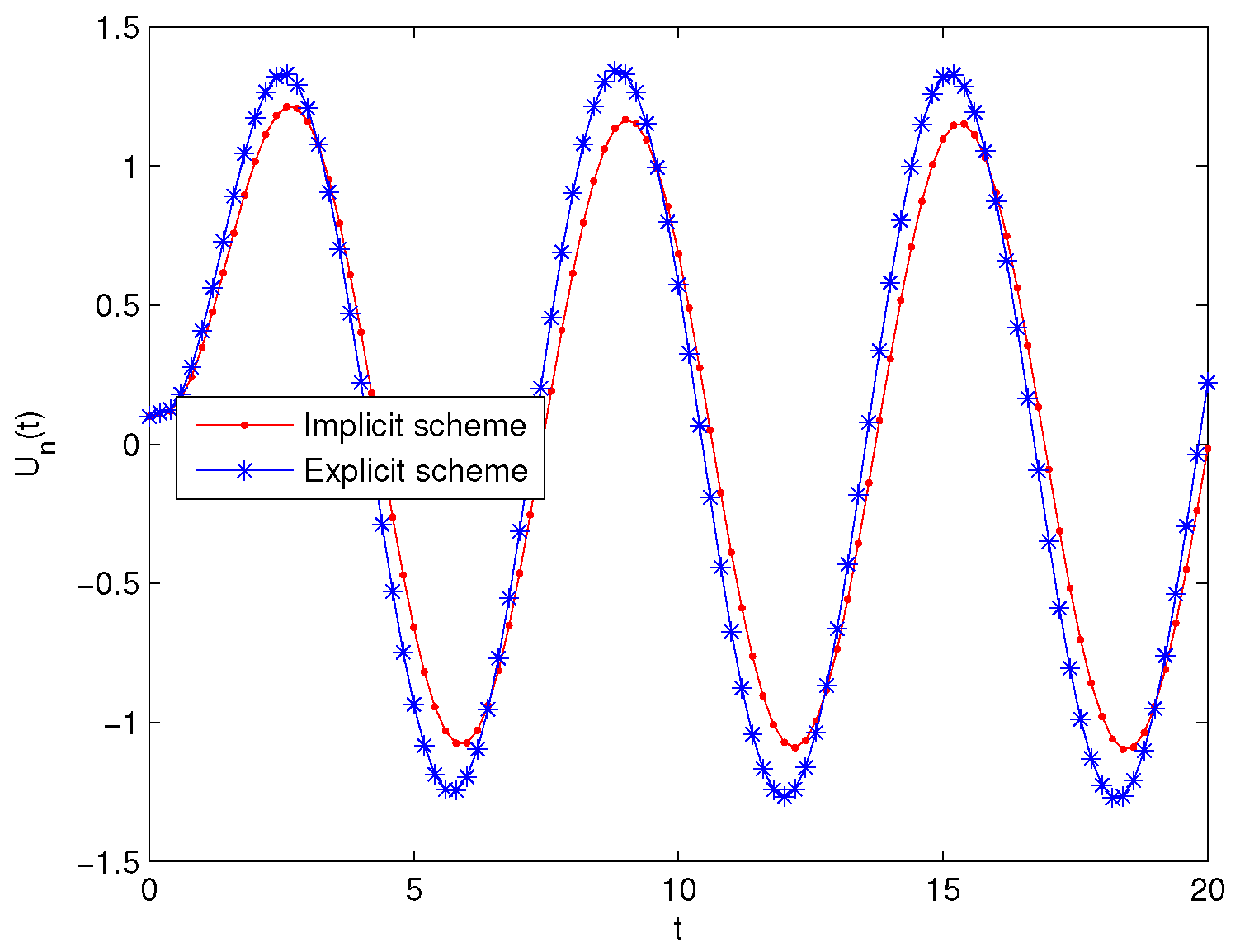
In this section, we provide a numerical example in one-dimensional space to show the validity of our results. We consider the following differential equation
in Euclidean space , when and equals , respectively.
According to Figure 1, Figure 2 and Figure 3, one can see that the solutions of implicit schemes are stable. Therefore, Theorem 4 is valid by means of these Figures. On the other hand, one can see that the solutions of explicit schemes are unstable in Figure 1 and Figure 2. The solution of explicit scheme is shown to be stable in Figure 3. Thus, Theorem 5 is also valid, since must be greater than in this theorem.
Figure 1.
.
Figure 2.
.
Figure 3.
.
5. Conclusions
In this work, the existence and stability of two difference schemes for nonhomogeneous fractional Cauchy problem are obtained in the space using of the methods of numerical analysis and functional analysis. These approaches are efficient, simple and can be applied to analogous problems. In the near future, we will investigate the order of convergence of difference schemes and stability for problem (3) in suitable spaces.
Author Contributions
Data curation, L.X.; Formal analysis, X.X.; Methodology, X.X.; Writing—original draft, X.X.; Writing—review and editing, L.X. All authors have read and agreed to the published version of the manuscript.
Funding
This research received no external funding.
Data Availability Statement
The program data used to support the findings of this study in Section 4 are available from the corresponding author upon request.
Acknowledgments
The authors would like to express there gratitude to the editor and anonymous reviewers for their valuable comments and suggestions.
Conflicts of Interest
The authors declare that they have no competing interest.
References
- Guidetti, D.; Karasözen, B.; Piskarev, S. Approximation of abstract differential equations. J. Math. Sci. 2004, 122, 3013–3054. [Google Scholar] [CrossRef]
- Li, M.; Morozov, V.; Piskarev, S. On the approximations of derivatives of integrated semigroups. J. Inverse Ill-Posed Probl. 2010, 18, 515–550. [Google Scholar] [CrossRef]
- Li, M.; Morozov, V.; Piskarev, S. On the approximations of derivatives of integrated semigroups II. J. Inverse Ill-Posed Probl. 2011, 19, 643–688. [Google Scholar] [CrossRef]
- Abdelaziz, N.H. On approximation by discrete semigroups. J. Approx. Theory 1993, 73, 253–269. [Google Scholar] [CrossRef]
- Abdelaziz, N.H.; Chernoff, P.R. Continuous and discrete semigroup approximations with applications to the Cauchy problem. J. Oper. Theory 1994, 32, 331–352. [Google Scholar]
- Ashyralyev, A.; Sobolevskii, P.E. Well-posedness of Parabolic Difference Equations. In Operator Theory; Springer: Basel, Switzerland; Boston, MA, USA; Berlin, Germany; Birkhäuser: Basel, Switzerland, 1994; Volume 69. [Google Scholar]
- Cao, Q.; Pastor, J.; Siegmund, S.; Piskarev, S. The approximations of parabolic equations at the vicinity of hyperbolic equilibrium point. Numer. Funct. Anal. Optim. 2014, 35, 1287–1307. [Google Scholar] [CrossRef]
- Piskarev, S. Differential Equations in Banach Space and Their Approximation; Moscow State University Publish House: Moscow, Russia, 2005. (In Russian) [Google Scholar]
- Vainikko, G. Approximative methods for nonlinear equations (two approaches to the convergence problem). Nonlinear Anal. 1978, 2, 647–687. [Google Scholar] [CrossRef]
- Alam, M.M.; Dubey, S. Strict Hölder regularity for fractional order abstract degenerate differential equations. Ann. Funct. Anal. 2022, 13, 1–29. [Google Scholar] [CrossRef]
- Alikhanov, A.A. A new difference scheme for the time fractional diffusion equation. J. Comput. Phys. 2015, 280, 424–438. [Google Scholar] [CrossRef]
- Bajlekova, E. Fractional Evolution Equations in Banach Spaces. Ph.D. Thesis, University Press Facilities, Eindhoven University of Technology, Eindhoven, The Netherlands, 2001. [Google Scholar]
- Fan, Z.; Dong, Q.; Li, G. Almost exponential stability and exponential stability of resolvent operator families. Semigroup Forum 2016, 93, 491–500. [Google Scholar] [CrossRef]
- Fan, Z. A short note on the solvability of impulsive fractional differential equations with Caputo derivatives. Appl. Math. Lett. 2014, 38, 14–19. [Google Scholar] [CrossRef]
- Gao, G.; Sun, Z. The finite difference approximation for a class of fractional sub-diffusions on a space unbounded domain. J. Comput. Phys. 2013, 236, 443–460. [Google Scholar] [CrossRef]
- He, J.W.; Zhou, Y. Hölder regularity for non-autonomous fractional evolution equations. Fract. Calc. Appl. Anal. 2022, 25, 378–407. [Google Scholar] [CrossRef]
- Kilbas, A.A.; Srivastava, H.M.; Trujillo, J.J. Theory and Applications of Fractional Differential Equations. In North-Holland Mathematics Studies; Elsevier: Amsterdam, The Netherlands, 2006; Volume 204. [Google Scholar]
- Li, K.; Peng, J.; Jia, J. Cauchy problems for fractional differential equations with Riemann-Liouville fractional derivatives. J. Funct. Anal. 2012, 263, 476–510. [Google Scholar] [CrossRef]
- Liang, Y.; Shi, Y.; Fan, Z. Exact solutions and Hyers-Ulam stability of fractional equations with double delays. Fract. Calc. Appl. Anal. 2023, 26, 439–460. [Google Scholar] [CrossRef]
- Liu, L.; Fan, Z.; Li, G.; Piskarev, S. Maximal regularity for fractional Cauchy equation in Hölder space and its approximation. Comput. Methods Appl. Math. 2019, 19, 779–796. [Google Scholar] [CrossRef]
- Liu, L.B.; Liang, Z.; Long, G.; Liang, Y. Convergence analysis of a finite difference scheme for a Riemann-Liouville fractional derivative two-point boundary value problem on an adaptive grid. J. Comput. Appl. Math. 2020, 375, 112809. [Google Scholar] [CrossRef]
- Liu, R.; Li, M.; Piskarev, S. Stability of difference schemes for fractional equations. Differ. Equ. 2015, 51, 904–924. [Google Scholar] [CrossRef]
- Liu, R.; Li, M.; Piskarev, S. Approximation of semilinear fractional Cauchy problem. Comput. Methods Appl. Math. 2015, 15, 203–212. [Google Scholar] [CrossRef]
- Liu, R.; Li, M.; Piskarev, S. The order of convergence of difference schemes for fractional equations. Numer. Funct. Anal. Optim. 2017, 38, 754–769. [Google Scholar] [CrossRef]
- Liu, R.; Li, M.; Pastor, J.; Piskarev, S. On the approximation of fractional resolution families. Differ. Equ. 2014, 50, 927–937. [Google Scholar] [CrossRef]
- Podlubny, I. Fractional Differential Equations; Academic Press: San Diego, CA, USA, 1999. [Google Scholar]
- Ponce, R. Time discretization of fractional subdiffusion equations via fractional resolvent operators. Comput. Math. Appl. 2020, 80, 69–92. [Google Scholar] [CrossRef]
- Ponce, R. Well-posedness of second order differential equations with memory. Math. Nachr. 2022, 295, 2246–2264. [Google Scholar] [CrossRef]
- Prüss, J. Evolutionary Integral Equations and Applications; Birkhäuser: Basel, Switzerland; Berlin, Germany, 1993. [Google Scholar]
- Shi, Y.; Fan, Z.; Li, G. New explicit solutions and Hyers-Ulam stability of fractional delay differential equations. J. Yangzhou Univ. (Nat. Sci. Ed.) 2023, 26, 1–5+19. (In Chinese) [Google Scholar]
- Wang, R.N.; Chen, D.H.; Xiao, T.J. Abstract fractional Cauchy problems with almost sectorial operators. J. Diff. Equ. 2012, 252, 202–235. [Google Scholar] [CrossRef]
- Zhang, J.; Wang, J.R.; Zhou, Y. Numerical analysis for time-fractional Schrödinger equation on two space dimensions. Adv. Differ. Equ. 2020, 2020, 53. [Google Scholar] [CrossRef]
- Zhu, S.; Fan, Z.; Li, G. Topological characteristics of solution sets for fractional evolution equations and applications to control systems. Topol. Methods Nonlinear Anal. 2019, 54, 177–202. [Google Scholar] [CrossRef]
Disclaimer/Publisher’s Note: The statements, opinions and data contained in all publications are solely those of the individual author(s) and contributor(s) and not of MDPI and/or the editor(s). MDPI and/or the editor(s) disclaim responsibility for any injury to people or property resulting from any ideas, methods, instructions or products referred to in the content. |
© 2023 by the authors. Licensee MDPI, Basel, Switzerland. This article is an open access article distributed under the terms and conditions of the Creative Commons Attribution (CC BY) license (https://creativecommons.org/licenses/by/4.0/).