


Abstract
Based on a comparison with first-order equations, we obtain new criteria for investigating the asymptotic behavior of a class of differential equations with neutral arguments. In this work, we consider the non-canonical case for an even-order equation. We concentrate on the requirements for excluding positive solutions, as the method used considers the symmetry between the positive and negative solutions of the studied equation. The results obtained do not require some restrictions that were necessary to apply previous relevant results in the literature.
1. Introduction
Differential equations (DEs) have been widely used in both pure and applied mathematics since they were first introduced in the middle of the 17th century. New connections between the various branches of mathematics, beneficial interactions with practical domains, and reformulations of fundamental problems and theories in diverse sciences have all led to a vast variety of new models and issues.
DEs can be used to simulate almost any physical, technological, or biological activity, including astronomical motion, the construction of bridges, and interactions between neurons. Most models that represent real phenomena and applications cannot have closed-form solutions. The available options in this case include finding approximate solutions or studying the qualitative properties of the solutions of these models, which include stability, symmetry, oscillation, periodicity, and others.
A type of functional differential equation known as “neutral differential equations (NDEs)” occurs when the highest derivative of the unknown function appears on the solution both with and without delay. NDEs are used to simulate a wide range of phenomena in many applied sciences, see [1].
The various differential models that have been proposed in various applied sciences have served as a great source of inspiration for research into the qualitative theory of DEs. According to this approach, the oscillation theory of DEs has made huge strides in recent decades, see [2,3,4,5]. Numerous authors have examined the oscillation of even-order differential equations and various methods for developing oscillatory criteria for these equations [6,7,8,9].
This study aims to create new conditions to investigate the asymptotic behavior of the even-order NDE
where are even integers, and . Furthermore, we suppose that does not vanish eventually, , , , and
For a solution to (1), we select a function , which has the properties and , and x satisfies (1) on We consider only those solutions to Equation (1) that will not vanish eventually. If a solution x of (1) is eventually positive or negative, then it is said to be non-oscillatory; otherwise, it is said to be oscillatory.
The oscillation theory, which has lately seen major growth and development, covers the study of oscillation for delay, neutral, mixed, and damping ordinary, fractional, and partial DEs. Second-order delay DEs have received the majority of attention in the literature, notably in the non-canonical case, see, for example, [10,11,12,13,14,15,16]. Recently, Bohner et al. [17] presented improved criteria for testing the oscillation of solutions of non-canonical second-order advanced differential equations.
In the non-canonical case, even-order delay DEs have gained more attention than neutral equations, see, for example, [6,7,18,19].
Li and Rogovchenko [20] considered the NDE
where and are ratios of odd positive integers. They obtained the oscillation criteria for Equation (2) by using comparison techniques and assuming three unknown functions that satisfy certain conditions. Moreover, the results in [20] required the following restrictions:
Recently, Moaaz et al. [21] studied the asymptotic behavior of solutions to the NDE (1).
Theorem 1
(Theorem 2.1 in [21]). Suppose that
If there is an such that the delay DE
is oscillatory and the condition
holds for some , then all solutions of Equation (1) oscillate or converge to zero, where
We provide helpful lemmas that will be applied throughout the results in the sections that follow.
Lemma 1
([22]). Suppose that for , and Then, for all .
Lemma 2
([4]). Suppose that , does not vanish eventually, and is of fixed sign. If and then, eventually,
for every
Lemma 3
(Lemma 1.2 in [23]). Suppose that and . Then,
2. Main Results
For any eventually positive solution x to Equation (1), we find that the corresponding function w has one of the following cases, based on Lemma 1.1 in [22]:
- Case 1
- and are positive and is nonpositive;
- Case 2
- and are positive and is negative;
- Case 3
- is positive for all
For ease, the symbol indicates the category of eventually positive solutions whose corresponding function satisfies case (i) for . Moreover, we define
and
Lemma 4
(Lemma 1 in [24]). Suppose that x is an eventually positive solution of (1). Then, eventually,
for any integer .
Lemma 5.
Suppose that . Then,
where
Proof.
Assume that . Then, assume that there is an integer such that is the first nonpositive derivative of w. Using Lemma 1 with and , we obtain for all . Thus,
Using this property with the fact that , we have that
and
Hence, it follows from Lemma 4 that
The proof is now complete. □
Lemma 6.
Then, .
Proof.
Suppose the contrary, i.e., that . From Lemma 5, we have that . Thus, from (1), we arrive at
Setting , we obtain
Now, we have that V is a positive solution of (9). It follows from [25] (Theorem 1), that the equation
has also a positive solution. Although, Theorem 2 in [26] asserts that condition (6) ensures the oscillation of Equation (10), which is a contradiction.
Assume that . Using Lemma 2 with and , we obtain, for all ,
Since , we have that , and so
or
Setting , we obtain
Now, we have that U is a positive solution of (12). It follows from [25] (Theorem 1) that the equation
also has a positive solution. Although, Theorem 2 in [26] asserts that condition (7) ensures the oscillation of Equation (13), which is a contradiction.
Therefore, . The proof is now complete. □
2.1. Criteria for Convergence of Non-Oscillatory Solutions to Zero
Theorem 2.
Proof.
Assume the contrary, i.e., that x is an eventually positive solution of (1). From Lemma 6, we have . Since and , we have that . Assume that . Then, there is a such that for all and . By choosing , we get that
where . Hence, (1) becomes
Integrating this inequality from to ∞, we obtain
which contradicts (14). Then, and hence . The proof is now complete. □
In the following theorem, we prove that the nonoscillatory solutions of Equation (1) converge to zero without using an additional condition such as condition (14) in Theorem 2.
Theorem 3.
Suppose that
and
where
and
Then, all solutions of Equation (1) oscillate or converge to zero.
Proof.
Assume the contrary, i.e., that x is an eventually positive solution of (1) and . From the fact that is of fixed sign, we have that w is increasing or decreasing.
Assume that w is increasing. Since , we get that and
Thus,
Assume that w is decreasing. Then, are positive for all . Using the fact that , we obtain
Then, , and so
By repeating this procedure, we arrive at . Using this property, we get that (20) holds. Therefore, Equation (1) becomes
Now, we classify the positive solutions of Equation (1) into the following only two categories:
- (C1)
- w and are positive and is non-positive;
- (C2)
- w and are positive and is negative.
By following the same approach as in Lemma 6 and using inequality (21) instead of (8), we get the required result.
The proof is now complete. □
Example 1.
Consider the NDE
where and . We find
and
Remark 1.
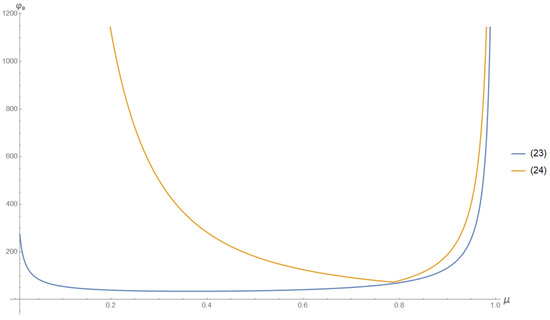
By applying Theorem 1, we obtain that all solutions of Equation (22) oscillate or converge to zero if
Consider the following special case of (22):
2.2. Oscillation Criteria for All Solutions
In the next section, we present criteria that test the oscillation of all solutions of the considered equation. For this, we need the following constraint:
Lemma 7
(Lemma 2, Lemma 3 in [27]). Suppose that . Then,
and
eventually for .
Lemma 8.
Suppose that . Then,
where
Proof.
It follows from Lemma 4 that (5) holds. From Lemma 7, we have is increasing, and so
Thus, (5) becomes
The proof is now complete. □
Proof.
Assume the contrary, i.e., that x is an eventually positive solution of (1). From Lemma 6, we have . Using Lemma 8, we get (25). Integrating (25) from to s, we arrive at
It follows from Lemma 7 that , and so
Therefore, w is a positive solution of (27). It follows from [25] (Theorem 1), that the equation
also has a positive solution. Although, Theorem 2 in [26] asserts that condition (26) ensures the oscillation of Equation (28), which is a contradiction.
The proof is now complete. □
3. Conclusions
In this work, the asymptotic behavior of solutions to even-order neutral differential equations in the non-canonical case is studied. We obtained a new relationship between the solution and its corresponding function. We then used this new relationship to derive criteria that ensure that all non-oscillatory solutions converge to zero. The new criteria do not require additional restrictions to delay functions (as in (3)). Furthermore, Theorem 3 improves Theorem 1, as it does not require verification of the extra condition (4).
Author Contributions
Conceptualization, B.A., O.M., A.E.A. and A.E.; methodology, B.A., O.M., A.E.A. and A.E.; investigation, B.A., O.M., A.E.A. and A.E.; writing—original draft preparation, B.A. and A.E.A.; writing—review and editing, O.M. and A.E. All authors have read and agreed to the published version of the manuscript.
Funding
Princess Nourah bint Abdulrahman University Researchers Supporting Project number (PNURSP2023R216), Princess Nourah bint Abdulrahman University, Riyadh, Saudi Arabia.
Acknowledgments
The authors gratefully acknowledge Princess Nourah bint Abdulrahman University Researchers Supporting Project number (PNURSP2023R216), Princess Nourah bint Abdulrahman University, Riyadh, Saudi Arabia.
Conflicts of Interest
The authors declare no conflict of interest.
References
- Hale, J.K. Theory of Functional Differential Equations; Springer: New York, NY, USA, 1977. [Google Scholar]
- Gyori, I.; Ladas, G. Oscillation Theory of Delay Differential Equations with Applications; Clarendon Press: Oxford, UK, 1991. [Google Scholar]
- Erbe, L.H.; Kong, Q.; Zhong, B.G. Oscillation Theory for Functional Differential Equations; Marcel Dekker: New York, NY, USA, 1995. [Google Scholar]
- Agarwal, R.P.; Grace, S.R.; O’Regan, D. Oscillation Theory for Difference and Functional Differential Equations; Marcel Dekker: New York, NY, USA; Kluwer Academic: Dordrecht, The Netherlands, 2000. [Google Scholar]
- Dassios, I.; Bazighifan, O.; Moaaz, O. Differential/Difference Equations: Mathematical Modeling, Oscillation and Applications; MDPI: Basel, Switzerland, 2021. [Google Scholar]
- Grace, S.R.; Džurina, J.; Jadlovská, I.; Li, T. On the oscillation of fourth-order delay differential equations. Adv. Differ. Equ. 2019, 2019, 118. [Google Scholar] [CrossRef]
- Jadlovská, I.; Džurina, J.; Graef, J.R.; Grace, S.R. Sharp oscillation theorem for fourth-order linear delay differential equations. J. Inequalities Appl. 2022, 2022, 122. [Google Scholar] [CrossRef]
- Moaaz, O.; Almarri, B.; Masood, F.; Atta, D. Even-Order Neutral Delay Differential Equations with Noncanonical Operator: New Oscillation Criteria. Fractal Fract. 2022, 6, 313. [Google Scholar] [CrossRef]
- Moaaz, O.; Park, C.; Muhib, A.; Bazighifan, O. Oscillation criteria for a class of even-order neutral delay differential equations. J. Appl. Math. Comput. 2020, 63, 607–617. [Google Scholar] [CrossRef]
- Bohner, M.; Grace, S.R.; Jadlovská, I. Oscillation criteria for second-order neutral delay differential equations. Electron. J. Qual. Theory Differ. Equ. 2017, 60, 1–12. [Google Scholar] [CrossRef]
- Bohner, M.; Grace, S.R.; Jadlovská, I. Sharp oscillation criteria for second-order neutral delay differential equations. Math. Methods Appl. Sci. 2020, 17, 10041–10053. [Google Scholar] [CrossRef]
- Džurina, J.; Grace, S.R.; Jadlovská, I.; Li, T. Oscillation criteria for second-order Emden-Fowler delay differential equations with a sublinear neutral term. Math. Nachr. 2020, 5, 910–922. [Google Scholar] [CrossRef]
- Džurina, J.; Jadlovská, I. A sharp oscillation result for second-order half-linear noncanonical delay differential equations. Electron. J. Qual. Theory Differ. Equ. 2020, 46, 1–14. [Google Scholar] [CrossRef]
- Džurina, J.; Jadlovská, I. Kneser-type oscillation criteria for second-order half-linear delay differential equations. Appl. Math. Comput. 2020, 380, 125289. [Google Scholar]
- Jadlovská, I. Oscillation criteria of Kneser-type for second-order half-linear advanced differential equations. Appl. Math. Lett. 2020, 106, 106354. [Google Scholar] [CrossRef]
- Jadlovská, I. New criteria for sharp oscillation of second-order neutral delay differential equations. Mathematics 2021, 9, 2089. [Google Scholar] [CrossRef]
- Bohner, M.; Vidhyaa, K.S.; Thandapani, E. Oscillation of Noncanonical Second-order Advanced Differential Equations via Canonical Transform. Constr. Math. Anal. 2022, 5, 7–13. [Google Scholar] [CrossRef]
- Muhib, A.; Moaaz, O.; Cesarano, C.; Abdel-Khalek, S.; Elamin, A.E.A.M.A. New monotonic properties of positive solutions of higher-order delay differential equations and their applications. Mathematics 2022, 10, 1786. [Google Scholar] [CrossRef]
- Zhang, C.; Li, T.; Suna, B.; Thandapani, E. On the oscillation of higher-order half-linear delay differential equations. Appl. Math. Lett. 2011, 24, 1618–1621. [Google Scholar] [CrossRef]
- Li, T.; Rogovchenko, Y.V. Asymptotic behavior of higher-order quasilinear neutral differential equations. Abs. Appl. Anal. 2014, 2014, 395368. [Google Scholar] [CrossRef]
- Moaaz, O.; Muhib, A.; Abdeljawad, T.; Santra, S.S.; Anis, M. Asymptotic behavior of even-order noncanonical neutral differential equations. Demonstr. Math. 2022, 55, 28–39. [Google Scholar] [CrossRef]
- Kiguradze, I.T.; Chanturia, T.A. Asymptotic Properties of Solutions of Nonautonomous Ordinary Differential Equations; Mathematics and Its Applications (Soviet Series); Kluwer Academic Publishers Group: Dordrecht, The Netherlands, 1993; Volume 89, p. xiv+331, Translated from the 1985 Russian Original. [Google Scholar] [CrossRef]
- Moaaz, O. New criteria for oscillation of nonlinear neutral differential equations. Adv. Differ. Equ. 2019, 2019, 484. [Google Scholar] [CrossRef]
- Moaaz, O.; Cesarano, C.; Almarri, B. An Improved Relationship between the Solution and Its Corresponding Function in Fourth-Order Neutral Differential Equations and Its Applications. Mathematics 2023, 11, 1708. [Google Scholar] [CrossRef]
- Philos, C.G. On the existence of nonoscillatory solutions tending to zero at ∞ for differential equations with positive delays. Arch. Math. 1981, 36, 168–178. [Google Scholar] [CrossRef]
- Kitamura, Y.; Kusano, T. Oscillation of first-order nonlinear differential equations with deviating arguments. Proc. Am. Math. Soc. 1980, 78, 64–68. [Google Scholar] [CrossRef]
- Almarri, B.; Moaaz, O. Improved properties of positive solutions of higher order differential equations and their applications in oscillation theory. Mathematics 2023, 11, 924. [Google Scholar] [CrossRef]
Disclaimer/Publisher’s Note: The statements, opinions and data contained in all publications are solely those of the individual author(s) and contributor(s) and not of MDPI and/or the editor(s). MDPI and/or the editor(s) disclaim responsibility for any injury to people or property resulting from any ideas, methods, instructions or products referred to in the content. |
© 2023 by the authors. Licensee MDPI, Basel, Switzerland. This article is an open access article distributed under the terms and conditions of the Creative Commons Attribution (CC BY) license (https://creativecommons.org/licenses/by/4.0/).