1. Introduction and Preliminaries
Let us rewrite the notion of the convex set and convex functions.
Definition 1. A is said to be a convex if: Definition 2. Let be a convex set. A function is said to be convex, if The basic concepts of convex analysis have been extensively explored in various directions due to their wide-ranging applications. The theory of convex functions is a fascinating subject in analysis, as it finds applications in diverse fields, such as engineering, separation theorems, optimization theory, differential equations, and more. Moreover, it has strong connections with the theory of inequalities, and many inequalities can be directly derived from the definition of convex functions. One of the most intriguing inequalities that emerges from the study of convex functions is the Jensen inequality.
Let
be a convex function, then
The Hermite–Hadamard inequality is a well-known inequality that serves as a necessary and sufficient condition for a convex function. It is formulated as follows:
Let
be a convex function, then
Various generalizations, extensions, and refinements of convexity have been proposed in the literature, utilizing diverse weighted means such as harmonic convexity and geometric convexity, among others. For more information, refer to [
1,
2,
3]. Moving on, let us now consider another generalization of convexity. We will revisit the concept of invex sets and preinvex functions.
Definition 3 ([
4]).
A set K is considered invex in relation to a bifunction if Definition 4 ([
4]).
If f is a function defined on an invex set K, then it is considered preinvex with respect to the bifunction if In their previous work, Mohan and Neogy [
5] introduced Condition C, which has proven to be highly useful and plays a significant role in establishing some of our main results. For the sake of completeness, we will recall Condition C as follows:
Let
be an invex set with respect to a bifunction
. Then, for any
and
, the following condition holds:
Moreover,
for any
.
Interval analysis is a unique implementation of set-valued analysis that utilizes a nonprobabilistic approach. It is undoubtedly an essential tool for both pure and applied mathematics. Initially, the interval analysis technique was developed to evaluate error estimates for finite state machines. Over the past fifty years, it has been utilized in mathematical models to address interval-uncertain structural systems. The technique has significant applications in various fields, including automatic error analysis, computer graphics, neural networking, and optimization.
The notion of interval-valued convexity was first introduced by Breckner [
6]. Furthermore, we denote the space of all real intervals and space of intervals of positive real numbers by
and
.
Definition 5. Let , which is said to to be an interval-valued convex function, if The following concept to consider is the preinvexity of interval values.
Definition 6 ([
7]).
An interval-valued function , defined on an invex set , is classified as an interval-valued preinvex function if and only ifwhich holds true for each and for all . Calculus is concerned with the investigation of derivatives and their implications in measuring the rate of change in a dependent variable relative to an independent variable. Fractional calculus, however, extends the concept of derivatives to noninteger orders. The roots of fractional calculus can be traced back to a conversation between Leibniz and L’Hospital about non-integer order derivatives. While the first-order derivative corresponds to the slope of a tangent at a point and the second-order derivative indicates the curvature, fractional calculus allows us to observe very small changes between two integer order derivatives in various phenomena. Fractional calculus is widely regarded as a powerful tool for describing real-life models, and its impact is indelible due to its wide range of applications in fields such as viscoelasticity, quantum mechanics, relativity theory, engineering, and more. Ongoing research in this area focuses on the development of new fractional operators and the generalization of existing results.
Let us now review some fundamental facts and concepts.
Definition 7 ([
8]).
Defined as , the Mittag-Leffler function is given bywhere and is the gamma function. Definition 8 ([
8]).
Let , where , , and are greater than zero, and . Let , , and . With these conditions, the extended generalized Mittag-Leffler function can be defined as follows:where is defined byand . Definition 9 ([
8]).
Assume that , where , , and are greater than zero, and . Let , , and . Consider and . Then, we can define the generalized left-hand-side fractional integral operator containing Mittag-Leffler function as follows:The following expression defines the generalized right-hand-side fractional integral operator: Atangana and Baleanu introduced a set of new integrals in [
9], which are commonly referred to as Atangana–Baleanu fractional integrals.
Definition 10. The fractional integral associated with the new nonlocal kernel of a mapping is defined in the following manner: The expression for the right-hand side of the integral operator is as follows: Here, is the gamma function. is called the normalization function satisfying the condition . For more detail, see [9]. Definition 11 ([
10]).
Assume that is the interval-valued function, where is the interior of . We call Lebesgue-integrable if the functions as well as are both measurable along with the Lebesgue integrable defined over . Furthermore, we can write as follows: Fractional calculus has attracted a lot of attention from researchers who seek to extend and improve fundamental inequalities. In 2012, Sarikaya et al. [
11] introduced fractional concepts to the well-known Hermite and Hadamard inequality, which opened the door for further research in mathematical analysis. Since then, many studies on inequalities have emerged using fractional calculus. For example, Muhammad et al. [
12,
13] have established new versions of the Hermite–Hadamard-type inequalities involving the tempered fractional integral operator and some fractional mid-point inequalities of the Hermite–Hadamard type, respectively. Akdemir et al. [
14] have investigated Chebyshev-type inequalities using generalized fractional integral operators. Set et al. [
15] have studied integral inequalities using the Atangana–Baleanu fractional operator. Recently, Butt et al. [
16] have derived improved versions of inequalities using the concept of harmonically exponential convex functions.
In 2012, the concept of interval-valued functions and the generalized Hukuhara derivative were introduced by authors [
17] to calculate some Ostrowski-like inequalities. Meanwhile, Chalco-Cano et al. [
18] derived Ostrowski-type inequalities using interval-valued mapping and presented some applications to numerical integration. In 2017, Costa et al. [
19] established integral inclusions involving fuzzy interval-valued functions. In 2018, Authors et al. [
20] studied integral inequalities involving the interval-valued property of functions. Zhang et al. [
21] described the relationship between vector interval-valued problems and associated variational inequalities. Zhao et al. [
22,
23] proved Jensen- and Hermite–Hadamard-type inequalities associated with a class of convexity known as interval-valued
h-convex functions and Chebyshev-type inequalities for interval-valued functions, respectively.
Budak et al. established fractional Hermite–Hadamard inequalities for interval-valued convex functions in [
24], while Abdeljawad et al. derived generalized Hermite–Hadamard-type inequalities using interval-valued
p-convexity in the fractional domain in [
25]. Khan et al. utilized the concept of generalized fuzzy interval-valued functions and order relation to obtain Hermite–Hadamard-type inequalities in [
26], and Liu et al. studied fractional analogs of these inequalities through interval-valued convexity in [
27]. In [
28], Younus et al. introduced a novel approach to investigate integral inequalities.
Recently, Kara et al. demonstrated coordinated inclusions of the Hermite–Hadamard type involving a generalized fractional operator in [
29]. In [
30,
31], Kalsoom et al. derived
analogs of Hermite–Hadamard inequalities utilizing interval-valued convexity, and they also established mid-point-type inequalities that involve the Pompeiu-Hausdroff distance between intervals. They further discussed Hermite–Hadamard–Fejer-type inequalities for harmonically interval-valued
h-convex functions. Finally, Afzal et al. introduced the concept of the Godunova–Levin
interval-valued convexity in [
32] and derived new generalized Jensen- and Hermite–Hadamard-type inequalities. In [
33], Bin-Mohsin et al. generalized the idea of LR-interval-valued convexity involving a
-connected set and derived some novel inequalities in the frame of fractional calculus. Bin-Mohsin and colleagues [
34] explored the idea of harmonically co-ordinated interval-valued convex mappings and generalized fractional operators and developed some fundamental inequalities as applications. Khan et al. [
35] formulated some weighted integral inequalities through generalized interval-valued convexity. Stojiljkovic and colleagues [
36] examined some new inclusion relations incorporated with classical Riemann–Liouville fractional operators and convex mappings.
With inspiration from the above mentioned works in [
22,
23,
24], our aim is to establish a new generalization of AB-fractional operators by utilizing the seven-parameter Mittag-Leffler functions as a nonsingular kernel in the setting of fractional interval-valued calculus. The main theme of our work is to introduce novel versions of Hermite–Hadamard’s inequality, Pachpatte’s inequality, and its weighted form named Hermite–Hadamard–Fejer inequality by leveraging the generalized interval-valued Mittag-Leffler fractional AB-integrals and the class of interval-valued preinvex functions. Some numeric examples and graphical illustrations will be provided to authenticate primary results. Then, we will describe some novel and exciting consequences of the main definitions and results. This paper aims to stimulate the curiosity of researchers interested in this field by presenting its unique ideas and techniques.
2. Main Results
In the proceeding section, we develop a new family of fractional operators that is described as:
Definition 12. Assuming that is an interval-valued function with , where the functions and are both Riemann-integrable and defined on the interval , the corresponding interval-valued left-sided and right-sided Mittag-Leffler fractional AB-integrals are defined as follows: The generalized right-hand-side fractional integral operator is given as follows:whereand Now, we discuss some special cases of Definition 12.
Definition 13. Let be an interval-valued function such that . Here, the functions and are both Riemann-integrable and defined on the interval . The interval-valued left-sided and right-sided Mittag-Leffler fractional AB-integrals, which pertain to the interval-valued function f, are defined as follows:andwith and is the normalization function, where Obviously, we observe thatand Here, we give some consequences of Definition 13.
The main results of this section will be presented in the following. Firstly, we will provide the fractional Hermite–Hadamard Inequality for interval-valued preinvex functions.
Theorem 1. Assume that the function is interval-valued preinvex and , then Proof. By the definition of the interval-valued preinvexity of
f, we have
If we consider taking
and
along with
, then we derive
Multiplying both sides of (
2) by
and integrating the resulting inclusion with regard to
on
, it yields that
By means of the change in the variable, and some calculations, we acquire that
Hence,
which is the first inclusion relation.
For the proof of the second inequality, taking into account the interval-valued preinvexity of the function
f, we know that
Adding these relations above, we can deduce that
Multiplying both sides of (
3) by
and integrating the resulting inclusion with regard to
on
, it yields that
Changing the variables, it yields that
Thus, the proof is accomplished. □
Special case
If we take
in Theorem 1, we obtain
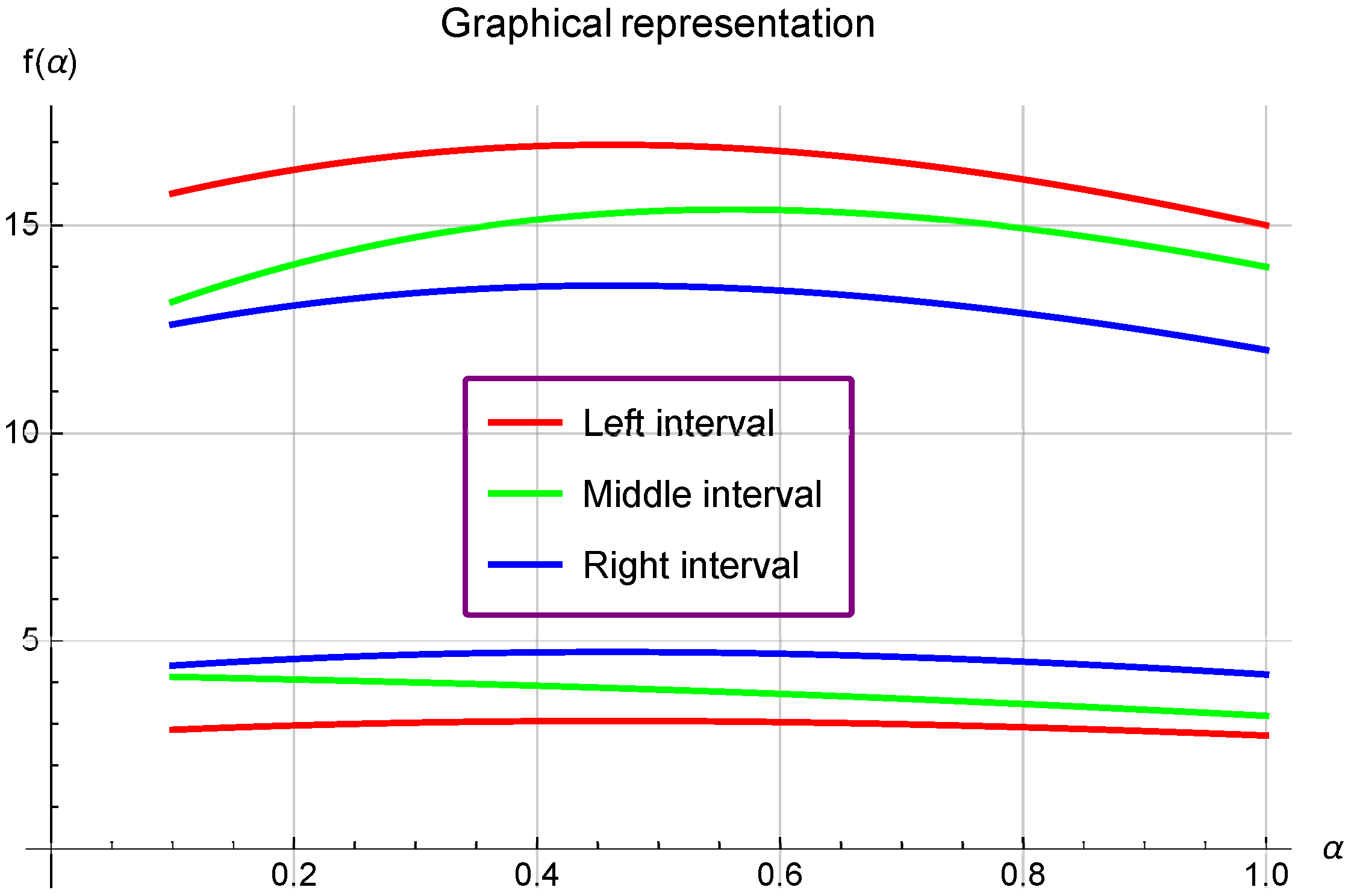
Example 1. We set in Theorem 1. If and , with and , then
That implies thatMoreover, it gives the verification of Theorem 1. If we choose
, with
,
,
, and
in Theorem 1, then (see
Figure 1).
Now, we derive a mid-point fractional analog of Hermite–Hadamard inequality.
Theorem 2. Under the hypothesis considered in Theorem 1, the following inclusion relations hold true: Proof. In view of the interval-valued preinvexity of the function
f, if we consider to take
and
, as well as
, then we know that
Multiplying both sides of (
4) by
and integrating the resulting inclusion with regard to
on
, it yields that
By means of the change in the variable and some calculations, we acquire that
Hence,
Thich is the first inclusion relation.
For the proof of the second inequality, taking into account the interval-valued preinvexity of the function
f, we know that
Adding these relations above, we can deduce that
Multiplying both sides of (
5) by
and integrating the resulting inclusion with regard to
on
, it yields that
Changing variables, it yields that
Thus, proof is accomplished. □
Special case
If we take
in Theorem 2, we acquire
Our next results are connected to Pachpatte-type inequalities.
Theorem 3. Suppose that the two functions are both interval-valued preinvex and and . Then, the successive inclusion relation holds true:where Proof. Applying the preinvexity of the interval-valued functions
f and
, we have
and
Multiplying (
7) and (
8), we obtain
Adding (
9) and (
10), we obtain
Multiplying both sides by
and integrating the resulting inclusion with regard to
on
, we have
By means of changes in variables and simple calculation, we obtained the required result. □
Special case
If we take
in Theorem 3, we obtain the result for the interval-valued convex function.
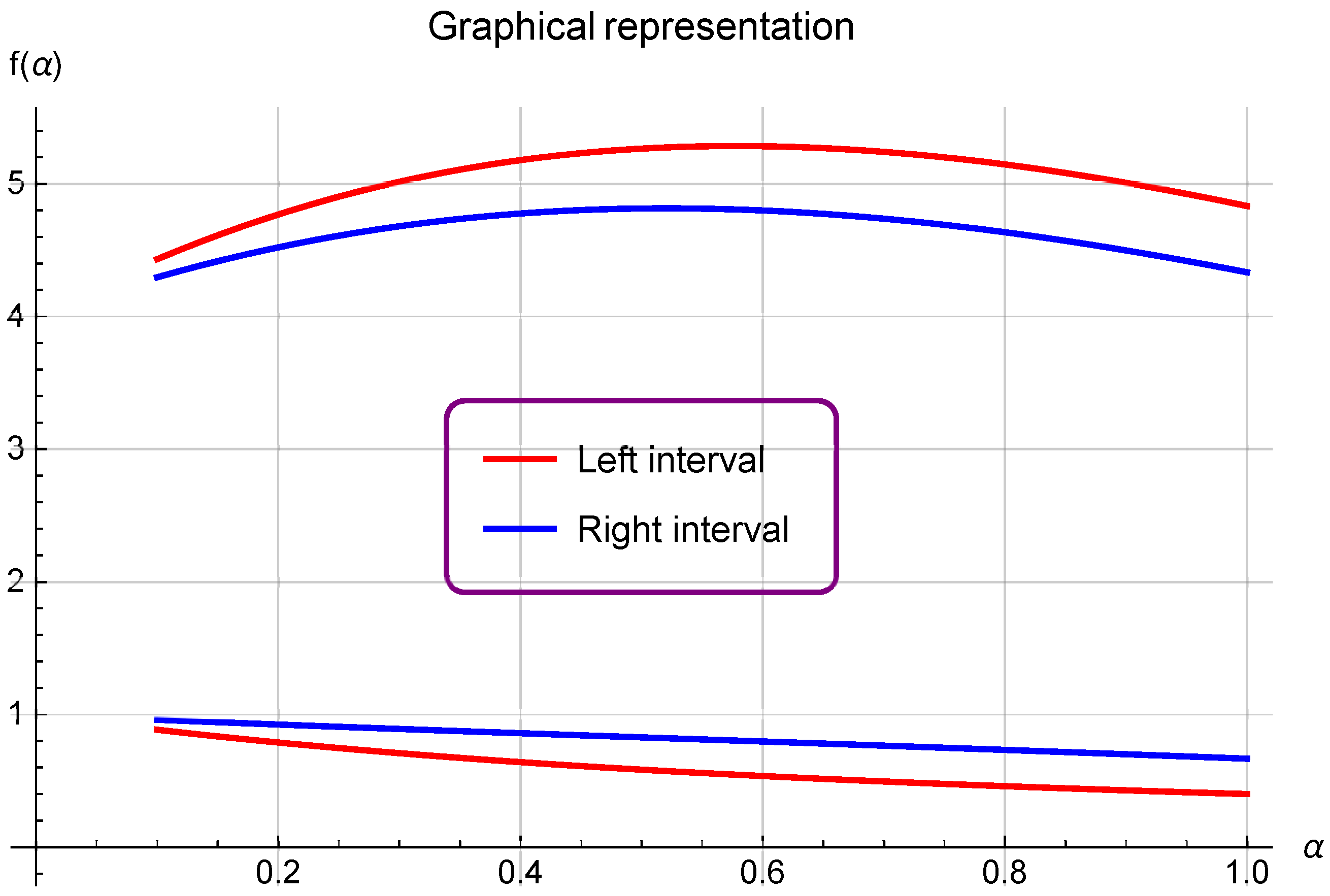
Example 2. We set and in Theorem 3. If and and , with and , thenThat implies thatwhich gives the verification of Theorem 3. If we choose
, and
, with
,
,
,
, and
in Theorem 3, then (see
Figure 2).
Figure 2.
This is an image showing the comparison between left and right sides of Theorem 3.
Figure 2.
This is an image showing the comparison between left and right sides of Theorem 3.
Theorem 4. Under the same hypothesis mentioned in Theorem 3, the following successive inclusion relation holds true: Proof. For
, we have
Since
f and
are non-negative interval-valued preinvex functions, we have
Multiplying both sides by
and integrating the resulting inclusion with regard to
on
, we have
By means of changes in variables and some calculations, we obtained the required result. □
Special case
If we take
in Theorem 4, we obtain the result for the interval-valued convex function.
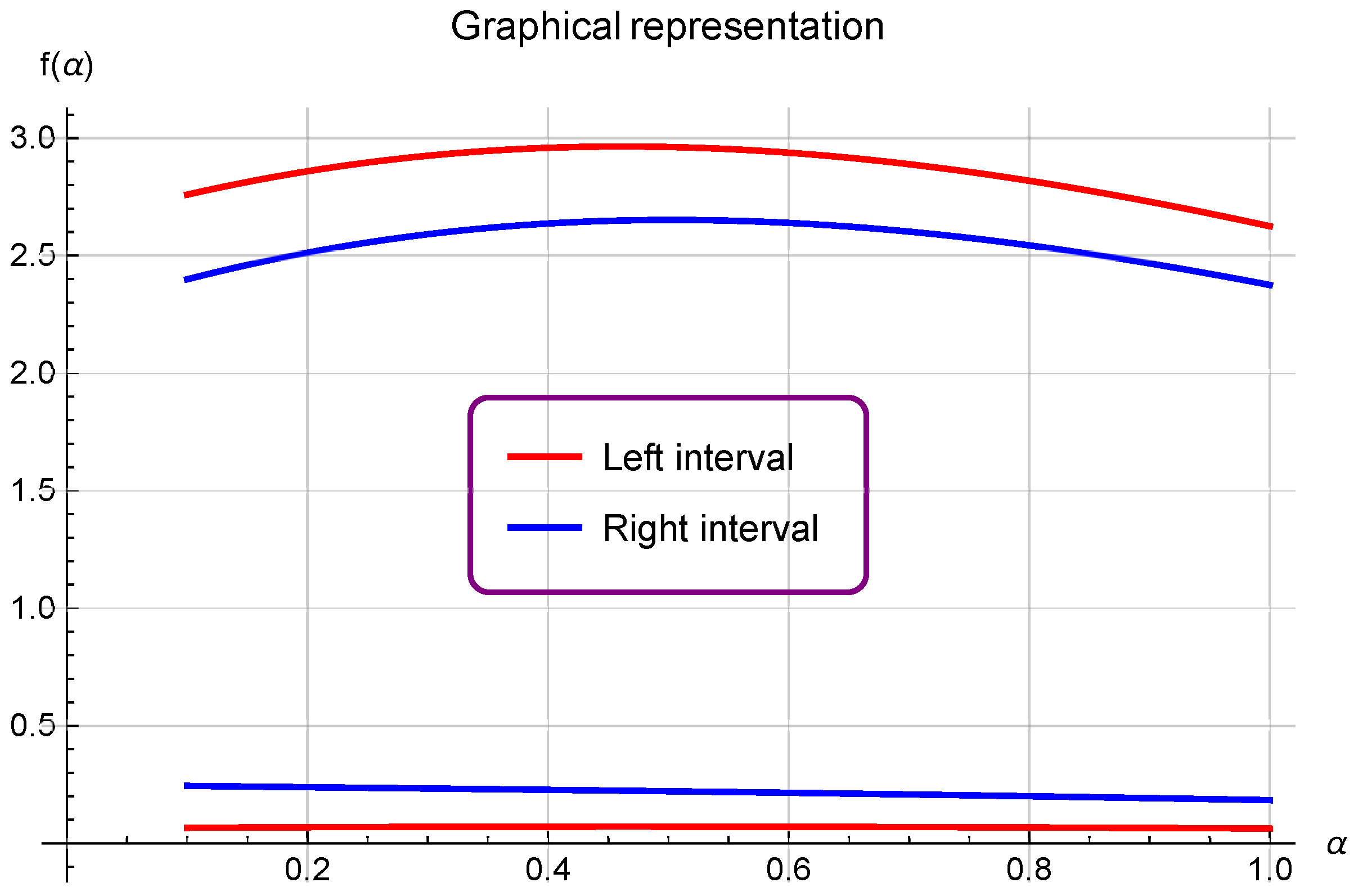
Example 3. We set in Theorem 4. If and and , with and , then
That implies thatwhich gives the verification of Theorem 4. If we choose
and
,
, with
,
,
, and
in Theorem 4, then (see
Figure 3).
Finally, we investigate new fractional Hermite–Hadamard–Fejer-type inclusions for interval-valued preinvex functions.
Theorem 5. Suppose that is a given interval-valued preinvex function defined over together with , and . If the function is non-negative-integrable and symmetric with respect to , i.e., , then we have
Proof. Proceeding from the relation (
2) within the proof of Theorem 1, multiplying both sides of it with
and integrating the resulting inclusion with regard to
on
, we derive that
Taking into consideration the change in the variable, we acquire that
In accordance with the symmetry of the function
, it yields that
This ends the proof of the first inclusion relation.
To establish the second inclusion relation, we will build upon inclusion relation (
3) from the proof of Theorem 1. We begin by multiplying both sides of (
3) with
. Then, we integrate the resulting inclusion with respect to
over the interval
, leading to the following conclusion:
Changing variables, it yields that
Thus, the proof is completed. □
Special case
If we take
in Theorem 5, we obtain the result for the interval-valued convex function.
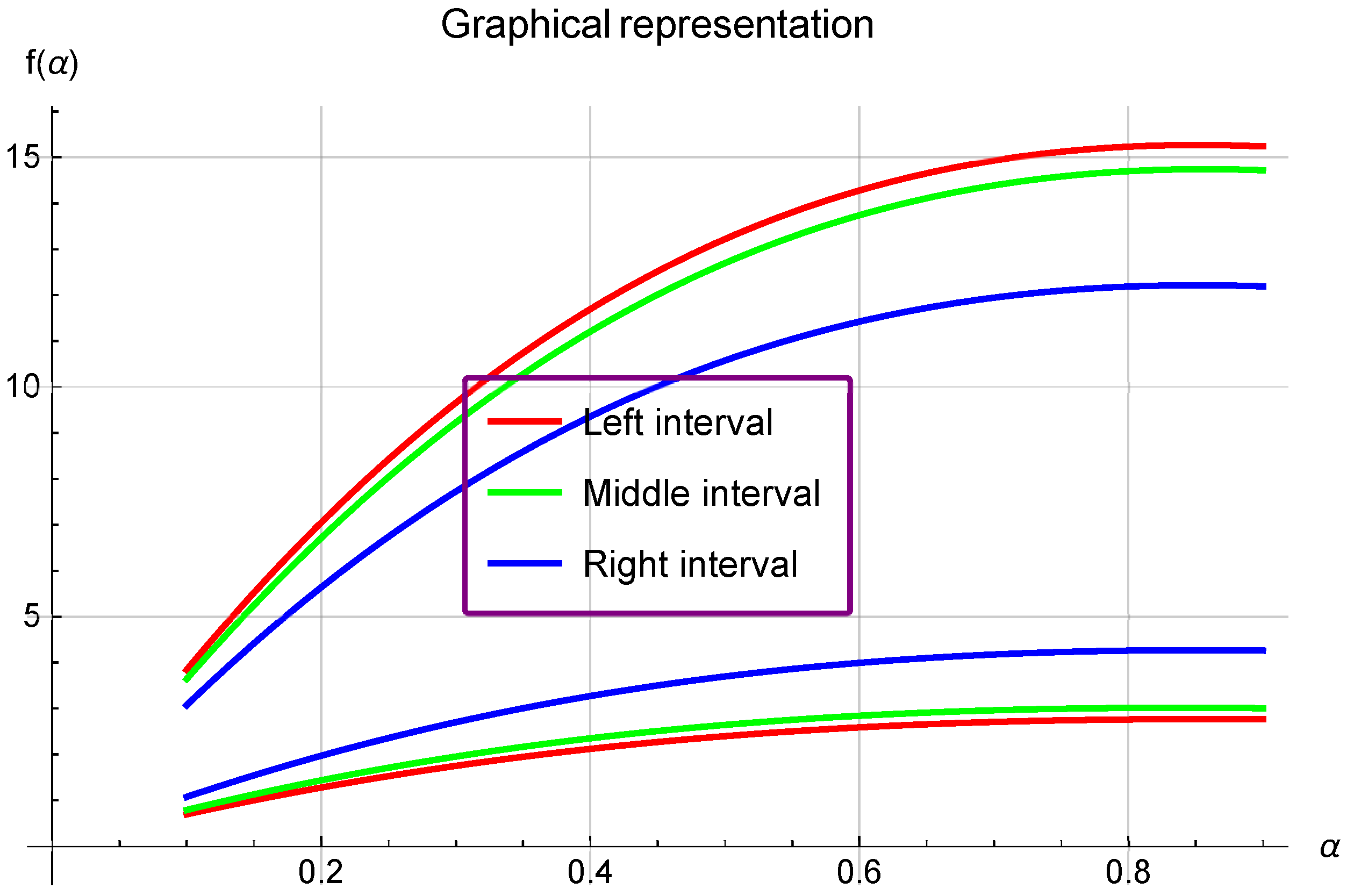
Example 4. We set and in Theorem 5. If andand , with and , thenThat implies thatwhich gives the verification of Theorem 5. If we choose
, and
, with
,
,
, and
in Theorem 5, then (see
Figure 4).




 ,
,