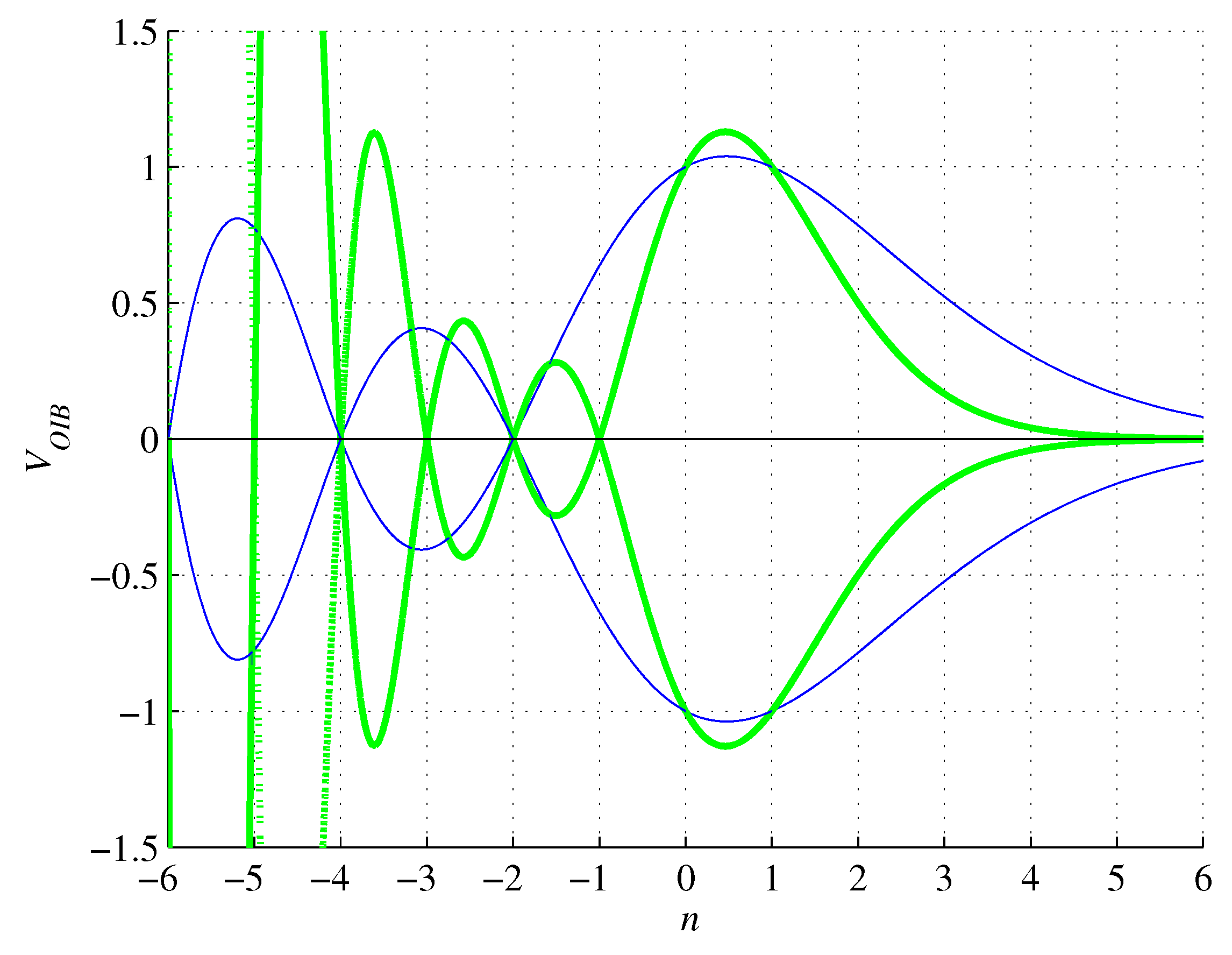
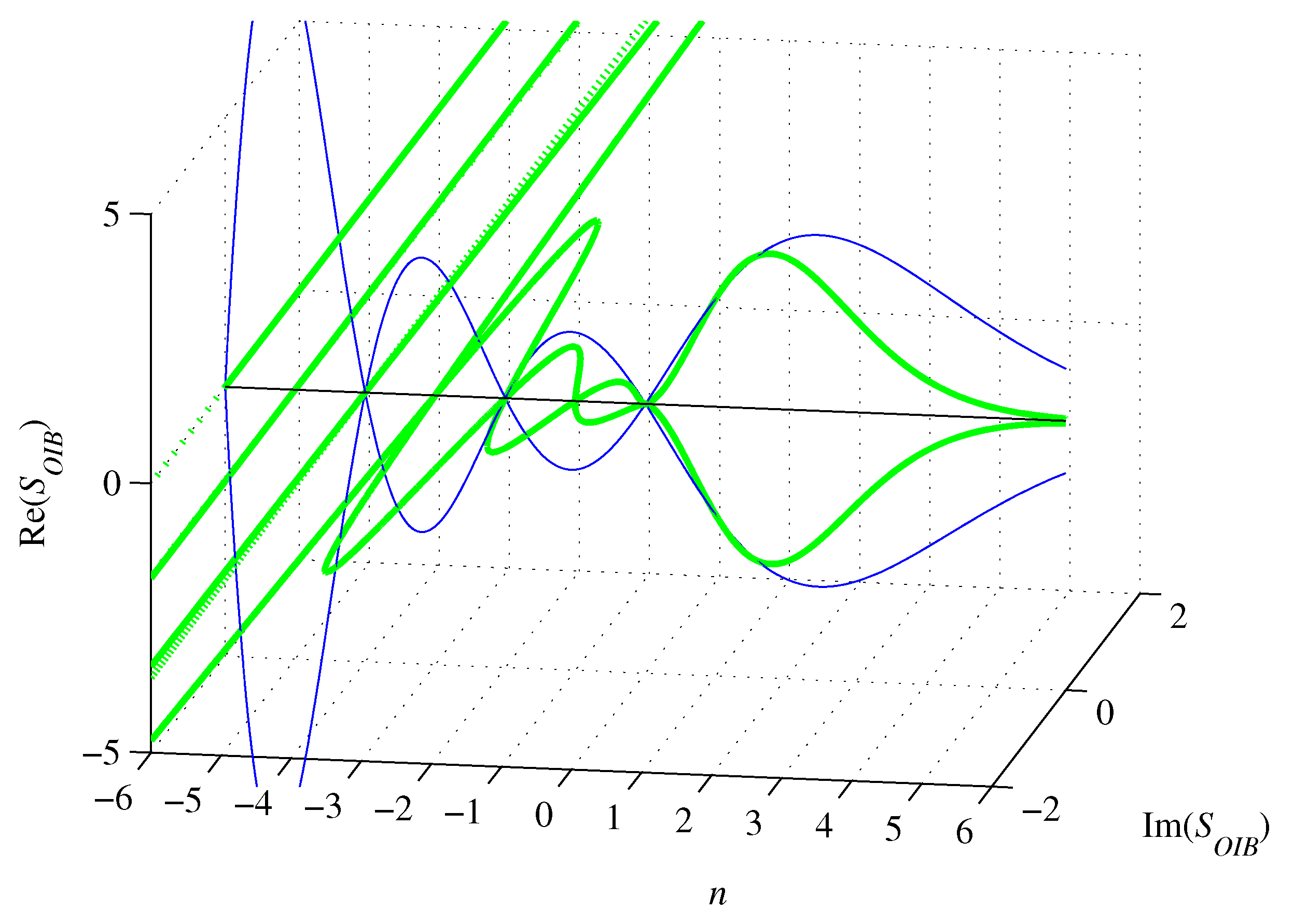
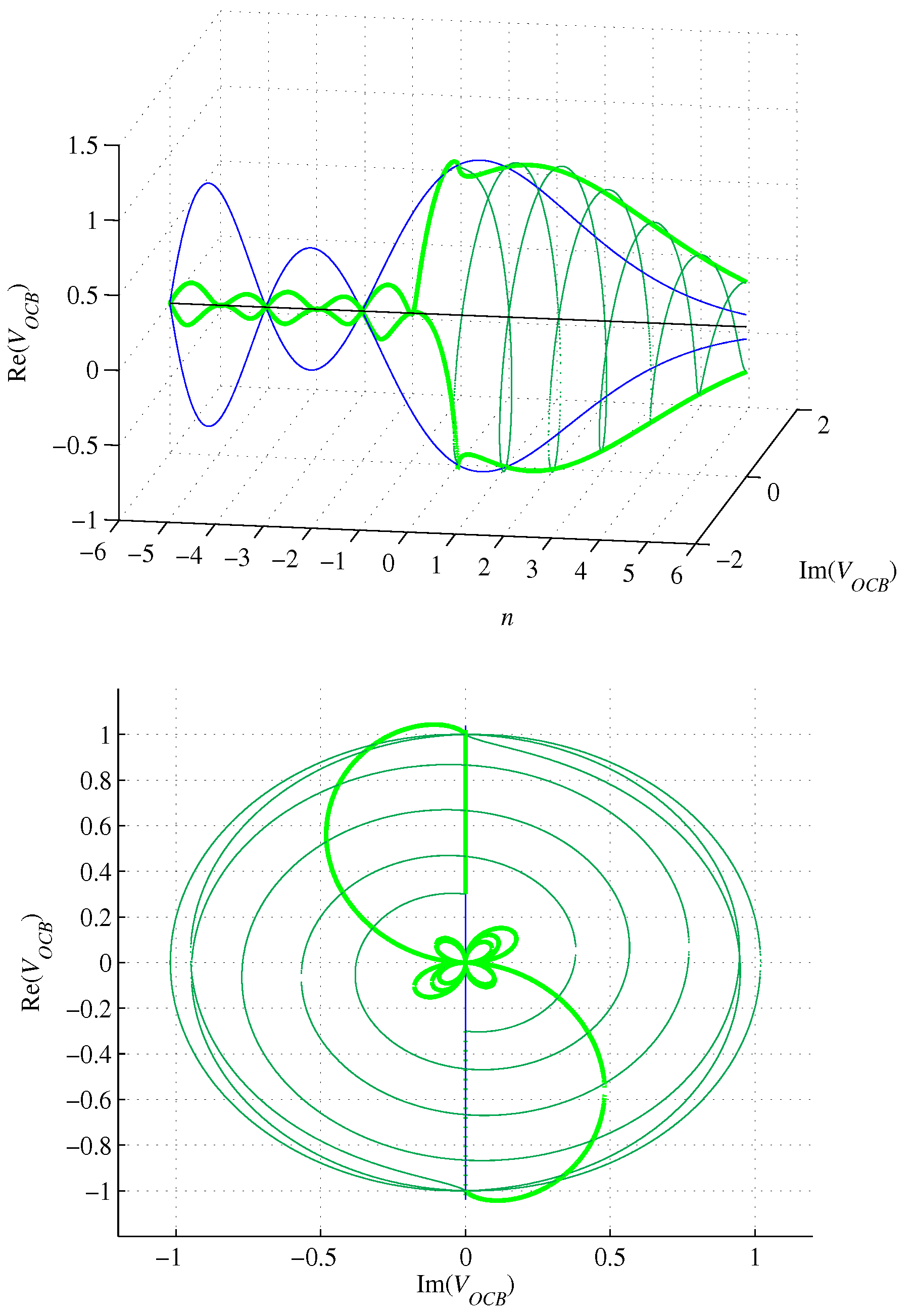
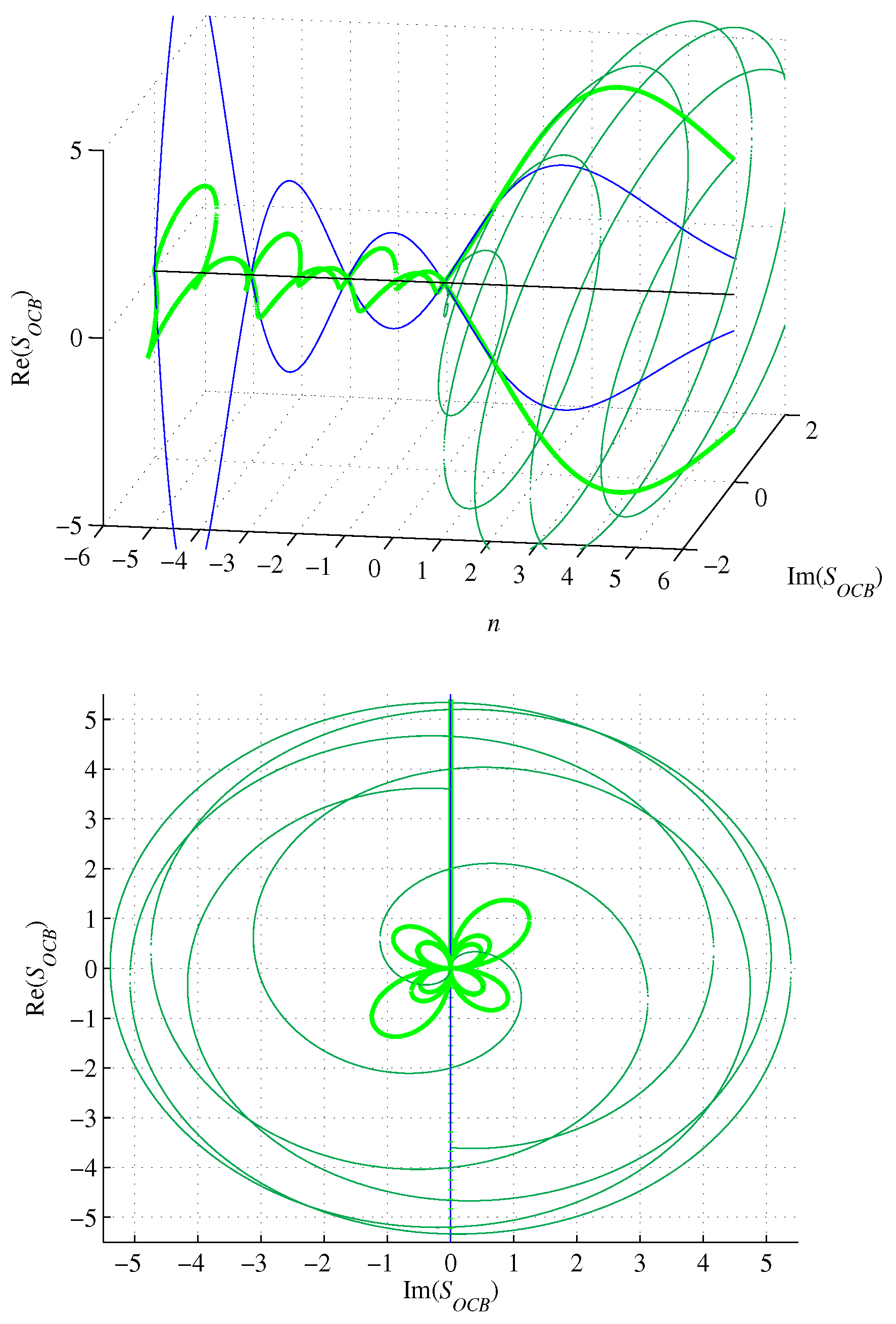
1. Introduction
The notion of a dimension
n is intuitively defined as a natural number of coordinates of a point within Euclidean space
. However, this is not the only possible definition [
1,
2] of a dimension of a set. For example, analytic continuations from positive dimensions [
2,
3,
4,
5] can define negative dimensions [
6]. Fractional (or fractal), including negative [
7], dimensions are consistent with experimental results and enable the examination of transport parameters in multiphase fractal media [
8,
9]. This renders dimension
n real, or at least a rational number. Complex [
2], including complex fractional [
10], dimensions can also be considered. Complex geodesic paths, for example, emerge in the presence of black hole singularities [
11] and in entropic motion on curved statistical manifolds [
12]. Complex wavelengths occur in Maxwell–Boltzmann, and Fermi–Dirac statistics on black hole event horizons [
13]. Fractional derivatives of complex functions can describe different physical phenomena [
14]. For example, it was recently shown [
15] that the magnetic monopole motion in a 3-simplicial spin ice crystal lattice is limited to a fractal cluster.
In
n-dimensional space,
n-dimensional objects have
-dimensional surfaces which have a dimension of volume in
-dimensional space. However, this sequence has a singularity at
. A 0-dimensional point in 0-dimensional space has a vanishing
-surface being a vanishing volume of the
-dimensional void. But the surface of the
-dimensional void is not
-dimensional. It is undefined. This discontinuity hints that thinking about dimension in terms of a point on a number axis, where negative dimensions are analytic continuations from positive ones, may be misleading. Thinking of a dimension as a point on a number semiaxis, similar to a point on a radius with
-dimension corresponding to
n-dimension seems more appropriate. Considering the dimension of a set as the length exponent at which that set can be measured makes the negative dimensions refer to densities as positive ones refer to quantities [
5]. Thus, the
-dimensional pressure, for example, considered in terms of density (e.g., in units of N/m
) corresponds to a 2-dimensional area (in units of m
) that it acts upon. Following the same logic, gravitational force
acting towards an
inside of a 2-dimensional equipotential surface is
-dimensional, whereas centripetal force
acting towards an
outside of a 1-dimensional curve is
-dimensional.
The notion of distance intuitively defines how far apart two points are. Thus, intuition suggests that it is a non-negative quantity. However, intuition can be misleading (e.g., in aviation, where relying on a sense of orientation [i.e., relying on intuition] can be fatal), and the Euclidean distance admits not only the principal, non-negative, square root but also a negative one. This fact, taken plainly, violates the nonnegativity axiom of the metric. However, diffuse metrics [
16], including the Łukaszyk–Karmowski metric [
17], are known to violate the identity of the indiscernibles axiom of the metric. This hints that axiomatizing distance as a non-negative quantity may also be misleading. Complex effects (bivalence) extend real effects (classically one value), just as quantum theory extends classical physics.
Prior research [
18] presented novel recurrence relations for volumes and surfaces of the three polytopes present in all natural dimensions [
19]. It was also conjectured in the prior research [
18] that they were continuous for
within domains of their definitions, whereas the starting points for fractional dimensions can be provided, e.g., using spline interpolation between two (or three, in the case of n-balls) subsequent integer dimensions. The present study shows that these recurrence relations allow removing indefiniteness present in known formulas, thus making them holomorphic functions of a complex dimension
n and omnidimensional (i.e., well-defined
).
Refs. [
13,
20,
21,
22] outline the framework for the physical explanation of the observed results.
The paper is structured as follows.
Section 2 summarizes known formulas and recurrence relations for volumes and surfaces of
n-balls and regular, convex
n-polytopes.
Section 3 shows that these formulas and recurrence relations can be extended to all complex dimensions.
Section 4 examines the properties of the omnidimensional, regular, convex polytopes inscribed in and circumscribed about
n-balls and their reflection functions.
Section 5 presents metric-independent relations between volumes and surfaces of these polytopes and
n-balls, whereas
Section 6 presents particular symmetries between volumes and surfaces for
.
Section 7 concludes and discusses the findings of this study, hinting at their possible applications.
2. Known Formulas
It is known that the volume of an
n-ball (
B) is
where
is the Euler’s gamma function,
,
, and
R denotes the
n-ball radius. As the gamma function is meromorphic, volumes of
n-balls are complex in complex dimensions. The volume of an
n-ball can be expressed [
23] in terms of the volume of an
-ball of the same radius as a recurrence relation
where
and
. The relation (
2) can be extended [
18] into negative dimensions as
solving Equation (
2) for
and assigning a new
n as the previous
. A radius recurrence relation [
18] (We choose the notation
over
, as
)
where
,
and
, allow for expressing the volume
n-ball as
where “
” is the floor function that yields the greatest integer less than or equal to its argument
x. The relation (
4) can be, analogously as Equation (
2), extended [
18] into negative dimensions as
which allows us to define
to initiate the sequences (
4) or (
6). The known [
23] surface of an
n-ball is
We note in passing that in this study
S(
n) denotes the (
n − 1)-dimensional surface of an
n-dimensional object (that is a property of this object), and not the
n-dimensional surface of the (
n + 1)-dimensional object, as it is commonly defined in the literature.
The known volume of an
n-cube (
C) is
where
and
A is the edge length. The known surface of an
n-cube is
where
.
The known [
24,
25] volume of a regular
n-simplex (
S) is
where
. Equation (
10) can be written [
18] as a recurrence relation
with
, to remove the indefiniteness of the factorial for
. Equation (
11) can be solved for
. Assigning new
n as the previous
, yields [
18]
which also removes the singularity for
present in the volume (
10). An
n-simplex has
-facets [
23]. Therefore, its surface is
The known [
23] volume of an
n-orthoplex (
O) is
where
.
Equation (
14) can be written [
18] as a recurrence relation
where
and
, to remove the indefiniteness of the factorial for
. Solving Equation (
15) for
and assigning new
n as the previous
, yields [
18]
which also removes singularity for
present in Equation (
15). Any
n-orthoplex has
facets [
23], which are regular
-simplices. Therefore, its surface is
3. Holomorphizing Known Formulas
The known formulas presented in the preceding section can be extended to all complex dimensions. We note that volumes and surfaces of
n-cubes are already defined
and thus are holomorphic. We also note that a square root is bivalued in the complex domain and by choosing complex analysis, we enter into bivalence by its very nature (
). Therefore, volumes and surfaces of
n-balls and regular, convex
n-polytopes are also bivalued in complex dimensions
n. We call the branch with positive values in positive real dimensions the principal branch.
Theorem 1. The volume of an n-ball is a holomorphic, bivalued function of a complex dimension n.
Proof. First, we note that the initial bivalued values for the radius recurrence relations (
4) and (
6) are
,
and
. Then, we note that the recurrence relations (
3) and (
5) correspond to each other
which, after setting
, yields
Comparing the non-recurrence general
n-ball volume (
1), which is bivalued for
and valid within the domain of the gamma function, with the recurrence relation (
3)
yields
Setting
yields
which recovers Equation (
1), as
,
,
. Thus, we have proved that the recurrence relations (
2), (
3), and (
5) correspond to the general
n-ball volume (
22) within this domain.
However, now we can use any of the
backward recurrence relations (
3) or (
5) with (
6) to determine the values of the
n-ball volume outside this domain:
we can find
.
On the other hand
so the poles of the meromorphic gamma function
present in Equation (
22), now defined in the sense of a limit of a function, vanish, which completes the proof. □
Corollary 1. The surface of an n-ball is a holomorphic, bivalued function of a complex dimension n.
Proof. If the volume of an
n-ball is a holomorphic, bivalued function by Theorem 1, then, using Equation (
7), the surface of an
n-ball is also a holomorphic function.
Using Equations (
22) and (
7) the surface of an
n-ball is given by
□
Theorem 2. The volume of a regular n-simplex is a holomorphic, bivalued function of a complex dimension n.
Proof. Expressing the factorial in the volume of a regular
n-simplex (
10) by the gamma function extends its domain of applicability to complex dimensions
On the other hand, comparing the volume (
25) with the recurrence relation (
12)
yields
which, after setting
, yields
and recovers the volume (
25) as
and
(cf.
Appendix A).Thus, we have proved that the recurrence relation (
12) corresponds to the generalized
n-simplex volume (
25) within this domain.
However, now we can use the recurrence relation (
12) to determine the values of the
n-simplex volume outside this domain:
we can find
. For example, even though
is undefined for
, we can determine that
using the recurrence relation (
12) with
obtained from the volume (
25).
On the other hand,
so the poles of the meromorphic gamma function
present in the volume (
25), now defined in the sense of a limit of a function, vanish, which completes the proof. □
For
}, the
n-simplex volume (
25) is imaginary.
Corollary 2. The surface of a regular n-simplex is a holomorphic, bivalued function of a complex dimension n.
Proof. If the volume of a regular
n-simplex is a holomorphic, bivalued function by Theorem 2, then its surface, using Equation (
13), is also a holomorphic, bivalued function.
Using (
13) and (
25), the surface of a regular
n-simplex is given by (cf.
Appendix A)
□
Again, even though
is undefined for
, we can determine that
directly from Equation (
13) knowing that
.
For
, the
n-simplex surface (
30) is imaginary.
Theorem 3. The volume of an n-orthoplex is a bivalued, holomorphic function of a complex dimension n.
Proof. Expressing the factorial in the volume of an
n-orthoplex (
14) with the gamma function extends the domain of applicability of Equation (
14) to complex dimensions
On the other hand, comparing Equation (
31) with the recurrence relation (
16)
yields
whereas setting
in Equation (
33) yields
which recovers
n-orthoplex volume (
14), as
. Thus, we have proved that the recurrence relation (
16) corresponds to the general
n-orthoplex volume (
31) within this domain.
However, now we can use the recurrence relation (
16) to determine the values of the
n-orthoplex volume outside this domain:
we can find
. On the other hand
so the poles of the meromorphic gamma function
present in (
31), now defined in the sense of a limit of a function, vanish, which completes the proof. □
Corollary 3. The surface of an n-orthoplex is a holomorphic, bivalued function of a complex dimension n.
Proof. If the volume of a regular
n-simplex is a holomorphic, bivalued function by Theorem 2, then, using Equation (
17), the surface of an
n-orthoplex is a holomorphic, bivalued function.
Using Equations (
17) and (
31), the surface of an
n-orthoplex is given by
□
For
,
n-orthoplex bivalued surface (
36) is imaginary.
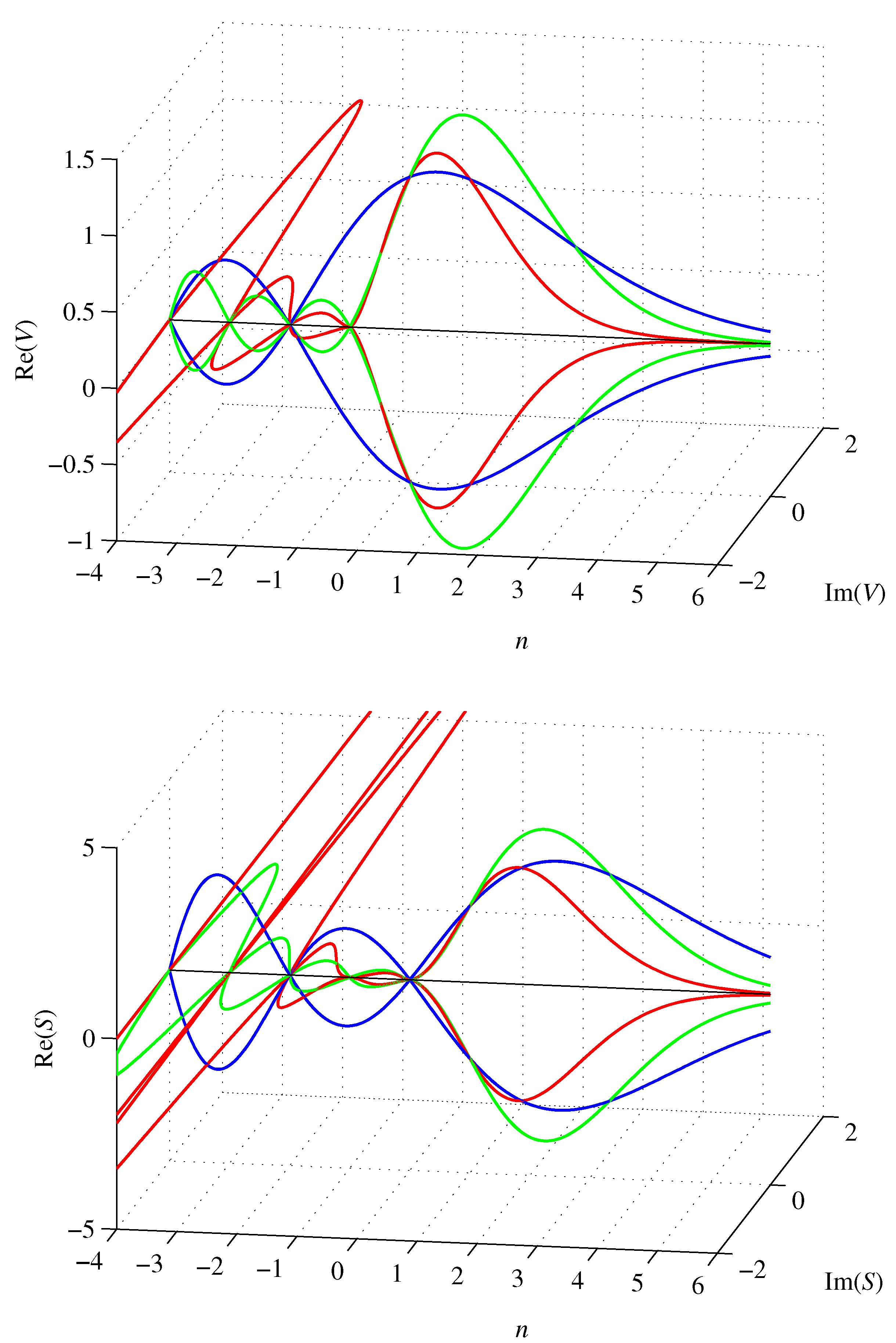
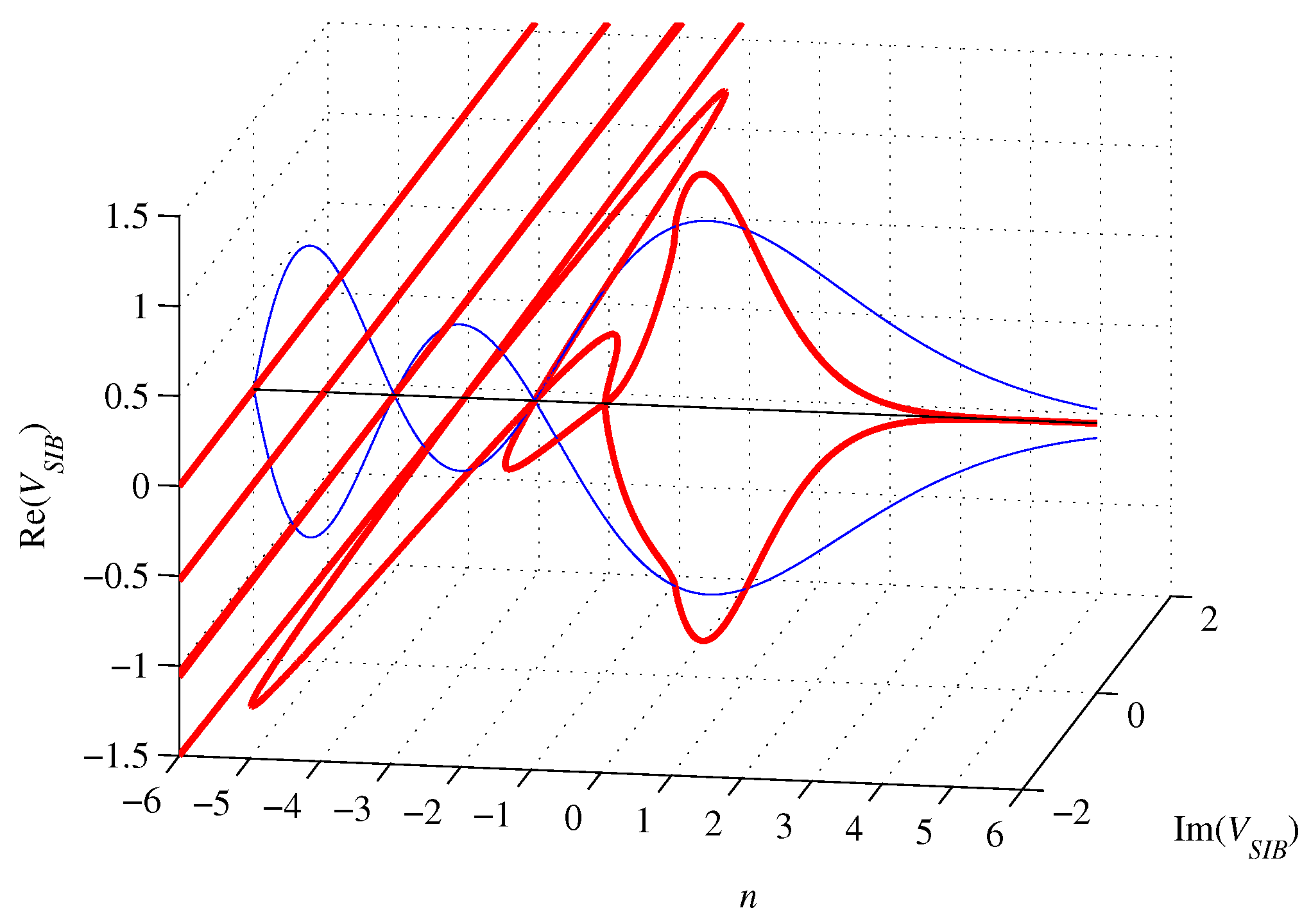
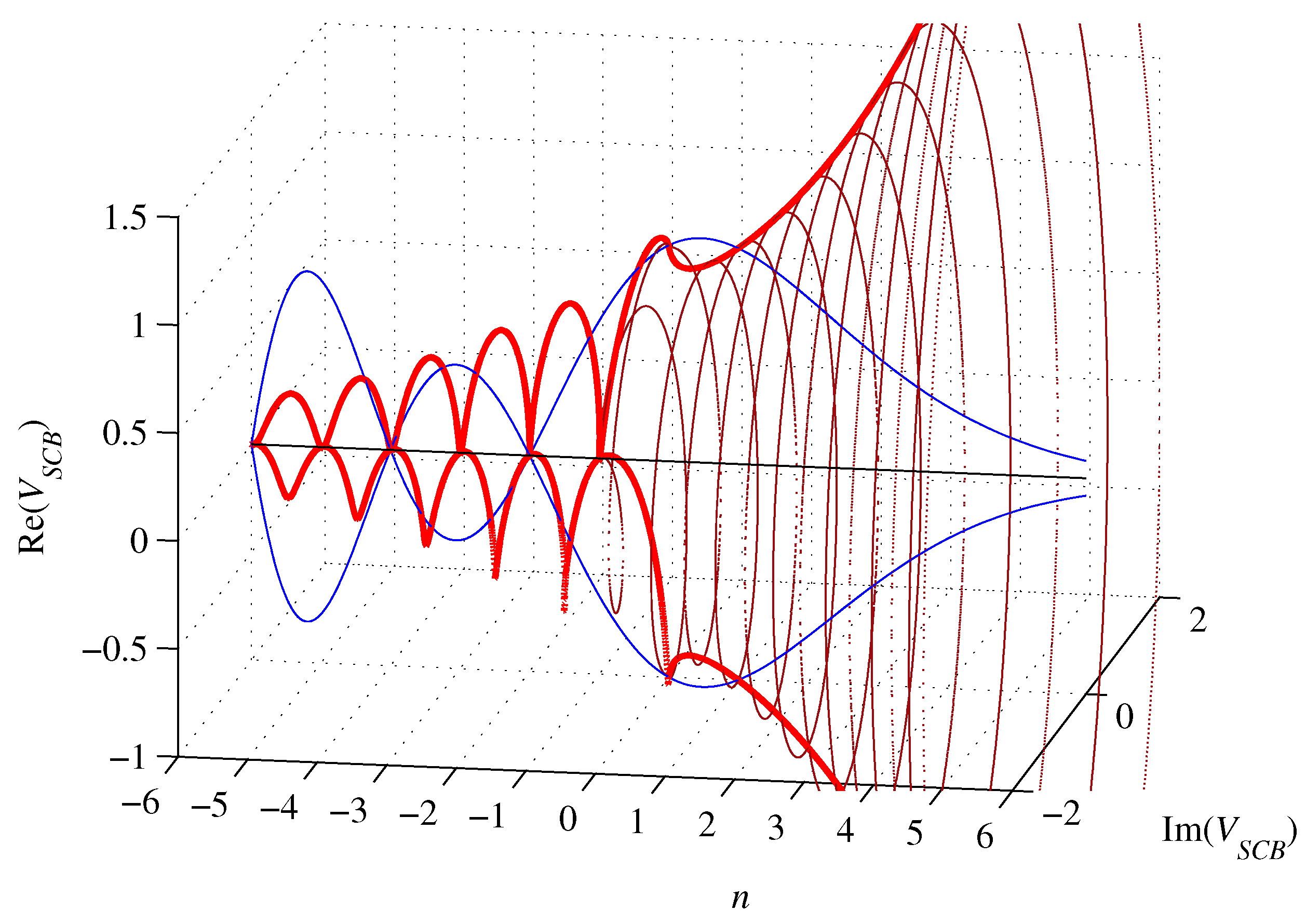
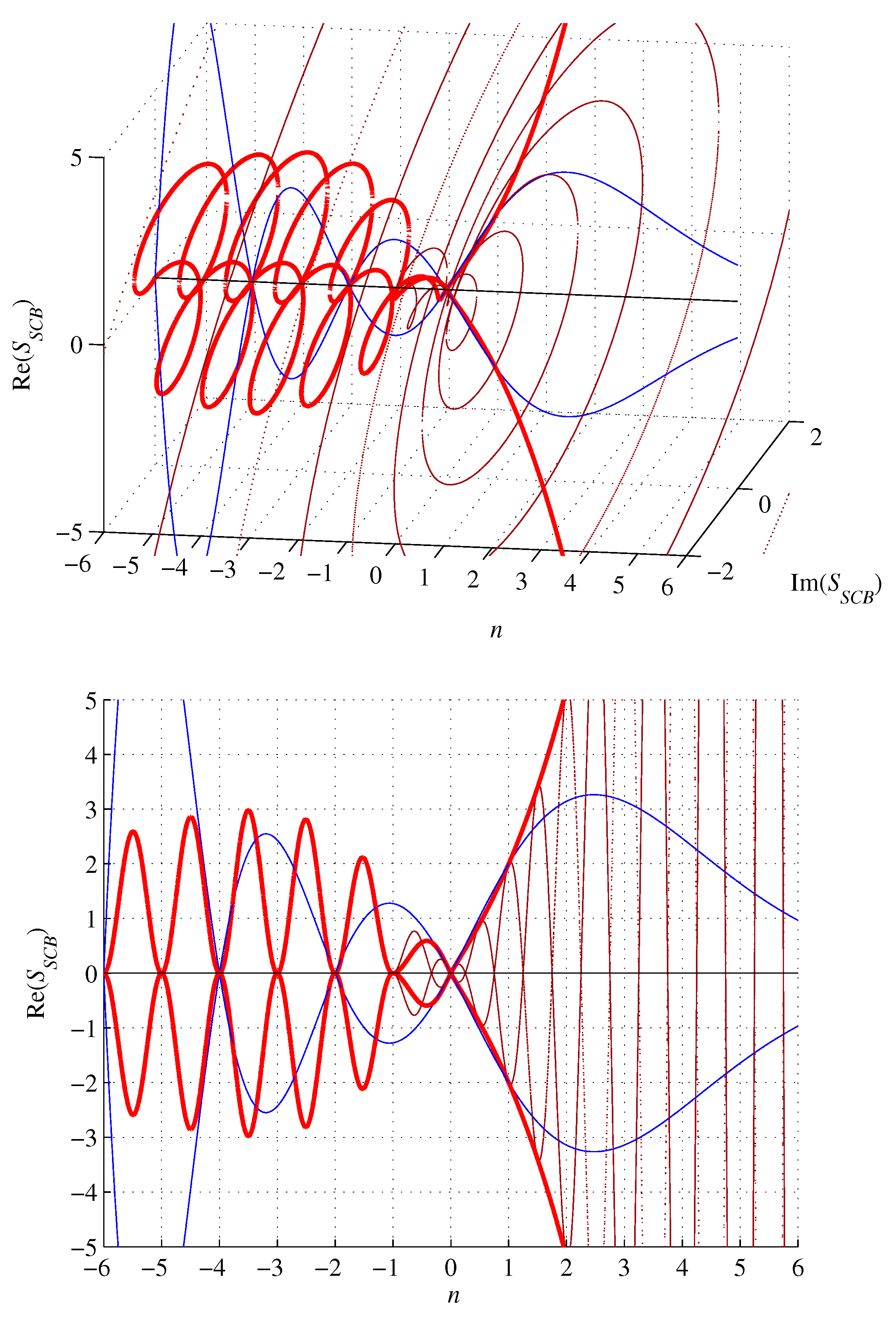
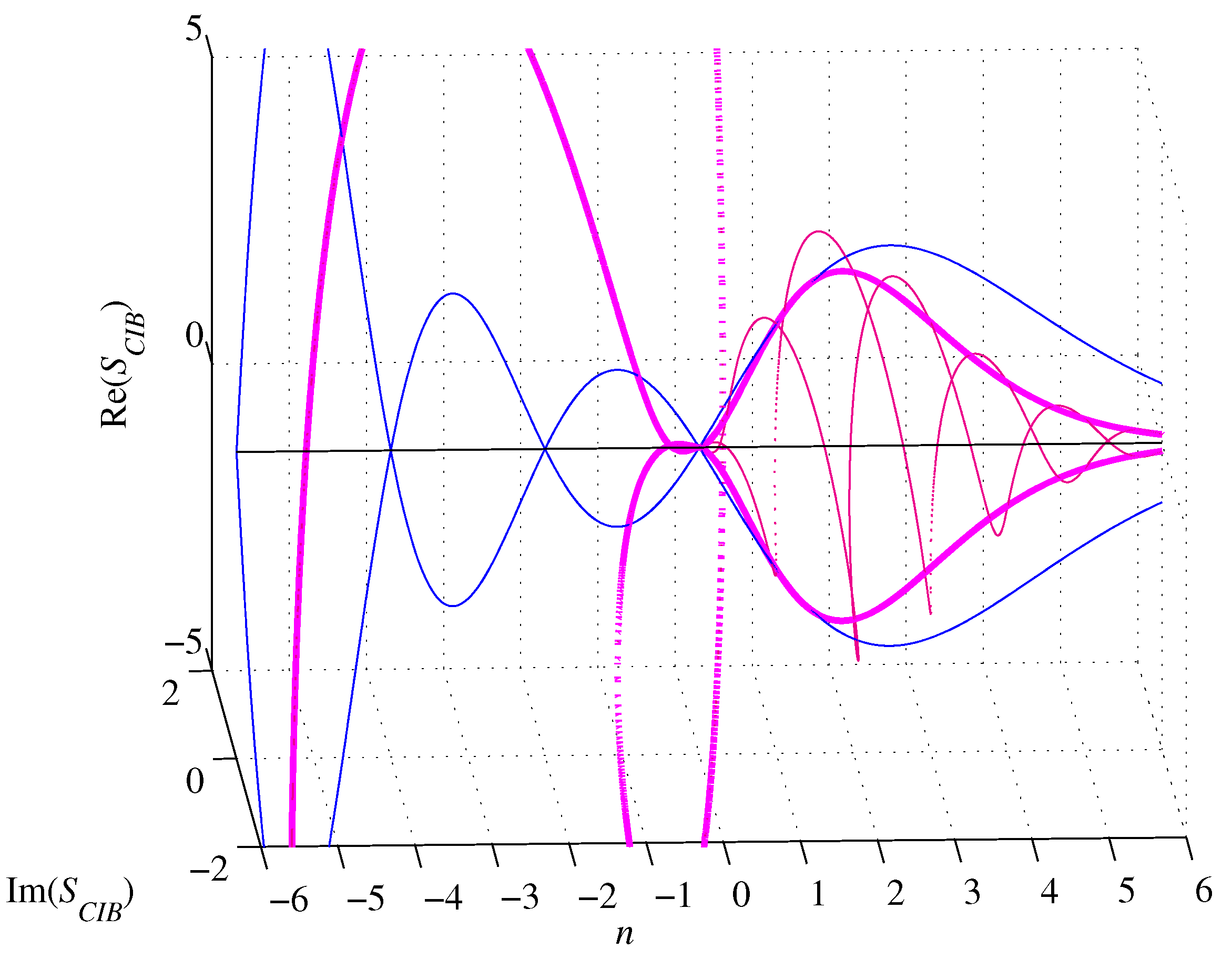
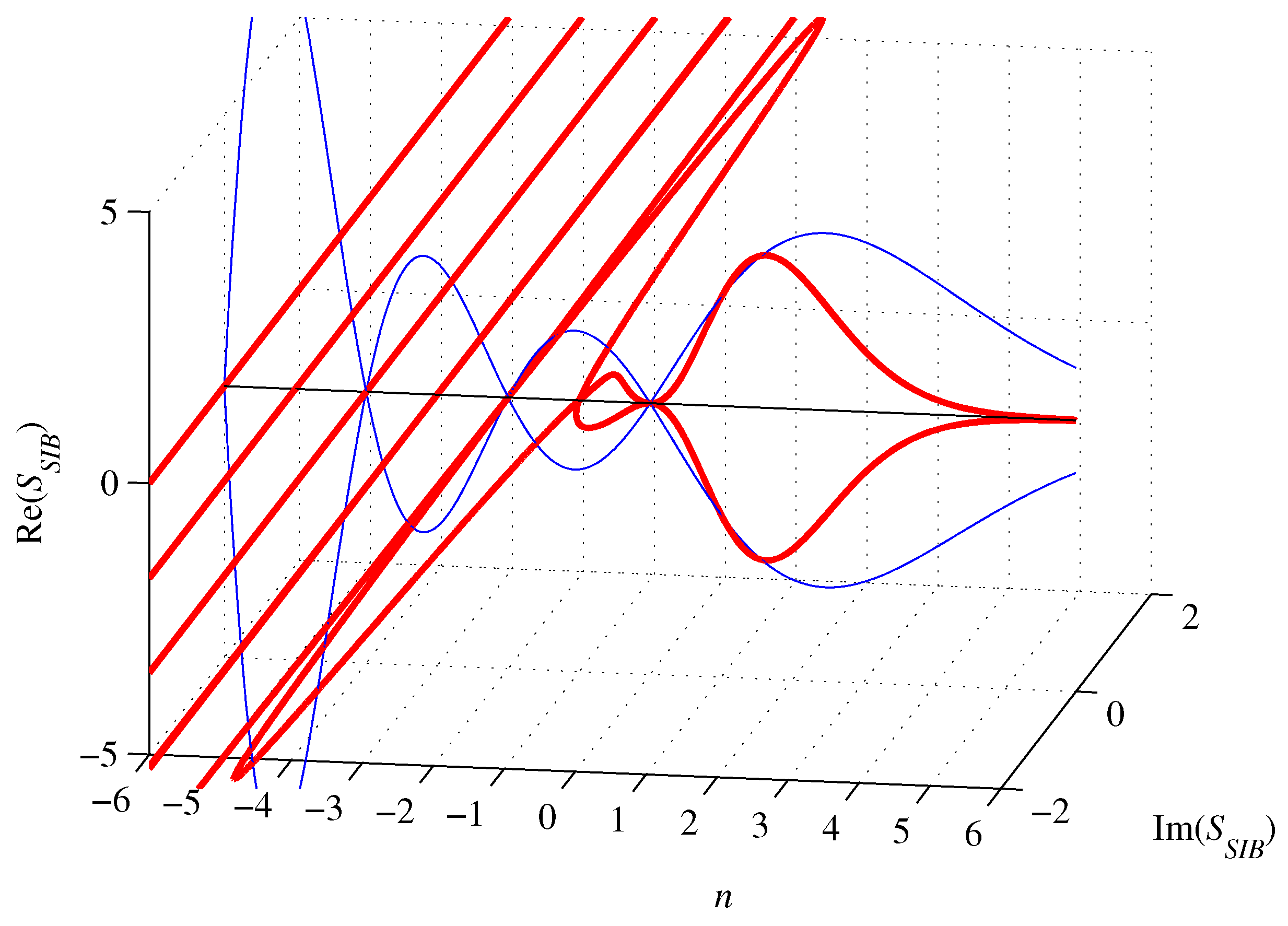
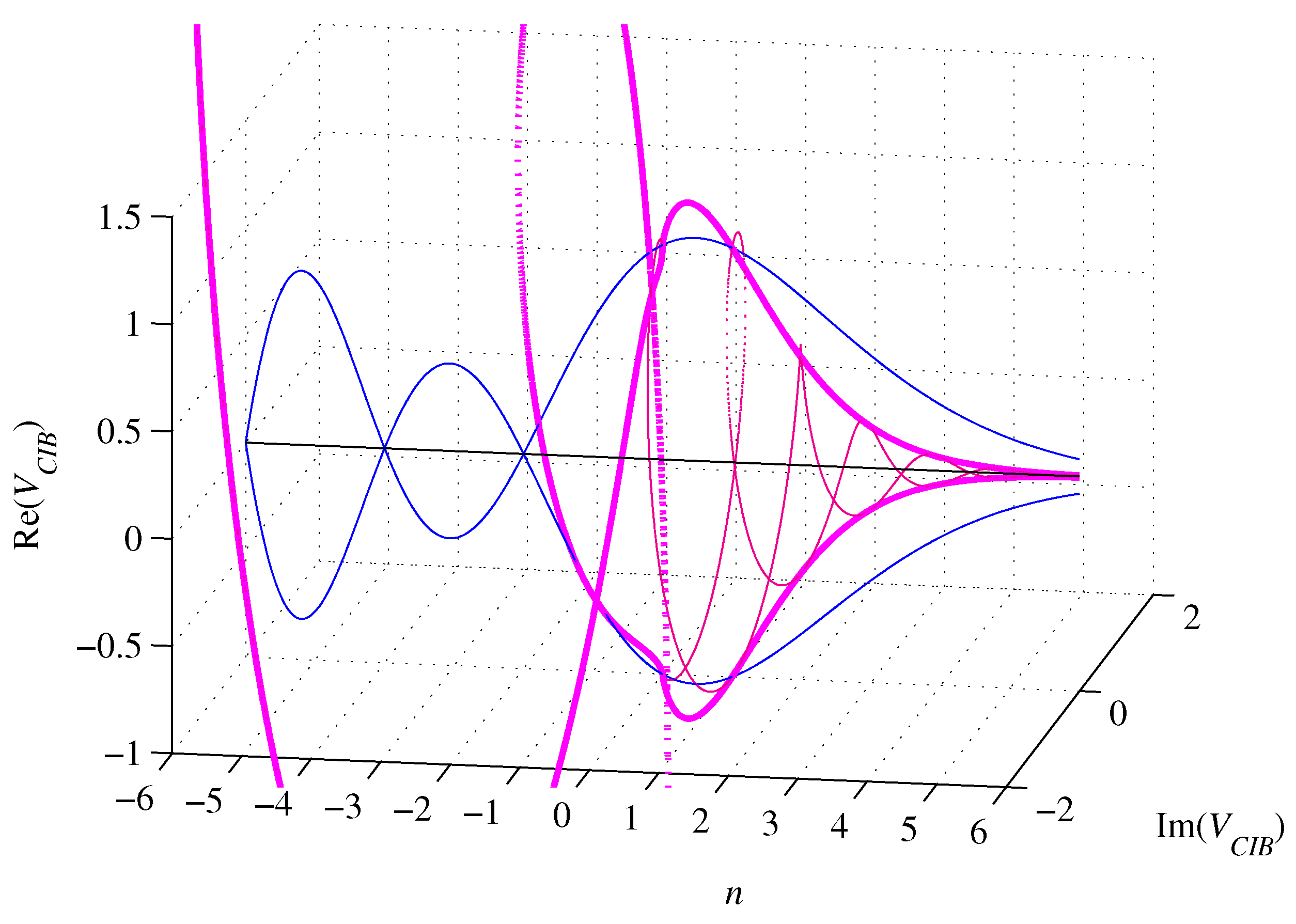
Thus, the volumes and surfaces of
n-balls,
n-simplices, and
n-orthoplices, shown in
Figure 1 and
Figure 2 for
, are holomorphic functions of
n, which makes those objects omnidimensional. They can be explicitly expressed in terms of the complex dimension (cf.
Appendix B).
5. Metric-Independent Relations
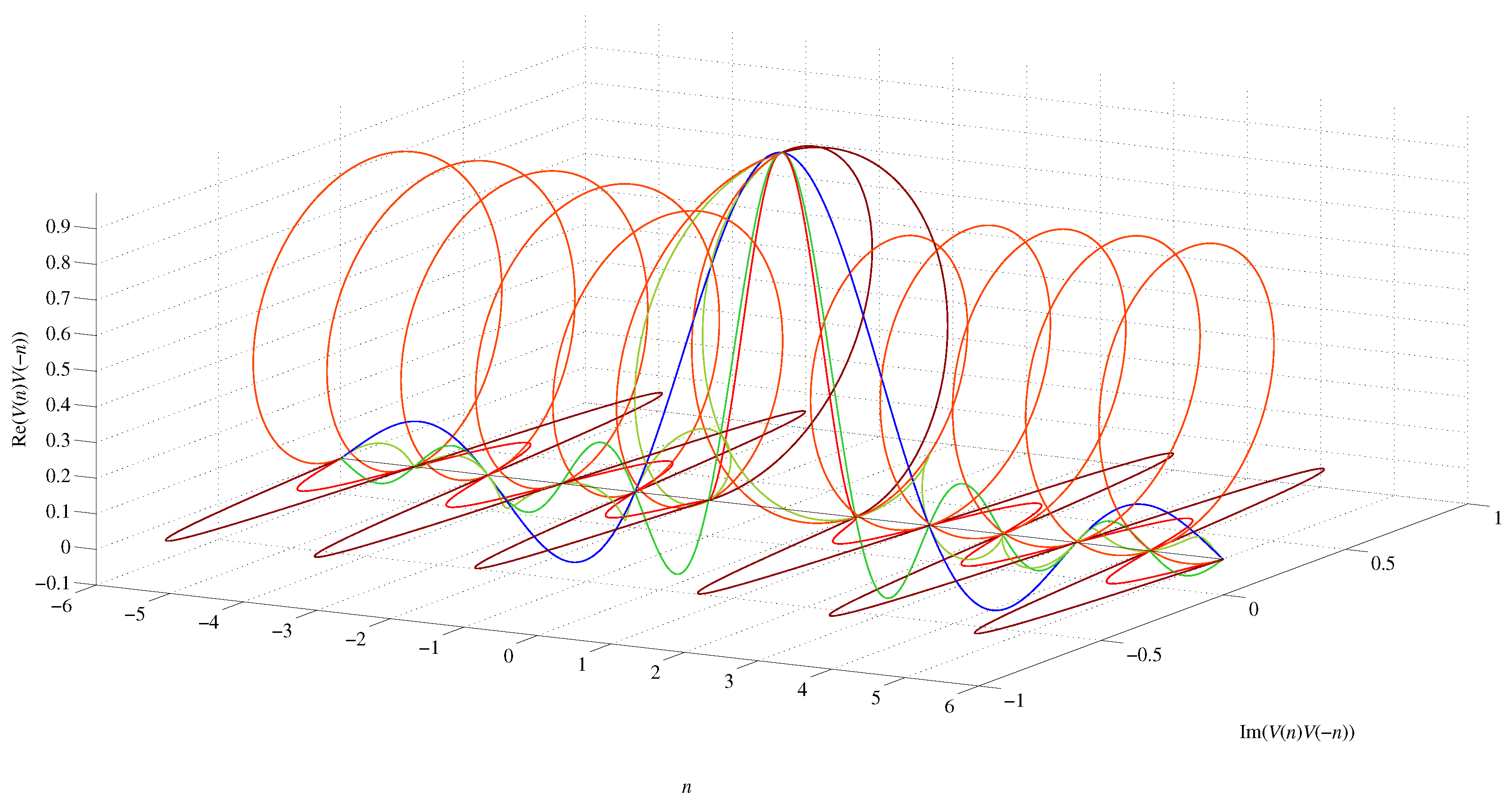
The following metric-independent relations hold, for
, between volumes of
n-balls (
22)
n-simplices (
25)
n-orthoplices (
31) and
n-orthoplices inscribed in
n-balls (
63)
n-simplices inscribed in
n-balls (
49)
n-simplices circumscribed about
n-balls (
53)
and
n-orthoplices circumscribed about
n-balls (
67)
where we used Euler’s reflection formula,
, with
, and
as well as (for
), between surfaces of
n-balls (
24)
n-simplices (
30),
n-orthoplices (
36)
n-simplices inscribed in
n-balls (
50)
n-simplices circumscribed about
n-balls (
57)
n-orthoplices inscribed in
n-balls (
64)
n-orthoplices circumscribed about
n-balls (
70)
and
n-cubes inscribed in
n-balls (
77) (
)
where we again used
,
, and Euler’s reflection formula
These relations are independent of the distance values
D (or
A) and their particular form, whether negative (
), complex (
,
), or purely imaginary (
). Furthermore, the relations (
80)–(
85) and (
87)–(
93) are independent of the gamma function. Relations (
80)–(
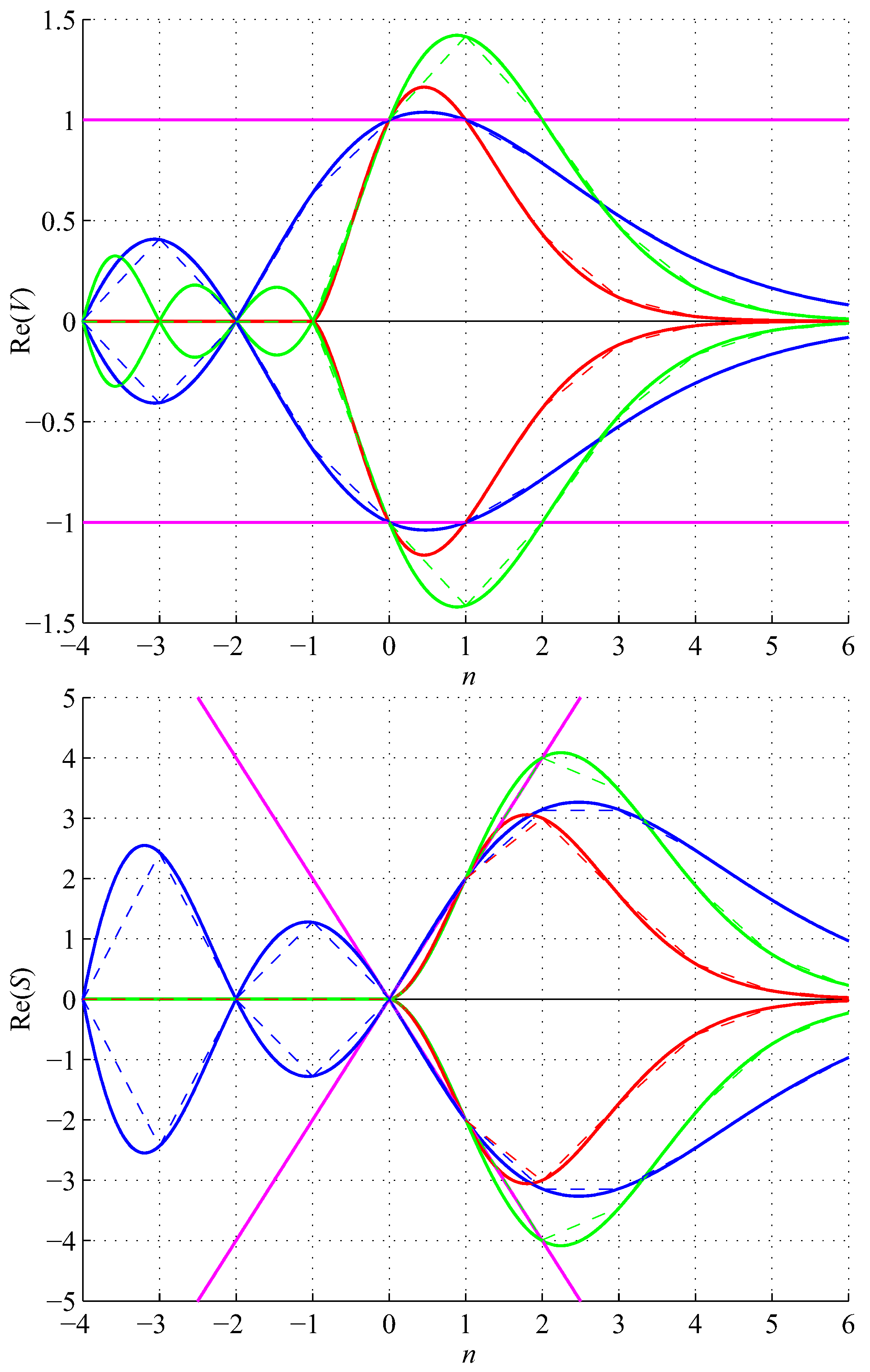
85) are shown in
Figure 13. The imaginary part of the surface relations (
88)–(
94) vanishes for
.
Moreover, for
, the following both metric and gamma function independent relations can be obtained between volumes (
73), (
76) and surfaces (
74), (
77) of circumscribed and inscribed
n-cubes
between volumes (
53), (
49) and surfaces (
57), (
50) of circumscribed and inscribed
n-simplices
and between volumes (
67), (
63) and surfaces (
70), (
64) of circumscribed and inscribed
n-orthoplices
Notably, the ratio of the volume
of an
n-cube circumscribed about an
n-ball to the volume
of an
n-cube inscribed in an
n-ball (
96) is the same as the ratio of the volume
of an
n-orthoplex circumscribed about an
n-ball to the volume
of an
n-orthoplex inscribed in an
n-ball (
98), and the same holds for the ratio of their surfaces,
. This is unsurprising: as an
n-cube is dual to an
n-orthoplex, these ratios remain invariant.
Curiously, analogous symmetries do not hold for the reflection functions (
38) of these volumes or surfaces, as neither the inscribed volumes
,
, nor the circumscribed volume
, nor the corresponding inscribed surfaces
,
, nor circumscribed surface
, have the reflection functions.
7. Discussion
The volumes and surfaces of
n-balls,
n-simplices, and
n-orthoplices have been defined in any complex dimension. As these geometric objects occur, along with
n-cubes, in all natural dimensions [
19], this result makes them omnidimensional, i.e., present in any complex dimension.
Applications of these formulas to the omnidimensional polytopes inscribed in and circumscribed about n-balls revealed previously unknown properties of these geometric objects. In particular, for , the omnidimensional polytopes’ volumes are larger than those of circumscribing n-balls, while their volumes and surfaces are smaller than those of inscribed n-balls.
Reflection functions for volumes and surfaces of these polytopes inscribed in and circumscribed about n-balls are proposed.
Symmetries of products (
80)–(
85), (
87)–(
94) and quotients (
96)–(
98) of volumes of these circumscribed and inscribed omnidimensional polytopes and
n-balls in complex dimensions
n and
and of surfaces in complex dimensions
n and
are shown to be independent of the metric factor and the gamma function.
Specific symmetries also hold between volumes and surfaces in dimensions and .
The results of this study could be applied in linguistic statistics, where the dimension in the distribution for frequency dictionaries is chosen to be negative [
3], and in fog computing, where an
n-simplex is related to a full mesh pattern, an
n-orthoplex is linked to a quasi-full mesh structure, and an
n-cube is referred to as a certain type of partial mesh layout [
27]. Further possible applications include molecular physics and crystallography. Perhaps the results of this study are also related to the 2-dimensional quantum hall effect.
One can also investigate the properties of the examined geometric objects extending these concepts to quaternions. This can help us discover many interesting mathematical properties and physical phenomena. One of the challenges certainly involves characterizing all types of symmetries introduced by Definition 1.