Abstract
Motivated by the recent work on the symmetric domains, this article investigates certain features of symmetric domain which are caused by the secant hyperbolic functions. Geometric characteristics of analytic functions associated with secant hyperbolic functions are discussed, which include the inclusion results, structural formula, certain sharp radii results such as radius of starlikeness and convexity of order It also finds a radius for ratios of analytic functions associated with Euler numbers.
MSC:
30C45; 30C50
1. Introduction
Denoted by , the class of functions analytic in and denote the class of analytic functions having the series form
The subclass of contains univalent functions (one to one) in . Moreover, and represent classes of starlike and convex functions in , respectively. These classes are defined for the functions analytically by the relation and in , respectively. A function analytic in is subordinated by analytic function denoted by g if there exists a Schwarz function w which maps to itself with such that . If is univalent in and , then .
The concept of subordination was applied by Ma and Minda [1] to introduce generalized subclasses and of starlike and convex functions, respectively, which are analytically defined as:
and
The function is an analytic and univalent in . It maps onto the convex set in with and in The classes and unify many subclasses of and . We write a few of these by taking the particular . The classes and represent the Janowski starlike and Janowski convex functions [2]. By choosing and the classes and reduce to the starlike and convex functions of order . The class represents the strongly starlike functions of order The class serves as the class of starlike functions related with sine function [3]. Sokół and Stankiewicz [4] defined the class . The class performs as a subclass of with order [5]. Similarly, the class is represented by [6]. The class is a subclass of related to a cardioid [7]. The class is a class related with limacon [8,9,10]. The class was defined by Mendiratta et al. [11]. The class represents the starlike functions related to the cosine function; see [12,13]. The class was introduced and studied in [14], while the class was given by Kargar et al. [15]. For some more recent work in the same direction, we refer to [16,17,18,19,20,21,22] and the references therein.
Recently, some authors have explored the geometry of certain generating functions for well-known numbers and connected them with certain subclasses of . For instance, Sokół [23] defined a subclass of by using Fibonacci numbers. Some applications of these numbers were given by Dziok et al. [24,25]. Certain coefficient bounds for starlike functions related to generalized telephone numbers were given by Deniz [26]; also see [27]. A subclass of related with Bell numbers was studied in [28,29]. The subclasses of and related to Bernoulli numbers were studied by Raza et al. [30].
Motivated by the given above progress, we take the function
where the Euler’s numbers satisfy the relation It is clear that and The numbers are closely connected with other well-known numbers such as the Genocchi numbers, the Bernoulli numbers, the Stirling numbers of two kinds, the tangent numbers, the Riemann zeta function and the Euler polynomials, and therefore are very useful in number theory and combinatorics; see [31,32,33,34] and references therein.
The generating function of Euler numbers is univalent in with in Therefore, by using the function we define the class in as follows:
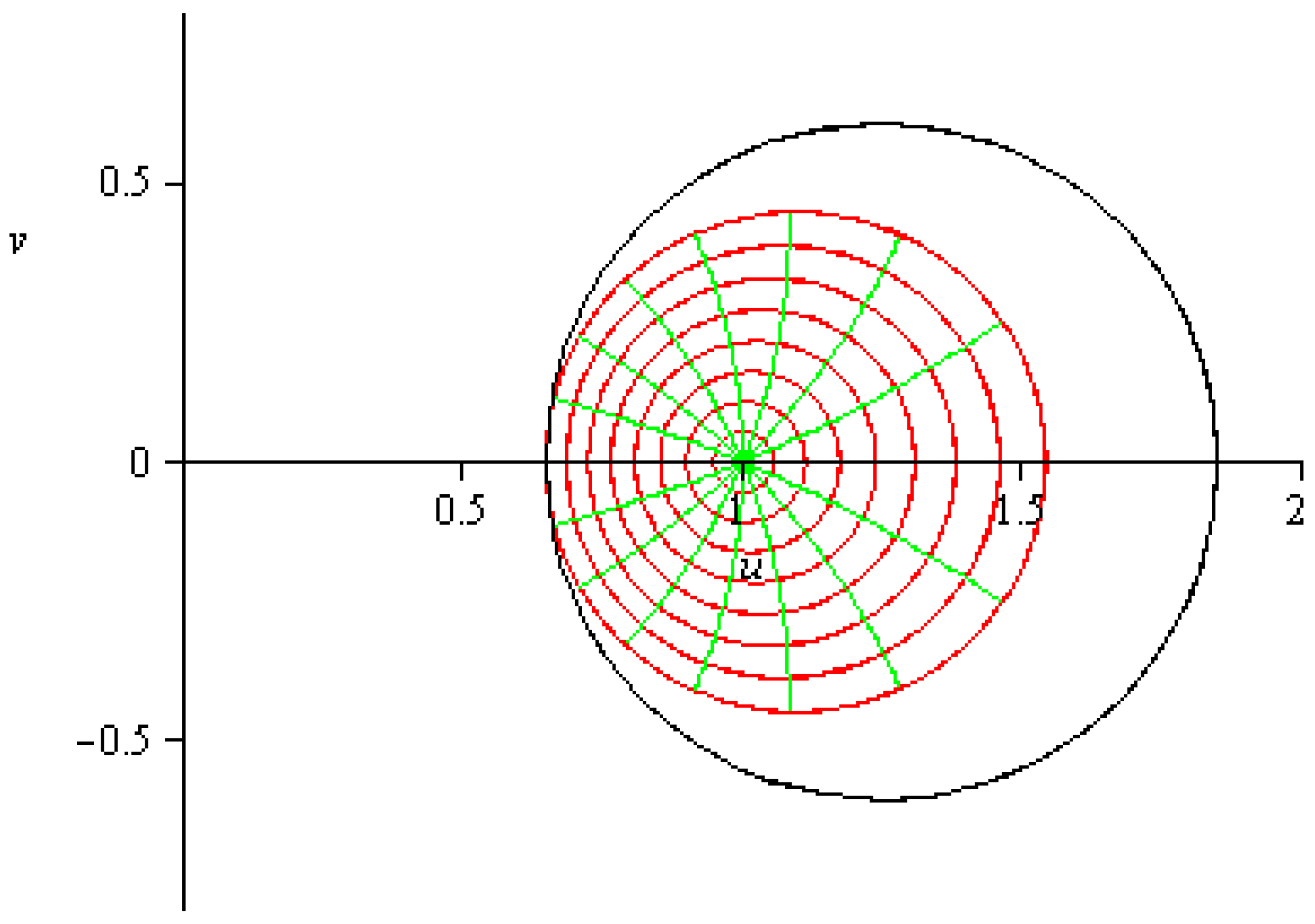
The function is symmetric about the real axis, as given in Figure 1.
Figure 1.
Graph of .
In other words, let Then is in the class if and only if it can be written as
Now we provide few examples in the class Consider
Since the function is univalent in with and therefore
We intend to prove that the following functions are in the class .
We also intend to establish connections of newly defined class of analytic functions associated with secant hyperbolic functions with many other classes of analytic functions. These connections are given by radii problems and inclusion results. We emphasize and thoroughly study the radii problems for starlikeness and convexity of the class . For that, we need the following classes of analytic functions and certain established results which are given below in Section 2. All the proved results are sharp, which is justified by giving suitable extremal functions.
The class is defined for the functions such that . The class for is defined as
In particular, for and , the well-known classes having functions with positive real parts in . Any function has the series form
Let and Ali et al. [35] studied the classes and These are defined as
and
2. Preliminary Results
We utilize the following results in our study.
Lemma 1.
[36] If , then, for ,
Lemma 2.
[37] If , then, for
In particular, if , then, for
3. Starlikeness and Convexity
Firstly, we study the starlikeness and strong starlikeness of order and order , respectively, for the class . We start with the following result, which is useful in proving our inclusion results.
Lemma 3.
Let Then for
and
Proof.
For and the function
has minimum value at and and maximum at Hence,
and
Additionally, the function
has minimum value at and and maximum at Hence, we conclude that
and
□
Theorem 1.
The class satisfies the following inclusion:
- 1.
- for
- 2.
- γ) for
- 3.
- whenever where
Proof. 1.
Let Then we can write
By using Lemma 3, we conclude that
Hence,
Thus, where
2. Result follows from (4).
3. Let Then,
Let
Then, has two roots in namely
A simple computation shows that Therefore, we conclude that . Thus,
□
Theorem 2.
The -radii, for is with
Proof.
Since then by using Lemma 3, we have
Hence,
for Thus, the radius of for is the positive and smallest root of the equation □
Theorem 3.
The -radius for the class is where is the positive and smallest root of the equation
Proof.
Since therefore for an analytic function with and , we can write
By taking logarithmic differentiation of (5) it follows that
From (6), we may write
For the minimum value, we assume with A simplification shows that
Since therefore we only consider and the equation has namely and roots. It implies that
and
This implies that
Now consider
We see that the equation has and roots. Since therefore we take It is easy to see that and Now
Therefore,
Additionally, it is easy to see that
Using (8), (9) and (10) along with the result due to Nehari [38] for Schwarz function such that
we have
for Thus, the -radius for the class is the root of the equation
□
Corollary 1.
The radius for is
4. Inclusion Results
This section deals with inclusion results for the class and certain subclasses of starlike functions.
Theorem 4.
For , the following inclusion relations hold:
- 1.
- , for
- 2.
- , for
- 3.
- , for
Proof. 1.
To show the function lies in the class , we use the result ([5], Lemma 2.1), that gives
Let . Then,
The function if either or Thus, for
2. Let Then and
We see that Thus, the function if . This gives
3. Proceeding as in part (ii), we see that the function lies in the class if
which holds for □
5. Radius Problems
In the following result, we establish the radius for the smallest and largest disks with center such that the domain contains the largest disk and is contained in the smallest disk.
Lemma 4.
Let . Then,
where
and be given by
where and
Proof.
Firstly, we consider the distance of any point on the boundary to . The square of this distance is given as
To obtain the radius for the largest disk in , we only prove that . Since , therefore we take . We have the following cases:
Case 1. When the equation has 0, and roots. Moreover, the function is positive when and negative for Hence, we conclude that minimum of l exists at 0 and This implies that
Case 2. When the equation has 0, , , and roots. Here the roots and depend upon Furthermore, the function is increasing for decreasing for increasing for and again decreasing for Therefore,
We also observe from the graph of the function l that when , the function l has minimum value at 0 and This implies that
Additionally, we see that when
Case 3. When the equation has 0, and roots. Moreover, the function is negative when and positive for Hence, we conclude that
Using the same argument, we obtain the result for . □
Theorem 5.
- 1.
- A function is in if and only if
- 2.
- The function if and only if
Proof. 1.
If , so we have . Using Lemma 2 for , it will map onto the disc
As , so we have and , which gives
Conversely, if , then
In view of Lemma 4, we see that .
2. If , then does not belong to the class , so . Then, by using Lemma 2 the following bilinear transformation maps onto the disc, where .
with diameter end points and . If , then , after simplifying it gives us . Conversely, if , then in the light of Lemma 4, we have
and
From the above equation, it is clear that
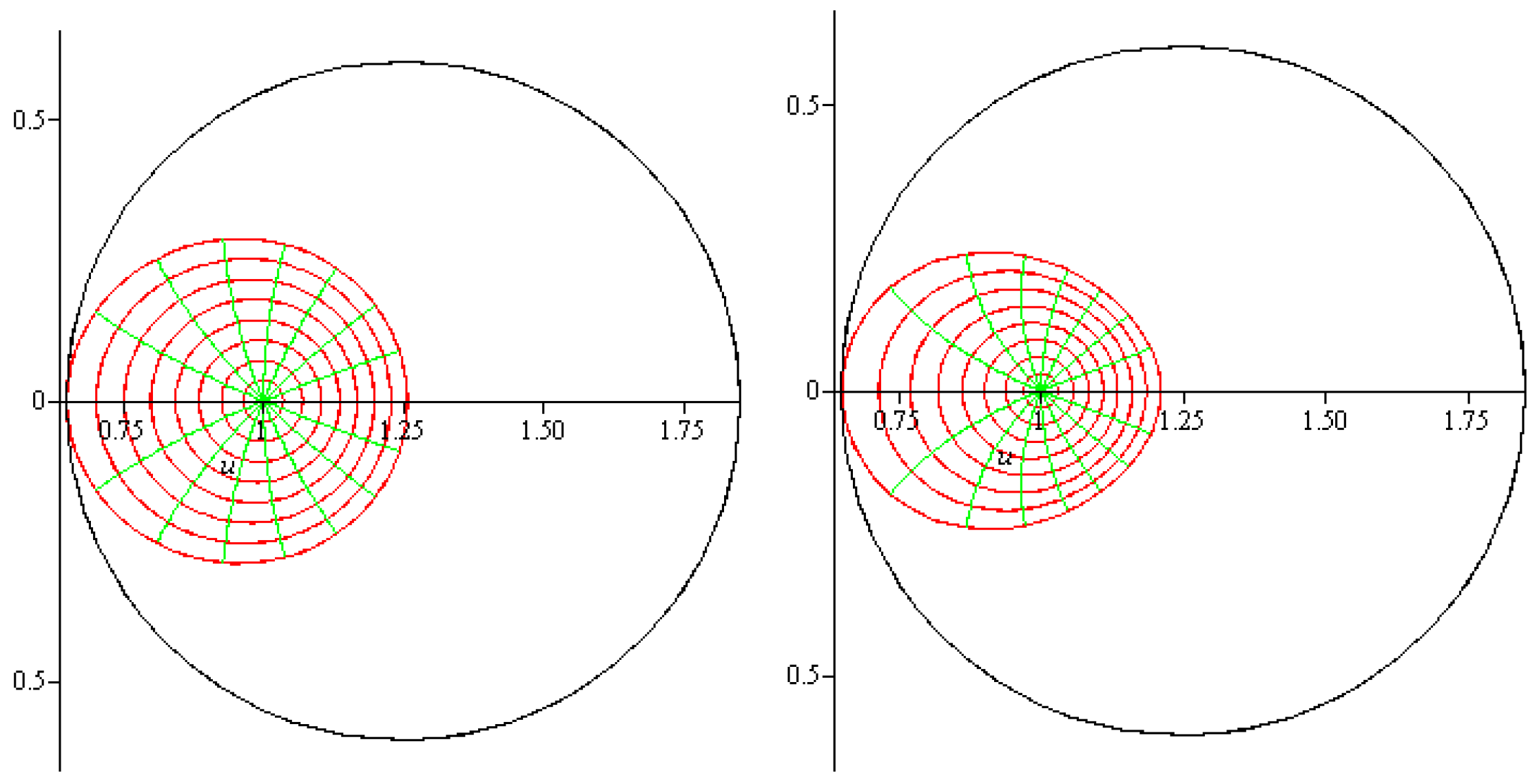
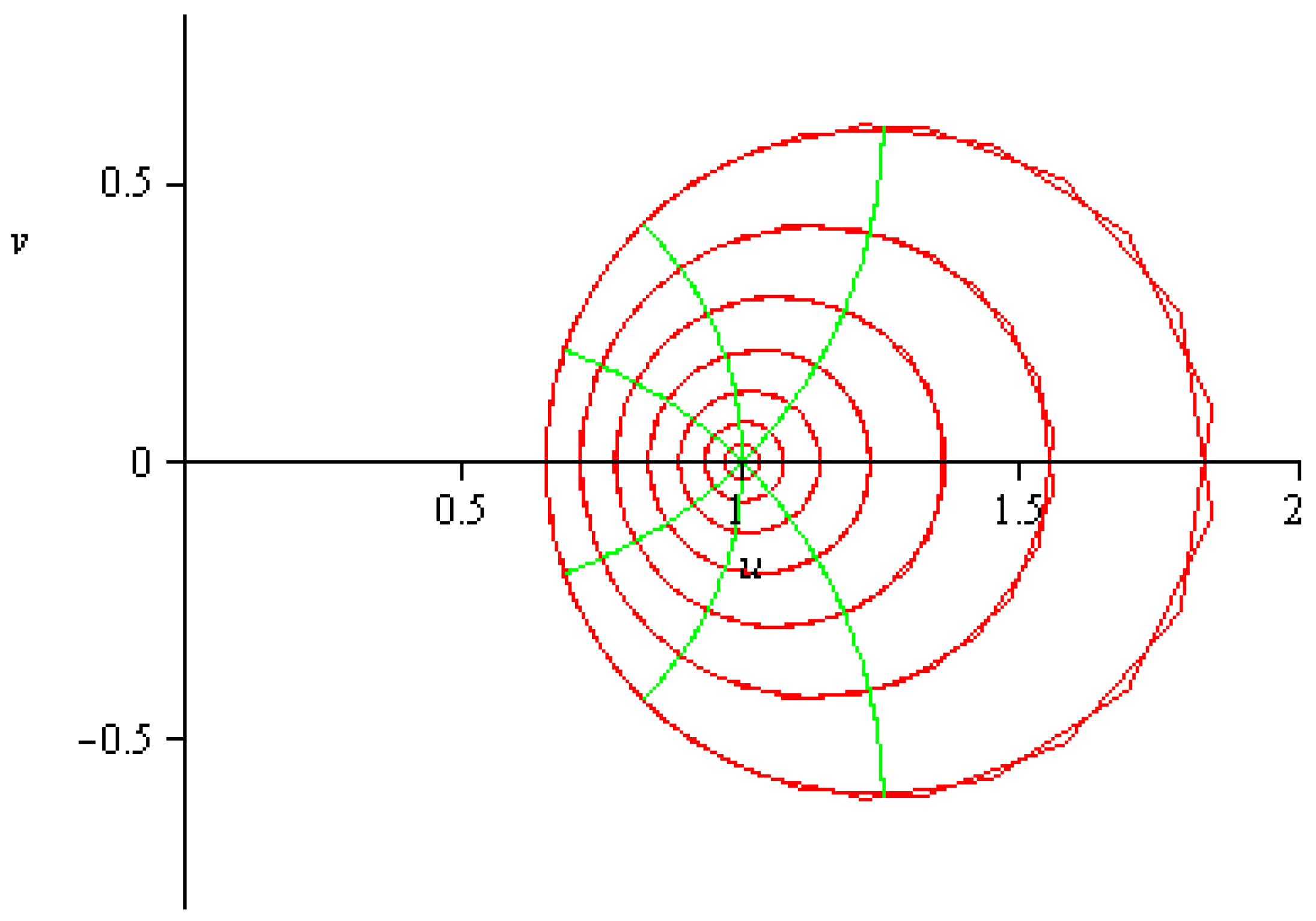
See the sharpness of the result in Figure 2. □
Figure 2.
Graph of for to be contained in .
Theorem 6.
The radii for the classes , , , , , and are given as follows.
- 1.
- ,
- 2.
- ,
- 3.
- ,
- 4.
- ,
- 5.
- 6.
- 7.
Proof. 1.
For the functions , we have . Thus, for , we have by Lemma 4,
whenever the inequality holds. The sharpness is obtained for the function
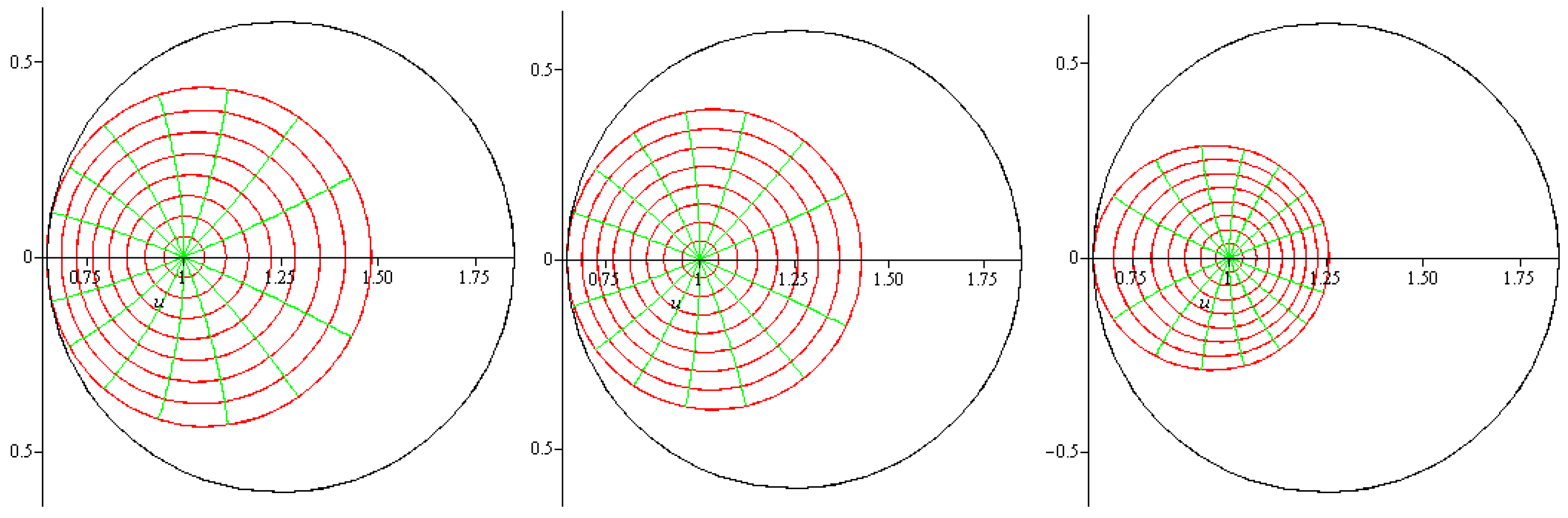
which is in class . Since at point (see Figure 3).
Figure 3.
radius for (left figure), (right figure).
2. For functions , we have
This implies that
provided
For sharpness, we consider the function given as
where
At point , we have
(see Figure 3).
3. For the functions , we have . Thus, for , we have by Lemma 4,
whenever the inequality holds. Consider the function
Since , so and at point we have . Hence, the result is sharp, see Figure 4 (left).
Figure 4.
radius for (left figure), (centered figure), (right figure).
4. For the functions , we have . Thus, for , we have by Lemma 4,
whenever the inequality holds. Consider the function
Since , so and at point we have . Hence, the result is sharp, see Figure 4 (centered).
5. Let . Then . Now we have
This holds for
The sharpness can be obtained for , given by the relation
and
for For , the sharpness is shown in Figure 4 (right).
6. For , we have which gives
for By using Lemma 4, we obtain and it simplifies to for Take the function given by
At the quantity is obtained.
7. Let . Then , for all . Let us define function such that . Then,
Thus, we have
By using Lemmas 1 and 4, the function for if . This simplifies to Sharpness can be seen for the function . For this function, we have
□
Theorem 7.
Let , with . Let
and
Then, radius for is given by
Proof.
Let , then by Lemmas 2 and 4, we have
We have to determine the numbers and . Now , if and only if . This yields us . Similarly if and only if
The above equation gives us . Also if and only if
A simple calculation yields
□
Theorem 8.
The -radius for is
Proof.
Take the function h given by h. Then h and Applying Lemma 1, it will give us the following disc
By Lemma 4, the above disc is contained in if
which gives
Consider the function defined by . It is easy to check that in . Thus, and
Furthermore, the function gives the sharpness as at , we have
□
Theorem 9.
Let
and
Then -radius for is given by
Proof.
Let and define , where . Then Therefore,
Using Lemma 2, we have
Therefore,
For and , we are going to find the values of and . Here, if and only if
This yields us
Next, we determine such that if and only if
provided
We determine such that if and only if
provided
□
Theorem 10.
The class is in the class if either of the following relations is satisfied.
- 1.
- and
- 2.
- and
Proof.
From the definition of the class , we have By using Lemma 2, we can write
The above relation gives us a disc with center and radius In view of Lemma 4, we have to show that
This implies that
which is equivalent to either
or
Simple calculations establish the required result. □
Theorem 11.
The -radius for is given by
The result is sharp.
Proof.
Let Then by using Lemma 2, we have
Clearly for , Then from Lemma 4, it follows that
provided
Consider the function given by
since , at point Hence, the sharpness is obtained. □
6. Radius Problems for Ratios of Analytic Functions
In this section, we find radii problems of class for some ratios of analytic functions.
Consider the function
Theorem 12.
The sharp -radii for the functions in the class is
Proof.
Let . Then we define functions given by and . Then, . Since , and therefore from Lemmas 1 and 4, it follows that
for . For the sharpness, consider the functions
Thus, clearly
This shows that . Now at
This guarantees sharpness. □
Next, consider the class of functions satisfying the inequality
for some with
Theorem 13.
The sharp -radii for the functions in the class is
Proof.
Let . Then, we introduce functions by and . Then, and . Since , it follows from Lemma 1 that
By Lemma 4 if , provided
Consider the functions
Then clearly and and hence . □
Let represent functions , satisfying
for and
Theorem 14.
The sharp -radii for the function in the class is
Proof.
Let . Then we define functions by and . Then, . We see that if and only if and hence . By using Lemma 1, we have
The remaining part of the proof is same as of Theorem 13. For sharpness, we consider a functions given by
where . Now at , we have
This confirms the sharpness of the result. □
Let be the class of functions satisfying the inequality
for some convex function
Theorem 15.
Let
and
Then -radii for the functions in the class is
Proof.
Let . Define functions as on open unit disk, where is convex function. Since every convex function is starlike of order half, therefore using Lemma 1, we can write
Here, . Using Lemma 4, we have
This gives us
Here we find the result by determining the three numbers and . We have , if and only if . This yields us . We determine , such that , if and only if The positive root of the above inequality is
Next, we determine such that if and only if
The positive root of the above inequality is
□
7. Conclusions
In this article, we have linked the generating function for Euler numbers with a class of starlike functions. We have also linked this class with various subclasses of univalent functions by inclusion and radius results. All the radii problems are sharp. This work covers the study of class regarding its connection with other classes of analytic functions. Its certain interesting characteristics are yet to be explored, which includes coefficient estimates such as coefficient bounds, Hankel determinants, inverse coefficients and logarithmic coefficients for class .
Author Contributions
Conceptualization, K.B., M.R. and Q.X.; Methodology, K.B., M.R. and Q.X.; Software, F.T.; Validation, F.T.; Formal analysis, M.R.; Investigation, K.B., M.R. and Q.X.; Resources, S.N.M.; Writing—original draft, S.N.M.; Writing—review & editing, S.N.M.; Visualization, S.N.M.; Supervision, S.N.M.; Project administration, F.T.; Funding acquisition, F.T. All authors have read and agreed to the published version of the manuscript.
Funding
This research received no external funding.
Institutional Review Board Statement
Not applicable.
Informed Consent Statement
Not applicable.
Data Availability Statement
No data is used in this work.
Acknowledgments
This research was supported by the researchers Supporting Project Number (RSP2023R401), King Saud University, Riyadh, Saudi Arabia.
Conflicts of Interest
The authors declare no conflict of interest.
References
- Ma, W.; Minda, D. A unified treatment of some special classes of univalent functions. In Proceeding of Conference on Complex Analysis; Li, Z., Ren, F., Yang, L., Zhang, S., Eds.; International Press: Somerville, MA, USA, 1994; pp. 157–169. [Google Scholar]
- Janowski, W. Extremal problems for a family of functions with positive real part and for some related families. Ann. Pol. Math. 1970, 23, 159–177. [Google Scholar] [CrossRef]
- Cho, N.E.; Kumar, V.; Kumar, S.S.; Ravichandran, V. Radius problems for starlike functions associated with the sine function. Bull. Iran. Math. Soc. 2019, 45, 213–232. [Google Scholar] [CrossRef]
- Sokół, J.; Stankiewicz, J. Radius of convexity of some subclasses of strongly starlike functions. Zeszyty Nauk. Politech. Rzeszowskiej Mat. 1996, 19, 101–105. [Google Scholar]
- Khatter, K.; Ravichandran, V.; Kumar, S.S. Starlike functions associated with exponential function and the lemniscate of Bernoulli. Rev. R. Acad. Cienc. Exactas Fís. Nat. Ser. A Mat. RACSAM 2019, 113, 233–253. [Google Scholar] [CrossRef]
- Mendiratta, R.; Nagpal, S.; Ravichandran, V. A subclass of starlike functions associated with left-half of the lemniscate of Bernoulli. Int. J. Math. 2014, 25, 1450090. [Google Scholar] [CrossRef]
- Sharma, K.; Jain, N.K.; Ravichandran, V. Starlike functions associated with a cardioid. Afr. Math. 2016, 27, 923–939. [Google Scholar] [CrossRef]
- Bano, K.; Raza, M. Starlikness associated with limacon. Filomat 2023, 37, 851–862. [Google Scholar]
- Masih, V.S.; Kanas, S. Subclasses of starlike and convex functions associated with the limaçon domain. Symmetry 2020, 12, 942. [Google Scholar] [CrossRef]
- Yunus, Y.; Halim, S.A.; Akbarally, A.B. Subclass of starlike functions associated with a limaçon. In Proceedings of the AIP Conference 2018, Maharashtra, India, 5–6 July 2018; AIP Publishing: New York, NY, USA, 2018. [Google Scholar]
- Mendiratta, R.; Nagpal, S.; Ravichandran, V. On a subclass of strongly starlike functions associated with exponential function. Bull. Malays. Math. Sci. Soc. 2015, 38, 365–386. [Google Scholar] [CrossRef]
- Bano, K.; Raza, M. Starlike functions associated with cosine functions. Bull. Iran. Math. Soc. 2021, 47, 1513–1532. [Google Scholar] [CrossRef]
- Tang, H.; Srivastava, H.M.; Li, S.; Deng, G. Majorization results for subclasses of starlike functions based on the sine and cosine functions. Bull. Iran. Math. Soc. 2020, 46, 381–388. [Google Scholar] [CrossRef]
- Raina, R.K.; Sokół, J. Some properties related to a certain class of starlike functions. C. R. Math. Acad. Sci. Paris 2015, 353, 973–978. [Google Scholar] [CrossRef]
- Kargar, R.; Ebadian, A.; Sokół, J. On Booth lemniscate and starlike functions. Anal. Math. Phys. 2019, 9, 143–154. [Google Scholar] [CrossRef]
- Khan, N.; Khan, S.; Xin, Q.; Tchier, F.; Malik, S.N.; Javed, U. Some Applications of Analytic Functions Associated with q-Fractional Operator. Mathematics 2023, 11, 930. [Google Scholar] [CrossRef]
- Liu, D.; Din, M.U.; Raza, M.; Malik, S.N.; Tang, H. Convexity, Starlikeness, and Prestarlikeness of Wright Functions. Mathematics 2022, 10, 3858. [Google Scholar] [CrossRef]
- Al-Shbeil, I.; Afis, S.; Cătaş, A.; Malik, S.N.; Oladejo, S.O. Some Geometrical Results Associated with Secant Hyperbolic Functions. Mathematics 2022, 10, 2697. [Google Scholar] [CrossRef]
- Orhan, H.; ÇaĞLar, M.; Cotirla, L.-I. Third Hankel Determinant for a Subfamily of Holomorphic Functions Related with Lemniscate of Bernoulli. Mathematics 2023, 11, 1147. [Google Scholar] [CrossRef]
- Deniz, E.; KazimoĞlu, S.; ÇaĞlar, M. Radii of Starlikeness and Convexity of the Derivatives of Bessel Function. Ukr. Math. J. 2022, 73, 1686–1711. [Google Scholar] [CrossRef]
- Deniz, E.; KazimoĞlu, S.; ÇaĞlar, M. Radii of Uniform Convexity of Lommel and Struve Functions. Bull. Iran. Math. Soc. 2021, 47, 1533–1557. [Google Scholar] [CrossRef]
- Riaz, A.; Raza, M.; Binyamin, M.A.; Saliu, A. The second and third Hankel determinants for starlike and convex functions associated with Three-Leaf function. Heliyon 2023, 9, e12748. [Google Scholar] [CrossRef]
- Sokół, J. On starlike functions connected with Fibonacci numbers. Folia Scient. Univ. Tech. Resoviensis 1999, 175, 111–116. [Google Scholar]
- Dziok, J.; Raina, R.K.; Sokół, J. Certain results for a class of convex functions related to a shell-like curve connected with Fibonacci numbers. Comput. Math. Appl. 2011, 61, 2605–2613. [Google Scholar] [CrossRef]
- Dziok, J.; Raina, R.K.; Sokół, J. On a class of starlike functions related to a shell-like curve connected with Fibonacci numbers. Math. Comput. Model. 2013, 57, 1203–1211. [Google Scholar] [CrossRef]
- Deniz, E. Sharp coefficient bounds for starlike functions associated with generalized telephone numbers. Bull. Malays. Math. Sci. Soc. 2021, 44, 1525–1542. [Google Scholar] [CrossRef]
- Murugusundaramoorthy, G.; Vijaya, K. Certain subclasses of analytic functions associated with generalized Telephone numbers. Symmetry 2022, 14, 1053. [Google Scholar] [CrossRef]
- Cho, N.E.; Kumar, S.; Kumar, V.; Ravichandran, V.; Srivastava, H.M. Starlike functions related to the Bell numbers. Symmetry 2019, 11, 219. [Google Scholar] [CrossRef]
- Kumar, V.; Cho, N.E.; Ravichandran, V.; Srivastava, H.M. Sharp coefficient bounds for starlike functions associated with the Bell numbers. Math. Slovaca 2019, 69, 1053–1064. [Google Scholar] [CrossRef]
- Raza, M.; Binyamin, M.A.; Riaz, A. A study of convex and related functions in the perspective of geometric function theory. In Inequalities with Generalized Convex Functions and Applications; Awan, M.U., Cristescu, G., Eds.; Springer: Berlin, Germany, 2023; To be published. [Google Scholar]
- Lehmer, E. On congruences involving Bernouli numbers and the quotients of Fermat and Wilson. Ann. Math. 1938, 39, 350–360. [Google Scholar] [CrossRef]
- Malenfant, J. Finite, closed-form expressions for the partition function and for Euler, Bernoulli, and Stirling numbers. arXiv 2011, arXiv:1103.1585. [Google Scholar]
- Yakubovich, S. Certain identities, connection and explicit formulas for the Bernoulli and Euler numbers and the Riemann zeta-values. Analysis 2015, 35, 59–71. [Google Scholar] [CrossRef]
- Abramowitz, M.; Stegun, I.A. Handbook of Mathematical Functions with Formulas, Graphs, and Mathematical Tables, 10th ed.; Applied Mathematics Series; National Bureau of Standards: Washington, DC, USA, 1972; Volume 55. [Google Scholar]
- Ali, R.M.; Jain, R.N.K.; Ravichandran, V. Radii of starlikeness associated with the lemniscate of Bernoulli and the left-half plane. Appl. Math. Comp. 2012, 218, 6557–6565. [Google Scholar] [CrossRef]
- Shah, G.M. On the univalence of some analytic functions. Pac. J. Math. 1972, 43, 239–250. [Google Scholar]
- Ravichandran, V.; Ronning, F.; Shanmugam, T.N. Radius of convexity and radius of starlikeness for some classes of analytic functions. Complex Var. Elli. Equ. 1997, 33, 265–280. [Google Scholar]
- Nehari, Z. Conformal Mapping; McGraw-Hill Inc.: New York, NY, USA, 1952. [Google Scholar]
Disclaimer/Publisher’s Note: The statements, opinions and data contained in all publications are solely those of the individual author(s) and contributor(s) and not of MDPI and/or the editor(s). MDPI and/or the editor(s) disclaim responsibility for any injury to people or property resulting from any ideas, methods, instructions or products referred to in the content. |
© 2023 by the authors. Licensee MDPI, Basel, Switzerland. This article is an open access article distributed under the terms and conditions of the Creative Commons Attribution (CC BY) license (https://creativecommons.org/licenses/by/4.0/).