Abstract
The algebraic group theory approach to pairing in nuclei is an old subject and yet it continues to be important in nuclear structure, giving new results. It is well known that for identical nucleons in the shell model approach with j − j coupling, pairing algebra is SU(2) with a complementary number-conserving Sp(N) algebra and for nucleons with good isospin, it is SO(5) with a complementary number-conserving Sp(2Ω) algebra. Similarly, with L − S coupling and isospin, the pairing algebra is SO(8). On the other hand, in the interacting boson models of nuclei, with identical bosons (IBM-1) the pairing algebra is SU(1, 1) with a complementary number-conserving algebra and for the proton–neutron interacting boson model (IBM-2) with good F-spin, it is SO(3, 2) with a complementary number-conserving SO(ΩB) algebra. Furthermore, in IBM-3 and IBM-4 models several pairing algebras are possible. With more than one j or ℓ orbit in shell model, i.e., in the multi-orbit situation, the pairing algebras are not unique and we have the new paradigm of multiple pairing [SU(2), SO(5) and SO(8)] algebras in shell models and similarly there are multiple pairing algebras [SU(1, 1), SO(3, 2) etc.] in interacting boson models. A review of the results for multiple multi-orbit pairing algebras in shell models and interacting boson models is presented in this article with details given for multiple SU(2), SO(5), SU(1, 1) and SO(3, 2) pairing algebras. Some applications of these multiple pairing algebras are discussed. Finally, multiple SO(8) pairing algebras in shell model and pairing algebras in IBM-3 model are briefly discussed.
Keywords:
pairing; multiple algebras; multi-j shell model; interacting boson models; SU(2); SO(5); Sp(2Ω); SU(1,1); SO(Ω); SO(3,2); LST coupling; SO(8); IBM-3,4 1. Introduction
Pairing is one of the most important concepts in nuclear structure physics and its fingerprints are seen clearly in binding energies of nuclei, ground state spins, odd-even effects, beta decay, double beta decay, orbit occupancies and so on [1,2]. Very early Bohr, Mottelson and Pines [3] suggested the use of BCS theory for pairing in nuclei and all the subsequent developments in this direction are well reviewed in [4,5,6]. Focusing on nuclear shell model [7,8], algebraic group theory approach to pairing has started receiving attention following Racah’s seniority quantum number [9,10]. For identical nucleons in a single-j shell, pair state is coupled to angular momentum zero and the corresponding pair creation operators are unique. The pair-creation operator, pair-annihilation operator and the number operator generate the pairing algebra. The eigenstates of the pairing Hamiltonian, that is a product of pair-creation and pair-annihilation operators, carry the quasi-spin or seniority quantum number. There are several single-j shell nuclei that are known to carry seniority quantum number (v) as a good or useful quantum number; see [7] and also [11,12,13,14] and references therein for full details of quasi-spin and seniority for identical particles and their applications. Even when single-j shell seniority is a broken symmetry, seniority quantum number is useful as it provides a basis for constructing shell model Hamiltonian matrices [15]. Pairing symmetry with nucleons occupying several j-orbits is more complex and less well understood from the point of view of its goodness or usefulness in nuclei. Restricting to nuclei with identical valence nucleons (protons or neutrons), and say these nucleons occupy several-j orbits, then it is possible to consider the pair-creation operator to be a sum of the single-j shell pair-creation operators with arbitrary phases and for each choice there will be quasi-spin algebra giving multi-orbit or generalized seniority quantum number v. With r number of orbits there will be number of pairing algebras. With , the spectrum generating algebra (SGA) is and the pairing algebra is complementary to the algebra in with v denoting the irreducible representations (irreps) of that belong to a given number m of identical nucleons [m denotes the irrep of ]. The usefulness or goodness of these multiple pairing algebras is not well known except a special situation that was studied long ago by Arvieu and Moszkowski (AM) [16] in the context of surface delta interaction. We will discuss this in detail in Section 2. In addition, pair states with linear superposition of single-j shell pair states with arbitrary coefficients are used in generating low-lying states of nuclei, such as Sn isotopes, with good generalized seniority [7], and they are also employed in the so called broken pair model [17]. On the other hand, these are also used in providing a microscopic basis for the interacting boson model [18]. Going beyond all these, there are also attempts to solve and apply more general pairing Hamiltonian’s by Pan Feng et al. [19] and also a pair shell model was developed by Arima and Zhao [20].
In the interacting boson models [21,22,23], the algebras in the SGA are well known. For example in IBM-1, and in IBM-1 and so on. However, what is not often emphasized is that the algebras correspond to pairing for bosons. In fact, for identical bosons in single ℓ shell (for example d orbit in IBM, g in IBM) or in multi-ℓ situation (for example , etc.), the pairing algebra is the non-compact algebra and the better known algebras are complementary algebras (see Section 3 ahead) [21,24]. However, just as the situation with identical fermions, here also there will be multiple pairing algebras (with r number of ℓ orbits, there will be number of algebras) and for each of these there will be a complementary algebra. These multiple multi-orbit pairing algebras and their applications are described in Section 3.
Pairing in identical fermion systems is easy to deal with as the algebra is . However, the situation changes if we consider nucleons with isospin (T) degree of freedom. Here, the algebra changes to the more complex algebra that generates seniority (v) and in addition also reduced isospin (t) [25,26]. Another important result is that the contains only isovector pair-creation and -annihilation operators (an unsatisfactory aspect of the pairing algebra of shell model is that it does not contain isoscalar pair operators). With isospin, in a single-j orbit the SGA is with . The algebra in is complementary to with uniquely labeling the irreps. For the first papers on single-j shell pairing with isospin see [25,26,27,28,29,30,31]. Similarly, for the technical work on the more complicated algebra [for example, deriving analytical formulas for the Wigner and Racah coefficients for ] see [30,32,33,34,35,36,37,38] and for recent applications see [39,40,41,42,43,44,45,46] and references therein. Although many of the single-j shell results extend to the multi-j shell situation with replaced by , a crucial aspect of the multi-j shell pairing algebra is that there will be multiple algebras (also the corresponding multiple algebras) as the pair-creation operator here is no longer unique. Section 4 describes these multiple isovector pairing and seniority multi-j algebras with isospin in nuclei and their applications.
Parallel to pairing in shell model with isospin is the pairing with F-spin in interacting boson models. Making a distinction between proton bosons and neutron bosons and treating them as projections of a fictitious (F) spin object, we have IBM or IBM-2 with F-spin degree of freedom (F-spin in IBM is mathematically similar to isospin in shell model). As we present in Section 5, the pairing algebra changes from to more complicated algebra [47]. More importantly, in the multi-ℓ situation there will be multiple algebras and for each of these there will be a complementary algebra. In Section 5 multiple multi-orbit pairing algebras with F-spin in IBMs are discussed.
Going further, interestingly multiple pairing algebras appear also in the pairing algebra in shell model and also in the isospin invariant IBM-3 model and spin-isospin invariant IBM-4 model; see [48,49,50,51,52,53,54] for algebra and [21,55,56] for IBM-3 and IBM-4. In Section 6 we will briefly describe multiple pairing algebras in shell model and the pairing algebras in IBM-3.
Before proceeding further, let us stress that the most important aspect of pairing algebras is the complementarity between the pairing algebras with number non-conserving generators and the shell model/IBM algebras with only number-conserving generators [57]. A general mathematical theory describing this complementarity is due to Neergard [58,59,60,61] and this is based on Howe’s general duality theorem [62,63]. It is important to mention that the first proof of complementarity is due to Helmers [28] and later work is due to Rowe et al. [64]. We will not discuss these more mathematically rigorous results in this paper.
2. Multiple Multi-Orbit Pairing Algebras in Shell Model: Identical Nucleons
With identical nucleons (protons or neutrons) in a single-j shell, the pair-creation operator and annihilation operator and the number operator [ or more appropriately with , generate remarkably the quasi-spin algebra. The quasi-spin quantum number Q and its z-component can be used to label many (m)-particle states. On the other hand, the SGA is and the subalgebra of is ‘complementary’ to the quasi-spin algebra. The seniority quantum number v that labels the states according to algebra [v labels irreps] corresponds to Q and similarly, particle number m that labels the irreps of corresponds to . Seniority quantum number gives number of particles that are not in zero coupled pairs. Thus, the classification of states given by with number non-conserving operators, is the same as the one given by the shell model chain which contains only number-conserving operators. More importantly, this solves the pairing Hamiltonian and allows one to extract m dependence of many particle matrix elements of a given operator. All these are well known [7].
All the single-j shell results extend to the multi-j shell situation i.e., for identical particles occupying several-j orbits, with replaced by . In this situation, v is called generalized seniority. A new result that appears for the multi-j situation is that there will be multiple quasi-spin (or ) algebras with the pair-creation operator here being a sum of single-j pair-creation operators with different phases; ; . Then, clearly with r number of j-orbits, there will be number of quasi-spin and the corresponding algebras. Section 2.1 and Section 2.2 give details of these multiple multi-orbit pairing and the complementary algebras. The complementarity is established at the level of quadratic Casimir invariants of various group algebras that appear here. These multiple multi-j quasi-spin algebras (one for each choice) play an important role in deciding selection rules for electric and magnetic multi-pole operators. This is the topic of Section 2.3. Correlations between realistic interactions and pairing interactions that correspond to various multiple pairing algebras are studied in Section 2.4. Applications of multi-j seniority describing data in certain nuclei is presented in Section 2.5 with results drawn from [7,70,71,72,73]. Finally, a summary is given in Section 2.6.
2.1. Multiple Multi-Orbit Pairing Algebras
Let us say there are m number of identical fermions (protons or neutrons) in j orbits , , …, . Now, it is possible to define a generalized pair-creation operator as
Here, are free parameters and assumed to be real. The m used for number of particles should not be confused with the m in . Given the operator, the corresponding pair-annihilation operator is
Note that . The operators , and ,
form the generalized quasi-spin SU(2) algebra [hereafter called ] only if
Note that , is the number operator. With Equation (4) we have,
Thus, in the multi-orbit situation for each
with there is a algebra defined by the operators in Equations (1)–(3). For example, say we have three j orbits , and . Then, without loss of generality we can choose and then can take values , , , giving four pairing algebras. Similarly, with four j orbits, there will be eight algebras and in general for r number of j orbits there will number of algebras. The consequences of having these multiple pairing algebras will be investigated in the following. Before going further let us mention that the here should not be confused with the quantum group of Biedenharn and Macfarlane [74,75] (see also [76]).
Though well known, for later use and for completeness, some of the results of the algebra are that the operator and the operator in Equation (3) define the quasi-spin s and its z-component with and . Furthermore, from Equation (3) we have ; the m here is number of particles. Moreover, it is possible to introduce the so called seniority quantum number v such that giving,
Note that the total number of single particle states is and therefore for one has fermion holes rather than particles. With the pairing Hamiltonian given by
where G being the pairing strength, the following results will provide a meaning to the seniority quantum number “v”,
with these, it is clear that for a given v and m there are zero coupled pairs in eigenstates of . Thus, v gives the number of particles that are not coupled to angular momentum zero. In Equation (9), is an extra label that is required to specify a state completely.
2.2. Multiple Multi-Orbit Complementary Algebras
In the space, often it is more convenient to start with the algebra generated by the one-body operators ,
The total number of generators is obviously and . All m fermion states will be antisymmetric and therefore belong uniquely to the irrep of . The quadratic Casimir invariant of is easily given by
with eigenvalues
Equation (13) can be proved by writing the one and two-body parts of and then showing that the one-body part is and the two-body part will have two-particle matrix elements diagonal with all of them having value .
More importantly, and the algebra is generated by the number of generators with k=odd only and , where
The quadratic Casimir invariant of is given by,
The algebra will be complementary to the quasi-spin algebra defined for a given set of provided
Using Equations (12) and (14)–(16) along with Equation (10) it is easy to derive the following important relation,
Now, Equations (8), (13) and (17) will give
and this proves that the seniority quantum number v corresponds to the irrep .
In summary, given the algebra generated by operators for a given set of with or , there is a complementary (↔) subalgebra of generated by
As the generators are one-body operators and that , there will be special selection rules for electro-magnetic transition operators connecting m fermion states with good seniority. These are well known for a special choice of ’s [7] and their relation to the multiple algebras or equivalently to the set is the topic of the next Section.
2.3. Selection Rules and Matrix Elements for Electro-Magnetic Transitions
Electro-magnetic (EM) operators are essentially one-body operators (two and higher-body terms are usually not considered). In order to derive selection rules and matrix elements for allowed transitions, let us consider the commutator of with . Firstly we have easily,
This gives
Note that the commutator being zero implies that the operator is a scalar with respect to and otherwise it will be a quasi-spin vector . In either situation the component of T is zero as a one-body operator can not change particle number. Thus, for we have
Here and are some constants. Similarly, for we have
The results in Equation (22) are easy to understand as in Equation (22) is to within a factor same as of Equation (19) and therefore a generator of . Hence it cannot change the v quantum number of a m-particle state. Moreover, as , clearly will be a scalar. Similarly turning to Equation (23), as with k odd are generators of and hence they are also scalars.
The general form of electric and magnetic multi-pole operators and respectively with is, with or M,
Thus, the tensorial nature of depends on the choice. For we have and for we have transitions. It is well known [7,16] that for and operators,
In Equation (26) is the orbital angular momentum of the orbit. Therefore, combining results in Equations (22)–(26) together with parity selection rule will give seniority selection rules, in the multi-orbit situation, for electro-magnetic transition operators when the observed states carry seniority quantum number as a good quantum number. The selection rules with the choice for all i are as follows.
- with L even will be w.r.t. .
- with L odd will be w.r.t. . However, if all j orbits have same parity, then with L odd will not exist. Therefore here, for the transitions to occur, we need minimum two orbits of different parity.
- with L odd will be w.r.t. .
- with L even will be w.r.t. . However, if all j orbits have same parity, then with L even will not exist. Therefore here, for the transitions to occur, we need minimum two orbits of different parity.
- For only transitions are allowed while for both and transition are allowed. For both m is not changed.
The above rules were given already by Arvieu and Moszkowski [16] and described by Talmi [7]. As stated by Arvieu and Moszkowski, they have introduced the choice “for convenience” and then found that it will make surface delta interaction a scalar. It is important to note that for generated by , the above rules (1)–(4) will be violated and then Equation (25) has to be applied. This is a new result and it was reported first in [65] (see also [77]). A similar result applies to interacting boson models as presented in Section 3.
Applying the Wigner–Eckart theorem for the many particle matrix elements in good seniority states, the number dependence of the matrix elements of and operators is easily determined. For fermions we simply need Wigner coefficients [78]. Results for fermion systems are given for example in [7]. For completeness we will give these here,
Before turning to applications, within the shell model context it is necessary to conform that a realistic pairing operator do respect the condition . In order to test this, we will use correlation coefficient between operators as defined in French’s spectral distribution method [79].
2.4. Correlation between Operators and Phase Choice in the Pairing Operator
Given an operator acting in m particle spaces and assumed to be real, its m particle trace is where are m-particle states. Similarly, the m-particle average is where is m-particle space dimension. In m particle spaces it is possible to define, using the spectral distribution method of French [79,80], a geometry [80,81] with norm (or size or length) of an operator given by ; is the traceless part of . With this, given two operators and , the correlation coefficient
gives the cosine of the angle between the two operators. Thus, and are same within a normalization constant if and they are orthogonal to each other if [79,81]. The most recent application of norms and correlation coefficients, defined above, to understand the structure of effective interactions is due to Draayer et al. [82,83,84].
Clearly, in a given shell model space, given a realistic effective interaction Hamiltonian H, the in Equation (28) can be used as a measure for its closeness to the pairing Hamiltonian with defined by Equation (1) for a given set of ’s. Evaluating for all possible sets, it is possible to identify the set that gives maximum correlation of with H. Following this, is evaluated for effective interactions in (, , , ), (, , , ) and (, , , , ) spaces using GXPF1 [85], JUN45 [86] and jj55-SVD [87] interactions respectively. As we are considering only identical particle systems and also as we are interested in studying the correlation of H’s with ’s, only the part of the interactions is considered (dropped are the two-body matrix elements and also the single particle energies). With this are calculated in the three spaces for different values of the particle number m and for all possible choices of ’s defining and hence . Results are given in Table 1. It is clearly seen that the choice gives the largest value for and hence it should be the most preferred choice. This is a significant result justifying the choice made by AM [16], although the magnitude of is not more than . Thus, realistic H are far, on a global m-particle space scale, from the simple pairing Hamiltonian. However, it is likely that the generalized pairing quasi-spin or sympletic symmetry may be an effective symmetry for low-lying state and some special high-spin states [12]. Evidence for this will be discussed in Section 2.5.
Table 1.
Correlation coefficient between the part of a realistic interaction and the pairing Hamiltonian for various particle numbers (m) in three different shell model spaces. The single particle (sp) orbits for these three spaces are given in column #1. The range of m values used is given in column #3. The phases for each orbit in the generalized pair-creation operator are given in column #4 (the order is the same as the sp orbits listed in column #1). The variation in with particle number m is given in column #5. Results for the phase choices that give for all m values are not shown in the table. See Section 2.4 for further discussion.
Before turning to applications of multiple pairing algebras, it is useful to add that in principle the spectral distribution method can be used to study the mixing of seniority quantum number in the eigenstates generated by a given Hamiltonian by using the so called partial variances [11,79]. The partial variances, with , are defined by
In Equation (29), is the dimension of the space. It is important to note that the partial variances can be evaluated without constructing the H matrices but by using the propagation equations. These are available both for fermion and boson systems; see [88,89,90]. However, propagation equations for the more realistic partial variances are not yet available.
2.5. Applications
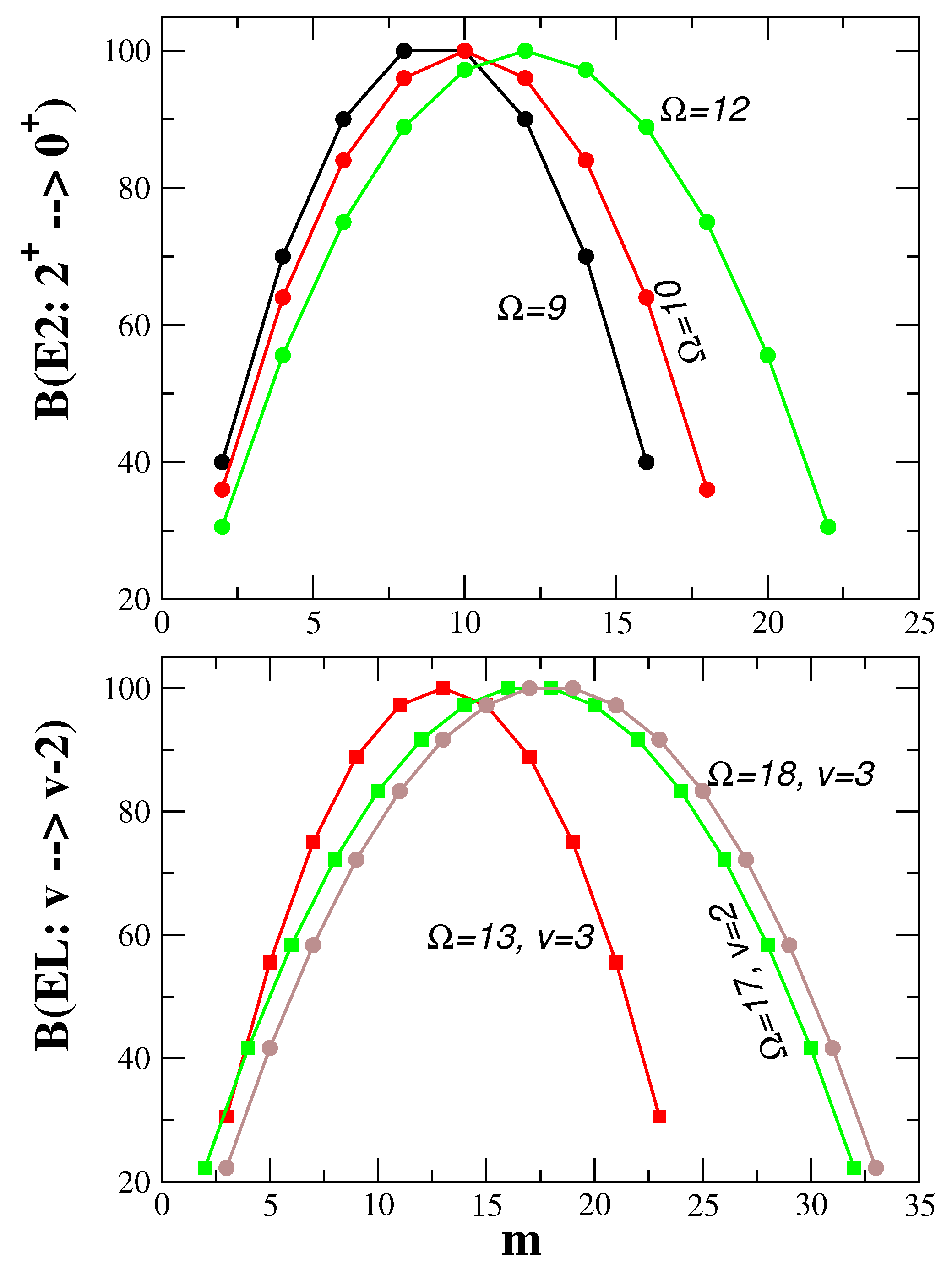
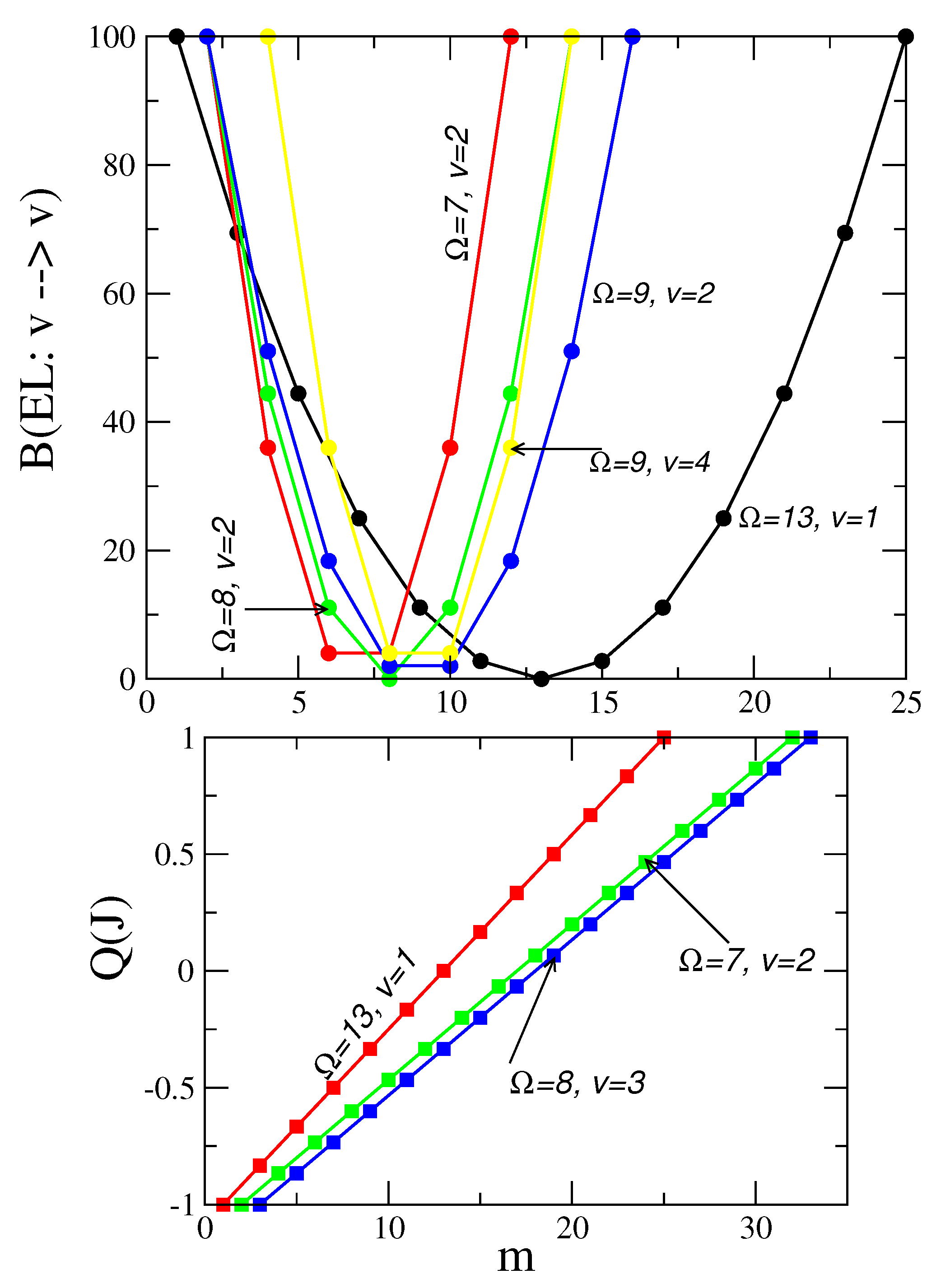
In order to understand the variation of [similarly )] for fermion systems, for states with good seniority, some numerical examples are shown in Figure 1 and Figure 2. Firstly, consider an electric multi-pole (of multi-polarity L) transition between two states with same v value. Then, the as seen from the second equation in Equation (27). Note that, with , the operators are w.r.t. . Assuming , variation of with particle number m is shown for three different values of and m varying from 2 to in Figure 1. It is clearly seen that decrease up to mid-shell and then again increases, i.e., vs m is an inverted parabola. The parabolas shift depending on the value of . In addition, shown in Figure 1 is also the variation with m for states with and 4. Assuming the ground and first excited states of a nucleus belong to and respectively, variation with particle number is calculated using the third equation in Equation (27) giving . The variation of is that it will increase up to mid-shell and then decrease; i.e., the vs m is a parabola. This is shown in Figure 2 for three different values of and again one sees a shift in the parabolas with changing. Similar is the result for more general transitions, assuming that the transitions are from states with a v value to those with ; see the lower panel in Figure 2.
Figure 1.
Upper panel shows variation of with particle number m for five different values of and seniority v for transitions. Similarly, lower panel shows variation of quadrupole moment with particle number m and for three different values of . The quadrupole moments are for states with seniority v. These results, useful in shell model description, are obtained by applying the second formula in Equation (27). The values are scaled such that the maximum value is 100 and similarly, is scaled such that the maximum value is 1. Thus, the and in the figure are not in any units. See Section 2.5 for further discussion.
Figure 2.
Upper panel shows variation of with particle number m for three different values of . Similarly, lower panel shows variation of with particle number m for transitions between states with v to states with . These results, useful in shell model description, are obtained by applying the third formula in Equation (27). The and values are scaled such that the maximum value is 100 and therefore they are not in any units. See Section 2.5 for further discussion.
First examples for the goodness of generalized seniority in nuclei are Sn isotopes. Note that for Sn isotopes the valence nucleons are neutrons with Z = 50, a magic number. From Equation (8) it is easy to see that the spacing between the first state (it will have ) and the ground state (it will have ) will be independent of m, i.e., the spacing should be same for all Sn isotopes and this is well verified by experimental data [7]. Going beyond this, recently data for Sn to Sn are analyzed using the results in Equation (27), i.e., the results in Figure 2. Data show a dip at Sn and they are close to adding two displaced parabolas; see Figure 1 in [71]. This is understood by employing , , and orbits for neutrons in Sn to Sn with and Sn core. Similarly, , , and orbits with and Sn core for Sn to Sn. Then, the vs m structure follows from Figure 2 by shifting appropriately the centers of the two parabolas in the figure and defining properly the beginning and end points. It is also shown in [71] that shell model calculations with an appropriate effective interaction in the above orbital spaces reproduce the results from the simple formulas given by seniority description and the experimental data.
In addition to data, there is now good data available for ’s and ’s for some high-spin isomer states in even Sn isotopes. These are: data for Sn to Sn and for Sn to Sn and in Sn to Sn. The states and are interpreted to be states while , and are states. Therefore, all these transitions are transitions and their variation with m will be as shown in Figure 1. This is well verified by data [70] by assuming that the active sp orbits are , and with (see also Figure 1 with ). The results with and , obtained by dropping and orbits respectively, are not in good accord with the data. In all this and in the analysis in [72,73], it is assumed that the and in Equation (27) are independent of m, i.e., they remain same for a given isotopic chain.
In summary, both the data and the and data for high-spin isomer states are explained by assuming goodness of generalized seniority with the choice but with effective values. Although the sp orbits (and hence values) used are different for the low-lying levels and the high-spin isomer states, the good agreements between data and effective generalized seniority description on one hand and the correlation coefficients presented in Section 2.4 on the other show that for Sn isotopes generalized seniority is possibly an ‘emergent symmetry’or a “partial dynamical symmetry (PDS)” (see [14] for PDS). Let us add that although detailed nuclear structure calculations are possible for Sn isotopes [91], generalized seniority gives simple explanation for trends seen in some of the observables.
Going beyond Sn isotopes, with some further assumptions, near constancy of the energies of and levels and also and using Equation (27) for ’s in Cd and Te isotopes are explained well [72]. In this study, neutrons in , , , and orbits in various combinations, depending on their occupancy, giving are employed. Further, more recently Equation (27) is applied successfully to explain empirical data on g-factors, quadrupole moments and values for the , and isomers in Hg, Pb and Po isotopes. See Figure 1 for variation of quadrupole moments with particle number m [this is obtained using the second formula in Equation (27)] and the decrease as we move towards mid-shell region is seen in data [73]. In addition, values in these isotopes are also explained [73]. In this study used are Equation (27) and neutrons in the single particle orbits , , , and giving , 17 and 18 depending on the occupancy of these orbits [73].
2.6. Summary
In this section presented are results on multiple multi-orbit pairing and the complementary algebras in coupling shell model for identical nucleons. The relationship between quasi-spin tensorial nature of one-body transition operators and the phase choices in the multi-orbit pair-creation operator is presented. As pointed out in Section 2.1 and Section 2.2, some of the results here are known before for some special situations. Selection rules for EM transition strengths as determined by multiple multi-orbit pairing algebras are presented in Section 2.3. In Section 2.4, results for the correlation coefficient between the pairing operator with different choices for phases in the generalized pair-creation operator and realistic effective interactions are presented. It is found that the choice advocated by AM [16] gives maximum correlation though its absolute value, no more than 0.3, is small. Applications using particle number variation in electromagnetic transition strengths, of multiple pairing algebras are briefly discussed in Section 2.5 drawing from the recent analysis by Maheswari and Jain [70,71,72,73]. Generalized seniority with phase choice advocated by AM appear to describe and data in Sn isotopes both for low-lying states and high-spin isomeric states. This agreement also appears to extend to Cd, Te, Hg, Pb and Po isotopes. Though deviations from the results obtained using AM choice is a signature for multiple multi-orbit pairing algebras, direct experimental evidence for the multiple pairing algebras is not yet available. This requires examination of data where EM selection rules are violated.
3. Multiple Multi-Orbit Pairing Algebras in Interacting Boson Models: Identical Boson Systems
3.1. Multiple Quasi-Spin and Complementary Pairing Algebras
Going beyond the shell model, also within the interacting boson models, i.e., for example in , , and IBM’s, again it is possible to have multiple pairing algebras as we have several ℓ orbits in these models but with bosons [21,22,23,55,56,92,93,94]. Here, as is well known, the pairing algebra is instead of [95]. Let us consider IBM with identical bosons carrying angular momentum , , …, and the parity of an orbit is . Now, again it is possible to define a generalized boson pair-creation operator as
Here, are free parameters and assumed to be real. Given the operator, the corresponding pair-annihilation operator is
Note that . The operators , and , with the number operator,
form the generalized quasi-spin SU(1,1) algebra [hereafter called —the here should not be confused with the quantum group of Kulish [96] only if
with Equation (33) we have,
Thus, in the multi-orbit situation for each
there is a algebra defined by the operators in Equations (30)–(32). Thus, in general for r number of ℓ orbits there will number of algebras. Let us mention that and provide the quasi-spin s and the quantum number giving the basis [56,92],
Here, is number of bosons and is an additional label needed for complete specification of a state with number of bosons.
Just as for fermions, corresponding to each of the algebras there will be, in the space, a subalgebra of with . The algebra is generated by the number of operators
As all the boson states need to be symmetric, they belong uniquely to the irrep of . The quadratic Casimir invariant of is easily given by
with eigenvalues
More importantly, and the generators of are [55],
Just as for fermion systems, the defined by Equation (40) is complementary to the quasi-spin defined by Equations (30)–(32) and this follows from the following relations that are proved in [55],
In the last step we have used Equations (36) and (39). Thus, the irreps of are labeled by the symmetric irreps with
In summary, we have established at the level of quadratic Casimir invariants that there are multiple algebras each with a complementary number-conserving algebra when we have identical bosons in several ℓ orbits. An important property is that the spectrum in the symmetry limit, generated by
will not depend on ; see Equation (36). However, the eigenfunctions do depend on and a method to construct the eigenfunctions is given in Appendix A. Now, as an example, we will consider the dependence on giving selection rules for EM transitions.
3.2. Selection Rules and Matrix Elements for One-Body Transition Operators
Given a general one-body operator
as , it should be clear from the generators in Equation (40) that the diagonal parts will be scalars for k odd and vectors for k even (except for ). Similarly, the off diagonal parts
will be scalars or vectors ,
Thus, the selection rules for the boson systems are similar to those for the fermion systems. Results in Equations (40) and (44) together with a condition for the seniority tensorial structure will allow us to write proper forms for the EM operators in boson systems. Let us say that is given by
If we impose the condition that the and operators are and w.r.t. , just as the fermion operators are w.r.t. (see Section 2), then
Note that for , parity selection rule implies that must be . Similarly, the parity changing and operators are,
Note that for , parity selection rule implies that must be and therefore here we need orbits of different parity as in and IBM’s. On the other hand, if we impose the condition that is w.r.t. , then
Similarly, can be chosen to be w.r.t. . Examples for , , and systems are discussed ahead.
Applying the Wigner–Eckart theorem for the many particle matrix elements in good seniority states, the number dependence of the matrix elements of and operators is easily determined. Here, we need Wigner coefficients. Using algebra (see for example [95]), we have
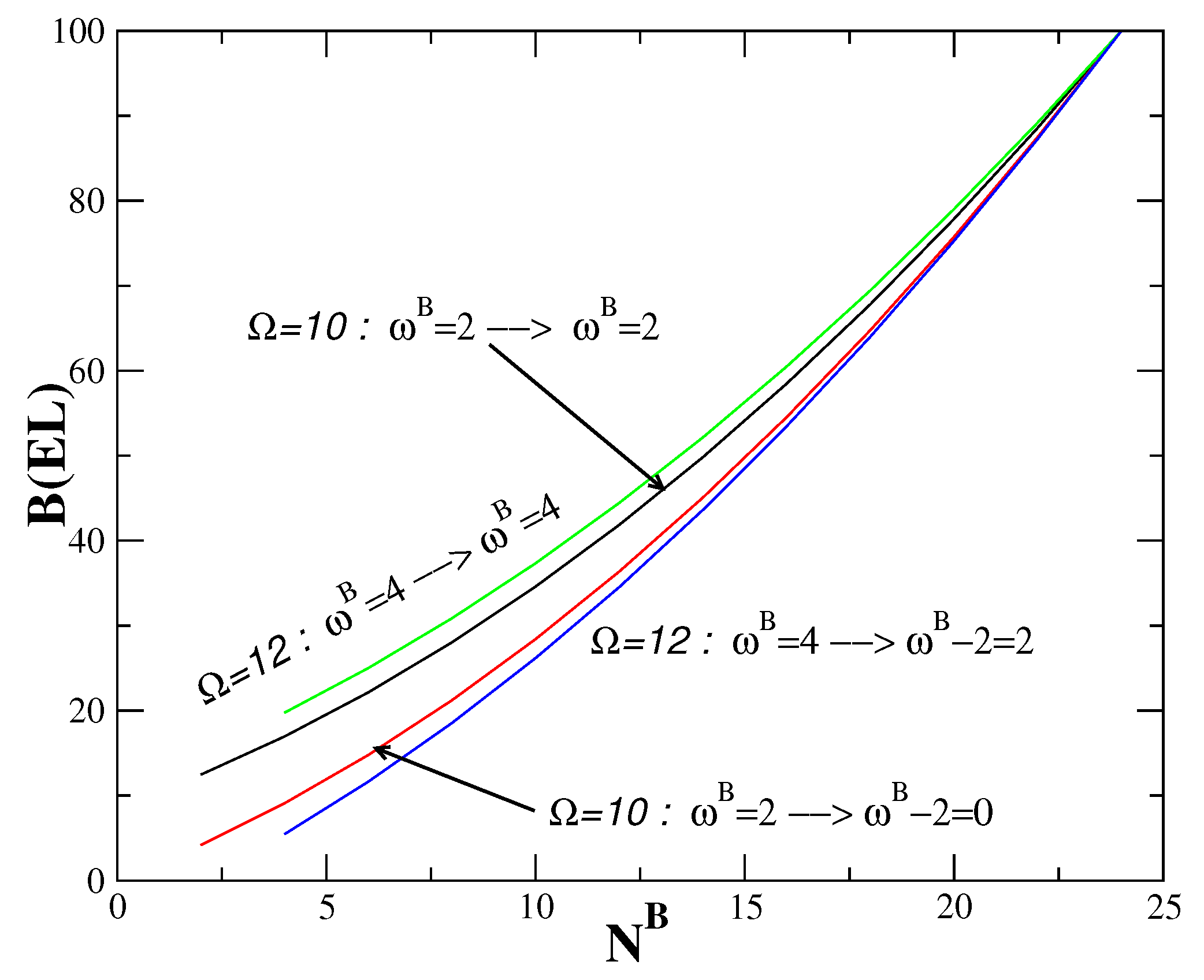
Note the well-established symmetry between the fermion and boson system formulas in Equations (27) and (49); see also [55,56,90]. Moreover, generates both and transitions while only transitions for fermion (boson) systems. The later matrix elements are independent of number of particles. Equation (49) is useful only when . In Figure 3, variation of for boson systems with boson number assuming for both and transitions are shown by employing the last two equations in Equation (49). The values increase with and this variation is quite different from the variation seen in Figure 1 and Figure 2 for fermion systems. However, for boson system such as those described by IBM, it is well known that the low-lying states correspond to highest seniority () and therefore, Equation (49) will not give, for example, trends in yrast levels.
Figure 3.
Variation of with particle number for and for transitions for two values of and seniority . Results are for boson systems and they are obtained by applying the last two equations in Equation (49). The values are scaled such that the maximum value is 100 and therefore they are not in any units. See Section 3.2 for further discussion.
3.3. Applications to EM Transition Operators
3.3.1. IBM
In the applications to interacting boson models, let us first consider the limit of IBM. Then, we have and the complementary algebra corresponds to the pair . Arima and Iachello [21] used the choice . The corresponding we denote as . Similarly, the with is denoted by . Corresponding to the two algebras, there will be two algebras as pointed out first in [97]. Their significance is seen in quantum chaos studies [98,99]. For illustration, let us consider the tensorial structure of the operator. Following the discussion in Section 3.2, the transition operator will be w.r.t. if we choose where is a constant. This is the choice made in [21] and this operator will not change the seniority quantum number (called in [21]) defining the irreps of that is complementary to . However, if we demand that the operator should be w.r.t. , then we have . This operator will have both and transitions. On the other hand, will be a mixture of and operators.
Employing , analytical formulas for ’s in the two limits are derived in [97]. Used is giving the basis states where and are and irreps with or 1 and . The rules are well known [21]. For the low-lying levels and for these the following formula was derived in [97],
and for example [21],
Thus, s carry the signature of multiple algebras in IBM.
3.3.2. IBM
In the second example we will consider the boson model, also called vibron model with applications to diatomic molecules [100] and two-body clusters in nuclei [101,102]. Just as in IBM, here we have and there will be two algebras with ; . The general form of the operator (to lowest order) in this model is . With defined by , from Equation (47) we see that will be w.r.t. . Similarly, with defined by , from Equation (46) we see that will be w.r.t. . If the definitions of are interchanged, then they will be w.r.t. the corresponding algebras. These results are described and applied in [100,103,104].
3.3.3. IBM
In the third example we will consider the interacting boson model [22] and there is new interest in this model in the context of quantum phase transitions (QPT) [105]. With s, d and g bosons, the generalized pair operator here is giving four algebras and the corresponding algebras in ; the superscripts in and similarly in are the signs of the s, d and g pair operators in . In QPT studies, Van Isacker et al. [105] have chosen the operators and to be scalars. Then, from Equation (44) it is seen that the will correspond to the algebra with where . Note that here the -part is the same as the one used by Arima and Iachello (see the IBM discussion above). In another recent study, the operator in IBM was chosen to be [106]
With respect to the above, this operator will be a mixture of and operators. However, w.r.t. , it will be a pure operator. It should be clear that with different choices of algebras (there are four of them), the QPT results for transition to rotational limit in IBM will be different. It is important to investigate this going beyond the results presented in [105]. Moreover, it will be useful to extend Equation (50) to IBM with the four (or ) algebras and test these using, say, the and data for Pd isotopes (they are examined using a different model in [107]).
3.3.4. IBM
In the final example, let us consider the model [23,93,94] applied recently with good success in describing strength distributions in Nd, Sm, Gd and Dy isotopes [108] and also spectroscopic properties (spectra, and and strengths) of even–even Ru isotopes [109]. Note that the parities of the p and f orbit are negative. In IBM, following the results in Section 3.1 and Section 3.2, there will be eight generalized pairs and the algebra complementary to the is in . Keeping the pair structure, as chosen by Arima and Iachello, of IBM intact we will have four pairs, giving and correspondingly four algebras. For each of the four choices, one can write down the and operators that transform as or w.r.t. . In [23], is employed. Then, the and operators employed in [23,108,109] will be mixture of and w.r.t. to . For example, the operator used is
The first term in the operator will be and the remaining two terms will be w.r.t. . However if we use in the above, then the whole operator will be . It will be interesting to employ the with given above (there will be four choices) in the analysis made in [109] and confront the data.
3.4. Application to QPT
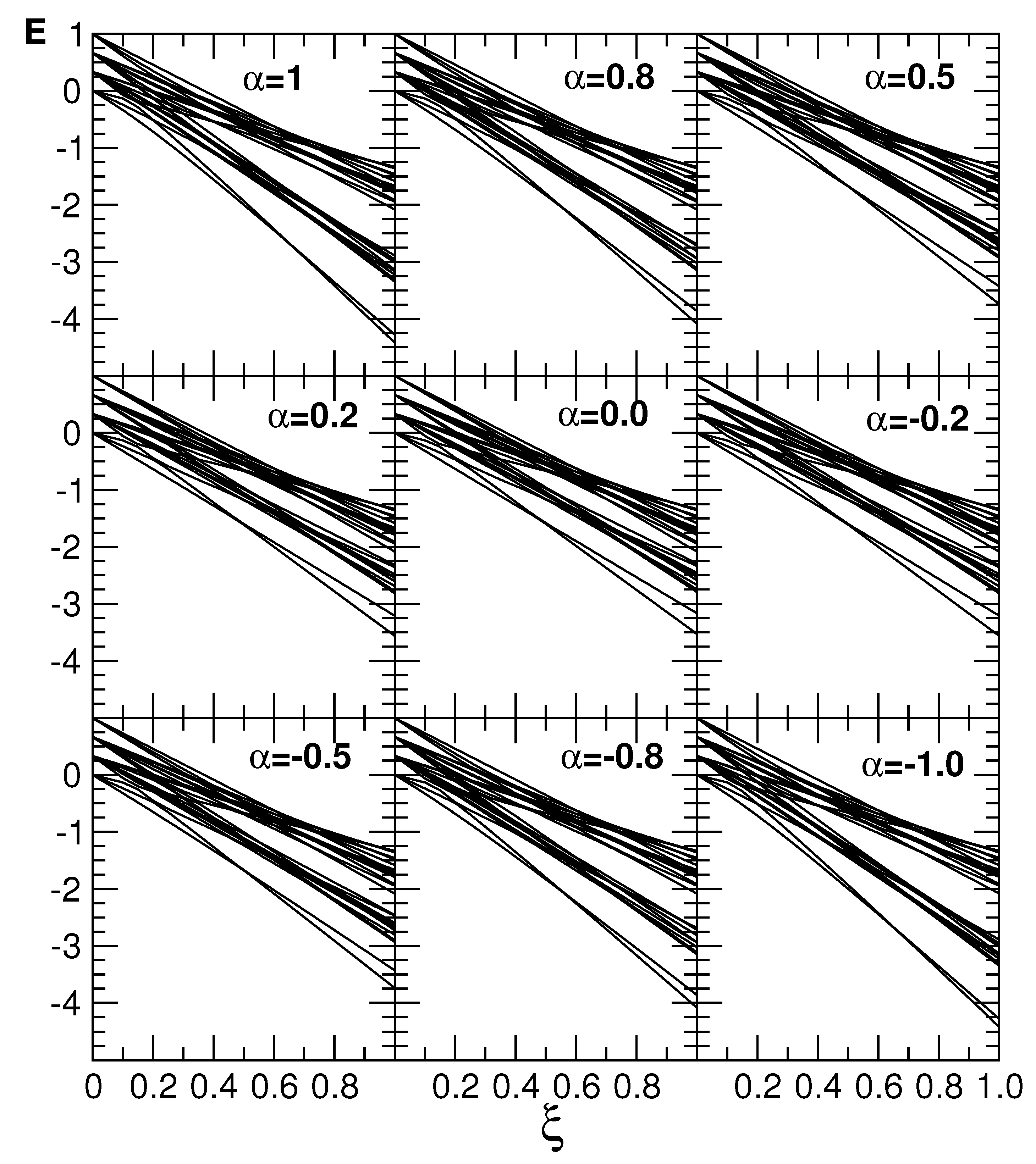
Quantum phase transitions (QPT) are studied in IBM in great detail using the , and algebras of this model [110]. This topic continues to be important with new investigations and experimental tests [111,112]. For example, with recent interest in [105] and [108,109] IBM’s, it will be interesting to study QPT and order–chaos transitions in these models, in a systematic way, employing Hamiltonians that interpolate the different pairing algebras in these models. Such studies for the simpler and IBM’s are available; see [98,99,110]. Construction of the Hamiltonian matrix for the interpolating Hamiltonians is straightforward as described briefly in Appendix A. As an example, results for the spectra for a IBM system are shown in Figure 4. The SGA for IBM is and the generalized pairing algebra here is in . Dividing the space into and g spaces, there will be two algebras and therefore it is possible to consider a Hamiltonian that interpolates the three symmetry limits
Figure 4.
Energy spectra for 50 bosons and in IBM with the Hamiltonian given by Equation (54). In each panel, energy spectra are shown as a function of the parameter taking values from 0 to 1. Results are shown in the figures for , , , , 0, , , and . Note that and correspond to the two or algebras in the model. In the figures, energies are not in any units. See Section 3.4 for further discussion.
The algebra K will not play any role in our present discussion. Note that the irrep is given by total number of bosons in the system. Number of bosons and number g bosons label the irreps of and respectively. The label . Similarly, the and labels are and respectively. The rules for are well known [113]. Employed in the calculations is the interpolating Hamiltonian
where is the operator for the boson system and for the g boson system. Results are presented in Figure 4 for a system with 50 bosons and . Figure clearly shows order–chaos–order transition as we have two or algebras in the model both giving the same spectrum for and . Let us add that QPT here was studied in the past by varying with (equivalently ) and it is shown that the transition point is [114,115]. Going further, it is possible to extend the two level results in Figure 4 using the four or algebras in s, d and g space. Then we have in place of , the operator . Explorations using this will give further insights in QPT and the role of multiple pairing algebras in IBM.
Finally, turning to fermion systems, just as using Equations (53) and (54) for QPT in IBM, it is also possible to use in a two orbit identical nucleon example (with ), a Hamiltonian interpolating between the following three algebras
A study using these and their extensions will give insights into QPT in shell model spaces.
3.5. Summary
In this section, multiple pairing algebras and the better known complementary algebras in multi-orbit interacting boson models, with identical bosons, such as , , and IBM’s are presented. The relationship between quasi-spin tensorial nature of one-body transition operators and the phase choices in the multi-orbit pair creation operator is derived for identical boson systems described by interacting boson models. All these results are presented in Section 3.1 and Section 3.2. As pointed out in these Sections, some of the results here are known before for some special situations. Turning to applications to interacting boson model description of collective states, imposing specific tensorial structure with respect to pairing algebras is possible as discussed with various examples in Section 3.3. It will be interesting to derive results for B(E2)’s (say in and IBM’s) and B(E1)’s (in IBM) with fixed tensorial structure for the transition operator but with wavefunctions that correspond to different algebras. Such an exercise was carried out before only for IBM as discussed in Section 3.3.1. Finally, an application to QPT in nuclei is presented in Section 3.4.
4. Multiple Multi-Orbit Pairing Algebras in Shell Model with Isospin
Going beyond identical nucleon (fermion) and interacting boson systems considered in Section 2 and Section 3, now we will consider pairing algebras for nucleons with isospin. As already mentioned in the introduction (Section 1), with isospin the pairing algebra is . In Section 4.1 the pairing and the complementary seniority and reduced isospin generating algebras are described for multi-j situation giving their generators and the quadratic Casimir operators. With r number of j orbits, there will be number of algebras and for each of these there will be a corresponding algebra as shown in Section 4.1. Section 4.2 gives a brief discussion of the irrep reductions and also the formulas for constructing many-particle matrix elements of the pairing Hamiltonian generating multiple algebras. In Section 4.3 presented are three applications. Finally, Section 4.4 gives a summary.
4.1. Multiple Multi-j Shell and Algebras
4.1.1. Number-Conserving Group Chain with Generating Seniority and Reduced Isospin
Let us consider a system of m nucleons in r number of spherical j orbits with defined by
In addition, let us consider the one-body operators in terms of the single particle creation and annihilation operators in angular momentum j and isospin t spaces,
where . Using angular momentum algebra it is easy to prove that the number of operators form a closed algebra (note that ) and this is the SGA . Moreover, we have the subalgebra
The operators ( in number) generate . Similarly, is generated by isospin T with given by
It is easy to prove that the commute with operators giving Equation (58). Let us add that the number operator is given by
Note that generate . Following the known results for the multi-j shell identical nucleon systems [65] and those for nucleons in a single-j shell with isospin, it is easy to recognize that and the generators of are
By simple counting, it is seen that the number of generators in Equation (61) is as required for . An important task now is to find the conditions on so that the generators in Equation (61) form algebra that is complementary to the pairing algebra; normalization factor is determined such that the quadratic Casimir operator gives eigenvalues in standard form. Before we turn to this, a few other remarks are in order.
Firstly, contains angular momentum algebra generated by where
with this, we have the decomposition, with only number-conserving operators,
All m nucleon states transform as the antisymmetric irrep of . Similarly, the irreps of will be two columned irreps in Young tableaux notation with and . Thus, the irreps are labeled by . Given a two-column irrep of , the irreps also will be at most two-columned, denoted by in Young tableaux notation. Then, is the seniority quantum number and is called reduced isospin. Group theory allows us to obtain reductions [116]. Examples are presented ahead in Section 4.2. In order to understand better the complicated algebra, the quantum numbers and their relation to pairing, we will turn to the complementary multi-j shell algebra.
4.1.2. Multiple Pairing Algebras with Isospin
Consider the angular momentum zero coupled isovector pair-creation operator for nucleons in a single-j shell,
and its hermitian adjoint ,
Now, with nucleons in orbits, pair-creation operator can be taken as a linear combination of the single-j shell pair-creation operators but with different phases giving the generalized pairing operator to be,
Similarly, the corresponding generalized pair-annihilation operator is
Using angular momentum algebra, it is easy to derive the commutators for the operators , , and . The results are independent of when as in Equation (66),
All the commutators that are not given above can be obtained by taking hermitian conjugates on both sides of the above formulas. Furthermore, we have dropped for brevity and because the results are independent of . Equation (68) shows that the ten operators , , and (equivalently ) form a pairing algebra for each set. Without loss of generality we can choose and then the remaining will be . Thus, there will be algebras. Then, with two j orbits we have two algebras and , with three we have four algebras , , and , with four j orbits there will be eight algebras and so on.
Before proceeding further, let us define isovector pairing Hamiltonians for each set,
Here, G is the pairing strength. Then, the non-zero two-body matrix elements of are,
and typically . We can prove that the quadratic Casimir invariant of is,
and this commutes with all the ten generators of . This is used to identify the complementary algebras as described below.
4.1.3. Multiple Algebras and the Complementary Algebras
With the generators of , and given in Section 4.1.1, the quadratic Casimir invariants of these algebras are
Starting with these it is easy to prove that
More importantly, carrying out considerable amount of angular momentum algebra, we are able to prove that, if the following conditions hold
then we have the equality
Thus, there is a that corresponds to the pairing Hamiltonians or the algebra. More explicitly, we have the important relation, combining Equations (71)–(73) and (75),
The Equation (76) establishes that the multiple algebras with number non-conserving generators and algebras with only number-conserving generators are complementary provided Equation (74) is satisfied along with Equation (66). As mentioned in the introduction, more formal mathematical proofs for all these are given recently by Neergard [58,59,60,61]. It is also important to add that the expressions for Casimir invariants, in a different form, are given by Racah very early [10,117].
Given the irrep or equivalently , the eigenvalues of are given by (see for example [56,118])
Further, irreps are labeled by with and both integers or half integers and [56,116,118]. Then, the eigenvalues of are
Moreover, Equations (69), (71) (76) and (77) will give the eigenvalues of the isovector pairing Hamiltonian as
Note that subalgebra with generating T, generating ( quantum number (N-Z)/2) and generating particle number or . Then, the eigenstates of are
In Equation (81), are additional labels that may be needed for complete classification of the eigenstates. Though the labels in Equation (81) do not depend on , explicit structure of the wavefunctions do depend on ; see Section 4.3. Thus, they will effect various selection rules and matrix elements of certain transition operators (see Section 4.3). Finally, with algebra it is possible to factorize dependence of various matrix elements and this is the most important application of pairing algebra [7,33,42].
4.2. Classification of Symmetry Adopted States and Their Construction
4.2.1. Classification of States
The first important question to be addressed, in applications of , is enumeration of the irrep labels in Equation (81). To this end we will use . Rules for enumerating the irreps allowed for a given irrep are well known [116,119,120,121] and used for example in [53]. The allowed irreps are given by the Kronecker product of the irrep with all allowed type irreps. All final irreps are irreps for m nucleons with and (where appropriate, we need to use particle-hole equivalence of irreps). Let us consider states and then and . Therefore, for we have
Note that here m is even. For we have and then . Therefore, for we have
Note that m is odd here. Results in Equations (82) and (83) are given in [7] and in many other papers by using quite different methods. Proceeding further with , there are two irreps and and they correspond to and respectively. Then, for we have
Finally, for we have
Note that here m is even and . A significant result that follows from Equation (85) is that here there will be T multiplicity. Moreover, in Equations (82)–(85) we need to apply particle-hole relation where appropriate (see Table 1, Table 2, Table 3 and Table 4 for examples).
Table 2.
Allowed T values for , 6, 4, 2 and 0 number of nucleons in an orbit for , and . Results in column 3 are for and in column 6 are for . See Section 4.2.1 for further discussion.
Table 3.
Basis states for a system with and positive parity. Quantum numbers are shown for seniorities in the two orbits and . See Section 4.2.1 for further discussion.
In reality, when pairing is important, often it is sufficient to enumerate the allowed T values for a given and m with seniority , 1 and 2. However, the procedure used above extends to any v. For example, for the system, for the only. Therefore, for we have giving only. For we have giving , 1 and 2. Similarly, for we have giving , 2 and 3. Finally, for we have , , and . In the same manner, for with we have , and .
Table 2 gives some examples for the basis state quantum numbers for , 6, 4, 2 and 0. Considered are systems with and 6. These results are obtained using the formulas in Equations (82)–(85). It is useful to note that in the table means T is appearing x number of times. In some of the results in the table we have applied particle hole equivalence. For example for , and in Equation (82) for and , the irrep goes to due to equivalence giving instead of 4. Similarly, for , and the irrep goes to giving instead of and for , the goes to giving instead of 6. In addition for some other , the restrictions on s in Equation (85) apply. Given the results in Table 2, the basis states with positive parity and for an example of eight nucleons in two-orbits, with the first orbit having with −ve parity and second orbit having with positive parity, will be 30 in number. These are listed in Table 3.
4.2.2. Construction of Many-Particle Pairing H Matrix with Multiple Algebras
In order to probe the role of multiple pair algebras with isospin, we need to obtain the eigenstates of the pairing Hamiltonian as a function of ’s. A convenient basis for constructing the matrix is the product basis defined by the single-j shell basis. We will illustrate this using two j-orbits, say and . Hereafter, we call the corresponding spaces a and b respectively (or 1 and 2). Then, the basis states are,
Given m number of nucleons with nucleons in number in the first orbit and in the second orbit, . Then, with and , we have and . Similarly and are the isospins in the two spaces respectively. Furthermore, the (or ) labels are additional labels that are required as discussed in [33,35]; see Equation (90) ahead. In the second line in Equation (86), we used the equivalent and often simpler labels and instead of (or ). Now, a general pairing Hamiltonian is,
Here is the number operator for the second orbit and and are parameters changing from 0 to 1 and to respectively. Note that for and we have a algebra in the total two-orbit space and similarly for and the algebra. This follows from the results in Section 4.1.
The diagonal matrix elements of in the basis defined by Equation (86) follow easily from Equations (79) and (80) and they will be independent of the labels. With giving in the chosen basis, we have
Similarly, off-diagonal matrix elements follow from the tensorial structure of and operators. The general tensorial form is . Then, tensorial structure in the j-space is and tensorial structure within a phase factor is . Now, the off-diagonal matrix elements of are first written in terms of the product of the reduced matrix elements of and in the and spaces. Then, applying the Wigner–Eckart theorem using the reduced Wigner coefficients and the formula
as described in detail in [33] (see Equation (14) of this paper) will finally give,
Note that , , and . Similarly, the are the reduced Wigner coefficients.
For the system considered in the next section, the needed Wigner coefficients follow from Tables III in [33] and Table A.1 of [35]. It is important to mention that the labels are not needed for the irreps of the type . For the irreps used is the label as defined in [35]. This gives for example for , in the convention used in [35],
Finally, Equation (89) can be extended to three or more orbits by using isospin T couplings. Thus, construction is possible with multiple algebras provided all the needed Wigner coefficients in Equation (89) are known. It is useful to add that the basis defined by Equation (86), with multi-orbit extension was employed in the Rochester–Oak Ridge shell model code [15].
4.3. Applications of Multiple and Algebras
4.3.1. Selection Rules for Electromagnetic Transitions
Electromagnetic transition operators and are one-body operators and selection rules for these follow from their tensorial structure. The general tensorial form is . Firstly, the creation operators transform as . Similarly, the annihilation operator with an appropriate phase factor transforms as . Therefore the tensorial structure of one-body operators (they will be of the form ) is given by where
Note that irrep is ten-dimensional, five-dimensional and is one-dimensional. The general formula for dimensions is [116,118],
Clearly, the 10 generators transform as the irrep of but not as the irrep of another with .
With or M, the general form of electric and magnetic multi-pole operators, ignoring the isospin part, is
As the electric and magnetic L-th multi-pole transition operators are one-body operators, their tensorial character is . Action of the part on a irrep is simple. The and parts acting on a state with irrep will generate states with irreps and the rules for enumerating the allowed correspond to the Kronecker product
For the irreps of interest for the examples considered in Section 4.2, Section 4.3.2 and Section 4.3.3 the following results for Kronecker products will suffice and they follow from the rules given in [116,119,120],
These can be changed easily into the rules for .
With for one-body operators, a isoscalar will be ; the irrep gives only isovector operators. Thus, isoscalar transition that involve states with different will be generated purely by the irrep part of . Further, Equations (61), (74) and (93) show that it is possible for and to be generators of depending on . Then, they will preserve or quantum numbers (note that the group generators when acting on group irreps will not change the irrep labels). With these, we have the following results.
- The isovector parts of and will not be scalars as the generators of this algebra consists of only isoscalar operators.
- The with L even (they preserve parity) will not be generators of any as are not generators. In addition, even for L odd [they change parity and hence we need , the will not be generators of ; see Equation (26).
- The isoscalar part of with L odd (they preserve parity) can be scalars. Firstly, the first part of as given by Equation (93) consists of only the generators of as L is odd. The second part also consists of only the generators provided one uses the Arvieu and Moszkowski [7,16] choice of for the orbits; see Equation (26).
- The with L even will change parity and hence the involve only the second part in Equation (93). Clearly, the isoscalar will be scalars if for the orbits.
With the phase choice , the selection rule from the generators that they will not change or irreps can be used for transitions in experimental tests. Moreover, if in an energy region high seniority v states occur with the immediate states below it having seniority , then all EL and ML transitions will be forbidden to these levels as EL and ML transitions can change seniority only by units of 2, i.e., transition for states only allowed. In addition, the dependence of, say, magnetic moments and ’s can be written down using the Wigner coefficients listed in [33,34,35]; see Ref. [7] for some examples.
4.3.2. Energy Levels and Order–Chaos Transitions
In the second application, let us consider a two level system with first level having with −ve parity and the second level having with +ve parity. This is appropriate for nuclei in A = 56–80 region so that the (, , ) orbits with degenerate single particle levels giving the orbit (we will call it orbit #1 or (a) and giving the orbit (we will call it orbit #2 or (b). In our numerical calculations we use the system with six nucleons in the above two orbits and without any restriction on in any of the two orbits. Then, the number of +ve parity basis states for and with all allowed , () will be 24 and these are listed in Table 4. It is important to note that the basis states are multiplicity free.
Table 4.
Basis states for the system with and for all allowed and . Here, and . See Section 4.3.2 for further discussion.
Table 4.
Basis states for the system with and for all allowed and . Here, and . See Section 4.3.2 for further discussion.
| 1 | |
| 2 | |
| 3 | |
| 4 | |
| 5 | |
| 6 | |
| 7 | |
| 8 | |
| 9 | |
| 10 | |
| 11 | |
| 12 | |
| 13 | |
| 14 | |
| 15 | |
| 16 | |
| 17 | |
| 18 | |
| 19 | |
| 20 | |
| 21 | |
| 22 | |
| 23 | |
| 24 |
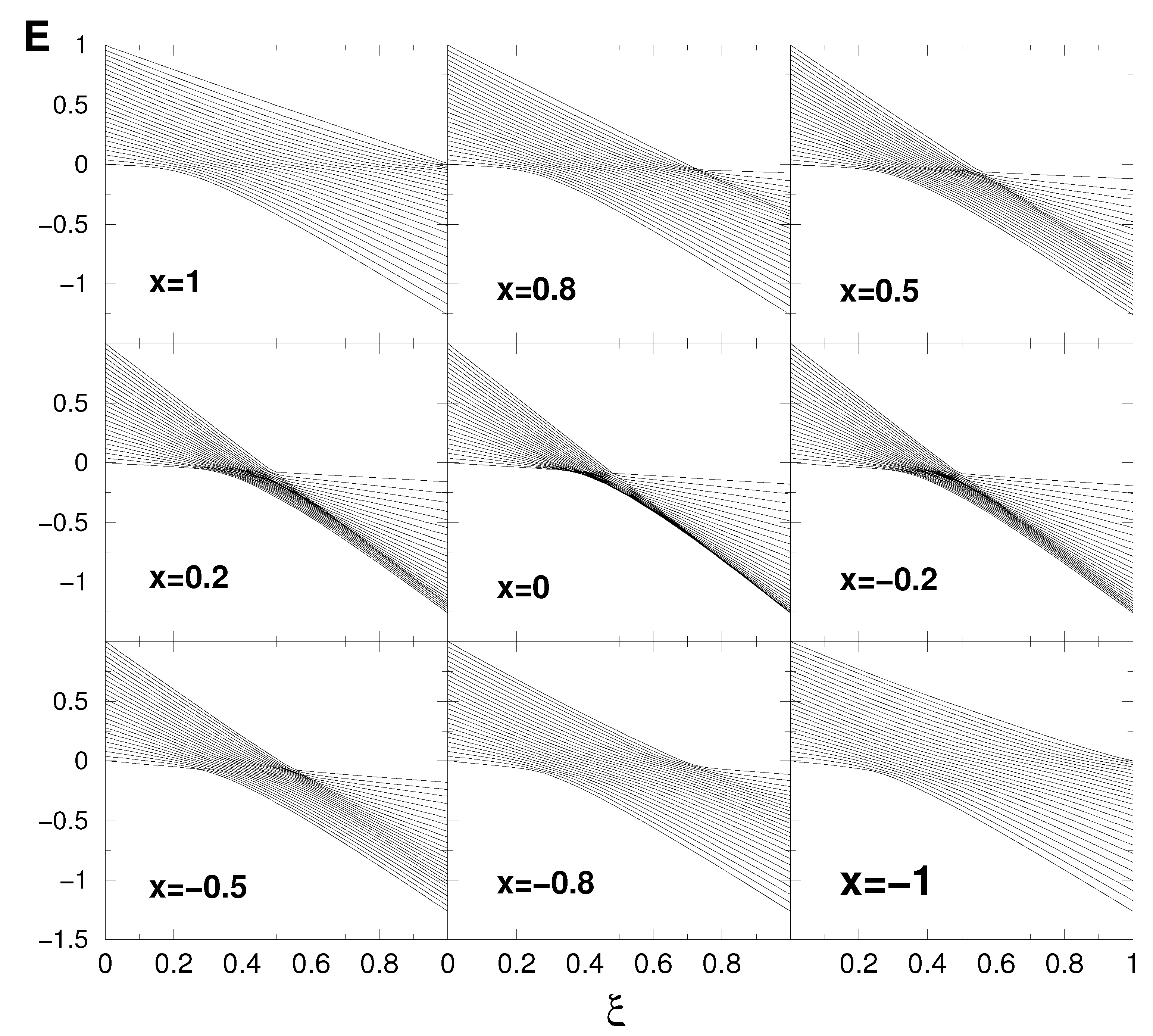
Using the basis states in Table 4, the matrix for defined by Equation (87) is constructed using Equation (88) for the diagonal matrix elements and Equation (89) for the off-diagonal matrix elements. The Wigner coefficients needed are all available from Table III in [33] and Table A.1 in [35]. As we are using all allowed states in the and space for six nucleons () with , diagonalization of will give eigenvalues that must be same as those given by Equation (80) with and , and . The eigenvalues are 0, and respectively. Thus, there will be degeneracies in the spectrum. There are two states with eigenvalue and , nine with eigenvalue and and thirteen with eigenvalue 0 and . It is easy to see that the wavefunctions are of the form where are additional labels. Therefore, a sum of and will remove some of the degeneracies in the spectrum without changing the eigenvectors. Following this, we have added the term to , i.e., used the modified Hamiltonian
and calculated the eigenvalues for the system. Shown in Figure 5 are the energies of the 24 states as a function of for nine values. In Table 5 the wavefunctions structure for (with ) is shown for all the 24 wavefunctions. With the dependence shown in the Table, clearly the two and limits generate different results for EM transition strengths, two nucleon transfer (TNT) strengths etc. Some TNT examples are discussed in the next subsection.
Figure 5.
Energy spectra generated by the pairing Hamiltonian in Equation (95) as a function of and . Note that the energies (E) are unitless. Results are for a two-orbit system with . See Section 4.3.2 for further discussion.
Table 5.
Eigenvalues (E) and eigenstates () for the system with and positive parity. Eigenstates are given as an expansion in the basis states given in Table 4. As stated in the text, eigenstates are of the form . See Section 4.3.2 for further discussion.
As seen from Figure 5, clearly by changing it is possible to study order–chaos–order transitions as the spectrum for and is identical. The QPT here is smoothed as we have a fermion system and the particle number is not large. It is easy to see that as we change and , there is transition among the following three group chains
4.3.3. Two-Nucleon Transfer
In order to bring out explicitly the role of multiple algebras, we will consider in this Subsection two-particle transfer. As an example let us consider removal of a isovector pair from the lowest state (see Table 5) of the system considered in Section 4.3.2 and this will generate some of the states of the system. To study the transfer strengths, we have diagonalized in space and the basis states here are 14 in number; see Table 6. Then, the eigenstates (see Table 7) belong to , and irreps of in the four-nucleon space. There are three, two and nine states respectively with these irreps [the corresponding eigenvalues are , and 0 respectively if we drop the parts in Equation (95)]. The transition operator is chosen to be
and and here correspond to the and spaces. Acting with the operator P on the ground state (gs) will generate states #4 and #7 in Table 7 of the system. From Table 5 we have,
Table 6.
Basis states for the system with and for all allowed and . Here, and . See Section 4.3.3 for further discussion.
Table 7.
Eigenvalues (E) and eigenstates () for the system with and positive parity. Eigenstates are given as an expansion in the basis states given in Table 6. As stated in the text, eigenstates are of the form . See Section 4.3.3 for further discussion.
As both operators will not change and in Equation (98), clearly only the states #4 and #7 listed in Table 7 will be generated by the action of . Then, the transfer strengths are given by
As all the states appearing in Equation (99) contain the parameter [ for and for ], the two-particle transfer strengths carry information about , i.e., multiple algebras. With the states having the structure , the reduced matrix elements in Equation (99) will be sum of the reduced matrix elements of and in the and spaces respectively (each multiplied by a factor as follows from Equations (7.1.7) and (7.1.8) in [78]). Formula for the reduced matrix elements of is [33],
All the Wigner coefficients in Equation (100) are available in [33]. Using these and carrying out all the simplifications will give
It is clearly seen that for , the transition from to state #7 of system is forbidden. This is due to the fact that for , the transfer operator is a generator of and the six-particle state belongs to irrep while the four-particle state belongs to irrep; see Table 5 and Table 7. Equation (101) clearly shows that the two-particle transfer strengths depend on (i.e., they are different for and ) in the situation . Finally, it is also possible to consider , and pairs in the ground states of a system and study their dependence; see [39,40] for the importance of such a study.
4.4. Summary
Multiple multi-orbit pairing and the complementary algebras with isospin degree of freedom for nucleons are described in this section. The complementarity is established at the level of quadratic Casimir operators. Besides giving some details of these algebras in Section 4.1, described in Section 4.2 are the methods for obtaining the irrep labels for algebra, i.e., the allowed values of T for a given m of and of . Tables are given for some particle numbers of interest. In addition, a method to construct symmetry defined Hamiltonian matrix in a two space example is also given. In this situation there will be two algebras and the wavefunctions that correspond to the two algebras are tabulated explicitly in two examples. Going further, in Section 4.3 three applications of multiple algebras are described and these are: (i) selection rules for EM operators; (ii) a simple Hamiltonian generating order–chaos–order transitions; (iii) two nucleon transfer strength. Further exploration of these and other examples will give us more signatures that are useful in finding empirical examples for multiple algebras in nuclei.
5. Multiple Pairing Algebras in Proton–Neutron Interacting Boson Model with Fictitious () Spin
For a two-species boson systems (such as the proton–neutron interacting boson model (IBM or IBM2) [21]), it is possible to introduce a fictitious (F) spin for the bosons such that the two projections of F represent the two species. Then, for N bosons the total fictitious spin F takes values , , …, 0 or . For such a system with N number of bosons occupying orbits with angular momentum and the Hamiltonian preserving F-spin, the SGA is with generating F-spin and . For example, for IBM, IBM and IBM we have , 15 and 16 respectively. There is good evidence that heavy nuclei preserve F-spin [21,122,123,124,125]. Here below we will show that they are multiple pairing algebras for boson systems with F-spin and consider some of their applications. It is important to stress that although we consider pairing algebras for bosons, their physical interpretation is different as is well known in the example of the limit of IBM-1 [21].
5.1. Multiple Pairing Algebras with F-Spin
Let us consider a system of N bosons in r number of spherical ℓ orbits and each boson carrying F-spin degree of freedom. Then, total number of degrees of freedom for a singe boson is where and . Now, it is easy to see that the number of one-body operators , with and 1,
where and b are single boson creation and annihilation operators in angular momentum and F-spin spaces, generate the SGA . Note that . Moreover, with good F-spin symmetry, we have the subalgebra
The operators [ in number] generate . Similarly, is generated by F-spin operator where
In addition, the number operator and the total angular momentum operator are given by
Note that generate . It is useful to note that all N boson states transform as the symmetric irrep of and the irreps of will be two-rowed, given by , in Young tableaux notation with and . Thus, the irreps are labeled by or .
Turning to pairing, for boson systems with F-spin and a single ℓ orbit, the pair-creation operator with angular momentum zero and F-spin 1 is where
and its hermitian adjoint is,
Now, with bosons in orbits, the pair-creation operator can be taken as a linear combination of the single-ℓ shell pair-creation operators but with different phases giving the generalized pairing operator (it is no longer unique) to be,
The corresponding generalized pair-annihilation operator is
Using straightforward but lengthy angular momentum algebra, it is easy to derive the commutators for the operators , , and . Note the difference in for fermions. The results are independent of when as in Equation (108),
Equation (110) shows that the ten operators , , and (equivalently ) form an algebra for each set and this is the non-compact Lie algebra . This was pointed out for the first time for bosons with F-spin by Lerma et al. [47]. Some mathematical details of algebra are given [118] and references therein. Without loss of generality we can choose and then the remaining will be . Thus, there will be algebras. Then, with two ℓ orbits we have two algebras and , with three ℓ orbits we have four algebras , , and , with four ℓ orbits there will be eight algebras and so on. Before proceeding further, let us introduce the pairing Hamiltonians for bosons,
where is the pairing strength. Now we will consider the complementary algebra for further results.
5.2. Complementary Algebras
Starting with the SGA , it is easy to recognize that and the generators of are
with and X determined such that is complementary to the pairing algebra. Towards this end we will define the quadratic Casimir operators () of the various algebras involved and then we will use the formulas for their eigenvalues as given for example in [118]. The quadratic Casimir invariants of , and are
Using angular momentum algebra and Equation (113) the following important relations are derived,
and the second equality above is valid only when
Note that for proper scaling for the Casimir operators, also needed is
with defining the generalized pair , we have from Equations (114) and (115) the correspondence
and solves the pairing Hamiltonian given by Equation (111). With the irreps labeled by or , the irreps are labeled by with or by where and . Then, is seniority, like quantum number, and f is reduced F-spin. With these, the symmetry algebra and the corresponding basis states are
where are additional labels needed for complete specification of the basis states and is eigenvalue with . Note that sometimes is included in . Formulas for the eigenvalues of the and are well known [56,118,121],
The first formula here also follows easily from the first equality in Equation (114). Using Equations (111), (114) and (117) we have
Thus, the pairing Hamiltonian is solvable by the symmetry (pairing eigenvalues do not depend on and ). In order to establish the above correspondence with algebra, we will rewrite the second formula in Equation (117) as
with these we can identify the subalgebra of algebra, the corresponding irrep labels (basis states) and the quadratic Casimir operator of ,
Then, we have the formula
5.3. Irreducible Representations
For labeling the eigenstates of , for a N boson system we need the irrep reductions . A simple method for this is to use the results for Kronecker products (denoted by × below) of the irreps of and similarly for . The rules for these follow from the Schur functions theory as given in [116,119,120] and for the present purpose the simplified results given for example in [56,113] will be adequate (see also Section 3). Given a two-rowed irrep of , it can be expanded in terms of Kronecker products involving only symmetric irreps,
Similarly, the Kronecker product of any two symmetric irreps, with , will give
Equations (122) and (123) along with the well known result from the pairing algebra for identical boson systems [65],
will give the reductions for any to ’s. Note that in Equation (124) is the symmetric irrep of with and similarly is a symmetric irrep of with . Using Equations (122)–(124) we obtain for example
In these equations is the integer part of and there is multiplicity (i.e., some irreps appear more than once) in the reductions. For , numerical results for the reductions can be obtained easily using Equations (122)–(124) as they are easy to program. Table 8 gives results for and Table 9 gives results for .
Table 8.
irreps reductions to irreps for to 15 and . The irreps are given as where is the multiplicity. Note that , , and . See Section 5.3 for further discussion.
Table 9.
irreps reductions to irreps for to 14 and . The irreps are given as where is the multiplicity. Note that , , and . See Section 5.3 for further discussion.
For boson systems, it is well known that the states with will be lowest in energy and then those with [21]. In order to obtain this ordering, it is necessary to add Majorana interaction (M) term as recognized in IBM studies. Then, changes to
with eigenvalues being . See [21,126] for details regarding the Majorana term M. The eigenvalues E for some states with and are,
These show the important result that for and , the states with will be lowest in energy and the states with will lie at energy above the states and they will be next higher states. If , the states will not be separated from states. The states with are called mixed symmetry states [21]. From Equation (127), it is clear that the formulas for irrep reductions given in Equations (124) and (125) and the results in Table 8 and Table 9 are sufficient for most applications.
5.4. Applications
5.4.1. Selection Rules
In the symmetry limit, selection rules for EM transitions follow from Equations (112) and (115). It is easy to see that only the isoscalar part of the EM operators will have selection rules. General form of the isoscalar part of EM operators is, with or M,
Therefore, isoscalar part of EL operators with L even will be generators and therefore connect only states having the same [or ] provided we choose the operators such that for all ℓ and in Equation (128) are such that Equation (115) is satisfied. This is indeed the choice made for quadrupole () transition operator in IBM-2 studies [21,124,125]. However, for operators with L-even, due to parity selection rule will not exist. Therefore, they will connect only states having the same [or ] provided we choose the operators such that in Equation (128) satisfy Equation (115). Turning to EM operators with L odd, both EL and ML operators with L odd will connect only states having the same [or ] provided we choose the operators such that in Equation (128) satisfy Equation (115). This is due the fact that with L odd (they are needed only for ML operators while they do not exist for EL operators due to parity selection rule) are generators of . It is important to add that the selection rules for the isoscalar part of EM operators will be violated if the in are not same as the needed for defining in Equation (128) via Equation (115). These selection rules may provide some tests of the multiple pairing algebras with good F-spin in interacting boson models (, , , etc) of nuclei.
5.4.2. H Matrix Construction
Results for electromagnetic transition strengths, as generated by multiple multi-orbit pairing algebras, can be obtained by developing the Wigner–Racah algebra for and following the same procedure that is adopted in Section 4 for multiple multi-orbit algebras with isospin in shell model. It may be possible in future to follow the methods used in Refs. [30,31,32,33,34,35,36,37,38] to obtain Wigner and Racah coefficients. As these group theory results, to our knowledge, are not available, an alternative is to construct the H matrix in a convenient basis and obtain the eigenfuctions generated for different choices of in Equations (108) and (111). To this end, one can use the basis, i.e., a basis with proton () and neutron () bosons. We will use the notation and . More explicitly, for a system of interacting bosons with sp angular momenta , a convenient basis is
Here, is number of proton bosons, is number of neutron bosons giving the total number of bosons. Similarly, and being the ℓ boson seniorities in and spaces. For a given nucleus or are preserved. Similarly, are the angular momentum of the number of bosons with sp angular momentum . Further, L is the total angular momentum obtained by vector addition of all . In addition, and are additional labels needed for complete specification of the basis states.
For example, the pairing Hamiltonian in terms of and bosons is
The and operators appearing above are as defined by Equations (30) and (31). Following the results in Appendix A, it is easy to write the matrix element of the terms involving and in the basis given by Equation (129). For the Second term in Equation (130) we need the reduced matrix elements of and tables, formulas and computer programmes for these are available for (p bosons), 2 (d bosons), 3 (f) bosons and 4 (g) bosons; see for example [21,100,127,128,129]. Let us add that it is possible to consider a more general H with the basis given in Equation (129), for example by adding splitting of single ℓ-orbit energies. Without explicit matrix construction, energy eigenvalues are obtained in [47] by employing the so called Richardson–Gaudin (RG) equations. Studied in [47] are energy spectra in , and boson systems (however, in this study multiple pairing algebras with F-spin are not considered). Let us add that it may be possible also to use in proton–neutron spaces the methods developed by Feng Pan et al. [19]. Further investigations using these approaches or by constructing the H matrix explicitly will give new insights into multiple pairing algebras in interacting boson models with F-spin but this is for future.
Going beyond IBM-2, in IBM-2, IBM-2, IBM-2 and so on, there will be many pairing algebras. For example, in IBM-2 the SGA is and the first pairing algebra corresponds to in
with pair operator
The can be decomposed further into three subalgebras
There are algebras corresponding to all these algebras. It is important to recognize that the choice of the four signs in will uniquely fix the sign choices of the pair-creation operators that correspond to the various algebras in the three subalgebras given above. Investigations of these various multiple pair algebras may prove to be useful.
5.5. Summary
Multiple multi-orbit pairing and the complementary algebras with F-spin in the proton–neutron interacting boson models of nuclei are described in this Section. The complementarity is established at the level of quadratic Casimir operators. Besides giving some details of these algebras in Section 5.1 and Section 5.2, described in Section 5.3 are the methods for obtaining the irrep labels for algebra, i.e., the allowed values of of for a given . Results for , , , and are presented. Going further, in Section 5.4 some possible applications of multiple algebras are described. Further explorations using group theory approach as in Section 4 but extended to , by explicit matrix construction, using the RG method employed in [47]) or by extending the methods developed by Feng Pan are expected to give us signatures that are useful in finding empirical examples for multiple algebras in nuclei.
6. Multiple Pairing Algebras with Coupling in Shell Model and in IBM with Isospin Degree of Freedom
In the shell model with coupling, a coupled nucleon pair carries spin-isospin degrees of freedom and . With this, the pairing algebra is as established first in [48]. More importantly, with nucleons occupying several ℓ-orbits, there will be multiple algebras and each of them contains both isoscalar and isovector pair-creation operators unlike only isovector pair operator in the pairing algebra for nucleons in j orbits (see Section 4). The algebra is complex with three subalgebra chains as discussed ahead in Section 6.1. In addition, in Section 6.2 we will describe briefly the various pairing algebras in the interacting boson model with the bosons carrying isospin degree of freedom (called IBM-3 or IBM-T [21,56]). Here also, there will be multiple pairing algebras for , , , , … boson systems. As the algebras appearing in this Section are quite complex, the presentation will be brief without too many details. We hope that the discussion here will prompt many investigations of these algebras in future.
6.1. Multiple Pairing Algebras in Shell Model
6.1.1. and Its Three Subalgebras
In the shell model, in the situation that nucleons occupy ℓ orbits (i.e., they occupy both orbits), then the nucleon pair coupled to orbital angular momentum zero, due to antisymmetry, carries spin-isospin degrees of freedom and . With this, the isoscalar and isovector pair-creation operators and respectively are
with . Note that we are using order in Equation (131). For the multi-orbit case, we have generalized isoscalar and isovector pair operators and as linear combinations of single orbit operators except for phase factors giving
Now, the isoscalar plus isovector pairing Hamiltonian in -coupling is
Note that and . Most significant result here is that the twelve operators , , , ), the six spin and isospin generators (, ), the number operator [or , ] and the nine operators, a total of 28 operators generate a algebra independent of the in Equation (132) [48,53] (note that the algebra appearing here is different from the appearing in the schematic model for monopole and quadrupole pairing in nuclei by Ginocchio [130]). Thus, there are multiple algebras in shell model and the number is for r number of ℓ orbits. Going further, each algebra admits three subalgebra chains and the pairing Hamiltonian in Equation (133) is diagonal in the basis defined by these subalgebra chains for . These are [48,53],
Noted that above is the same as the well known spin-isospin supermultiplet algebra [131]. By varying the parameter x in Equation (133), it is possible to study the competition between isoscalar and isovector pairing. It is important to recognize that contains only the generators of and therefore for all x values, the eigenstates will carry quantum numbers. It is well known that irreps contain four numbers and they can be recasted into a seniority quantum number v and three other numbers. It is useful to add that the shell model SGA is and the three subalgebra chains of this SGA that are in one-to-one correspondence with the chains in Equation (134) are
Using group theory, all the irrep labels for the algebras in Equation (135) can be determined and by correspondence, the irrep labels of the algebras in Equation (134). See [53,54] for details. Most importantly, for the seniority a convenient set of basis states for a given number m of nucleons and a given value of are the basis states, i.e., the states given by the chain with above. These states are labeled by
The various quantum numbers appearing here are given by (assuming m is even) [49,53,54],
For the limit, for the above seniority basis states, the Wigner–Racah algebra was developed in [49]. Further, the algebra is also available for and states; see [49,52]. Using these, spectra and two-nucleon and transfer strengths are studied in some detail using H with pairing and considering only seniority in [50,51]. The algebra was also applied to study some aspects of double -decay matrix elements in [132] and in the study of some aspects of IBM-4 (interacting boson model with spin-isospin degrees of freedom) in [133,134].
6.1.2. Two-Nucleon Transfer in a Two-Orbit System
With our interest in this article being on multiple algebras, here below we will consider the simpler two-orbit situation and present some results for two-nucleon transfer that distinguishes the two algebras. Note that with two orbits there will be two algebras, with three orbits there will be four algebras and so on.
Let us consider two orbits with taking values say for the first orbit and for the second orbit. Given that there are say m number of nucleons in these orbits, we can distribute them in these orbits in all possible ways. Then, with number of nucleons in orbit #1 and in orbit #2. For each we can generate the basis states in spaces 1 and 2 using Equation (136). Table 10 gives an example with , and with total . Note that the basis states are of the form,
and here one is restricting the seniorities and in the two spaces to and . With , the above is defined by following Equation (136) and similarly the by . Finally, the labels in Equation (137) will not play any role in the results presented here. Using the above basis and the algebra given in [49,131], it is possible to construct the H matrix for the isoscalar plus isovector pairing Hamiltonian,
Table 10.
limit quantum numbers for the basis states in a two-orbit example with and . Shown are the quantum numbers for eight nucleons () with total . Note that the seniorities for the nucleons in the two orbits are zero. See Section 6.1.2 for further discussion.
Adding the splitting of the energies of the two orbits and restricting to , spectra, two nucleon transfer strengths and transfer strengths are studied in two-orbit examples in [51] and the systems studied are found to exhibit several interesting phase transitions. As our interest is in multiple algebras, we have analyzed the eigenvalues and eigenvectors for various values as generated by for and using , and . The results are as follows. Firstly, as is well known, the eigenvalues do not depend on and this is seen in the calculated results. For , the eigevalues with respect to the eigenvalue of state for , , , , , and are 38, 48, 6, 48, 58, 46 and 46 respectively. Further, for , they are 42, 76, 20, 42, 76, 42 and 22. Similarly, for they are 6, 20, 20, 26, 40, 22 and 42. These eigenvalues, all independent of , clearly show that the spectrum in isospin space, as expected [53], for is rotational and for close to vibrational (see the spacing between , 2 and 4 states). However, the eigenfunctions do depend on . In order to exhibit this feature, we have studied two-nucleon transfer strengths in a simple example as described below.
Two nucleon transfer strength for adding a pair of two nucleons coupled to to the ground state of a system with the two orbits as above and generating states with are calculated using as the transfer operator. Then, the transfer strength is given by
Note that is the reduced matrix element with respect to both spin and isospin. For calculating S, first the eigenstates of system are obtained using the Hamiltonian given by Equation (138) for both and . The basis states for the states are given in Table 11. Note that the eigenfunctions for system are linear combination of the basis states in Table 10 and similarly, for in terms of the states in Table 11. These are obtained by diagonalizing the matrices in m = 8 and m = 6 basis spaces. Now, using angular momentum algebra, it is easy to see that all we need are the reduced matrix elements of in the first orbit basis states and in the second orbit basis states. From [49,51], we have following result (for an orbit with ):
Formulas for the f factors here are given in [49] and similarly, formulas for the coefficients are given in [131]. Using Equations (139) and (140) and the wavefunctions obtained for and systems in the basis states given in Table 10 and Table 11, the transfer strengths are obtained. The strength to the first state of the system with for is found to be 25 times the strength to the first state for . Similarly, it is 25 times also for the second states. Thus, two nucleon transfer, distinguishes multiple algebras. Further, for the transfer strength for is found to be 25 times the strength to the first state for . However, for the second state the ratio is zero. Further, for , the strength to the first state for and are same and so is the result for the second state. It is possible to extend this study to a general x value and also for transfer as well as for two nucleon removal strengths. Further, using the formulation described in [51], it possible to study transfer strengths as a function of .
Table 11.
limit quantum numbers for the basis states in a two orbit example with and . Shown are the quantum numbers for six nucleons () with total . Note that the seniorities for the nucleons in the two orbits are zero. See Section 6.1.2 for further discussion.
6.2. Multiple Pairing Algebras in IBM-3
Interacting boson model with the bosons carrying angular momentum and isospin (or an intrinsic spin 1) degree of freedom, the SGA is , . This model is called IBM-3 or IBM-T. For nuclei, it is possible to consider IBM-3 with , , and bosons. The boson version was investigated with applications in the past [42,43,44,135,136,137]. Interestingly, IBM-3 admits two types of pairing algebras and they are related to and . These are first discussed in [138] for systems with several orbits but with . Here, we will consider briefly the general systems.
6.2.1. Multiple Pairing Algebras with
Denoting isospin by t for a single boson, we have in IBM-3. With bosons carrying angular momentum , single boson creation operator is and then the generators of the SGA are
Note that . Ahead we will use the definition
Going further, clearly we have and the generator of are
with the determined by the pairing algebra as we will show now. In the space, the pair-creation operator is
The operators with and for each set, generate a pairing algebra and this is in correspondence with the generated by the operators in Equation (142) satisfying
Thus, we have in IBM-3 multiple pairing algebras with corresponding algebras. These first class of pairing algebras are clearly established at the level of quadratic Casimir operators. The following are easily proved [55] given Equations (141)–(144),
Following the results presented in Section 3, given m number of bosons, the irreps [equivalently the irreps of ] are labeled by with , 0 or 1. With this, the eigenvalues of the Casimir operators are,
Given several ℓ orbits, they can be grouped in different ways giving and we can define again pairing algebras in each space. For example with IBM-3, we have and the SGA is . With this first we have pairing algebra and there will be four of these algebras as seen from Equation (143). Further, we have , , algebras (two each) besides and algebras in IBM-3. All these are pairing algebras with a corresponding algebra for each of them. Thus, in IBM-3 there will be large number of class of pairing algebras. It is challenging to investigate the various structures that they generate.
6.2.2. Multiple Pairing Algebras with
In order to identify the second class of pairing algebras, let us first decompose the space into orbital part and isospin part giving algebra. Generators of , , (and ) and are identified following the results in [55],
Note that and these are fixed by identifying the pairing algebra that is complementary to the algebra. For a pair coupled to angular momentum zero, symmetric nature of the wavefunctions with respect to show that the isospin K of the pairs will be ( is forbidden due to symmetry). Therefore, we have six pair-creation operators given by
Now, the 21 operators , , and generate the pairing algebra for each set. Thus, we have multiple pairing algebras and they will be complementary to the algebras given above provided
with this we have the important relation,
The quadratic Casimir operators appearing here are given by
Besides these, , and . Finally, given m number of bosons, the irreps of will be three-rowed Young tableux with and . Similarly, the irreps are labeled by the same and those of then are . Given a three-rowed irrep, the irreps will be also maximum three-rowed and denoted by . With this we have the states and the reductions for and follow from the rules given in [53,116,119,135,139]. It is important to recognize that the algebra we have is a non-compact algebra [118]. The irreps of are labeled by three numbers and they will be in correspondence with via Equation (150). Moreover, with pairing we have the algebra . This algebra need to be analyzed in detail in future. Finally, by grouping the ℓ orbits in different ways, it is easy to recognize that there will be large number of algebras in IBM-3. For example, in IBM-3 there will be algebras that correspond to , and so on.
6.3. Summary
Multiple pairing algebras appear with -coupling in shell model and they allow for both isoscalar and isovector pairing terms in the Hamiltonian. The algebra generates three subalgebras with each having a correspondence with a algebra chain that starts with the SGA . In Section 6.1 these are briefly discussed along with a method to construct H matrices in a two-orbit example assuming seniority zero in the two-orbits. Using this system, it is shown that two-nucleon transfer distinguishes the two pairing algebras possible although the energy spectra are same. More detailed investigations of the multiple pairing algebras are possible by developing further the corresponding Wigner–Racah algebra. An alternative is to employ nuclear shell model codes as attempted in [140,141] or use the Richardson–Gaudin method as discussed in [142]. Turning to boson systems, described briefly in Section 6.2 are the two different types of pairing algebras in IBM-3 (or IBM-T). The first one operates in the total space giving pairing algebra in correspondence with the algebra. The other one is a pairing algebra in correspondence with in the direct product subalgebra . In the multi-orbit situation (as in , , etc.), there will be multiple and pairing algebras. These algebras need to be investigated in further. Let us mention that the and IBM-3 pairing algebras are important for heavy N = Z nuclei.
7. Conclusions and Future Outlook
Pairing plays a central role in nuclear structure and it is essential for many exotic processes such as for example double beta decay. From the point of view of symmetries, pairing algebras are a topic of investigation for many decades. In shell model for identical nucleons, the pairing algebra is and similarly for nucleons with isospin it is . Furthermore, coupling gives pairing algebra. In the same way, pairing algebra for identical bosons in the interacting boson models is the non-compact algebra and F-spin gives algebra. However, in the multi-orbit situation the pairing algebras are not unique and recently it is recognized that we have the new paradigm of multiple multi-orbit pairing algebras , and within shell model and , and within interacting boson models. In the present paper, a review of the results for multiple multi-orbit pairing algebras in shell model and interacting boson models is presented. In Section 2 results are presented for pairing algebra for identical nucleon systems in shell model and in Section 3 for pairing algebra for identical bosons in interacting boson models. Similarly, in Section 4 and Section 5 results are presented for pairing algebra for nucleons with isospin in shell model and pairing algebra for bosons with F-spin in the interacting boson models. As seen from the results presented in Section 2, Section 3, Section 4 and Section 5, clearly a given set of multiple pairing algebras generate the same spectrum but different results for properties such as EM transition strengths, two-nucleon transfer strengths and so on that depend on the wavefunctions. In the final Section 6, the more complex multiple pairing algebras in shell model with -coupling and the two classes of pairing algebras in interacting boson models with isospin degree of freedom are briefly described. Here the algebras need much more further development. Summarizing, Table 12 gives the list of main cases of complementary algebras described in the present review. Let us add that, although we have discussed only IBM-1, IBM-2, and IBM-3 models, it is also possible to consider multiple pairing algebras in IBM-4, interacting boson model with spin–isospin degrees of freedom [21,55,56]. The algebras here will be much more complex and they will be discussed elsewhere. In addition, multiple multi-orbit pairing algebras each generating a pairing Hamiltonian and combining this with the quadrupole–quadrupole () Hamiltonians generated by multiple algebras (both in shell model and interacting bosons models [67,68,69]) will give multiple pairing plus Hamiltonians. Nuclear structure studies using these new class of pairing plus interactions will be interesting. Finally, it is our hope that the results presented in this review will lead to much further work on multiple pairing and also multiple algebras in future.

Author Contributions
All authors contributed equally to various aspects of the paper. All authors have read and agreed to the submitted version of the manuscript.
Funding
A part of the work (R.S.) was funded by SERB of DST (Government of India).
Institutional Review Board Statement
Not applicable.
Informed Consent Statement
Not applicable.
Data Availability Statement
Data are contained within the article.
Acknowledgments
Thanks are due to A.K. Jain and Feng Pan for many useful discussions and for correspondence. Thanks are also due to K. Drumev and N. Minkov for invitation to Sofia meetings held during 2015–2021 where many of the results in this paper are presented.
Conflicts of Interest
The authors declare no conflict of interest.
Appendix A
Let us consider identical bosons in r number of ℓ orbits. Now, given the general pairing Hamiltonian
it will interpolate pairing algebra and pairing algebra for arbitrary values of ’s and ’s. Matrix representation for the Hamiltonian is easy to construct by choosing the basis
where are additional labels required for complete specification of the basis states (they play no role in the present discussion) and total number of bosons . The first term (one-body term) in is diagonal in the basis giving simply . The second term can be written as
In the basis , the first term is diagonal and its matrix elements follow directly from Equation (36) and it is the second term that mixes the basis states ’s. The mixing matrix elements follow from,
It is important to note that the action of on the basis states will not change the quantum numbers. For boson numbers not large, it is easy to apply Equations (A3) and (A4) and construct the matrices. It is easy to extend the above formulation to fermion systems and also for the situation where two or more orbits are combined to a larger orbit. The later, for example for IBM gives and interpolation [similarly with and algebras]. Finally, it is also possible to use the exact solution for the generalized pairing Hamiltonians as given by Feng Pan, Draayer and others; see [19] and references therein.
References
- Bohr, A.; Mottelson, B.R. Nuclear Structure, Vol. I; W.A. Benjamin Inc.: Reading, MA, USA, 1969. [Google Scholar]
- Bohr, A.; Mottelson, B.R. Nuclear Structure Vol. II: Nuclear Deformations; W.A. Benjamin Inc.: Reading, MA, USA, 1975. [Google Scholar]
- Bohr, A.; Mottelson, B.R.; Pines, D. Possible analogy between the excitation spectra of nuclei and those of the superconducting metallic state. Phys. Rev. 1958, 110, 936–939. [Google Scholar] [CrossRef]
- Broglia, R.A.; Zelevinsky, V. (Eds.) Fifty Years of Nuclear BCS: Pairing in Finite Systems; World Scientific: Singapore, 2013. [Google Scholar]
- Suhonen, J. From Nucleons to Nucleus: Concepts of Microscopic Nuclear Theory; Springer: Berlin, Germany, 2010. [Google Scholar]
- Brink, D.M.; Broglia, R.A. Nuclear Superfluidity: Pairing in Finite Systems; Cambridge University Press: Cambridge, UK, 2005. [Google Scholar]
- Talmi, I. Simple Models of Complex Nuclei: The Shell Model and the Interacting Boson Model; Harwood: New York, NY, USA, 1993. [Google Scholar]
- Menendez, J.; Poves, A.; Caurier, E.; Nowacki, F. Disassembling the nuclear matrix elements of the neutrinoless ββ decay. Nucl. Phys. A 2009, 818, 139–151. [Google Scholar] [CrossRef]
- Racah, G. Theory of Complex Spectra. III. Phys. Rev. 1943, 63, 367–382. [Google Scholar] [CrossRef]
- Racah, G. Nuclear levels and Casimir operators. L. Farkas Memorial Volume Edited by A. Farkas and E.P. Wigner; Research Council of Israel: Jerusalem, Israel, 1952; pp. 294–304. [Google Scholar]
- Parikh, J.C. Group Symmetries in Nuclear Structure; Plenum: New York, NY, USA, 1978. [Google Scholar]
- Van Isacker, P.; Heinze, S. Seniority in quantum many-body systems. I. Identical particles in a single shell. Ann. Phys. 2014, 349, 73–99. [Google Scholar] [CrossRef]
- Escuderos, A.; Zamick, L. Seniority conservation and seniority violation in the g9/2 shell. Phys. Rev. C 2006, 73, 044302. [Google Scholar] [CrossRef]
- Van Isacker, P.; Heinze, S. Partial conservation of seniority and nuclear isomerism. Phys. Rev. Lett. 2008, 100, 052501. [Google Scholar] [CrossRef]
- French, J.B.; Halbert, E.C.; McGrory, J.B.; Wong, S.S.M. Complex spectroscopy. Adv. Nucl. Phys. 1969, 3, 193–257. [Google Scholar]
- Arvieu, R.; Moszkowski, S.A. Generalized seniority and the surface delta interaction. Phys. Rev. 1966, 145, 830–837. [Google Scholar] [CrossRef]
- Allaart, K.; Boeker, E.; Bonsignori, G.; Savoia, M.; Gambhir, Y.K. The broken pair model for nuclei and its recent applications. Phys. Rep. 1988, 169, 209–292. [Google Scholar] [CrossRef]
- Iachello, F.; Talmi, I. Shell-model foundations of the interacting boson model. Rev. Mod. Phys. 1987, 59, 339–361. [Google Scholar] [CrossRef]
- Pan, F.; Guan, X.; Dai, L.; Zhang, Y.; Draayer, J.P. Exact solutions of mean-field plus various pairing interactions and shape phase transitions in nuclei. Eur. Phys. J. Spec. Top. 2020, 229, 2497–2526. [Google Scholar] [CrossRef]
- Zhao, Y.M.; Arima, A. Nucleon-pair approximation to the nuclear shell model. Phys. Rep. 2014, 545, 1–45. [Google Scholar] [CrossRef]
- Iachello, F.; Arima, A. The Interacting Boson Model; Cambridge University Press: Cambridge, UK, 1987. [Google Scholar]
- Devi, Y.D.; Kota, V.K.B. sdg Interacting boson model: Hexadecupole degree of freedom in nuclear structure. Pramana J. Phys. 1992, 39, 413–491. [Google Scholar] [CrossRef]
- Kusnezov, D. Nuclear Collective Quadrupole-Octupole Excitations in the U(16) Spdf Interacting Boson Model. Ph.D. Thesis, Princeton University, Princeton, NJ, USA, 1988, unpublished. [Google Scholar]
- Sun, H.; Zhang, M.; Feng, D.H. The analytic wavefunctions of the interacting boson model. Phys. Lett. B 1985, 163, 7–13. [Google Scholar] [CrossRef]
- Flowers, B.H. Studies in jj-coupling I. Classification of nuclear and atomic states. Proc. R. Soc. 1952, A212, 248–263. [Google Scholar]
- Edmonds, A.R.; Flowers, B.H. Studies in jj-coupling II. Fractional Parentage coefficients and the central force energy matrix for equivalent particles. Proc. R. Soc. 1952, 214, 515–532. [Google Scholar]
- Kerman, A. Pairing forces and nuclear collective motion. Ann. Phys. 1961, 12, 300–329. [Google Scholar] [CrossRef]
- Helmers, K. Sympletic invariants and Flower’s classification of shell model states. Nucl. Phys. 1961, 23, 594–611. [Google Scholar] [CrossRef]
- Flowers, B.H.; Szpikowski, S. A generalized quasi-spin formalism. Proc. Phys. Soc. 1964, 84, 193–199. [Google Scholar] [CrossRef]
- Hecht, K.T. Some simple R5 Wigner coefficients and their application. Nucl. Phys. 1965, 63, 177–213. [Google Scholar] [CrossRef]
- Parikh, J.C. The role of isospin in pair correlations for configurations of the type (j)N. Nucl. Phys. 1965, 63, 214–232. [Google Scholar] [CrossRef]
- Ginocchio, J.N. Generalized quasi-spin in neutron-proton systems. Nucl. Phys. 1965, 74, 321–347. [Google Scholar] [CrossRef]
- Hecht, K.T. Five-dimensional quasi-spin: Exact solutions of a pairing hamiltonian in the J-T scheme. Phys. Rev. 1965, 139, B794–B817. [Google Scholar] [CrossRef]
- Hecht, K.T. Five-dimensional quasi-spin: The n,T dependence of shell-model matrix elements in the seniority scheme. Nucl. Phys. A 1967, 102, 11–80. [Google Scholar] [CrossRef]
- Hemenger, R.P.; Hecht, K.T. Five-dimensional quasi-spin: Towards a complete classification of the isospin characteristics of shell model states in the seniority scheme. Nucl. Phys. A 1970, 145, 468–496. [Google Scholar] [CrossRef]
- Hecht, K.T.; Szpikowski, S. On the new quasi-particle factorization of the j-shell. Nucl. Phys. A 1970, 158, 449–475. [Google Scholar] [CrossRef]
- Hecht, K.T.; Elliott, J.P. Coherent-state theory for the proton-neutron quasi-spin group. Nucl. Phys. A 1985, 438, 29–40. [Google Scholar] [CrossRef]
- Hecht, K.T. Wigner coefficients for the proton-neutron quasi-spin group: An application of vector coherent state technique. Nucl. Phys. A 1989, 493, 29–60. [Google Scholar] [CrossRef]
- Engel, J.; Langanke, K.; Vogel, P. Pairing and isospin symmetry in proton-rich nuclei. Phys. Lett. B 1996, 389, 211–216. [Google Scholar] [CrossRef]
- Dobes, J. How to count nucleon pairs? Phys. Lett. B 1997, 413, 239–245. [Google Scholar] [CrossRef]
- Stefanik, D.; Simkovic, F.; Muto, K.; Faessler, A. Two-neutrino double-β decay Fermi transition and two-nucleon interaction. Phys. Rev. C 2013, 88, 025503. [Google Scholar] [CrossRef]
- Elliott, J.P.; Evans, J.A.; Long, G.L. Shell-model matrix elements in the neutron-proton quasi-spin formalism using vector coherent states. J. Phys. A Math. Gen. 1992, 25, 4633–4657. [Google Scholar] [CrossRef]
- Elliott, J.P.; Evans, J.A.; Long, G.L.; Lac, V.S. Shell-model matrix elements in a neutron-proton quasi-spin formalism for several shells. J. Phys. A Math. Gen. 1994, 27, 4465–4471. [Google Scholar] [CrossRef]
- Evans, J.A.; Elliott, J.P.; Lac, V.S.; Long, G.L. An IBM-3 hamiltonian from a multi-j-shell model. Nucl. Phys. A 1995, 593, 85–94. [Google Scholar] [CrossRef]
- Draayer, J.P.; Weeks, K.J. Towards a shell model description of the low-energy structure of deformed nuclei I. Even-even systems. Ann. Phys. 1984, 156, 41–67. [Google Scholar] [CrossRef]
- Draayer, J.P.; Han, C.S.; Weeks, K.J.; Hecht, K.T. Band crossing and the prealignment B(E2) anomaly in 126Ba. Nucl. Phys. A 1981, 365, 127–141. [Google Scholar] [CrossRef]
- Lerma, S.H.; Errea, B.; Dukelsky, J.; Pittel, S.; Van Isacker, P. Exactly solvable models of proton and neutron interacting bosons. Phys. Rev. C 2006, 74, 024314. [Google Scholar]
- Flowers, B.H.; Szpikowski, S. Quasi-spin in LS coupling. Proc. Phys. Soc. 1964, 84, 673–679. [Google Scholar] [CrossRef]
- Pang, S.C. Exact solution of the pairing problem in the LST scheme. Nucl. Phys. A 1969, 128, 497–526. [Google Scholar] [CrossRef]
- Evans, J.A.; Dussel, G.G.; Maqueda, E.E.; Perazzo, R.P.J. Isovector and isoscalar pairing correlations in a solvable model. Nucl. Phys. A 1981, 367, 77–94. [Google Scholar] [CrossRef]
- Dussel, G.G.; Maqueda, E.E.; Perazzo, R.P.J.; Evans, J.A. A two-level solvable model involving competing pairing interactions. Nucl. Phys. A 1986, 450, 164–180. [Google Scholar] [CrossRef]
- Hecht, K.T. Coherent-state theory for the LST quasi-spin group. Nucl. Phys. A 1985, 444, 189–208. [Google Scholar] [CrossRef]
- Kota, V.K.B.; Castilho Alcarás, J.A. Classification of states in SO(8) proton-neutron pairing model. Nucl. Phys. A 2006, 764, 181–204. [Google Scholar] [CrossRef]
- Rowe, D.J.; Carvalho, M.J. Duality relationships and supermultiplet symmetry in the O(8) pair-coupling model. J. Phys. A Math. Theor. 2007, 40, 471–500. [Google Scholar] [CrossRef]
- Kota, V.K.B. O(36) Symmetry limit of IBM-4 with good s, d and sd boson spin-isospin Wigner’s SU(4)∼O(6) symmetries for N ≈ Z odd-odd nuclei. Ann. Phys. 2000, 280, 1–34. [Google Scholar] [CrossRef]
- Kota, V.K.B.; Sahu, R. Structure of Medium Mass Nuclei: Deformed Shell Model and Spin-Isospin Interacting Boson Model; CRC Press/Taylor & Francis Group: Boca Raton, FL, USA, 2017. [Google Scholar]
- Rowe, D.J.; Carvalho, M.J.; Repka, J. Dual pairing of symmetry and dynamical groups in physics. Rev. Mod. Phys. 2012, 84, 711–757. [Google Scholar] [CrossRef]
- Neergard, K. Proof by characters of the orthogonal-orthogonal duality and relations of Casimir invariants. J. Math. Phys. 2019, 60, 81705. [Google Scholar] [CrossRef]
- Neergard, K. Fock space dualities. J. Math. Phys. 2020, 61, 81702. [Google Scholar] [CrossRef]
- Neergard, K. Fermion Fock space dualities with orthogonal Lie algebras and related groups. arXiv 2021, arXiv:2006.08047v6. [Google Scholar]
- Neergard, K. Fock space dualities. Bulg. J. Phys. 2021, 48, 390–399. [Google Scholar] [CrossRef]
- Howe, R. Remarks on classical invariant theory. Trans. Am. Math. Soc. 1989, 313, 539–570. [Google Scholar] [CrossRef]
- Howe, R. Perspectives in invariant theory. Isr. Math. Conf. Proc. 1995, 8, 1–234. [Google Scholar]
- Rowe, D.J.; Repka, J.; Carvalho, M.J. Simple unified proofs of four duality theorems. J. Math. Phys. 2011, 52, 013507. [Google Scholar] [CrossRef]
- Kota, V.K.B. Multiple multi-orbit fermionic and bosonic pairing and rotational SU(3) algebras. Bulg. J. Phys. 2017, 44, 454–465. [Google Scholar]
- Kota, V.K.B.; Sahu, R. Multiple SO(5) isovector pairing and seniority Sp(2Ω) multi-j algebras with isospin. Bulg. J. Phys. 2021, 48, 411–420. [Google Scholar] [CrossRef]
- Kota, V.K.B.; Sahu, R.; Srivastava, P.C. Shell model analysis of multiple SU(3)algebras in nuclei. Bulg. J. Phys. 2019, 46, 313–324. [Google Scholar]
- Sahu, R.; Kota, V.K.B.; Srivastava, P.C. Quadrupole properties of the eight SU(3) algebras in (sdgi) space. Eur. Phys. J. Spec. Top. 2020, 229, 2389–2403. [Google Scholar] [CrossRef]
- Kota, V.K.B.; Sahu, R. Multiple SU(3) algebras in interacting boson model and shell model: Results for (β,γ) bands and scissors 1+ band. Nucl. Phys. A 2021, 1016, 122313. [Google Scholar] [CrossRef]
- Maheswari, B.; Jain, A.K. Odd tensor electric transitions in high-spin Sn-isomers and generalized seniority. Phys. Lett. B 2016, 753, 122–125. [Google Scholar] [CrossRef]
- Maheswari, B.; Jain, A.K.; Singh, B. Asymmetric behavior of the B(E2;0+ → 2+) values in 104–130Sn and generalized seniority. Nucl. Phys. A 2016, 952, 62–69. [Google Scholar] [CrossRef]
- Maheswari, B. A unified view of the first excited 2+ and 3- states of Cd, Sn and Te isotopes. Eur. Phys. J. Spec. Top. 2020, 229, 2485–2495. [Google Scholar] [CrossRef]
- Maheswari, B.; Choudhury, D.; Jain, A.K. Generalized seniority isomers in and around Z = 82 closed shell: A survey of Hg, Pb and Po isotopes. Nucl. Phys. A 2021, 1014, 122277. [Google Scholar] [CrossRef]
- L C Biedenharn, L.C. The quantum group SUq(2) and a q-analogue of the boson operators. J. Phys. A Math. Gen. 1989, 22, L873–L878. [Google Scholar] [CrossRef]
- Macfarlane, A.J. On q-analogues of the quantum harmonic oscillator and the quantum group SU(2)q. J. Phys. A Math. Gen. 1989, 22, 4581–4588. [Google Scholar] [CrossRef]
- Arik, M.; Coon, D.D. Hilbert spaces of analytic functions and generalized coherent states. J. Math. Phys. 1976, 17, 524–527. [Google Scholar] [CrossRef]
- Hammad, M.M.; Fawaz, S.M.; El-Hammamy, M.N.; Motaweh, H.A.; Doma, S.B. Some algebraic structures for the bosonic three level system. J. Phys. Commun. 2018, 2, 85010. [Google Scholar] [CrossRef]
- Edmonds, A.R. Angular Momentum in Quantum Mechanics; Princeton: Princeton, NJ, USA, 1974. [Google Scholar]
- Kota, V.K.B.; Haq, R.U. Spectral Distributions in Nuclei and Statistical Spectroscopy; World Scientific: Singapore, 2010. [Google Scholar]
- Chang, F.S.; French, J.B.; Thio, T.H. Distribution methods for nuclear energies, level densities and excitation strengths. Ann. Phys. 1971, 66, 137–188. [Google Scholar] [CrossRef]
- Potbhare, V. Correlation coefficients of effective interactions in the s-d shell. Nucl. Phys. A 1977, 289, 373–380. [Google Scholar] [CrossRef]
- Sviratcheva, K.D.; Draayer, J.P.; Vary, J.P. Underlying symmetries of realistic interactions and the nuclear many-body problem. Phys. Rev. C 2006, 73, 034324. [Google Scholar] [CrossRef]
- Sviratcheva, K.D.; Draayer, J.P.; Vary, J.P. Global properties of fp-shell interactions in many-nucleon systems. Nucl. Phys. A 2007, 786, 31–46. [Google Scholar] [CrossRef]
- Launey, K.D.; Dytrych, T.; Draayer, J.P. Similarity renormalization group and many-body effects in multi-particle systems. Phys. Rev. C 2012, 85, 044003. [Google Scholar] [CrossRef]
- Honma, M.; Otsuka, T.; Brown, B.A.; Mizusaki, T. New effective interaction for pf-shell nuclei and its implications for the stability of the N = Z = 28 closed core. Phys. Rev. C 2004, 69, 034335. [Google Scholar] [CrossRef]
- Honma, M.; Otsuka, T.; Mizusaki, T.; Hjorth-Jensen, M. New effective interaction for f5pg9-shell nuclei. Phys. Rev. C 2009, 80, 064323. [Google Scholar] [CrossRef]
- Qi, C.; Xu, Z.X. Monopole-optimized effective interaction for tin isotopes. Phys. Rev. C 2012, 86, 044323. [Google Scholar] [CrossRef]
- Quesne, C.; Spitz, S. Spectral distributions of mixed configurations of identical nucleons in the seniority scheme I. Generalized seniority scheme. Ann. Phys. 1974, 85, 115–151. [Google Scholar] [CrossRef]
- Quesne, C.; Spitz, S. Spectral distributions of mixed configurations of identical nucleons in the seniority scheme II. Configuration-seniority scheme. Ann. Phys. 1978, 112, 304–327. [Google Scholar] [CrossRef]
- Kota, V.K.B. A symmetry for the widths of the eigenvalue spectra of boson and fermion systems. J. Phys. Lett. 1979, 40, L579–L582. [Google Scholar] [CrossRef]
- Togashi, T.; Tsunoda, Y.; Otsuka, T.; Shimizu, N.; Honma, M. Novel shape evolution in Sn isotopes from magic numbers 50 to 82. Phys. Rev. Lett. 2018, 121, 062501. [Google Scholar] [CrossRef]
- Kota, V.K.B.; Devi, Y.D. Nuclear Shell Model and the Interacting Boson Model: Lecture Notes for Practitioners; Report Published by IUC-DAEF; Calcutta Center: Kolkata, India, 1996. [Google Scholar]
- Kusnezov, D. The U(16) algebraic lattice. J. Phys. A Math. Gen. 1988, 22, 4271–4280. [Google Scholar] [CrossRef]
- Kusnezov, D. The U(16) algebraic lattice. II. Analytic construction. J. Phys. A Math. Gen. 1990, 23, 5673–5695. [Google Scholar] [CrossRef]
- Ui, H. SU(1,1) quasi-spin formalism of the many-boson system in a spherical field. Ann. Phys. 1968, 49, 69–92. [Google Scholar] [CrossRef]
- Kulish, P.P.; Damaskinsky, E.V. On the q oscillator and the quantum algebra suq(1,1). J. Phys. A Math. Gen. 1990, 23, L415–L420. [Google Scholar] [CrossRef]
- Van Isacker, P.; Frank, A.; Dukelsky, J. Phase ambiguities in the O(6) limit of the interacting boson model. Phys. Rev. C 1985, 31, 671–673. [Google Scholar] [CrossRef]
- Kusnezov, D. Incompleteness of representation theory: Hidden symmetries and quantum nonintegrability. Phys. Rev. Lett. 1997, 79, 537–540. [Google Scholar] [CrossRef]
- Cejnar, P.; Jolie, J. Dynamical-symmetry content of transitional IBM-1 hamiltonians. Phys. Lett. B 1998, 420, 241–247. [Google Scholar] [CrossRef]
- Iachello, F.; Levine, R.D. Algebraic Theory of Molecules; Oxford University Press: New York, NY, USA, 1995. [Google Scholar]
- Iachello, F. Algebraic approach to nuclear quasimolecular spectra. Phys. Rev. C 1981, 23, 2778–2780. [Google Scholar] [CrossRef]
- Daley, H.J.; Iachello, F. Nuclear vibron model. I. The SU(3) limit. Ann. Phys. 1986, 167, 73–98. [Google Scholar] [CrossRef]
- Frank, A.; Lemus, R. The O(4) wave functions in the vibron model for diatomic molecules. J. Chem. Phys. 1986, 84, 2698–2702. [Google Scholar] [CrossRef]
- Frank, A.; Van Isacker, P. Algebraic Methods in Molecular and Nuclear Physics; Wiley: New York, NY, USA, 1994. [Google Scholar]
- Van Isacker, P.; Bouldjedri, A.; Zerguine, S. Phase transitions in the sdg interacting boson model. Nucl. Phys. A 2010, 836, 225–241. [Google Scholar] [CrossRef]
- Hennig, A.; Spieker, M.; Werner, V.; Ahn, T.; Anagnostatou, V.; Cooper, N. Mixed-symmetry octupole and hexadecapole excitations in the N = 52 isotones. Phys. Rev. C 2014, 90, 051302(R). [Google Scholar] [CrossRef]
- Jafarizadeh, M.A.; Ranjbar, Z.; Fouladi, N.; Ghapanvari, M. Exactly solvable model of transitional nuclei based on dual algebraic structure for the three level pairing model in the framework of sdg interacting boson model. Nucl. Phys. A 2018, 969, 114–137. [Google Scholar] [CrossRef]
- Spieker, M.; Pascu, S.; Zilges, A.; Iachello, F. Origin of low-lying enhanced E1 strength in rare-earth nuclei. Phys. Rev. Lett. 2015, 114, 192504. [Google Scholar] [CrossRef] [PubMed]
- Jafarizadeh, M.A.; Majarshin, A.J.; Fouladi, N.; Ghapanvari, M. Investigation of quantum phase transitions in the spdf interacting boson model based on dual algebraic structures for the four level pairing model. J. Phys. G Nucl. Part. Phys. 2016, 43, 095108. [Google Scholar] [CrossRef]
- Cejnar, P.; Jolie, J.; Casten, R.F. Quantum phase transitions in the shapes of atomic nuclei. Rev. Mod. Phys. 2010, 82, 2155–2212. [Google Scholar] [CrossRef]
- Cejnar, P.; Stransky, P. Quantum phase transitions in the collective degrees of freedom: Nuclei and other many-body systems. Phys. Scr. 2016, 91, 083006. [Google Scholar] [CrossRef]
- Kota, V.K.B.; Jain, A.K. (Eds.) Role of Symmetries in Nuclear Physics. Eur. Phys. J. Spec. Top. 2020, 229, 2349–2628. [Google Scholar] [CrossRef]
- Kota, V.K.B. Group Theoretical and Statistical Properties of Interacting Boson Models of Atomic Nuclei: Recent Developments. In Focus on Boson Research; Ling, A.V., Ed.; Nova Science Publishers Inc.: New York, NY, USA, 2006; pp. 57–105. [Google Scholar]
- Caprio, M.A.; Skrabacz, J.H.; Iachello, F. Dual algebraic structures for the two-level pairing model. J. Phys. A Math. Theor. 2011, 44, 075303. [Google Scholar] [CrossRef]
- Kota, V.K.B. Lie algebra symmetries and quantum phase transitions in nuclei. Pramana-J. Phys. 2014, 82, 743–755. [Google Scholar] [CrossRef]
- Wybourne, B.G. Symmetry Principles and Atomic Spectroscopy; Wiley: New York, NY, USA, 1970. [Google Scholar]
- Racah, G. Group Theory and Spectroscopy; Princeton: Princeton, NJ, USA, 1951; Available online: http://cds.cern.ch/record/104181 (accessed on 7 February 2023).
- Wybourne, B.G. Classical Groups for Physicists; Wiley: New York, NY, USA, 1974. [Google Scholar]
- Littlewood, D.E. The Theory of Group Characters and Matrix Representations of Groups, 2nd ed.; AMS Chelsea Publishing: Providence, RI, USA, 2006. [Google Scholar]
- James, G.; Kerber, A. The Representation Theory of the Symmetric Group. In Encyclopedia of Mathematics and Its Applications Series; Addison & Wesley: Reading, MA, USA, 1984; Volume 16. [Google Scholar]
- Iachello, F. Lie Algebras and Applications, 2nd ed.; Springer: Berlin/Heidelberg, Germany, 2015. [Google Scholar]
- Harter, H.; von Brentano, P.; Gelberg, A.; Casten, R.F. F-spin multiplets in collective nuclei. Phys. Rev. C 1985, 32, 631–633. [Google Scholar] [CrossRef]
- Zamfir, N.V.; Casten, R.F.; von Brentano, P.; Chou, W.-T. F-spin multiplets of O(6)-like nuclei. Phys. Rev. C 1992, 46, R393–R396. [Google Scholar] [CrossRef]
- Van Isacker, P.; Heyde, K.; Jolie, J.; Servin, A. The F-spin symmetric limits of the neutron-proton interacting boson model. Ann. Phys. 1986, 171, 253–296. [Google Scholar] [CrossRef]
- Scholten, O.; Heyde, K.; Van Isacker, P.; Jolie, J.; Moreau, J.; Waroquier, M. Mixed-symmetry states in the proton-neutron interacting boson model. Nucl. Phys. A 1985, 438, 41–77. [Google Scholar] [CrossRef]
- Vyas, M.; Chavda, N.D.; Kota, V.K.B.; Potbhare, V. One- plus two-body random matrix ensembles for boson systems with F-spin: Analysis using spectral variances. J. Phys. A Math. Theor. 2012, 45, 265203. [Google Scholar] [CrossRef]
- Bayman, B.F.; Lande, A. Tables of identical-particle fractional parentage coefficients. Nucl. Phys. 1966, 77, 1–80. [Google Scholar] [CrossRef]
- Scholten, O. The Program Package PHINT Manual Book; National Superconducting Cyclotron Laboratory, Michigan State University: East Lansing, MI, USA, 1982. [Google Scholar]
- Devi, Y.D.; Kota, V.K.B. Fortran Programmes for Spectroscopic Calculations in (sdg)—Boson Space: The Package SDGIBM1; Physical Research Laboratory Technical Report PRL-TN-90-68: Ahmedabad, India, 1990. [Google Scholar]
- Ginocchio, J.N. A schematic model for monopole and quadrupole pairing in nuclei. Ann. Phys. 1980, 126, 234–276. [Google Scholar] [CrossRef]
- Hecht, K.T.; Pang, S.C. On the Wigner supermultiplet scheme. J. Math. Phys. 1969, 10, 1571–1616. [Google Scholar] [CrossRef]
- Štefánik, D.; Šimkovic, F.; Faessler, A. Structure of the two-neutrino double-β decay matrix elements within perturbation theory. Phys. Rev. C 2015, 91, 064311. [Google Scholar] [CrossRef]
- Kota, V.K.B. Fermionic O(8) and bosonic U(36) symmetry schemes for heavy N = Z nuclei. In Symmetries in Science XI; Gruber, B., Marmo, M., Yoshinaga, N., Eds.; Kluwer Academic Publishers: Dordrecht, The Netherlands, 2004; pp. 265–290. [Google Scholar]
- Van Isacker, P.; Dukelsky, J.; Pittel, S.; Juillet, O. The fermion SO(8) model and its connection with an IBM-4 with L = 0 bosons. J. Phys. G Nucl. Part. Phys. 1998, 24, 1261–1276. [Google Scholar] [CrossRef]
- Kota, V.K.B. Spectra and E2 transition strengths for N = Z even-even nuclei in IBM-3 dynamical symmetry limits with good s and d boson isospins. Ann. Phys. 1998, 265, 101–133. [Google Scholar] [CrossRef]
- García-Ramos, J.E.; Van Isacker, P. The interacting boson model with SU(3) charge symmetry and its applications to even-even N ≈ Z nuclei. Ann. Phys. 1999, 274, 45–75. [Google Scholar] [CrossRef]
- Al-Khudair, F.H. Investigation of isospin excited and mixed-symmetry states in even–even N = Z nuclei. Int. J. Mod. Phys. E 2018, 27, 1850065. [Google Scholar] [CrossRef]
- Deota, H.N.; Chavda, N.D.; Kota, V.K.B.; Potbhare, V.; Vyas, M. Random matrix ensemble with random two-body interactions in the presence of a mean field for spin-one boson systems. Phys. Rev. E 2013, 88, 022130. [Google Scholar] [CrossRef] [PubMed]
- Elliott, J.P. Collective motion in the nuclear shell model I. Classification schemes for states of mixed configurations. Proc. R. Soc. 1958, A245, 128–145. [Google Scholar]
- Lei, Y.; Pittel, S.; Sandulescu, N.; Poves, A.; Thakur, B.; Zhao, Y.M. Systematic study of proton-neutron pairing correlations in the nuclear shell model. Phys. Rev. C 2011, 84, 044318. [Google Scholar] [CrossRef]
- Drumev, K.P.; Georgieva, A.I.; Cseh, J.; Kota, V.K.B. Negative-parity states in sd-shell nuclei within the algebraic microscopic pairing-plus-quadrupole shell model. AIP Conf. Proc. 2019, 2075, 070002. [Google Scholar]
- Lerma H, S.; Errea, B.; Dukelsky, J.; Satula, W. Exact solution of the spin-isospin proton-neutron pairing Hamiltonian. Phys. Rev. Lett. 2007, 99, 032501. [Google Scholar] [CrossRef]
Disclaimer/Publisher’s Note: The statements, opinions and data contained in all publications are solely those of the individual author(s) and contributor(s) and not of MDPI and/or the editor(s). MDPI and/or the editor(s) disclaim responsibility for any injury to people or property resulting from any ideas, methods, instructions or products referred to in the content. |
© 2023 by the authors. Licensee MDPI, Basel, Switzerland. This article is an open access article distributed under the terms and conditions of the Creative Commons Attribution (CC BY) license (https://creativecommons.org/licenses/by/4.0/).