Abstract
In this paper, we consider the singularities and geometrical properties of timelike developable surfaces with Bishop frame in Minkowski 3-space. Taking advantage of the singularity theory, we give the classification of generic singularities of these developable surfaces. Furthermore, an example of application is given to illustrate the applications of the results.
1. Introduction
A channel or canal surface is a surface traced by a one-parameter family of spheres, whose center is on a smooth space curve, its directrix or spine. If the radii of the traced spheres are stationary then the canal surface is named a tubular or sweeping surface. There are several famous examples: circular cylinder, right circular cone, torus, and rotation surface. This visualization is a generalization of the classical registration of a partner of a planar curve [1,2,3,4,5,6]. One of the eminent facts about sweeping surface is that the sweeping surface can be a developable surface, that is, a smooth surface can be flattened onto a plane without distortion. Therefore, the developable surface can be made out of sheet metal, since such a surface must be attainable by modification from a plane, and every point on such a surface lies on at least one straight line. Therefore, sweeping surfaces and developable surfaces have been paid interest to in engineering, architecture, and design, etc. [7,8,9,10,11,12,13,14,15,16,17,18].
In Euclidean 3-space , in spite of the fact that the Serret–Frenet frame can simply be calculated, it is not continuously defined for a -continuous space curve, and even for a -continuous space curve the Serret–Frenet frame becomes undefined at an inflection point (i.e., curvature κ = 0), thus causing unacceptable discontinuity when utilized for surface modeling. Thus, in Ref. [19], Bishop defined a novel frame named the alternative frame or Bishop frame, which could yield the desired means to move smoothly on a space curve. We know that the Bishop frame in Euclidean 3-space is a sharp tool used to investigate the topological and geometrical properties of curves in Euclidean 3-space. Even though the second derivative of the curves are vanishing, the Bishop frame can still work for them. The idea can be expanded to the Minkowski space. Therefore, we give the Minkowski version moving frame, which is the Minkowski Bishop frame. We can find many articles related with the Minkowski Bishop frames, for example, Refs. [20,21,22,23].
The present work studies the singularities and geometrical properties of timelike developable surfaces according to the Minkowski Bishop frame. The field, as far as we are aware, is not covered by any articles, though it has been carefully and ably worked by many researchers. Thus, the present paper hopes to help such a need, and it is inspired by the works of Izumiya, and Haiming et al. [3,23,24,25,26]. In this article, we construct the Bishop frame of speed timelike curve and take advantage of the singularity theory to study the singularities and geometrical properties of timelike developable.
2. Preliminaries
In this section, we present some definitions and employ notions that we will use in this paper (see for instance Refs. [1,24]). Let , (i = 1, 2, 3)} be a 3-dimensional Cartesian space. For any , and , the pseudo scalar product of and is defined by
We name Minkowski 3-space. We write instead of (. We say that a non-zero vector is spacelike, lightlike, or timelike if <,, <, or <,, respectively. The norm of the vector is defined to be . For any two vectors , , we define the cross product by
where , , is the canonical basis of . The hyperbolic () and Lorentzian unit spheres (), respectively, are
and
Let be a smooth curve in , where I is an interval of . We call is , , if is spacelike, timelike, lightlike for any , respectively. A surface in the Minkowski 3-space is named a timelike surface if the induced metric on the surface is a Lorentzian metric and is named a spacelike surface if the induced metric on the surface is a positive definite Riemannian metric, i.e., the normal vector on spacelike (timelike) surface is a timelike (spacelike) vector. Let be a unit speed timelike curve in ; by and we indicate the natural curvature and torsion, respectively. is called the Serret–Frenet curve if , and . Consider the Serret–Frenet frame correlating with curve , then the Serret–Frenet formulae reads:
where , and are named the unit tangent vector, the principal normal vector and the binormal vector, respectively. Here “prime” indicates the derivative with respect to the parameter s. The Serret–Frenet vector fields satisfy the relations:
The Bishop frame or rotation minimizing frame (RMF) of is defined by
Here, Bishop functions of ) are defined by , . The relation matrix can be expressed as
where is a spacelike angle. One can show that
A ruled surface in is locally the map : defined by
where is named the base curve, and the director curve. The straight lines are named rulings. It is well known that is a developable surface if and only if det(.
3. Singularities for Timelike Developable Surfaces
In this section, we will investigate the singularities of two timelike developable ruled surfaces according to Bishop frame of regular unit speed timelike curve in Minkowski 3-space . Next we deduce Legendrian dualities between spherical indicatrixes of curves by using the theory of Legendrian duality as follows: By the theory of Legendrian duality we define one-forms
and
Let be the Lorentzian (de Sitter space) unit sphere in . Then we have the following double fibration:
Here (), (). , and define the same tangent plane on △, which is denoted by K, and indicates that (△,K) is a contact manifold and each of (j = 1, 2) is Legendrian fibration. If there exists an isotropic mapping i: , which means that , we say that and are △-dual to each other. It is uncomplicated to see that the condition is equivalent to . Then we have:
Corollary 1.
Let γ: be a unit speed timelike curve, with (i = 1, 2), we have:
- (1)
- and is Δ-dual to each other;
- (2)
- and is Δ-dual to each other.
Proof.
(1) Consider the curve . Then we have
, and . The affirmation (1) holds.
(2) Consider the curve . Then, we have
, and . The affirmation (2) holds. □
Let be a parametric sweeping given by:
Here is a timelike unit speed spine curve, , s is the arc length parameter, and is the characteristic circle, with another parameter . It can be seen that is a timelike surface. From Equation (7) it follows that the expression of the two timelike developable surfaces is
It is clear that (resp. ), , that is, the surface (resp. ) interpolate the curve . Now, it seems natural to pose the following two questions. Under what condition does have singularities, and how do we recognize their different types? The answer can be stated as: To discuss the singularities of , the cross product can be obtained as
and
It follows that (resp. ) is non-singular at if and only if (resp. . Hence, according to Theorem 3.2 in Ref. [10], we can give the following corollary:
Corollary 2.
For the developable ruled surfaces , , we have:
- (1)
- is locally diffeomorphic to the cuspidal edge (CE) C(2,3) at if and only if , and .
- (2)
- is locally diffeomorphic to the Swallowtail (SW) at if and only if , , and .
Now, we should address the next concept regarding the contact of curves with some surfaces. Let F: be a regular function, and be a smooth unit speed timelike Frenet–Serret curve. We say that and have k-point contact for if the function satisfies , and . Further, for any fixed , we define the set
We call it the first (resp. second) Bishop rectifying bundle of through when j = 1 (resp. j = 2).
The major aim of this work is in the following theorem:
Theorem 1.
Under this situation at is locally diffeomorphic to CE C(2,3), and is locally diffeomorphic to a line;
Under this situation at is locally diffeomorphic to SW, and is locally diffeomorphic to the (2,3,4)-cusp.
Under this situation at is locally diffeomorphic to CE C(2,3), and is locally diffeomorphic to a line; (c) The curve and have at least a 4-point contact at s0 if and only if
Under this situation at is locally diffeomorphic to SW, and is locally diffeomorphic to the (2,3,4)-cusp.
Let γ: be a unit speed timelike curve, with ; i = 1, 2. Then we: A- For and the second Bishop rectifying bundle of . One has the following:
- (a)
- The curve and have at least a 2-point contact at s0;
- (b)
- The curve and have at least a 3-point contact at s0 if and only if
- (c)
- The curve and has at least a 4-point contact at s0 if and only if
For and the first Bishop rectifying bundle of . One has:
- (a)
- The curve and have at least a 2-point contact at s0;
- (b)
- The curve and have at least a 3-point contact at s0 if and only if
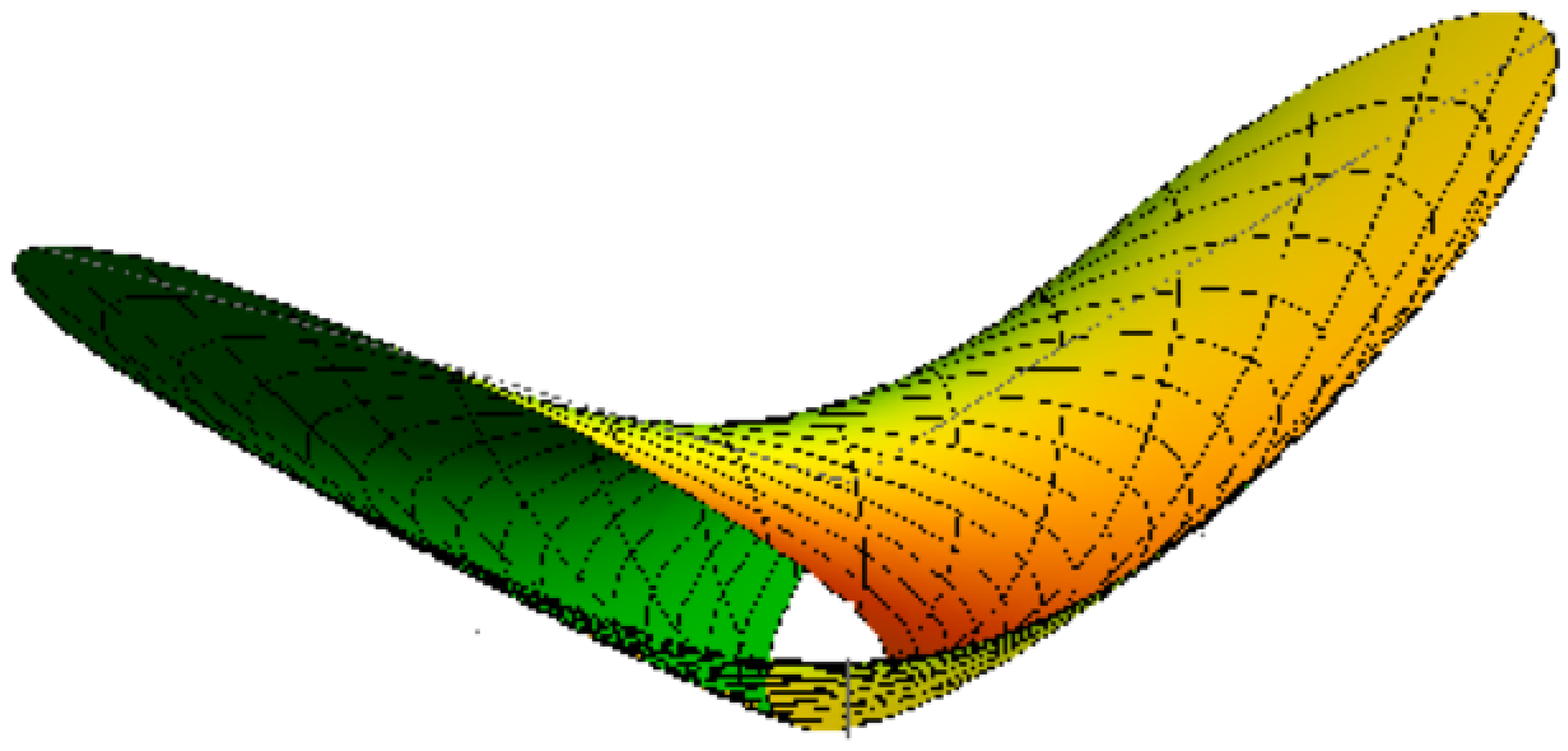
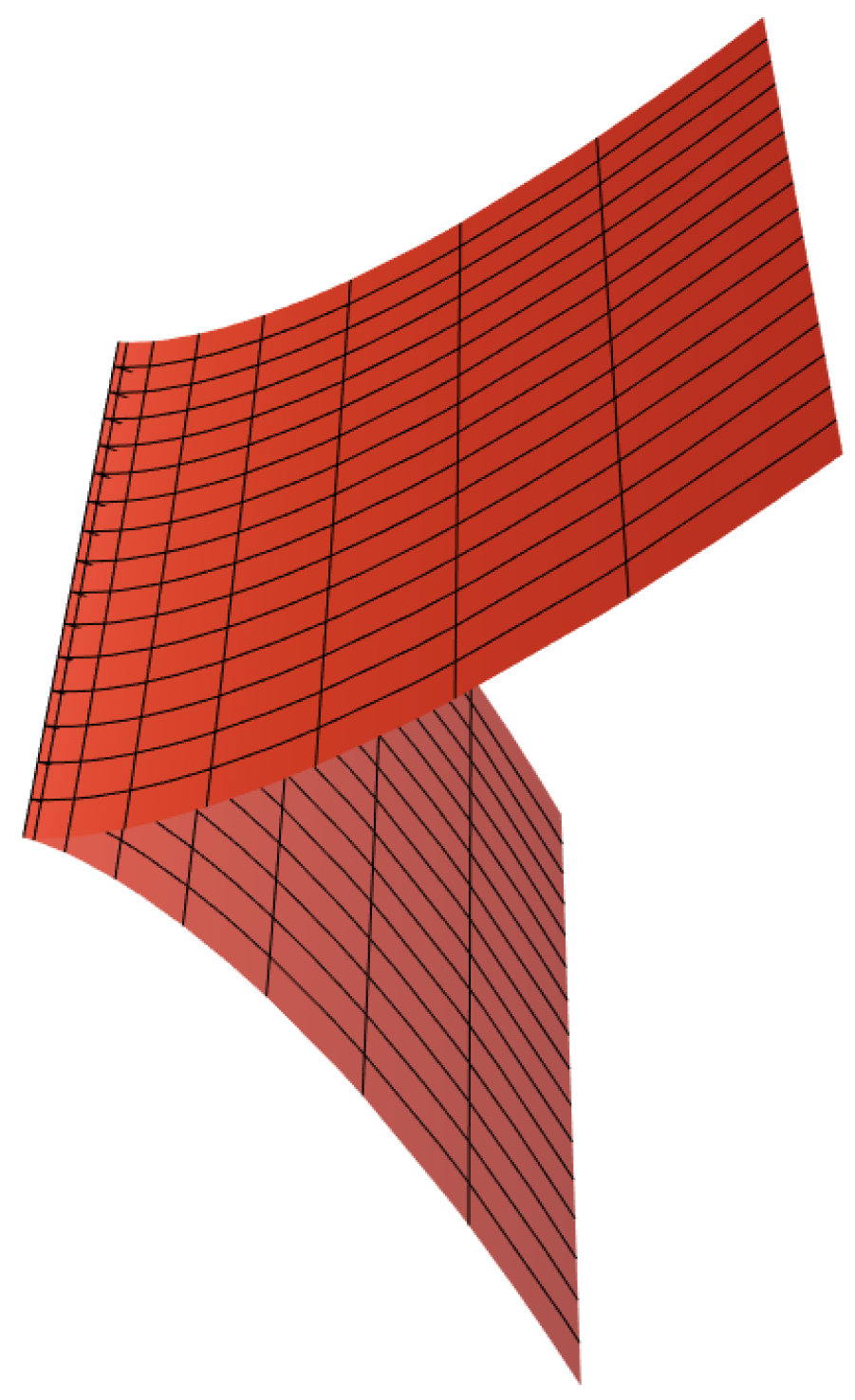
Here, C(2,3), C(2, 3, 4) = , and . The graphs of cuspidal edge and swallowtail can be seen in Figure 1 and Figure 2.
Figure 1.
Cuspidal edge.
Figure 2.
Swallowtail.
3.1. Bishop Height Functions
Now we will consider two various sets of Bishop height functions, which will be helpful for studying the singularities of as follows [27,28]: by = ; i = 1, 2. We name it the first (resp. second) Bishop height function for i = 1 (resp. 2). We use the notation for any fixed . From now on, we shall not often write the parameter s. Then, we have the following proposition:
Proposition 1.
Let γ: be a unit speed timelike curve, with , and . Then:
- (A)
- (1)
- if and only if there exist a, such that ,
- (2)
- if and only if
- (3)
- if and only if .
- (4)
- if and only if , and
- (5)
- if and only if , and
- (B)
- (1)
- if and only if there exist a, such that ,
- (2)
- if and only if
- (3)
- if and only if .
- (4)
- if and only if , and
- (5)
- if and only if , and
Proof.
(A). (1) Since , and , is RMF along , then there exists a, such that .
(2) When , the affirmation (2) follows from the fact that , . Thus, we have that . It follows from the fact that , and . Thus, we get that if and only if .
(3) When , the affirmation (3) follows from the fact that
Since , we get that if and only if .
(4) Under the hypothesis that , this derivative is calculated as follows:
Since , we get , which is equivalent to the assumption . The affirmation (4) follows.
(5) Under the hypothesis that , this derivative is calculated as:
where
By in the above, we have that:
Since , , we get that is synonymous to the assumption . The affirmation (5) follows. Using the identical computation as the proof of (A), we can get (B). □
By simple calculations, we have:
Proposition 2.
Let γ: be a unit speed timelike curve, with , and . Then:
- (1)
- if and only if is a constant vector.
- (2)
- if and only if is a constant vector.
3.2. Unfolding of Functions by One-Variable
Now we employ some public results on the singularity theory for families of function germs [27,28]. Let F: be a smooth function, and . Then F is called an r-parameter unfolding of . We say that has Ak-singularity at if for all , and . We also say that f has A-singularity () at s0. Let the -jet of the partial derivative at be (without the constant term), for . Then is called an p-versal unfolding if the matrix of coefficients has rank k . Therefore, we write serious sets on the unfolding regarding to the above notations. The discriminant set of order t of F is the set
Then , and is the set of singular points of .
We state the following theorem:
Theorem 2.
Let F: be an r-parameter unfolding of , which has the singularity at .
Suppose that F is a p-versal unfolding.
(a) If , then is locally diffeomorphic to , and ;
(b) If , then is locally diffeomorphic to , is locally diffeomorphic to , and .
(c) If , then is locally diffeomorphic to , is locally diffeomorphic to , and is locally diffeomorphic to , and .
Then, the following proposition can be obtained.
Proposition 3.
Under the situations of Proposition 1, if has -singularity ( at , then is a versal unfolding of . (2). If has -singularity ( at , then is a versal unfolding of .
Proof.
(1) Let , in , and . Then,
Thus, we have
Therefore, the 2-jets of at (i=0, 1) are:
and
(i) If has the -singularity at , then . So the matrix of coefficients is:
Suppose that the rank of the matrix A is zero, then we have:
Since , we have , so that we have a contradiction. Therefore rank(, and H is the (p) versal unfolding of at .
(ii) If has the -singularity at , then . Therefore, the matrix of the coefficients is
For the intention, we also require the matrix B to be non-singular, which it constantly is. Furthermore, the determinate of this matrix at is
Since , we have . Substituting these equations to the above equality, we obtain
Thus rank, if we consider the matrix which consists of the first and the second row of the matrix B, so that rank. (2) Using the same computation as the proof of (1), we can get (2). □
Proof of Theorem 1 .
(1) Let : be a unit speed timelike curve, with , and . For , we define a function (i = 1, 2), then we have .
First, we consider the affirmation (1). For , since , where 0 is a regular value of ; has the A-singularity at s0 if and only if and have (k+1)-point contact for . On the other hand, the discriminant set of is
The affirmation (1) follows from Theorem 2 and Proposition 1. Since the trajectory of the singularities of CE is locally diffeomorphic to the line, the affirmation (b) holds. Since the trajectory of singularities of SW is C(2,3,4), the affirmation (c) holds.
For the affirmation (2), the discriminant set of of is
By a similar argument, we can also prove the affirmation (2). This completes the proof. □
Example 1.
Given the timelike helix:
It is simple to have that
Taking we have . Using Equations (3)–(5), we obtain , and . Hence:
Thus, we get
So, the timelike developable surface is
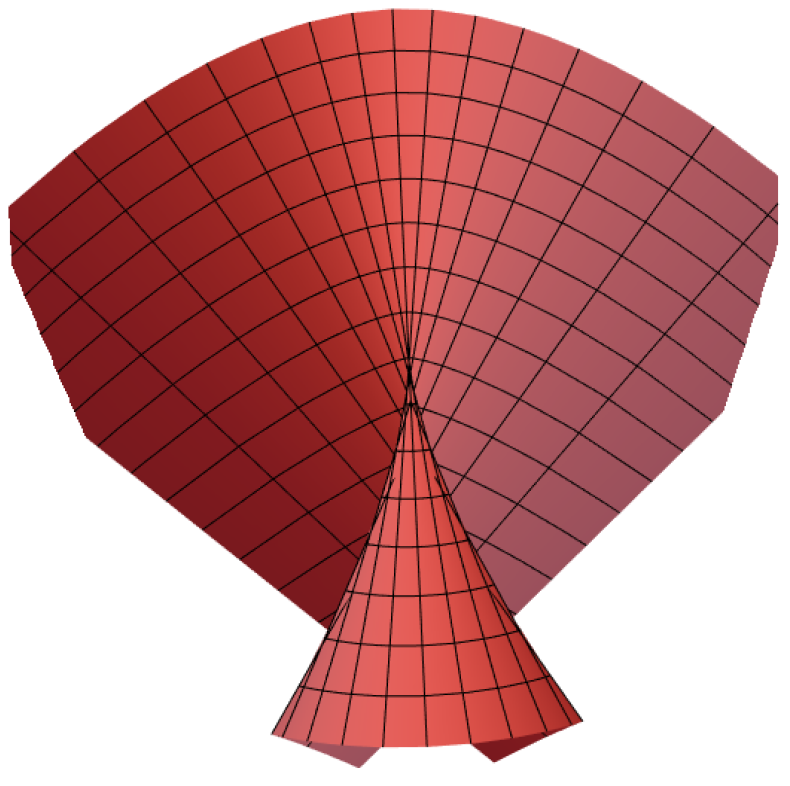
(1) If we take , and , then we instantly obtain the surface (see Figure 3).
Figure 3.
Timelike developable surface.
(2) If , then , and , respectively, are:
and
In addition, the singular locus of , and , respectively, are:
and
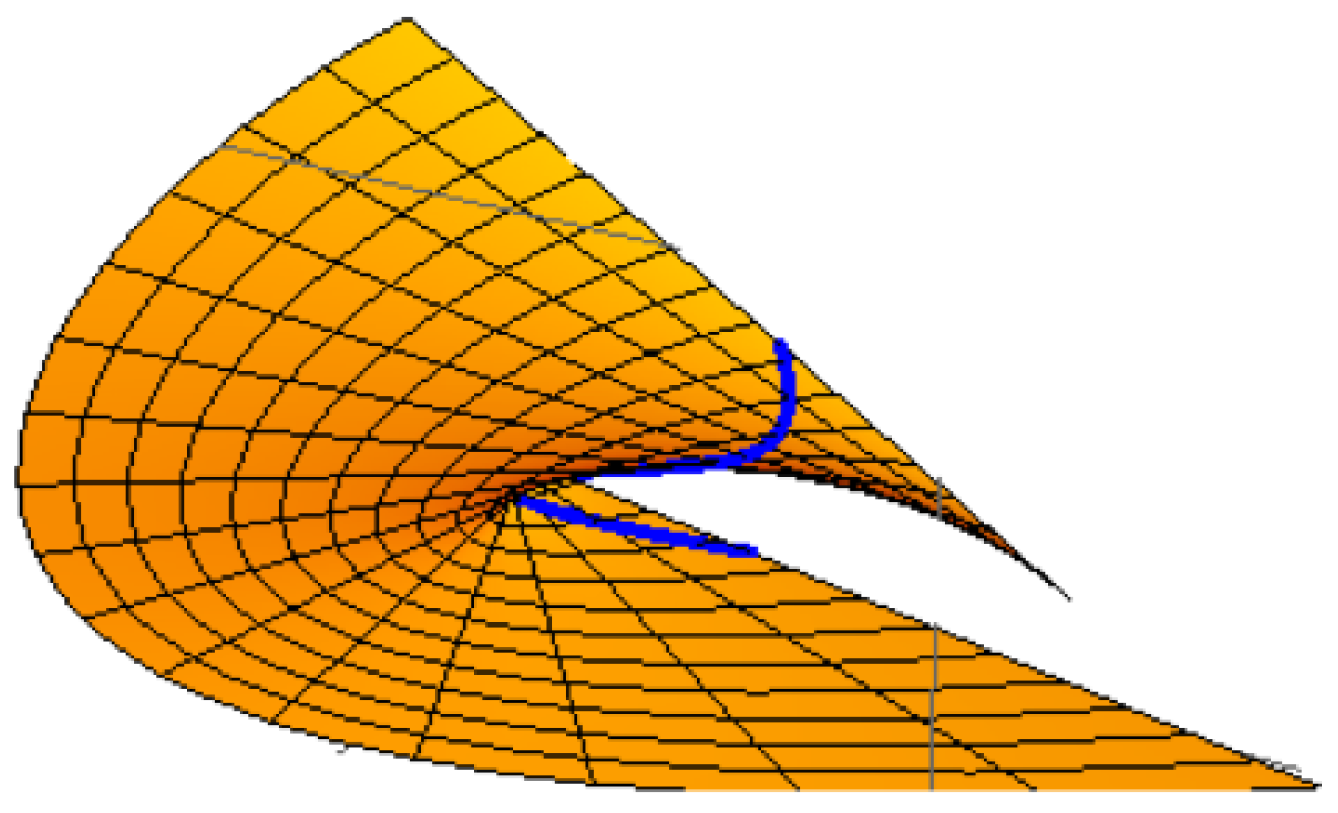
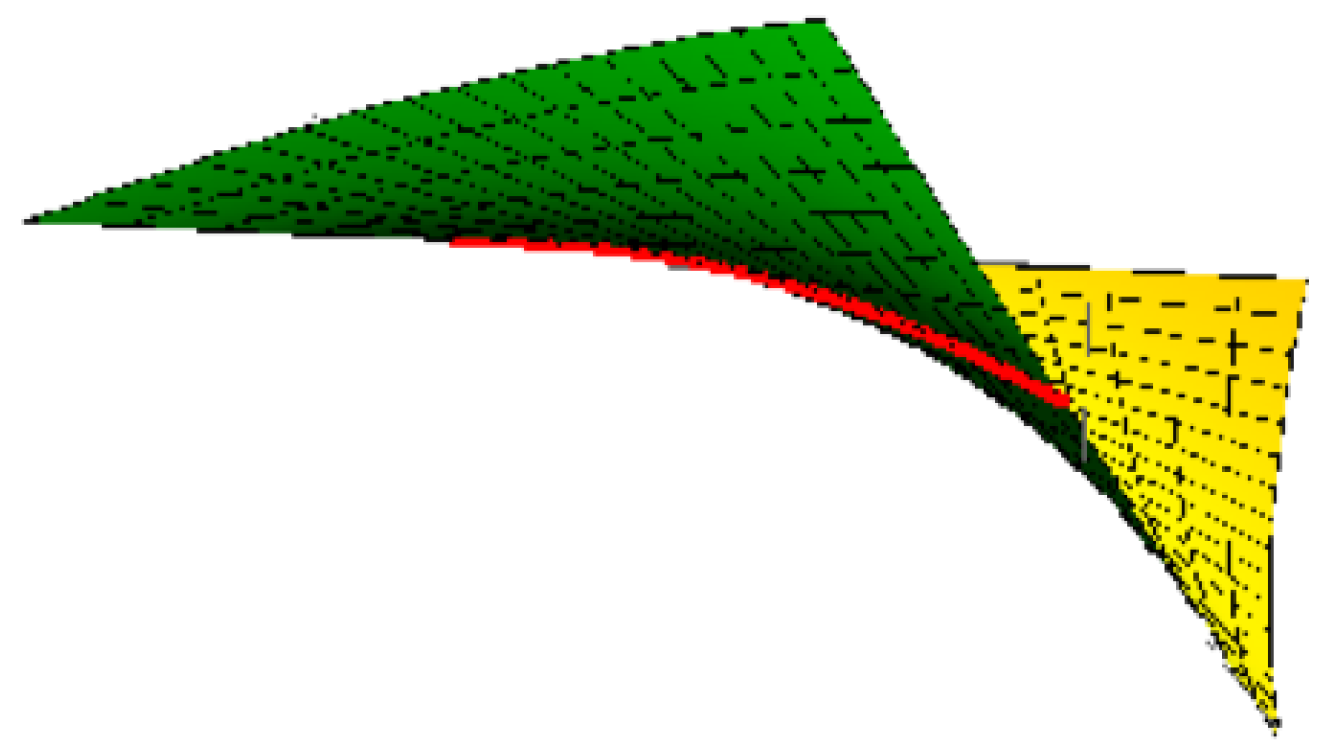
We consider a local part of this curve when . We see that , and for . This means that is locally diffeomorphic to a CE and its singular locus is locally diffeomorphic to a line (the red line), see Figure 4. For , when . We see that , gives one real root . We can also get that , that is, fails to be locally diffeomorphic to SW and its singular locus is not locally diffeomorphic to the C(2,3,4)-cusp at . Hence fails to be a versal unfolding of the (s) at ; see Figure 5.
Figure 4.
.
Figure 5.
.
4. Conclusions
In this paper, we considered the notion of timelike developable surfaces with rotation minimizing frames in Minkowski 3–Space . By applying singularities theory, we classified the generic properties of the cuspidal edge and swallowtail. Finally, an example of application is offered to demonstrate the theoretical results. Furthermore, recently the application of singularity theory and submanifolds theory and so forth, presented in Refs. [29,30,31,32,33,34,35,36,37,38,39,40,41,42,43,44,45,46,47,48,49,50,51,52,53,54,55,56,57], has attracted great interest. In the following work, we will connect the results of this paper with the techniques and methods in Refs. [29,30,31,32,33,34,35,36,37,38,39,40,41,42,43,44,45,46,47,48,49,50,51,52,53,54,55,56,57] to explore more results and theorems related to symmetric properties about this topic.
Author Contributions
Conceptualization, Y.L., Z.C., S.H.N., R.A.A.-B.; methodology, Y.L., Z.C., S.H.N., R.A.A.-B.; investigation, Y.L., Z.C., S.H.N., R.A.A.-B.; writing—original draft preparation, Y.L., Z.C., S.H.N., R.A.A.-B.; writing—review and editing, Y.L., Z.C., S.H.N., R.A.A.-B. All authors have read and agreed to the published version of the manuscript.
Funding
This research was funded by the National Natural Science Foundation of China (grant no. 12101168) and the Zhejiang Provincial Natural Science Foundation of China (grant no. LQ22A010014).
Data Availability Statement
Not applicable.
Acknowledgments
The authors would like to express their sincere thanks to the editor and the anonymous reviewers for their helpful comments and suggestions.
Conflicts of Interest
The authors declare no conflict of interest.
References
- do Carmo, M.P. Differential Geometry of Curves and Surface; Prentice-Hall: Englewood Cliffs, NJ, USA, 1976. [Google Scholar]
- Xu, Z.; Feng, R. Analytic and algebraic properties of canal Surfaces. J. Comput. Appl. Math. 2006, 195, 220–228. [Google Scholar] [CrossRef]
- Izumiya, S.; Saji, K.; Takeuchi, N. Circular surfaces. Adv. Geom. 2007, 7, 295–313. [Google Scholar] [CrossRef]
- Cui, L.; Wang, D.; Dai, J. Kinematic geometry of circular surfaces with a fixed radius based on Euclidean invariants. ASME J. Mech. 2009, 131, 101009. [Google Scholar] [CrossRef]
- Qian, J.; Kim, Y. Some characterizations of canal surfaces. Bull. Korean Math. Soc. 2016, 53, 461–477. [Google Scholar]
- Qian, J.; Kim, Y. Some Classification of canal surfaces with the Gauss map. Bull. Malays. Math. Sci. Soc. 2019, 42, 261–3272. [Google Scholar] [CrossRef]
- Abdel-Baky, R.A. Developable surfaces through sweeping surfaces. Bull. Iran. Math. Soc. 2019, 45, 951–963. [Google Scholar] [CrossRef]
- Mofarreh, F.; Abdel-Baky, R.; Naghi, M. Developable surfaces through spacelike sweeping surfaces in Minkowski 3–Space. Appl. Math. Inf. Sci. 2021, 15, 263–270. [Google Scholar]
- Mofarreh, F.; Abdel-Baky, R. Timelike sweeping surfaces and Singularities. Int. J. Geom. Methods Mod. Phys. 2021, 18, 2150006. [Google Scholar] [CrossRef]
- Abdel-Baky, R.; Mofarreh, F.; Alluhaii, N. Spacelike sweeping surfaces and singularities in Minkowski 3-Space. Math. Probl. Eng. 2021, 2021, 5130941. [Google Scholar]
- Pottmann, H.; Wallner, M. Approximation Algorithms for Developable Surfaces. Comput.-Aided Geom. Des. 1999, 16, 539–556. [Google Scholar] [CrossRef]
- Kose, O. A method of the determination of a developable ruled surface. Mech. Mach. Theory. 1999, 34, 1187–1193. [Google Scholar] [CrossRef]
- Zhao, H.; Wang, G. A new method for designing a developable surface utilizing the surface pencil through a given curve. Prog. Nat. Sci. 2008, 18, 105–110. [Google Scholar] [CrossRef]
- Yıldız, O.G.; Karakus, S.O.; Hacısalihoglu, H.H. On the determination of a developable spherical orthotomic ruled surface. Bull. Math. Sci. 2015, 5, 137–146. [Google Scholar] [CrossRef]
- Izumiya, S.; Takeuchi, N. New Special Curves and Developable Surfaces. Turk. J. Math. 2004, 28, 153–163. [Google Scholar]
- Li, Y.; Nazra, S.H.; Abdel-Baky, R.A. Singularity Properties of Timelike Sweeping Surface in Minkowski 3-Space. Symmetry 2022, 14, 1996. [Google Scholar] [CrossRef]
- Li, Y.; Eren, K.; Ayvacı, K.H.; Ersoy, S. The developable surfaces with pointwise 1-type Gauss map of Frenet type framed base curves in Euclidean 3-space. AIMS Math. 2023, 8, 2226–2239. [Google Scholar] [CrossRef]
- Izumiya, S.; Takeuchi, N. Singularities of ruled surfaces in R3. Math. Proc. Camb. Philos. Soc. 2001, 130, 1–11. [Google Scholar] [CrossRef]
- Bishop, R.L. There is more than one way to frame a curve. Am. Math. Mon. 1975, 82, 246–251. [Google Scholar] [CrossRef]
- Bükcu, B.; Karacan, M.K. On the slant helices according to Bishop frame of the timelike curve in Lorentzian space. Tamkang J. Math. 2008, 39, 255–262. [Google Scholar] [CrossRef]
- Keskin, O.; Yayli, Y. An application of N-Bishop frame to spherical images for direction curves. Int. J. Geom. Methods Mod. Phys. 2017, 14, 1750162. [Google Scholar] [CrossRef]
- Grbovic, M.; Nešovic, E. On the Bishop frames of pseudo null and null Cartan curves in Minkowski 3-space. J. Math. Anal. Appl. 2018, 461, 219–233. [Google Scholar] [CrossRef]
- Liu, H.; Pei, D. Legendrian dualities between spherical indicatrixes of curves and surfaces according to Bishop frame. J. Nonlinear Sci. Appl. 2016, 9, 2875–2887. [Google Scholar] [CrossRef]
- O’Neil, B. Semi-Riemannian Geometry Geometry, with Applications to Relativity; Academic Press: New York, NY, USA, 1983. [Google Scholar]
- Walfare, J. Curves and Surfaces in Minkowski Space. Ph.D. Thesis, K.U. Leuven, Faculty of Science, Leuven, Belgium, 1995. [Google Scholar]
- Nagai, T. The Gauss map of a hypersurface in Euclidean sphere and the spherical Legendrian duality. Topol. Appl. 2012, 159, 545–554. [Google Scholar] [CrossRef]
- Bruce, J.; Giblin, P. Generic geometry. Am. Math. Mon. 1983, 90, 529–545. [Google Scholar] [CrossRef]
- Bruce, J.W.; Giblin, P.J. Curves and Singularities, 2nd ed.; Cambridge University Press: Cambridge, UK, 1992. [Google Scholar]
- Antic, M. Characterization ofWarped Product Lagrangian Submanifolds in Cn. Results Math. 2022, 77, 106. [Google Scholar] [CrossRef]
- Antic, M.; Vrancken, L. Conformally flat, minimal, Lagrangian submanifolds in complex space forms. Sci. China Math. 2022, 65, 1641–1660. [Google Scholar] [CrossRef]
- Li, Y.; Aldossary, M.T.; Abdel-Baky, R.A. Spacelike Circular Surfaces in Minkowski 3-Space. Symmetry 2023, 15, 173. [Google Scholar] [CrossRef]
- Li, Y.; Alluhaibi, N.; Abdel-Baky, R.A. One-Parameter Lorentzian Dual Spherical Movements and Invariants of the Axodes. Symmetry 2022, 14, 1930. [Google Scholar] [CrossRef]
- Li, Y.; Mofarreh, F.; Abdel-Baky, R.A. Timelike Circular Surfaces and Singularities in Minkowski 3-Space. Symmetry 2022, 14, 1914. [Google Scholar] [CrossRef]
- Li, Y.; Erdoğdu, M.; Yavuz, A. Differential Geometric Approach of Betchow-Da Rios Soliton Equation. Hacet. J. Math. Stat. 2022, 1–12. [Google Scholar] [CrossRef]
- Li, Y.; Abdel-Salam, A.A.; Saad, M.K. Primitivoids of curves in Minkowski plane. AIMS Math. 2023, 8, 2386–2406. [Google Scholar] [CrossRef]
- Li, Y.; Prasad, R.; Haseeb, A.; Kumar, S.; Kumar, S. A Study of Clairaut Semi-Invariant Riemannian Maps from Cosymplectic Manifolds. Axioms 2022, 11, 503. [Google Scholar] [CrossRef]
- Li, Y.; Eren, K.; Ayvacı, K.H.; Ersoy, S. Simultaneous characterizations of partner ruled surfaces using Flc frame. AIMS Math. 2022, 7, 20213–20229. [Google Scholar] [CrossRef]
- Li, Y.; Abolarinwa, A.; Alkhaldi, A.H.; Ali, A. Some Inequalities of Hardy Type Related to Witten–Laplace Operator on Smooth Metric Measure Spaces. Mathematics 2022, 10, 4580. [Google Scholar] [CrossRef]
- Li, Y.; Mofarreh, F.; Laurian-Ioan, P.; Ali, A. Geometric Inequalities on the Dirac Operator and the Frobenius Norms. Adv. Math. Phys. 2023, 2023, 1275374. [Google Scholar]
- Gür, S.; Şenyurt, S.; Grilli, L. The Dual Expression of Parallel Equidistant Ruled Surfaces in Euclidean 3-Space. Symmetry 2022, 14, 1062. [Google Scholar]
- Çalışkan, A.; Şenyurt, S. Curves and ruled surfaces according to alternative frame in dual space. Commun. Fac. Sci. Univ. 2020, 69, 684–698. [Google Scholar] [CrossRef]
- Çalışkan, A.; Şenyurt, S. The dual spatial quaternionic expression of ruled surfaces. Therm. Sci. 2019, 23, 403–411. [Google Scholar] [CrossRef]
- Şenyurt, S.; Çalışkan, A. The quaternionic expression of ruled surfaces. Filomat 2018, 32, 5753–5766. [Google Scholar] [CrossRef]
- Şenyurt, S.; Gür, S. Spacelike surface geometry. Int. J. Geom. Methods Mod. Phys. 2017, 14, 1750118. [Google Scholar] [CrossRef]
- As, E.; Şenyurt, S. Some Characteristic Properties of Parallel-Equidistant Ruled Surfaces. Math. Probl. Eng. 2013, 2013, 587289. [Google Scholar] [CrossRef]
- Özcan, B.; Şenyurt, S. On Some Characterizations of Ruled Surface of a Closed Timelike Curve in Dual Lorentzian Space. Adv. Appl. Clifford Al. 2012, 22, 939–953. [Google Scholar]
- Ali, A.T. Non-lightlike constant angle ruled surfaces in Minkowski 3-space. J. Geom. Phys. 2020, 157, 103833. [Google Scholar] [CrossRef]
- Ali, A.T. A constant angle ruled surfaces. Int. J. Geom. 2018, 7, 69–80. [Google Scholar]
- Ali, A.T. Non-lightlike ruled surfaces with constant curvatures in Minkowski 3-space. Int. J. Geom. Methods Mod. Phys. 2018, 15, 1850068. [Google Scholar] [CrossRef]
- Ali, A.T.; Hamdoon, F.M. Surfaces foliated by ellipses with constant Gaussian curvature in Euclidean 3-space. Korean J. Math. 2017, 25, 537–554. [Google Scholar]
- Ali, A.T.; Abdel Aziz, H.S.; Sorour, A.H. On some geometric properties of quadric surfaces in Euclidean space. Honam Math. J. 2016, 38, 593–611. [Google Scholar] [CrossRef]
- Ali, A.T.; Abdel Aziz, H.S.; Sorour, A.H. On curvatures and points of the translation surfaces in Euclidean 3-space. J. Egyptian Math. Soc. 2015, 23, 167–172. [Google Scholar] [CrossRef]
- Gulbahar, M.; Kilic, E.; Keles, S.; Tripathi, M.M. Some basic inequalities for submanifolds of nearly quasi-constant curvature manifolds. Differ. Geom. Dyn. Sys. 2014, 16, 156–167. [Google Scholar]
- Tripathi, M.M.; G ülbahar, M.; Kiliç, E.; Keleş, S. Inequalities for scalar curvature of pseudo-Riemannian submanifolds. J. Geom. Phys. 2017, 112, 74–84. [Google Scholar] [CrossRef]
- Gulbahar, M. Qualar curvatures of pseudo Riemannian manifolds and pseudo Riemannian submanifolds. AIMS Math. 2021, 6, 1366–1377. [Google Scholar] [CrossRef]
- Kiliç, E.; Gulbahar, M.; Kavuk, E. Concurrent Vector Fields on Lightlike Hypersurfaces. Mathematics 2020, 9, 59. [Google Scholar] [CrossRef]
- Gulbahar, M.; Kiliç, E.; Keles, S. A useful orthonormal basis on bi-slant submanifolds of almost Hermitian manifolds. Tamkang J. Math. 2016, 47, 143–161. [Google Scholar] [CrossRef]
Disclaimer/Publisher’s Note: The statements, opinions and data contained in all publications are solely those of the individual author(s) and contributor(s) and not of MDPI and/or the editor(s). MDPI and/or the editor(s) disclaim responsibility for any injury to people or property resulting from any ideas, methods, instructions or products referred to in the content. |
© 2023 by the authors. Licensee MDPI, Basel, Switzerland. This article is an open access article distributed under the terms and conditions of the Creative Commons Attribution (CC BY) license (https://creativecommons.org/licenses/by/4.0/).