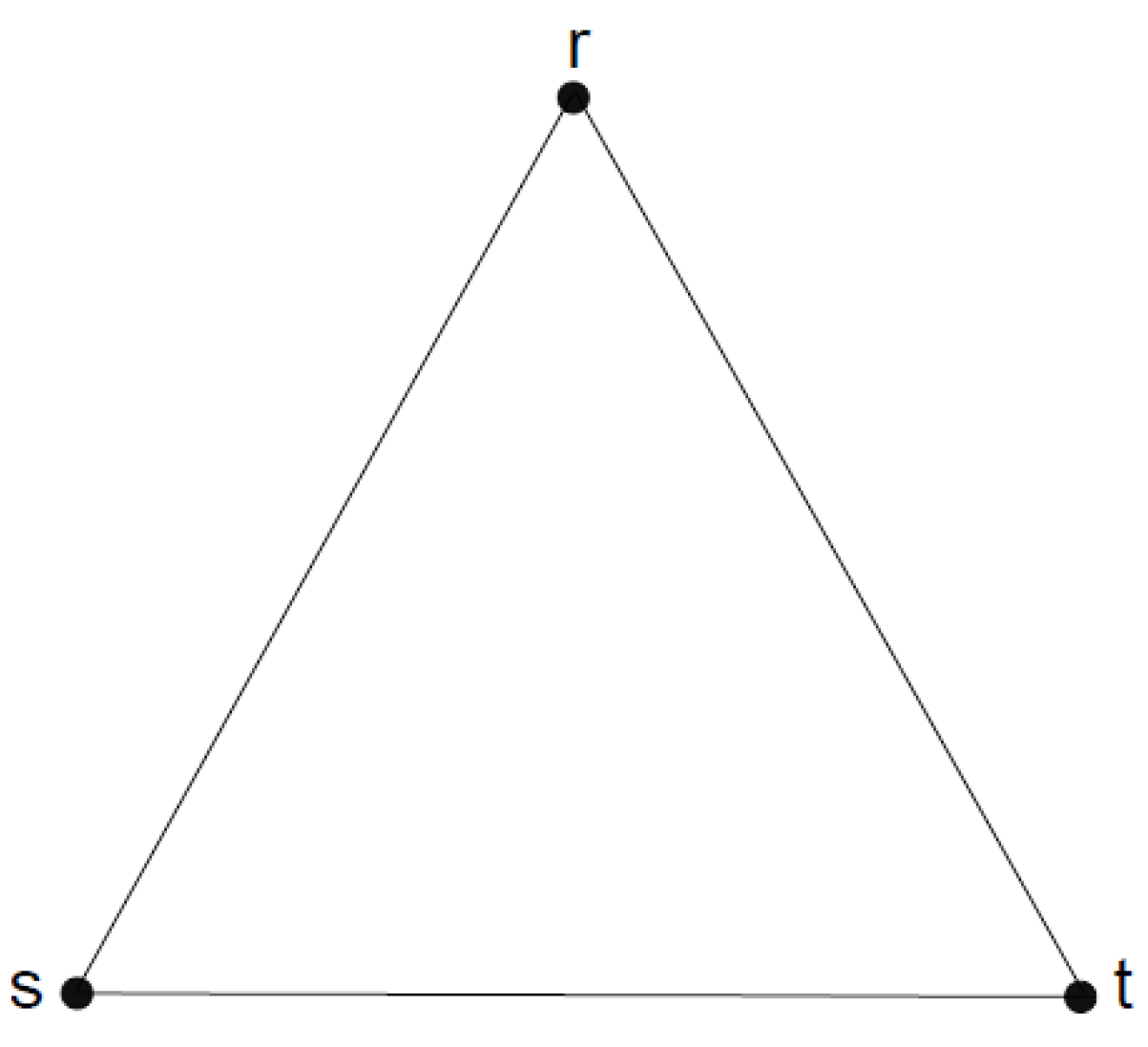
Abstract
The importance of symmetry in graph theory has always been significant, but in recent years, it has become much more so in a number of subfields, including but not limited to domination theory, topological indices, Gromov hyperbolic graphs, and the metric dimension of graphs. The purpose of this monograph is to initiate the idea of a multi polar q-rung orthopair fuzzy graphs (m- as a fusion of multi polar fuzzy graphs and q-rung orthopair fuzzy graphs. Moreover, for a vertex of multi polar q-rung orthopair fuzzy graphs, the degree and total degree of the vertex are defined. Then, some product operations, inclusive of direct, Cartesian, semi strong, strong lexicographic products, and the union of multi polar q-rung orthopair fuzzy graphs (m-, are obtained. Also, at first we define some degree based fuzzy topological indices of m-. Then, we compute Zareb indices of the first and second kind, Randic indices, and harmonic index of a m-.
Keywords:
multi polar fuzzy graph; q-rung orthopair fuzzy graph; product operations; total degree; topological indices MSC:
05C72
1. Introduction
The theory of a fuzzy subset of a set was put forward in 1965 by Zadeh [1]. He generalized crisp set by providing membership grades to each member of the set from the interval . Since than, the fuzzy set theory has developed into a robust discipline of research in different fields inclusive of graph theory, social science, decision making, medical field, management, artificial intelligence and engineering. The technique that offers coherence in the ranking of alternatives under multiple criterion is familiar as Multi criteria decision making (MCDM). Through these processes decision makers provides a feasible decision while considering a set multiple criteria. To fulfil their requirements and pursue an optimal alternative, this technique helps them in the hierarchy of short listed alternatives. Being inspired by the idea of bi-polar fuzzy sets which was established by Zhang [2,3], Chen et al. [4] proposed an augmentation of fuzzy set known as m-polar fuzzy set. In an m-polar fuzzy set the assessment of the membership grade of a member with m different attributes lies in and all its respective membership grades are captured by following the same procedure. He indicated that 2-polar fuzzy sets and bipolar fuzzy sets are cryptographic mathematical ideas and that can acquire compactly one from the corresponding one [4]. In real world problems the data are sporadically collected from i agents this is the concept behind “multipolar information”. For example, in neurobiology, a lot of information is gathered by multi-polar neurons from other neurons in the brain. Some characteristics of m-polar fuzzy sets and several algebraic operations were introduced by Naeem et al. [5]. Multi-polar technology is designed to meet the needs of wide-ranging systems in information technology. In the last decades, the focus of many researchers has been shifted to imperfect, uncertain and vague information related problems. With the intention of dealing with such problems, Atanassov [6] put forward an augmentation of the fuzzy set by virtue of the membership and the non-membership functions, familiar as intuitionistic fuzzy set (IFS). Yager [7] established the notion of Pythagorean fuzzy set (PFS) as an extended form of Atanassov’s intuitionistic fuzzy set. Subtraction and division over Pythagorean fuzzy numbers are presented by Peng [8]. He also explored their characteristics such as boundedness, idempotency and monotonicity. Hashmi and Riaz [9] introduced an innovative idea of Pythagorean m-polar fuzzy sets and a few fundamental operations on these sets. In 2019, Hashmi [10] expressed the concept of m-polar neutrosophic set. Yager [11] in established the concept of q-rung orthopair fuzzy sets (q-ROFS), which is abstraction of (IFS) and (PFS). For the q-ROFSs, the membership and non-membership function need to fulfil the following condition where and , here the span of information expression is determined by parameter q. The span of information expression becomes larger as q increases. q-ROFSs came up with more flexibility to make assessments with reference to membership and non-membership functions as in contrast with IFSs and PFSs. Ali [12] studied the uncertainty index which depends on the orbit where the point () is situated. In 2021, Riaz et al. [13], introduced a hybrid model of the m-polar fuzzy set and q-rung orthopair fuzzy set, familiar as m-polar q-rung orthopair fuzzy set. Toward uncertainty, a q-ROmPFS is more elastic and superior approach as compared with the prior approaches of intuitionistic m-polar fuzzy sets and Phythagorean m-polar fuzzy sets.
Graphs are diagrammatical representations of decision making problems. By utilizing this convenient appliance vertices and edges are used to demonstrate the decision-making objects and their relationships. In 1973, Kaufmann [14] initiated the rudimentary notion of fuzzy graph. Some advanced concepts of fuzzy graphs were discovered by Rosenfeld [15] in 1975. Rosenfeld also discussed the fuzzy relations between fuzzy sets. Bhattacharya [16] defined certain concepts of fuzzy cut vertices and fuzzy bridges with reference to connectivity. Mordeson and Nair [17] explored a number of new ideas of fuzzy graphs. Nagoorani and Latha [18,19] investigated irregular fuzzy graphs and degree and order of intuitionistic fuzzy graphs. Many new ideas, comprising of bipolar fuzzy graphs, irregular bipolar fuzzy graphs, bipolar fuzzy digraph in decision support system, m-polar fuzzy graphs, m-polar fuzzy line graphs and certain metrics in m-polar fuzzy graphs were established by Akram et al. [20,21,22,23,24,25,26]. With different representation, numerous different types of graphs have been initiated for decision-making information, such as Pythagorean fuzzy graph [27] and single-valued neutrosophic graphs [28]. In 2014 Samanta [29] introduced m-step neighbourhood graph which is generalization of fuzzy competition graph. Based on q-ROFSs, a new form of graph has been created by Habib et al. [30] in which is named as q-rung orthopair fuzzy graph (q-ROFG). Rashmanlou and others in [31,32,33,34] added some interesting results to generalized fuzzy graphs.
Product operations of graphs are large and essential part of graph theory. Mordeson and Peng [35,36] defined a number of product operations on fuzzy graphs. Later, for different kinds of product operations of fuzzy graphs, the degree of the vertices was obtained by Nirmala in 2012 [37]. Sahoo and Pal [38,39] defined product operations on IFGs and also estimated the degree of vertex in IFGs. The number of product operations on fuzzy hypergraphs were introduced by Gong and Wang [38]. On interval-valued fuzzy graphs Rashmanlou et al. [40] established product operations and degree of a vertex for these graphs was also investigated. Single-valued neutrosophic graphs SVNGs were initiated by Naz et al. [28] in the scenario of multi-criteria decision-making, also several product operations on SVNGs were obtained. Latterly, Akram et al. [27] explored product operations for Pythagorean fuzzy graphs and for a vertex in PFGs the degree and total degree were defined. In 2019, Songyi et al. [41] defined product operations on q-ROPFGs.
In mathematical chemistry its topology branch is known as chemical graph theory which deals with the combination of graph theory and chemistry. For a chemical phenomena we applied graph theory to its mathematical model in chemical graph theory. The graph invariant of a graph which is a numerical parameter is known as a topological index as the topology of the graph is characterized with the help of this numeric value. Topological indices are utilized in the advancement of (QSAR) Quantative Structure Activity Relationships. These indices play important role to demonstrate the properties of molecules or biological activities which are correlated with their chemical structure. Several indices were initiated due to their application in chemistry such as Zagreb indices, Randic, Harmonic and Gutman indices but the first developed topological index is the Wiener index or Wiener number. In It was Xu [42] who introduced the application of fuzzy graph in chemical sciences. In 2019, Mordeson et al. [43] defined connectivity index and Wiener index in fuzzy graphs. Naeem [44] developed some connectivity indices in the context of IFG in 2021. He introduced two kinds of connectivity index and average connectivity index in the environment of IFGs. Kalathian et al. [45] developed fuzzy Zagreb indices of first and second kind, fuzzy Randic index and fuzzy Harmonic index. Some topological indices for intuitionistic fuzzy graph were presented by Dinar et al. [46] in 2023.
2. Preliminaries
This section presents a study of some rudimentary notions that will be beneficial to understand the current monograph.
Definition 1 ([1]).
For a set of discourse a fuzzy set is expressed in a well known format,
where membership function of fuzzy set is portryed by
Definition 2 ([4]).
An m-polar fuzzy set on a non empty set is a mapping for a natural number m. is used to denote the set of all m-polar fuzzy set on Where is the largest value in and the smallest value in is
Definition 3 ([6]).
Let be a universe of discourse. Then a set is considered as intuitionistic fuzzy set if is a mapping in the form where, and are taken from the interval . These are used to define the membership grade and non-memembership grade of the element , respectively, to the set with for each
Definition 4 ([11]).
On a set of discourse . We define a set for in the given format
is familiar as q-rung orthopair fuzzy set (q-ROPFS). We take and from the interval and these values are used to porty the membership grade and non-membership grade of
Definition 5.
A set on a set of discourse is introduced as an multi polar q-rung orthopair fuzzy set (m-) if it is established in the following form,
where and Here we take and in descending and ascending order, respectively, but it is not necessary condition for m-
We denote multi polar q-rung orthopair fuzzy set
by where and
Example 1.
Let be a universe of discourse. The 2-polar 3-rung orthopair fuzzy set is given below:
Definition 6.
Consider two multi polar q-rung orthopair fuzzy sets and on a set given below:
Some relations and operations are defined below:
- (i)
- Inclusion
- (ii)
- Complement
- (iii)
- Union In we obtained the membership and non-membership grades by following way:
- (iv)
- Intersection In we obtained the membership and non-membership grades by following way:
- (v)
- Addition In ) we obtained the membership and non-membership grades by following way:
- (vi)
- Multiplication In ) the membership and non-membership grades are obtained as:
- (vii)
- Alpha-beta cut Letbe a m- Let such that Then -cut of is defined as a crisp set and it is constructed in the following formwhere and
Theorem 1.
For any three m- and
- 1.
- 2.
- 3.
- 4.
- 5.
- 6.
Proof.
Straightforward. □
3. Multi Polar q-Rung Orhopair Fuzzy Graphs
Definition 7.
An m-ℜ in is considered to be a m-polar q-rung orthopair fuzzy relation in expressed by
where and represents the membership and non-membership function of respectively, such that and for all
Definition 8.
An multi polar q-rung orthopair fuzzy graph (m-) of a graph (where is the set of vertices and is the set of edges) is defined as an ordered pair , (where and ℜ are, respectively, the m- on and ), if following conditions are satisfied:
- (i)
- (ii)
for all and
Example 2.
Consider a graph where and Let and ℜ be the 3-polar 3-rung orthopair fuzzy vertex set and the 3-polar 3-rung orthopair fuzzy edge set defined on and respectively:
It is easy to find by direct calculation that in Figure 1 is a m-
Figure 1.
3-polar 3-rung fuzzy graph.
Definition 9.
Let be multi polar q–rung orthopair fuzzy graph of a graph Then we define the degree and total degree of a vertex η in graph as
respectively. Where,
for
Example 3.
Consider a 3-polar 3-rung orthopair fuzzy graph given in Figure 1. The degree of vertex r is and the total degree of vertex r is
4. Some Product Operations of Multi Polar q-Rung Orthopair Fuzzy Graphs
This section deals with some product operations of m- We analyze direct, Cartesian, semi strong, strong and lexicographic products of m-.
4.1. Direct Product of Multi Polar q-Rung Orhopair Fuzzy Graphs
Definition 10.
Let and be two m- of the graphs and , respectively. Then, the direct product of and is expressed as and defined as:
- (i)
- for all and
- (ii)
- for all , and .
Proposition 1.
Let and be two m- of the graphs and , respectively. Then, represents the direct product of and and it is a m- of
Definition 11.
Let and be two m- Then, the degree of vertex is defined as:
where,
and
for
Theorem 2.
Let and be two m- If then and if then for all Where the number of vertices adjacent to in is represented by , similarly shows the number of vertices adjacent to in
Proof.
By definition of degree of vertex in we have
where,
for Hence, In similar manner we can show that if then □
Definition 12.
Let and be two m- Then, for vertex the total degree is defined as:
where,
and,
for
Theorem 3.
Let and be two m- If
- 1.
- then
- 2.
- then
- 3.
- then
- 4.
- thenfor all and where and
Proof.
By using Definition 12 and Theorem 2 the proof is straightforward. □
Example 4.
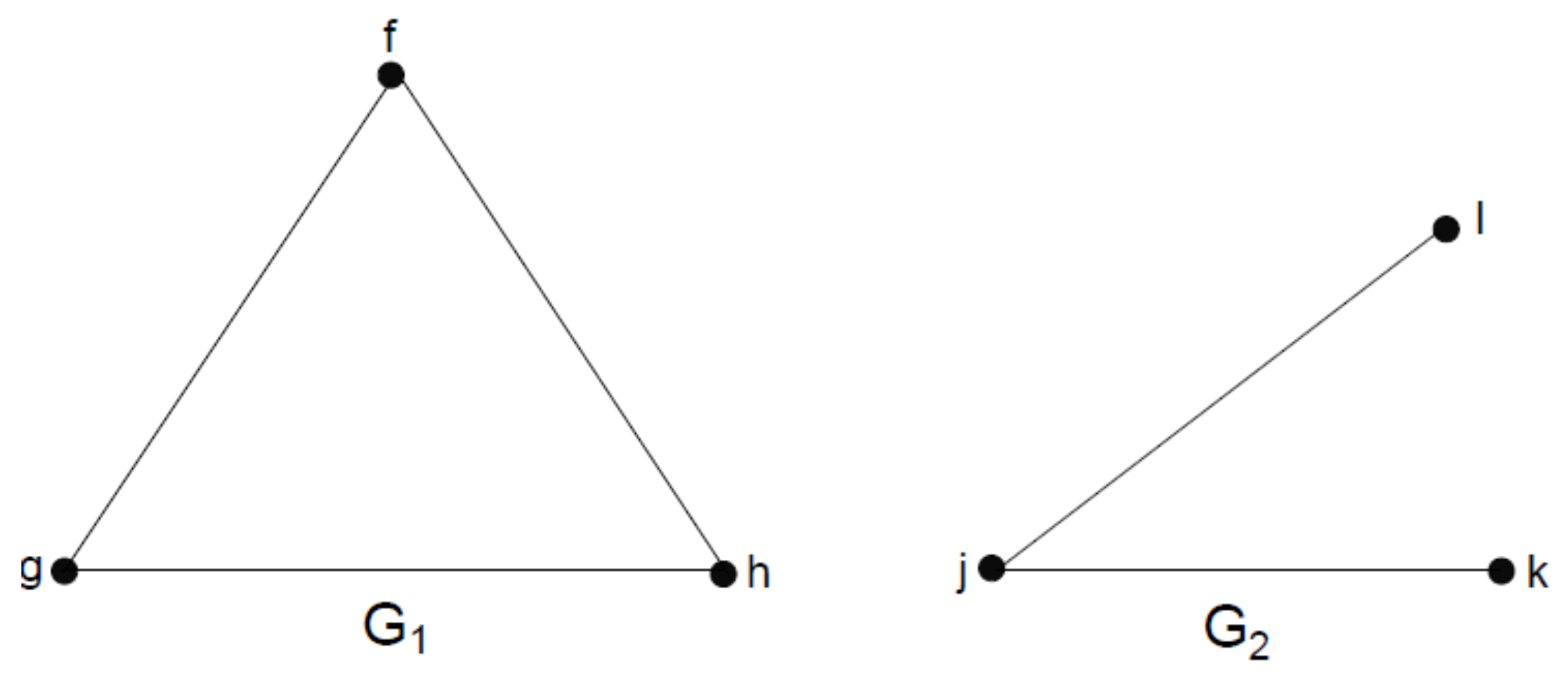
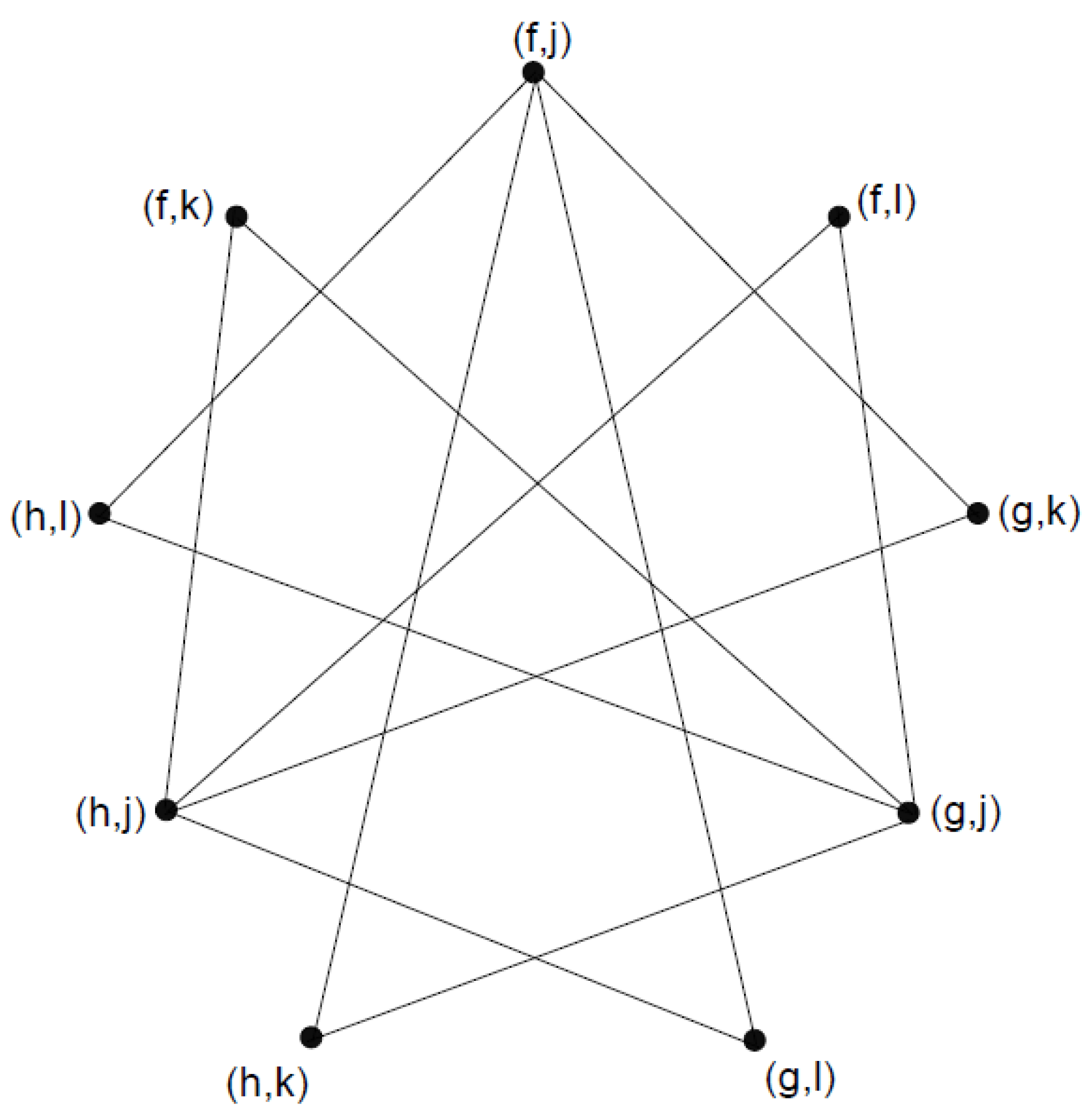
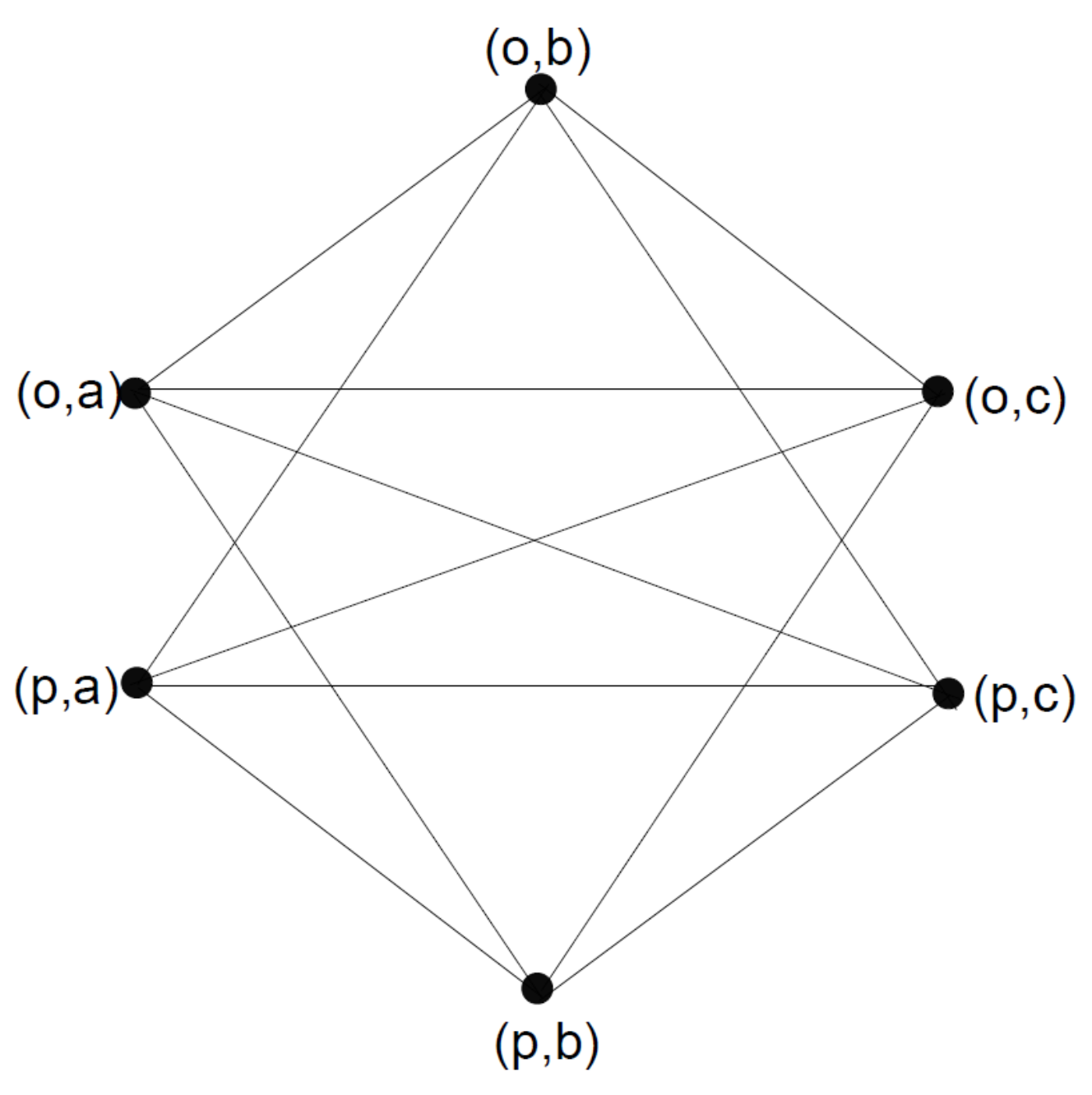
Consider two 3-polar 3-rung orthopair fuzzy graphs and on vertex sets and respectively, as represented in Figure 2, Table 1 and Table 2. Then, the direct product is given in Figure 3, Table 3 and Table 4.
Figure 2.
.
Table 1.
.
Table 2.
.
Figure 3.
Direct product ().
Table 3.
Vertex set ().
Table 4.
Edge set ().
Since so by Theorem 2, we have
Therefore,
In addition, by Theorem 3, we have
Therefore,
Similarly, for all the vertices in we can find the degree and total degree.
4.2. Cartesian Product of Multi Polar q-Rung Orhopair Fuzzy Graphs
Definition 13.
Let and be two m- of and respectively. Then, for and represents the Cartesian product and it is defined as:
- (i)
- for all and
- (ii)
- for all , , and .
- (iii)
- for all , and .
Proposition 2.
Let and be the m- of the graphs and respectively. Then, the Cartesian product is a m-
Definition 14.
Let and be two m-. Then, the degree of vertex is defined as:
where,
for
Theorem 4.
Let and be two m-. If , and then, for all × and
Proof.
By definition of vertex degree of □, we have
for Hence □
Definition 15.
Let and be two m- Then, for any vertex ×, the total degree is defined as:
where,
and,
for
Theorem 5.
Let and be two m- If
- (i)
- and then
- (ii)
- and thenfor all and for
Proof.
By definition of vertex total degree of
- (i)
- If ,
- (ii)
- Iffor
□
Example 5.
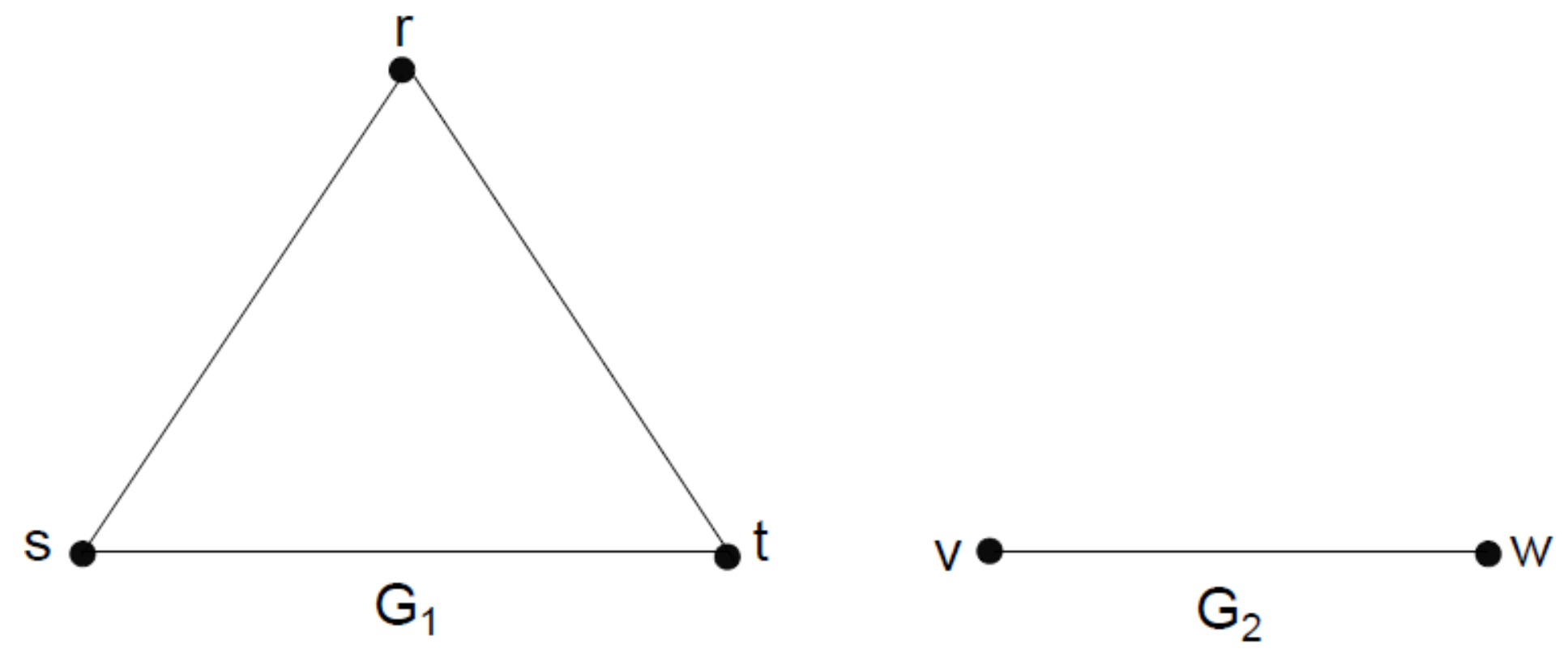
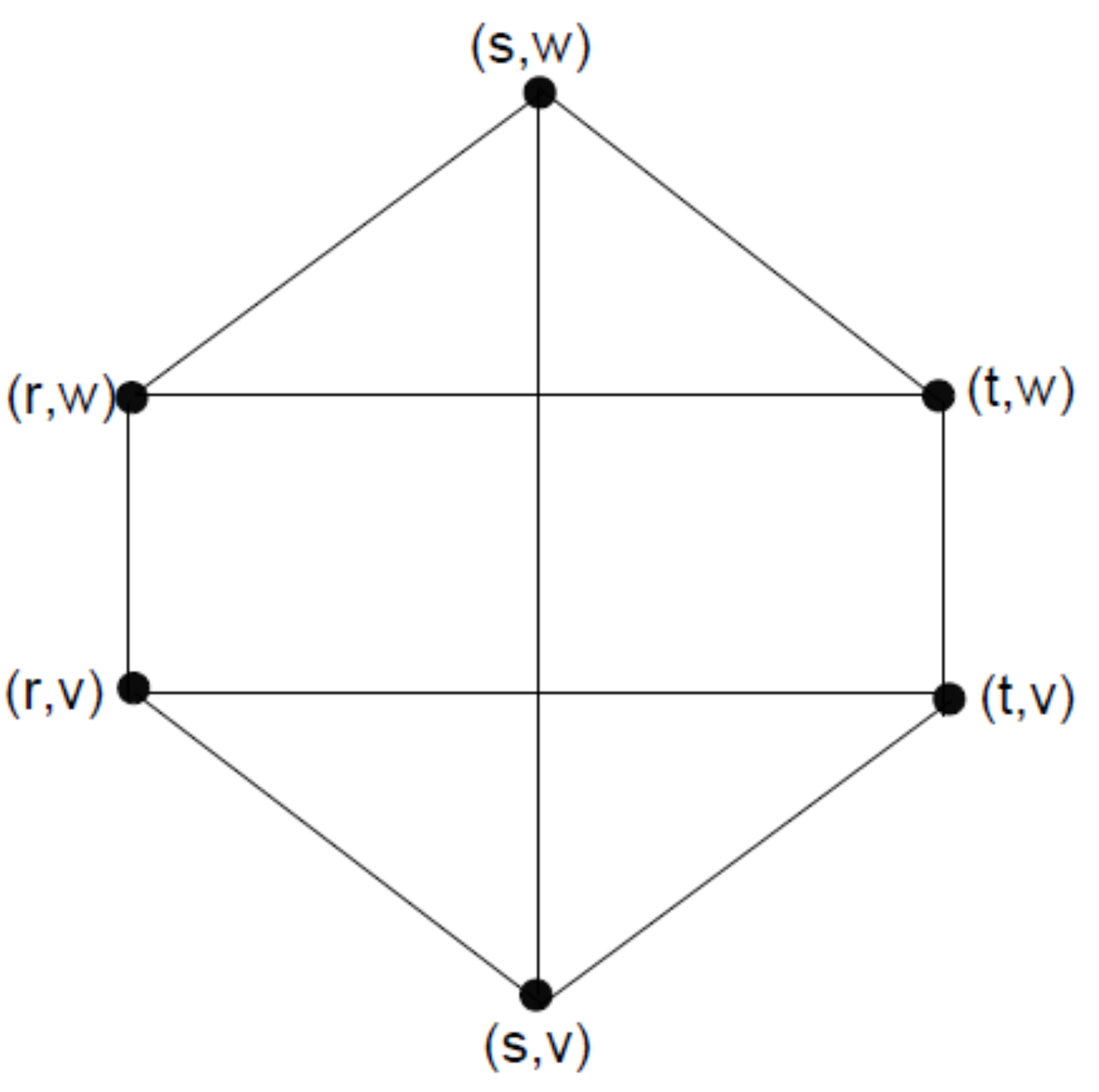
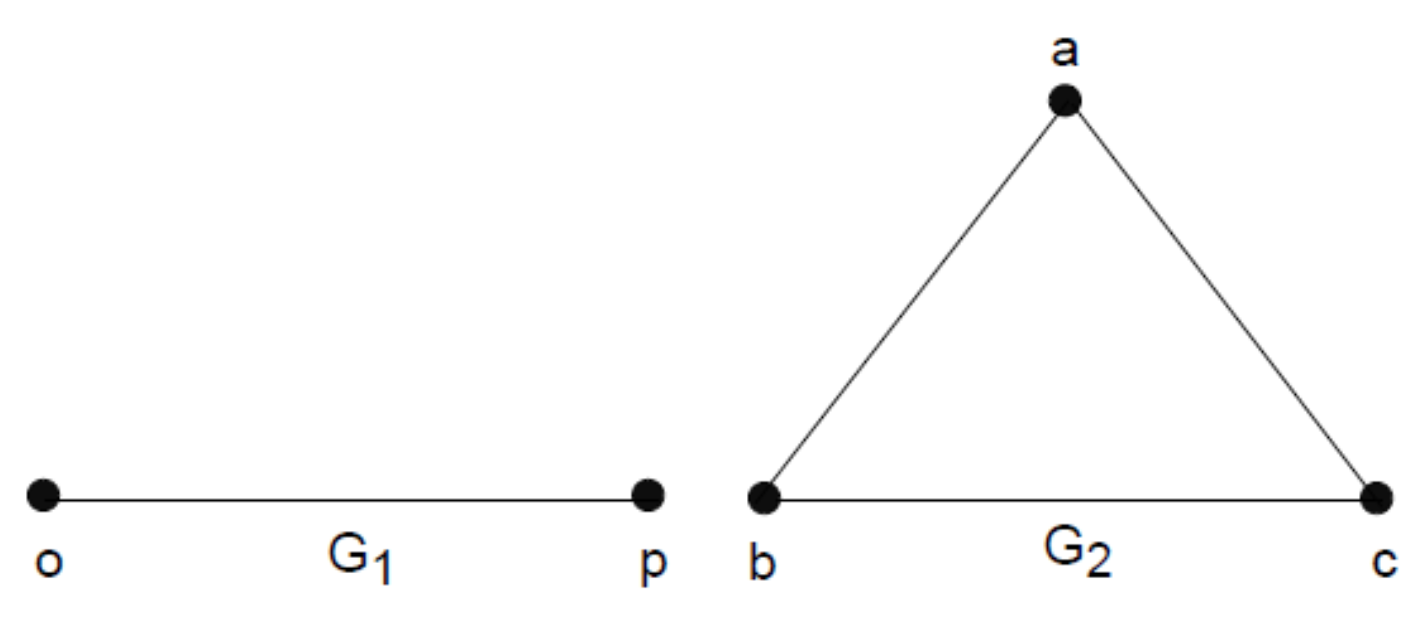
Consider two 3-polar 3-rung orthopair fuzzy graphs and on vertex sets and , respectively, given in Figure 4, Table 5 and Table 6, where and Then, their Cartesian product is presented in Figure 5, Table 7 and Table 8.
Figure 4.
).
Table 5.
).
Table 6.
).
Figure 5.
Cartesian product ).
Table 7.
Vertex set ().
Table 8.
Edge set ().
with the help of Theorem 4, we obtain
Therefore,
In addition, by Theorem 5, we have
Therefore,
Similarly, for all the vertices in the degree and total degree can be found.
4.3. Semi Strong Product of Multi Polar q-Rung Orhopair Fuzzy Graphs
Definition 16.
Let and be two m- of the graph and , respectively. Then, denoted the semi-strong product of and and defined as:
- (i)
- for all and
- (ii)
- for all , and .
- (iii)
- for all , and .
Proposition 3.
Let and be two m- of the graph and respectively. Then, is the semi-strong product of and and it is a m-
Definition 17.
Let and be two m-. Then, the degree of vertex is defined as:
where,
for
Theorem 6.
Let and be two m- If , , then, for all and
Proof.
By definition of vertex degree of , we have
for Analogously, it can be proved that Hence, □
Definition 18.
Let and be two m- Then, for vertex the total degree is determined as:
where,
for
Theorem 7.
Let and be two m- If
- (i)
- and then,
- (ii)
- and then,for all
Proof.
By definition of vertex total degree of
(i) and
for Analogously, can be proved. □
Example 6.
Consider and be two 3-polar 3-rung orthopair fuzzy graphs be visible in Figure 6, Table 9 and Table 10, where and Then, their semi-strong product is shown in Figure 7, Table 11 and Table 12.
Figure 6.
).
Table 9.
).
Table 10.
).
Figure 7.
Semi strong product ().
Table 11.
Vertex set ().
Table 12.
Edge set ().
Therefore,
In addition, by Theorem 7, we have
Therefore,
Similarly, for all the vertices in we can find their degree and total degree.
4.4. Strong Product of Multi Polar q-Rung Orhopair Fuzzy Graphs
Definition 19.
Let and be two m- of and respectively. Then represents the strong product of these two m- and defined as:
- (i)
- for all and
- (ii)
- for all and .
- (iii)
- for all , and .
- (iv)
- for all , and .
Proposition 4.
Let and be two m- of and respectively. Then, the strong product is a m-
Definition 20.
Let and be two m- The degree of vertex is defined as:
where,
Theorem 8.
Let and be two m- If , , , , then for all , where is total number of vertices adjscent to in
Proof.
By definition of vertex degree of ⊠, we have
□
Definition 21.
Let and be two m- The total degree of vertex is defined as:
where,
Theorem 9.
Let and be two m- If
(i) and then
(ii) then
for all
Proof.
For any vertex
(i)
Analogously is easy to prove. □
Example 7.
Consider and be two 3-polar 3-rung orthopair fuzzy graphsas in example 34, where and their strong product is shown in Figure 8. The vertex set of is same as given in Table 11 and edge set of is Table 12 with three additional edges given in the Table 13.
Figure 8.
Strong product ().
Table 13.
Additional edges for Edge set ().
Therefore,
By using Theorem 9, we can prove
Therefore,
Similarly, for all the vertices in the degree and total degree can be calculated.
4.5. The Lexicographic Product of Multi Polar q-Rung Orhopair Fuzzy Graphs
Definition 22.
Let and be two m- of and respectively. Then denotes the lexicographic product of these two m- and it is defined as follows:
- (i)
- for all and
- (ii)
- for all , and .
- (iii)
- for all , and .
- (iv)
- for all , and
Proposition 5.
For two m- and the lexicographic product is a m-
Definition 23.
Let and be two m- The degree of any vertex is defined as:
where,
for
Theorem 10.
Let and be two m-. If and , then for all where represents the number of total vertices in
Proof.
For any vertex
□
Definition 24.
Let and be two m- The degree of any vertex is defined as:
where,
Theorem 11.
Let and be two m- If
(i) then
(ii) then
for all and
Proof.
For any vertex
(i)
Analogously, can be proved. □
Example 8.
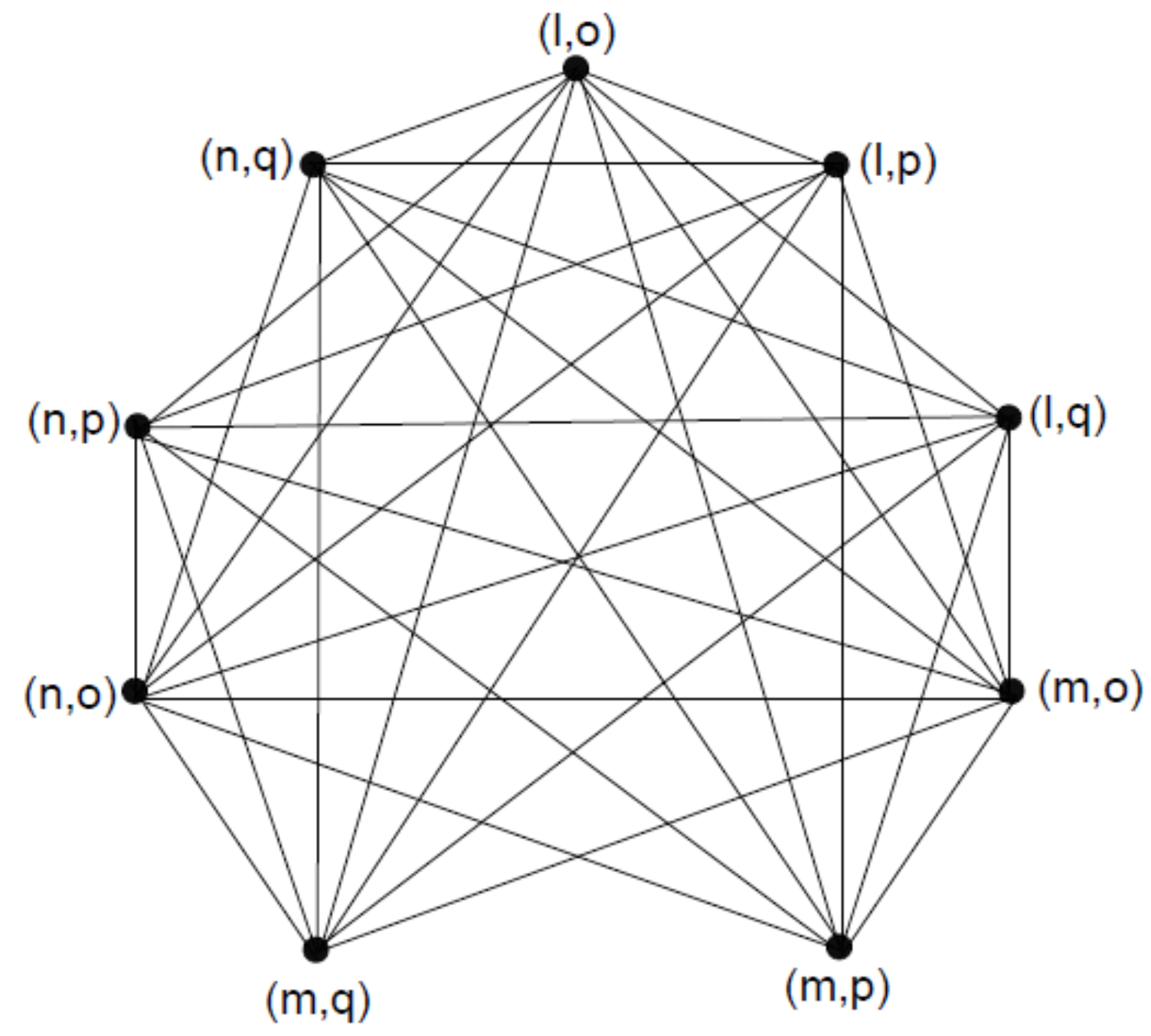
Consider and be two 3-polar 3-rung orthopair fuzzy graphs shown in Figure 9, Table 14 and Table 15, where and and their lexicographic product is shown in Figure 10 and Table 16.
Figure 9.
).
Table 14.
.
Table 15.
.
Figure 10.
Lexicographic product .
Table 16.
Edge set .
Now we find degree of vertex . We have
and
. We have total 33 number of edges in edge set of but here we take only those edges which are adjacent with vertex in Table 16.
Therefore, In addition, we must have the following results by using Theorem 11,
Therefore,
In similar way, for all the vertices in the degree and total degree of these vertices can be calculated.
5. Union of Multi Polar q-Rung Orthopair Fuzzy Graphs
Definition 25.
Let and be two m- of the graphs and respectively. Then, the union is defined as follows:
- (i)
- (ii)
- (iii)
- (
- (iv)
- for
Theorem 12.
If and are m- of and respectively, Then the union is a m- of , where and are the m- of and , respectively, and
Definition 26.
Let and be two m- For any vertex and the degree of vertex is defined as
and total degree is defined as
Here, we consider three cases.
Case 1.
Either or . Then, no edge incident at ς lies in Thus, for and
For and
Case 2.
If but no edge insident at ς lies in Then, any edge incident at ς is either in or in For we have,
Similarly,
Similarly,
Case 3.
If and some edges incident at ς are in Then, for
Similarly, ).
In addition,
Example 9.
Consider and be two 3-polar 3-rung orthopair fuzzy graphs on vertex sets and respectively, as shown in Figure 11, Table 17 and Table 18. In addition, their union is shown in Figure 12, Table 19 and Table 20, since .
Figure 11.
).
Table 17.
.
Table 18.
.
Figure 12.
Union .
Table 19.
Vertex set ().
Table 20.
Edge set .
Since thus,
Therefore,
Therefore,
Since but no edge concide with h lies in
Therefore,
Therefore,
Since and thus,
Therefore,
Therefore,
6. Some Topological Indices for Multi Polar q-Rung Orthopair Fuzzy Graphs
The physicochemical properties of molecular structures are well described with a numeric value which is known as Topological index. Topological indices of a graph have a wide range of implication in network design, theoretical chemistry, data transmission, etc. In fuzzy graphs these topological indices play very important role and have thorough implications. We named them modified topological indices as these are new in fuzzy graphs. In Kalathian et al. [45] established several toplogical indices of fuzzy graphs inclusive of Zagreb indices of two kinds, Randic index, and Harmonic index. Further these indices are cumputed for IFG by Dinar et al. [46] in 2023. Firstly in this part of the monograph we introduce the topological indices of multi polar q-rung fuzzy graphs and then computed these indices in an example.
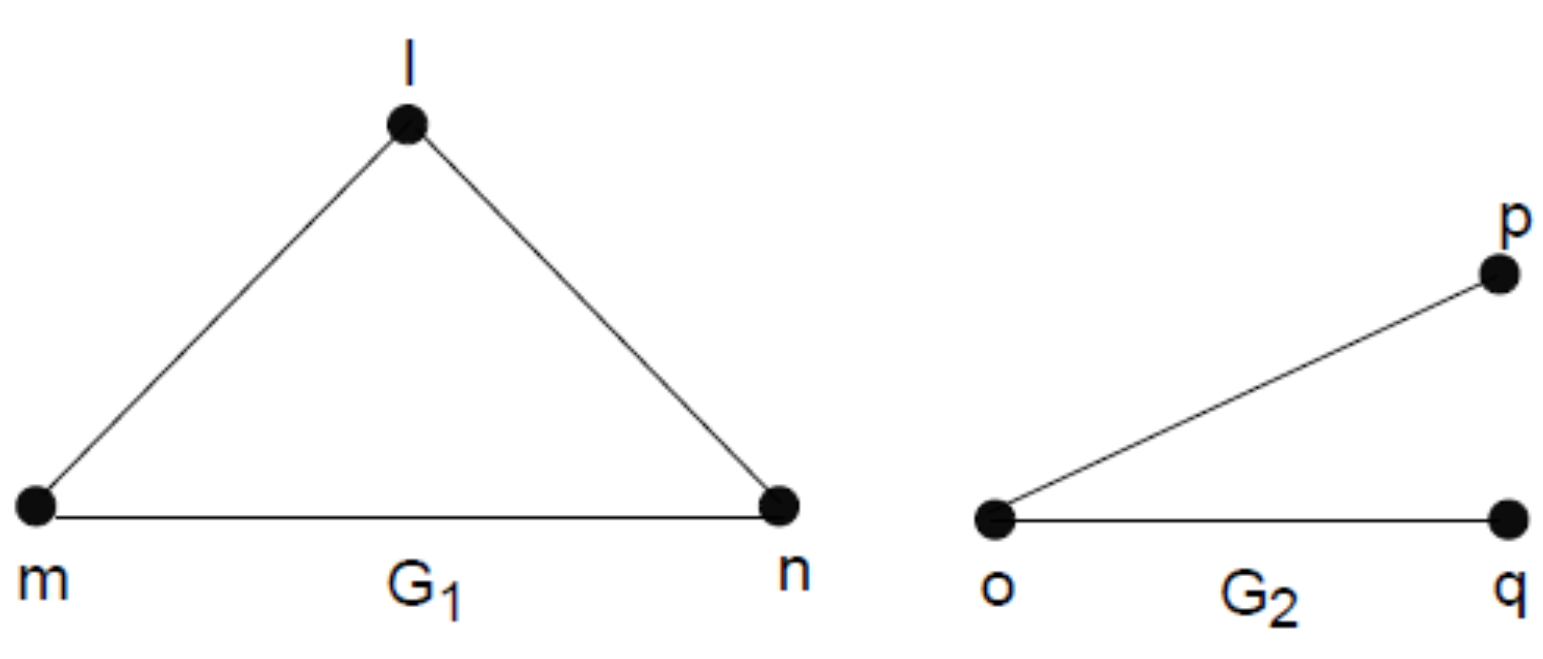
Definition 27.
Let be the multi polar q-rung orthopair fuzzy graph of where
Then the first Zagreb index is represnted by and defined as
where,
for
Definition 28.
Let be the multi polar q-rung orthopair fuzzy graph of represnts the second Zagreb index which is defined as
for
Definition 29.
Let be the multi polar q-rung orthopair fuzzy graph of The Randic index is denoted by and defined as
where,
for
Definition 30.
Let be the multi polar q-rung orthopair fuzzy graph of The Harmonic index is represented by and defined as
where,
for
Example 10.
Consider be a 3-polar 3-rung orthopair fuzzy graph of where and are vertex set and edge set, respectively, as given in the Figure 13 and Table 21. Then we find the first and second kind of Zagreb indices, Randic index and Harmonic index of this graph.
Figure 13.
.
Table 21.
.
By direct calculation, we have
Now by using definition, we calculate first Zagreb index
where,
hence, and in similar mannar we calculate and ,
We also observed that
Now we calculate second Zagreb index by using definition,
Also we have,
Now by using definition we calculate Randic index
where we have,
Finally we find Harmonic index by using definition
We observed that,
Theorem 13.
If two m- and are isomorphic to each other, then these graphs have equal topological indices values.
Proof.
Let and be two isomorphic m- Then there we have an identity function, for every there exist as well as for each there exist such that for vertices and edges of each membership value coincides with the values of graph . Therefore, we conclude that, with same membership values for equal collection of vertices and edges the graph structures may differ but there topological indices values are equal. □
Corollary 1.
If the topological values of two and are same, then the two m- need not to be isomorphic.
Corollary 2.
Let and be the m- Then the union of two m- is
- (i)
- (ii)
- (iii)
- (iv)
for
Proof.
We can prove these results with the help of Example 9. □
7. Conclusions
In this monograph we have demonstrated several rudimentary operations on m- together with their essential results. Firstly, for a vertex in m- we have defined the degree of vertex then we calculated its total degree. For product operations on m- these degrees permit to comprehend their characteristics. Secondly, product operations on m- inclusive direct, Cartesian, semi-strong, strong and lexicographic products, are obtained. Thirdly, using degree and total degree of vertex we have defined some general theorems under the obtained product operations on m-. More specifically, in product operations on m- the relationship between the degree and total degree of a vertex and the collection of adjoining vertices is analyzed with the help of these theorems. Finally, we have defined some degree based topological indices for m- and calculated these indices in an example. Due to vast range of implementation in various fields of sciences such as molecular science, medication, computer science, etc., the utilization of topological indices in fuzzy graphs are obtaining attraction. We can define and calculate already existed different topological indices for m-. In our upcoming work we can extend the application of m- to chemical structures.
Author Contributions
A.K. wrote the main manuscript text. N.A. and N.Y. supplied the main results. All authors have read and agreed to the published version of the manuscript.
Funding
This research was funded by the Princess Nourah bint Abdulrahman University Researchers Supporting Project Number (PNURSP2023R87), Princess Nourah bint Abdulrahman University, Riyadh, Saudi Arabia.
Data Availability Statement
Data are contained within the article.
Conflicts of Interest
All the authors in the paper have no conflict of interest.
References
- Zadeh, L.A. Fuzzy sets. Inf. Control 1965, 8, 338–353. [Google Scholar] [CrossRef]
- Zhang, W.R. Bipolar fuzzy sets and relations: A computational framework forcognitive modeling and multiagent decision analysis. In Proceedings of the 1st International Joint Conference of The North American Fuzzy Information Processing Society Biannual Conference, San Antonio, TX, USA, 18–21 December 1994; pp. 305–309. [Google Scholar]
- Zhang, W.R. Bipolar fuzzy sets. In Proceedings of the International Conference on Fuzzy Systems, Anchorage, AK, USA, 4–9 May 1998; pp. 835–840. [Google Scholar]
- Chen, J.; Li, S.; Ma, S.; Wang, X. m-Polar fuzzy sets: An extension of bipolar fuzzy sets. Sci. World J. 2014, 2014, 416530. [Google Scholar] [CrossRef]
- Naeem, K.; Riaz, M.; Afzal, D. Pythagorean m-polar fuzzy sets and TOPSIS method for the selection of advertisement mode. J. Intell. Fuzzy Syst. 2019, 37, 8441–8458. [Google Scholar] [CrossRef]
- Atanassov, K. Intuitionistic fuzzy sets. Fuzzy Sets Syst. 1986, 20, 87–96. [Google Scholar] [CrossRef]
- Yager, R.R.; Abbasov, A.M. Pythagorean membership grades, complex numbers, and decision making. Int. J. Intell. Syst. 2013, 28, 436–452. [Google Scholar] [CrossRef]
- Peng, X.; Yang, Y. Some results for Pythagorean fuzzy sets. Int. J. Intell. Syst. 2015, 30, 1133–1160. [Google Scholar] [CrossRef]
- Hashmi, M.R.; Riaz, M. A novel approach to censuses process by using Pythagorean m-polar fuzzy Dombi’s aggregation operators. J. Intell. Fuzzy Syst. 2020, 38, 1977–1995. [Google Scholar] [CrossRef]
- Hashmi, M.R.; Riaz, M.; Smarandache, F. m-Polar neutrosophic topology with applications to multi-criteria decision-making in medical diagnosis and clustering analysis. Int. Fuzzy Syst. 2020, 22, 273–292. [Google Scholar] [CrossRef]
- Yagar, R.R. Generalized orthopair fuzzy sets. IEEE Trans. Fuzzy Syst. 2017, 25, 1220–1230. [Google Scholar] [CrossRef]
- Ali, M.I. Another view on q-rung orthopair fuzzy sets. Int. J. Intell. Syst. 2018, 33, 2139–2153. [Google Scholar] [CrossRef]
- Riaz, M.; Hamid, M.T.; Afzal, D.; Pamucar, D.; Chu, Y.M. Multi-criteria decision making in robotic agri-farming with q-rung orthopair m-polar fuzzy sets. PLoS ONE 2021, 16, e0246485. [Google Scholar] [CrossRef] [PubMed]
- Kaufmann, A. Introduction a la Theorie des Sous-Emsembles Flous; Masson et Cia Editeurs: Paris, France, 1973. [Google Scholar]
- Rosenfeld, A. Fuzzy Graphs, Fuzzy Sets and Their Applications to Cognitive and Decision Processes; Academic Press: New York, NY, USA, 1975; pp. 77–95. [Google Scholar]
- Bhattacharya, P. Some remarks on fuzzy graphs. Pattern Recognit. Lett. 1987, 6, 297–302. [Google Scholar] [CrossRef]
- Mordeson, J.N.; Nair, P.S. Cycles and cocycles of fuzzy graphs. Inf. Sci. 1996, 90, 39–49. [Google Scholar] [CrossRef]
- Gani, A.N.; Begum, S.S. Degree, order and size in intuitionistic fuzzy graphs. Int. J. Algorithms Comput. Math. 2010, 3, 11–16. [Google Scholar]
- Gani, A.N.; Latha, S.R. On irregular fuzzy graphs. Appl. Math. Sci. 2012, 6, 517–523. [Google Scholar]
- Akram, M. Bipolar fuzzy graphs. Inf. Sci. 2011, 181, 5548–5564. [Google Scholar] [CrossRef]
- Akram, M. Bipolar fuzzy graphs with applications. Knowl.-Based Syst. 2013, 39, 1–8. [Google Scholar] [CrossRef]
- Akram, M.; Adeel, A. m-Polar fuzzy graphs and m-polar fuzzy line graphs. J. Discret. Math. Sci. Cryptogr. 2017, 20, 1597–1617. [Google Scholar] [CrossRef]
- Akram, M.; Adeel, A. m-Polar fuzzy labeling graphs with application. Math. Comput. Sci. 2016, 10, 387–402. [Google Scholar] [CrossRef]
- Akram, M.; Waseem, N. Certain metrics in m-polar fuzzy graphs. New Math. Nat. Comput. 2016, 12, 135–155. [Google Scholar] [CrossRef]
- Akram, M.; Akmal, R.; Alshehri, N. On m-Polar Fuzzy Graph Structures. SpringerPlus 2016, 5, 1448. [Google Scholar] [CrossRef] [PubMed]
- Akram, M.; Sarwar, M. Novel applications of m-polar fuzzy competition graphs in decision support system. Neural Comput. Appl. 2018, 30, 3145–3165. [Google Scholar] [CrossRef]
- Naz, S.; Ashraf, S.; Akram, M. A novel approach to decision-making with Pythagorean fuzzy information. Mathematics 2018, 6, 95. [Google Scholar] [CrossRef]
- Naz, S.; Rashmanlou, H.; Malik, M.A. Operations on single valued neutrosophic graphs with application. J. Intell. Fuzzy Syst. 2017, 32, 2137–2151. [Google Scholar] [CrossRef]
- Samanta, S.; Akram, M.; Pal, M. m-Step fuzzy competition graphs. J. Appl. Math. Comput. 2015, 47, 461–472. [Google Scholar] [CrossRef]
- Habib, A.; Akram, M.; Farooq, A. q-Rung orthopair fuzzy competition graphs with application in the soil ecosystem. Mathematics 2019, 7, 91. [Google Scholar] [CrossRef]
- Borzooei, R.A.; Rashmanlou, H. Cayley interval-valued fuzzy graphs. UPB Sci. Bull. Ser. A Appl. Math. Phys. 2016, 78, 83–94. [Google Scholar]
- Rashmanlou, H.; Pal, M. Some properties of highly irregular interval-valued fuzzy graphs. World Appl. Sci. J. 2013, 27, 1756–1773. [Google Scholar]
- Rashmanlou, H.; Borzooei, R.A. New concepts of interval-valued intuitionistic (S, T)-fuzzy graphs. J. Intell. Fuzzy Syst. 2016, 30, 1893–1901. [Google Scholar] [CrossRef]
- Talebi, A.A.; Rashmanlou, H.; Sadati, S.H. Interval-valued Intuitionistic Fuzzy Competition Graph. J. Mult. Log. Soft Comput. 2020, 34, 335–364. [Google Scholar]
- Mordeson, J.N.; Chang-Shyh, P. Operations on fuzzy graphs. Inf. Sci. 1994, 79, 159–170. [Google Scholar] [CrossRef]
- Mordeson, J.N.; Nair, P.S. Fuzzy Graphs and Fuzzy Hypergraphs; Physica Verlag: Heidelberg, Germany, 2012; Volume 46. [Google Scholar]
- Nirmala, G.; Vijaya, M. Fuzzy graphs on composition, tensor and normal products. Int. J. Sci. Res. Publ. 2012, 2, 1–7. [Google Scholar]
- Gong, Z.; Wang, Q. Some operations on fuzzy hypergraphs. Ars Comb. 2017, 132, 203–217. [Google Scholar]
- Sahoo, S.; Pal, M. Product of intuitionistic fuzzy graphs and degree. J. Intell. Fuzzy Syst. 2017, 32, 1059–1067. [Google Scholar] [CrossRef]
- Rashmanlou, H.; Pal, M.; Borzooei, R.A.; Mofidnakhaei, F.; Sarkar, B. Product of interval-valued fuzzy graphs and degree. J. Intell. Fuzzy Syst. 2018, 35, 6443–6451. [Google Scholar] [CrossRef]
- Yin, S.; Li, H.; Yang, Y. Product operations on q-rung orthopair fuzzy graphs. Symmetry 2019, 11, 588. [Google Scholar] [CrossRef]
- Xu, J. The use of fuzzy graphs in chemical structure research. In Fuzzy Logic in Chemistry; Academic Press: Cambridge, MA, USA, 1997; pp. 249–282. [Google Scholar]
- Mordeson, J.N.; Mathew, S. Advanced Topics in Fuzzy Graph Theory; Springer: Berlin/Heidelberg, Germany, 2019; Volume 375. [Google Scholar]
- Naeem, T.; Gumaei, A.; Kamran Jamil, M.; Alsanad, A.; Ullah, K. Connectivity indices of intuitionistic fuzzy graphs and their applications in internet routing and transport network flow. Math. Probl. Eng. 2021, 2021, 4156879. [Google Scholar] [CrossRef]
- Kalathian, S.; Ramalingam, S.; Raman, S.; Srinivasan, N. Some topological indices in fuzzy graphs. J. Intell. Fuzzy Syst. 2020, 39, 6033–6046. [Google Scholar] [CrossRef]
- Dinar, J.; Hussain, Z.; Zaman, S.; Rehman, S.U. Wiener index for an intuitionistic fuzzy graph and its application in water pipeline network. Ain Shams Eng. J. 2023, 14, 101826. [Google Scholar] [CrossRef]
Disclaimer/Publisher’s Note: The statements, opinions and data contained in all publications are solely those of the individual author(s) and contributor(s) and not of MDPI and/or the editor(s). MDPI and/or the editor(s) disclaim responsibility for any injury to people or property resulting from any ideas, methods, instructions or products referred to in the content. |
© 2023 by the authors. Licensee MDPI, Basel, Switzerland. This article is an open access article distributed under the terms and conditions of the Creative Commons Attribution (CC BY) license (https://creativecommons.org/licenses/by/4.0/).