Abstract
In this paper, we provide explicit expressions as well as recurrence relations for the single and product moments of generalized order statistics from the log-extended exponential–geometric distribution. These relations are utilized to discuss the special cases of generalized order statistics, and some numerical computations are carried out. Further, we use these results to obtain the best linear unbiased estimators for the location and scale parameters based on progressively Type-II right censored samples. Finally, a real data application is presented.
1. Introduction
The extended exponential–geometric (EEG) distribution was proposed by [1] to analyze lifetime data. If the Y random variable has the EEG distribution, then its probability density function (PDF) is given by
where and . This distribution provides decreasing or increasing hazard functions based on the values of its parameters, providing great flexibility of fit for real applications.
The importance of models with bounded support, particularly at unit intervals, is well established for modeling rates, indices, proportions, scores, etc. A wide range of distributions have been introduced and used in numerous different fields. The log-extended exponential–geometric (LEEG) distribution was introduced by [2], applying the transformation , where the random variable Y follows the EEG distribution. The LEEG distribution is an alternative to the beta distribution and has applications in the populations of cities, the sizes of power outages, and the intensities of earthquakes. Ref. [2] investigates some of the mathematical features of the LEEG distribution, such as moments and order statistics. Ref. [3] discussed the Fisher information matrix of the LEEG distribution based on simple random sample, ranked set sample, median ranked set sample, and extreme ranked set sample. Ref. [4] estimated the LEEG distribution parameters under simple random sampling and moving extremes ranked set sampling.
The PDF of the random variable X following the LEEG distribution is of the form
and the corresponding cumulative distribution function (CDF) is
where , . It is worth noting that the specific situation corresponds to the power function, which includes the uniform distribution for . The PDF of the LEEG distribution is flexible and has a variety of asymmetic shapes, which make it attractive for statistical purposes. For more details on the LEEG distribution and its applications, see [2,4,5,6].
The j-th moment of the LEEG distribution in Equation (1) is given as (see [2])
where is the Lerch transcendent function of the form which converges for any real number if z and s are any complex numbers with either or and , see [7].
The generalized order statistics (GOS) model is a model that contains many models of ordered random variables by selecting the parameters appropriately. Ref. [8] introduced the concept of GOS as follows.
Let be the parameters such that . Then, are the n GOS, and their joint PDF is of the form
where
Many models of ordered random variables can be viewed as special instances of GOS. If and such that , then the model reduces to ordinary order statistics. For and such that , the model reduces to the k-th record values. Also, for , and where denotes the fixed number of failure of units to be observed, the model reduces to progressive Type-II censored order statistics. Here, we consider the following two cases:
Case 1: When , the PDF of is given by (Kamps and Cramer [9])
and the joint PDF of and , is given by [9]
where , and
Case 2: When In this case, the PDF of is given by (Kamps [8])
and the joint PDF of and , is given by (Kamps [8])
where and .
The moments of ordered random schemes have garnered a lot of attention in recent years. Many authors studied the moments of GOS for various distributions. For example, see for some general forms of distribution [9,10,11] and for some specific distributions [12,13,14,15,16]. For more recent works, see [17,18,19,20]. However, to our knowledge, no attempt has yet been made to study the LEEG distribution based on GOS.The motivation for this paper is twofold: first, to derive the explicit expressions and recurrence relations for the single and product moments based on the GOS of the LEEG distribution; second, to obtain the best linear unbiased estimators (BLUEs) for the location and scale parameters based on progressively Type-II right censored order statistics.
The paper is organized as follows. Section 2 and Section 3 provide the explicit expressions and recurrence relations for the single and product moments of GOS from the LEEG distribution. In Section 4, we compute the BLUEs for the location and scale parameters based on progressively Type-II right censored order statistics. Section 5 includes a real example that is utilized to illustrate the findings obtained in the previous section.
2. Single Moments of GOS from LEEG Distribution
The explicit expression and recurrence relation for single moments of GOS from the LEEG distribution are found in this section.
Theorem 1.
For the LEEG distribution as given in (1) and ,
where is the Gauss hypergeometric function defined by
, and denotes the ascending factorial.
Proof.
Setting , we obtain
Now, by using the result from [21] (p. 317) given as
where is the beta function, we obtain
which is (10). □
Corollary 1.
For the single moment of GOS for case 2 is given by
Remark 1.
Setting and in (16), the expression for the single moments of ordinary order statistics from the LEEG distribution can be obtained as
Remark 2.
At and in (10), we obtain the expression for single moments of LEEG distribution from progressive Type-II censored order statistics.
Theorem 2.
For the LEEG distribution as given in (1), and for , the following recurrence relation for the single moments of GOS
is satisfied.
Proof.
We use the result of [11] for the LEEG distribution to obtain the recurrence relation for the single moments of GOS:
Let then
By simplifying the previous expression, we obtain the required result. □
Corollary 2.
If then the recurrence relation for the single moments of GOS for case 2 is as follows:
Remark 3.
Setting and in (21), we get the recurrence relation for the single moments of ordinary order statistics for the LEEG distribution as
Remark 4.
Setting and in (18), then the recurrence relation for the single moments of progressive Type-II censored order statistics of the LEEG distribution is given by
3. Product Moments of GOS from LEEG Distribution
In this part, the explicit expression and recurrence relation for product moments of GOS are considered.
Theorem 3.
For , the product moment of tth and sth GOS from the LEEG distribution is given by
Proof.
The product moment of GOS is given by
Corollary 3.
When the product moment of GOS for case 2 is given as
where
Remark 5.
Putting and in (29), we obtain the product moment of ordinary order statistics as
Remark 6.
At and in (24), the explicit expression for the product moment of progressive Type-II censored order statistics of the LEEG distribution can be obtained.
Theorem 4.
For , the recurrence relation for product moments of GOS from the LEEG distribution is given by
Proof.
From [11], we have
Corollary 4.
When the recurrence relation for the product moments of GOS for case 2 is given by
Remark 7.
For and in (33), we obtain the recurrence relation for product moments of ordinary order statistics for the LEEG distribution as
Remark 8.
If and in (31), then the recurrence relation for the product moments of progressive Type-II censored order statistics of the LEEG distribution is given by
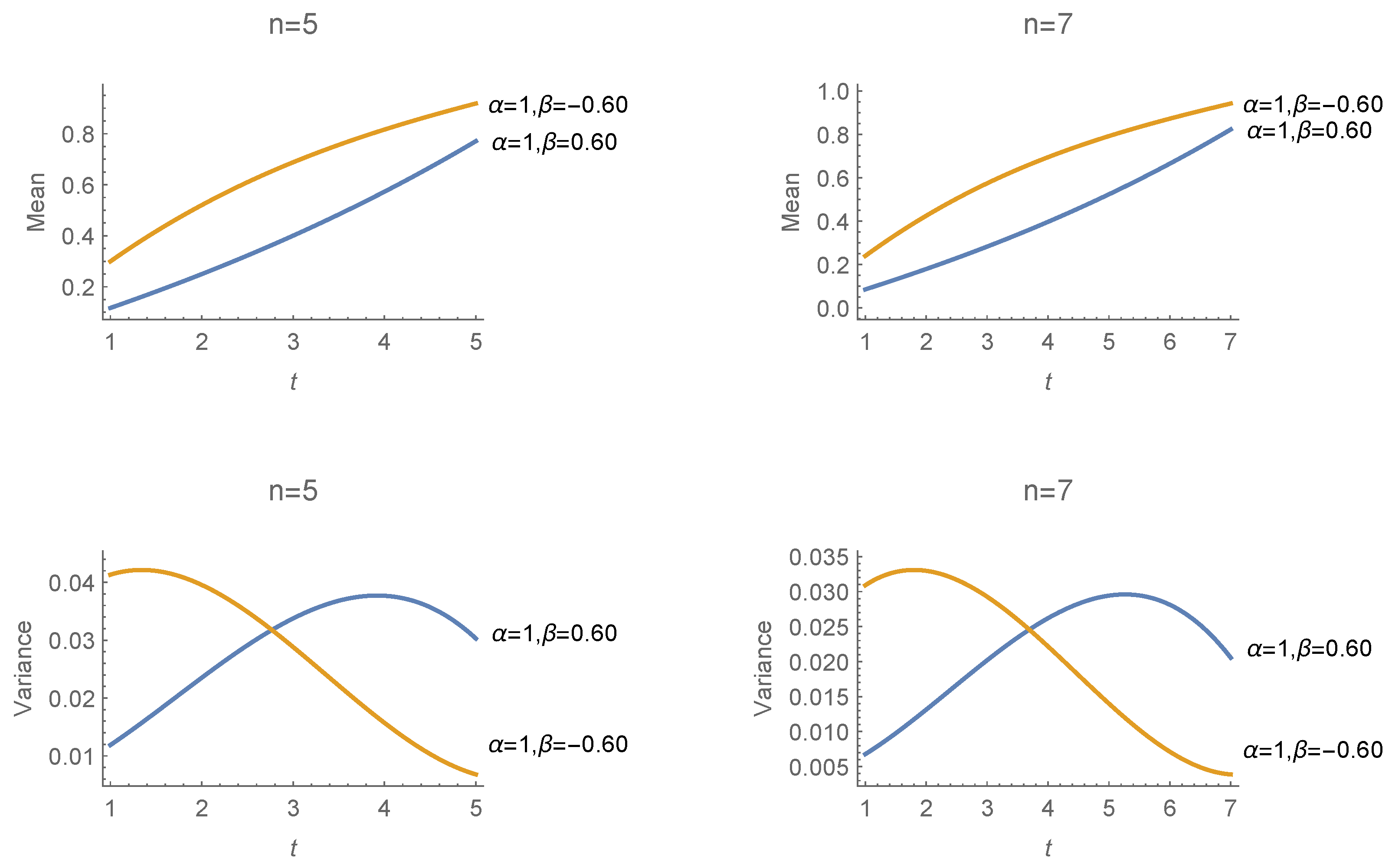
Utilizing the explicit expressions for the single and product moments given in Theorems (1) and (3), we calculated the means and variances of the LEEG distribution based on ordinary order statistics and progressively Type-II censored order statistics as shown in Table 1, Table 2, Table 3 and Table 4. For simplicity, the notation , for example, is used in Table 3, Table 4, Table 5, Table 6 and Table 7 to signify the censoring scheme . Figure 1 shows the behavior of the means and variances of order statistics.
Table 1.
Means and variances of order statistics from the LEEG distribution with and .
Table 2.
Means and variances of order statistics from the LEEG distribution with and .
Table 3.
Means of progressively Type-II right censored order statistics from the LEEG distribution with and .
Table 4.
Variances of progressively Type-II right censored order statistics from the LEEG distribution with and .
Figure 1.
Behavior of the means and variances of order statistics.
In the case of moments of order statistics, the following identities are utilized to validate the computations of means, variances, and covariances:
where ; see [22].
4. BLUEs for Location-Scale LEEG Distribution
Suppose is a progressively Type-II right censored sample from a location-scale LEEG distribution with location parameter and scale parameter . Let , denote the corresponding progressively Type-II right censored sample from the standard distribution, and . Denote , as the mean vector, and as the variance–covariance matrix.
Then, the BLUE of the parameter is given by
where and
Moreover, the variances and covariances of these BLUEs are given by
and
See [23,24] for more details.
The coefficients of the BLUEs for and and the values Var, Var, and Cov are displayed in Table 5, Table 6 and Table 7 for sample size and for different choices of and progressive censoring schemes. The coefficients of the BLUEs and in Table 5 and Table 6 can be checked by the conditions and .
Table 5.
Coefficients for the BLUEs of for some selected progressive censoring schemes for the location-scale LEEG distribution with and .
Table 5.
Coefficients for the BLUEs of for some selected progressive censoring schemes for the location-scale LEEG distribution with and .
| n | Scheme | Coefficients | ||||||
|---|---|---|---|---|---|---|---|---|
| −0.60 | 2 | 10 | 1.35761 | −0.35761 | ||||
| −0.60 | 2 | 10 | 2.21617 | −1.21617 | ||||
| 0.60 | 2 | 10 | 1.15115 | −0.15115 | ||||
| 0.60 | 2 | 10 | 1.93408 | −0.93408 | ||||
| −0.60 | 3 | 10 | 1.267510 | 0.048873 | −0.316382 | |||
| −0.60 | 3 | 10 | 1.622630 | 0.090463 | −0.713096 | |||
| 0.60 | 3 | 10 | 1.084910 | 0.044168 | −0.129077 | |||
| 0.60 | 3 | 10 | 1.465590 | −0.028833 | −0.436757 | |||
| −0.60 | 4 | 10 | 1.233440 | 0.035801 | 0.051191 | −0.32043 | ||
| −0.60 | 4 | 10 | 1.424650 | 0.058870 | 0.071805 | −0.555328 | ||
| 0.60 | 4 | 10 | 1.079010 | −0.057814 | 0.147298 | −0.168491 | ||
| 0.60 | 4 | 10 | 1.309520 | −0.019550 | −0.018046 | −0.271927 | ||
| −0.60 | 5 | 10 | 1.212280 | 0.029705 | 0.040361 | 0.054430 | −0.336772 | |
| −0.60 | 5 | 10 | 1.324870 | 0.043549 | 0.053086 | 0.064140 | −0.485642 | |
| 0.60 | 5 | 10 | 1.154350 | −0.249614 | 0.081079 | 0.283290 | −0.269101 | |
| 0.60 | 5 | 10 | 1.231460 | −0.014845 | −0.013701 | −0.012619 | −0.190292 | |
Table 6.
Coefficients for the BLUEs of for some selected progressive censoring schemes for the location-scale LEEG distribution with and .
Table 6.
Coefficients for the BLUEs of for some selected progressive censoring schemes for the location-scale LEEG distribution with and .
| n | Scheme | Coefficients | ||||||
|---|---|---|---|---|---|---|---|---|
| −0.60 | 2 | 10 | −1.93907 | 1.93907 | ||||
| −0.60 | 2 | 10 | −6.59438 | 6.59438 | ||||
| 0.60 | 2 | 10 | −2.48946 | 2.48946 | ||||
| 0.60 | 2 | 10 | −15.3849 | 15.3849 | ||||
| −0.60 | 3 | 10 | −1.50756 | −0.12082 | 1.62838 | |||
| −0.60 | 3 | 10 | −3.43490 | −0.361011 | 3.79591 | |||
| 0.60 | 3 | 10 | −1.88178 | 0.146175 | 1.73560 | |||
| 0.60 | 3 | 10 | −7.63449 | 0.409117 | 7.22538 | |||
| −0.60 | 4 | 10 | −1.37515 | −0.069004 | −0.100254 | 1.54441 | ||
| −0.60 | 4 | 10 | −2.41641 | −0.19848, | −0.241947 | 2.85684 | ||
| 0.60 | 4 | 10 | −1.86443 | 0.583966 | −0.312108 | 1.592570 | ||
| 0.60 | 4 | 10 | −5.02877 | 0.254115 | 0.234554 | 4.54010 | ||
| −0.60 | 5 | 10 | −1.310220 | −0.048427 | −0.066312 | −0.089994 | 1.514960 | |
| −0.60 | 5 | 10 | −1.927040 | −0.123346 | −0.150142 | −0.181194 | 2.381720 | |
| 0.60 | 5 | 10 | −2.310470 | 1.680380 | −0.497668 | −0.637334 | 1.765090 | |
| 0.60 | 5 | 10 | −3.706610 | 0.174442 | 0.160968 | 0.148230 | 3.222970 | |
Table 7.
The values of Var, Var and Cov for some selected progressive censoring schemes for the location-scale LEEG distribution with and .
Table 7.
The values of Var, Var and Cov for some selected progressive censoring schemes for the location-scale LEEG distribution with and .
| n | Scheme | |||||
|---|---|---|---|---|---|---|
| −0.60 | 2 | 10 | 0.039000 | 0.234720 | −0.071469 | |
| −0.60 | 2 | 10 | 0.056385 | 0.691219 | −0.160697 | |
| 0.60 | 2 | 10 | 0.004760 | 0.423011 | −0.023590 | |
| 0.60 | 2 | 10 | 0.007123 | 0.924341 | −0.058274 | |
| −0.60 | 3 | 10 | 0.033814 | 0.094203 | −0.044520 | |
| −0.60 | 3 | 10 | 0.042320 | 0.292673 | −0.085827 | |
| 0.60 | 3 | 10 | 0.003466 | 0.159245 | −0.005680 | |
| 0.60 | 3 | 10 | 0.005344 | 0.437374 | −0.028838 | |
| −0.60 | 4 | 10 | 0.032441 | 0.060941 | −0.037824 | |
| −0.60 | 4 | 10 | 0.037611 | 0.168037 | −0.061599 | |
| 0.60 | 4 | 10 | 0.002489 | 0.072280 | 0.002225 | |
| 0.60 | 4 | 10 | 0.004751 | 0.272057 | −0.018936 | |
| −0.60 | 5 | 10 | 0.031844 | 0.048360 | −0.035150 | |
| −0.60 | 5 | 10 | 0.035224 | 0.110639 | −0.049896 | |
| 0.60 | 5 | 10 | 0.000822 | 0.012654 | 0.010497 | |
| 0.60 | 5 | 10 | 0.004454 | 0.186895 | −0.013908 |
5. Real Data Application
In this part, we consider a real data set as an application of the estimating method provided in this article. The data set is available in [25] and consists of seventy-three observations on seven variables. Many authors analyzed these data; see [26,27,28]. The data set’s description may be found in [27].
Here, attention is on the variable FIRMCOST (divided by 100), which is a measure of the cost effectiveness of the firm’s risk management practices. A random sample of size ten is selected as follows: 0.002, 0.0036, 0.004, 0.0122, 0.0407, 0.0571, 0.0849, 0.1357, 0.1833, 0.2222. From the above data, we generate a progressively Type-II censored sample with , , and the censoring scheme . The generated progressively Type-II censored sample is shown in Table 8.
Table 8.
Generated progressively Type-II censored sample from the data of [25].
A simple plot of these censored values against the expected values given in Table 3 for and shows a quite high correlation (i.e., a correlation coefficient of the order of 0.9743). Hence, we can assume that these data comes from the LEEG distribution with and .
Based on the progressively Type-II censored sample presented above, we find the BLUEs of and to be and , respectively, and their standard errors to be and .

6. Conclusions
In this study, we obtain explicit expressions and recurrence relations for the single and product moments of GOS from the LEEG distribution. Based on these results, the means and variances of ordinary order statistics and progressively Type-II censored order statistics are calculated using Mathematica software. Further, based on progressively Type-II censored order statistics, we obtain the BLUEs of the location and scale parameters of the LEEG distribution. In addition, a real data set is used for illustration. The findings of this study can be utilized to obtain the best linear invariant estimators for the location and scale parameters of the LEEG distribution, as well as the best linear unbiased predictors and best linear invariant predictors for future unobserved GOS. It is also worth noting that the recurrence relations presented here can be used to characterize the LEEG distribution.
Funding
This research received no external funding.
Data Availability Statement
This study relied on previously published data. These earlier studies are listed as references in the text at appropriate places.
Acknowledgments
The author would like to acknowledge the Deanship of Scientific Research at Taif University for supporting this work.
Conflicts of Interest
The author declares no conflict of interest.
References
- Adamidis, K.; Dimitrakopoulou, T.; Loukas, S. On an extension of the exponential-geometric distribution. Stat. Probab. Lett. 2005, 73, 259–269. [Google Scholar] [CrossRef]
- Jodra, P.; Jimenez-Gamero, M.D. A quantile regression model for bounded responses based on the exponential-geometric distribution. Revstat-Stat. J. 2020, 18, 415–436. [Google Scholar]
- Yang, R.; Chen, W.; Yao, D.; Long, C.; Dong, Y.; Shen, B. The efficiency of ranked set sampling design for parameter estimation for the log-extended exponential–geometric distribution. Iran. J. Sci. Technol.-Trans. A Sci. 2020, 44, 497–507. [Google Scholar] [CrossRef]
- Yang, R.; Chen, W.; Dong, Y. Log-extended exponential-geometric parameters estimation using simple random sampling and moving extremes ranked set sampling. Commun. Stat. Simul. Comput. 2023, 52, 267–277. [Google Scholar] [CrossRef]
- Mitzenmacher, M. A brief history of generative models for power law and lognormal distributions. Internet Math. 2004, 1, 226–251. [Google Scholar] [CrossRef]
- Clauset, A.; Shalizi, C.R.; Newman, M.E. Power-law distributions in empirical data. SIAM Rev. 2009, 51, 661–703. [Google Scholar] [CrossRef]
- Apostol, T.M. Zeta and Related Functions; Cambridge University Press: Cambridge, UK, 2010; Chapter 25; pp. 601–616. [Google Scholar]
- Kamps, U. A Concept of Generalized Order Statistics; Teubner: Stuttgart, Germany, 1995; p. 210. [Google Scholar]
- Kamps, U.; Cramer, E. On distributions of generalized order statistics. Statistics 2001, 35, 269–280. [Google Scholar] [CrossRef]
- Ahmad, A.E.B.A.; Fawzy, M.A. Recurrence relations for single moments of generalized order statistics from doubly truncated distributions. J. Stat. Plan. Inference 2003, 117, 241–249. [Google Scholar] [CrossRef]
- Athar, H.; Islam, H.M.U. Recurrence relations for single and product moments of generalized order statistics from a general class of distribution. Metron 2004, 62, 327–337. [Google Scholar]
- Khan, R.U.; Kumar, D.; Athar, H. Moments of generalized order statistics from Erlang-truncated exponential distribution and its characterization. Int. J. Stat. Syst. 2010, 5, 455–464. [Google Scholar]
- Kumar, D. Exact moments of generalized order statistics from type II exponentiated log-logistic distribution. Hacet. J. Math. Stat. 2015, 44, 715–733. [Google Scholar] [CrossRef]
- Zarrin, S.; Athar, H.; Abdel-Aty, Y. Relations for moments of generalized order statistics from power Lomax distribution. J. Stat. Appl. Probab. Lett. 2019, 6, 29–36. [Google Scholar] [CrossRef]
- Athar, H.; Zarrin, S.; Noor, Z. Moment properties of generalized order statistics from Weibull-geometric distribution. Appl. Math. E-Notes 2019, 19, 199–209. [Google Scholar]
- Gupta, N.; Anwar, Z. Relations for single and product moments of odds generalized exponential-Pareto distribution based on generalized order statistics and its characterization. Stat. Optim. Inf. Comput. 2019, 7, 160–170. [Google Scholar] [CrossRef]
- Khan, M.J.S.; Sharma, A.; Iqrar, S. On moments of Lindley distribution based on generalized order statistics. Am. J. Math. Manag. Sci. 2020, 39, 214–233. [Google Scholar] [CrossRef]
- Athar, H.; Noor, Z.; Zarrin, S.; Almutairi, H.N. Expectation Properties of Generalized Order Statistics from Poisson Lomax Distribution. Stat. Optim. Inf. Comput. 2021, 9, 735–747. [Google Scholar] [CrossRef]
- Alharbi, Y.F. A Study on Moments of Generalized Order Statistics from Lomax-Exponential Distribution and Characterization. Int. J. Math. Comput. Sci. 2021, 16, 1179–1202. [Google Scholar]
- Athar, H.; Fawzy, M.A.; Alharbi, Y.F. Moment Properties of Generalized Order Statistics Based on Modified Weighted Rayleigh Distribution. Eur. J. Stat. 2023, 3, 1. [Google Scholar] [CrossRef]
- Gradshteyn, I.S.; Ryzhik, I.M. Table of Integrals, Series, and Products, 7th ed.; Elsevier/Academic Press: Amsterdam, The Netherlands, 2007; Volume 48, p. 1171. [Google Scholar]
- Joshi, P.C.; Balakrishnan, N. Recurrence relations and identities for the product moments of order statistics. Sankhyā Ser. B 1982, 44, 39–49. [Google Scholar]
- Balakrishnan, N.; Cohen, A.C. Order Statistics and Inference: Estimation Methods; Elsevier: Amsterdam, The Netherlands, 2014. [Google Scholar]
- Arnold, B.C.; Balakrishnan, N.; Nagaraja, H.N. A First Course in Order Statistics; Society for Industrial and Applied Mathematics: Delhi, India, 2008. [Google Scholar]
- Frees, E.W. Regression Modeling with Actuarial and Financial Applications; Cambridge University Press: Cambridge, UK, 2010. [Google Scholar]
- Schmit, J.T.; Roth, K. Cost effectiveness of risk management practices. J. Risk Insur. 1990, 57, 455–470. [Google Scholar] [CrossRef]
- Gómez-Déniz, E.; Sordo, M.A.; Calderín-Ojeda, E. The Log–Lindley distribution as an alternative to the beta regression model with applications in insurance. Insur. Math. Econ. 2014, 54, 49–57. [Google Scholar] [CrossRef]
- Jodrá, P.; Jimenez-Gamero, M.D. A note on the Log-Lindley distribution. Insur. Math. Econ. 2016, 71, 189–194. [Google Scholar] [CrossRef]
Disclaimer/Publisher’s Note: The statements, opinions and data contained in all publications are solely those of the individual author(s) and contributor(s) and not of MDPI and/or the editor(s). MDPI and/or the editor(s) disclaim responsibility for any injury to people or property resulting from any ideas, methods, instructions or products referred to in the content. |
© 2023 by the author. Licensee MDPI, Basel, Switzerland. This article is an open access article distributed under the terms and conditions of the Creative Commons Attribution (CC BY) license (https://creativecommons.org/licenses/by/4.0/).