


Abstract
Numerical methods play an important role in modern mathematical research, especially studying the symmetry analysis and obtaining the numerical solutions of fractional differential equation. In the current work, we use two numerical schemes to deal with fractional differential equations. In the first case, a combination of the group preserving scheme and fictitious time integration method (FTIM) is considered to solve the problem. Firstly, we applied the FTIM role, and then the GPS came to integrate the obtained new system using initial conditions. Figure and tables containing the solutions are provided. The tabulated numerical simulations are compared with the reproducing kernel Hilbert space method (RKHSM) as well as the exact solution. The methodology of RKHSM mainly relies on the right choice of the reproducing kernel functions. The results confirm that the FTIM finds the true solution. Additionally, these numerical results indicate the effectiveness of the proposed methods.
1. Introduction
The fractional calculus’ sense (FC) is presented after classical calculus, but after identifying the limitations of the classical one, many researchers weighed the notions of fractional calculus to comprehend the character systematically. Plenty of mathematicians promoted the vital establishment with the aid of new attributes and corresponding outcomes for FC [1,2,3,4,5,6]. Specifically, the particular functions are proposed to create novel non-integer integral and differential operators. These latter are presented by many people to investigate and symbolize different equations linked with phenomena [7,8,9,10,11,12,13,14,15]. The symmetric and anti-symmetric solitons of the fractional Schrödinger equation have been studied in [16]. In [17], the authors extended the Lie symmetry analysis to the time fractional generalized KdV equations. The Adomian decomposition technique for investigating the fractional KdV–Burgers equation was applied in [18]. Since the Chebyshev collocation technique is implemented for investigating the time-fractional nonlinear Klein–Gordon equation [19], a geometric method is applied for the Korteweg–de Vries equation [20]. A combination of FTIM and geometric method is applied for the fractional Burger–Huxley equation [21]. Additionally, in [22], a lie group approach is implemented for solving the fractional equation. Some other applications can be seen in [23,24,25,26,27,28,29,30,31].
Consider the following equation:
where c denotes the specific heat, c is the density, describes the thermal conductivity coefficient, and shows the Caputo fractional derivative. Equations of this type are used to describe the transport processes with a long memory.The fractional heat equation is one of the most well-known fractional partial differential equations that describe the physical phenomenon. In recent years, solving the fractional heat equation magnetized the attention of mathematicians because of its importance. Many methods have been worked to solve this problem. The higher-order numerical method is used for investigating the fractional heat equation [32]. Additionally, the Laplace homotopy technique is worked to solve this equation [33]. In [34], authors used one-step backward-forward algorithms for multi-dimensional backward heat conduction problems.
Motivated by the above works, in this paper, two numerical methods are worked to solve this equation. One is a combination of a specific type of fictitious time integration technique and the Runge–Kutta method. The other is the RKHSM. The main paper’s contributions are as follows:
- We present new results on the numerical simulation for the considered equation.
- We apply two effective numerical methods to obtain these new accurate results.
- The convergence analysis that confirms the theoretical parts of both methods is discussed.
Variable transformation of a time integration method, namely FTIM, was suggested by Atluri and Liu. Researchers used it for solving linear or nonlinear algebraic equations by defining the fictitious time and using it to derive a system of nonautonomous first-order ordinary differential equations that is equivalent to the original algebraic equations in an n-dimensional space. Some applications of this technique can be seen in [35,36,37,38,39].
In another aspect of this paper, as we mentioned before, we applied the RKHSM for solving the proposed equation.
Recently, the RKHSM has achieved great popularity and success. It became a powerful tool in treating different types of FPDEs, such as the fractional Bloch–Torrey equations [40] and fractional differential equations, including the ABC derivative [41], to name a few. See also [42,43,44,45,46,47] for more research about this method. The RKHSM has many advantages, such as its simplicity and flexibility in treating many fractional differential systems and the fact that it is a mesh-free method. The rest of the paper consists of the following: Section 2 recalls some essential concepts about fractional calculus and reproducing kernel theories. Section 3 and Section 4 are where we see the main theory of the FTIM and RKHSM, respectively, to build a numerical solution for the considered problem. Before finishing with the conclusion part, we validate the proposed methods through two examples.
2. Basic Definitions
Definition 1.
The left-sided Riemannian–Liouville fractional integral of order of , is
Definition 2.
We write
provided
Definition 3.
Suppose a real function f (with ) is in the space , . By such that . Obviously, if .
Definition 4.
Suppose , the Caputo derivative of f is
Lemma 1.
Assume and Then,
and
Definition 5.
The fractional derivative of f in the Caputo sense is
Definition 6.
The Caputo time-fractional derivative operator is
for m to be the smallest integer that exceeds The space-fractional derivative with is described by
Notations
- (i)
- We will writeto denote the collection of all absolutely continuous functions on
- (ii)
- We write CCF to mean a completely continuous function.
Definition 7.
Define the function space by
Definition 8.
If the inner product and norm of this space are described to be
and
Theorem 1.
The RK function of is the function described as
with
For the proof, see [43].
Definition 9.
Define the function space by
Definition 10.
If the inner product and norm are
Theorem 2.
The RK function of is the function defined by
For the proof, see [43].
Definition 11.
If the inner product and norm are
and
Theorem 3.
The RK function of is the function defined by
For the proof, see [43].
Throughout
Definition 12.
Define the binary function space by
Definition 13.
If the inner product and norm of this space are
and
Theorem 4.
The RK function of is the function
Definition 14.
Define the binary function space by
Definition 15.
If the inner product and norm of this space are
and
Theorem 5.
The RK function of is the function
3. The Fictitious Time Integration Method (FTIM)
Here, the FTIM is implemented. Consider the following equation:
To increase the stability of the technique, we propose a fictitious damping coefficient in Equation (29) by
We consider
Equation (32) will be
Equation (34) can be converted to a new class of PDE for by choosing :
Using
Implementing for Equation (35), one obtains
By , we obtain
Suppose that as the discrete values of u at a grid point , and Equation (38) converts to
where
where and .
, Equation (39) can be abstracted by
where is a vector-valued function of and and is an M-dimensional vector. Now, we implement the group-preserving scheme (GPS) [48] to solve Equation (39) as
Now, we employ the GPS by taking the initial value of to solve Equation (39) from the initial fictitious time to a selected final fictitious time . Additionally, the terminating criterion for this method is
where is a picked convergence criterion. The solution of u will be obtained by
where satisfies the above criterion.
4. The Application of RKHSM
4.1. Methodology for RKHSM
Step 1: Considering the following transformation
where for which and
With
where
Step 2: Defining a linear operator as follows
Lemma 2.
The operator is a bounded linear.
Proof.
We begin by checking directly that is bounded. So, we must show that
We have
In view of reproducing the property,
In a similar way, we deduce
Applying the Schwarz inequality, we discover
Since is continuous, we consequently have
Hence
Therefore,
where □
Step 3: Construct the on providing this by using the Gram–Schmidt process:
where
- in which denotes the adjoint of and where is given by (27).
- The countable set is dense in
- is a function system in and the following shows the way that we can construct it:
- is the orthogonalization coefficients which are defined bywhere
Theorem 6.
Assume is dense; therefore, is the complete system of
Proof.
Clearly, Thus, for
as
and due to the density of in
by applying
□
Step 4: The solution’s representation is given by
Theorem 7.
Proof.
We know that the basis is a complete orthonormal system in the space then
with
On the other hand, (66) follows directly from □
Remarks
- 1.
- We have
- 2.
- is a Hilbert space. Then, we deduce
4.2. Convergence Analysis
Here, by letting it is possible to know the values of from the initial and boundary conditions. In addition,
Theorem 8.
Proof.
- (i)
- From (70), we know
Now, the orthogonality of implies
Hence,
The convergence of follows directly from the boundedness of . So, there exists such that
where the constant is positive.
As a result,
As and for , we write
Furthermore,
Thus,
The completeness of allows us to deduce that as .
- (ii)
- To prove this, let us take the limits in (70)
We apply the linear operator to (81)
Hence,
Thus,
and we take the summation to deduce
Observe then from (71) that
For all it exists such that .
It is well-known to us that
Using the continuity of ℏ and letting allows us to
□
5. Numerical Experiments
We apply the proposed methods to solve some problems. In Example 1, we use RKHSM to solve the considered equation, and the GPS is considered for Example 2 to deal with the fractional convection–diffusion equation. Now, how to apply the RKHSM can be summarized in the following procedure:
- Step 1: Setting
- Step 2: Setting
- Step 3: Calculating the orthogonalization coefficients using (60);
- Step 4: Setting
- Step 5: Choosing an initial guess
- Step 6: Setting
- Step 7: Setting
- Step 8:
- Step 9: If set Go to step 7. Else stop, Where and n is the grid points’ number.
Example 1.
Considering the following problem with the fractional order :
where
and
In this example, the RKHSM is tested with the standard grid points and with The comparison of (89) with (1) and (2) shows and Therefore, as we see in Section 4, the approximate solution of (89) takes the form
In Table 1, a numerical comparison between the obtained results via RKHSM with the exact solution, for = 0.9, 0.8, 0.75, is given. These results clearly show that the approximate solution (using the RKHSM) converges to the exact solution. The results are in good agreement with each other, and this confirms the effectiveness of the RKHSM to solve this type of equation.
Table 1.
Absolute errors of the RKHSM solution for Example 1.
Example 2.
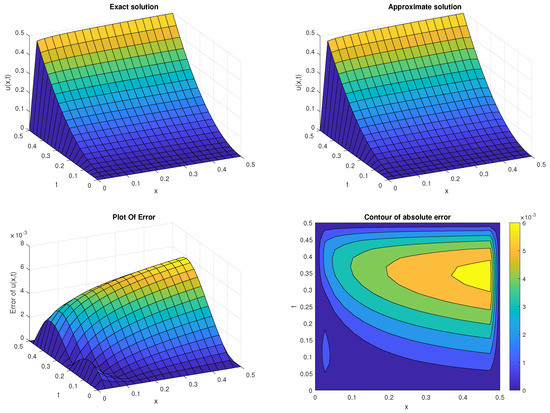
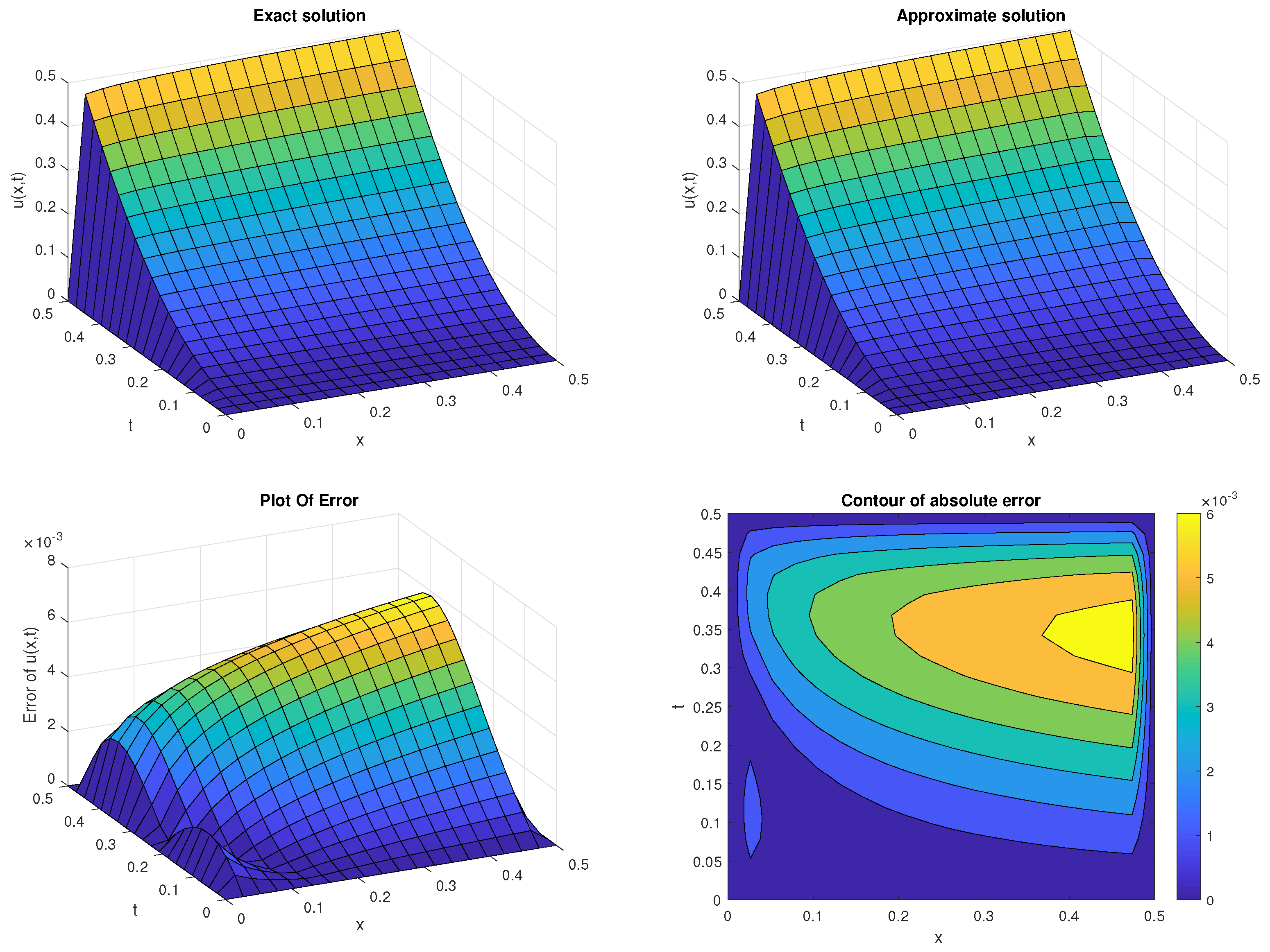
We solve this problem by using the GPS with taking , and . Additionally, an initial guess of is taken. Figure 1 shows the numerical solution, exact solution, absolute error, and absolute error’s contour. Indeed, we present in Table 2 the values of absolute errors between the numerical solution (using the GPS) and the exact solution for Example 2. From this table’s results, it is clear that the error estimate confirms the accuracy of this new method, and Figure 1 shows that both graphs are very similar in their behavior.
Figure 1.
Solution under applying GPS for the fractional convection-diffusion equation in Example 2.
Table 2.
Comparison between the exact solution and FITM solution for Example 2.
6. Conclusions
In the current work, we successfully implemented two numerical schemes to gain approximate solutions to the considered problems. One is the FITM, which converted the original problem into a new one with one extra dimension. After that, we used GPS to solve the problem. The other is the RKHSM, which was used for the mentioned problem. The main steps for applying this method are defining an appropriate bounded linear operator and constructing an orthonormal function system of the appropriate RKHS. Indeed, the both methods are shown to have good convergence. Two examples were employed to show the capacity and reliability of the FITM and RKHSM. Our obtained results are compared with exact results and they are found to be in good agreement with each other. From the numerical results, it can be observed the suitability, ease, and effectiveness of the proposed approaches for solving such types of fractional partial differential equation. This research opens the way for the use of the two proposed methods to study the mentioned problem for various new fractional derivatives. As part of our purpose, we plan to apply the FTIM and RKHSM to multidimensional fractional partial differential equations, which will be new in the literature.
Author Contributions
Conceptualization, E.K.A.; Methodology, M.P. and N.A.; Software, A.A.; Formal analysis, N.A.; Investigation, M.P.; Resources, M.D.l.S.; Data curation, A.A.; Writing—original draft, N.A.; Writing—review & editing, N.A.; Visualization, A.A. and E.K.A.; Supervision, M.B.; Project administration, A.A., M.D.l.S. and M.B.; Funding acquisition, M.D.l.S. and M.B. All authors have read and agreed to the published version of the manuscript.
Funding
Basque Government, Grants IT1555-22 and KK-2022/00090 MCIN/AEI 269.10.13039/ 501100011033, Grant PID2021-1235430B-C21/C22.
Data Availability Statement
Data are included within this research.
Acknowledgments
We are thankful to the anonymous reviewers for carefully reading the paper and their helpful comments.
Conflicts of Interest
The authors declare no conflict of interest.
References
- Liouville, J. Mémoire sur quelques questions de géométrie et de mécanique, et sur un nouveau genre de calcul pour résoudre ces questions. JEC Polytech. 1832, 13, 1–69. [Google Scholar]
- Riemann, G.F.B. Versuch Einer Allgemeinen Auffassung der Integration und Differentiation; Gesammelte Mathematische Werke: Leipzig, Germany, 1896. [Google Scholar]
- Caputo, M. Elasticita e Dissipazione; Zanichelli: Bologna, Italy, 1969. [Google Scholar]
- Miller, K.S.; Ross, B. An Introduction to Fractional Calculus and Fractional Diffrential Equations; Wiley: New York, NY, USA, 1993. [Google Scholar]
- Podlubny, I. Fractional Diffrential Equations; Academic Press: New York, NY, USA, 1999. [Google Scholar]
- Singh, H.; Kumar, D.; Baleanu, D. Methods of Mathematical Modelling: Fractional Diffrential Equations; CRC Press Taylor & Francis Group: New York, NY, USA, 2019. [Google Scholar]
- Baleanu, D.; Guvenc, Z.B.; Tenreiro Machado, J.A. New Trends in Nanotechnology and Fractional Calculus Applications; Springer: Dordrecht, The Netherlands, 2010. [Google Scholar]
- Atangana, A.; Alkahtani, B.T. Analysis of non-homogenous heat model with new trend of derivative with fractional order. Chaos Solit. Fract. 2016, 89, 566–571. [Google Scholar]
- Kumar, D.; Singh, J.; Tanwar, K.; Baleanu, D. A new fractional exothermic reactions model having constant heat source in porous media with power, exponential and Mittag-Leffler laws. Int. Heat Mass Transf. 2019, 138, 1222–1227. [Google Scholar] [CrossRef] [Scilit]
- Baleanu, D.; Wu, G.C.; Zeng, S.D. Chaos analysis and asymptotic stability of generalized Caputo fractional diffrential equations. Chaos Solit. Fract. 2017, 102, 99–105. [Google Scholar] [CrossRef] [Scilit]
- Veeresha, P.; Prakasha, D.G.; Baskonus, H.M. New numerical surfaces to the mathematical model of cancer chemotherapy effct in Caputo fractional derivatives. Chaos 2019, 29, 013119. [Google Scholar] [CrossRef] [Scilit]
- Gao, W.; Veeresha, P.; Baskonus, H.M.; Prakasha, D.G.; Kumar, P. A new study of unreported cases of 2019-nCOV epidemic outbreaks. Chaos Solit. Fract. 2020, 138, 109929. [Google Scholar] [CrossRef] [Scilit]
- Kumar, D.; Singh, J.; Baleanu, D. On the analysis of vibration equation involving a fractional derivative with Mittag-Leffler law. Math. Meth. Appl. Sci. 2020, 43, 443–457. [Google Scholar] [CrossRef] [Scilit]
- Veeresha, P.; Prakasha, D.G.; Baleanu, D. Analysis of fractional Swift-Hohenberg equation using a novel computational technique. Math. Meth. Appl. Sci. 2020, 43, 1970–1987. [Google Scholar] [CrossRef] [Scilit]
- Caputo, M.; Fabrizio, M. A new defiition of fractional derivative without singular kernel. Prog. Fract. Diffr. Appl. 2015, 1, 73–85. [Google Scholar]
- Cao, Q.-H.; Dai, C.-Q. Symmetric and anti-symmetric solitons of the fractional second- and third-order nonlinear Schrödinger equation. Chin. Phys. Lett. 2021, 38, 090501. [Google Scholar] [CrossRef] [Scilit]
- Chen, C.; Jiang, Y.-L.; Wang, X.-T. Lie symmetry analysis of the time fractional generalized KdV equations with variable coefficients. Symmetry 2019, 11, 1281. [Google Scholar] [CrossRef] [Scilit]
- Wang, Q. Numerical solution for fractional KdV-Burgers equation by Adomian decomposition method. Appl. Math. Comput. 2006, 182, 1048–1055. [Google Scholar]
- Nagy, A.M. Numerical solution of time fractional nonlinear Klein-Gordon equation using Sinc Chebyshev collocation method. Appl. Math. Comput. 2017, 310, 139–148. [Google Scholar] [CrossRef] [Scilit]
- Parto-Haghighi, M.; Akinlar, M.A.; Chu, Y. New numerical solutions of fractional-order Korteweg-de Vries equation. Results Phys. 2020, 19, 103326. [Google Scholar]
- Inc, M.; Partohaghighi, M.; Akinlar, M.A.; Agarwal, P.; Chu, Y.-M. New solutions of fractional-order Burger-Huxley equation. Results Phys. 2020, 18, 103290. [Google Scholar] [CrossRef] [Scilit]
- Hashemi, M.S.; Baleanu, D.; Parto-Haghighi, M. A lie group approach to solve the fractional Poisson equation. Rom. J. Phys. 2015, 60, 1289–1297. [Google Scholar]
- Akgül, A.; Ahmad, H. Reproducing kernel method for Fangzhu’s oscillator for water collection from air. Math. Meth. Appl. Sci. 2020, 1–10. [Google Scholar] [CrossRef] [Scilit]
- Ahmad, H.; Akgül, A.; Khan, T.A.; Stanimirović, P.S.; Chu, Y.-M. New perspective on the conventional solutions of the nonlinear time-fractional partial differential equations. Complexity 2020, 2020, 8829017. [Google Scholar] [CrossRef] [Scilit]
- Inc, M.; Khan, M.N.; Ahmad, I.; Yao, S.W.; Ahmad, H.; Thounthong, P. Analysing time-fractional exotic options via efficient local meshless method. Results Phys. 2020, 19, 103385. [Google Scholar] [CrossRef] [Scilit]
- Ahmad, I.; Khan, M.N.; Inc, M.; Ahmad, H.; Nisar, K.S. Numerical simulation of simulate an anomalous solute transport model via local meshless method. Alex. Eng. J. 2020, 59, 2827–2838. [Google Scholar] [CrossRef] [Scilit]
- Hussain, M.; Haq, S. Weighted meshless spectral method for the solutions of multi-term time fractional advection-diffusion problems arising in heat and mass transfer. Int. J. Heat Mass Transf. 2019, 129, 1305–1316. [Google Scholar] [CrossRef] [Scilit]
- Ahmad, I.; Ahmad, H.; Inc, M.; Yao, S.-W.; Almohsen, B. Application of local meshless method for the solution of two term time fractional-order multi-dimensional PDE arising in heat and mass transfer. Therm. Sci. 2020, 24, 95–105. [Google Scholar] [CrossRef]
- Pitolli, F.; Sorgentone, C.; Pellegrino, E. Approximation of the Riesz-Caputo derivative by cubic splines. Algorithms 2022, 15, 69. Available online: https://www.mdpi.com/1999-4893/15/2/69 (accessed on 15 February 2022). [CrossRef] [Scilit]
- Izadi, M.; Srivastava, H.M. A discretization approach for the nonlinear fractional logistic equation. Entropy 2020, 22, 1328. Available online: https://www.mdpi.com/1099-4300/22/11/1328 (accessed on 16 November 2020). [CrossRef] [Scilit]
- Shymanskyi, V.; Sokolovskyy, Y. Finite element calculation of the linear elasticity problem for biomaterials with fractal structure. Open Bioinform. J. 2021, 14, 114–122. [Google Scholar] [CrossRef] [Scilit]
- Priya, G.S.; Prakash, P.; Nieto, J.J.; Kayar, Z. Higher-order numerical scheme for the fractional heat equation with Dirichlet and Neumann boundary conditions. Numer. Heat Transf. 2013, 63, 540–559. [Google Scholar] [CrossRef] [Scilit]
- Mehmet, Y.; Necati, O. Numerical inverse Laplace homotopy technique for fractional heat equations. Therm. Sci. 2018, 22, 185–194. [Google Scholar]
- Chen, Y.-W. A highly accurate backward-forward algorithm for multi-dimensional backward heat conduction problems in fictitious time domains. Int. J. Heat Mass Transf. 2018, 120, 499–514. [Google Scholar] [CrossRef] [Scilit]
- Partohaghighi, M.; Akinlar, M.A.; Weber, G.W. New solutions of hyperbolic telegraph equation. J. Dyn. Games 2021, 8, 129–138. [Google Scholar]
- Partohaghighi, M.; Bayram, M.; Baleanu, D. On numerical solution of the time fractional advection-diffusion equation involving Atangana-Baleanu-Caputo derivative. Open Phys. 2019, 17, 816–822. [Google Scholar] [CrossRef] [Scilit]
- Chen, Y.-W.; Liu, C.-S.; Chang, Y.-S.; Chang, J.-R. Constraint-type fictitious time integration method for solving non-linear multi-dimensional elliptic partial differential equations. J. Mar. Sci. Technol. 2020, 28, 168–178. [Google Scholar]
- Chen, Y.-W. High order implicit and explicit Lie-group schemes for solving backward heat conduction problems. Int. J. Heat Mass Transf. 2016, 101, 1016–1029. [Google Scholar] [CrossRef] [Scilit]
- Liu, C.S. Cone of non-linear dynamical system and group preserving schemes. Int. J. Non Linear Mech. 2021, 36, 1047–1068. [Google Scholar] [CrossRef] [Scilit]
- Akgül, E.K. A novel method for the space and time fractional Bloch-torrey equations. Therm. Sci. 2018, 22, S253–S258. [Google Scholar] [CrossRef] [Scilit]
- Akgül, A. A novel method for a fractional derivative with non-local and non-singular kernel. Chaos Solit. Fract. 2018, 114, 478–482. [Google Scholar] [CrossRef] [Scilit]
- Hemati, F.; Ghasemi, M.; Khoshsiar Ghaziani, R. Numerical solution of the multiterm time-fractional diffusion equation based on reproducing kernel theory. Numer. Methods Partial Differ. Equ. 2021, 37, 44–68. [Google Scholar] [CrossRef] [Scilit]
- Attia, N.; Akgül, A.; Seba, D.; Nour, A. Reproducing kernel Hilbert space method for the numerical solutions of fractional cancer tumor models. Math. Meth. Appl. Sci. 2020, 1–22. [Google Scholar] [CrossRef] [Scilit]
- Abu Arqub, O.; Shawagfeh, N. Solving optimal control problems of Fredholm constraint optimality via the reproducing kernel Hilbert space method with error estimates and convergence analysis. Math. Methods Appl. Sci. 2021, 44, 7915–7932. [Google Scholar] [CrossRef] [Scilit]
- Abu Arqub, O.; Shawagfeh, N. Application of reproducing kernel algorithm for solving Dirichlet time-fractional diffusion-Gordon types equations in porous media. J. Porous Media 2019, 22, 411–434. [Google Scholar] [CrossRef] [Scilit]
- Djennadi, S.; Shawagfeh, N.; Abu Arqub, O. A numerical algorithm in reproducing kernel-based approach for solving the inverse source problem of the time-space fractional diffusion equation. Partial Differ. Equ. Appl. Math. 2021, 4, 100164. [Google Scholar] [CrossRef] [Scilit]
- Abu Arqub, O. Reproducing kernel algorithm for the analytical-numerical solutions of nonlinear systems of singular periodic boundary value problems. Math. Prob. Eng. 2015, 2015, 518406. [Google Scholar] [CrossRef] [Scilit]
- Cui, M.; Lin, Y. Nonlinear Numerical Analysis in the Reproducing Kernel Space; Nova Science Publishers Inc.: New York, NY, USA, 2009. [Google Scholar]

Disclaimer/Publisher’s Note: The statements, opinions and data contained in all publications are solely those of the individual author(s) and contributor(s) and not of MDPI and/or the editor(s). MDPI and/or the editor(s) disclaim responsibility for any injury to people or property resulting from any ideas, methods, instructions or products referred to in the content. |
© 2022 by the authors. Licensee MDPI, Basel, Switzerland. This article is an open access article distributed under the terms and conditions of the Creative Commons Attribution (CC BY) license (https://creativecommons.org/licenses/by/4.0/).