Generalized Interval-Valued q-Rung Orthopair Hesitant Fuzzy Choquet Operators and Their Application

Abstract
1. Introduction
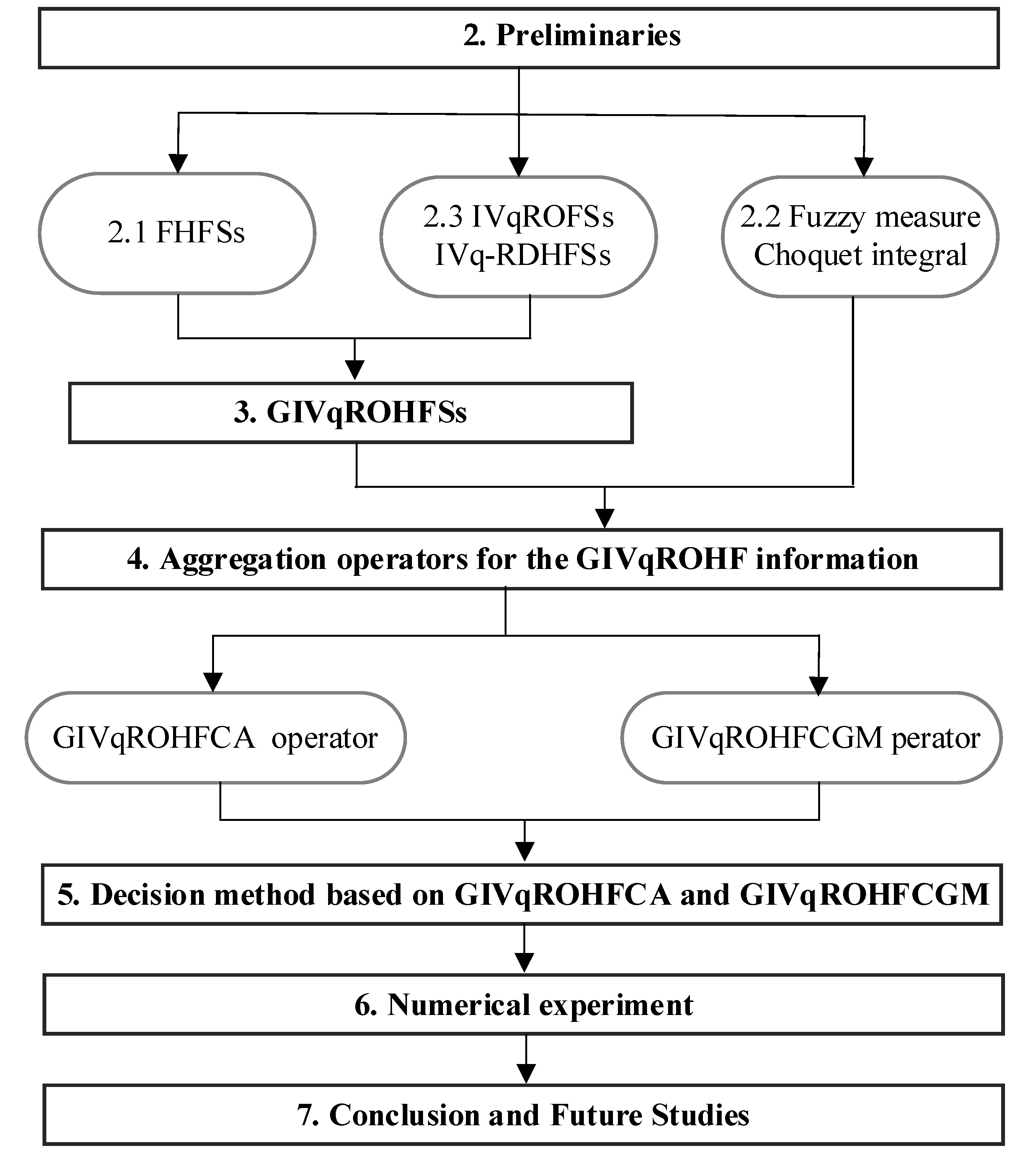
2. Preliminaries
2.1. HFSs
- (1)
- ; (2).
2.2. -Fuzzy Measure and Choquet Integral
- (1)
- .
- (2)
- ,.
- (3)
- ,,.
- (1)
- andis a positive real-valued function.
- (2)
- satisfieswith.
- (3)
- ,and.
- (4)
- is a-fuzzy measure on.
2.3. IVqROFSs and IVq-RDHFSs
- (1)
- is a nonempty set,is a real number and.
- (2)
- For,and.
- (3)
- Forand.
- (1)
- (2)
- (3)
- (4)
- ,
- (5)
- (6)
- (7)
- (1)
- , and are three nonempty sets,is a real number.
- (2)
- For any, and,
- (3)
- For any, and.
3. GIVqROHFSs
- (1)
- (2)
- Let be an IVq-RDHFE, then one can obtain the GIVqROHFE which contains pairs of intervals and does not make loss of information. On the contrary, when a GIVqROHFE is transformed into the IVq-RDHFE by the simple separation, due to the existence of the same membership degree interval and nonmembership degree interval in the interval pair set , the following inequalities hold:
4. Aggregation Operators for the GIVqROHF Information
The GIVqROHFCA and GIVqROHFCGM Operators
- (1)
- A GIVqROHFCA operator is modeled.
- (2)
- A GIVqROHFCGM operator is a kind of following form.
- (1)
- If , the GIVqROHFCA and GIVqROHFCGM operator, respectively, reduce to the basic GIVqROHFCA operator abbreviated as IVqROHFCA and the basic GIVqROHFCGM operator with the symbol IVqROHFCGM.
- (2)
- If , the GIVqROHFCA operator is called the generalized IVqROHF weighted averaging (GIVqROHFWA) operator.
- (3)
- For a given , is an invariant constant for any permutation of , the GIVqROHFCA operator degenerates the generalized IVqROHF ordered weighted averaging (GIVqROHFOWA) operator. Especially, when for any , a GIVqROHFCA operator is a generalized IVqROHF mathematical averaging (GIVqROHFMA) operator.
5. A New Decision Method Based on GIVqROHFCA and GIVqROHFCGM Operators
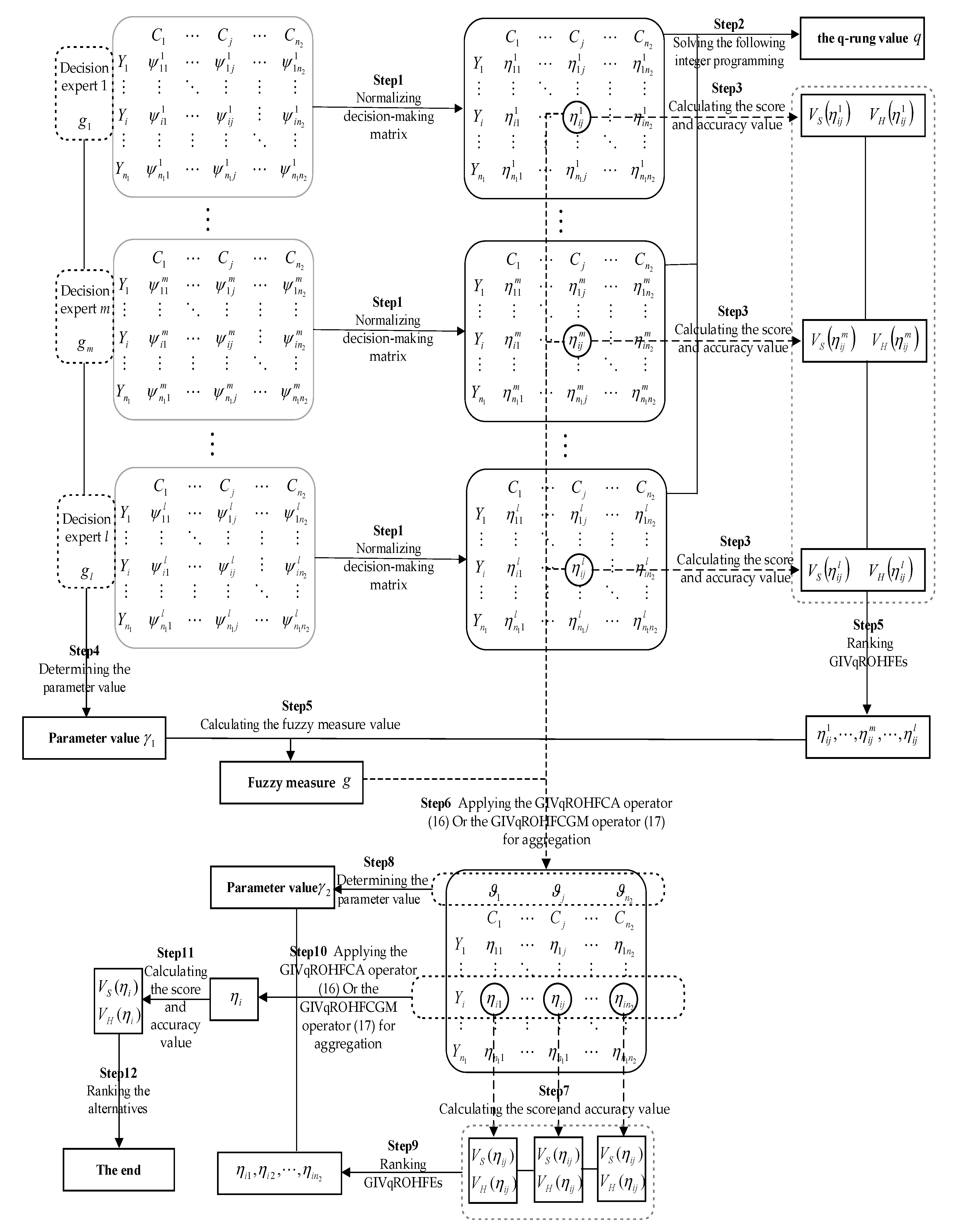
- Step 1. Obtaining the normalized decision-making matrix from the decision profile .
- Step 2. Solving the following integer programming to determining the q-rung value .
- Step 3. Calculating values of the score functionand the values of the accuracy function
- Step 4. Determining the -fuzzy measure value of the decision expert , and solving the following equation to obtain the parameter value.where is determined by numerical calculation method.
- Step 5. Ranking GIVqROHFEs such that , combining the ordered decision experts and calculating -fuzzy measure value as the following formula:
- Step 6. Applying the GIVqROHFCA operator (16) Or the GIVqROHFCGM operator (17) in order to obtain the the collective GIVqROHF matrix with the following form:
- Step 7. Calculating the values of to obtain score values ofand the values of the accuracy function
- Step 8. Provide the -fuzzy measure value of the attribute , and solving the equation as follows:
- Step 9. Ranking GIVqROHFEs such that:yielding the ordered attributes set and -fuzzy measure value as the following formula:
- Step 10. Applying the GIVqROHFCA operator (16) or the GIVqROHFCGM operator (17) In order to derive the collective value of the alternative .
- Step 11. By Definition (13), calculating the score value ofand the accuracy value ofarrange all of the alternatives by the score value or accuracy value.
- Step 12. End.
6. Numerical Experiment
6.1. An Example for the New MAGDM Approach
- Step 2. Solving programming to obtain .
- Step 3. By Table 2 and the Equation (25), we obtain the values of the score function , where the values of the accuracy function is not necessary provided, because the values of are not equal to each other.
- Step 4. Based on -fuzzy measure value provided in Table 2, we have the parameter value by the Equation (27).
- Step 6. For generalization, taking the value and using the GIVqROHFCA operator (29) to obtain the collective GIVqROHF matrix (see Table 13).
- Step 7. We use the Equations (31) and (32) to yield the values of the score function. Here the ones of the accuracy function are not necessarily provided for the similar sake of Step 2.
- Step 8. By the Table 2, and the parameter value is calculated by (33).
- Step 9. The ordered fuzzy measure values of for any are calculated by the Equation (34) (see Table 14).
- Step 10. Applying the GIVqROHFCA operator (35) to derive the collective value of the alternative (see Table 15).
- Step 11. By the Equation (37), calculating of and obtaining the descending order of alternatives , the best one is .
- Step 12. End.
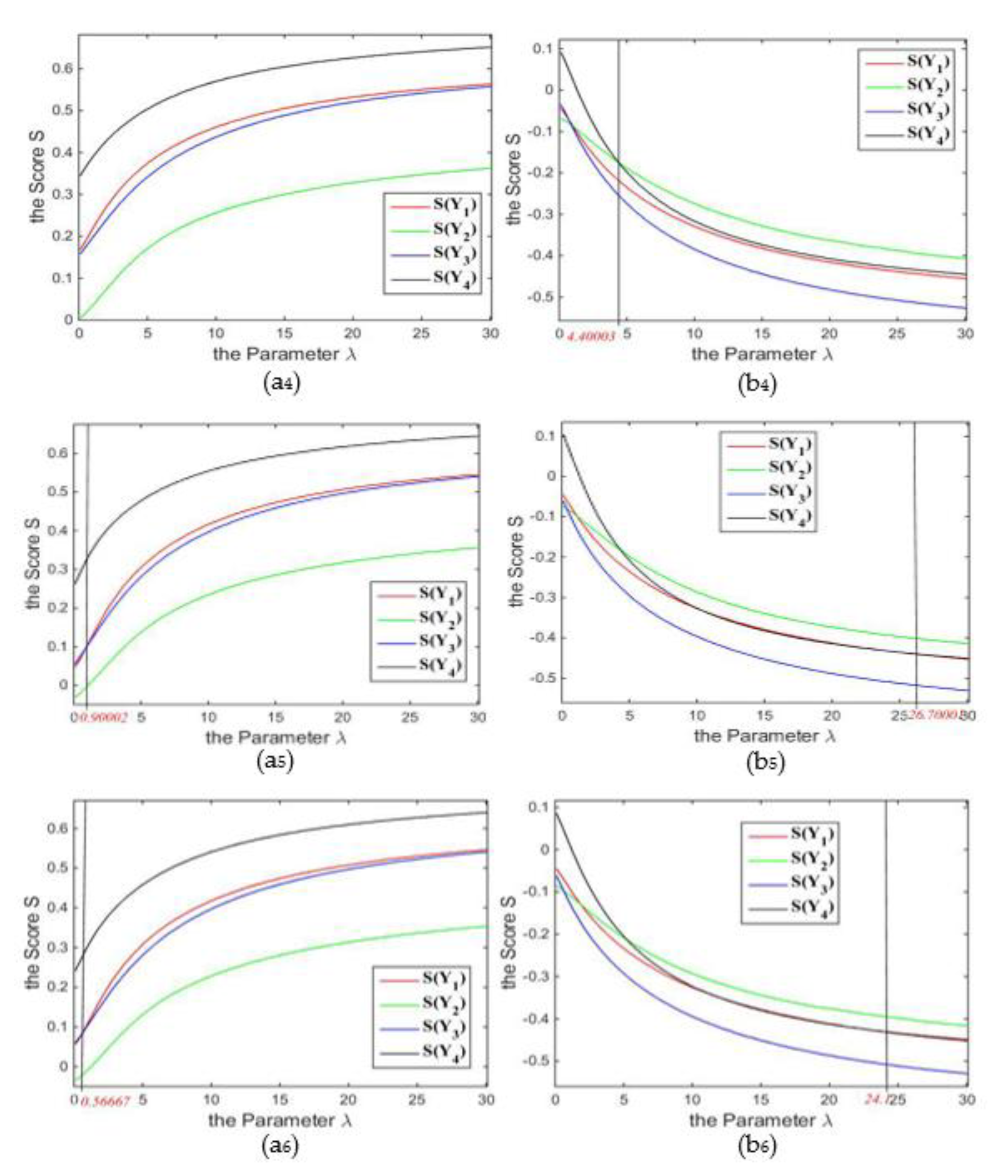
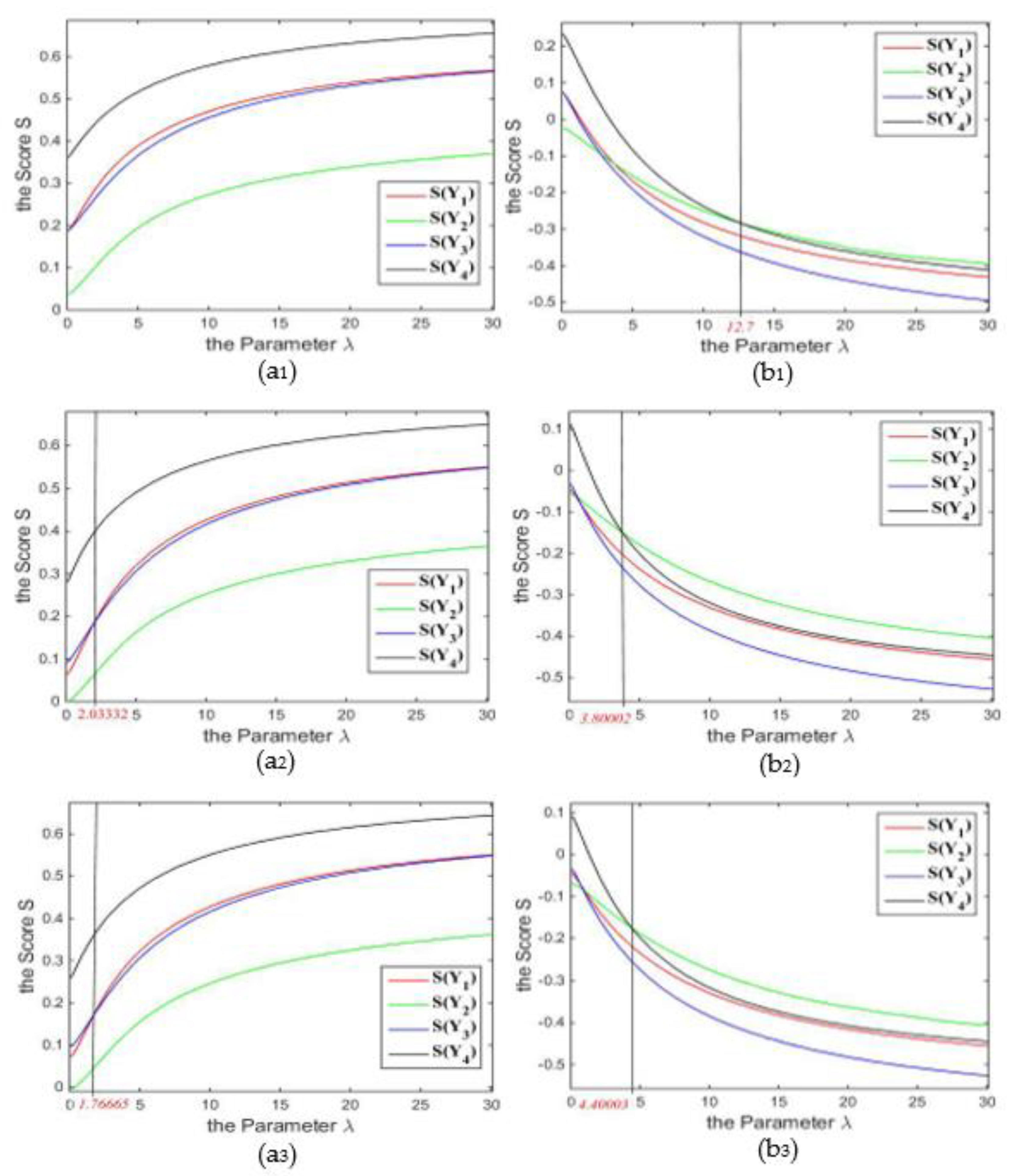
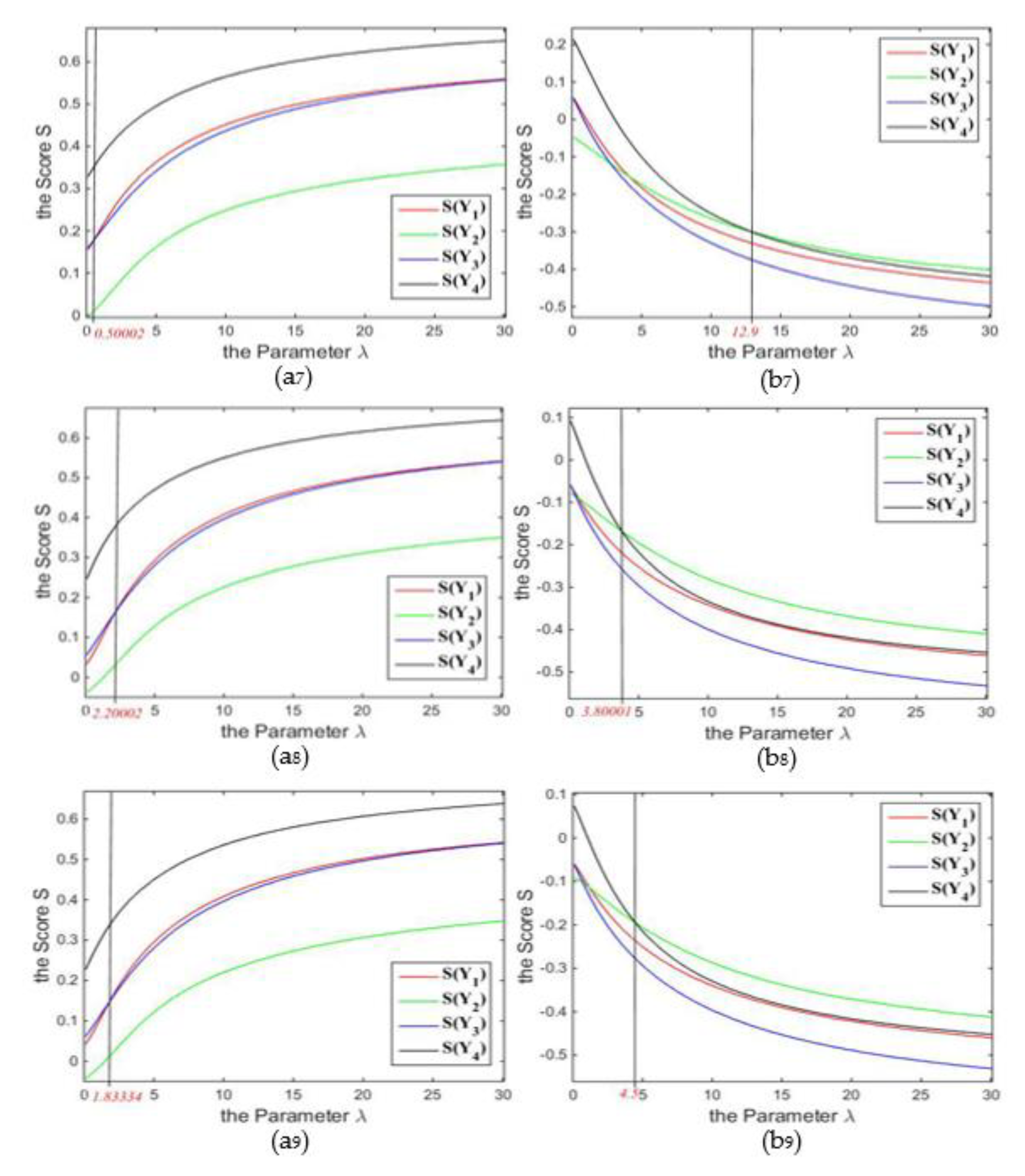
6.2. Sensitivity Experience of the Parameter of the GIVqROHFCA and GIVqROHFCGM Operators
6.3. Comparison Experience with the Existing MAGDM Approaches Based on the Different Hesitant Fuzzy Aggregation Rules
7. Conclusions and Future Studies
Author Contributions
Funding
Acknowledgments
Conflicts of Interest
Appendix A
References
- Xia, M.M.; Xu, Z.S. Hesitant fuzzy information aggregation in decision making. Int. J. Approx. Reason. 2011, 52, 395–407. [Google Scholar] [CrossRef]
- Ding, Z.; Wu, Y. An Improved Interval-Valued Hesitant Fuzzy Multi-Criteria Group Decision-Making Method and Applications. Math. Comput. Appl. 2016, 21, 22. [Google Scholar] [CrossRef]
- Torra, V. Hesitant fuzzy sets. Int. J. Intell. Syst. 2010, 25, 529–539. [Google Scholar] [CrossRef]
- Wang, H.; Xu, Z.; Zeng, X.J. Hesitant fuzzy linguistic term sets for linguistic decision making: Current developments, issues and challenges. Inf. Fusion 2018, 43, 1–12. [Google Scholar] [CrossRef]
- Oner, T.; Katican, T.; Saeid, A.B. Fuzzy filters of Sheffer stroke Hilbert algebras. J. Intell. Fuzzy Syst. 2021, 40, 759–772. [Google Scholar] [CrossRef]
- Tahsin, Ö.; Katican, T.; Saeid, A.B. Study strong Sheffer stroke non-associative MV-algebras by fuzzy filters. Math. Stati. 2022, 71, 165–187. [Google Scholar]
- Qi, X.; Zhang, J.; Liang, C. Multiple Attributes Group Decision-Making Approaches Based on Interval-Valued Dual Hesitant Fuzzy Unbalanced Linguistic Set and Their Applications. Complexity 2018, 2018, 3172716. [Google Scholar] [CrossRef]
- Joshi, D.; Kumar, S. Interval-valued intuitionistic hesitant fuzzy Choquet integral based TOPSIS method for multi-criteria group decision making. Eur. J. Oper. Res. 2016, 248, 183–191. [Google Scholar] [CrossRef]
- Wei, G.; Mao, L.; Tang, X. Pythagorean hesitant fuzzy Hamacher aggregation operators and their application to multiple attribute decision making. Int. J. Intell. Syst. 2018, 97, 24–39. [Google Scholar] [CrossRef]
- Deli, I. Bonferroni mean operators of generalized trapezoidal hesitant fuzzy numbers and their application to decision-making problems. Soft. Comput. 2021, 25, 4925–4949. [Google Scholar] [CrossRef]
- Liao, H.; Wu, X.; Liang, X. A New Hesitant Fuzzy Linguistic ORESTE Method for Hybrid Multicriteria Decision Making. IEEE Trans. Fuzzy Syst. 2018, 26, 3793–3870. [Google Scholar] [CrossRef]
- Mishra, A.R.; Rani, P.; Pardasani, K.R. Multiple-criteria decision-making for service quality selection based on Shapley COPRAS method under hesitant fuzzy sets. Granul. Comput. 2019, 2019, 435–449. [Google Scholar] [CrossRef]
- Wan, S.; Zhong, L.; Dong, J. A new method for group decision making with hesitant fuzzy preference relations based on multiplicative consistency. IEEE Trans. Fuzzy Syst. 2019, 28, 1449–1463. [Google Scholar] [CrossRef]
- Shen, Q.; Lou, J.; Liu, Y. Hesitant fuzzy multi-attribute decision making based on binary connection number of set pair analysis. Soft. Comput. 2021, 25, 14797–14807. [Google Scholar]
- Liu, S.; Guo, Z. Probabilistic hesitant fuzzy multi-attribute decision-making method based on improved distance measurement. J. Intell. Fuzzy Syst. 2022, 43, 5953–5964. [Google Scholar] [CrossRef]
- Meng, L.; Li, L. Time-sequential hesitant fuzzy set and its application to multi-attribute decision making. Complex Intell. Syst. 2022, 2022, 4319–4338. [Google Scholar]
- Chen, N.; Xu, Z. Properties of interval-valued hesitant fuzzy sets. J. Intell. Fuzzy Syst. 2014, 27, 143–158. [Google Scholar] [CrossRef]
- Ismat, B.; Tabasam, R. Group Decision Making Using Intuitionistic Hesitant Fuzzy Sets. Int. J. Fuzzy Log. Intell. Syst. 2014, 14, 181–187. [Google Scholar]
- Zhang, Z. Interval-Valued Intuitionistic Hesitant Fuzzy Aggregation Operators and Their Application in Group Decision-Making. J. Appl. Math. 2013, 2013, 670285. [Google Scholar] [CrossRef]
- Khan, M.S.A.; Abdullah, S.; Ali, A. Pythagorean Hesitant Fuzzy Information Aggregation and Their Application to Multi-Attribute Group Decision-Making Problems. J. Intell. Syst. 2020, 29, 154–171. [Google Scholar] [CrossRef]
- Chen, T.; Ye, L. A Novel Decision-Making Method for Selecting Superintendent Based on a Q-Rung Dual Hesitant Fuzzy Power Partitioned Bonferroni Mean Operator. Symmetry 2022, 14, 590. [Google Scholar] [CrossRef]
- Atanassov, K.; Gargov, G. Interval valued intuitionistic fuzzy sets. Fuzzy Sets Syst. 1989, 31, 343–349. [Google Scholar] [CrossRef]
- Yager, R.R. Pythagorean Membership Grades in Multicriteria Decision Making. IEEE Trans. Fuzzy Syst. 2014, 22, 958–965. [Google Scholar] [CrossRef]
- Peng, X.; Yang, Y. Fundamental Properties of Interval-Valued Pythagorean Fuzzy Aggregation Operators. Int. J. Intell. Syst. 2016, 31, 444–487. [Google Scholar] [CrossRef]
- Joshi, B.P.; Singh, A.; Bhatt, P.K. Interval valued q-rung orthopair fuzzy sets and their properties. J. Intell. Fuzzy Syst. 2018, 35, 5225–5230. [Google Scholar] [CrossRef]
- Ju, Y.; Luo, C.; Ma, J. Some interval-valued q-rung orthopair weighted averaging operators and their applications to multiple-attribute decision making. Int. J. Intell. Syst. 2019, 2019, 34. [Google Scholar] [CrossRef]
- Liu, Y.; Qin, Y.; Han, Y. Multiple Criteria Decision Making with Probabilities in Interval-Valued Pythagorean Fuzzy Setting. Int. J. Fuzzy Syst. 2018, 20, 558–571. [Google Scholar] [CrossRef]
- Garg, H. New exponential operational laws and their aggregation operators for interval-valued Pythagorean fuzzy multicriteria decision-making. Int. J. Intell Syst. 2018, 33, 653–683. [Google Scholar] [CrossRef]
- Rahman, K.; Abdullah, S. Generalized interval-valued Pythagorean fuzzy aggregation operators and their application to group decision-making. Granul. Comput. 2019, 4, 15–25. [Google Scholar] [CrossRef]
- Mu, Z.; Zeng, S.; Wang, P. Novel approach to multi-attribute group decision-making based on interval-valued Pythagorean fuzzy power Maclaurin symmetric mean operator. Comput. Ind. Eng. 2021, 155, 107049. [Google Scholar] [CrossRef]
- Li, F.; Xie, J.; Lin, M. Interval-valued Pythagorean fuzzy multi-criteria decision-making method based on the set pair analysis theory and Choquet integral. Complex Intell. Syst. 2022, 2022, 1–13. [Google Scholar] [CrossRef] [PubMed]
- Zhao, M.; Wei, G.; Wei, C. TODIM method for interval-valued Pythagorean fuzzy MAGDM based on cumulative prospect theory and its application to green supplier selection. Arab. J. Sci. Eng. 2021, 46, 1899–1910. [Google Scholar] [CrossRef]
- Peng, X.; Li, W. Algorithms for Interval-Valued Pythagorean Fuzzy Sets in Emergency Decision Making Based on Multiparametric Similarity Measures and WDBA. IEEE Access 2019, 7, 7419–7441. [Google Scholar] [CrossRef]
- Gao, H.; Ju, Y.; Zhang, W. Multi-Attribute Decision-Making Method Based on Interval-valued q-Rung Orthopair Fuzzy Archimedean Muirhead Mean Operators. IEEE Access 2019, 7, 74300–74315. [Google Scholar] [CrossRef]
- Garg, H. A new possibility degree measure for interval-valued q-rung orthopair fuzzy sets in decision-making. Int. J. Intell. Syst. 2021, 36, 526–557. [Google Scholar] [CrossRef]
- Garg, H.; Ali, Z.; Mahmood, T. Algorithms for complex interval-valued q-rung orthopair fuzzy sets in decision making based on aggregation operators, AHP and TOPSIS. Expert Syst. 2021, 38, e12609. [Google Scholar] [CrossRef]
- Turanoglu, B.E.; Cakmakci, M.; Kahraman, C. Fuzzy COPRAS method for performance measurement in total productive maintenance: A comparative analysis. J. Bus. Econom. Manag. 2016, 17, 663–684. [Google Scholar] [CrossRef]
- Alkharabsheh, A.; Moslem, S.; Oubahman, L. An integrated approach of multi-criteria decision-making and grey theory for evaluating urban public transportation systems. Sustainability 2021, 13, 2740. [Google Scholar] [CrossRef]
- Esangbedo, M.O.; Bai, S.; Mirjalili, S. Evaluation of human resource information systems using grey ordinal pairwise comparison MCDM methods. Expert Syst. Appl. 2021, 182, 115–151. [Google Scholar] [CrossRef]
- Zadeh, L.A. Fuzzy sets. Inf. Control 1965, 8, 338–353. [Google Scholar] [CrossRef]
- Zhang, H.; Dai, Y. Revisiting Additive Consistency of Hesitant Fuzzy Linguistic Preference Relations. Symmetry 2022, 14, 1601. [Google Scholar] [CrossRef]
- Khalil, S.; Kousar, S.; Kausar, N. Bipolar Interval-Valued Neutrosophic Optimization Model of Integrated Healthcare System. Comput. Mater. Cont. 2022, 73, 6207–6224. [Google Scholar] [CrossRef]
- Zeng, W.; Xi, Y.; Yin, Q. Weighted dual hesitant fuzzy set and its application in group decision making. Neurocomputing 2021, 458, 714–726. [Google Scholar] [CrossRef]
- Jiang, W.; Yuan, X.; Zang, Y. Interval-valued dual hesitant fuzzy linguistic group recommendation method by considering the double relevance. Appl. Intell. 2022, 2022, 13714–13728. [Google Scholar] [CrossRef]
- Atanassov, K.T.; Rangasamy, P. Intuitionistic Fuzzy Sets. Fuzzy Sets Syst. 1986, 20, 87–96. [Google Scholar] [CrossRef]
- Turksen, I.B. Interval valued fuzzy sets based on normal forms. Fuzzy Sets Syst. 1986, 20, 191–210. [Google Scholar] [CrossRef]
- Zheng, W.; Zhou, L.; Zhang, M. Interval-Valued Pythagorean Hesitant Fuzzy Set and Its Application to Multiattribute Group Decision-Making. Complexity 2020, 2020, 1724943. [Google Scholar] [CrossRef]
- Yang, Z.; Zhang, L.; Li, T. Group decision making with incomplete interval-valued q-rung orthopair fuzzy preference relations. Int. J. Intell. Syst. 2021, 36, 7274–7308. [Google Scholar] [CrossRef]
- Xu, Y.; Shang, X.; Wang, J. Some interval-valued q-rung dual hesitant fuzzy Muirhead mean operators with their application to multi-attribute decision-making. IEEE Access 2019, 7, 54724–54745. [Google Scholar] [CrossRef]
- Naz, S.; Akram, M.; Alsulami, S. Decision-making analysis under interval-valued q-rung orthopair dual hesitant fuzzy environment. Int. J. Comput. Int. Syst. 2021, 14, 332–357. [Google Scholar] [CrossRef]
- Feng, X.; Shang, X.; Xu, Y. A method to multi-attribute decision-making based on interval-valued q-rung dual hesitant linguistic Maclaurin symmetric mean operators. Complex Intell. Syst. 2020, 6, 447–468. [Google Scholar] [CrossRef]
- Choquet, G. Theory of Capacities. Ann. L’institut Fourier 1954, 5, 131–292. [Google Scholar] [CrossRef]
- Xia, M. Choquet-Integral-Based Data Envelopment Analysis with Stochastic Multicriteria Acceptability Analysis. Symmetry 2022, 14, 642. [Google Scholar] [CrossRef]
- Peng, X.; Yang, Y. Pythagorean Fuzzy Choquet Integral Based MABAC Method for Multiple Attribute Group Decision Making. Int. J. Intell. Syst. 2016, 31, 989–1020. [Google Scholar] [CrossRef]
- Liu, B.; Fu, M.; Zhang, S. An interval-valued 2-tuple linguistic group decision-making model based on the Choquet integral operator. Int. J. Syst. Sci. 2018, 49, 407–424. [Google Scholar] [CrossRef]
- Sajjad, A.K.M.; Abdullah, S.; Yousaf, A.M. Extension of TOPSIS method base on Choquet integral under interval-valued Pythagorean fuzzy environment. J. Intell. Fuzzy Syst. 2018, 34, 267–282. [Google Scholar] [CrossRef]
- Awang, A.; Aizam, N.A.H.; Ghani, A.T. A Normalized Weighted Bonferroni Mean Aggregation Operator Considering Shapley Fuzzy Measure Under Interval-valued Neutrosophic Environment for Decision-Making. Int. J. Fuzzy Syst. 2020, 22, 321–336. [Google Scholar] [CrossRef]
- Xu, X.; Xie, J.; Chen, S. Multi-attribute Decision Making Based on the Choquet Integral Operator with Hesitant Fuzzy Linguistic Information. In Fuzzy Information and Engineering-2019, 1st ed.; Springer: Singapore, 2020; pp. 107–118. [Google Scholar]
- Riaz, M.; Almalki, Y.; Batool, S. Topological Structure of Single-Valued Neutrosophic Hesitant Fuzzy Sets and Data Analysis for Uncertain Supply Chains. Symmetry 2022, 14, 1382. [Google Scholar] [CrossRef]
- Zhang, Z. Hesitant fuzzy power aggregation operators and their application to multiple attribute group decision making. Inf. Sci. 2013, 234, 150–181. [Google Scholar] [CrossRef]
- Wang, J.; Gao, H.; Wei, G. Methods for Multiple-Attribute Group Decision Making with q-Rung Interval-Valued Orthopair Fuzzy Information and Their Applications to the Selection of Green Suppliers. Symmetry 2019, 11, 56. [Google Scholar] [CrossRef]
- Murillo, J.; Guillaume, S.; Tapia, E. Revised HLMS: A useful algorithm for fuzzy measure identification. Inf. Fusion 2013, 14, 532–540. [Google Scholar] [CrossRef]
- Bernal, R.; Karanik, M.; Peláez, J.I. Fuzzy measure identification for criteria coalitions using linguistic information. Soft Comput. 2016, 20, 1315–1327. [Google Scholar] [CrossRef]
- Liang, D.; Liu, D. A Novel Risk Decision Making Based on Decision-Theoretic Rough Sets Under Hesitant Fuzzy Information. IEEE Trans. Fuzzy Syst. 2015, 23, 237–247. [Google Scholar] [CrossRef]



| Symbols | Illustration |
|---|---|
| alternatives | |
| attributes | |
| -Fuzzy measure value of attribute | |
| decision experts | |
| -Fuzzy measure value of decision expert | |
| The GIVqROHFE that satisfies from | |
| The possible IVqROF membership and non-membership degree that satisfies from | |
| A GIVqROHF decision profile from | |
| A normalized GIVqROHF decision profile from | |
| The normalized possible IVqROF membership and non-membership degree that satisfies from | |
| The normalized GIVqROHFE that satisfies benefit attribute from | |
| The normalized GIVqROHFE that satisfies cost attribute from | |
| Inverse operation of the GIVqROHFE | |
| The parameter of the GIVqROHFCA operator | |
| The parameter of the GIVqROHFCGM operator | |
| The parameter of -Fuzzy measure with respect to decision experts | |
| The parameter of -Fuzzy measure with respect to attributes | |
| The number of elements in GIVqROHFE | |
| The number of elements in GIVqROHFE | |
| The number of elements in GIVqROHFE | |
| A permutation of |
| Symbols | Illustration | |
|---|---|---|
| alternatives | ||
| technological attribute (cost) | ||
| economical attribute (benefit) | ||
| sociopolitical attribute (benefit) | ||
| environmental attribute (cost) | ||
| 0.20 | ||
| 0.35 | ||
| 0.50 | ||
| 0.15 | ||
| decision experts | ||
| 0.25 | ||
| 0.50 | ||
| 0.35 | ||
| 0.10 | ||
| matrix from (Table 3) | ||
| matrix from (Table 4) | ||
| matrix from (Table 5) | ||
| matrix from (Table 6) | ||
| normalized matrix from (Table 7) | ||
| normalized matrix from (Table 8) | ||
| normalized matrix from (Table 9) | ||
| normalized matrix from (Table 10) | ||
| 1 | ||
| 1 | ||
| Alternatives | ||||
|---|---|---|---|---|
| {([0.3, 0.4], [0.6, 0.7]) ([0.4, 0.5], [0.5, 0.7])} | {([0.7, 0.8], [0.2, 0.4])} | {([0.3, 0.5], [0.7, 0.8])} | {([0.6, 0.9], [0.2, 0.3]) ([0.7, 0.9], [0.3, 0.4])} | |
| {([0.3, 0.5], [0.5, 0.6]) ([0.4, 0.5], [0.6, 0.7])} | {([0.2, 0.5], [0.6, 0.7])} | {([0.3, 0.6], [0.2, 0.5]) ([0.7, 0.8], [0.3, 0.5])} | {([0.3, 0.7], [0.4, 0.5])} | |
| {([0.5, 0.6], [0.4, 0.6])} | {([0.8, 0.9], [0.3, 0.4]) ([0.7, 0.9], [0.2, 0.3])} | {([0.3, 0.7], [0.4, 0.4])} | {([0.4, 0.6], [0.3, 0.6]) ([0.3, 0.5], [0.4, 0.6]) ([0.5, 0.6], [0.4, 0.7])} | |
| {([0.3, 0.6], [0.5, 0.7])} | {([0.3, 0.7], [0.3, 0.4])} | {([0.3, 0.8], [0.2, 0.3])} | {([0.6, 0.8], [0.2, 0.3])} |
| Alternatives | ||||
|---|---|---|---|---|
| {([0.2, 0.4], [0.7, 0.8]) ([0.3, 0.5], [0.6, 0.8])} | {([0.8, 0.9], [0.1, 0.4])} | {([0.3, 0.4], [0.4, 0.6])} | {([0.5, 0.6], [0.2, 0.4])} | |
| {([0.2, 0.5], [0.7, 0.8])} | {([0.4, 0.7], [0.5, 0.7])} | {([0.4, 0.5], [0.4, 0.5])} | {([0.4, 0.5], [0.2, 0.5])} | |
| {([0.6, 0.6], [0.4, 0.4]) ([0.3, 0.6], [0.5, 0.6]) ([0.4, 0.6], [0.4, 0.4])} | {([0.6, 0.9], [0.1, 0.2]) ([0.7, 0.8], [0.1, 0.3])} | {([0.4, 0.5], [0.5, 0.6])} | {([0.7, 0.9], [0.3, 0.3])} | |
| {([0.5, 0.7], [0.6, 0.7])} | {([0.5, 0.7], [0.5, 0.6])} | {([0.8, 0.9], [0.2, 0.4]) ([0.9, 0.9], [0.1, 0.2])} | {([0.6, 0.9], [0.2, 0.2]) ([0.7, 0.8], [0.1, 0.2])} |
| Alternatives | ||||
|---|---|---|---|---|
| {([0.3, 0.5], [0.6, 0.8])} | {([0.6, 0.7], [0.2, 0.5])} | {([0.3, 0.5], [0.6, 0.7])} | {([0.6, 0.7], [0.3, 0.5])} | |
| {([0.3, 0.6], [0.5, 0.7])} | {([0.3, 0.6], [0.6, 0.8])} | {([0.3, 0.4], [0.5, 0.6])} | {([0.3, 0.4], [0.1, 0.4])} | |
| {([0.7, 0.7], [0.5, 0.5])} | {([0.6, 0.8], [0.2, 0.3])} | {([0.5, 0.6], [0.6, 0.7])} | {([0.8, 0.9], [0.3, 0.4])} | |
| {([0.4, 0.6], [0.7, 0.8]) ([0.4, 0.6], [0.5, 0.6])} | {([0.4, 0.7], [0.4, 0.6])} | {([0.7, 0.9], [0.3, 0.4])} | {([0.6, 0.8], [0.2, 0.3])} |
| Alternatives | ||||
|---|---|---|---|---|
| {([0.3, 0.4], [0.7, 0.8])} | {([0.5, 0.7], [0.3, 0.5]) ([0.4, 0.6], [0.2, 0.4]) ([0.6, 0.7], [0.3, 0.4])} | {([0.4, 0.6], [0.6, 0.8])} | {([0.7, 0.8], [0.4, 0.6])} | |
| {([0.4, 0.6], [0.6, 0.7])} | {([0.4, 0.6], [0.7, 0.8]) ([0.2, 0.4], [0.7, 0.9])} | {([0.2, 0.4], [0.5, 0.7]) ([0.3, 0.5], [0.5, 0.6])} | {([0.2, 0.4], [0.2, 0.5])} | |
| {([0.7, 0.8], [0.5, 0.6])} | {([0.6, 0.7], [0.3, 0.4])} | {([0.4, 0.5], [0.7, 0.8])} | {([0.7, 0.9], [0.3, 0.5])} | |
| {([0.3, 0.4], [0.7 0.9]) ([0.4, 0.5], [0.5, 0.7])} | {([0.5, 0.7], [0.5, 0.6])} | {([0.7, 0.8], [0.3, 0.5])} | {([0.6, 0.7], [0.1, 0.3])} |
| Alternatives | ||||
|---|---|---|---|---|
| {([0.6, 0.7], [0.3, 0.4]) ([0.5, 0.7], [0.4, 0.5])} | {([0.7, 0.8], [0.2, 0.4])} | {([0.3, 0.5], [0.7, 0.8])} | {([0.2, 0.3], [0.6, 0.9]) ([0.3, 0.4], [0.7, 0.9])} | |
| {([0.5, 0.6], [0.3, 0.5]) ([0.6, 0.7], [0.4, 0.5])} | {([0.2, 0.5], [0.6, 0.7])} | {([0.3, 0.6], [0.2, 0.5]) ([0.7, 0.8], [0.3, 0.5])} | {([0.4, 0.5], [0.3, 0.7])} | |
| {([0.4, 0.6], [0.5, 0.6])} | {([0.8, 0.9], [0.3, 0.4]) ([0.7, 0.9], [0.2, 0.3])} | {([0.3, 0.7], [0.4, 0.4])} | {([0.3, 0.6], [0.4, 0.6]) ([0.4, 0.6], [0.3, 0.5]) ([0.4, 0.7], [0.5, 0.6])} | |
| {([0.5, 0.7], [0.3, 0.6])} | {([0.3, 0.7], [0.3, 0.4])} | {([0.3, 0.8], [0.2, 0.3])} | {([0.2, 0.3], [0.6, 0.8])} |
| Alternatives | ||||
|---|---|---|---|---|
| {([0.7, 0.8], [0.2, 0.4]) ([0.6, 0.8], [0.3, 0.5])} | {([0.8, 0.9], [0.1, 0.4])} | {([0.3, 0.4], [0.4, 0.6])} | {([0.2, 0.4], [0.5, 0.6])} | |
| {([0.7, 0.8], [0.2, 0.5])} | {([0.4, 0.7], [0.5, 0.7])} | {([0.4, 0.5], [0.4, 0.5])} | {([0.2, 0.5], [0.4, 0.5])} | |
| {([0.4, 0.4], [0.6, 0.6]) ([0.5, 0.6], [0.3, 0.6]) ([0.4, 0.4], [0.4, 0.6])} | {([0.6, 0.9], [0.1, 0.2]) ([0.7, 0.8], [0.1, 0.3])} | {([0.4, 0.5], [0.5, 0.6])} | {([0.3, 0.3], [0.7, 0.9])} | |
| {([0.6, 0.7], [0.5, 0.7])} | {([0.5, 0.7], [0.5, 0.6])} | {([0.8, 0.9], [0.2, 0.4]) ([0.9, 0.9], [0.1, 0.2])} | {([0.2, 0.2], [0.6, 0.9]) ([0.1, 0.2], [0.7, 0.8])} |
| Alternatives | ||||
|---|---|---|---|---|
| {([0.6, 0.8], [0.3, 0.5])} | {([0.6, 0.7], [0.2, 0.5])} | {([0.3, 0.5], [0.6, 0.7])} | {([0.3, 0.5], [0.6, 0.7])} | |
| {([0.5, 0.7], [0.3, 0.6])} | {([0.3, 0.6], [0.6, 0.8])} | {([0.3, 0.4], [0.5, 0.6])} | {([0.1, 0.4], [0.3, 0.4])} | |
| {([0.5, 0.5], [0.7, 0.7])} | {([0.6, 0.8], [0.2, 0.3])} | {([0.5, 0.6], [0.6, 0.7])} | {([0.3, 0.4], [0.8, 0.9])} | |
| {([0.7, 0.8], [0.4, 0.6]) ([0.5, 0.6], [0.4, 0.6])} | {([0.4, 0.7], [0.4, 0.6])} | {([0.7, 0.9], [0.3, 0.4])} | {([0.2, 0.3], [0.6, 0.8])} |
| Alternatives | ||||
|---|---|---|---|---|
| {([0.7, 0.8], [0.3, 0.4])} | {([0.5, 0.7], [0.3, 0.5]) ([0.4, 0.6], [0.2, 0.4]) ([0.6, 0.7], [0.3, 0.4])} | {([0.4, 0.6], [0.6,0.8])} | {([0.4, 0.6], [0.7, 0.8])} | |
| {([0.6, 0.7], [0.4, 0.6])} | {([0.4, 0.6], [0.7, 0.8]) ([0.2, 0.4], [0.7, 0.9])} | {([0.2, 0.4], [0.5, 0.7]) ([0.3, 0.5], [0.5, 0.6])} | {([0.2, 0.5], [0.2, 0.4])} | |
| {([0.5, 0.6], [0.7, 0.8])} | {([0.6, 0.7], [0.3, 0.4])} | {([0.4, 0.5], [0.7, 0.8])} | {([0.3, 0.5], [0.7, 0.9])} | |
| {([0.7 0.9], [0.3, 0.4]) ([0.5, 0.7], [0.4, 0.5])} | {([0.5, 0.7], [0.5, 0.6])} | {([0.7, 0.8], [0.3, 0.5])} | {([0.1, 0.3], [0.6, 0.7])} |
| Descending Order | Descending Order | ||||||||||
|---|---|---|---|---|---|---|---|---|---|---|---|
| 0.232 | 0.398 | 0.330 | 0.440 | 4231 | −0.045 | −0.073 | −0.240 | −0.260 | 1234 | ||
| 0.465 | 0.640 | 0.280 | 0.220 | 2134 | 0.593 | 0.538 | 0.435 | 0.300 | 1234 | ||
| −0.395 | −0.135 | −0.255 | −0.240 | 2431 | 0.130 | −0.100 | −0.120 | −0.360 | 1234 | ||
| −0.522 | −0.205 | −0.255 | −0.305 | 2341 | 0.025 | −0.560 | −0.600 | −0.480 | 1423 | ||
| 0.177 | 0.420 | 0.145 | 0.165 | 2143 | 0.145 | 0.055 | 0.175 | 0.345 | 4312 | ||
| −0.280 | −0.045 | −0.275 | −0.428 | 2314 | 0.165 | 0.065 | 0.065 | 0.065 | Y1 > Y2 =Y4 > Y3 | ||
| 0.415 | 0.675 | 0.585 | 0.675 | ||||||||
| 0.237 | 0.000 | −0.180 | −0.202 | 1234 | 0.300 | 0.705 | 0.525 | 0.395 | 2341 | ||
| −0.085 | −0.060 | −0.040 | 0.045 | 4321 | −0.435 | −0.542 | −0.435 | −0.375 | Y4 > Y1 =Y3 > Y2 | ||
| 0.565 | 0.608 | 0.565 | 0.475 |
| 0.100 | 0.578 | 0.841 | 1.000 | 0.250 | 0.696 | 0.941 | 1.0000 | ||
| 0.500 | 0.696 | 0.941 | 1.000 | 0.250 | 0.696 | 0.941 | 1.0000 | ||
| 0.500 | 0.578 | 0.841 | 1.000 | 0.250 | 0.696 | 0.941 | 1.0000 | ||
| 0.500 | 0.774 | 0.841 | 1.000 | 0.250 | 0.339 | 0.766 | 1.0000 | ||
| 0.500 | 0.696 | 0.766 | 1.000 | 0.100 | 0.435 | 0.638 | 1.0000 | ||
| 0.500 | 0.774 | 0.941 | 1.000 | 0.250 | 0.696 | 0.766 | 1.0000 | ||
| 0.250 | 0.696 | 0.941 | 1.000 | 0.500 | 0.774 | 0.841 | 1.0000 | ||
| 0.100 | 0.435 | 0.841 | 1.000 | 0.100 | 0.339 | 0.638 | 1.0000 |
| Descending Order | |||||||||
|---|---|---|---|---|---|---|---|---|---|
| 0.365 | 0.522 | −0.194 | −0.258 | 2134 | 0.350 | 0.520 | 0.908 | 1.000 | |
| 0.307 | −0.159 | 0.030 | −0.031 | 1342 | 0.200 | 0.657 | 0.765 | 1.000 | |
| −0.096 | 0.532 | −0.036 | −0.361 | 2314 | 0.350 | 0.775 | 0.908 | 1.000 | |
| 0.163 | 0.107 | 0.611 | −0.464 | 3124 | 0.500 | 0.657 | 0.908 | 1.000 |
| Alternatives | ||
|---|---|---|
| {([0.662, 0.787], [0.247, 0.424]) ([0.651, 0.787], [0.259, 0.439]) ([0.612, 0.787], [0.300, 0.472]) ([0.599, 0.787], [0.314, 0.489])} | {([0.732, 0.842], [0.145, 0.428]) ([0.730, 0.840], [0.141, 0.422]) ([0.735, 0.842], [0.145, 0.422])} | |
| {([0.623, 0.743], [0.250, 0.528]) ([0.638, 0.756], [0.264, 0.528])} | {([0.349, 0.643], [0.553, 0.732]) ([0.339, 0.636], [0.553, 0.737])} | |
| {([0.434, 0.499], [0.601, 0.634]) ([0.478, 0.579], [0.441, 0.634]) ([0.434, 0.499], [0.501, 0.634])} | {([0.668, 0.874], [0.166, 0.274]) ([0.706, 0.829], [0.166, 0.328]) ([0.629, 0.874], [0.150, 0.255]) ([0.673, 0.829], [0.150, 0.305])} | |
| {([0.633, 0.767], [0.397, 0.609]) ([0.564, 0.708], [0.397, 0.609]) ([0.615, 0.739], [0.409, 0.623]) ([0.540, 0.671], [0.409, 0.623])} | {([0.438, 0.700], [0.418, 0.542])} | |
| Alternatives | ||
| {([0.309, 0.465], [0.502, 0.669])} | {([0.250, 0.436], [0.553, 0.681]) ([0.265, 0.448], [0.567, 0.681])} | |
| {([0.345, 0.504], [0.360, 0.533]) ([0.349, 0.509], [0.360, 0.528]) ([0.488, 0.595], [0.398, 0.533]) ([0.490, 0.598], [0.398, 0.528])} | {([0.225, 0.470], [0.324, 0.479])} | |
| {([0.408, 0.587], [0.504, 0.573])} | {([0.300, 0.443], [0.628, 0.813]) ([0.329, 0.443], [0.584, 0.777]) ([0.329, 0.490], [0.664, 0.813])} | |
| {([0.728, 0.883], [0.230, 0.388]) ([0.812, 0.883], [0.162, 0.274])} | {([0.192, 0.269], [0.600, 0.824]) ([0.162, 0.269], [0.634, 0.789])}} |
| Alternatives | Score | Order | |
|---|---|---|---|
| {([0.581, 0.713], [0.291, 0.530]), ([0.582, 0.714], [0.291, 0.530]) ([0.579, 0.713], [0.293, 0.534]), ([0.579, 0.714], [0.294, 0.534]) ([0.571, 0.713], [0.300, 0.540]), ([0.571, 0.714], [0.301, 0.540]) ([0.568, 0.713], [0.303, 0.543]), ([0.568, 0.714], [0.303, 0.543]) ([0.580, 0.712], [0.288, 0.528]), ([0.580, 0.712], [0.289, 0.528]) ([0.577, 0.712], [0.290, 0.531]), ([0.578, 0.712], [0.291, 0.531]) ([0.569, 0.712], [0.298, 0.538]), ([0.570, 0.712], [0.299, 0.538]) ([0.567, 0.712], [0.300, 0.541]), ([0.567, 0.712], [0.301, 0.541]) ([0.583, 0.713], [0.291, 0.528]), ([0.584, 0.714], [0.291, 0.528]) ([0.581, 0.713], [0.293, 0.531]), ([0.581, 0.714], [0.294, 0.531]) ([0.573, 0.713], [0.300, 0.538]), ([0.573, 0.714], [0.301, 0.538]) ([0.570, 0.713], [0.303, 0.541]), ([0.570, 0.714], [0.303, 0.541])} | S: 0.232 H: 0.607 | 2 | |
| {([0.418, 0.600], [0.366, 0.567]), ([0.417, 0.598], [0.366, 0.568]) ([0.420, 0.602], [0.366, 0.565]), ([0.418, 0.600], [0.366, 0.565]) ([0.477, 0.633], [0.383, 0.567]), ([0.476, 0.631], [0.383, 0.568]) ([0.479, 0.635], [0.383, 0.565]), ([0.477, 0.633], [0.383, 0.565]) ([0.425, 0.605], [0.370, 0.567]), ([0.423, 0.603], [0.370, 0.568]) ([0.426, 0.607], [0.370, 0.565]), ([0.424, 0.605], [0.370, 0.565]) ([0.482, 0.637], [0.388, 0.567]), ([0.481, 0.636], [0.388, 0.568]) ([0.484, 0.639], [0.388, 0.565]), ([0.482, 0.637], [0.388, 0.565])} | S: 0.062 H: 0.525 | 4 | |
| {([0.524, 0.724], [0.357, 0.463]), ([0.525, 0.724], [0.355, 0.461]) ([0.525, 0.726], [0.359, 0.463]), ([0.528, 0.730], [0.343, 0.463]) ([0.529, 0.730], [0.341, 0.461]), ([0.529, 0.731], [0.345, 0.463]) ([0.524, 0.724], [0.349, 0.463]), ([0.525, 0.724], [0.347, 0.461]) ([0.525, 0.726], [0.351, 0.463]), ([0.547, 0.689], [0.357, 0.493]) ([0.548, 0.689], [0.355, 0.491]), ([0.548, 0.691], [0.359, 0.493]) ([0.551, 0.695], [0.343, 0.493]), ([0.553, 0.695], [0.341, 0.491]) ([0.553, 0.697], [0.345, 0.493]), ([0.547, 0.689], [0.349, 0.493]) ([0.548, 0.689], [0.347, 0.491]), ([0.548, 0.691], [0.351, 0.493]) ([0.502, 0.724], [0.345, 0.451]), ([0.503, 0.724], [0.343, 0.450]) ([0.503, 0.726], [0.347, 0.451]), ([0.507, 0.730], [0.331, 0.451]) ([0.508, 0.730], [0.329, 0.450]), ([0.508, 0.731], [0.333, 0.451]) ([0.502, 0.724], [0.337, 0.451]), ([0.503, 0.724], [0.334, 0.450]) ([0.503, 0.726], [0.338, 0.451]), ([0.527, 0.689], [0.345, 0.481]) ([0.528, 0.689], [0.343, 0.479]), ([0.528, 0.691], [0.347, 0.481]) ([0.533, 0.695], [0.329, 0.479]), ([0.532, 0.695], [0.331, 0.481]) ([0.533, 0.697], [0.333, 0.481]), ([0.527, 0.689], [0.337, 0.481]) ([0.528, 0.689], [0.334, 0.479]), ([0.528, 0.691], [0.338, 0.481])} | S: 0.221 H: 0.561 | 3 | |
| {([0.635, 0.811], [0.318, 0.485]), ([0.634, 0.811], [0.319, 0.483]) ([0.625, 0.805], [0.318, 0.485]), ([0.624, 0.805], [0.319, 0.483]) ([0.632, 0.808], [0.319, 0.487]), ([0.631, 0.808], [0.321, 0.485]) ([0.622, 0.801], [0.319, 0.487]), ([0.621, 0.801], [0.321, 0.485]) ([0.701, 0.811], [0.267, 0.408]), ([0.700, 0.811], [0.268, 0.406]) ([0.693, 0.805], [0.267, 0.408]), ([0.693, 0.805], [0.268, 0.406]) ([0.698, 0.808], [0.268, 0.409]), ([0.698, 0.808], [0.270, 0.408]) ([0.691, 0.801], [0.268, 0.409]), ([0.690, 0.801], [0.270, 0.408])} | S: 0.401 H: 0.689 | 1 |
negative | |||
independent | |||
positive | |||
| GIVqROHFN | HFN | PHFN | IVHFN |
| IVIHFN | IVqROFN | IVqRDHFN | |
| Method | Operator | Oder | Best | ||||
|---|---|---|---|---|---|---|---|
| HFN [57] | GHFWA 3,4 | 0.588 | 0.495 | 0.574 | 0.676 | ||
| PHFN [58] | PHFWA 3,4 | 0.318 | 0.170 | 0.446 | 0.651 | ||
| IVHFN [61] | IVHFWBM 3,4 | 0.140 | 0.109 | 0.137 | 0.134 | ||
| IVIHFN [19] | GIVIHFWA 3,4 | 0.166 | 0.021 | 0.159 | 0.329 | ||
| IVqROFN [26] | IVqROFWA 3,4 | 0.173 | 0.196 | 0.086 | 0.371 | ||
| IVqRDHFN [49] | IVqRDHFWMM 3,4 | 0.201 | 0.059 | 0.382 | 0.226 | ||
| GIVqROHFN (In this paper) | GIVqROHFCA 1,2 | 0.232 | 0.062 | 0.221 | 0.401 |
Disclaimer/Publisher’s Note: The statements, opinions and data contained in all publications are solely those of the individual author(s) and contributor(s) and not of MDPI and/or the editor(s). MDPI and/or the editor(s) disclaim responsibility for any injury to people or property resulting from any ideas, methods, instructions or products referred to in the content. |
© 2023 by the authors. Licensee MDPI, Basel, Switzerland. This article is an open access article distributed under the terms and conditions of the Creative Commons Attribution (CC BY) license (https://creativecommons.org/licenses/by/4.0/).
Share and Cite
Zhang, G.; Yuan, G. Generalized Interval-Valued q-Rung Orthopair Hesitant Fuzzy Choquet Operators and Their Application. Symmetry 2023, 15, 127. https://doi.org/10.3390/sym15010127
Zhang G, Yuan G. Generalized Interval-Valued q-Rung Orthopair Hesitant Fuzzy Choquet Operators and Their Application. Symmetry. 2023; 15(1):127. https://doi.org/10.3390/sym15010127
Chicago/Turabian StyleZhang, Guofang, and Guoqiang Yuan. 2023. "Generalized Interval-Valued q-Rung Orthopair Hesitant Fuzzy Choquet Operators and Their Application" Symmetry 15, no. 1: 127. https://doi.org/10.3390/sym15010127
APA StyleZhang, G., & Yuan, G. (2023). Generalized Interval-Valued q-Rung Orthopair Hesitant Fuzzy Choquet Operators and Their Application. Symmetry, 15(1), 127. https://doi.org/10.3390/sym15010127