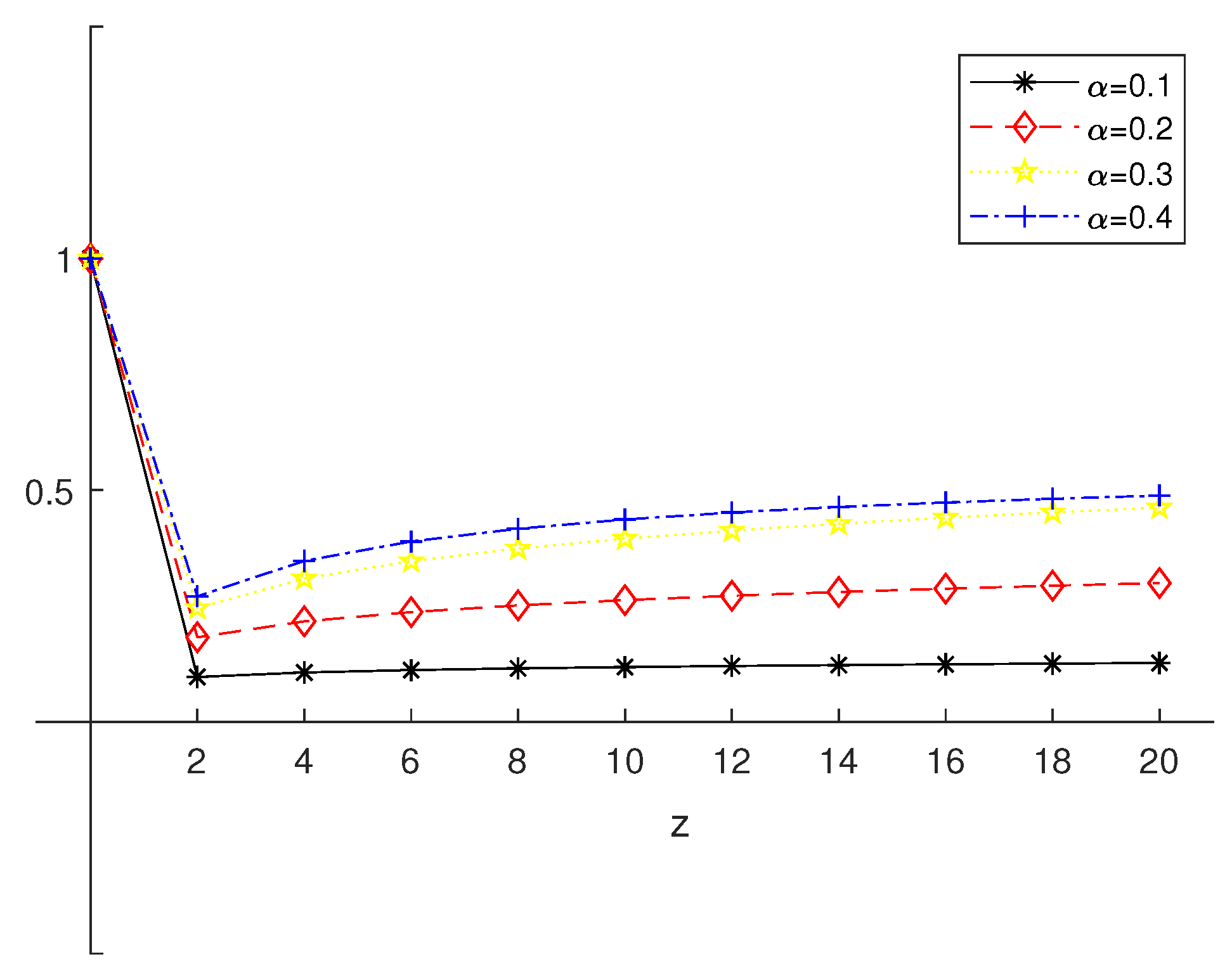
Abstract
The discrete fractional operators of Riemann–Liouville and Liouville–Caputo are omnipresent due to the singularity of the kernels. Therefore, convexity analysis of discrete fractional differences of these types plays a vital role in maintaining the safe operation of kernels and symmetry of discrete delta and nabla distribution. In their discrete version, the generalized or modified forms of various operators of fractional calculus are becoming increasingly important from the viewpoints of both pure and applied mathematical sciences. In this paper, we present the discrete version of the recently modified fractional calculus operator with the Mittag-Leffler-type kernel. Here, in this article, the expressions of both the discrete nabla derivative and its counterpart nabla integral are obtained. Some applications and illustrative examples are given to support the theoretical results.
Keywords:
discrete fractional calculus; discrete Atangana–Baleanu fractional differences; discrete Liouville–Caputo operator; discrete Mittag-Leffler kernels MSC:
26A48; 26A51; 33B10; 39A12; 39B62
1. Introduction
Fractional calculus is a 327-year-old interdisciplinary field [1,2] in which the integral and derivatives of a fractional real or complex order have been investigated (see [3,4,5,6]) as well as their applications (see [7,8,9,10]). It is well-known that there are many definitions of fractional calculus operators, mainly due to the fact that there is no single extension of meaning in this area. We can also mention that the Liouville–Caputo fractional derivative has appeared in several investigations in the history of fractional calculus (see, for example, the works of Abel [11], Liouville [12], Caputo [13], and Dzherbashian and Nersesian [14]). Based on the works of Boltzmann [15] and continuing with the contemporary works, we conclude that finding some generalized (see, for example, [16,17,18]) or modified versions [19] of some existing operators [20] is an interesting issue in the field of fractional calculus. In passing, we recall Wright’s general function , which occurred in his study of the asymptotic behavior of a certain Taylor-Maclaurin series, which obviously provides a remarkably deep generalization of the Mittag-Leffler function of two parameters and (see [21], p. 424):
where is a suitably restricted function of . Recent works [22,23] (see also [24,25]) provide other historical and important backgrounds in detail regarding an interesting unification of Equation (1) and several multiparameter extensions of many functions happening in analytic number theory. It is defined by
for with , where for a suitably restricted function , the parameters s, and a are appropriately constrained. In its very specialized case where
the Srivastava function reduces immediately to the Hurwitz–Lerch zeta function . More importantly, the Srivastava function , defined by Equation (2), has already been successfully used as the kernel of some general families of Riemann–Liouville-type fractional integrals and fractional derivatives (for details, see [22,23]). Appropriately defined operators of discrete fractional calculus, which are based upon the general operators of fractional calculus with the Srivastava function in the kernel, can possibly lead to some interesting future investigations.
The discrete fractional calculus [26,27,28,29] started to be an interesting part of fractional calculus [30,31,32,33] due to its multiple important applications in solving the complex dynamics of several complicated systems [34,35,36] arising from several fields of science and engineering [37,38,39]. Aside from that, the possibility of applying the discrete fractional calculus to improve some methods and techniques from artificial intelligence (AI) makes this branch of fractional calculus of great interest to readers. In addition, finding the discrete counterpart of a modified or generalised operator fractional operator is always an interesting topic, mainly because the discrete version of the continuous non-local operators possesses qualitatively different properties. In particular, the fractional continuous and discrete operators involving the Mittag-Leffler kernels (see [17] for the continuous version and [30,40,41,42] for the discrete version) present their own interest, due to the fact that this special function is considered to be the queen of fractional calculus.
Motivated by the aforementioned works, in the current study, we establish the discrete version of the recently modified fractional calculus operator defined using the Mittag-Leffler kernel in [19]. Furthermore, we obtain its series representation formula and some related examples.
The organization of this manuscript is as follows. Section 2 deals with the basic definitions and properties of the discrete fractional calculus used in this manuscript. Section 2.1 is dedicated to discrete Mittag-Leffler functions, and Section 2.2 is for the discrete Laplace transform, including some of its properties. Section 3 deals with recalling the discrete Atangana–Baleanu derivative of the Liouville–Caputo-type fractional operators and the new finding of discrete modifications of the discrete Atangana–Baleanu derivative of the Liouville–Caputo-type fractional operators. Section 4 contains two illustrative examples, and the last section is devoted to our conclusions.
2. Preliminary Tools
This section recalls some basic concepts of discrete fractional calculus, such as discrete Mittag-Leffler functions and discrete Laplace transformations on the time set for .
2.1. Riemann–Liouville Fractional Sums and Mittag-Leffler Functions
Definition 1
(see [30,40,43]). For , the κ-rising factorial function can be expressed by
In general, it can be expressed as follows:
for such that neither nor is a pole of the Gamma function. One of the major properties of this function is given by
Definition 2
(see [30,40,43]). For and , the nabla left-sided Riemann–Liouville fractional sum of the order α can be expressed as follows:
In addition, for , the right-sided one can be expressed as follows:
Lemma 1
(see [30,40,43]). Suppose that , and . Then, one can have
Definition 3
(see [43]). For with , the discrete Mittag-Leffler function of a generalized form can be expressed as follows:
where . Particularly, the discrete Mittag-Leffler function of two parameters can be deduced when as follows:
for , satisfying .
Furthermore, the discrete Mittag-Leffler function of one parameter can be deduced when as follows:
where λ is as explained above.
Lemma 2
(see [43]). Assume that . Then, it is asserted that
for , satisfying .
2.2. Discrete Laplace Transformation
Definition 4
(see [30]). Let f and g be defined on . Then, the discrete Laplace transformation can be expressed as follows:
Furthermore, the discrete convolution of f and g can be expressed as follows:
Lemma 3
(see [30]). For any it is asserted that
provided that .
Lemma 4
(see [30]). Let f and g be defined on . Then, it is asserted that
Lemma 5
(see [30,40,43]). Let f be defined on . Then, it is asserted that
More generally, the following result holds true:
Lemma 6
(see [30]). Let α be any real numbers. Then, it is asserted that
Lemma 7
(see [43]). For in with and if with it is asserted that
and, in particular, that
3. Discrete Atangana–Baleanu and the Modified Atangana–Baleanu of the Liouville–Caputo Fractional Differences
We start this section by briefly recalling the Atangana–Baleanu derivative of the Liouville–Caputo-type fractional difference operators, and then we introduce their modified versions, which are discrete fractional analogues of the continuous case in [19]. For the more salient details on these subjects, see [30,40,43].
Definition 5
(see [30]). For and , the left discrete generalized Atangana–Baleanu of the Liouville–Caputo-type fractional difference is given by
and the right one is given by
The corresponding discrete Atangana–Baleanu fractional sum is given by
where such that .
It is worth mentioning that the above definition is the discrete analogue of the Atangana–Baleanu fractional operators in [20]. Now, we will proceed to obtain the modified version of Definition 5.
Therefore, we can define the left discrete modified Atangana–Baleanu of the Liouville–Caputo-type fractional difference for as follows:
Definition 6.
For and , the left discrete modified Atangana–Baleanu of the Liouville–Caputo-type fractional difference is given by
for each in . Furthermore, by applying the action of the operator to Equation (16) (for further information on this action, see [32,37]), we can deduce the right one as follows:
for each in .
The above can be generalized by the same technique used for , and we can deduce the following:
Definition 7.
For with and , the left discrete modified Atangana–Baleanu of the Liouville–Caputo-type fractional difference of a higher order can be expressed as follows:
for each in . Additionally, the right one can be expressed as follows:
for each in .
Throughout the remainder of this article, we consider the left discrete modified Atangana–Baleanu of the Liouville–Caputo-type fractional differences. Interested readers can use the operator action on the left one’s results, and they will be able to obtain the corresponding results for the right one.
Theorem 1.
For each of the following results holds true:
and
for in .
Proof.
Denote the following:
Take the Laplace transform on both sides to obtain
where and . By solving for , we find that
where we used the following (see [30], Equation (32)):
By taking the inverse Laplace transform on both sides of (23), we obtain
which rearranges to the desired result of Equation (20).
To prove the second part, we set
Then, by taking the Laplace transform on , we obtain
where , and we first used
Later, we used
By taking the Laplace transform on both sides of (25), we obtain
which ends the second part our proof. The proof of Theorem 1 is thus completed. □
Theorem 2.
For the following result provides an alternative series representation of the discrete modified Atangana–Baleanu of the Liouville–Caputo-type fractional difference:
for in .
Proof.
According to Definitions 3 and 6, we can have
which is the result asserted by Theorem 2. □
4. Applications
This section presents some specific illustrative examples to verify the results which we obtained in the preceding sections. In addition, each of these examples shows the applicability of the alternative discrete modified Atangana–Baleanu of the Liouville–Caputo-type fractional difference series representation.
Example 1.
Let be any constant function. We can see from Definition 6 that
On the other hand, by using the series representation theorem (Theorem 2), we have
where we used .
5. Concluding Remarks
Continuous fractional calculus, as an extension of its meaning, has a profound impact on its discrete version counterpart. During recent years, several singular and nonsingular fractional calculus operators were deeply scrutinized from the perspective and viewpoints of both pure and applied mathematical sciences. In particular, discrete fractional calculus has huge potential for applications in treating the extraction and modeling of hidden aspects from complicated real-world problems. Typically, the results provided by discrete fractional calculus can be easily adapted to improve and extend the classical methods and techniques within the artificial intelligence field. In particular, the operator possessing the Mittag-Leffler-type kernel, in the Liouville–Caputo sense, was extended in several ways in order to bypass the standard initialization procedure. In this paper, we constructed the modified nabla version of the Atangana–Baleanu discrete operator of the Liouville–Caputo type in Definitions 6 and 7, which was derived from the original discrete Atangana–Baleanu operator as defined in Definition 5. Furthermore, we proved the corresponding commutation relations and its series representation formula in Theorem 2. Aside from that, some examples were provided to see the similarities and differences with the classical discrete counterpart. We believe that the new expressions presented in this paper can be applied successfully in the modeling of complicated systems from various branches of engineering and science. We also briefly indicated some potential directions for further research by using much more general families of the appropriately defined operators of discrete fractional calculus, which are based upon the continuous fractional calculus operators with the kernel involving the Srivastava function defined by Equation (2) (for details, see [22,23]).
Author Contributions
Conceptualization, P.O.M., H.M.S. and D.B.; data curation, P.O.M., H.M.S. and K.M.A.; formal analysis, P.O.M., D.B. and K.M.A.; funding acquisition, D.B. and K.M.A.; investigation, P.O.M., H.M.S., D.B. and K.M.A.; methodology, H.M.S.; project administration, H.M.S. and D.B.; resources, D.B.; software, P.O.M.; supervision, H.M.S. and D.B.; validation, K.M.A.; visualization, K.M.A.; writing—original draft, P.O.M.; writing—review and editing, H.M.S. and D.B. All authors have read and agreed to the published version of the manuscript.
Funding
This research received no external funding.
Institutional Review Board Statement
Not applicable.
Informed Consent Statement
Not applicable.
Data Availability Statement
Not applicable.
Conflicts of Interest
The authors declare no conflict of interest.
References
- Leibniz, G.W. Letter from Hanover, Germany to G.F.A. L’Hospital, September 30, 1695. Math. Schriften 1849. reprinted in Olns Verl. 1962, 2, 301–302. [Google Scholar]
- Wang, G.; Wazwaz, A. On the modified Gardner type equation and its time fractional form. Chaos Solit. Fract. 2022, 155, 111694. [Google Scholar] [CrossRef]
- Miller, K.S.; Ross, B. An Introduction to the Fractional Calculus and Fractional Differential Equations; John Wiley & Sons: New York, NY, USA, 1993. [Google Scholar]
- Kilbas, A.A.; Srivastava, H.M.; Trujillo, J.J. Theory and Applications of Fractional Differential Equations; Elsevier: Amsterdam, The Netherlands, 2006. [Google Scholar]
- Wang, G.; Wazwaz, A. A new (3 + 1)-dimensional KDV equation and MKDV equation with their corresponding fractional forms. Fractals 2022, 30, 2250081. [Google Scholar] [CrossRef]
- Wang, G. Symmetry analysis, analytical solutions and conservation laws of a generalized KdV-Burgers–Kuramoto equation and its fractional version. Fractals 2021, 29, 2150101. [Google Scholar] [CrossRef]
- Podlubny, I. Fractional Differential Equations; Academic Press: New York, NY, USA, 1999. [Google Scholar]
- Srivastava, H.M. Fractional-order derivatives and integrals: Introductory overview and recent developments. Kyungpook Math. J. 2020, 60, 73–116. [Google Scholar]
- Baleanu, D.; Diethelm, K.; Scalas, E.; Trujillo, J.J. Fractional Calculus: Models and Numerical Methods; World Scientific Publishing Company: Singapore, 2017. [Google Scholar]
- Wang, G. A new (3 + 1)-dimensional Schrödinger equation: Derivation, soliton solutions and conservation laws. Nonlinear Dyn. 2021, 104, 1595–1602. [Google Scholar] [CrossRef]
- Abel, N.H. Oplosning af et Par Opgaver ved Hjelp af Bestemte Integraler. Magazin for Aturvidenskaberne. Aargang I, Bind 2, Christiania. 1823, pp. 55–68. Available online: https://abelprisen.no/sites/default/files/2021-04/Magazin_for_Naturvidenskaberne_oplosning_av_et_par1_opt.pdf (accessed on 26 June 2022).
- Liouville, J. Memoire sur quelques questions de geometries et de mecanique, et sur un nouveau genre de calcul pourr esoundre ces questions. J. Écol. Polytech. 1832, 13, 1–69. [Google Scholar]
- Caputo, M. Linear models of dissipation whose Q is almost frequency independent—II. Geophys. J. Int. 1967, 13, 529–539. [Google Scholar] [CrossRef]
- Dzherbashian, M.M.; Nersesian, A.B. Fractional derivatives and Cauchy problem for differential equations of fractional order. Izv. AN Armenian SSR Ser. Math. 1968, 3, 1. [Google Scholar] [CrossRef]
- Boltzmann, S. Zur Theorie der elastischen Nachwirkung. Sitzber. Akad. Wiss. Wien Math. Naturw. Kl. 1874, 70, 275, reprinted in Pogg. Ann. Phys. 1876, 7, 624. [Google Scholar]
- Prabhakar, T.R. A singular integral equation with a generalized Mittag Leffler function in the kernel. Yokohama Math. J. 1971, 19, 7–15. [Google Scholar]
- Kilbas, A.A.; Saigo, M.; Saxena, R.K. Generalized Mittag-Leffler function and generalized fractional calculus operators. Integral Transform. Spec. Funct. 2004, 15, 31–49. [Google Scholar] [CrossRef]
- Fernandez, A.; Baleanu, D.; Srivastava, H.M. Series representations for fractional-calculus operators involving generalised Mittag-Leffler functions. Commun. Nonlinear Sci. Numer. Simul. 2019, 67, 517–527. [Google Scholar] [CrossRef] [Green Version]
- Al-Refai, M.; Baleanu, D. On an extension of the operator with Mittag-Leffler kernel. Fractals 2022, 30, 2240129. [Google Scholar] [CrossRef]
- Atangana, A.; Baleanu, D. New fractional derivatives with non-local and non-singular kernel: Theory and application to heat transfer model. Thermal Sci. 2016, 20, 763–769. [Google Scholar] [CrossRef] [Green Version]
- Wright, E.M. The asymptotic expansion of integral functions defined by Taylor series—I. Philos. Trans. Ro. Soc. Lond. Ser. A Math. Phys. Sci. 1940, 238, 423–451. [Google Scholar]
- Srivastava, H.M. Some parametric and argument variations of the operators of fractional calculus and related special functions and integral transformations. J. Nonlinear Convex Anal. 2021, 22, 1501–1520. [Google Scholar]
- Srivastava, H.M. An introductory overview of fractional-calculus operators based upon the Fox-Wright and related higher transcendental functions. J. Adv. Eng. Comput. 2021, 5, 135–166. [Google Scholar] [CrossRef]
- Srivastava, H.M. Some families of Mittag-Leffler type functions and associated operators of fractional calculus. TWMS J. Pure Appl. Math. 2016, 7, 123–145. [Google Scholar]
- Srivastava, H.M. A survey of some recent developments on higher transcendental functions of analytic number theory and applied mathematics. Symmetry 2021, 13, 2294. [Google Scholar] [CrossRef]
- Goodrich, C.; Peterson, A.C. Discrete Fractional Calculus; Springer: Berlin/Heidelberg, Germany, 2015. [Google Scholar]
- Atici, F.; Eloe, P. A transform method in discrete fractional calculus. Int. J. Differ. Equ. 2007, 2, 165–176. [Google Scholar]
- Atici, F.; Sengul, S. Modeling with fractional difference equations. J. Math. Anal. Appl. 2010, 369, 1–9. [Google Scholar] [CrossRef] [Green Version]
- Wu, G.-C.; Baleanu, D.; Xie, H.-P. Riesz Riemann-Liouville difference on discrete domains. Chaos 2016, 26, 084308. [Google Scholar] [CrossRef] [PubMed]
- Abdeljawad, T.; Baleanu, D. Discrete fractional differences with nonsingular discrete Mittag-Leffler kernels. Adv. Differ. Equ. 2016, 2016, 232. [Google Scholar] [CrossRef] [Green Version]
- Mohammed, P.O.; Goodrich, C.S.; Hamasalh, F.K.; Kashuri, A.; Hamed, Y.S. On positivity and monotonicity analysis for discrete fractional operators with discrete Mittag-Leffler kernel. Math. Meth. Appl. Sci. 2022, 45, 6391–6410. [Google Scholar] [CrossRef]
- Abdeljawad, T. Dual identities in fractional difference calculus within Riemann. Adv. Differ. Equ. 2017, 2017, 36. [Google Scholar] [CrossRef] [Green Version]
- Abdeljawad, T.; Baleanu, D. Monotonicity results for fractional difference operators with discrete exponential kernels. Adv. Differ. Equ. 2017, 2017, 78. [Google Scholar] [CrossRef] [Green Version]
- Mohammed, P.O.; Abdeljawad, T.; Hamasalh, F.K. On Riemann-Liouville and Caputo fractional forward difference monotonicity analysis. Mathematics 2021, 9, 1303. [Google Scholar] [CrossRef]
- Goodrich, C.S.; Lyons, B. Positivity and monotonicity results for triple sequential fractional differences via convolution. Analysis 2020, 40, 89–103. [Google Scholar] [CrossRef]
- Goodrich, C.S.; Lizama, C. Positivity, monotonicity, and convexity for convolution operators. Discrete Contin. Dyn. Syst. 2020, 40, 4961–4983. [Google Scholar] [CrossRef]
- Abdeljawad, T. On delta and nabla Caputo fractional differences and dual identities. Discret. Dyn. Nat. Soc. 2013, 2013, 12. [Google Scholar] [CrossRef]
- Abdeljawad, T. Fractional operators with generalized Mittag-Leffler kernels and their differintegrals. Chaos 2019, 29, 023102. [Google Scholar] [CrossRef]
- Abdeljawad, T.; Fernandez, A. On a new class of fractional difference-sum operators with discrete Mittag-Leffler kernels. Mathematics 2019, 7, 772. [Google Scholar] [CrossRef] [Green Version]
- Abdeljawad, T. Different type kernel h-fractional differences and their fractional h–sums. Chaos Solit. Fract. 2018, 116, 146–156. [Google Scholar] [CrossRef]
- Mohammed, P.O.; Goodrich, C.S.; Brzo, A.B.; Hamed, Y.S. New classifications of monotonicity investigation for discrete operators with Mittag-Leffler kernel. Math. Biosci. Eng. 2022, 19, 4062–4074. [Google Scholar] [CrossRef]
- Abdeljawad, T.; Baleanu, D. Monotonicity analysis of a nabla discrete fractional operator with discrete Mittag-Leffler kernel. Chaos Solitons Fract. 2017, 116, 1–5. [Google Scholar] [CrossRef]
- Abdeljawad, T. Fractional difference operators with discrete generalized Mittag-Leffler kernels. Chaos Solitons Fract. 2019, 126, 315–324. [Google Scholar] [CrossRef]
Publisher’s Note: MDPI stays neutral with regard to jurisdictional claims in published maps and institutional affiliations. |
© 2022 by the authors. Licensee MDPI, Basel, Switzerland. This article is an open access article distributed under the terms and conditions of the Creative Commons Attribution (CC BY) license (https://creativecommons.org/licenses/by/4.0/).