


Abstract
The significance of radiation, Soret and Dufour’s effects on MHD flow in a porous media near a stagnation point past a vertical plate with slip, temperature, and concentration boundary conditions were investigated. Local similarity variables are used in the solution, which reduces the PDEs into analogous boundary value problem for ODEs. Symmetry analysis can be used to detect these variations in local similarity. To numerically explain the problem, a shooting approach and the MATLAB bvp4c solver are utilized. As the magnetic field and porous medium parameters are raised, the skin friction increases, and the temperature increases as the radiation pointer is increased. As the Soret number grows, the concentration profile rises.
1. Introduction
Fluid flow in porous media is essential in various applications, including drying, fuel cell technologies, and material processing. Heat and mass transfer flow of fluids in the presence of a porous medium and magnetic field is an efficient strategy for increasing thermal performance. Ferdows et al. [1], Yirga and Tesfay [2] examined the MHD flow in a porous medium across a stretching sheet. Ullah et al. [3] studied the impact of Newtonian heating on the MHD Casson fluid through a porous medium with a velocity slip parameter. Khan et al. [4] used an analytical solution to investigate heat transfer and thin film flow of a second-grade fluid in a porous media over a stretched sheet. Cortell [5] explored the mass transfer and MHD flow of chemical species in a second-grade electrically conducting fluid across a stretched sheet through a porous medium. Malarselvi et al. [6] pioneered examining the effect of convective heating and slip on the MHD flow of chemically reacting fluid in a porous medium. Heat diffusion and radiation effects on hydro-magnetic convection flow through a porous medium of a fluid past a uniformly moving plate were explored by Seth et al. [7]. Ellahi et al. [8] explored the effects of magnetohydrodynamics and porosity factors on the Jeffrey fluid flow embedded in a porous medium. Sivasankaran et al. [9] tested the influence of chemical reaction, slip, and Newtonian heating on MHD flow with convective boundary conditions embedded in a porous medium. Abbas et al. [10] used the Darcy–Forchheimer relation to investigate heat and mass transport in a third-grade fluid over an exponentially extending surface in a porous medium.
Both the Dufour and Soret effects are important in oceanography, geosciences, air pollution, and chemical engineering. Rasool et al. [11] studied the effect of constant incompressible Darcy flow on Soret–Dufour, chemical reactions, and thermal radiation effects. They noticed that raising the Soret parameter causes the concentration distribution to widen significantly. Ameer Ahamad et al. [12] investigated the Dufour effect on the rotating MHD flow across a semi-vertical infinite moving plate with radiation absorption. Ahammad and Krishna [13] deliberated the numerical investigation of Soret and Dufour effects on convective MHD gyrating flow through a porous vertical channel. Several researchers examined the influence of Soret and Dufour’s effects through a porous medium over a stretching sheet; refer to [14,15,16,17,18,19,20,21,22,23]. The majority of flow problems involving moving surfaces in nature are caused by buoyancy and the effects of boundary movement caused by concentration and thermal convections. Fan-cooled electronic equipment, cooling of nuclear reactors during an emergency shutdown and so on are practical examples of such flows. Khan et al. [24] analyzed the performance of convective boundary conditions on Williamson fluid flow across a linear porous stretched surface with thermal radiation. Ullah et al. [25] studied the effects of convective boundary conditions on mixed convection flow of MHD Casson fluid in a porous medium with radiation. Krishna et al. [26] reported the radiative incompressible MHD flow of electrically conducting Casson fluid over a vertically moving porous surface. Lakshmi Devi et al. [27] studied the combined effect of activation energy, thermal radiation, and chemical reaction on induced MHD fluid flow over a vertical stretching surface. Krishna et al. [28] examined the radiation absorption effect on convective MHD flow of nanofluids over a vertically moving porous surface. The impacts of radiation, Soret, and Dufour on MHD flow of non-Newtonian Jerry fluid with convective boundary conditions were investigated (see Refs. [29,30,31,32,33]).
The primary goal of this research is to examine the radiation, thermo-diffusion (Soret), and diffusion-thermo (Dufour) effects on the MHD flow near a stagnation point on a vertical plate in a porous medium with slip, temperature, and concentration boundary conditions. The PDEs are turned into non-linear ODEs using similarity transformations in the solution approach. To solve the modified ODEs, the shooting method and MATLAB bvp4c were employed. The various profiles for different flow parameter values were shown in figures. The current analysis’ numerical results were compared to earlier results and determined to be in good agreement.
2. Mathematical Model
Consider an incompressible electrically conducting fluid flowing steadily over a stretching sheet in a porous medium. Figure 1 shows the fluid model and the coordinate system.
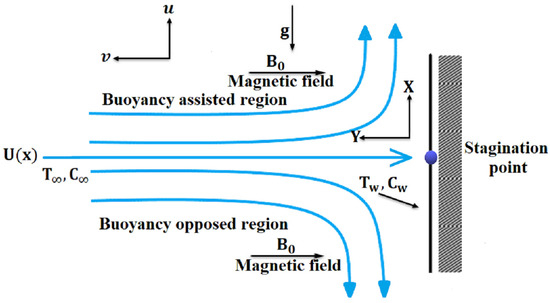
Figure 1.
Model of a flow with a coordinate system.
In this study
Subject to the boundary conditions
where u and v represent velocity components along the x and y axes, respectively, and T signifies the temperature of the fluid. The following formula is used to compute the radiant heat flux:
Because temperature differences inside the flow are too small, the Rosseland approximation can be written as (linear function of temperature) around the free stream temperature making use of Taylor series.
For temperature, Equation (2) is replaced in (3). The following dimensionless variables are presented:
Equation (1) is satisfied identically. In Equations (1)–(6), Equation (8) is employed, and the nonlinear ODEs and accompanying boundary conditions are as follows:
The physical engineering parameters are the skinfriction coefficient , local Nusselt number , and local Sherwood number , which are defined as follows:
where ( = wall sher stress, = surface heat flux, = surface mass flux) are well-defined as follows:
The non-dimensional form of physical engineering parameters is obtained as follows:
3. Numerical Method
The shooting approach is used in conjunction with MATLAB bvp4c to solve non-linear governing ordinary differential Equations (10)–(12) with boundary conditions (13) and (14). We made first-order differential equations out of the non-linear governing ordinary differential equations. For this, we considered the following:
4. Results and Discussion
The impact of radiation, Soret and Dufour’s effects on MHD flow in a porous media near a stagnation point past a vertical plate with slip, temperature, and concentration boundary conditions were considered. The employment of proper similarity parameters converts non-linear controlling PDEs to non-linear ODEs. Shooting method and MATLAB bvp4c are used to solve the modified ODEs. Various profiles are used to examine the impact of dimensionless characteristics. The numerical values of , , and are computed and displayed in Table 1. We compared our findings to those of Makinde [34], and they were strikingly similar. Table 2 shows the for distinct porosity values when . As the porosity parameter is increased, skin friction increases. Table 3 shows the , , and for distinct values of b, , and when , . The and drop as the velocity slip parameter and the thermal Biot number grow, whereas the increases. The and rise as the concentration Biot number rises, whereas the falls.

Table 1.
For varying values of S, is compared to Makinde [34] when , , , .
Table 2.
For distinct values of K, when .
Table 3.
Numerical values of , , and for distinct values of b, , and when .
Figure 2 shows how thermal radiation affects the temperature profile. As the value of increases, the rises. In this situation, greater radiation reduces the mean absorption coefficient, causing the radiative heat flux to diverge. The rate of radiative heat transfer to the fluid will be boosted as a result. The rose as a result of this. The link between fluid velocity and the porosity parameter is depicted in Figure 3. By raising the porosity parameter, the holes of the porosity medium enlarge. Due to this, kinematic viscosity rises and a resistive force acts in the opposite direction of the flow, causing a decrease in velocity profile. The influence of the Dufour effect on is depicted in Figure 4. The term Dufour describes the impact of concentration gradients, which is important in facilitating the fluid flow and has a propensity to rise the thermal energy within the boundary layer. As a result, the increased. The effect of the Soret number on the concentration profile is seen in Figure 5. We discovered that as the is increased, the rises. The temperature gradient in the Soret phenomena affected the concentration distribution. So the Soret numbers with larger values produce greater convective flow, which raises concentration.
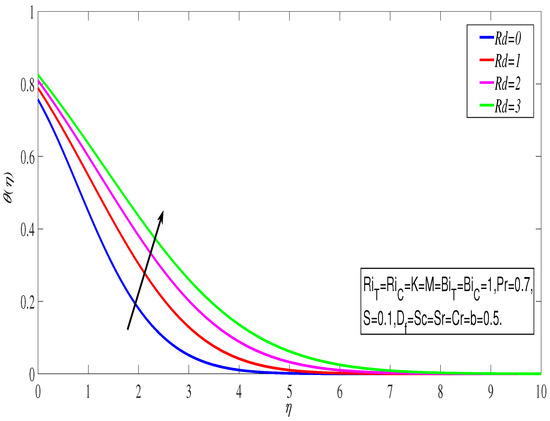
Figure 2.
Temperature profile with .
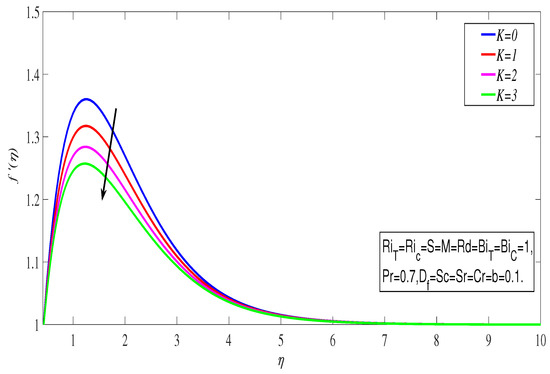
Figure 3.
Velocity profile with K.
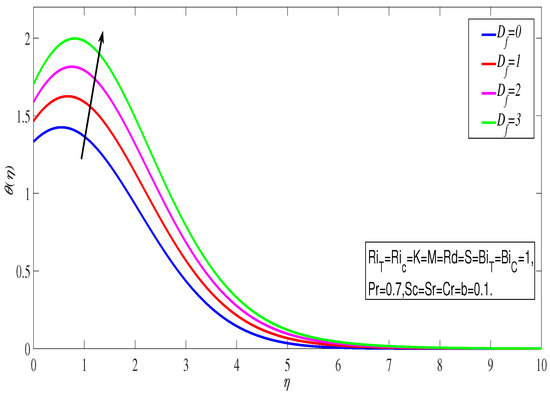
Figure 4.
Temperature profile with .
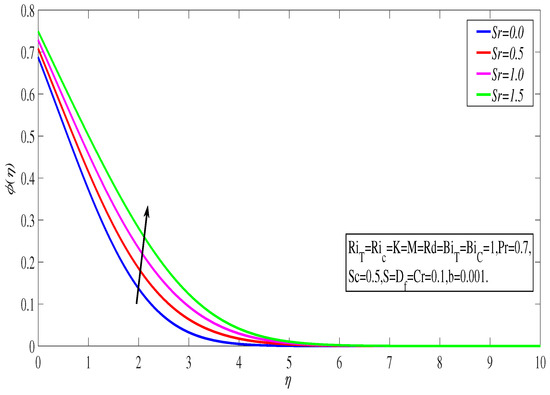
Figure 5.
Concentration profile with .
Figure 6 shows the increasing when the slip parameter was raised. The boundary layer thickness in the viscous zone decreases when the slip parameter is increased. Thus, the slip parameter rises with any value of in the presence of heat radiation. Hence the fluid velocity increases throughout the boundary layer. Figure 7 illustrates the impact of the thermal Biot number on . The effect is very clear and promising within . The parametric categorization assures the amplification of ; hence, the resistance provided by creates some frictional heat together with sheet and fluid, which in turn supplies the required amplification in temperature. An alternative approach can show this fact with greater veracity. We are aware that , where q stands for the total amount of heat transferred and is the temperature difference. The necessary thermal resistance is determined by R-value, which is where represents the heat flux. Thus, . This investigates the inverse relationship between R and . Therefore, as rises, rises as well, and thermal resistance falls, it is possible to raise the fluid temperature through the stretching surface by convection. The impact of the concentration Biot number ) on is seen in Figure 8. In general, the mass transfer coefficient rises as the rises. The increased as a result of this.
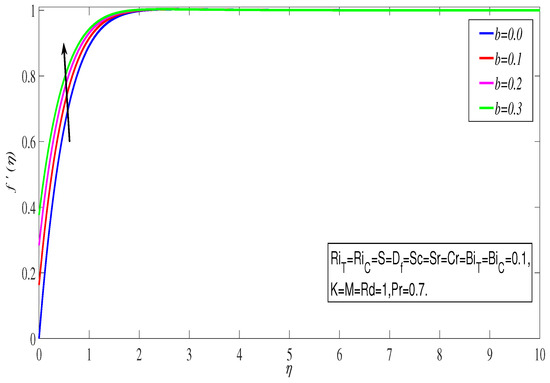
Figure 6.
Velocity profile with b.
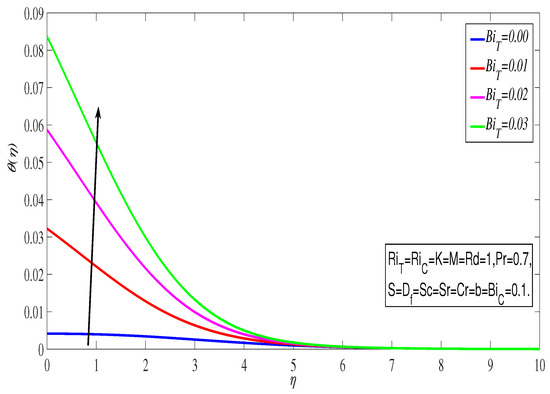
Figure 7.
Temperature profile with .
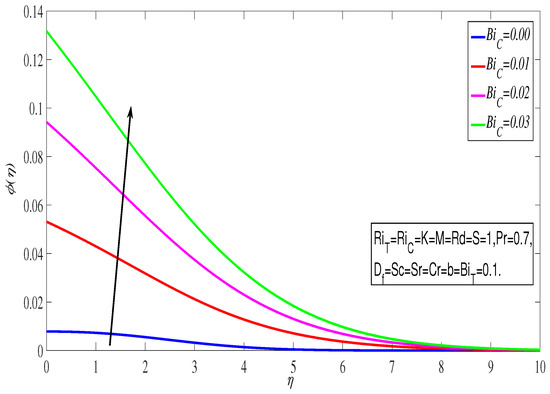
Figure 8.
Concentration profile with .
Figure 9 shows how skin friction is affected by both porosity and magnetic field factors. We found that as the K and M parameters were raised, the increased. Figure 10 illustrates the effect of the b and the on the local Nusselt number . In this case, the b raised the whereas the reduced it.
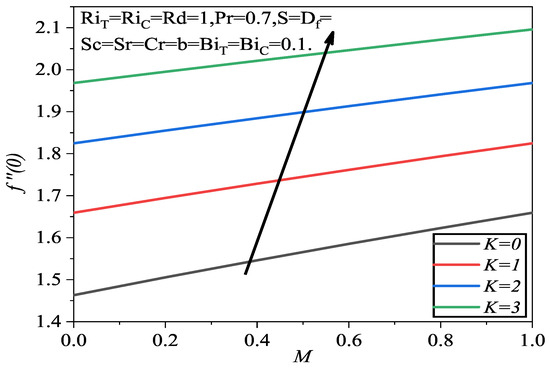
Figure 9.
Skin friction with K and M.
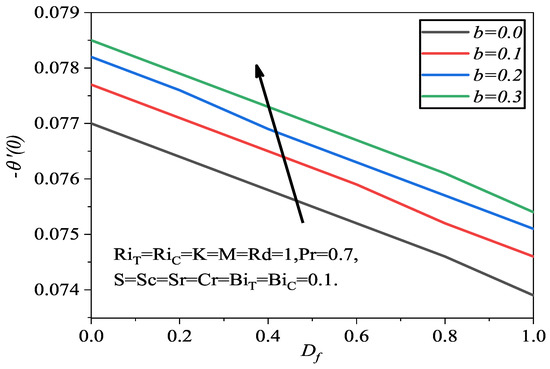
Figure 10.
Local Nusselt number with b and .
5. Conclusions
Radiation, thermo-diffusion (Soret), and diffusion-thermo (Dufour) effects on the MHD flow near a stagnation point on a vertical plate in a porous medium with slip, temperature, and concentration boundary conditions were explored. The employment of proper similarity parameters converts non-linear controlling PDEs to non-linear ODEs. Shooting method and MATLAB bvp4c are used to solve the modified ODEs. Various profiles are used to examine the impact of dimensionless characteristics. The following are the study’s main findings: The fluid temperature increases as the radiation parameter increases. The thermal state of fluid is enhanced with Dufour effect. The Soret numbers with larger values produce greater convective flow, which raises concentration. Increasing the thermal Biot number increases the heat transfer coefficient. The temperature increased as a result. The fluid concentration increased as a result of the concentration Biot number. The local Nusselt number raised with slip parameter but diminished with Dufour effect.
Author Contributions
G.L.D. contributed to the investigation, data collection, and visualization, H.N. contributed by reading and manuscript write-up and review and editing, supervision of the manuscript. All authors have read and agreed to the published version of the manuscript.
Funding
This research received no external funding.
Institutional Review Board Statement
Not applicable.
Informed Consent Statement
Not applicable.
Data Availability Statement
Data sharing is not applicable to this article.
Acknowledgments
The authors extend their appreciation to their leadership of Scientific Research at Vellore Institute of Technology in this section.
Conflicts of Interest
The authors declare no conflict of interest.
Abbreviations
| b | Slip parameter, [-] |
| Strength of magnetic field, [A m] | |
| Thermal Biot number, [-] | |
| Concentration Biot number, [-] | |
| c | Constant, [-] |
| Specific heat at constant pressure, | |
| [J K kg] | |
| Concentration susceptibility, [-] | |
| C | Species concentration, [kg m] |
| Fluid concentration, [mol m] | |
| Chemical reaction parameter, [-] | |
| D | Diffusion coefficient, [m s] |
| Dufour number, [-] | |
| Mass diffusivity, [m s] | |
| Thermophoretic diffusion coefficient, | |
| [m s] | |
| f | Dimensionless stream function, [-] |
| g | Gravitational acceleration, [m s] |
| Solutal Grashof number, [-] | |
| Thermal Grashof number, [-] | |
| Convective heat transfer coefficient, | |
| [W m K] | |
| Convective mass transfer coefficient, | |
| [m s] | |
| k | Thermal conductivity, [W m K] |
| K | Porosity parameter, [-] |
| Porous medium permeability, [m] | |
| Thermal diffusion ratio, [m s] | |
| Mean absorption coefficient, [-] | |
| M | Magnetic field parameter, [-] |
| Navier slip coefficient, [-] | |
| Prandtl number, [-] | |
| Q | Heat generation/absorption, [J] |
| Thermal radiation parameter, [-] | |
| Local Reynolds number, [-] | |
| Thermal Richardson | |
| number, [-] | |
| Solutal Richardson number, [-] | |
| S | Heat generation/absorption parameter, [-] |
| Schmidt number, [-] | |
| Soret number, [-] | |
| T | Temperature, [K] |
| Thermal diffusivity, [m s] | |
| Coefficient of thermal expansion, | |
| [K] | |
| Coefficient of solutal expansion, [-] | |
| Chemical reaction rate, [M s] | |
| Similarity variable, [-] | |
| Dimensionless temperature, [-] | |
| Kinematic viscosity, [m s] | |
| Dynamic viscosity, | |
| [Pa s] | |
| Density, [kg m] | |
| Electrical conductivity, [S m] | |
| Stefan-Boltzmann constant, | |
| [W m K] | |
| Dimensionless concentration, [-] | |
| Stream function, [kg m s] | |
| w | Condition at a wall, [-] |
| ∞ | Condition at free stream, [-] |
References
- Ferdows, M.; Khan, M.; Alam, M.; Sun, S. MHD mixed convective boundary layer flow of a nanofluid through a porous medium due to an exponentially stretching sheet. Math. Probl. Eng. 2012, 2012, 408528. [Google Scholar] [CrossRef]
- Yirga, Y.; Tesfay, D. Heat and mass transfer in MHD flow of nanofluids through a porous media due to a permeable stretching sheet with viscous dissipation and chemical reaction effects. Int. J. Mech. Aerosp. Ind. Mechatron. Manuf. Eng. 2015, 9, 709–716. [Google Scholar]
- Ullah, I.; Shafie, S.; Khan, I. Effects of slip condition and Newtonian heating on MHD flow of Casson fluid over a nonlinearly stretching sheet saturated in a porous medium. J. King Saud Univ. Sci. 2017, 29, 250–259. [Google Scholar] [CrossRef] [Green Version]
- Khan, N.S.; Islam, S.; Gul, T.; Khan, I.; Khan, W.; Ali, L. Thin film flow of a second grade fluid in a porous medium past a stretching sheet with heat transfer. Alex. Eng. J. 2018, 57, 1019–1031. [Google Scholar] [CrossRef]
- Cortell, R. MHD flow and mass transfer of an electrically conducting fluid of second grade in a porous medium over a stretching sheet with chemically reactive species. Chem. Eng. Process. 2007, 46, 721–728. [Google Scholar] [CrossRef]
- Malarselvi, A.; Bhuvaneswari, M.; Sivasankaran, S.; Ganga, B.; Abdul Hakeem, A.K. Effect of slip and convective heating on unsteady MHD chemically reacting flow over a porous surface with suction. Appl. Math. Comput. 2019, 357–365. [Google Scholar] [CrossRef]
- Seth, G.S.; Hussain, S.M.; Sarkar, S. Hydromagnetic natural convection flow with radiative heat transfer past an accelerated moving vertical plate with ramped temperature through a porous medium. J. Porous Media 2014, 17, 67–79. [Google Scholar] [CrossRef]
- Ellahi, R.; Bhatti, M.M.; Riaz, A.; Sheikholeslami, M. Effects of magnetohydrodynamics on peristaltic flow of Jeffrey fluid in a rectangular duct through a porous medium. J. Porous Media 2014, 17, 143–157. [Google Scholar] [CrossRef]
- Sivasankaran, S.; Niranjan, H.; Bhuvaneswari, M. Chemical reaction, radiation and slip effects on MHD mixed convection stagnation-point flow in a porous medium with convective boundary condition. Int. J. Numer. Method. Heat Fluid Flow 2017, 27, 454–470. [Google Scholar] [CrossRef]
- Abbas, A.; Shafqat, R.; Jeelani, M.B.; Alharthi, N. Significance of Chemical Reaction and Lorentz Force on Third-Grade Fluid Flow and Heat Transfer with Darcy–Forchheimer Law over an Inclined Exponentially Stretching Sheet Embedded in a Porous Medium. Symmetry 2022, 14, 779. [Google Scholar] [CrossRef]
- Rasool, G.; Shafiq, A.; Baleanu, D. Consequences of Soret–Dufour effects, thermal radiation, and binary chemical reaction on Darcy Forchheimer flow of nanofluids. Symmetry 2020, 12, 1421. [Google Scholar] [CrossRef]
- Ameer Ahamad, N.; Veera Krishna, M.; Chamkha, A.J. Radiation-absorption and Dufour effects on magnetohydrodynamic rotating flow of a nanofluid over a semi-infinite vertical moving plate with a constant heat source. J. Nanofluids 2020, 9, 177–186. [Google Scholar] [CrossRef]
- Ahammad, N.A.; Krishna, M.V. Numerical investigation of chemical reaction, Soret and Dufour impacts on MHD free convective gyrating flow through a vertical porous channel. Case Stud. Therm. Eng. 2021, 28, 101571. [Google Scholar] [CrossRef]
- Mallikarjuna, B.; Chamkha, A.J.; Vijaya, R.B. Soret and Dufour effects on double diffusive convective flow through a non-darcy porous medium in a cylindrical annular region in the presence of heat sources. J. Porous Media 2014, 17, 623–636. [Google Scholar] [CrossRef]
- Bhuvaneswari, M.; Eswaramoorthi, S.; Sivasankaran, S.; Hussein, A.K. Cross-diffusion effects on MHD mixed convection over a stretching surface in a porous medium with chemical reaction and convective condition. Eng. Trans. 2019, 67, 3–19. [Google Scholar] [CrossRef]
- Karthikeyan, S.; Bhuvaneswari, M.; Sivasankaran, S.; Rajan, S. Soret and Dufour effects on MHD mixed convection heat and mass transfer of a stagnation point flow towards a vertical plate in a porous medium with chemical reaction, radiation and heat generation. J. Appl. Fluid Mech. 2016, 9, 1447–1455. [Google Scholar] [CrossRef]
- Pal, D.; Mondal, H. Effects of Soret Dufour, chemical reaction and thermal radiation on MHD non-Darcy unsteady mixed convective heat and mass transfer over a stretching sheet. Commun. Nonlinear Sci. Numer. Simul. 2011, 16, 1942–1958. [Google Scholar] [CrossRef]
- Niranjan, H.; Sivasankaran, S.; Bhuvaneswari, M. Chemical reaction, Soret and Dufour effects on MHD mixed convection stagnation point flow with radiation and slip condition. Sci. Iran. 2017, 24, 698–706. [Google Scholar] [CrossRef] [Green Version]
- Bhattacharyya, K.; Layek, G.C.; Seth, G.S. Soret and Dufour effects on convective heat and mass transfer in stagnation-point flow towards a shrinking surface. Phys. Scr. 2014, 89, 095203. [Google Scholar] [CrossRef]
- Dhanalakshmi, M.; Jyothi, V.; Reddy, K.J. Soret and Dufour effects on MHD convective flow past a vertical plate through porous medium. J. Phys. Conf. Ser. 2019, 1344, 012008. [Google Scholar] [CrossRef]
- Postelnicu, A. Influence of a magnetic field on heat and mass transfer by natural convection from vertical surfaces in porous media considering Soret and Dufour effects. Int. J. Heat Mass Transf. 2004, 47, 1467–1472. [Google Scholar] [CrossRef]
- Rashad, A.; Chamkha, A. Heat and mass transfer by natural convection flow about a truncated cone in porous media with Soret and Dufour effects. Int. J. Numer. Method. Heat Fluid Flow 2014, 24, 595–612. [Google Scholar] [CrossRef]
- Das, M.; Mahanta, G.; Shaw, S.; Parida, S.B. Unsteady MHD chemically reactive double-diffusive Casson fluid past a flat plate in porous medium with heat and mass transfer. Heat Transf.-Asian Res. 2019, 48, 1761–1777. [Google Scholar] [CrossRef] [Green Version]
- Khan, A.S.; Nie, Y.; Shah, Z.; Dawar, A.; Khan, W.; Islam, S. Three-dimensional nanofluid flow with heat and mass transfer analysis over a linear stretching surface with convective boundary conditions. Appl. Sci. 2018, 8, 8112244. [Google Scholar] [CrossRef] [Green Version]
- Ullah, I.; Bhattacharyya, K.; Shafie, S.; Khan, I. Unsteady MHD mixed convection slip flow of Casson fluid over nonlinearly stretching sheet embedded in a porous medium with chemical reaction, thermal radiation, heat generation/absorption and convective boundary conditions. PLoS ONE 2016, 11, 0165348. [Google Scholar] [CrossRef] [Green Version]
- Krishna, M.V.; Ahammad, N.A.; Chamkha, A.J. Radiative MHD flow of Casson hybrid nanofluid over an infinite exponentially accelerated vertical porous surface. Case Stud. Therm. Eng. 2021, 27, 101229. [Google Scholar] [CrossRef]
- Lakshmi Devi, G.; Niranjan, H.; Sivasankaran, S. Effects of chemical reactions, radiation, and activation energy on MHD buoyancy induced nano fluidflow past a vertical surface. Sci. Iran. 2022, 29, 90–100. [Google Scholar] [CrossRef]
- Krishna, M.V.; Ahamad, N.A.; Chamkha, A.J. Radiation absorption on MHD convective flow of nanofluids through vertically travelling absorbent plate. Ain Shams Eng. J. 2021, 12, 3043–3056. [Google Scholar] [CrossRef]
- Bilal Ashraf, M.; Hayat, T.; Alsaedi, A. Mixed convection flow of Casson fluid over a stretching sheet with convective boundary conditions and Hall effect. Bound. Value Prob. 2017, 2017, 137. [Google Scholar] [CrossRef] [Green Version]
- Hayat, T.; Khan, M.I.; Waqas, M.; Alsaedi, A. Effectiveness of magnetic nanoparticles in radiative flow of Eyring-Powell fluid. J. Mol. Liq. 2017, 231, 126–133. [Google Scholar] [CrossRef]
- Shehzad, S.A.; Hayat, T.; Alsaedi, A. MHD flow of Jeffrey nanofluid with convective boundary conditions. J. Braz. Soc. Mech. Sci. Eng. 2015, 37, 873–883. [Google Scholar] [CrossRef]
- Abbasi, F.M.; Shehzad, S.A. Convective thermal and concentration transfer effects in hydromagnetic peristaltic transport with Ohmic heating. J. Adv. Res. 2017, 8, 655–661. [Google Scholar] [CrossRef] [PubMed]
- Ullah, I.; Alkanhal, T.A.; Shafie, S.; Nisar, K.S.; Khan, I.; Makinde, O.D. MHD slip flow of Casson fluid along a nonlinear permeable stretching cylinder saturated in a porous medium with chemical reaction, viscous dissipation, and heat generation/absorption. Symmetry 2019, 11, 531. [Google Scholar] [CrossRef] [Green Version]
- Makinde, O.D. Heat and mass transfer by MHD mixed convection stagnation point flow toward a vertical plate embedded in a highly porous medium with radiation and internal heat generation. Meccanica 2012, 47, 1173–1184. [Google Scholar] [CrossRef]
Publisher’s Note: MDPI stays neutral with regard to jurisdictional claims in published maps and institutional affiliations. |
© 2022 by the authors. Licensee MDPI, Basel, Switzerland. This article is an open access article distributed under the terms and conditions of the Creative Commons Attribution (CC BY) license (https://creativecommons.org/licenses/by/4.0/).