Abstract
We perform a Lie analysis of th-order difference equations and obtain non-trivial symmetries. We utilize these symmetries to obtain their exact solutions. Sufficient conditions for convergence of solutions are provided for some specific cases. We exemplify our theoretical analysis with some numerical examples. The results in this paper extend to some work in the recent literature.
MSC:
39A10; 39A33
1. Introduction
Rational ordinary difference equations have been studied in the literature by many researchers [1,2,3,4,5,6,7,8]. Recently, the well-known symmetry methods for differential equations have been extended to difference equations [9,10,11]. The concept is similar to the one developed for differential equations (see [12]), and it consists of solving the difference equations using the group of transformations that leave the equation invariant. Hydon [10] developed a systematic method that enables one to find the group of transformations for difference equations. Though his algorithm is valid for any given difference equation, he mainly applied it to second-order difference equations. This could be due to the fact that for higher-order difference equations, the calculations are cumbersome. For more references on recurrence equations via the symmetry approach, see [13,14,15].
In this paper, we investigate the solutions of difference equations of the form
for some arbitrary sequences and using a symmetry-based method.
Special cases of the above equation exist in the recent literature. In [1], Cinar studied the positive solutions of the special case where , and :
In [2], the author studied the special case where , and :
In [5], the author studied the special case where , and :
In [4], the author studied the special case where , and :
In [3], the author studied the special case where , and :
In [15], the author obtained the solutions of Equation (6) with less restrictions on the initial conditions.
In [6], the author studied the special case where , and :
In [7], the case where , and k = 1 such that
was studied by Elsayed, and exact solutions were obtained.
In [8], the author studied and obtained exact solutions of the special case where , and :
In [16], the author studied the positive solutions and attractivenesss of the special case where and :
In [17], the author studied the solutions of the special case where and :
For more work on difference equations, please see [18].
For definiteness, we study the difference equation
instead of Equation (1). To derive the solutions for Equation (12) using a symmetry-based method, we will first find the Lie group of point transformations of Equation (12). Then, we will reduce the order via the invariants and construct the solutions. Furthermore, we will explain how the solutions for Equation (1) can be obtained from the solutions for Equation (12). Finally, we will show how one can obtain the results in the literature using our results.
Preliminaries
In this section, we provide background to Lie symmetry analysis of difference equations. In this paper, we adopt the same notation as that in [10].
Definition 1.
Let G be a local group of transformations acting on a manifold M. A subset is called G-invariant, and G is called a symmetry group of . If whenever , and is such that is defined, then [12].
Definition 2.
Let G be a connected group of transformations acting on a manifold M. A smooth real-valued function is an invariant function for G if and only if
and every infinitesimal generator X of G [12].
Definition 3.
A parameterized set of point transformations
where are continuous variables is a one-parameter local Lie group of transformations if the following conditions are satisfied [10]:
- is the identity map if when ;
- for every a and b sufficiently close to 0;
- Each can be represented as a Taylor series (in a neighborhood of that is determined by x), and therefore
Consider the ordinary difference equation
for some smooth function and a regular domain . To find a symmetry group of Equation (13), we consider the group of point transformations given by
where is the parameter and Q is a continuous function which we shall refer to as a characteristic. Let
be the corresponding infinitesimal of . The substitution of the new variable (obtained using given in Equation (14)) in Equation (13) yields the linearized symmetry condition
whenever Equation (13) is true. The shift operator S acts on n as follows: . Once the characteristic is known, the invariant may be obtained by solving the characteristic system [12]
or by introducing the canonical coordinate [19]
We use the standard conventions
2. Symmetries
Consider the th-order difference Equation (12), which is
To obtain the symmetries, we impose the infinitesimal criterion of invariance (Equation (15)) to obtain
The latter is a functional equation for the characteristic Q, making Equation (16) difficult to solve. To eliminate the first undesirable argument , we differentiate implicitly with respect to (keeping fixed and regarding as a function of and ). This leads to
After simplification, we obtain
To eliminate the second undesirable variable , we differentiate with respect to , and we obtain the following second-order differential equation involving only the argument :
The general solution of Equaiton (17) is then given by
where f and g are arbitrary functions of n. To eliminate the dependency between these two functions, we substitute Equation (18) into Equation (16) and simplify the resulting equation to obtain
We separate by powers of shifts of , and we readily reduce the resulting over-determining system to obtain
The solutions for Equation (19) are
This means that we have non-trivial characteristics
and
where . We will refer to as the corresponding symmetry generator of .
3. Exact Solutions
Here, we introduce the canonical coordinate (i.e., the variable such that ). We use the well-known choice [19]
Using any one of the symmetry generators, such as , we have that
Using Equation (19), we have proven that
Therefore, the following is an invariant function of :
Since the equation under study is a rational difference equation, it is favorable to use
In other words, . It turns out (using the plus sign together with Equation (12)) that
It is easy to verify that the solution for Equation (22) in closed form is given by
for . By going up the hierarchy created by the change of variables, we obtain the solution for Equation (12) in a unified manner as follows:
- For k being odd:
- For k being even:
where
The properties of and are as follows:
In regard to these properties, one can further simplify the solution through Equations (24) and (25). We have that
Note: It can be shown, using the expression of given in Equation (21), that one can write Equation (26) without using the symbol of the absolute value.
On this note, and in the same way, we have proven that
We therefore obtain, by combining Equations (23), (27) and (28) and by replacing with , the solution for Equation (12) in closed form as
where and provided that
where . Recall that we enacted the shift operator times in Equation (1) to obtain Equation (12), and therefore we can write the solutions for Equation (1) as follows
provided that
3.1. Case with -Periodic Sequences and
Case with
3.2. Case with One-Periodic Sequences and
3.2.1. Case with
3.2.2. Case with
4. Results
In this section, we verify the results in [1,2,3,4,5,6,7,8,16,17] by utilizing different combinations of values of and in Equation (1):
- If we set , and in Equations (42)–(44), we obtain the result (for the case ) in [6] for Equation (7) (see Theorem 2), and the restriction () in [6] coincides with our restrictions (, , and ). Additionally, the solution for the case (see Theorem 5 in [6]) corresponds to our solution with the same restrictions on the initial conditions;
- If we set , and (resp ) in Equations (48)–(50), we obtain the result in [7] for Equation (8) (see Theorem 1 (resp. Theorem 4)). However, the restriction ( and are nonzero positive real numbers (resp. , for )) in [7] is a special case of our restrictions ( (resp. , and )). On the other hand, if and , the results are the same as in [7] (see Theorems 6 and 9) with the same restrictions on the initial conditions ( and );
5. Numerical Examples
Below are some graphs that show the behavior of the solutions.
Example 1.
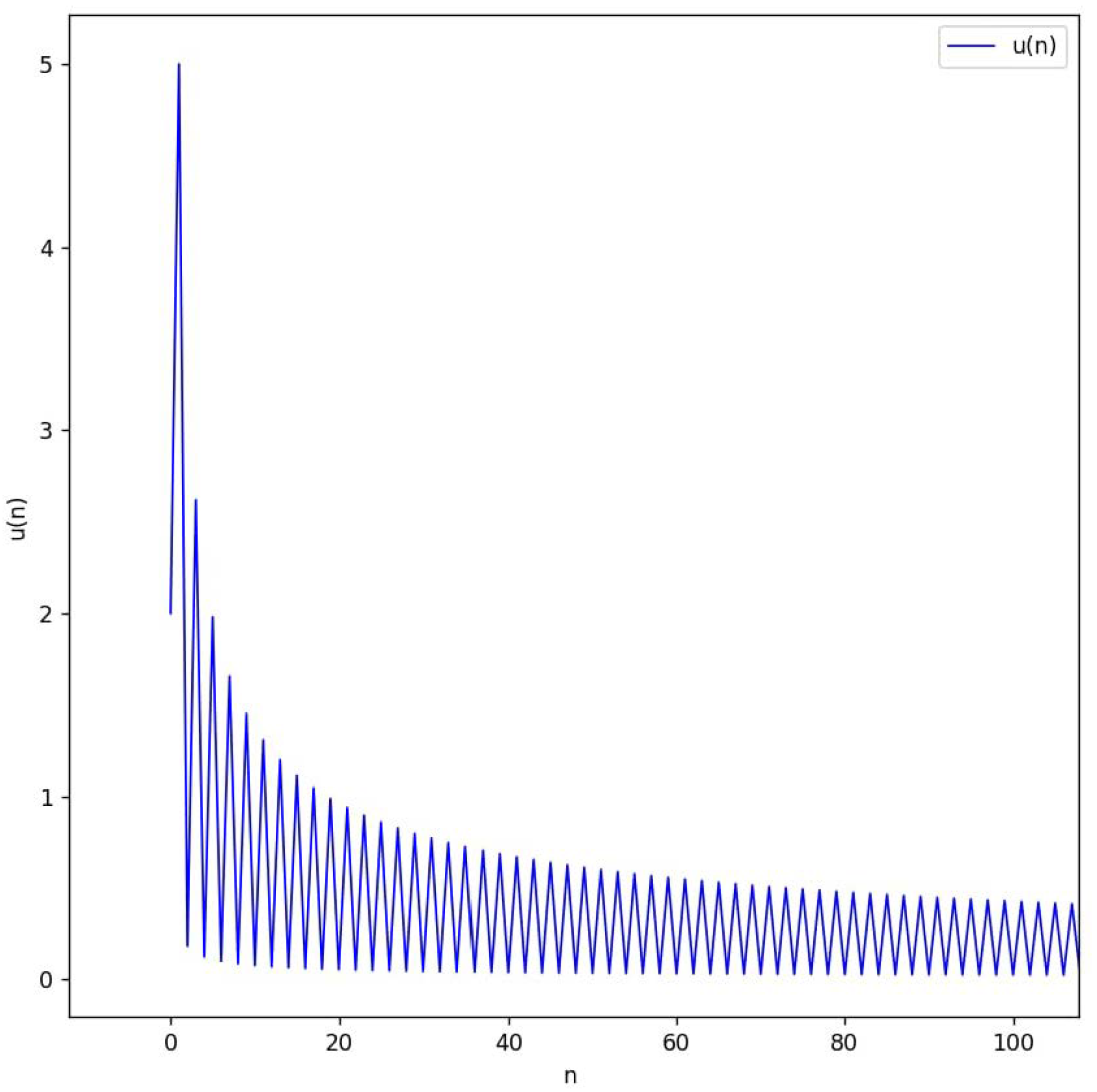
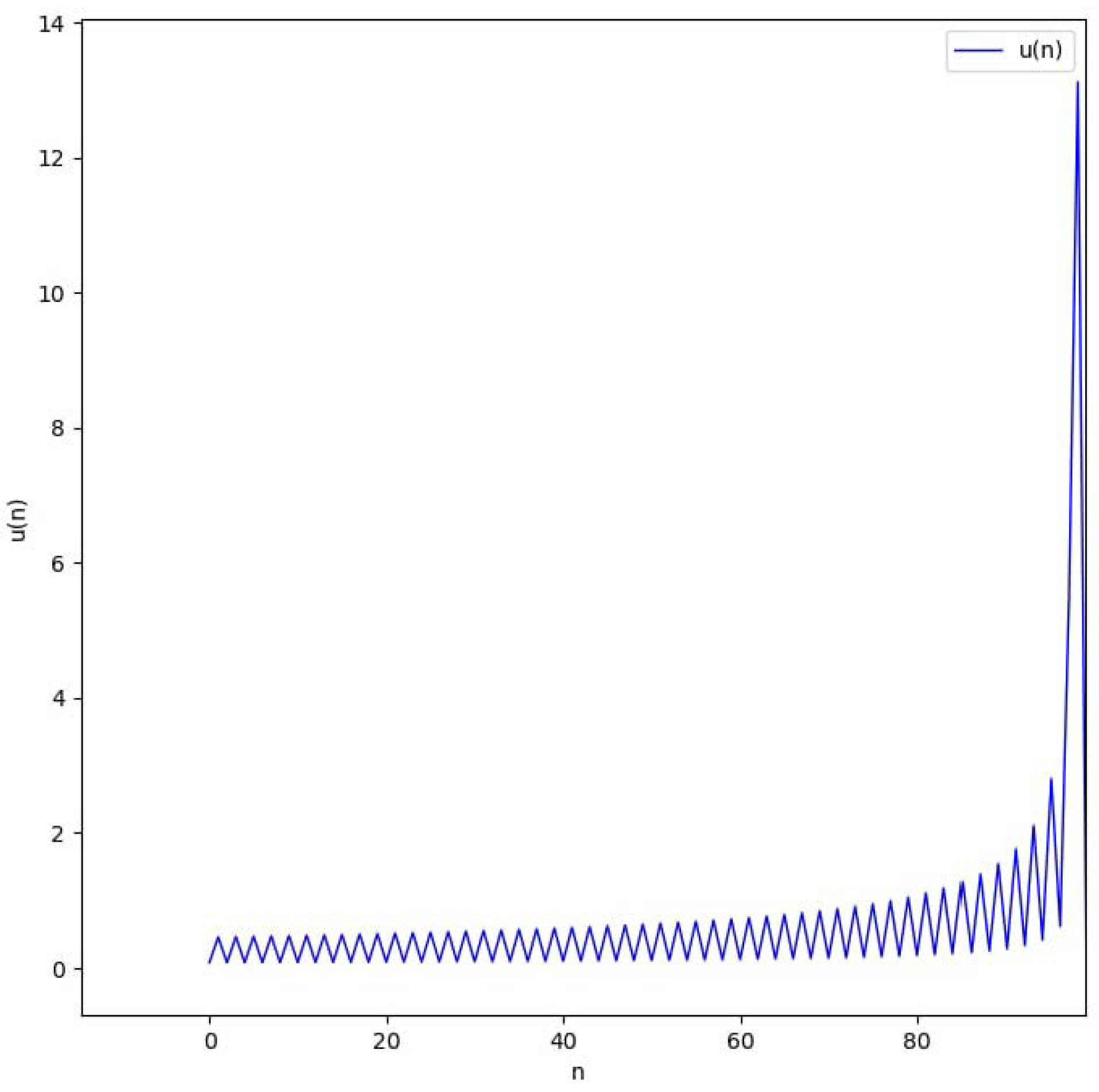
A sufficient condition for this solution to converge is given by and for . This implies that . It is then clear that if , then the solution converges. On the other hand, a sufficient condition for this solution to diverge is given by or for . This implies that . It is then clear that if , then the solution diverges.
Figure 1 shows the graph of with and . The solution converges as expected, since .
Figure 1.
The graph of .
Figure 2 shows the graph of with and . The solution diverges as expected, since .
Figure 2.
The graph of .
Example 2.
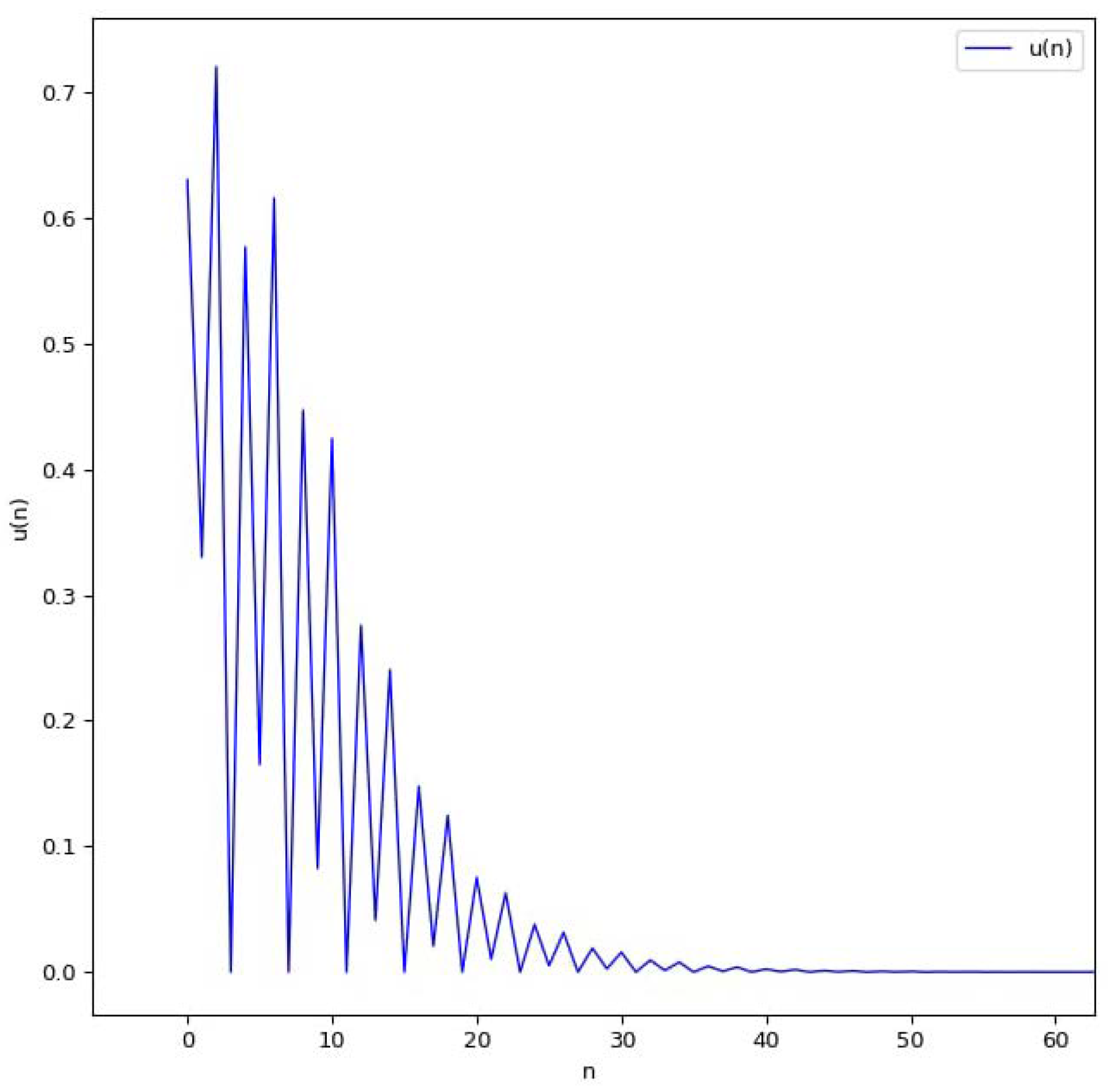
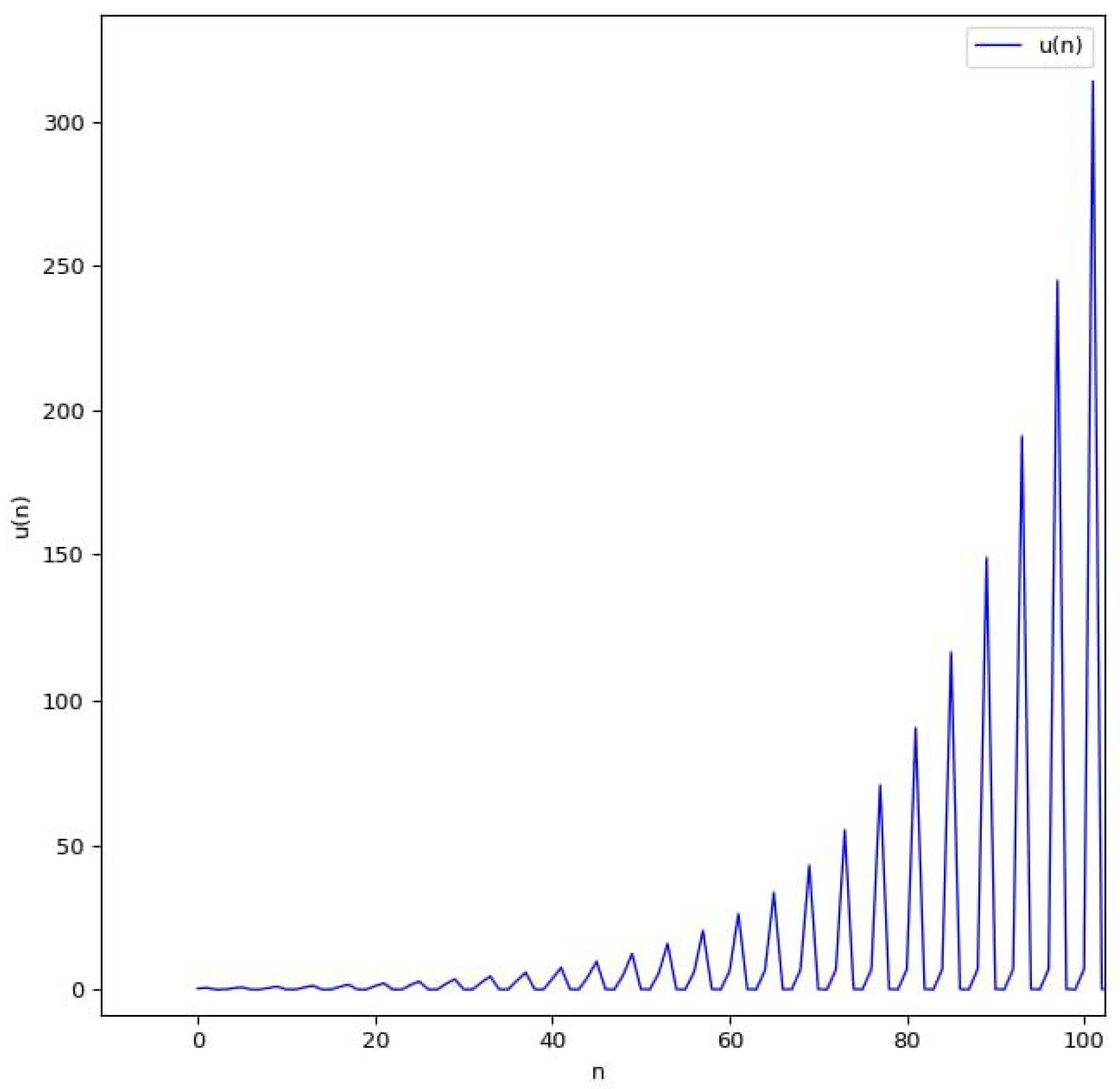
Similarly, a sufficient condition for this solution to converge is for the numerators in Equations (51)–(54) to be less than their corresponding denominators. This implies that and , where . It is then clear that if and , then the solution converges. On the other hand, a sufficient condition for this solution to diverge is for at least one of the numerators in Equations (51)–(54) to be greater than its corresponding denominator. This implies that or , where . It is then clear that if or , then the solution diverges.
Figure 3 shows the graph of with , and . The solution converges as expected, since and .
Figure 3.
The graph of .
Figure 4 shows the graph of with , and . The solution diverges as expected, since .
Figure 4.
The graph of .
6. Conclusions
We obtained all the Lie point symmetries of the difference equation (Equation (12)). We used a symmetry-based method to derive its solutions. The solutions were given in ‘single’ form and then separated into categories. We explained how the solutions of Equation (1) can be obtained using those of Equation (12) to show that the results in the recent literature can be obtained as special cases of our generalized solutions.
Funding
This research was funded by the National Research Foundation (NRF) of South Africa, grant number: 132108.
Institutional Review Board Statement
Not applicable.
Informed Consent Statement
Not applicable.
Data Availability Statement
Not applicable.
Conflicts of Interest
The author declares no conflict of interest.
References
- Cinar, C. On the positive solutions of the difference equation xn+1 = xn−1/(1 + xnxn−1). Appl. Math. Comput. 2004, 150, 21–24. [Google Scholar]
- Cinar, C. On the difference equation xn+1 = xn−1/(−1 + xnxn−1). Appl. Math. Comput. 2004, 158, 813–816. [Google Scholar]
- Cinar, C. On the positive solutions of the difference equation xn+1 = axn−1/(1 + bxnxn−1). Appl. Math. Comput. 2004, 156, 587–590. [Google Scholar]
- Cinar, C. On the solutions of the difference equation xn+1 = xn−1/(−1 + axnxn−1). Appl. Math. Comput. 2004, 158, 793–797. [Google Scholar]
- Cinar, C. On the positive solutions of the difference equation xn+1 = xn−1/(1 + axnxn−1). Appl. Math. Comput. 2004, 158, 809–812. [Google Scholar]
- Aloqeili, M. Dynamics of a rational difference equation. Appl. Math. Comput. 2006, 176, 768–774. [Google Scholar] [CrossRef]
- Elsayed, E.M. On the solution of some difference equation. Eur. J. Pure Appl. Math. 2011, 4, 287–303. [Google Scholar]
- Elsayed, E.M. On the difference equation. Int. J. Contemp. Math. Sci. 2008, 3, 1657–1664. [Google Scholar]
- Quispel, G.R.W.; Sahadevan, R. Lie symmetries and the integration of difference equations. Phys. Lett. A 1993, 184, 64–70. [Google Scholar] [CrossRef]
- Hydon, P.E. Difference Equations by Differential Equation Methods; Cambridge University Press: Cambridge, UK, 2014. [Google Scholar]
- Levi, D.; Vinet, L.; Winternitz, P. Lie group formalism for difference equations. J. Phys. A Math. Gen. 1997, 30, 633–649. [Google Scholar] [CrossRef]
- Olver, P. Applications of Lie Groups to Differential Equations, 2nd ed.; Springer: New York, NY, USA, 1993. [Google Scholar]
- Folly-Gbetoula, M.; Kara, A.H. Symmetries, conservation laws, and integrability of difference equations. Adv. Differ. Eq. 2014, 2014, 1–14. [Google Scholar] [CrossRef]
- Hydon, P.E. Symmetries and first integrals of ordinary difference equations. Proc. R. Soc. Lond. A 2000, 456, 2835–2855. [Google Scholar] [CrossRef]
- Folly-Gbetoula, M. Symmetry, reductions and exact solutions of the difference equation un+2 = aun/(1 + bunun+1). J. Diff. Eq. Appl. 2017, 23, 1017–1024. [Google Scholar] [CrossRef]
- Yalcinkaya, I. On the global attractivity of positive solutions of a rational difference equation. Selcuk J. Appl. Math. 2008, 9, 3–8. [Google Scholar]
- Karatas, R. On the solutions of the recursive sequence . Fasc. Math. 2010, 45, 37–45. [Google Scholar]
- Abdelrahman, M.A.E.; Chatzarakis, G.E.; Li, T.; Moaaz, O. On the difference equation xn+1 = axn−l + bxn−k + f(xn−l,xn−k). Adv. Differ. Eq. 2018, 431, 2018. [Google Scholar]
- Joshi, N.; Vassiliou, P. The existence of Lie Symmetries for First-Order Analytic Discrete Dynamical Systems. J. Math. Anal. Appl. 1995, 195, 872–887. [Google Scholar] [CrossRef][Green Version]
Publisher’s Note: MDPI stays neutral with regard to jurisdictional claims in published maps and institutional affiliations. |
© 2022 by the author. Licensee MDPI, Basel, Switzerland. This article is an open access article distributed under the terms and conditions of the Creative Commons Attribution (CC BY) license (https://creativecommons.org/licenses/by/4.0/).