3.1. Structural Properties in G
In this subsection, we discuss the structural properties of the minimal counterexample G by a series of auxiliary claims. A cut vertex v is nontrivial if there are at least two components of with an order of at least 2. If v is a k-vertex, then we use to denote the vertices adjacent to v.
Claim 1 (Wang and Huang, [
11]).
There is no nontrivial cut vertex in G. Claim 2. A 1-vertex is not adjacent to a -vertex in G.
Proof. Assume to the contrary that G contains an edge with and . Then, admits an NDE-13-coloring by the minimality of G. As has at most 12 forbidden colors, we color with a color in such that v does not conflict with the vertices adjacent to v. This gives an NDE-13-coloring of G, a contradiction. □
Claim 3 (Cheng et al. [
10]).
Let with .- (1)
If , then .
- (2)
If , then .
- (3)
If , then for .
- (4)
If and , then .
Claim 4 (Wang et al. [
13]).
Let .- (1)
If , then for .
- (2)
If , then .
- (3)
v is not in any special 4-cycle.
- (4)
If v is in a special 3-cycle, then .
Claim 5. Let with .
- (1)
v is in at most one bad 3-cycle. Further, if v is in a bad 3-cycle, then and .
- (2)
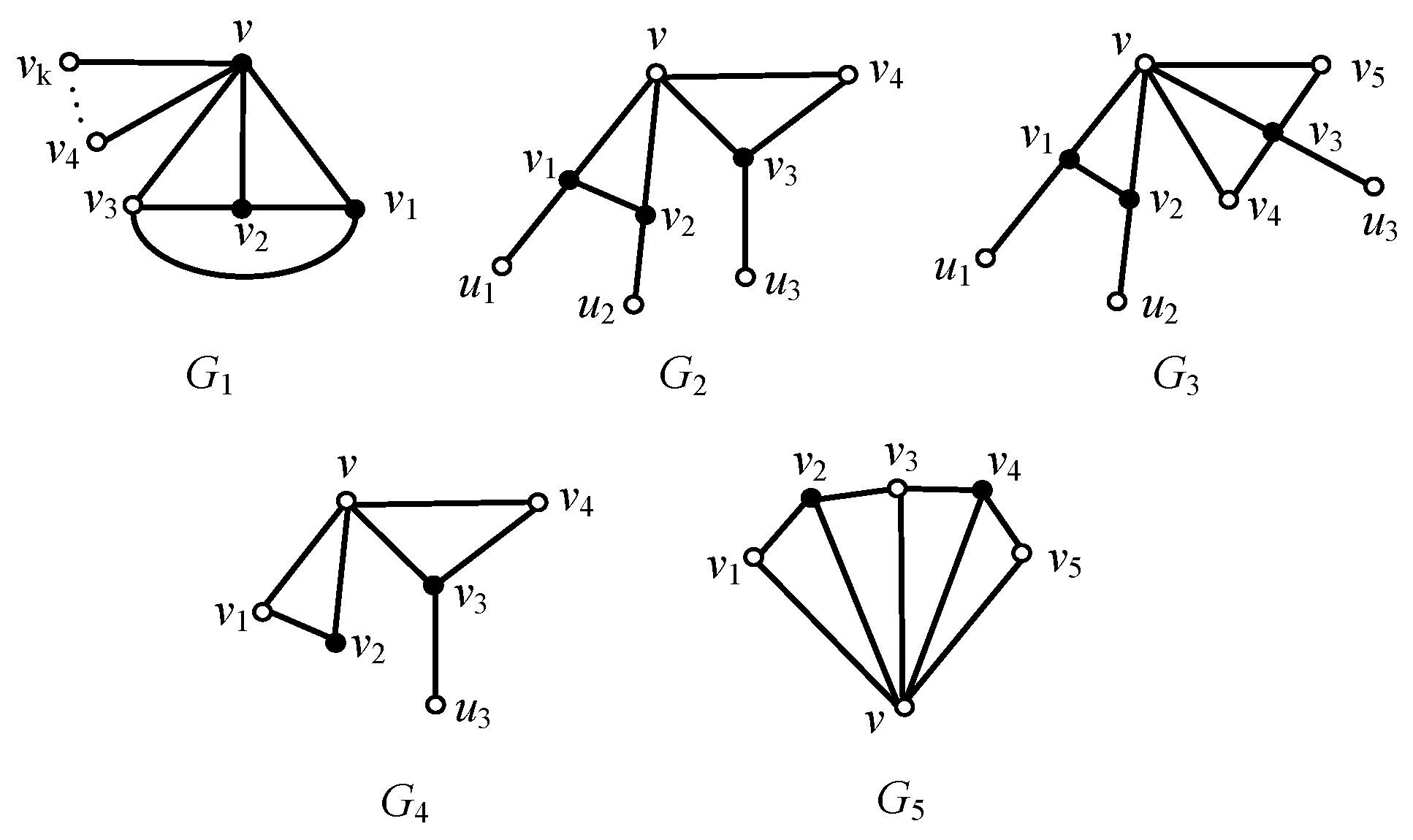
If v is in of Figure 1, then . - (3)
G contains none of the configurations for , as shown in Figure 1.
In
Figure 1, black (white) dots are used to mark the vertices whose degrees are exactly (at least) the one shown in the configurations.
Proof. In the first place, we prove that v is in at most one bad 3-cycle. Assume to the contrary that v is in two bad 3-cycles. Let us say that for and . We use to denote the third vertex adjacent to for . Then, admits an NDE-13-coloring with for . If , then is colored properly to obtain an NDE-13-coloring of G. Assume that , that is, and . Notice that or , say . We remove the color of . We recolor with a color in , say 1, and with 3. Then, , are colored properly to obtain an NDE-13-coloring of G, which is a contradiction.
In the second place, suppose that v is in a bad 3-cycle. Let with . Then, admits an NDE-13-coloring with for . If , then is colored properly to obtain an NDE-13-coloring of G. We suppose that .
Prove that . Assume to the contrary that . Firstly, or is recolored with any color in . Secondly, we recolor with 11 and with 12 or 13. Thirdly, we recolor with 12 and with 13. We can find at least nine different ways to recolor or Since v has at most eight conflict vertices, we may extend to G, which is a contradiction.
Prove that . Assume to the contrary that By Claim 3(1), does not have any conflicting vertices. We recolor with a color in , say 1, and with 3. Then, is colored properly to obtain an NDE-13-coloring of G, which is a contradiction.
Assume to the contrary that
. By Claim 5(1), we can conclude that
. Let
. We use the same vertex labels as shown in
of
Figure 1. Then,
admits an NDE-13-coloring
with
for
. If
, then
is colored properly to obtain an NDE-13-coloring of
G. We suppose that
, that is,
and
.
If , then is recolored with a color such that does not conflict with the vertices adjacent to . If , say, with , then is recolored with a color in . Let . Then, is recolored with a color . Hence, there exists a color such that, if is recolored with , then does not conflict with the vertices adjacent to . If , then is recolored with 4. If , then we recolor with 4, with 1 and with 3. Then, is colored properly to obtain an NDE-13-coloring of G, which is a contradiction.
The proof that
G does not contain
and
has been provided in [
13]. Now, we will prove it in two cases and use the same vertex labels as shown in
Figure 1.
Case 1. Suppose that G contains . By Claims 3 and 5(1), we can conclude that , . We split into two 1-vertices, and , such that v is adjacent to , and is adjacent to . Then, the resultant graph H admits an NDE-13-coloring with , and for . We stick and to restore the graph G. If , we are done. Otherwise, . Then, we discuss two subcases as follows.
Case 1.1.. Let . If , then we recolor with 1, with 2 and with 3. If , then we recolor with 3. If and , then we recolor with 4 and with 2. If and , then we recolor with 4, with 1 and with 2.
Case 1.2., that is, . By Claim 3, we can conclude that each vertex in is a -vertex in G. The color of is removed. Let and . If , then we recolor with 1, with 2 and with 3. If , then we recolor with 3. If and , then we recolor with 4 and with 2. If and , then we recolor with 4, with 1 and with 2. Finally, we color properly to obtain an NDE-13-coloring of G, which is a contradiction.
Case 2. Suppose that
G contains
. As can be seen from
Figure 1,
is a symmetric configuration. We split
into one 1-vertex
and one 2-vertex
such that
is adjacent to
v and
is adjacent to
and
; and
into one 1-vertex
and one 2-vertex
such that
is adjacent to
v and
is adjacent to
and
. Then, the resultant graph
H admits an NDE-13-coloring
with
for
,
,
,
,
,
and
. If
and
can be stuck together properly, then we obtain an NDE-13-coloring
of
G, which is a contradiction. Otherwise, we discuss two subcases as follows.
Case 2.1. If there is exactly one pair, say , that cannot be stuck together properly, then and . We consider (the case can be proved with similar arguments). Sticking and , we restore the graph G. Based on symmetry, we analyze the following possibilities.
. If , then we exchange the colors of and . Otherwise, . We exchange the colors of and , and the colors of and .
and . We recolor with 3 and with 2.
, and . We exchange the colors of and and the colors of and , and recolor with 5.
, and . We exchange the colors of and and recolor with 4, with 1.
and . We exchange the colors of and and recolor with 5.
and . We exchange the colors of and , and the colors of and , and recolor with 4 and with 3.
and . We exchange the colors of and , and the colors of and , and recolor with 3.
Case 2.2. If no pair can be stuck together properly, then we can assert that and . We exchange the colors of and , and the colors of and , and recolor with 5 and with 1. Thus, and could be stuck together properly to obtain an NDE-13-coloring of G, which is a contradiction. □
Claim 6. Let with . If , then for .
Proof. Assume to the contrary that . Let and . Then, admits an NDE-13-coloring with for . By Claim 3, we discuss two cases as follows.
Case 1.. Without a loss of generality, suppose that for . Firstly, is colored with any color in . Secondly, for each with and , by Claim 3, has at most one conflicting vertex. We recolor with a color such that does not conflict with the vertices adjacent to , and we color with a color in . We can find at least different ways to recolor or color some edges incident with v. As v has at most conflicting vertices, we may extend to G, which is a contradiction.
Case 2., that is, . By Claim 3, we can conclude that each vertex in is a -vertex in G. We recolor with a color in . Let . We notice that if can be colored with some color in , , then and do not conflict with each other. Without loss of generality, suppose that . By a similar argument to Case 1, we may extend to G, which is a contradiction. □
Claim 7. Let with .
- (1)
If , then for .
- (2)
If v is adjacent to a -3-vertex, then .
Proof. Assume to the contrary that . Let us say that and . Then, admits an NDE-13-coloring with for . By Claim 3, we discuss two cases as follows.
Remark 1. If , or and , then is recolored with a color such that does not conflict with the vertices adjacent to . If and , assuming with , then is recolored with a color in . Let . Then, is recolored with a color . Hence, there exists a color such that if is recolored with , then does not conflict with the vertices adjacent to .
Case 1.. Without loss of generality, suppose that for . Firstly, is colored with any color in . Secondly, for each with and , by Claim 3, has at most one conflicting vertex. According to Remark 1, we recolor with a color such that does not conflict with the vertices adjacent to , and color with a color in . We can find at least different ways to recolor or color some edges incident with v. Because v has at most conflicting vertices, we may extend to G, which is a contradiction.
Case 2., that is, . By Claim 3, we can conclude that each vertex in is a -vertex in G. We recolor with a color in . Let . We notice that if can be colored with some color in , , then and do not conflict with each other. Without loss of generality, suppose that . By a similar argument to Case 1, we may extend to G, which is a contradiction.
Suppose that is a -3-vertex. By Claim 5(1), we can conclude that v is not in any bad 3-cycle. Let and . Then, . Assume to the contrary that . Then, admits an NDE-13-coloring with for . If , then is colored properly to obtain an NDE-13-coloring of G. We suppose that , that is, and . We deal with the following two possibilities in terms of symmetry.
. Firstly, we recolor with any color in . Secondly, we exchange the colors of and , and recolor with any color in . Thirdly, for each with and , we recolor with a color such that does not conflict with the vertices adjacent to , and with any color in We can find at least different ways to recolor the edges incident with v. Because v has at most conflicting vertices, we may extend to G, which is a contradiction.
, say . Firstly, we recolor with any color in . Secondly, we exchange the colors of and , and recolor with any color in . Thirdly, for each with and , we recolor with a color such that does not conflict with the vertices adjacent to , and with any color in We can find at least different ways to recolor the edges incident with v. As v has at most conflicting vertices, we may extend to G, which is a contradiction.
□
Claim 8. Let with .
- (1)
If and , then .
- (2)
If , then .
- (3)
If v is in a bad 3-cycle, then .
- (4)
If v is in a -cycle and , then .
- (5)
If v is adjacent to a -3-vertex, then .
Proof. Assume to the contrary that . Let us say that and . Then admits an NDE-13-coloring with for .
Firstly, is colored with any color in . Secondly, by Claim 3, has at most one conflicting vertex. By a similar argument to Remark 1 in Claim 7(1), we recolor with a color such that does not conflict with the vertices adjacent to , and color with any color in . Thirdly, for each with and , by Claim 3, has at most one conflicting vertex. According to Remark 1 in Claim 7(1), is recolored with a color such that does not conflict with the vertices adjacent to . If , then is colored with any color in . If , then we recolor with and color with any color in . We can find at least different ways to recolor or color some edges incident with v. Because v has at most conflicting vertices, we may extend to G, which is a contradiction.
Assume to the contrary that . Let and x be the neighbor of different from v (if it exists). Then, admits an NDE-13-coloring with for . Suppose that , if x exists.
Firstly, is colored with any color in . Secondly, for each with and , by Claim 3, has at most one conflicting vertex. By a similar argument to Remark 1 in Claim , is recolored with a color such that does not conflict with the vertices adjacent to . Then, is colored with a color in . We can find at least different ways to recolor or color some edges incident with v. As v has at most conflicting vertices, we may extend to G, which is a contradiction.
Assume to the contrary that Let with . Then, admits an NDE-13-coloring with for . If , then is colored properly to obtain an NDE-13-coloring of G. We suppose that .
Firstly, or is recolored with any color in . Secondly, we recolor with 12 and with 13. Thirdly, for each with and , by Claim 3, has at most one conflicting vertex. According to Remark 1 in Claim 7(1), is recolored with a color such that does not conflict with the vertices adjacent to . If , then is recolored with any color in . If , then or is recolored with . We can find at least different ways to recolor some edges incident with v. As v has at most conflicting vertices, we may extend to G, which is a contradiction.
Assume to the contrary that Let with and . Then, admits an NDE-13-coloring with for . If , then is colored properly to obtain an NDE-13-coloring of G. We suppose that . Let us deal with the following two possibilities according to symmetry.
. Firstly, we recolor or with any color in . Secondly, we recolor with 12 and with 13. Thirdly, is recolored with a color such that does not conflict with the vertices adjacent to . If then is recolored with 12 or 13. If , then or is recolored with . We can find at least seven different ways to recolor some edges incident with v. As v has at most five conflicting vertices, we may extend to G, which is a contradiction.
, say . By a similar argument to Remark 1 in Claim 7(1), is recolored with a color such that does not conflict with the vertices adjacent to . If then we recolor with 3 and color properly to obtain an NDE-13-coloring of G. Otherwise, . Firstly, we recolor with 3 and or with 13. Secondly, for each with , we recolor with 12 and with 3 or 13. We can find at least six different ways to recolor some edges incident with v. As v has at most five conflicting vertices, we may extend to G, which is a contradiction.
Suppose that is a -3-vertex. If v is in a bad 3-cycle, by Claim 8(3), then and . So, we suppose that v is not in any bad 3-cycle. Let and . Then, . Assume to the contrary that . Then, admits an NDE-13-coloring with for . If , then is colored properly to obtain an NDE-13-coloring of G. We suppose that , that is, and . On the basis of symmetry, we consider the following two possibilities.
. Firstly, we recolor with any color in . Secondly, we exchange the colors of and , and recolor with any color in . Thirdly, for each with and , by a similar argument to Remark 1 in Claim 7(1), we recolor with a color such that does not conflict with the vertices adjacent to , and with any color in We can find at least different ways to recolor the edges incident with v. As v has at most conflicting vertices, we may extend to G, which is a contradiction.
, say . Firstly, we recolor with 13. Secondly, we exchange the colors of and , and recolor with 1 or 13. Thirdly, we exchange the colors of and , and recolor with 13. Fourthly, for each with and , by a similar argument to Remark 1 in Claim 7(1), is recolored with a color such that does not conflict with the vertices adjacent to . If , then is recolored with 13. If , then we exchange the colors of and . We can find at least different ways to recolor the edges incident with v. As v has at most conflicting vertices, we may extend to G, which is a contradiction.
□
Claim 9. Let with .
- (1)
If , then .
- (2)
If v is in a bad 3-cycle, then .
- (3)
If v is in a -cycle and , then .
- (4)
If v is adjacent to a -3-vertex, then .
Proof. Assume to the contrary that . Let for . Then, admits an NDE-13-coloring with for . Firstly, is colored with any color in . Secondly, for each with , we recolor with 12 and color with 13. Thirdly, for each with and , by a similar argument to Remark 1 in Claim 7(1), is recolored with a color such that does not conflict with the vertices adjacent to . If , then we recolor with 12 and color with 13. If , then we color with . We can find at least different ways to recolor or color some edges incident with v. As v has at most conflicting vertices, we may extend to G, which is a contradiction.
Assume to the contrary that . Let with . Then, admits an NDE-13-coloring with for . If , then is colored properly to obtain an NDE-13-coloring of G. We suppose that . We recolor or with 13. We can find at least two different ways to recolor some edges incident with v. As v has at most one conflicting vertex, we may extend to G, which is a contradiction.
Assume to the contrary that Let , and with . Then, admits an NDE-13-coloring with for . If , then is colored properly to obtain an NDE-13-coloring of G. We suppose that . By Claim 3, we can conclude that has at most one conflicting vertex. If , then we recolor with 1 and with 3. Otherwise, . By a similar argument to Remark 1 in Claim 7(1), is recolored with a color such that does not conflict with the vertices adjacent to . If , then we recolor with 2 and with 3. If , then is recolored with 2. Finally, is colored properly to obtain an NDE-13-coloring of G, which is a contradiction.
Assume to the contrary that . Suppose that is a -3-vertex. By Claim 5(1), we can conclude that v is not in any bad 3-cycle. Let , and . Then, , and admits an NDE-13-coloring with for . If , then is colored properly to obtain an NDE-13-coloring of G. We suppose that , that is, and . If , then we recolor with 3 and with 1. If , then we exchange the colors of and , and recolor with 2. Finally, is colored properly to obtain an NDE-13-coloring of G, which is a contradiction. □
Let H be the graph gained from G after we remove all 1-vertices in G. We notice that . Then, H is a connected plane graph with .
3.2. Discharging Analysis in H
To derive a contradiction, we need to implement discharging analysis in
H. By Claim 1, we may conclude that
H is 2-connected. By Claims 2-9, we show the relationship between
and
in
Table 1, and some structural properties of
H, are given in Claim 10.
Claim 10. Let .
- (1)
If , then . So, .
- (2)
If , then .
- (3)
If , then .
- (4)
If , then .
- (5)
Assume that . If , then .
- (6)
Assume that . Then v is not in any bad 3-cycle. If , then .
- (7)
Assume that . Then v is not in any bad 3-cycle. If , then . If , then .
- (8)
Assume that . Then v is not in any bad 3-cycle. If , then . If v is adjacent to a -3-vertex, then .
- (9)
Assume that . If v is in a bad 3-cycle, then . If , then . If v is in a -cycle and , then . If v is adjacent to a -3-vertex, then .
- (10)
Assume that . If v is in a bad 3-cycle, then .
Proof. Statements
,
,
and
hold clearly by
Table 1 and Claims 3 and 9.
It is trivial when
. If
, then
by
Table 1. If
, then
. By Claim 3(4),
, which means that
.
It is trivial when
. If
, then
or
by
Table 1. If
, then
. By Claim 3(4),
, which means that
. If
, then
. By Claim 4(1),
for
, which means that
.
It is trivial when . If , then and . By Claim 5(1), v is not in any bad 3-cycle in H. If , then . By Claim 6(1), , which means that . If , then . By Claim 7(1), , which means that . If , then . By Claim 4(1), for , which means that .
It is trivial when . If , then and . By Claim 5(1), v is not in any bad 3-cycle in H. If , then . By Claim 7(1), , which means that . If , then . By Claim 8(1), , which means that . If , then . By Claim 4(1), for , which means that .
It is trivial when . If , then and . By Claim 5(1), v is not in any bad 3-cycle in H. Assume that . Then, . If , meaning , by Claim 8(1), then . If v is adjacent to a -3-vertex, meaning , by Claim 8(1), then . Assume that . Then, . By Claim 4(1), for , which means that .
It is trivial when . If , then and . By Claim 5(1), v is not in any bad 3-cycle in H. By Claim 9(4), v is not adjacent to any -3-vertex in H. By Claim 4(1), , which means that . If , meaning , by Claim 9(3), v is not in any -cycle in G, which means that v is not in any -cycle in H. □
By Euler’s formula
, we have
Firstly, we define an initial weight function
for every vertex
and
for every face
. Secondly, we design some discharging rules and redistribute weights accordingly. After discharge is complete, a new weight function
is produced. When discharge is in process, the sum of all weights is kept fixed. However, we can prove that
for all
. This results in the following obvious contradiction:
and, hence, demonstrates that there is no such counterexample.
The discharging rules are made as follows:
- (R1)
Let f be a 4-face. If , then f sends 2 to its incident 2-vertex. Otherwise, f sends 1 to each incident small vertex.
- (R2)
Let f be a -face. Then, f sends 2 to each incident 2-vertex, and to each incident small vertex of a degree of at least 3.
For a small vertex u, we use to denote the total sum of charges transferred into u after (R1)–(R2) was carried out.
- (R3)
Let v be a -vertex adjacent to a small k-vertex u. If , then v sends max to u; if , then v sends max to u.
For , we use to denote the charge transferred from x to y on the basis of the above rules.
Observation 1. (Wang et al. [
13])
Suppose that , and v is a small vertex incident with f.- (1)
Every face f is incident with at most small vertices.
- (2)
Let . If , then . Otherwise, .
- (3)
Let . If , then . Otherwise, .
- (4)
Let . Then, .
Observation 2. Suppose that is a -vertex, u is a small vertex adjacent to v and is the configuration of Figure 1. - (1)
Assume that . If v is in a special 3-face, then . Otherwise, .
- (2)
Assume that . If v is in , then . Otherwise, .
- (3)
Assume that . Then, .
- (4)
Assume that . Then, .
- (5)
If v is in a bad 3-face, and u is not in this bad 3-face, then .
- (6)
If v is in , and u is not in , then .
- (7)
If v is in a special 3-face and , then .
Proof. has been proved in [
13], and we only need to prove
. If
v is in a special 3-face, by Claim 4(4), then
. According to the nonexistence of
in Claim 5(3), one of the faces incident with
is at least a 4-face without 2-vertex or
-face. By (R1) and Observation 1, we can conclude that
. If
, then
. If
, by Claim 5(1), then two of the faces incident with
u are at least 4-faces without 2-vertices or
-faces. By (R1) and Observation 1, we have
. Hence,
. □
Observation 3. Let be an -vertex that is not in any bad 3-face, and , be consecutive neighbors of v. If for and , then . Further,
- (1)
If neither nor is in a bad 3-face, then .
- (2)
If exactly one of and is in a bad 3-face, then .
- (3)
If and , then .
- (4)
If and for , then .
- (5)
If and for , then .
Proof. has been proved in [
13], and we only need to prove
and
. If there are three consecutive vertices
, then one of the faces incident with
is at least a 4-face without 2-vertex or
-face by Claim 10(3). Hence,
by (R1) and Observation 1. Similarly, if there are three consecutive vertices
, then one of the faces incident with
is at least a 4-face without 2-vertex or
-face by Claim 10(3). Hence,
by (R1) and Observation 1. □
Suppose that
. If
, then
. If
, then
f is incident with at most two
-vertices by Observation 1. By Claim 4(3) and (R1),
f sends at most 2 to all its incident small vertices. Hence,
. If
, by (R2), then
Suppose that is a k-vertex. Then, . We use to denote the vertices adjacent to v in clockwise order. For , is used to denote the incident face of v in H with and as boundary edges, where all indices are taken modulo k. If , by (R3) and Claim 10(4), then .
Case 1.. If , then by Claim 10(1)–(4). Hence, by (R1)–(R3), . If , by Claim 10(1)–(4), then . Hence, by (R1)–(R3), .
Case 2.. Then, . If , by Claim 10(5), then . Then, v is not in any bad 3-face. Hence, by Observation 2(1)–(3), . Otherwise, . If , by Observation 2(4), then . If , then there exist three consecutive vertices . Hence, by Observation 3(5) and by Observation 2(4). If , then there are two vertex-disjoint subsets , and then by Observations 2 and 3.
Case 3.. Then, . By Claim 10(6), v is not in any bad 3-face. If , then by Claim 10(6). Hence, by Observation 2(1)–(4), . If , then by Observation 2(4).
Case 4.. Then, . By Claim 10(7), v is not in any bad 3-face. If , by Claim 10(7), then , which means that . Hence, by Observation 2(1)–(4), . If and , by Claim 10(7), then , which means that . Hence, by Observation 2(3)–(4), . If , by Observation 2(4), then .
Case 5.. Then, . By Claim 10(8), v is not in any bad 3-face.
Case 5.1.. By Claim 4(2), . By Claim 10(8), , which means that . If , by Observation 2(1)–(4), then . If and , then by Observation 2(1)–(3). Otherwise, , and .
If v is in a special 3-face, by Claim 4(4), then . Hence, by Observation 2. Thus, we assume that v is not in any special 3-face. If , then by Observation 2(1)–(4). If and , then by Observation 2(1)–(4). Then, we suppose that , , and . By Claim 10(8), v is not adjacent to any -3-vertex. For each with , . For each two consecutive vertices , by (R1) and Observation 1.
If there exist two consecutive vertices , then by Observation 2. If there are two consecutive vertices with and , then by Observation 2. Otherwise, there are nine consecutive vertices with and . By the nonexistence of in Claim 5(3), there are two subscripts such that one of and is at least a 4-face without 2-vertex or -face, and one of and is at least a 4-face without 2-vertex or -face. Hence, by Observation 2, .
Case 5.2.. If , by Observation 2(3)–(4), then . If , by Observation 3(1), then . Otherwise, .
. Then, there are three consecutive vertices . Hence, by Observation 3(4) and by Observation 2.
. Then, there are two vertex-disjoint subsets , , . By Observation 3(4), and . Hence, by Observation 2.
Case 6.. Then, . If v is in a bad 3-face, then by Claim 10(9). Hence, by Observation 2. Thus, we assume that v is not in any bad 3-face.
Case 6.1.v is in a special 3-face. By Claim 4(4) and 10(9), and . If , then by Observation 2. Otherwise, . By Claim 10(9), v is not in any -face. For each two consecutive vertices , by (R1) and Observation 1.
. Then, , and there exist two consecutive vertices such that . Hence, by Observation 2.
. Then, , and there are two vertex-disjoint subsets , such that and . Hence, by Observation 2.
Case 6.2.v is not in any special 3-face. By Claim 4(2), . Let , be -vertices or 2-vertices with , and for . Then, and . By Observation 3, for . If , then by Observation 2. If , then by Observation 3. Otherwise, .
. By Claim 10(9), . Then . If , then by Observation 2. If , then , and there are three consecutive vertices . By Observation 3(4), . Hence, by Observation 2.
. If v is adjacent to a -3-vertex, by Claim 10(9), then , and by Observation 2. Thus, we assume that v is not adjacent to any -3-vertex. For each with , . For each s consecutive vertices , by (R1) and Observation 1. If , then .
Assume that . If there exist three consecutive vertices , then by Observation 2. If there exist with , then by Observation 2. Otherwise, there are nine consecutive vertices with and . If there are at most three 3-vertices in , then by Observation 2. Thus, we assume that . By the nonexistence of in Claim 5(3), there are two subscripts such that one of and is at least a 4-face without 2-vertex or -face, and one of and is at least a 4-face without 2-vertex or -face. Hence, by Observation 2.
Case 7.. Then, . If v is in , by Claim 10(10), then . Hence, by Observation 2, . Thus, we assume that v is not in . If v is in a bad 3-face, by Claim 10(10), then . Hence, by Observation 2. Thus, we assume that v is not in a bad 3-face.
Case 7.1.v is in a special 3-face. By Claim 4(4), . For each , by Observation 2. For each s consecutive vertices , by (R1) and Observation 1.
Let , be -vertices, where and is a 2-vertex. Let for , and . Then, , , for and . If , by Observation 2, then . If , then If , then there exist two consecutive vertices . Hence, by Observation 2.
Case 7.2.v is not in any special 3-face. Let , be -vertices or 2-vertices, where , and for . Then, and . By Observation 3, for . If , by Observation 2, then . If , then
. If there exist three consecutive vertices , by Observations 2 and 3, then . Otherwise, there are with . By Observations 2 and 3, .
. If there exist five consecutive vertices , by Observations 2 and 3, then . If there exist with and , by Observations 2 and 3, then . If there exist with , by Observations 2 and 3, then . If there exist with and , then by Observations 2 and 3. Otherwise, . By Observation 3, .
Case 8.. Then, . If v is in , by Observation 2, then . Thus, we assume that v is not in .
Assume that v is in a bad 3-face. Then, and v is in at most one bad 3-face by Claim 5(1). If , then by Observation 2. Otherwise, . Suppose that for . If , then and are 4-faces without 2-vertices or -faces. Hence, by (R1) and Observation 1, . If and , then by Claim 10(3). Then, we can conclude that at least one of and is a -face. Hence, by (R1) and Observation 1, . If and , then one of and is a 4-face without 2-vertex or -face, and the other is a -face. Hence, by (R1) and Observation 1, . Therefore, we have , and . Thus, we assume that v is not in a bad 3-face.
Case 8.1.v is in a special 3-face. By Claim 4(4), . For each , by Observation 2. For each s consecutive vertices , by (R1) and Observation 1.
Let , be -vertices, where and is a 2-vertex. Let for and . Then, , , for and . If , by Observation 2, then . If , then by Observation 2.
Case 8.2.v is not in any special 3-face. Let , be -vertices or 2-vertices, where , and for . Then, and . By Observations 2 and 3, for . If , by Observation 2, then . If , then .
Assume that . If there exist three consecutive vertices , by Observations 2 and 3, then . Otherwise, there exist with . By Observations 2 and 3, we have .