


Abstract
In this paper, through complex analysis, the convergence rate is given on a quadrature of a Fourier integral with symmetrical Jacobi weight. The interpolation nodes of this quadrature formula are expressed by the frequency, and the coefficients can be expressed by the Bessel function. When the frequency is close to 0, the nodes are close to those in the Gauss quadrature. When the frequency tends to infinity, the nodes tend symmetrically to the two ends of the integrand. The higher the frequency is, the higher the accuracy of this quadrature will be. Numerical examples are provided to illustrate the theoretical results.
1. Introduction
Numerical integration is an ancient subject that is still present today [1,2,3,4,5,6,7]. In recent years, for quadratures of highly oscillatory functions, many numerical analysts have developed approaches such as the Filon-type method, Clenshaw–Curtis quadrature, etc. [8,9,10,11,12,13,14,15,16,17,18]. As shown in these articles, the convergence rate is related to three factors: node location, node number, and frequency [4,6,7,9]. For a non-oscillatory function, the convergence rate of a Clenshaw–Curtis quadrature will approach that of a Gauss quadrature as the number of nodes increases [11,14]. On the contrary, for the quadrature of a highly oscillatory function, the interpolation node’s location is related to the frequency [4,12,13,14,15,16,17,18,19,20].
In this paper, for simplicity, we will focus on the quadrature of a Fourier integral with a symmetrical Jacobi weight function. Through the integral estimation of the analytical function, the interpolation nodes will be given.
Let
It is well known that the Gauss quadrature is
where the Lagrange basic polynomial [7,9,13,16]. If g is a highly oscillatory function, then it is ineffective to approximate by . So, many numerical analysts have given other efficient methods using derivatives in recent years [10,14,15,16,17,18,19,20,21,22]. However, free from derivatives, we will approximate with the following quadrature interpolation formula:
Specifically, we will study the approximation of the following two Fourier integrals:
and
where are nodes, and , are coefficients. The quadrature nodes depend on the frequency , so this quadrature method can be called the method of changing quadrature nodes.
The structure of this paper is as follows. Section 2 analyzes the algebraic precision of (1) when and the asymptotic order of (2) and (3) when . Section 3 gives the error bounds of (2) through complex analysis. According to the above error bounds, for simplicity, we suggest the simple expression of the nodes in Section 4. Section 5 gives the Bessel function expression of the coefficients. Based on the given expressions of the nodes and coefficients, Section 6 and Section 7 summarize the details of (2) and (3), respectively. Finally, the numerical experiments in Section 8 show the efficiency of (2) and (3). Furthermore, an error comparison between (2) and the Filon-type method is given.
2. The Algebraic Precision and Asymptotic Order
Suppose that and . In this section, we will analyze the algebraic precision of (1) when and the asymptotic order of (2) and (3) when .
2.1. The Algebraic Precision
Theorem 1.
If are a set of Lagrange basic polynomials with different points , then (1) is algebraically accurate of the order.
Proof.
For the different points , since the Lagrange interpolation approximation
is accurate if f is a polynomial of less than or equal to the order, the approximation
is accurate if f is a polynomial of less than or equal to the order. □
Theorem 2.
Suppose that is the k-th orthogonal polynomial with the weight in , where , and are the roots of . For , if , then (1) is algebraically accurate of the order.
Proof.
Let . According to the Gauss quadrature [3,4,7,11,13], the approximation
is accurate if f is a polynomial of less than or equal to the order. Noting that , for , the approximation
is accurate if f is a polynomial of less than or equal to the order. □
2.2. The Asymptotic Order
Theorem 3.
For , if the even nodes satisfy
and with , then
where .
Proof.
Let
Then, are removable discontinuity points of F such that can be assumed. In addition,
Noting that with , the above formula can be rewritten as
According to and
where denotes the sum of the products of all elements chosen from the set , and we have
By repeated integration by parts,
For ,
Therefore, with the assumption , (4) holds.
Similarly, for , according to
(5) holds. □
Theorem 4.
For , if the odd nodes satisfy
with and , then
where .
3. The Error Bounds According to Complex Analysis
In this section, we assume that U is a bounded region whose boundary is and that f is analytic in the region U and continuous in the closed region , i.e., , .
Lemma 1.
If , then
where the polynomial , Γ is a Jordan curve with the points in its interior, L is the length of Γ, γ is the homotopy deformation of the integral path , the distance , the distance , and
Proof.
Since
we have
According to the Cauchy theorem,
Next, exchanging the order of the integrals,
According to the integral value theorem,
Obviously, implies that .
Moreover, , so (8) holds. □
Lemma 2.
If , with and , then for all ,
where , and the path is .
Proof.
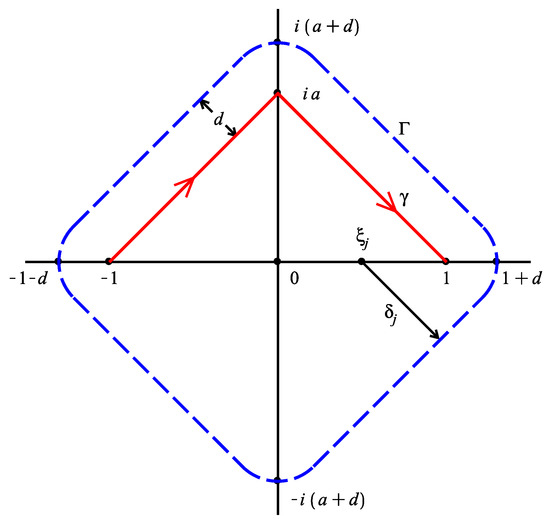
The path is shown in Figure 1. By ,
Figure 1.
The homotopy deformation of the integral path and the contour for estimation.
Moreover, , and on the path ; it is true that
Noting that with , then is an even function, so the above formula can be written as
Obviously, the length L of satisfies , in which .
Theorem 5.
Suppose Γ as it is shown in Figure 1 and that U is a region enclosed by Γ. If and the different even nodes satisfy with , then for all , it is true that
where , , .
Proof.
Theorem 6.
Suppose Γ as it is shown in Figure 1 and that U is a region enclosed by Γ. If , the different odd nodes satisfy with , and , then for all , it is true that
where , , .
4. The Nodes Related to Frequency
4.1. The Nodes of
If the right sides of the inequalities (11) and (12) are minimized, then a is a function about and n. According to the theoretical analyses and numerical experiments, there are three conclusions. First, if , then , and the even nodes are the roots of the -th Legendre orthogonal polynomial, or the odd nodes are the roots of the -th Legendre orthogonal polynomial [7,13]. Second, a increases slowly as increases. Third, a decreases as n increases.
Therefore, for simplicity, we suggest that
and for the even nodes,
where are the roots of the -th Legendre orthogonal polynomial, and for the odd nodes,
where are the roots of the -th Legendre orthogonal polynomial.
4.2. The Nodes of
Similarly to Section 4.1, we suggest that a is defined as (13). If , then , and the even nodes are the roots of the -th Jacobi orthogonal polynomial, or the odd nodes are the roots of the -th Jacobi orthogonal polynomial with the weight [7,13].
5. The Expression of Coefficients with the Bessel Function
5.1. The Coefficients
In this subsection, the coefficients in (2) will be expressed as follows.
- If the even nodes satisfy with , then
Moreover, the following moments of Fourier integrals can be expressed by the Bessel function of the first kind [20]; if , then
and
If there is no segmentation, is assumed. We will not repeat this assumption below. According to the above formulas, the coefficients in (2) are
with .
- If the odd nodes satisfy with and , then
For ,
where is defined as in (16). According to the Bessel expression of the moments of Fourier integrals, the coefficients in (2) can be expressed as
with . Meanwhile, for ,
where is the sum of the products of all elements chosen from the set , denoted as
Therefore, the coefficients in (2) are
5.2. The Coefficients
In this section, the coefficients in (3) will be expressed.
- Let the even nodes be with . The coefficients in (3) are
- Let the odd nodes be with and .
6. The Quadrature Interpolation Formulas of
On one hand, by (18), the quadrature interpolation formula (2) with even nodes can be written as
where is given as in (16).
On the other hand, by (18) and (20), the quadrature interpolation formula (2) with odd nodes can be written as
where is given as in (16) and is given as in (19).
As examples, the quadrature interpolation formulas with two, three, and four nodes are listed below.
- The quadrature formula with two nodes:
- The quadrature formula with three nodes:where
- The quadrature formula with four nodes:whereand
7. The Quadrature Interpolation Formulas of
On one hand, by (21), the quadrature interpolation formula (3) with even nodes can be written as
where is given as in (16).
On the other hand, by (22) and (23), the quadrature interpolation formula (3) with odd nodes can be written as
where is given as in (16) and is given as in (19).
As examples, the quadrature interpolation formulas with two, three, and four nodes are listed below.
- The quadrature formula with two nodes:
- The quadrature formula with three nodes:where
- The quadrature formula with four nodes:
8. The Numerical Experiments
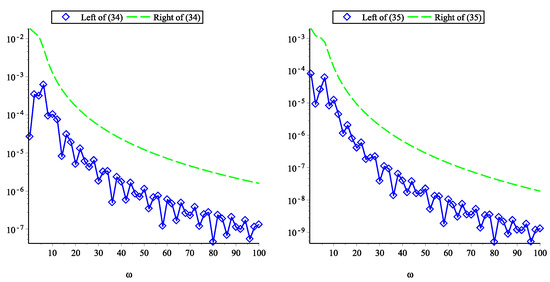
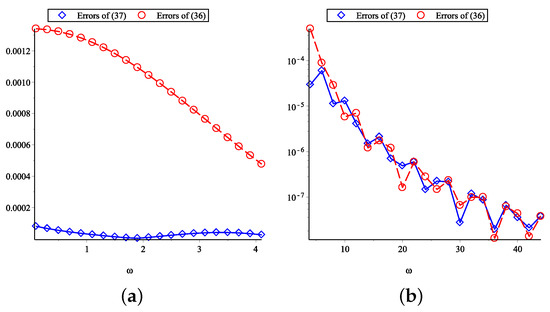
In this section, firstly, for Examples 1 and 2, we will show the real and imaginary absolute errors of and by using the quadrature interpolation formulas with two, three, and four nodes. Secondly, for Example 3, according to Theorems 5 and 6, we will give the absolute errors of and their error bounds by using the quadrature interpolation formulas with five and six nodes. Finally, for Example 4, we will compare the errors of the six-node quadrature interpolation with those of the six-order Filon-type method.
These numerical experiments will be performed in Maple 16.
Example 1.
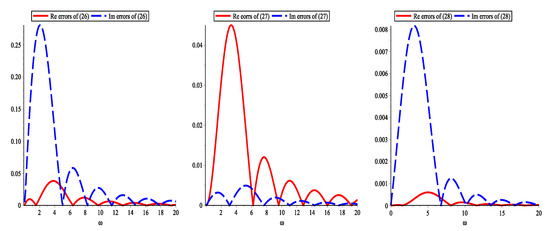
Example 2.
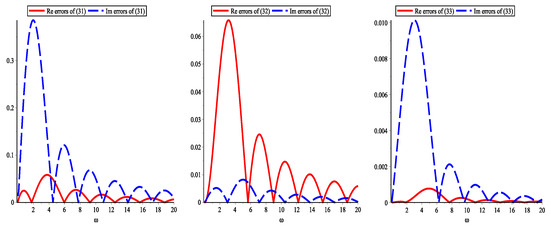
Example 3.
As shown in Figure 4, the absolute errors of the quadrature interpolation formulas on the left side of the inequalities (34) and (35) are represented by diamond points for with . In addition, when or , the right sides of (34) and (35) are taken as the error bounds, as shown by the dashed lines for with .
Example 4.
In recent years, Fourier integrals have usually been approximated with Filon-type methods [10,16]. A Filon-type method of the order can be defined as
where is the -th Hermite interpolation polynomial of satisfying
These can be expressed as Bessel expansions [20]. For , the six-order Filon-type formula is
where and .
Error comparisons between Filon-type formula (36) and the quadrature interpolation formula (37) are shown in Figure 5, where the absolute errors of (36) are represented by circular points and the those of (37) are represented by diamond points for or with . These numerical experiments show that the quadrature interpolation formula in (37) is better than the Filon-type formula (36) from a low frequency to a medium frequency, and (37) is as good as (36) from a medium frequency to a high frequency. More importantly, there are no derivatives in the quadrature interpolation formula.
9. Conclusions
In this paper, according to the error bounds established by complex analysis, we studied the quadrature interpolation formula of a Fourier integral with Jacobi symmetrical weight, where the nodes and coefficients depend on frequency. For a fixed number of nodes, the formula for changing quadrature nodes is efficient regardless of whether the frequency is low or high. It is expected that the changing quadrature nodes can be generated in other ways. We will study these in the future.
Author Contributions
Conceptualization, R.C.; methodology, R.C.; writing—original draft preparation, Y.Z.; writing—review and editing, Y.Z. All authors have read and agreed to the published version of the manuscript.
Funding
This work was supported by the Natural Science Foundation of Guangdong Province of China (No.2022A1515010419) and the Educational Commission of Guangdong Province of China (No.2020KTSCX049).
Institutional Review Board Statement
Not applicable.
Informed Consent Statement
Not applicable.
Data Availability Statement
Not applicable.
Acknowledgments
The authors are grateful for the referees’ helpful suggestions and insightful comments, which helped significantly improve the manuscript.
Conflicts of Interest
The authors declare no conflict of interest. The funders had no role in the design of study; in the collection, analysis, or interpretation of data; in the writing of the manuscript, or in the decision to publish the results.
References
- Filon, L.N.G. On a quadrature formula for trigonometric integrals. Proc. R. Soc. Edinb. 1928, 49, 38–47. [Google Scholar] [CrossRef]
- Chawla, M.M.; Jain, M.K. Asymptotic error estimates for the Gauss quadrature formula. Math. Comp. 1968, 22, 91–97. [Google Scholar] [CrossRef]
- Rabinowitz, P. Gaussian integration of functions with branch points singularities. Int. J. Comput. Math. 1968, 2, 625–638. [Google Scholar] [CrossRef]
- Piessens, R. Gaussian Quadrature Formulas for the Integration of Oscillating Functions. ZAMM 1970, 50, 698–700. [Google Scholar] [CrossRef]
- Piessens, R.; Branders, M. The evaluation and application of some modified moments. BIT Numer. Math. 1973, 13, 443–450. [Google Scholar] [CrossRef]
- Kzaz, M. Convergence acceleration of some Gaussian quadrature formula for analytic functions. Appl. Numer. Math. 1992, 10, 481–496. [Google Scholar] [CrossRef]
- Sobolev, S.L.; Vaskevich, V. The Theory of Cubature Formulas; Springer Science & Business Media: Berlin/Heidelberg, Germany, 1997; Volume 415. [Google Scholar]
- Bolinder, E.F. The Fourier integral and its applications. Proc. IEEE 2005, 51, 267. [Google Scholar] [CrossRef]
- Gradshteyn, I.S.; Ryzhik, I.M. Table of Integrals, Series, and Products, 7th ed.; Elsevier/Academic Press: Amsterdam, The Netherlands, 2007. [Google Scholar]
- Xiang, S.H. Efficient Filon-type methods for . BIT Numer. Math. 2007, 105, 633–658. [Google Scholar] [CrossRef]
- Trefethen, L.N. Is Gauss quadrature better than Clenshaw-Curtis? SIAM Rev. 2008, 50, 67–87. [Google Scholar] [CrossRef]
- Boykov, I.V.; Ventsel, E.S.; Boykova, A.I. An approximate solution of hypersingular integral equations. Appl. Numer. Math. 2010, 60, 607–628. [Google Scholar] [CrossRef]
- Brass, H.; Petras, K. Quadrature Theory: The Theory of Numerical Integration on a Compact Interval; American Mathematical Society: Providence, RI, USA, 2011. [Google Scholar]
- Xiang, S.; Bornemann, F. On the convergence rates of Gauss and Clenshaw-Curtis quadrature for functions of limited regularity. SIAM J. Numer. Anal. 2012, 50, 2581–2587. [Google Scholar] [CrossRef] [Green Version]
- He, G.; Zhang, C. On the numerical approximation for Fourier-type highly oscillatory integrals with Gauss-type quadrature rules. Appl. Math. Comp. 2017, 308, 96–104. [Google Scholar] [CrossRef]
- Deaño, A.; Huybrechs, D.; Iserles, A. Computing Highly Oscillatory Integrals; SIAM: Philadelphia, PA, USA, 2018. [Google Scholar]
- Wang, H. On the convergencerate of Clenshaw-Curtis quadrature for integrals with algebraic endpoint singularities. J. Comput. Appl. Math. 2018, 333, 87–98. [Google Scholar] [CrossRef]
- Kang, H. Efficient calculation and asymptotic expansions of many different oscillatory infinite integrals. Appl. Math. Comp. 2019, 346, 305–318. [Google Scholar] [CrossRef]
- Huybrechs, D.; Kuijlaars, A.; Lejon, N. A numerical method for oscillatory integrals with coalescing saddle points. SIAM J. Numer. Anal. 2019, 57, 2707–2729. [Google Scholar] [CrossRef] [Green Version]
- Zhou, Y.; Zhao, Z. The Bessel expansion of Fourier integral on finite interval. Symmetry 2019, 11, 607. [Google Scholar] [CrossRef] [Green Version]
- Liu, G.; Xiang, S. Clenshaw-Curtis-type quadrature rule for hypersingular integrals with highly oscilltory kernels. Appl. Math. Comput. 2019, 340, 251–267. [Google Scholar]
- Arama, A.; Xiang, S.; Khan, S. On the Convergence Rate of Clenshaw-Curtis Quadrature for Jacobi Weight Applied to Functions with Algebraic Endpoint Singularities. Symmetry 2020, 12, 716. [Google Scholar] [CrossRef]
Publisher’s Note: MDPI stays neutral with regard to jurisdictional claims in published maps and institutional affiliations. |
© 2022 by the authors. Licensee MDPI, Basel, Switzerland. This article is an open access article distributed under the terms and conditions of the Creative Commons Attribution (CC BY) license (https://creativecommons.org/licenses/by/4.0/).