Abstract
A side skirt is a planar rooted tree T, , where the root of T is a vertex of degree at least two, and all other vertices except the leaves are of degree at least three. A reduced Halin graph or a skirted graph is a plane graph , where T is a side skirt, and P is a path connecting the leaves of T in the order determined by the embedding of T. The structure of reduced Halin or skirted graphs contains both symmetry and asymmetry. For and as a path of length , we call the Cartesian product of a graph G and a path , the n-generalized prism over a graph G. We have known that the n-generalized prism over a skirted graph is Hamiltonian. To support the Bondy’s metaconjecture from 1971, we show that the n-generalized prism over a skirted graph is pancyclic.
1. Introduction
The topological structure of an interconnection network or other network can be represented by a graph. The processors can be shown as vertices or nodes, and the communication links between processors can be expressed by edges connecting two vertices together. The study of the structural properties of a network is beneficial for parallel or distributed systems. The problem of finding cycles of various lengths in networks or graphs receives much attention from researchers because this is a key measurement for evaluating the suitability of the network’s structure for its applications and more information, see [1].
Pancyclicity in graph theory refers to the problem of finding cycles of all lengths from three to its order. It was first investigated in the context of tournaments by Harary and Moser [2], Moon [3] and Alspach [4]. Bondy [5] was the first one who introduced and extended the concept of pancyclicity from directed graphs to undirected graphs. In 1971, Bondy [6] posed a metaconjecture which states that almost any nontrivial condition on a graph that implies that the graph is Hamiltonian also implies that the graph is pancyclic (there may be a simple family of exceptional graphs). There are a number of works that correspond to this metaconjecture. For instance, in 1960, Ore [7] introduced the degree sum condition which states that “for each pair of non-adjacent vertices in G, ” and showed that if G is a graph satisfying the degree sum condition, then G is Hamiltonian. Bondy [5] showed that if G is a graph satisfying the degree sum condition, then G is pancyclic or . Moreover, in terms of degree sequence of a graph, Chvátal [8] showed that if G is a graph of order with vertex degree sequence and implies , then G is Hamiltonian. Schmeichel and Hakimi [9] showed that if G satisfies such a condition introduced by Chvátal [8], then G is either pancyclic or bipartite. Recently, the concept of pancyclicity was also extended to hypergraphs, for examples, see [10,11].
Meanwhile, for the prism over a graph G, there are some Hamiltonian and pancyclicity results. For examples, Paulraja [12] proved in 1993 that if G is a 3-connected 3-regular graph, then the prism is Hamiltonian. In 2001, Goddard [13] showed that if G is a 3-connected 3-regular graph that contains a triangle, then the prism is pancyclic. In 2009, Čada et al. [14] showed that if G is a connected almost claw-free graph and is an even integer, then is Hamiltonian. They also showed that if G is a 1-pendent cactus with and is an even integer, then is vertex even pancyclic, i.e., each vertex of is contained in a cycle of each even length.
From our previous study [15], we have proven that the n-generalized prism over any skirted graph is Hamiltonian. Then, to satisfy the metaconjecture, we are interested to answer this question: Is the n-generalized prism over any skirted graph pancyclic? To find the answer, we started by investigating the n-generalized prism over three specific types of skirted graphs. These three types were introduced by Bondy and Lovász [16] in 1985. They studied the pancyclicity of a Halin graph. To show that a Halin graph is almost pancyclic, they restricted the problem to a reduced Halin graph and then showed that a reduced Halin graph H is almost pancyclic, i.e., it contains cycles of each length from three through the order of H, except, possibly, for one even value. Moreover, if it contains no cycle of even length m, then it contains a subgraph which is also a reduced Halin graph or a skirted graph of order of type I, II or III. Note that skirted graphs of these three types contain symmetric structure. However, the technique that we use to prove pancyclicity of the n-generalized prism over three such specific types of skirted graphs cannot be extended to conclude pancyclicity of the n-generalized prism over any skirted graphs that contain both symmetric and asymmetric structures. In this article, we conduct a novel technique modified from the idea of vertex pacyclicity of lexicographic product over graphs presented in [17] to prove that the n-generalized prism over any skirted graphs is pancyclic.
To study pancyclicity of the n-generalized prism over any skirted graphs, we present some definitions and preliminary knowledge in Section 2. In Section 3, we prove that the n-generalized prism over a triangle is pancyclic. In Section 4, we prove pancyclicity of the n-generalized prism over a skirted graph. Finally, conclusions and discussion about our future study are provided in Section 5.
2. Preliminaries
We consider a finite undirected simple graph. Several terminologies of graph theory presented in this article follow from West’s textbook [18]. The length of a path or a cycle is the number of its edges. A path of length is denoted by . An -path of a graph G is a path in G from s to t, denoted by . Then, denotes the reversed path of . A path in G is a spanning path if it contains all vertices of G. A cycle of G is a Hamiltonian cycle if it contains all vertices of G. A graph G is said to be Hamiltonian if it contains a Hamiltonian cycle. A graph G of order n is said to be pancyclic if it contains a cycle of each length l for . A tree is a connected graph with no cycles. A rooted tree is a tree with one vertex a chosen as its root. For each vertex u of a rooted tree with root a, let be the unique path. The parent of u is its neighbor on , the children of u are its other neighbors, the descendents of u are the vertices v of the rooted tree such that contains u, the leaves are vertices of the rooted tree having no children and the internal vertices are vertices of the rooted tree having children.
Let G and H be two graphs. The Cartesian product of graphs G and H, denoted by , is defined as a graph with the vertex set and an edge presents in the Cartesian product whenever and or symmetrically and . For and , we call a graph , the n-generalized prism over a graph G. The 2-generalized prism over a graph G is called the prism over a graph G. For convenience, the n-generalized prism over a graph G is referred to a family of the n-generalized prism over a graph G for all . If , then, for ease, we refer to the vertex u in the s-th copy of as instead of .
In a graph G and its subgraph , the contraction of H is the replacement of H by a single vertex whose incident edges are the edges other than edges in that are incident to some vertices in .
A Halin graph [16] is a plane graph , where T is a planar tree with no vertices of degree two and at least one vertex of degree at least three, and C is a cycle connecting the leaves of T in the cyclic order determined by the embedding of T.
Let x be a vertex of C and a be the neighbor of x in T. Then, the graph is called a reduced Halin graph with root a. Clearly, , where and . Note that has no vertex of degree two except possibly the vertex a. For technical reasons, Bondy and Lovász [16] regarded that a single vertex is also a reduced Halin graph.
In this study, we are interested in the pancyclicity of the Cartesian product of a reduced Halin graph or a skirted graph G and a path for . We can see that the Cartesian product is pancyclic only if the order of G is at least 2. Here, we recall that a skirted graph is isomorphic to a reduced Halin graph defined by Bondy and Lovász [16]. However, we exclude the case of a single vertex.
Before giving a definition of a skirted graph, let us introduce a definition of a side skirt as follows.
A side skirt is a planar rooted tree T, , where the root of T is a vertex of degree at least two, and all other vertices, except the leaves, are of degree at least three.
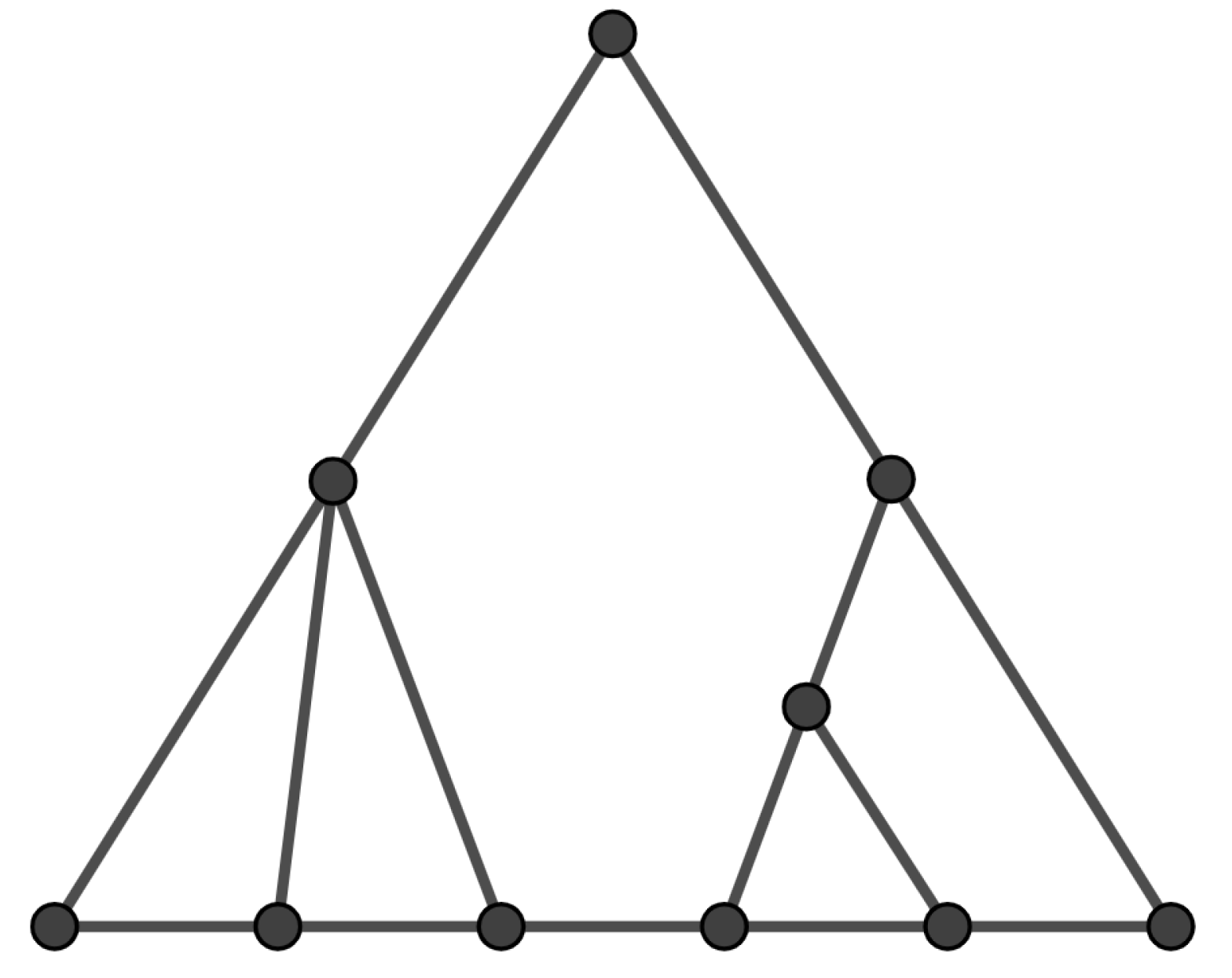
Now, a skirted graph is a plane graph , where T is a side skirt, and P is a path connecting the leaves of T in the order determined by the embedding of T (see Figure 1).
Figure 1.
A skirted graph.
Let be a skirted graph, a be the root of T and be the endpoints of P. Then, the graph G is called a skirted graph with root a and is denoted by . We notice that if u is a vertex of a side skirt T, then u and its descendents induce a skirted subgraph of G.
Since our skirted graphs are isomorphic to reduced Halin graphs defined by Bondy and Lovász [16], we obtain the following theorem and lemma from their study.
Theorem 1
([16]). A skirted graph is Hamiltonian.
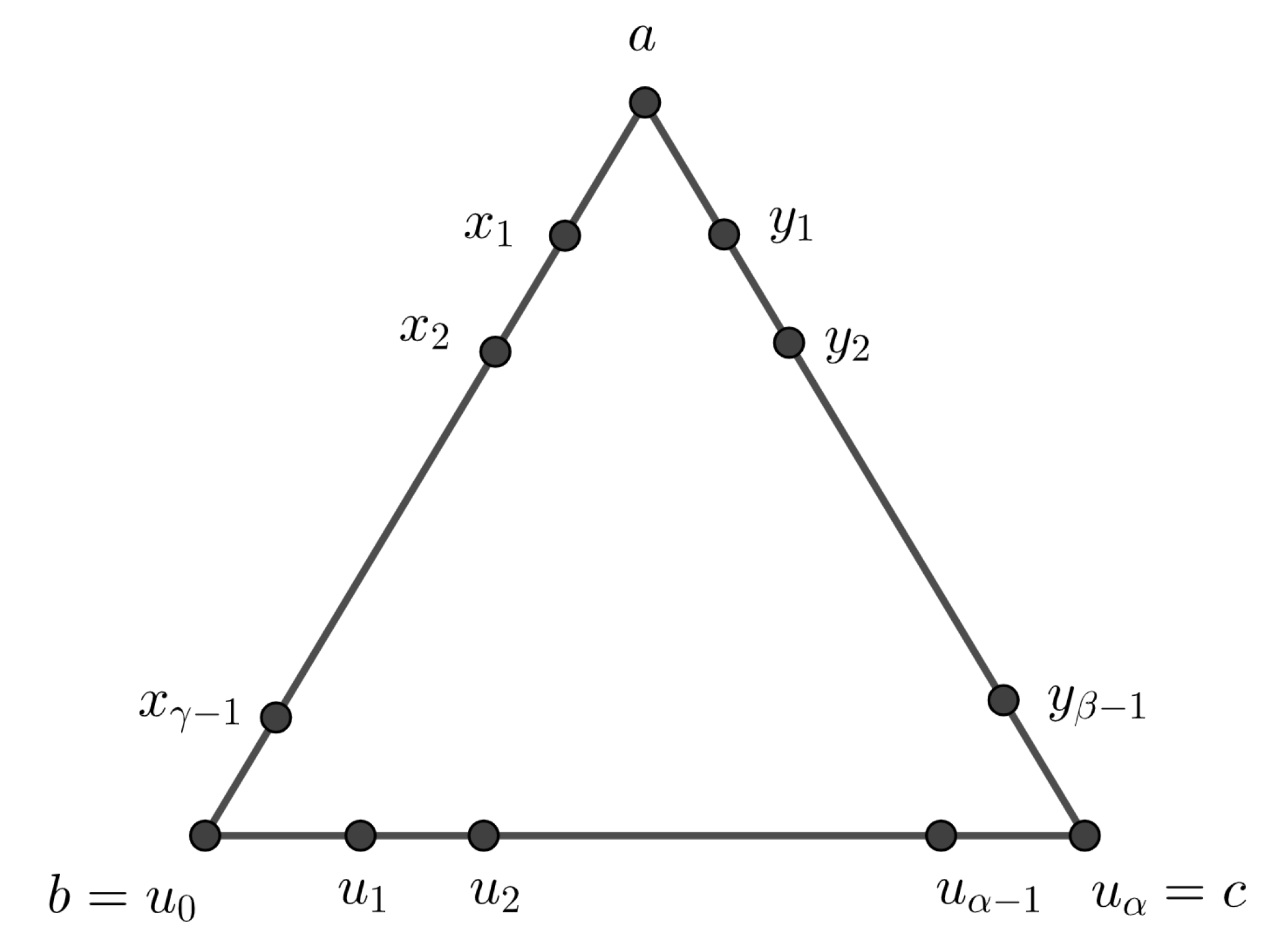
In order to mention about the Lemma 1 of [16], let us introduce some notations as follows. For any skirted graph , we denote the path P of length by , and the -path of length and the -path of length in T by and , respectively. Thus, , , and (see Figure 2).
Figure 2.
Paths , -path and -path of .
Lemma 1
([16]). Let be a reduced Halin graph or a skirted graph of order m. Then, G contains:
- (i)
- an -path of each length l for ;
- (ii)
- a -path of each length l for .
Remark 1.
We obtain that
- (i)
- Lemma 1(i) gives an -path of each length l for by the symmetry of ;
- (ii)
- To track down the path from each skirted subgraph of , a -path of length (without the root a) can be obtained by Lemma 1(ii).
From our previous study [15], we have proven the following theorem.
Theorem 2
([15]). The n-generalized prism over any skirted graphs is Hamiltonian.
Now, we notice that a skirted graph contains a cycle of length three and one of the edges of such cycle belongs to the path P as follows.
Lemma 2.
A skirted graph contains a cycle of length three, and exactly one edge of the cycle belongs to the path P.
Proof.
To prove this statement, we let . Consider the side skirt T. Since T is a finite rooted tree, there exists an internal vertex u such that all of its children are leaves of T. Since the degree of u is at least three (can be two if u is the root of T), u has at least two children. Let U be the set of all children of u. Thus, and . Let and i be the minimum index of vertices in U. Since u has at least two children and a skirted graph is a plane graph, . Thus, induces a cycle of length three in G. Moreover, this cycle has one edge and belongs to the path P. □
In general, a triangle in graph theory usually means a cycle of length three. However, in this research, we define a triangle as follows.
Definition 1.
- (i)
- Let be a skirted graph with . For and , an induced subgraph of is said to be a triangle in if u is an internal vertex of T such that all children of u are leaves of T and is the first vertex and is the last vertex in P in which and are children of u. Moreover, since a skirted graph is a plane graph, vertices between and in the path P, , are all children of u;
- (ii)
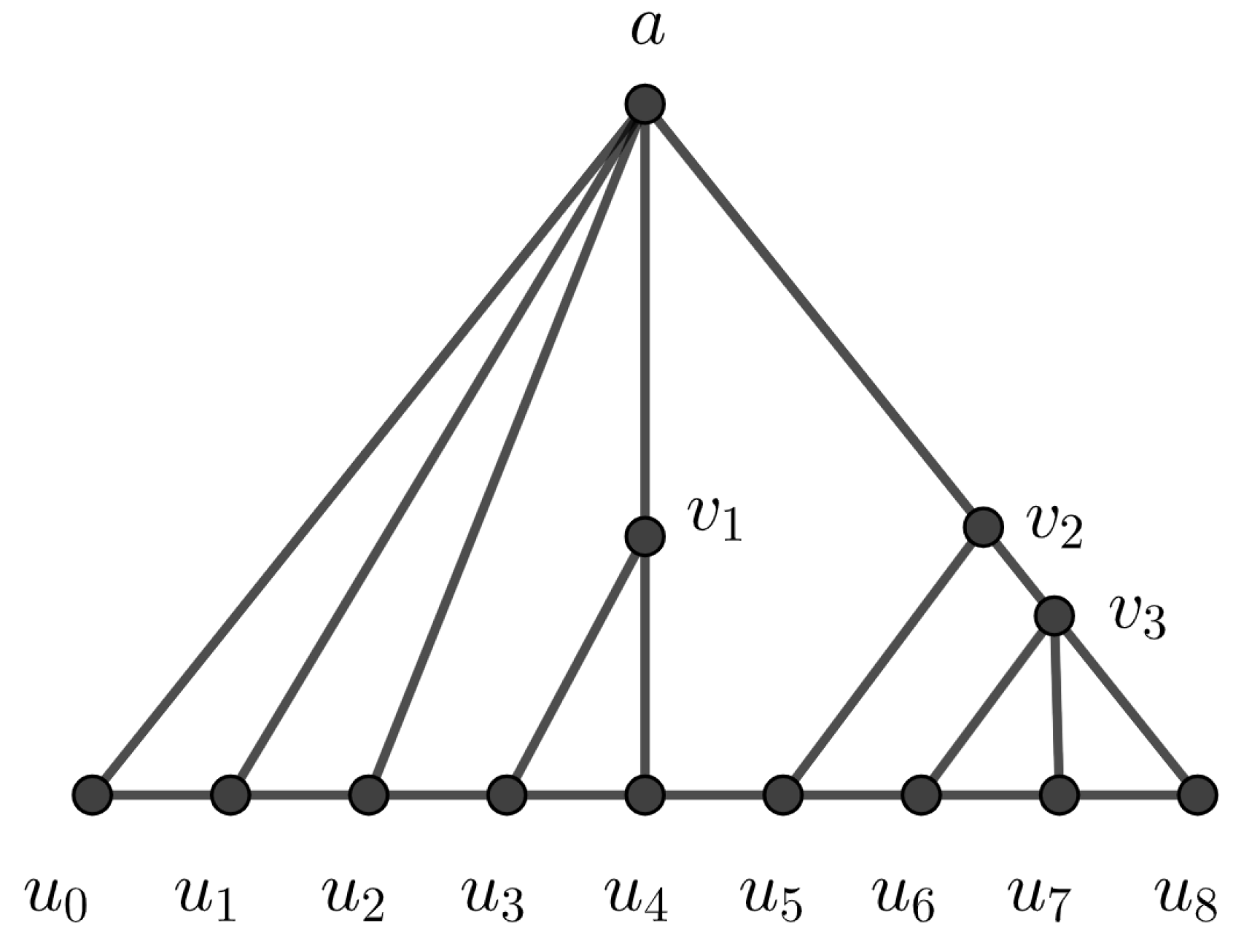
- From the triangle , if , then is called a single-triangle. Otherwise, is called a multi-triangle (see Figure 3).
Figure 3. and are a single triangle and a multi-triangle in , respectively, while is neither a single triangle nor a multi-triangle.
Observation 1.
From Definition 1, a triangle of is also a skirted graph containing the side skirt with root u and the path . Note that u has degree at least two because .
We obtain from Lemma 2 that a skirted graph G contains a cycle C of length three. Let be vertices of C in which x is an internal vertex. If another leaf neighbor of x is adjacent to either y or z, then we can extend C to be a multi-triangle. Otherwise, C is a single triangle. Therefore, a skirted graph contains a triangle.
Theorem 3.
Let be a skirted graph with . If is a simple graph obtained from a skirted graph by contracting a triangle of where . Then, is a skirted graph.
Proof.
Let be a skirted graph and be a triangle in for some and . Let be a simple graph obtained from by contracting and be the vertex of represented by the triangle , i.e., all vertices are contracted into one vertex . Since , is not a trivial graph.
Consider the side skirt T of . It can be seen that we obtain from T by deleting all children of u and then turn the internal vertex u to be a leaf of . The contraction does not affect the degree of other vertices in . Thus, is a side skirt. Now, we consider the path P of . The contraction turns the path into the path in . Since the contraction does not affect the degree of other vertices outside the triangle, all leaves of T except are still the leaves of . Thus, all vertices of are all leaves of . Since is a union , is a skirted graph. □
Note that if , if (in this case, ) and if (in this case, ). However, to prove Theorem 3, we do not care about the endpoints of the path in . Thus, we just wrote .
From Theorem 3, we already know that if is a simple graph obtained from a skirted graph by contracting a triangle of where , then, is a skirted graph. Next, we investigate the case that . By the definition of a triangle, we obtain that and . Thus, in this case, the skirted graph is a triangle. In the next section, we prove the pancyclicity results for the n-generalized prism over a triangle.
3. Pancyclicity of the n-Generalized Prism over a Triangle
To show that the n-generalized prism over a triangle is pancyclic, we need the following lemmas.
Lemma 3.
Let be a triangle of order . Then, C contains:
- (i)
- a -path of each length l for ;
- (ii)
- a -path of lengths α and .
Proof.
Let be a triangle of order and . We prove this statement by the mathematical induction on α. If , then C is a cycle of length three. It contains (i) a -path of lengths one and two and (ii) a -path of lengths one and two. Now, we suppose that the statement holds for all triangles of order less than where .
Let . Then, is a triangle subgraph of C. By the induction hypothesis, we obtain that contains (i) a -path of each length l for and (ii) a -path of lengths and α.
Since is adjacent to u in C, C contains a -path of length one. Since is adjacent to in C, we can extend a -path of length l to a -path of length . Thus, C contains (i) a -path of each length l for and (ii) a -path of lengths α and . □
Remark 2.
We obtain that
- (i)
- Lemma 3(i) gives a -path of each length l for by the symmetry of ;
- (ii)
- is a -path of length α (without the vertex u) in .
The following lemma is an immediate observation about the pancyclicity of the prism over a triangle.
Lemma 4.
The prism over a triangle is pancyclic.
Proof.
Let and be a triangle of length . For , the s-th copy of C contains a -path of each length l for by Lemma 3(i). We link each -path and -path (maybe of different sizes) together with edges and . We obtain a cycle of each length l for . Since C contains a cycle of length 3, is pancyclic. □
By using Lemma 4 as a basic step, we can use the mathematical induction to establish the following result.
Theorem 4.
The n-generalized prism over a triangle is pancyclic.
Proof.
Let and be a triangle of order and be a path of order . We prove that is pancyclic by the mathematical induction on n. The basic step is already taken by Lemma 4. For , suppose that is pancyclic. Since is a subgraph of , contains a cycle of each length l for . We shall find a cycle of each length l for .
To show that contains a cycle of such lengths, we give the following paths and link them together with edges joining each copy of C.
- The first copy and the last copy of C contain paths and , respectively, of each length l for by Lemma 3(i). Also, for the last copy of C, a path of each length l for exists by the symmetry of C in Remark 2(i);
- The remaining copies of G contain the path of length α (without the root ) for , which exists by Remark 2(ii);
- The path of length is a path in from the last copy to the first copy of C.
Now, we link each path (maybe of different sizes) by edge when s is odd and by edge when s is even. We obtain a cycle of each length l for . Since for all , contains a cycle of each length l for . Therefore, is pancyclic. □

4. Pancyclicity of the n-Generalized Prism over a Skirted Graph
To show that the n-generalized prism over a skirted graph is pancyclic, we first establish the preliminary results of even cycles in the n-generalized prism over a skirted graph. Note that since a skirted graph is traceable, we investigate the n-generalized prism over a path instead of the n-generalized prism over a skirted graph as follows.
4.1. Even Cycles in the n-Generalized Prism over a Path
Let be an even integer and , we need the following lemma to prove that contains a cycle of each even length l where l is an even integer ranging from 4 to .
Lemma 5.
Suppose that . Then, the prism over contains a cycle of each length l where l is an even integer ranging from 4 to . Moreover, if , then the edges and of the first copy and the second copy of , respectively, are contained in a cycle of each even length l for .
Proof.
Let . We define a sequence of cycles in as follows.
The length of each cycle in the sequence increases as an arithmetic sequence with the common difference two. Then, the last cycle
of this sequence has length . Since the first cycle is a cycle of length 4, the lengths of the cycles are even integers ranging from 4 to . Moreover, and are edges contained in all even cycles. □
Observation 2.
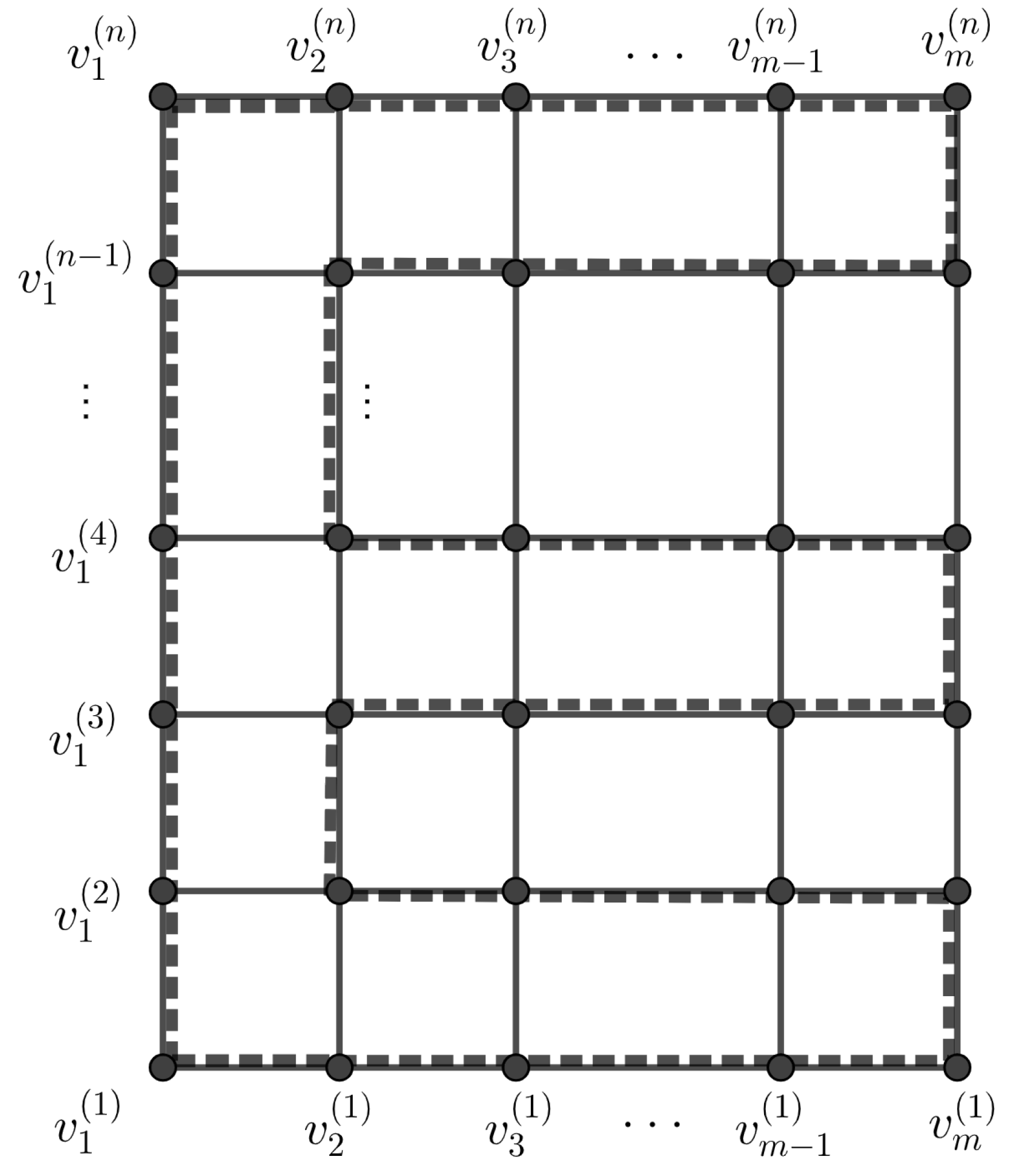
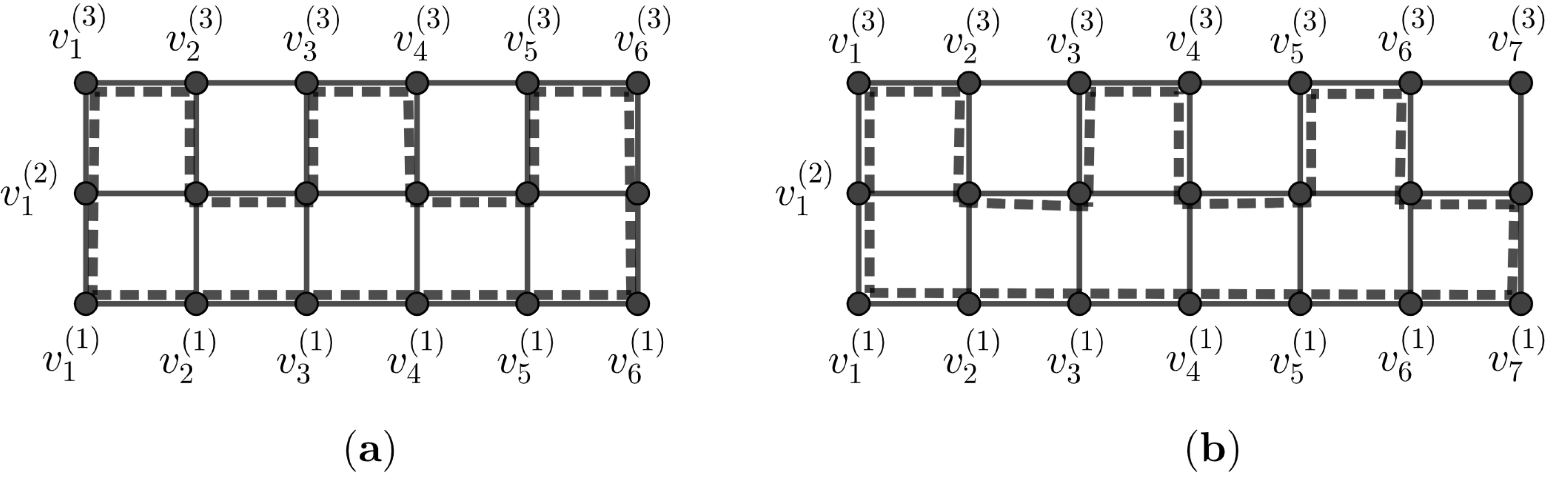
For is an even integer and , if , then the edges and of the first copy and the last copy of , respectively, are contained in a cycle of length (see Figure 4).
Figure 4.
The dashed line represents a spanning cycle of length containing edges and .
By using Lemma 5 as a basic step, we can use mathematical induction to establish the following result.
Lemma 6.
Suppose that is an even integer, and . Then, the n-generalized prism over contains a cycle of each length l, where l is an even integer ranging from four to . Moreover, if , then the edge of the first copy of is contained in a cycle of each even length l for .
Proof.
Let , where , and for some positive integer k. We prove by the mathematical induction on k. The basic step is already done by Lemma 5. For , suppose that contains a cycle of each even length l, where l is an even integer ranging from 4 to . We shall find an even cycle of each length l for .
Here, let us regard as a subgraph of induced by the set of all vertices of the first copies of . By Observation 2, there is a cycle of length in containing the edges and .
Now, we consider the last two copies of . The vertices of these two copies induce a subgraph of . By Lemma 5, an edge is contained in a cycle of each even length l for in . Since and are edges of , we delete edges and and then join to and to , respectively. Then, can be extended to a cycle of each even length l for .
Moreover, since the cycle contains edge and the extension of does not affect the edge , it is contained in a cycle of each even length l for . □
By Lemma 6, contains an even cycle of each length l for when n is even. Next, to investigate the case that n is odd, we first examine the case that as follows.
Lemma 7.
Suppose that . Then, the three-generalized prism over contains a cycle of each length l, where l is an even integer ranging from 4 to . Moreover, if , then the edge of the first copy of is contained in:
- (i)
- a cycle of each even length l for if m is even;
- (ii)
- a cycle of each even length l for if m is odd.
Proof.
Let and . Here, let us regard as a subgraph of induced by vertices of the first two copies of . By Lemma 5 and is a subgraph of , contains a cycle of each length l, where l is an even integer ranging from 4 to and the edge of the first copy of is contained in a cycle of each length l, where l is an even integer ranging from 4 to . We shall find even cycles of each length l for . By Lemma 5, contains a cycle
of length in which it contains .
Now, we consider the second and the third copies of . For an odd integer j such that , there is a path of length 3 in .
Since and have not been contained in for all odd integers j, we replace each edge with each path . Then, can be extended to a cycle of each even length l for . Since this extension does not change anything in the first copy of , the extended cycle still contains the edge .
Moreover, we can see that (i) if m is even, then is contained in a cycle of each even length l for ( is even); (ii) if m is odd, then is contained in a cycle of each even length l for ( is odd). □
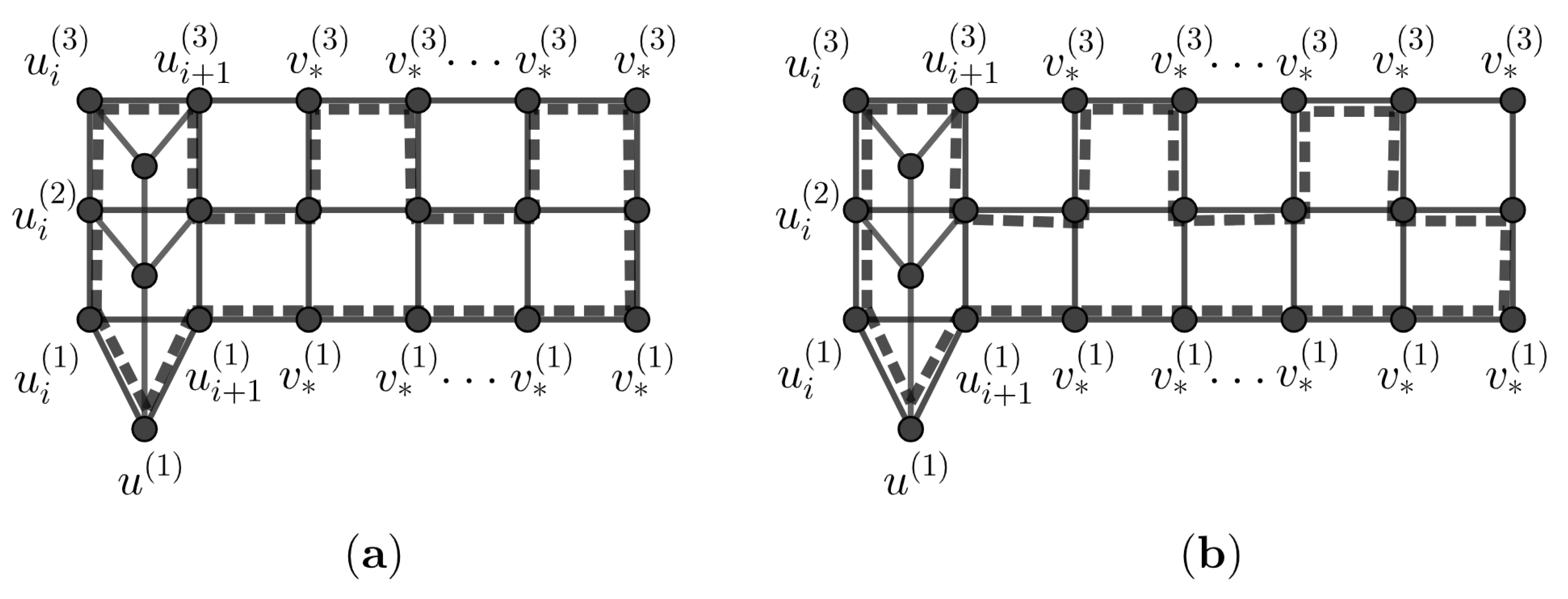
Figure 5 shows examples of cycles of length 18 and 20 in and , respectively.
Figure 5.
(a) The dashed line represents a cycle of length 18 in ; (b) The dashed line represents a cycle of length 20 in .
Remark 3.
From the proof of Lemma 7, we obtain the cycles of length when m is even and when m is odd. We notice that, apart from edge , these two cycles also contain edges and when .
4.2. Our Main Results
To show that the n-generalized prism over any skirted graphs is pancyclic, we start by providing some observations and investigating the pancyclicity of the prism over a skirted graph. The pancyclicity of the three-generalized prism over a skirted graph is as follows.
Observation 3.
Let , , and be a skirted graph of order m with and be a triangle of order t in such that . Let be a skirted graph of order obtained from a skirted graph by contracting the triangle C and be the vertex of represented the triangle C. By Theorem 1, is Hamiltonian. Let be a spanning cycle in . Then, there is a spanning path in .
Since is the vertex of represented by the triangle C and is adjacent to , is adjacent to either u, or in . Let .
- If , then is a path of length (without the vertex u) in G;
- If , then is a path of length (without the vertex ) in G.
Theorem 5.
The prism over any skirted graphs is pancyclic.
Proof.
First, we consider a single skirted graph. Let be a skirted graph of order m with . Let be a triangle of order t in , where . If , then G itself is a triangle. By Theorem 4, the prism over G is pancyclic. Now, we assume that .
Let be a skirted graph of order obtained from a skirted graph G by contracting the triangle C and be the vertex of represented by the triangle C. By Theorem 1, is Hamiltonian. Let be a spanning cycle in . Then, is a spanning path in .
Since is the vertex of represented by the triangle C and is adjacent to , is adjacent to either u, or . By Observation 3, without loss of generality, let be adjacent to . Then, is a path of length (without the vertex u) in G. Note that if C is a single-triangle.
Now, consider prism over a skirted graph which contains the first and the second copies of the same skirted graph. By Lemma 2, contains a cycle of each even length l for in which it contains the edge . Since is a subgraph of , the prism over G contains a cycle of each even length l for .
We shall find a cycle of each odd length l for . Since is a path of length two in the first copy of and is not contained in , we replace edge with the path P. Then, can be extended to a cycle of length . Since , we obtain a cycle of each odd length l for .
Since G contains a cycle of length three, the prism over G also contains a cycle of length three. By Theorem 2, the prism over G is Hamiltonian, i.e., it contains a cycle of length . Therefore, the prism over G is pancyclic. □
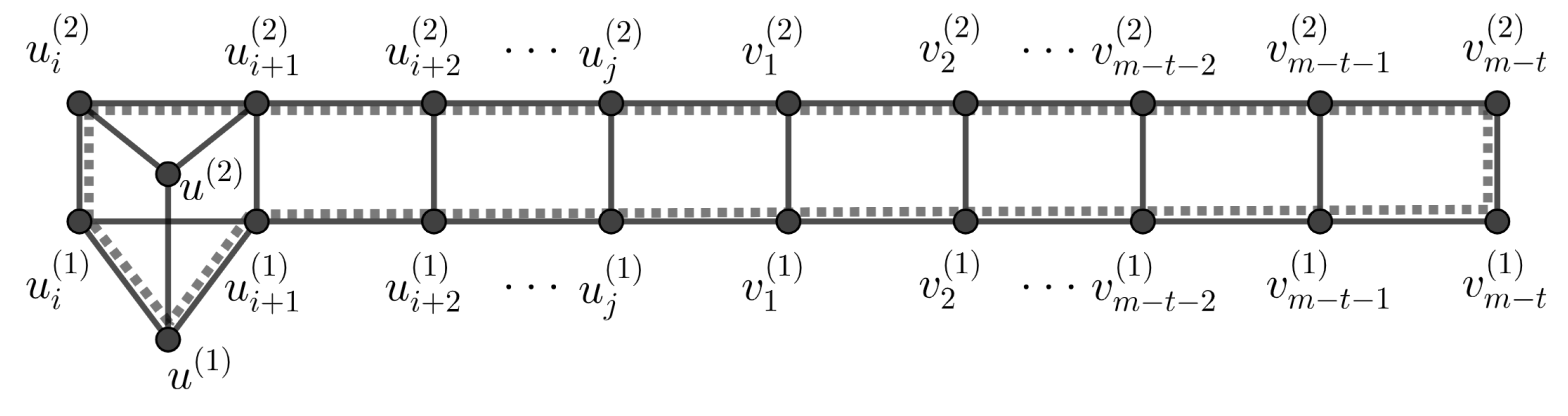
Remark 4.
From the proof of Theorem 5, the edge of the second copy of is contained in an odd cycle of length (see Figure 6).
Figure 6.
The dashed line represents a cycle of length in containing edge , where G is a skirted graph in Theorem 5.
Next, we consider the pancyclicity of the three-generalized prism over a skirted graph.
Theorem 6.
The three-generalized prism over a skirted graph is pancyclic.
Proof.
First, we consider a single skirted graph. Let be a skirted graph of order m with . Let be a triangle of order t in , where . If , then G itself is a triangle. By Theorem 4, is pancyclic. Now, we assume that .
Let be a skirted graph of order obtained from a skirted graph G by contracting the triangle C and be the vertex of represented the triangle C. By Theorem 1, is Hamiltonian. Let be a spanning cycle in . Then, we let be a spanning path in .
Since is the vertex of represented by the triangle C and is adjacent to , is adjacent to either u, or . By Observation 3, without loss of generality, let be adjacent to . Then, is a path of length (without the vertex u) in G. Note that if C is a single triangle.
Now, consider the three-generalized prism over a skirted graph which contains three copies of the same skirted graph. Since is a subgraph of , we show that is pancyclic by applying Lemma 7. Then, we consider two cases as follows.
Case 1. Here is even. By Lemma 7(i), contains a cycle of each even length l for in which it contains the edge . Note that, for all , vertex has not been contained in . To find an odd cycle, we replace of such cycles with a path and then obtain a cycle of each odd length l for . Let be the cycle of length without the vertex (see Figure 7a). By Remark 3, contains the edge . Then, we replace of with a path and then obtain a cycle of length . Thus, we obtain that contains a cycle of each length l for all .
Figure 7.
(a) The dashed line represents a cycle of length in when is even; (b) The dashed line represents a cycle of length in when is odd.
Case 2. Here is odd. By Lemma 7(ii), contains a cycle of each even length l for in which it contains edge . Note that, for all , vertex has not been contained in . To find an odd cycle, we replace of such cycles with a path and then obtain a cycle of each odd length l for . Let be the cycle of length without vertex (see Figure 7b). By Remark 3, contains edge . Thus, we replace of with a path and then obtain a cycle of length . Therefore, contains a cycle of each length l for all .
We shall find a cycle of length in . Recall that is a triangle of order t in such that . To show that contains a cycle of length , we give the following paths and link them together with edges joining each copy of G.
- For the first copy of G, we consider subgraph . If , then . Note that since . Then, . Since is a skirted graph, by Lemma 1, contains an -path of length . Suppose that is adjacent to in . Then, is adjacent to either u or in G. We consider two cases as follows.
- -
- If is adjacent to u, then is a path of length (without the vertex );
- -
- If is adjacent to , then is a path of length (without the vertex u).
Therefore, we can extend the path of length in to be a path of length in G by replacing the edge of with the path . Suppose that . Then, . Since is a skirted graph, by Lemma 1, contains an -path of length . Since is a spanning path in , contains the vertex . Suppose that and are adjacent to in . Then, each of and is adjacent to either or in G. We consider three cases as follows.- -
- If , then is a path of length t (without the vertex u);
- -
- If , then is a path of length t (without the vertex );
- -
- If , then is a path of length t (without the vertex ).
Therefore, we can extend the path of length in to be a path of length in G by replacing the path in with the path . Thus, the first copy of G contains a path of length ; - By Remark 1(ii), the second copy of G contains a -path of length (without the root );
- By Remark 1(i), the last copy of G contains an -path of length ;
- The path of length 2 is a path in from the last copy to the first copy of G.
Now, we link each path by edges and . The cycle of length is
Therefore, contains a cycle of length .
From these two cases, we obtain that contains a cycle of each length l for all . Since G is a skirted graph, by Lemma 2, G contains a cycle of length three. By Theorem 2, is Hamiltonian, i.e., it contains a cycle of length . Therefore, is pancyclic. □
By the proof of Theorem 6, the pancyclicity of the three-generalized prism over a skirted graph, we need to consider the special case. However, there is no special case when we show that is pancyclic for . Therefore, we prove the following theorem by considering .
Theorem 7.
The n-generalized prism over any skirted graphs is pancyclic.
Proof.
First, we consider a single skirted graph. Let be a skirted graph of order m with . Let be a path of order . If or 3, then we respectively obtain from Theorems 5 and 6 that is pancyclic. Suppose now that .
Let be a triangle of order t in , where . If , then G itself is a triangle. By Theorem 4, the n-generalized prism over G is pancyclic. Now, we assume that .
Let be a skirted graph of order obtained from a skirted graph G by contracting the triangle C and be the vertex of represented by the triangle C. By Theorem 1, is Hamiltonian. Let be a spanning cycle in . Then, is a spanning path in .
Since is the vertex of represented by the triangle C and is adjacent to , is adjacent to either u, or . By Observation 3, without loss of generality, let be adjacent to . Then, is a path of length (without the vertex u) in G. Note that if C is a single triangle.
Now, consider the n-generalized prism over a skirted graph which contains n copies of the same skirted graph. Since , is a path of length in G, i.e., is a spanning path in G. We can see that is a subgraph of .
To show that is pancyclic, we consider two cases as follows.
Case 1. Here n is even.
By Lemma 6, contains a cycle of each even length l for . Since is a subgraph of , contains a cycle of each even length l for . We shall find a cycle of each odd length in by considering two disjoint-induced subgraphs and of , where is induced by the first two copies of G and is induced by the last copies of G.
First, we consider . By Theorem 5, contains a cycle of each length l for . Since is a subgraph of , we obtain that contains a cycle of each length l for . Let be the cycle of length in containing edge , which exists by Remark 4.
Next, we consider subgraph induced by the last copies of G, in order to show that contains a cycle of each odd length l for . Since is a subgraph of , we can consider cycles in instead of . Since is even, by Lemma 6 and the reverse of the path , the edge is contained in a cycle of each length l, where l is an even integer ranging from 4 to in . Since , we delete the edge of and then join to and to . Then, we can extend to be a cycle of length . In addition, we delete the edge of each cycle of each length l in and then join to and to . Then, we can extend to be a cycle of each length l for . Therefore, is pancyclic.
Case 2. Here n is odd. Since is even, by Case 1, contains a cycle of each length l for . Thus, we consider two disjoint-induced subgraph and of , where is induced by the first copies of G and is induced by the last three copies of G.
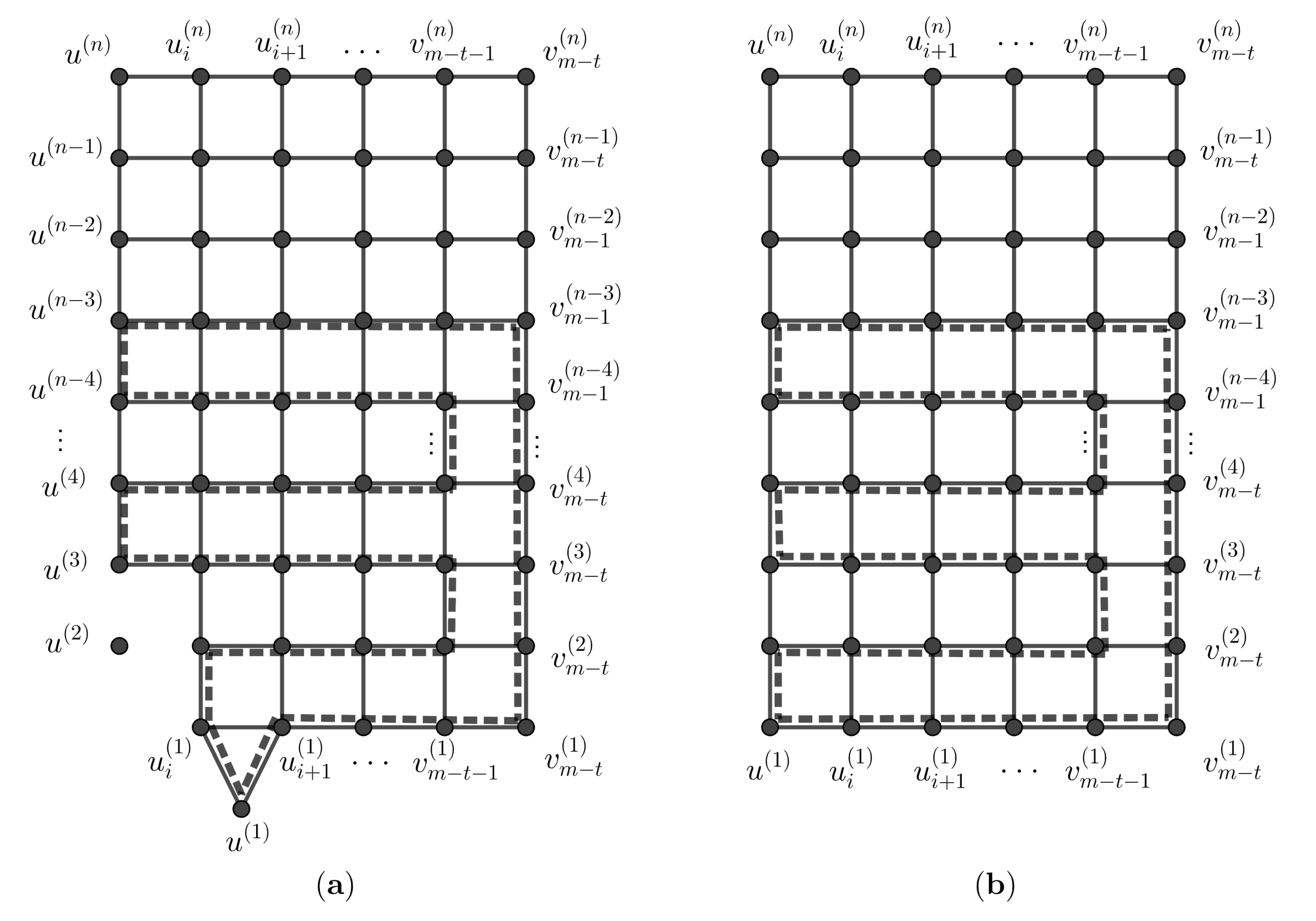
We shall find a cycle of each remaining length l for . Recall that G is a skirted graph of order m and is a spanning path in G. Then, is a subgraph of . Let be the cycle of odd length in containing the edge (see Figure 8a) and be the cycle of even length in containing the edge (see Figure 8b).
Figure 8.
(a) The dashed line represents of length ; (b) The dashed line represents of length .
Consider . Since is a spanning path in G, we can apply Lemma 7 as follows.
- If m is even, then contains a cycle of each even length l for containing edge by Lemma 7(i). We delete the edge of and the edge of each cycle of each length l in and then join to and to . Thus, we can extend of length to be a cycle of each odd length l for and extend of length to be a cycle of each even length l for in a similar way. Thus, contains a cycle of each length l for .
- If m is odd, then contains a cycle of each even length l for containing edge by Lemma 7(ii). We delete the edge of and the edge of each cycle of each length l in and then join to and to . Thus, we can extend of length to be a cycle of each odd length l for and extend of length to be a cycle of each even length l for in a similar way. Since is Hamiltonian, it contains a cycle of length . Thus, contains a cycle of each length l for .
Therefore, is pancyclic. □

5. Conclusions and Discussion
In this paper, we prove that the n-generalized prism over skirted graphs is pancyclic. The result holds for any skirted graph, even though we have not known the exact configuration of this family of graphs. Moreover, since the Cartesian product of a graph over a path is a subgraph of the Cartesian product of the graph over a cycle and the Cartesian product of the graph over a complete graph , the results can be concluded in the similar way when is replaced by or for . However, we have not investigated panconnectivity of the n-generalized prism over any skirted graph, which is a stronger concept than pancyclicity. For a definition of panconnectivity, we can see, for examples, [1,19,20]. Therefore, it is recommended that further studies can investigate panconnectivity of the n-generalized prism over any skirted graph.
Author Contributions
Conceptualization, A.M., R.B. and S.S.; methodology, A.M., R.B. and S.S.; validation, A.M., R.B. and S.S.; formal analysis, A.M.; investigation, A.M.; resources, A.M.; writing—original draft preparation, A.M.; writing—review and editing, R.B. and S.S.; visualization, A.M.; supervision, R.B. and S.S.; project administration, R.B. and S.S.; funding acquisition, A.M. All authors have read and agreed to the published version of the manuscript.
Funding
This research received no external funding.
Institutional Review Board Statement
Not applicable.
Informed Consent Statement
Not applicable.
Data Availability Statement
Not applicable.
Acknowledgments
The research of the first author was in part supported by the Science Achievement Scholarship of Thailand.
Conflicts of Interest
The authors declare no conflict of interest.
References
- Xu, J.-M.; Ma, M.-J. Survey on Path and Cycle Embedding in Some Networks. Front. Math. China 2009, 4, 217–252. [Google Scholar] [CrossRef]
- Harary, F.; Moser, L. The Theory of Round Robin Tournaments. Am. Math. Mon. 1966, 73, 231–246. [Google Scholar] [CrossRef]
- Moon, J.W. On Subtournaments of a Tournament. Can. Math. Bull. 1966, 9, 297–301. [Google Scholar] [CrossRef]
- Alspach, B. Cycles of Each Length in Regular Tournaments. Can. Math. Bull. 1967, 10, 283–286. [Google Scholar] [CrossRef]
- Bondy, J.A. Pancyclic Graphs I. J. Comb. Theory Ser. B 1971, 11, 80–84. [Google Scholar] [CrossRef]
- Bondy, J.A. Pancyclic Graph. In Proceedings of the Second Louisiana Conference on Combinatorics, Graph Theory and Computing, Baton Rouge, LA, USA, 8–11 March 1971; pp. 167–172. [Google Scholar]
- Ore, O. Note on Hamilton Circuits. Am. Math. Mon. 1960, 67, 55. [Google Scholar] [CrossRef]
- Chvátal, V. On Hamilton’s Ideals. J. Comb. Theory Ser. B 1972, 12, 163–168. [Google Scholar] [CrossRef]
- Schmeichel, E.F.; Hakimi, S.L. Pancyclic Graphs and a Conjecture of Bondy and Chvátal. J. Comb. Theory Ser. B 1974, 17, 22–34. [Google Scholar] [CrossRef][Green Version]
- Guo, Y.; Surmacs, M. Pancyclic Arcs in Hamiltonian Cycles of Hypertournaments. J. Korean Math. Soc. 2014, 51, 1141–1154. [Google Scholar] [CrossRef]
- Kostochka, A.; Luo, R.; Zirlin, D. Super-Pancyclic Hypergraphs and Bipartite Graphs. J. Comb. Theory Ser. B 2020, 145, 450–465. [Google Scholar] [CrossRef]
- Paulraja, P. A Characterization of Hamiltonian Prisms. J. Graph Theory 1993, 17, 161–171. [Google Scholar] [CrossRef]
- Goddard, W.; Henning, M.A. Pancyclicity of The Prism. Discret. Math. 2001, 234, 139–142. [Google Scholar] [CrossRef]
- Čada, R.; Flandrin, E.; Li, H. Hamiltonicity and Pancyclicity of Cartesian Products of Graphs. Discret. Math. 2009, 309, 6337–6343. [Google Scholar] [CrossRef]
- Muaengwaeng, A.; Boonklurb, R.; Singhun, S. Pancyclicity of Generalized Prisms over Specific Types of Skirted Graphs. Thai J. Math. 2022, accepted. [Google Scholar]
- Bondy, J.A.; Lovász, L. Lengths of Cycles in Halin Graphs. J. Graph Theory 1985, 9, 397–410. [Google Scholar] [CrossRef]
- Muaengwaeng, A.; Boonklurb, R.; Singhun, S. Vertex Pancyclicity over Lexicographic Products. AKCE Int. J. Graphs Comb. 2022, accepted. [Google Scholar] [CrossRef]
- West, D.B. Introduction to Graph Theory, 2nd ed.; Pearson Education: Hoboken, NJ, USA, 2000. [Google Scholar]
- Chia, G.L.; Hemakul, W.; Singhun, S. Graphs with Cyclomatic Number Three Having Panconnected Square. Discret. Math. Algorithms Appl. 2017, 9, 1750067. [Google Scholar] [CrossRef]
- Chia, G.L.; Hemakul, W.; Singhun, S. Graphs with Cyclomatic Number Three Having Panconnected Square, II. AKCE Int. J. Graphs Comb. 2020, 17, 911–914. [Google Scholar] [CrossRef]
Publisher’s Note: MDPI stays neutral with regard to jurisdictional claims in published maps and institutional affiliations. |
© 2022 by the authors. Licensee MDPI, Basel, Switzerland. This article is an open access article distributed under the terms and conditions of the Creative Commons Attribution (CC BY) license (https://creativecommons.org/licenses/by/4.0/).