


Abstract
Singularity theory is a significant field of modern mathematical research. The main goal in most problems of singularity theory is to understand the dependence of some objects in analysis and geometry, or physics; or from some other science on parameters. In this paper, we study the singularities of the spherical indicatrix and evolute of space-like ruled surface with space-like ruling. The main method takes advantage of the classical unfolding theorem in singularity theory, which is a classical method to study singularity problems in Euclidean space and Minkowski space. Finally, we provide an example to illustrate our results.
MSC:
53A05; 53A25; 58A05
1. Introduction
Ruled surfaces have the most important positions and applications in the study of design problems in spatial mechanisms and physics, kinematics, and computer-aided design (CAD). Therefore, these surfaces are one of the most important topics of surface theory. Because of this position of ruled surfaces, many geometers and engineers have investigated and obtained many properties of the ruled surfaces. There exists a vast literature on the subject including several monographs (see for instance, [1,2,3,4,5]). Furthermore, the differential geometry of ruled surfaces in Minkowski space is much more complicated than the Euclidean case, since the Lorentzian metric is not a positive definite metric, the distance function can be positive, negative, or zero, whereas the distance function in Euclidean space can only be positive. For instance, a continuously moving timelike line along a curve generates a timelike ruled surface. Turgut and Hacısalihoğlu have studied timelike ruled surfaces in Minkowski 3-space and they have given some properties of these surfaces [6]. Timelike ruled surfaces with timelike rulings have been studied by Abdel-All et al. [7]. Küçük has obtained some results on the developable timelike ruled surfaces in the same space [8]. Furthermore, Uğurlu and Onder introduced Frenet frames and Frenet invariants of timelike ruled surfaces in Minkowski three-space [9].
One of the main techniques for applying the singularity theory to Euclidean differential geometry is to consider the distance squared function and the height function on a submanifold of [10,11,12]. In this paper, we focus on the geometric analysis and the singularity of the spherical indicatrix and evolute of spacelike ruled surface with spacelike ruling. Finally, we provide an example to support our obtained results. There are some articles concerning singularity theory and submanifolds for several types of geometry. In the next work, we will combine the main results in this paper with the methods and techniques of singularity theory and submanifolds theory, etc., presented in [13,14,15,16,17,18,19,20,21,22] to explore new results and theorems related with more symmetric properties about this topic.
2. Basic Concepts
To meet the requirements in the next sections, here, the basic elements of the theory of curves in the Minkowski 3-space are briefly presented. There exists a vast literature on the subject, including several monographs (see for example [1,5]).
Let be the three-dimensional Minkowski space, that is, the three-dimensional real vector space with the following metric:
where denotes the canonical coordinates in . An arbitrary vector of is said to be spacelike if 0 or = , timelike if 0, and lightlike or null if and . A timelike or light-like vector in is said to be causal. For , the norm is defined by then, the vector is called a spacelike unit vector if and a timelike unit vector if . Similarly, a regular curve in can locally be spacelike, timelike, or null (lightlike), if all of its velocity vectors are spacelike, timelike, or null (lightlike), respectively. For any two vectors and of , the inner product is the real number and the vector product is defined by the following.
The hyperbolic and Lorentzian (de Sitter space) unit spheres are as follows, respectively.
Definition 1.
Let and in be two non-null vectors.
- Assume that and are spacelike vectors, then we have the following:
- If they span a spacelike plane, there is s a unique real number such that . This number is called the spacelike angle between the vectors and .
- If they span a timelike plane. there is s a unique real number such that , where or according to or , respectively. This number is called the central angle between the vectors and .
- Let us assume that and are timelike vectors, then there is a unique real number such that , where or according to and have different time-orientation or the same time-orientation, respectively. This number is called the Lorentzian timelike angle between vectors and .
- Let us assume that is spacelike and is timelike, then there is a unique real number such that , where or according to or . This number is called the Lorentzian timelike angle between vectors and .
Let be a unit speed non-null curve in , and it has a spacelike or timelike rectifying plane. The and denote the natural curvature and torsion of , respectively. Then, is called if and . Consider the Serret–Frenet frame , is associated with curve , then the Serret–Frenet formulae are read as follows [7,8,9]:
where , . Here, “prime” denotes the derivative with respect to the arc length parameter s. Now, on the base of the different values of , , and , we provide three detailed classifications for :
- is a timelike curve if ;
- is called the first kind of spacelike curve ;
- is called the second kind of spacelike curve .
Furthermore, if is a spherical curve in , by a translation in if necessary, we may assume the following:
where a is a constant. Without a loss of generality, we assume that . Then, we define the following unit vector.
It is easy to see that , , and form an orthonormal basis along curve . Here, it is convenient to assume , 1 and . Hence, Equation (4) yields the following.
Since , and form an orthonormal basis along curve , we call , the spherical Blaschke frame of the spherical curve . By a direct computation, we conclude that there exists a function satisfying the following.
Moreover, we call the spherical (geodesic) curvature function of spherical curve . The following can be shown.
It is obvious that is the curvature axis or evolute of the spherical curve . In fact, it is important to consider the relations between the spherical curvature (s) and the curvature (s), as well as the torsion (s) of . Therefore, from Equations (3) and (6), we have the following.
By computing the inner products with both sides of the above equation, respectively, we obtain the following.
Differentiating both sides of Equation (10), we can directly generate the following.
Since the following is the case:
the above equation provides the following.
Similarly, by computing the inner products with both sides of Equation (12), we obtain the following.
On the other hand, let us consider a circle on , which is described by the following equation:
where c is a real constant, and is a fixed spacelike unit vector that determines the circle’s center. This means that is a great circle if , and a small circle if , respectively. Then, we have the following.
Proposition 1.
Let be a unit speed timelike curve. Then, is a part of if and only if .
Proof.
Suppose that . By the Blaschke formula (4), we have as a constant unit vector. We consider a function defined by . Then, we have the following.
Therefore, f is identically equal to 0, and .
Conversely, assume that there exists such that . Then, function f as above is identically equal to zero. It follows that f. Thus, the following is the case.
Since , we have . the following is the case.
Since , we have . Then, , which contradicts the fact that . Thus, for any . □
Corollary 1.
Let be a unit speed timelike curve. Then, if and only if is a part of .
Proof.
For the first differential of , we obtain the following.
Then, if and only if . From Equation (14), we can figure out that yields and that and are constant directly, which implies that is a part of the small circle for which its center is . □
3. Spacelike Ruled Surface with Spacelike Ruling
A spacelike ruled surface in Minkowski 3-space can be written as follows:
with the following being the case.
Here, is a spacelike curve and is a unit vector moving a long . In this case, the curve is the striction curve, and parameter s is the arc length of spherical image or indicatrix . Generally, we call such an expression the standard equation of the non-developable spacelike ruled surfaces with spacelike ruling in Minkowski 3-space . Here, we will take notation . Since , it is reasonable to assume the following.
The functions , , and are called the curvature functions or construction parameters of the ruled surface. The geometrical meanings of these invariants are explained as follows: is the geodesic curvature of the spherical image curve ; describes the angle between the tangent of the striction curve and the ruling of the surface; and is the distribution parameter of the ruled surface M at the ruling .
3.1. Lorentzian Height Functions
In this subsection, we introduce a family of functions that is useful for the study of geometric invariants of timelike spherical curve in . For this purpose, similarly to the books in [10,12], the spacelike fixed unit vector of will be said to be a evolute of the timelike curve in at if for all i such that , , but . Here denotes the i-th derivatives of with respect to the arc length of .
We now define a smooth function by . We call a Lorentzian height function of in . We use the notation for any fixed spacelike unit vector of . Then, we have the following proposition.
Proposition 2.
Under the aforementioned notations, by direct calculation, the following holds:
- will be invariant in the first approximation if and only if is spanned by and :for some numbers and .
- will be invariant in the second approximation if and only if is evolute of .
- will be invariant in the third approximation if and only if is evolute of .
- will be invariant in the fourth approximation if and only if is evolute of .
By Proposition 2, we can discuss the contact of with circle :
- There exist a spacelike vector such that if and only if . In this case, has at least 3-point contact with at .
- The circle and curve in both have at least 4-point contact at if and only if and .
3.2. Unfoldings of Functions of One Variable
In this subsection, we will use the same technique on the singularity theory for families of smooth functions. Detailed descriptions are found in books [10,11]. Let F: be a smooth function, and , . Then, F is called an r-parameter unfolding of . If for all 1 , and , we say has -singularity at . We also say has -singularity at at if for all 1 . Let F be an r-parameter unfolding of and has -singularity (1 at , we define the -jet of the partial derivative at to be (without the constant term), for . Then, is called a versal unfolding if and only if the matrix of coefficients has rank . (This certainly requires ; thus, the smallest value of r is .)
We now state important sets about the unfoldings relative to the above notations. The singular set of is the following set.
The bifurcation set of F is the following set [11].
Then, similarly to [11], we can state the following theorem.
Theorem 1.
Let F: be an r-parameter unfolding of , which has the singularity at . Suppose that F is a versal unfolding. Then, the following is the case:
- If , then is locally diffeomorphic to × ;
- If , then is locally diffeomorphic to × , where is the ordinary cusp.
For the given curve and , the bifurcation set of is given as follows.
Hence, we have the following fundamental proposition:
Proposition 3.
For the unit speed timelike curve x on . If has the -singularity ( at , then is the versal unfolding of .
Proof.
Let b, with . Then, we have the following.
Suppose that and . Then, we have the following.
Therefore, we have the following.
We also have the following:
and the following is the case.
Thus, the following is obtained.
(i) If has the -singularity at , then . Therefore, the matrix of coefficients is as follows.
Suppose that the rank of the matrix A is zero; then, we have the following:
Since , we have so that we have the contradiction as follows.
This means that rank (, and is the (p) versal unfolding of at .
(ii) If has -singularity at , then , and by Proposition 1, we have the following:
where , and . Therefore, the matrix of the coefficients is as follows.
For the purpose, we also require the matrix B to be non-singular, which it always is. In fact, the determinate of this matrix at is the following.
Since x, we have xx. Substituting these relations to the above equality, we have:
This means that rank . □
Proposition 4.
Let x be a unit speed timelike curve on , we have the following:
(1) The spherical evolute of x is locally diffeomorphic to a constant spacelike vector if ;
(2) The spherical evolute of x is locally diffeomorphic to the cusp at if and .
Proof.
For the proof of assertion (1), from Equation (22), we have the following.
Therefore, is locally diffeomorphic to a constant spacelike vector if . For assertion (2), from Proposition 2 and Theorem 1, the bifurcation set at is locally diffeomorphic to the ordinary cusp in if and □
4. Example
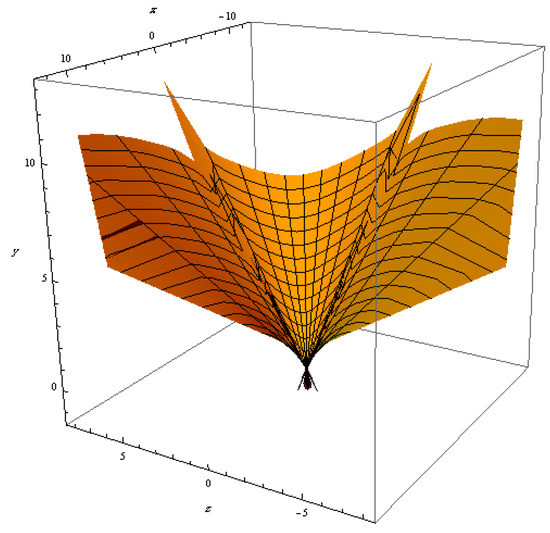
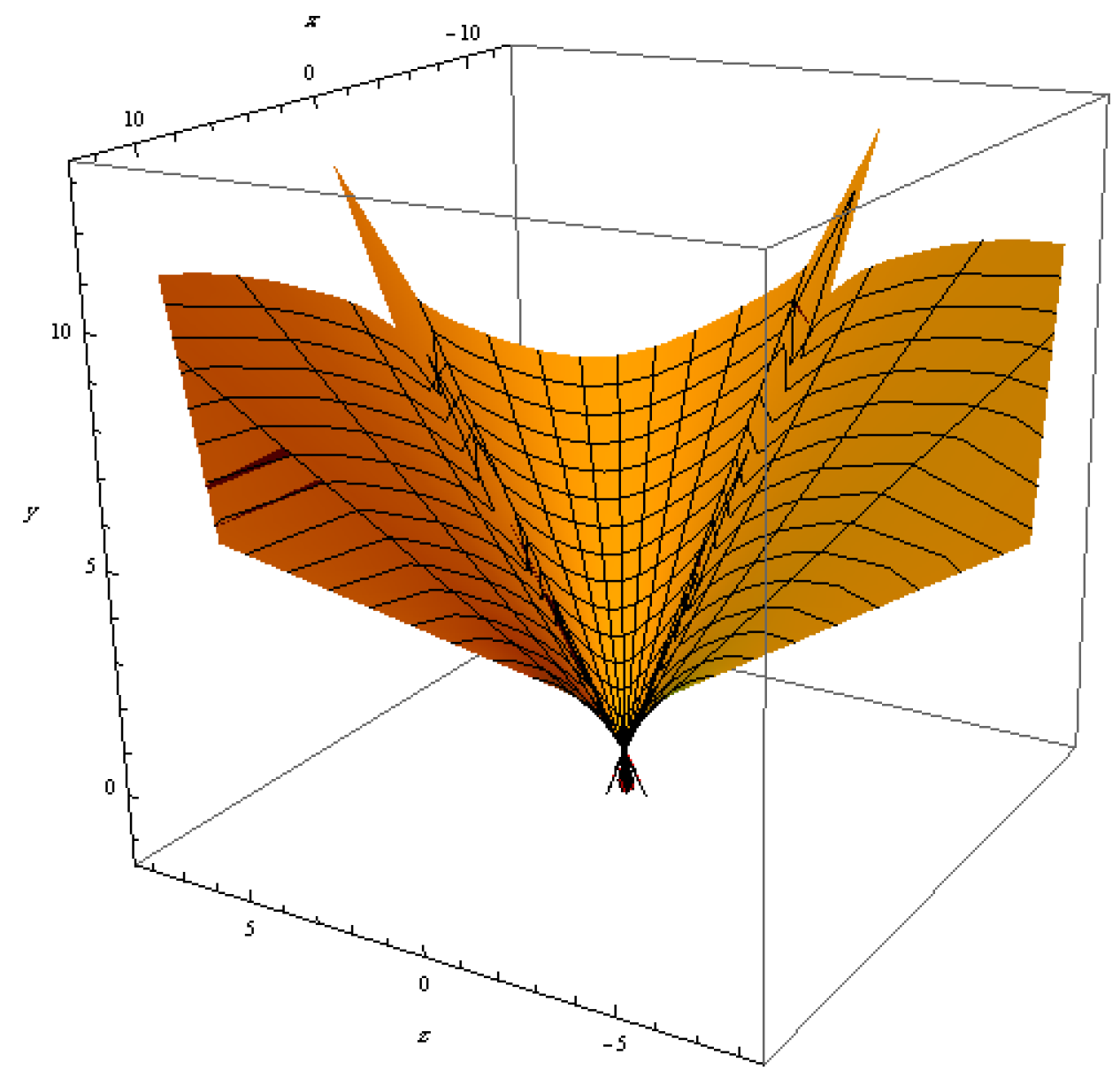
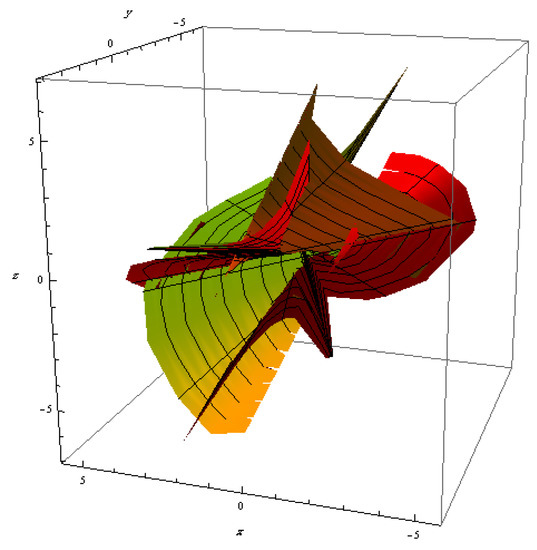
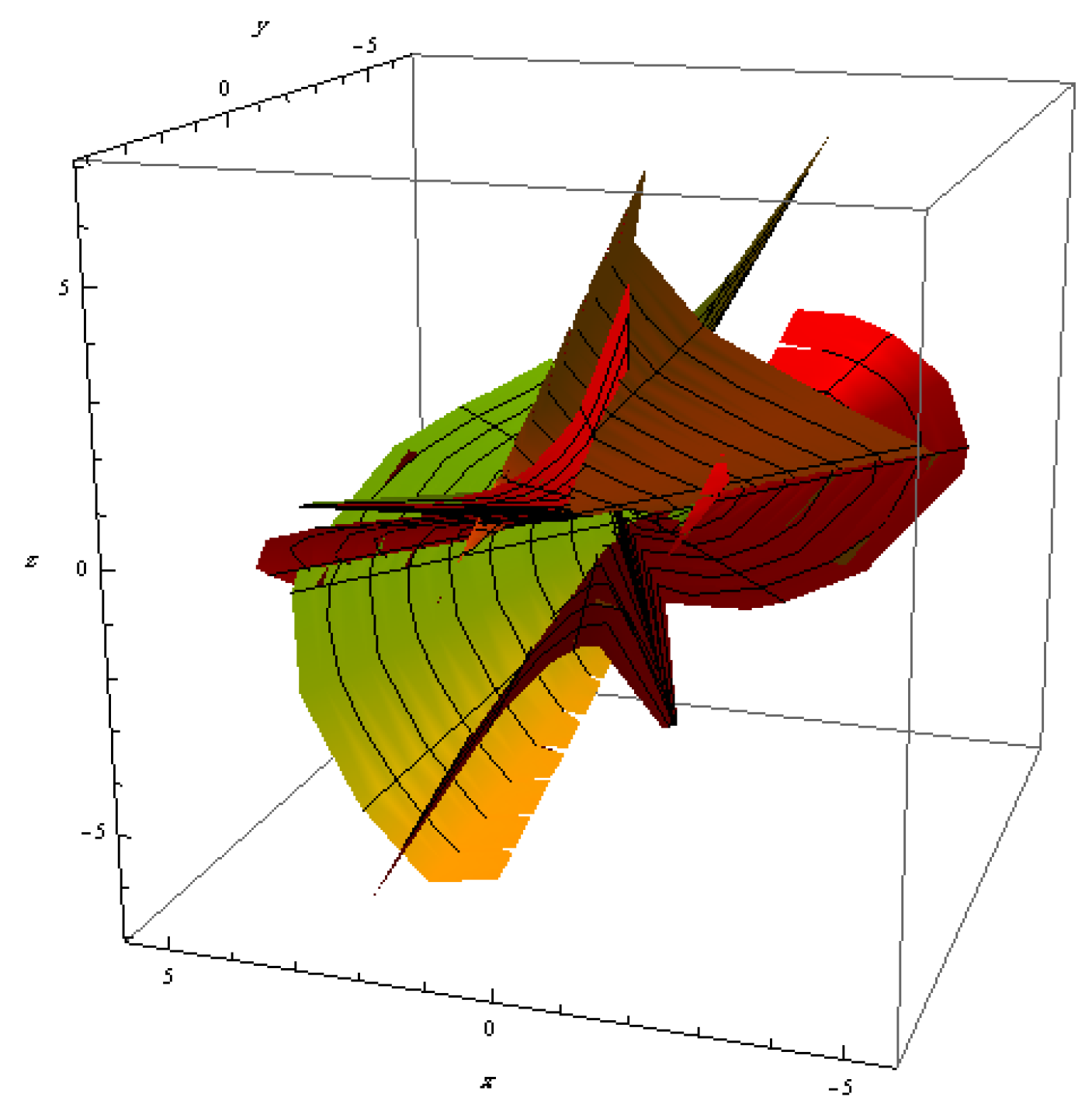
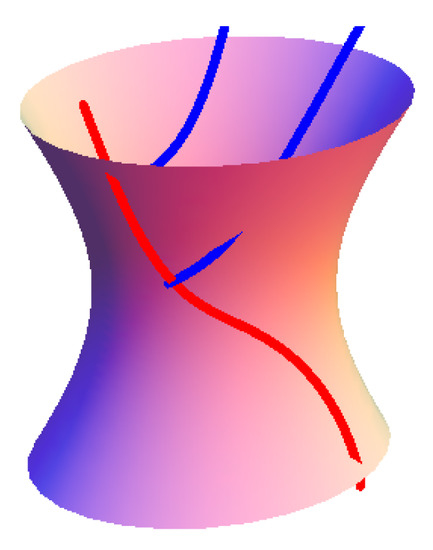
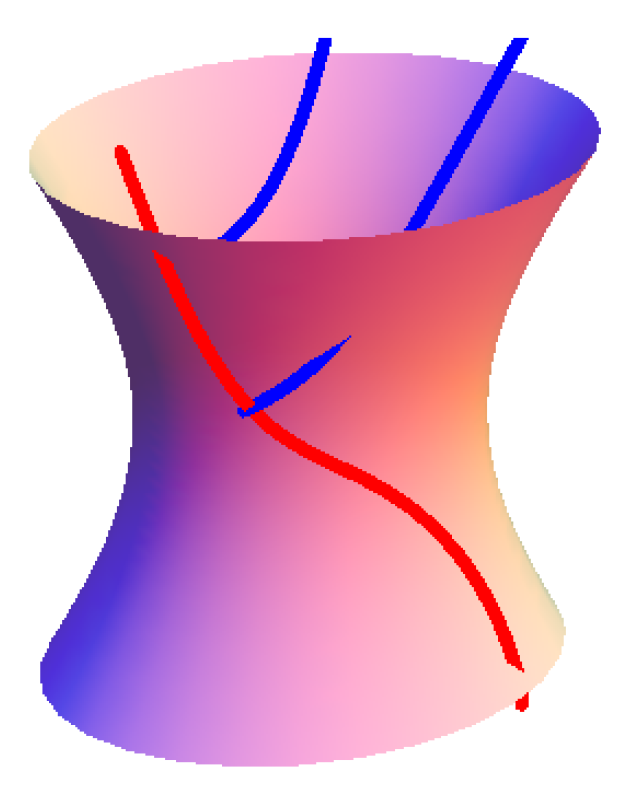
In this section, we provide an example to illustrate our results. Figure 1, Figure 2 and Figure 3 are shown below.
Figure 1.
The spacelike ruled surface M.
Figure 2.
The evolute surface of M.
Figure 3.
The space curve of the tangential surface.
Example 1.
Let a spacelike ruled surface defined by the following be the case:
where the following obtains:
and . By a straightforward calculation, we have the following:
Furthermore, we obtain the following:
It follows that evolute is given as follows:
where
According to Proposition 4, the osculating circle has a three-point contact with at and .
Author Contributions
Conceptualization, R.A.-S.A.-B. and M.K.S.; methodology, R.A.-S.A.-B. and M.K.S.; investigation, R.A.-S.A.-B. and M.K.S.; writing—original draft preparation, R.A.-S.A.-B. and M.K.S.; writing—review and editing, R.A.-S.A.-B. and M.K.S. All authors have read and agreed to the published version of the manuscript.
Funding
This research received no external funding.
Institutional Review Board Statement
Not applicable.
Informed Consent Statement
Not applicable.
Data Availability Statement
Not applicable.
Acknowledgments
We gratefully acknowledge the constructive comments from the editor and the anonymous referees.
Conflicts of Interest
The authors declare no conflict of interest.
References
- Abdel-Baky, R.A.; Al-Ghefari, R.A. On the kinematic geometry of relative screw motions. Mech. Sci. Technol. 2012, 26, 2497–2503. [Google Scholar] [CrossRef] [Scilit]
- Bottema, O.; Roth, B. Theoretical Kinematics; North-Holland Press: New York, NY, USA, 1979. [Google Scholar]
- Karger, A.; Novak, J. Space Kinematics and Lie Groups; Gordon and Breach Science Publishers: New York, NY, USA, 1985. [Google Scholar]
- McCarthy, J.M. An Introduction to Theoretical Kinematics; The MIT Press: London, UK, 1990. [Google Scholar]
- Pottman, H.; Wallner, J. Computational Line Geometry; Springer: Berlin/Heidelberg, Germany, 2001. [Google Scholar]
- Turgut, A.; Hacsalihoğlu, H.H. Timelike ruled surfaces in the Minkowski 3-space. Far East J. Math. Sci. 1997, 5, 83–90. [Google Scholar]
- Hassan, N.; Abdel-Baky, R.A.; Hamdoon, F.M. Ruled surfaces with timelike rulings. Appl. Math. Comput. 2004, 147, 241–253. [Google Scholar]
- Küçük, A. On the developable timelike trajectory ruled surfaces in Lorentz 3-space R13. App. Math. Comp. 2004, 157, 483–489. [Google Scholar] [CrossRef] [Scilit]
- Onder, M.; Ugurlu, H.H. Frenet frames and invariants of timelike ruled surfaces. Ain Shams Eng. J. 2013, 4, 507–513. [Google Scholar] [CrossRef] [Scilit]
- Izumiya, S.; Takeuchi, N. Geometry of Ruled Surfaces, Applicable Mathematics in the Golden Age; Misra, J.C., Ed.; Narosa Publishing House: New Delhi, India, 2003; pp. 305–338. [Google Scholar]
- Izumiya, S.; Takeuchi, N. New Special Curves and Developable Surfaces. Turk. J. Math. 2004, 28, 153–163. [Google Scholar]
- Porteous, R. Geometric Differentiation for the Intelligence of Curves and Surfaces, 2nd ed.; Cambridge University Press: Cambridge, UK, 2001. [Google Scholar]
- Li, Y.L.; Liu, S.Y.; Wang, Z.G. Tangent developables and Darboux developables of framed curves. Topol. Appl. 2020, 2020, 107526. [Google Scholar] [CrossRef] [Scilit]
- Li, Y.L.; Wang, Z.G. Lightlike tangent developables in de Sitter 3-space. J. Geom. Phys. 2021, 164, 104188. [Google Scholar] [CrossRef] [Scilit]
- Li, Y.L.; Wang, Z.G.; Zhao, T.H. Geometric Algebra of Singular Ruled Surfaces. Adv. Appl. Clifford Algebras 2021, 31, 19. [Google Scholar] [CrossRef] [Scilit]
- Li, Y.L.; Zhu, Y.S.; Sun, Q.Y. Singularities and dualities of pedal curves in pseudo-hyperbolic and de Sitter space. Int. J. Geom. Methods Mod. Phys. 2021, 18, 2150008. [Google Scholar] [CrossRef] [Scilit]
- Li, Y.L.; Ganguly, D.; Dey, S.; Bhattacharyya, A. Conformal η-Ricci solitons within the framework of indefinite Kenmotsu manifolds. AIMS Math. 2022, 7, 5408–5430. [Google Scholar] [CrossRef] [Scilit]
- Li, Y.L.; Alkhaldi, A.H.; Ali, A.; Laurian-Ioan, P. On the Topology of Warped Product Pointwise Semi-Slant Submanifolds with Positive Curvature. Mathematics 2021, 9, 3156. [Google Scholar] [CrossRef] [Scilit]
- Li, Y.L.; Lone, M.A.; Wani, U.A. Biharmonic submanifolds of Kähler product manifolds. AIMS Math. 2021, 6, 9309–9321. [Google Scholar] [CrossRef] [Scilit]
- Li, Y.L.; Ali, A.; Ali, R. A general inequality for CR-warped products in generalized Sasakian space form and its applications. Adv. Math. Phys. 2021, 2021, 5777554. [Google Scholar] [CrossRef] [Scilit]
- Li, Y.L.; Ali, A.; Mofarreh, F.; Abolarinwa, A.; Ali, R. Some eigenvalues estimate for the ϕ-Laplace operator on slant submanifolds of Sasakian space forms. J. Funct. Space 2021, 2021, 6195939. [Google Scholar]
- Li, Y.L.; Ali, A.; Mofarreh, F.; Alluhaibi, N. Homology groups in warped product submanifolds in hyperbolic spaces. J. Math. 2021, 2021, 8554738. [Google Scholar] [CrossRef] [Scilit]
Publisher’s Note: MDPI stays neutral with regard to jurisdictional claims in published maps and institutional affiliations. |
© 2022 by the authors. Licensee MDPI, Basel, Switzerland. This article is an open access article distributed under the terms and conditions of the Creative Commons Attribution (CC BY) license (https://creativecommons.org/licenses/by/4.0/).