Abstract
Numerical solution and parameter estimation for a type of fractional diffusion equation are considered. Firstly, the symmetrical compact difference scheme is applied to solve the forward problem of the fractional diffusion equation. The stability and convergence of the symmetrical difference scheme are presented. Then, the Bayesian method is considered to estimate the unknown fractional order of the fractional diffusion equation model. To validate the efficiency of the symmetrical numerical scheme and the estimation method, some simulation tests are considered. The simulation results demonstrate the accuracy of the compact difference scheme and show that the proposed estimation algorithm can provide effective statistical characteristics of the parameter.
1. Introduction
In recent years, the studies of fractional calculus have attracted many researchers [1,2,3], and fractional differential equations have many applications in economics [4], finance [5], physics [6,7,8], bioecology [9,10], porous media dynamics [11,12,13], and so on. However, only few exact solutions can be founded for some linear fractional differential equations. Many researchers turned to develop efficient numerical schemes. For example, the authors in [14,15,16] considered the difference schemes. Li et al. [17,18] proposed a novel algorithm based on linear and quadratic approximations. Zhou et al. [19] considered a nonuniform Alikhanov linearized Galerkin finite element methods. The authors in [20,21] considered the Chebyshev collocation method.
Recently, the research about the inverse problem has attracted more and more interest, one can refer to [22,23,24] and the references therein. Most of the literature on the inverse problem of the fractional differential equations exploited deterministic techniques, such as exact matching, least squares optimizations, without considering measurement error and numerical error. In general, very roughly speaking, one may split the corresponding approaches of recovering the order into the following two categories: solving the corresponding inverse problems analytically or using numerical–analytical methods [25,26,27,28,29,30,31], or using some more soft, metaheuristic, or statistical optimization and regularization techniques [32,33,34,35,36,37]. However, the observations are usually contaminated with measurement error, and the forward problem of the models will bring the numerical error, so the uncertainties are non-ignorable. Some studies for the inverse problem under uncertainties have been provided, such as the extended maximum likelihood method [38], sensitivity analysis method [39], and the Bayesian method [40,41].
The work of this paper was mainly motivated by the study in [41]. However, in the paper, Fan et al. considered homogeneous fractional diffusion equation, and the center Box difference method was used to obtain the numerical solution of the equation. An inhomogeneous fractional diffusion equation was considered in this paper, and a high-order compact difference scheme instead of the second-order center Box difference method was used to obtain the corresponding numerical solution. We considered the Bayesian method to estimate the parameter of the fractional diffusion equation model based on a compact difference scheme. Firstly, a high-order compact difference scheme is employed to solve the forward problem of the fractional diffusion equation. The convergence and stability of the difference scheme are proved, where the difference scheme has order in the temporal direction and 4 order in the spatial direction. Then, the Bayesian method is considered to estimate the unknown fractional order of the model, where some additional observations contaminated with measurement errors must be provided. To validate the efficiency of the numerical scheme and the estimation method, some simulation tests are considered. The simulation results demonstrate the accuracy of the compact difference scheme and show that the proposed estimation algorithm can provide effective statistical characteristics of the parameters.
The outline of this paper is as follows. In Section 2, mathematical model of the problem is introduced, and a compact difference scheme is constructed to solve the forward problem. Section 3 introduces the Bayesian method for the inverse problem. In Section 4, numerical tests are presented to validate the performance of the estimation algorithm. Section 5 gives some discussion and remarks.
2. Mathematical Model of the Problem and the Compact Difference Scheme
This section described the mathematical model of the problem, and a compact difference scheme was constructed to solve the forward problem.
2.1. Mathematical Model of the Problem
Consider the following fractional parabolic equation,
where and are constants, , , and are given functions. The time fractional partial derivative is defined in the Caputo sense as the following
where is the gamma function.
If is a known parameter, Equations (1)–(3) represent a forward problem; extensive studies have been provided. However, in some practical situations, we cannot know the exact values of . Under this situation, additional data must be provided to estimate the unknown parameter, which can be called the inverse problem. The additional data may be observed at some measured time for a fixed point . For simplicity, let in this paper, and we have the following observations,
Let F be an operator, , where ; then, the inverse problem can be seen as the solution of the following equation,
In fact, the observations may be contaminated with measurement errors inevitably. We will consider the Bayesian approach to deal with the inverse problem.
2.2. The Compact Difference Scheme for the Forward Problem
Assuming in the operator F to be known in this subsection, we construct the high-order compact difference scheme to solve (6).
Let , and , where . Introducing , where , . Denote . Let
be the grid function space defined on . Introducing the following notations
where
One can use Lemma 1 to deal with (4).
Lemma 1
([42]). Suppose , , it holds that
And satisfies Lemma 2.
Lemma 2
([43]). Assume , then it holds that
- (1)
- decreases monotonically as j increases, and ;
- (2)
- , .
The following Lemma 3 will play the key role to construct the high-order compact difference scheme.
Lemma 3
([44]). Suppose , then we have
where .
Considering (1) at the point , we have
By Lemma 1, we have
From Lemma 3 and Taylor expansion, we have
Replacing by in (11)–(13), the following compact difference scheme solving for (1)–(3) can be obtained,
The proof of Theorem 1 can be referred to the corresponding proof in [45].
Denote and ; then, we can obtain the following error equations
where .
To prove the following theorems, introducing the following notations
Theorem 2.
where C is a positive constant independent of h and τ.
Proof.
Multiplying (17) with and summing up for i from 1 to M-1, one can obtain
Then, we will estimate each term of (21). From the discrete Green formula, we have
where inequality is used.
By the discrete Green formula, one has
From Cauchy–Schwarz inequality, we have
Noticing , from Lemma 6 in [45], we have
where is a positive constant independent of h and . Then, we have
The proof is completed. □
3. Parameter Estimation for the Inverse Problem
Considering the measurement error and numerical error in the observations, then (6) has the following form,
where , and is assumed to be a known parameter. is the parameter to be estimated from the observations governed by (26).
Assume is the prior probability distributions. We have the prior probability density function of ,
From (26), we have the following likelihood function,
where Y is the observation vector, n is the length of Y.
By the Bayes theorem, the posterior probability density function is
The Bayesian method for estimating is as follows,
- (1)
- Draw an initial value of ,
- (2)
- for i = 0:draw ,draw ,if , then ,else ,whereandwhere is the number of iterations.
In the Bayesian method, we will use the posterior mean as the estimation of .
Remark 1.
in (29) can be obtained through (5), where a higher compact difference scheme is used. However, the traditional Crank–Nicolson difference scheme and other algorithms such as finite element method and finite volume method can also be used to solve (5). The advantage of the compact difference is that it is highly accurate, easy to program, and easily parallel. The advantage of the Bayesian estimation algorithm is that it can deal with contaminated observations and inhomogeneous fractional diffusion equation, and the most disadvantage of the Bayesian estimation algorithm is that it is time consuming.
4. Simulation
This section considers the following example. The configuration of the computer is Intel(R) Core(TM) i5-8265U CPU @ 1.60 GHz 1.80 GHz, Memory 4 GB (Lenovo, Beijing, China). All the codes are compiled in MATLAB 2009(a).
Example 1.
the exact solution of (30) is , and
4.1. Simulation for the Forward Problem
As for the forward problem, we will validate the performance of the scheme (14)–(16) for solving (30). Introducing the following maximum error,
and we define the following convergence order as
For calculating , h needs to be fixed and small enough. While for , needs to be fixed and small enough.
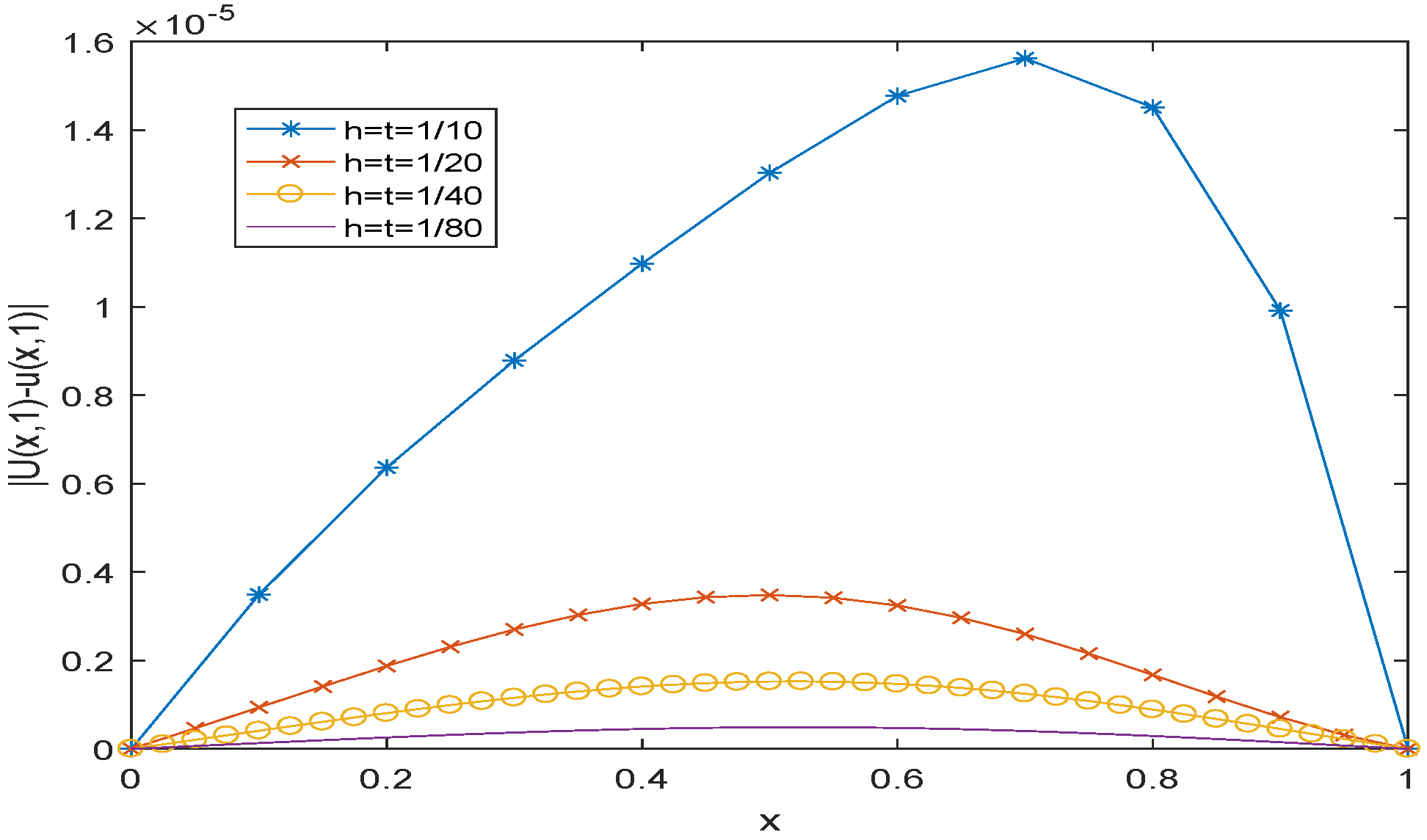
To compare the errors between the numerical solution and the exact solution of (30), Figure 1 was provided. Taking temporal and spatial step sizes as respectively, let , and we can see that the value of the error is within . The numerical solution can approximate the exact solution well enough.
Figure 1.
The error curves of for different temporal and spatial step sizes for solving (30), where , , and denote the numerical solution and exact solution, respectively.
Table 1 shows the maximum errors in the temporal directions for and 0.8, respectively, where we fixed the spatial step to be . We can see that the temporal convergence order is .
Table 1.
Maximum errors and convergence order for solving (30) in the temporal direction, where , , and , and 0.8. * means no value.
Table 2 shows the maximum errors in the spatial directions for and 0.8, respectively, where we fixed the temporal step = 1/10,000. In most of the cases, we can conclude that the spatial convergence order is 4. However, we can see that the convergence of the considered numerical scheme is not steady under the condition that .
Table 2.
Maximum errors and convergence order for solving (30) in the spatial direction, where , = 1/10,000, and and 0.8. * means no value.
4.2. Simulation for the Inverse Problem
As for the inverse problem, we will testify to the validity of the Bayesian method provided. To obtain the observations Y governed by (26), let in Equation (1) be the given value (note: and will take the same conclusion, only is considered in this subsection for the sake of brevity). Firstly, we applied the compact difference scheme (14)–(16) to discrete (30), where . A series of points were generated. Then, we picked up every fourth (two or one) point from the generated points, finally add the noise on each data, and we get the observations with length (, ).
However, the length of observations n and may affect the estimation results of . In the following tests, we will evaluate such effects caused by different values of n and . In the following tests, the length of the Markov chain is taken to be , and the burn in number is taken to be 1000.
Let be fixed, and assume . For different , we will inspect the posterior mean, standard error, and quantile of . Table 3 was obtained, and we can see that the measurement error with bigger may take more uncertainty of the estimation results.
Table 3.
Impact of different on estimation for of (30), where , the true value of is .
To inspect the effect of different n for , let be fixed, assume , , and . For different n, we also inspect the posterior mean, standard error, and quantile of . Table 4 was obtained, when and , the different values of n make little impact on the estimation results. While when , there is more uncertainty in the estimation results of . We can draw the conclusion that there is little influence for estimating under bigger values of different n. From the computational time, it can be seen that we need more estimation time when a bigger n is given.
Table 4.
Impact of different n on estimation for of (30), where , and the true value of is .
Remark 2.
In the tests of simulation for the inverse problem, we set the seed as ’sum(100*clock)’ in the ’rand’ function to specify the settings of the random number generator. Then, the estimation results can always be the same.
5. Conclusions
This paper considered both the forward problem and inverse problem of a type of fractional diffusion equation. Firstly, a compact difference scheme was provided to solve the forward problem of the fractional diffusion equation. The convergence and stability of the difference scheme were proved, and the convergence order is . Secondly, as for the inverse problem, a Bayesian algorithm was provided to estimate the fractional order of the diffusion equation under the condition that some additional observations contaminated with measurement errors were provided. Numerical experiments were provided to testify the convergence results both in the temporal direction and in the spatial direction and the estimation efficiency of the Bayesian algorithm.
Author Contributions
All the authors contributed equally to this paper. All authors have read and agreed to the published version of the manuscript.
Funding
This work is supported by National Natural Science Foundation of P.R. China (No. 71974204).
Institutional Review Board Statement
Not applicable.
Informed Consent Statement
Not applicable.
Data Availability Statement
Not applicable.
Conflicts of Interest
The authors declare no conflict of interest.
References
- Bazhlekova, E. Fractional Evolution Equations in Banach Spaces. Ph.D. Thesis, Eindhoven University of Technology, Eindhoven, The Netherlands, 2001. [Google Scholar]
- Kostic, M. Abstract Volterra Integro-Differential Equations; CRC Press: Boca Raton, FL, USA, 2015. [Google Scholar]
- Oldham, K.B.; Spanier, J. The Fractional Calculus; Academic Press: New York, NY, USA; London, UK, 1974. [Google Scholar]
- Xie, C.; Xia, X.; Aghdam, Y.E.; Farnam, B.; Jafari, H.; Wang, S. The numerical strategy of tempered fractional derivative in European double barrier option. Fractals 2022, 30, 2240049. [Google Scholar] [CrossRef]
- Mesgarani, H.; Aghdam, Y.E.; Tavakoli, H. Numerical Simulation to Solve Two-Dimensional Temporal–Space Fractional Bloch–Torrey Equation Taken of the Spin Magnetic Moment Diffusion. Int. J. Appl. Comput. Math. 2021, 7, 94. [Google Scholar] [CrossRef]
- Bouchaud, J.; Georges, A. Anomalous diffusion in disordered media: Statistical mechanisms, models and physical applications. Phys. Rep. 1990, 195, 127–293. [Google Scholar] [CrossRef]
- Li, D.; Wang, J.; Zhang, J. Unconditionally convergent L1-Galerkin FEMs for nonlinear time-fractional schrödinger equations. SIAM J. Sci. Comput. 2017, 39, A3067–A3088. [Google Scholar] [CrossRef]
- Li, L.; Li, D. Exact solutions and numerical study of time fractional Burgers’ equations. Appl. Math. Lett. 2020, 100, 106011. [Google Scholar] [CrossRef]
- Podlubny, I. Fractional Differential Equations; Academic Press: New York, NY, USA, 1999. [Google Scholar]
- Li, D.; Zhang, C. Long time numerical behaviors of fractional pantograph equations. Math. Comput. Simul. 2020, 172, 244–257. [Google Scholar] [CrossRef]
- Berardi, M.; Difonzo, F.V. A quadrature-based scheme for numerical solutions to Kirchhoff transformed Richards’ equation. J. Comput. Dyn. 2022. [Google Scholar] [CrossRef]
- Liu, F.; Fukumoto, Y.; Zhao, X. A multi level linearized CrankCNicolson scheme for Richards equation under variable flux boundary conditions. Appl. Anal. 2021. [Google Scholar] [CrossRef]
- Garrappa, R. Trapezoidal methods for fractional differential equations: Theoretical and computational aspects. Math. Comput. Simul. 2015, 110, 96–112. [Google Scholar] [CrossRef] [Green Version]
- Alikhanov, A. A new difference scheme for the time fractional diffusion equation. J. Comput. Phys. 2015, 280, 424–438. [Google Scholar] [CrossRef] [Green Version]
- Langlands, T.; Henry, B. The accuracy and stability of an implicit solution method for the fractional diffusion equation. J. Comput. Phys. 2005, 205, 719–736. [Google Scholar] [CrossRef]
- Chen, X.; Di, Y.; Duan, J.; Li, D. Linearized compact ADI schemes for nonlinear time-fractional Schrodinger equations. Appl. Math. Lett. 2018, 84, 160–167. [Google Scholar] [CrossRef]
- Li, D.; Sun, W.; Wu, C. A novel numerical approach to time-fractional parabolic equations with nonsmooth solutions. Numer. Math. Theory Meth. Appl. 2021, 14, 355–376. [Google Scholar]
- Li, D.; Liao, H.; Sun, W.; Wang, J.; Zhang, J. Analysis of L1-Galerkin FEMs for time-fractional nonlinear parabolic problems. Commun. Comput. Phys. 2018, 24, 86–103. [Google Scholar] [CrossRef] [Green Version]
- Zhou, B.; Chen, X.; Li, D. Nonuniform Alikhanov linearized Galerkin finite element methods for nonlinear time-fractional parabolic equations. J. Sci. Comput. 2020, 85, 39. [Google Scholar] [CrossRef]
- Aghdam, Y.E.; Mesgarani, H.; Moremedi, G.M.; Khoshkhahtinat, M. High-accuracy numerical scheme for solving the space-time fractional advection-diffusion equation with convergence analysis. Alex. Eng. J. 2022, 61, 217–225. [Google Scholar] [CrossRef]
- Mesgarani, H.; Beiranvand, A.; Aghdam, Y.E. The impact of the Chebyshev collocation method on solutions of the time-fractional Black-Scholes. Math. Sci. 2021, 15, 137–143. [Google Scholar] [CrossRef]
- Janno, J.; Kinash, N. Reconstruction of an order of derivative and a source term in a diffusion equation from final measurements. Inverse Probl. 2018, 34, 025007. [Google Scholar] [CrossRef]
- Li, G.; Zhang, D.; Jia, X.; Yamamoto, M. Simultaneous inversion for the space-dependent diffusion coefficient and the order in the time-diffusion equation. Inverse Probl. 2013, 29, 65014. [Google Scholar] [CrossRef]
- Miller, L.; Yamamoto, M. Coefficient inverse problem for a diffusion equation. Inverse Probl. 2013, 29, 75013. [Google Scholar] [CrossRef]
- Hatano, Y.; Nakagawa, J.; Wang, S.; Yamamoto, M. Determination of order in fractional diffusion equation. J. Math-for-Ind. 2013, 5, 118. [Google Scholar]
- Jin, B.; Kian, Y. Recovery of the Order of Derivation for Fractional Diffusion Equations in an Unknown Medium. arXiv 2021, arXiv:2103.15166. [Google Scholar]
- Jin, B.; Kian, Y. Recovering multiple fractional orders in time-fractional diffusion in an unknown medium. Proc. R. Math. Phys. Eng. Sci. 2021, 477, 20210468. [Google Scholar] [CrossRef]
- Jin, B.; Zhou, Z. Recovering the potential and order in one-dimensional time-fractional diffusion with unknown initial condition and source. Inverse Probl. 2021, 37, 105009. [Google Scholar] [CrossRef]
- Janno, J. Determination of the order of fractional derivative and a kernel in an inverse problem for a generalized time fractional diffusion equation. Electron. J. Differ. Equ. 2016, 2016, 1–28. [Google Scholar]
- Yamamoto, M. Uniqueness in determining fractional orders of derivatives and initial values. Inverse Probl. 2021, 37, 095006. [Google Scholar] [CrossRef]
- El Hamidi, A.; Tfayli, A. Identification of the derivative order in fractional differential equations. Math. Methods Appl. Sci. 2021, 44, 8397–8413. [Google Scholar] [CrossRef]
- Krasnoschok, M.; Pereverzyev, S.; Siryk, S.V.; Vasylyeva, N. Regularized reconstruction of the order in semilinear subdiffusion with memory. In Springer Proceedings in Mathematics and Statistics; Springer: Singapore, 2020; Volume 310, pp. 205–236. [Google Scholar]
- Krasnoschok, M.; Pereverzyev, S.; Siryk, S.V.; Vasylyeva, N. Determination of the fractional order in semilinear subdiffusion equations. Fract. Calc. Appl. Anal. 2020, 23, 694–722. [Google Scholar] [CrossRef]
- Gao, F.; Lee, X.J.; Tong, H.Q.; Fei, F.X.; Zhao, H.L. Identification of Unknown Parameters and Orders via Cuckoo Search Oriented Statistically by Differential Evolution for Noncommensurate Fractional-Order Chaotic Systems. Abstr. Appl. Anal. 2013, 2013, 382834. [Google Scholar] [CrossRef] [Green Version]
- Yuan, L.G.; Yang, Q.G. Parameter identification and synchronization of fractional-order chaotic systems. Commun. Nonlinear Sci. Numer. Simul. 2012, 17, 305–316. [Google Scholar] [CrossRef]
- Bohaienko, V.; Gladky, A. Parameters identification for fractional-fractal model of filtration-consolidation using GPU. In Proceedings of the CMIS 2021: 4th International Workshop on Computer Modeling and Intelligent Systems, Zaporizhzhia, Ukraine, 27 April 2021; pp. 409–418. [Google Scholar]
- Bohaienko, V.; Gladky, A.; Romashchenko, M.; Matiash, T. Identification of fractional water transport model with ψ-Caputo derivatives using particle swarm optimization algorithm. Appl. Math. Comput. 2021, 390, 125665. [Google Scholar] [CrossRef]
- Fadale, T.D.; Nenarokomov, A.V.; Emery, A.F. Uncertainties in parameter estimation: The inverse problem. Int. J. Heat Mass Transf. 1995, 38, 511–518. [Google Scholar] [CrossRef]
- Sun, N.Z.; Yeh, W.G. A stochastic inverse solution for transient groundwater flow: Parameter identification and reliability analysis. Water Resour. Res. 1992, 28, 3269–3280. [Google Scholar] [CrossRef]
- Kaipio, J.; Somersalo, E. Statistical and Computational Inverse Problems; Springer: New York, NY, USA, 2005. [Google Scholar]
- Fan, W.; Jiang, X.; Chen, S. Parameter estimation for the fractional fractal diffusion model based on its numerical solution. Comput. Math. Appl. 2016, 71, 642–651. [Google Scholar] [CrossRef]
- Sun, Z.; Wu, X. A fully discrete difference scheme for a diffusion-wave system. Appl. Numer. Math. 2006, 56, 193–209. [Google Scholar] [CrossRef]
- Chen, S.; Liu, F.; Zhuang, P.; Anh, V. Finite difference approximations for the fractional Fokker-Planck equation. Appl. Math. Model. 2009, 33, 256–273. [Google Scholar] [CrossRef] [Green Version]
- Sun, Z. The Numerical Methods for Partial Equations; Science Press: Beijing, China, 2005. (In Chinese) [Google Scholar]
- Gu, W.; Zhou, Y.; Ge, X. Compact Difference Scheme for Solving Fractional Neutral Parabolic Differential Equation with Proportional Delay. J. Funct. Spaces 2017, 2017, 3679526. [Google Scholar] [CrossRef] [Green Version]
Publisher’s Note: MDPI stays neutral with regard to jurisdictional claims in published maps and institutional affiliations. |
© 2022 by the authors. Licensee MDPI, Basel, Switzerland. This article is an open access article distributed under the terms and conditions of the Creative Commons Attribution (CC BY) license (https://creativecommons.org/licenses/by/4.0/).