Abstract
The sign-invariant theory is used to study the radially symmetric nonlinear diffusion equations with gradient-dependent diffusivities. The first-order non-stationary sign-invariants and the first-order non-autonomous sign-invariants admitted by the governing equations are identified. As a consequence, the exact solutions to the resulting equations are constructed due to the corresponding reductions. The phenomena of blow-up, extinction and behavior of some solutions are also described.
1. Introduction
For nonlinear diffusion equations, some results on second-order conditional Lie-Bäcklund symmetries can be translated to first-order sign-invariants [1,2,3]. The sign-invariant theory, introduced by Galationov [4], is a junction of qualitative and quantitative properties of nonlinear partial differential equations. Some ideas of sign-invariants are originated from the blow-up singularity analysis of combustion reaction-diffusion Equations [5]. Sign-invariants play a fundamental role in the study of existence, uniqueness, differential and asymptotic properties of wide classes of solutions [6]. In addition, exact solutions via finite-dimensional dynamical systems can be constructed due to zero-preserving of the first-order operator [4,5,6,7]. The corresponding reduction idea has a natural relation to the general theory of differential constraint [8].
The paper [4] presents a backward approach to study nonlinear parabolic equation starting from sign-invariant computed via the idea from the qualitative theory and finally giving the set of exact solution by means of the zero-invariant property. Three different types of first-order sign-invariants are, respectively, considered for different kinds of nonlinear diffusion equations. The governing equations and the admitted sign-invariants are presented. As a consequence, exact solutions of the resulting equations are constructed due to the corresponding reductions. In addition, the definition of Hamilton–Jacobi sign-invariant for evolution equation is also given in [4].
Definition 1
([4]). The first-order Hamilton–Jacobi operator
is said to be a sign-invariant of the nonlinear evolution equation
if it preserves both signs and on the solution manifold of the evolution equation. This means
The types of non-stationary autonomous sign-invariant
for the parabolic equations with the diffusion term of the gradient-dependent type
and
are, respectively, studied in [4,7]. The structure of (1) comes from the conditions of criticality of solutions to quasi-linear parabolic Equations [9]. The general quadratic Hamilton–Jacobi sign-invariants
for the nonlinear diffusion equation
are considered in [5]. It is known that the type of first-order Hamilton–Jacobi sign-invariant (2) is closely related to the second-order conditional Lie-Bäcklund symmetry
for nonlinear diffusion Equations [1,2,3].
The second-order conditional Lie-Bäcklund symmetry with the characteristic
is used to study classifications and reductions of the radially symmetric nonlinear diffusion equation with gradient-dependent diffusivity
in [10], where the type of first-order Hamilton–Jacobi sign-invariant
is also presented due to the admitted conditional Lie-Bäcklund symmetry (3). The type of first-order sign-invariant
is not discussed there [10] since the corresponding conditional Lie-Bäcklund symmetry (3) degenerates to conditional symmetry.
In fact, Equation (4) is corresponding to the multi-dimensional generalization of nonlinear diffusion equation
It is well known that this equation occur, for instance, in the theory of non-Newtonian liquids and in some turbulence problems [11,12,13]. The descriptions of Lie symmetries of a class of nonlinear diffusion equations in one and two dimensions are presented in [14,15,16,17,18,19]. The nonclassical symmetries and reductions of nonlinear diffusion equations in two and n dimensions can, respectively, be referred to [19,20,21,22]. The second-order conditional Lie-Bäcklund symmetry and first-order Hamilton–Jacobi sign-invariant for nonlinear diffusion equations with gradient-dependent diffusivity can be referred to [2,10,23].
In this manuscript, we consider the non-stationary sign-invariant
and non-autonomous sign-invariant
for the general Equation (4) with , which are both particular case of (5). Section 2 and Section 3 are, respectively, devoted to study sign-invariants of the form (6) and (7) for the nonlinear diffusion Equation (4). The corresponding exact solutions due to the reductions of the resulting sign-invariants are constructed in Section 4. The conclusions are provided in the last section.
2. Non-Stationary Sign-Invariant of Nonlinear Diffusion Equation
The procedure for computing sign-invariant (6) of Equation (4) is about the same as what is presented in [5,24,25]. Firstly, we need to differentate with respect to t. The next step is to eliminate and other lower-order ones in by substituting the second derivative from (4) and calculating other lower-order ones from . A direct computation yields
where denotes the set of differential consequence of Equation (4) with respect to t, that is, , and denotes the set of all differential consequences of with respect to t and r, that is, .
We can derive the well known Determining System by equating the coefficients of and to zero, which are listed as
Solving the determining system (9), we can identify the governing Equation (4) and the admitting non-stationary sign-invariant (6). It is stated clearly in [10] that Equation (4) admits of first-order sign-invariant is equivalent to that Equation (4) admits of second-order conditional Lie-Bäcklund symmetry (3). Thus, the resulting admitting sign-invariant (6) of Equation (4) will yield the corresponding conditional Lie-Bäcklund symmetry (3) of Equation (4). These results are presented in Table 1.
3. Non-Autonomous Sign-Invariant of Nonlinear Diffusion Equation
In this section, we consider sign-invariant of the stationary structure (7) which is non-autonomous in the spatial variable . We restrict our attention to the first-order operator possessing the form
with yet unknown smooth non-negative functions and . The idea of such sign-invariants goes to the gradient bounds introduced [26] for semi-linear parabolic equations. Generalizations to the quasi-linear gradient-dependent operators can be found in [27]. The discussion of the sign-invariant
and
for the quasi-linear heat equations can be referred to [4]. These two structures are, respectively, include the rotation invariant and scaling invariant [28]. The extension to the rotation invariant and scaling invariant (11), (12) and other generalized forms for nonlinear evolution equations are considered in [29,30], where the form of (11) and (12) are defined as the invariant set.
Similar procedure as what is shown for the previous one in Section 2 will yield that and satisfy
if the non-autonomous operator (7) is a sign-invariant of Equation (4).
Substituting into (13), we can derive that
The left-side of (14) is a linear combination in a space of the form
For the case of , the space W degenerate to
The discussion of the dimension of the linear space (15) and (16) will finally yield the determining system for h and Q. We omit the tedious computational procedure and just list the corresponding results in Table 2. The results for the sign-invariant (12) of Equation (4) are also listed in Table 2.
4. Exact Solutions of Nonlinear Diffusion Equation
The compatibility of and the governing Equation (4) will yield exact solutions of the nonlinear diffusion Equation (4). To derive these solutions, one first solves the ordinary differential equation to determine the form of , and then substitutes the corresponding results into Equation (4) to finally identify the solutions. Here we just present several examples to illustrate the reduction procedure.
Example 1.
Equation
with and admits of the first-order sign-invariant
and the second-order conditional Lie-Bäcklund symmetry
The corresponding solutions are given by
where and satisfy two-dimensional dynamical system
This system can be easily integrated. The corresponding solutions are given as follows.
- (i)
- For ,
- (ii)
- For ,
The solutions blow-up along the curves for the case of and extinguish along the curves for the case of , namely, the interface of the solution is the curve . Notably, exact solutions of this form were found by Cherniha et al. [18] for the special case of and , where the solutions are constructed due to Lie’s classical symmetry reductions. It is also remarked that the solutions can reduce to the instantaneous source solutions of the porous medium equation with source for the case of and . Thus, the resulting solutions are also generalizations of the instantaneous source solutions of the porous medium equation with source.
Example 2.
Equation
admits of the first-order sign-invariant
and the second-order conditional Lie-Bäcklund symmetry
The corresponding solutions are given by
where and are given as below.
- (i)
- For ,
- (ii)
- For ,
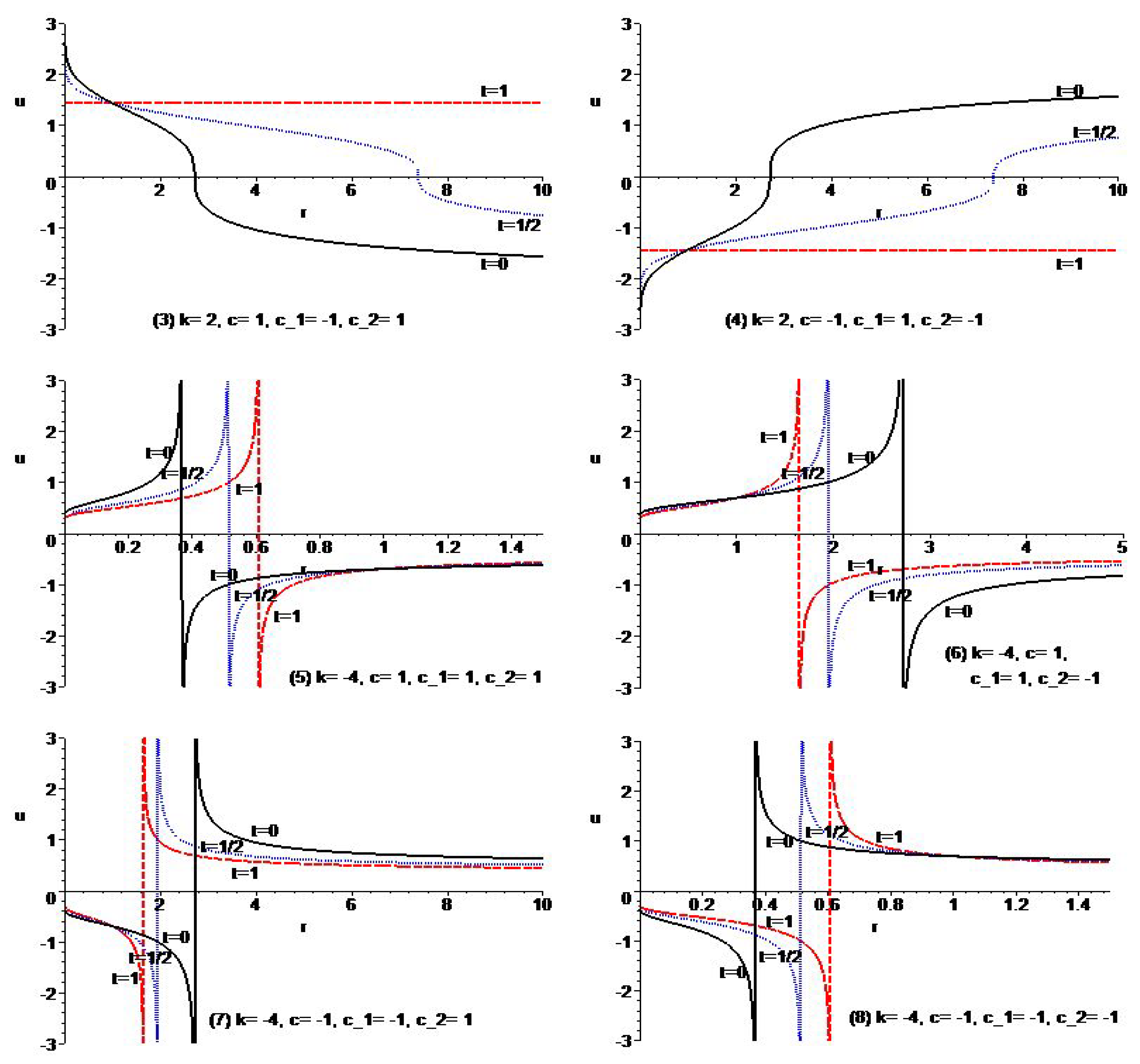
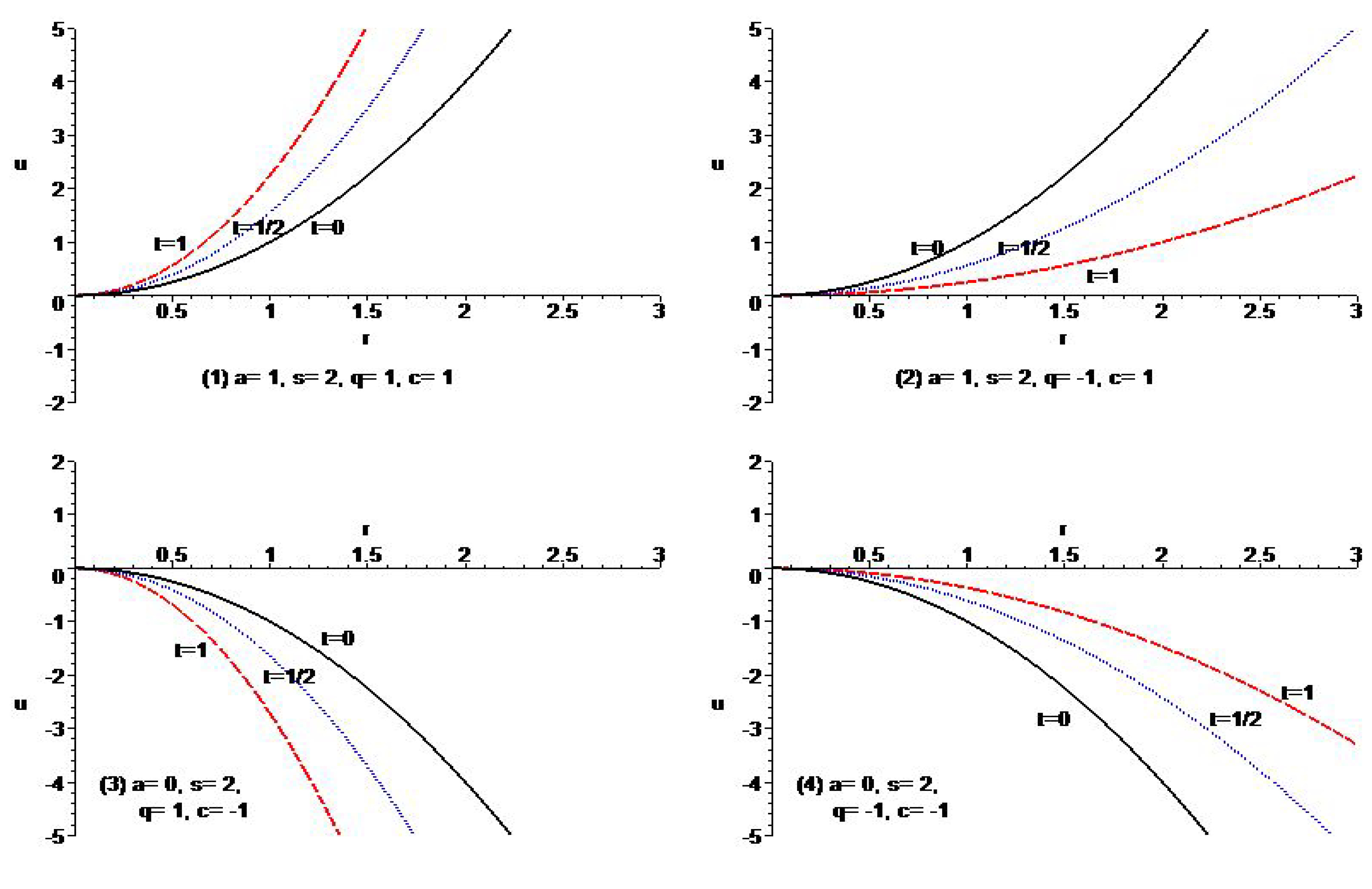
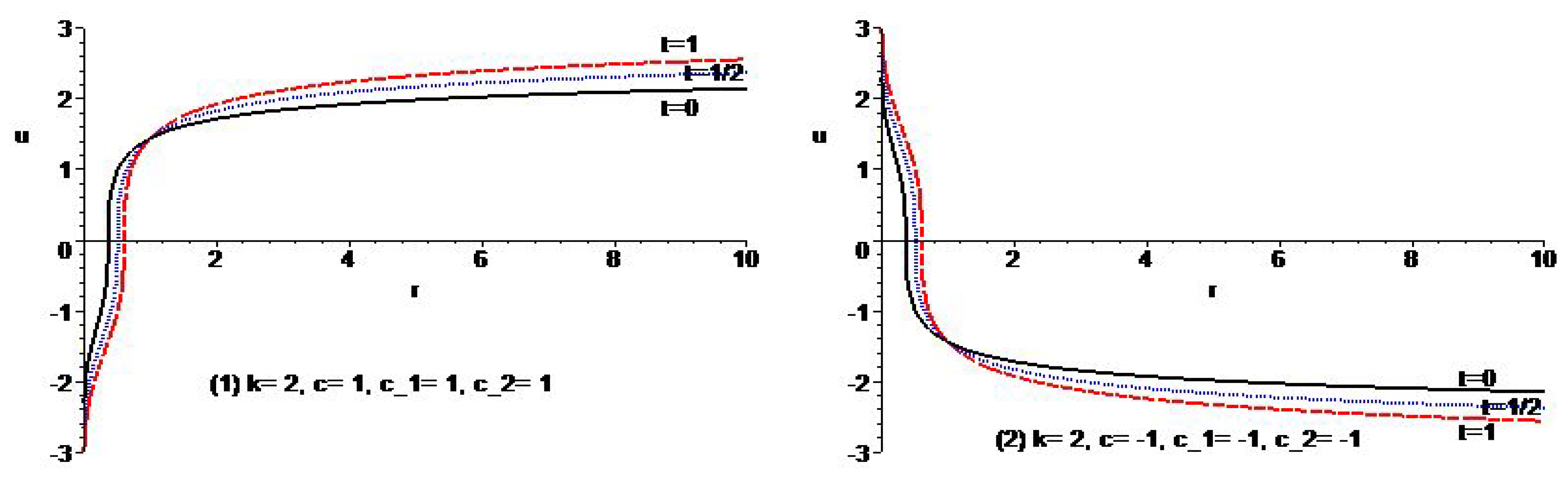
The solutions blow-up along the curves for the case of and extinguish along the curves for the case of , namely, the interface of the solution is the curve . Figure 1 shows the typical behavior of the governing equation for the case of and . The three curves are, respectively, corresponding to different times, and the vertical axis and the horizontal axis are, respectively, corresponding to u and r; this is the same as for the other Figures below.

Figure 1.
Typical variation of the solutions with and of Example 2 for different types of parameters.
Example 3.
Equation
admits of the first-order sign-invariant
and the second-order conditional Lie-Bäcklund symmetry
The corresponding solutions are given by
where and are listed as below.
- (i)
- For ,
- (ii)
- For ,
For the independent case, the relevant equation with degenerates to the Gompertz Equation [31].
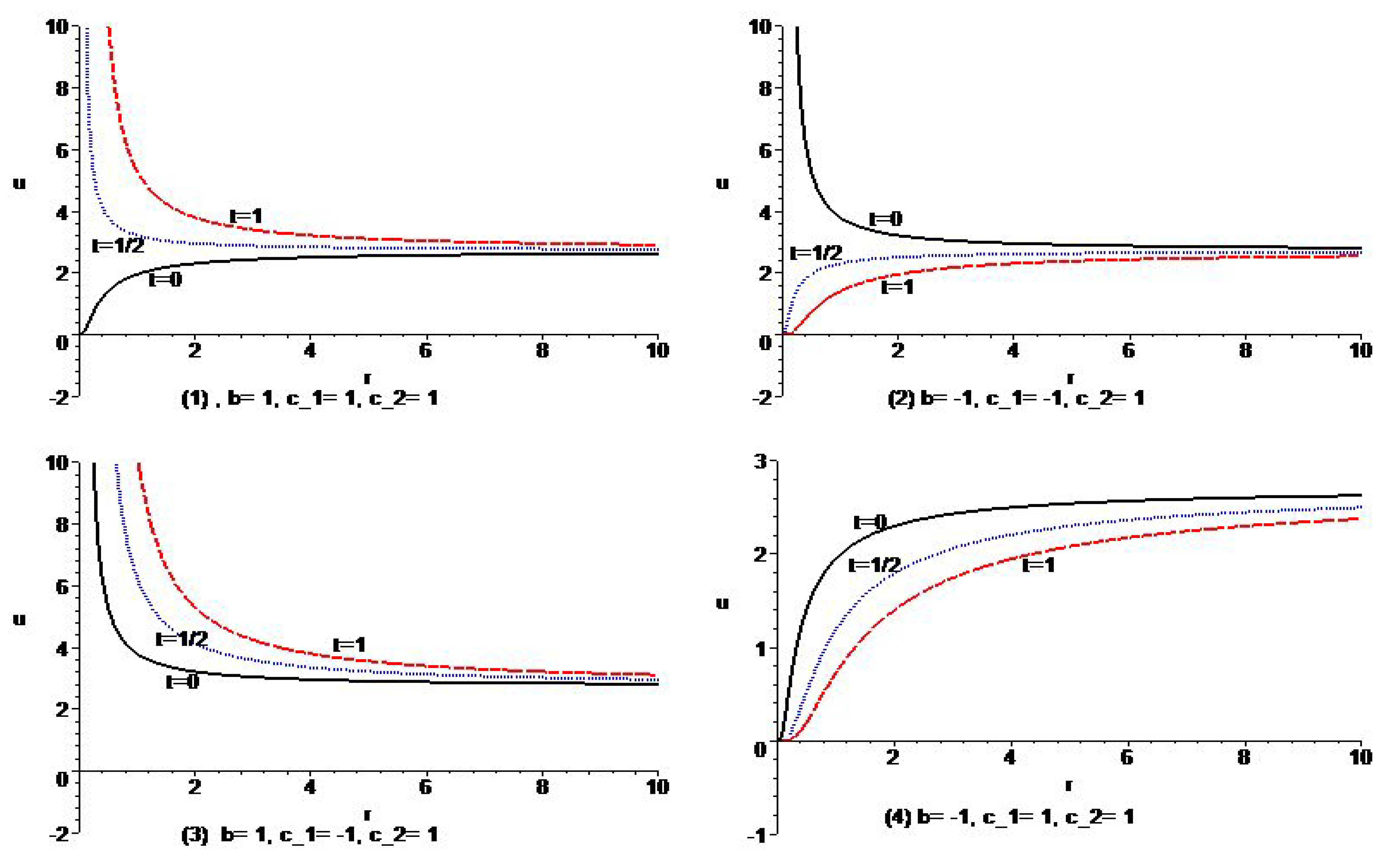
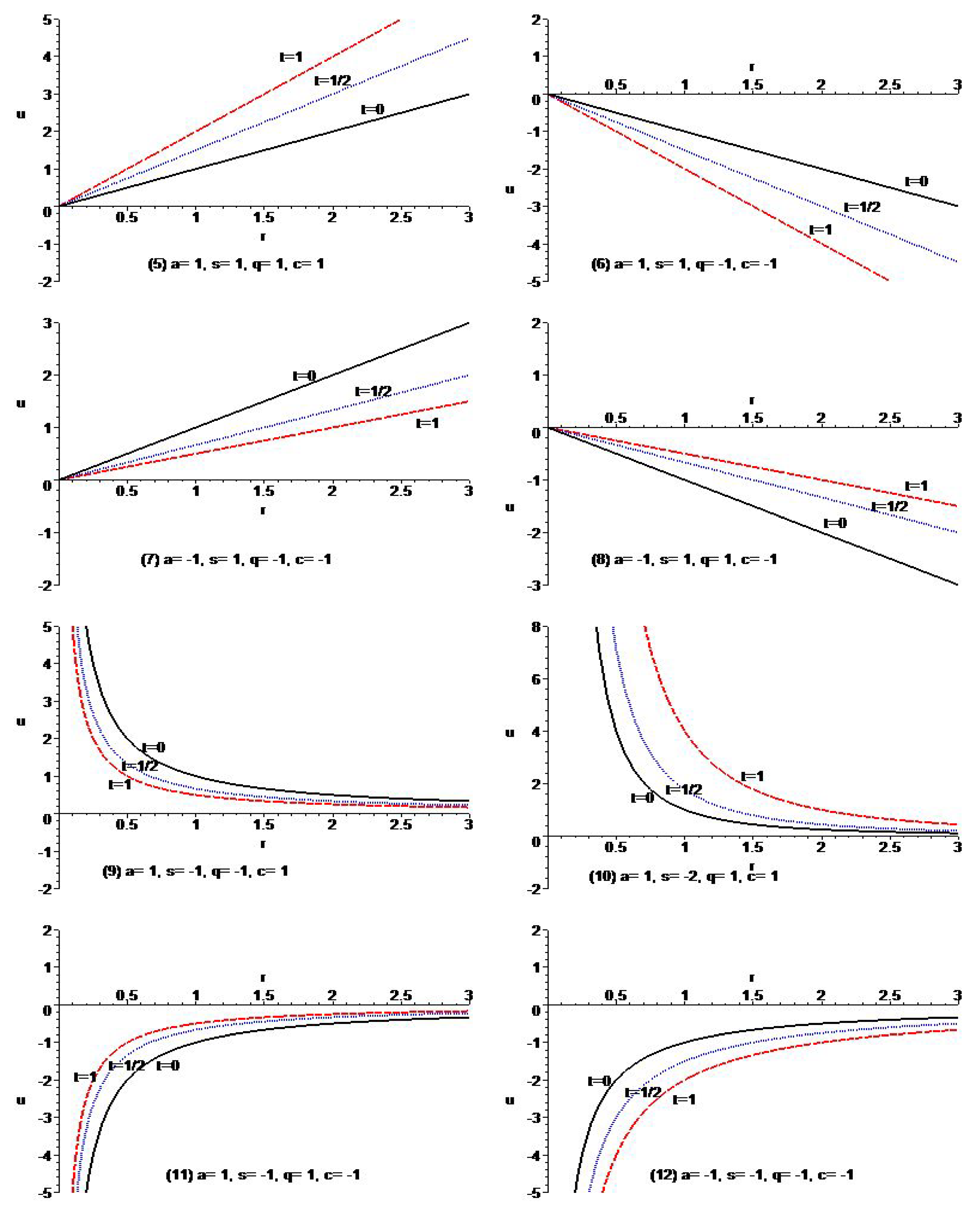
which is suitable for the tumor growth. It is also noted that the resulting solution can reduce to the traveling wave solution for the case of and . Thus, this solution can be regarded as an extension of the traveling wave solution of the porous medium equation with source. Figure 2 shows the typical behavior of the governing equation for the case of and .
Figure 2.
Typical variation of the solutions with and of Example 3 for different types of parameters.
Example 4.
Equation
admits of the first-order sign-invariant
and the second-order conditional Lie-Bäcklund symmetry
The corresponding solutions are given by
and satisfy
Example 5.
Equation
admits of the first-order sign-invariant
The corresponding solutions are given by
where satisfy
The solutions are listed as below.
- (i)
- For ,
- (ii)
- For ,
- (iii)
- For ,
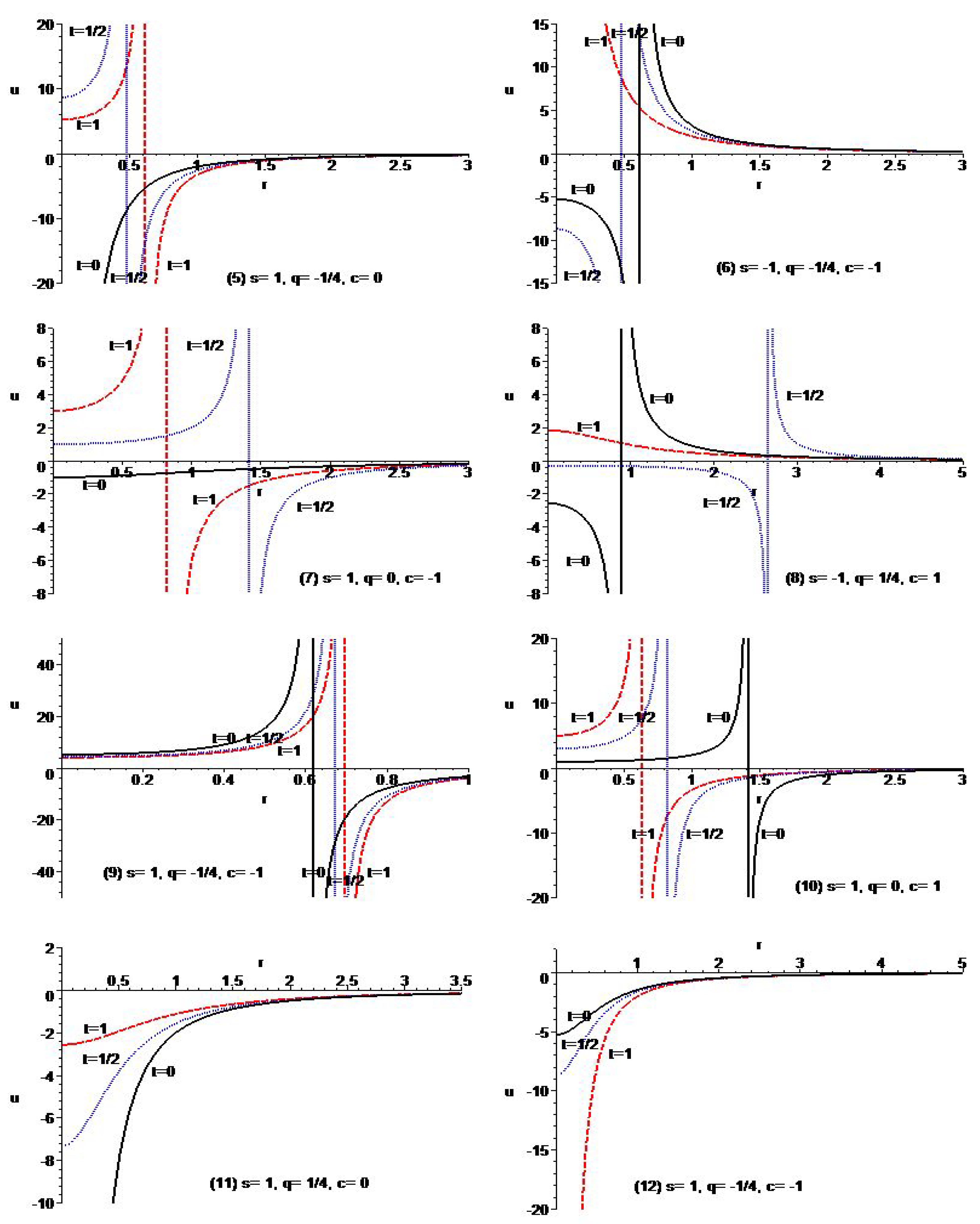
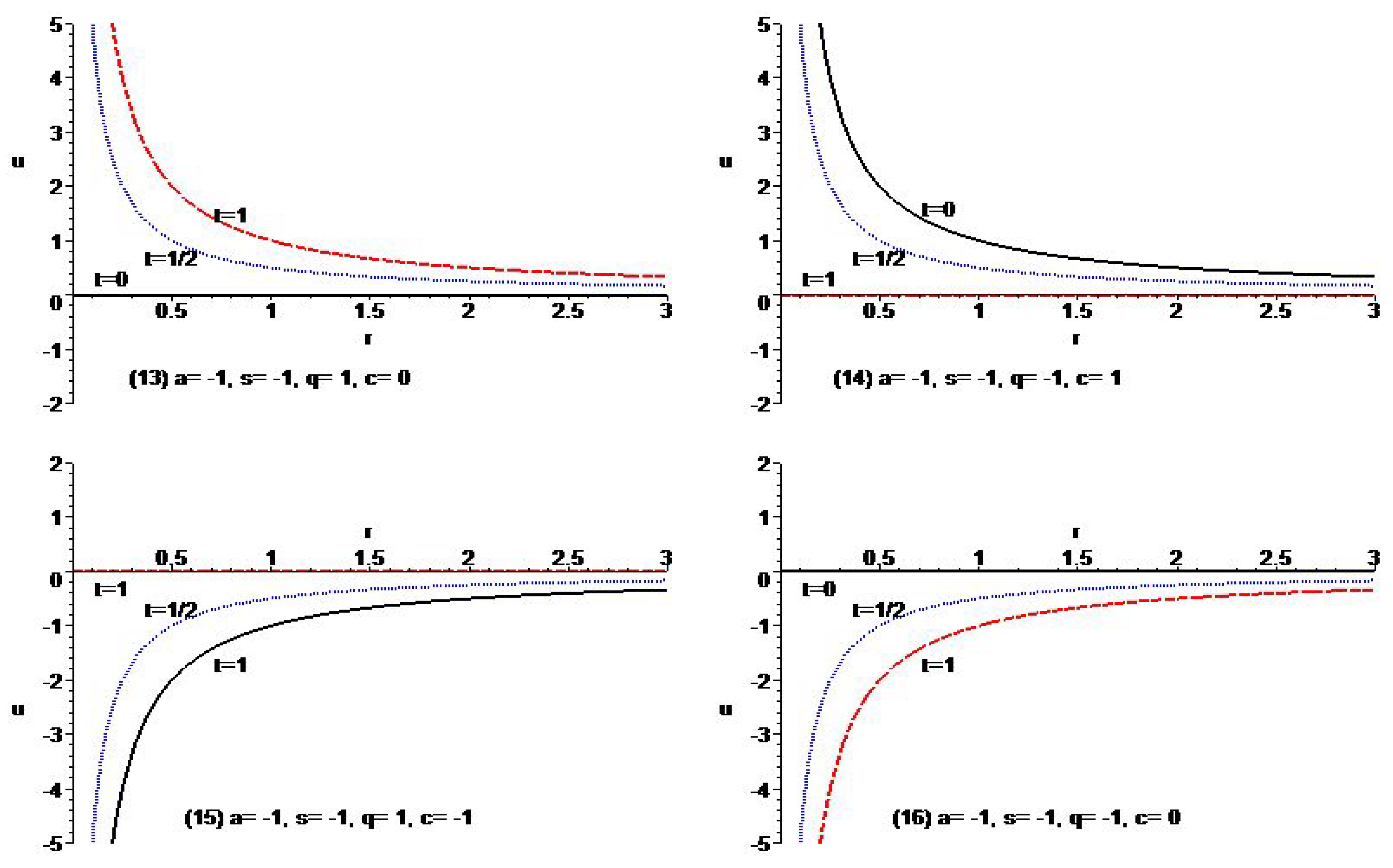
The solutions exhibit the asymptotical behavior as . Moreover, the solutions are the periodic function of t with the period for . Figure 3 shows the typical behavior of the governing equation for the case of .


Figure 3.
Typical variation of the solutions with of Example 5 for different types of parameters.
Example 6.
Equation
admits of the first-order sign-invariant
The corresponding solutions are given as
where satisfy
The solutions are listed as below.
- (i)
- For ,
- (ii)
- For ,
The resulting solutions are exactly functional separable solutions, which exist widely for the nonlinear diffusion Equation (4) with and .
Example 7.
Equation
admits of the first-order sign-invariant
The corresponding solutions are given as below.
- (i)
- For ,
- (ii)
- For ,
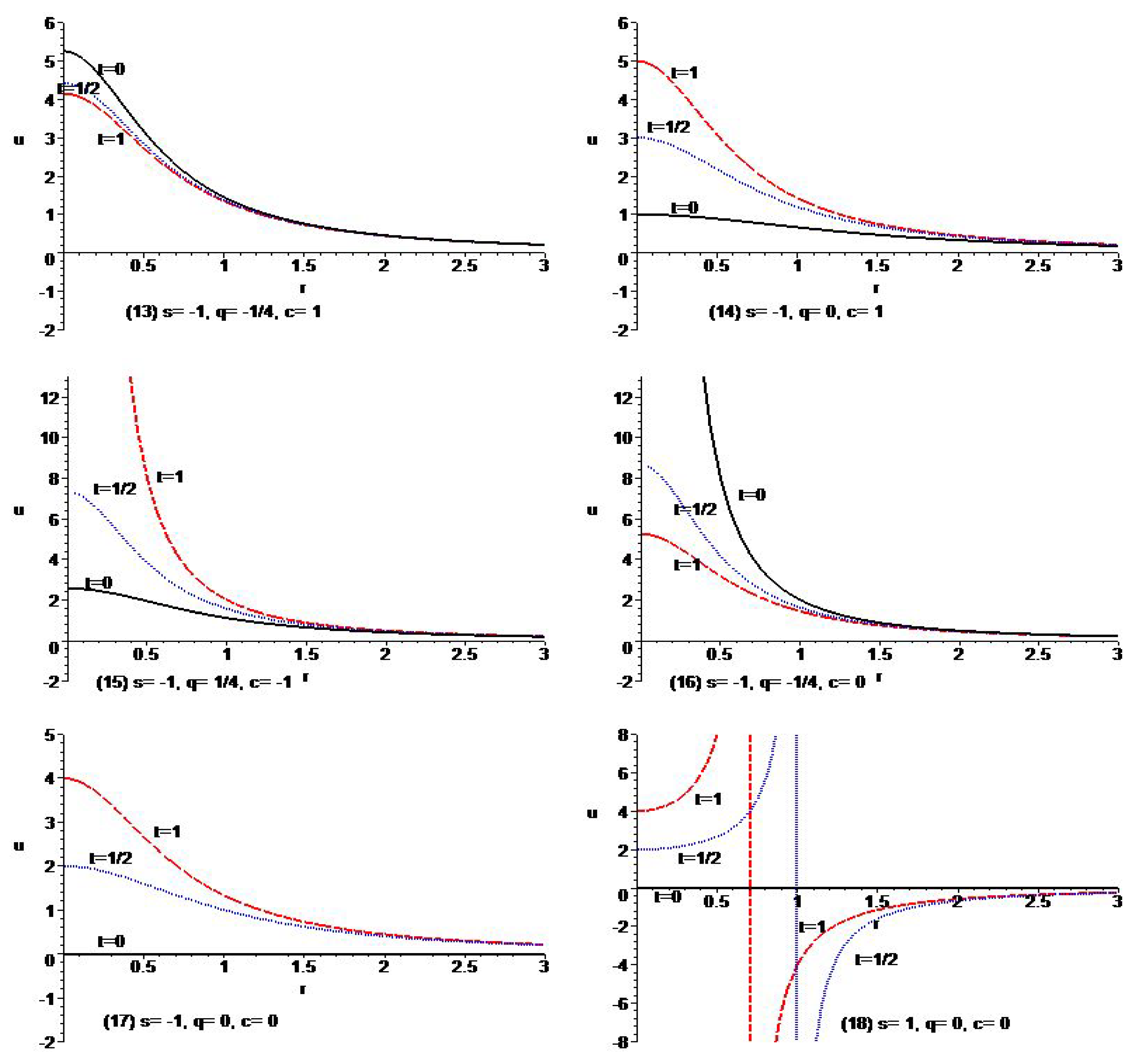
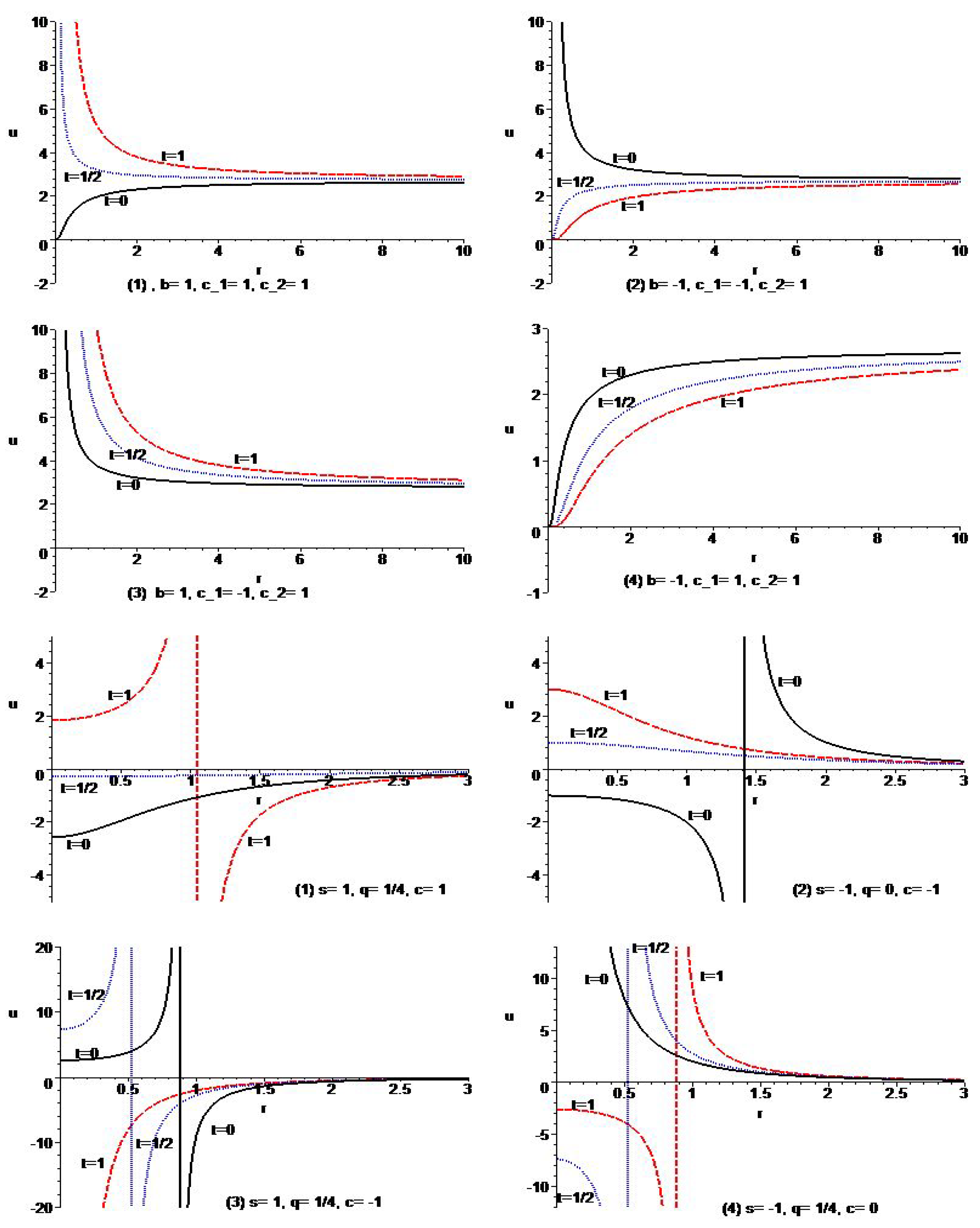
The solutions exhibit the asymptotical behavior as for . Figure 4 shows the typical behavior of the governing equation.


Figure 4.
Typical variation of the solutions of Example 7 for different types of parameters.
5. Conclusions
We constructed exact solutions to the radially symmetric nonlinear diffusion equation with gradient-dependent diffusivity (4) due to the first-order sign-invariant (6), (11) and (12). The first-order sign-invariant (6) can be translated to the degenerated second-order conditional Lie-Bäcklund symmetry for Equation (4), which yields the form of nonlinear separable solutions for the governing Equation (4). Moreover, various kinds of functional separable solutions for Equations (4) are constructed due to the reductions of the admitted first-order sign-invariant (11) and (12). The analysis of the resulting equation are also presented.
In fact, second-order conditional Lie-Bäcklund symmetry can give symmetry interpretation for first-order sign-invariant of nonlinear diffusion Equations [1,2,3]. Moreover, symmetry methods and symmetry-related methods are very effective to study different types of evolution equations and its fractional version, so does for systems of evolution equations. The discussion of first-order sign-invariant (6), (7) and other forms for variant forms of KdV Equation [32] and its fractional version, multi-dimensional Schrödinger equation, and systems of KdV equations will be involved in our future study.
Author Contributions
Conceptualization, L.J.; methodology, L.J.; software, J.Z. and M.X.; validation, X.L.;formal analysis, L.J.; investigation, X.L.; resources, J.Z. and M.X; data curation, J.Z. and M.X; writing—original draft preparation, L.J.; writing—review and editing, Y.M.; visualization, L.J.; supervision, Y.M.; All authors have read and agreed to the published version of the manuscript.
Funding
This work was supported by the Foundation of Yibin University (Grant No. 2019QD07).
Institutional Review Board Statement
Not applicable.
Informed Consent Statement
Not applicable.
Data Availability Statement
Not applicable.
Conflicts of Interest
The authors declare no conflict of interest.
References
- Qu, C.Z.; Estévez, P.G. On nonlinear diffusion equations with x-dependent convection and absorption. Nonlinear Anal. TMA 2004, 57, 549–557. [Google Scholar] [CrossRef]
- Qu, C.; Ji, L.; Wang, L. Conditional Lie Bäcklund Symmetries and Sign-Invariants to Quasi-Linear Diffusion Equations. Stud. Appl. Math. 2007, 119, 355–391. [Google Scholar] [CrossRef]
- Ji, L.; Zhang, X.; Yan, R. Conditional Lie–Bäcklund symmetries and sign-invariants to second-order evolution equations. Commun. Nonlinear Sci. Numer. Simul. 2012, 17, 3476–3482. [Google Scholar] [CrossRef]
- Galaktionov, V.A. Quasilinear heat equations with first-order sign-invariants and new explicit solutions. Nonlinear Anal. Theory Methods Appl. 1994, 23, 1595–1621. [Google Scholar] [CrossRef]
- Galaktionov, V.A.; Posashkov, S.A. New explicit solutions of quasilinear heat equations with general first-order sign-invariants. Phys. D Nonlinear Phenom. 1996, 99, 217–236. [Google Scholar] [CrossRef]
- Galaktionov, V.A.; Svirshchevskii, S.R. Exact Solutions and Invariant Subspaces of Nonlinear Partial Differential Equations in Mechanics and Physics; CRC Press: Boca Raton, FL, USA, 2006. [Google Scholar]
- Galaktionov, V.A.; Posashkov, S.A. Maximal sign-invariants of quasilinear heat equations with gradient diffusivity. J. Math. Phys. 1998, 39, 4948–4964. [Google Scholar] [CrossRef]
- Olver, P.J. Direct reduction and differential constraints. Proc. R. Soc. Lond. A 1994, 444, 509–523. [Google Scholar] [CrossRef]
- Galaktionov, V.A. Two methods of comparison of solutions of parabolic equations. Sov. Phys. Dok. 1980, 25, 250–252. [Google Scholar]
- Ji, L.; Feng, W. Second-Order Conditional Lie–Bäcklund Symmetries and Differential Constraints of Nonlinear Reaction–Diffusion Equations with Gradient-Dependent Diffusivity. Symmetry 2018, 10, 267. [Google Scholar] [CrossRef]
- Grarilov, V.P.; Klepikova, N.V.; Rodean, H.C. Trials of nonlinear diffusion equation as a model of turbulent diffusion. Atmo. Env. 1995, 29, 2317–2322. [Google Scholar]
- Pascal, J.; Pascal, H. On some non-linear shear flows of non-Newtonian fluids. Int. J. Nonlinear Mech. 1995, 30, 487–500. [Google Scholar] [CrossRef]
- Assis, P.C., Jr.; Da Silva, L.R.; Lenzi, E.K.; Malacarne, L.C.; Mendes, R.S. Nonlinear diffusion equation, Tsallis formalism and exact solutions. J. Math. Phys. 2005, 46, 123303. [Google Scholar] [CrossRef]
- Bokhari, H.; AI Deweik, A.Y.; Kara, A.H.; Zaman, F.D. A symmetry analysis of some classes of evolutionary nonlinear (2+1)-diffusion equations with variable diffusivity. Nonlinear Dyn. 2010, 62, 127–138. [Google Scholar] [CrossRef]
- Opanasenko, S.; Boyko, V.; Popovych, R.O. Enhanced group classification of nonlinear diffusion–reaction equations with gradient-dependent diffusivity. J. Math. Anal. Appl. 2020, 484, 123739. [Google Scholar] [CrossRef]
- Cherniha, R.; Kovalenko, S. Lie symmetries and reductions of multi-dimensional boundary value problems of the Stefan type. J. Phys. A Math. Theor. 2011, 44, 485202. [Google Scholar] [CrossRef]
- Cherniha, R.; Serov, M.; Prystavka, Y. A complete Lie symmetry classification of a class of (1+2)-dimensional reaction-diffusion-convection equations. Commun. Nonlinear Sci. Numer. Simul. 2020, 92, 105466. [Google Scholar] [CrossRef]
- Cherniha, R.; King, J.R.; Kovalenko, S. Lie symmetry properties of nonlinear reaction-diffusion equations with gradient-dependent diffusivity. Commun. Nonlinear Sci. Numer. Simul. 2016, 36, 98–108. [Google Scholar] [CrossRef]
- Cherniha, R.; King, J.R. Lie and Conditional Symmetries of a Class of Nonlinear (1 + 2)-Dimensional Boundary Value Problems. Symmetry 2015, 7, 1410–1435. [Google Scholar] [CrossRef]
- Broadbridge, P.; Bradshaw-Hajek, B.H.; Triadis, D. Exact non-classical symmetry solutions of Arrhenius reaction–diffusion. Proc. R. Soc. A Math. Phys. Eng. Sci. 2015, 471, 20150580. [Google Scholar] [CrossRef]
- Broadbridge, P.; Daly, E.; Goard, J.M. Exact solutions of the Richards equation with nonlinear pant-root extraction. Water Resour. Res. 2017, 53, 9679–9691. [Google Scholar] [CrossRef]
- Goard, J.; Broadbridge, P. Nonclassical symmetry analysis of nonlinear reaction-diffusion equations in two spatial dimensions. Nonlinear Anal. Theory Methods Appl. 1996, 26, 735–754. [Google Scholar] [CrossRef]
- Ji, L.; Wang, R. Conditional Lie-Bäcklund Symmetries and Differential Constraints of Radially Symmetric Nonlinear Convection-Diffusion Equations with Source. Entropy 2020, 22, 873. [Google Scholar] [CrossRef] [PubMed]
- Hu, J.Y.; Yin, H. Separation of variables solutions of nonlinear reaction-diffusion system. J. Phys. A Math. Theor. 2007, 40, 3389–3398. [Google Scholar]
- Zhu, X.N.; Zhang, S.L. Sign-invariant and explicit solutions of nonlinear reaction-diffusion systems. Comm. Theor. Phys. 2008, 49, 1361–1364. [Google Scholar]
- Friedman, A.; McLeod, B. Blow-up of positive solutions of semilinear heat equation. Ind. Univ. Math. J. 1985, 34, 425–447. [Google Scholar] [CrossRef]
- Galaktionov, V.A.; Posashkov, S.A. Single point blow-up for N-dimensional quasi-linear equations with gradient diffusion and source. Ind. Univ. Math. J. 1991, 40, 1041–1060. [Google Scholar] [CrossRef]
- Galaktionov, V.A. Groups of scalings and invariant sets for higher-order nonlinear evolution equations. Diff. Int. Equ. 2001, 14, 913–924. [Google Scholar]
- Qu, C.; Estévez, P. Extended rotation and scaling groups for nonlinear evolution equations. Nonlinear Anal. Theory, Methods Appl. 2003, 52, 1655–1673. [Google Scholar] [CrossRef]
- Qu, C. Symmetries and solutions to the thin film equations. J. Math. Anal. Appl. 2006, 317, 381–397. [Google Scholar] [CrossRef][Green Version]
- Britton, N.F. Essential Mathematical Biology; Springer: Singapore, 2003. [Google Scholar]
- Benia, Y.; Scapellato, A. Existence of solution to Korteweg-de Vries equation in a non-parabolic domain. Nonlinear Anal. Theory Methods Appl. 2020, 195, 111758. [Google Scholar] [CrossRef]
Publisher’s Note: MDPI stays neutral with regard to jurisdictional claims in published maps and institutional affiliations. |
© 2022 by the authors. Licensee MDPI, Basel, Switzerland. This article is an open access article distributed under the terms and conditions of the Creative Commons Attribution (CC BY) license (https://creativecommons.org/licenses/by/4.0/).