


Abstract
The main objective of this work is to develop the fuzzy fractional mathematical model that will be used to examine the dynamics of monkeypox viral transmission. The proposed dynamical model consists of human and rodents individuals and this monkeypox infection model is mathematically formulated by fuzzy fractional differential equation defined in Caputo’s sense. We provide results that demonstrate the existence and uniqueness of the considered model’s solution. We observe that our results are accurate, and that our method is applicable to the fuzzy system of fractional ordinary differential equations (ODEs). Furthermore, this monkeypox virus model has been identified as a generalization of SEIQR and SEI models. The results show that keeping diseased rodents apart from the human population reduces the spread of disease. Finally, we present brief discussions and numerical simulations to illustrate our findings.
1. Introduction
The first case of monkeypox in humans was detected in the Congo region in 1970, where smallpox had been eradicated in that region in 1968 [1]. Monkeypox is a zoonotic viral disease that is connected to smallpox and other orthopoxviruses [2]. Although early research revealed that human-to-human transmission was unusual, more current research indicates significant attack rates, raising the prospect of an epidemic or pandemic [3,4]. However, compared to smallpox, monkeypox has a much lower mortality rate [5]. Additionally, it appears that those who have received the smallpox vaccination tolerate the sickness better than the general public who are not vaccinated (see [2,3,6]). However, in Europe, where smallpox was successfully eradicated, only the older age groups of the population received smallpox vaccinations [7]. This problem was resolved by the swift procurement of smallpox vaccines in the United Kingdom, which will mostly be spread to close relatives of people with monkeypox diagnoses and to healthcare professionals who will look after such patients [6]. Although there are various cutting-edge antivirals, such as Tecovirimat, vaccinia immune globulin, and Brincindofovir that can be used to stop the transmission of the disease, there are currently no established treatments for monkeypox infection.
In human history, smallpox was the first viral disease to be eradicated. Following a successful global vaccination program, the World Health Organization (WHO) proclaimed the elimination of the Variola virus in 1980. Since that time, the only known smallpox virus samples have been stored in particular repositories in Russia and the USA [8,9,10]. Smallpox is a highly contagious illness that only affects humans and has an extreme fatality rate of up to 40. Between 300 and 500 million people died of smallpox throughout the 20th century [11]. All nations stopped routinely delivering vaccinia-based smallpox vaccinations at least 40 years ago. Unvaccinated populations are now more vulnerable to infection with the monkeypox virus, whereas vaccination provided protection against the disease in the west and central Africa [1].
A non-endemic outbreak of human monkeypox was reported in 50 different nations as of the end of June 2022, with fewer than 4900 cases worldwide. Transmission has moved from human-to-human in each nation beyond instances connected to original exposure in Africa [12]. The monkeypox virus spreads slowly and only through close contact, there are licensed vaccines and treatments are available, and the circulating virus is a member of the Western African clade of monkeypox viruses, which is known to be less virulent. These criteria suggest that the outbreak is manageable [12,13,14,15,16]. Therapeutics and vaccinations for smallpox and monkeypox that have just received approval are now being used in the real world, and revealing gaps in our arsenal [17]. Numerous vaccinations and antivirals have been tested in this model thus far [18], including medicines licensed by the Drug Administration (FDA) and US Food [19]. The spread of monkeypox virus is provided in [20].
Monkeypox outbreaks were reported in many non-endemic nations in May 2022. Research is now being conducted to better understand the epidemiology, patterns of transmission, and sources of illness [1]. The yearwise monkeypox virus outbreaks are mentioned in Table 1.

Table 1.
The global spread of the monkeypox virus is depicted below.
The WHO has classified the ongoing monkeypox outbreak as a public health emergency of international concern [21]. This is in accordance with the surveillance report published by the European Center for Disease Prevention and Control (ECDC) up to the second of August 2022, which listed 15,926 MPXV cases detected in 38 different countries throughout Europe [22]. From 1 January 2022, to 15 August 2022, the conformed global cases and confirmed global deaths are 31,799 and 12, respectively, [23].
Recently, ref. [24] The European Medicines Agency (EMA) approved Tecovirimat as the first oral therapy for monkeypox in January 2022. The most recent information on the phylogenesis, pathophysiology, prevention, and treatment of this alarming disease is available in [25].
Modern genetic research on orthologous immunogenic vaccinia-virus proteins is examined in [26]. The article [27] describes a morphogenic composition-characterized preparation of EV-enriched monkeypox virus. The authors in [28] describe the illness brought on by the Zaire strain of pure monkeypox virus [29]. The thorough explanation of an early instance, supported by clinical findings as well as results from Whole-Genome Sequencing (WGS) data and studies. This report illustrates one of the current outbreak’s first well-documented instances. A panel of closely related pathogens were being quickly and accurately identified using the RANS technique [30].
Since the disease has not received much attention in the past, we do not know enough about how it spreads. To explore the dynamics of the monkeypox virus, mathematical modeling has only been used in a small number of research. Our aim is to applying the fuzzy fractional differential equations (FFDE) in the monkeypox virus model and then investigating the disease transmission for the time t and effects of such factors on a mathematical approach. One can refer the different types of solving technique for the fractional order epidemic models in [31,32,33,34,35].
In our work, the fractional order (Caputo’s sense) SEIQRSEI epidemic model is investigated for Monkeypox virus system mathematically. Since the fractional order differential operators are non-local operators, they can better represent some dynamic system processes and natural physics processes when compared to integer order differential equation. The Caputo fractional operator is more flexible for analysis and handles the initial and boundary value problems. It is also widely used to define the time-fractional derivatives in fractional partial differential equations. This motivates us to solve the fuzzy fractional differential equations in Caputo sense. The fractional differential equations with fuzzy solutions, as well as fuzzy boundary and initial value problems can be solved using the fuzzy Laplace transform technique. Another significant benefit is that it offers direct problem-solving without first generating non-homogeneous differential equations and then figuring out a general solution. In addition, the numerical results from the fuzzy Laplace transform based on the Adomian decomposition are helpful in understanding the physical behaviour of Monkeypox virus with dynamical structures. The monotonicity theorem and the numerical simulations for the inter-valued fractional order differential equations can refer in the recent articles such as [36,37,38,39,40].
The following is how the paper is organized: Section 2 describes model formulation and analysis. Next, we analyze the existence and uniqueness of the solutions of fuzzy fractional differential equation system for the model. Section 3.2 is followed by numerical simulations and results, followed by Section 4, and then finally conclusion.
2. Mathematical Modelling
We present a deterministic compartmental model of monkeypox transmission dynamics based on two individuals: humans and rodents [41]. In the given model (1), the human population is subdivided into five compartment such as suspected , exposed , infected , Quarantine , recovered and rodent individuals is subdivided into three compartment such as suspected , exposed , infected . The corresponding system is taken as
where .
The transmission parameters for human population and the rodent individuals is given in Table 2 and their Schemmatic representation of monkeypox virus model is given in Figure 1.
Table 2.
The parameter (transmission rate) values are mentioned as follows [41].
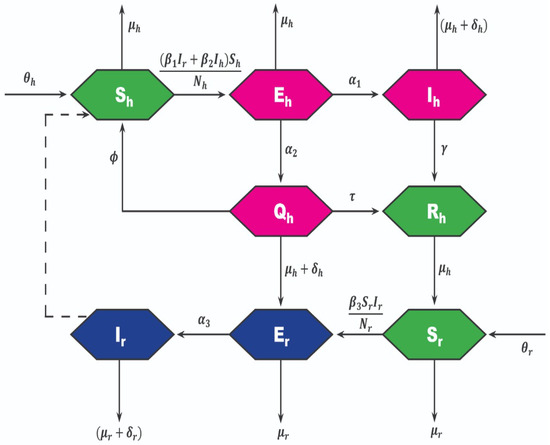
Figure 1.
Diagrammatic representation of monkeypox virus.
Since we are dealing with the caputo derivative, we should solve the right side of Equation (1) in the caputo sense by applying the caputo fractional derivative to the left side of Equation (1). Using the Caputo fractional derivative for fractional order , Equation (1) can be formulated as
Fuzzy calculus and FODEs have been developed in recent years by extending modern calculus and DEs [42] and then it was extended to fuzzy FODEs [43]. In order to establish the uniqueness and existence theory of solutions, several academics have explored FODEs and fuzzy integral equations [44,45,46]. Numerous efforts have been undertaken by mathematicians to solve fuzzy FODEs using a variety of strategies, including spectral techniques, integral transform methods, perturbation methods and stability analysis [47,48,49].
The fuzzy fractional operator in caputo sense of Equation (2) becomes
with fuzzy initial conditions for .
3. Fuzzy Fractional Analysis in the Monkeypox Model
This section takes into account the solution’s existence and uniqueness for the fuzzy fractional model.
3.1. A Fuzzy Fractional Model’S Existence Furthermore, Uniqueness
It is significant to remember the following points, if the fuzzy fractional differential equation represents a physical problem mathematically, i.e.,
- The mathematical model’s beginning conditions should have a solution.
- We want every mathematical model to have a single solution that is determined by the initial conditions. Now, rewriting Equation (3) in the form ofwhere the fuzzy functions are . Therefore,which subject to the initial conditions
Now, applying the fuzzy fractional Integration on Equation (5), we obtain
3.2. Scheme of the Solution
Applying the fuzzy Laplace transform on Equation (5), one can easily find
The above expressions can be written as the form of
By substituting and then performing the inverse Laplace transform on both sides, we obtain
If , then , then the aforementioned relation can be expressed as
Considering the infinite series solution, we arrive at
Now, substituting these infinite series solution in the previous equations, we obtain
When equating the terms in the parametric form, then Equation (8) becomes
The second term of the human suspected case of infinite sum of Equation (8) will be
The second term of the human exposed case of infinite sum of Equation (8) will be
Similarly, the second term of the human-infected, quarantined, and recovered case of infinite sum of Equation (8) are given in Equations (11)–(13), respectively.
In the similar manner, the second term of the rodent-infected, quarentine and recovered case of infinite sum of Equation (8) are, respectively, given in Equations (14)–(16).
The third term of the human suspected, exposed, infected, quarantined, and recovered case are mentioned in Equations (17)–(21).
The third term of the rodent suspected, exposed, or infected cases are mentioned in Equations (22)–(24).
Similarly, we can find the third, fourth, fifth, ⋯ terms. Finally, the general solution for the SEIQRSEI epidemic model for the monkeypox virus infection is given below.
- (i)
- Human suspected case:
- (ii)
- Human-exposed case:
- (iii)
- Human-infected case:
- (iv)
- Human-quarantined case:
- (v)
- Human recovered case:
- (vi)
- Rodent suspected case:
- (vii)
- Rodent exposed case:
- (viii)
- Rodent-infected case:
4. Results Furthermore, Discussion
In this section, the series solution for a particular triangular fuzzy number are computed. Take the suggested model’s initial conditions as
Using the approach described above and with the initial conditions, we obtain the first term as
The second term of the infinite sum will be
The third term of the infinite sum will be
Now we can solve Equations (25)–(32) by substituting the values from Table 2 in the first term, second term, third term, etc. relations, and we obtain
The spread of transmission of monkeypox virus is shown in Figure 2, Figure 3, Figure 4, Figure 5, Figure 6, Figure 7, Figure 8 and Figure 9 using the fuzzy fractional order at . It also finds the solution for the following Equations (25)–(32). The existence of solutions is guaranteed by w-monotunity conditions (refer [39,40]).
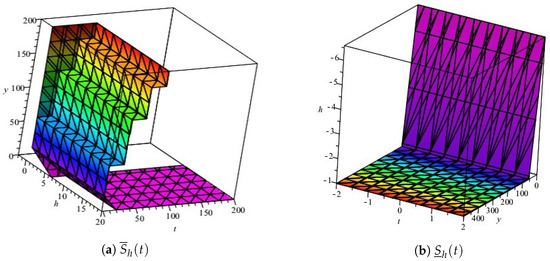
Figure 2.
(a) t ranges from −2 to 20 and y varies from 0 to 200; (b) t ranges from −2 to 2 and y varies from 0 to 500.
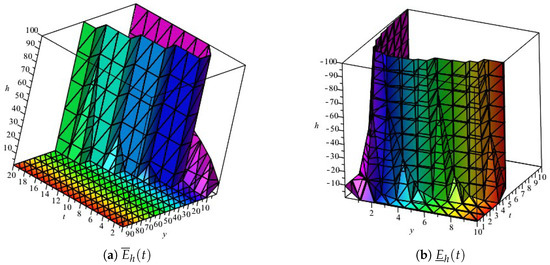
Figure 3.
(a) t varies from 0.5 to 20 and y ranges from 0.25 to 100; (b) t ranges from 0.05 to 10 and y ranges from 0.001 to 10.
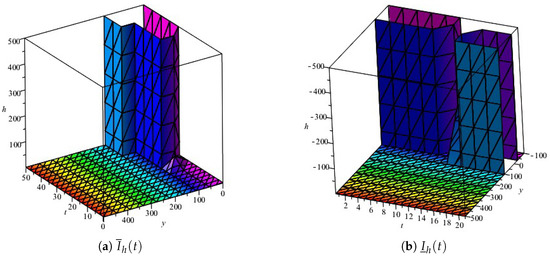
Figure 4.
(a) t ranges from −0.5 to 50 and y ranges from 0 to 500; (b) t ranges from 0 to 20 and y ranges from 1 to 250.
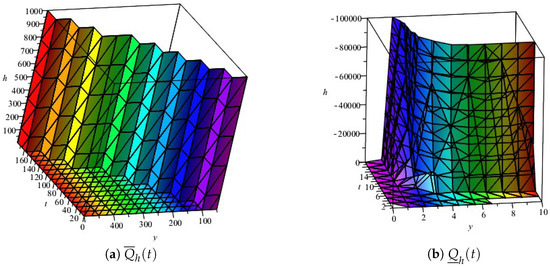
Figure 5.
(a) t ranges from 0 to 200 and y ranges from 50 to 500; (b) t ranges from 1 to 20 and y ranges from 0 to 10.
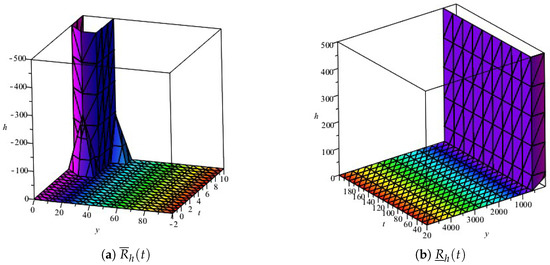
Figure 6.
(a) t ranges from −2 to 10 and y ranges from 0 to 100; (b) t ranges from 20 to 200 and y ranges from 500 to 5000.
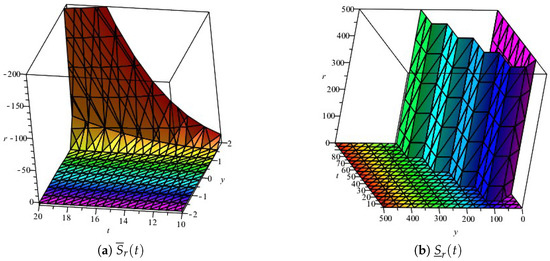
Figure 7.
(a) t ranges from 10 to 20 and y ranges from −2 to 2; (b) t ranges from 5 to 100 and y ranges from 0 to 500.
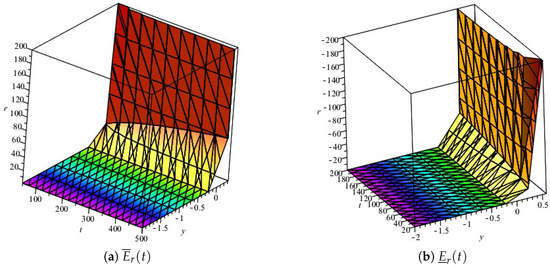
Figure 8.
(a) t ranges from 50 to 500 and y ranges from −2 to 2; (b) t ranges from 20 to 200 and y ranges from −2 to 2.
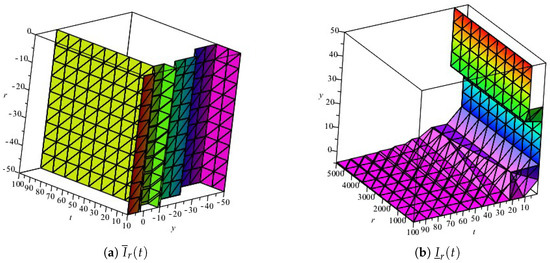
Figure 9.
(a) t ranges from 0.5 to 100 and y ranges from −50 to 10; (b) t ranges from 0.1 to 100 and y ranges from −5 to 50.
Generalized Compartmental Model
According to model (1), close interaction with infected rodents will result in the spread of the monkeypox virus to humans. The monkeypox virus will not spread to humans if the infected rodents do not infect any humans. As a result, if falls to zero in (1), there are no suspected, exposed, or infected human populations. As a result, this model will reduce to the SEIQR model.
Equations (49) and (50) represent the SEIQR and SEI models for humans and rodents, respectively. There are numerous approaches used to solve the solution for these two models [50,51,52,53]. As a result, the monkeypox virus model can be considered to be the generalized compartmental model for all other compartmental models.
5. Conclusions
The goal of the current paper is to use a fuzzy fractional mathematical model to analyze the dynamics of monkeypox virus transmission. Here, we used the Caputo’s derivative method in fuzzy system to solve the uniqueness and existence for the considered model. The results pertaining to fractional order differential equation solutions are advantageous in applications to various epidemic models for the deduction of viral spread. The graphic representation of the SEIQRSEI system’s response to changes for different parameters shows that the number of suspected and exposed human cases is gradually rising. This has the effect of rapidly accelerating infection transmission. The spread of infection within the population can be reduced using control measures. The spread of the monkeypox virus will slow down due to the reduction in the transmission parameter, which includes contact rates between exposed individuals and infected individuals , and contributions from different values. It was observed that exposed and infected people exhibit a reasonable reduction. As a result, the infection can be somewhat controlled by lowering effective contact rates. Furthermore, we deduced that the compartmental monkeypox virus model will result in the generalization of additional models such as SEI, SEIR, SEIQR, etc. The generalized compartmental section indicates that if the infection rate of rodent is zero (), there will be no spread of rodent individuals to the human population. Future research can be conducted using several monkeypox epidemic models with various fractional order derivatives.
Author Contributions
Funding acquisition, R.I.; Conceptualization, Writing—original draft, V.R.S. and R.I.; Methodology, Writing—review and editing, P.C.; Software, Visualization, N.A.; Validation, Formal analysis, review and editing, G.B.A.X.; Validation, Investigation and Formal analysis, R.I. All authors have read and agreed to the published version of the manuscript.
Funding
This research was supported by Deanship of Scientific Research at King Khalid University. Grant number [R.G.P.1/277/43].
Institutional Review Board Statement
Not applicable.
Informed Consent Statement
Not applicable.
Data Availability Statement
Not applicable.
Acknowledgments
The authors express their appreciation to the Deanship of Scientific Research at King Khalid University for funding this work through the public research project (R.G.P.1/277/43).
Conflicts of Interest
The authors declare no conflict of interest.
References
- World Health Organization. Monkeypox. 2022. Available online: https://www.who.int/news-room/fact-sheets/detail/monkeypox (accessed on 19 May 2022).
- McCollum, A.M.; Damon, I.K. Human monkeypox. Clin. Infect. Dis. 2014, 58, 260–267. [Google Scholar] [CrossRef] [PubMed]
- Fine, P.E.; Jezek, Z.; Grab, B.; Dixon, H. The transmission potential of monkeypox virus in human populations. Int. J. Epidemiol. 1988, 17, 643–650. [Google Scholar] [CrossRef] [PubMed]
- Nolen, L.D.; Osadebe, L.; Katomba, J.; Likofata, J.; Mukadi, D.; Monroe, B.; Doty, J.; Hughes, C.M.; Kabamba, J.; Malekani, J.; et al. Extended human-to-human transmission during a monkeypox outbreak in the Democratic Republic of the Congo. Emerg. Infect. Dis. 2016, 22, 1014. [Google Scholar] [CrossRef] [PubMed]
- Kavanagh, K. Monkeypox: CDC Raises Travel Alert, However, How Much Threat Is It Really? 2022. Available online: https://www.infectioncontroltoday.com/view/monkeypox-cdc\-raises-travel-alert-but-how-much-threat-is-it-really (accessed on 18 July 2022).
- Mahase, E. Monkeypox: Healthcare workers will be offered smallpox vaccine as UK buys 20,000 doses. BMJ 2022, 377, o1379. [Google Scholar] [CrossRef] [PubMed]
- Strassburg, M.A. The global eradication of smallpox. Am. J. Infect. Control 1982, 10, 53–59. [Google Scholar] [CrossRef] [PubMed]
- Moss, B. Genetically engineered poxviruses for recombinant gene expression, vaccination, and safety. Proc. Natl. Acad. Sci. USA 1996, 93, 11341–11348. [Google Scholar] [CrossRef]
- Henderson, D.A. Smallpox: Clinical and Epidemiologic Features. Emerg. Infect. Dis. 1999, 5, 537–539. [Google Scholar] [CrossRef]
- Pennington, H. Smallpox and bioterrorism. Bull. World Health Organ. 2003, 81, 762–767. [Google Scholar]
- Silva, N.I.; de Oliveira, J.S.; Kroon, E.G.; Trindade, G.D.; Drumond, B.P. Here, there, and everywhere: The wide host range and geographic distribution of zoonotic orthopoxviruses. Viruses 2020, 13, 43. [Google Scholar] [CrossRef]
- Memariani, M.; Memariani, H. Multinational monkeypox outbreak: What do we know and what should we do? Ir. J. Med. Sci. 2022, 1–2. [Google Scholar] [CrossRef]
- Bunge, E.M.; Hoet, B.; Chen, L.; Lienert, F.; Weidenthaler, H.; Baer, L.R.; Steffen, R. The changing epidemiology of human monkeypox—A potential threat? A systematic review. PLoS Negl. Trop. Dis. 2022, 16, e0010141. [Google Scholar] [CrossRef] [PubMed]
- Vaughan, A.; Aarons, E.; Astbury, J.; Balasegaram, S.; Beadsworth, M.; Beck, C.R.; Chand, M.; Oconnor, C.; Dunning, J.; Ghebrehewet, S.; et al. Two cases of monkeypox imported to the United Kingdom, September 2018. Eurosurveillance 2018, 23, 1800509. [Google Scholar] [CrossRef] [PubMed]
- Reed, K.D.; Melski, J.W.; Graham, M.B.; Regnery, R.L.; Sotir, M.J.; Wegner, M.V.; Kazmierczak, J.J.; Stratman, E.J.; Li, Y.; Fairley, J.A.; et al. The detection of monkeypox in humans in the Western Hemisphere. N. Engl. J. Med. 2004, 350, 342–350. [Google Scholar] [CrossRef] [PubMed]
- Hutson, C.L.; Olson, V.A.; Carroll, D.S.; Abel, J.A.; Hughes, C.M.; Braden, Z.H.; Weiss, S.; Self, J.; Osorio, J.E.; Hudson, P.N.; et al. A prairie dog animal model of systemic orthopoxvirus disease using West African and Congo Basin strains of monkeypox virus. J. Gen. Virol. 2009, 90, 323–333. [Google Scholar] [CrossRef]
- Adler, H.; Gould, S.; Hine, P.; Snell, L.B.; Wong, W.; Houlihan, C.F.; Osborne, J.C.; Rampling, T.; Beadsworth, M.B.; Duncan, C.J.; et al. Clinical features and management of human monkeypox: A retrospective observational study in the UK. Lancet Infect. Dis. 2022, 22, 1153–1162. [Google Scholar] [CrossRef]
- Parker, S.; Buller, R.M. A review of experimental and natural infections of animals with monkeypox virus between 1958 and 2012. Future Virol. 2013, 8, 129–157. [Google Scholar] [CrossRef]
- Merchlinsky, M.; Albright, A.; Olson, V.; Schiltz, H.; Merkeley, T.; Hughes, C.; Petersen, B.; Challberg, M. The development and approval of tecoviromat (TPOXX®), the first antiviral against smallpox. Antivir. Res. 2019, 168, 168–174. [Google Scholar] [CrossRef]
- World Health Organization. Monkeypox. Available online: https://www.who.int/emergencies/emergency-events/item/monkeypox (accessed on 11 July 2022).
- WHO Director-General Declares the Ongoing Monkeypox Outbreak a Public Health Emergency of International Concern. Available online: https://www.who.int/europe/news/item/23-07-2022-who-director-general-declares-the-ongoing-monkeypox-outbreak-a-public-health-event-of-international-concern (accessed on 1 August 2022).
- Joint ECDC-WHO Regional Office for Europe Monkeypox Surveillance Bulletin. Available online: https://monkeypoxreport.ecdc.europa.eu/ (accessed on 9 August 2022).
- Barron, M. Monkeypox vs. COVID-19. American Society for Microbiology. 2022. Available online: https://asm.org/Articles/2022/August/Monkeypox-vs-COVID-19 (accessed on 19 August 2022).
- Almehmadi, M.; Allahyani, M.; Alsaiari, A.A.; Alshammari, M.K.; Alharbi, A.S.; Hussain, K.H.; Alsubaihi, L.I.; Kamal, M.; Alotaibi, S.S.; Alotaibi, A.N.; et al. A Glance at the Development and Patent Literature of Tecovirimat: The First-in-Class Therapy for Emerging Monkeypox Outbreak. Viruses 2022, 14, 1870. [Google Scholar] [CrossRef] [PubMed]
- Tiecco, G.; Degli Antoni, M.; Storti, S.; Tomasoni, L.R.; Castelli, F.; Quiros-Roldan, E. Monkeypox, a Literature Review: What Is New and Where Does This concerning Virus Come From? Viruses 2022, 14, 1894. [Google Scholar] [CrossRef]
- Ahmed, S.F.; Sohail, M.S.; Quadeer, A.A.; McKay, M.R. Vaccinia-Virus-Based Vaccines Are Expected to Elicit Highly Cross-Reactive Immunity to the 2022 Monkeypox Virus. Viruses 2022, 14, 1960. [Google Scholar] [CrossRef]
- Mucker, E.M.; Shamblin, J.D.; Goff, A.J.; Bell, T.M.; Reed, C.; Twenhafel, N.A.; Chapman, J.; Mattix, M.; Alves, D.; Garry, R.F.; et al. Evaluation of Virulence in Cynomolgus Macaques Using a Virus Preparation Enriched for the Extracellular Form of Monkeypox Virus. Viruses 2022, 14, 1993. [Google Scholar] [CrossRef] [PubMed]
- Mucker, E.M.; Shamblin, J.D.; Raymond, J.L.; Twenhafel, N.A.; Garry, R.F.; Hensley, L.E. Effect of Monkeypox Virus Preparation on the Lethality of the Intravenous Cynomolgus Macaque Model. Viruses 2022, 14, 1741. [Google Scholar] [CrossRef] [PubMed]
- Chmel, M.; Bartos, O.; Kabickova, H.; Pajer, P.; Kubickova, P.; Novotna, I.; Bartovska, Z.; Zlamal, M.; Burantova, A.; Holub, M.; et al. Retrospective Analysis Revealed an April Occurrence of Monkeypox in the Czech Republic. Viruses 2022, 14, 1773. [Google Scholar] [CrossRef] [PubMed]
- Israeli, O.; Guedj-Dana, Y.; Shifman, O.; Lazar, S.; Cohen-Gihon, I.; Amit, S.; Ben-Ami, R.; Paran, N.; Schuster, O.; Weiss, S.; et al. Rapid Amplicon Nanopore Sequencing (RANS) for the Differential Diagnosis of Monkeypox Virus and Other Vesicle-Forming Pathogens. Viruses 2022, 14, 1817. [Google Scholar] [CrossRef] [PubMed]
- Zafar, Z.U.; Shah, Z.; Ali, N.; Alzahrani, E.O.; Shutaywi, M. Mathematical and stability analysis of fractional order model for spread of pests in tea plants. Fractals 2021, 29, 2150008. [Google Scholar] [CrossRef]
- Jan, M.N.; Zaman, G.; Ahmad, I.; Ali, N.; Nisar, K.S.; Abdel-Aty, A.H.; Zakarya, M. Existence Theory to a Class of Fractional Order Hybrid Differential Equations. Fractals 2022, 30, 240022. [Google Scholar] [CrossRef]
- Zafar, Z.U.; Tunç, C.; Ali, N.; Zaman, G.; Thounthong, P. Dynamics of an arbitrary order model of toxoplasmosis ailment in human and cat inhabitants. J. Taibah. Univ. Sci. 2021, 15, 882–896. [Google Scholar] [CrossRef]
- Haq, I.U.; Ali, N.; Ahmad, H.; Nofal, T.A. On the fractional-order mathematical model of COVID-19 with the effects of multiple non-pharmaceutical interventions. AIMS Math. 2022, 7, 16017–16036. [Google Scholar] [CrossRef]
- Jin, T.; Yang, X. Monotonicity theorem for the uncertain fractional differential equation and application to uncertain financial market. Math. Comput. Simul. 2021, 190, 203–221. [Google Scholar] [CrossRef]
- Jin, T.; Yang, X.; Xia, H.; Ding, H.U. Reliability index and option pricing formulas of the first-hitting time model based on the uncertain fractional-order differential equation with Caputo type. Fractals 2021, 29, 2150012. [Google Scholar] [CrossRef]
- Fan, Q.; Wu, G.C.; Fu, H. A note on function space and boundedness of a general fractional integral in continuous time random walk. J. Nonlinear Math. Phys. 2022, 29, 95–102. [Google Scholar] [CrossRef]
- Wu, G.C.; Kong, H.; Luo, M.; Fu, H.; Huang, L.L. Unified predictor-corrector method for fractional differential equations with general kernel functions. Fract. Calc. Appl. Anal. 2022, 25, 648–667. [Google Scholar] [CrossRef]
- Huang, L.L.; Liu, B.Q.; Baleanu, D.; Wu, G.C. Numerical solutions of interval-valued fractional nonlinear differential equations. Eur. Phys. J. Plus 2019, 134, 220. [Google Scholar] [CrossRef]
- Huang, L.L.; Wu, G.C.; Baleanu, D.; Wang, H.Y. Discrete fractional calculus for interval-valued systems. Fuzzy Sets Syst. 2021, 404, 141–158. [Google Scholar] [CrossRef]
- Peter, O.J.; Kumar, S.; Kumari, N.; Oguntolu, F.A.; Oshinubi, K.; Musa, R. Transmission dynamics of Monkeypox virus: A mathematical modelling approach. Model. Earth Syst. Environ. 2022, 8, 3423–3434. [Google Scholar] [CrossRef]
- Agarwal, R.P.; Lakshmikantham, V.; Nieto, J.J. On the concept of solution for fractional differential equations with uncertainty. Nonlinear Anal. 2010, 72, 2859–2862. [Google Scholar] [CrossRef]
- Lupulescu, V. Fractional calculus for interval-valued functions. Fuzzy Sets Syst. 2015, 63–85. [Google Scholar] [CrossRef]
- Park, J.; Han, H.K. Existence and uniqueness theorem for a solution of fuzzy Volterra integral equations. Fuzzy Sets Syst. 1999, 105, 481–488. [Google Scholar] [CrossRef]
- Ali, N.; Khan, R.A. Existence of positive solution to a class of fractional differential equations with three point boundary conditions. Math. Sci. Lett. 2016, 5, 291–296. [Google Scholar] [CrossRef]
- Morris, T.A. Computational and Image Analysis Techniques for Quantitative Evaluation of Striated Muscle Tissue Architecture. Ph.D. Theses, University of California Irvine, Irvine, CA, USA, 2021. [Google Scholar]
- Perfilieva, I. Fuzzy transforms: Theory and applications. Fuzzy Sets Syst. 2006, 157, 993–1023. [Google Scholar] [CrossRef]
- Salahshour, S.; Allahviranloo, T. Application of fuzzy differential transform method for solving fuzzy Volterra integral equations. Appl. Math. Model. 2013, 37, 1016–1027. [Google Scholar] [CrossRef]
- Zhu, Y. Stability analysis of fuzzy linear differential equations. Fuzzy Optim. Decis. Mak. 2010, 9, 169–186. [Google Scholar] [CrossRef]
- Rahimi, I.; Gandomi, A.H.; Asteris, P.G.; Chen, F. Analysis and prediction of COVID-19 Using SIR, SEIQR, and machine learning models: Australia, Italy, and UK Cases. Information 2021, 12, 109. [Google Scholar] [CrossRef]
- Sharma, S.; Volpert, V.; Banerjee, M. Extended SEIQR type model for COVID-19 epidemic and data analysis. Math. Biosci. Eng. 2020, 17, 7562–7604. [Google Scholar] [CrossRef]
- Gol, S.; Pena, R.N.; Rothschild, M.F.; Tor, M.; Estany, J. A polymorphism in the fatty acid desaturase-2 gene is associated with the arachidonic acid metabolism in pigs. Sci. Rep. 2018, 8, 14336. [Google Scholar] [CrossRef]
- Avinash, N.; Xavier, G.B.A.; Alsinai, A.; Ahmed, H.; Sherine, V.R.; Chellamani, P. Dynamics of COVID-19 Using SEIQR Epidemic Model. J. Math. 2022, 2022, 2138165. [Google Scholar] [CrossRef]
Publisher’s Note: MDPI stays neutral with regard to jurisdictional claims in published maps and institutional affiliations. |
© 2022 by the authors. Licensee MDPI, Basel, Switzerland. This article is an open access article distributed under the terms and conditions of the Creative Commons Attribution (CC BY) license (https://creativecommons.org/licenses/by/4.0/).