Abstract
In this paper, we first generalize the Dirac spectral problem to isospectral and non-isospectral problems and use the Tu scheme to derive the hierarchy of some new soliton evolution equations. Then, integrable coupling is obtained by solving the isospectral and non-isospectral zero curvature equations.We find that the obtained hierarchy has the bi-Hamiltonian structure of the combined form. In particular, one of the integrable soliton hierarchies is reduced to be similar to the coupled nonlinear Schördinger system in the AKNS hierarchy. Next, the strict self-adjointness of the reduced equation system is verified, and conservation laws are constructed with the aid of the Ibragimov method. In addition, we apply the extended Kudryashov method to obtain some exact solutions of this reduced equation system.
1. Introduction
Integrable systems are an important research field in nonlinear science and have important application backgrounds in the fields of optical fiber communication, superconductivity, shallow water waves, and plasma. The famous Lax pair method proposed by Magri [1] can generate a large number of integrable hierarchies of evolutionary equations. Tu [2] constructed the Lax pair or isospectral problem by using the Lie algebra of square matrix and its corresponding loop algebra, derived the soliton hierarchy from its compatibility, and determined the Hamiltonian structure of the soliton hierarchy by the trace identity, which is called the Tu scheme by Ma [3]. Many interesting isospectral integrable hierarchies and their properties can be obtained using the Tu scheme, as shown in Refs. [4,5,6,7,8,9,10,11,12,13]. The above integrable hierarchies are proposed in the case of isospectral problems. As a result, Zhang et al. [14,15,16] proposed a method for generating a nonisospectral integrable hierarchy on the basis of the assumption that .
With the introduction of the integrable coupling problem, there have been more methods to construct integrable coupling, such as the perturbation method, the generalization method of new loop algebra, and the non-semisimple Lie algebra method. Among them, Ma et al. [17], for the first time, put forward the use of the non-semisimple Lie algebra method to find integrable coupling. Based on this, experts and scholars worldwide have obtained meaningful conclusions, which have greatly promoted the development of integrable coupling [18,19,20,21,22].
In this paper, we first consider the application of the Tu scheme to the Dirac spectral problem and derive some new isospectral–non-isospectral soliton equation hierarchies. In Section 3, we construct a new Lie algebra and its corresponding loop algebra and obtain the nonisospectral integrable coupling of Dirac by solving the zero curvature equation.
In Section 4, we use the method proposed by Tu [2] to generate integrable Hamiltonian hierarchies by using trace identities, as well as the Tu scheme to obtain some properties of integrable systems and Hamiltonian structures, such as the works [23,24,25]. In Section 5 and Section 6, we focus on Equation (12) that is reduced from the new isospectral–non-isospectral soliton equation hierarchies in Section 2, which are similar to the coupled nonlinear Schördinger system in the AKNS hierarchy; then, we study the self-adjointness and conservation laws of this equation system using the method proposed by Ibragimov [26] and find some exact solutions to the equation system by improving the methods in Refs. [27,28,29].
2. An Isospectral–Non-Isopectral Dirac Equation Integrable Hierarchy
Firstly, we show a classical algebra , where
given a loop algebra
along with the commutators
Consider the following Dirac spectral problem
where
Taking the spectral evolution , the compatibility condition of (1) and (2) reads
According to the generalized Tu scheme, we first solve the stationary zero curvature equation for V:
which gives rise to
Taking and into (5), we have
Note that
then, a direct calculation reads
Set ; then, by the compatibility condition of non-isospectral Lax pairs, we have
which admits an isospectral–non-isospectral integerable hierarchy of evolution equations
From (5) we find
Similarly, it can be inferred from (5) that
Therefore, (6) can be written, using (7) and (8), as
Obviously, when , (9) reduces to a hierarchy of the Dirac systems
When and , we obtain from (9)
Taking , (11) becomes
This system is similar to the coupled nonlinear Schördinger system in the AKNS hierarchy.
When and , we obtain from (9)
3. Integrable Coupling of the Nonisospectral Dirac Hierarchy
We quote a Lie algebra [30], which has a set of bases,
with the commuting relations
The corresponding loop alegbra is taken by
along with the commutator
Based on the loop algebra , we consider the spectral problem
where is the potential, is the eigenfunction, and
In terms of the steps of the Tu scheme, the non-isospectral stationsry zero curvature equation
admits that
which has an equivalent form
Set
and
then, the first two sets are written as:
Denote that
Then, Equation (15) can be written as
By taking (18) into (19) and taking these terms of gradation 0, we can obtain
Then, the zero curvature equation
gives rise to the non-isospectral Dirac integrable coupling hierarchy as follows:
The first two nonlinear examples as:
and
4. Hamiltonian Structure of the Dirac Integrable Coupling
In this section, we focus on the Hamiltonian structure of the hierarchy (22) by using the trace identity proposed by Tu [2]. We denote the trace of the square matrices A and B by .
From (14), let
we obtain
which can be substituted into the following two sets of component-trace identity
Then, we substitute the Laurent series into the above identity (25), (26), and we compare the powers of to yield
We find that via substituting into (27). Hence,
Consequently, we obtain the Hamilitonian structure of (22)
with the Hamiltonian operators
and the Hamiltonian functionals
For the first component, one has the Hamiltonian structure for the integrable coupling hierarchy (22) as follows:
Now, using the recurrence relationships (17), we obtain the recursion operator of the hierarchy (22) as follows:
where
Therefore, we obtain the first component of the Hamiltonian structure of the soliton hierarchy (22) as follows:
where the second pair of Hamiltonian operators
and the recursion operator
Simliarily, we can obtain the following relationships
and for the second component, one has the Hamiltonian structure for the integrable coupling hierarchy (22) as follows:
where the second pair of Hammiltonian operators
and the recursion operator
After calculation, we find
5. Self-Adjointness and Conservation Laws
In this section, we consider the strictly self-adjointness and conservation laws of Equation (12) by the method proposed by Ibragimov [26].
First, let us start with the following notation and basic definition
where are independent variables, and denotes the total differentiations operator with four dependent variables, u, v, and , i.e.,
The systems of m differential equations can be written as
which admits the adjoint equations
where
with as the formal Lagrangian for Equation (37) given by
and is the variational derivative that reads
Definition 1.
Proposition 1.
Equation (12) is strictly self-adjoint.
Proof.
Set
then, the formal Lagrangian for (40) can be written as
which admits the adjoint
Substituting into (44), we have
Thus, Equation (42) is strictly self-adjoint.
Next, we consider the conservation laws of Equation (12).
Let be any Lie–Bcklund operator
where
We associate with X the following n operators by the formal sums:
where
The Euler–Lagrange (41), Lie–Bcklund (46), and the associated operators (49) are connected by the following fundamental identity (see [31]):
□
Lemma 1.
A function with several independent variables and several dependent variables is the divergence of a vector field , where represents the set of all finite order differential functions, i.e.,
if and only if the following equations hold identically in
Theorem 1.
Any Lie point, Lie–Bcklund, and nonlocal symmetry (see Refs. [26,32])
of the Frobenius Equation (37) leads to the conservation law constructed by the formula
with .
Proof.
Let us begin with the Euler–Lagrange equations
where is a first-order Lagrangian, i.e., it involves, along with the independent variables and the dependent variables , the first-order derivatives only.
Noether’s theorem states that if the variational integral with Lagrangian is invariant under a group G with a generator
then the vector field , defined by
provides a conservation law for the Euler–Lagrange Equation (54), i.e., obeys the equation for all solutions of (54), i.e.,
Any vector field , satisfying (57), is called a conserved vector for Equation (54). □
In order to apply Noether’s theorem, one has first of all to find the symmetries of Equation (54). Then, one should single out the symmetries leaving invariant the variational integral (54). This can be done by means of the following infinitesimal test for the invariance of the variational integral (see [31]):
where the generator X is prolonged to the first derivatives by the formula
If Equation (58) is satisfied, then the vector (56) provides a conservation law.
From Lemma 1, we can obtain that if one adds to a Lagrangian the divergence of any vector field, the Euler–Lagrange equations remain invariant. Therefore, one can add to the Lagrangian the divergence of an arbitrary vector field depending on the group parameter and replace the invariance condition (58) by the divergence condition
Then, Equation (54) is again invariant and has a conservation law , where (56) is replaced by
It follows from Equations (50) and (58) that if a variational integral with a higher-order Lagrangian is invariant under a group with a generator (59), then the vector
provides a conservation law for the corresponding Euler–Lagrange equations. Dropping the differentiations of with respect to higher-order derivative and changing the summation indices, we obtain from (62) and (48):
where is the operator (48), and is given by (49).
With the aid of Maple, Equation (42) has five symmetries as follows:
For the generator , we have and . Thus, formulas (53) yield the following conserved vector
6. Exact Solutions of Equation (12)
Let us take a nonlinear partial differential equation (NLPDE) of the form
We assume that the solutions of Equation (65) can be expressed in the form
where , and are constants to be determined, and the functions and satisfy the Beronoulli and the Riccati equations, respectively,
where , and are constants.The parameters and are given by and , where and are constants to be determined later. The solutions of the Bernoulli Equation (67) are
where is a constant of integration.
It is well known that the Riccati Equation (68) admits several types of solutions
where , and is a constant of integration.
Now, we rewrite (12) as the following form
We consider the exact solutions of Equation (73). To do that, let
Next, by balancing the nonlinear term and the highest derivative term in Equation (12), we can obtain and . Therefore, we have the following ansatz solution of Equation (12):
where and are constants to be determined, and the functions and satisfy Equations (67) and (68). Substituting (75) into (73), we obtain a system of algebraic equations for and . We solve these algebraic equations with the aid of Maple. Therefore, we obtain the following formulae of the traveling wave solutions of Equation (73):
where ,
where ,
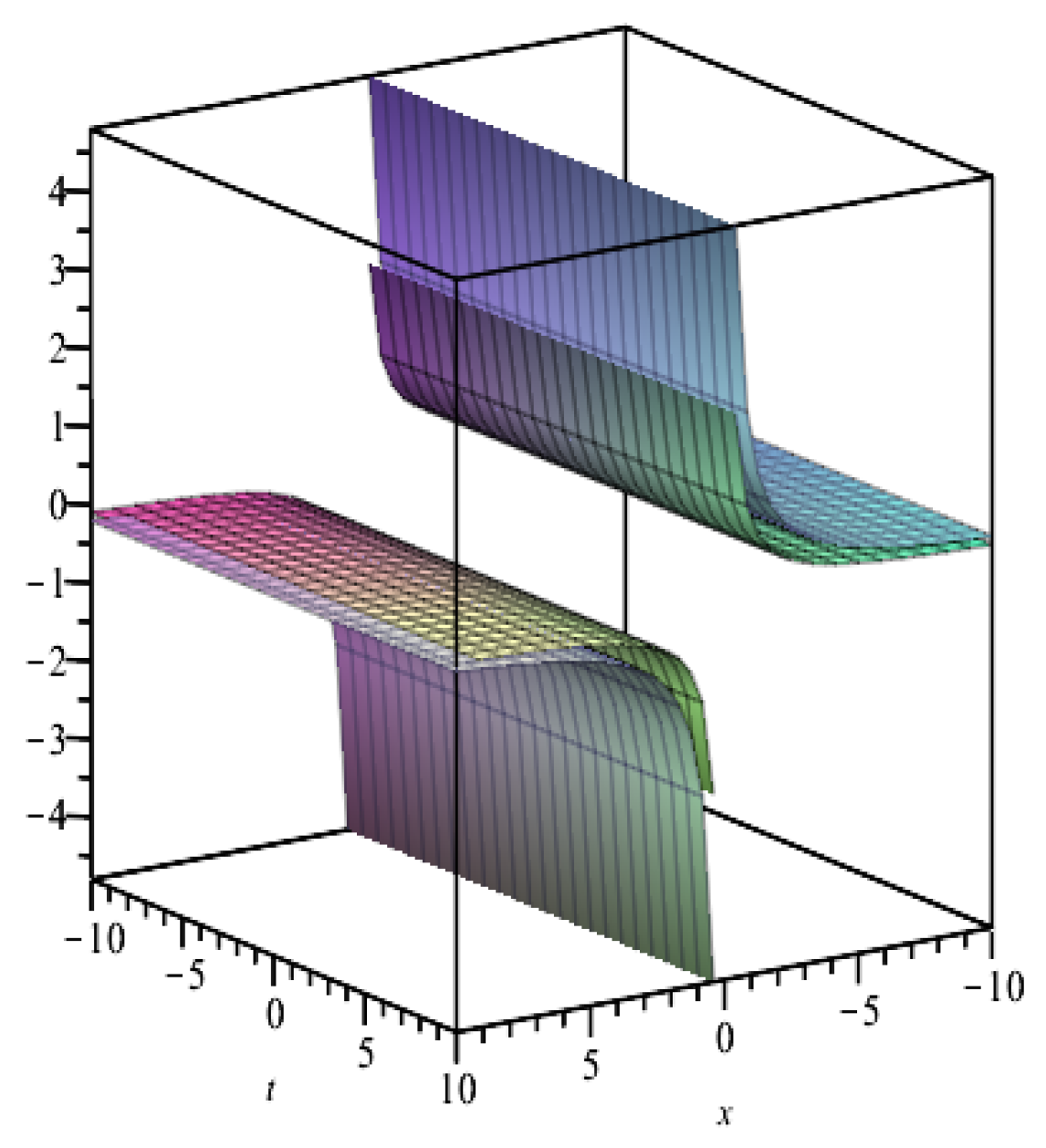
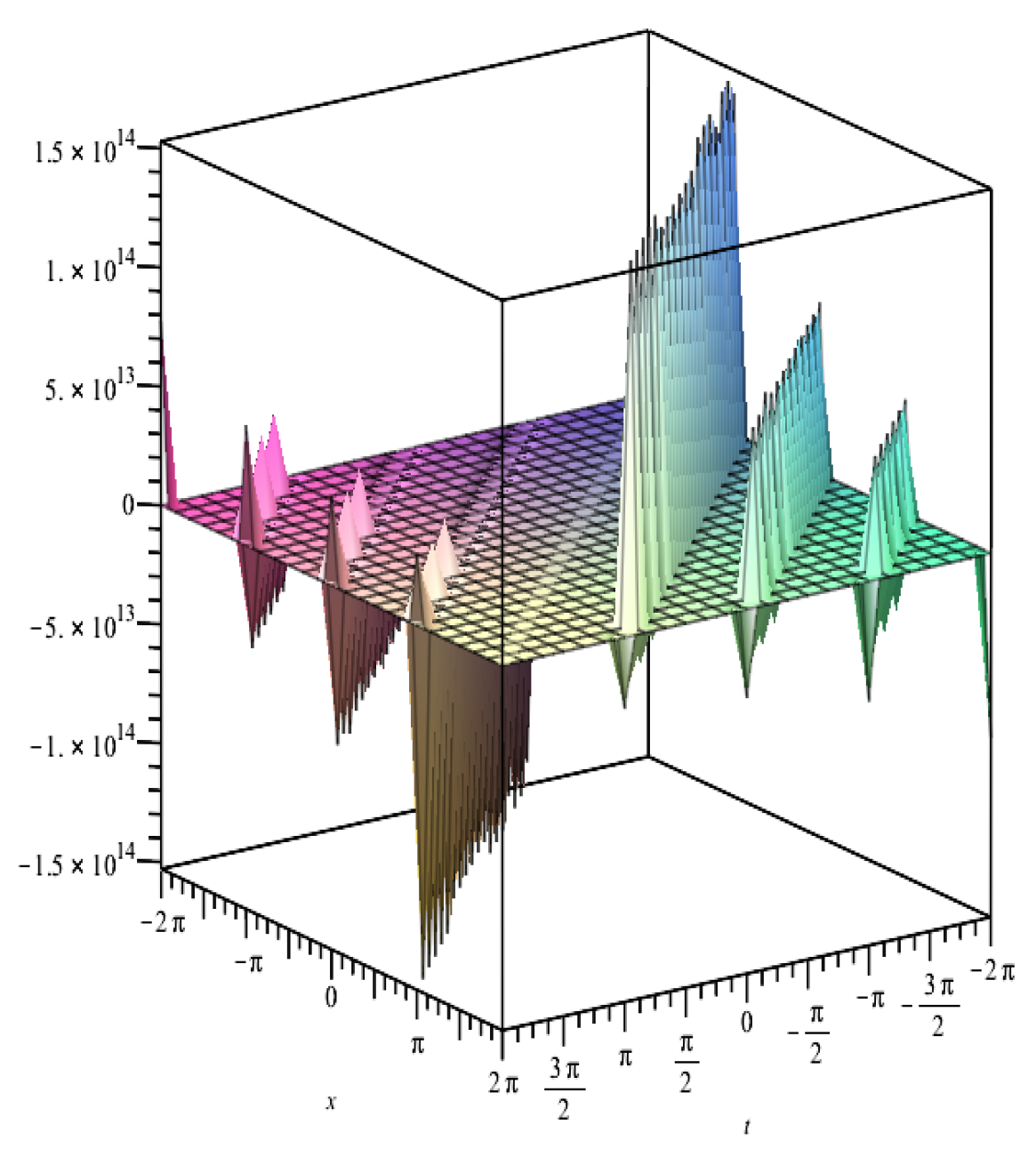
Figure 1 and Figure 2 display the kind of solution structure of and determined by (76) and (77), respectively.
where ,
where ,
where ,
where ,
where ,
where ,
where .
Figure 1.
Plot of the and given by Equation (76) for parameters and .
Figure 2.
Plot of the and given by Equation (77) for parameters and .
7. Conclusions and Discussion
In this paper, the Lax pairs of Dirac spectral problems were studied by the improved Tu-scheme of Zhang et al., and the isospectral–non-isospectral integrable hierarchies were derived from their compatibility. The integrable hierarchy can be reduced to Equation (12). Subsequently, the self-adjointness and conservation laws of this system of equations were discussed using the method proposed by Ibragimov, and the exact solution of the equation system was obtained by using the solutions of the Bernoulli and Riccati equations. In Section 3 and Section 4, based on the non-semisimple Lie algebra , we obtained the nonisospectral coupling hierarchies of the soliton hierarchy (22) and the Hamiltonian structure of its coupling hierarchy. We hope to apply the Tu scheme to find new nonisospectral integrable systems and their properties.
Author Contributions
Writing—original draft preparation, C.C., J.Z., and S.Z.; writing—review and editing, B.F. All authors have read and agreed to the published version of the manuscript.
Funding
This work was supported by the National Natural Science Foundation of China (Grant No.11971475) and SuQian Sci&Tech Program (Grant No.Z202225).
Institutional Review Board Statement
Not applicable.
Informed Consent Statement
Not applicable.
Data Availability Statement
Not applicable.
Acknowledgments
The authors wish to thank the anonymous referees for their valuable suggestions.
Conflicts of Interest
The authors declare that they have no competing interests.
References
- Magri, F. Nonlinear evolution equations and dynamical systems. In Springer Lecture Notes in Physics; Springer: Berlin/Heidelberg, Germany, 1980; Volume 120, p. 233. [Google Scholar]
- Tu, G.Z. The trace identity, a powerful tool for constructing the hamiltonian structure of integrable systems. J. Math Phys. 1989, 30, 330–338. [Google Scholar] [CrossRef]
- Ma, W.X. A new hierarchy of liouville integrable generalized hamiltonian equations and its reduction. Chin. Ann. Math. A 1992, 13, 115–123. [Google Scholar]
- Ma, W.X. A hierarchy of liouville integrable finite-dimensional hamiltonian systems. Appl. Math. Mech. 1992, 13, 369–377. [Google Scholar]
- Fan, E.G. Quasi-periodic waves and an asymptotic property for the asymmetrical nizhnik– novikov–veselov equation. J. Phys. A Math. Theor. 2009, 42, 095206. [Google Scholar] [CrossRef]
- Geng, X.G.; Ma, W.X. A multipotential generalization of the nonlinear diffusion equation. J. Phys. Soc. Jpn. 2000, 69, 985–986. [Google Scholar] [CrossRef]
- Hu, X.B. A powerful approach to generate new integrable systems. J. Phys. A Math. Gen. 1994, 27, 2497. [Google Scholar] [CrossRef]
- Zhang, Y.F.; Zhang, H.Q. A direct method for integrable couplings of td hierarchy. J. Math. Phys. 2002, 43, 466–472. [Google Scholar] [CrossRef]
- Zhang, Y.F.; Tam, H.; Guo, F.K. Invertible linear transformations and the lie algebras. Commun. Nonlinear Sci. Numer. Simul. 2008, 13, 682–702. [Google Scholar] [CrossRef]
- Zhang, Y.F.; Tam, H. Discussion on integrable properties for higher-dimensional variable-coefficient nonlinear partial differential equations. J. Math. Phys. 2014, 54, 013516. [Google Scholar] [CrossRef]
- Zhang, Y.F.; Tam, H. Generation of nonlinear evolution equations by reductions of the self-dual yang—Mills equations. Commun. Theor. Phys. 2014, 61, 203. [Google Scholar] [CrossRef]
- Qiao, Z.J. Algebraic structure of the operator related to stationary systems. Phys. Lett. A 1995, 206, 347–358. [Google Scholar] [CrossRef]
- Li, Y.S. A kind of evolution equations and the deform of spectral. Sci. Sin. A. 1982, 25, 385–387. [Google Scholar]
- Zhang, Y.F.; Mei, J.Q.; Guan, H.Y. A method for generating isospectral and nonisospectral hierarchies of equations as well as symmetries. J. Geom. Phys. 2020, 147, 103538. [Google Scholar] [CrossRef]
- Wang, H.F.; Zhang, Y.F. Two nonisospectral integrable hierarchies and its integrable coupling. Int. J. Theor. Phys. 2020, 59, 2529–2539. [Google Scholar] [CrossRef]
- Lu, H.H.; Zhang, Y.F.; Mei, J.Q. A generalized isospectral–nonisospectral heat equation hierarchy and its expanding integrable model. Adv Differ Equ. 2020, 2020, 1–24. [Google Scholar] [CrossRef]
- Ma, W.X.; Meng, J.H.; Zhang, H.Q. Integrable couplings, variational identities and hamiltonian formulations. Glob. J. Math. Sci. 2012, 1, 1. [Google Scholar]
- Zhang, W.Y.; Ma, W.X. An so (3, r) counterpart of the dirac soliton hierarchy and its bi-integrable couplings. Int. J. Theor. Phys. 2014, 53, 4211–4222. [Google Scholar] [CrossRef]
- Manukure, S.; Ma, W.X. Bi-integrable couplings of a new soliton hierarchy associated with a non-semisimple lie algebra. Appl. Math. Comput. 2014, 245, 44–52. [Google Scholar] [CrossRef]
- Wang, Z.B.; Wang, H.F. Integrable couplings of two expanded non-isospectral soliton hierarchies and their bi-hamiltonian structures. Int. J. Geom. Methods Mod. Phys. 2022, 19, 2250160. [Google Scholar] [CrossRef]
- Wang, H.F.; Zhang, Y.F. A kind of nonisospectral and isospectral integrable couplings and their hamiltonian systems. Commun Nonlinear Sci Numer Simul. 2021, 99, 105822. [Google Scholar] [CrossRef]
- Ma, W.X.; Chen, M. Hamiltonian and quasi-hamiltonian structures associated with semi- 18 direct sums of lie algebras. J. Phys. A Math. Gen. 2006, 39, 10787. [Google Scholar] [CrossRef]
- Zhang, Y.F.; Fan, E.G.; Tam, H. A few expanding lie algebras of the lie algebra a1 and applications. Phys. Lett. A. 2006, 359, 471–480. [Google Scholar] [CrossRef]
- Qiao, Z.J. New hierarchies of isospectral and non-isospectral integrable nlees derived from the harry–dym spectral problem. Phys. A. 1998, 252, 377–387. [Google Scholar] [CrossRef]
- Li, Y.S.; Zhu, G.C. New set of symmetries of the integrable equations, lie algebra and non-isospectral evolution equations. ii. akns system. J. Phys. A Math. Gen. 1986, 19, 3713. [Google Scholar]
- Ibragimov, N.H. Nonlinear self-adjointness in constructing conservation laws. J. Phys. A Math. Theor. 2011, 44, 432002. [Google Scholar] [CrossRef]
- Hassan, M.M.; Abdel-Razek, M.A.; Shoreh, A.A. New exact solutions of some (2 + 1)-dimensional nonlinear evolution equations via extended kudryashov method. Rep. Math. Phys. 2014, 74, 347–358. [Google Scholar] [CrossRef]
- Kabir, M.M.; Khajeh, A.; Abdi, A.E.; Yousefi, K.A. Modified kudryashov method for finding exact solitary wave solutions of higher-order nonlinear equations. Math. Methods Appl. Sci. 2011, 34, 213–219. [Google Scholar] [CrossRef]
- Vitanov, N.K. Application of simplest equations of bernoulli and riccati kind for obtaining exact traveling-wave solutions for a class of pdes with polynomial nonlinearity. Commun. Nonlinear Sci. Numer. Simul. 2010, 15, 2050–2060. [Google Scholar] [CrossRef]
- Wang, H.F.; Zhang, Y.F. The multi-component nonisospectral KdV hierarchies associated with a novel kind of N-dimensional Lie algebra. arXiv 2022, arXiv:2201.03205. [Google Scholar]
- Ibragimov, N.H. Elementary Lie Group Analysis and Ordinary Differential Equations; Wiley: Chichester, UK, 1999; Volume 197. [Google Scholar]
- Ibragimov, N.H. A new conservation theorem. J. Math. Anal. Appl. 2007, 333, 311–328. [Google Scholar] [CrossRef]
Publisher’s Note: MDPI stays neutral with regard to jurisdictional claims in published maps and institutional affiliations. |
© 2022 by the authors. Licensee MDPI, Basel, Switzerland. This article is an open access article distributed under the terms and conditions of the Creative Commons Attribution (CC BY) license (https://creativecommons.org/licenses/by/4.0/).