


Abstract
In this paper, the (2+1)-dimensional q-deformed Sinh-Gordon model has been investigated via -expansion and Sine-Gordon-expansion methods. These techniques successfully retrieve trigonometric as well as hyperbolic solutions, along necessary restricted conditions applied on parameters. In addition to these solutions, dark solitons and complexiton solutions have also been obtained. The proposed equation expands the possibilities for modeling physical systems in which symmetry is broken. The obtained solutions are graphically illustrated. A Painlevé analysis for the proposed model has also been discussed in this paper.
1. Introduction
In the past few decades, the exploration of nonlinear wave propagation on the surface of the ocean has piqued the interest of scientists. Nonlinear wave processes have been experienced in numerous domains, such as chemical physics, plasma physics, control theory, tsunami waves, etc. [1,2,3,4,5,6,7,8]. Analytical and computational soliton solutions can explicitly define these phenomena. Solitons are particularly fascinating because of their true capacity for new applications in a wide range of scientific fields [9,10,11,12,13,14,15,16,17]. A balance of dispersion and nonlinearity can be used to describe them and are produced by various notable nonlinear partial differential equations such as the Kadomtsev–Petviashvili model [18], the nonlinear Schrodinger model [19], the Sine-Gordon, Korteweg–de Vries, and the Sinh-Gordon equations [20,21]. Indeed, solitons are one of the most distinct solutions of nonlinear dynamics. The Sinh-Gordon equation is useful in many contexts, including surface theory, crystal lattice creation, and the dynamics of strings in curved space. When the q-deformed hyperbolic function, developed by Arai in the nineteenth century, is added in the dynamical system, the symmetry of the system and, as a result, the symmetry of the solution are lost. Recent developments have resulted in the generation of several solutions for the Schrödinger equation and the Dirac equation with q-deformed hyperbolic potential. q-deformed functions are interesting for simulating atom-trapping potentials, statistical distributions in Bose–Einstein condensates, and diatomic molecule vibrational spectra [22,23,24].
Using soliton solutions, mathematicians have collaborated to develop many techniques for direct examining nonlinear evolution equations (NLEEs). Representing diverse physical phenomena, they have performed a key role in wide range of applications over the last several decades, including water waves, fluid mechanics, elastic media, nonlinear optics, solid-state physics, and acoustic waves within crystals. Over the last two decades, a huge amount of work has been devoted to developing solid and reliable analytical methods for solving these equations. Numerous plans for extracting exact and numerical solutions for these models have been concocted to give adequate data for understanding actual events happening in various science and technology fields. Examples include the unified technique [25] in order to find the exact wave solution, the Painlevé technique [26], linear superposition principle [27], Wronskian formulation [28], Hirota bilinear technique [29], inverse scattering [30], invariant subspaces [31], novel auxiliary equation technique, and symmetry reduction strategy [32,33]. The extraction of lump solutions [34,35,36,37] has become a popular topic of research among researchers. Huge headway has been made recently as various efficient and proficient techniques for acquiring exact solutions to NLEEs have been laid out [38,39,40,41,42].
The solutions of Klein–Gordon and Sine-Gordon equations were investigated in [43,44]. The generalized q-deformed Sinh-Gordon equation (Eleuch Equation) [22,23,24] is the subject of this paper in (2 + 1) dimensions. It describes
where and is a function of the Arai q-deformed expression described by
Taking provided standard functions of . and with their own reciprocals as well as their useful characteristics are discussed in detail in [45]. To examine the solution of Equation (1), we want to apply the proposed techniques. Contrarily, unique optical solitons and many other types of solution to the discussed model have been proposed in this article. This piece of paper discussed a noticeable achievement and moderate enhancements to previous work.
The article has been arranged as follows. Section 2 contains an explanation of the applicable methods. Section 3 discusses the mathematical analysis. Section 4 explains soliton solutions using the proposed method and the visual depiction is also discussed in this section. Section 5 contains a Painlevé analysis for the proposed model. At last, in Section 6, the conclusions of work are discussed.
The main motivation of writing this article is to solve the generalized q-deformed Sinh-Gordon equation in (2 + 1) dimension using -expansion and Sine-Gordon-expansion methods. A Painlevé analysis for the proposed model is also discussed in this paper. By introducing the generalized q-deformed Sinh-Gordon equation, we may begin to imagine models of physical systems in which the symmetry is either missing or broken.
2. Descriptions of Suggested Expansion Methods
The detailed overview of the suggested expansion methods -expansion and the Sine-Gordon expansion methods are presented as follows.
2.1. Description of -Expansion Method [46,47]
Consider the following ODE
and take , , then we have
where and are constants.
Consider and
where ; so, a general solution of Equation (3) becomes
where and are arbitrary constants. Now, let and
where , Equation (3) has a solution of the form
where and are arbitrary constants.
Assume the following NLEE
Fundamental steps of the ()-expansion method [46,47] are illustrated below.
The following wave transformation
is used for converting Equation (9) into an ordinary differential equation
where x and y are space coordinates and t is the time coordinate, whereas C denotes the velocity of the wave.
Assume the solution of Equation (11) is
where and . The solution can be obtained by finding the values of and . For achieving this task, we substitute Equation (12) along Equation (4) and Equation (5) into Equation (11). This substitution converts Equation (11) into an expansion containing and . Now, by comparing the coefficients of and to zero gives set of nonlinear equations. The values of , are to be extracted upon simultaneously solving the equations.
Next, we substitute Equation (12) with Equations (4) and (7) into Equation (11) for . This substitution converts Equation (11) into an expansion containing and . Now, by equating the coefficients of and to zero gives a set of nonlinear equations. The values of , are to be extracted upon simultaneously solving the equations.
2.2. Overview of Sine-Gordon Method [48,49,50]
Assume that the sine-Gordon equation has the following form
where and .
By the wave transformation , , Equation (13) assumes the form:
where c represents the speed of the traveling wave. Integrating Equation (14) gives
Here, the constant of integration is zero. Taking and . Equation (15), becomes
Choosing in Equation (16) and applying some trigonometric identities, we find
where is a constant of integration.
According to Sine-Gordon expansion method, the predicted solution to Equation (11) assumes the form
3. Mathematical Examination
To find the traveling wave solution of Equation (1), we utilize the transformation
where represents the velocity of the wave. Utilizing Equation (21), Equation (1) can be transformed into an ODE,
4. Extraction of Solutions via -Expansion Method
Before we start applying the proposed technique, the balancing law helps us in determining N. Balancing the highest-order derivative and nonlinear term in Equation (24) gives .
The assumed solution of Equation (24), for this proposed method, has been obtained by putting in Equation (12):
where , and , and are constants. Applying the -expansion method as explained in Section 2, the solutions for and have been obtained as follows:
CASE 1
For , the values of constants , and have been obtained as
Family 1
The extracted hyperbolic solutions to Family 1 are
The solution corresponding to Family 1 has been expressed graphically in Figure 1 using the values of arbitrary parameters , , , , , and .
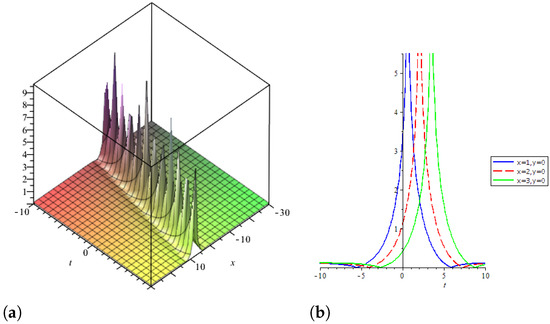
Figure 1.
3D graph of is shown in (a), 2D line graph with the variation in x is shown in (b).
The solution corresponding to Family 1 has been expressed graphically in Figure 2 using the values of arbitrary parameters , , , , , and .
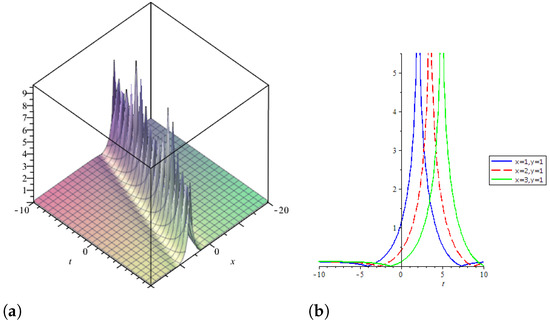
Figure 2.
3D graph of is shown in (a), 2D line graph with the variation in x is shown in (b).
CASE 2
For , the values of constants , and have been obtained as
Family 2
5. Extraction of Solutions via Sine-Gordon Expansion Method
Before we start applying the proposed technique, the balancing law helps us in determining N. Balancing the highest-order derivative and nonlinear term in Equation (24) gives . For , the assumed solution for Equation (24), for this proposed method, has been obtained by putting in Equation (20):
where , and are arbitrary constants. Applying the Sine-Gordon expansion method as explained in Section 2, the following two families of solutions have been obtained.
Family 3
Family 4:
The dark solitons extracted from Family 3 are
The solution corresponding to Family 3 has been expressed graphically in Figure 3 taking .
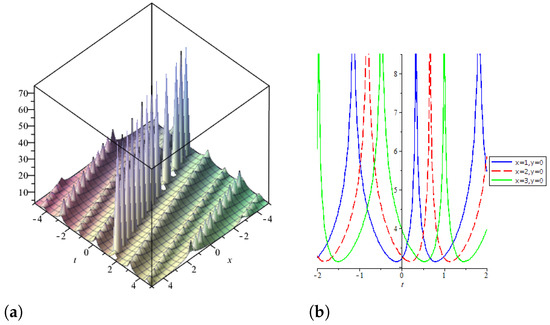
Figure 3.
3D graph of is shown in (a), 2D line graph with the variation in x is shown in (b).
The solution corresponding to Family 3 has been expressed graphically in Figure 4 taking .
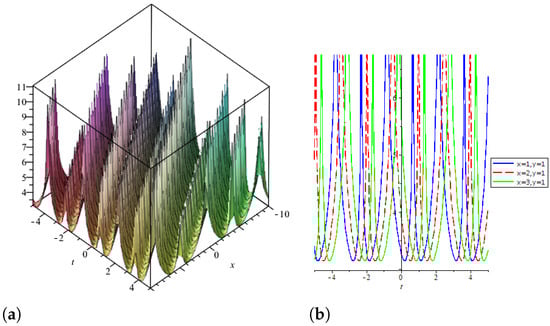
Figure 4.
3D graph of is shown in (a), 2D line graph with the variation in x is shown in (b).
The complexiton solutions have been constructed from Family 4 as
where .
6. Painlevé Analysis
The Painlevé analysis is one of the most efficient approach for examining integrability of any PDEs [51,52,53]. The integrability of Equation (1) in case of and and is tested assuming a solution in form of a Laurent series about the singular manifold as
where , are arbitrary functions of x, y, and t.
The leading order of the solution of Equation (1) is assumed as
where is the initial constant of integration and represents the dominant behavior which is to be evaluated initially.
Resonance v is computed for the dominant behavior by putting
in Equation (1) and equating the least power of (i.e., ) to zero. The following expression is the characteristic equation of the resonances
Solving the above equation for v, we find
The resonance at is compared to the arbitrariness of the singular manifold . The constant of integration is to be found by checking the compatibility conditions. Let us suppose
Let us substitute Equation (34) in Equation (1) and equate the coefficients of different powers of to zero at different levels of v, for the evaluation of , . After some computational work at level , we obtain the explicit expression for as
It is observed that at level , comes out to be an arbitrary function, which implies that the compatibility condition is satisfied identically. Hence, Equation (1) is Painlevé integrable. Throughout this work, we have made the following observations:
First, Maple was used to check the validity of all solutions to Equation (1) found here. Second, our solution functions are novel and have not been published previously, as shown by a comparison with the work given in [23,24].
7. Conclusions
In this paper, we studied the periodic and hyperbolic solutions of the (2+1)-dimensional q-deformed Sinh-Gordon equation. The -expansion and the Sine-Gordon-expansion methods have been effectively employed to obtain the model solutions. The proposed methods extract singular solitons, dark solitons, periodic solutions, and complexiton solutions. Bright solitons are not obtained by the applications of the proposed methods. The graphical illustration of the obtained results was presented. Moreover, a Painlevé analysis was applied for investigating integrability. The novel results showed that the proposed strategies were successful in identifying novel solutions of the (2+1)-dimensional q-deformed Sinh-Gordon equation.
Author Contributions
Conceptualization, H.I.A., N.R., S.A., A.R.B., A.-H.A.-A., C.C. and H.E.; Data curation, H.I.A., N.R., S.A., A.R.B., A.-H.A.-A., C.C. and H.E.; Formal analysis, H.I.A., N.R., S.A., A.R.B., A.-H.A.-A., C.C. and H.E.; Investigation, H.I.A., N.R., S.A., A.R.B., A.-H.A.-A., C.C. and H.E.; Methodology, H.I.A., N.R., S.A., A.R.B., A.-H.A.-A., C.C. and H.E.; writing—review and editing, H.I.A., N.R., S.A., A.R.B., A.-H.A.-A., C.C. and H.E. All authors have read and agreed to the published version of the manuscript.
Funding
This work was supported by Princess Nourah bint Abdulrahman University Researchers Supporting Project number (PNURSP2022R106), Princess Nourah bint Abdulrahman University, Riyadh, Saudi Arabia.
Informed Consent Statement
Not applicable.
Data Availability Statement
Not applicable.
Acknowledgments
Princess Nourah bint Abdulrahman University Researchers Supporting Project number (PNURSP2022R106), Princess Nourah bint Abdulrahman University, Riyadh, Saudi Arabia. We would like to thank the reviewers for their thoughtful comments and efforts towards improving our manuscript.
Conflicts of Interest
The authors declare no conflict of interest.
References
- Hashemi, M. A novel approach to find exact solutions of fractional evolution equations with non-singular kernel derivative. Chaos Solitons Fractals 2021, 152, 111367. [Google Scholar] [CrossRef]
- Zillur Rahman, M. Zulfikar Ali and Harun-Or Roshid. Chinese Phys. B 2021, 30, 050202. [Google Scholar]
- Kaplan, M.; Bekir, A.; Akbulut, A. A generalized Kudryashov method to some nonlinear evolution equations in mathematical physics. Nonlinear Dyn. 2016, 85, 2843–2850. [Google Scholar] [CrossRef]
- Zhang, S. Application of Exp-function method to high-dimensional nonlinear evolution equation. Chaos Solitons Fractals 2008, 38, 270–276. [Google Scholar] [CrossRef]
- Mesloub, S. On a singular two dimensional nonlinear evolution equation with nonlocal conditions. Nonlinear Anal. Theory Methods Appl. 2008, 68, 2594–2607. [Google Scholar] [CrossRef]
- Akbar, M.A.; Ali, N.H.M.; Islam, M.T. Multiple closed form solutions to some fractional order nonlinear evolution equations in physics and plasma physics. AIMS Math. 2019, 4, 397–411. [Google Scholar] [CrossRef]
- Abdel-Aty, A.H.; Khater, M.M.A.; Attia, R.A.M.; Abdel-Aty, M.; Eleuch, H. On the new explicit solutions of the fractional nonlinear space-time nuclear model. Fractals 2020, 28, 2040035. [Google Scholar] [CrossRef]
- Abdalla, M.S.; Eleuch, H. Exact analytic solutions of the Schr?dinger equations for some modified q-deformed potentials. J. Appl. Phys. 2014, 115, 234906. [Google Scholar] [CrossRef]
- Buckel, W.; Thauer, R.K. Flavin-Based Electron Bifurcation, A New Mechanism of Biological Energy Coupling. Chem. Rev. 2018, 118, 3862–3886. [Google Scholar] [CrossRef]
- Jabin, P.E.; Wang, Z. Quantitative estimates of propagation of chaos for stochastic systems with W−1,∞ kernels. Invent. Math. 2018, 214, 523591. [Google Scholar] [CrossRef]
- Lan, C.Z.Z.; Su, J.J. Solitary and rogue waves with controllable backgrounds for the nonautonomous generalized AB system. Nonlinear Dyn. 2019, 96, 25352546. [Google Scholar] [CrossRef]
- Zafar, A.; Shakeel, M.; Ali, A.; Akinyemi, L.; Rezazadeh, H. Optical solitons of nonlinear complex Ginzburg–Landau equation via two modified expansion schemes. Opt. Quantum Electron. 2022, 54, 5. [Google Scholar] [CrossRef]
- Darvishi, M.T.; Naja, M.; Wazwaz, A.M. Conformable space-time fractional nonlinear (1+1)- dimensional Schrodinger-type models and their traveling wave solutions. Chaos Solitons Fractals 2021, 150, 111187. [Google Scholar] [CrossRef]
- Fink, T.; Schade, A.; Höfling, S.; Schneider, C.; Imamoglu, A. Signatures of a dissipative phase transition in photon correlation measurements. Nat. Phys. 2018, 14, 365–369. [Google Scholar] [CrossRef]
- Arshed, S.; Rahman, R.U.; Raza, N.; Khan, A.K.; Inc, M. A variety of fractional soliton solutions for three important coupled models arising in mathematical physics. Int. J. Mod. Phys. B 2021, 36, 2250002. [Google Scholar] [CrossRef]
- Hao, R. Dark soliton in the exponentially decaying optical lattice with spatially inhomogeneous Gaussian nonlinearities. Nucl. Instrum. Methods Phys. Res. Sect. Accel. Spectrometers Detect. Assoc. Equip. 2011, 637, S145–S148. [Google Scholar] [CrossRef]
- Boutabba, N.; Eleuch, H.; Bouchriha, H. Thermal bath effect on soliton propagation in three-level atomic system. Synth. Met. 2009, 159, 1239–1243. [Google Scholar] [CrossRef]
- Osman, M.S.; Ghanbari, B.; Machado, J.A.T. New complex waves in nonlinear optics based on the complex Ginzburg-Landau equation with Kerr law nonlinearity. Eur. Phys. J. Plus 2019, 134, 20. [Google Scholar] [CrossRef]
- Ding, C.C.; Gao, Y.T.; Deng, G.F.; Wang, D. Lax pair, conservation laws, Darboux transformation, breathers and rogue waves for the coupled nonautonomous nonlinear SchrÖdinger system in an inhomogeneous plasma. Chaos Soliton Fract 2020, 133, 109580. [Google Scholar] [CrossRef]
- Wazwaz, A.-M. Travelling wave solutions for combined and double combined sine–cosine-Gordon equations by the variable separated ODE method. Appl. Math. Comput. 2006, 177, 755–760. [Google Scholar] [CrossRef]
- Akram, G.; Arshed, S.; Imran, Z. Soliton solutions for fractional DNA Peyrard-Bishop equation via the extended (G0/G2)-expansion method. Phys. Scr. 2021, 96, 094009. [Google Scholar] [CrossRef]
- Eleuch, H. Some Analytical Solitary Wave Solutions for the Generalized q-Deformed Sinh-Gordon Equation , Hindawi. Adv. Math. Phys. 2018, 2018, 5242757. [Google Scholar] [CrossRef]
- Raza, N.; Salman, F.; Butt, A.R.; Gandarias, M.L. Lie symmetry analysis, soliton solutions and qualitative analysis concerning to the generalized q-deformed Sinh-Gordon equation. Commun. Nonlinear Sci. Numer. Simul. 2023, 116, 106824. [Google Scholar] [CrossRef]
- Raza, N.; Arshed, S.; Alrebdi, H.; Abdel-Aty, A.-H.; Eleuch, H. Abundant new optical soliton solutions related to q-deformed Sinh–Gordon model using two innovative integration architectures. Results Phys. 2022, 35, 105358. [Google Scholar] [CrossRef]
- Kivshara, Y.S.; Davies, B.L. Dark optical solitons: Physics and applications. Phys. Rep. 1998, 298, 81–197. [Google Scholar] [CrossRef]
- Hao, R. Optical soliton control in inhomogeneous nonlinear media with the parity-time symmetric potentials. Opt. Commun. 2015, 338, 265–268. [Google Scholar] [CrossRef]
- Raza, N.; Hassan, Z.; Butt, A.R.; Rahman, R.U.; Abdel-Aty, A.; Mahmoud, M. New and more dual-mode solitary wave solutions for the Kraenkel–Manna–Merle system incorporating fractal effects. Math. Methods Appl. Sci. 2021, 45, 2964–2983. [Google Scholar] [CrossRef]
- Riaz, M.B.; Wojciechowski, A.; Oros, G.I.; Rahman, R.U. Soliton Solutions and Sensitive Analysis of Modified Equal-Width Equation Using Fractional Operators. Symmetry 2022, 14, 1731. [Google Scholar] [CrossRef]
- Bagheri, M.; Khani, A. Analytical Method for Solving the Fractional Order Generalized KdV Equation by a Beta-Fractional Derivative. Adv. Math. Phys. 2020, 2020, 8819183. [Google Scholar] [CrossRef]
- Sousa, J.V.D.C.; De Oliveira, E.C. A New Truncated M-Fractional Derivative Type Unifying Some Fractional Derivative Types with Classical Properties. Int. J. Anal. Appl. 2018, 16, 83–96. [Google Scholar]
- Abdalla, M.S.; Eleuch, H.; Barakat, T. Exact Analytical Solutions of the Wave Function for Some q-Deformed Potentials. Rep. Math. Phys. 2013, 71, 217–229. [Google Scholar] [CrossRef]
- Fabian, A.L.; Kohl, R.; Biswas, A. Perturbation of topological solitons due to sine-Gordon equation and its type. Commun. Nonlinear Sci. Numer. Simul. 2009, 14, 1227–1244. [Google Scholar] [CrossRef]
- Biswas, A.; Rezazadeh, H.; Mirzazadeh, M.; Eslami, M.; Zhou, Q.; Moshokoa, S.P.; Belic, M. Optical solitons having weak non-local nonlinearity by two integration schemes. Optik 2018, 164, 380–384. [Google Scholar] [CrossRef]
- Kaur, L.; Wazwaz, A.-M. Lump, breather and solitary wave solutions to new reduced form of the generalized BKP equation. Int. J. Numer. Methods Heat Fluid Flow 2019, 29, 569–579. [Google Scholar] [CrossRef]
- Kaur, L.; Wazwaz, A.-M. Bright-dark lump wave solutions for a new form of the (3+1)-dimensional BKP-Boussinesq equation. Rom. Rep. Phys. 2019, 71, 102. [Google Scholar]
- Kaur, L.; Wazwaz, A.-M. Dynamical analysis of lump solutions for (3+ 1) dimensional generalized KP-Boussinesq equation and259its dimensionally reduced equation. Phys. Scr. 2018, 93, 075203. [Google Scholar] [CrossRef]
- Kaur, L.; Wazwaz, A.-M. Bright-dark optical solitons for Schrödinger-Hirota equation with variable coefficients. Commun. Phys. Scr. 2019, 179, 479–484. [Google Scholar] [CrossRef]
- Seadawy, A.; El-Rashidy, K. Dispersive solitary wave solutions of Kadomtsev-Petviashvili and modified Kadomtsev-Petviashvili dynamical equations in unmagnetized dust plasma. Results Phys. 2018, 8, 1216–1222. [Google Scholar] [CrossRef]
- Liu, J.-G.; Zhu, W.-H. Multiple rogue wave, breather wave and interaction solutions of a generalized (3+1)-dimensional variable-coefficient nonlinear wave equation. Nonlinear Dyn. 2021, 103, 1841–1850. [Google Scholar] [CrossRef]
- Kumar, D.; Park, C.; Tamanna, N.; Paul, G.C.; Osman, M. Dynamics of two-mode Sawada-Kotera equation: Mathematical and graphical analysis of its dual-wave solutions. Results Phys. 2020, 19, 103581. [Google Scholar] [CrossRef]
- Rezazadeh, H.; Kurt, A.; Tozar, A.; Tasbozan, O.; Mirhosseini-Alizamini, S.M. Wave behaviors of Kundu–Mukherjee–Naskar model arising in optical fiber communication systems with complex structure. Opt. Quantum Electron. 2021, 53, 317. [Google Scholar] [CrossRef]
- Tozar, A.; Tasbozan, O.; Kurt, A. Optical soliton solutions for the (1+1)-dimensional resonant nonlinear Schröndinger’s equation arising in optical fibers. Opt. Quantum Electron. 2021, 53, 316. [Google Scholar] [CrossRef]
- Abdeljabbar, A.; Roshid, H.-O.; Aldurayhim, A. Bright, Dark, and Rogue Wave Soliton Solutions of the Quadratic Nonlinear Klein–Gordon Equation. Symmetry 2022, 14, 1223. [Google Scholar] [CrossRef]
- Batiha, B. New Solution of the Sine-Gordon Equation by the Daftardar-Gejji and Jafari Method. Symmetry 2022, 14, 57. [Google Scholar] [CrossRef]
- Arshed, S.; Biswas, A.; Mallawi, F.; Belic, M.R. Optical solitons with complex Ginzburg–Landau equation having three nonlinear forms. Phys. Lett. A 2019, 383, 126026. [Google Scholar] [CrossRef]
- Zayed, E.M.E.; Abdelaziz, M.A.M. The two-variable (G’/G,1/G)-expansion method for solving the nonlinear KdV-mKdV equation. Math. Probl. Eng. 2012, 2012, 725061. [Google Scholar] [CrossRef]
- Zayed, E.M.E.; Hoda Ibrahim, S.A.; Abdelaziz, M.A.M. Traveling wave solutions of the nonlinear (3 + 1)- dimensional Kadomtsev-Petviashvili equation using the two variables (G’/G,1/G)-expansion method. J. Appl. Math. 2012, 2012, 560531. [Google Scholar] [CrossRef]
- Azzouzi, F.; Triki, H.; Mezghiche, K.; El Akrmi, A. Solitary wave solutions for high dispersive cubic-quintic nonlinear Schrödinger equation. Chaos Solitons Fractals 2009, 39, 1304–1307. [Google Scholar] [CrossRef]
- Kumar, D.; Hosseini, K.; Samadani, F. The sine-Gordon expansion method to look for the traveling wave solutions of the Tzitéica type equations in nonlinear optics. Optik 2017, 149, 439–446. [Google Scholar] [CrossRef]
- Korkmaz, A.; Hepson, O.E.; Hosseini, K.; Rezazadeh, H.; Eslami, M. Sine-Gordon expansion method for exact solutions to conformable time fractional equations in RLW-class. J. King Saud Univ. -Sci. 2018, 32, 567–574. [Google Scholar] [CrossRef]
- Raza, N.; Arshed, S.; Javid, A. Optical solitons and stability analysis for the generalized second-order nonlinear Schrödinger equation in an optical fiber. Int. J. Nonlinear Sci. Numer. Simul. 2020, 21, 855–863. [Google Scholar] [CrossRef]
- Weiss, J.; Tabor, M.; Carnevale, G. The Painlevé property for partial differential equations. J. Math. Phys. 1983, 24, 522–526. [Google Scholar] [CrossRef]
- Malik, S.; Almusawa, H.; Kumar, S.; Wazwaz, A.M.; Osman, M.S. A (2+1)-dimensional Kadomtsev–Petviashvili equation with competing dispersion effect: Painlevé analysis, dynamical behavior and invariant solutions. Results Phys. 2021, 23, 104043. [Google Scholar] [CrossRef]
Publisher’s Note: MDPI stays neutral with regard to jurisdictional claims in published maps and institutional affiliations. |
© 2022 by the authors. Licensee MDPI, Basel, Switzerland. This article is an open access article distributed under the terms and conditions of the Creative Commons Attribution (CC BY) license (https://creativecommons.org/licenses/by/4.0/).