Abstract
We introduce two approaches by modifying split-step exponential schemes to study stochastic differential equations. Under the Lipschitz condition and linear-growth bounds, it is shown that our explicit schemes converge to the solution of the corresponding stochastic differential equations with the order in the mean-square sense. The mean-square stability of our methods is investigated through some linear stochastic test systems. Additionally, asymptotic mean-square stability is analyzed for the two-dimensional system with symmetric and asymmetric coefficients and driven by two commutative noise terms. In particular, we prove that our methods are mean-square stable for any step-size. Finally, some numerical experiments are carried out to confirm the theoretical results.
1. Introduction
Due to the significant role played by stochastic differential equations (SDEs) in describing different phenomena, studying their solutions’ behavior is an important topic for researchers [1,2,3,4,5]. Since there is no analytical form solution for most SDEs, a critical issue in their study is the design of efficient schemes for numerical solutions. Thus, many numerical schemes are used to approximate their solution, for example, see [4,6,7,8,9,10,11,12,13].
In recent years, split-step techniques have been widely used to solve various SDEs. For example, Haghighi and Hosseini [7] analyzed the mean-square (MS) convergence of Rosenbrock stochastic balanced methods, which are a combination of Milstein methods [12] and Rosenbrock ordinary differential equation (ODE) solvers [14]. Additionally, using the Rosenbrock ODE solver, the split-step double-balanced scheme was constructed for solving SDEs [15]. In [16], Nouri et al. gave the split-step Rosenbrock scheme for SDEs. By the split Adams–Moulton ODE solver [17], new stochastic schemes are proposed to solve SDEs [18,19]. Recently, an attempt has been made to provide new explicit schemes with a wide stability region using ODE solvers [20]. In [21,22,23], the authors established new types of Euler–Maruyama and Milstein schemes by the exponential function for the solution of stiff SDEs arising in physical and chemical models.
In the last decades, using stability properties has led to the creation of better numerical algorithms. Saito and Mitsui [24] investigate the MS stability behavior of several numerical schemes for linear scalar SDE. Additionally, in [25], the MS stability condition of the Euler–Maruyama approach for a two-dimensional SDE with symmetric coefficients driven by one noise term is investigated. Buckwar and Sickenberger [26] studied the MS stability of the -Euler–Maruyama and -Milstein schemes for scalar SDEs driven by an s-dimensional Wiener process. Additionally, the same authors analyzed, in [27], the MS stability properties of the -Euler–Maruyama and -Milstein schemes for two-dimensional SDEs driven by commutative and non-commutative noise terms with symmetric and asymmetric coefficients. Following this line, the MS stability of many numerical schemes was studied, for example, see [11,12,16,18,19,26,28,29].
We modify the split-step forward methods based on the exponential Milstein scheme for solving stiff SDEs. In the following section, we make some necessary notations and assumptions of SDE (1). We also construct our schemes in this section. In Section 3, we study the convergence theorem and show that the proposed schemes converge to accurate solutions under the Lipschitz condition and linear-growth bounds of order in the MS sense. Furthermore, the stability behavior of our schemes on some test systems of SDEs is considered in Section 4. Next, several numerical experiments are presented in Section 5. Some concluding remarks are given in the final section.
2. Hybrid Approach of Split-Step and Milstein Schemes
We consider d-dimensional Itô SDEs [11,16],
For solving (1), many authors have suggested the split-step approach [8,28,30], in the following general form:
where is the increment function of an appropriate ODE solver. To establish our schemes, we consider
where denotes a Jacobian Matrix. Now, we derive the following explicit approaches by the Milstein method, the first drifting split-step exponential modified Milstein (DRSSEMM) scheme
and the second diffused split-step exponential modified Milstein (DISSEMM) scheme
where
Additionally, is the approximation to for , , , , and is an independent variable with distribution .
Assumption 1.
Functions f, in SDE (1), and satisfy Lipschitz condition and linear-growth bounds with constants and , respectively. Additionally,
3. Mean-Square Convergence
We derive MS convergence results for the DRSSEMM (3) and DRSSEMM (4) schemes. Before proving the main theorem, we state the following lemma.
Lemma 1
([9]). For and assume that
with and . Then,
Lemma 2.
Assume the linear-growth bounds hold. Then,
Proof.
It is easy to write
and
So, we obtain the desired result by using and the linear-growth bounds. □
In what follows, we will employ Assumption 1 and Lemmas 1 and 2 to show MS convergence of DRSSEMM (3) and DRSSEMM (4) methods.
Theorem 1.
Proof.
We show that the DRSSEMM and DISSEMM methods convergence to SDE (1), according to Lemma 1, by the local Milstein approximation step
with [9]
Assumption 1, Lemmas 2, and mean value Theorem as
lead to
If we divide (6) into two parts by standard arguments, using (9b) we can obtain local MS error for DRSSEMM (3) and DISSEMM (4) schemes as
To continue, we use Assumption 1, Lemma 2, and (11) for the estimation of .
4. Stability Properties
This section is devoted to the MS stability analysis of the DRSSEMM and DISSEMM schemes for scalar linear SDEs driven by a one-dimensional Wiener process and multi-dimensional commutative noise terms. Also, we study the asymptotic MS stability of our schemes for two-dimensional SDE with two commutative noise terms.
4.1. A Scalar Linear SDE Driven by a One-Dimensional Wiener Process
In this part of the paper, we study the MS stability of the DRSSEMM (3) and DISSEMM (4) schemes by considering the Itô test equation
where . The actual value of (16) is
which is MS-stable if and only if [24]
By applying the DRSSEMM (3) and DISSEMM (4) methods to (16), we obtain the following explicit difference equation:
with
where . Now, we compute stability domains of proposed methods by (19) and the condition,
Using , and , we can compute the MS stability function of the DRSSEMM (3) and DISSEMM (4) schemes, as
Theorem 2.
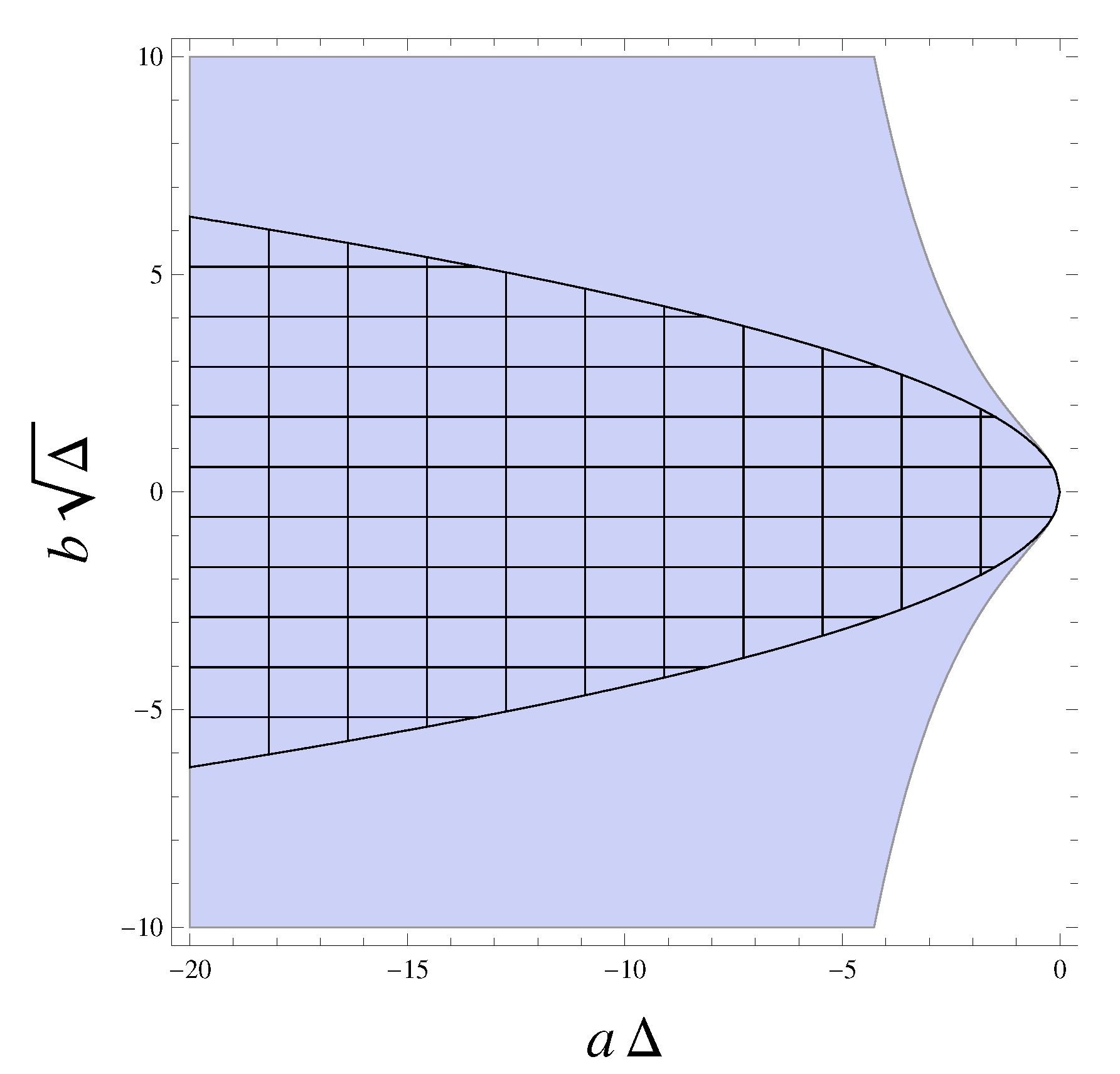
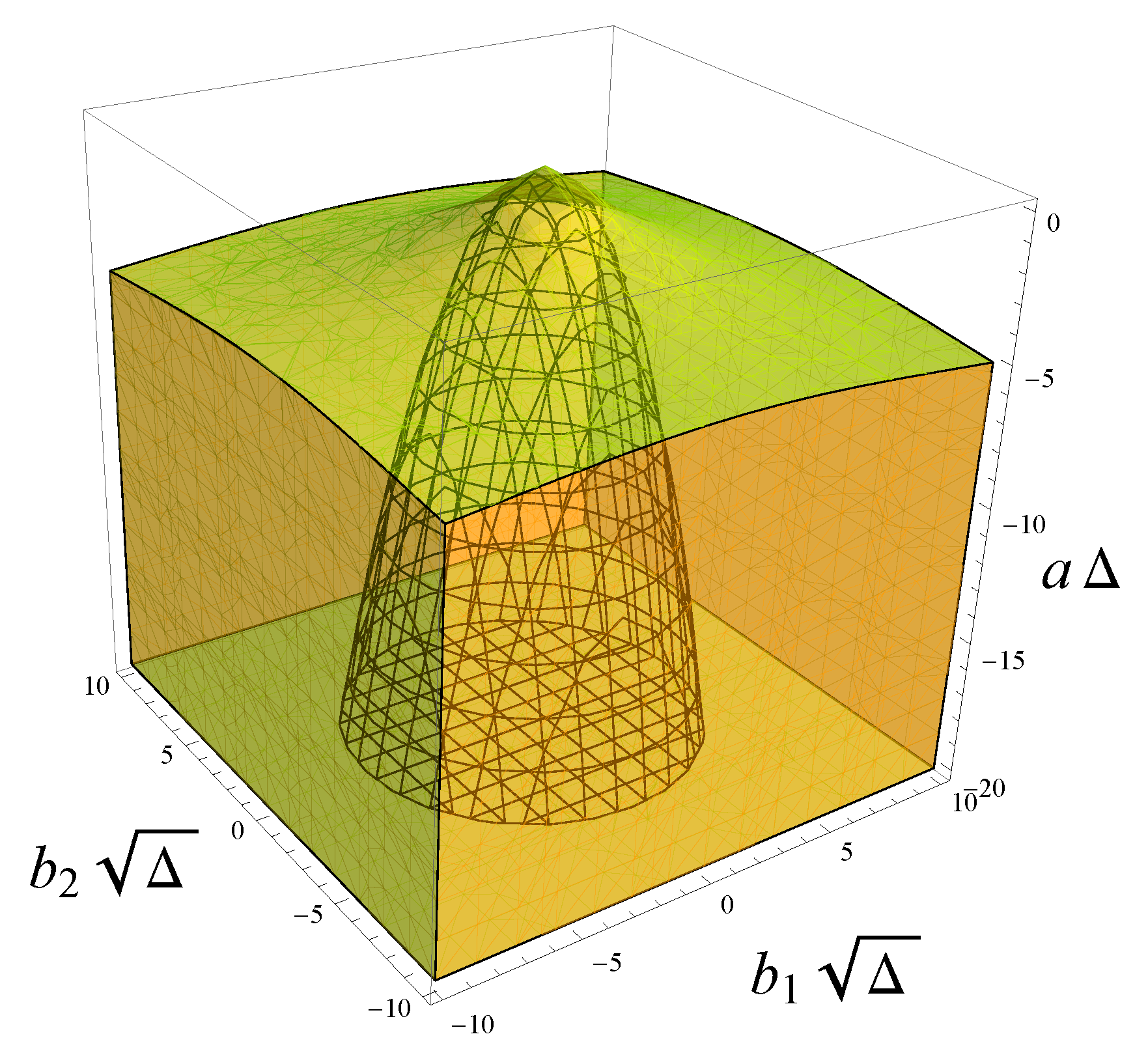
In Figure 1, the region of MS stability is presented for the DRSSEMM (3) and DISSEMM (4) schemes (shaded) when . The MS stability areas belonging to the proposed schemes cover the area of scalar test Equation (16) (gridded). As a result, the DRSSEMM (3) and DISSEMM (4) approaches are appropriate in this respect.
4.2. A Scalar Linear SDE with Multi-Dimensional Commutative Noise Terms
For the analysis of the MS stability of our scheme, we consider the following one-dimensional linear SDE driven by multi-dimensional commutative noise terms:
with theoretical solution
where , .
We note that the above explicit difference equation is the result of using the commutative property of noise terms, i.e., . Therefore, the stability domain of schemes is obtained as follows:
Theorem 3.
Proof.
The schemes are MS-stable if and only if , which is equivalent to , where
By using , and (23), the desired result is easily obtained. □
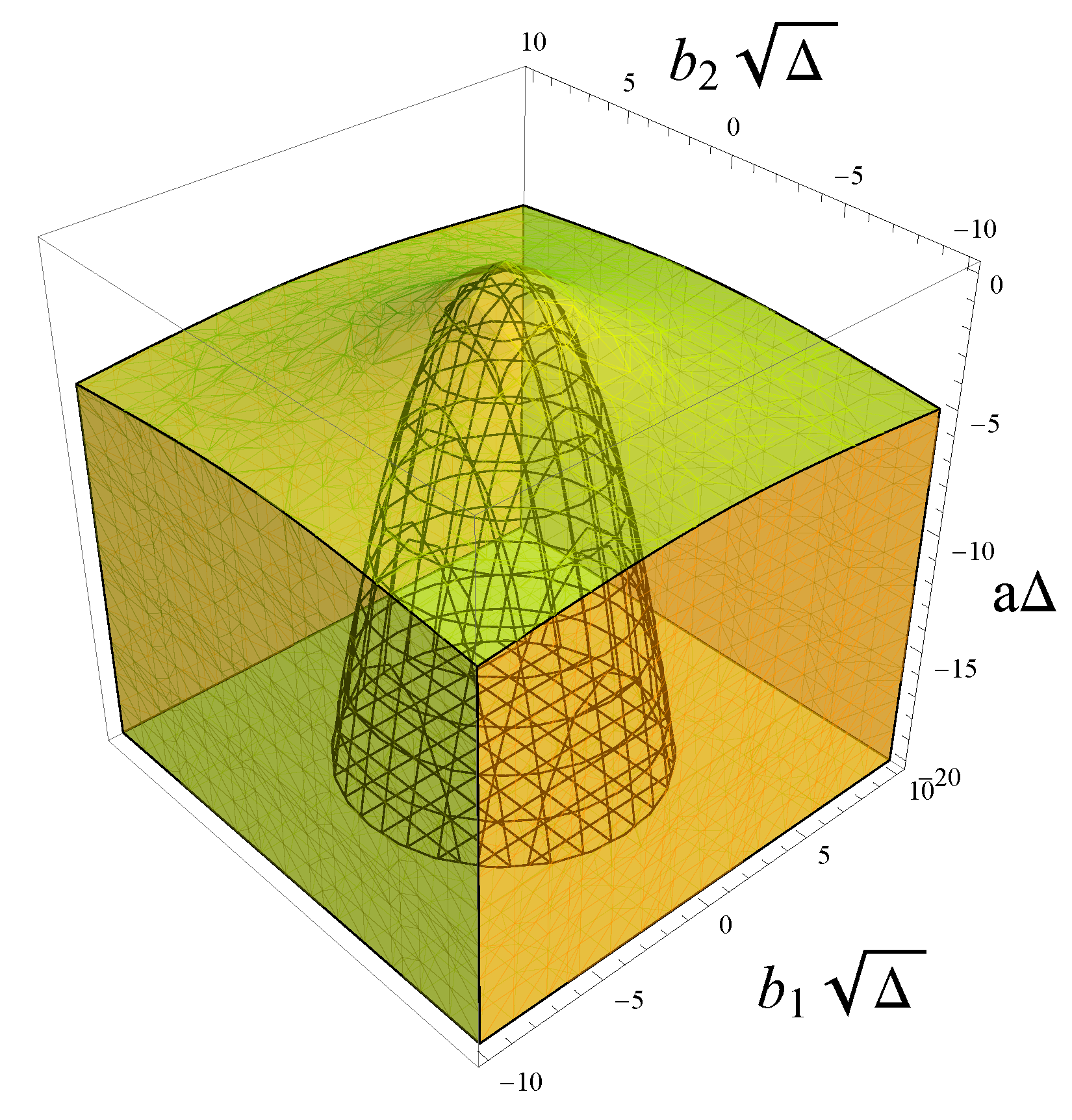
In Figure 2, we show the real MS stability regions, i.e., , of our schemes (25) (shaded) and SDE test Equation (23) (gridded) for two commutative noise terms. It is obvious that the MS stability areas belonging to the proposed schemes cover the area of SDE Equation (21). Therefore, once again the results of Theorem 3 are confirmed.
4.3. A Two-Dimensional System with Two Commutative Noise Terms
Let us consider
where and , are two commutative noise terms. If we apply our schemes to system (26), we have
where
In order to investigate the asymptotic MS stability of the equilibrium position for proposed schemes, we use the findings of Buckwar and Sickenberger [27]. Therefore, from (27), we obtain
where ⊗ is a Kronecker product, , and . From [27], we know that the equilibrium position of difference Equation (27) is asymptotically MS-stable if and only if , where is the spectral radius of . So, the eigenvalues of the MS stability matrix (28) are
5. Numerical Results
In the following, several examples are used to demonstrate the theoretical outcomes stated in Section 3 and Section 4. The theoretical and numerical solutions are compared by considering the MS errors (MSEs), which are defined by
where and are the calculated and theoretical values on the jth independent sample path evaluated at and the total number of samples .
5.1. A Scalar Linear SDE
Consider a scalar linear SDE (16) with real parameters a and b on with initial value . To validate the findings of the Theorem 1, we carry out a numerical experiment with eight different step-sizes , at .
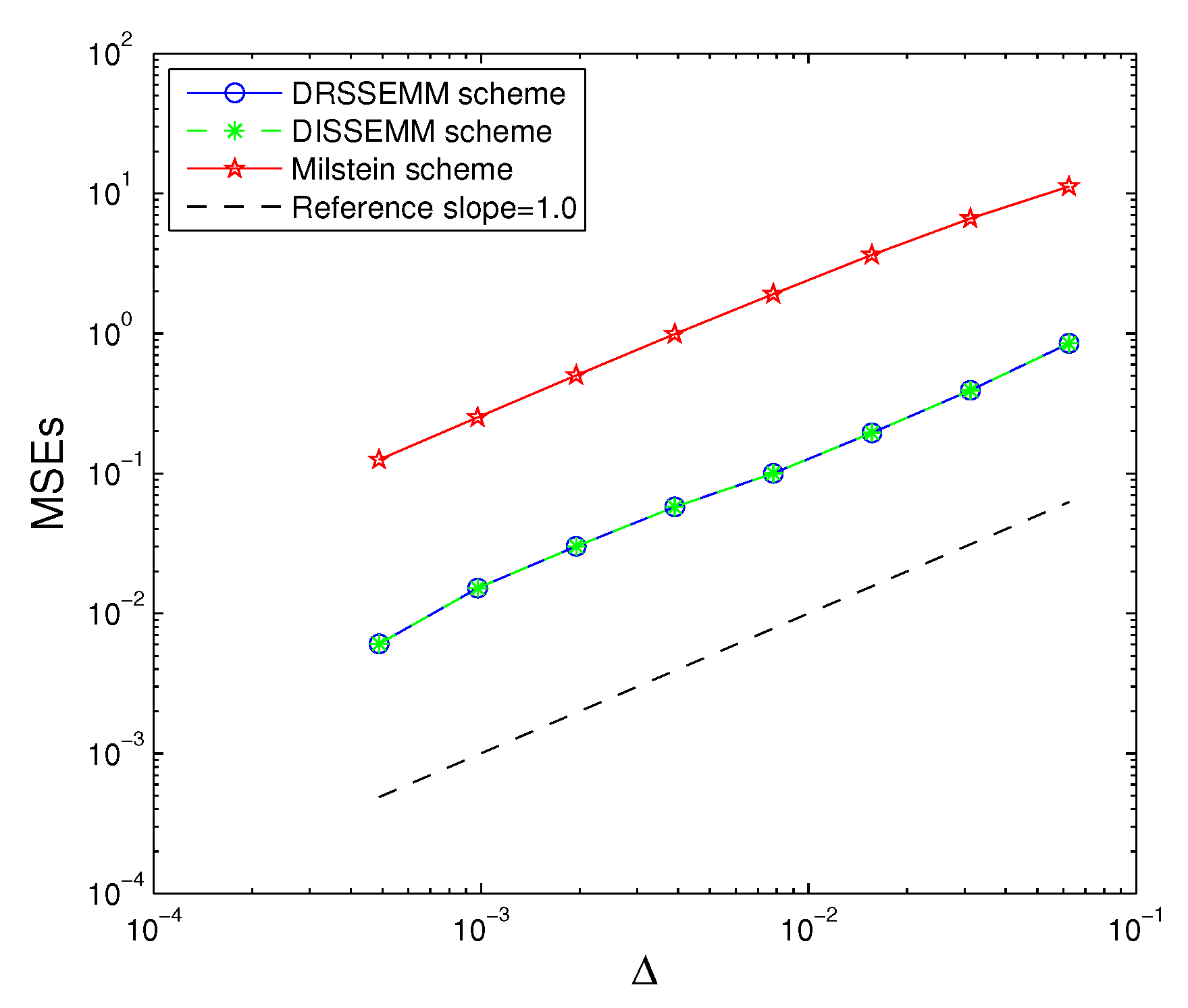
For and , Figure 4 shows the MSEs and a comparison of the DRSSEMM (3) and DISSEMM (4) schemes with the Milstein scheme. Additionally, Figure 4 reveals that the convergence order of our approaches is close to , and this is a confirmation of the theoretical conclusion of Theorem 1.
Figure 4.
MSEs of the Milstein, DRSSEMM, and DISSEMM schemes applied to SDE (16).
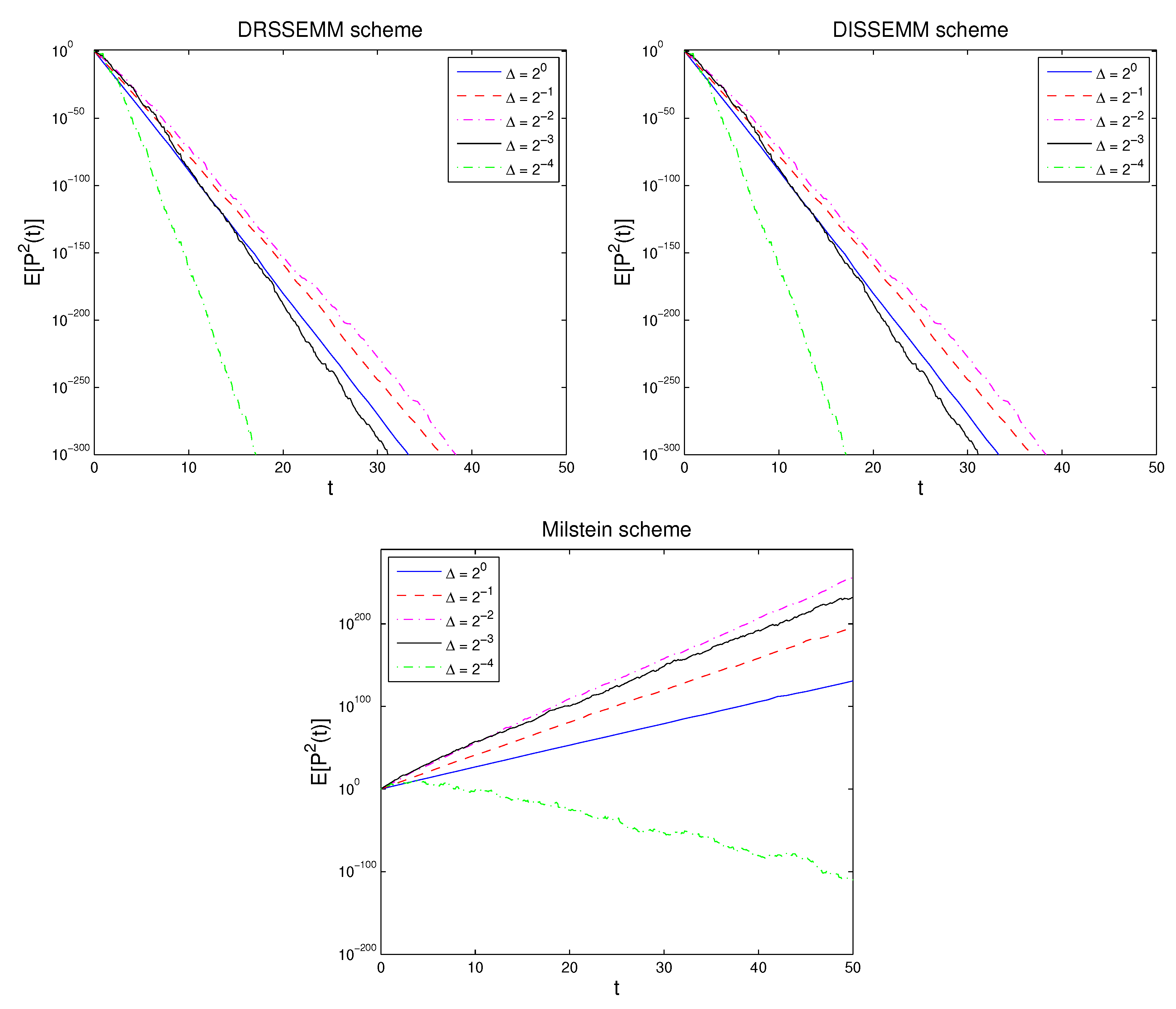
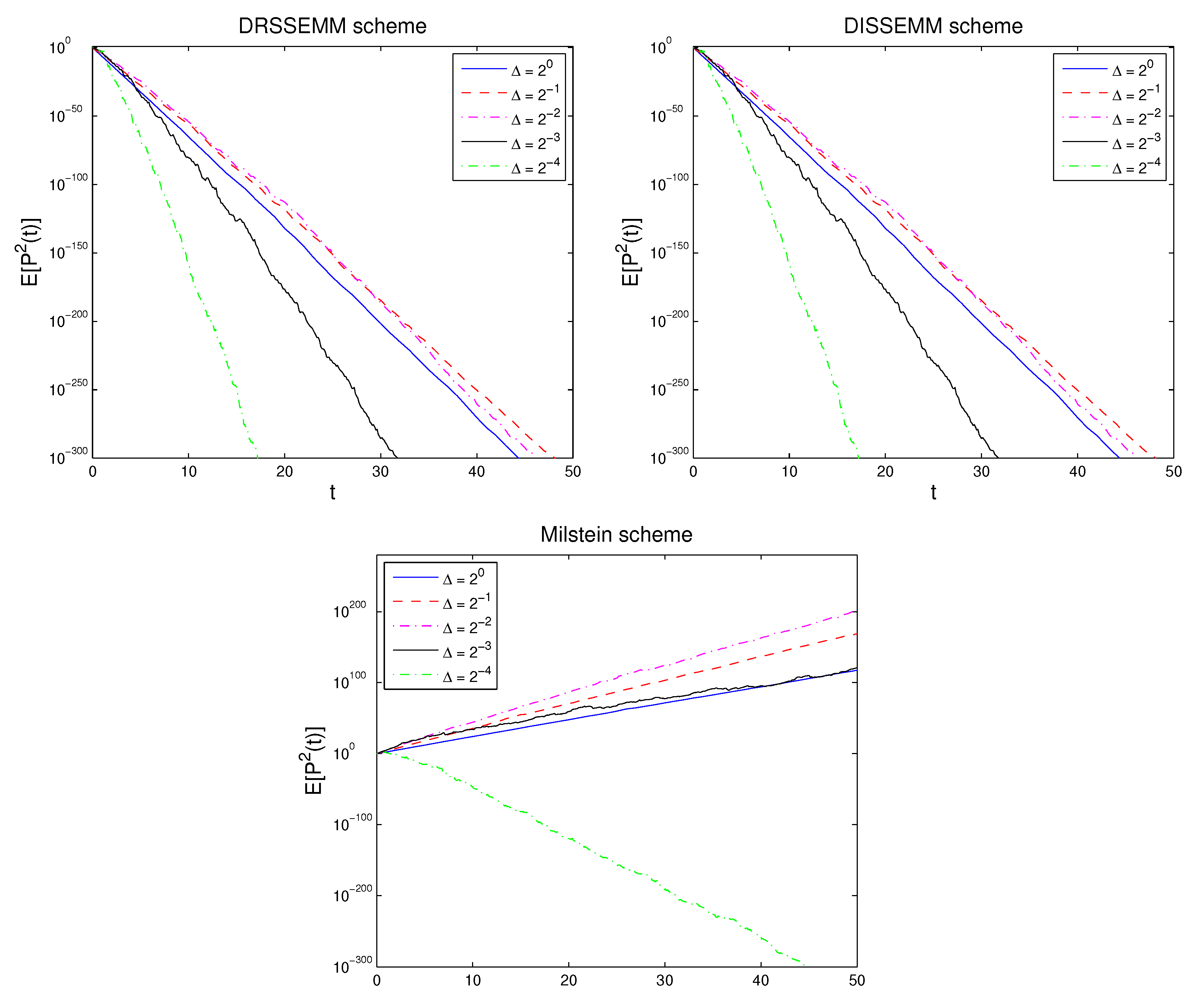
We investigate the numerical MS stability of the Milstein method and of our schemes, for the linear SDE (16) with coefficients and . The coefficients satisfy the condition (18). Figure 5 shows that our proposed schemes preserve the MS stability of the exact solution for various step-sizes , , while the numerical solution from the Milstein method is MS-stable only for step-size . To obtain the graphs of Figure 5, we simulated 50,000 sample paths of numerical solutions.
Figure 5.
MS stability of the Milstein, DRSSEMM, and DISSEMM applied to SDE (16).
5.2. A One-Dimensional Linear SDE with Two Commutative Noise Terms
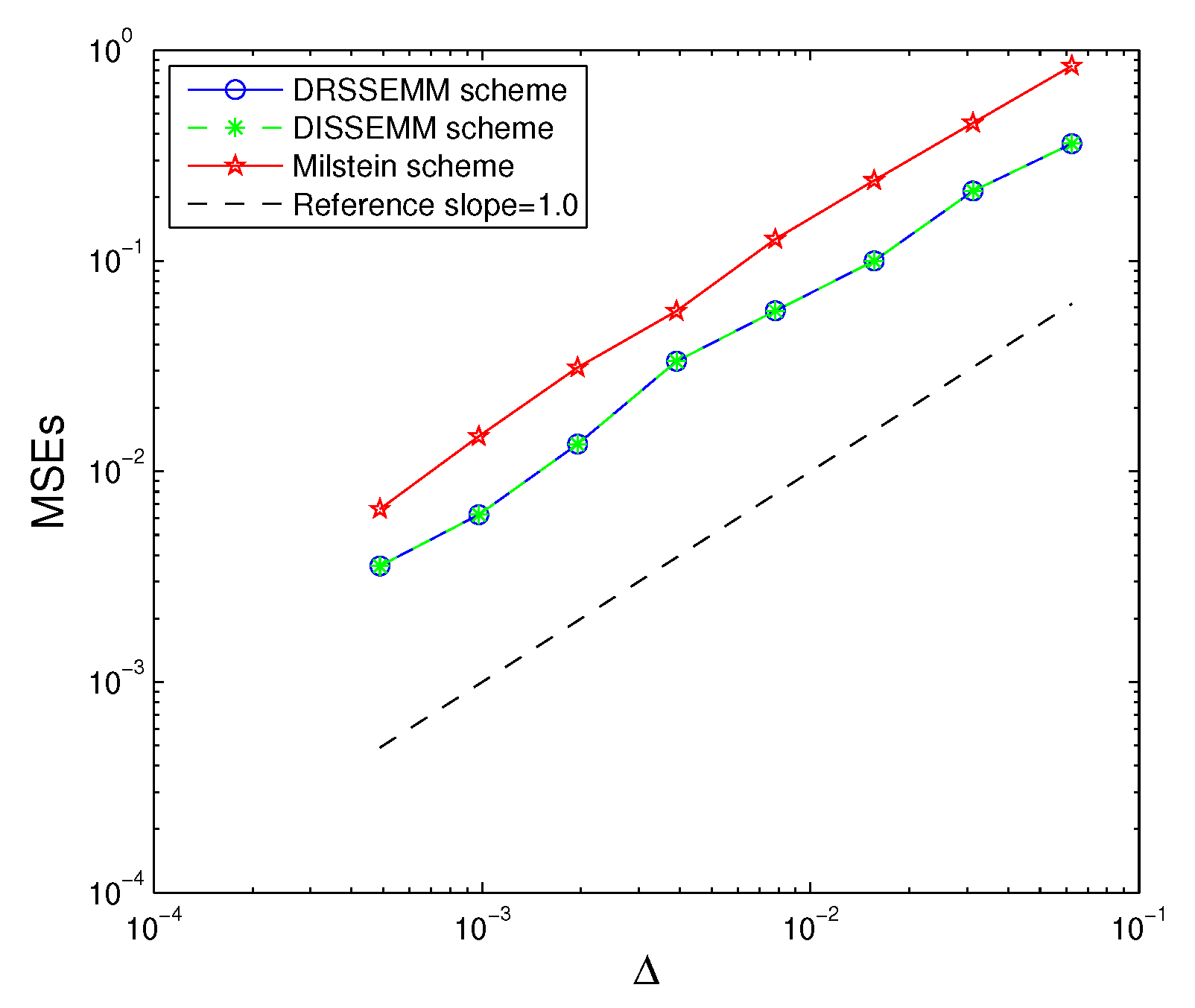
Consider a linear SDE (21) with real parameters a, and on with initial value . We choose , and eight different step-sizes , , for computer simulation, then we compare the MSEs of the DRSSEMM (3) and DISSEMM (4) schemes with the Milstein scheme in Figure 6.
Figure 6.
MSEs of the Milstein, DRSSEMM, and DISSEMM schemes applied to SDE (21).
In Figure 7, we plotted the numerical MS stability of the Milstein method and of our schemes, for the linear SDE (21) with coefficients and . We note that these coefficients satisfy condition (18). The numerical solutions are evaluated by 50,000 sample paths. According to Figure 7, our methods are MS-stable for all step-sizes , , while the numerical solution from the Milstein method preserves the MS stability of the exact solution only for step-size .
Figure 7.
MS stability of the Milstein, DRSSEMM, and DISSEMM applied to SDE (21).
5.3. A Scalar Nonlinear SDE
Consider the nonlinear SDE of the form
with the exact solution [4]
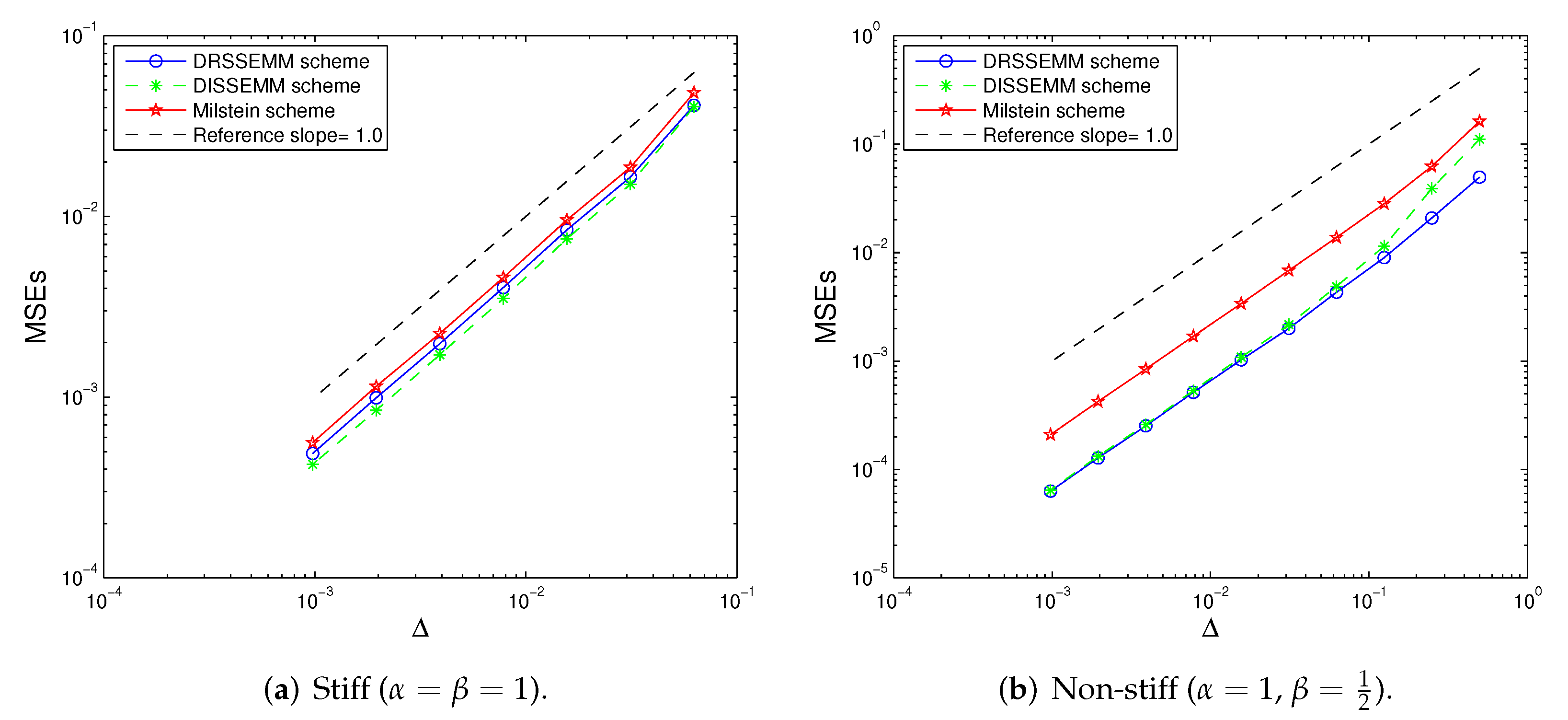
Figure 8 depicts the MSEs of methods for two cases, a stiff equation () and a non-stiff one (, ), with different step-sizes , , and .
Figure 8.
MSEs of the Milstein, DRSSEMM, and DISSEMM schemes applied to nonlinear SDE (29).
5.4. A Two-Dimensional Linear SDE with Two Commutative Noise Terms
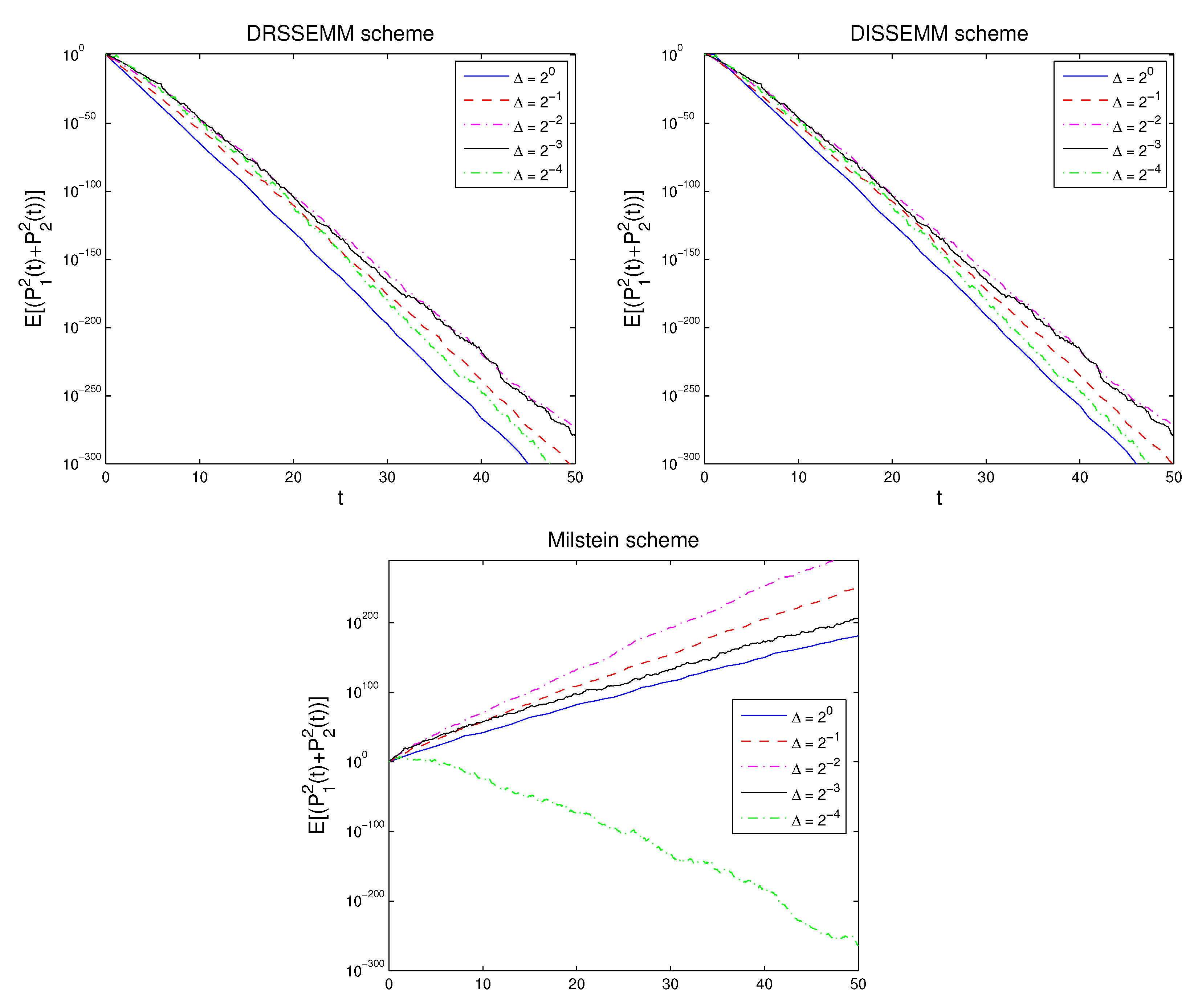
To study the numerical MS stability of the stochastic system (26), we choose , , and . Figure 9 indicates the numerical MS stability of the Milstein, DRSSEMM, and DISSEMM schemes. It is obvious that our methods preserve the MS stability of the exact solution for all step-sizes , , but the Milstein scheme is MS-stable only for step-size .
Figure 9.
MS stability of the Milstein, DRSSEMM, and DISSEMM schemes applied to SDE (26).
6. Conclusions
In the last decade, developing explicit numerical methods with a wide stability region has become one of the topics of interest for researchers. In this paper, we proposed new numerical schemes, DRSSEMM and DISSEMM, by combining the ODE solver and the explicit Milstein method and proved that the proposed schemes convergence to the exact solution with order in MS sense. Furthermore, we investigated the MS stability of the DRSSEMM and DISSEMM methods, for three different SDEs. It was shown that our approaches applied to the scalar linear SDE (16) are MS-stable for any step-size (see Theorem 2). Figure 1 confirms this. Additionally, Theorem 3 and Corollary 1 indicated that our methods are MS-stable for any step-size for scalar one-dimensional and two-dimensional SDEs driven by two commutative noise terms, respectively. Figure 2 and Figure 3 support this.
In several examples, we tested the theoretical findings of this paper. For scalar linear and non-linear SDEs, we show that the convergence order of our schemes is , see Figure 4, Figure 6 and Figure 8. Additionally, we compare the MSEs of the presented methods and the Milstein scheme in these figures. The results show that the accuracy of the DRSSEMM and DISSEMM approaches is comparable to that of the Milstein scheme. Next, the MS stability theory of the linear scalar Equations (16), (21) and (26) was investigated and compared. The results show that our methods preserve the MS stability of the exact value, while the Milstein scheme is MS-stable for small step-sizes, see Figure 5, Figure 7 and Figure 9.
Author Contributions
Conceptualization, L.T. and H.R.; methodology, L.T. and H.R.; software, H.R. and K.N.; validation, L.T., S.M. and K.N.; formal analysis, L.T., H.R., S.M. and K.N.; investigation, S.M. and K.N.; writing—original draft preparation, L.T. and H.R.; and writing—review and editing, L.T., S.M. and K.N. All authors have read and agreed to the published version of the manuscript.
Funding
This research received no external funding.
Institutional Review Board Statement
Not applicable.
Informed Consent Statement
Not applicable.
Data Availability Statement
Not applicable.
Acknowledgments
The publication of this article was partially supported by the 2022 Development Fund of the Babeș-Bolyai University, Cluj Napoca, Romania.
Conflicts of Interest
The authors declare no conflict of interest.
References
- Ali, I.; Khan, S.U. Threshold of stochastic SIRS epidemic model from infectious to susceptible class with saturated incidence rate using spectral method. Symmetry 2022, 14, 1838. [Google Scholar] [CrossRef]
- Eissa, M.A.; Elsayed, M. Improve stock price model-based stochastic pantograph differential equation. Symmetry 2022, 14, 1358. [Google Scholar] [CrossRef]
- George, R.; Mitrovic, Z.D.; Turab, A.; Savic, A.; Ali, W. On a unique solution of a class of stochastic predator-prey models with two-choice behavior of predator animals. Symmetry 2022, 11, 846. [Google Scholar] [CrossRef]
- Kloeden, P.E.; Platen, E. Numerical Solution of Stochastic Differential Equations; Springer: Berlin/Heidelberg, Germany, 1992. [Google Scholar]
- Lee, Y.; Kim, Y.; Lee, J. Pricing various types of power options under stochastic volatility. Symmetry 2020, 12, 1911. [Google Scholar] [CrossRef]
- Geiser, J. Numerical Picard iteration methods for simulation of non-Lipschitz stochastic differential equations. Symmetry 2020, 3, 383. [Google Scholar] [CrossRef]
- Haghighi, A.; Hosseini, S.M. A class of split-step balanced methods for stiff stochastic differential equations. Numer. Algorithms 2012, 61, 141–162. [Google Scholar] [CrossRef]
- Higham, D.J.; Mao, X.; Stuart, A.M. Strong convergence of Euler-type methods for nonlinear stochastic differential equations. SIAM J. Numer. Anal. 2002, 40, 1041–1063. [Google Scholar] [CrossRef]
- Milstein, G.N.; Tretyakov, M.V. Stochastic Numerics for Mathematical Physics; Springer: Berlin/Heidelberg, Germany, 2004. [Google Scholar]
- Nouri, K.; Ranjbar, H.; Torkzadeh, L. Improved Euler-Maruyama method for numerical solution of the Itô stochastic differential systems by composite previous-current-step idea. Mediterr. J. Math. 2018, 15, 140. [Google Scholar] [CrossRef]
- Nouri, K.; Ranjbar, H.; Torkzadeh, L. Modified stochastic theta methods by ODEs solvers for stochastic differential equations. Commun. Nonlinear Sci. Numer. Simul. 2019, 68, 336–346. [Google Scholar] [CrossRef]
- Wang, P.; Liu, Z. Split-step backward balanced Milstein methods for stiff stochastic systems. Appl. Numer. Math. 2009, 59, 1198–1213. [Google Scholar] [CrossRef]
- Zhang, Y.; Zhang, E.; Li, L. The improved stability analysis of numerical method for stochastic delay differential equations. Mathematics 2022, 10, 3366. [Google Scholar] [CrossRef]
- Hairer, E.; Wanner, G. Solving Ordinary Differential Equations II, Stiff and Differential-Algebraic Problems; Springer: Berlin/Heidelberg, Germany, 1991. [Google Scholar]
- Haghighi, A.; Rößler, A. Split-step double balanced approximation methods for stiff stochastic differential equations. Int. J. Comput. Math. 2019, 96, 1030–1047. [Google Scholar] [CrossRef]
- Nouri, K.; Ranjbar, H.; Torkzadeh, L. Study on split-step Rosenbrock type method for stiff stochastic differential systems. Int. J. Comput. Math. 2020, 97, 818–836. [Google Scholar] [CrossRef]
- Voss, D.A.; Casper, M.J. Efficient split linear multistep methods for stiff ordinary differential equations. SIAM J. Sci. Statist. Comput. 1989, 10, 990–999. [Google Scholar] [CrossRef]
- Reshniak, V.; Khaliq, A.Q.M.; Voss, D.A.; Zhang, G. Split-step Milstein methods for multi-channel stiff stochastic differential systems. Appl. Numer. Math. 2015, 89, 1–23. [Google Scholar] [CrossRef]
- Voss, D.A.; Khaliq, A.Q.M. Split-step Adams-Moulton Milstein methods for systems of stiff stochastic differential equations. Int. J. Comput. Math. 2015, 92, 995–1011. [Google Scholar] [CrossRef]
- Nouri, K. Improving split-step forward methods by ODE solver for stiff stochastic differential equations. Math. Sci. 2022, 16, 51–57. [Google Scholar] [CrossRef]
- Nouri, K.; Ranjbar, H.; Baleanu, D.; Torkzadeh, L. Investigation on Ginzburg-Landau equation via a tested approach to benchmark stochastic Davis-Skodje system. Alex. Eng. J. 2021, 60, 5521–5526. [Google Scholar] [CrossRef]
- Nouri, K.; Ranjbar, H.; Torkzadeh, L. The explicit approximation approach to solve stiff chemical Langevin equations. Eur. Phys. J. Plus 2020, 135, 758. [Google Scholar] [CrossRef]
- Ranjbar, H.; Nouri, K.; Torkzadeh, L. Improvement of split-step forward Milstein schemes for SODEs arising in mathematical physics. Math. Probl. Eng. 2022, 2022, 7498865. [Google Scholar] [CrossRef]
- Saito, Y.; Mitsui, T. Stability analysis of numerical schemes for stochastic differential equations. SIAM J. Numer. Anal. 1996, 33, 2254–2267. [Google Scholar] [CrossRef]
- Saito, Y.; Mitsui, T. Mean-square stability of numerical schemes for stochastic differential systems. Vietnam J. Math. 2002, 30, 551–560. [Google Scholar]
- Buckwar, E.; Sickenberger, T. A comparative linear mean-square stability analysis of Maruyama and Milstein-type methods. Math. Comput. Simul. 2011, 81, 1110–1127. [Google Scholar] [CrossRef]
- Buckwar, E.; Sickenberger, T. A structural analysis of asymptotic mean-square stability for multi-dimensional linear stochastic differential systems. Appl. Numer. Math. 2012, 62, 842–859. [Google Scholar] [CrossRef]
- Ding, X.; Ma, Q.; Zhang, L. Convergence and stability of the split-step θ-method for stochastic differential equations. Comput. Math. Appl. 2010, 60, 1310–1321. [Google Scholar] [CrossRef]
- Higham, D.J. A-stability and stochastic mean-square stability. BIT Numer. Math. 2000, 40, 404–409. [Google Scholar] [CrossRef]
- Guo, Q.; Li, H.; Zhu, Y. The improved split-step θ methods for stochastic differential equation. Math. Methods Appl. Sci. 2014, 37, 2245–2256. [Google Scholar] [CrossRef]
- Khasminskii, R. Stochastic Stability of Differential Equations; Springer: Berlin/Heidelberg, Germany, 2012. [Google Scholar]
- Mao, X. Stochastic Differential Equations and Their Applications; Horwood Publishing: Chichester, UK, 1997. [Google Scholar]
- Arnold, L. Stochastic Differential Equations: Theory and Applications; John Wiley & Sons: New York, NY, USA, 1974. [Google Scholar]
Publisher’s Note: MDPI stays neutral with regard to jurisdictional claims in published maps and institutional affiliations. |
© 2022 by the authors. Licensee MDPI, Basel, Switzerland. This article is an open access article distributed under the terms and conditions of the Creative Commons Attribution (CC BY) license (https://creativecommons.org/licenses/by/4.0/).