Abstract
In this paper, we give the parametric equation of the Bishop frame for a timelike sweeping surface with a unit speed timelike curve in Minkowski 3-space. We introduce a new geometric invariant to explain the geometric properties and local singularities of this timelike surface. We derive the sufficient and necessary conditions for this timelike surface to be a timelike developable ruled surface. Afterwards, we take advantage of singularity theory to give the classification of singularities of this timelike developable surface. Furthermore, we give some representative examples to show the applications of the theoretical results.
1. Introduction
Singularity theory of curves and surfaces is an efficient area of research in various branches of mathematics and physics. In the view of differential geometry, curves and surfaces are performed by functions with one variable and two variables, respectively. In recent years, singularity theory for curves and surfaces has become a paramount tool for different interesting fields such as medical imaging and computer vision (see, e.g., [1,2,3,4] ).
As we know, a sweeping surface is the surface traced by the movement of a plane curve (the profile curve or generatrix) whilst the plane is moved through space in such a way that the movement of the plane is always in the direction of the normal to the plane. Sweeping is a very important, powerful, and widespread method in geometric modelling. The basic concept is to select some geometrical object (generator) that is then swept along a spine curve (trajectory) in the space. The result of such evolution, consisting of movement through space and intrinsic shape deformation, is a sweep object. The sweep object kind is determined by the choice of the generator and the trajectory. Thus, sweeping a curve over another curve generates a sweeping surface. There are several names of sweeping surfaces that we are familiar with, such as tubular surface, pipe surface, string, and canal surface. In [5], J. Suk and D.W Yoon initiated the study of a tube in Euclidean 3-space, satisfying some equation in terms of the Gaussian curvature, the mean curvature, and the second Gaussian curvature. The kinematic geometry of circular surfaces with a fixed radius based on Euclidean invariants was defined by L. Cui et al. in [6]. RA. Abdel-Baky in [7] considered the study of developable surfaces through sweeping surfaces in Euclidean 3-space. S. Izumiya et al. in [8] examined some corresponding properties of circular surfaces with classical ruled surfaces. A survey of the principle geometric features of canal surfaces has been defined by Xu et al. in [9]. Furthermore, the authors presented sufficient conditions for canal surfaces without local self-intersection. Moreover, they derived a simple expression for the area and Gaussian curvature of canal surfaces.
One of the most suitable methods to analyzing curves and surfaces in differential geometry is the Serret–Frenet frame, but it is not unique; there are also other frame fields such as the rotation minimizing frame (RMF) or the Bishop frame [10]. Some applications of the Bishop frame can be found in [11,12,13,14]. Corresponding to the Bishop frame in Euclidean space, there exists a Minkowski version frame that is called a Minkowski–Bishop frame as applied to Minkowski geometry. When we investigate a space curve, it is more convenient for us to use the Minkowski–Bishop frame along the curve as the basic tool than the Serret–Frenet frame in Lorentzian space. There are several papers about the Minkowski–Bishop frame; for example, [1,7,15].
In this paper, we present the notion of timelike sweeping surfaces with rotation minimizing frames in Minkowski 3-space. Thus, by applying singularity theory, we classify the generic properties and present q new invariant connected to the singularity of this timelike sweeping surface. The main generic singularities of this sweeping surface are the well-known cuspidal edge and swallowtail, and they are characterized by this new invariant. Furthermore, from the viewpoint of singularity theory, we present the singularity properties of timelike sweeping surfaces in Minkowski 3-space. In this way, we take advantage of some classical and well-known results in singularity theory as evidence to prove our main results in this paper. Moreover, this paper gives the necessary and sufficient conditions to characterize when the timelike sweeping surface is a timelike developable ruled surface and discusses further conclusions. Regarding the timelike developable surfaces, we studied the uniqueness properties. Furthermore, this paper also focuses on the singularity properties of the timelike developable surfaces. Finally, to illustrate the main results, two examples are given and investigated in detail. Our plans for the future research are to conduct interdisciplinary research because it can provide valuable new insights, but synthesizing articles across disciplines with highly varied standards, formats, terminology, and methods requires an adapted approach. Therefore, we find some of the latest related studies in [16,17,18,19,20,21,22,23,24,25,26,27,28,29,30,31,32,33,34,35,36,37,38,39,40,41,42,43,44,45,46,47,48,49,50,51,52,53,54,55,56,57,58,59,60,61,62,63,64,65,66]. One possible way to achieve the interdisciplinary research goal of obtaining more singularity and symmetry properties of timelike sweeping surfaces is to apply a mix or a blend of the techniques in [16,17,18,19,20,21,22,23,24,25,26,27,28,29,30,31,32,33,34,35,36,37,38,39,40,41,42,43,44,45,46,47,48,49,50,51,52,53,54,55,56,57,58,59,60,61,62,63,64,65,66] combine them the methods of this paper.
2. Preliminaries
We introduce in this section some basic notions on Minkowski 3-space. For basic concepts and properties, see [67,68].
Let , (i=1, 2, 3)} be a 3-dimensional Cartesian space. For any , and , the pseudo-scalar product of and is defined by
We call Minkowski 3-space. We write instead of (. We say that a non-zero vector is spacelike, lightlike, or timelike if , or . The norm of the vector is defined to be . For any two vectors , , we define a vector by
where , , is the canonical basis of . We can easily check that
so that is pseudo-orthogonal to any . The Lorentzian unit sphere with center in the origin of is defined by
Let be a unit speed timelike curve; by and , we denote the natural curvature and torsion of , respectively. Let , be the Serret–Frenet frame associated with . For each point of , the corresponding Serret–Frenet formulae read:
where is the Darboux vector of the Serret–Frenet frame. In this paper, dashes denote the derivatives with respect to the arc-length parameter s. It is easy to see that
Definition 1.
A pseudo -orthogonal moving frame , along a non-null space curve is a rotation minimizing frame (RMF) with respect to if the derivatives of and are both parallel to , or its angular velocity ω satisfies . An analogous characterization holds when or is chosen as the reference direction [11].
According to Definition 1, we observe that the Serret–Frenet frame is an RMF with respect to the principal normal , but not with respect to the tangent and the binormal . Although the Serret–Frenet frame is not an RMF with respect to , one can easily derive such an RMF from it. New normal plane vectors (,) are specified through a rotation of (,) according to
with a certain spacelike angle . Here, we call the set , , an RMF or Bishop frame. The RMF vector satisfies the relations
Therefore, we have the alternative frame equations
where is the RMF Darboux vector. Here, the Bishop curvatures are defined by and . One can show that
Consequently, the Serre–Frenet frame and the RMF are identical if and only if is a planar, i.e., . Now we define the spacelike Bishop spherical Darboux image , by
Therefore, we consider a new geometric invariant .
We denote a surface M in by
Let be the standard unit normal vector field on a surface M defined by where . Then, the metric (first fundamental form) I of a surface M is defined by
where , . We define the second fundamental form of M by
where , .
3. Timelike Sweeping Surface
The concept of a sweeping surface is obtained kinematically by a planar curve moving such that the motion of any point on the surface is constantly orthogonal to the plane. Then, the sweeping surface along is [13,14]:
where is called the -continuous. is the planar profile (cross-section) curve given by parametric representation . The symbol ’t’ represents transposition, with another parameter . The semi orthogonal matrix , specifies the RMF along . Geometrically, the sweeping surface is generated by moving the profile curve along the spine curve with the orientation as specified by .
Without loss of generality, we can suppose the profile curve is a unit speed spacelike curve, that is, . In the following, “dot” denotes the derivative with respect to the parameter u of the profile curve . From now on, we shall often not write the parameters s and t explicitly in our formulae. Therefore, from the derivative formulas of RMF, partial differentiation with respect to s and u is as follows:
By simple calculations, we have the following:
and
Note that means that M is a timelike surface. Furthermore, we have:
Then, we can compute
Hence, the u-and s curves of M are curvature lines; that is, .
Corollary 1.
Let M be the sweeping surface defined by Equation (14). Then:
- (1)
- The s-parameter curve is also a geodesic on M if
- (2)
- The s-parameter curve is also an asymptotic curve on M if
Proof.
- (1)
- The s-parameter curve is a also geodesic if ; that is,Since , and are linearly independent unit vectors, we have the desired equation system;
- (2)
- The s-parameter curve is also an asymptotic curve on M if ; that is,
Since (See Equation (15)), it follows that as claimed. □
Corollary 2.
Let M be the sweeping surface represented by Equation (14). Then:
- (1)
- The parameter curve cannot be also a geodesic on M;
- (2)
- The parameter curve is also an asymptotic curve on M if
Proof.
- (1)
- Since and , the parameter curve cannot be also a geodesic on M;
- (2)
- The parameter curve is also an asymptotic curve on M if ; that is,as claimed. In this case, , so M is a developable ruled surface, that is, its Gaussian curvature is identically zero.
□
The aim of this work is the following theorem:
Theorem 1.
Let β: be a unit speed timelike curve with . Then, for any fixed , one has the following:
A—(1) is locally diffeomorphic to a line {} at if and only if ;
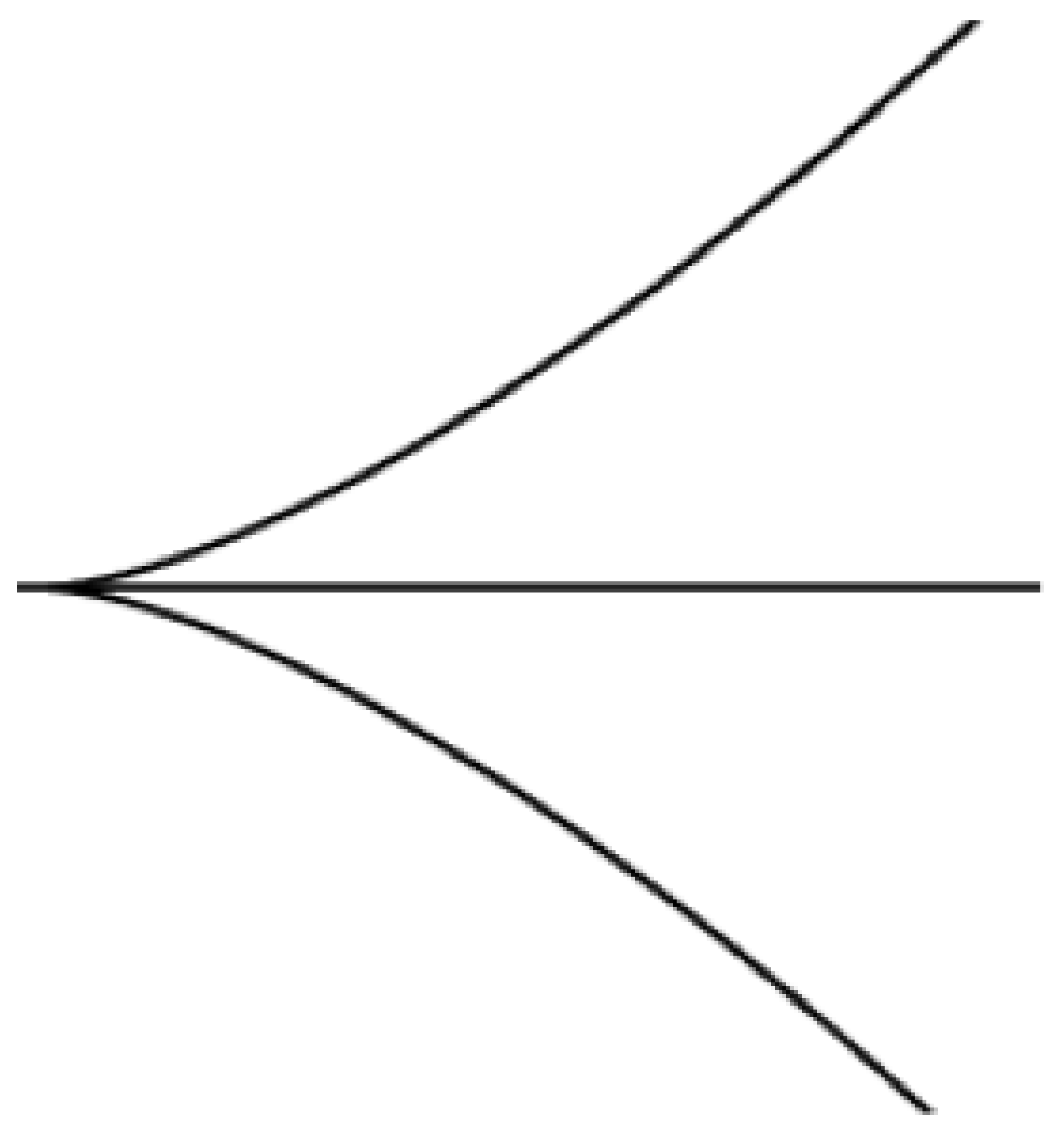
(2) is locally diffeomorphic to the cusp at if and only if , and .
B—(1) M is locally diffeomorphic to cuspidal edge at ( if and only if and ;
(2) M is locally diffeomorphic to swallowtail SW at ( if and only if , and .
The proof will appear later. Here,
Figure 1.
.
Figure 2.
CE.
Figure 3.
SW.
3.1. Lorentzian Height Functions
Next, let us introduce two different families of Lorentzian height functions that will be useful to study the singularities of M as follows [1,11,67]: by . We call this the Lorentzian height function. We use the notation for any fixed . We also define as . We call it the extended Lorentzian height function of . We denote that . From now on, we shall often not write the parameter s. Then, we give the following proposition:
Proposition 1.
Let β: be a unit speed timelike curve with . Then, the following holds:
(A).
(1) if and only if and ;
(2) if and only if ;
(3) if and only if and
(4) if and only if and
(5) if and only if and
(B).
(1) if and only if there exist ;
(2) if and only if there exist , such that and ;
(3) if and only if , , and ;
(4) if and only if , , and ;
(5) if and only if , , and
Proof.
(A). (1) Since , and , is RMF along , then there exists , such that . Moreover, in combination with , we obtain ; it follows that if and only if and .
(2) When , the assertion (2) follows from the fact that . Thus, we have . It follows from the fact that and . Thereby, we have
Thus, we obtain if and only if .
(3) Under the condition that , , and by Equation (20), we have
Since , we obtain if and only if and .
(4) Since
Thus, making use of Equation (20) in the above, we have that
This is equivalent to the condition .
(5) Since , we have
Similarly, by Equation (20) in the above, we have
This is equivalent to the condition . (B). Using the same computation as the proof of (A), we can obtain (B). □
Proposition 2.
Let β: be a unit speed timelike curve with . Then, we have if and only if
is a constant vector.
Proof.
Suppose that . By simple calculations, we have
Thus, if and only if □
Proposition 3.
Let β: be a unit speed timelike curve with . Then, we state the following:
- (a)
- β is a slant helix if and only if is constant;
- (b)
- is a part of a circle on whose center is the spacelike constant vector
Proof.
- (a)
- Suppose that . Hence, we can writeThis means that =constant; that is, is a slant helix;
- (b)
- Suppose that . Since
is a part of a circle on whose center is the constant spacelike vector . □
3.2. Unfolding of Functions by One-Variable
Now, we use some general results on the singularity theory for families of function germs [1,2,3]. Let F: be a smooth function and . Then, F is called an r-parameter unfolding of . We say that has A-singularity at if for all , and . We also say that f has A-singularity () at s. Let the -jet of the partial derivative at be (without the constant term), for . Then, is called a p-versal unfolding if the matrix of coefficients has rank k. Therefore, we write an important set about the unfolding relative to the above notations. The discriminant set of F is the set
The bifurcation set of F is the set
Then, similar to [1,11,67], we state the following theorem:
Theorem 2.
Let F: be an r-parameter unfolding of , which has the singularity at .
Suppose that F is a p-versal unfolding;
- (a)
- If , then is locally diffeomorphic to , and ;
- (b)
- If , then is locally diffeomorphic to and is locally diffeomorphic to ;
- (c)
- If , then is locally diffeomorphic to and is locally diffeomorphic to .
Hence, we have the following fundamental proposition:
Proposition 4.
Let β: be a unit speed timelike curve . (1). If has an -singularity ( at , then H is a versal unfolding of . (2). If has an -singularity ( at , then is a versal unfolding of
Proof.
(1) Since and . Without loss of generality, suppose . Then, by , we have
Thus, we have that
Therefore, the 2-jets of at (i = 0, 1) are as follows. Let and assume ; then
and
- (i)
- If has the -singularity at , then . Therefore, the matrix of coefficients is:
Suppose that the rank of the matrix A is zero; then, we have:
Since , we have and the contradiction as follows:
Therefore, rank(, and H is the (p) versal unfolding of at .
- (ii)
- If has the -singularity at , then and by Proposition 1:where , and . Therefore, the matrix of the coefficients is
For the purpose, we also require the matrix B to be non-singular, which always holds true. In fact, the determinate of this matrix at is
Since , we have . Substituting these relations for the above equality, we have
This means that rank .
(2) Under the same notation as in (1), we have
We require the matrix
to have the maximal rank. By case (1) in Equation (30), the second raw of G does not vanish, so rank . □
Proof
(Proof of Theorem 1). (1) By Proposition 1, the bifurcation set of is
The assertion (1) of Theorem 1 follows from Proposition 1, Proposition 4, and Theorem 2. The discriminant set of is given as follows:
The assertion (1) of Theorem 1 follows from Proposition 1, Proposition 4, and Theorem 2.
□
Example 1.
Given the timelike helix:
It is easy to show that
Taking , we have . Using the Equation (9), we obtain
Hence, the geometric invariant is
The transformation matrix can be expressed as
From this, we have
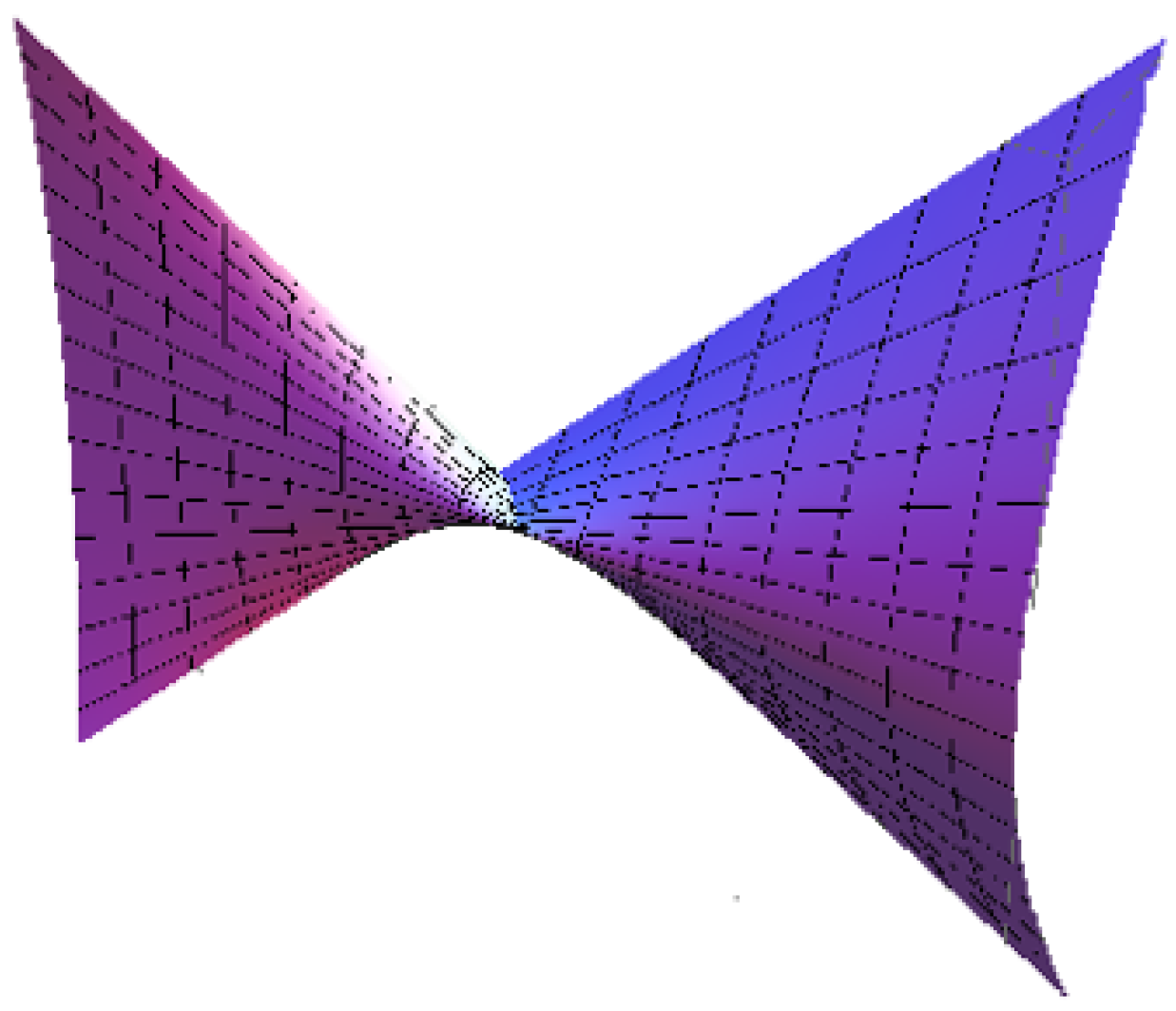
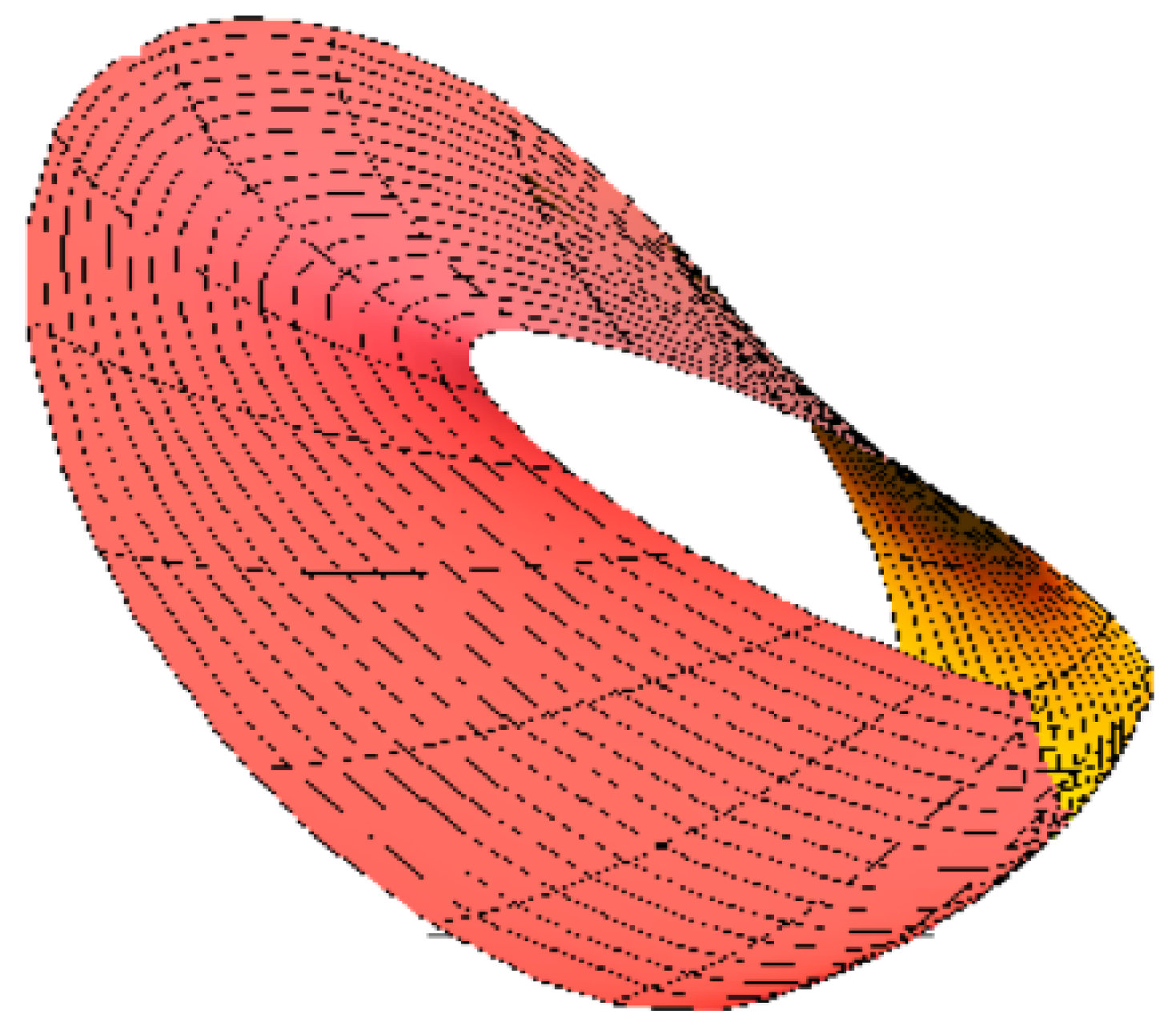
Hence, the timelike sweeping surface is (Figure 4)
Figure 4.
Timelike sweeping surface.
The Bishop spherical Darboux image is
3.3. Timelike Developable Surfaces and Singularities
In this subsection, we analyze the case that the profile curve degenerates to a spacelike straight line; that is, . Then, we can give the following timelike developable surface
Similarly, we have the following timelike developable surface
It is easy to show that (resp. ), ; that is, the surface (resp. ) interpolates the curve . Furthermore, we have
and
Hence, we have that M (resp. ) is non-singular at if and only if (resp. . We designate to represent (i = 1, 2); based on the Theorem 3 in [69], we can give the following corollary:
Corollary 3.
For the timelike developable ruled surfaces and , we have the following:
- (1)
- (resp. ) is locally diffeomorphic to the cuspidal edge CE at if , and ;
- (2)
- (resp. ) is locally diffeomorphic to the swallowtail SW at if and .
Example 2.
By using Example 1, the timelike developable surfaces, respectively, are
and
The singular loci of M, and , respectively, are
and
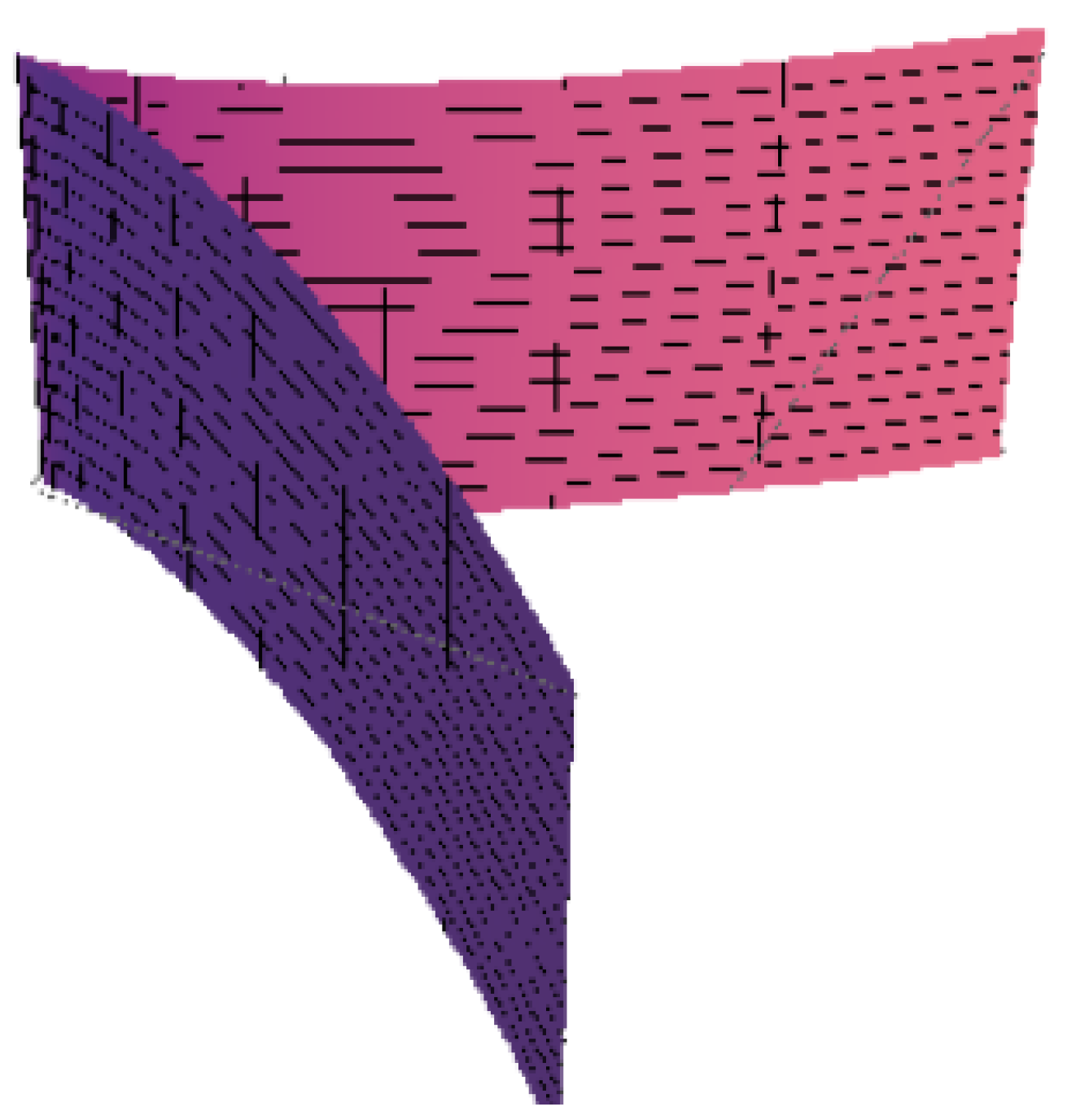
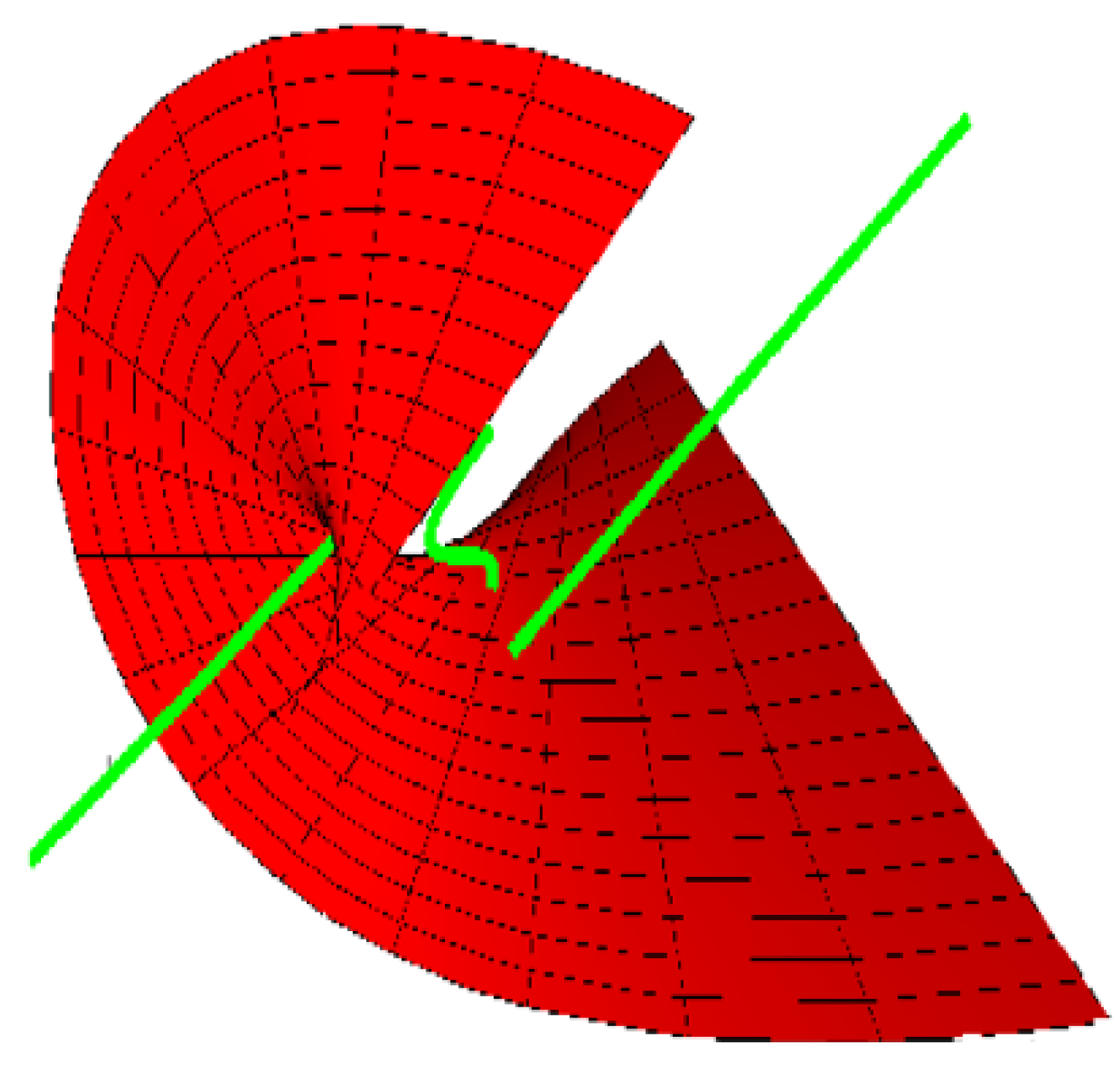
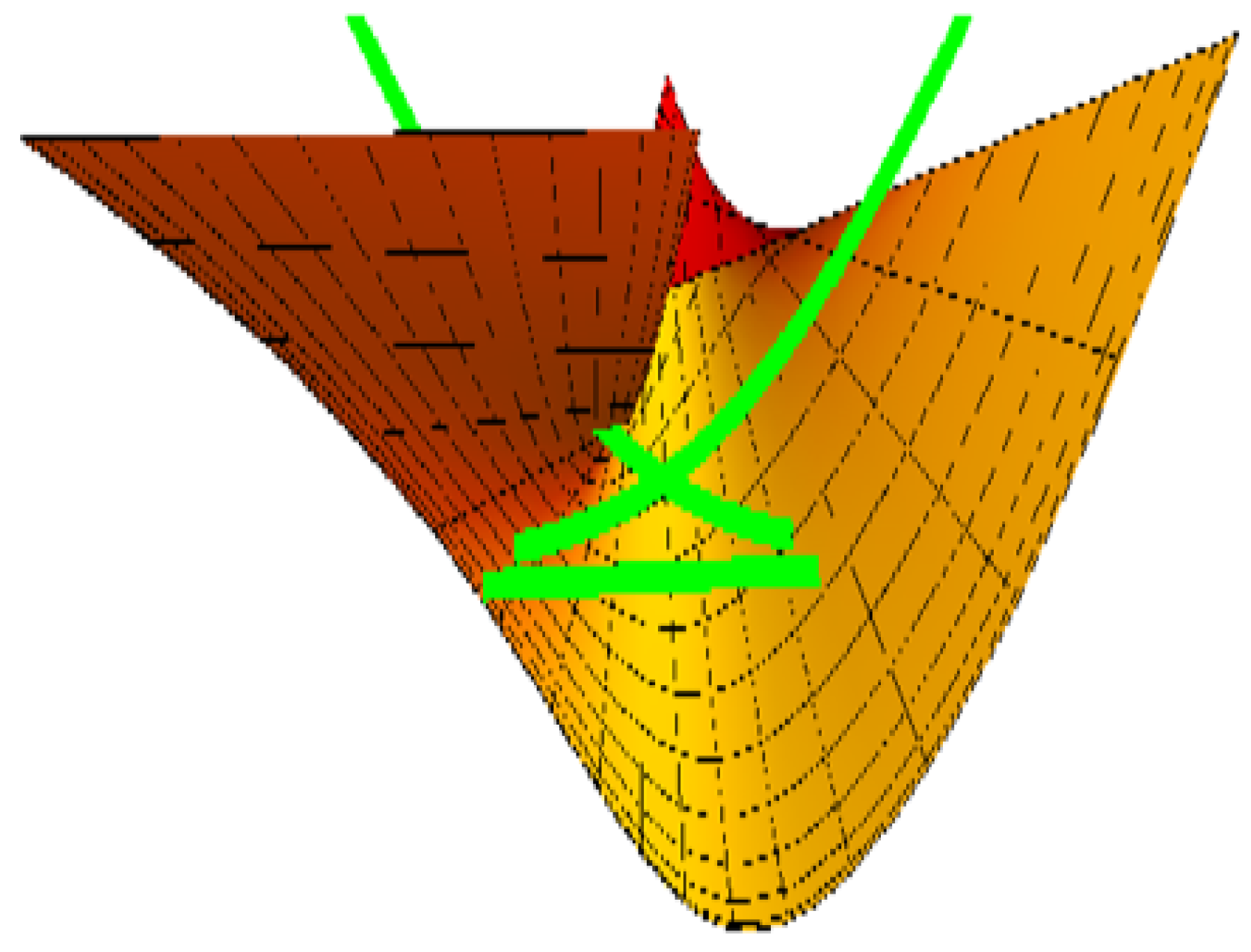
We consider a local part of this curve when . We see that and for . This means that M is locally diffeomorphic to a CE and its singular locus is locally diffeomorphic to a line (the green line); see Figure 5. For , when , we see that , gives one real root . This means that is locally diffeomorphic to SW and the singular locus is locally diffeomorphic to a line (the green line) at ; see Figure 6.
Figure 5.
CE timelike developable surface.
Figure 6.
SW timelike developable surface.
4. Conclusions
This paper is concerned with the study of a special kind of timelike tube surface, called the named timelike sweeping surface in Minkowski 3-space. It is traced by a spacelike plane curve moving through a timelike curve such that the movement of any point on the surface is constantly orthogonal to the plane. Then, the problems of singularity and convexity of such a timelike sweeping surface are discussed. In particular, we derived the sufficient and necessary conditions for this timelike sweeping surface to be a timelike developable ruled surface. Afterwards, the problem of singularity of a timelike developable ruled surface is investigated. We also illustrated our main results by giving some representative examples. Hopefully, these results will be useful to physicists and those studying the general relativity theory. There are several opportunities for further work. An analogue of the problem addressed in this paper may be consider for 3-surfaces in 4-space. We will study this problem in the future.
Author Contributions
Conceptualization, Y.L., S.H.N. and R.A.A.-B. methodology, Y.L., S.H.N. and R.A.A.-B. investigation, Y.L., S.H.N. and R.A.A.-B.; writing—original draft preparation, Y.L., S.H.N. and R.A.A.-B.; writing—review and editing, Y.L., S.H.N. and R.A.A.-B. All authors have read and agreed to the published version of the manuscript.
Funding
This research was funded by the National Natural Science Foundation of China (grant no. 12101168) and the Zhejiang Provincial Natural Science Foundation of China (grant no. LQ22A010014).
Institutional Review Board Statement
Not applicable.
Informed Consent Statement
Not applicable.
Data Availability Statement
Not applicable.
Conflicts of Interest
The authors declare no conflict of interest.
References
- Bükcu, B.; Karacan, M.K. On the slant helices according to Bishop frame of the timelike curve in Lorentzian space. Tamkang J. Math. 2008, 39, 255–262. [Google Scholar] [CrossRef]
- Bruce, J.W.; Giblin, P.J. Curves and Singularities, 2nd ed.; Cambridge University Press: Cambridge, UK, 1992. [Google Scholar]
- Saji, K.; Umehara, M.; Yamada, K. The geometry of fronts. Ann. Math. 2009, 169, 491–529. [Google Scholar] [CrossRef]
- Teramoto, K. Parallel and dual surfaces of cuspidal edges. Differ. Geom. Appl. 2016, 44, 52–62. [Google Scholar] [CrossRef]
- Ro, J.S.; Yoon, D.W. Tubes of weingarten types in Euclidean 3-space. J. Chungcheong Math. Soc. 2009, 22, 359–366. [Google Scholar] [CrossRef][Green Version]
- Cui, L.; Wang, D.L.; Dai, J.S. Kinematic geometry of circular surfaces with a fixed radius based on Euclidean invariants. ASME J. Mech. 2009, 131, 101009. [Google Scholar] [CrossRef]
- Keskin, O.; Yayli, Y. An application of N-Bishop frame to spherical images for direction curves. Int. J. Geom. Methods Mod. Phys. 2017, 14, 1750162. [Google Scholar] [CrossRef]
- Izumiya, S.; Saji, K.; Takeuchi, N. Circular surfaces. Adv. Geom. 2007, 7, 295–313. [Google Scholar] [CrossRef]
- Xu, Z.; Feng, R.S. Analytic and algebraic properties of canal surfaces. J. Comput. Appl. Math. 2006, 195, 220–228. [Google Scholar] [CrossRef]
- Bishop, R.L. There is more than one way to frame a curve. Am. Math. Mon. 1975, 82, 246–251. [Google Scholar] [CrossRef]
- Klok, F. Two moving coordinate frames for sweeping along a 3D trajectory. Comput. Aided Geom. Des. 1986, 3, 217–229. [Google Scholar] [CrossRef]
- Farouki, R.T.; Giannelli, C.; Sampoli, M.L. Rotation-minimizing osculating frames. Comput. Aided Geom. Des. 2011, 31, 27–34. [Google Scholar] [CrossRef]
- Wang, W.; Joe, B. Robust computation of the rotation minimizing frame for sweep surface modelling. Comput. Aided Des. 1997, 29, 1997. [Google Scholar] [CrossRef]
- Wang, W.; Jüttler, B.; Zheng, D.; Liu, Y. Computation of rotating minimizing frames. ACM Trans. Graph. 2008, 27, 2008. [Google Scholar] [CrossRef]
- Grbovic, M.; Nešovic, E. On the Bishop frames of pseudo null and null Cartan curves in Minkowski 3-space. J. Math. Anal. Appl. 2018, 461, 219–233. [Google Scholar] [CrossRef]
- Li, Y.; Ganguly, D.; Dey, S.; Bhattacharyya, A. Conformal η-Ricci solitons within the framework of indefinite Kenmotsu manifolds. AIMS Math. 2022, 7, 5408–5430. [Google Scholar] [CrossRef]
- Li, Y.; Abolarinwa, A.; Azami, S.; Ali, A. Yamabe constant evolution and monotonicity along the conformal Ricci flow. AIMS Math. 2022, 7, 12077–12090. [Google Scholar] [CrossRef]
- Li, Y.; Khatri, M.; Singh, J.P.; Chaubey, S.K. Improved Chen’s Inequalities for Submanifolds of Generalized Sasakian-Space-Forms. Axioms 2022, 11, 324. [Google Scholar] [CrossRef]
- Li, Y.; Mofarreh, F.; Agrawal, R.P.; Ali, A. Reilly-type inequality for the ϕ-Laplace operator on semislant submanifolds of Sasakian space forms. J. Inequal. Appl. 2022, 1, 102. [Google Scholar] [CrossRef]
- Li, Y.; Mofarreh, F.; Dey, S.; Roy, S.; Ali, A. General Relativistic Space-Time with η1-Einstein Metrics. Mathematics 2022, 10, 2530. [Google Scholar] [CrossRef]
- Li, Y.; Dey, S.; Pahan, S.; Ali, A. Geometry of conformal η-Ricci solitons and conformal η-Ricci almost solitons on Paracontact geometry. Open Math. 2022, 20, 574–589. [Google Scholar] [CrossRef]
- Li, Y.; Uçum, A.; İlarslan, K.; Camcı, Ç. A New Class of Bertrand Curves in Euclidean 4-Space. Symmetry 2022, 14, 1191. [Google Scholar] [CrossRef]
- Li, Y.; Şenyurt, S.; Özduran, A.; Canlı, D. The Characterizations of Parallel q-Equidistant Ruled Surfaces. Symmetry 2022, 14, 1879. [Google Scholar] [CrossRef]
- Li, Y.; Haseeb, A.; Ali, M. LP-Kenmotsu manifolds admitting η-Ricci solitons and spacetime. J. Math. 2022, 2022, 6605127. [Google Scholar] [CrossRef]
- Li, Y.; Mofarreh, F.; Abdel-Baky, R.A. Timelike Circular Surfaces and Singularities in Minkowski 3-Space. Symmetry 2022, 14, 1914. [Google Scholar] [CrossRef]
- Li, Y.; Alluhaibi, N.; Abdel-Baky, R.A. One-Parameter Lorentzian Dual Spherical Movements and Invariants of the Axodes. Symmetry 2022, 14, 1930. [Google Scholar] [CrossRef]
- Li, Y.; Eren, K.; Ayvacı, K.H.; Ersoy, S. Simultaneous characterizations of partner ruled surfaces using Flc frame. AIMS Math. 2022, 7, 20213–20229. [Google Scholar] [CrossRef]
- Yang, Z.C.; Li, Y.; Erdoǧdub, M.; Zhu, Y.S. Evolving evolutoids and pedaloids from viewpoints of envelope and singularity theory in Minkowski plane. J. Geom. Phys. 2022, 176, 104513. [Google Scholar] [CrossRef]
- Gür, S.; Şenyurt, S.; Grilli, L. The Dual Expression of Parallel Equidistant Ruled Surfaces in Euclidean 3-Space. Symmetry 2022, 14, 1062. [Google Scholar]
- Çalışkan, A.; Şenyurt, S. Curves and ruled surfaces according to alternative frame in dual space. Commun. Fac. Sci. Univ. 2020, 69, 684–698. [Google Scholar] [CrossRef]
- Çalışkan, A.; Şenyurt, S. The dual spatial quaternionic expression of ruled surfaces. Therm. Sci. 2019, 23, 403–411. [Google Scholar] [CrossRef]
- Şenyurt, S.; Çalışkan, A. The quaternionic expression of ruled surfaces. Filomat 2018, 32, 5753–5766. [Google Scholar] [CrossRef]
- Şenyurt, S.; Gür, S. Spacelike surface geometry. Int. J. Geom. Methods Mod. Phys. 2017, 14, 1750118. [Google Scholar] [CrossRef]
- As, E.; Şenyurt, S. Some Characteristic Properties of Parallel-Equidistant Ruled Surfaces. Math. Probl. Eng. 2013, 2013, 587289. [Google Scholar] [CrossRef][Green Version]
- Özcan, B.; Şenyurt, S. On Some Characterizations of Ruled Surface of a Closed Timelike Curve in Dual Lorentzian Space. Adv. Appl. Clifford Al. 2012, 22, 939–953. [Google Scholar]
- Antić, M.; Moruz, M.; Van, J. H-Umbilical Lagrangian Submanifolds of the Nearly Kähler 𝕊3 × 𝕊3. Mathematics 2020, 8, 1427. [Google Scholar] [CrossRef]
- Antić, M.; Djordje, K. Non-Existence of Real Hypersurfaces with Parallel Structure Jacobi Operator in S6(1). Mathematics 2022, 10, 2271. [Google Scholar] [CrossRef]
- Antić, M. Characterization of Warped Product Lagrangian Submanifolds in ℂn. Results Math. 2022, 77, 1–15. [Google Scholar] [CrossRef]
- Antić, M.; Vrancken, L. Conformally flat, minimal, Lagrangian submanifolds in complex space forms. Sci. China Math. 2022, 65, 1641–1660. [Google Scholar] [CrossRef]
- Antić, M.; Hu, Z.; Moruz, M.; Vrancken, L. Surfaces of the nearly Kähler 𝕊3 × 𝕊3 preserved by the almost product structure. Math. Nachr. 2021, 294, 2286–2301. [Google Scholar] [CrossRef]
- Antić, M. A class of four-dimensional CR submanifolds in six dimensional nearly Kähler manifolds. Math. Slovaca 2018, 68, 1129–1140. [Google Scholar] [CrossRef]
- Antić, M. A class of four dimensional CR submanifolds of the sphere S6(1). J. Geom. Phys. 2016, 110, 78–89. [Google Scholar] [CrossRef]
- Todorčević, V. Harmonic Quasiconformal Mappings and Hyperbolic Type Metrics; Springer International Publishing: Berlin/Heidelberg, Germany, 2019. [Google Scholar]
- Todorčević, V. Subharmonic behavior and quasiconformal mappings. Anal. Math. Phys. 2019, 9, 1211–1225. [Google Scholar] [CrossRef]
- Kojić, V.; Pavlović, M. Subharmonicity of |f|p for quasiregular harmonic functions, with applications. J. Math. Anal. Appl. 2008, 342, 742–746. [Google Scholar] [CrossRef]
- Kojić, V. Quasi-nearly subharmonic functions and conformal mappings. Filomat 2007, 21, 243–249. [Google Scholar] [CrossRef]
- Manojlović, V.; Vuorinen, M. On quasiconformal maps with identity boundary values. Trans. Am. Math. Soc. 2011, 363, 2367–2479. [Google Scholar] [CrossRef]
- Manojlović, V. On bilipschicity of quasiconformal harmonic mappings. Novi Sad J. Math. 2015, 45, 105–109. [Google Scholar] [CrossRef]
- Manojlović, V. Bilipschitz mappings between sectors in planes and quasi-conformality. Funct. Anal. Approx. Comput. 2009, 1, 1–6. [Google Scholar]
- Manojlović, V. Bi-Lipschicity of quasiconformal harmonic mappings in the plane. Filomat 2009, 23, 85–89. [Google Scholar] [CrossRef]
- Manojlović, V. On conformally invariant extremal problems. Appl. Anal. Discret. Math. 2009, 3, 97–119. [Google Scholar] [CrossRef]
- Jäntschi, L. Introducing Structural Symmetry and Asymmetry Implications in Development of Recent Pharmacy and Medicine. Symmetry 2022, 14, 1674. [Google Scholar]
- Jäntschi, L. Binomial Distributed Data Confidence Interval Calculation: Formulas, Algorithms and Examples. Symmetry 2022, 14, 1104. [Google Scholar] [CrossRef]
- Jäntschi, L. Formulas, Algorithms and Examples for Binomial Distributed Data Confidence Interval Calculation: Excess Risk, Relative Risk and Odds Ratio. Mathematics 2021, 9, 2506. [Google Scholar] [CrossRef]
- Donatella, B.; Jäntschi, L. Comparison of Molecular Geometry Optimization Methods Based on Molecular Descriptors. Mathematics 2021, 9, 2855. [Google Scholar]
- Mihaela, T.; Jäntschi, L.; Doina, R. Figures of Graph Partitioning by Counting, Sequence and Layer Matrices. Mathematics 2021, 9, 1419. [Google Scholar]
- Kumar, S.; Kumar, D.; Sharma, J.R.; Jäntschi, L. A Family of Derivative Free Optimal Fourth Order Methods for Computing Multiple Roots. Symmetry 2020, 12, 1969. [Google Scholar] [CrossRef]
- Deepak, K.; Janak, R.; Jäntschi, L. A Novel Family of Efficient Weighted-Newton Multiple Root Iterations. Symmetry 2020, 12, 1494. [Google Scholar]
- Janak, R.; Sunil, K.; Jäntschi, L. On Derivative Free Multiple-Root Finders with Optimal Fourth Order Convergence. Mathematics 2020, 8, 1091. [Google Scholar]
- Jäntschi, L. Detecting Extreme Values with Order Statistics in Samples from Continuous Distributions. Mathematics 2020, 8, 216. [Google Scholar] [CrossRef]
- Deepak, K.; Janak, R.; Jäntschi, L. Convergence Analysis and Complex Geometry of an Efficient Derivative-Free Iterative Method. Mathematics 2019, 7, 919. [Google Scholar]
- Gulbahar, M.; Kilic, E.; Keles, S.; Tripathi, M.M. Some basic inequalities for submanifolds of nearly quasi-constant curvature manifolds. Differ. Geom. Dyn. Sys. 2014, 16, 156–167. [Google Scholar]
- Tripathi, M.M.; Gülbahar, M.; Kiliç, E.; Keleş, S. Inequalities for scalar curvature of pseudo-Riemannian submanifolds. J. Geom. Phys. 2017, 112, 74–84. [Google Scholar] [CrossRef]
- Gulbahar, M. Qualar curvatures of pseudo Riemannian manifolds and pseudo Riemannian submanifolds. AIMS Math. 2021, 6, 1366–1377. [Google Scholar] [CrossRef]
- Kiliç, E.; Gulbahar, M.; Kavuk, E. Concurrent Vector Fields on Lightlike Hypersurfaces. Mathematics 2020, 9, 59. [Google Scholar] [CrossRef]
- Gulbahar, M.; Kiliç, E.; Keles, S. A useful orthonormal basis on bi-slant submanifolds of almost Hermitian manifolds. Tamkang J. Math. 2016, 47, 143–161. [Google Scholar] [CrossRef]
- O’Neil, B. Semi-Riemannian Geometry Geometry, with Applications to Relativity; Academic Press: New York, NY, USA, 1983. [Google Scholar]
- Walfare, J. Curves and Surfaces in Minkowski Space. Ph.D. Thesis, K.U. Leuven, Faculty of Science, Leuven, Belgium, 1995. [Google Scholar]
- Mofarreh, F.; Abdel-Baky, R.A.; Alluhaii, N. Spacelike sweeping surfaces and singularities in Minkowski 3-Space. Math. Probl. Eng. 2021, 2021, 5130941. [Google Scholar] [CrossRef]
Publisher’s Note: MDPI stays neutral with regard to jurisdictional claims in published maps and institutional affiliations. |
© 2022 by the authors. Licensee MDPI, Basel, Switzerland. This article is an open access article distributed under the terms and conditions of the Creative Commons Attribution (CC BY) license (https://creativecommons.org/licenses/by/4.0/).