


Abstract
A method for constructing all admissible unitary non-equivalent Wigner quasiprobability distributions providing the Stratonovic-h-Weyl correspondence for an arbitrary N-level quantum system is proposed. The method is based on the reformulation of the Stratonovich–Weyl correspondence in the form of algebraic “master equations” for the spectrum of the Stratonovich–Weyl kernel. The later implements a map between the operators in the Hilbert space and the functions in the phase space identified by the complex flag manifold. The non-uniqueness of the solutions to the master equations leads to diversity among the Wigner quasiprobability distributions. It is shown that among all possible Stratonovich–Weyl kernels for a -level system, one can always identify the representative that realizes the so-called -symmetric spin-j symbol correspondence. The method is exemplified by considering the Wigner functions of a single qubit and a single qutrit.
1. Introduction
The modern boom in quantum engineering and quantum computing has reinvigorated the study of the interplay between classical and quantum physics. In particular, a new insight has been gained into the long-standing problem of finding “quantum analogues” for the statistical distributions of classical systems. The Wigner procedure [1] to associate the so-called “quasiprobability distribution” on a phase space with a density operator acting on a Hilbert space was essentially the definition of the inverse of the Weyl quantization rule [2]. The discovery of this mapping provided the formulation of one of the most interesting representations of quantum mechanics, namely the statistical theory on a phase space, which is usually attributed to Groenewold [3] and Moyal [4]. After almost a century of elaboration of the initial ideas, diverse aspects of the interrelations between the phase space functions and the operators in the Hilbert space have been established (e.g., [5,6,7,8,9,10,11,12,13,14,15,16,17]). Nowadays, as already mentioned, special attention is being paid to the consideration of the phase-space formulation of the quantum theory, including the studies of the Wigner quasiprobability distributions for finite-dimensional quantum systems, due to quantum engineering needs (cf. [13] and references therein).
In the present paper, we continue these studies and discuss the issue of the non-uniqueness of the mapping between quantum and classical descriptions. Based on the postulates known as the Stratonovich–Weyl correspondence [14], an exhaustive method of determining the Wigner quasiprobability distributions (shortened as the Wigner functions (WF)) for generic N-level quantum systems is suggested. The Wigner function is constructed from two objects: the density matrix describing a quantum state, and the so-called Stratonovich–Weyl (SW) kernel defined over the symplectic manifold As will be shown below, starting from the first principles, the kernel is subject to a set of algebraic equations. According to these equations, the SW kernel for a given quantum state depends on a set of real parameters Moreover, these SW kernels are unitary non-equivalent for different values of . The precise definition and meaning of the parameter , which labels members of the SW family, will be given in the following sections. Here, we emphasize that the structure of the family, as well as the functional dependence of the Wigner functions on the coordinates of the symplectic manifold , is encoded in the type of degeneracy of the Stratonovich–Weyl operator kernel For example, if is an eigenvalue of the Hermitian kernel with the algebraic multiplicity , then its isotropy group H is
and the family of WF can be defined over the complex flag manifold:
where is a sequence of positive integers with sum N, such that and with In this case, the family of the Wigner functions of an N-dimensional system in state is constructed according to the Weyl rule:
where the phase space counterpart of density matrix is given by an matrix from the -dimensional coset with coordinates . The symbol in Equation (2) denotes a real diagonal matrix, the entries of which are eigenvalues of the Hermitian kernel .
Our article is organized as follows. In Section 2, based on the Stratonovich–Weyl correspondence, “master equations” for the SW kernel matrix will be derived and the ambiguity in the solution to these equations will be analyzed. In Section 3, connections between the proposed generic SW mapping and a well-elaborated -symmetric spin-j symbol correspondence (see, e.g., [7] and references therein) will be described. It will be shown how to obtain the reduced Wigner function performing the reduction from flag manifold (1) to its two-dimensional submanifold. Section 4 and Section 5 are devoted to the exemplification of the suggested scheme of construction of the WF for a qubit and a qutrit, respectively. We present a detailed description of the Wigner functions of two- and three-dimensional systems, i.e., qubits and qutrits, respectively. Among others, representations for the reduced Wigner functions of spin-1/2 and spin-1 systems satisfying the Stratonovich–Weyl correspondence will be derived from the generic SW mapping. Our final comments and remarks are given in Section 6.
2. The Wigner Function via the Stratonovich–Weyl Correspondence
2.1. The Stratonovich–Weyl Postulates
Let us consider an N-dimensional quantum system in a mixed state that is defined by the density matrix operator acting on the Hilbert space . According to the basic principles of phase space representation of quantum mechanics, there is a mapping between the operators on the Hilbert space of a finite-dimensional quantum system and the functions on the phase space of its classical mechanical counterpart. This mapping can be realized with the aid of the Stratonovich–Weyl operator kernel defined over a phase space . In particular, the Wigner quasiprobability distribution corresponding to a density matrix reads:
The basic principles of quantum theory are expressed through the following set of requirements (cf. formulation by Stratonovich [14], Brif and Mann [16,17]) of the SW kernel:
- (I)
- (II)
- Hermicity:.
- (III)
- Finite Norm: The state norm is given by the integral of the Wigner distribution
- (IV)
- Covariance: The unitary transformations induce the kernel change
For our further purposes, it is worth commenting on the measure in (4). Identifying the phase space as a flag manifold (1), the measure in the reconstruction integral (4) can be written formally as
where is a real normalization constant, is the normalized Haar measures on the . Since the integrand in (4) is a function of the coset variables only, the reconstruction integral can be extended to the whole group ,
by introducing the normalization constant Here, the factor denotes the volume of the isotropy group H calculated with the measure induced by a given embedding, .
Summarizing all these commonly accepted views, the kernel satisfying postulates (I)–(IV) and providing the mapping from an element of the space state to the Wigner function (3) will hereafter be referred to as the Stratonovich–Weyl kernel.
2.2. Master Equations for Stratonovich–Weyl Kernel
Now, we are in a position to show how one can reformulate the above generic requirements of the SW kernel in terms of certain simple algebraic equations. In particular, we will prove that the Stratonovich–Weyl kernel with isotropy group defined on a phase-space identified as a flag manifold satisfies the following algebraic equations:
To proceed further, we use the singular value decomposition of the Hermitian kernel :
with the following descending order of the eigenvalues:
The unitary matrix in (9) is not unique and the character of its arbitrariness follows from the degeneracy of the spectrum of the SW kernel, i.e., it is determined by the isotropy group of the diagonal matrix P. Thus, we assume that the diagonalizing matrix belongs to a certain coset It is convenient to identify it with a complex flag manifold (1) and use the coordinates for its description.
Now, performing the integration in identity (11), we will obtain an algebraic equation for the SW kernel. Indeed, using the fourth-order Weingarten formula [18,19,20]:
on the left side of (11), we arrive at the equations for the kernel:
Now, taking into account the finite norm condition (III) and the second-order Weingarten formula,
one can verify that (5) is satisfied if
Comparing (13) with (12) allows the determination of the normalization constant, . Finally, using the covariance condition (IV) and invariance of (12), we obtain the “master equations” for the SW kernel:
- Comments on a set of conditions for SW kernel
Finalizing our derivation of the master equations, it is worth commenting on the particular formulation of the Stratonovich–Weyl correspondence rules that we use in this paper.
According to the formulation given in [16,17], the Stratonovich rules partially rewritten in our notations are:
- Linearity: is one-to-one map.
- Standardization:
- Covariance: under transformation of operators the symbol changes as
- Traciality:
Here, the index s is a label for a family of quasiprobability distributions (namely, correspond to Husimi Q, Wigner W and GlauberSudarshan P functions, respectively) with different SW kernels realizing the Weyl map, In general, the inverse of the Weyl transform is performed by the kernel inverse to the direct ones:
Comparing this list with the requirements (I)–(IV), one can see that our reconstruction Formula (4) is implemented by the SW kernel , which is the same as that used in the construction of WF in (3). Below, describing families of non-equivalent Wigner quasiprobability distributions, originating from the non-uniqueness of the solutions to the master equations (14), we still restrict our study to this kind of “self-dual” SW kernel, corresponding to . In this case, the traciality condition (15) is satisfied automatically for each representative of the “self-dual” family of SW kernels independently. This follows, once again, from the Weingarten formula for the integral (15). It results in an identity modulo the “master equations”.
2.3. Dual Picture
Thus, we come to the following dual description of the finite-dimensional system with two basic ingredients, the quantum state space, the space of operators on the Hilbert space, and the space of matrix-valued functions on phase-space
The quantum state space of dimensional system is a subspace of matrices over , fulfilling the following:
Meanwhile, the space of matrix-valued functions on phase-space of the dimensional system, the Stratonovich–Weyl kernel, we define as:
Now, the Weyl dual pairing:
defines the Wigner quasiprobability function on phase-space and the inverse mapping :
for all elements and
2.4. Space of Solutions to the Master Equations
To further understand the dual picture, more detailed knowledge of the structure of the quantum state space as well as the SW kernel space is necessary. In this section, we will analyze the latter. In particular, the moduli space of SW kernels will be described.
The unitary group acting via conjugation defines the unitary equivalence relations and, as a result, the family of unitary non-equivalent SW kernels is in one-to-one correspondence with the coadjoint orbit modulo the constraints coming from the master Equation (14). This observation allows us to obtain an explicit description of the corresponding moduli space as follows. Consider the coadjoin orbit of parameterized by decreasingly ordered n-tuple with components summed up to zero, and C as the positive Weyl chamber
It is easy to see that the intersection of dimensional sphere, with the Weyl chamber C gives the moduli space of solutions to the master Equation (4):
Indeed, consider the SVD decomposition for , with its diagonal part expanded over the basis elements of a Cartan subalgebra
where , and the orthonormal basis of the algebra concerning the trace norm is chosen. Here, are real parameters subject to the master Equation (4). The equations in (4), being invariant under the group action, constrain only the parameters , which are associated with the orbits of orbit. It is easy to see that substitution of (23) into Equation (14) leads to the constraint on :
Now, if we identify the eigenvalues of the traceless part of the SW kernel, ordered decreasingly (cf. (10)), with the , then Equation (24) reduces to the equation proving the representation (22) for moduli space .
Hence, for generic orbits, i.e., assuming the existence of N different eigenvalues of the SW kernel, the maximal number of continuous parameters characterizing the solution is The parameters may be chosen as spherical angles. After the corresponding restriction of their range of definition, the fundamental domain/the moduli space represents the locus of points on sphere , which are in one-to-one correspondence with a given ordered set of eigenvalues of . Geometrically, fixation of a certain ordering of eigenvalues (10) results in cutting out the moduli space of in the form of a spherical polyhedron on . (For example, in the quatrit case, any fixed order of eigenvalues corresponds to one out of 24 tiles tessellating a sphere by the spherical triangles whose angles are . Such a triangle is one of the four fundamental spherical Möbius Triangles with the tetrahedral symmetry, which is classified as a (2, 3, 3) triangle. Repeated reflections in the sides of the triangles will tile a sphere exactly once. In accordance with Girard’s theorem, the spherical excess of a triangle determines the solid angle: .) Furthermore, the faces, edges and vertices of this polyhedron correspond to the SW kernels, the isotropy group of which is larger than the maximal torus.
2.5. Parameterizing the Wigner Function
In summary, we are in the position to present the parametrization and the general form of the Wigner function.
Consider the symplectic manifold and suppose that a quantum level system is in a mixed state characterized by -dimensional Bloch vector
The SW mapping implemented by the SW kernel defines a family of Wigner functions
where is -dimensional unit vector given by superposition of orthogonal vectors
with coefficients defined over the moduli space The vectors correspond to the basis elements of the Cartan subalgebra and are determined by the diagonalizing matrix in (23):
As mentioned in the Introduction, the number of independent variables in the Wigner function (26) depends on the isotropy group of the SW kernel. The maximal number for a given N equals and corresponds to the maximal torus However, depending on the symmetry of the SW kernel and the state, the number of the independent variable in WF can be reduced. In subsequent sections, we will derive sufficient conditions for the reduction of the proposed scheme to -symmetric spin j correspondence. It will be shown how to reduce the number of independent phase space variables to one or two for half-integer and integer values of j, respectively.
3. Reduction to Symmetric Spin- Correspondence
In this section, we clarify connections between the proposed generic SW mapping and a well elaborated -symmetric spin-j symbol correspondence. To make the presentation self-sufficient, we start with the definitions of the spin-j system and a spin-j symbol correspondence in the form presented in the work by de Rios and Straum [21].
Definition 1.
A spin-j system is a complex Hilbert space together with an irreducible unitary representation
where G denotes the image of , which is isomorphic to or according to whether j is half-integral or integer.
Definition 2.
A symbol correspondence for a spin-j system is a rule which ascribes to each operator a smooth function on , called its symbol, with the following properties:
- (i)
- Linearity: the map is linear and injective;
- (ii)
- Equivariance: , for each ;
- (iii)
- Reality: ;
- (iv)
- Normalization: .
Definition 3.
A Stratonovich–Weyl correspondence is a symbol correspondence that, additionally to (i)–(iv) axioms, also satisfies the so-called isometry axiom:
- (v)
- Isometry: .
The left-hand side of the equations denotes the normalized inner product of two functions on the sphere,
We claim that for any , where among solutions to the “master equations” (7), one can always find at least one SW kernel , of a symmetry type such that a generic dual pairing (3) with a density matrix of symmetry type reduces to the -symmetric spin-j correspondence. The reduced Wigner function associated with a density matrix is defined either on a one-dimensional subspace of the phase space for a half-integer, or on a two-dimensional subspace of the phase space for an integer,
We prove this claim by deriving sufficient conditions in the form of algebraic equations for the reduction and then demonstrating the existence of at least one solution to the equations for each case of values of j.
Let us first observe that the reduced Wigner quasiprobability distribution , when the symmetry groups of the density matrix and SW kernel correspondingly are and , can be determined as follows.
- Introduce the double coset with the following left and right factors:where and are degrees of degeneracy of the decreasingly ordered eigenvalues of a given density matrix and SW kernel, and
- Consider a mapping from to the subspace of the Birkhoff polytope by prescribing to each element the unistochastic matrix:
- Define, based on the above mapping (32), the bilinear form:
The variety of possible symmetries of SW correspondence is determined by all pairs of Young diagrams corresponding to a set of solving the master equations. (The symmetry of a point associated with the adjoint action of group G is given by the isotropy (stability) group : ) The WF corresponding to another ordering of eigenvalues obtained by transposition P from is given by pairing (33) with the transposed matrix:
The result of transposition (34) can be moved to the change in the phase space coordinates.
To see this, consider SVD decomposition for density matrices and SW kernel with the spectrum of the types of degeneracy (30) and (31):
These are not unique. The most general family of diagonalizing unitary matrices V and U in (35) is
where and denote the unitary matrices constructed of right eigenvectors of matrix and ordered according to their decreasing eigenvalues. The matrices and are arbitrary unitary matrices of order and , respectively, and P and Q are matrices transposing the columns.
Now, to perform the reduction to -symmetric spin-j symbol correspondence, it is sufficient to find pairs of tuples and that solve the equations
if j is a half-integer, or
if j is an integer.
To prove this statement, let us make a few observations on unistochastic matrices in (32). Note that matrices form a subset of space of the so-called unistochastic matrices [22]. Its dimension reads
Now, first of all, we are ready to show that WF for the most generic SW kernel and density matrices has dimensional support in accordance with the dimension of the space of unistochastic matrices (39). Indeed, taking into account that, for a generic case, without symmetries, the isotropy groups of states and SW kernel are minimal ones,
a real dimension of the coset :
reduces for a generic case to
A realization of the -symmetric SW correspondence for spin-j assumes that level system is in specific states possessing a nontrivial isotropy group , and, at the same time, the SW kernel has a symmetry given by a certain isotropy group as well.
Now, to determine both symmetry groups, we formulate the set of algebraic equations for and tuples. It is found that the minimal dimension of is one and two for odd and even numbers of levels, respectively. Hence, the equation for is
while for integer spins, it reads
Using the expression for the coset dimension:
we reformulate (42) and (43) as the problem of solving Equations (37) or (38).
We do not have a complete solution to these equations for an arbitrary N, but in order to establish symmetric spin j correspondence, it is enough to find at least a single solution to (37) and (38). It is straightforward to check that the pairs , and , for half-integer and integer j, respectively, fulfil the corresponding equations.

Table 1.
Symmetries and partitions corresponding to low-dimensional half-integer -symmetric spin-j correspondence.
Table 2.
Symmetries and partitions corresponding to low-dimensional integer -symmetric spin-j correspondence.
In the tables, is a partition function that gives a number of possible partitions of a non-negative integer N into natural numbers.
In the following sections, we consider in detail examples of low-dimensional quantum systems. The explicit form of the Wigner functions for and level systems will be given. Apart from these, we will describe the reduction of the Wigner functions to the subspaces of the phase space, constructing the SW mapping when the systems possess a certain symmetry. The construction of the reduced WF of spin-1/2 and spin-1 is presented.
4. Wigner Function of a Single Qubit
- A qubit mixed state
Consider a generic two-level system in a mixed state, characterized by the Bloch vector with spherical components,
where the vector refers to the set of the Pauli matrices, Equivalently, in SVD form reads:
The eigenvalues of the density matrix and are linear combinations of the radius r of the Bloch vector:
and matrix V is an element of the coset in conventional parameterization,
- SW kernel
The master Equation (7) give a unique solution for the spectrum of the two-dimensional SW kernel:
Therefore, the SW kernel of the qubit
is defined over two spheres described by the unit vector,
Hence, the Wigner function for the two-level system in a state on a two-sphere reads:
- Reduced WF of qubit
For the case of qubit, the symmetry analysis is trivial. The two-level system is associated with the spin-1/2 system directly. For spin-1/2, there are only partitions, namely and .
According to (37), the partition (1, 1) gives the desired symmetric coset with the same left and right factors . Following the procedure described in the previous section, the reduced Wigner function depending only on the radius of the Bloch vector and defined over a one-dimensional orbit of i.e., on a circle, is
The reduced SW kernel is derived from the generic kernel (49) by projecting the matrix written in the symmetric 3-2-3 Euler decomposition to its double coset, ,
with the Euler angle serving as the double coset coordinate. Evaluation of the trace in (51) gives the reduced WF in the form of dual pairing with the unistochasic matrix B:
Hence, explicitly, the reduced WF of the two-level system reads
- Comment on the reduced phase space
The WF in Equation (53) is defined over one half of a unit circle. How can we extend it to a whole circle?
According to the discrete symmetry of SVD decomposition, i.e., symmetry under the permutation of eigenvalues, there are two WFs corresponding to opposite orders,
One can move the permutations P of eigenvalues to the following transformation of the phase-space coordinate
Hence, this relation
gives the rule to extend the domain of definition of WF to a whole circle, .
- Comment on the reduced quasiprobability distributions and observables
Finally, it is worth commenting on the role that the reduced quasiprobability distribution plays in a description of observables.
The reduced WF allows reconstruction of the spectrum of a density matrix Indeed, this verifies that the diagonal matrix of a qutrit state can be reconstructed
and, thus, the complete state can be reconstructed via the SVD for density matrix
Using the reconstruction Equation (55), we can build the reduced symbols of operators and corresponding observables. The expectation value of spin-1/2 operator in the state ,
can be derived using the symbol of the spin operator and WF. The symbol of spin-1/2 operator reads:
On the other hand, (56) can be written as convolution,
Based on the reconstruction Equation (55), one can obtain the same result integrating the reduced Wigner function with the spin symbol for the spin operator in the rotated frame, :
The spin symbol is calculated with the aid of a reduced SW kernel,
5. Wigner Function of a Single Qutrit
We start with the construction of WF for a three-level system in a mixed state using a generic one-parametric kernel defined over a six-dimensional symplectic manifold. Then, we perform its reduction to WF defined over two spheres and associated with a conventional -symmetric spin-1 SW correspondence.
- Generic qutrit state
Assume that the qutrit is in a mixed state
The eight-dimensional Bloch vector in (59) obeys the following constraints due to the non-negativity of the density matrix, :
where denotes the “symmetric structure constants” of the algebra. Equivalently, the mixed state in (59) can be rewritten in the SVD form as
with a unitary diagonalizing matrix V and -invariant content of a state accumulated in its ordered set of eigenvalues. The eigenvalues in (60) are in one-to-one correspondence with points of the ordered 2-simplex,
This simplex describes the orbit space of a qutrit. Taking into account the unit norm condition, it is convenient to introduce two independent variables, and :
As result of this mapping, the ordered 2-simplex (61) in new variables and defines the following representation for orbit space of a qutrit:
- SW kernel
For a three-level system, the master Equation (14) determine a one-parametric family of kernels,
Here, the standard Gell–Mann basis of the algebra and from its Cartan subalgebra is used. Two coefficients and are coordinates of a unit circle and the moduli space of qutrit represents an arc of this circle with a polar angle , and all SW kernels constructed from the solutions to the Equation (14) are divided into two classes, namely the generic and degenerate ones.
- A generic SW kernel with three different eigenvalues is parameterized as follows:with angle
- The degenerate kernels have a double algebraic multiplicity of eigenvalues and represent two unitary non-equivalent solutions, corresponding to the edges and of the arc (the second SW kernel (66) defines the Wigner function of a qutrit, derived by Luis in [23]):
The angle serving as the moduli parameter of the unitary non-equivalent Wigner functions of a qutrit is related to the third-order SU(3)-invariant polynomial of the SW kernel:
which remains “unaffected” by the master Equation (14).
- WF of qutrit in terms of the Bloch vector
Now, we pass to the derivation of an explicit form of the Wigner function for a qutrit. With this aim, the diagonalizing matrix in (23) can be presented in the form of a generalized Euler decomposition (see, e.g., [24,25,26], and references therein) with coordinates
where the left and right factors V denote two copies of the group embedded in :
The angles in decomposition (67) take values from the intervals
These ranges allow parameterizing almost all group elements (except the set of points on the group manifold whose measure is zero).
Substituting the Bloch representation for a mixed three-level state (59) and SW kernel decomposition (64) with Euler parametrization (67) in the expression (3), we arrive at the following representations for the Wigner function of a single qutrit:
with two orthogonal unit 8-vectors and
The explicit expressions for the components of these vectors in the Euler parametrization (67) are listed in Appendix A (see Equations (A2) and (A3), respectively).
- Symmetry adapted parametrization for SW kernel
The symmetries of the system set some limitations on the WF dependence on the symplectic coordinates. It is found that, since the regular and degenerate kernels have different isotropy groups, the corresponding diagonalizing matrices in (64) belong to different cosets and, as a result, the WF admits a reduction to certain invariant subspaces of The symmetry types of the SW kernel for the three-level system are dictated by the corresponding isotropy groups:
- (i).
- For the regular kernels,
- (ii).
- The degenerate kernel with is characterized by two equal eigenvalues of in the upper corner, which means that and therefore the Wigner function depends only on four angles:
- (iii).
- For the degenerate kernel with , the coefficients take the values and the Wigner function takes the form
Despite the fact that the kernel with in (66) has the isotropy group , the Wigner function in (69) shows dependence on six angles. This indicates that the choice of Euler parametrization (67) is not adapted to the isotropy group structure. To find a minimal set of four functionally independent coordinates on the coset , it is necessary to consider another embedding of Namely, using the Gell–Mann basis, we fix the subalgebra With this choice, the Euler decomposition for the group resembles (67), but with the difference that both subgroups are embedded in the “lower corner”:
As a result, the angles and turn out to be redundant. The Wigner function in the newly adapted parametrization depends only on the four remaining angles through the eight-dimensional vector :
The explicit dependence of the vector on the angles is given by Equation (A6). As expected, the vector can be obtained from by rotation
with the constant orthogonal matrix which is the adjoint matrix corresponding to the permutation T of the first and third eigenstates of the SW kernel. Its explicit form can be found in Equation (A5), together with the components of in Equation (A6) (see Appendix B).
- SW spin-1 correspondence from WF of qutrit
Having the expression for WF of a generic three-level system defined on , we are able to show how to reduce WF to the subset The reduced Wigner function realizes the symmetric SW spin-1 correspondence. In the construction of this SW correspondence, we will proceed similarly to the spin-1/2 case. First of all, we introduce the reduced SW kernel:
where matrix is an element of the double coset
In (71), we use the Euler representation (67) with the left and right factors fixed by an embedding of into the group such that the five angles form a subset of of eight Euler angles in (67). Hence, the reduced three-level WF is
Taking into account (71), the reduced Wigner function defined in (33) can be written for the three-level system similarly to the case of a qubit (52) as the bilinear form
with matrix
where elements of submatrix are:
The function F from the above expressions reads:
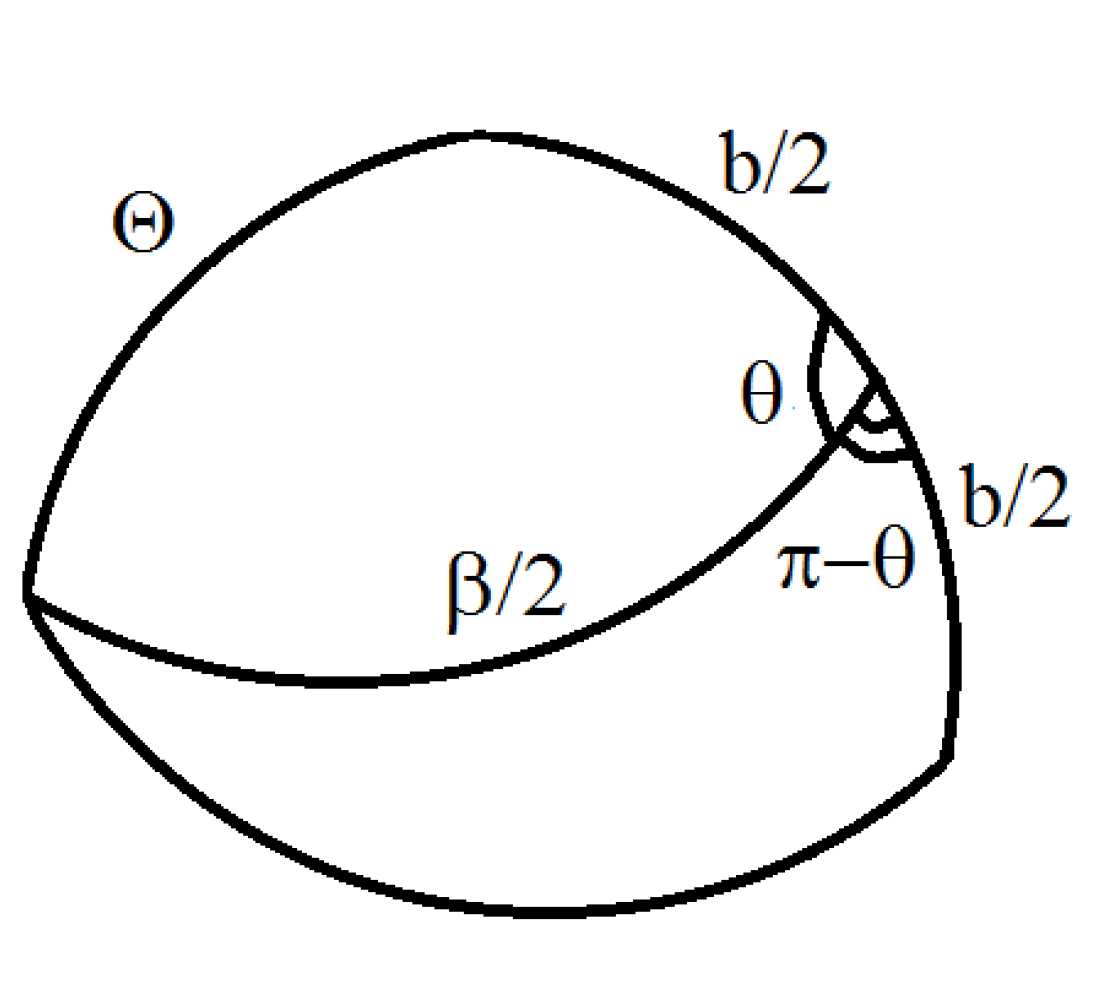
Assuming that is the angle between sides and of a spherical triangle, the function F can be written as
where is the side opposite to angle (see Figure 1; note, considering the corresponding polar triangle, the function can be interpreted as a cosine of the angle opposite to the side ). Taking into account expressions for the qutrit density matrix (62) and eigenvalues of the SW kernel
the reduced Wigner function (73) can be written as:
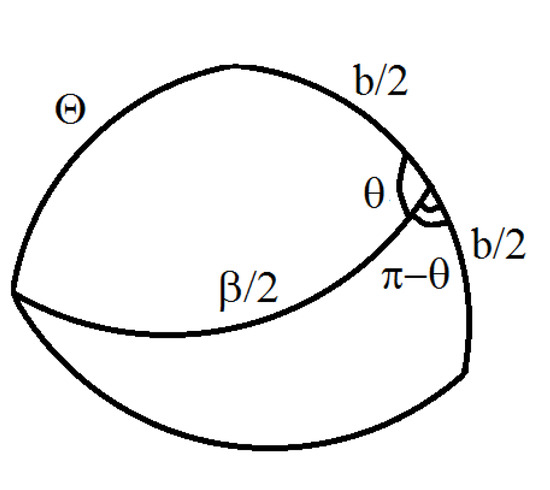
Figure 1.
Geometrical meaning of the angle .
The matrix in terms of Euler angles reads
- Reduction to symmetric SW spin-1 correspondence
According to Table 2, the symmetry type of the SW kernel and mixed state allowing us to realize the desired reduction to is given by pairs of Young diagrams (1, 1, 1) and (2, 1); the necessary value of the sum of squares is describing SU(2) symmetric SW correspondence for spin-1 as:
- Comments on the reduced phase space
Note that the reduced WF in both cases, 1 and 2, is definite on one-fourth of a unit sphere:
According to the Equations (75)–(78), the left action of the permutation matrix on the matrix B can be moved to the following shifts in angles and :
Therefore, the domain of definition of angles in (84) can be extended to cover an entire two-sphere unit.
6. Concluding Remarks
In the present article, we argue for the existence of the unitary non-equivalent representations for the Stratonovich–Weyl kernels corresponding to the Wigner functions of an arbitrary N- dimensional quantum system. The admissible Wigner functions can be classified by the values of -invariant polynomials in the elements of the SW kernel. As shown, the “master equation” (14) fixes the values only of the lowest degree polynomial invariants, the first and second ones, while values of the remaining algebraically independent invariants distinguish members of the family of SW kernels. We have derived the sufficient conditions for the reduction of our scheme to symmetric spin-j symbol correspondence. In conclusion, it is necessary to mention that the present consideration of the quasiprobability functions does not distinguish between elementary and composite systems. A comprehensive study of restrictions on the SW kernel for composite systems is still needed.
Author Contributions
Conceptualization V.A. and A.K.; Investigation V.A. and A.K.; Writing original draft V.A. and A.K. Writing review and editing V.A. and A.K. Both authors have read and agreed to the published version of the manuscript.
Funding
This paper has been supported by the RUDN University Strategic Academic Leadership Program.
Institutional Review Board Statement
Not applicable.
Informed Consent Statement
Not applicable.
Data Availability Statement
Not applicable.
Conflicts of Interest
The authors declare no conflict of interest.
Appendix A. The Adjoint Vectors of SU(3)
Below, only expressions for vectors and , specifying the Wigner function of a single qutrit (68), will be presented. Components of the vector read:
The 8-vector depends only on four angles and its components are:
Appendix B. The Adjoint Action of the Permutation Matrix T
Let us consider the matrix which permutes the first and third entries of a diagonal diagonal matrix
The corresponding adjoint matrix, reads:
The 8-dimensional vector in Equation (70) reads
References
- Wigner, E.P. On the quantum correction for thermodynamic equilibrium. Phys. Rev. 1932, 40, 749. [Google Scholar] [CrossRef]
- Weyl, H. Gruppentheorie und Quantenmechanik; Hirzel: Leipzig, Germany, 1928. [Google Scholar]
- Groenewold, H.J. On the principles of elementary quantum mechanics. Physica 1946, 12, 405. [Google Scholar] [CrossRef]
- Moyal, J.E. Quantum mechanics as a statistical theory. Math. Proc. Camb. Philos. Soc. 1949, 45, 99. [Google Scholar] [CrossRef]
- Hillery, M.; O’Connell, R.F.; Scully, M.O.; Wigner, E.P. Distribution functions in physics: Fundamentals. Phys. Rep. 1984, 106, 121. [Google Scholar] [CrossRef]
- Klimov, A.B.; Guise, H. General approach to (n) quasi-distribution functions. J. Phys. A. 2010, 43, 402001. [Google Scholar] [CrossRef]
- Klimov, A.B.; Romero, J.L.; De Guise, H. Generalized SU(2) covariant Wigner functions and some of their applications. J. Phys. A. 2017, 50, 323001. [Google Scholar] [CrossRef]
- Rowe, D.J.; Sanders, B.C.; de Guise, H. Representations of the Weyl group and Wigner functions for SU(3). J. Math. Phys. 1999, 40, 3604. [Google Scholar] [CrossRef]
- Chumakov, S.; Klimov, A.; Wolf, K.B. Connection between two Wigner functions for spin systems. Phys. Rev. A 2000, 61, 034101. [Google Scholar] [CrossRef]
- Alonso, M.A.; Pogosyan, G.S.; Wolf, K.B. Wigner functions for curved spaces. I. On hyperboloids. J. Math. Phys. 2002, 43, 5857. [Google Scholar] [CrossRef]
- Lvovsky, A.I.; Raymer, M.G. Continuous-variable optical quantum-state tomography. Rev. Mod. Phys. 2009, 81, 299. [Google Scholar] [CrossRef]
- Rigas, I.; Sánchez-Soto, L.L.; Klimov, A.B.; Rehacek, J.; Hradil, Z. Orbital angular momentum in phase space. Ann. Phys. 2011, 326, 426. [Google Scholar] [CrossRef]
- Tilma, T.; Everitt, M.J.; Samson, J.H.; Munro, W.J.; Nemoto, K. Wigner functions for arbitrary quantum systems. Phys. Rev. Lett. 2016, 117, 180401. [Google Scholar] [CrossRef]
- Stratonovich, R.L. On distributions in representation space. Sov. Phys. JETP 1957, 4, 891. [Google Scholar]
- Varilly, J.C.; Gracia-Bondia, J.M. The Moyal representation for spin. Ann. Phys. 1989, 190, 107. [Google Scholar] [CrossRef]
- Brif, C.; Mann, A. A general theory of phase-space quasiprobability distributions. J. Phys. A 1998, 31, L9. [Google Scholar] [CrossRef]
- Brif, C.; Mann, A. Phase-space formulation of quantum mechanics and quantum-state reconstruction for physical systems with Lie-group symmetries. Phys. Rev. A 1999, 59, 971. [Google Scholar] [CrossRef]
- Weingarten, D. Asymptotic behavior of group integrals in the limit of infinite rank. J. Math. Phys. 1978, 19, 999. [Google Scholar] [CrossRef]
- Collins, B. Moments and cumulants of polynomial random variables on unitary groups, the Itzykson-Zuber integral, and free probability. Int. Math. Res. Not. 2003, 17, 953. [Google Scholar] [CrossRef]
- Collins, B.; Sniady, P. Integration with respect to the Haar measure on unitary, orthogonal and symplectic group. Commun. Math. Phys. 2006, 264, 773. [Google Scholar] [CrossRef]
- Rios, P.d.; Straum, E. Symbol Correspondences for Spin Systems; Springer International Publishing: Berlin/Heidelberg, Germany, 2014. [Google Scholar]
- Bengtsson, I.; Ericsson, A.; Kus, M.; Tadej, W.; Zyczkowski, K. Birkhoff’s polytope and unistochastic matrices, n = 3 and n = 4. Commun. Math. Phys. 2005, 259, 307–324. [Google Scholar] [CrossRef]
- Luis, A. SU(3) Wigner function for three-dimensional systems. J. Phys. A 2008, 41, 495302. [Google Scholar] [CrossRef]
- Byrd, M.S.; Sudarshan, E.C.G. SU(3) Revisited. J. Phys. A 1998, 31, 9255. [Google Scholar] [CrossRef]
- Gerdt, V.; Horan, R.; Khvedelidze, A.; Lavelle, M.; McMullan, D.; Yu, P. On the Hamiltonian reduction of geodesic motion on SU(3) to SU(3)/SU(2). J. Math. Phys. 2006, 47, 112902. [Google Scholar] [CrossRef]
- Byrd, M.S. Differential Geometry on SU(3) with applications to three state systems. J. Math. Phys. 1998, 39, 6125, Erratum in 2000, 41, 1026. [Google Scholar] [CrossRef]
Publisher’s Note: MDPI stays neutral with regard to jurisdictional claims in published maps and institutional affiliations. |
© 2021 by the authors. Licensee MDPI, Basel, Switzerland. This article is an open access article distributed under the terms and conditions of the Creative Commons Attribution (CC BY) license (https://creativecommons.org/licenses/by/4.0/).