


Abstract
In this paper, we incorporate two known polynomials to introduce so-called 2-variable q-generalized tangent based Apostol type Frobenius–Euler polynomials. Next we present a number of properties and formulas for these polynomials such as explicit expressions, series representations, summation formulas, addition formula, q-derivative and q-integral formulas, together with numerous particular cases of the new polynomials and their associated formulas demonstrated in two tables. Further, by using computer-aided programs (for example, Mathematica or Matlab), we draw graphs of some particular cases of the new polynomials, mainly, in order to observe in several angles how zeros of these polynomials are distributed and located. Lastly we provide numerous observations and questions which naturally arise amid the present investigation.
Keywords:
q-calculus; q-generalized tangent polynomials and numbers; Apostol type q-Frobenius–Euler polynomials and numbers; generating function; distribution of zeros MSC:
33E20; 11B83; 05A30
1. Introduction
A remarkably large number of a variety of polynomials, numbers and functions, and their generalizations and variants have been introduced and investigated, due mainly to their potential usefulness and direct applications in a wide range of research subjects (see, e.g., [1,2,3,4,5,6,7,8,9,10,11,12,13,14,15,16,17,18,19] and the references therein). Among a recent deluge of various extensions of known polynomials, numbers, functions, and newly introduced polynomials, many researchers’s particular attentions have been paid to q-analogues of polynomials, numbers, and functions (see, e.g., [7,9,10,17,19,20,21,22] and the references therein). q-Bernstein polynomials amid some discrete q-operators are presented in [20] (Chapter 2). Fractional derivatives of five elementary functions including exponential function, together with their graphs, are illustrated in [21]. Certain q-orthogonal polynomials including the little and big q-Jacobi polynomials are studied in [22] (Chapter 7). Apostol type q-Frobenius–Euler polynomials are introduced and investigated in [7]. The generalized q-Apostol-Bernoulli, q-Apostol–Euler, and q-Apostol–Genocchi polynomials in two variables and their numbers are defined and studied in [9]. q-Bernoulli, q-Euler, and q-Genocchi polynomials and their numbers are investigated in [10]. New -Stirling polynomials of the second kind fitting for the -analogue of Bernstein polynomials are introduced and studied in [17], which includes an extensive list of references about q-and -extenstions of some known polynomials and numbers, in particular, q-and -Stirling polynomials and q-and -Bernstein polynomials.
Moreover, the tangent polynomials and numbers, and their diverse extensions including their q-analogues have many applications in a number of research areas such as analytic number theory and physics (see, e.g., [3,12,13,19] and the references therein). For example, a new class of q-generalized tangent-based Appell polynomials by welding 2-variable q-generalized tangent polynomials and q-Appell polynomials is introduced and investigated in [19].
In this paper, we couple the polynomials in Definitions 1 and 5 to introduce new polynomials which are called the 2-variable q-generalized tangent based Apostol type Frobenius–Euler polynomials of order in the variables u and v, denoted by , in Definition 6. Then we provide a number of properties and formulas for these polynomials such as explicit representations, series representations, summation formulas, addition formula, q-derivative, q-integral formulas, numerous particular cases of the new polynomials and their related formulas illustrated with Table 1 and Table 2. Moreover, we use computer-aided programs (for example, Mathematica or Matlab) to draw graphs of some particular cases of the new polynomials, mainly, in order to observe in several angles how zeros of these polynomials are distributed and located. Finally we give a number of observations and questions which naturally occurs amid this investigation.

Table 1.
Particular cases of the .
Table 2.
Corresponding results for , , and .
2. Preliminaries
In this section, we recall certain standard notations for q-analogues (or extensions), definitions, and some required properties (see, e.g., [22,23,24,25,26,27,28]), together with a remark.
The q-analogues of a number and the factorial are given, respectively, by
and
Here and in the following, let , , , , and denote the sets of complex numbers, real numbers, positive real numbers, integers, and positive integers, respectively, and let . The q-binomial coefficient is defined by (see, e.g., [23] (p. 484))
Here is the q-shifted factorial defined by (see, e.g., [22,23,26,28])
where and it is assumed that . We also recall
The q-analogue of the binomial expansion is given by (see, e.g., [23] (p. 484), [9] (Equation (4)))
Recall two q-exponential functions (see, e.g., [23] (p. 492), [9] (Equations (6) and (7)), [28] (p. 488))
and
They satisfy the following relation
The relation (9) can be proved by using the following Euler’s formulae (see, e.g., [23] (p. 490), [9] (Equations (6) and (7)), [28] (p. 487)):
and
F. H. Jackson [29] may be recognized as the first researcher to develop q-calculus in a systematic way. The q-derivative of a function is defined by
Obviously
if is differentiable. The q-derivative of functions and with respect to u are given by
Here and throughout, denotes the q-derivative of a function of several variables with respect to u. The following q-derivative formulas for product and quotient of functions and are satisfied:
and
Suppose that . The (Jackson’s) definite q-integral is defined as follows (see, e.g., [26] (Section 19), [28] (Chapter 6)), [29]:
and
A fundamental theorem of q-calculus is recalled as in the following lemma (see, e.g., [26] (p. 74, Corollary 20.1)).
Lemma 1.
If exists in a neighborhood of and is continuous at , where denotes the ordinary derivative of , we have
where .
We recall the q-generalized tangent polynomials and numbers in [18] (Definition 2.1) whose restrictions may be slightly amended as in the following definition.
Definition 1.
(cf. [18]) The q-generalized tangent polynomials in the variable u(abbreviated as ) are defined by means of the generating function
Here ξ is the smallest one among the absolute values of all complex zeros of . The cases are called q-generalized tangent numbers.
Note that the following two particular cases
and
are called q-Euler polynomials (see [16]) and q-tangent polynomials (see [12]), respectively.
Further the q-Apostol-Bernoulli polynomials, q-Apostol–Euler polynomials, q-Apostol–Genocchi polynomials, and Apostol-type q-Frobenius–Euler polynomials have recently been actively introduced and investigated (see, e.g., [2,7,8,9,14,15,16] and the references therein). They are recalled in the following definitions.
Definition 2.
(see [9]) The q-Apostol-Bernoulli polynomials of order α in variables u and v(abbreviated as ) are defined by means of the generating function
Here are called the q-Apostol-Bernoulli numbers.
Definition 3.
(see [9]) The q-Apostol–Euler polynomials of order α in variables u and v(abbreviated as ) are defined by means of the generating function
Here are called the q-Apostol–Euler numbers.
Definition 4.
(see [9]) The q-Apostol–Genocchi polynomials of order α in variables u and v (abbreviated as ) are defined by means of the generating function
Here are called the q-Apostol–Genocchi numbers.
Definition 5.
(see [7]) The Apostol type q-Frobenius–Euler polynomials of order α in the variables u and v (abbreviated as ) are defined by means of the generating function
Here the Apostol type q-Frobenius–Euler numbers of order α are defined by
Remark 1.
The constraints in Definitions 2–5 should and can be modified as those in Definition 6 (see also Definition 1).
The polynomials in Definition 5 are found to reduce to yield
- (q-Apostol Euler polynomials [7]);
- (q-Frobenius–Euler polynomials [14,15]);
- (q-Euler polynomials [8]);
- (q-Apostol type Frobenius–Euler polynomials [16]);
- (Apostol type Frobenius–Euler polynomials [2]).The five above-right-hand sided polynomials when are simply written as follows:
3. q-Generalized Tangent-Apostol Type Frobenius–Euler Polynomials and Their Related Formulas
In this section, we introduce the q-generalized tangent based Apostol type Frobenius–Euler polynomials and investigate some of their properties.
Definition 6.
The 2-variable q-generalized tangent based Apostol type Frobenius–Euler polynomials of order α in the variables u and v (abbreviated as ) are defined by means of the following generating function
where ξ is the same as in the restrictions of Definition 1 and η is the smallest nonzero one among the absolute values of all complex zeros of . Here
are called the q-generalized tangent-Apostol type Frobenius–Euler numbers of order α.
By selecting suitable parameters in generating function (27), we obtain several members belonging to the family of qGTATFEP , which are listed in Table 1.
For simplicity, let
be the generating function in (27).
We present two series representations for the polynomials by using series manipulation techniques in some combinations of the polynomials and numbers in Section 1 as in the following theorem.
Theorem 1.
Let . Moreover, let the other parameters and variables in the identities below be assumed to satisfy the restrictions (28). Then
and
Proof.
We find from (27) and (30) that
where a series rearrangement technique (or Cauchy product for double series) of a double sequence of real or complex numbers (see, e.g., [30]):
the middle double series being absolutely convergent under the given conditions, is used to give the last equality. Then, identifying the right-hand sides of (27) and (33), and equating the coefficients of on both sides of the resulting identity, we obtain the desired identity (31).
We establish three summation formulae for the polynomials as in Theorem 2.
Theorem 2.
Let . Moreover, let the other parameters and variables in the identities below be assumed to satisfy the restrictions (28). Then
Proof.
For (34), we factor the generating function (30) so that (29), (7) and (8) can be used in order and use series rearrangement technique, with the aid of (6), to get
Now a similar process of the proof of Theorem 1 may be applied in (37) to obtain (34). The remaining details and proofs of the other two identities are omitted. □;
In view of Table 1 (I, II and III), selecting suitable parameters in Theorems 1 and 2 the corresponding results for qGTAEP , qGTFEP and qGTEP are obtained and listed in Table 2.
Remark 2.
Theorem 3.
Let . Moreover, let the other parameters and variables in the identities below be assumed to satisfy the restrictions (28). Then
Theorem 4.
(Addition formula) Let and . Moreover, let the other parameters and variables in the identities below be assumed to satisfy the restrictions (28). Then
Proof.
A relationship between and is provided in the following theorem.
Theorem 5.
Let . Moreover, let the other parameters and variables in the identities below be assumed to satisfy the restrictions (28). Then
4. Explicit Representations
In this section, we present explicit expressions for some numbers and polynomials which are chosen from the previous sections as in the following remarks.
Remark 3.
Let . Moreover, let the other parameters and variables in the identities below be assumed to satisfy the restrictions (28). Then the q-generalized tangent numbers in Definition 1 are explicitly given by
where the sum is over all nonnegative integers , , …, that satisfy , and . The first few of them are
Remark 4.
Let . Moreover, let the other parameters and variables in the identities below be assumed to satisfy the restrictions (28). Then the Apostol type q-Frobenius–Euler numbers of order α in Definition 5 are explicitly given by
where the sum is over all nonnegative integers , , …, that satisfy , and . Here is the Pochhammer symbol defined by and . The first few of them are
Remark 5.
Let . Moreover, let the other parameters and variables in the identities below be assumed to satisfy the restrictions (28). Then, from Definition 6, the q-generalized tangent-Apostol type Frobenius–Euler numbers of order α are given by
The first few of them are
The first few of are
From Definition 6, we find that the 2-variable q-generalized tangent based Apostol type Frobenius–Euler polynomials of order α in the variables u and v are given by
The first few of them are
5. q-Derivative and q-Integral Formulas
In this section, we establish q-derivative and q-integral formulas for the polynomials , which are in the following theorems.
Theorem 6.
Let . Moreover, let the other parameters and variables in the identities below be assumed to satisfy the restrictions (28). Then
Proof.
A q-derivative formula of the polynomials with respect to m is established as in the following theorem.
Theorem 7.
Let . Moreover, let the other parameters and variables in the identities below be assumed to satisfy the restrictions (28). Then
Proof.
Using (13) and (15), we have
Further, q-differentiating both sides of (27) termwise with respect to m, with the aid of (54), Definition 1, and
we obtain
Setting in the last summations and dropping the prime on n, we find
Employing the following series manipulation for a double sequence of real or complex numbers (both sides are absolutely convergent)
in the last double series, we get
Finally, upon matching the coefficients of on both sides of (56) yields (53). □
Two q-integral formulas are presented in the following theorems.
Theorem 8.
Let , , and . Moreover, let the other parameters and variables in the identities below be assumed to satisfy the restrictions (28). Then
Proof.
Theorem 9.
Let , , and . Moreover, let the other parameters and variables in the identities below be assumed to satisfy the restrictions (28). Then
6. Graphical Representations and Locations of Zeros
In this section, by using Mathematica, we draw graphs of for some chosen n and particular parameters to examine several of their properties such as shapes, surface plot, zeros. In particular, we observe their zeros in several ways.
The graphs of for few even and odd values of n () are displayed in Figure 1.
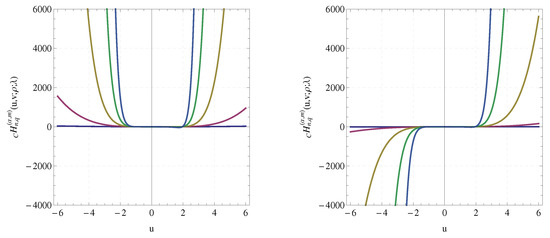
Figure 1.
Curves of .
The surface plot of for and are shown in Figure 2.
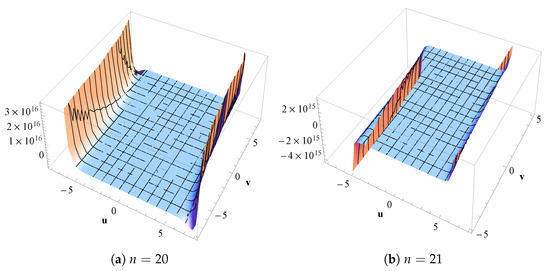
Figure 2.
Surface plot of and .
Graphs of the qGTATFEP for , and for parameters and for different values of q are given in Figure 3.
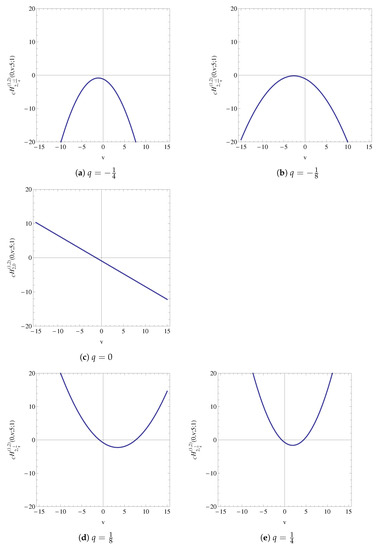
Figure 3.
Graphs of qGTATFEP for and different values of q.
Further, graphs of the qGTATFEP for , and for parameters and for different values of q are provided in Figure 4.
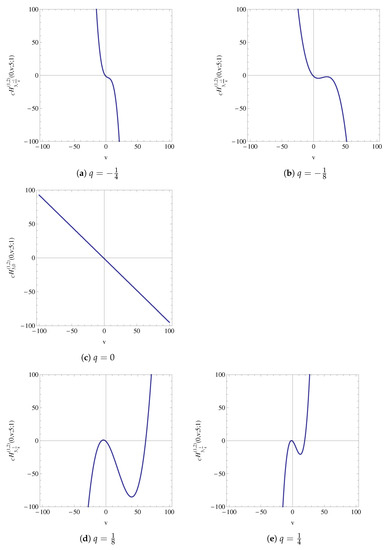
Figure 4.
Graphs of qGTATFEP for and different values of q.
The numbers of real and complex zeros of along with its approximate values are listed in Table 3.
Table 3.
Approximate solutions of .
Figure 5 shows how the zeros of can be located in the complex u-plane as the m grows from 10, 20, 30 and 40.
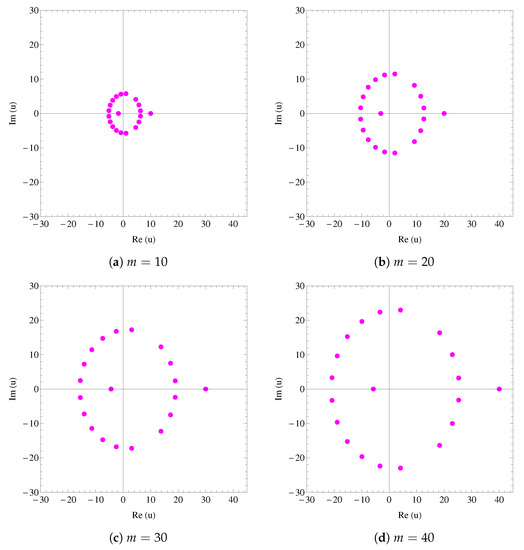
Figure 5.
Zeros of .
If each approximate real zeros of , is piled up according to the value of n for , it will appear as shown in Figure 6. The values of real zeros for are listed in Table 3.
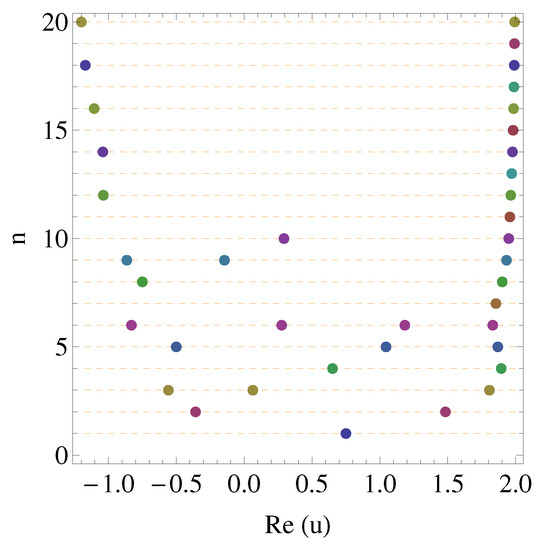
Figure 6.
Real zeros of .
A stack of zeros of for which are displayed in the 3-dimensional space are presented in Figure 7.
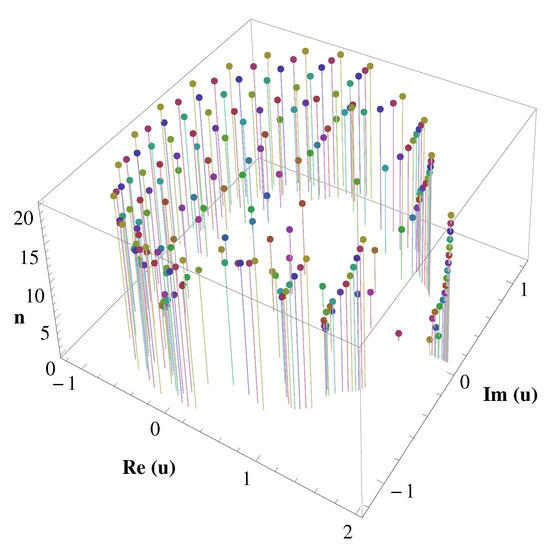
Figure 7.
Stacks of zeros of .
7. Concluding Remarks, Further Observations, and Posing Questions
Recently, due mainly to their importance and diverse applications, a growing number of polynomials and numbers, and their variants and generalizations have been introduced and investigated. In the wake of this trend, by combining the polynomials in Definitions 1 and 5, we introduced the 2-variable q-generalized tangent based Apostol type Frobenius–Euler polynomials of order in the variables u and v. Then we presented a number of properties and formulas for these polynomials such as explicit representations, series representations, summation formulas, addition formula, q-derivative and q-integral formulas. Moreover, using computer-aid programs (e.g., Mathematica, or Matlab), we tried to draw graphs of certain specialized polynomials introduced here. Through those graphs, a number of questions about certain unexpected properties of the polynomials (for example, their zeros) are found to be naturally occurred.
We tried to apply these newly-introduced polynomials to a real world problem (for example, computational fluid dynamics [32,33]). However, we find that it will take a longer period to be familiar with such topics. It remains to be a future investigation.
Observations and Questions
- (i)
- It may be important to find complex zeros of the following equationsfrom Definitions 1 and 6 (see also generating functions in Definitions 2, 3, and 5), in particular, in order to determine the and there exactly. When , the zeros of two equations in (63) are easily given, respectively, bywhere is an argument of .Question 1: Find or approximate the zeros of two equations in (63).
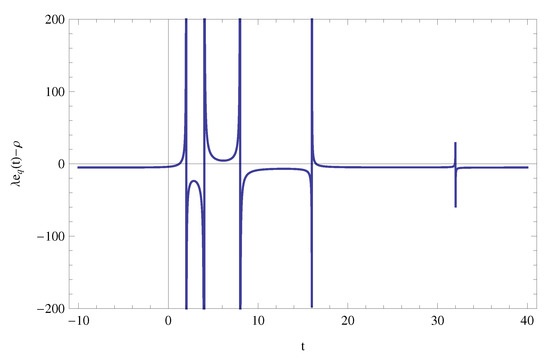 Figure 8. Graph of .
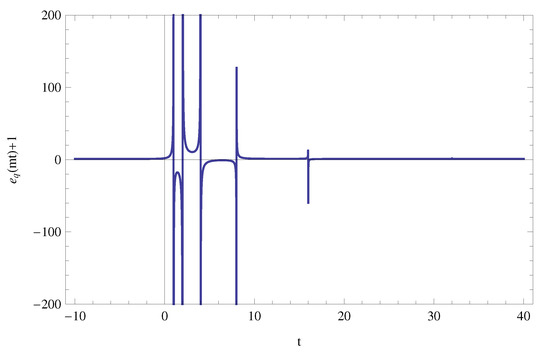 Figure 9. Graph of .Graph of (for and ) as follows:Certain approximate real and complex zeros ofare given, respectively, asand
 - (ii)
- To approximate zeros of some functions or polynomials, we can use Newton-Raphson’s theorem (see, e.g., [34] (pp. 262–263); for a use of this theorem, one may consult with [11] (Section 6)).
- (iii)
- (iv)
- As shown in Figure 5, all zeros of the polynomials with the other parameters being real are found to be symmetrically located with respect to the real axis of u (that is, ). Indeed, if is among its zeros, then, in view of (47), we havewhich implies that the complex conjugate of is also zero.One may also recall the reflection principle (see, e.g., [35] (p. 57)).
- (v)
- In Figure 5, as m becomes larger, the corresponding absolute values (distances from the origin) of zeros of are getting greater (become more distant from the origin).Question 2: Prove or disprove that this observation is true as .Question 3: Prove or disprove truth of this observation for where becomes larger and .This can be observed graphically. For several different values of m (−10,000, −1000, 1000, 10,000), graphs of zeros of are demonstrated in Figure 10.
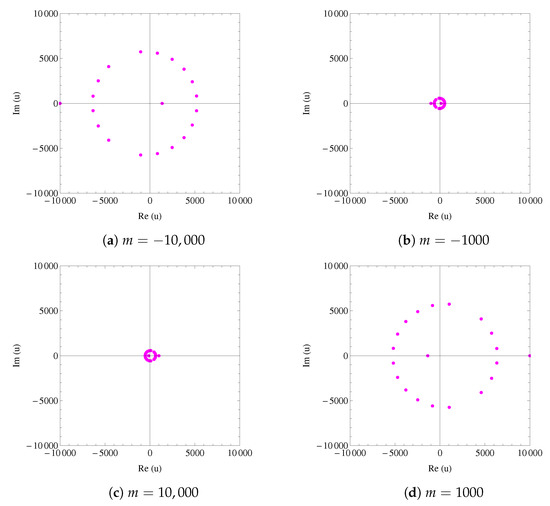 Figure 10. Zeros of for different increasing values of m.
 - (vi)
- From Figure 6, the number of real zeros of is observed to range from 1 to 4.Question 4: Prove or disprove that this observation is true for general .Question 5: Prove or disprove truth of this observation for where varies and .For , it is observed experimentally (Mathematica) for n up to 200 that for even values of , number of real zeros are 2 and for odd values of , number of real zero is 1. For , number of zeros are mentioned in Table 3.
- (vii)
- In each of Definitions 1–5 and Definition 6, the ordinary Taylor (Maclaurin) series expansion is employed, even though each generating function is involved in q-analogues.Question 6: In the above definitions, it may be really interesting and speculative to see the possible resulting series if the q-Taylor series expansion (see, e.g., [26,28] (Theorem 6.3)) is used, instead of the ordinary Taylor series expansion.
Author Contributions
Writing—original draft, G.Y., H.I. and J.C.; Writing—review and editing, G.Y., H.I. and J.C. All authors have read and agreed to the published version of the manuscript.
Funding
The third-named author was supported by Basic Science Research Program through the National Research Foundation of Korea (NRF) funded by the Ministry of Education (NRF-2020R111A1A01052440).
Institutional Review Board Statement
Not applicable.
Informed Consent Statement
Not applicable.
Acknowledgments
The authors are very and really grateful to the anonymous referees for their constructive and encouraging comments which improved this paper.
Conflicts of Interest
The authors have no conflict of interest.
References
- Abdalla, M.; Akel, M.; Choi, J. Certain matrix Riemann–Liouville fractional integrals associated with functions involving generalized Bessel matrix polynomials. Symmetry 2021, 13, 622. [Google Scholar] [CrossRef]
- Bayad, A.; Kim, T. Identities for Apostol-type Frobenius–Euler polynomials resulting from the study of a nonlinear operator. Russ. J. Math. Phys. 2016, 23, 164–171. [Google Scholar] [CrossRef]
- Bildirici, C.; Acikgoz, M.; Araci, S. A note on analogues of tangent polynomials. J. Algebra Number Theor. Acad. 2014, 4, 21–29. [Google Scholar]
- Jain, S.; Nieto, J.J.; Singh, G.; Choi, J. Certain generating relations involving the generalized multi-index Bessel-Maitland function. Math. Prob. Eng. 2020, 2020, 8596736. [Google Scholar] [CrossRef]
- Khammash, G.S.; Agarwal, P.; Choi, J. Extended k-Gamma and k-Beta functions of matrix arguments. Mathematics 2020, 8, 1715. [Google Scholar] [CrossRef]
- Khan, N.U.; Usman, T.; Choi, J. A new class of generalized polynomials involving Laguerre and Euler polynomials. Hacet. J. Math. Stat. 2021, 50, 1–13. [Google Scholar] [CrossRef]
- Kurt, B. A note on the Apostol type q-Frobenius–Euler polynomials and generalizations of the Srivastava-Pinter addition theorems. Filomat 2016, 30, 65–72. [Google Scholar] [CrossRef][Green Version]
- Mahmudov, N.I. On a class of q-Bernoulli and q-Euler polynomials. Adv. Differ. Equ. 2013, 2013, 108. [Google Scholar] [CrossRef]
- Mahmudov, N.I.; Keleshteri, M.E. q-extensions for the Apostol type polynomials. J. Appl. Math. 2014, 2014, 868167. [Google Scholar] [CrossRef]
- Mahmudov, N.I.; Momenzadeh, M. On a class of q-Bernoulli, q-Euler, and q-Genocchi polynomials. Abs. Appl. Anal. 2014, 2014, 696454. [Google Scholar] [CrossRef]
- Nahid, T.; Alam, P.; Choi, J. Truncated-exponential-based Appell-type Changhee polynomials. Symmetry 2020, 12, 1588. [Google Scholar] [CrossRef]
- Ryoo, C.S. A note on the tangent numbers and polynomials. Adv. Stud. Theor. Phys. 2013, 7, 447–454. [Google Scholar] [CrossRef]
- Ryoo, C.S. Generalized tangent numbers and polynomials associated with p-adic integral on Zp. Appl. Math. Sci. 2013, 7, 4929–4934. [Google Scholar] [CrossRef]
- Satoh, J. A construction of q-analogue of Dedekind sums. Nagoya Math. J. 1992, 127, 129–143. Available online: https://projecteuclid.org/euclid.nmj/1118783238 (accessed on 15 March 2021). [CrossRef]
- Simsek, Y. q-analogue of twisted l-series and q-twisted Euler numbers. J. Number Theory 2005, 110, 267–278. [Google Scholar] [CrossRef]
- Simsek, Y. Generating functions for q-Apostol type Frobenius–Euler numbers and polynomials. Axioms 2012, 1, 395–403. [Google Scholar] [CrossRef]
- Usman, T.; Saif, M.; Choi, J. Certain identities associated with (p,q)-binomial coefficients and (p,q)-Stirling Polynomials of the second kind. Symmetry 2020, 12, 1436. [Google Scholar] [CrossRef]
- Yasmin, G.; Muhyi, A. Certain results of 2-variable q-generalized tangent-Apostol type polynomials. J. Math. Comput. Sci. 2020, 22, 238–251. [Google Scholar] [CrossRef]
- Yasmin, G.; Ryoo, C.S.; Islahi, H. A numerical computation of zeros of q-generalized tangent-Appell polynomials. Mathematics 2020, 8, 383. [Google Scholar] [CrossRef]
- Aral, A.; Gupta, V.; Agarwal, R.P. Applications of q-Calculus in Operator Theory; Springer: New York, NY, USA, 2013. [Google Scholar] [CrossRef]
- Dalir, M.; Bashour, M. Applications of fractional calculus. Appl. Math. Sci. 2010, 4, 1021–1032. [Google Scholar]
- Gasper, G.; Rahman, M. Basic Hypergeometric Series, 2nd ed.; Cambridge University Press: Cambridge, UK, 2004. [Google Scholar]
- Andrews, G.E.; Askey, R.; Roy, R. Special Functions; Encyclopedia of Mathematics and Its Applications 71; Cambridge University Press: Cambridge, UK, 1999. [Google Scholar]
- Ernst, T. A newew method for q-calculus. J. Nonlinear Math. Phys. 2003, 10, 487–525. [Google Scholar] [CrossRef]
- Ernst, T. The different tongues of q-calculus. Proc. Est. Acad. Sci. 2008, 57, 81–99. [Google Scholar] [CrossRef]
- Kac, V.G.; Cheung, P. Quantum Calculus; Springer: New York, NY, USA, 2002. [Google Scholar]
- Nalli, P. Sopra un procedimento di calcolo analogo all’integrazione. Palermo Rend. 1923, 47, 337–374. [Google Scholar] [CrossRef]
- Srivastava, H.M.; Choi, J. Zeta and q-Zeta Functions and Associated Series and Integrals; Elsevier Science Publishers: Amsterdam, The Netherlands; London, UK; New York, NY, USA, 2012. [Google Scholar]
- Jackson, F.H. On q-definite integrals. Quart. J. Pure Appl. Math. 1910, 41, 193–203. [Google Scholar]
- Choi, J. Notes on formal manipulations of double series. Commun. Korean Math. Soc. 2003, 18, 781–789. [Google Scholar] [CrossRef]
- Olver, F.W.J.; Lozier, D.W.; Boisvert, R.F.; Clark, C.W. (Eds.) NIST Handbook of Mathematical Functions; NIST and Cambridge University Press: Cambridge, UK; New York, NY, USA; Melbourne, Australia; Madrid, Spain; Cape Town, South Africa; Singapore; São Paulo, Brazil; Delhi, India; Dubai, United Arab Emirates; Tokyo, Japan, 2010. [Google Scholar]
- Bhatti, M.M.; Marin, M.; Zeeshan, A.; Abdelsalam, S.I. Editorial: Recent Trends in Computational Fluid Dynamics. Front. Phys. 2020, 8, 593111. [Google Scholar] [CrossRef]
- Bhatti, M.M.; Marin, M.; Zeeshan, A.; Ellahi, R.; Abdelsalam, S.I. Swimming of motile gyrotactic microorganisms and nanoparticles in blood flow through anisotropically tapered arteries. Front. Phys. 2020, 8, 95. [Google Scholar] [CrossRef]
- Wade, W.R. An Introduction to Analysis, 4th ed.; Pearson Education Inc.: Upper Saddle River, NJ, USA, 2010. [Google Scholar]
- Brown, J.W.; Churchill, R.V. Complex Variables and Applications, 6th ed.; McGraw-Hill International Editions: New York, NY, USA, 1996. [Google Scholar]
Publisher’s Note: MDPI stays neutral with regard to jurisdictional claims in published maps and institutional affiliations. |
© 2021 by the authors. Licensee MDPI, Basel, Switzerland. This article is an open access article distributed under the terms and conditions of the Creative Commons Attribution (CC BY) license (https://creativecommons.org/licenses/by/4.0/).