

Abstract
In this article, we presented the notion of M-parameterized N-soft set (MPNSS) to assign independent non-binary evaluations to both attributes and alternatives. The MPNSS is useful for making explicit the imprecise data which appears in ranking, rating, and grading positions. The proposed model is superior to existing concepts of soft set (SS), fuzzy soft sets (FSS), and N-soft sets (NSS). The concept of M-parameterized N-soft topology (MPNS topology) is defined on MPNSS by using extended union and restricted intersection of MPNS-power whole subsets. For these objectives, we define basic operations on MPNSSs and discuss various properties of MPNS topology. Additionally, some methods for multi-attribute decision making (MADM) techniques based on MPNSSs and MPNS topology are provided. Furthermore, the TOPSIS (technique for order preference by similarity to an ideal solution) approach under MPNSSs and MPNS topology is established. The symmetry of the optimal decision is illustrated by interesting applications of proposed models and new MADM techniques are demonstrated by certain numerical illustrations and well justified by comparison analysis with some existing techniques.
1. Introduction
The information in various complex real life problems is generally imprecise, ambiguous, and imperfect. Fuzzy modeling and fuzzy decision making are very helpful to capture these uncertainties. Conventionally, the information about an alternative is considered by the crisp numbers or linguistic numbers. The researchers have introduced various mathematical models to handle such realistic issues. Zadeh [1] innovated fuzzy set theory, rough set theory introduced by Pawlak in (1982) [2] and soft set theory established by Molodtsov [3] are powerful tools towards uncertainties. These theories are independent generalizations of classical sets or crisp sets. The notion of intuitionistic fuzzy set (IFS) innovated by Atanassov [4] is the extension of fuzzy set(FS) and a Pythagorean fuzzy set (PFS) established by Yager [5,6] is the expansion of IFS.
Soft set is the parametric representation of objects of universe that provides the binary evaluation to the objects. Numerous researchers have studied soft set to handle uncertainties. Fatimah et al. [7] invented the idea of N-soft set (NSS) to handle situations when non-binary assessments are expected to demonstrate the objects real importance. Recently, Riaz et al. [8] innovated the concept of N-soft topology (NS-topology) and its applications to MAGDM. Akram et al. [9,10] extended this concept to fuzzy N-soft sets (FNSSs) and hesitant N-soft sets (HNSSs) for MAGDM applications. Akram and Adeel [11] established the TOPSIS method for MAGDM with interval-valued hesitant fuzzy N-soft sets.
Some researchers established various hybrid mathematical structures of soft sets (see [12,13,14,15,16,17,18]). Soft topology on soft sets was proposed by Cagman et al. [19], and Shabir and Naz [20]. Riaz and Tehrim [21] introduced bipolar fuzzy soft topology on bipolar fuzzy soft sets and developed an important application in medical diagnosis. Soft set theory and fuzzy set theory have been studied for decision-making and modeling uncertainties in recent decades (see [22,23,24,25,26,27,28,29,30,31]). Garg and Arora [32,33] introduced Dual hesitant fuzzy soft aggregation operators and Generalized intuitionistic fuzzy soft power aggregation operator. Pamucar and Jankovic [34] presented an application of the hybrid interval rough weighted Power-Heronian operators. Riaz et al. [35] introduced hesitant fuzzy soft topology and its applications to MADM. Riaz et al. [36,37] introduced soft rough topology and soft multi rough topology with new properties and applications to MADM. The concept of linear Diophantine fuzzy Set (LDFS) introduced by Riaz and Hashmi [38]. Kamaci [39] introduced new algebraic structures of LDFSs.
In N-soft set environments, the ranking, rating. or grading is assigned to alternatives/objects only. Meanwhile, there is a lack of independent non-binary evaluations to the attributes which may effect the decision analysis phenomena. To enhance the significance of attributes there is a need for non-binary grading positions given to the attributes. The main objective of this study is to handle these difficulties with M-parameterized N-soft set (MPNSS) and MPNS topology. The proposed model of MPNSS is very helpful to assign independent non-binary evaluations to both attributes and alternatives. Additionally, this model is useful for developing strong MADM techniques to select most convincible alternative and make a robust optimal decision.
To facilitate our discussion, the classification of the paper is presented as follows: In Section 2, a few basic concepts of soft set, NSS, and FPSS are given. In Section 3, the notion of M-parameterized N-soft set (MPNSS) is introduced. The concepts of empty, universal, bottom weak complements, top weak complements, weak complements, restricted intersection, and extended union of MPNSSs are presented. In Section 4, the construction of MPNS topology is defined on MPNSS by using MPNS-power whole subsets, extended union and restricted intersection of MPNSSs. Several key properties of MPNS topology, as well as their implications, are well identified. In Section 5, MPNS topology- based MADM methods and their corresponding Algorithms 1 and 2 are developed to estimate the losses, formed extensive damage, displaced and affecting several people in the most affected districts in Sindh province, south-east Pakistan, during historical flooding of August 2011. Section 6 develops and illustrates a robust MADM method of TOPSIS with MPNSSs and MPNS topology using a numerical illustration. Finally, in Section 7, we summarize the findings of this research study.
2. Preliminaries
In the section presented, we discuss some rudiments of soft set (SS), N-soft sets (NSS), fuzzy soft set (FSS) and FP soft sets (FPSS) that are helpful in understanding the contributions in rest of the paper.
Definition 1
([3]). Suppose Λ be the universal set, be the class of decision variables or parameters, and . A soft set (SS) defined on Λ is a set of order pairs, denoted by and can be represented as,
where is a set valued mapping. In short, can also be denoted as .
Definition 2
([7]). Let Λ be the universe of discourse, be the collection of decision variables or parameters. Suppose is the grading set, where . The N-soft set (NSS) over Λ is formalized by where in such a manner that for every there exist a specific for all .
Definition 3
([7]). Let be NSS defined over The weak complement of NSS , specified as , where for each
Definition 4
([7]). Let be NSS defined over The top weak complement of NSS is a NSS, defined by where
Definition 5
([7]). Let be NSS defined over The bottom weak complement of NSS is defined by , where
Definition 6
([40]). Let Λ be the collection of universal elements, is the aggregation of subsets of Υ is the collection of decision variables and be fuzzy set over A Fuzzy Parameterized soft set (FPSS), denoted by on the universe Λ is defined as,
where is a set valued mapping and is called membership function.
3. M-Parameterized N-Soft Set (MPNSS)
Fatima et al. [7] presented the idea of NSS as an extension of SS to cope up with situations in which non-binary assessment is required. This section is devoted to the establishment of M-parameterized N-soft set (MPNSS) which is superior than NSS and SS. For MPNSS becomes NSS and for it reduces to SS.
Definition 7.
Let Λ be the universe, is a collection of attributes. Consider two different sets for grading or rating and , where . Then the M-Parameterized N-soft set (MPNSS) over Λ, designated as or and defined by
Table 1 gives the matrix representation of MPNSS as follows.
Table 1.
Matrix representation of .
Thenrepresents the collection of all MPNSSs.
Example 1.
Letbe the collection of different cities of Pakistan andis a collection of attributes, where
The attributes can be evaluated with the scales as follows.
For alternatives, the evaluation scales are,
According to comprehensive properties of the cities, the public give assessment scores to the evaluation attributes and cities, presented in Table 2 and matrix form of 6P6S-set is presented in Table 3.
Table 2.
Evaluation of data provided by public.
Table 3.
Tabular representation of corresponding 6P6S .
Definition 8.
Let Λ be universe, Υ is the set of attributes and Then the empty MPNSS, denoted by or , is defined as
that is, and .
Definition 9.
Let Λ be universe, Υ is the set of attributes and Then the universal MPNSS, denoted by or and defined as
that is, and .
Definition 10.
Let Λ be a set of universal elements and is the set of attributes. The weak compliment of MPNSS over Λ, indicated by and described as
where
Example 2.
Table 4.
Tabular representation of .
Definition 11.
Let Λ be universe and is the collection of attributes. A top weak compliment of MPNSS over Λ, identified by and demonstrated as
where
and
Example 3.
Table 5.
Tabular representation of .
Definition 12.
Let Λ be universe and is the collection of attributes. A bottom weak compliment of MPNSS over Λ, denoted by and defined as,
where
and
Example 4.
Table 6.
Tabular representation of .
Definition 13.
Letbe two MPNSSs defined on set of attributesandrespectively. Their extended union is symbolized asand defined as:
where
Example 5.
Consider a 6P6S-set() as given in Example 1, also consider another 5P4S-set() defined on Λ, as given in Table 7.
Table 7.
Tabular representation of .
The extended union of and is defined as , given in Table 8.
Table 8.
Tabular representation of .
Definition 14.
Let Their restricted intersection is symbolized by and defined as:
where
Example 6.
Consider and as given in Example 5. The restricted intersection is defined by , given in Table 9.
Table 9.
Tabular representation of .
4. M-Parameterized N-Soft Topology
The concept of M-parameterized N-soft topology (MPNS topology) based on MPNSS is introduced in this section. Certain properties of MPNS topology are expressed and their corresponding results are established.
Definition 15.
Let be a MPNSS over Λ, Υ is the collection of attributes, be two grading sets. The M-parameterized N-soft power whole set (MPNSPW-set) of the indicated as, and defined as,
The cardinality of MPNSPW-set is defined by
Example 7.
Letis a collection of different restaurants under consideration andis a set of attributes, where
- good food quality,
- economical.
Consider the 8P8S-set as given below
The cardinality of 8P8SPW-set is
The list of all possible MPNS-power whole subsets of 8P8S-setis as follows:
Definition 16.
Let Λ is the collection of universal elements and is a MPNSS on Λ. A collection of power whole MPNS-subsets of is called MPNS topology defined on a MPNSS , if the following conditions hold,
- (1)
- .
- (2)
- Arbitrary union of elements ofis a member of,i.e.,.
- (3)
- Finite intersection of elements ofis a member ofi.e.,.
The MPNS-topological space is indicated as,. The MPNS-open sets are members of a MPNS topologyand MPNS-closed sets are their bottom weak complements.
Example 8.
Consider the 8P8S-subsets of, as given in Example 7. Then,
is the 8P8S-topology on. But
is not a 8P8S-topology on.
Example 9.
is 8P8S-discrete topology andis 8P8S-indiscrete topology.
Theorem 1.
Suppose be a MPNS-topological space, the following conditions hold,
- (1)
- The universal MPNSS and are MPNS-closed sets.
- (2)
- Finite MPNS-union of the MPNS-closed sets are MPNS-closed sets.
- (3)
- Arbitrary MPNS-intersection of the MPNS-closed sets are MPNS-closed sets.
Proof.
- (1)
- and are MPNS-closed sets.
- (2)
- If is a given collection of MPNS-closed sets, thenis MPNS-open set. So that is a MPNS-closed set.
- (3)
- In the same way, if is MPNS-closed set for , thenis MPNS-open set. Hence, is a MPNS-closed set.
□
Definition 17.
Let and are two MPNS-topologies.
- (1)
- and are said to be equivalent MPNS-topologies, if either or .
- (2)
- If then is MPNS-finer than or is MPNS-coarser than .
Example 10.
Consider 8P8S-topologies on as given in Example 9. is 8P8S-coarser than or is 8P8S-finer than .
Proposition 1.
Let and be two MPNS-topological spaces over the same MPNSS, then is a MPNS-topological space defined on MPNSS .
Proof.
- (1)
- (2)
- Let be a collection of MPNSSs in Then and , , thus and . Thus, .
- (3)
- Let Then and . Since and , thereforeConsequently, establishes MPNS topology on and is a MPNS-topological space on universal MPNSS .
□
Definition 18.
Suppose be a MPNS-topological space and The MPNS-subspace topology, denoted by is the collection
is called subspace of
Example 11.
Consider a is 8P8S-topological space as given in Example 8. Let
8P8S-subspace can be obtained as
Hence is -subspace topology.
Theorem 2.
Suppose be a MPNS-topological space and .
Then a MPNS-subspace topology on is a MPNS topology.
Proof.
Indeed, contains and because and , where Since , it is closed under finite MPNS-intersections and MPNS-unions,
□
Definition 19.
Let is a MPNSS. A basis is an assemblage of subsets of , for a topology on , which holds the following conditions,
- (1)
- There exists one or multiple elements β containing , for each
- (2)
- If intersection of and contains then there must exist a containing in such a way that
Example 12.
Consider a 8P8S-topology defined on -set as given in Example 8. Then
is a 8P8S-basis for the 8P8S-topology .
Definition 20.
Let be a MPNS-topological space and be a subset of The MPNS-interior of is the MPNS-union of all open subsets of and it is indicated by
Remark 1.
The interior of is the union of all subsets of which are open in
Example 13.
Consider a 8P8S-topology defined on 8P8SS as given in Example 8. Let . The open subsets of are . Hence 8P8S-interior is
Theorem 3.
Let be a MPNS-topological space and is a MPNS-open set iff .
Proof.
If is a MPNS-open set, then the largest open set, that is containing is equal to . Consequently, .
Conversely, As we know, is a MPNS-open set and if , then is MPNS-open set. □
Theorem 4.
Let be a MPNS-topological space and . Then
- (1)
- (2)
- (3)
- (4)
- .
Proof.
- (1)
- Let , then if and only if . Therefore, .
- (2)
- Let . From the definition of a MPNS-interior, and . is the biggest MPNS open set that is contained by Hence, .
- (3)
- By definition of a MPNS interior, and .Then, .is the biggest MPNS open set that is contained by .Hence, . Conversely, consider and Then, and . Therefore, .
- (4)
- and .Then, .is the biggest MPNS open set that is contained by .Hence, .
□
Definition 21.
Letbe a MPNS-topological space and. The MPNS-closure of, indicated as,, is the MPNS-intersection of all MPNS-closed super sets of.
Remark 2.
It should be emphasized thatis the smallest closed super MPNSS ofandis MPNS-closed being the MPNS-intersection of MPNS-closed sets.
Example 14.
Consider 8P8S-set and 8P8S-topology as given in Example 8.
. The closed sets can be calculated as
The closed supersets of are . Hence
Theorem 5.
Let be a MPNS-topological space and . is a MPNS-closed set iff .
Proof.
The proof is obvious. □
Theorem 6.
Let is a MPNS-topological space and . Then .
Proof.
Indeed, . Then, and for all . So . . Then, and for all . So . Hence, .
□
Theorem 7.
Let be MPNS-topological space and . Then,
- (1)
- (2)
Proof.
- (1)
- Let . Then, is a MPNS closed set. Therefore, and are equal. Hence .
- (2)
- Let . By the definition of a MPNS-closure, and . is the smallest MPNS-closed set that containing . Then .
□
Corollary 1.
Let is any subset of MPNSS then,
- (1)
- (2)
Definition 22.
Let be MPNS-topological space and the frontier or boundary of is represented by Fr and determined as,
Example 15.
Consider 8P8SS and 8P8S-topology as given in Example 8.
Let . Then
Theorem 8.
Let be a subset of MPNS-topological space . Then
- (1)
- Fr=
- (2)
- =
- (3)
- is open
- (4)
- is closed
- (5)
- is both open and closed
Proof.
It can be proved by using Definitions 20–22. □
Definition 23.
Let be MPNS-topological space and . The exterior of is indicated byExt and characterized as,
Theorem 9.
Let be a MPNSS, Then
- (1)
- (2)
Proof. (1)
. Then . Thus, .
(2) Clearly Ext. Then Ext. □
5. MPNS-Topology Based MADM
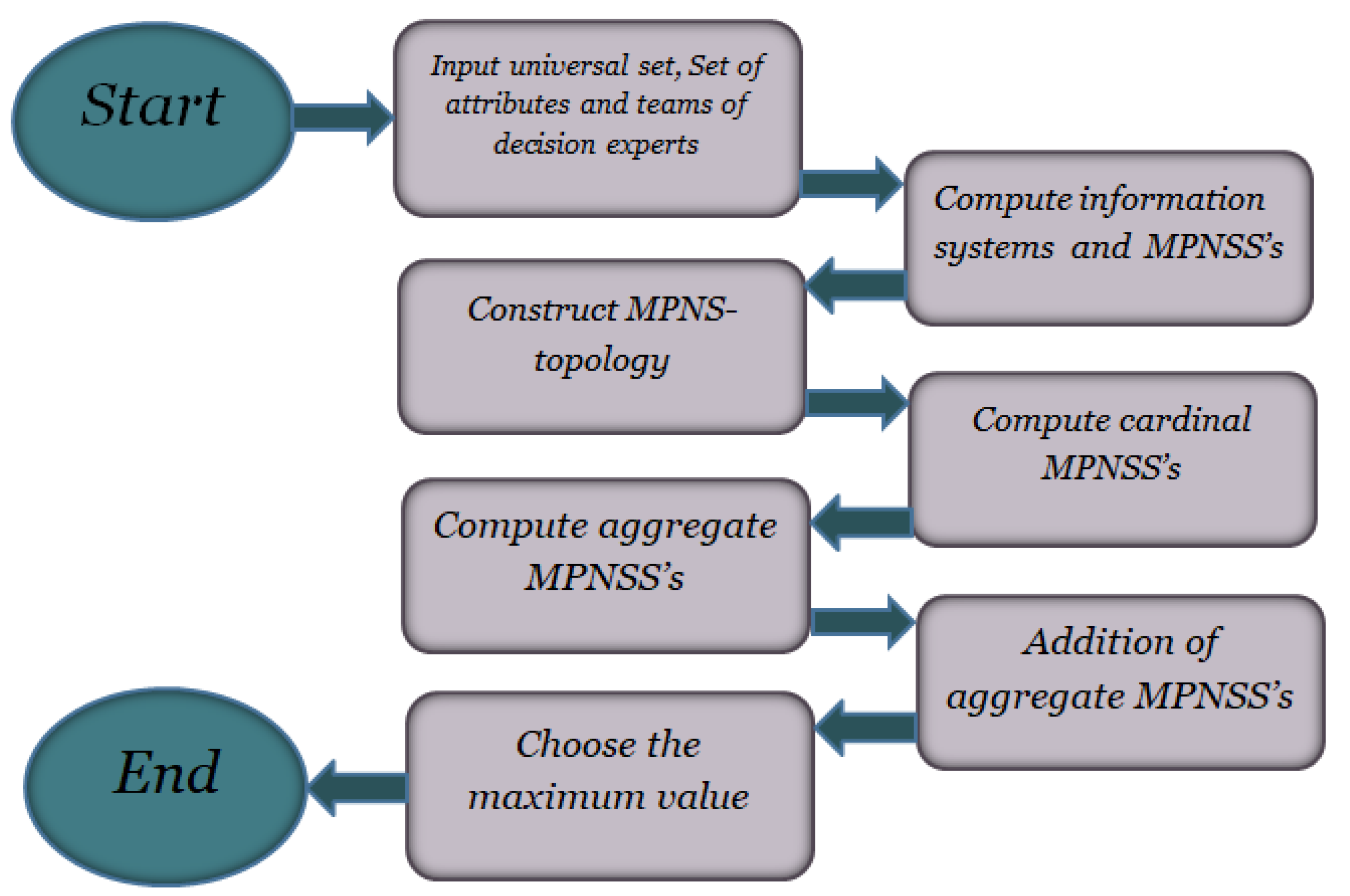
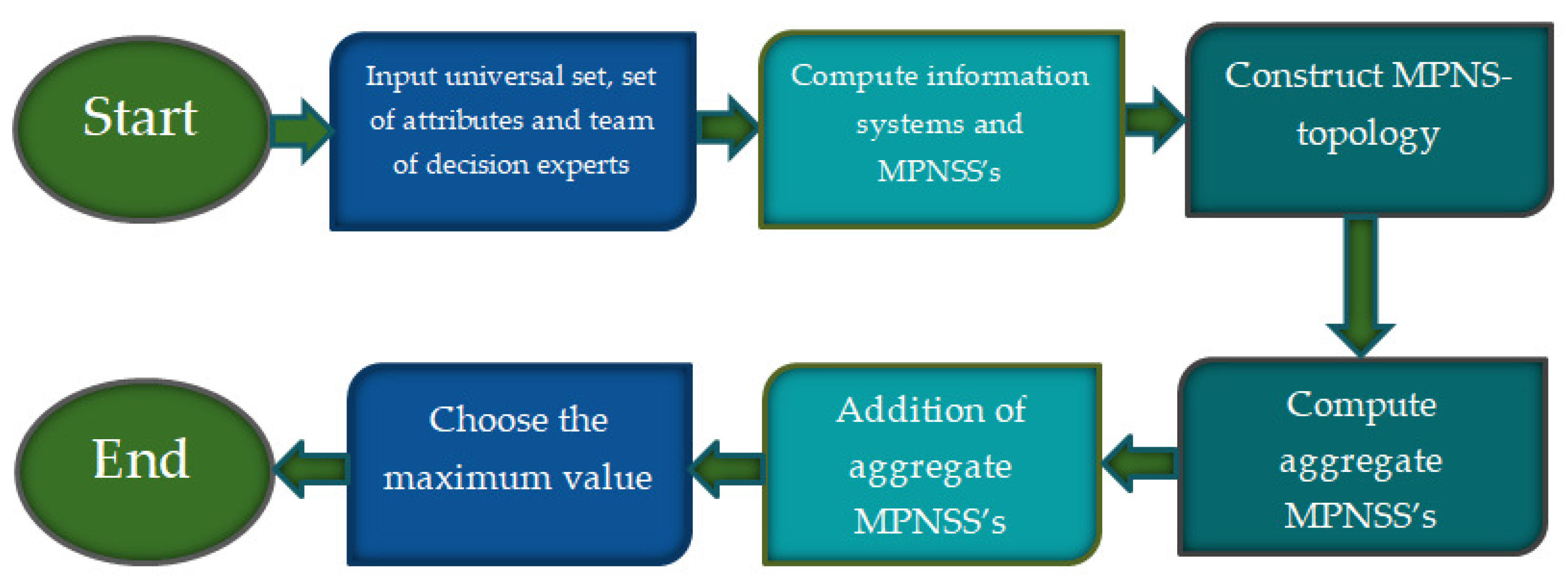
MPNS topology is the generalization of soft topology and NS-topology. In this section, we execute the MPNS topology towards MADM to make a robust optimal decision. MPNS topology provides strong mathematical modeling towards uncertainty. The eminent characteristic of MPNS topology-based MADM is that the attributes and alternatives are analyzed by the decision makers (say) and their evaluations are represented in terms of MPNS-open sets (say) . To meet these objectives, we present two algorithms named as Algorithms 1 and 2 and their corresponding real life applications. The flow chart of MPNS topology based method 1 is expressed by Algorithm 1 as follows.
| Algorithm 1: (MPNS topology based method 1). |
|
The flow chart of Algorithm 1 is given in Figure 1.
Figure 1.
Flow chart of Algorithm 1.
MPNS topology based method 2 is expressed by Algorithm 2 as follows.
| Algorithm 2: (MPNS topology based method 2). |
|
Flow chart of Algorithm 2 is given in Figure 2.
Figure 2.
Flow chart of Algorithm 2.
Numerical Example
Floods normally are short-lived and local incidences that can occur all of sudden, often with no alerts. They are generally occur due to exquisite storms that develop more drain than a region can stream or store may carry inside its normal channel. Floods can also occur when ice jams, when dams fail or landslides provisionally obstruct a channel or when snow melts swiftly. In a more comprehensive manner, usually floods occur in dry lands by high tides, by high levels of lakes or by waves directed in the ground by stiff breeze. Some floods occur seasonally due to monsoon rains, fill river basins, along with melting snows. Pakistan continued to face crisis situation due to the destructive flood of 2011. In Sindh province, a disastrous flood entered in August 2011, presumed as the most severe in the history, molded extensive devastation and crowd out thousands of people and millions were badly affected. The province persisted disabled over the end of 2011, as the affected communities and government accomplished with overburdened funds and enormous financial damage. About 4.8 million people, in which children were half of the number were badly affected by the floods in Sindh and according to estimates that some 72,000 people inhabited in relief camps. Sindh was the most affected province where monsoon rains, swamped 22 districts. According to, National Disaster Management Authority (NDMA), the floods in Sindh have caused 756 injuries and 466 deaths, 1.5 million houses were damaged and 6.6 million acres of land was affected. Provincial Disaster Management Authority (PDMA) and Pakistan Red Crescent Society (PRCS) had been dispatched evaluation teams to the area, which illustrated a sketch of huge destruction, although because of unavailability of roads, had problems to carry out a comprehensive evaluation. The provincial branch of PRCS in Sindh aligned with PDMA. Specifically, due to Pakistan’s dreadful economic condition, is conviction that total devastation of standing crops was about 10 million acres of land. An evaluated loss of 7 billion to Pakistan’s land economy was caused by floods in 2011.
- Step 1:
- Let be the collection of the worst affected districts of Sindh, where = Badin, = Dadu, = Khairpur, = Mirpurkhas, = Sh. Banazirabad, = Tharparkar, = Sanghar, = T. M. Khan. Let be the set of decision variables, whereThe great challenge of this problem is to get estimation of most affected area on the basis of grading assessment of decision experts in two teams, in order to distribute the resources and funding according to the damage level. Let and be two grading sets.
- Step 2:
- PRCS Sindh branch sent two rapid evaluation teams to get estimation of immediate requirements to make urgent progressive scheme in most affected district firstly. We consider two decision-makers (DMs) and made two separate teams for assessment and analysis of consequences of flood. Both teams gave the report about the situation of badly affected districts in accordance with chosen subsets by team- and team- in terms of sets, in which grades are given to the attributes. i.e., and , respectively. After a complete research both teams construct 10P10SS’s, and over First we construct a 10P10SS over namely on the assessment of other departments of different institutions, feed back of people of affected areas and according to demand of assessment teams of PRCS. The information system corresponding to collected data from other resources and people of affected areas is given in Table 10 and its matrix form is given in Table 11.
Table 10. Information system obtained by different resouces in terms of 10P10SS.
Table 11. Tabular representation of 10P10SS .The information system corresponding to team of decision experts, is shown in Table 12 and its matrix form is shown in Table 13.
Table 12. Information system provided by decision team in terms of 10P10SS.
Table 13. Tabular representation of .The information system corresponding to team of decision experts is shown in Table 14 and its matrix form is given in Table 15.
Table 14. Information system provided by decision team in terms of 10P0SS.
Table 15. Tabular representation of . - Step 3:
- Now we construct a 10P10S-topology as
- Step 4:
- Computing aggregate 10P10SS’s of all 10P10S-open sets by using Equation (1), given by
- Step 5:
- By adding and , we obtain the final decision. There is unnecessary to incorporate the aggregate 10P10S-sets of and . By adding the aggregate 10P10SS’s, and to the sum of and , we get the same ranking. Hence there is no need to include these two sets. We haveThis shows that
- Step 6:
- By taking maximum of grading values, we obtain the optimal decision as,The greatest aggregated value is 117. This shows that = Badin is most affected district than others. PRCS, Sindh Branch responded rapidly through its district branches. Teams comprising volunteers and trained staff in emergency relief, first assistance were posted to the badly affected areas within 24 h to implement quick requirement evaluations and deliver humanitarian assistance. Now we solve the same problem by using proposed Algorithm 2. First 3 steps are same as calculated in Algorithm 1. In Algorithm 2, we proceed from step 4.
- Step 7:
- Step 8:
- Then we find out the matrix of by using Equation (3).that means, Similarly, we can find the aggregate 10P10SS for given as,that means,
- Step 9:
- Now we find the final decision 10P10SS by adding and only because there is no need to add and
- Step 10:
- The optimal decision is obtained by taking maximum of final aggregated values as,
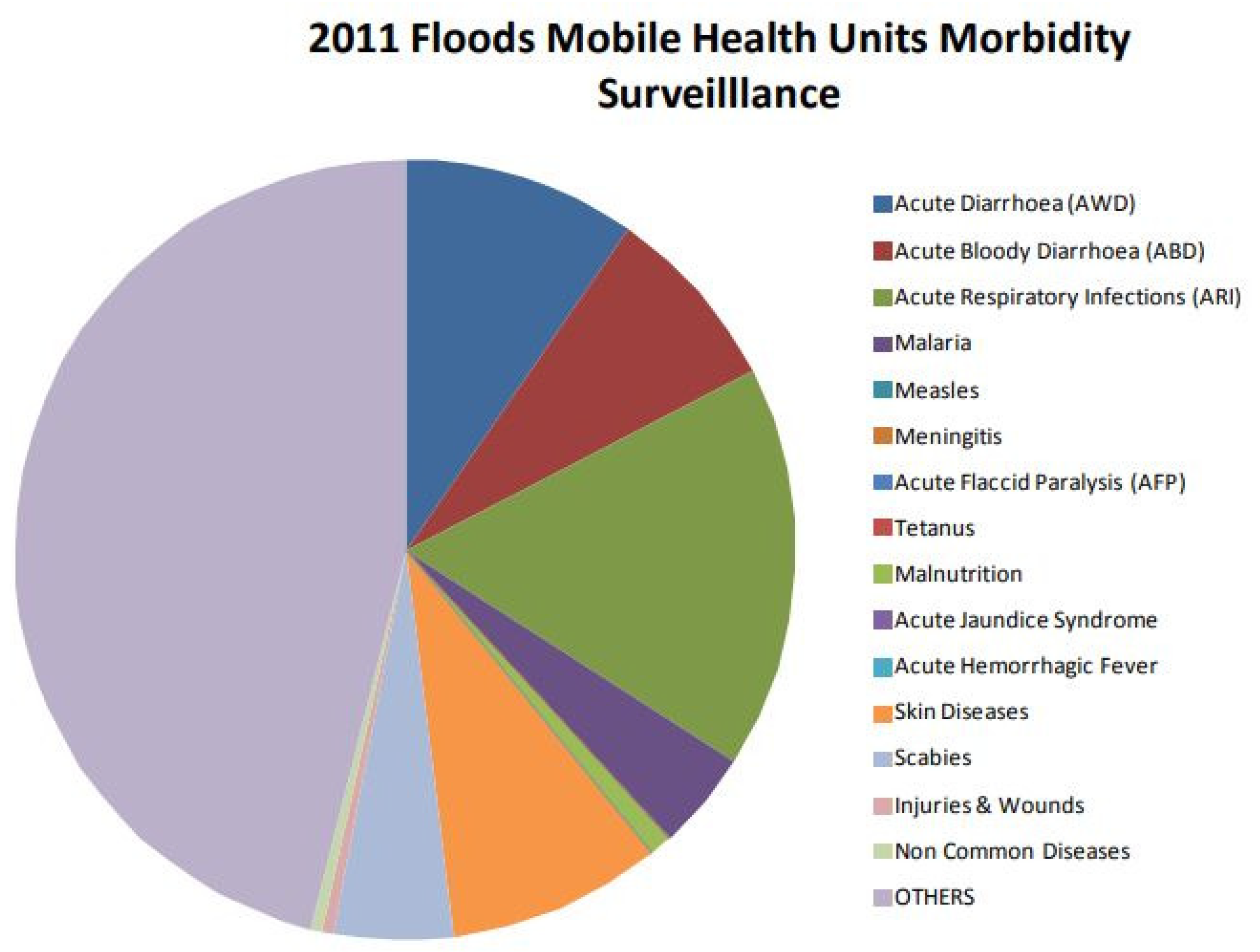
This implies that the district = Badin has highest grading value and according to Algorithms 1 and 2 = Badin is the badly affected district. 2011 floods mobile health units morbidity surveillance is shown in Figure 3.
Figure 3.
Source: www.ifrc.org.pk or www.ifrc.org/docs/Appeals/11/MDRPK007FR.pdf.
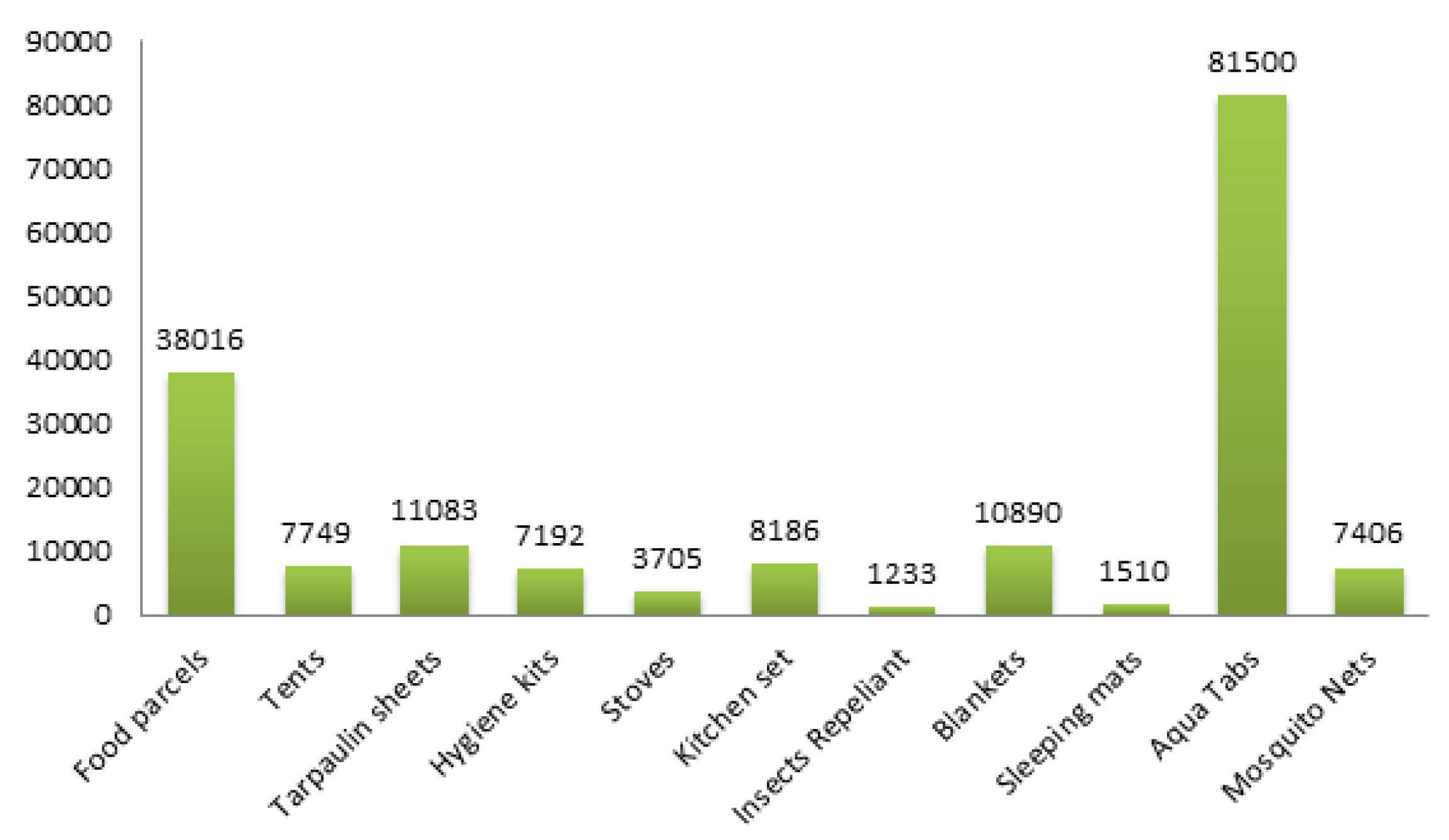
PRCS had intensified the efforts of healthcare by conducting the sessions of health education of mobile health units in Dadu, Badin, and Benazirabad. The most essential food items (FI’s) and non-food items (NFI’s), as contemplated by PRCS, guided the arrangement of the items supplied to affected families, as given in Figure 4.
Figure 4.
Assistance provided by PRCS, Sindh Branch from 19 August 2011 to 24 November 2011 (Source: www.prcs.org.pk, accessed on 1 January 2021.)
6. TOPSIS Method under M-Parameterized N-Soft Topology
Many researchers thoroughly investigated the multi-attribute decision making (MADM). The established methods particularly relay on the nature of problem under consideration. There are large number of vague, imperfect and uncertain realistic issues. In this section, we discuss how MPNS topology is useful in MADM, to cope with such real life circumstances. We develop TOPSIS method under MPNSSs and MPNS topology for MADM. TOPSIS method is strong and powerful approach for critical decision analysis to estimate the losses, constructed extensive damage and moving thousands of people and millions of people in worst affected districts in Sindh province in the course of flooding of August 2011. The linguistic variables, according to importance of attribute and the condition of most affected areas/alternatives are given below.
- Step 1:
- Identification of decision problem:Consider is a collection of teams of decision experts, is a collection of alternatives, be two grading sets, is the set of evaluation attrbiutes.
- Step 2:
- By choosing linguistic variables from Table 16, construct weighted parameterized matrix,
Table 16. Linguistic terms for alternatives.Decision experts assigned grades, row-wise to each parameter, represented by by using the linguistic variables. In all matrices, the first row (in bold letters) represents the grading values, assigned to parameters by chairman of PRCS according to the surveyed data of teams of other departments, by using linguistic variables from Table 17.
Table 17. Linguistic terms for attributes. - Step 3:
- Creating normalized weighted parameterized matrix ,where
- Step 4:
- Creating weight vector by using the expression
- Step 5:
- Constructing MPNS-decision matrices for each team such that all make MPNS topology,Here are MPNS-elements.
- Step 6:
- The aggregated matrix can be calculated as,
- Step 7:
- Constructing the final weighted decision matrix,where
- Step 8:
- Now finding positive ideal solution (PIS) and negative ideal solution (NIS).
- Step 9:
- Calulating separation measurements and of PIS and NIS, respectively, for each parameter by making use ofand
- Step 10:
- Calculating the relative closeness,
- Step 11:
- Ranking the alternatives in descending order. The optimal choice would be the alternative with largest value of .
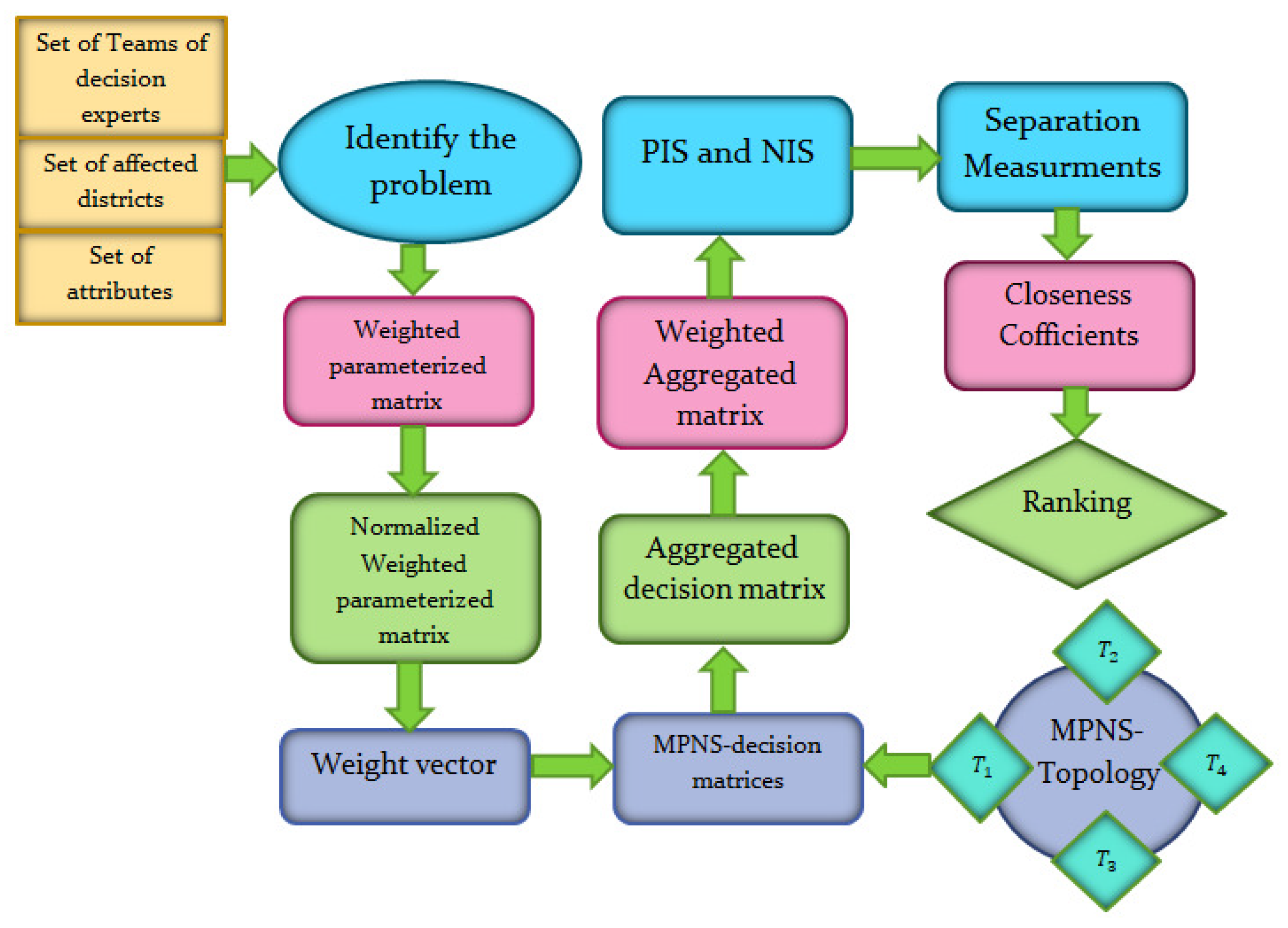
Figure 5 shows the the flow chart of MPNS topology based TOPSIS.
Figure 5.
Flow chart of TOPSIS method under MPNS topology.
6.1. Numerical Example
- Step 1:
- Let is a collection of the badly affected districts of Sindh, where = Badin, = Dadu, = Khairpur, = Mirpurkhas, = Sh.Banazirabad, = Tharparkar, = Sanghar, = T.M Khan. Let be the set of evaluation attributes, whereThe major challenge is to estimate which district/area is most affected on the basis of grading values of decision experts in two teams, so as to allocate the funds accordingly to the level of damage. Let and be two grading sets.
- Step 2:
- Decision experts of assessment teams of PRCS, assigned grades to each evaluation attribute, represented by by using the linguistic variables. In all matrices, first row (in bold letters) represents the grading values, assigned to evaluation attributes by chairman of PRCS according to the information of teams of other departments, by using linguistic variables given in Table 17.
- Step 3:
- The normalized weighted parameterized matrix , by using Equation (4) is given as,
- Step 4:
- The weight vector by using Equation (5) is given as,
- Step 5:
- The 10P10S-decision matrices of two teams are given in which each row represents alternatives and each column represents evaluation attributes and all make 10P10S-topology. There is no need to write null matrix and universal matrix for 10P10S-topology.
- Step 6:
- The Aggregated matrix ¥ obtained as,
- Step 7:
- Constructing final weighted decision matrix as,
- Step 8:
- The positive ideal solution (PIS) and negative ideal solution (NIS) are given belowand
- Step 9:
- The separation measurements of PIS and NIS for each parameter by using the Equations (9) and (10) are given in Table 18.
Table 18. Separation measurements. - Step 10:
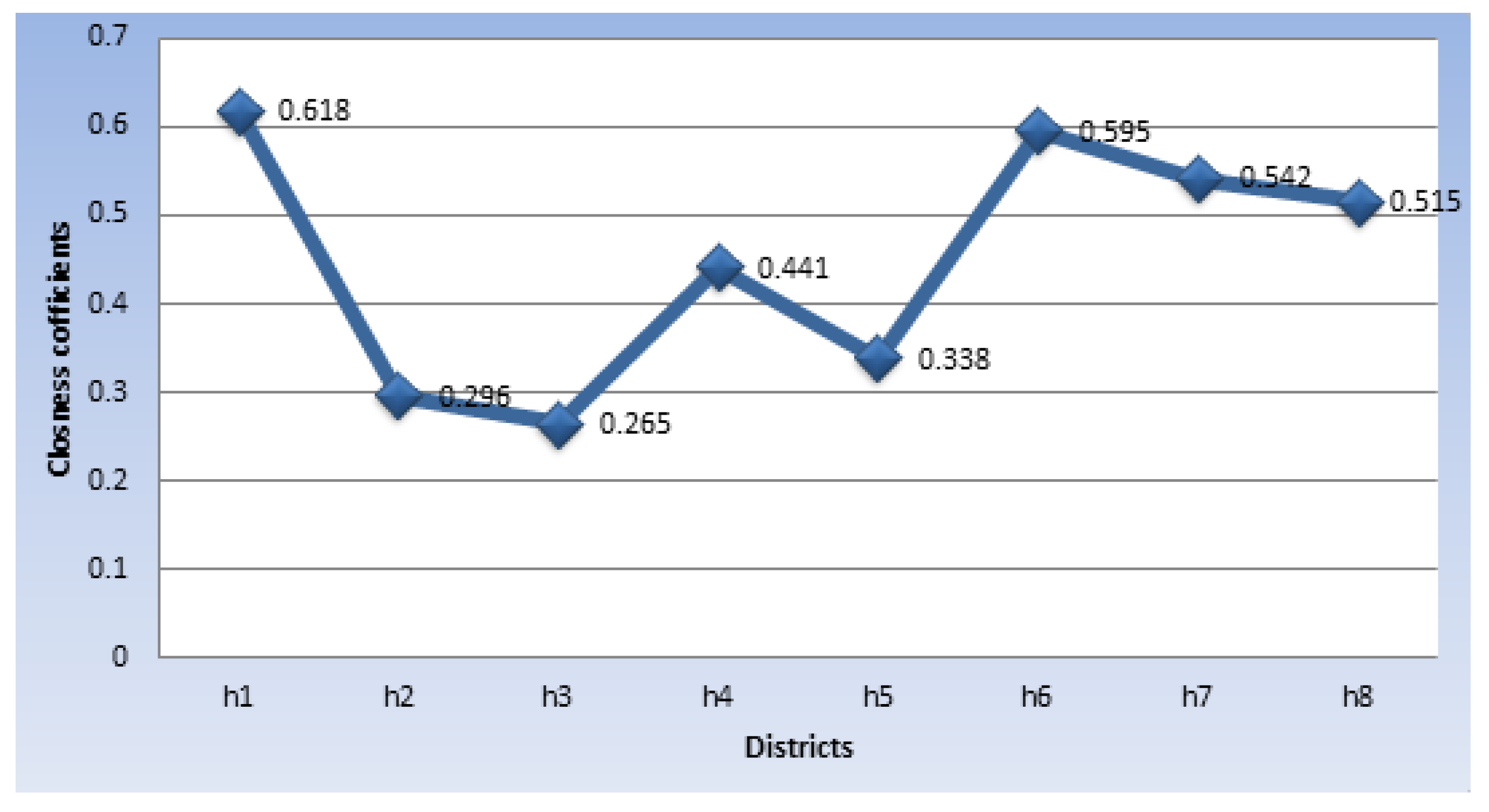
- The relative closeness to alternatives are given in Table 19 as follows,
Table 19. Relative clossness. - Step 11:
- The ranking order is . This shows, Badin is the most affected district.
Figure 6 shows the ranking of alternatives obtained by TOPSIS method.
Figure 6.
Ranking of alternative by TOPSIS method.
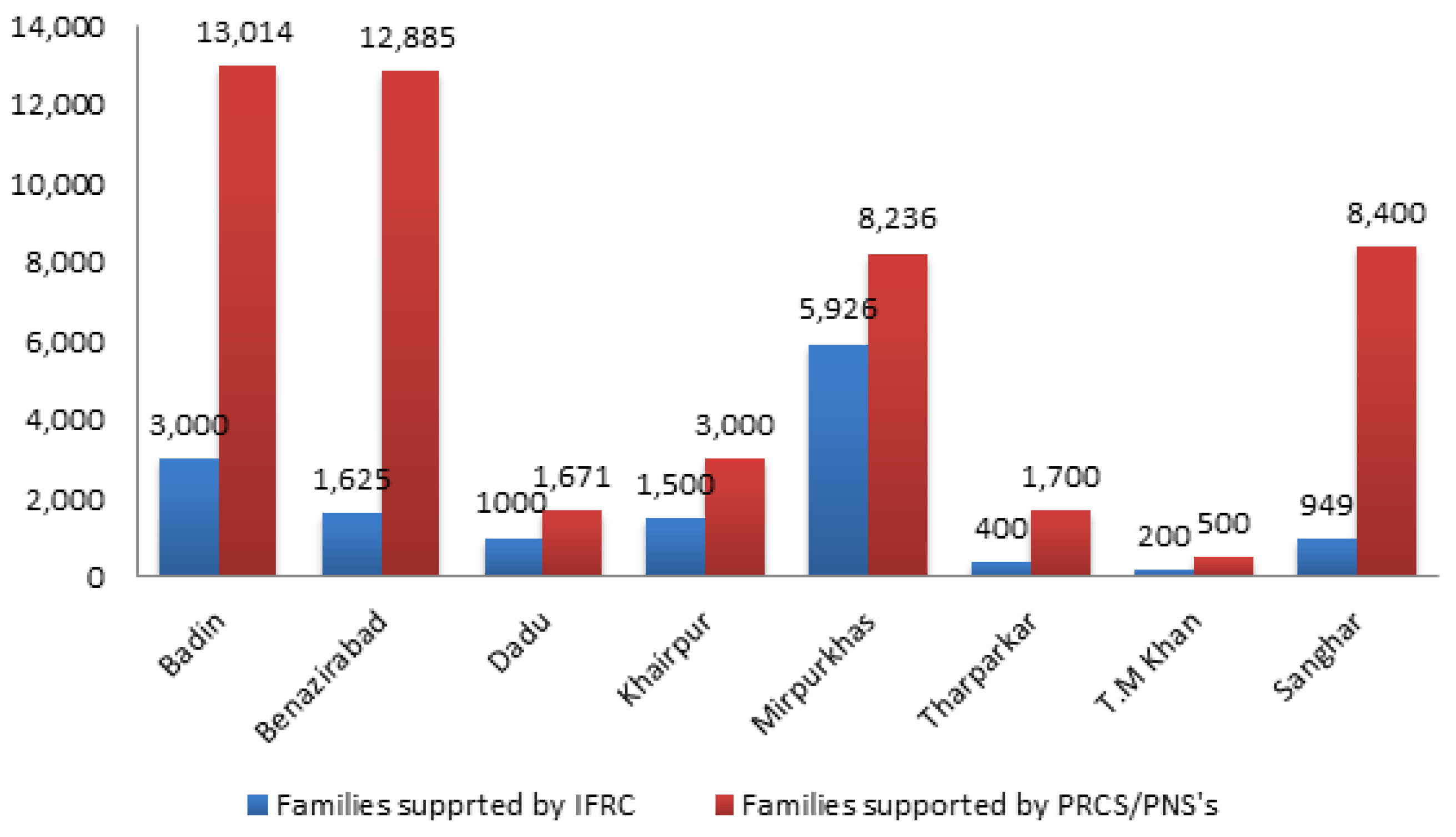
Pakistan Red Crescent Society (PRCS), supported by the International Federation of Red Cross and Red Crescent Societies (IFRC) and other Red Cross Red Crescent movement partners, reached 65,406 families (457,842 poeople) with food and non-food items, 208,600 people with water, 140,112 people with health services, as given in Figure 7.
Figure 7.
Assistance provided by PRCS and IFRC (source: www.ifrc.org.pk).
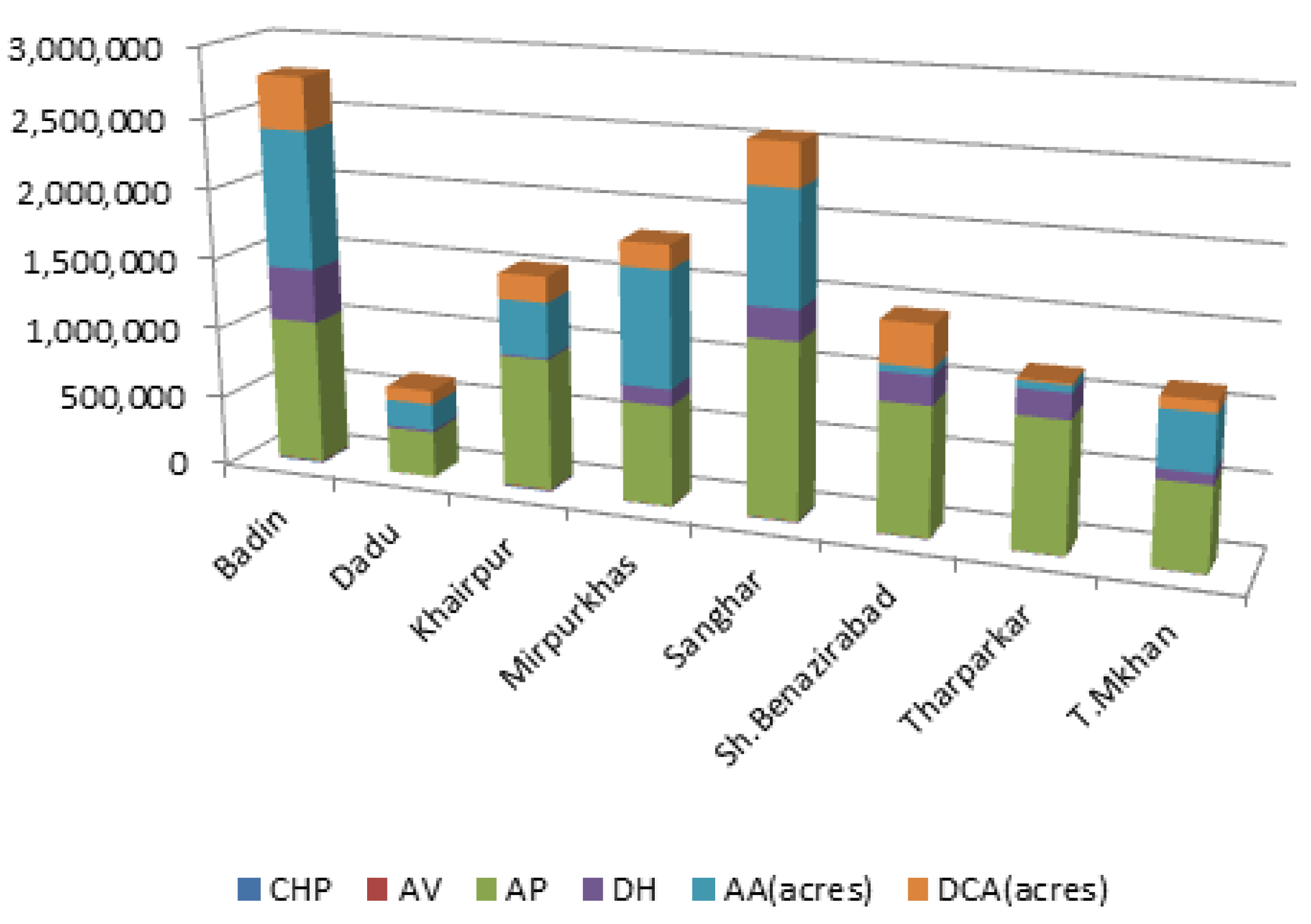
Provincial disaster management authority (PDMA) provide data about the losses in most affected districts in Sindh which is approximately same as we evaluate from Algorithms and MPNS-TOPSIS technique, as given in Figure 8. According to this data, Badin was the badly affected district. The bad condition of districts measured according to number of cattle head perished (CHP), affected villages (AV), affected people (AP), damaged houses (DH), affected area in acres (AA) and damaged crop area in acres (DCA).
Figure 8.
Summary of losses due to flood-2011 Dated:15 November 2011. (Source: www.pdma.gos.pk, accessed on 1 January 2021).
6.2. Comparison Analysis
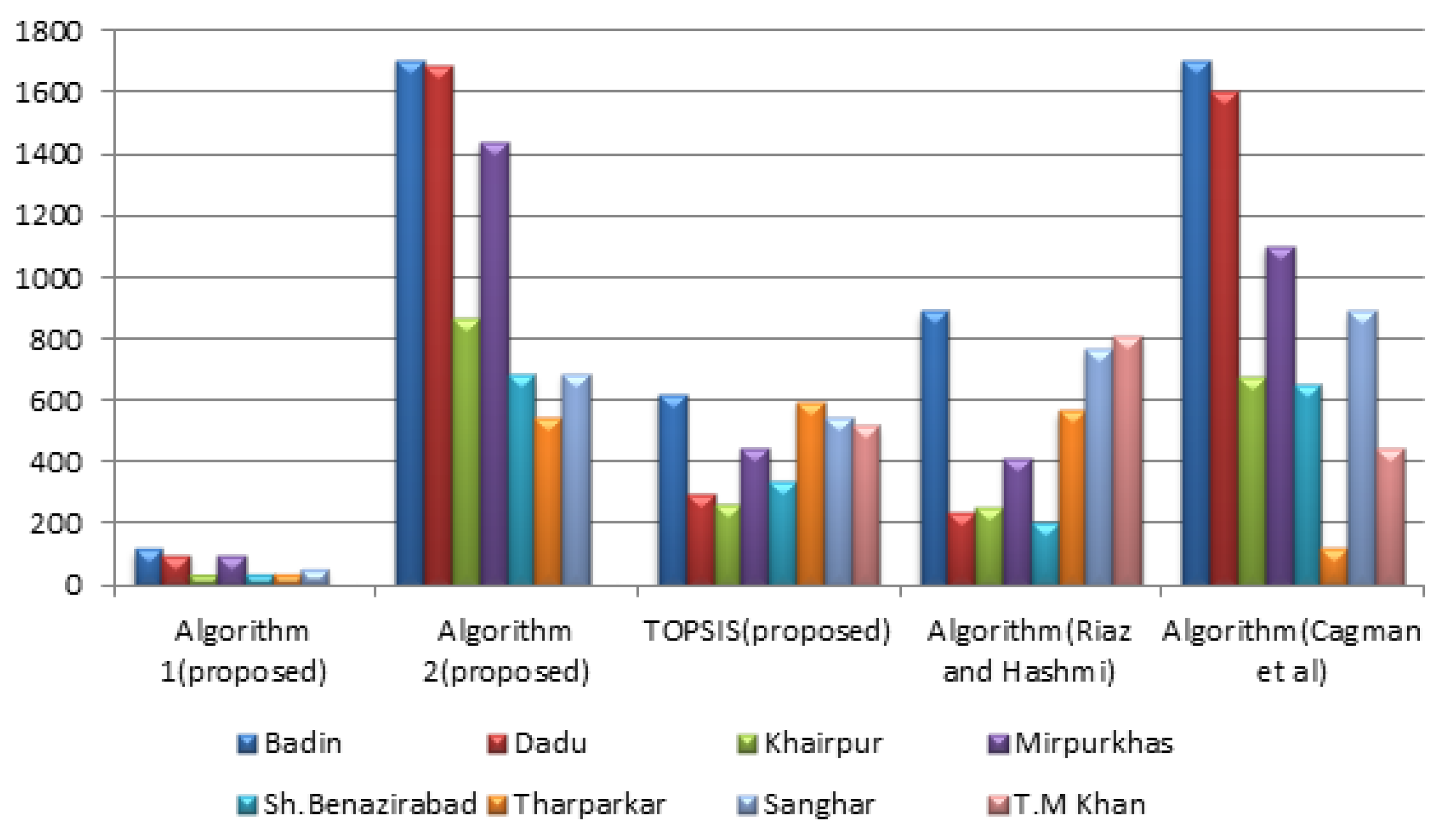
The proposed MPNS topology-based Algorithms 1 and 2 and TOPSIS are compared as indicated in Table 20. In the comparison analysis, it can be noted that the suitable alternative obtained by any one proposed technique endorses the authenticity and effectiveness of the proposed algorithms. The comparison analysis of final ranking is also shown by multiple bar chart in the Figure 9.
Table 20.
Comparison analysis of final ranking with existing methods in given numerical example.
Figure 9.
Comparison of final ranking by TOPSIS and other MADM techniques.
7. Conclusions
We deal with vague, ambiguous, unclear, and imprecise data in various real world issues. Existing models of soft sets, fuzzy sets, intuitionistic fuzzy sets, and neutrosophic sets are helpful in capturing these uncertainties. However, all of these models have some limitations on membership and non-membership grades. Existing mathematical frameworks are unable to address realistic issues when non-binary assessments are required while modeling uncertainty. Non-binary assessments are absolutely essential in ranking, grading or rating systems. The ranking may be specified in terms of grades, dots, stars or any notation. To deal with the real situation in life when the grading/rating of both parameters and alternatives is desired, we have introduced the novel concept of the M-parameterized N-soft set (MPNSS). Various concepts including MPNS-empty, MPNS-universal, MPNS-weak compliment, MPNS-top weak compliment, MPNS-bottom weak compliment, extended union, and restricted intersection of MPNSSs are defined. On the basis of these concepts, the idea of MPNS topology is established and various properties of MPNS topology are well established. MPNS topology is the extension of soft topology and N-soft topology. MPNS topology is a strong mathematical model of uncertainties that has a large number of applications in many fields like image processing, artificial intelligence, computational intelligence, forecasting, medical diagnosis. We developed algorithms for MADM applications of MPNSSs and MPNS topology. We established the TOPSIS method for multi attribute decision making by using MPNSSs and MPNS topology. The symmetry of the optimal decision is illustrated by interesting applications of proposed models and new MADM techniques. The viability and flexibility of the proposed MADM techniques are justified by comparison analysis them with existing MADM techniques.
Author Contributions
M.R., A.R. and M.A., conceived and worked together to achieve this manuscript, D.P. and M.A. construct the ideas and algorithms for data analysis and design the model of the manuscript, M.R., A.R. and D.P., processed the data collection and wrote the paper. All authors have read and agreed to the published version of the manuscript.
Funding
This research received no external funding.
Institutional Review Board Statement
Not applicable.
Informed Consent Statement
Not applicable.
Data Availability Statement
Not applicable.
Acknowledgments
The authors extend their appreciation to the Deanship of Scientific Research at King Khalid University, Abha 61413, Saudi Arabia for funding this work through research groups program under grant number R.G. P-2/29/42.
Conflicts of Interest
The authors declare no conflict of interest.
References
- Zadeh, L.A. Information and Control. Fuzzy Sets 1965, 8, 338–353. [Google Scholar]
- Pawlak, Z. Rough sets. Int. J. Inf. Comput. Sci. 1982, 11, 341–356. [Google Scholar] [CrossRef]
- Molodtsov, D. Soft set theory-first results. Comput. Math. Appl. 1999, 37, 19–31. [Google Scholar] [CrossRef]
- Atanassov, K.T. Fuzzy Sets and Systems. Intuit. Fuzzy Sets 1896, 20, 87–96. [Google Scholar] [CrossRef]
- Yager, R.R. Pythagorean fuzzy subsets. In 2013 Joint IFSA World Congress and NAFIPS Annual Meeting (IFSA/NAFIPS); IEEE: New York, NY, USA, 2013; pp. 57–61. [Google Scholar]
- Yager, R.R.; Abbasov, A.M. Pythagorean membership grades, complex numbers, and decision making. Int. J. Intell. Syst. 2013, 28, 436–452. [Google Scholar] [CrossRef]
- Fatimah, F.; Rosadi, D.; Hakim, R.B.F.; Alcantud, J.C.R. N-soft sets and their decision-making algoritms. Soft Comput. 2018, 22, 3829–3842. [Google Scholar] [CrossRef]
- Riaz, M.; Çağman, N.; Zareef, I.; Aslam, M. N-Soft Topology and its Applications to Multi-Criteria Group Decision Making. J. Ournal Intell. Fuzzy Syst. 2018, 36, 6521–6536. [Google Scholar] [CrossRef]
- Akram, M.; Adeel, A.; Alcantud, J.C.R. Group decision-making methods based on hesitant N-soft sets. Expert Syst. Appl. 2019, 115, 95–105. [Google Scholar] [CrossRef]
- Akram, M.; Adeel, A.; Alcantud, J.C.R. Fuzzy N-soft sets: A novel model with applications. J. Intell. Fuzzy Syst. 2018, 35, 4757–4771. [Google Scholar] [CrossRef]
- Akram, M.; Adeel, A. TOPSIS Approach for MAGDM Based on Interval-Valued Hesitant Fuzzy N-Soft Environment. Int. J. Fuzzy Syst. 2019, 21, 993–1009. [Google Scholar] [CrossRef]
- Ashraf, S.; Abdullah, S.; Mahmood, T. Spherical fuzzy Dombi aggregation operators and their application in group decision making problems. J. Ambient. Intell. Humaniz. Comput. 2019. [Google Scholar] [CrossRef]
- Ali, M.I.; Feng, F.; Liu, X.Y.; Min, W.K.; Shabir, M. On some new operations in soft set theory. Comput. Math. Appl. 2009, 57, 1547–1553. [Google Scholar] [CrossRef]
- Ali, M.I. A note on soft sets, rough soft sets and fuzzy soft sets. Appl. Soft Comput. 2011, 11, 3329–3332. [Google Scholar]
- Karaaslan, F.; Hunu, F. Type-2 single-valued neutrosophic sets and their applications in multi-criteria group decision making based on TOPSIS method. J. Ambient. Intell. Humaniz. Comput. 2020. [Google Scholar] [CrossRef]
- Kumar, K.; Garg, H. TOPSIS method based on the connection number of set pair analysis under interval-valued intuitionistic fuzzy set environment. Comput. Appl. Math. 2018, 37, 1319–1329. [Google Scholar] [CrossRef]
- Maji, P.K.; Biswas, R.; Roy, A.R. Fuzzy Soft sets. J. Fuzzy Math. 2001, 9, 589–602. [Google Scholar]
- Maji, P.K.; Biswas, R.; Roy, A.R. Intuitionistic fuzzy soft sets. J. Fuzzy Math. 2001, 9, 677–691. [Google Scholar]
- Çağman, N.; Karataş, S.; Enginoglu, S. Soft topology. Comput. Math. Appl. 2011, 62, 351–358. [Google Scholar] [CrossRef]
- Shabir, M.; Naz, M. On soft topological spaces. Comput. Math. Appl. 2011, 61, 1786–1799. [Google Scholar] [CrossRef]
- Riaz, M.; Tehrim, S.T. On Bipolar Fuzzy Soft Topology with Application. Soft Comput. 2011, 24, 18259–18272. [Google Scholar] [CrossRef]
- Eraslan, S.; Karaaslan, F. A group decision making method based on TOPSIS under fuzzy soft environment. J. New Theory 2015, 3, 30–40. [Google Scholar]
- Feng, F.; Jun, Y.B.; Liu, X.; Li, L. An adjustable approach to fuzzy soft set based decision making. J. Comput. Appl. Math. 2010, 234, 10–20. [Google Scholar] [CrossRef]
- Feng, F.; Li, C.; Davvaz, B.; Ali, M.I. Soft sets combined with fuzzy sets and rough sets, a tentative approach. Soft Comput. 2010, 14, 899–911. [Google Scholar] [CrossRef]
- Peng, X.D.; Yang, Y. Some results for Pythagorean fuzzy sets. Int. J. Intell. Syst. 2015, 30, 1133–1160. [Google Scholar] [CrossRef]
- Peng, X.D.; Yuan, H.Y.; Yang, Y. Pythagorean fuzzy information measures and their applications. Int. J. Intell. Syst. 2017, 32, 991–1029. [Google Scholar] [CrossRef]
- Peng, X.D.; Selvachandran, G. Pythagorean fuzzy set: State of the art and future directions. Artif. Intell. Rev. 2019, 52, 1873–1927. [Google Scholar] [CrossRef]
- Peng, X.D.; Liu, L. Information measures for q-rung orthopair fuzzy sets. Int. J. Intell. Syst. 2019, 34, 1795–1834. [Google Scholar] [CrossRef]
- Zhang, X.L.; Xu, Z.S. Extension of TOPSIS to multiple criteria decision making with pythagorean fuzzy sets. Int. J. Intell. Syst. 2014, 29, 1061–1078. [Google Scholar] [CrossRef]
- Zhang, L.; Zhan, J. Fuzzy soft β-covering based fuzzy rough sets and corresponding decision-making applications. Int. J. Mach. Learn. Cybernatics 2019, 10, 1487–1502. [Google Scholar] [CrossRef]
- Zhang, L.; Zhan, J.; Alcantud, J.C.R. Novel classes of fuzzy soft β-coverings-based fuzzy rough sets with applications to multi-criteria fuzzy group decision making. Soft Comput. 2019, 23, 5327–5351. [Google Scholar] [CrossRef]
- Garg, H.; Arora, R. Generalized intuitionistic fuzzy soft power aggregation operator based on t-norm and their application in multicriteria decision-making. Int. J. Intell. Syst. 2019, 34, 215–246. [Google Scholar] [CrossRef]
- Garg, H.; Arora, R. Dual hesitant fuzzy soft aggregation operators and their application in decision-making. Cogn. Comput. 2018, 10, 769–789. [Google Scholar] [CrossRef]
- Pamucar, D.; Jankovic, A. The application of the hybrid interval rough weighted Power-Heronian operator in multi-criteria decision making. Oper. Res. Eng. Sci. Theory Appl. 2020, 3, 54–73. [Google Scholar] [CrossRef]
- Riaz, M.; Davvaz, B.; Fakhar, A.; Firdous, A. Hesitant fuzzy soft topology and its applications to multi-attribute group decision-making. Soft Comput. 2020. [Google Scholar] [CrossRef]
- Riaz, M.; Smarandache, F.; Firdous, A.; Fakhar, A. On soft rough topology with multi-attribute group decision making. Mathematics 2019, 7, 67. [Google Scholar] [CrossRef]
- Riaz, M.; Agman, N.; Wali, N.; Mushtaq, A. Certain properties of soft multi-set topology with applications in multi-criteria decision making. Decis. Making: Appl. Manag. Eng. 2020, 3, 70–96. [Google Scholar] [CrossRef]
- Riaz, M.; Hashmi, M.R. Linear Diophantine fuzzy set and its applications towards multi-attribute decision making problems. J. Intell. Fuzzy Syst. 2019, 37, 5417–5439. [Google Scholar] [CrossRef]
- Kamaci, H. Linear Diophantine fuzzy algebraic structures. J. Ambient. Intell. Humaniz. Comput. 2021. [Google Scholar] [CrossRef]
- Çağman, N.; Enginoglu, S.; Çitak, F. Fuzzy soft set theory and its applications. Iran. J. Fuzzy Syst. 2011, 8, 137–147. [Google Scholar]
- Tehrim, S.T.; Riaz, M. A novel extension of TOPSIS to MCGDM with bipolar neutrosophic soft topology. J. Intell. Fuzzy Syst. 2019, 37, 5531–5549. [Google Scholar] [CrossRef]
Publisher’s Note: MDPI stays neutral with regard to jurisdictional claims in published maps and institutional affiliations. |
© 2021 by the authors. Licensee MDPI, Basel, Switzerland. This article is an open access article distributed under the terms and conditions of the Creative Commons Attribution (CC BY) license (https://creativecommons.org/licenses/by/4.0/).